Introduction: The Italian literary war
‘Oh, what a literary war!’, Paul Fussel has exclaimed, commenting on the extraordinarily high degree of literariness of the language in which British troops narrated, assessed and imagined the First World War.Footnote 1 Position warfare, involving long hours of inevitable idleness in the trenches and no chances of entertainment at the front, had consistently encouraged the British soldiers involved in the expedition to France to read and write. Of course, the Tommies fighting on the western front had little or nothing in common with the Italian infantrymen who were deployed on Mount Grappa or in the Carso. British soldiers – either the millions of volunteers that had joined the ranks of the ‘pal-battalions’ before 1916 or the men who were called up for military service at a later time – were neither illiterate conscripts nor summarily trained cannon fodder. More often than not, His Majesty's infantrymen held some kind of qualification (no matter how basic), and their letters home could largely draw on a popular imagery moulded on romance to describe war as a crusade against evil, or themselves as paladins on a quest to slay the dragon and restore peace, although in reality they were plagued by lice and fighting knee-deep in mud.Footnote 2 Thus, the battlefield ceased to be a place of anonymous cruelty and meaningless destruction, suggesting an implicit comparison with the arena in which Christian knights would showcase their warlike virtues: valour, courage, justice and God's benevolence.Footnote 3
The Italian army as it was mobilised in 1915, however, was essentially a motley crew of semi-illiterates: in its ranks were enlisted at least two and a half million peasants, called up from rural districts in which the questionable school policies of the liberal government had proven dismally ineffective. The rate of illiteracy on the frontlines was so high that we have reasons to assume that half the troops could neither read nor write. Additionally, the literacy of the remaining half was probably quite rudimentary.Footnote 4 Be that as it may, in Italy, too, the First World War induced a frenzy of writing activity among occasional écrivants, who translated their urge to bear witness into a flood of notes, diaries, and letters.Footnote 5
Of course, the range of emotions and imagery that can be found in these documents is extremely diverse. The pen-wielder could either be a young second lieutenant fresh out of university or a peasant-infantryman who had his letters from home read to him by his commander, the military chaplain or an educated comrade. ‘Lieutenant, sir, would you mind reading out this letter for me?’ So runs the orderly Cuccuru's bashful request to lieutenant Salsa in Trincee, one of a number of literary sources that feature this typical everyday situation.Footnote 6 As for the younger reserve officers, most of them interventionists, they might use their letters from the front as an instrument to convey a virile representation of themselves, addressing reassuring proclamations of warlike enthusiasm to their wives, fiancées or mothers. ‘This is the war that we have been dreaming of as children, when our first books taught us to loathe the Austrian army’, wrote Giovanni Bassi, an emblematic specimen of a generation that had left for the battlefield in the company of ‘Mazzini, Garibaldi, Carducci . . . the entire Risorgimento and our civilisation as a whole’ (this is how Piero Calamandrei, infantry lieutenant in 1915–1918, later an anti-Fascist militant and father of Italy's republican constitution, would describe this attitudeFootnote 7). One of the major recurrent themes that can be found in the writings of young men and still younger students who had marched to the front in 1915 was the wish to live up to the memory of their fathers, who had fought to unify Italy in the military campaigns of the Risorgimento.
In fact, what specifically characterises this section of the Italian Army in 1915–18 is that it represents itself as a unanimous community belonging to the same generation, with a very consistent ethical vision of the war. Fresh out of high school or university, the children of the middle class and the well-to-do bourgeoisie had been taught to look forward to a military ‘trial by fire’ that would put their generation to test, and to harbour a respectful devotion for the legend of an as yet unfinished Risorgimento.
The strong patriotic ethos of the young Italians at the beginning of the twentieth century was the result of the patriotic education that the state school system (and especially the ‘liceo classico’, the secondary school specialising in classical studies) had perfected during the last decades of the nineteenth century. The teaching of history was conceived as a means to convey to the students the glorious past of the Italian nation, whose legacy was dated back to Ancient Rome. The teaching of literature was based on the study of the canonical texts of the epos of the Risorgimento: the poetry by Romantic patriotic authors and the writings of Alessandro Manzoni. The upbringing of young people revolved around a national and secular ‘religion of the fatherland’.Footnote 8 Therefore, the ‘generation of 1915’ (that is, that of the young citizens who were educated in state schools) was the result of an intensive exposure to the cult of the founding fathers of the nation. It is not coincidental that the primary self-image conveyed by the young combatants who wrote is that of a ‘generation of sons’, with a specific duty towards their family. They have to be worthy heirs to their fathers and grandfathers, whose generations had built the unified Italy on the battle fields; moreover, it is their precise duty not to disappoint their mothers (even more than their future brides), who expect their sons to be valiant and heroic.Footnote 9
They were eager to fight a ‘fourth war of independence’ that would at long last claim Italy's ‘unredeemed’ territories (essentially Trento and Trieste). The ideals of the well-educated eighteen to twenty-year-olds that made up the backbone of Italy's reserve officers (second lieutenants and lieutenants) were much more attuned to the romantic reminiscences of Giuseppe Mazzini, Giosuè Carducci and Garibaldi than to the fantasies of imperial power set forth by the nationalist party.Footnote 10 No wonder, considering that future platoon and company commanders had been schooled on the works of the ‘founding fathers of the nation’, from which they had absorbed the basic principles of national unity. They were soaked in nineteenth-century patriotic mythologies. By comparison, nationalistic propaganda, relying in equal parts on the artistic avant-garde and selected segments of the media landscape, was a comparatively recent and fundamentally less influential discourse. In most cases, the reminiscences and self-representations of this segment of the Italian army were not about everyday realities such as death, distress and degradation. On the other hand, the image of the soldier as a war-machine bent on glory and victory, concocted by nationalist journalists and agitators, was also remarkably absent.
The writings of this generation of officers were dominated by the ideal of the vir bonus, the ‘citizen who will do what he has to do, at all times’, bringing to war a strong faith in the inextricability of duty, patriotism and loyalty to the heritage of the Risorgimento. In 1934 Adolfo Omodeo documented this attitude in his anthology of letters and diaries of fallen soldiers, the pioneering Momenti della vita di guerra. Later editions of similar material have confirmed its enduring popularity among young interventionists. The authors came from a variety of social backgrounds and swore by different ideologies (the gamut runs from Piero Calamandrei to nationalists like Gualtiero Castellini; from Carlo Rosselli, later murdered in exile by the Fascist police, to the future ‘quadrumvire’ of the Fascist regime, Italo Balbo). However, the letters of young volunteers and officers invariably bear witness to this deeply ingrained background. ‘Faith’ is proclaimed and exalted, as if to prove to the primary addressees, the soldier's relatives, that the writer has attained manhood by adopting a conduct worth of the expectations of their parents or partners. ‘My son, a man in uniform is no longer a boy. In my mind's eye, I see you as a strong and brave soldier.’ These are words of second lieutenant Luigi Nicastro's mother to her son, now a bombardier. These lines conveyed the fundamentals of an ethics of the male warrior that was widely shared by families and women volunteering behind the lines.Footnote 11
Seasons of writing: Narrations and memories of the Great War, from patriotic rhetoric to a historiography of dissent
It goes without saying that not all the soldiers writing from the front were preoccupied with rhetorically and stylistically sophisticated constructions of their emotional adherence to war and its motives. At the opposite end of the military and cultural hierarchy, the common soldier could either resort to a more or less awkward travesty of the conventional patriotic vocabulary, possibly in order to trick a nit-picking postal censorship, or write in his dialect, depending on the addressee (a close relative, a person of high standing or his employer). More often than not, a lofty and affected vocabulary, coupled with poor grammar, infiltrated the coarser language that served to convey personal information and discuss everyday subjects: thus, letters from the front read like polyphonic, frequently multilingual tangles of material life, private matters, care for one's loved ones and professional issues. Proportions varied according to the addressee. A letter could be a way to reassure people at home, possibly by passing over in silence the actual conditions of life in the trenches, or it could document one's (rarely genuine) identification with the codes of patriotic duty, a fundamental requirement when the soldier was requesting material help, a leave of absence, a permit or simply benevolence.Footnote 12 However, writing letters also served to reassert a patriarchal control over the household economy and, more importantly, to perpetuate existing hierarchies of power within the family. Even in Italy, the unprecedented facts of total mobilisation, resulting in the sudden disappearance of the entire adult male population, frequently undermined, and occasionally subverted, the balance of power between genders. Compared to European patterns, the emancipation of women in the workplace and their enfranchisement from the guardianship of the paterfamilias were slower and ephemeral: the economy was conservative, and female education was too imperfect to allow women to hold their own at all professional levels. What is more, this short-lived rearrangement was soon to be crushed by the ‘return to order’ that afflicted the condition of women in post-war Italy. At any rate, the exceptional liberty women enjoyed far from the domestic hearth was reason enough for concern, especially when peasant families were involved.Footnote 13
The soldiers’ access to the written word was frequently mediated by a proxy (typically a benevolent officer or an educated comrade who would read and write for the troops) or by rudimentary writing aids, such as pre-printed military postcards in which only the names and addresses had to be filled in. Either way, mail from the front was closely scrutinised by an all-pervading system of censorship that was set up in the early days of the war and gradually improved as the months passed. However, this was the first time in history that a majority of Italians were confronted with reading and writing as habitual activities: more than two billion letters and postcards were posted from the frontlines, a billion and a half to the front, and nearly three hundred million travelled between war zones. This was nothing like the ten billion letters and cards exchanged by the French, or the thirty billion posted by Germans, to say nothing of British troops, but they stand as a proof of the massive shift towards literacy that was one of the major consequences of the Great War. This is one of the most tangible indicators that the conflict induced a homogenisation and modernisation of perceptions and behaviours, although by no means the only one.Footnote 14
In the following years, this epidemic of compulsory writing among citizens in arms was significantly underrated. One exception was the anthology of letters from the front edited by Antonio Monti in 1935. However, the book adopted an openly laudatory stance towards the interventionists’ enthusiasm for war and the regime that had inherited it, and its reliability is questionable, to say the least. For decades, the written legacy of ‘the common soldier’ was considered irrelevant to the construction and understanding of a public memory of war.Footnote 15 A common soldier's psychological reactions when confronted with the danger of death might be a legitimate object of study, in that their patterns helped to better understand the ‘human machine’ and to control and discipline troops in wartime. Such was the purpose of Agostino Gemelli's well-known treatise on the psychology of the soldier, written and published while the conflict was still raging.Footnote 16 From another point of view, anthropologists like Cesare Caravaglios could study the ‘religious soul’, that is the superstitious devotion of soldiers as a part of the ‘folklore’ of trench life. Again, the point was discovering a more efficient way to ‘implant in the mind of combatants’ the notion that physical death was not so dreadful when it was ‘illuminated by the idea of the Motherland’.Footnote 17 In general, however, the soldiers’ point of view was considered ‘irrelevant’, as Adolfo Omodeo readily admitted: ‘commoners do not “feel” the war, they are unable to grasp its deep motivations’. The best a soldier could do in his writings was talk about his most elementary needs, child rearing, or the well-being of his cattle.Footnote 18 The authority enjoyed by Omodeo, and his prestige as a scholar who never indulged in gratuitous celebration of the regime, would later contribute to support, well into the republican age, the notion that it was permissible to ignore the opinions of common soldiers. They were either illiterate, that is incapable of leaving a written legacy, or at best only interested in family, friends, and personal matters.Footnote 19
This paradigm, that is the assumption that the point of view of the ‘humble’ was either irrelevant or banal, would not survive the historiographic shift of the 1960s and 70s, when, among other things, the importance of accounts ‘from below’ was reassessed. Letters, diaries and memoirs, most of them as yet unpublished, were now cited as evidence of attitudes of protest, desertion and rejection of the rhetorical codes and patriotic justifications of war. The autobiographical legacy and the behaviour of a population in arms that had been largely hostile to intervention and anxious to escape armed confrontation were imbued with refusal. Unearthed by what would come to be known, not without undue simplifications, as the Italian ‘historiography of dissent’, popular writings as historical sources – on daily life, on devotion and superstition, on psychological traumas and military trials – contributed to the construction of a brand new narrative canon of the experience of war on the Italian front. In a matter of years, the rediscovery of a rampant antagonism between ‘low’ and ‘high’, military hierarchy and the troops, political power and the working classes, shattered the picture of a fundamentally consensual and participative outlook on war that had heretofore dominated, with minimal adjustments, the perception of the Great War as the ‘last war of the Risorgimento’ and a unanimous chorus of national endeavour.Footnote 20 What is more, the anxious search for new documents ‘from below’, allegedly guaranteeing – according to most ‘historians of dissent’ – truthful rather than aestheticised accounts, inevitably led to the marginalisation of texts that had been traditionally regarded as mainstays of Italian literature on war (literature ‘from above’, as it were). In the long run, the ‘myth of the Great War’ was displaced by another myth, the ‘myth of Caporetto’, as monolithic and obdurate as the old one.Footnote 21
To be sure, the rediscovery of the legacy of the ‘illiterate’ has greatly enriched our understanding of the way the First World War was perceived by the masses. However, this new perspective had little to say about the genesis of a public discourse on war in the aftermath of the conflict, during the Fascist regime, and in the early years of the Republic. Before the intensive publication and reception of innumerable memoirs of ‘humble’ soldiers in grigioverde (the grey-green uniforms worn in the First World War) that began about three decades ago, the public memory of the Great War was predicated on a biased canon that paid little or no mind to ‘subordinates’ (in a social, not military sense), or to protest, dissent and the refusal of a warlike logic and conceptual grammar.Footnote 22 The official canon was a wide-ranging and partly inhomogeneous conglomerate of different styles, addressees, geographic coordinates and degrees of popularity. However, its unity was guaranteed by the common social and cultural background of the authors, their rank in the military hierarchy, and, more specifically, recurring themes and catchwords. Authorised speakers on behalf of the war were, first and foremost, educated witnesses, self-aware soldier-writers who published their recollections in the form of diaries and memoirs, occasionally novels.
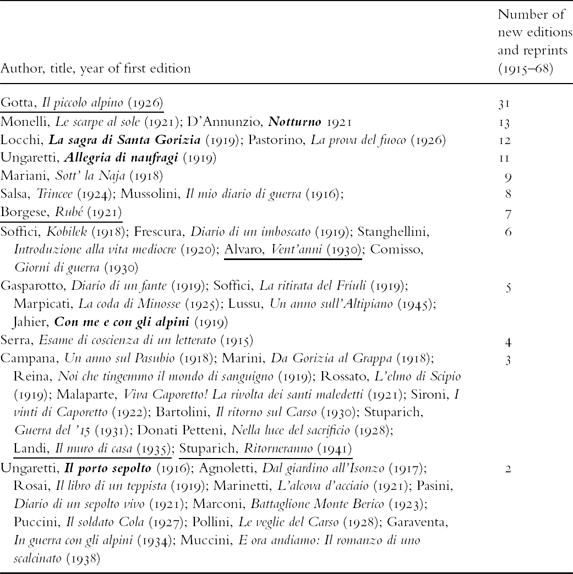
If one considers First World War writings attentively, the hegemony of the ‘bourgeois as a soldier’ writer stands out. In a recent essay, Enrica Bricchetto has attempted a systematic census of Italian intellectual productions on the subject of the period 1915 to 1918, indicating, in 1919–40 alone, about 1,500 texts.Footnote 23 In fact, these publications can hardly be assimilated to the proper corpus of circulating works, which were read and received by the public as a testimony and a narrative of the conflict. Many of the works mentioned in that census, especially those published between 1919 and the early 1920s, belong to the genre of the political or military polemical works, or are memoirs by diplomats and politicians. However, what really marked out the Italian cultural market after the war was the success of soldiers’ autobiographical writings. Under close inspection, the (relatively small) group of books about the First World War which were best sellers until the 1960s reveals that the majority of the works are memoirs and journals (less frequently novels and poems) set in the front lines, focusing on the experience and memory of the fighting (see Table 1Footnote 24).
Italian Literature of the Great War: Works with two or more editions (1915–68).

Note: Titles in bold are partly or entirely in verse; underlined titles indicate novels.
Source: CUBI: Bibliografia Nazionale Italiana 1886–1957 and Bibliografia nazionale italiana (1958–).
In Italy from the 1920s to the post-1945 period, these autobiographical writings, whose popularity to a large extent depended on the taste of a new readership (in their turn, mostly veterans), represented the ‘theatre of memory’ to the new generations (in Jay Winter's words); they handed down the meaning of intervention, mobilisation and sacrifice.Footnote 25
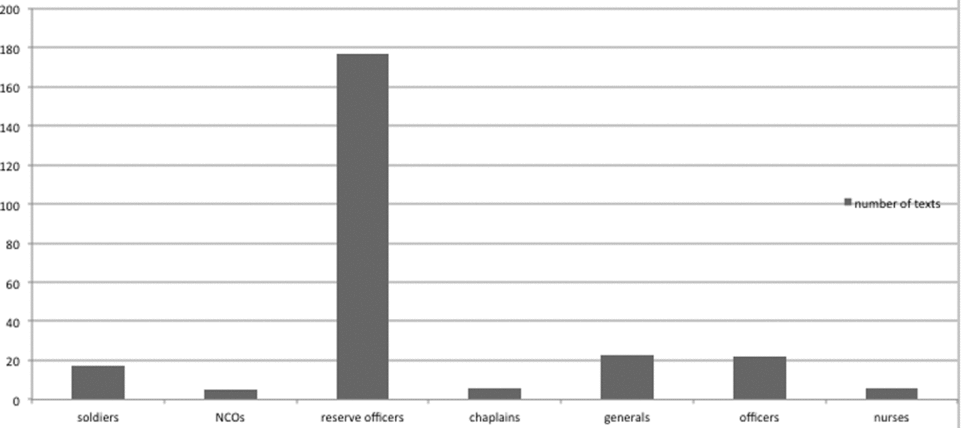
They are characterised by two shared elements. The first one is the recurring theme of self-sacrifice. At the core of all war stories there is the experience of fighting and death; this is a liminal experience that fixes one's relation to war. The second one is the author's profile. The narrator of the ‘warrior phenomenon’ (to use the expression of Stéphane Audoin-Rouzeau) is almost invariably a young reserve officer, which means, in the majority of cases, a twenty-year old middle-class man, often a high-school graduate or a university student.Footnote 26 They were proud to call themselves platoon officers (plotonisti) or trench officers (trinceristi), that is commanders of smaller units who had shared with their men the inconveniences of life at the front and, at least in part, the risk of death in battle (see Figure 1).
Italian Literary Texts on the Great War (1915–68).
Source: Survey of 263 autobiographic texts devoted to the Great War, published in Italy between 1915 and 1968, based on the Bibliografia Nazionale Italiana.
So, Italian war literature can be aptly defined as the class of those texts that deal exclusively or for the most part with experience at the front (either in prose or verse), their authors being for the most part traditional eyewitnesses in uniform deployed on the advanced lines. Others had not fought in the trenches, but had shared the anguish and misery of veterans at the front, and had reasons to consider life in the war zone as a pivotal chapter of their autobiography. This subgroup includes nurses in advanced field hospitals, military chaplains, higher officers and generals (not necessarily involved in the actual fighting). In contrast, popular works that do not deal with the experience of the ‘reality of warfare’ proper are not part of war literature, as described above, no matter what their circulation. Participation in the actual fighting and exposure to the possibility of dealing death or being killed are a fundamental threshold experience.Footnote 27 Successful ‘instant books’ by star-reporters from the advanced lines (such as Luigi Barzini, who in reality saw nothing of the actual front), patriotic and occasional poetry for national celebrations, the memoirs of political leaders and diplomats, and lectures delivered by officers to build social consensus and mobilise civil society bear no relationship whatsoever to the dimensions of death in battle and self-sacrifice: they are nondescript propaganda material.
Their exclusion from the field of war literature as it will be studied in the following pages has nothing to do with their actual ‘truth content’ as compared to the supposed veracity of autobiographic writings. In 1929, in his monumental anthology Témoins, Jean Norton-Cru insisted on first-person eyewitness accounts as the only possible source of an authentic social memory of war. Characteristically, the implicit hierarchy of the sources that he accepted (diaries, memoirs, meditations, letters, novels) reflected the degree of ‘genuineness’ of their authors and their credentials as witnesses.Footnote 28 In fact, as a pugnacious methodological debate on war literature in general and Norton-Cru's approach in particular has proved in later years, a rigid classification of war literature according to genres is all but impossible. On the one hand, indisputably, memoirs and diaries were the dominant form of European war narratives in the aftermath of 1918 (and would continue to be for two decades afterwards). On the other hand, these pieces of writing register the powerful influence of the author's pre-existing cultural background.Footnote 29 Even if the first-person account is ‘real’, that is ‘truthful’, it is always couched in the literary language of the writer. More often than not, the repulsive realities of life and death in the trenches are compensated for with stylistic refinement (a case in point could be the euphemistic tropes found in the memoirs of British soldiers-writers). Or, alternatively, the atrocities of modern warfare are attenuated through recourse to a heroic-chivalric imagery that trivialises tragedy and allows the construction of a heroic image of the self.Footnote 30 As Leonard Smith puts it, the issue at stake in literary texts that purport to record the experience of the Great War is not the elusive line between fact and fiction, as it was in Norton-Cru's time. The real question is understanding how certain literary artefacts that tradition has invariably accepted as ‘true’ have been shaped by narrative clichés connected with the writer's academic and literary education, his wish to establish himself as a bona fide ‘author’ by interiorising the alleged rules of good prose (what Pierre Bourdieu would term the ‘rules of the field’), and his need to suppress negative memories in order to put forward a more advantageous image of himself.Footnote 31 In the Italian canon, more specifically, mixed genres are a common occurrence in war-related texts. For instance, autobiography, factual account and fiction are inextricably interconnected in two of the most celebrated ‘classics’ of war literature, Curio Malaparte's Viva Caporetto: La rivolta dei santi maledetti and Emilio Lussu's Un anno sull’Altipiano.Footnote 32
The texts of this narrative field of war were designed for publication, and were printed between the early months of war – L’esame di coscienza by Renato Serra, serialised in the journal La Voce in April 1915, is the progenitor of all literary accounts – and the first half of the 1930s, when the early wave of writings on war began to ebb, ushering in a season of anthologies and critical overviews.Footnote 33 In later years, memoirs and novels about the war disappeared from the mainstream: throughout the 1920s, the literary field had been monopolised by major publishers; now a constellation of minor regional houses specialising in collections of war memoirs began to flourish and even enjoy a comparative success. Some of these collections are fundamental documents: the Collana della guerra vittoriosa (published by STERN, Ravenna), L’Eroica, founded in La Spezia by a former student of the Scuola Normale Superiore, Ettore Cozzani; Gladio, published in Bologna by Cappelli, whose reputation rested, at least in part, on patriotic material. Between 1945 and the 1960s, this production progressively dwindled. Later publications were only partly new, and had either been conceived or written years before (consider Carlo Emilio Gadda's Diario di guerra e prigionia, first published in 1955) or had remained unknown in Italian (like Emilio Lussu's Un anno sull’Altopiano, whose first Italian edition dates from well after the Second World War). As the book market was no longer subject to state control, the narrations of the conflict began to change, both in their ideological underpinnings and their practical purposes.Footnote 34
Fearless heroes and brothers in arms: The construction of a masculine role-model in autobiographical writings
A powerful leitmotiv running through the mixed array of texts and genres that make up what I have termed the ‘narrative field’ of the Great War was the metaphor of the military community as a ‘family’. It is true that soldier-writers who had spent the greatest part of the conflict in a trench, among a small group of comrades, might really have experienced this. However, it must not be forgotten that the writing style of young and very young officials belonging to the ‘generation of 1915’ was heavily influenced by classical rhetorical formulas and nineteenth-century literary stereotypes on war, mostly absorbed at school. In a prototypical novel such as Edmondo De Amicis's Cuore, the ‘secular gospel’ of nineteenth-century Italian schools, the army was portrayed as a big family born of moral rules and emotional ties: officers were cast, according to their seniority and rank, as either older brothers or fathers to their soldiers. Together with Pinocchio, Cuore remained the most widely read Italian novel until the aftermath of the Second World War: the impact and persistence of its stereotypes can hardly be overrated.Footnote 35 As Pierre Schoentjes has recently shown, the influence of school culture and popular novels on the language and style of European war literature (well beyond fiction) was strong: more often than not, formulas and commonplaces trumped direct accounts based on experience.Footnote 36 Italy was no exception to this rule. Take Renato Serra's L’esame di coscienza di un letterato, a sort of moral testament bequeathed by one of the earliest casualties among soldier-writers (1915), published before the end of the conflict. In these pages, units are compared to a ‘military brotherhood’ in which intellectuals in uniform learn more than they teach, in a regime of genuine mutual friendship cemented by war, duty and collective sacrifice.
Are we brothers? Most definitely so. Some of us are reluctant, seedy, slow, stubborn, unco-operative, but what does it matter? So are brothers in this imperfect world. For a grouchy or diffident comrade, dozens greet me with a hearty smile when they see me . . . or they shake my hand with reserved affection . . . What we have in common is stronger than any difference, there is no need to look any further. We will be walking down the same road and heading for the same goal: how can anything else matter? One step, one breath, one pace, one fate. After the first miles of march, all differences will be shed, drop by drop, like sweat . . . Marching together . . . pining and holding our tongues, together.Footnote 37
Guerra del '15: Dal taccuino di un volontario, was the diary of an intellectual and irredentist militant from Trieste, Giani Stuparich, volunteering in the regiment of ‘Sardinian Grenadiers’. Their commander was described as a fatherly and generous figure, as affectionate towards his soldiers as ‘to his own children’, and in turn he was treated by his soldiers with ‘tender filial piety’.Footnote 38 Stuparich was neither a naive lieutenant nor a war enthusiast: he had marched to the front as a common soldier, had suffered from the social isolation that afflicted the offspring of the bourgeoisie among an army of peasants, and he was aware of the contempt in which volunteers (particularly irredentists) were held by conscripts, who did not buy into the ostensibly idealistic reasons for the conflict. Nevertheless, his descriptions of his unit's life in the trenches is awash in canonical formulas drawn from nineteenth-century romantic imagery: ‘what we lived together during those two months, the earth we shared lying side by side, bound us so tightly that I have the impression of growing up with them’.Footnote 39 The family-like structure of the trench community would rapidly become a refrain in the occasional memorialists as well: ‘There's nothing that brings together . . . like death’, one of them wrote.Footnote 40
No wonder that in the narrative galaxy of the war the parallels between combatant units and a ‘family’ were associated with the construction of a specifically male role-model, endowed with all the martial virtues becoming a good soldier. Italian war historiography has shown comparatively little interest in the persistence (and renewal) of such stereotypes of masculinity in times of war. The history of women, by contrast, has received much greater attention. In Italy, as everywhere else in Europe, the First World War was an extraordinary occasion for the emancipation of women from professional and cultural constraints. The progressive de-masculinisation of society, as more and more young men were sent to the front, allowed an unprecedented number women to seek employment beyond traditionally feminine professions such as teaching.Footnote 41 Women's bourgeois associations were also heavily involved in the mobilisation, on one hand as pillars of a nationalist consensus, and on the other as precious contributors to civilian assistance to soldiers at the front, an experience that involved as many women as the Red Cross, and as a mass experience had a similar, possibly greater impact.Footnote 42 It was a crucial if short-lived opportunity: Fascism would stifle it with a rigorous policy of ‘return to order’, and restructure the economy in a conservative and male-centred perspective, privileging the promotion of family life over female education and banning women from leading academic and managerial positions throughout the 1920s.Footnote 43 However, the mobilisation, and the social and political emancipation of women had little or no impact on the imagery: women continued to be associated with traditional stereotypes and functions. Mothers, wives and daughters sitting by the hearth and impatiently waiting for the warrior's return; angel-women and providential nurses who rescued and healed (possibly in a Red Cross uniform); erotic prey and spoils for the victorious: the depiction of Italian women between 1915 and 1918 oscillated between these contrasting stereotypes, but it never escaped their canonical and traditional boundaries. The production of visual material connected with the Great War was immense (and as diverse as postcards, advertisements, photographic books and illustrated periodicals), yet women are invariably depicted as either consoling and devout, or seductive and available.Footnote 44 Accordingly, the elaboration of a masculine icon of the modern warrior continued to rely on the traditional attributes that George Mosse has resumed in the dyad ‘sacrifice-comradeship’, the alpha and omega of a military masculinity (hegemonic during and well after the war) that was based on a canon of moral qualities whose templates went as far back as the virtues of the medieval Christian knight and the bravery and civic loyalty of the ancient warrior (devotion, self-sacrifice, unwavering faith).Footnote 45 The authors, diarists and simple letter writers who cast themselves as a part of a warring community did not necessarily buy into the radical or nationalist presuppositions that Mosse associates with cultural mobilisation. Italian soldiers who sang the praise of military life and the virtues of frank comradeship as a shelter against the chaos and horror of modern warfare were rarely supporters of the nationalist party: after the war they frequently distinguished themselves as anti-Fascist militants. However, their published writings and memoirs, when read in the context of an overarching public discourse, evince a representation of men that is fully compatible with the hegemonic, monolithic and fundamentally binary reduction of the masculine community to an aristocracy of Frontkämpfer. This particular aspect of the ‘myth of the war experience’ has been thoroughly studied in a European context, but remains marginal in Italy.Footnote 46
Young officers, typically former students from a city background and interventionists at heart, consistently referred to their admission to the ‘family’ of soldiers at war as a life-changing transition: they had left behind their ordinary bourgeois existence, comfortable and safe (and therefore ‘unmanly’), to step into a new world, a dimension of war, death and suffering, but also comradeship and solidarity. A vita nuova, a new life that would at long last afford them the right to be regarded and, more crucially, to look upon themselves as fully-fledged men. The incipits of two popular classics of the war memoir, Paolo Monelli's Le scarpe al sole (1921) and Mario Mariani's Sott’ la Naja (1925), are paradigmatic in this regard.Footnote 47 A volunteer, Monelli was a very young student from a rich bourgeois family based in Bologna. He had filed a request to be sent to the front and was mobilised in the alpine battalion Val Cismon. The protagonist of his memoir, relieved and grateful to be admitted to the anti-hell of the front lines, embarks on a journey of redemption through the world of the alpini: modest, seemingly anti-heroic characters, neither dashing nor eloquent, but immediately signalling a distance from all the protagonist's past experience:
The alpini who are loitering along the village streets are different from those I left at the warehouse. When I enter the tiny room full of pipe smoke, I immediately recognise the pointed beards of the major and the captain-doctor, sitting at a small table. The major stands up, welcomes one with a hearty and simple greeting, the newcomer's wineglass touches the glasses of his comrades, and at last one feels among men of a new kind, among real men. Men who have travelled to the outer reaches of life and lived to tell the tale. And the captain tells one: “Here's three things you need to do. Get a haircut, grow a beard, and learn to drink wine.”Footnote 48
To be enrolled in a military unit is to enter a new life. There are specific rites of passage, such as the adoption of external marks of affiliation signalling adoption by a brotherhood that is characterised by eminently virile features (short hair, a beard, wine). Mariani's life story was quite different. Something of an anarchist, from a modest background, Mariani was no volunteer: he had been enrolled by force during the second year of war. Nevertheless, the plot of his novel revolves around a narrative of war as a journey of individual redemption: deliverance from the ‘cowardice’ of bourgeois life, and rebirth into a new, masculine identity. Mariani's path into a new life begins with the anti-hell of the barracks, where he was given his basic military instruction. ‘We were conscripts’, is the opening line. Conscripts, that is to say long-haired outsiders, unworthy of their instructors, all heroes of war: ‘Children of a minor sun, we had watched our older brothers march to the front without a tear, but rather a hint of envy in our hearts; however, we had stayed home’.Footnote 49 As yet untouched by suffering and death, and therefore only halfway a man, the author is confronted with heroic veterans from Monte Nero, where the first massacres had taken place: through them, he gets to know a model of heroic virility made of defiance, of danger, sense of duty, physical courage and loyalty, and he immediately attempts to conform to these principles. A selected group of archetypal characters who condense all these virtues embodies the quintessence of the ‘new man’. One by one, the author presents these role-models to the attention and admiration of the reader. The first is corporal Paoletta, one of the most seasoned instructors, ‘alpine among the alpini, a tall . . . battle-hardened mountain man . . . with a spiteful grin and cold steely eyes’Footnote 50: an ideal example, both heroic and tragic, a fighter possessed by an almost ascetic attraction to military life, but at the same time ready to sacrifice and volunteer for a new mission to the front to allow a psychologically weary comrade to visit home. A second archetype is the orderly Bepi, a paragon of devotion and altruism, killed by a bullet while he is carrying food to his commanding officer, worn out by the merciless battles on Mount Asolone. His death is mourned like a brother’s, a tribute to a comradeship that has evolved into a blood-bond with a palpable homoerotic subtext. ‘A bottle of wine had crashed as he fell, and wine was mixing with his blood. Wine and blood, all war songs are about wine and blood, since the dawn of humanity. M— touched him. Stone cold. I saw him turn his face away. He was shaken by violent sobs. “You see,” he volunteered, “for two years he was all I had”.’Footnote 51
It goes without saying that non-combatant males, insofar as ‘real men’ are identified with soldiers at the front, are featured as ambiguous and contemptible figures: a vir bonus is primarily defined by his courage as a citizen in arms who braves death to fulfil his duty, this is where the line is drawn. In the Italian literature of war, as anywhere else in Europe, the ‘others’ are constantly referred to as negative counterparts and condemned – invariably in the plural – as a bunch of ‘draft dodgers’, consummated shirkers who will not come anywhere near danger and death. Draft dodgers and shirkers thrive behind the lines (particularly in military hospitals), a haven for ‘skulks in uniform’. Their cowardice is condemned, their safety is envied. A case in point, mentioned by Carlo Pastorino, are the ‘closely shaved little sergeants’ in sedentary service or health care, who crawl out of their holes only to attend official ceremonies.Footnote 52 However, the kingdom of the ‘others’ and the irreducibly different is the city: cities are awash with former war-obsessed interventionists who have found a safe nest for themselves behind the lines, poor excuses for soldiers, children of fathers with connections serving in sedentary units, big-mouthed amateur strategists and wanton ladies, all enjoying the comfort of a modern life that disdainfully continues, oblivious to the squalor of trench life. They are half-men with decadent bodies: the ‘insultingly obese guy’ Attilio Frescura met in Milan;Footnote 53 the ‘paunchy’ Colonel who punished Carlo Salsa before his departure to the front;Footnote 54 the ‘repugnantly fat’ Colonel in the court martial that finds lieutenant Denandri guilty in Arturo Marpicati's novel La coda di Minosse;Footnote 55 the ‘fatso’ with a ‘face like a moon’ who was serving in the carabinieri and would poke fun at Arturo Rossato, author of a polemic war diary entitled L’elmo di Scipio, for wanting to fight at the front.Footnote 56 Contemptible half-men function as cathartic figures: they are everything warriors are not (cowardly, unwarlike, sly); they have access to the pleasures that soldiers must forbear (including women, even prostitutes); they are a foil that makes the sacrifice of real men at the front stand out as nobler; they mark the distance separating those who live and fight the war, and those who talk about it, or turn a handsome profit from its horrors.Footnote 57
In a sense, all the soldiers-writers of the Great War suffer from an acute disillusion. Their disenchantment is connected with the contrast between the naive image of war they all had harboured before the Italian intervention and the experience of the front, but also with the untranslatability of their life-world in the language of society, military and civil, impervious to the reality of war and to the sacrifices of men at the front. This last is a trauma that invariably accompanies home leave.Footnote 58 The only refuge for the trincerista is the new family of brotherhood in arms. The pathos of community life guarantees the persistence of an outlook that perceives and describes the trench as a place of triumphant comradeship, solidarity and unadulterated feelings, a moral comfort that nourishes idyllic tales of the military experience.Footnote 59 Knee-deep in the carnage of the Carso, at the foot of mount Kobilek, Ardengo Soffici finds it in him to speak of an ‘idyllic trench’ and enjoy the peacefulness of nature, flowers and small animals. In his dark and epic La ritirata del Friuli (1919), describing the harshest war front in all Europe and the disastrous retreat from Caporetto, war remains a sublime adventure for a ‘marvellous heroic youth’ that faces death every day in the collective awareness of a supreme test. Life in the trenches is evoked with nostalgia as ‘open and pure’, a one-of-a-kind experience, just as the beauty of the forfeited landscape during the retreat, ‘the still Alps and the crimson Carso . . . covered in blood and glory’, is described with melancholy by a diary-writer who claims to have spent the best of his youth in those places.Footnote 60 These recurrent themes build bridges between such authors as Soffici, an interventionist of nationalist persuasion, a democratic populist like Mario Puccini (Il soldato Cola), an apolitical novelist like Corrado Alvaro (Vent’anni), and embittered veterans like Arturo Stanghellini (L’introduzione alla vita mediocre) or Luigi Bartolini (Il ritorno sul Carso).Footnote 61 In the eyes of these authors, in the sheer diversity of their biographical and ideological trajectory, war stands for the experience of an exceptional masculine community. In its midst and through its agency, the protagonist experiences an unforgettable and utterly unique season of tragic grandeur. For everybody, the bond of camaraderie will forever be the model of an affective tie that lives through time. The fallen ‘brothers’ will always live in the memory of the comrades-in-arms, destined to convey to the community of the living, and to the future generations, the example of the dead heroes. ‘They [the fallen] have dreamt of a fatherland as beautiful as their beautiful sacrifice . . . Let us gather with pure hands the burning torch that they fuelled with their generous blood, and let us hand it down to those who will come.’Footnote 62 Pure and unshakeable, genuine and disinterested, the brotherhood in arms is so intense as to border on the intensity of a homoerotic relationship, although the latter is rarely made explicit (as occurs, for example, in War Days by Giovanni Comisso), unlike what happens in British war narratives.Footnote 63
The masculine hero model in memory booklets
A characteristic phenomenon of war culture in Italy during the First World War was the publication of a great number of booklets dedicated to the memory of dead soldiers. This battalion of memory texts (sometimes microtexts) had nothing to do with the rediscovery of ‘popular memory’ as it has been practised by scholars since the early 1980s. In the comparatively few years between the Italian intervention and the Second World War, more than 2,300 printed works were devoted ‘to the memory’ of war.Footnote 64 Ranging from flimsy brochures to sizable collections, these works typically reproduced the letters from the front, and occasionally the war diaries, of more or less prominent soldiers who had fallen in battle. Quite a few, about a quarter of the total, were sponsored by patriotic associations, schools and institutions wishing to commemorate ‘illustrious martyrs’ (Cesare Battisti, Damiano Chiesa, Fabio Filzi and a few others). The rest was edited by a myriad of ‘mourning communities’ (mostly families and groups of friends and co-workers) to honour the memory of young men who had fallen ‘on the field of honour’ (four times out of five, these were educated officers, coming from bourgeois families located in cities of the Centre-North). In fact about 10% of the officers who died at the front between 1915 and 1918 (compared to one soldier out of 10,000) were made the object of one such publication immediately after their death.Footnote 65 The public discourse on war relied, among other things, on this quite extraordinary memory galaxy: a small part of it served as a source for the widely-read collections we have mentioned above (essentially, Omodeo and Monti), reservoirs of a virile memory of the fallen that was designed for public consumption; other circulated in a private context, among friends and family members, nourishing a private memory of the conflict.Footnote 66 However, in both cases the semantics of death were extraordinarily similar, as fundamentally homogeneous as were the communities of authors and readers (the latter frequently doubling as sponsors of the publication). In the eyes of most young officials, self-sacrifice in battle was a sacred duty, a pledge to the forefathers of the nation and, characteristically, an obedient response to the virile and civic education imparted by their families.
As a whole, these ‘paper stones’ reaffirmed the features of the ‘1915 generation’ to which the authors generally belonged (more than two thirds of the booklets were made of fragments of diaries or letters by very young officers, and only one third concerned married men). The traditionally national-popular rhetorical code plays a role of paramount importance. In the majority of the publications, the favourite subjects are the homeland (for which one sacrifices oneself) and the family (as an ethical model). The fallen soldier is introduced (often by the purchasers of the booklet) almost invariably through Christian rhetoric: he is a martyr for his country, his death, which is solemn and often beautiful, is a willing sacrifice for the safety of the country-family and the redemption of the land occupied by the enemy (Trento and Trieste). Such references have little to do with the soldier's spirituality. In two-thirds of the publications there is no explicit reference to denominations and religious practices. The Catholic Church (and its representatives at the front, the chaplains) are barely mentioned either in the memories of the dead or in the autobiographical memoirs. These sources bear witness to the deep-seated secularism of the ‘sons-in-arms’ of the 1915 generation, as well as to the lack of regional gaps (the only significant difference is that the majority of the memorial writings are published by presses located in the northern cities).Footnote 67 As Lieutenant Vaifro Aguiari wrote to his mother only days before his demise, death in battle was a source of pride, not grief, for the family of the fallen:
To hark to the beckoning of the cannon with greater willingness and enthusiasm, beloved mother, I need you to recoil from prostration, misery and tears: I need to think of your fiery vigour and dignity as a mother, an Italian mother . . . proud to have a son fighting in the front lines.Footnote 68
In most anthologies, certainly in Omodeo, the primary female reference of most letters is the soldier's mother. Alberto Franci, a captain by 1916, when he wrote to his mother to reassure her of his enduring observance of the ethics of ‘sacred duty’ he had acquired in the family, declared:
The mere thought that others may believe for a second that I am trying to shirk the dangers of the front makes me flush with anger . . . I would sooner croak on the spot than commit such a villainy. Alas, the war has brought to the surface the cowardice and egoism of so many people . . . However, I am certain that you would disapprove of me if you knew that I was wallowing in this kind of mud.Footnote 69
This attitude is not surprising. To begin with, most of the authors of the war letters that were divulged in print after 1918 were young or very young children of the bourgeoisie: well-educated and enthusiastic patriots, whose accounts are more or less unintentional documents of what Omodeo himself has defined as a ‘belated adolescence’ and its limits.Footnote 70 Nevertheless, a number of other female figures populated the galaxy of published war letters. As often as not, correspondence with the family served as a showcase of manly virtues, obeying the dual code that structured communication between the front and the inner front: one strategy served to comfort and reassure (real dangers are minimised or trivialised); a second strategy put a stress on military valour. A man and his legitimate pride were defined by his ability to face the dangers of battle. In his letters to his wife, Guido Ruggiero, a lieutenant who died in 1917 at barely thirty years of age, wrote:
One day, he [their son] will be proud, and my deeds will be a school to him . . . Let others run for cover and shirk danger: I don't envy them, I pity them. They are half-men, their cowardice leaves them no option but to lurk in the shadows, they are spineless wimps, they have no morals. They know what benefits them, but have no notion of duty.Footnote 71
Ruggiero saw his unflinching courage as a proof of his dignity as a good citizen and a real man, that is, ultimately, a worthy husband and father.
This is not to say, however, that letters might not occasionally contain polemical rants against the worthlessness of death as an ideal and sacrificial immolation, but military censorship, the soldiers’ own self-censorship, the expectations of relatives at home, and the pressure of bereft families depending on the alleged valour of their fallen children for their mourning and posthumous pride, functioned as a severe filter, banning from public circulation letters and diaries that contradicted the dominant rhetoric of consolation and pride in a ‘worthy death’.Footnote 72 The celebration of a ‘typical’ archetype, the ubiquitous image of the vir bonus that thrived in the Italian memory policies between the wars, and well into the first two decades of the Republic, was mediated by a representation of virility centred on the traditional virtues of nineteenth-century family education: endurance, self-control in the face of danger, devotion to the Motherland and the community of comrades, the self-composed bravery of a martyr dying with his loved ones’ names on his lips. The imagery of fascism would largely draw on these blueprints for the perfect warrior and the good Italian.