Introduction
‘Shisha’, known variably as ‘water pipe’, ‘hubble bubble’, ‘narghile’, ‘ghoza’ and ‘hookah’, has been used by mankind for the past several centuries. It is believed to be invented by a physician, Hakim Abdul Fath, during the reign of the Mughal emperor Akbar, as a less harmful form of smoking tobacco (Chattopadhyay, Reference Chattopadhyay2000). Shisha smoking is considered to be part of the cultural heritage in some parts of the Middle East and in rural areas of South Asia. The preparation contains flavoured tobacco burnt with different aromatic substances, and inhaled via a pipe after passing through a water receptacle. The most common type of tobacco used in shisha is ‘maassel’. Other forms of tobacco that are also used commonly include ‘ajami’, ‘tumbak’ and ‘jurak’ (Shihadeh, Reference Shihadeh2003; Zahran, Ardawi, & Al-Fayez, Reference Zahran, Ardawi and Al-Fayez1985; Morsy, & Khaled, Reference Morsy and Khaled2001;. Anjum, Ahmed, & Ashfaq, Reference Anjum, Ahmed and Ashfaq2008).
Shisha has recently been gaining popularity across the globe as a fashionable, urban activity and Pakistan remains no exception. The trend started with the advent of Arabian shisha cafes in high class localities of the country (Anjum, Ahmed, & Ashfaq, Reference Anjum, Ahmed and Ashfaq2008). This rapid rise in popularity is probably due to the myth that shisha smoke, being filtered through water, is not as harmful as smoke from cigarettes (Shihadeh et al., Reference Shihadeh, Salman, Jaroudi, Saliba, Sepetdjian, Blank, Cobb and Eissenberg2012, p. 1377). In a recent survey conducted by the Aga Khan University, Karachi, it was found that 90% of the adolescents who had tried shisha were unaware of the fact that it contained tobacco (Jawaid et al., Reference Jawaid, Zafar, Rehman, Nazir, Ghafoor, Afzal and Khan2008).
Research on the hazards of shisha smoking shows that though its adverse effects are usually compared to those of cigarette smoking, they may be relatively severe due to longer exposure to tobacco smoke than cigarettes (Mohamed, Loffredo, & Israel, Reference Mohamed, Loffredo and Israel2006). Diseases that can occur due to shisha smoking include lung cancer (El-Hakim, & Uthman, Reference El-Hakim and Uthman1999), chronic obstructive pulmonary disease (COPD), asthma, pneumonia and pulmonary tuberculosis (Kiter, Uçan, Ceylan, & KILINÇ, Reference Kiter, Uçan, Ceylan and Kilinç2000). Children who are exposed to shisha smoke become particularly vulnerable to lung infections, asthma and sudden infant death syndrome (SIDS) (DiFranza, & Lew, Reference DiFranza and Lew1996).
The dangers and hazards associated with shisha smoking have not been adequately studied in Pakistan. There is a paucity of literature with few studies conducted (Anjum, Ahmed, & Ashfaq, Reference Anjum, Ahmed and Ashfaq2008; Shihadeh et al., Reference Shihadeh, Salman, Jaroudi, Saliba, Sepetdjian, Blank, Cobb and Eissenberg2012, p. 1377; Jawaid et al., Reference Jawaid, Zafar, Rehman, Nazir, Ghafoor, Afzal and Khan2008).
Medical doctors are perceived as role models in many societies, including Karachi. They not only exert an influence on the health care system but can also communicate with the mass population to spread awareness regarding different problems of the community. Since misconception about shisha is an important factor responsible for its increasing use, the need to evaluate medical practitioners’ knowledge about shisha is an important step in controlling the growing epidemic. By increasing doctors’ awareness of shisha use and its harms, they can transfer this knowledge to the wider community to facilitate prevention and cessation. We conducted this survey to assess knowledge, attitudes and practices of medical practitioners relating to shisha use and to ascertain their need for education and training to promote the health of their communities.
Methods
This cross sectional study was conducted during January and February 2011. Karachi is the largest metropolitan city of Pakistan and it is divided into four zones. The overall prevalence of smoking in Karachi is 32.7% (Maher, & Devji, Reference Maher and Devji2002). Eight tertiary care hospitals are working in Karachi.One hospital from each zone was chosen for study purpose. Convenience sampling of medical doctors from these four hospitals was done. A self-administered questionnaire from the Tobacco Free Initiative, a project of the World Health Organization, in collaboration with the Centers for Disease Control and a number of additional partners (World Health Organization, 2000) called Global Health Professional Survey (GHPS), was used.The GHPS is a student based survey developed for third year students of dentistry, medicine nursing and pharmacy and is composed of a questionnaire related to demographics, prevalence of tobacco use in cigarette and other forms, knowledge and attitudes related to tobacco use (WHO/CDC Global Health Professional Survey, 2004). It was modified as described to enhance its relevance to the target community: the word ‘cigarette’ was replaced with ‘shisha’ in all questionnaire items; and items relating to smoking at workplaces were omitted because shisha is usually restricted to social gatherings or shisha cafes. The questionnaire had 33 items in total and was divided into three parts. The first part included items on prevalence of Shisha smoking amongst medical practitioners. Participants were instructed to select one option to describe their use of shisha. Options were ‘never used’, ‘quit’, ‘occasional user’, and ‘everyday user’. The remainder of the questionnaire focused on investigating the knowledge, attitudes and practices of medical practitioners regarding shisha smoking and associated hazards. These sections were composed of different statements wherein respondents were asked whether they agree, were unsure, or disagree with each statement.
The study was approved by the Chest Health and Education Society Ethical Committee. Chest Health and Education Society is a registered society of Pakistan with over 400 chest physicians as its members from all over the country. It has its own research and ethical units providing a platform for research work in the field of pulmonology. The modified questionnaire was approved by the Research Evaluation Unit of Chest Health and Education Society with the ref letter No-102/CHEST/2010.
The validity of the modified questionnaire was checked by pre-testing the original questionnaire on 10 medical practitioners and then applying the same with the modifications, i.e. replacing cigarette with shisha in all items. The results obtained were comparable thus confirming the validity of the modified version. Informed consent was obtained from all participants prior to voluntary participation.
Printed questionnaires were handed over by the investigator to all medical practitioners in their respective hospitals and they were asked to complete and return the questionnaire immediately to the investigator.
Statistical analysis
The sample size was calculated by using the WHO formula for sample size determination in health studies. This calculation included taking 40% (Hodgetts, Broers, & Godwin, Reference Hodgetts, Broers and Godwin2004) of the smoking proportion with 95% C.I. and 5.2% margin of error. The sample size was 341. Statistical analyses were done using statistical package for social sciences (SPSS) version 17 with the help of an experienced statistician. Nominal variables such as gender and designation were presented as frequencies and percentages. Chi-square analysis was used to establish if significant associations exist between different levels of medical practitioners and study variables. A p-value <0.05 was considered statistically significant.
Results
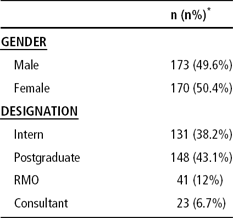
A total of 343 medical practitioners participated in the study including 50.4% men and 49.6% women (Table 1). Of these, 38.2% were house physicians, 43.1% were postgraduate trainees, 12% were medical officers and 6.7% were consultants (Table 1).
Demographics of the study population
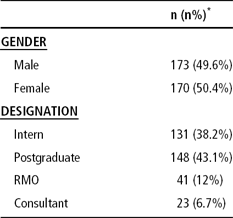
*n denotes number and n% represents percentage
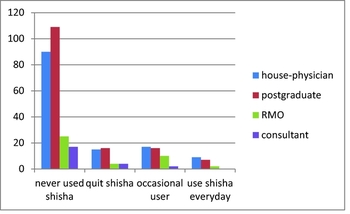
Among the study population, 70.3% (n = 241) of the medical practitioners never used Shisha while 11.4% (n = 39) had quit using it. Occasional use was reported by 13.1% (n = 45) of the medical practitioners while5.2% (n = 18) admitted to use it every day (Figure 1).
Shisha practice of different designations of medical practitioners

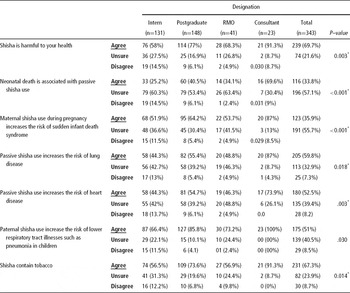
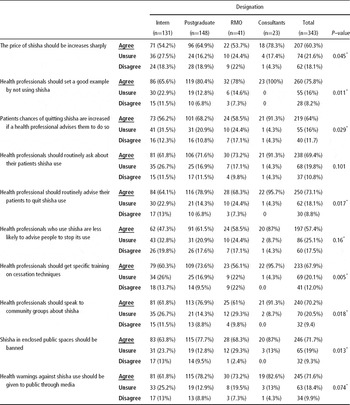
When shisha-using medical practitioners were asked about their future plans for shisha cessation, 55.6% were not ready to quit in next six months; 28.6% were thinking of quitting in the next six months; and 15.9% reported being ready to quit now. Overall, the knowledge regarding shisha smoking and its hazardous effects were not uniform amongst the medical practitioners, with consultants demonstrating the highest knowledge level as indicated by correct responses (Table 2). The fact that shisha contains tobacco was agreed by 67.3% of medical practitioners (p-0.014) (Table 2). Only 35.9% of the medical practitioners under study agreed that shisha smoking during pregnancy increases the risk of Sudden Infant Death Syndrome(p- < 0.001), while only 33.8% of doctors agreed that passive shisha smoking is linked to neonatal deaths (p- < 0.001) (Table 2). Overall, 67.9% (n = 233) of the medical practitioners agreed there was a the need for specific training on shisha cessation techniques (p-0.005) (Table 3), while 73.1% (n = 250) were in favour of shisha use to be banned for children and adolescents.
Knowledge of the hazards associated with Shisha smoking

Attitudes of different designations of doctors, towards Shisha awareness and policies

Various options were endorsed by the medical practitioners to prevent the hazards associated with shisha smoking. According to 87.2% (n = 299) of respondents, doctors serve as role models for the community while 64% (n = 219) medical practitioners favoured that the patients can quit shisha more easily if it is advised by medical practitioners (p-0.029) (Table 3). In view of 70.2% (n = 240) medical practitioners and doctors should run public awareness campaigns to reduce shisha smoking in the community, while71.6% (n = 245) medical practitioners suggested the use of media campaigns to raise awareness regarding hazards associated with shisha use (Table 3).
Discussion
This study was conducted to assess the knowledge, attitude and practices of shisha smoking among doctors in our society. To the best of our knowledge, no study has been conducted amongst medical practitioners on the prevalence of shisha smoking, however, a study conducted on medical students showed a high prevalence (23.7%) of shisha use (Khan et al., Reference Khan, Siddiqui, Ahmed, Hashmi, Fatima and Muzaffar2008). These results are in line with our findings of interns and postgraduate students being the largest proportion of shisha users.
In this survey 5.2% of doctors were found to use shisha almost every day. In a study conducted among Iranian physicians 4.3% used shisha on a regular basis (Peykari, Tehrani, Afzali, Dovvon, & Djalalinia, Reference Peykari, Tehrani, Afzali, Dovvon and Djalalinia2010). In Bahrain, it was found that 3% smoke only Shisha while 4% consumed both Shisha and cigarettes (Fadhil, Reference Fadhil2009)..
Our study showed a wide range of difference in knowledge among different designation of doctors. This might be due to lack of transfer of knowledge or a casual attitude of junior doctors towards tobacco use. Another reason could be the lack of awareness and deficiency in the academic curriculum about this serious, non-communicable and preventable cause of morbidity and mortality (Kandela, Reference Kandela1997). It was alarming to note that a sizable number of study respondents, especially the junior doctors, were unaware of the hazards of shisha use. Similar results were noted in studies done in Middle Eastern countries and Egypt on students. These have shown that the belief about shisha not being harmful is the major motivation for its use (Chaaya, Reference Chaaya, El Roueiheb, Chemaitelly, Azar, Nasr and Al Sahab2004; Abolfotouh, Abdel, Badawi, & Alakija, Reference Abolfotouh, Abdel, Badawi and Alakija1997; Memon, Reference Memon, Moody, Sugathan, Gerges, Bustan, Shatti and Jazzaf2000; Mostafa, Mohamed, Christopher, Loffredo, & Ebenezer (ed.), Reference Mostafa, Mohamed, Christopher, Loffredo and Ebenezer2007).One significant observation of these studies was that medical students were found to have average knowledge regarding harmful effects of tobacco use (Chaaya, Reference Chaaya, El Roueiheb, Chemaitelly, Azar, Nasr and Al Sahab2004; Mostafa, Mohamed, Christopher, Loffredo, & Ebenezer (ed.); (Reference Mostafa, Mohamed, Christopher, Loffredo and Ebenezer2007).
Though there has been a lot of publicity to reduce cigarette smoking, discouraging shisha smoking has been relatively ignored. Studies done on tobacco use largely focus on cigarette smoking and use of smokeless tobacco as noted during the 12th World Conference on Tobacco or Health (Helsinki, February 2003) and thus, there is a dearth of literature evaluating the harmful effects of using tobacco in the form of shisha (Maziak, Ward, Afifi Soweid, & Eissenberg, Reference Maziak, Ward, AfifiSoweid and Eissenberg2004). This is probably contributing to its increasing use as a safe substitute to be consumed for pleasure and its reputation as a status symbol, also reported in the literature (Mostafa, Mohamed, Christopher, Loffredo, & Ebenezer (ed.), Reference Mostafa, Mohamed, Christopher, Loffredo and Ebenezer2007).
More research needs to be conducted to gauge the extent of the damage that shisha smoking is causing in society. As shisha smoking is a modified traditional and cultural activity, discouraging its use is more challenging than cigarette smoking. Knowledge of factors leading people to take up shisha smoking is necessary before launching any program to discourage its use.
As respected figures in Karachi society, health professionals must know and be able to communicate the dangers of shisha smoking. They are an important conduit of information to the community. It is the ethical and professional obligation of doctors to educate society about health related issues by any means they can including private consultation sessions, community meetings and public campaigns and shisha smoking is no exception to this. Government, non-government and social organizations should come forward too.
The curriculum in medical colleges should be revised to impart knowledge to the young doctors regarding the harmful effects of tobacco used in different forms (Mostafa, Mohamed, Christopher, Loffredo, & Ebenezer (ed.), Reference Mostafa, Mohamed, Christopher, Loffredo and Ebenezer2007).
Conclusion
Junior doctors’ lack of awareness needs to be addressed as a way of controlling the use of shisha because they spend more time with patients as compared to senior doctors. With greater education and awareness they can impart accurate information regarding health hazards associated with shisha use and can make informed decisions about their own shisha use.
Acknowledgement
We thank Mr SalmanBashir and Mr Jaffar bin Baqar for their help with statistical analysis.
Conflict of interest
The authors declare that they have no competing interests.
Financial support
None.
Ethical standards
The authors assert that all procedures contributing to this work comply with the ethical standards of the relevant national and institutional committees on human experimentation and with the Helsinki Declaration of 1975, as revised in 2008. The authors assert that all procedures contributing to this work comply with the ethical standards of the relevant national and institutional guides on the care and use of laboratory animals. Ethical committee letter ref number is 102/CHEST/2010.