INTRODUCTION
Creativity and innovation are key competitive advantages in rapidly changing environments (Ford & Gioia, Reference Ford and Gioia2000; Shin, Kim, Lee, & Bian, Reference Shin and Zhou2012). Moreover, teams are widely used in workplaces (Shin et al., Reference Shin and Zhou2012). How to stimulate team creativity is therefore a highly relevant issue (Cerne, Nerstad, Dysvikr, & Škerlavaj, 2014). Team creativity is defined as the development of novel and useful ideas which are relevant to services, products, procedures, and processes by a team of employees working together (Shin & Zhou, Reference Shrout and Bolger2007; Farh, Lee, & Farh, 2010). To date, understanding the factors that facilitate team creativity and their interplay has remained a significant agenda for researchers (Shin & Zhou, Reference Shrout and Bolger2007; Farh, Lee, & Farh, Reference Farh, Lee and Farh2010).
In particular, knowledge sharing, defined as a process in which an individual shares its relevant knowledge, ideas, suggestions, and skills with other team members (Srivastava, Bartol, & Locke, Reference Tzabbar, Aharonson and Amburgey2006), has been studied intensively by creativity researchers in recent years (e.g., Perry-Smith, 2006; Zhou & Li, 2012), and has been linked to team creativity (Zhang, Tsui, & Wang, Reference Zhou and Li2011; Bodla, Tang, Jiang, & Tian, Reference Bliese2016). However, despite this type of knowledge management’s theoretical significance and substantial enhancement of team creativity, to date, few studies have investigated the underlying influence processes, leaving unclear how knowledge sharing shapes team creativity.
To address this theoretical gap, we develop and test a theoretical framework on how knowledge sharing unfolds and operates to affect creativity in teams. In examining the relationship between knowledge sharing and team outcome, previous researchers have rarely included emergent state and team process concepts simultaneously in their models (Liao, Fei, & Chen, Reference Lin and Chen2007; Bao, Xu, & Zhang, Reference Bao, Xu and Zhang2016), though both categories of mediating mechanisms are important (Cohen & Bailey, Reference Cohen and Bailey1997; Kearney, Gebert, & Voelpel, 2009). The relationship between knowledge sharing and team outcome can be fully understood by considering both the emergent states perspective and the processes perspective. Marks, Mathieu, and Zaccaro (2001) emphasized that emergent states are different from team processes, noting that emergent states are ‘cognitive, motivational, and affective states of teams’ (Marks et al., 2001: 357), but team processes refer to ‘members’ interdependent acts that convert inputs to outcomes through cognitive, verbal, and behavioral activities directed toward organizing taskwork to achieve collective goals’ (Marks et al., 2001: 357). Absorptive capacity is an emergent state that represents a dynamic organizational capability to value, assimilate, and apply new knowledge (Cohen & Levinthal, Reference Cohen and Levinthal1990), and it reflects the ability and motivation of the team members to create and deploy new knowledge (Minbaeva, Pedersen, Bjorkman, Fey, & Park, 2003; Lee, Lee, & Park, Reference Lee, Lee and Park2014). Knowledge integration is a team process defined as the combination of specialized and differentiated but complementary knowledge (Tell, 2011; Sankowska & Söderlund, Reference Schulze and Hoegl2015), and it can create new knowledge by sorting, adding, recategorizing, and recontextualizing existing knowledge (Nonaka, Reference Oldham and Cummings1994; Boer, Bosch, & Volberda, Reference Bodla, Tang, Jiang and Tian1999). Drawing on componential theory of creativity (Amabile, Reference Amabile1996), factors that prompt knowledge exploration and exploitation set the stage for creativity (Schulze & Hoegl, Reference Shin, Kim, Lee and Bian2008; Hirst, Knippenberg, & Zhou, 2009; Chang, Hung, & Lin, Reference Chang, Hung and Lin2014). We argue that knowledge sharing has implications for absorptive capacity and knowledge integration, which, in turn, relates to team creativity.
In addition, one critical field of knowledge sharing and creativity research concerns the conditions that can enhance or decrease the effect of knowledge sharing on team creativity. The interactional approach of creativity study suggests that researchers should be attentive to team members’ differences to completely understand the relationship between contexts and team outcomes (Oldham & Cummings, Reference Perry-Smith and Shalley1996; Shin et al., Reference Shin and Zhou2012; Huang, Hsieh, & He, Reference Huang, Hsieh and He2014; Bodla et al., Reference Bliese2016). Jackson, Joshi, and Erhardt (Reference Jackson, Joshi and Erhardt2003) suggested that team diversity is a reflection of individual differences, in particular, cognitive team diversity, which refers to the perceived differences in knowledge, values, skills, beliefs, and thinking styles among team members (Dahlin, Weingart, & Hinds, Reference Dahlin, Weingart and Hinds2005). Bodla et al. (Reference Bliese2016) suggested that cognitive team diversity is likely to influence team members’ responses to knowledge sharing, and their subsequent creative outcomes. However, they used a cross-national student team sample and did not explore the interaction between cognitive team diversity and knowledge sharing. Although Huang, Hsieh, and He (Reference Huang, Hsieh and He2014) study found that team-level knowledge sharing activities and individual team members’ expertise dissimilarity jointly predict individual creativity, it focused on individual-level expertise dissimilarity and used functional department – a weak proxy to represent team members’ diversity (Huang, Hsieh, & He, Reference Huang, Hsieh and He2014). Thus, in this study, answering scholars’ call for research that accurately measured diversity (Huang, Hsieh, & He, Reference Huang, Hsieh and He2014) and examines the relationships among knowledge sharing, team diversity, and creativity with other teams, such as research teams from research institutes, business organizations, and R&D centers (Bodla et al., Reference Bliese2016), we propose to examine this moderating role of cognitive team diversity in the relationship between knowledge sharing and team outcomes in knowledge worker teams.
In general, our theoretical point of view and empirical results offer significant contributions to knowledge management and team creativity literature, respectively. First, we test the relationship between knowledge sharing and team creativity, and craft a theoretical framework to understand the mechanisms by which knowledge sharing influences team creativity. Drawing on componential theory of creativity (Amabile, Reference Amabile1996), we develop a multiple-mediation model that links knowledge sharing to team creativity through two distinct mechanisms: absorptive capacity as an emergent state and knowledge integration as a team process. We chose knowledge sharing as a predictor of team creativity because knowledge plays a key role in creative achievements (Mumford, 2000), and knowledge sharing is an important process for a team to develop its creative potential (Zhang, Tsui, & Wang, Reference Zhou and Li2011; Bodla et al., Reference Bliese2016). To date, however, knowledge sharing and team creativity within specific situations remain largely unexplored (Zhang, Tsui, & Wang, Reference Zhou and Li2011). Specifically, it is unclear how knowledge sharing will affect team creativity. Addressing this question is important because it enables us to better understand how the influence mechanisms of knowledge sharing are entangled from different perspectives. Second, the diversity has been deemed important for both knowledge sharing and creativity (Oldham & Cummings, Reference Perry-Smith and Shalley1996; Huang, Hsieh, & He, Reference Huang, Hsieh and He2014; Bodla et al., Reference Bliese2016). According to Shin et al. (Reference Shin and Zhou2012), creativity involves cognitive processes, and the generation of creative ideas is a result of the interaction of motivational processes and cognitive processes. By investing the effects of team-level interaction between cognitive team diversity and knowledge sharing on team creativity, we help explain why and when knowledge sharing influences team creativity, and offer a perspective complementary to the previous cross-level interaction between knowledge sharing and individual team members’ expertise diversity on individual creativity (Huang, Hsieh, & He, Reference Huang, Hsieh and He2014). Moreover, our study advances prior team creativity research, which has addressed only the main effect of cognitive team diversity on team creativity (Shin et al., Reference Shin and Zhou2012), by theorizing that cognitive team diversity, in conjunction with knowledge sharing, influences team creativity. In practice, our research can help to explain how creative initiatives engender and what managers and employees should do about it.
THEORY AND HYPOTHESES
Knowledge sharing and team creativity
Creativity needs to think divergently and combine previously unrelated knowledge, products, or processes into something new, it is a result of the interactions of team members (Amabile, Reference Amabile1996; Bodla et al., Reference Bliese2016). Research has demonstrated that knowledge sharing to be essential for team creativity (Zhang, Tsui, & Wang, Reference Zhou and Li2011). According to the componential theory of creativity, creativity includes three important components: expertise, creative-thinking skill, and intrinsic task motivation (Amabile, Reference Amabile1996). Research suggests that knowledge sharing is conducive to the acquisition of knowledge, expertise, and skills (Huang, Hsieh, & He, Reference Huang, Hsieh and He2014). Knowledge sharing has also been shown to increase the mutual understanding of team members and facilitate the motivation to gain insights from other team members to broaden their scope of knowledge, which are important sources of team creativity (Gong, Kim, Zhu, & Lee, Reference Gong, Kim, Zhu and Lee2013; Huang, Hsieh, & He, Reference Huang, Hsieh and He2014). That is, with the abundant knowledge through sharing with others, team members are more likely to utilize a variety of perspectives, ideas, and expertise of other team members to generate novel and creative ideas in a context requiring creativity (Shin et al., Reference Shin and Zhou2012). Empirical evidence also suggests by sharing team members’ expertise, knowledge, and skills, teams can develop its creative potential (e.g., Bodla et al., Reference Bliese2016).
Thus, knowledge sharing has an important effect on team creativity. Based on the above analysis, we hypothesize that:
Hypothesis 1: Knowledge sharing will relate positively to team creativity.
The mediating effect of absorptive capacity
Absorptive capacity exists as ‘two subsets of potential and realized absorptive capacity’ (Zahra & George, Reference Zhang, Tsui and Wang2002: 185). Potential absorptive capacity that includes knowledge acquisition and knowledge assimilation capabilities centers on knowledge exploration, and realized absorptive capacity focuses on knowledge transformation and exploitation (Zahra & George, Reference Zhang, Tsui and Wang2002; Matusik & Heeley, 2005). Absorptive capacity is a critical organizational ability that influences organizational outcomes (Cohen & Levinthal, Reference Cohen and Levinthal1990; Lowik, Kraaijenbrink, & Groen, Reference Marks, Mathieu and Zaccaro2016). In particular, absorptive capacity is vital to innovation (Cohen & Levinthal, Reference Cohen and Levinthal1990). The literature on absorptive capacity suggests that through improving the level of absorptive capacity, employees can connect previously unconnected knowledge and ideas, and thus create new knowledge (Kogut & Zander, 1992). Empirical research suggests that a certain level of absorptive capacity can stimulate innovation (e.g., Cohen & Levinthal, Reference Cohen and Levinthal1990; Lichtenthaler & Lichtenthaler, Reference Lichtenthaler and Lichtenthaler2009; Lowik, Kraaijenbrink, & Groen, Reference Marks, Mathieu and Zaccaro2016).
While innovation is different from creativity, it encompasses idea generation (i.e., creativity) and idea implementation (Somech & Drach-Zahavy, 2013). Thus, there is no reason to believe that absorptive capacity has a different relationship with creativity. Through improving the level of absorptive capacity, team members not only bring different bodies of related knowledge, but also improve their ability to explore new knowledge and exploit existing knowledge (Cohen & Levinthal, Reference Cohen and Levinthal1990; Zahra & George, Reference Zhang, Tsui and Wang2002). Drawing on componential theory of creativity (Amabile, Reference Amabile1996), both the broader pool of related knowledge and enhanced ability of the team members, which prompt knowledge exploration and exploitation, provide cognitive resources for team creativity (Gong et al., Reference Gong, Kim, Zhu and Lee2013). So we argue that there is a positive relationship between absorptive capacity and team creativity.
According to Minbaeva et al.’s (2003) study, absorptive capacity includes two elements: prior knowledge (employees’ ability) and intensity of effort (employees’ motivation). Potential absorptive capacity is expected to have a high content of employees’ ability while realized absorptive capacity is expected to have a high content of employees’ motivation (Minbaeva et al., 2003; Liao et al., Reference Lin and Chen2007). Previous research has suggested that knowledge sharing has a positive effect on absorptive capacity (e.g., Lee, Lee, & Park, Reference Lee, Lee and Park2014; Costa & Monteiro, Reference Costa and Monteiro2016). For example, Liao et al. (Reference Lin and Chen2007) research has shown that in a knowledge sharing context, team members are more likely to share their knowledge with other colleagues, which in turn will improve their learning ability and enhance motivation to perform effectively. More specifically, through the process of interacting with other colleagues (e.g., knowledge sharing), team members can increase their related knowledge and revamp their knowledge stock (Liao et al., Reference Lin and Chen2007). Research on memory development suggests that accumulated prior knowledge can increase both employees’ ability to acquire knowledge and employees’ motivation to deploy knowledge (Minbaeva et al., 2003). Consequently, knowledge sharing has a positive relationship with employees’ absorptive capacities. Simultaneously, according to Cohen and Levinthal (Reference Cohen and Levinthal1990), a team’s absorptive capacity will depend on the absorptive capacities of its team members (Lowik, Kraaijenbrink, & Groen, Reference Marks, Mathieu and Zaccaro2016). Thus, we argue that knowledge sharing has an important effect on team absorptive capacity.
Based on the above analysis, we argue that knowledge sharing is likely to influence a team’s creativity through absorptive capacity. Absorptive capacity plays a mediating role in the relationship between knowledge sharing and team creativity. Thus, we hypothesize that:
Hypothesis 2: Absorptive capacity will mediate the relationship between knowledge sharing and team creativity.
The mediating effect knowledge integration
From the perspective of process, knowledge integration is the second mechanism by which knowledge sharing influences team outcomes. The purpose of knowledge integration is to create new architectural knowledge by combining various types of component knowledge existing in the organization (Boer, Bosch, & Volberda, Reference Bodla, Tang, Jiang and Tian1999). More particularly, knowledge integration can use three types of capabilities to combine component knowledge. System capabilities, which are associated with the directions, policies, and manuals, can create new architectural knowledge through rules and procedures (Khandwalla, Reference Khandwalla1977). Coordination capabilities relevant to the relations among team members can create new architectural knowledge through participation and training (Boer, Bosch, & Volberda, Reference Bodla, Tang, Jiang and Tian1999). Socialization capabilities, which refer to understanding rules for appropriate action, can create new architectural knowledge through cultural institutions, such as norms and values. Furthermore, according to componential theory of creativity (Amabile, Reference Amabile1996), exploring new architectural knowledge can prompt team members to develop creative and novel ideas, thereby facilitating team creativity (Mcadam, Reference Minbaeva, Pedersen, Bjorkman, Fey and Park2004; Cremades, Balbastre-Benavent, & Sanandres Dominguez, Reference Cremades, Balbastre-Benavent and Sanandres Dominguez2015). Söderlund and Bredin’s (Reference Srivastava, Bartol and Locke2011) study also suggested that knowledge integration is the primary source of promoting team effectiveness in terms of creativity.
We argue that knowledge sharing positively influences knowledge integration. Further knowledge integration influences team effectiveness (i.e., team creativity). Thus, we expect knowledge integration to mediate the relationship between knowledge sharing and team creativity.
In line with previous studies, we think that knowledge sharing and knowledge integration are closely linked but distinct processes (Bao et al., 2016). According to Nonaka’s (Reference Oldham and Cummings1994) knowledge creation model, knowledge integration involves team members to exchange and combine explicit knowledge through exchange mechanisms (Nonaka, Reference Oldham and Cummings1994). Namely, knowledge sharing can be viewed as a necessary condition for knowledge integration, because knowledge sharing nourishes knowledge integration only when team members are willing to share knowledge with other team members (Bao et al., 2016). More specifically, different individuals has specialized component knowledge, in order to integrate diverse individual knowledge and expertise into cognitive structures, team members need to connect it with existing component knowledge (Moon, Reference Mumford and Gustafson1999). In that respect, knowledge sharing among team members with diverse expertise and knowledge will be a very valuable source of knowledge integration. It can enrich the component knowledge by sharing knowledge and experience with other team members, which will enhance the efficiency, scope, and flexibility of knowledge integration, thereby facilitating knowledge integration. Sankowska and Söderlund (Reference Schulze and Hoegl2015) also indicated that knowledge sharing will result in knowledge integration if it effectively combines the existing component knowledge located within the team.
Based on the above analysis, we argue that knowledge sharing can affect a team’s creativity through knowledge integration, that is, knowledge integration plays a mediating role in the relationship between knowledge sharing and team creativity. Thus, we hypothesize that:
Hypothesis 3: Knowledge integration mediates the relationship between knowledge sharing and team creativity.
The moderating effect of cognitive team diversity
Cognitive team diversity, defined as the extent to which the thinking styles, skills, knowledge, beliefs, and values are perceived differently by team members (Dahlin et al., Reference Dahlin, Weingart and Hinds2005), has been highlighted as a contextual moderator in the literature of team performance and creativity (Van der Vegt & Janssen, Reference Warner, Kenny and Stoto2003; Horwitz & Horwitz, Reference Horwitz and Horwitz2007). According to the information/decision-making perspective (Williams & O’Reilly, Reference Zahra and George1998), the broadened range of task-relevant skills, knowledge, and perspectives that diversity affords may enhance team effectiveness (Kearney, Gebert, & Voelpel, 2009). By extension, the relationship between knowledge sharing and absorptive capacity and knowledge integration, via value in diversity, should be strengthened when the cognitive team diversity is relatively high. We expect that knowledge sharing is more likely to facilitate absorptive capacity and knowledge integration under high cognitive team diversity than under low cognitive team diversity for two reasons.
On the one hand, cognitive team diversity requires team members to assimilate, rearrange, and integrate the different perspectives and knowledge they encounter (Jehn, Northcraft, & Neale, Reference Jehn, Northcraft and Neale1999; Shin et al., Reference Shin and Zhou2012; Huang, Hsieh, & He, Reference Huang, Hsieh and He2014) and induce team members to generate innovative ideas (Perry-Smith & Shalley, Reference Preacher, Rucker and Hayes2003). As Shin et al. (Reference Shin and Zhou2012) noted, high cognitive team diversity increased the importance of knowledge exchange and knowledge processing requirement among team members. Knowledge sharing facilitates the flow of knowledge and experience among team members, and knowledge can be more effectively utilized for high cognitive team diversity, whereas low cognitive team diversity requires less knowledge sharing. On the other hand, the higher cognitive team diversity, the more likely individual will require other team members’ knowledge and experience. Knowledge sharing allows team members to access other team members who have the requisite formulas, processes, routines, and experience for acquiring, assimilating, and integrating diverse knowledge. In general, in higher cognitive team diversity, knowledge sharing will be more likely to promote team’s absorptive capacity and facilitate knowledge integration.
Based on the above analysis, we argue that in high cognitive team diversity, knowledge sharing can help team members to obtain the requisite knowledge or experience, thus enhancing their absorptive capacity and facilitating knowledge integration. Thus, we hypothesize that:
Hypothesis 4a: Cognitive team diversity can strengthen the relationship between knowledge sharing and absorptive capacity. That is, in higher level of cognitive team diversity, knowledge sharing plays a more positive role in absorptive capacity than in lower level of cognitive team diversity.
Hypothesis 4b: Cognitive team diversity can strengthen the relationship between knowledge sharing and knowledge integration. That is, in higher level of cognitive team diversity, knowledge sharing plays a more positive role in knowledge integration than in lower level of cognitive team diversity.
Given the two moderation hypotheses, that is Hypothesis4a and Hypothesis 4b, and the notion that cognitive team diversity influences organizations’ creative outcomes (Kearney & Gebert, Reference Kearney and Gebert2009; Shin et al., Reference Shin and Zhou2012), cognitive team diversity could also impact the strength of the indirect relationship between the knowledge sharing and team creativity, thereby demonstrating a pattern of moderated mediation. Hence, we propose,
Hypothesis 5a: Cognitive team diversity moderates the positive and indirect effects of the knowledge sharing on team creativity through absorptive capacity, such that this indirect effect is stronger with higher cognitive team diversity.
Hypothesis 5b: Cognitive team diversity moderates the positive and indirect effect of the knowledge sharing on team creativity through knowledge integration, such that this indirect effect is stronger with higher cognitive team diversity.
RESEARCH METHOD
Samples
Data were collected from subordinates and their supervisors from 101 knowledge worker teams (such as project team, R&D team) in Chinese high-technology organizations located in the eastern part of China (65.4% in software and system integration; 27.9% in meters and equipment manufacturing; and 6.7% in biotechnology and pharmaceuticals). Chinese high-technology organizations were selected because employee creativity to develop newer services and products is emphasized in these organizations (Jia, Shaw, Tsui, & Park, Reference Jia, Shaw, Tsui and Park2014). Participation was voluntary, and respondents were assured of the anonymity of their responses. To avoid common method bias, we collected data with two separate questionnaires: one for the subordinates who assessed knowledge sharing, absorptive capacity, knowledge integration, and cognitive team diversity and the other for their supervisors, who assessed team creativity.
A total of 427 matched employee–supervisor questionnaires were returned (a 80.6%response rate). Because of missing data and some smaller teams (i.e., fewer than three members), the final sample used in the analyses comprised 381 employee–supervisor matched questionnaires and 86 teams. Their demographic data are as follows: among employees, 62.8% were male; their average job tenure was 3.39 years; 2.7% had high school diplomas or below, 3.4% had junior college diplomas, 61.4% had bachelor’s degrees, 25.4% had master’s degrees, and 7.1% had PhDs. Among supervisors, 83.7% were male, their average job tenure was 5.11 years; and 89.5% had a bachelor’s degree or above.
Measures
Response to all the measures were made on a 5-point Likert-type scale, ranging from 1=‘strongly disagree’ to 5=‘strongly agree.’
Knowledge sharing
We measured knowledge sharing behavior using Huang, Hsieh, and He’s (Reference Huang, Hsieh and He2014) 5-item scale, including explicit knowledge sharing and tacit knowledge sharing. Explicit knowledge sharing was measured in the current study using two items, a sample item is ‘I provide my methodologies, manuals, and models for members of this time.’ Tacit knowledge sharing was measured using three items, a sample item is ‘I share my experience or know-how from work with members in this team frequently.’ The Cronbach’s α coefficient for individual knowledge sharing was 0.81. We aggregated the individual responses to compute team-level knowledge sharing.
Absorptive capacity
Absorptive capacity was assessed with 21-item scale developed by Jansen, Van den Bosch, and Volberda (Reference Jansen, Van den Bosch and Volberda2005), including potential absorptive capacity and realized absorptive capacity. Potential absorptive capacity was measured using nine items, a sample item is ‘Our team can quickly analyze and interpret changing market demands.’ Realized absorptive capacity was measured in the current study using 12 items, a sample item is ‘Our team constantly considers how to better exploit knowledge.’ The Cronbach’s α coefficient for individual absorptive capacity was 0.88. We aggregated the individual responses to compute team-level absorptive capacity.
Knowledge integration
Knowledge integration was measured using a 4-item scale instrument developed by Lin and Chen’s (Reference Lowik, Kraaijenbrink and Groen2006), a sample item is ‘synergy created by combining knowledge among participating team members.’ The Cronbach’s α coefficient for individual knowledge integration was 0.84. We aggregated the individual responses to compute team-level knowledge integration.
Cognitive team diversity
Cognitive team diversity was measured using Van der Vegt and Janssen’s (Reference Warner, Kenny and Stoto2003) 4-item scale. For example, the subordinates were asked to indicate ‘the extent to which the members of their team differ in their knowledge and skills’ and ‘the extent to which the members of their team differ in their beliefs about what is right and wrong.’ The Cronbach’s α coefficient for individual cognitive team diversity was 0.85. We aggregated the individual responses to compute team-level cognitive team diversity.
Team creativity
Supervisors assessed their teams’ creativity using Shin and Zhou’s (Reference Shrout and Bolger2007) 4-item scale. It includes items such as ‘How creative do you consider your team to be’ and ‘How well does your team produce new ideas.’ The Cronbach’s α coefficient for team creativity was 0.91. We emphasized to supervisors that they should assess the team’s creativity with respect to the creativity associated with that phase.
Control variables
We included employees’ female percentage, average job tenure, and average educational level as control variables. We controlled for gender, because team creativity may be influenced by gender (e.g., Farmer, Tierney, & Kung-Mcintyre, Reference Farmer, Tierney and Kung-Mcintyre2003). In addition, according to Amabile’s (Reference Amabile1988) study, creativity is the outcome of an individual’s accumulated creative-thinking skills and expertise, which are related to individual team members’ educational level and job tenure, thus these variables were also controlled in the current study. We controlled for individual team members’ educational level with five response options: (1) high school or below; (2) junior college; (3) bachelor; (4) master; and (5) doctorate.
RESULTS
Descriptive statistics
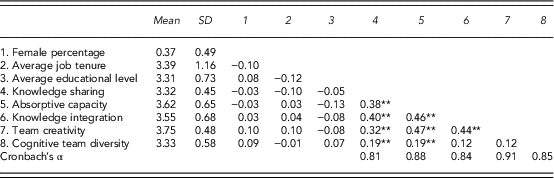
Table 1 presents descriptive statics and correlations of the study variables. The correlations of the study variables were in the expected directions, and all the study variables had an acceptable degree of internal consistency.
Means, standard deviations, and correlations among study variables

Note. *p<.05; **p<.01.
Construct validity
Because our measures of knowledge sharing, absorptive capacity, knowledge integration, and cognitive team diversity came from the same source, we performed a confirmatory factor analysis using individual-level data to examine the construct distinctiveness of the four major variables in our model. We tested a model that contained four factors: knowledge sharing, absorptive capacity, knowledge integration, cognitive team diversity. Results showed the four-factor model provided a good fit, with all fit indices within acceptable levels (χ2=113.08, df=48, comparative fit index (CFI)=0.95, root mean square error of approximation (RMSEA)=0.068, and Tucker-Lewis index (TLI)=0.94). We further compared the four-factor model to a one-factor model that consisted of one single factor (χ2=649.82, df=54, CFI=0.59, RMSEA=0.194, and TLI=0.47). A χ2 difference test showed the four-factor model exhibited a better fit than the one-factor model (χ2 difference=536.74, df=11, p<.01).
Level of analysis
In our study, all the hypotheses were at the team level and we aggregated the individual-level variables to the team-level according to the composition theory (Rousseau, 1985). We assessed within-team agreement before aggregation by using R wg (James, Demaree, & Wolf, Reference James, Demaree and Wolf1993), intraclass correlation coefficient (ICC1) and ICC2 (Bliese, Reference Boer, Bosch and Volberda2000). The average inter-rater agreement coefficients (R wg) for the four variables of knowledge sharing (0.77, ranging from 0.73 to 0.85), absorptive capacity (0.83, ranging from 0.77 to 0.88), knowledge integration (0.84, ranging from 0.78 to 0.88), and cognitive team diversity (0.74, ranging from 0.70 to 0.76) indicated high inter-rater agreement (above the value 0.70). The ICC1 values were as follows: knowledge sharing (0.29); absorptive capacity (0.25); knowledge integration (0.27); and cognitive team diversity (0.24). The test statistics (F-ratios) associated with the ICC1 values of all four variables were statistically significant. The ICC2 values were as follows: knowledge sharing (0.78); absorptive capacity (0.71); knowledge integration (0.74); and cognitive team diversity (0.79). The ICC2 values of all four variables were higher than 0.50. Thus, we concluded that aggregation was justified for these four variables.
The multiple-mediation model
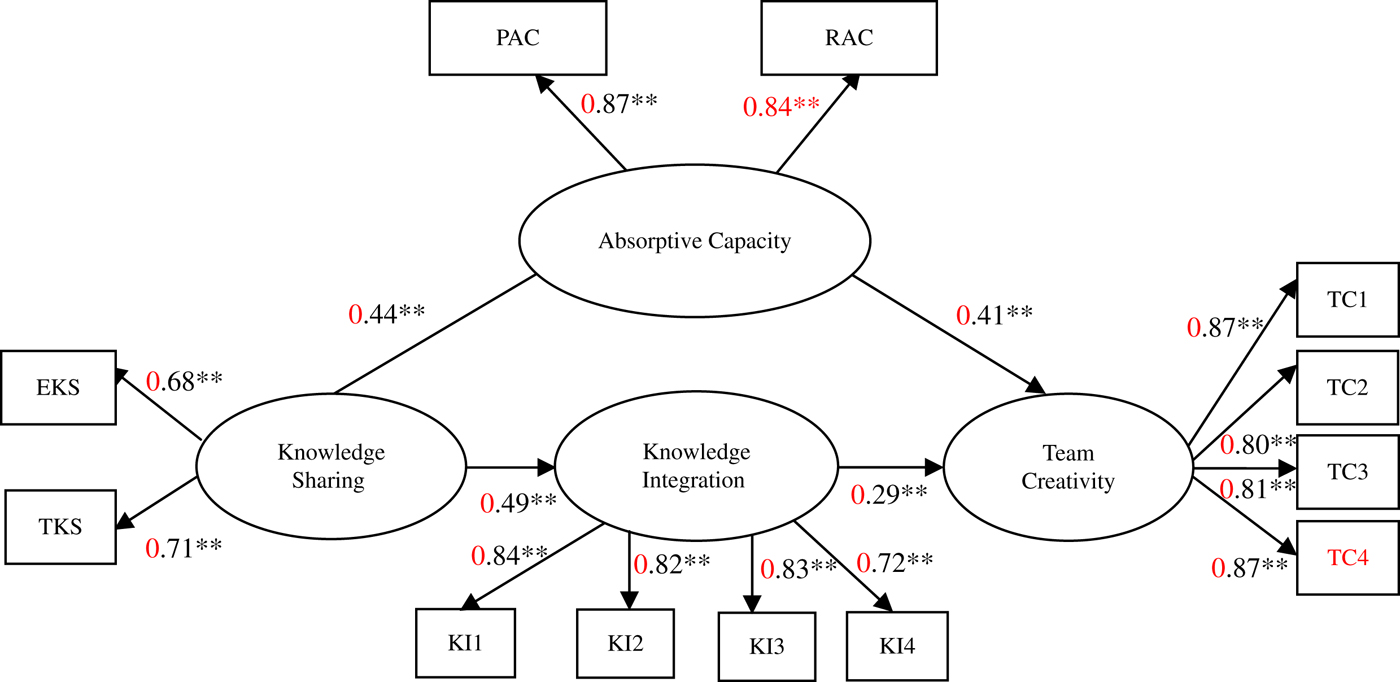
We used a structural equation modeling to test the multiple-mediation model, that is, we were to explore the mediating mechanisms by which knowledge sharing influenced absorptive capacity and knowledge integration. Results show that the model had a good fit to the data (χ2=73.86, df=50, CFI=0.96, RMSEA=0.075, and TLI=0.94), supporting the hypothesized relationships of knowledge sharing and absorptive capacity (β=0.44, p<.01) and knowledge integration (β=0.49, p<.01); absorptive capacity with team creativity (β=0.41, p<.01); and knowledge integration with team creativity (β=0.29, p<.01).
To further examine whether absorptive capacity and knowledge integration fully or partially mediated the relationship between knowledge sharing and team creativity, we tested an alternative model that included direct paths from knowledge sharing to team creativity. This partial mediation model also provided a good fit to the data (χ2=72.51, df=49, CFI=0.96, RMSEA=0.075, and TLI=0.94). However, this alternative model did not have a better fit based on the nonsignificance of the χ2 change (Δχ2(1)=1.35, ns). This indicates that absorptive capacity and knowledge integration fully mediated the relationship between knowledge sharing and team creativity (Figure 1).
Standardized path loadings of the impacts of knowledge sharing on team creativity. EKS=explicit knowledge sharing; KI=knowledge integration; PAC=potential absorptive capacity; RAC=realized absorptive capacity; TC=team creativity; TKS=tacit knowledge sharing

Graphical depiction of the mediating effects
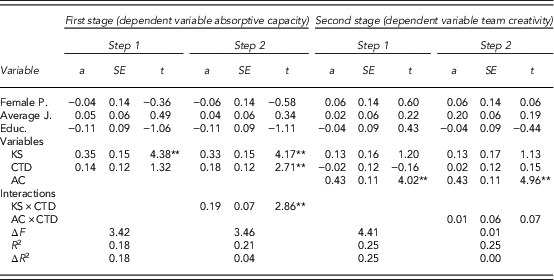
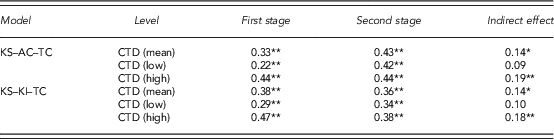
In order to ensure the robustness of the mediating effects of absorptive capacity and knowledge integration, we tested Hypotheses 2 and 3 using path analytic procedures (Edwards & Lambert, Reference Edwards and Lambert2007; Preacher, Rucker, & Hayes, 2007), and conducted bootstrapping analysis to assess the significance of indirect effects (Shrout & Bolger, Reference Söderlund and Bredin2002). For the knowledge sharing–absorptive capacity–team creativity model, Tables 2 and 4 indicated that at the mean level of cognitive team diversity (CTD=0), the first-stage simple effect was 0.33 (p<.01), and the second-stage simple effect was 0.43 (p<.01). The indirect effect at the mean level of cognitive team diversity was 0.14. The bootstrapping procedure indicated that this indirect effect was significant (p<.05). Thus, Hypothesis 2 was supported.
Coefficient estimates for the moderated mediation model (KS–AC–TC)

Note. AC=absorptive capacity; average J.=average job tenure; CTD=cognitive team diversity; Educ.=average education level; female P.=female percentage; KS=knowledge sharing; TC=team creativity.
*p<.05; **p<.01.
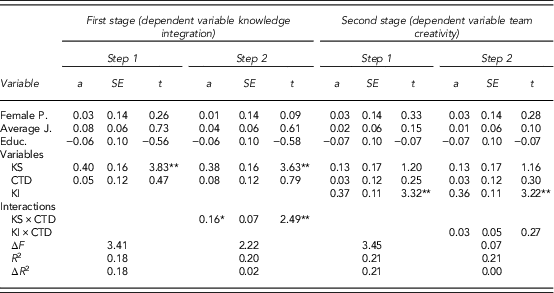
Coefficient estimates for the moderated mediation model (knowledge sharing [KS]–knowledge integration [KI]–team creativity [TC])

Note. average J.=average job tenure; CTD=cognitive team diversity; Educ.=average education level; female P.=female percentage.
*p<.05; **p<.01.
Simple effects across the mean, low, and high levels of cognitive team diversity (CTD) for knowledge sharing (KS)

Notes. AC=absorptive capacity; KI=knowledge integration; TC=team creativity.
*p<.05; **p<.01.
Significance tests for the indirect effects were based on bias-corrected confidence intervals derived from 1,000 bootstrapped samples (Shrout & Bolger, Reference Söderlund and Bredin2002; Preacher & Hayes, 2004).
For the knowledge sharing–knowledge integration–team creativity model, Tables 3 and 4 indicated that at the mean level of cognitive team diversity (CTD=0), the first-stage simple effect was 0.38 (p<.01), and the second-stage simple effect was 0.36 (p<.01). The indirect effect at the mean level of cognitive team diversity was 0.14. The bootstrapping procedure indicated that this indirect effect was significant (p<.05). Thus, Hypothesis 3 was supported.
Graphical depiction and simple slopes of the moderating effects
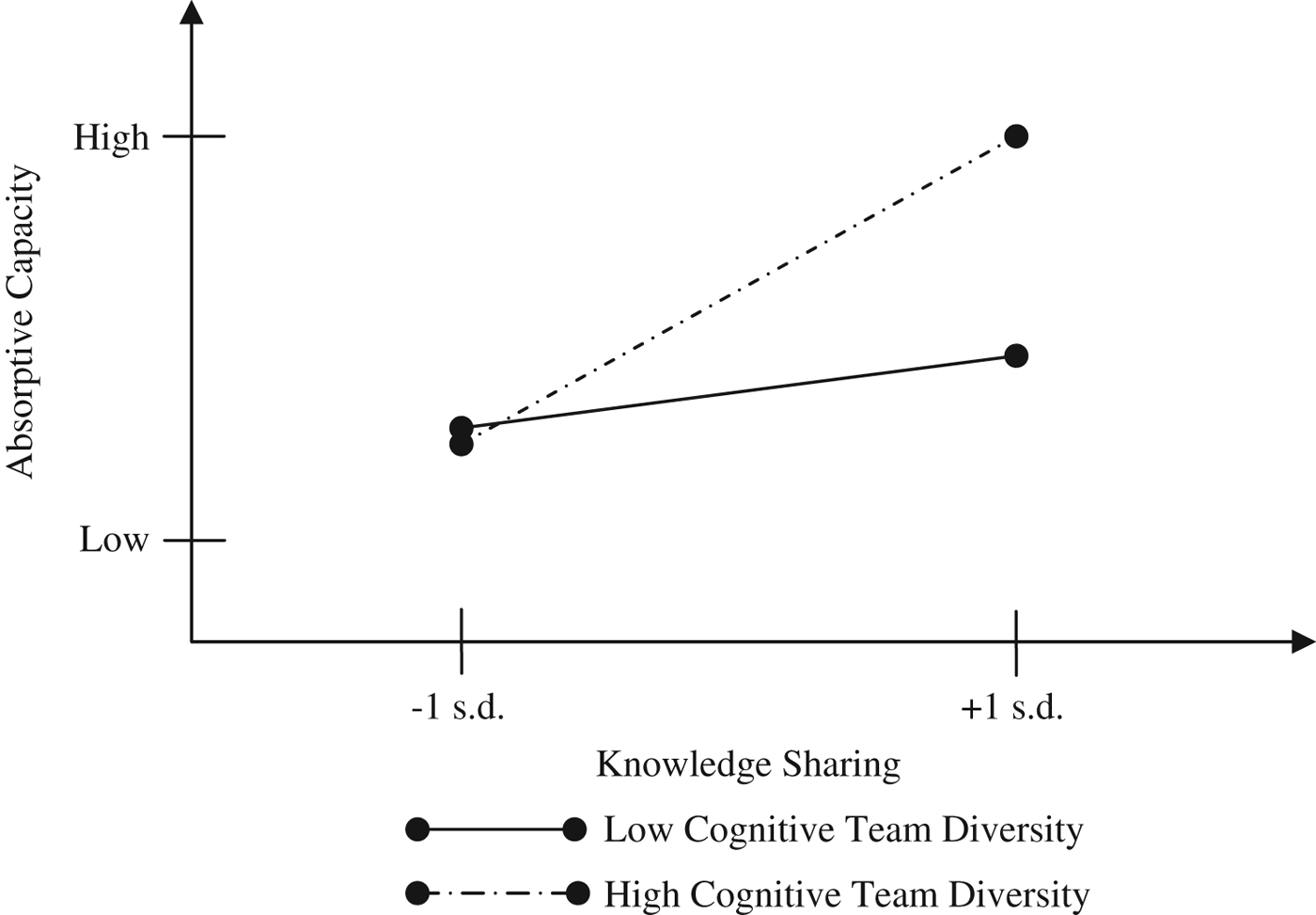
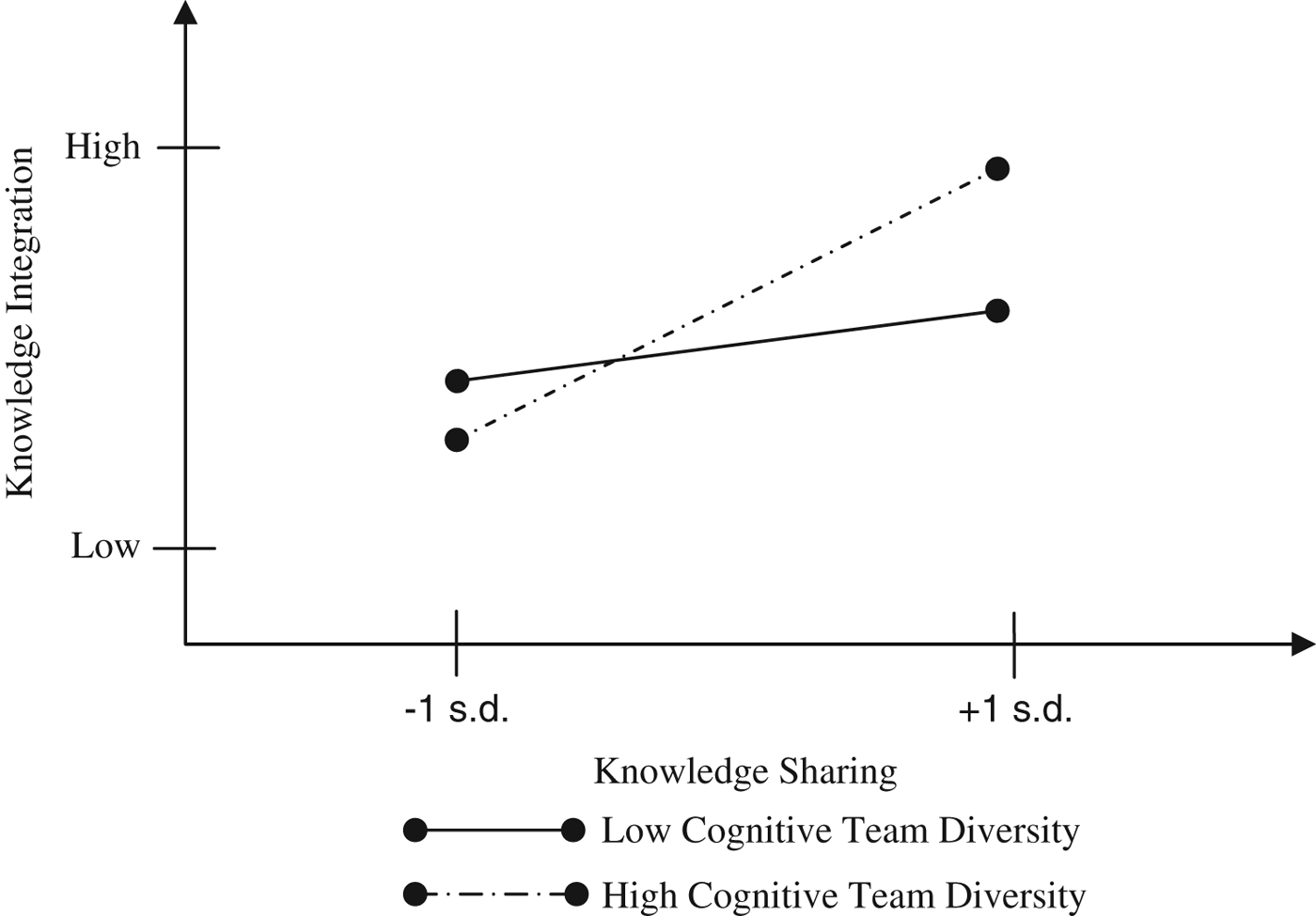
Tables 2 and 4 show the results of the moderated mediation model. Table 2 shows that the interaction of knowledge sharing with cognitive team diversity was significant in predicting absorptive capacity (γ=0.19, p<.01). As shown in Figure 2, with a high level of cognitive team diversity, knowledge sharing was positively related to team creativity (γ=0.52, p<.01), and when the level of cognitive team diversity was low, the relationship between knowledge sharing and absorptive capacity was less positive (γ=0.14, p<.05). Thus, Hypothesis 4a was supported. Table 3 shows that the interaction of knowledge sharing with cognitive team diversity was significant in predicting knowledge integration (γ=0.16, p<.05). As shown in Figure 3, with a high level of cognitive team diversity (1 SD above the mean), knowledge sharing was positively related to knowledge integration (γ=0.54, p<.01), and when the level of cognitive team diversity was low (1 SD below the mean), the relationship between knowledge sharing and knowledge integration was less positive (γ=0.22, p<.01). Thus, Hypothesis 4b was supported.
Interactive effect of knowledge sharing and cognitive team diversity on absorptive capacity

Interactive effect of knowledge sharing and cognitive team diversity on knowledge integration

Further, we examined the conditional indirect effects of knowledge sharing on team creativity through absorptive capacity and knowledge integration at two values of cognitive team diversity (1 SD below the mean and 1 SD above the mean). As Tables 2 and 4 show, for the knowledge sharing–absorptive capacity–team creativity model, when cognitive team diversity was high (CTD=0.58), the first- and second-stage simple effects were 0.44 (p<.01) and 0.44 (p<.01), respectively. Thus, the indirect effect for high cognitive team diversity was 0.19 (p<.01). For low cognitive team diversity (CTD=−0.58), the first- and second-stage simple effects were 0.22 (p<.01) and 0.42 (p<.01), respectively. Thus, the indirect effect for low cognitive team diversity was 0.09 (p>.05). Taken together, the results indicated the conditional indirect effect for knowledge sharing on team creativity through absorptive capacity was significant across high levels of cognitive team diversity, but it was not significant across low levels of cognitive team diversity. Thus, Hypothesis 5a was supported.
Similarly, in the knowledge sharing–knowledge integration–team creativity model (Tables 3 and 4), when cognitive team diversity was high (cognitive team diversity=0.58), the first- and second-stage simple effects were 0.47 (p<.01) and 0.38 (p<.01), respectively. Thus, the indirect effect for high cognitive team diversity was 0.18 (p<.01). For low cognitive team diversity (cognitive team diversity=−0.58), the first- and second-stage simple effects were 0.29 (p<.01) and 0.34 (p<.01), respectively. Thus, the indirect effect for low cognitive team diversity was 0.10 (p>.05). Taken together, the results indicated the conditional indirect effect for knowledge sharing on team creativity through knowledge integration was significant across high levels of cognitive team diversity, but it was not significant across low levels of cognitive team diversity. Thus, Hypothesis 5b was supported.
DISCUSSION
Drawing on componential theory of creativity (Amabile, Reference Amabile1996), our study has presented a theoretical and integrated framework to delineate the relationship between knowledge sharing and team creativity. Specifically, we pinpointed one mechanism behind the effect of knowledge sharing on team creativity. In addition, we shed light on cognitive team diversity, through which knowledge sharing exerts positive effects on team creativity.
Our study makes several theoretical contributions to knowledge sharing and team creativity literatures. First, it provides insights into whether and how knowledge sharing positively relates to team creativity. Although knowledge sharing can significantly influence creativity processes (Zhang, Tsui, & Wang, Reference Zhou and Li2011; Huang, Hsieh, & He, Reference Huang, Hsieh and He2014), how knowledge sharing affects team creativity has rarely been studied. We provide a test of the mediating mechanisms by which knowledge sharing impacts team creativity. Previous research on knowledge sharing focused on either an emergent state or on a team process as the mediating mechanism (Liao et al., 2007; Bao et al., Reference Bao, Xu and Zhang2016). However, our study examined the intervening roles of both absorptive capacity as an emergent state and knowledge integration as a team process. Including these two categories of mechanisms in one model makes it more inclusive in terms of the heuristic model of team effectiveness (Cohen & Bailey, Reference Cohen and Bailey1997). Our study indicates that both absorptive capacity and knowledge integration are important intervening variables in the relationship between knowledge sharing and team creativity, even when their effects are considered simultaneously. More specifically, we argue that knowledge sharing may influence team creativity via absorptive capacity, because knowledge sharing can broaden a team’s existing knowledge base and enhance team members’ learning ability (Liao et al., Reference Lin and Chen2007), which will in turn influence team members’ ability and motivation to recognize, assimilate, and apply knowledge, and ultimately affect team creativity. Knowledge sharing also influences team creativity via knowledge integration. Knowledge sharing requires team members to share knowledge and expertise that underlie their abilities to learn and participate in appropriate actions to create new architectural knowledge by integrating component knowledge. It will positively influence a team’s knowledge integration process, thereby affecting team creativity. In general, our study shows the potential influence of knowledge sharing and that its effect on team creativity is exerted through absorptive capacity and knowledge integration.
Second, another important implication of our findings is that cognitive team diversity plays an important role in helping team members capitalize on the shared knowledge, expertise, and suggestions for absorptive capacity and knowledge integration. The present study not only theoretically developed the interaction effect on absorptive capacity and knowledge integration by combining research on cognitive team diversity, knowledge sharing, absorptive capacity, and knowledge integration, but also empirically demonstrated the moderating role of cognitive team diversity on the relationship between knowledge sharing and absorptive capacity, and knowledge integration, respectively, in different knowledge worker teams.
Furthermore, we centered on cognitive team diversity as the prime diversity variable in examining the relationship between knowledge sharing and absorptive capacity and knowledge integration. For absorptive capacity and knowledge integration, which requires assimilating different knowledge and expertise, thinking divergently, and integrating previously unrelated products, processes, knowledge, or materials (Mumford & Gustafson, Reference Nonaka1988), cognitive team diversity is likely to be the most relevant diversity variable due to its different ideas, thinking styles, and perspectives required for absorptive capacity and knowledge integration (Williams & O’Reilly, Reference Zahra and George1998). These results support previous study suggesting that researchers should choose appropriate diversity variable based on the interesting conceptual relevance to outcomes (Shin et al., Reference Shin and Zhou2012).
Finally, our study demonstrates that the mediation-chain relationship is more complicated than was previously understood, in that the relationship seems to vary with cognitive team diversity. By adopting Edwards and Lambert’s (Reference Edwards and Lambert2007) moderated-mediation approach, we found that the mediating effects of absorptive capacity and knowledge integration in the relationship between knowledge sharing and team creativity at different stages can be significantly stronger or weaker, depending on cognitive team diversity. In particular, our study indicated that the mediating effects of absorptive capacity and knowledge integration in the relationship between knowledge sharing and team creativity were stronger for team members with higher cognitive team diversity.
Our study also provides several implications for managerial practices. We have shown that team members’ knowledge sharing promotes absorptive capacity and knowledge integration, and, thus, team creativity. This result can serve as advice to managers should find a way to encourage knowledge sharing between coworkers. Knowledge sharing can be an effective knowledge management tool influencing team creativity (Zhang, Tsui, & Wang, Reference Zhou and Li2011; Bodla et al., Reference Bliese2016). In organizations where team members’ knowledge, suggestions, and opinions have critical implications for organizational functions, managers should pay more attention to their display of positive encouragement in team members’ knowledge sharing, because showing positive encouragement to knowledge sharing can increase team members’ absorptive capacity and promote knowledge integration in generating new ideas. Moreover, organizations should implement training programs to teach managers how to encourage knowledge sharing. Simultaneously, organizations should invest in training programs to help team members develop better interpersonal skills. According to ‘what goes around comes around’ (Cerne et al., 2014; 188), employees who willingly share more knowledge seem bound to then in turn receive such selfless treatment from their colleagues, which will ultimately encourage them and prompt their creativity. Therefore, team members should engage in more knowledge sharing behavior in order to facilitate their own creative ability and team creativity.
Another implication of our research relates directly to cognitive team diversity in member–member interaction dynamics. Our findings showed that knowledge sharing plays a salient role in eliciting absorptive capacity, knowledge integration, and team creativity, especially for teams with high cognitive diversity. This suggests that teams with high cognitive diversity are more likely to improve their absorptive capacity and promote knowledge integration. Accordingly, managers should value the importance of cognitive team diversity, so that team members can appreciate other colleagues’ different expertise, skills, and perspective readily, and discover novel and practical ideas when they work in cognitively diverse teams (Shin et al., Reference Shin and Zhou2012). As a result, team members are more likely to improve their absorptive capacities and integrate the cognitive resources (e.g., expertise, skills, and perspective) coming from cognitive team diversity to become more creative (Shin et al., Reference Shin and Zhou2012).
LIMITATIONS
Despite its contribution to theory and practice, our study has several potential limitations. First, although we collected data from different sources to reduce potential common method biases, we still cannot draw conclusions about causality from a cross-sectional study. A longitudinal design measuring the variables with time lag would be necessary. That is, there should be a meaningful time lag between measures of knowledge sharing, cognitive team diversity, absorptive capacity, knowledge integration, and team creativity.
Second, by focusing on the cognitive team diversity, we decided to include a limited number of factors promoting the knowledge sharing–creativity relationship. For example, the ability of cognitive team diversity can stimulate the positive relationship between knowledge sharing and creativity could also be dependent upon other factors, such as resource-flexibility-oriented human resource management (HRM) system, coordination-flexibility-oriented HRM system, relational embeddedness, knowledge familiarity, and other variables that have been found to influence absorptive capacity and knowledge integration (e.g., Chang, Gong, Way, & Jia, Reference Chang, Gong, Way and Jia2013; Tzabbar, Aharonson, & Amburgey, Reference Tell2013). Further research in exploring work situations that stimulate or mitigate the positive relationship between knowledge sharing and team creativity within the extant cognitive team diversity is required.
Third, our study examined perceived cognitive team diversity instead of actual cognitive team diversity. Compared with actual diversity, perceived diversity that is frequently used in diversity research can explain team members’ behavior more strongly. However, individuals may not assess other team members’ cognitive team diversity accurately, and the assessment is likely to be biased (Harrison & Klein, 2007; Shin et al., Reference Shin and Zhou2012). Future research should compare the moderating role of perceived cognitive team diversity and actual cognitive team diversity in the relationship between knowledge sharing and team creativity and use experimental designs to replicate our findings.
In addition, we measured knowledge sharing by asking team members to describe the extent to which they share explicit or tacit knowledge with their colleagues. A more effective way to measure knowledge sharing in teams would be using a round-robin design or taking social networks (Warner, Kenny, & Stoto, Reference Williams and O’Reilly1979). For example, the round-robin design would require every team member assessing its experience of sharing knowledge with other members of the team. Then, the results should be aggregated at the team level (Huang, Hsieh, & He, Reference Huang, Hsieh and He2014). These two approaches would measure knowledge sharing in teams more accurately.
CONCLUSION
Interest in knowledge sharing has increased in the last decade. The research has focused on knowledge sharing as a team-level phenomenon. In this paper, our goal has been to take the knowledge sharing literature in new directions by providing scholars with different perspectives regarding the mechanisms by which it influences outcomes. Drawing on the componential theory of creativity, this paper sheds light on the influence knowledge sharing can have on team creativity. Our results suggest that absorptive capacity and knowledge integration may function as important intervening mechanisms in the knowledge sharing–team creativity relationship, and cognitive team diversity is an important determinant of the degree to which a team stands to benefit from knowledge sharing. This research, therefore, provides a foundation for more comprehensive understanding of knowledge sharing in teams, and the conditions that engender the best team outcomes.
Acknowledgments
The authors acknowledge financial support from the National Natural Science Foundation of China (Grant Nos. 71472137, 71202031, 71302048).
This manuscript is an original work that has not been submitted to nor published anywhere else.
All authors have read and approved the paper.