1 Introduction
Since the late 1960s, the German population has been aging, while the rate of reproduction has stabilized at a level of 1.4 children per woman. This demographic change and the stepwise retirement of the baby boom generation from 2015 on will result in a shortfall in financial old age benefits under the statutory pay-as-you-go pension system, if contribution rates to this system and/or retirement age remain constant. An increasing number of pensioners facing a drop in the number of contributors will cause financial pressure on the public pension system. Therefore, politicians as well as researchers claim that own responsibility for old age income should be enhanced by more use of private and occupational pension systems. Also people themselves are not satisfied with their financial situation for old age and are willing to place responsibility for financial income on to both private and statutory organizations (Wunder and Schwarze, Reference Wunder and Schwarze2005: 25). Incentives are set by the state through instruments such as tax benefits for both firms and employees, portability rules or shorter vesting periods.
In general the German pension system can be characterized as a system with a generous pay-as-you-go pillar, which covers more than 80% of individual retirement income, whereas the second pillar (occupational pensions) and third pillar (private pensions) cover only small parts of retirement income. Due to rising costs in public spending for retirees the system had to undergo several reforms. One aspect of the reform in 1992 was an increase in retirement age from age 63 to 65 and the anchoring of retirement payments to net wages instead of gross wages. Besides a reform in 1999 which introduced a demographic factor for calculating pension payments the latest reform in 2001 got the Riester pensionFootnote 1 under way in order to support lower income levels, to stabilize both contributions and pension levels, and to strengthen the second and third pillar as supplementary pensions (Börsch-Supan and Wilke, Reference Börsch-Supan and Wilke2004: 23–37).
Since 1 January 2002, the German occupational pension system via Entgeltumwandlung is mandatory for employers if employees ask for it. To save for retirement, five pension plan types (Durchführungswege) are optional for the employer (BetrAVG §1a I, as amended on 9 December 2004 (BGBl. I: 3242)).Footnote 2 They allow for three different methods of financing (employer-based, employee-based, or hybrid financed). Up to now, the employer-based system has been dominant in Germany, but because of complexity many employers do not provide any occupational pension yet or would like to switch to an employee-based system. This results in an undersupply of occupational old age pensions because so far it has not been obligatory for employers to provide such a system. Moreover, as will be shown in the following sections, the participation rate of employees in company pension plans is rather low. This problem is common also in other countries such as the US, the UK, and Norway. Especially small and medium-sized enterprises (SMEs) face the problem of undersupply and low participation rates. In descriptive surveys, they often name high administration costs and costs of search for or information about external suppliers and their offered range of products as an obstacle for providing an occupational pension.
Economic research still fails to explain econometrically the incidence of occupational pensions in Germany. The purpose of this paper therefore is to evaluate the determinants of the observed gap in occupational pension provision between German firms. We first formulate hypotheses on supply and demand for occupational pensions and provide an overview of recent literature in Section 2. In Section 3, the hypotheses will be examined econometrically on the basis of the German Socio-Economic Panel (GSOEP) and the German SAVE survey. Finally, Section 4 concludes and gives an outlook on future research.
2 Overview of previous research
2.1 Stylized facts
Several analyses based on surveys showed that a gap in pension provision between SMEs and large firms was an apparent phenomenon in Germany, the US, the UK, and Norway. Some of these found significant differences across lines of business.
In Germany, most of the interviewed people state that they do not believe the statutory pension system to be effective enough to provide money for old age. Individual retirement income by statutory pension paybacks will not be sufficient to maintain their standards of living. However, many of them do not seem to be adequately informed about this issue. The same applies to employers. More than 75% of them are not aware of the fact that they are obliged to provide for their employees a system of deferred compensation (R+V, 2004: 5). Most of the authors identify a gap between SMEs and large firms in pension provision, as well as between Eastern and Western Germany (Kortmann and Haghiri, Reference Kortmann and Haghiri2005; Müller, Reference Müller2004; R+V, 2004).
On the one hand, an amazing result of the surveys is people's lack of willingness to save additional money for retirement; on the other hand, it has been shown by Schunk (Reference Schunk2007) that people have different priorities regarding saving, as they might decide in favor of the bequest motive or in favor of precautionary motives or others besides retirement provision. Moreover, it can be explained by the fact that employees with lower incomes will have less savings for their retirement as these employees are liquidity constrained (Huberman et al., Reference Huberman, Iyengar and Jiang2007: 27/28; Reifner et al., Reference Reifner, Tiffe and Turner2003: 19/20).
New findings in the surveys by Kortmann and Haghiri (Reference Kortmann and Haghiri2005), Müller (Reference Müller2004), and R+V (2004) provide answers to the questions why people want to participate in a pension plan and why they reject participation. The most often given arguments for enhancing demand are advice from, as well as the competence of, the consultant or the employer. Employees are aware that they are not necessarily able to keep abreast of recent developments or statutory advancements and they, therefore, expect consultants to act as information intermediaries. If this criterion is fulfilled properly, employees demand an occupational pension plan (HDI PM, Reference Haisken-DeNew and Frick2005; 20/21; R+V, 2004: 6).
People are more likely to demand a pension plan if they have a socially responsible employerFootnote 3 or one that wants to increase motivation of employees and corporate identification. In most cases of pension rejection, employees are not interested in retirement provision because they think the system offered is too risky, they overestimate individual benefits from the statutory pension system, or they will not have enough money left to save. Sometimes, employees are also reluctant to ask their employer for a plan (HDI PM, Reference Haisken-DeNew and Frick2005; Müller, Reference Müller2004; Delta Lloyd, Reference Delta2004).Footnote 4
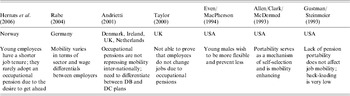
Similar results are found by other authors who evaluated whether mobility of employees served as an additional factor of influence (see Table 1). Additionally, Gustman et al. (Reference Gustman, Mitchell and Steinmeier1994) mention that mobility is affected by an employee's current wage and any potential capital loss. Rabe (Reference Rabe2004) and Andrietti (Reference Andrietti2001) prove this argument for several European countries.
Survey of studies on job mobility and occupational pensions

Note: DB=defined benefit plan, DC=defined contribution plan.
Source: own compilation.
As in Germany, countries such as the US, the UK, and Norway face the following problems: low participation rates in private or occupational pension schemes and less retirement plan provision in SMEs than in large companies. A commonly named reason for this is that young employees and those with low incomes reject participation in an occupational plan. Individual reasons are different (Ghilarducci and Lee, Reference Ghilarducci and Lee2005; Hinz and Turner, Reference Hinz and Turner1998; Even and Macpherson, Reference Even and MacPherson1994). Moreover, it has been shown that long job tenures are the result of offered pension plans (Mealli and Pudney, Reference Mealli and Pudney1996). Finally, despite 401(k) plansFootnote 5 which are popular in the US and do not have excessive administration cost, SMEs in particular reject pension plan provision. The results named above show that low participation rates in pension programs in general and pension gaps between SMEs and large firms are important policy issues at present in various countries.
The studies for Germany remain on a descriptive level to show the development of occupational pension plan supply and demand. It is therefore necessary to show econometrically which determinants have a statistically significant impact on pension plan provision. To fill this gap, we derive several hypotheses from economic theory in the following section.
2.2 Theoretical background and hypotheses
Given the gaps in the provision of pension payments by the statutory pension system, reasons as to why people demand a certain category of pension need to be evaluated by relating existing literature to the study carried out in this paper.
Mitchell (Reference Mitchell1988) notes that employees make suboptimal decisions concerning their pension plans as they are imperfectly informed about tax deductions, the different channels to choose between, and other plan characteristics. Employers are more likely to offer a plan if the firm is profitable. An equilibrium between demand by employees and supply by employers could be achieved only if we lived in a world without information cost.
Several authors identified parameters influencing a person's individual decision to participate in an occupational pension plan, subject to the assumption that employers offer one. What reasons do arise for the demand for and supply of occupational pensions? Economic literature developed different hypotheses to explain influences on both the employee side and the employer side. The first three arguments refer mainly to supply-side factors, although a clear separation between supply side and demand side is not possible.
Employee retention
First, pension systems could act as a mechanism for employee retention. This may be in the interest of both employees and employers. Participation in a plan implies that the employer saves a certain amount of money for the employee's retirement period. Either the same amount of money is saved as a wage deferral (defined contribution) every period or the employee is paid a fixed pension amount at the beginning of the retirement period (defined benefit). Gustman and Steinmeier (Reference Gustman and Steinmeier1993) show that defined contribution plans are more portable and therefore associated with higher employee turnover than defined benefit plans as a new employer only needs to pay defined contributions to the employee without having to guarantee the final amount of pension from a defined benefit plan. Taylor (Reference Taylor2000: 248/249) supports this hypothesis for the UK and notes that especially defined benefit plans keep employees from leaving a company. Defined benefit plans increase individual commitment to a company as has been measured by Nyce (Reference Nyce2007). He mentions that although pension benefits can be very costly to a company, the appreciation of pension plans as wage components by employees can positively influence the performance of that company. Some authors (for example Krahnen, Reference Krahnen1990: 200/201) call benefit plans a sponsoring mechanism of employers due to the fact that the employees' contributions are saved for retirement and therefore act as a backloading mechanism by providing debt capital from inside of the firm. By funding a pension, the employer receives a credit from the employee, which will be paid back when the latter retires. Contributions by the employee are disposed by the firm for the whole period of saving and thus stay within the company. Under uncertainty about possible insolvency of the firm and the risk premium they have to pay, workers are not able to work as creditors. However, the employee is likely to loose the compound interest if he or she quits the job before retirement and changes to another employer. Then a new pension with a lower capital stock has to be built up (Dorsey et al., Reference Dorsey, Cornwell and Macpherson1998; Ippolito, Reference Ippolito1997; Kotlikoff and Wise, Reference Kotlikoff, Wise and Wise1985, Lazear and Moore, Reference Lazear and Moore1984).Footnote 6 Besides, Gustman et al. (Reference Gustman, Mitchell and Steinmeier1994) argue that mobility is affected not only by the employee's current wage, but also by the capital loss incurred from a job change.
Efficiency wages
A second argument that is closely related to the hypothesis of employee retention is based on Lazear (Reference Lazear1979). He shows that employees are able to realize the individual benefit of a pension plan.Footnote 7 Therefore, they avoid shirking before retirement. This is due to efficiency wages: employees earn lower wages than their marginal product of labor at a younger age and higher wages when they get older. So employer and employee build up an implicit contract. An anticipated capital loss evoked by job loss because of shirking leads to a reduction in employee mobility; otherwise, people would look for a job in which they are not offered a pension. Moreover, the avoidance of shirking may have the additional effect of decreasing training costs and the costs of finding and recruiting new staff as employees have an incentive to work harder and have a longer tenure (McCarthy, Reference McCarthy2006; Allen et al., Reference Allen, Clark and McDermed1993). An impact on motivation and loyalty from fringe benefits or occupational pensions could be proved for the US (Allen et al., Reference Allen, Clark and McDermed1993) but not for Germany (Frick et al., Reference Frick, Frick, Schwarze, Frick, Neubäumer and Sesselmeier1999). Our first hypothesis therefore is:
H 1: A longer tenure in a firm shows that people feel safe with their job, which means hardly any risk of losing wage payments and thus they are more interested in an occupational pension plan program. Because of that there is a positive relationship between the probability of adopting a pension and tenure.
Economies of scale
If a firm employed a large number of employees, it could offer a pension plan that required possibly higher fixed costs from administrative expenses.Footnote 8 So, the costs per employee decrease with firm size. Furthermore, large firms have a higher probability to survive business cycle fluctuations and are more able to earn extra money to pay for higher pensions. A small firm would not be able to pay a pension if it went bankrupt. The risk of becoming insolvent is higher for small firms than for large firms.Footnote 9 Furthermore, a case of death or invalidity could result in high payments, which reduces cash flow and may cause insolvency if the employer did not save enough for an event like that. This risk is higher for small firms than for large firms because large firms are more able to handle the financial burden caused by a sudden case of death. Finally, economies of scale and bankruptcy risk differ across lines of business (Horiba and Yoshida, Reference Horiba and Yoshida2002; Aoki, Reference Aoki1984; Mitchell and Andrews, Reference Mitchell and Andrews1981).
This leads us to two further hypotheses:
H 2: Large companies are more likely to offer a pension plan than small companies.
H 3: Supply and demand for occupational pension plans differ across lines of business and regions.
Literacy and pension provision
From the supply side of our analysis we have to add, based on human capital theory, that people who are offered a pension plan, who are well informed and stay longer at a firm, tend to be more productive than others. The reason for this is that employees acquire firm-specific human capital, which, as a result, increases firm productivity (Becker, Reference Becker1964; Andrietti and Patacchini, Reference Andrietti and Patacchini2004: 2). This could not be rejected for the US (Cornwell and Dorsey, Reference Cornwell and Dorsey2000).Footnote 10
Mitchell (Reference Mitchell1988) finds evidence that educated employees and women are better informed about details of pension plans, as they are more likely to be involved in the process of obtaining information about pension determinants. Bernstein (Reference Bernstein2002: 2065) supports this argument by pointing out that educated people are better aware of tax reductions, which are related to pension plans and other types of fringe benefits. Hence, we suppose that better knowledge about pension plan features and benefits increases the willingness to participate in that kind of plan, therefore we develop hypothesis 4:
H 4: As female and well-educated people are better informed, they know more about the advantages of occupational pensions and therefore have a higher probability of participating in a plan.
Influence of socio-economic aspects
Mincer (Reference Mincer and Atkinson1976) tested several sociodemographic factors (such as schooling, hours worked, gender) and their influence on individual income. We suggest that these factors influence retirement income too, as Blundell et al. (Reference Blundell, Browning and Meghir1994) found out that demographic attributes and labor market variables significantly influence intertemporal behavior.
Thus, we expect:
H 5: The demand for occupational pension plans depends on sociodemographic attributes (e.g. income, age, marital status, position, and number of children).
Individual motives
Saving for retirement goes back to the idea of the life-cycle hypothesis by Modigliani and Brumberg (Reference Modigliani, Brumberg and Kurihara1955), who discuss an intertemporal optimization problem for separate consumption over the life-cycle as income after retirement is smaller than during the working period. In this case saving helps maintain standard of living. This hypothesis has been tested empirically by many authors and strongly confirms the motive of old age provision. Moreover, unexpected events might affect current and retirement income, evidence on the precautionary motive of saving is far-reaching. Some find evidence for an intention to secure themselves against uncertain resources in retirement, others do not (see for example Kennickell and Lusardi, Reference Kennickell and Lusardi2004; Cagetti, Reference Cagetti2003; Skinner, Reference Skinner1988; Carroll and Samwick, Reference Carroll and Samwick1998, among others). They find evidence that individual circumstances as well as risk aversion affect personal savings behavior, which leads us to the following hypothesis:
H 6: Savings motives based on individual circumstances influence the willingness to provide for retirement.
These hypotheses shall be tested in the following chapter.
3 Empirical analysis
3.1 Data
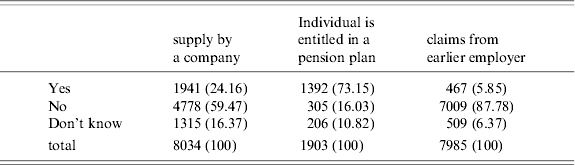
The data used in this study have been taken from the German Socio Economic Panel (GSOEP) and the German SAVE survey. The GSOEP is an annual survey among German individuals with questions concerning several socio-economic factors, with every wave focusing on a special topic. From 1985 to 1995 questions concerning occupational pensions were asked. Thus, the most recent data available refer to 1995.Footnote 11 The dataset for our analysis contains 13 768 people who were asked to participate in the survey.Footnote 12 The answers to the questions about occupational pension coverage are given in Table 2. As shown in the first column, in 1995 almost 2000 people in our dataset worked in a firm that offered a pension plan, but only 1392 of them (73%) were entitled in a plan (see second column). It is an astonishing fact that 16% of those who answered the question, ‘In some companies the employees are offered a company pension in addition to social security. Does your company offer this for all or some of its employees?’, did not know whether their firm offered a pension plan. This hints at the undersupply of information inside firms, as a lot of people are not aware of the possibility to make provision for retirement. Moreover, 87.8% of the people considered in this study are not entitled in plans from an earlier employer. This could possibly be due to the fact that the mean age of people owning an occupational pension is 41.7 years. Cohorts of older employees are more likely to be bound to the firm than cohorts of younger employees who are more career-minded. Of the total number of employees entitled in an occupational pension plan, 35.7% are female and 64.3% of them are male.
Answers to questions about supply and claims of occupational pensions (percentages in parentheses)
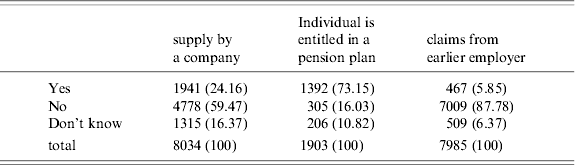
Note: This table includes self-employed people. Later on they will be left out of our analysis, because most other studies attribute the occupational pensions of self-employed people to the private pillar.
Source: own calculations based on GSOEP, wave 12 (1995).
Another possible reason for the apparent low mobility might be that before 2002 the portability and vesting rules had been more restrictive and more complex. The rules concerning vesting periods are a popular exampleFootnote 13:
An employee participating in an occupational pension plan keeps his entitlements if he leaves the firm before occurrence of an insured event only if he is at least 35 years old and either the pension promise exists for at least 10 years or the employee is employed at that firm for at least 12 years and his pension promise exists for at least 3 years. (BetrAVG §1 I 1, as amended on 05.10.1994 (BGBl. I: 2911))
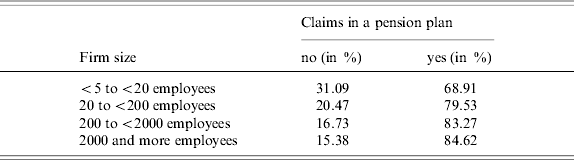
After exclusion of self-employed people from our analysis 31% of those who are subordinates in a small firm do not own an occupational pension, whereas almost 85% of those employed in a large firm (2,000 and more) have claims in a pension system.Footnote 14 This can be seen from Table 3.Footnote 15
Percentage of claims in terms of firm size
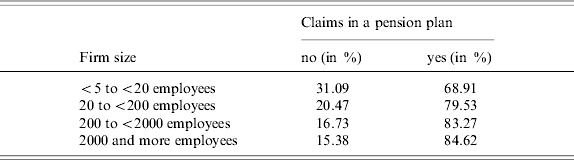
Note: Due to the fact that not all participants in the GSOEP answered questions on pension provision and other financial aspects for different reasons, the numbers especially for people who answered ‘yes’ and who are employed in the smallest category of firms might be too large.
Source: GSOEP, wave 12 (1995), weighted, firm size measured by number of employees.
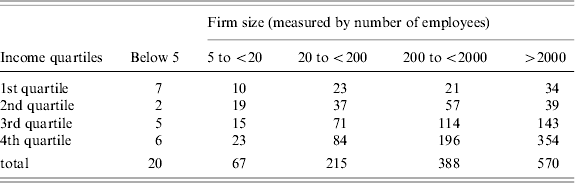
Concerning hypothesis 5 derived above, our dataset suggests that people with higher wagesFootnote 16 have a higher probability of participating in an occupational pension scheme. To show this we took the quartiles of individual income and related them to firm size with respect to the fact that the person owns a claim in occupational pensions. Table 4 points out that in our dataset the participation rate is higher for people in a higher income quartile and who are employed in large firms. This gives first evidence that large firms both achieve economies of scale in administration costs, e.g. individual consulting activities in human resources departments, and enable employees to participate in pension plans due to higher wages, which leave enough for retirement saving as well as spending on current consumption.
Number of pension participants with respect to income and firm size
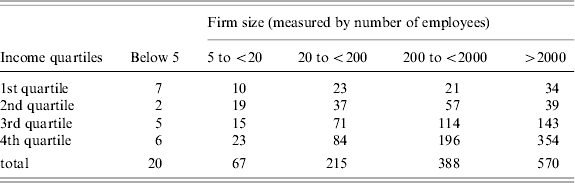
Source: own calculations based on GSOEP, wave 12 (1995).
On a descriptive basis, no clear answer can be given on the question about the relation between education and pension coverage. Of those with a university degree, 81% are entitled in a pension plan but almost 83% of those with no university degree as qualification for their current job are entitled in a pension plan, too. Besides socio-economic attributes the GSOEP contains questions on people's savings behavior as well as attitudes towards assets, income, and life satisfaction. Therefore, we include these variables in our analyses to control for an influence of psychological factors.Footnote 17
In order to find out whether people's attitude towards pension plan adoption has changed over the past ten years we use the German SAVE survey, which includes both socio-economic attributes and questions on household's savings behavior, and attitudes towards assets and income. The survey started in 2001 and the second wave followed in 2003. The third wave we use, including 2305 households, was collected in summer 2005.Footnote 18 The weights used on the multivariate level are based on the distribution of income and age of the German sample census of the respective year.Footnote 19
In times of demographic change, with the amount of statutory pension received by retirees decreasing, it could be useful for those who are believed to have an above-average life expectancy to provide for old age via occupational pensions. Such people may provide for themselves, as they would be influenced by lower payoffs and could possibly face old age poverty. The SAVE data show on a descriptive basis that only 15.0% (8.5%) of those expecting to live longer than an average person use occupational (private) pension plans to fill their individual gap in financial benefits. But there is still the question whether supposed life expectancy has a statistically significant influence on individual pension plan demand.
Furthermore, it can be argued that people participating in private pension plans may value these as a substitute for occupational pensions. The SAVE dataset shows that 19.3% of those participating in an occupational pension plan have a private pension as well and 8.3% of those not having an occupational pension have a private pension instead. It is amazing that more than 90% of the households asked in the GSOEP who are not participating in occupational plans do not provide for old age on their own.Footnote 20 Calculated with reference to the whole survey, we see that more than half of the households participating in the SAVE survey provide neither privately nor occupationally for old age. Therefore, the descriptive statistics do not support the argument for occupational and private pensions being substitutes. A closer look has to be taken on the multivariate level. To test the above hypotheses, we will undertake the following estimations.Footnote 21
3.2 Estimation method
We use data consisting of all male and female employees who hold claims in occupational pensions either with the actual employer or at a former employer or not at all.Footnote 22
We estimate the probability P of a household i (or a firm) owning (offering) an occupational pension (Y=1) in terms of a vector of socio-economic attributes X i. As the resulting dependent variable is a binary one, we have to estimate a binary probit model underlying the assumption of a cumulative standard normal distribution function, which can be written as

with I* incorporating an unobservable utility indexFootnote 23 of household i and t being a standardized normal variable t~N (0, 1).
As the utility index I is being defined as  it can be estimated econometrically as (2) with u i being the error term

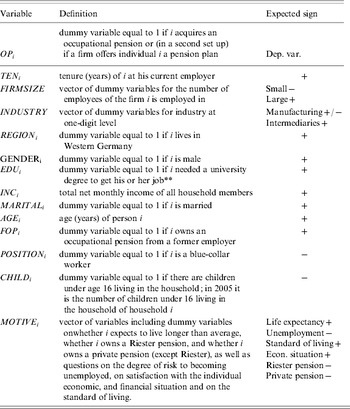
Socio-economic attributes included in vector X i of household i are shown in Table 5.
Socio-economic attributes included in vector Xi of household i

Notes: * D1: less than 5 employees, D2: 5–19, D3: 20–199, D4: 200–1999, D5: 2000 and more.
** For 1995 we used EDU as proxy for education of individual i because data are not available. This way we are able to catch up time preferences, as those who spend longer in education in order to earn higher wages in future have a small time preference. Therefore they are less likely to demand pensions or other forms of savings (see for example Börsch-Supan (Reference Börsch-Supan2001) and Rodepeter (Reference Rodepeter1997) among others).
Therefore the structural part of the regression can be written as

Afterwards we evaluated what attributes significantly influenced the duration of claims in occupational pensions. Therefore, we undertook OLS estimations using the same socio-economic attributes as in equation (3) but with the logarithm of duration (years) of claims in occupational pensions as the dependent variable and the log of household income and age as independent variables.
First of all in model 1 we tried to estimate determinants of the supply of an occupational pension on firm side.Footnote 24 However, due to insufficient information on attributes of the firms that supply occupational pensions, these regressions could be improved if more firm-specific attributes, such as legal form of a company, whether it is a local branch, share of white-collar workers, or amount of money spent for further education, were available.Footnote 25
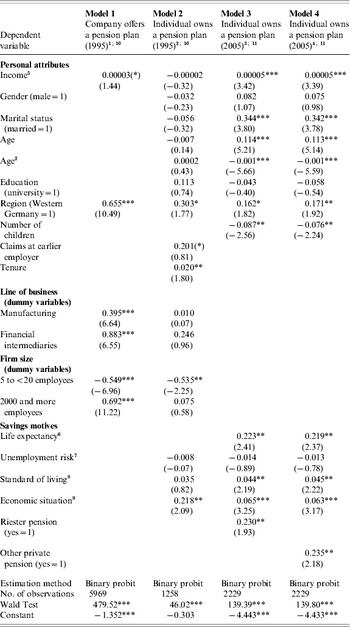
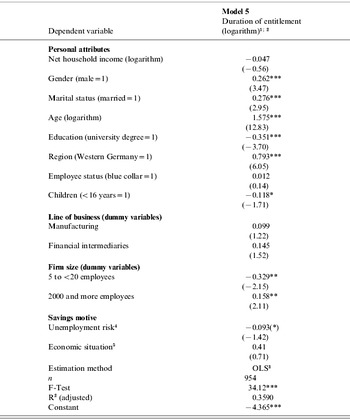
Following the supply side, we evaluate in model 2, using the GSOEP, the determinants of the demand side, including socio-economic attributes, dummy variables for lines of business, and firm size. We furthermore include savings motives to control for the influence of satisfaction with different attributes on old age provision.Footnote 26 Models 3 and 4 also evaluate the demand side, but due to possible changes in household behavior, caused by several reforms of the German pension system, we focus on demand in 2005. Therefore, we include a dummy variable Riester pension in model 3 and a dummy variable other private pension to include supplementary pensions besides occupational pensions in order to avoid biased results.Footnote 27 Model 5 finally evaluates influence factors on the duration of pension plan entitlements, but due to data limitations solely for 1995.
All observations have been weighted in our multivariate analyses. The estimated coefficients of binary and limited variables cannot be interpreted as marginal effects but the direction of the effect can be deduced from the estimated sign of the coefficient. However, the dependent variable increases (decreases) with the positive (negative) sign of the exogenous variable.
3.3 Results
Our estimation results reported in Tables 6 and 7 provide insights into the German occupational pension system and people's pension plan adoption.Footnote 28
Estimation results – determinants of occupational pension plan provision

Notes: 1+2 based on GSOEP (1995), wave 12.
3+4 based on SAVE dataset wave 2005.
5 for 1995 measured as net household income; for 2005 measured as net household income computed by adding income of the head of the household to that of his or her partner's income.
6 measured on a three-point rating scale: 1=shorter than average, 2=approx. average, 3=longer than average.
7 for 1995 measured on a three-point rating scale of whether a person is worried about the security of his/her job (subjective classification): 1=not worried, 2=slightly worried, 3=very worried; for 2005 measured on a rating scale (subjective classification for year 2005 to become unemployed): 0%=totally unlikely,…, 100%=totally likely.
8 for 1995 measured on a rating scale (subjective classification of the present happiness with own life as a whole): 0=low, …, 10=very happy; for 2005 measured on a rating scale (subjective classification for year 2005 of being satisfied with individual economic situation): 0=totally unsatisfied, …, 10=very satisfied.
9 for 1995 measured on a three-point rating scale of whether a person is worried about his/her own financial situation (subjective classification): 1=not worried, 2=slightly worried, 3=very worried; for 2005 measured on a rating scale (subjective classification for the future of own economic situation): 0=very negative, …, 10=very positive.
10 results weighted by a person level projection factor.
11 weighted results are based on the distribution of income and age of the German sample census: ***, **, and *=significant on 1%, on 5%, on 10% level, z-values in parentheses.
Reference groups: line of business: people employed in agrarian, mining, construction, electricity, sale, hotels, restaurants, and others; firm size: less than 5 employees+20 to <2000 employees.
Source: own estimation, estimated with ‘Stata SE 9.2’.
Estimation results – determinants of pension plan entitlement duration

Notes: 1 results weighted by a person level projection factor.
2 based on GSOEP (1995), wave 12.
3 White-heteroscedasticity-consistent OLS estimation.
4 measured on a three-point rating scale of whether a person is worried about the security of his/her job (subjective classification): 1=not worried, 2=slightly worried, 3=very worried.
9 for 1995 measured on a three-point rating scale of whether a person is worried about his/her own financial situation (subjective classification): 1=not worried, 2=slightly worried, 3=very worried; for 2005 measured on a rating scale (subjective classification for the future on own economic situation): 0=very negative, …, 10=very positive.
*** **, and *=significant on 1%, on 5%, on 10% level, t-values in parentheses.
Reference groups: line of business: people employed in agrarian, mining, construction, electricity, sale, hotels, restaurants, and others; firm size: less than 5 employees+20 to <2000 employees.
Source: own estimation, estimated with ‘Stata 9.2 SE’.
Supply of occupational pensions
To start with we undertook regressions on the impact of firm-specific variables influencing the supply of a pension plan by a company (see model 1). It can be shown that income (as a proxy for wages paid) has a positive influence on pension plan supply, which might be caused by the level of contributions as a percentage of individual salaries an employee is able to pay if he receives higher wages.Footnote 29 Furthermore, we identify statistically significant differences between firm sizes. Firms with a low number of employees (no more than 20) will offer an occupational pension plan less often than firms with more than 2,000 employees compared to the reference group.Footnote 30 Across lines of business, we identified statistically significant differences, too. Financial intermediaries and manufacturing firms are more likely to provide a pension system than firms in the reference groupFootnote 31. This might be due to historical backgrounds and sectoral differences in knowledge about financial products. Furthermore, regional differences between Eastern and Western Germany could be identified.
Socio-economic attributes
Based on models 2–5, which refer to the question whether households demand a pension plan and how long they acquire claims from it, we are able to point out the following. Models 2–4 can be used to compare pension plan demand in 1995 (model 2) with that of 2005 (models 3 and 4). Model 2 shows that provision behavior in 1995 is less motivated by personal attributes but caused by firm characteristics. Household income in 1995 does not have the expected positive and (highly) significant influence on the dependent variables as proposed by H5, which can thus neither be rejected nor be confirmed. It seems as if households with a higher household income do not care as much for old age provision by an occupational plan, which could be due to the fact that they prefer other forms of savings. It supports Blinder (Reference Blinder1982: 30–32), who claims that pensions are imperfect substitutes for wages. In 2005, the coefficient of household income was found to have the expected positive influence on the adoption of a pension plan. People who earn higher wages are more able to provide for the future. Furthermore, the impact of age is statistically highly significant in 2005, which indicates that older people are aware of the fact that they should prepare for their retirement age. As models 3 and 4 make evident, in 2005 individual factors and subjective attitudes become more important. The influence of marital status is only predictable for 2005. Therefore, it cannot be concluded that single adults seem to be less accountable for others and therefore care less for them. Married people have a statistically significant higher probability of particpating in a plan in 2005. The influence of being a man is not significant, so it is not possible to reject or confirm the hypothesis of women being better informed than men and therefore having a higher probability of adopting a pension. Given that our analyses include only working men and women, this argument needs to be viewed carefully. For the UK, Johnson et al. (Reference Johnson, Stears and Webb1998) found that marital status and gender are most important for the likelihood of having claims in an occupational pension plan.Footnote 32 To have children under age 16 living in the household, based on the argument of care, does not have a statistically significant impact on the adoption or duration of claims. But the higher the number of children in the household in 2005, the lower is the probability of providing for old age using company pensions. Instead, a probable substitution effect has been found by Börsch-Supan et al. (Reference Börsch-Supan, Reil-Held and Schunk2007), as the probability to have a Riester pension promoted by the state is higher for households with more children. A popular argument for this is that families need to spend money to care for their family and therefore have less money left to save. Furthermore, if people own a plan from a former employer, they are more likely to have a plan at their current employer, as they seem to be informed about their possibilities and show willingness to care about retirement income.
Literacy and private pensions
Neither in 1995 nor in 2005 can it be stated that those who are supposed to be highly educated (people having a university degree) provide more for old age using the second pillar. We are not able to find evidence of a significant impact for the education variable. A possible reason for this result might be that young, highly skilled employees, who are more career-minded, neglect old age pension provision because they want to be more mobile, and are not willing to bind themselves to a company facing reductions in the capital stock. Besides this, highly skilled employees might possibly use the third pillar (private pensions) as a substitute for occupational pensions because fewer problems such as restricted portability occur there.Footnote 33 We chose models 3 and 4 to test whether the existence of the Riester pension has a certain impact on pension provision behavior that differs from that of households who have another form of private pension. To control for this with the data of 2005, we use two variables (Riester pension and private pension) that include information about the household's attitude towards private pension provision. In 2005, both the ownership of a Riester pension or another private pension has a statistically significant positive influence, which is against the opinion that private pensions are substitutes for occupational pensions. It seems as if the chance to care occupationally is higher for those who provide for old age privately as well, because they are better informed about the need to save. As both employed men and employed women are included in our analysis, it cannot be stated that typically men act as the head of the household and therefore care more for their family.
Therefore, H 4can neither be rejected nor confirmed.
Employee retention
Model 5 shows that, besides the arguments named above, being employed as a blue-collar worker does not have a clearly identified influence on both pension plan adoption and duration of plans. Additionally, with tenure being statistically highly significant in model 2 we are not able to reject H 1. Households who plan for retirement income seem to be aware of the fact that they need to profit from the compound interest effect, might feel the need save in their job as they have a longer tenure and therefore are willing to hold a pension.
Lines of business
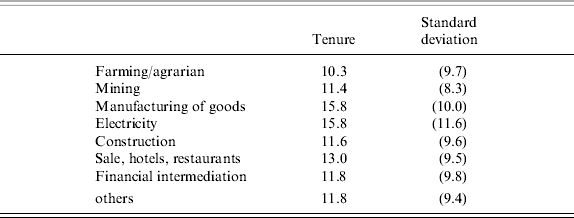
Mitchell and Andrews (Reference Mitchell and Andrews1981), were able to show differences across lines of business and regions for the US. We find regional effects for Germany, which can be identified clearly, whereas differences across lines of business cannot be identified clearly if we rely on models 2 and 5.Footnote 34 Households employed in Western Germany, both in 1995 and 2005, are statistically more likely to be included in a plan due to historical effects. Besides, households from Eastern Germany might have a different attitude towards old age financial provision, as they could rely more on state activity. The economic development of each region and its influence on firms may play an important role because those firms that face positive economic development are more likely to provide a pension plan due to higher ability to fund them. Differences in sector-specific demand and supply for occupational pensions may be related to historical background also. In construction, sales, hotels, and restaurants, historically it has not been usual to provide pension plans. Another possible reason might be that people employed in sectors such as farming and construction have a lower mean tenure than employees in other sectors (see Table 8). Therefore, they are less likely to provide for old age as they might need to rebuild capital stock, but evidence for this cannot be given in this analysis. It had been expected that the coefficient of financial intermediaries would have a positive sign, because this line of business is one of the external intermediaries to offer pension products and people employed in this sector might use information advantages to plan for old age. But we have to reject this hypothesis for 1995.
Mean tenure by line of business
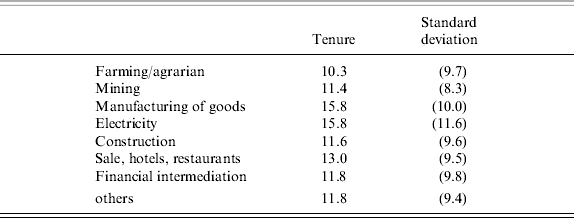
Note: Table 8 includes the mean tenure of people who are entitled in an occupational pension plan, numbers are given in years, standard deviation in parentheses.
Source: own calculations based on GSOEP, wave 12 (1995).
Firm size
As models 2 and 5 point out, firm size is an important factor. We find that a low level of pension plans occur in small firms. Households employed in firms with 5–19 employees have a significantly lower probability of participating in an occupational pension plan with lower duration than firms employing 2,000 and more employees. This can be explained by scale economies and the fact that large firms are more likely to have a historical background in plan provision. Furthermore, large firms are more likely to survive business cycle fluctuations and therefore are more willing to provide a pension plan. The dimension of payments depends on the duration of the plan.
Thus, we cannot reject hypotheses H 2and H 3.
Individual motives
To control for different attitudes towards saving we include variables in our analyzes that are supposed to capture the current situations of living, risk, and other savings motives for 1995 and 2005. The estimation results make evident that H 6cannot be rejected in either case. Households make up their own minds on their current standard of living. For 2005, we find evidence that the more they are satisfied with their economic situation and their standard of living, the more likely they are to save for retirement, as they want to maintain it. This could be deduced for 1995 also, but the coefficient of standard of living is not statistically significant. Contrary to our assumptions, the risk of becoming unemployed does not have a statistically significant impact. Neither in 1995 nor in 2005, after the crash of the ‘New Economy’, with an increasing number of unemployed people, do households save more for retirement if the subjective risk of becoming unemployed rises.
If households expect to have a longer life expectancy, they are more likely to participate in a pension plan as can be seen from models 3 and 4, which is some evidence that over time information about financial problems in old age arising from demographic change increased. These households tend to be aware of the need to depend on more than the mandatory social security programs.
Summarizing, we find that individual income, marital status, age, and being employed in a small or large firm have a huge impact on the decision by a person to stay in a pension plan and to save for a longer period. This is supported by different savings motives. Differences across lines of business could not be identified clearly across all models.Footnote 35
4 Conclusion
Currently pension savings are decreasing in large companies. Others underestimate the costs arising from offering a pension plan to employees. In most cases, a decrease is caused by the high position of pensions in the balance sheet, which causes poor ratings, resulting in worse conditions for receiving credits. Therefore, rating agencies ask companies to use pension funds or other instruments to reduce internal pension savings. Companies offer pensions to their workforce for several aims (e.g. economic, foresight, responsibility for the workforce). Therefore, it is important to evaluate who the people are who adopt an occupational pension. In this analysis, we have shown, using econometric methods, that differences exist both across SMEs and large firms, as well as across regions. Our results are supported by other descriptive studies carried out for Germany, which indicate that a gap between different firm sizes occurs. We point out that the supply of pension plans differs across lines of business, which might be due to different historical backgrounds and economic performance. Differences concerning claims of pensions and entitlement duration could not be identified across lines of business. We furthermore found that younger cohorts save less via occupational pensions, which might be caused by a lack of knowledge about different kinds of products or even of the necessity for additional old age provision. Besides information problems, young people might have a higher discount rate than older people and prefer to spend more money on consumption and do not care for old age. Less provision by single adults and households with children could not be identified in 1995 but in 2005 the probability of having a company pension decreases with the number of children.
Concerning information differences across individuals, it would be interesting to investigate the effects of individual labor union membership in future studies. Freeman (Reference Freeman and Wise1985) uses information about labor union membership based on the model of union monopoly power, as these institutions are able to collect and pool information and afterwards pass it on to their members, showing both theoretically and empirically that it has a positive influence on pension plan demand. This is due to the fact that labor unions have a huge impact on wage discussions as well as on offers of fringe benefits. Therefore, labor unions are supposed to have a greater impact on offers of pension plans. Empirical evidence on the impact of labor unions on labor compensation by cash wages and fringe benefits is provided by Long and Scott (Reference Long and Scott1982). Besides, the willingness to participate in an occupational pension plan could be dependent on individual payments to the statutory pension system. It could thus be expected that those paying small amounts to the statutory system are aware that they will not receive large paybacks at retirement age and hence do demand occupational plans. Even a distinction between defined benefit and defined contribution plans and the way of financing these plans could have an effect on provision behavior. Due to data limitations we have not been able to examine this.
Important determinants of saving for retirement are individual attitudes and satisfaction with standard of living. These have been measured by several variables. The more satisfied people are at present, the more they want to maintain it in future and therefore care more about providing for retirement. According to Terry and White (Reference Terry and White1998: 25), management aspects concerning occupational pensions are of importance, as employers should inform their employees about future shortfalls in public pension systems and the need to prevent more. To eliminate the named gaps, further research needs to be done on questions concerning the possibility for the state to set incentives for both employers and employees to adopt a pension scheme and improve information policies.