1. Introduction.
Several approaches, such as homonyny, monosemy, and polysemy have been developed in the past to account for the existence of multiple distinct meanings associated with one lexical form. Within the framework of Cognitive Linguistics, the polysemy approach receives support from many studies of spatial particles in English and other languages (Bellavia 1996; Brugman 1981; Dewell 1994, 1996; Kreitzer 1997; Lakoff 1987; Sandra and Rice 1995; Taylor 1986; Vandeloise 1991, 1994).1
I use spatial particle since it is the broadest term and subsumes such categories as preposition, verbal prefix (separable or inseparable), nominal prefix, adprep, and part of a compound preposition (such as hinüber).
The purpose of this paper is fourfold. Primarily, it sets out to test Tyler and Evans's methodology on the German particle über (the closest counterpart of the much studied over) in order to see whether it is applicable to the investigation of other languages. Since Tyler and Evans rely on general principles of Cognitive Linguistics, such as profiling and topological extension, if their analysis is accurate we would expect the model to apply generally to other languages and possibly to be adaptable for the purposes of establishing polysemy networks of not only particles, but of other functional categories as well (for example, modal verbs). The second purpose of this paper runs parallel to the task of testing the methodology, namely, establishing a network of senses for über. Thirdly, this paper attempts to provide insights into the thorny issue of (in)separability of German particles when combined with verbs—an issue I believe to be inherently connected with the semantic structure of the particles. Finally, through the analysis of über, I augment the semantic structure of over established by Tyler and Evans.
2. The Principled Polysemy Approach.
Lakoff's (1987) “full-specification” approach to the creation of the semantic network for spatial particles has been criticized in the literature for mainly two reasons (see Dewell 1994; Kreitzer 1997; Sandra and Rice 1995). First, by attempting to build too much redundancy into the semantic representation, his model provides an unconstrained semantic network with a vast number of distinct senses, which disregards the role of sentential context and background knowledge. Second, Lakoff does not provide a methodology for identification of the senses, relying primarily on his intuition. Kreitzer (1997), in particular, attempts to constrain Lakoff's analysis by organizing the multitude of senses postulated by Lakoff under three image-schemas in which over represents a static, dynamic, or occluding sense. However, he does not offer an explanation as to how these three image-schemas are related to each other and relies too heavily on the ability of a formal linguistic expression to carry a rich fully-specified meaning, ignoring the fundamental human ability to draw on contextual clues and general background knowledge in interpreting linguistic input.
To overcome the deficiencies of both Lakoff's and Kreitzer's models, Tyler and Evans (2001:731–733; 2003) propose a methodology based on what the authors term “principled polysemy,” which means that a particular form, such as the spatial particle over, is associated with a number of distinct but related senses derived from a primary spatial sense in systematic and motivated ways. Central to the model developed by Tyler and Evans is the role of real-world knowledge and inferencing strategies (such as best fit, real-world force dynamics, and topological extensions) in interpreting linguistically underspecified clues. The authors point to a difference between meanings constructed on-line with the help of contextual cues and senses that are instantiated in memory. This important differentiation helps limit the number of senses that are part of a semantic network of a particle and demonstrates that—at least for over—there are not as many senses as Lakoff claimed.
In explaining how new senses are derived from a primary spatial sense (or the PROTOSCENE), the authors appeal to two types of processes: experiential correlation (Grady 1997) and change of a vantage point, both of which are supported by a mechanism called PRAGMATIC STRENGTHENING or conventionalization of implicatures resulting from continued usage and ultimate entrenchment of usage patterns (Traugott 1989). Grady suggests that recurring correlations in our everyday experiences create conceptual associations between otherwise unrelated concepts. For instance, we recurrently observe increase in quantity manifested in vertical elevation, which gives rise to the entrenched metaphor “more is up” (see Lakoff and Johnson 1980), manifested in such sentences as The prices have gone up. This experiential correlation also gives rise to the “more” sense of over (for example, Over [= more than] five hundred people came to the concert). Once a sense is instantiated in memory as part of a semantic network, it can be employed to mediate relationships between non-physical entities—relationships that are functional rather than purely spatial.
Another process by which a new sense can emerge rests on what Langacker (1987) calls PROFILING. Profiling is defined as giving special prominence to only a part of a semantic structure, called the “base,” or, put in a less technical way, focusing on an element of a scene. Langacker claims that the same scene can be construed in different ways, but changes in construal will result in shifts in meaning (and often in changes in the linguistic realization of this construal). Tyler and Evans argue, for instance, that in a spatial scene in which the trajector (TR) is higher than the landmark (LM), a shift of perspective from off-stage to the speaker's viewpoint will result in a new sense of over, namely “on-the-other-sideof,” as in Arlington is over the Potomac River from Georgetown (2001:747).2
The difference between “trajector” and “landmark” exemplifies a general cognitive phenomenon of figure-ground organization and has to do with a relative prominence of one entity (TR) vis-à-vis another (LM). Within a conceptualization of a relation, a TR is singled out as the primary focus of attention, whereas an LM has secondary focus.
Based on the above mechanisms, Tyler and Evans suggest that for a particle meaning to count as a distinct sense in a polysemy network, it must satisfy two conditions. First, a sense must contain additional meaning not apparent in any other senses associated with this particle. Second, “there must be instances of the sense that are context-independent, instances in which the distinct sense could not be inferred from another sense and the context in which it occurs” (2001:731–732). Applying these two criteria, the authors found fourteen distinct senses for the spatial particle over; they also proposed five criteria for identifying the primary sense, or the protoscene (see below). In the semantic network for over, several clusters of distinct senses are derived from the reanalysis of the prototypical scene. In some cases a distinct conventionalized sense arises from another distinct sense, rather than directly from the protoscene. Below is a list of the distinct senses associated with over (Tyler and Evans 2001:746):
- 1. Protoscene
- 2. ABC trajectory cluster:
- 2A. On-the-other-side-of sense
- 2B. Above-and-beyond (excess I) sense
- 2C. Completion sense
- 2D. Transfer sense
- 3. Covering sense
- 4. Examining sense
- 4A. Focus-of-attention sense
- 5. Up cluster:
- 5A. More sense
- 5A1. Over-and-above (excess II) sense
- 5B. Control sense
- 5C. Preference sense
- 6. Reflexive sense
- 6A. Repetition sense
3. Principled Polysemy and a Semantic Network of über.
German-German dictionaries (Wahrig 1994, Duden 2001) and grammars (for example, Schmitz 1961, Schröder 1986) usually give lists of different usages and meanings of spatial particles. However, the variability of those lists indicates that there are no set criteria that could be applied to identify the distinct senses of each particle. To the best of my knowledge, there are only two accounts of German über from a Cognitive Linguistics perspective that attempt to explain the semantic structure of über, rather than simply listing its uses the way traditional treatments tend to do. Concerned primarily with the issue of (in)separability of particles as verbal prefixes, Dewell (1996) investigates the range of senses that appear in prepositional and prefixal uses of über. Following Lakoff and Brugman's analyses of over, he assumes that über is primarily a path preposition—but with an arc trajectory rather than a flat “across” one.
Bellavia (1996) investigates the meaning of über across the three domains of its use: as a preposition and as a verbal prefix, separable and inseparable. Basing her analysis on the examples from the Wahrig 1978 and Duden 1981 dictionaries, she proposes a network of eight schemas that represent various spatial configurations inherent in this particle (p. 105):
- 1. TR above the LM, -motion
- 2 TR above the LM, +motion
- 3. TR above the LM, crossing LM's boundaries along the horizontal dimension, -contact
- 4. TR crossing LM's boundaries along the horizontal dimension, +contact
- 5. motionless TR at the endpoint of a path represented by schema 4
- 6. TR moves along an arc trajectory beyond LM obstacle (+/-contact)
- 7. TR crosses the LM's boundary along the vertical dimension (where LM is conceptualized as a container)
- 8. TR entirely covers the LM.
She further applies these spatial schemas to what are called “extended” or metaphorical meanings of über (p. 83), which cover control, excess, time, and beyond metaphors. Again, the weakness of Bellavia's treatment of über is the lack of a consistent approach to establishing the schemas, without which she runs the same risk as Lakoff in positing too many or too few meanings that speakers associate with über (why, for instance, is the “+/-contact” feature irrelevant for schema 6, whereas it is the only feature that distinguishes schemas 3 and 4?). Moreover, although Bellavia offers a network of schemas connected to each other, she does not explain the mechanisms behind these connections or the schemas' connections with the “extended” meanings; nor does she offer any argumentation as to why the ARC schema represents the central meaning of über. Bellavia's and Dewell's treatments of separable and inseparable prefixes is discussed in more detail below.
As in the investigations of the semantic structure of über mentioned above, my examples and their interpretations stem from what is available in German-German dictionaries (Wahrig, Duden, Langenscheidt 2003), and additionally from grammars (Schmitz 1961; Helbig and Buscha 1970; Schröder 1986), a novel (Richter 2001), and insights of adult college-educated native speakers who were interviewed for this study.3
The following methodology was used. First, I asked two college-educated native speakers (NS) of German to translate into German all sentences with the particle over from Tyler and Evans (2001) in order to establish a basis for comparison between over and über. The NSs were instructed to use the particle über in their translations where possible (as a preposition, adprep, or a verbal prefix). During interviews, they explained why they could not translate some of the expressions with over into German using über and elaborated on the anomalous readings of the sentences one would get if one were to use über with them (for example, see 10b below). Then, I augmented the list of translated sentences with sentences that represented additional shades of meaning for über, which came from the German-German dictionaries and from the grammars mentioned above. In one-on-one interviews, I asked five additional NSs to judge each sentence on its acceptability and briefly elaborate on a context in which each sentence can be used. All NSs were young college-educated adults (between 25 and 34 years old) from different parts of Germany, who had been living in the United States between one and eight years. Subsequently, I enlarged the database of sentences for this analysis even further by adding to it all instances of über found in the first five chapters of a contemporary German novel (Richter 2001). While these instances constituted naturally occurring uses of the particle (in contrast to presumably artificially constructed sentences in dictionaries and grammars) and while the novel provided rich context for interpreting their meanings, I did not include these sentences in this paper, mainly due to their length.
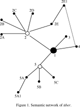
Where appropriate, I use Tyler and Evans's terminology for labeling the senses, for the purposes of comparability of the semantic networks of over and über. Due to space constraints, I only briefly summarize Tyler and Evans's analyses of the following senses of over, much of which is also applicable to über: the protoscene and “covering,” “over-and-above,” and “control” senses. Figure 1, a preview of the remainder of this paper, represents the proposed semantic network of über, which subsumes 13 distinct senses. In accordance with Tyler and Evans's signs, the primary sense is denoted by a large shaded circle in the middle, distinct senses by smaller shaded circles, and clusters of senses by an open circle. The dotted line between senses 4 and 2E1 indicates the alternate route for the “causality” sense discussed below.

Figure 1. Semantic network of über.
3.1. The Primary Sense (1).
The polysemy network approach presupposes that the prepositions are organized around a primary sense (protoscene), which is stored in the memory as an abstracted representation of the spatial scenes we encounter in the real world (for an overview of a polysemy approach within Cognitive Linguistics, see Smith 2005). Tyler and Evans offer five criteria for determining which sense should be considered a primary one: diachronic evidence, predominance in the network (the unique spatial configuration that is involved in the majority of distinct senses in the network), use in composite forms, relations to other spatial particles, and grammatical predictions. In this section, I apply these criteria to über in order to determine which sense is primary, that is, which sense gave rise to other senses in the semantic network.
Brugman's (1981) and Lakoff's (1987) work has established a tradition among cognitive linguists to see over primarily as a path preposition (Dewell 1994; Taylor 1986), disagreeing only regarding the shape of this path: a curved arc-trajectory or a flat “across” one. As I mentioned above, in their analysis of über, the closest counterpart of over in German, Bellavia (1996) and Dewell (1996) similarly argue that the basic meaning of über is a spatial scene in which a TR is—at some point of its path—higher than the LM. In contrast, Kreitzer (1997) asserts that the primary spatial scene for over is a non-path, static image (represented in the sentence, The hummingbird hovered over the flower), the secondary sense being a linear trajectory (as in The bridge stretches over the river).
However, regardless of the shape of the trajectory, these analyses presuppose that spatial prepositions profile dynamic temporal relations between TR and LM, which contradicts Langacker's (1992:292) assertion that spatial particles profile atemporal relationships (the ones that do not evolve over time but rather are scanned in summary fashion). Both Kreitzer (1997) and Tyler and Evans (2001:742) argue that a path component that presupposes movement is coded by the verb rather than by the particle over, and that the representation of a particular trajectory is not stored in the semantic network of either the verb or particle, but comes from our knowledge of the world, in general, and force dynamics, in particular. Wunderlich (1983) makes the same argument for über. In fact, if we compare the two uses of über in 1, the spatial configuration remains the same (TR is higher than the LM), and the understanding of the dynamism in 1a comes from the verb.

Therefore, the primary spatial scene (or the protoscene) for the particle über does not include path (see figure 2).

Figure 2. Protoscene.
Determining which schema represents a central meaning for über— an across trajectory, an arc trajectory (which presumably both subsume a static “higher than the LM” configuration), or a static configuration as represented above—is ultimately an empirical question. Evidence from future studies in child L1 acquisition and in psycholinguistics may lend evidence in support of one theory or another, but for the remainder of this paper I assume that the primary sense for über represents a static locational configuration.
One of Tyler and Evans's criteria for establishing a primary sense also lends support to this assumption: the “compositional sets” criterion postulates that particles divide the space in particular ways and partially co-determine each other's meaning. The compositional set that divides vertical dimension in German includes über and unter, and the sense that distinguishes über from unter is that the TR is located higher than the LM (as opposed to “lower-than-the-LM”). It is hard to imagine that anyone would argue that the primary spatial schema for unter is an inverted arc trajectory. In fact, it is impossible to juxtapose the TR's movement along the arc trajectory above (for über) with below (for unter) the LM (see 2). At the same time, however, it is entirely possible to juxtapose the static “higher-than-the-LM” sense of über with the static “lower-than-the-LM” sense of unter when the entire action—being or flying—takes place at a static location above or below a specified LM (see 3 and 4).


The other four criteria also point to the “higher-than-the-LM” sense as being the primary one. I review them in turn.
(i) Earliest attested meaning. According to a German etymological dictionary (Pfeifer 1989), the formation of über can be traced as far back as the Indo-European form +uper(i), which meant above and described a spatial scene where the TR is higher than the LM.
(ii) Predominance in the semantic network. The reader can see from the analysis below that the majority of senses for über are derived directly from the “higher-than-the-LM” sense and involve a spatial configuration in which the TR is higher than the LM (“higher-than-the-LM,” “focus-of-attention,” “covering” senses, as well as the Up cluster).
(iii) Use in composite forms. Tyler and Evans suggest that participation in composite forms cannot directly determine the primary sense, but the failure to participate will exclude the sense from being considered as a primary sense. As demonstrated below, the analysis of the use of über as a verbal prefix shows that the higher-than-the-LM sense is relatively productive in coining new word forms.
(iv) Grammatical predictions. This criterion postulates that a number of senses should be directly derivable from the primary sense or, if derived from another sense, that other sense should be traceable to the primary one. It will be evident in my analysis (and is graphically represented in Figure 1) that the higher-than-the-LM sense has given rise to two clusters of senses, as well as to several distinct separate senses. There is no way, for example, to connect the “covering” sense with a “better” sense without going through the “higher-than-the-LM” sense.
There is an important caveat regarding the application of criteria i and ii above. Predominance of a certain sense in the semantic network does not guarantee in and of itself that this sense is the most frequently used one in the current spoken and written language. Only a systematic corpus-based analysis can reveal which sense or senses come out as the predominant one(s) in language patterns and which ones are used only sporadically and/or in highly marked or restricted contexts. Accordingly, frequency of occurrence may be considered a sixth criterion for establishing a primary sense. However, the results of its application may potentially contradict the results of the “earliest attested meaning” criterion, since over the course of a particle's use, the scope of its original meaning may shift significantly and no longer play an important role in the current usage or may even be completely bleached out in the process of grammaticalization. In case of contradicting results, deciding which of the two criteria is more important becomes ultimately a question of deciding how much weight should be attributed to the diachronic versus synchronic evidence in determining the particle's primary sense and whether diachronic evidence is relevant for the current shape of a semantic network.
3.2. ABC Trajectory Cluster.
What in previous analyses of über was described as various instantiations of an arc-trajectory appears instead to be representative of several distinct senses of über arising from reconceptualization of a recurrent scenario in which a TR starts out on one side of the LM and ends up on another, as captured by sentences such as 5 and represented in figure 3.


Figure 3. ABC trajectory.
Senses belonging to the ABC trajectory cluster profile a sequentially evolving process that is conceptualized in a summary format: what sets the senses apart is the change of viewing point as well as change of focus or, to use Tyler and Evans's terminology, change in the highlighted elements, which together yield different construals of the scene represented in figure 3. For example, we see below that in the “on-the-other-side-of” sense, point C is highlighted but the viewing point is at point A, whereas in the “via” sense the viewing point is off-stage and the entire trajectory is highlighted. In addition to changes in spatial construals, each sense invokes a different functional relationship between the TR and the LM (for example, going beyond a target in the “above-and-beyond” or LM serving as a medium for TR in the “medium” sense) associated with conventionalized implicatures that result from changing the vantage point. The ABC trajectory cluster consists of six distinct senses, each of which I examine in the sections below.
3.3. On-the-Other-Side-of Sense (2A).
If we assume that the primary sense for über is a static “TR-is-higher-than-the-LM” configuration and that the idea of motion along the path comes from the verb, how then do we come to understand the sentence in 6 to mean that the TR (“dog”) is dead? I would argue that this understanding comes from the “on-the-other-side-of” sense of über.

The first criterion for establishing a separate sense postulates that the spatial configuration between TR and LM has to be different from the one in other senses. Changing vantage point on a spatial scene can give rise to different construals and consequently to different senses. Tyler and Evans argue that the default off-stage vantage point in the primary sense shifts to the speaker's vantage point to produce the “on-the-other-side-of” sense. Consider the examples in 7, where this is clearly the case.

Not only the vantage point has changed, but there is also no motion verb in the above examples to prompt for a trajectory. Instead, über designates a spatial configuration in which the motion is complete and the TR is located on the other side of the LM, relative to the starting point of the trajectory. Thus, two criteria for establishing a sense are satisfied.
There are, however, some caveats. The Duden dictionary and Schröder's (1986:174) grammar describe the use of über in 7a as obsolete or colloquial, and the sentence was either completely unacceptable or at least somewhat odd to the young native speakers I talked to (although 7b was acceptable).4
Only one of seven NSs found the sentence Er wohnt gegenüber von uns unacceptable, although she considered it to be fine without “von uns.” Instead, she offered an alternative: Er wohnt uns gegenüber, which other NSs in their turn found unacceptable. This discrepancy may have to do with the fact that this particular NS has spent the most time (eight years) in the United States.
There are many more instantiations of the “on-the-other-side-of” sense of über involving overt LMs and motion verbs, as in 8.

In English, such cases present a clear picture: the understanding of motion comes from the verb, the shape of the trajectory from our knowledge of the world and real world force dynamics, and the “on-the-other-side-of” sense of over contributes to our interpretation that the TR (plane) made it to the other side of the ocean—in the absence of any information to the contrary. In German, however, the picture is complicated by the contribution made by the grammatical case of the LM—a situation that reveals an intricate “co-operation” between lexical (particle meaning) and category (case) semantics. At first glance—and this is the way the conventional wisdom goes—sentences 8 and 9 differ only in the case assigned to the LM, namely accusative or dative. German language students are often taught that when one wants to indicate that the TR crosses a boundary of a LM, one needs to use accusative; when it does not, then dative is to be used. From this, a misperception might arise that the meaning of “on-the-other-side-of” (as a consequence of crossing of a boundary) comes from the use of accusative case, and not from über.

Smith (1987), in his comprehensive inquiry into case semantics from a cognitive perspective, convincingly argues that in the prepositional domain the meaning of accusative is a changed relationship between TR and LM, which for spatial prepositions means a change in spatial configuration that holds between TR and LM. By contrast, dative signals that no such change has occurred. Crossing a boundary by definition means such change in a spatial configuration between TR and LM, therefore it has been associated with the use of accusative.
I conclude that the two meanings being contributed by accusative case and by über, respectively, are “change in configuration by crossing a boundary” and “on-the-other-side-of-a-LM,” whereby über specifies in which particular fashion the TR and LM changed their configuration: namely, that TR left the LM completely behind (as opposed, for instance, to the preposition in in combination with accusative, which indicates that TR was outside of a container-like LM and, as a result of a change, is now inside the LM).
We see that the use of accusative case is compatible with this sense, whereas the semantics of the dative often clashes with the “on-the-other-side-of” sense of über and, in fact, may not instantiate it. Consider the examples in 10.

While there is no problem interpreting 10a in the same way as 8, in order for the sentence in 10b to be somewhat comprehensible we must think of a ghostly apparition. Since there is no accusative case in 10b to support the “on-the-other-side-of” sense of über, we revert to this particle's primary sense, namely “TR-is-higher-than-the-LM” with no contact between them, which is supported by the use of dative. In a similar construction in 9, our knowledge of the real world and the fact that planes can move through air without contact with a LM allows us to arrive at an acceptable interpretation. The same real world knowledge that humans cannot walk suspended in the air leaves us the only option of interpreting 10b as referring to a ghostly presence capable of defying gravity and walking without contact with the LM.5
It is interesting that when the TR and LM are in immediate contact with each other, the meaning of the English particle across is also subsumed by the “onthe-other-side-of” sense of German über. Talmy (1983) describes “across schema” as “(motion along the whole length of) a horizontal path-line that runs perpendicularly from one edge to the other of a planar object bounded by two opposite parallel edges, where this plane is not ‘laterally collapsible’” (p. 259). While the motion is coded by the verb, the sense of crossing a border while in contact with a flat planar LM comes from across, but apparently this notion is not represented in German either by a separate particle or by a distinct sense of über. Consider the sentences in i and ii.

In both cases, the major spatial configuration remains the same: the TR is on the other side of the LM. It is from the sentential context that we understand that the TR was in contact with the LM: it is a necessary condition for the verb “to swim” to remain in contact with the LM, and a necessary condition of “to jump” to be out of contact with the LM, at least for some time. Therefore, the use of über in the first sentence fails the test for establishing a distinct sense.
Example 10b also highlights an important aspect of the über's primary sense, namely that there is no contact between TR and LM (although the lack of contact is not a necessary part of other senses of über, some of which actually arose because the “lack of contact” condition was suspended). If native speakers want to describe a spatial scene in which a TR moves or is situated higher than the LM and which in every other way is identical to the protoscene for über—except for the presence of contact between TR and LM—they would choose the particle auf. The TR (he) in example 11 is in contact with the LM (street) and, most importantly, there is no sense of the TR getting to the other side of the LM—otherwise the use of über would be necessary.

3.4. Medium Sense (2B).
This sense is invoked particularly often when the transmission of information is involved. The ABC trajectory is reanalyzed to focus the attention on its end point C, and is conceived of as follows: there is an implied transmitter at point A, who sends the information (TR), and there is a receiver at point C. The vantage point shifts from being “off-stage” to point C, or the end point of a trajectory. The LM is conceptualized as the medium that enables the movement of the TR along the trajectory from point A to point C, thus yielding a new functional relationship between the TR and the LM (see sentences in 12). Because of their prominent roles in this functional relationship, such LMs of über are never gapped, as opposed to some highly abstract gapped LMs in the “on-the-other-side-of” sense.

The “medium” sense of über is consistent with the communication metaphor entrenched in many languages. It indicates that people conceptualize communication as transmission of information via a certain medium. Bellavia (1996:99) rightly observes that the expression eine Anfrage über Fernschreiber übermitteln (‘to send an inquiry by telex’) is possible—and not redundant—because the two structures utilizing particle über (the prepositional phrase and the inseparable verb) focus on two different aspects of this metaphor. She suggests that the prepositional phrase introduces the medium, while the verb highlights “the action of crossing the transmitted object” (emphasis in the original). I would also argue that the two structures invoke different senses of über: the prepositional phrase invokes the “medium” sense, whereas the verb invokes the “on-the-other-side-of” sense (with a gapped LM).
From the English translations of the sentences in 12, it is evident that the “medium” sense is also part of a semantic network for the English over, although Tyler and Evans do not mention this sense in their analysis. However, this sense is inherent to both particles because the verbs erfahren/find out and klingen/sound fail to indicate either sense of motion or sense of transfer, and hence there is no principled way of deriving trajectory and medium readings from the sentential context. This conclusion, combined with a new distinct non-spatial relationship between the TR and LM discussed above, satisfies Tyler and Evans's two criteria for establishing a separate sense; therefore, we can extend the semantic network of over to include the “medium” sense as part of the “ABC trajectory” cluster. It is worth pointing out here that once a sense is instantiated as distinct within the semantic network, it can be employed to mediate relationships between non-physical (abstract) TRs and LMs, as attested in the sentences in 12. Below we also see this phenomenon at work when we discuss temporal, causality, and other senses of über.
3.5. Above-and-Beyond (Excess I) Sense (2C).
Without replicating Tyler and Evans's argument for “above-and-beyond” being a separate sense, which is applicable both to over and über, I note here that this sense of über includes two additional implicatures: that the LM serves as an intended target (rather than an obstacle) and that the TR moves beyond it, which is often reconceptualized as going too far or involving too much, as in 13a. This is one of several senses of the particle that gives rise to the use of über in composite forms, especially verbs, as in 13b,c.

3.6. “Via” Sense (2D).
Another reanalysis of the ABC trajectory is represented by the “via” sense, as in the sentences in 14.

The difference between the “via” sense and the rest of the trajectory cluster is that the “via” sense profiles the entire trajectory (not only its end point), the vantage point is still off-stage, and the TR comes into contact with the LM at the mid point B (see figure 4). This change in profiling not only adds crucial prominence to point B, but also shifts our attention to it from the trajectory's endpoint C (which may even be explicitly omitted from a sentence). This spatial configuration is especially apparent in sentence 14b, where the plane actually touches ground at the mid-point B of the journey (Frankfurt). The presence of a new configuration not evident in other senses of the ABC trajectory cluster satisfies the first criterion for establishing a separate sense, reviewed in section 2. Additional evidence, as Tyler and Evans argue, for the existence of a distinct sense is if a sentence is ambiguous because the immediate sentential context does not rule out one of the two senses that are competing in the interpretation (Tyler and Evans's second criterion). If we consider sentence 14b, we can obtain two readings: (a) we fly via Frankfurt (make a stop there and change planes), or (b) we physically fly above Frankfurt at the moment of speech (as, for instance, a pilot might inform the passengers on the plane).

Figure 4. Via sense.
3.7. Temporal Sense (2E).
Several predominantly spatial particles in English and German consistently give rise to temporal senses (for example, English: in, for, through, around; German: in, für, durch, gegen, am, um). Über also falls into this category. It is very common for different languages to conceptualize time in terms of motion and three dimensional space (Lakoff and Johnson 1999). German speakers do that in various ways (as attested by the above list of particles with a spatial sense), one of them being an ABC trajectory with the events located on it at different points. Sentence 15a is ambiguous: in one conceptualization, only the end of the trajectory—the end of a time period—constitutes the focus of attention of the speaker, whereas the vantage point is located at point A, at the moment of speaking. In another conceptualization, the vantage point is off-stage and the entire ABC trajectory is being profiled, which provides the reader with a durative (or in this case, repetitive) interpretation of the event. When über is used as a postposition, though, only the second conceptualization is possible, which is illustrated in sentence 15b (in English, the durative interpretation is conveyed by the verb's continuous aspect “been raining”).

Again, one of the signs that a meaning constitutes a separate sense is the ambiguity of a sentence when two senses compete for interpretation. For example, the sentence in 16 is ambiguous, depending on the larger context.

Although in their book Tyler and Evans do not deal with a temporal sense of over, it is evident from sentence 17 that over profiles a temporal relationship. In contrast to German über, over can only be used to indicate a durative aspect of a temporal relationship, and not a punctual one—the way über can in 15a.

3.8. Causality Sense (2E1).
Time is often characterized not in temporal expressions (one year, the entire day), but in terms of processes that take place during a certain time period. Thus, in sentence 18 duration of time is implied in the process of reading; the event (falling asleep) is conceptualized as a point on the time ABC trajectory, which is profiled in its entirety.

However, in addition to the purely temporal reading, this sentence has another interpretation, namely that the person fell asleep because of reading. This can be explained by the fact that temporal relationships are very often experientially correlated with cause and effect, and therefore we tend to interpret two co-occurring or subsequent events as one causing the other (whether we are right to draw such conclusions is another matter). Therefore, conditional and temporal readings can often be interchanged and augment one another.6
For instance, it is often possible in English to substitute if for when. When we talk about a condition, we automatically imply a certain moment in time when this condition is realized, and vice versa. Let us consider the sentences below in i–iii.

There is a clear conditional content-domain reading of i described by Sweetser: “‘his’ absence is a sufficient condition for ‘their’ leaving a message, in the real world” (p. 123). At the same time, the temporal reading is also implied in this sentence. When will they have to leave a message?—when they discover that he is already gone. By the same token, we can often read conditionality in the when-temporals, as in ii.

The temporal reading of this sentence is: at that point of time in the future, when the hearer wants to go to the movies, s/he should call the speaker (and then they can go together, or the speaker will organize the free tickets for the hearer, or give the hearer a ride, etc.). The sentence can also be read as: in case (if) the hearer wants to go to the movies, s/he should call the speaker. The conditional reading of sentence ii also satisfies the “sufficient conditionality requirement” proposed by Van der Auwera (cited in Sweetser 1990:113), with the hearer's desire to go to the movies being a sufficient condition for calling the speaker. Therefore, we can substitute the conjunction if for when, without changing much in the meaning of the sentence. This closeness in meaning must have given rise to polysemy of the conjunction wenn in German (meaning both if and when), which leads to the fact that the same sentence can be read as either conditional or temporal, depending on the context, as in iii.


Note that in these sentences über cannot be felicitously interpreted as “higher than the LM,” indicating that the implicature of cause is conventionalized.
3.9. Covering Sense (3).
Covering sense arises in the instances when the conceptualization involves two changes from the protoscene (“higher-than-the-LM” sense): the TR is larger than the LM and the vantage point shifts from off-stage (default) to higher than the TR, as exemplified in 20.

Our interpretation of 20 includes the understanding that the older layer of paint was obscured from view by the newer one. To evoke this interpretation, the TR does not have to be a continuous entity; it can consist of separate objects belonging to one class (or what Lakoff (1987) calls a “multiplex trajector”), as in 21.

We interpret 21 as “the entire room floor was covered with the child's toys.” It can be argued that in this case—because of the possible covering interpretation—über adds emphasis to the fact that there were a lot of toys on the floor, as if one almost could not see the floor itself.
The fact that we obtain a covering reading in 22, where the TR is not vertically higher than the LM, lends further support to the claim that the “covering” sense is instantiated in semantic memory for über and is not an on-line constructed meaning.

In addition to suspending the vertical superiority of the TR, the covering relationship “involves the suspension of a meaning component essential to the central [primary] sense, that is, lack of contact between TR and LM” (Taylor 1986:18). We saw in 10b above that the TR cannot be interpreted as being in contact with the LM, producing a nonconventional “ghost” reading precisely because the protoscene for über has a distance between the TR and LM as its inherent feature. In contrast to that, for the “covering” sense to arise, the TR and LM almost always have to be in contact with each other. The TR-LM configurations for 22a and 22b are schematically represented figure 5.

Figure 5. Covering sense.
3.10. Focus of Attention Sense (4).
Another change of vantage point leads to the development of a distinct “focus-of-attention” sense. The construal that gives rise to it is the result of the shift from the off-stage vantage point to that of the TR, with the TR's line of vision directed at the LM. Consider the sentence in 23.

This scene can be spatially conceptualized as a person (TR) sitting at the table with her upper body physically higher than the books on the table (LM) she is looking at. Since looking at an object entails focusing attention on it, we understand 23 as “she is focusing her attention on the activity of reading the books.”
Again, once instantiated in the semantic memory, this sense can be used to mediate relationships between non-animate as well as non-physical TRs and LMs, as in 24 and 25. In 24, the TR is an object (a book) that by itself cannot have the cognitive capacity of paying attention. However, deconstructing this conventionalized metaphor, we understand that the little girl was the focus of attention of the author who wrote the book.

In 25, the focus of attention (the LM) is a state of affairs, not a physical object or even a process.

Native speakers also discern the sense of causality in 25: not only the TR (I) cried about the death of the grandmother, but simultaneously because of it. The strength of Tyler and Evans's model consists precisely in allowing several senses to contribute to a particular interpretation, nuancing each usage of the particle. They specifically hypothesize that speakers may differ in the routes that they take in deriving interpretations (Tyler and Evans 2001:750). In this case, it is possible to arrive at the “causality” interpretation either through a temporal sense or through a “focus-of-attention” sense, depending on the overall context.
3.11. Up Cluster.
The four senses in this cluster arise from construing the TR as being vertically elevated or up relative to the LM. The upward orientation is generally quite meaningful in human experience; it is experientially correlated with such positive and desirable states as being strong, healthy, in control (see Lakoff and Johnson's (1980:14–21) discussion of ubiquitous metaphors such as “happy is up, health and life are up”), and consequently assigns a superior status to the TR relative to the LM—a characteristic absent from the primary sense of über.
3.12. “More” Sense (5A).
Vertical elevation and quantity are associated through experiential correlation (Grady 1997). For instance, when the level of water in one glass is comparatively higher than the level of water in another glass, we assume that the first glass contains a larger quantity of water. By the same token, because über is associated with a vertical elevation of the TR, an implicature of having more of some entity is associated with über. Hence, über can imply the larger quantity of some entity and can often be paraphrased by mehr als (‘more than’), as in 26.

A very specific instance of the “more” sense is present in the grammatical construction NOUN über NOUN, as in 27.

Our interpretation of this sentence is not only that there were very many people (if the speaker wanted to convey just that, then she would choose to say sehr viele Menschen ‘very many people’), but it also contains additional shading of surprise caused by the fact that there were more people than expected.
3.13. Over-and-Above Sense (5A1).
The “over-and-above” sense adds the interpretation of “too much” to the “more” sense, to which it is closely related. It probably originated from reanalyzing the scenes involving a container (LM), whose capacity has been exceeded by the excess of the TR (see Bellavia 1996:93–98). An excellent example of such a scene is provided by the sentence in 28: the rise in vertical elevation (and consequently rise in quantity) of the TR leads to the filling of the container to the point of exceeding its capacity.

Just like with the conceptualization of containment, TR and LM do not have to be physical entities:

In sentence 29, we conceptualize fun (Spaß) as a container, which can be filled with different activities or emotions characterized as amusing. When there is an excess of such activities and the capacity of the container is not enough to hold them, it results in “spillage,” which then defeats the purpose of the container and contradicts its name (in this case, “fun”). Another example of this sense for über is found in 30, where a person is conceptualized as a container whose capacity is exceeded by a certain behavior or activity.

In fact, Bellavia (1996:93–98) demonstrates that this sense is very productive in describing emotions because we conceptualize our bodies as containers for them. She is also concerned with a distinction between separable and inseparable prefix verbs, and points out an important regularity in the kinds of processes that are described with either separable or inseparable verbs. Whenever a process or an emotion fits a covering schema, then an inseparable verb is used, as in 31a,b.

When a process fits an out-of-the-container schema, it is expressed by a separable verb, as in 32a,b.7
Bellavia (1996) further places these regularities into a larger pattern: she argues that the ARC-schema is conceptually central for the prefix über in both separable and inseparable verbs, but if the TR “displaces from one point to another, the speaker uses the separable verb. While if the TR moves over the entire LM [that is, covers it], the speaker uses the inseparable structure” (p. 93). Bellavia extends this rule to cover the uses of separable and inseparable verbs describing spatial scenes, emotions, and “communication metaphors.” Although she provides interesting observations, they lack explanatory power to account for these regularities. In addition, it is not clear whether her hypothesis would hold if used to account for all the separable and inseparable über-verbs, since she looks at a semantically limited group.
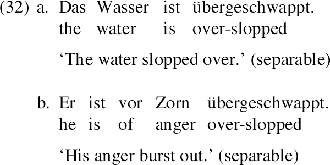
In accordance with Bellavia and the framework developed in this paper, one could say that inseparable verbs are formed with the “covering” sense of über and separable ones with its “over-and-above” sense. I return to this important distinction in the next section in order to examine the larger pattern of interaction between various senses and (in)separability of verbal prefixes. For now, note also that the “over-and-above” sense practically always has a negative connotation in contrast with another excess sense, “above-and-beyond.” This negative connotation comes from our understanding of the purpose of a container: it is supposed to “hold in” whatever we put in it. If the capacity of a container is exceeded, it no longer can serve its purpose, which we certainly perceive as a negative experience.
3.14. Control Sense (5B).
Due to an experiential correlation between control and vertical elevation, over becomes associated with a sense of control through the conceptualization of the TR as being vertically elevated relative to the LM. Therefore, for sentence 33 we get the reading of “being in control,” rather than the anomalous reading of the TR being higher than the LM.

The presence of the “control” sense in the network can be particularly well illustrated by juxtaposing two sentences that describe the same event:

Although the English translations are the same, the two sentences differ in a very important way, as described by Bellavia (1996:100): “in both sentences […] the horse goes beyond the fence but in [34a] the LM (introduced by the prepositional phrase) is conceived as the purely spatial reference point for the TR to go beyond; whereas in [34b] the transitive clause stresses the superiority of the TR over the LM (the direct object of the sentence) and the obstacle appears to be dominated by the mover” (emphasis in the original). Thus, in addition to the purely spatial understanding that the horse ended up beyond the fence, which comes from the “on-the-other-side-of” sense of the ABC trajectory, we also interpret this sentence as an achievement of the horse in overcoming an obstacle, stemming from the “control” sense of über.
3.15. Better Sense (5C).
In the sentences in 35, the TR and the LM are non-physical entities and the reading is that the TR is better than the LM.

The likely origin of this sense is the experiential correlation metaphor “up is good” (Lakoff and Johnson 1980). We associate the physical state of being up with wellness or other positive states, while being down is associated with negative states (such as, for instance, being ill).8
While Lakoff and Johnson based their analysis on English, I believe this metaphor is also applicable to German. However, it is important to remember that such metaphors are by no means universal.

4. Particle über as a Separable and Inseparable Verbal Prefix.
As has been already mentioned, the German spatial particle über can also function as a verbal prefix, which either separates when the verb is moved/conjugated (separable prefix) or stays attached to the verb (inseparable prefix). Traditional grammars (for example, Helbig and Buscha 1970) do not link the prepositional and prefix usage of über in their descriptions, although there is diachronic evidence that the transformation of a preposition into a prefix is a very old process for German (Wunderlich 1983). Besides, on a synchronic level the meanings of prefixes and spatial prepositions are clearly related, as evidenced in the examples provided in this paper. One common observation is that the separable prefix usually preserves the original local meaning of the verb, whereas the inseparable prefix either changes it (see 37a) or adds a new dimension that is not present in either the particle or verb when taken separately. At the same time, the “original” meanings of both the particle and verb are also traceable. In example 37b, neither the sense of “without paying attention” nor the sense of “death” is present in the meanings of über or either one of the verbs.

Although traditional accounts rarely look for further patterns or attempt explanations for the above phenomena, Dewell (1996) convincingly demonstrates that there are predictable regularities, semantic in nature, that underlie the alternations in uses of über as a preposition, or a separable or inseparable prefix. Dewell offers a compelling explanation for them based on a syntactic analysis that focuses on the sequence of processing the constituents.
Dewell observes that prepositional constructions and separable verbs are essentially similar, since they both describe spatial path scenes. In both constructions, über and the verb retain their independence as syntactic heads of their respective phrases. Prepositional constructions are used when the LM is significant enough to be mentioned (see 38a), while separable verbal constructions tend to occur in situations in which the LM is construed as a highly abstract boundary and is usually gapped (see 38b).

Since purely spatial scenes can be adequately described by the above structures, it is not pragmatically useful to employ inseparable verbs for this purpose. They only come into consideration “when the speaker wishes to mark the event as transitive (and aspectually more punctual, with a pronounced focus on the LM)” and thus fill “more specialized pragmatic niches” (Dewell 1996:117–118); for instance, in situations of overcoming an obstacle or skipping a grade, as shown in 39a,b. In short, inseparable constructions do not describe where the TR goes with respect to the LM, they describe what the TR does to the LM.

Dewell argues that there is an aspectual dissonance in sentence processing between the path profile of a compound inseparable verb and the transitive profile of the construction that inseparable verbs fit into. The path profile of über leads past the LM, which at the end of the trajectory is behind us and unaffected by the TR. By contrast, the transitive profile introduces the LM, which is directly affected by the action described by the verb, as the culminating event in the processing. Therefore, the tension between “a durative path leading beyond the LM and a transitive act implying a punctual arrival at the LM” (p. 126) forces us to interpret inseparable constructions as “acts” rather than “paths,” as well as endow them with additional specialized connotations.
Dewell (1996:129) contends that an “adequate analysis [of separable and inseparable über-verbs] will need to be embedded in a more general framework which includes studies of the other variable prefixes and of prefixes generally.” I wholeheartedly agree and would add to this list studies of particle semantic structures, since they may provide this kind of larger frame of reference in which the semantics of prefixal uses of these particles can be better understood and which would complement other approaches, such as Dewell's.
If we look at all über-verbs, we notice that they fall into several categories according to the senses of über combined with the root verbs. The overwhelming majority of inseparable verbs (both with concrete and abstract TRs and LMs) combines with über particles that express one of the following three senses (some of the verbs have already been discussed above):


In contrast, the use of über in separable verbs (again, with concrete and abstract TRs and LMs) can be traced back to three other different senses of über.


Note that one and the same verb, for instance überlaufen, may have up to four meanings (or potentially even more) arising from four different senses of über. The inseparable über contributes the sense of “covering” to the verb in 40a and the sense of “control” in 40b, whereas the separable über contributes the “over and above” sense to überlaufen in 40c and the “on-the-other-side-of” sense in 40d.

If we look at the senses that give rise to separable versus inseparable prefixes, we can see that the ones resulting in separable prefixes reflect purely spatial configurations between TR and LM, whereas the ones resulting in inseparable prefixes reflect not spatial but functional relationships. I would argue that the protoscene (for obvious reasons), “on-the-other-side-of,” and “over-and-above” senses reflect recurrent spatial configurations: TR higher than the LM, TR on the other side of the LM at the endpoint of ABC trajectory, and TR crossing the boundary of a container (LM), which is overfilled. By contrast, the three senses involved in the formation of inseparable prefixes all reflect functional elements not part of the spatial scenes from which these senses originate: the functional relationship of covering, going beyond the intended target (in the “above-and-beyond” sense), and control.
Such “division of labor” is consistent with the phenomena described by Bellavia (1996) and Dewell (1994, 1996). Inseparable verbs of motion take the auxiliary haben in the present perfect (and not sein) because they do not describe purely spatial scenes, where motion is the primary event and auxiliary sein would be appropriate. They are employed to describe “acts” or functional scenes precisely because the crucial contribution of the four senses of über mentioned above enables them to do so. The claim that purely spatial senses are involved in the creation of separable verbs is also consistent with observations made by many researchers that roots and prefixes in separable verbs maintain their autonomy (expressed in primary stresses on the root and on the prefix, and in freedom of movement of the prefix itself), and are often semantically “decomposable” into a verb and a prepositional phrase (see Heinisch 1977).
Given the above regularities, I would disagree with Dewell's (1996: 120–122) assessment that inseparable verbs (a) “fill particular niches” in non-spatial domains such as “overcoming, overwhelming, bypassing, or overlooking, […] surpassing or outdoing, […] and holistic perception,” or (b) are restricted to “transfer of possession, transmitting information, transfer of medium, or persuasion to change sides on an issue.” Relying too much on the specific semantics of the verbs and too little on the semantic structure of über as a particle (and not only as a prefix) leads to this high degree of granularity that obscures the larger trends suggested above. Dewell is both right and wrong when he says: “[inseparable] verbs can be traced semantically to spatial constructions, but they are variants specific to the particular verbs as units, filling restricted gaps in the lexical system, not general path images applied to other domains” (p. 121). Indeed, inseparable verbs do not represent path images (in concrete or abstract domains), since the senses of their prefixes are non-spatial ones. However, combining these non-spatial senses with verbs results in covering of large semantic domains and not simply “restricted gaps.”
If we consider all the über-verbs, we see that there are many more inseparable than separable verbs. Apparently, only a few verbs are readily combined with spatial senses of über, whereas many more verbs can harmoniously combine with non-spatial senses (at first glance, it is a very semantically diverse group of verbs). The question of what kinds of verbs are compatible with spatial senses of über and why merits further investigation.
Another challenge is presented by the inseparable verbs, the meaning of which possesses a new dimension not readily traced back to any of the senses of the prefix or to the meanings of the root verb. Very often such verbs have two diametrically opposed meanings. Compare the two meanings of übersehen in 41a,b.

The interpretation of 41a is more or less straightforward: it is prompted by the “covering” sense of über, and as a result we understand that the range of vision of the TR (I) covers the entire street. The interpretation of 41b is more complex: our understanding that the teacher missed a mistake probably comes from the “above-and-beyond” sense of über, which prompts us to conceptualize the LM (in this case “mistake”) as an intended target that was missed by the TR. What makes 41b more intriguing (and what makes the two meanings of the verb oppose each other) is the intentionality aspect: while the overseeing of the street is the result of an intended action, the mistake was missed inadvertently, and it is not an inherent feature of the “above-and-beyond” sense and actually contradicts another sense of über, namely “focus-of-attention.”
The same “lack of attention” meaning distinguishes one of the meanings of several other verbs from the “covering” sense: überlesen ‘accidentally miss while reading’ versus ‘quickly read something again to get the general meaning’; überschlagen ‘miss while leafing through a book’ versus ‘intentionally leave out a chapter in a book’; überhören ‘accidentally or because of lack of attention not hear something’ versus ‘intentionally not react to something as if not having heard it’; überfahren (as in einen Ampel überfahren ‘to accidentally run the red light’), etc.
Moreover, überfahren also means ‘to injure or kill by driving over’ and überstimmen can mean ‘to win the voting’ or ‘to reject or turn down a proposal’. The question is: where do the meanings of lack of attention, injury or death, winning, or rejecting come from? They are not part of the semantic network of über, nor are they part of the meanings of the root verbs: schlagen means ‘to beat, strike, hit’, fahren means ‘to drive’, and stimmen ‘to vote’.9
Note, though, that the scenario of driving does not exclude a fatal accident, just like the scenario of voting actually presupposes that one side will win, while the other side will be rejected. This is not to say, however, that “to drive” automatically means “to kill,” or “to vote” automatically leads to “to win.”
These additional meanings may be the result of the process of BLENDING studied in detail by Fauconnier and Turner (1994, 1996; see also Fauconnier 1997) and defined as a cognitive operation, which “consists in integrating partial structures from two separate domains into a single structure with emergent properties within a third domain” (Fauconnier 1997:22). To use Fauconnier's example, when we map the notion of a virus from the domain of health onto the domain of computers, we create a blended notion of virus that incorporates the properties of the source domains and goes beyond them. In the blend, the notion of virus is not restricted to the members of the input domains of health and computers anymore, but can create members in other domains, such as social or mental viruses. The crucial aspect of a blend is that it is typically richer than the input categories that are elaborated to create this emergent structure. It is quite possible that such a process is involved in the creation of some inseparable verbs.
Let us consider überfahren. If we assume that the meaning ‘to accidentally kill or injure while driving’ is a blend, we should examine the input domains of the root verb (driving) and the particle (über). Note that the blend inherits the structures of the input domains only partially, which means that not all of the features of the input scenario “to drive” will be incorporated in the blend. In this case, the processes of turning the wheel, speeding up, slowing down, or making turns are not relevant in the blend; what is inherited in überfahren is some kind of vehicle, big enough to harm a human or animal. Similarly, not all meanings of über will be relevant; the one that is probably most relevant is the sense of “control.” In the moment of contact with the vehicle, the victim of überfahren (LM) is under the total control of this vehicle (TR)—to the point that the victim cannot resist the vehicle's force that causes the victim's injury or death. While the implicature of injury or death is not inherent in the notions of driving or control, they are not incompatible with them, which allows the blend to emerge in the first place.
There is at least one more family of inseparable verbs, in which blending results in the added dimension of “transfer” or more specifically “change in possession” (übereignen, over+possess: ‘transfer possession’; überantworten, over+answer: ‘transfer responsibility for something’; übernehemen, over+take: ‘take over’; überreichen, over+give: ‘hand over’, überschreiben, over+write: ‘sign something over to someone’; etc.). Considering this systematicity, one could potentially argue that the sense of “transfer” is part of the semantic network for über and, therefore, produces the above meanings when combined with the verbs. However, such an argument would mean that we have to include the multitude of other meanings discussed above into the network, such as “death” or “lack of attention,” which would make the task of constraining the network practically impossible.
There is another factor that speaks against the inclusion of a “transfer” meaning, as well as the others, into the network: when used as a preposition, über does not exhibit any of these meanings, they only surface when the particle is fused with the root verb as an inseparable prefix.10
Note that for English over the “transfer” sense also arises only when over functions as an adprep, and not as a preposition (Tyler and Evans 2001:751).
The scope of this paper does not allow for further exploration of this issue. However, this question undoubtedly merits a deeper investigation within Cognitive Linguistics. Further research may reveal, for instance, why all senses of über are not as productive as the six discussed in forming either separable or inseparable verbs. It would also be extremely important for the support or refusal of the above claims to examine the semantic networks of other spatial particles participating in verb formation to determine if similar trends hold for them as well (that is, spatial senses for separable prefixes and non-spatial senses for inseparable prefixes). The application of the blending hypothesis to the shifts of meaning in inseparable verbs also deserves further investigation.
5. Semantic Network for über.
In this analysis, I have identified thirteen distinct senses for the spatial particle über, including the protoscene (see figure 1 above for a graphic representation of the network):
- 1. Protoscene (higher-than-the-LM)
- 2. ABC trajectory cluster:
- 2A. On-the-other-side-of sense
- 2B. Medium sense
- 2C. Above-and-beyond sense
- 2D. Via sense
- 2E. Temporal sense
- 2E1. Causality sense
- 3. Covering sense
- 4. Focus-of-attention sense
- 5. Up cluster:
- 5A. More sense
- 5A1. Over-and-above sense
- 5B. Control sense
- 5C. Better sense
In the process of the analysis of über, I have also discovered two additional senses for English over: “medium” and “temporal.” Below is the expanded list of over senses (with the added senses underscored and the senses that are common to both over and über bolded):11
This is not to suggest that these common senses for English and German particles cover exactly the same semantic space in both languages, but only where the closest correspondences between the meanings are; for instance, the “better” sense in the semantic network for über has many similarities with the “preference” sense of over.
- 1. Protoscene
- 2. ABC trajectory cluster:
- 2A. On-the-other-side-of sense
- 2B. Above-and-beyond (excess I) sense
- 2C. Completion sense
- 2D. Transfer sense
- 2D1. Medium sense
- 2E. Temporal sense
- 3. Covering sense
- 4. Examining sense
- 4A. Focus-of-attention sense
- 5. Up cluster:
- 5A. More sense
- 5A1. Over-and-above (excess II) sense
- 5B. Control sense
- 5C. Preference sense
- 6. Reflexive sense
- 6A. Repetition sense
6. Conclusion.
In this paper, I investigated the semantic structure of the German spatial particle über using the Polysemy Network Model proposed by Tyler and Evans (2003). Their methodology proved to be a helpful construct in identifying the distinct senses associated with über. In addition, it can be used potentially as a principled way of investigating other spatial particles and describing them in reference materials, such as German-German or bilingual dictionaries and teaching materials. To further strengthen Tyler and Evans's methodology, it might be useful to add one more criterion for establishing a primary sense, namely frequency of occurrence of this sense in the current spoken and written language. Additionally, it seems reasonable to postulate a German-specific criterion for determining distinct senses (for those particles that can function both as prepositions and prefixes): to be counted as distinct, a sense has to be instantiated when a particle is used as a preposition, and not only as an inseparable prefix. The examination of the usage of spatial particles as separable and inseparable verbal prefixes, and their contribution to the meaning construction in these and other composite forms, constitutes in my view a very promising direction for further research in the framework of Cognitive Linguistics.