With the coalescence of Pre-Angkorian polities from the late eighth century, continuing beyond the nominal date for the declaration of Angkor's independence in 802,Footnote 1 both the wealth flowing to the centre as taxes and tribute and the bureaucracy required to administer an enhanced territory were to increase substantially. This is seen in the inscriptions of the early Angkorian period containing new vocabulary for luxury goods, pointing to increased exposure to foreign trade and growing wealth, at least among the elite. There are also new terms for names and titles,Footnote 2 indicating a society more hierarchical than before.Footnote 3
The Pre-Angkorian societies which had preceded the Angkorian Empire (802–ca.1430) are judged to have been based on communal ownership of land, with temples fulfilling roles both as centres of economic integration and as components of elite assets justifying accumulation of surpluses.Footnote 4 The society already appears to have been stratified.Footnote 5 If the claims in the inscriptions written by officials two centuries later are accepted, Jayavarman II rewarded his followers with land, setting off a process of continuing privatisation which extended over three centuries. There developed an ‘official’ class, whose members owed their positions, directly through patronage or indirectly through inheritance, to the rulers and their associates. Their activities predominate in the Angkorian inscriptions, and while they would have increased in number over time through the inheritance of titles, they must have been relatively small in number.
Within a century and a half, the bureaucracy seems to have become complex and quite unwieldy, with large numbers of officials having a variety of titles and functions.Footnote 6 It is often difficult to see a demarcation between the roles of temple administrators, the bureaucratic class, high court officials, and the landowning benefactors of religious foundations,Footnote 7 given the temple officials who are buying land, endowing foundations, dealing in high value goods, acting as witnesses and administering levies.
Official titles varied in importance over time. Of note are the disappearance of the Pre-Angkorian poñ in the late eighth century, the introduction of the titles vāp, loñ, chloñ, teṅ,Footnote 8 teṅ tvan, steṅ/ steñ, kaṃsteṅ in the ninth century and the increasing proportion of elite titles in the eleventh century.Footnote 9 By the mid-eleventh century, chloñ Footnote 10 and vāp have disappeared from dated texts, and in the early twelfth century, loñ appear only as temple servants. The decline of these categories has been attributed to the civil war at the beginning of Sūryavarman's reign, in which the bureaucracy descended from followers of Jayavarman II was weakened,Footnote 11 or to later changes following the advent of the Mahīdharapura dynasty in 1080.Footnote 12 This article explores an alternative hypothesis, that economic pressures and social constraints, starting before Sūryavarman, led to the downgrading of this middle-ranking section of the society.
Much of our knowledge of Khmer society comes from the inscriptions placed on walls, door jambs and pillars within the precincts of well-endowed temples, and nearly always written by elites. They would have been composed from perspectives different from those of the communities which established the many more village shrines and small temples of the day.Footnote 13 The material evidence for this appears so great that Wheatley has described the Khmer landscape as resembling ‘one huge oblation’.Footnote 14 But since we have little in the way of written or indeed material records from small communities, we are restricted to what we find in the temple inscriptions. These deal to a large extent with temple matters: new foundations; royal edicts; donations; lists of personnel; disputes over property; temple treasure, etc.Footnote 15 They are not a compendium of information about the Khmer world, because, as Claude Jacques advises, inscriptions ‘must not be asked to provide more than they can deliver: the inscriptions are not history textbooks and only say what matters to them’.Footnote 16 Nevertheless, the inscriptions written by elite officials do tell us, albeit often incidentally, about some middle-ranking officials, who are often, though not always, fulfilling roles in events that were primarily of interest to the elite.
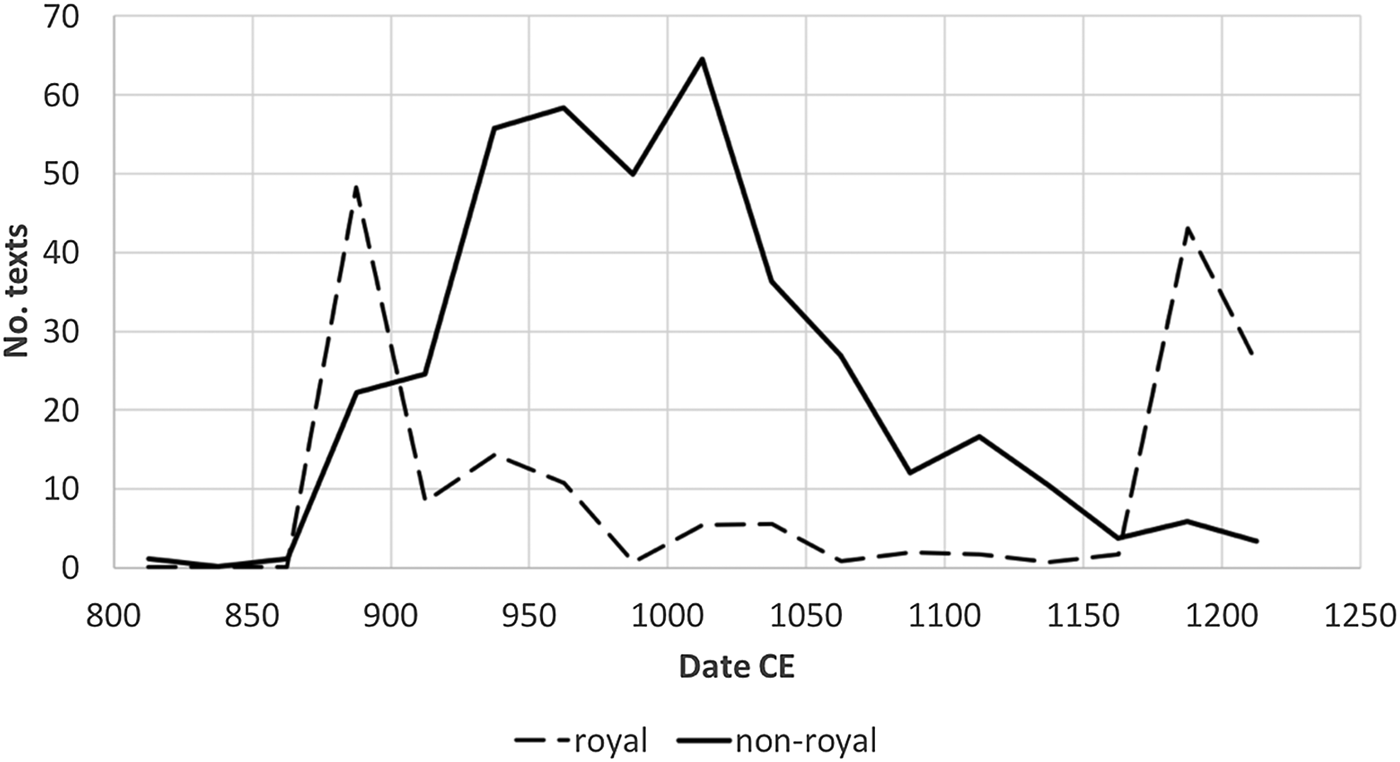
Angkorian inscriptions to the end of Yaśovarman I's reign (889–910) were written mainly by kings (fig. 1). Thereafter, and before Jayavarman VII (1181–1218), the majority of texts were non-royal, produced by officials from powerful families and the middle-ranking category of which the vāp and loñ were part. The number of these texts peaks in the second half of the tenth century, again at the beginning of the eleventh, and then there is a sharp decrease. We investigate whether there is a relationship between this decline and the decline of the vāp and loñ.
Royal (n = 170) and non-royal (n = 393) texts against time

To this end, we assess the relative status of each title, followed by the economic circumstances of the title-holders.
Middle-level officials
In order to elicit factors associated with the changes of fortune of the middle-level officials, we examine their representations in the inscriptions, their occurrences over time, their opportunities for promotion, their activities and roles.
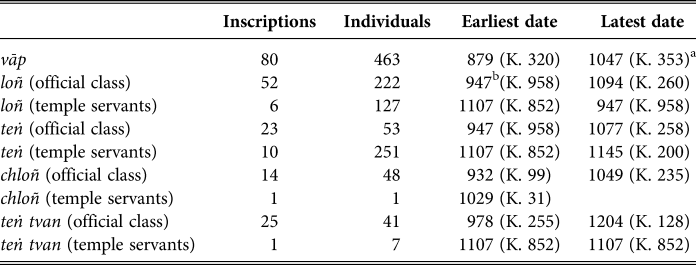
Although vāp and loñ have not been regarded as high-level titles,Footnote 17 this seems not to have always been so. Many vāp are said by their descendants to have been associated with or related through marriage to rulers and high-ranking officials, often the followers of Jayavarman II and his immediate successors, but none are descended from royalty. Tenth to eleventh century texts show vāp and loñ owning foundations, land and slaves.Footnote 18 Loñ, (and chloñ) and their female counterparts teṅ, are seen as not only associated with rulers and high-ranking officials, but occasionally as directly descended from royalty.Footnote 19 Some families appear to have had members who were either vāp Footnote 20 or loñ Footnote 21 over generations. However, there are instances where vāp, seemingly through marriage, are mentioned as relatives of loñ or higher-ranking individuals.Footnote 22 One explanation is that inheritance was through the female line, and passed often, but not always, from mother's brother to son.Footnote 23 We also see them together as residents of a village or belonging to the same varṇa or varga.Footnote 24 Vāp are mentioned more than twice as often as loñ. Women titled teṅ, many being relatives or spouses of loñ, are mentioned far less frequently. Tāñ (lady; wife) and me (mother) are also used, while teṅ tvan (women of higher rank), often donors of land and slaves, are seen in texts dated between 978 and 1204.Footnote 25 Table 1 summarises the occurrences of these officials in the corpus of Angkorian inscriptions.
Mentions of vāp, loñ, teṅ, chloñ and teṅ tvan in dated texts

Notes: a K. 235: D91 (1052) mentions three vāp, but the reference is to an event in 979. A vāp mentioned in K. 208 (1049–66) appears to have lived during a previous reign. K. 1074 (10th–11th century?) and K. 1001A (9th–12th century?) have uncertain dates. bAn earlier date for K. 252: 4 (942?), is uncertain.
Although there are earlier mentions of royal gifts of teṅ to temples,Footnote 26 it is only between 1107 and ca. 1150, that loñ and teṅ appear in significant numbers as temple servants, assigned to provide the allowances for the gods, or in columns and allocated to serve in alternate fortnights.Footnote 27 They are twice listed ahead of the typical temple servants si and tai, while in two texts, teṅ are in the company of the other commonplace temple personnel, gho, and not loñ.Footnote 28 In one inscription, several teṅ tvan are grouped together with teṅ and loñ.Footnote 29 Up to 1129, there are still texts with temple personnel who are gho or si and tai only.Footnote 30 As temple workers had in the main been si, tai and gho throughout the Angkorian period up to the early twelfth century, the appearance of loñ and teṅ, seemingly in similar roles, suggests a relative downgrading of the status of these categories. As the titles of loñ and teṅ appear to be hereditary, it may not be that the titles alone are being devalued over time.
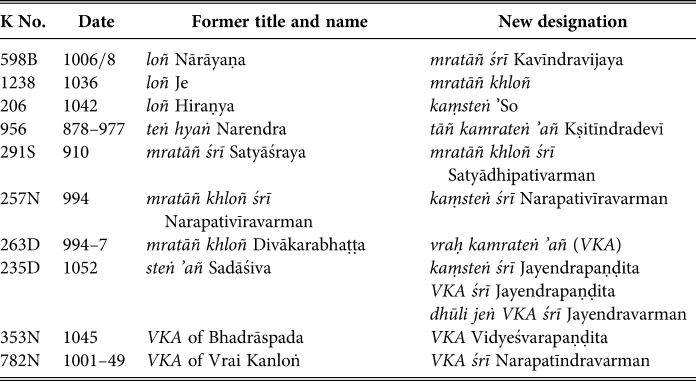
Loñ are placed mostly ahead of vāp in lists of officials, indicating a superior standing.Footnote 31 Indeed, only loñ and people of greater status — not vāp — are recorded as having been awarded higher-ranking titles (table 2). About 30 individuals, including high ranking women, were said to have received a higher appellation and/or new name from the early tenth to the mid-eleventh century. Eighteen of these were loñ. While the original personal name may have been Khmer (loñ + X), the name accompanying the new title was in Sanskrit. Many of the new titles also contain the term śrī, an expression of reverence. About half of the promotions recorded are for the reign of Sūryavarman I.
Examples of promotions

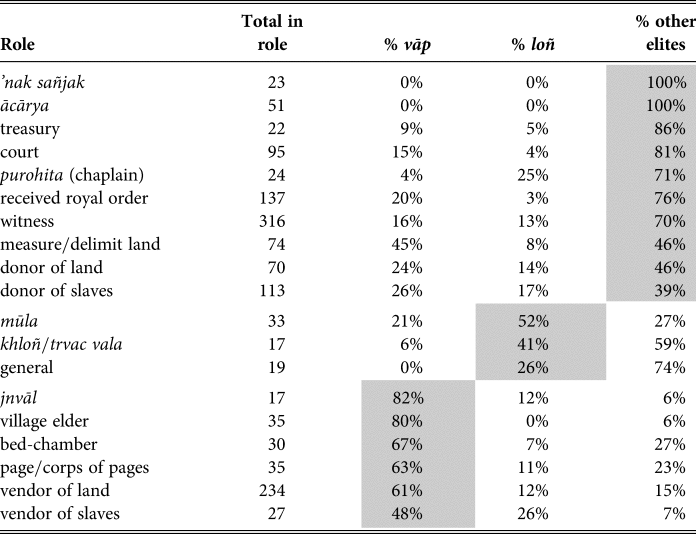
Further disparities in status become apparent when we compare the functions and activities of vāp, loñ and higher-ranking officials (table 3). Those identified as women are not included in this table, as they constitute only 11 per cent of all individuals and feature almost exclusively as donors and vendors of land and slaves.Footnote 32
Most frequently mentioned functions of vāp, loñ and other elites

Vāp dominate in several fields, notably as village elders, officers of the royal bed-chamber, in the office of jnvāl, and as pages. Significantly, vāp constitute 61 per cent of the 234 vendors of land. Officials with higher titles dominate prestigious roles, as might be expected.Footnote 33 Thus while some positions in the royal courts are filled by loñ and vāp, they are never chief justice or inquisitor. Broadly, where the percentages of vāp are high, the percentages of both loñ and other elites tend to be low. Loñ are found in a wide range of roles, but they are prominent only as mūla and khloñ vala. Five generalsFootnote 34 out of nineteen are loñ, but none are vāp. The rarity of vāp in high-ranking positions indicates again that they were of lower socioeconomic standing than loñ, who, as we have seen in table 2, could aspire to the roles and titles of the elite class.
Land and the religious foundations
Another way of discerning the status of the officials featured in the texts is to examine their holdings of land, a key resource, and a primary preoccupation of Angkorian inscriptions. Changes in status should be reflected in a capacity to maintain control over landholdings, and we argue, whether land is being acquired or relinquished. Assigning land to one's foundation in the name of a deity promised both an intangible benefit of enhanced merit and material gain from agricultural surplus, particularly if the foundation was granted fiscal or other immunities.
The desire for land
From the ninth century, religious foundations were being established not only by royalty, but also by associates of the rulers, elite families who were gaining possession of lands. We read of donations, purchases, sales and inheritance of land, and the delegation of authority to manage it. The produce of land (mainly rice), the producers attached to the land, and the levies imposed on the land's production are often mentioned. Many texts from the century between 950 and 1050 were written with the purpose of validating title to lands.Footnote 35 Several give details of disputes over ownership, which were settled by the courts and ratified by the king.
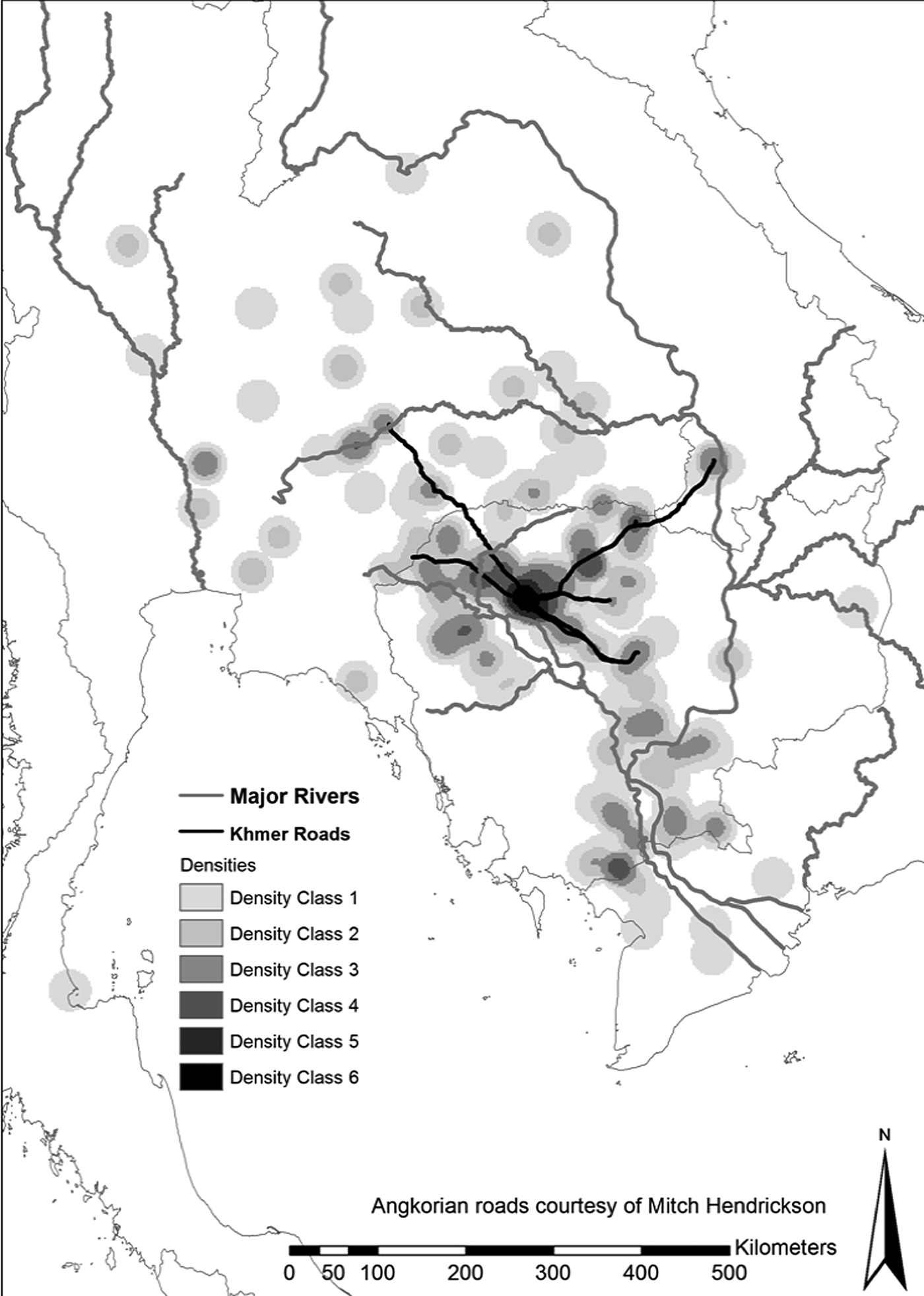
Figure 2 shows the densities of Khmer temple inscription sites for the Angkorian period. The highest density is in black at Angkor. Given that temples were mostly at population centres, it should follow that the greatest densities would be on favourable land, near water and communication routes.Footnote 36 Their desirability would heighten the potential for tensions over ownership, as is seen in the many tenth and eleventh century accounts by officials of grants, purchases, demarcations of land, disputes in court over land, and genealogies going back to the ninth century.Footnote 37 We shall argue that there was a crisis over land ownership for the families of middle-level officials from the mid-tenth century linked to the hierarchical structure of the society and the mode of taxation.
Densities of Angkorian period inscription sites (E.J. Lustig, ‘Using inscription data to investigate power in Angkor's Empire’, Aséanie 27 [June 2011], p. 49).

Pre-Angkorian inscriptions are unclear about individual ownership of land. Most people were likely living in small communities which consisted of extended kinship groups or religious foundations, growing rice and perhaps specialising in a particular craft or profession.Footnote 38 Yet there would have been private ownership by the Angkorian period at the beginning of the ninth century, because we are told that Jayavarman II rewarded some of his supporters with land grants.Footnote 39 The recipients and their descendants often acquired additional lands, in order to provide the means of support for religious foundations — temples and āśrama.
Merle Ricklefs has reasoned that the right to own land and the protection of tenure by law in tenth-century Cambodia applied to all free people in the society — not only elite officials — on the grounds that many landowners were vāp, loñ and me, who were often not of very high rank. The king's permission does not appear to have been required if land was given, purchased or sold.Footnote 40 Nevertheless, the texts mention a large number of land parcels said to have been acquired as karuṇāprasāda (royal grace), a royally sanctioned purchase or sometimes a royal gift.Footnote 41
Other grants made by kings were reassignments of lands which were without inheritors or unoccupied.Footnote 42 Occasionally, the circumstances of such allocations warrant scrutiny. The land on which Prasat Trapeang Rung was founded,Footnote 43 was said initially to be without an owner, and reallocated to a mratāṅ khloñ śri Kavīndrapaṇḍita, despite it being under the ‘sole’ authority of a vāp who was a khloñ jnvāl. When it transpired that the vāp had sold part of it, the buyers had to be compensated with a different tract of land of the same quality. This might suggest that the vāp did have some claim to the land from the outset. What may be significant is that the transfer of land from the sole authority of the vāp jnvāl, seemingly with little in the way of compensation, appears to have been viewed at the time, 1006, as unremarkable. Three earlier textsFootnote 44 report that the villages, with their fields, slaves and livestock given by Jayavarman V (968–1001) to two new varṇa were not to be taken back by their previous chiefs. One might wonder how willingly the chiefs had made those lands available. Notwithstanding our modern-day responses to these examples, we need to bear in mind that our understanding of the different kinds of Angkorian land tenure is imperfect.Footnote 45 This is highlighted in a text from Wat Damnak,Footnote 46 in which tracts of land were ‘given’ to a Vraḥ kamratāṅ ‘añ (VKA) Vīrendravarman by a teṅ tvan. When she died, a certain VKA of Vrac bought the land again from her grandson — suggesting that some rights had been retained by the original owner, despite the earlier transaction.Footnote 47
Merit, immunities and other rewards
There were both spiritual and material rewards for providing for a god. Gifts of land and other donations to a foundation are frequently recorded in the inscriptions as ‘works of merit’, presumably enhancing the donor's status before the gods and helping ensure a comfortable and prosperous afterlife. The value of a foundation's merit was such that it could be apportioned as if it were a commodity,Footnote 48 often presented as outweighing material gain and as the prime motive for actions. For example, following a dispute over a ricefield, the winner of a case ‘gave’ the land in question to Brahma in a ceremony conducted by the loser, who then asked for, and received the same land as an honorarium.Footnote 49 Again, in an elaborate ceremony for fixing the boundary markers of a temple's land, poetry was recited, assuring the king of the great merit accruing to him by granting land.Footnote 50
Sometimes, a foundation might be offered as a gift to the king, with a request for it to be a royal foundation (rājadharma).Footnote 51 The benefits from such a gesture, in the form of privileges granted to the founders and their religious establishments, must have been significant. The founders and their families often also benefited materially from the landholdings,Footnote 52 and many texts are quite explicit about the management of a foundation and who should inherit it. Inscriptions sometimes state that the foundation's deity had ‘exclusive rights’ to the land, its produce and other property,Footnote 53 but more often the founders and their descendants claimed these rights.Footnote 54 Violators of the specified provisions would be condemned to suffer eternally in the next world. There was sometimes, at best, a fine line between the property of a god and that of temple officials and their families. In one text from Wat Baset,Footnote 55 several parcels of land were granted by five officials to a VKA śrī Guṇapativarman. Upon offering these to the god, the latter presented the land to his three daughters. In another from Phnom Preah Net Preah,Footnote 56 the estate of an official to be inherited by his family included the slaves, sruk and ricefields of his two foundations.
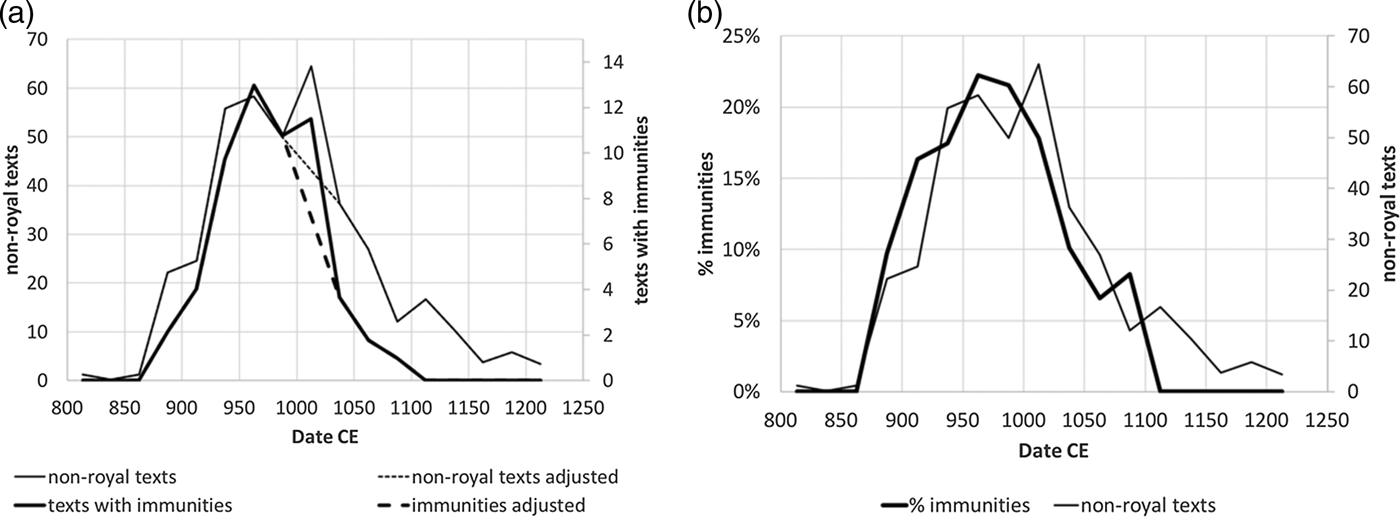
Rulers might also grant benefits to foundations and their communities in the form of immunities from the demands of local officials. In 52 texts, the authors stipulate that officials representing the state or local agenciesFootnote 57 must not extract taxes and corvée nor interfere with the running of their foundations.Footnote 58 This practice reached a peak in the second half of the tenth century and another at the beginning of the eleventh century, thereafter declining (fig. 3a). The last certain date for an immunity granted was the year 1082.Footnote 59
a) Non-royal texts (n = 393) and texts with immunities over time (n = 53); b) Non-royal texts and percentage immunities.

It should be noted that in the peak period of non-royal texts in figs. 3a and 3b, over half (36) of the 64 texts in the years 1000–1025 were produced in the period 1001–1006. Moreover, this very short interval has three-quarters of the texts recording immunities granted in these 25 years. This was the period of uncertainty and civil war over the throne under Udayādityavarman I (1001–1002), Jayavīravarman (1002–1006) and Sūryavarman. We suggest the heightened production of texts might be linked to an apprehension or desire to demonstrate loyalty to the particular claimant to the throne under whose authority people found themselves. From the perspective of the rival claimants, it could have made sense to grant immunities in order to harness support. The dotted, ‘adjusted’ lines in fig. 3 suggest how the two curves might have looked without this interlude, with only one peak in the tenth century.
While the curve for immunities seems to follow that for non-royal texts quite closely in fig. 3a, we can see that there is a significant difference in fig. 3b, which plots the percentage of texts with immunities granted. There, a single maximum of 22 per cent is reached in the mid-tenth century. This indicates that impediments to obtaining immunities were in place before the eleventh century.
Land transactions
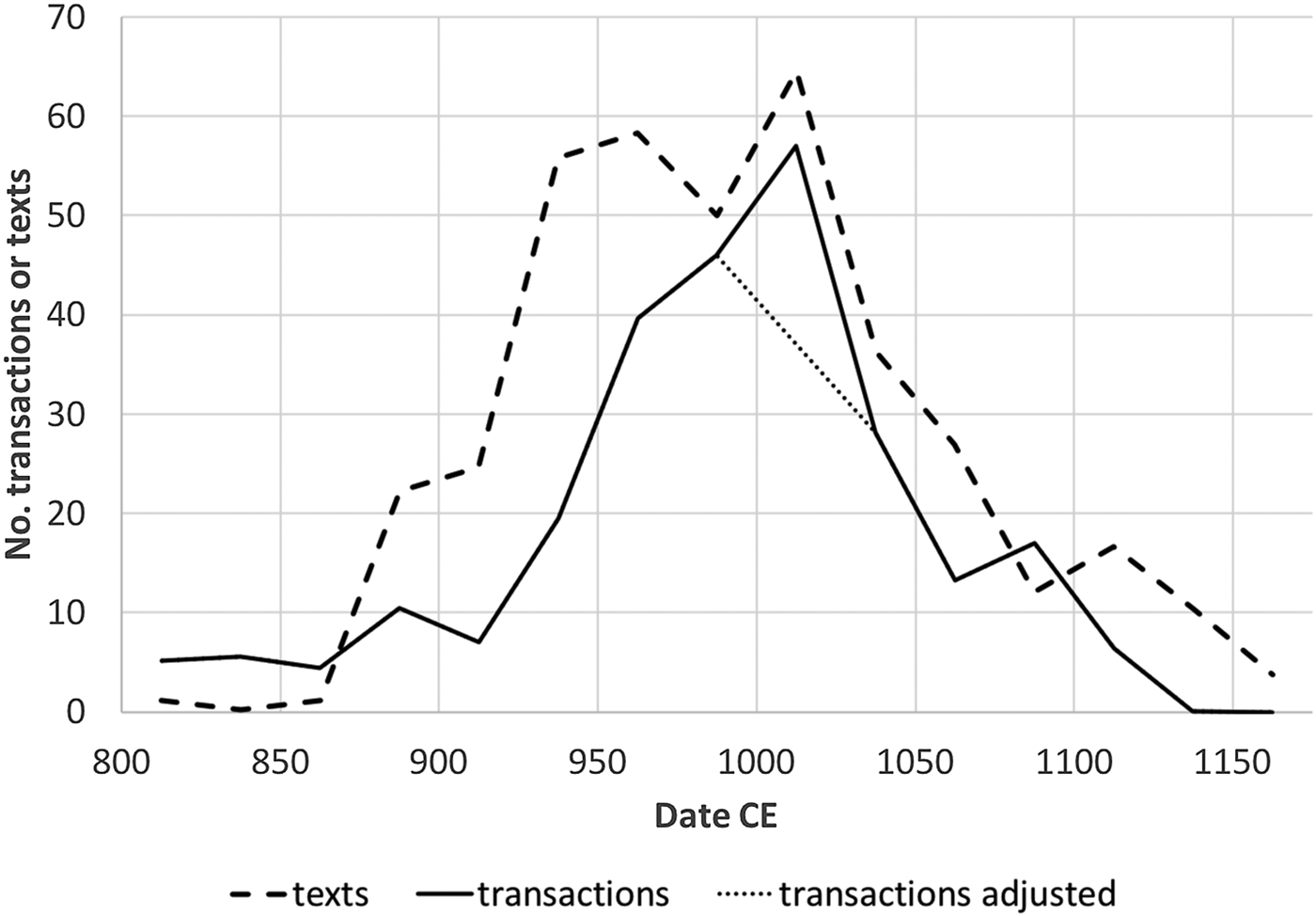
In the graph of the frequency of land transactions, fig. 4, we see again that the number in the first quarter of the eleventh century (57) is higher than at any other time. However, 30 of these took place in the troubled years 1001–1006. If we abstract away from the high activity in this period as before, the greatest number of exchanges might otherwise have been in the late tenth century, around the same time as the greatest number of immunities was granted.
Non-royal texts and land transactions (n = 260)

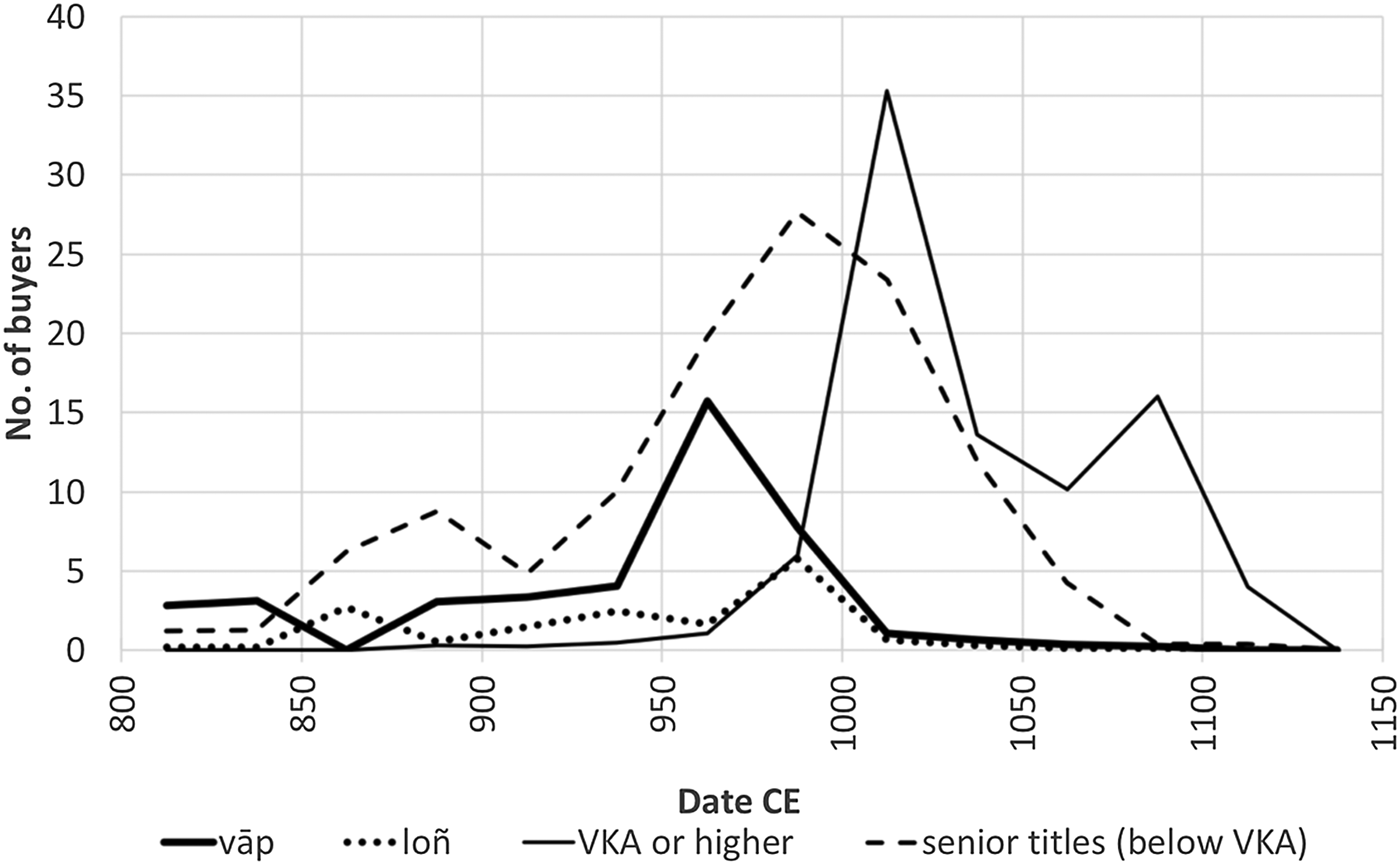
We next analyse these transactions in more detail, by examining the categories of people who are buying and selling land, and find a broad transfer to higher elites. Figure 5 shows the predominant buyers of land in each quarter century.Footnote 60 The small peak at the end of the eleventh century in fact records many purchases by a single founder in the Samrong inscription.Footnote 61 The rise of vāp and senior officialsFootnote 62 as buyers in the mid-tenth century is noteworthy, as is the near absence of loñ. Thereafter, loñ and senior officials begin to supplant vāp, and from the early eleventh century, the majority of buyers have the VKA or a higher title.Footnote 63 This pattern points to the transfer of land up the line.
Titles of land buyers over time

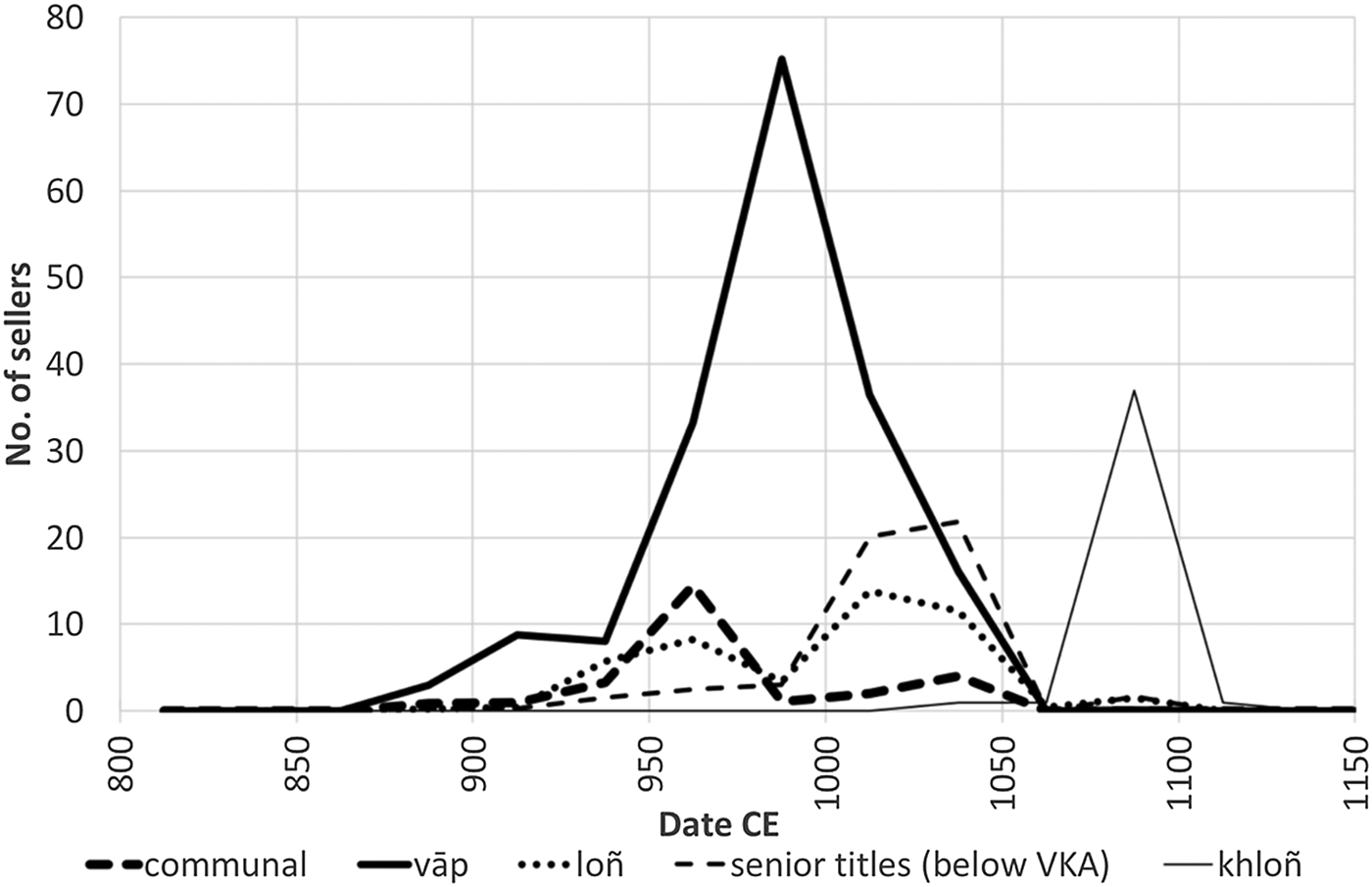
Figure 6 similarly depicts the main vendors of land. The predominant sales by vāp, peaking in the last quarter of the tenth century, represents a significant transfer from this class at the same time as more senior officials are becoming the principal buyers (fig. 5). At the turn of the eleventh century, sales by vāp are falling rapidly. As the purchases by loñ and the more senior officials are starting to decline, some of them are beginning to sell. The many vendors in the late eleventh century titled khloñ — something new — are almost all from the Samrong inscription.Footnote 64
Titles of land vendors over time

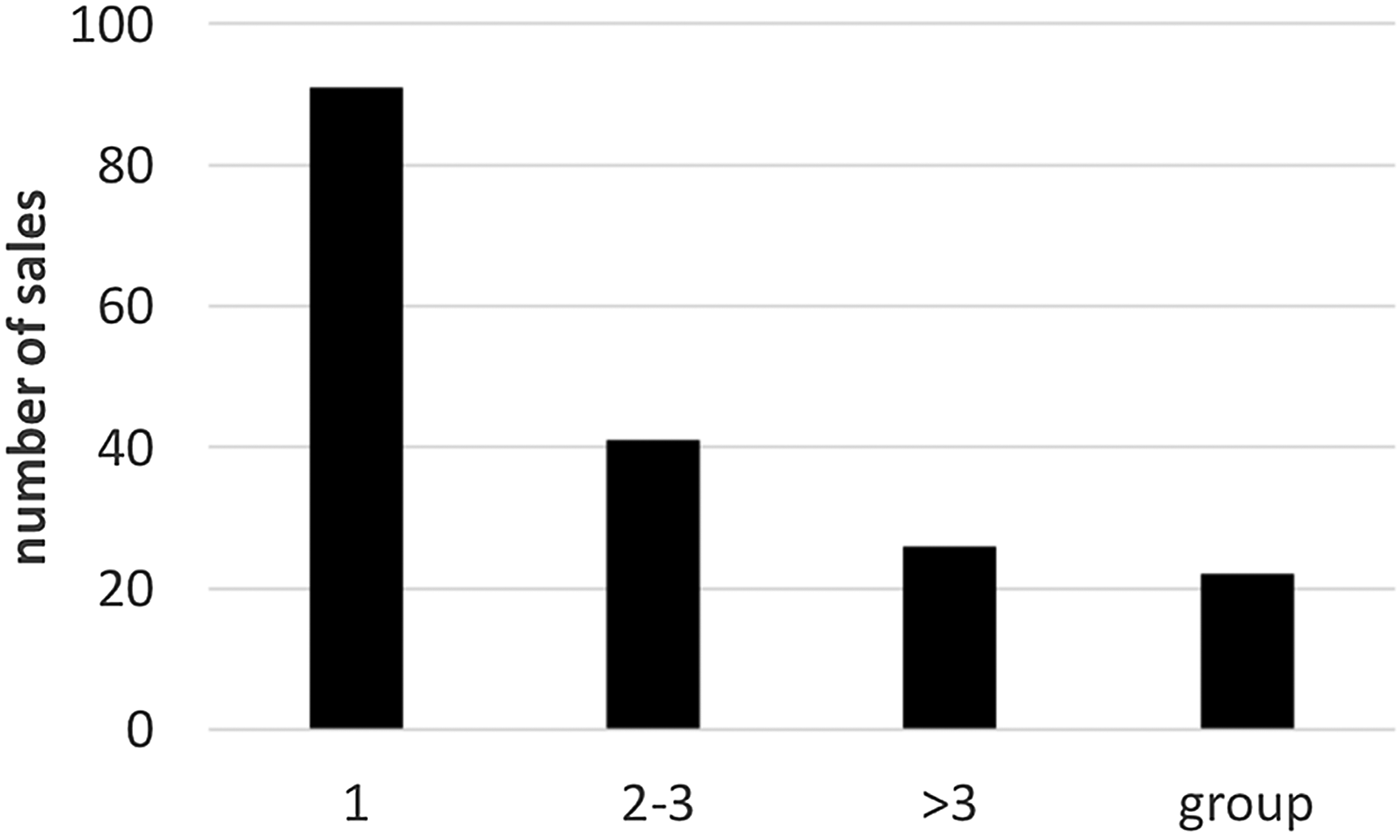
At the time when the vāp are most active as buyers, the principal vendors are communal entities (varṇa, varga, kinship groups or villages) or other vāp. In fact, we consider that communal sales were more numerous than shown in fig. 6, with many of the individual sellers (fig. 7) representing a number of vendors. In one text,Footnote 65 a loñ offers up a ricefield which had been purchased by a relative. In another,Footnote 66 a mratāñ khloñ, a member of the Aninditapura varṇa, is only the nominal vendor of some land, since three vāp, his relatives, received the payment. It is likely that other sales were of communally held land. We never see groups buying land, only selling it.
Land vendors per sale, tenth and eleventh centuries (n = 180)

We are told little about communal holdings, but in K. 1238 (1036), there are indications that even though land was communal, in that it could be sold communally, it was worked by families in individual tracts. Here we see that a number of loñ of the varṇa of cooks each required costly goods provided by a VKA śrī Narendravarman (of the same varṇa) to pay their rājakāryya (the royal service tax). The varṇa paid for all the goods with a single tract of land. Such a scenario has elements of both communal and individual entitlement, perhaps because the land and property originally owned by a whole varṇa was later allocated to individual families.Footnote 67 There still seems to have been communal ownership in the late eleventh century, since some of the sellers in the Samrong inscription were part-owners of several different tracts, while some tracts had vendors from different villages.
It is difficult to conceive of the payments for sales as representing equivalent values. Since money was not in use, land was purchased by means of costly goods. In a number of texts, notably the Samrong inscription,Footnote 68 any association between the prices paid for particular tracts of land and their size or productivity is not discernible. Nor is it always clear who actually received the exchange goods from communal sales. A Wat Baset textFootnote 69 lists a payment of 13 items, including an elephant, which, having first been offered up to the god, were reportedly shared among the family members of the vendors, who were two loñ and 13 vāp. Unless the shares were unequal, we might presume they were intended for a different destination (perhaps the temple god or the rājakāryya). At Banteay Prav,Footnote 70 14 vendors, between them representing several villages (perhaps a varṇa), together sold a ricefield to a kaṃsteṅ. The price paid was 10 liṅ (~60 g)Footnote 71 of white silver, about 4 g each. The ricefield might thus be considered a gift to the kaṃsteṅ’s foundation, or the merit gained perhaps valued as the greater part of the transaction.
Pressures and constraints
We suggest that transfers of land such as the above were not entirely voluntary, in light of the increasing pressures the middle-ranking landholders were experiencing.
Disputes over land
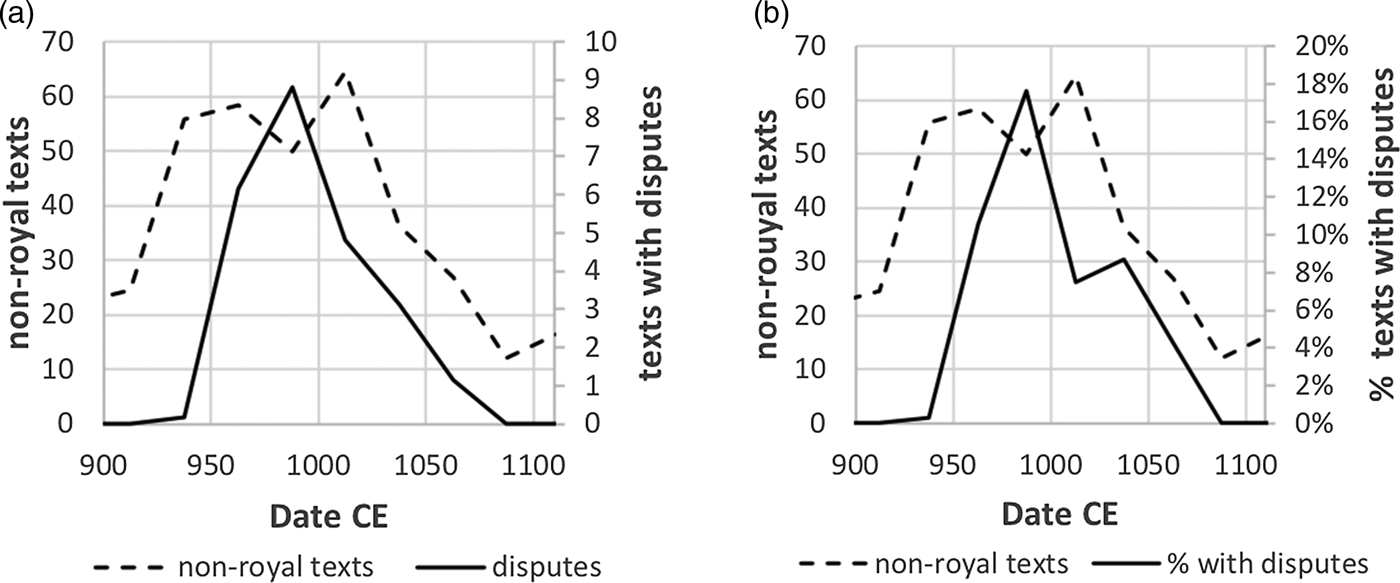
Of twenty-five disputes resolved by the courts,Footnote 72 sixteen had vāp either as litigants or defendants. Eighteen of the arguments were over land, and, while ten of these involved vāp, loñ are only mentioned twice.Footnote 73 Both the number of disputes (fig. 8a) and the proportion of texts with disputes (fig. 8b) reach a maximum in the late tenth century. This coincides with the period when the number of vāp selling land also peaks (fig. 6).Footnote 74 The disputes are testimony to a period of tensions particularly among minor officials.Footnote 75 After Jayavīravarman, three of six recorded disputes were over land, two involving vāp and loñ. The extent of involvement of the vāp in these disputes indicates that they were the most under pressure. We also suggest that to challenge actions by those of higher rank could have been viewed as having little point, in that people with greater resources may sometimes have stood a better chance of prevailing in a court case.Footnote 76 Not only were these middle-level officials in litigation, they seem also to have had limitations imposed upon them.
a) Non-royal texts (n = 359) and texts with disputes (n = 25) over time; b) Non-royal texts and percent texts with disputes over time.

Hierarchical constraints on land acquisition
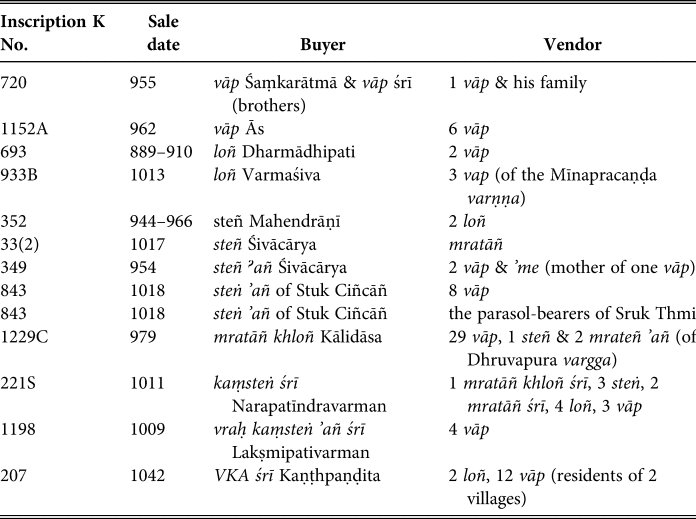
The significantly high number of sales by vāp, already apparent in table 3, and their involvement in disputes, might be better understood when we look at who the buyers and who the sellers were for each transaction. Here we see something of a hierarchical pattern, exemplified by the examples in table 4, whereby vāp purchase land only from vāp, loñ buy from loñ and vāp, while people designated by higher titles buy from all categories. This pattern both highlights the distinction between loñ and vāp, and underscores the idea that land was being transferred into elite ownership.Footnote 77
Land sales: Titles of buyers and vendors

We have no evidence that restrictions on land purchases based on hierarchical status were codified.Footnote 78 Even so, status and hierarchy are evident throughout the inscriptions: in the order of titles in lists of witnesses or temple servants; in payments for land or services such as boundary marking; and in the severity of fines prescribed for violation of a monastery's regulations. In one inscription,Footnote 79 officials titled VKA were paid more for their share of a land parcel than were kaṃsteṅ. The transaction also included payment to the god, who seems to have received the most.
We suggest that the hierarchical structure of the society contributed to a declining ownership of land by the vāp. We have seen that they were particularly prominent as vendors in the late tenth and early eleventh centuries, alone or on behalf of communities. Towards the end of the reign of Sūryavarman I, they may have had little quality land left to sell, so that they were simply less relevant to the elites who were writing the inscriptions. Other middle-ranking officials, many of these being loñ, would have been affected in turn, and faced with the same impediments as the vāp. Once there was little land available to them, their options were also constrained.
Demand for high value goods: tax and other payments
A further constraint affecting the minor officials likely stems from the mode of paying taxes. The prime means of producing wealth for Angkor was growing rice, and since Angkor did not use money, this would have been the taxation commodity available to most of the population. We infer from the inscriptions that taxes paid by non-elites were normally in rice, livestock and corvée, managed locally. To avoid the costs of transporting bulky goods over long distances to the centre, it would have been pragmatic to encourage, or even specify payment of levies such as the rājakāryya in high value goods. Where these were acquired in exchange for rice, land, animals or slaves, we suggest that the purchaser had to pay a premium for this.Footnote 80
There are several instances where the transaction of obtaining goods for paying the rājakāryya is currently translated as having been borrowed at high interest, the Old Khmer word being pul. In modern Khmer, pul has the meaning of ‘borrowing at 100 per cent interest’,Footnote 81 and we see in several Angkorian inscriptions that the guṇa, currently translated as ‘interest’, is 100 per cent. We propose that the old meaning of pul may have been more along the lines of ‘trading up to high-value goods, for which one had to pay double’.Footnote 82 One meaning of the Sanskrit word guṇa, which could fit the contexts better, is ‘a multiplier or co-efficient in algebra’,Footnote 83 always equal to two in the Khmer texts. In an inscription from O Smach, a vāp owed 2 liṅ of gold for the rājakāryya. This was given to him by a vraḥ kaṃsteṅ ’añ in exchange for a tract of land valued at 4 liṅ of gold.Footnote 84 In another such exchange,Footnote 85 some dignitaries and villagers acquired a number of cult objects from the sanctuary belonging to an official. A tract of land was made over to the official, declared a royal benefice from the king and offered to the god. In this, we see a temple playing an economic role in providing high value goods. Between the reigns of Jayavarman V and Sūryavarman I, of nine inscriptions which contain pul, four also have guṇa.Footnote 86 In at least three cases, the stated reason for requiring the goods was to pay rājakāryya. It is feasible that two further mentions, to acquire materials, were also in the cause of the rājakāryya.Footnote 87 The buyers were vāp in five of the instances of pul and in two they were loñ. Many seem to have had little choice but to part with land.
Decline
We do not consider that the decline of the middle-ranking officials stems from the civil war and their opposition to Sūryavarman I, whose claim to the throne was based on his descent from Indravarman II (877–889).Footnote 88 Sūryavarman may well have moved to disestablish some of the supporters of Jayavīravarman.Footnote 89 It is also understandable that he appointed members of his family, the Saptadevakula, to important positions to strengthen his support base.Footnote 90 He may even have started to move against some of the very powerful families who had been close to the previous rulers, filling the highest offices, those of purohita, hotar, ācārya and guru,Footnote 91 and who, as Lawrence Palmer Briggs observes, ‘one by one carved their swan-songs and disappeared from history’.Footnote 92 Yet authors of inscriptions during Sūryavarman's reign continued to refer to Jayavarman II, providing genealogies commencing at the time of this ruler, or claiming that their ancestors were granted land or began their careers under him. Perhaps the legitimacy of Sūryavarman's claim to the throne was not such an issue.Footnote 93 Nor are we inclined to the alternative hypothesis mentioned earlier that changes brought about when the Mahīdharapura dynasty came to power were an important factor in the decline of the loñ and teṅ, since these had all but ceased to sell their land 30 years earlier.
We argue that the changes in status that have been observed in and beyond Sūryavarman I's reign were set in train earlier, around the time of the concurrent peak numbers of texts, immunities, land transactions, and disputes towards the end of the tenth century. If there were a continual requirement for vāp to make payments in high value goods, coupled with social constraints on whom they could buy land from, they would have become net vendors of land within a short period. The large number of sales by vāp at that time suggests they were under stress, and it is not surprising that there were many disputes. The declining production of texts towards the end of the century — temporarily reversed during the troubled period 1001–1006 — is consistent with a reduced availability of land. Loñ and teṅ were also victims of this land transfer, but, insofar as they were closer to the elite, their decline may have been buffered. An option may have been for them to be taken into wealthy temples and āśrama as a solution acceptable to the elite.Footnote 94
The reduction in new inscriptions and land transactions from the end of the tenth century may have been exacerbated by other constraints. We suggest that the tax immunities previously enjoyed by many private foundations and their founders were being curtailed by the late tenth century, leaving fewer incentives to establish new ones.Footnote 95 Reversing a strategy employed by rulers for more than a century could indicate an emerging concern, known for other states, that tax immunities were becoming a drain on revenue.Footnote 96 Such an action would have most affected those with limited resources, and served to enhance the power wielded by influential families through their increasingly great landholdings and the revenues these delivered. Indeed, most founders from Sūryavarman's reign were of the elite. From the reign of Udayādityavarman II (1049–1066), texts, though fewer, still record pious works, with the authors still seeking merit by offering their foundations to the reigning king. However, there were far fewer disputes and only four texts referring to land transactions.Footnote 97
Conclusion
The development of the state of Angkor altered an existing system of land ownership, to the extent that prime communal and family-held lands were broken up and transferred to elites. Many of the vendors were caught up in the interconnected affairs of the officials and the religious foundations and were obliged one way or another to support the temples, the local elites and the state. The transfers seem to have been engendered by existing social and economic mores, namely, the need for tax and other payments to be in high value goods, and hierarchical restrictions on land acquisitions.
Vāp may have been traditional landholders, living in kinship or other communal groups, who were granted title to lands at the time of Jayavarman II, and whose descendants acquired bureaucratic positions and more land during the next two centuries. At least up to the late tenth century, they were not unempowered. We suggest that their seemingly abrupt disappearance from the inscriptions resulted from the depletion of their landholdings through having to make payments with articles of high value (pul), and from the hierarchical restrictions on their land purchases. The disputes predominantly in the tenth century may have been a symptom of the reduced availability of favourable land, which they had been seeking to hold on to, unsuccessfully.
The class to which loñ and teṅ belonged had sometimes claimed descent from royalty or from the cohorts of Jayavarman II and were socially superior to vāp. We have proposed that the avenues open to this class were eventually restricted too, for much the same reasons. Their capacity to remain property owners having been reduced, many were left with few options but to place themselves or be given to serve in temple roles.
Whatever actions may have been taken by rulers from the mid-tenth century — we suggest restricting some of the privileges that had been enjoyed, in particular the fiscal immunities — there would now have been fewer incentives to establish foundations. This in turn would have slowed the production of texts, except, as it seems, during the period of conflict at the beginning of the eleventh century.
The disappearance of the vāp and the drawn-out demotion of the loñ could be seen as markers of a shift in the balance of power between some of the mid-level officials and elites. In Angkor's hierarchical and moneyless society, this may have been almost inevitable.
Supplementary Material
To view supplementary material for this article, please visit https://doi.org/10.1017/S0022463419000365.