


1. Introduction
A child’s task when learning the language(s) spoken in his/her surroundings is complex and includes a vast array of different elements, such as learning the lexicon, phonological inventory, morphology, syntax, and grammatical rules of the particular language. These elements differ across languages, and individual children differ in their language learning development, although similar patterns are observed between languages and in language development (Caselli et al. Reference Caselli, Bates, Casadio, Fenson, Fenson, Sanderl and Weir1995; Bleses et al. Reference Bleses, Vach, Slott, Wehberg, Thomsen, Madsen and Basbøll2008a). Research has shown variation in vocabulary at certain age levels regarding different languages due to cross-linguistic differences, e.g. phonologically or dissimilarities regarding frequency for cultural or environmental reasons (Caselli et al. Reference Caselli, Bates, Casadio, Fenson, Fenson, Sanderl and Weir1995; Bleses et al. Reference Bleses, Vach, Slott, Wehberg, Thomsen, Madsen and Basbøll2008a). The first word is a milestone in a child’s development and is influenced by a variety of aspects, e.g. the characteristics of the child, including health and cognitive factors, as well as the environment surrounding the child, such as which language is spoken to the child, whether the child is raised bilingual, and the quantity and style of talk by the child’s caregivers (Hart & Risley Reference Hart and Risley1995; Hoff Reference Hoff2006). The study of children’s first words and vocabulary composition is a growing field in linguistics, and while English is one of the most studied languages, research has also been conducted on a variety of other languages (e.g. Bleses et al. Reference Bleses, Vach, Slott, Wehberg, Thomsen, Madsen and Basbøll2008a; Schults et al. Reference Schults, Tulviste and Konstabel2012; Marjanovič-Umek et al. Reference Marjanovič-Umek, Fekonja-Peklaj and Podlesek2013; Simonsen et al. Reference Simonsen, Kristoffersen, Bleses, Wehberg and Jørgensen2014).
The present study reports on the acquisition of Faroese children’s first words, and data for this study were derived from a recent population-based normative study of the Faroese MacArthur–Bates Communicative Development Inventories (FAEMB-CDI; Rasmussen & Bleses Reference Rasmussen and Bleses2018). Summing up the results from the norming study, which are relevant to this present study, it describes the developmental trends in early expressive vocabulary development. Regarding vocabulary size, the infants started with a mean of two words in productive vocabulary at 8 months, increasing to 120 words at 20 months. ANOVA analysis demonstrated a main effect of age (F(12,402) = 37.2), p < 0.001) for the age group ranging from 8 to 20 months. The results showed a gender difference regarding productive vocabulary in favour of girls; ANOVA analysis also demonstrated a main effect of gender (F(1,413) = 12.5, p < 0.001). In terms of numbers, girls produced a mean of 29 words over all ages in this sample, while boys produced 16 words. The study also reports that so-called baby word forms, which are a very common part of interactions between children and adults, are part of early vocabulary in Faroese children. Additionally, if included in the set of first words, they comprise 30% of the first 50 words, but they vanish over time (Rasmussen & Bleses Reference Rasmussen and Bleses2018). The baby word forms are typically simplifications of the adult word form, e.g. geggar [g̊ɛg̊ːaɹ] for skógvar [sg̊ɛg̊vaɹ] ‘shoes’.
1.1 Characteristics of the Faroese language and learning environment
Faroese is a language spoken by approximately 52,000 people living in the Faroe Islands (Hagstova Føroya 2019), and by an estimated additional 21,000 people outside the islands (Norðuratlantsbólkurin á Fólkatingi 2009). The Faroe Islands are situated in the North Atlantic Ocean and they are a self-governing territory within the Kingdom of Denmark. In this small language society, very limited research has been carried out regarding Faroese children’s language acquisition and their early lexical development. This lack of research constrains our understanding of how children learn Faroese and our knowledge of the characteristics of their early vocabulary development. The few existing studies on language acquisition focus on older children and other aspects, such as syntax (see e.g. Heycock et al. Reference Heycock, Sorace, Hansen and Wilson2013), and they are therefore not relevant to this study, which focuses on vocabulary and the characteristics of first words. The only study to date focusing on early vocabulary is the aforementioned Faroese adaptation of the MacArthur–Bates Communicative Development Inventories (FAEMB-CDI; Rasmussen & Bleses Reference Rasmussen and Bleses2018). A very small study that is of interest in relation to this study, which addressed the impact that English and Danish digital input has on Faroese toddlers, showed that children in some cases spontaneously used English words when shown a picture of, for example, a flower (Steinbjørnsdóttir Reference Steinbjørnsdóttir2018).
Faroese is described as a West Nordic language, and compared with English, Faroese has a richer inflectional system, e.g. for nouns. Faroese has two numbers (singular and plural), three genders (masculine, feminine, and neuter), and four cases (nominative, accusative, dative, and genitive). For an in-depth description of Faroese, see Thráinsson et al. (Reference Thráinsson, Petersen, Jacobsen and Hansen2004). One characteristic of Faroese is that there are many morpho-phonological alternations in both nouns and verbs. As an example of a noun, the word ‘cow’ has a low degree of transparency both morphologically and phonologically due to inflections, such as kúgv [kʰɪg̊v] (indef nom/acc.sg), kýr [kʰʊiːɹ] (indef nom/acc.pl), kýrnar [kʰʊitnar] (def nom/acc.pl), and kúnni [kʰʏnːə] (def dat.sg), and these could be difficult for a child to identify as the same word. As an example of a verb, the word ‘lie’ undergoes changes from liggja [lɪʤ̥ːa] (inf) to lá [lɔaː] (pst.3sg) and ligið [lɪːjɛ] (pst.ptcp), where it is only the onset consonant that stays the same, and the word ‘walk’ undergoes substantial changes from ganga [g̊ɛŋg̊a] (inf) to gekk [ʤ̥ɛʰkː] (pst.3sg) and gingið [g̊ɪɲʤ̥ɛ] (pst.ptcp) due to inflections in strong verbs, where one main characteristic is vowel alternation of the stem. Such morpho-phonological alternations are also present in other Germanic languages, but they are frequent and occur in central words in Faroese. For instance, see Árnason (Reference Árnason2011) on the phonology of Faroese and, for example, Trudgill (Reference Trudgill2011), who states that:
So not only is the amount of morphological opacity here considerable but historical linguistic studies show that it has actually increased through time. It is apparent that modern Faroese has in some respects become more irregular than Old Norse/Mediaeval Faroese, or indeed than Icelandic (Trudgill Reference Trudgill2011:86–87; original emphasis).
For children acquiring the language, the segmentation task here can be challenging, and there is some indication that these alternations can affect the earliest segmentation process and temporarily slow the comprehension rate (see Rasmussen & Bleses Reference Rasmussen and Bleses2018). Another characteristic of the language is a rich vowel system and a substantial difference in vocabulary use between the written and spoken language. Some spoken word forms are borrowed from Danish, while written language is more conservative regarding these word forms (Sandøy Reference Sandøy, Sandøy, Brodersen and Brunstad2003; Petersen Reference Petersen2012). This discrepancy between oral and written language can potentially have relevance for children because children will hear different word forms when they are exposed to language based on written forms, e.g. when reading aloud from books, radio, or television programmes. Dialectal differences are found in Faroese, e.g. phonological differences in pronunciation and dialectal differences in inflectional morphology (Thráinsson et al. Reference Thráinsson, Petersen, Jacobsen and Hansen2004), but Faroese is mutually intelligible for speakers. With regard to dialectal variation in Faroese and vocabulary acquisition in infants, this dialectal variation is not well researched, but it is assumed that there is not as great an impact on lexical word forms in early vocabulary acquisition. Some of the characteristics of Faroese are highlighted above, although a description of other domains that are of interest in the present study regarding child language acquisition is lacking, e.g. data on word frequency in both adult and child language and a description of syllable length in Faroese.
Regarding the language environment, the language used in interactions by children and adults is Faroese, in interactions both between children and adults, child to child, and between adults (i.e. in Faroese-speaking families); the Faroe Islands have until very recently not been a multilingual society, as 90% of the population speak only Faroese at home (Hagstova Føroya 2013). However, the size of the speech community results in language learning opportunities in the mother tongue being reduced because of the limited resources available, mostly economic, to produce language-stimulating materials and programmes such as cartoons, books, children’s radio, television, YouTube, and apps; therefore they receive considerable input in Danish and English through these media. Faroese children are not considered bilingual in the conventional manner, as they do not use Danish or English in everyday communication and do not receive formal instruction in other languages until the age of 9 or 10 years. However, as a result of the language environment including (and to a large extent only consisting of) Danish and English, mainly through digital media, they can be characterized as asymmetrical bilinguals if the term is defined as the ability to use two or more languages sufficiently to have limited casual conversations (Myers-Scotton Reference Myers-Scotton2006). There have been concerns raised, e.g. by teachers about Faroese children increasingly using English, for example, in informal communication with each other, but results regarding this phenomenon will have to be revealed by future research studies.
The Faroe Islands are a family-oriented society (Gaini Reference Gaini2013; Hayfield et al. Reference Hayfield, Olavson and Patursson2016; Hayfield Reference Hayfield2018; Hayfield & Schug Reference Hayfield and Schug2019). Hayfield (Reference Hayfield2018) states ‘The significance of family networks was clear in the data and the women who had lived abroad pointed out how “… there’s a big difference between how much more help you have here [compared to Denmark]”’ (Hayfield Reference Hayfield2018:1148). In another study, women stated that having close support networks, such as parents, siblings, and in-laws, to help with childcare was central to the Faroese society, although they also mentioned that this is declining concurrently with grandparents working more (Hayfield et al. Reference Hayfield, Olavson and Patursson2016).
In summary, Faroese can be characterized as a language that has not been extensively studied with respect to child language acquisition. As mentioned, it has a rich morphology and many morpho-phonological alternations. The language environment is quite dispersed regarding material-based input and availability of digital language input in the mother tongue due to the small language society.
1.2 Characteristics of early productive vocabulary
Vocabulary increases rapidly during the first years of childhood, and typically, children understand words before they can produce them (Fenson et al. Reference Fenson, Dale, Steven Reznick, Bates, Thal and Pethick1994). Children usually say their first word around their first birthday, although research has indicated large individual differences (Bates et al. Reference Bates, Marchman, Thal, Fenson, Dale and Steven Reznick1994; Fenson et al. Reference Fenson, Dale, Steven Reznick, Bates, Thal and Pethick1994). Fenson et al. (Reference Fenson, Dale, Steven Reznick, Bates, Thal and Pethick1994) found these individual differences in vocabulary size among children to be both extensive and stable over time. Research has shown that, regarding lexical development, children seem to acquire the same words whether they are typically developing children or late talkers, although late talkers may acquire the words at a slower rate (Caselli et al. Reference Caselli, Bates, Casadio, Fenson, Fenson, Sanderl and Weir1995). Schneider et al. (Reference Schneider, Yurovsky, Frank, Noelle, Rick Dale, Warlaumont, Matlock, Jennings and Maglio2015) found that the first words children produce are predictable from two linguistic factors: input frequency and phonological complexity of the words, while McDonough et al. (Reference McDonough, Song, Hirsh-Pasek, Golinkoff and Lannon2011) found that nouns tended to dominate the first words due to the imageability of the words, which means the ease with which a word can be associated with a mental image or picture.
Research on children’s early lexical development reveals the same tendencies in similar languages, as well as smaller differences in the first lexical word forms. Braginsky and colleagues found cross-linguistic consistency regarding the factors that predict the degree of difficulty of learning words; for example, nouns and predicates were influenced by concreteness and frequency, but function words were influenced by ‘babiness’ (a constructed measure of a word’s association with babies), number of phonemes, and sentence length (Braginsky et al. Reference Braginsky, Yurovsky, Marchman and Frank2019). Caselli et al. (Reference Caselli, Bates and Casadio1999) argue that children undergo four different stages in lexical development, which they identified as routines and word games, reference, predication, and grammar. The first words in children’s productive vocabulary are often used to name things in the environment and are context-bound; later in development, verbs and adjectives are added, followed by function words, e.g. pronouns, prepositions, and determiners. There is a discussion on the proportion of verbs versus nouns in different languages and whether children learn a language in different ways depending on how rich the morphology is and which language is learned; for a more detailed discussion, see e.g. Gentner (Reference Gentner and Kuczaj1982), Caselli et al. (Reference Caselli, Bates, Casadio, Fenson, Fenson, Sanderl and Weir1995), and Tardif (Reference Tardif1996).
Regarding the composition of productive vocabulary, social terms and nouns are found to dominate vocabulary in various linguistic environments among the first 50 to 100 words (Conboy & Thal Reference Conboy and Thal2006; Wehberg et al. Reference Wehberg, Vach, Bleses, Thomsen, Madsen and Basbøll2007), and the use of verbs, adjectives, and function words is extremely rare until vocabularies reach 100 words (Caselli et al. Reference Caselli, Bates, Casadio, Fenson, Fenson, Sanderl and Weir1995). Research has shown that children transition from single word utterances to two-word utterances when their vocabulary reaches approximately 50–100 words (Caselli et al. Reference Caselli, Bates and Casadio1999). Hence the development of vocabulary is crucial to the development of grammar and has been found to predict the development of grammar better than age (Devescovi et al. Reference Devescovi, Caselli, Marchione, Pasqualetti, Reilly and Bates2005); in addition, lexicon size is a good predictor of later language development (Lee Reference Lee2011; Bleses et al. Reference Bleses, Makransky, Dale, Højen and Aktürk Ari2016). The acquisition of early linguistic milestones is therefore of importance to explore, both in research and in clinical settings.
The phonology of children’s early words can be affected by the child’s ability to produce specific speech sounds and different combinations of sounds and also by the language acquired (de Boysson-Bardies Reference de Boysson-Bardies1991). Garmann and colleagues studied the acquisition of early words regarding word-initial bilabials and word length in syllables for Norwegian, Danish, Swedish, Italian, and English. They found that there was a predilection for words with initial bilabials; however, in relation to word learning the effect of word length varied depending on the language acquired (Garmann et al. Reference Garmann, Hansen, Simonsen and Kristoffersen2019).
A substantial segment of research on early language development is based on parental reports, which are found to be a good and reliable method of gathering data (Bates et al. Reference Bates, Dale, Thal, Fletcher and MacWhinney1995; Fenson et al. Reference Fenson, Bates, Dale, Goodman, Reznick and Thal2000; Feldman et al. Reference Feldman, Dale, Campbell, Kathleen Colborn, Kurs-Lasky, Rockette and Paradise2005; Law & Roy Reference Law and Roy2008). One of these parental reports is the MacArthur–Bates Communicative Development Inventories (MB-CDI; Fenson et al. Reference Fenson, Bates, Dale, Marchman, Reznick and Thal2007). Findings from MB-CDI studies have shown remarkably similar patterns in acquisition, e.g. large variability and acceleration in vocabulary during the second year (Bleses et al. Reference Bleses, Vach, Slott, Wehberg, Thomsen, Madsen and Basbøll2008a). The inventories are based on parents reporting which words children are producing, but there is no information on the concrete pronunciation. However, it is possible to identify the effects of phonological factors by examining which words are or are not acquired. Garmann and colleagues used the MB-CDI to assess children’s phonological acquisition of word production in the aforementioned study (Wehberg et al. Reference Wehberg, Vach, Bleses, Thomsen, Madsen and Basbøll2007; Garmann et al. Reference Garmann, Hansen, Simonsen and Kristoffersen2019).
This study utilizes the Faroese adaptation of the MB-CDI Infant form, FAEMB-CDI I Orð og keipur (Words and Gestures). The parental report has also been adapted from American English to the Nordic languages, including Norwegian (Simonsen et al. Reference Simonsen, Kristoffersen, Bleses, Wehberg and Jørgensen2014), Swedish (Eriksson & Berglund Reference Eriksson and Berglund1999), Danish (Bleses et al. Reference Bleses, Vach, Slott, Wehberg, Thomsen, Madsen and Basbøll2008b), and Icelandic (Thordardottir & Weismer Reference Thordardottir and Weismer1996). The results from the Nordic MB-CDI studies are comparable to findings from MB-CDI studies on other languages regarding vocabulary growth, individual differences, asymmetry in comprehension/production rate, and composition of early vocabulary (see Rasmussen & Bleses Reference Rasmussen and Bleses2018 for a comparison of Faroese versus other Nordic languages and Bleses & Trecca Reference Bleses, Trecca, Hans Olav Enger, Knoph, Kristoffersen and Lind2016 for a description of three mainland Scandinavian languages).
1.3 Objectives of the current study
The motivation behind the research was to conduct the first fundamental study of early expressive vocabulary, thereby providing data that have not been obtainable previously. This information will be very helpful for further research questions and for work in developing norm-referenced tools for screening and language assessment. Based on previous research, that we see the same cross-linguistic tendencies in early acquisition but also some effect of the language and environment, the suggestion could be that close family relations and the higher degree of words changing phonologically due to inflections would affect the results. The research questions in this study relate to describing Faroese children’s early vocabulary acquisition regarding word categories, age, gender, and any special characteristics for emerging word forms in Faroese and agreement with other languages: (a) Which are the top 50 expressive words first learned? (b) What are the characteristics of the first words acquired regarding phonological features, semantic categories, and lexical composition? (c) Are some words found to be stable, for example, are the same words found across different age spans in the emerging language?
2. Method
2.1 Materials
To assess Faroese children’s productive vocabulary acquisition, data were collected using the FAEMB-CDI parental reports (Fenson et al. Reference Fenson, Dale, Steven Reznick, Bates, Thal and Pethick1994; Rasmussen & Bleses Reference Rasmussen and Bleses2018). This instrument is well known and has been widely used to gather data regarding children’s language acquisition; the instrument makes it possible to gather large amounts of data in terms of both the number of words included and the number of participants. The questionnaire has proved to be a valid instrument to assess early language skills in children (Bates et al. Reference Bates, Dale, Thal, Fletcher and MacWhinney1995; Fenson et al. Reference Fenson, Bates, Dale, Goodman, Reznick and Thal2000; Feldman et al. Reference Feldman, Dale, Campbell, Kathleen Colborn, Kurs-Lasky, Rockette and Paradise2005; Fenson et al. Reference Fenson, Bates, Dale, Marchman, Reznick and Thal2007; Law & Roy Reference Law and Roy2008). The method has various strengths and drawbacks. Some advantages are that the instrument does not require active cooperation from children, it is an economical instrument to use in gathering data, and the word list that is used aids parents in remembering words their child might use. Disadvantages are that parents can overestimate their child’s ability (Law & Roy Reference Law and Roy2008), and a higher proportion of well-educated parents often participate in the questionnaire compared with less educated parents (Fenson et al. Reference Fenson, Bates, Dale, Goodman, Reznick and Thal2000, Reference Fenson, Bates, Dale, Marchman, Reznick and Thal2007; Simonsen et al. Reference Simonsen, Kristoffersen, Bleses, Wehberg and Jørgensen2014). While caution should be taken in interpreting the results, this method has proved to be very well suited to gathering data regarding infants and children up to 3 years (Law & Roy Reference Law and Roy2008).
The Faroese adaptation of the MB-CDI followed the guidelines on adaptation (see http://mb-cdi.stanford.edu), to ensure the instrument is as close and comparable as possible to the original and Nordic adaptations (e.g. the Norwegian, Danish, Swedish, and Icelandic adaptations). Some changes were made in the Faroese adaptation to reflect both the cultural and linguistic environments. In the vocabulary list, some words were replaced or added, especially in the section about animals and food, and a category called ‘baby words’ was added that contains words used by infants and in infant-directed speech in the Faroe Islands. For a detailed description of the Faroese version of the MB-CDI tool, the adaptation process, and the norming study, see Rasmussen & Bleses (Reference Rasmussen and Bleses2018).
2.2 MB-CDI I vocabulary list
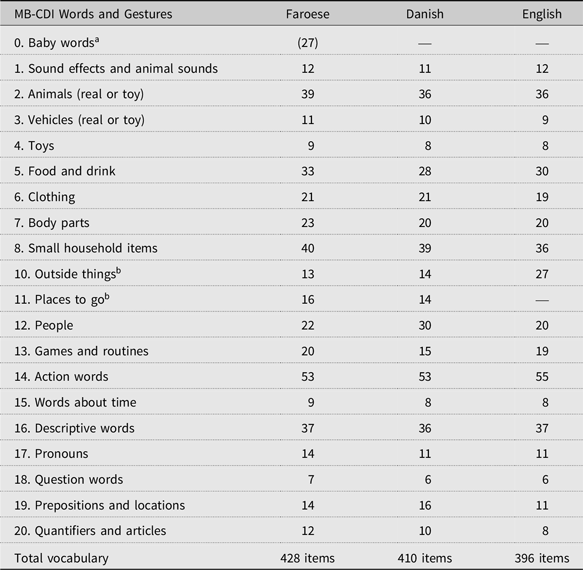
In this study, the infant form of the FAEMB-CDI I (Words and Gestures) scale is used; the construction of the word list is described in Rasmussen & Bleses (Reference Rasmussen and Bleses2018). The data comprise the first section of FAEMB-CDI I regarding productive vocabulary, which consists of a word checklist containing 428 words divided into 21 categories, including ‘food and drink’ and ‘toys’ (see Table 1). Note that the Faroese version has an added category labelled 0, which contains baby word forms. This category is not included in the sum scores or analysed in this paper but was added as an experimental part of the norming study to provide insight into a phenomenon often observed in Faroese. Of the 428 vocabulary items on the list, 26.2% are one-syllable words while 55.3% are two-syllable words. The rest of the words in the list are three-syllable words or more (11.1% and 7.3%, respectively). Regarding phonological characteristics of the words in the list, 66.3% of the words start with a consonant, 21.4% start with a consonant cluster (85 of the words with two consonants and five with three consonants), and 12.4% start with a vowel or diphthong. Of the onset consonants in the word list, 18.3% are bilabials.
Categories and number of items in the vocabulary list in the MB-CDI I: Words and Gestures in the Faroese, Danish, and English MB-CDIs

a Baby words are not counted in the total number of items, as it is an added section.
b ‘Outside things’ and ‘places to go’ represent one category in the English MB-CDI I: Words and Gestures.
2.3 Procedure
2.3.1 Sampling
The children were identified through Landsfólkayvirlitið [The National Register], which provided contact information, e.g. addresses, names of the parents and children, and the child’s birthday, and the children’s parents were invited by mail to participate in the study. The data collection was part of a wider project including both the infant and toddler form of the FAEMB-CDI. As stated in Section 1.1, the population of the Faroe Islands is very limited, which affects the number of infants in the population (only approximately 600 babies are born each year). Therefore, all parents of Faroese children in the age range of 8 months to 3 years received an invitation letter with thorough information about the project and a guide on how to complete the questionnaire. To obtain sufficient data, there were two rounds of data collection, with ten months between them. This method resulted in a small number of children in age groups 18 to 20 months (under 15%) potentially being represented twice in the dataset but in different age groups (e.g. as an 8-month-old and 18-month-old), but this is not the case for any of the children in the age groups up to 18 months. The time lag of ten months between the rounds was chosen to address the issue that the parents’ responses in the first round of data collection should not be too present in their minds during the later round.
The parents had two options for completing the FAEMB-CDI I: a password-protected website or a paper version, which the parents could request. Virtually all the parents used the website, as there was only one request for the paper version. Ninety per cent of Faroese households have Internet access (Hagstova Føroya 2013). In addition to the FAEMB-CDI parental forms, the parents also completed a questionnaire with background information regarding issues relevant to language development.
To fill out the FAEMB-CDI I questionnaire, the parents were asked to mark words that their child understood and words that the parents had heard the child say (‘understood and said’). The parents were asked to mark a word even if the pronunciation deviated from the adult pronunciation (examples of accepted but deviating pronunciations were provided) and to fill out the questionnaire when the child was not present. If the parents had questions, they could contact the first author via email or telephone throughout the sampling period, and common questions from the parents were posted on the web page hosting the web form under a tab labelled ‘frequently asked questions’ (FAQ). There were 70 comments and questions mainly concerning technical problems, e.g. problems signing in, loss of password, and questions from parents not included in the study, e.g. if the child was older or the family was living abroad, asking if they could participate (which they could not). The system allowed parents to log in and out and to return to complete the form later, and they were able to switch between the sections of the FAEMB-CDI form until they pressed the submit button. The parents had approximately 12 days to complete the form (calculated from the day they received the invitation by letter) and a reminder was sent to the parents who had not completed the form at that point. Age was calculated from the child’s date of birth to the date that the parents completed the form.
2.3.2 Response rate
The data were collected over two rounds. The response rate was 51.2% in the first round and 37.7% in the second round, which resulted in a response rate of 44.5% over the two rounds. Due to the limited cohort of children, significant effort was made to inform about the data collection through all types of media, which seems to have made an impact, as the response rate was somewhat higher than that of similar studies, e.g. the Norwegian study, which had a response rate of 37% (Simonsen et al. Reference Simonsen, Kristoffersen, Bleses, Wehberg and Jørgensen2014).
2.3.3 Criteria for inclusion in the study
The children included in the present study had no documented or suspected serious developmental or health issues and had to meet the following four criteria: birth at full term (from week 36), hospital stay not exceeding four weeks, no parental concerns regarding the language development of the child, and only limited contact with languages other than Faroese. All bilingual children were excluded, which included children who had been living abroad and children who spoke another language according to their parents. Both parents had to have Faroese as their first language, or one parent had Faroese and the other had a Nordic language as their first language. Ninety per cent of the parents in the sample were monolingual. Children who had physical or mental disadvantages in acquiring language were excluded, e.g. if they had been in contact with a speech and language therapist or if the parents, kindergarten teacher, or health personnel had a suspicion of language delay, hearing problems, or serious illness. Profoundly deaf children and internationally adopted children were also excluded from the study. To be included in the study, at least one item on the questionnaire had to be marked.
2.4 Participants
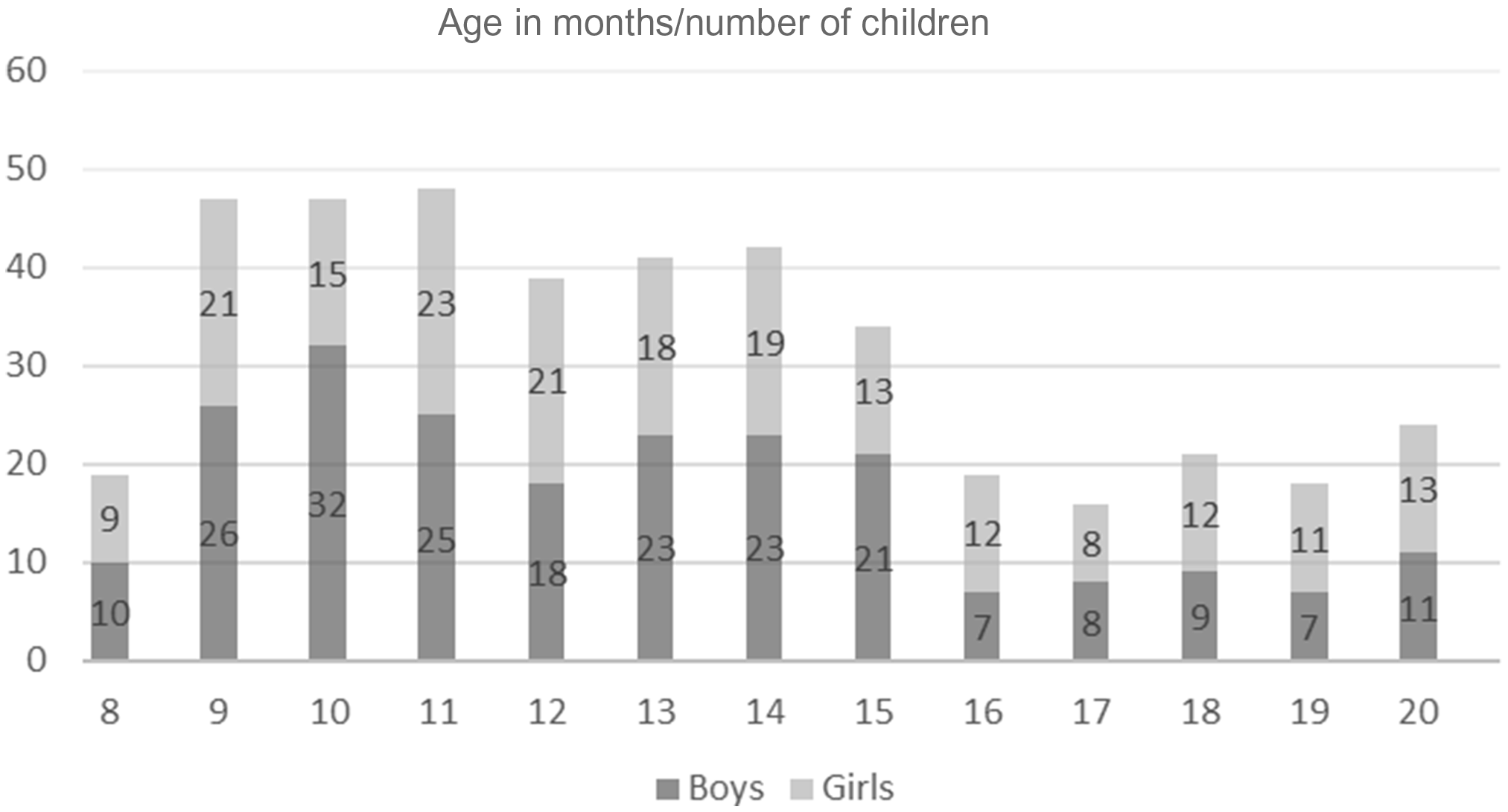
The following results are based on 415 infants aged 8 to 20 months, including 220 boys (53%) and 195 girls (47%), which is in accordance with the demographic distribution of gender (Hagstova Føroya).
As shown in Figure 1, there are between 34 and 48 children in each age group from 9 to 15 months. The age groups from 16 to 20 months contain fewer children, ranging from 16 to 24, than the earlier age groups. The reason for the smaller groups from 16 to 20 months is that these data were a part of a larger study, and children in these age groups were divided across two questionnaires, FAEMB-CDI I and II, due to the research design. There are also fewer children in the 8-month age group, 19, but this may be because some parents were reluctant to answer the questionnaire when their children had only a few words or perhaps only a single word in their productive vocabulary.
Number of participants in each age group.

2.5 Demographic characteristics of the sample
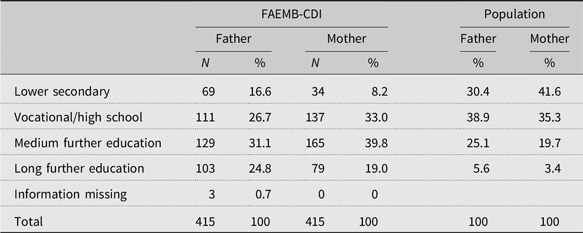
Table 2 provides information on the educational status of the parents in the final sample compared with the characteristics of the whole population.

The sample contains fewer mothers and fathers with basic education than the Faroese population in general and more with further education; this results in a sample in which parents with basic education or less are underrepresented, which is in accordance with other MB-CDI studies (Fenson et al. Reference Fenson, Bates, Dale, Marchman, Reznick and Thal2007; Bleses et al. Reference Bleses, Vach, Slott, Wehberg, Thomsen, Madsen and Basbøll2008a; Simonsen et al. Reference Simonsen, Kristoffersen, Bleses, Wehberg and Jørgensen2014). Regarding sibling status, a quarter of the children in this sample were the only child in the home, which is in accordance with population data, namely, 27% of families have one child (Hagstova Føroya 2014) and the rest have two or more children. The children were from all areas of the Faroe Islands, covering different dialects, and over 90% of the families were monolingual, while the remainder were bilingual, with one parent speaking a Nordic language and the other speaking Faroese. The population in the Faroe Islands is 90% monolingual (Hagstova Føroya 2013).
After applying the exclusion criteria and comparing the demographic characteristics of the final sample with the population, the sample was found to be balanced regarding monolingual status, geography, gender, and sibling status compared with the overall population but skewed toward higher educational levels of the parents.
2.6 Validity
The following results regarding the Faroese children’s first words are based on an adaptation of the MacArthur–Bates Communicative Development Inventories (MB-CDI). The adaptation process, construction of the word list, and norming study are described in Rasmussen & Bleses (Reference Rasmussen and Bleses2018) and are summarized in the following. The reliability of the FAEMB-CDI I Orð og keipur (Word and Gestures) scale regarding the items in the word list was evaluated based on internal consistency scores and Cronbach’s alpha, which returned a coefficient of 0.992 regarding word production for the productive vocabulary scale. This value is comparable to the results of other MB-CDI studies (e.g. Fenson et al. Reference Fenson, Bates, Dale, Marchman, Reznick and Thal2007; Bleses et al. Reference Bleses, Vach, Slott, Wehberg, Thomsen, Madsen and Basbøll2008a) and demonstrates high internal consistency of the scale. Measuring the validity of the FAEMB-CDI I is difficult because of the absence of previous research on the topic or other measurement instruments in Faroese. To provide indications of the validity of the lexical items on the FAEMB-CDI, measurements from two different methods and the internal consistency for the scores on the MB-CDI I scale are provided. The first measure of validity was a composed picture test using words from the FAEMB-CDI to investigate whether frequently checked words on the MB-CDI were also produced more often by children in real testing than infrequent words (see Rasmussen & Bleses Reference Rasmussen and Bleses2018 for information on the study design). The picture test contained 30 nouns, which were easy to depict, from different categories, such as food, animals, and toys, in the FAEMB-CDI. Both frequent words – words that more than 75% of the children in the sample could produce – and 10 words that fewer than 25% of the children could produce were included in the picture test. The picture test was administered to 22 children who were part of the sample (parents had completed the FAEMB-CDI checklist). The results of the picture test reflected the same tendency in frequency in the picture test as in the FAEMB-CDI checklist, as the children correctly produced 8.7% of the infrequent words compared to 82.3% of the frequent words. Moreover, the FAEMB-CDI form was administered to the parents of these children, and a comparison between the picture data and the parental form showed that there is agreement between the parental answers on the FAEMB-CDI checklist and the child answers for the same words in the picture test for 70% of the items. This result confirms the agreement between the parent’s responses on the FAEMB-CDI checklist and their child’s actual ability to produce the words. As a supplemental measure to obtain some indication of the representativeness of words on the FAEMB-CDI, video recordings were made with two children. The parents were guided to play with books and toys and to elicit words by asking questions about, for instance, food, toys, and clothes. A comparison between the recordings and the answers on the parental form revealed that 78% of the words (different word types) said in the recordings are included in the FAEMB-CDI. To learn more about the validity and reliability of the FAEMB-CDI forms, see Rasmussen & Bleses (Reference Rasmussen and Bleses2018).
2.7 Scoring
Productive vocabulary is the total number of words marked by the parents as produced by the infants on the FAEMB-CDI questionnaire. The results are based on the sum scores for productive vocabulary, which is the number of words marked ‘said’ on the FAEMB-CDI form.
2.8 Procedure to compose the first word frequency list
In the following, the procedure to establish a list for use in describing first words will be outlined. Table 3 provides an overview of the 50 first words calculated in two different ways. Following Fenson et al. (Reference Fenson, Dale, Steven Reznick, Bates, Thal and Pethick1994), the list on the left is based on the first 50 words reported to reach the frequency of 50% in each age group. The list on the right follows Rescorla et al. (Reference Rescorla, Frigerio, Sali, Spataro and Longobardi2014) in illustrating the vocabulary composition through percentage use scores and is based on the first 50 words acquired in the expressive vocabulary of Faroese children, where ‘acquired’ is defined as the child being reported to produce that word. The frequency of the occurrence of each word on the Infant FAEMB-CDI form was calculated, and the first 50 words were assigned a rank. These percentages are collapsed over age levels.
Fifty first words

The words marked with italics represent games, e.g. spæla bø (game: ‘peek a boo’), sítt egna navn (own name), which are not analysable regarding syllables and phonological characteristics, for example.
A comparison between the two top 50 rankings in Table 3 reveals very few differences between the two lists based on the first 50 words acquired in the expressive vocabulary of Faroese children; very few words are not the same. The differences partially stem from one list having more words than the other because all words reaching the rank of 50 (five words) are included in the list on the left, resulting in a total of more than 50 words (54 words). The list on the left has eight words that are not included in the list on the right: køka ‘cake’, oyra ‘ear’, jakki ‘jacket’, ísur ‘ice cream’, upp ‘up’, kykkeliky ‘cockadoodledoo’, dunna ‘duck’, and eta ‘eat’ are not in the right-hand list. The list on the right has four words that are not included in the left-hand list: beiggi ‘brother’, mm mm ‘yum yum’, tyst ‘thirsty’, and so stórur (a game in which the child stretches his/her arms in response to ‘So big?’). The results in Table 3 show that the lists are similar regarding content of words, with very few differences between them.
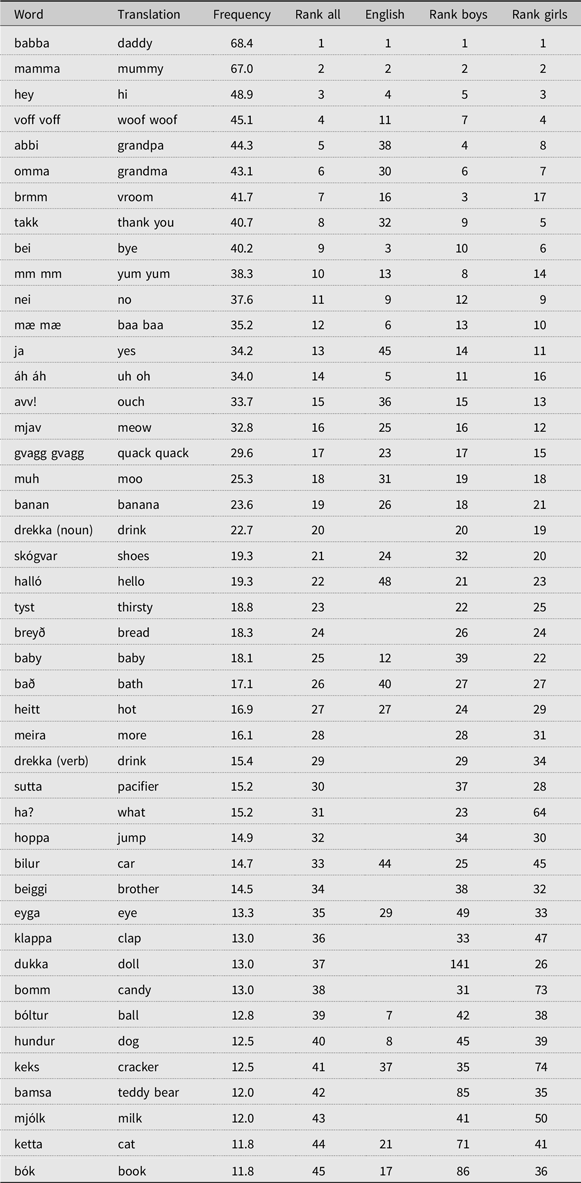
Fenson et al. reported high correlations between the two methods of reporting first words, and the Rescorla et al. (Reference Rescorla, Frigerio, Sali, Spataro and Longobardi2014) procedure is followed in this study. Five items in the list on the right in Table 3 representing games and names marked with italics, e.g. so stórur ‘so big’ (game), spæla bø ‘peek a boo’ (game), shh ‘shh’, sítt egna navn (own name), and navn á pedagogi/dagrøktara (name of kindergarten teacher), which are not analysable regarding syllables and phonological characteristics, for example, are omitted, resulting in the final list in Table 4. This list contains 45 words (although the list is labelled ‘Fifty first words’, as it is based on the top 50 words), and the following results are based on this list. Regarding the baby word forms mentioned in Section 1, they could have been included in the list; however, to allow for cross-linguistic comparison and because they are not stable over time, they are not included in the list.
List of the 50 first words (excluding five items; see main text)

3. Results
3.1 First words
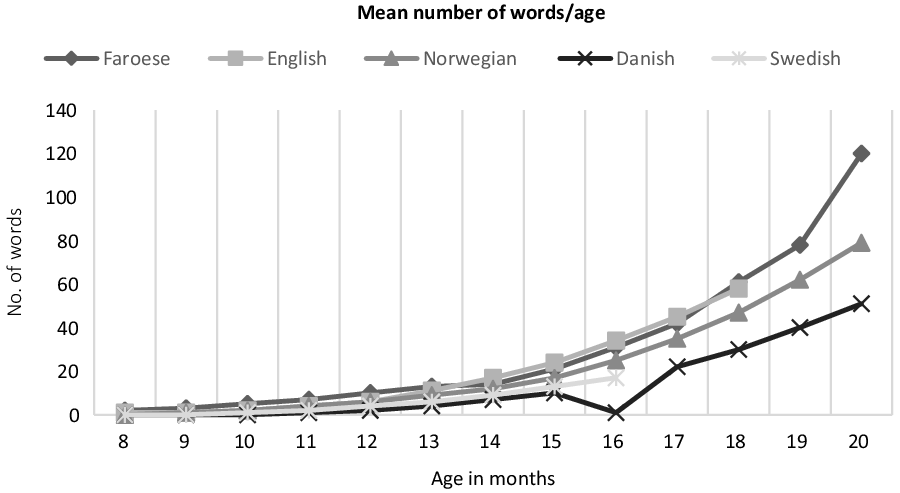
In this section, descriptive analyses of the results of Faroese children’s first productive words are presented. As can be seen in Figure 2, the Faroese results of the productive vocabulary for infants are comparable to that of other languages. The mean number of words produced by Faroese infants is compared with that produced by children exposed to other languages via Wordbank, an open database of children’s vocabulary development, using the MB-CDI questionnaire (see http://wordbank.stanford.edu/). The Swedish data include children up to the age of 16 months, and the English data include children up to 18 months, while the Faroese, Danish, and Norwegian data include infants up to 20 months. Faroese children show the same developmental trend as children exposed to the other languages and are most similar to English children and slightly higher in productive vocabulary than Norwegian children.
Productive vocabulary by language.

3.1.1 List of the first 50 words
Table 4 lists the 50 first words acquired by Faroese children (after removing five unanalysable items, as explained above). The list shows the frequency of each word on the list, a translation to English, and separate rankings for Faroese boys and girls. The rank for the word in English from the American MB-CDI study is added for comparison. The American study was chosen as it reflects a large-scale study and was the original study that other results emerge from. Blank spaces in the English top 50 word list reflect that the word is found in the Faroese top 50 but is not included in the American top 50 word list.
3.1.2 Content and composition of first words
The next section is an analysis of the first words produced by the children in this study regarding content and composition, and it was determined whether any differences can be seen in ranking of words regarding gender. The first words were also compared with English children’s first words.
Word types/categories
The FAEMB-CDI I word list is divided into 20 different categories, and eight of the categories are represented in Table 4. As for the lexical categories the list has 23 nouns (51%), which include some onomatopoetic words and words used in social routines, and three verbs (7%), two adjectives (4%), and the remainder of the words are onomatopoetic expressions, interjections, and adverbs. The three verbs Faroese infants use in their productive vocabulary are klappa ‘clap’, drekka ‘drink’, and hoppa ‘jump’.
It is not possible to use the MB-CDI to assess how children produce words phonologically, although it is possible to analyse the words that are acquired in terms of their phonological characteristics. The results in Table 4 show that the word list contains 30 words starting with a consonant, with 20 of these words (44%) starting with a bilabial and five words (11%) starting with a vowel (one of these is a diphthong). Eight of the words, equal to 16%, start with a consonant cluster. Regarding syllable length, the list contains 27 disyllabic words (60%, including onomatopoetic words such as mm mm) and 18 monosyllabic words (40%).
The distribution of words from different semantic categories reveals a tendency for words to belong to three categories: people, sound effects and animal sounds, and games and routines. This finding is illustrated in Table 5 in selected age groups, as only words from these three categories are present among the 10 most frequent words (the numbers do not sum to 10 because some words share the 10th rank).
Ten most frequent words and their distribution across categories in productive vocabulary

First words and gender
Analysing the word for gender differences reveals that the highest-ranked words in the list are quite similar; in the top 20 words there is only one word that is not the same for both genders (the girls have the word ‘shoe’ in the top 20 instead of ‘banana’, although banan is ranked as 21, so it is near the top 20). Regarding differences between the genders in ranking in the top 20 words, the word brmm ‘vroom’ has the most different rankings: it is ranked 3 for boys and 17 for girls.
From the top 50 list for both genders combined, there are five words that are not included in the boys’ list: eyga ‘eye’, dukka ‘doll’, bamsa ‘teddy bear’, ketta ‘cat’, and bók ‘book’. There are also five words that are not on the girls’ list but are on the list of the top 50 words for both genders: ha? ‘what?’, klappa ‘clap’, bomm ‘candy’, keks ‘cracker’, and mjólk ‘milk’. Thus, 40 of the 45 words on the list of first words are the same for both genders, resulting in 88.9% of the 50 first words being the same for both genders.
First words by language
Comparing the Faroese and English lists of the first 50 words, we see that 69% of the words are the same, with the difference between ranks in Faroese and English being 10 ranks or less for 40% of the words. Among the 10 words with rankings that are more than 20 places apart in the two languages, two of these words are omma ‘grandma’ and abbi ‘grandpa’, which have notably different ranks, e.g. numbers 5 and 6 in Faroese compared with 38 and 30 in English.
3.1.3 Emerging word forms
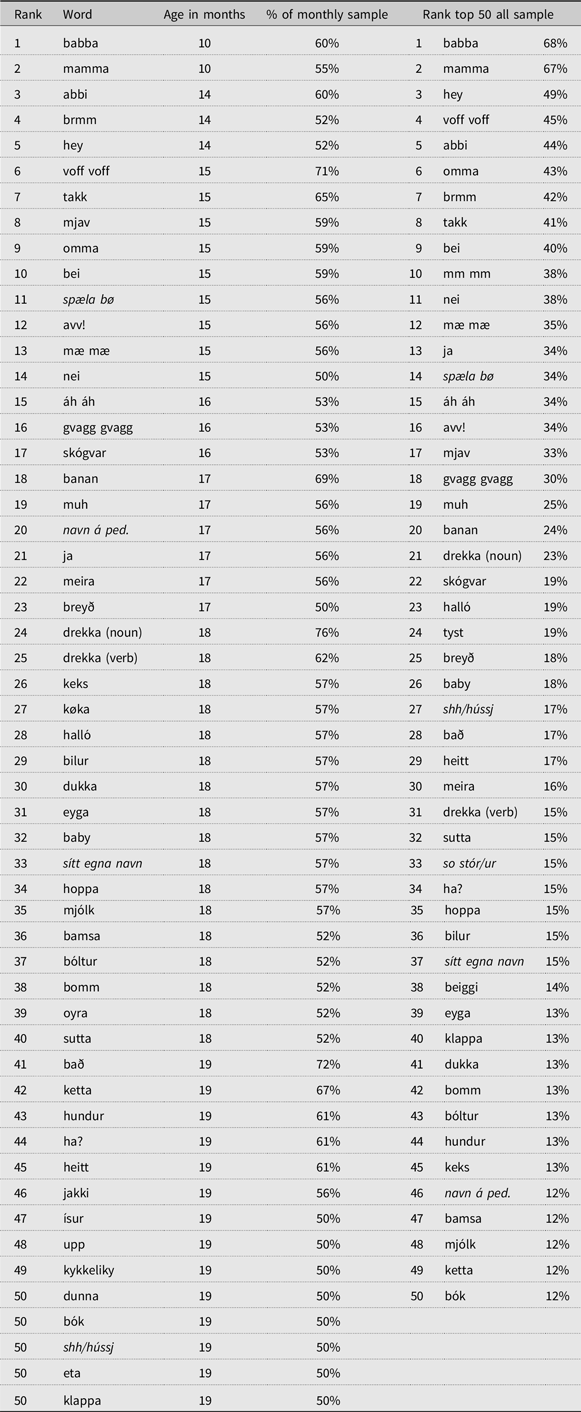
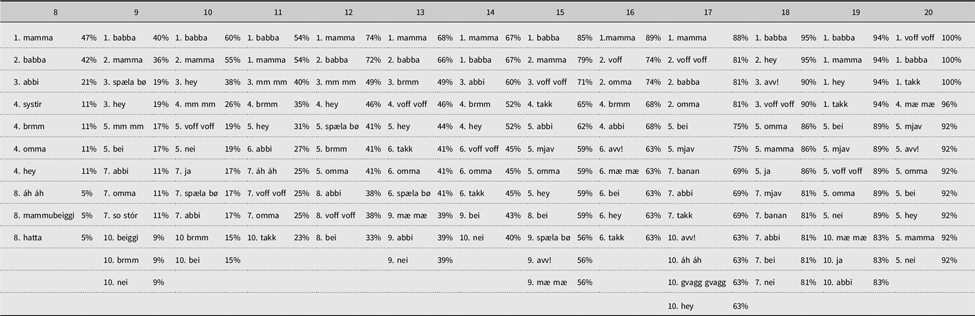
Table 6 displays the emerging word forms based on the top 10 list of words for each of the months represented in this study. The percentage reported is for individual words produced by the children month by month from 8 months to 20 months. For the 8-month age group, the list represents all different words said at that point, but for the remainder of the age groups, the top 10 words are shown. In some age groups, more than 10 words are shown, which is due to more than one word having the same rank in the list and therefore sharing a rank number.
Emerging word forms by month

Regarding the emerging productive vocabulary in Table 6, these words are predominantly from the ‘people’ category, which includes family members, and the ‘games and routines’ category. In 10 of the 13 age groups, four of the words in the top 10 represent family members. Words from the ‘games and routines’ category are well represented, as are ‘sound effects and animal sounds’.
Analysing the top 10 list according to age reveals that some words are stable over the age spectrum, e.g. the six words mamma ‘mummy’, babba ‘daddy’, bei ‘bye bye’, omma ‘grandmother’, abbi ‘grandfather’, and brmm ‘vroom’ are present in six of the 13 age groups. Five of these six words are present in other age groups. When comparing the first age group, 8 months, with the last, 20 months, four of the top 10 words are the same. This result demonstrates a very stable vocabulary based on the most frequent words from 8 months to 20 months. Other emerging word forms, such as bei ‘bye bye’, can also be traced through the table and are present in 10 of 13 age categories. Therefore they are quite stable among the most common words.
In the case of the words in the 8-month category, there are two words to comment on. The word systir ‘sister’ is in the top 10, and because of its phonologically complex form, having a word-medial consonant cluster, an explanation is required. In the 8-month group there are only 19 children. Few children say anything at this time, and, as reported previously, the list contains all words said at this point. Thus, if the word is checked by the parents, it ends up in the top 10 list, which makes the data more unreliable in the 8-month-old group. Another explanation is that parents actually mean that the child says the easier word form didda, which is the baby word form for systir. Both forms have the same frequency, perhaps because parents ‘translate/replace’ the word systir with didda. Regarding the word mammubeiggi ‘uncle’, which is a phonologically complex four-syllable word, either the case is the same as with systir in that the child says mamba (baby word form for mammubeiggi), or the data are more unstable, for example, if only two parents check the word, it ends up in the top 10 because there are few children saying anything at this time.
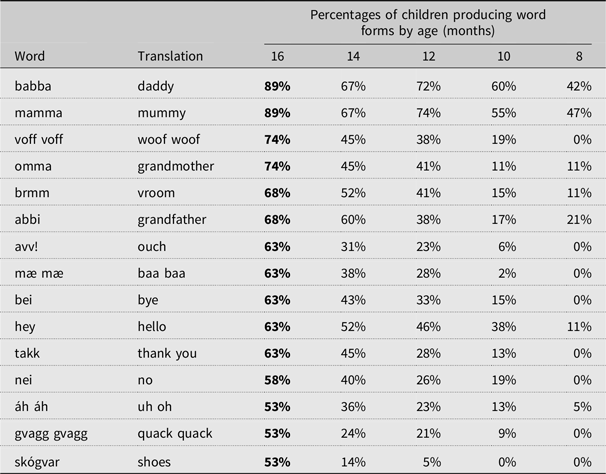
Table 7 shows emerging word forms from the FAEMB-CDI I, focusing on the age group of 16 months, which is the oldest age group for which the form was originally intended. The total sum score for the words produced by more than 50% of those children is selected. Then the percentage for the same words for selected ages (14, 12, 10, and 8 months) is shown to trace how the word behaves in younger age groups, showing the developmental trend of the word in relation to age.
Emerging word forms produced at different ages

All of the words show a steady increase with age. The words mamma ‘mummy’ and babba ‘daddy’ are both represented with the highest percentages for all age groups, and there is a tendency for the ranking of words at 16 months to be quite similar to the rankings in the younger age groups.
4. Discussion
This large-scale study presented findings on the first words in Faroese children’s early lexical development. The main goal was to describe the composition of early productive vocabulary, which to date is unexplored with respect to frequency, emerging words, syllable length, age, gender, and use of different categories, using the Faroese adaptation of the MB-CDI. As there is very restricted research in the Faroese language regarding both adult- and child-based data, the comparison is based on the characteristics of the MB-CDI I word list and cross-linguistic research.
The trend observed in other languages, namely that verbs, adjectives, and grammatical function words are rare in early lexical acquisition, was also observed in this study (Caselli et al. Reference Caselli, Bates, Casadio, Fenson, Fenson, Sanderl and Weir1995, Reference Caselli, Bates and Casadio1999). The results show that, as for other languages, nouns (including kinship terms, onomatopoetic words, and common nouns) are dominant among Faroese children’s first words, with over 50% of the first words being nouns and 7% being verbs. This could be due to input frequency, e.g. found by Schneider et al. (Reference Schneider, Yurovsky, Frank, Noelle, Rick Dale, Warlaumont, Matlock, Jennings and Maglio2015) as stated in Section 1, ease of articulation, and imageability of the word, but these factors have not been measured in Faroese. Onomatopoetic words and names for persons are considered as nouns, e.g. mamma ‘mummy’, abbi ‘grandfather’, and gvagg gvagg ‘quack quack’, and they have the highest frequencies while common nouns dominate the lower frequencies. The three verbs among the first 50 words also reflect the finding in international research that the first verbs are often verbs reflecting activity, in this case ‘clap’, ‘drink’, and ‘hop’. Regarding phonological characteristics of the words the children are reported to produce, we see similarities between the words in the total list of 428 words and the first 50 words. Eleven per cent of the first 50 words start with a vowel or diphthong, compared with 12.4% in the full word list; 60% of the words start with a consonant compared with 66.3% in the full word list; and 16% start with a cluster of two or three consonants (85 of the words with two consonants and five with three consonants), compared with 21.4% in the full word list. These numbers are very close, with a somewhat smaller proportion of consonant clusters than that for the whole set. As revealed in Table 4, Faroese infants have a preference for words starting with initial bilabials, as nearly half of the first words they produce start with a bilabial, while 18.3% of the words in the word list are bilabials. Regarding syllable length, the children produce 27 disyllabic words (60%, including onomatopoetic words such as mm mm) and 18 monosyllabic words (40%), compared with 55.3% disyllabic words and 26.3% monosyllabic words in the total word list (the rest of the words in the list are three-syllable words or more, 11.1% and 7.3%, respectively). The infants seem to learn both monosyllabic and disyllabic words, with a larger proportion of disyllabic words, in the first stages of productive vocabulary, as seen in international research, e.g. Danish MB-CDI studies (Bleses et al. Reference Bleses, Vach, Slott, Wehberg, Thomsen, Madsen and Basbøll2008b). If the results are compared to the study by Garmann et al. (Reference Garmann, Hansen, Simonsen and Kristoffersen2019), which comprises data on children’s early words regarding both initial bilabials and syllable length in Norwegian, Swedish, English, and Italian, the Faroese children follow the tendency to use word-initial bilabials, but regarding syllable length they resemble the Swedish and Italian children. Although word frequency lists for adult or child language are not found in Faroese, the results of the first 50 words demonstrate no surprise or unexpected items, but words that contain the predicted characteristics of frequency, social routines, and non-complex phonological characteristics, e.g. words for family members such as mum and dad, words for animal sounds such as moo and woof woof, and nouns such as car, doll, book, and banana. The first 50 words are mostly not words influenced by morpho-phonological alternations described as a characteristic of Faroese. Only three of the first 50 words are characterized as such words: skógvar [sg̊ɛg̊vaɹ] ‘shoes’, which in an inflectional form skóm (dat.pl) is pronounced [sg̊ɔun], drekka [d̥ɹɛʰkːa] ‘to drink’ as [d̥ɹʊʤ̥ɔː] (drukkið, pst.ptcp), and bók [b̥ɔuk] ‘book’ as [b̥øːkɪɹ] (bøkur, nom/acc.pl). It would be expected that the infants learn the easier and more frequent word forms first compared with more opaque word forms due to these morpho-phonological alternations.
Comparing the 50 first words with the English-American children’s first words shows that 69% of the words are the same, which reflects a tendency that the first words are universal as stated in previous research. Analysis of the list regarding words that have quite different rankings reveals that words for family members, such as ‘grandpa’ and ‘grandma’, have quite different rankings, e.g. 5 and 6 in Faroese compared with 30 and 38 in English, as well as beiggi ‘brother’, which is one of the first 50 words in Faroese but not in English. This could reflect input frequency stemming from a more family-oriented society, as stated in Section 1 (Hayfield et al. Reference Hayfield, Olavson and Patursson2016; Hayfield Reference Hayfield2018), although these words are easier to pronounce in Faroese compared with English, e.g. they are less complex phonologically and comprise early-acquired segments such as the bilabials /m/ and /b/. This result is also in accordance with the Wehberg et al. (Reference Wehberg, Vach, Bleses, Thomsen, Madsen and Basbøll2007) findings regarding the later acquisition of the words for ‘mother’ (Danish mor) and ‘father’ (Danish far) compared with the English words mum and dad. Other words with different rankings in the two languages include takk ‘thank you’, which in Faroese is ranked 8, compared with 32 in English. This could stem from the circumstance that in English, it is phonologically more complex and is a two-word utterance and therefore more complicated than the Faroese word takk, although children in the sample are able to utter two-syllable words, e.g. grandma (in this case two-word utterances are not overly more complicated than a two-syllable word). However, the words ball and dog in English are ranked 7 and 8, as opposed to 39 and 40 in Faroese, where they are two-syllable words, bóltur ‘ball’ and hundur ‘dog’, and phonologically more complicated to produce. As stated in Section 1, the first words children produce can be predicted from linguistic factors such as concreteness, input frequency, babiness, phonological complexity, and imageability of the words, and these results show that the words acquired by Faroese children early are seemingly also related to these factors, although it is not possible to relate them to research on word frequency and babiness in Faroese, for example.
The results provide the first information on the characteristics of vocabulary acquisition in Faroese children and add to the literature by providing descriptive data. In summary, we found a domination of nouns and social terms among the first 50 words. In terms of emerging word forms, the highest ranked words are quite stable across age groups, indicating that these words are important words in early vocabulary. Words reflecting family are present throughout all ages and may reflect a family-oriented environment, as seen in Italian, where children have a higher proportion of social terms, e.g. terms for family members, than English children in the earliest stages of language acquisition. Caselli and colleagues explained the higher representation of social terms with the tendency for Italian children to have family closer, and, therefore, both have a reason for naming them and prompting more interaction (e.g. Caselli et al. Reference Caselli, Bates, Casadio, Fenson, Fenson, Sanderl and Weir1995, Reference Caselli, Bates and Casadio1999; Hayfield et al. Reference Hayfield, Olavson and Patursson2016). At this stage, children do not use many verbs and follow the trend seen in other languages that first verb forms reflect actions, e.g. clapping and jumping. We can see some small gender differences in the composition and ranking of vocabulary, although not in the 20 highest ranked words, which seem to be the same for both genders. These results are comparable to other Scandinavian results and to English results, and may be an expected result given that the cultures are fairly similar and considering the method used, namely, the word lists are adaptations of the same instrument. Rescorla et al. (Reference Rescorla, Frigerio, Sali, Spataro and Longobardi2014) showed that some words in the early word learning process have strong cross-linguistic similarities and the present study demonstrates that they are also part of the early Faroese vocabulary.
It must be taken into account that the demographic data show that the sample is skewed regarding the educational status of the parents in relation to the population, and education is known to have an impact on children’s language development. The validity of the assessment method has been proved, but it is based on parents and can be influenced by memory limitations. The sample contains a higher proportion of parents with education compared to the population. Parental education influences children’s language acquisition and therefore this element must be considered when interpreting the results. It should be noted, as stated in the description of the participants, that the sample included 44.5% of the whole population in this age spectrum, although the sample is smaller in number than those in Norwegian and Danish studies.
There are some limitations to this study, mainly, the lack of other research to validate the data and the reliance of the results on parental reports rather than direct measures of vocabulary acquisition. Therefore generalizations of the results are limited to parent-reported vocabulary. Despite these limitations, the study has important value for constructing language tests, for example, and identifying future directions that research on Faroese child language should take.
The next research steps should involve analysing broader aspects of lexical acquisition regarding age, and include receptive vocabulary, longitudinal data, and other aspects of language acquisition.
Acknowledgements
The author would like to thank all the parents participating in this study, as well as Philip Dale and the CDI Advisory Board for providing permission to adapt the MacArthur–Bates Communicative Development Inventories to Faroese. I want to thank the three anonymous NJL reviewers and editor Gunnar Ólafur Hansson for valuable feedback and comments.
The author has no conflicts of interest to declare.
This research was funded by a grant from Granskingarráðið (The Faroese Research Council).