Introduction
The clinical condition of dementia, by definition a global cognitive decline with functional impairment, is now recognized as a diagnosis that can only be applied too late in the disease process to be useful for current and future therapeutic approaches that centre on disease modification. As a result, in recent years increasing research attention has been given to mild cognitive impairment (MCI) and the diagnosis of prodromal dementia. Petersen et al. (Reference Petersen, Smith, Waring, Ivnik, Tangalos and Kokmen1999) described MCI as an entity with clinical characteristics intermediate between dementia and healthy controls, and high rates of conversion to dementia [most commonly Alzheimer's disease (AD) because of the amnestic weighting of the MCI definition]. Later, the diagnosis was refined to subcategorize MCI into amnestic (aMCI) and non-amnestic MCI (naMCI), depending on whether memory was affected or not (Petersen et al. Reference Petersen, Doody, Kurz, Mohs, Morris, Rabins, Ritchie, Rossor, Thal and Winblad2001; Winblad et al. Reference Winblad, Palmer, Kivipelto, Jelic, Fratiglioni, Wahlund, Nordberg, Backman, Albert, Almkvist, Arai, Basun, Blennow, de Leon, DeCarli, Erkinjuntti, Giacobini, Graff, Hardy, Jack, Jorm, Ritchie, van Duijn, Visser and Petersen2004). aMCI was hypothesized to precede AD or vascular dementia whereas naMCI was thought to be more likely to precede dementia with Lewy bodies (DLB), vascular dementia or frontotemporal dementia (Petersen, Reference Petersen2004).
More recently, criteria for the diagnosis of MCI due to AD (Albert et al. Reference Albert, DeKosky, Dickson, Dubois, Feldman, Fox, Gamst, Holtzman, Jagust, Petersen, Snyder, Carrillo, Thies and Phelps2011) and prodromal AD (Dubois et al. Reference Dubois, Feldman, Jacova, Cummings, Dekosky, Barberger-Gateau, Delacourte, Frisoni, Fox, Galasko, Gauthier, Hampel, Jicha, Meguro, O'Brien, Pasquier, Robert, Rossor, Salloway, Sarazin, de Souza, Stern, Visser and Scheltens2010) have been put forward. These diagnostic criteria are similar to previous descriptions of aMCI but also include validated disease biomarkers indicative of brain amyloid deposition and/or neuronal injury.
The diagnosis of prodromal dementia has gained prominence following disappointing results in recent trials of anti-amyloid therapies and the hypothesis that such treatments may only be successful in the earliest stages of the disease (Aisen et al. Reference Aisen, Vellas and Hampel2013). AD, the most common type of dementia, has received significant attention in this regard. A wide variety of other causes of dementia exist, with vascular dementia, DLB and frontotemporal dementia being among the most common subtypes. Less common subtypes account for a significant proportion of dementia cases, particularly in those under 65 years old (Harvey et al. Reference Harvey, Skelton-Robinson and Rossor2003). Huntington's disease has demonstrated a long prodromal phase that has been characterized in recent longitudinal studies (Paulsen et al. Reference Paulsen, Langbehn, Stout, Aylward, Ross, Nance, Guttman, Johnson, MacDonald, Beglinger, Duff, Kayson, Biglan, Shoulson, Oakes and Hayden2008; Tabrizi et al. Reference Tabrizi, Reilmann, Roos, Durr, Leavitt, Owen, Jones, Johnson, Craufurd, Hicks, Kennard, Landwehrmeyer, Stout, Borowsky, Scahill, Frost and Langbehn2012).
DLB is the second most common type of neurodegenerative dementia after AD, accounting for at least 4.2% of all diagnosed dementias in the community and 7.5% of those in secondary care (Vann Jones & O'Brien, Reference Vann Jones and O'Brien2014). There are validated consensus criteria for the clinical diagnosis of DLB (McKeith et al. Reference McKeith, Dickson, Lowe, Emre, O'Brien, Feldman, Cummings, Duda, Lippa, Perry, Aarsland, Arai, Ballard, Boeve, Burn, Costa, Del Ser, Dubois, Galasko, Gauthier, Goetz, Gomez-Tortosa, Halliday, Hansen, Hardy, Iwatsubo, Kalaria, Kaufer, Kenny, Korczyn, Kosaka, Lee, Lees, Litvan, Londos, Lopez, Minoshima, Mizuno, Molina, Mukaetova-Ladinska, Pasquier, Perry, Schulz, Trojanowski and Yamada2005). These display high positive predictive values for the post-mortem neuropathological classification of intermediate- or high-likelihood DLB (Fujishiro et al. Reference Fujishiro, Ferman, Boeve, Smith, Graff-Radford, Uitti, Wszolek, Knopman, Petersen, Parisi and Dickson2008). DLB requires different management from AD, most notably the avoidance of antipsychotic medications (Ballard et al. Reference Ballard, Grace, McKeith and Holmes1998).
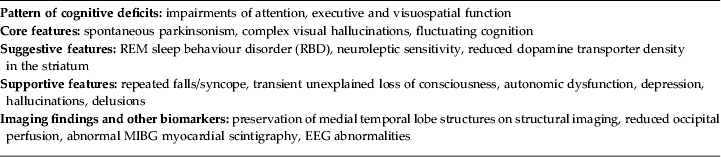
The existence of a prodromal phase of DLB is to be expected, given the insidiously progressive nature of the disorder, as with AD. It may also be expected that prodromal DLB should display some of the features characteristic of established DLB (Table 1) (McKeith et al. Reference McKeith, Dickson, Lowe, Emre, O'Brien, Feldman, Cummings, Duda, Lippa, Perry, Aarsland, Arai, Ballard, Boeve, Burn, Costa, Del Ser, Dubois, Galasko, Gauthier, Goetz, Gomez-Tortosa, Halliday, Hansen, Hardy, Iwatsubo, Kalaria, Kaufer, Kenny, Korczyn, Kosaka, Lee, Lees, Litvan, Londos, Lopez, Minoshima, Mizuno, Molina, Mukaetova-Ladinska, Pasquier, Perry, Schulz, Trojanowski and Yamada2005; Troster, Reference Troster2008). The identification of a DLB prodrome would enable investigation of the early pathophysiology of DLB and the development of treatments to interrupt these pathophysiological processes. Prodromal DLB may require different management from other dementia prodromes. For example, DLB may potentially be more responsive to cholinesterase inhibition in its prodromal phase, given the early and widespread cholinergic losses seen in DLB compared with AD (Tiraboschi et al. Reference Tiraboschi, Hansen, Alford, Merdes, Masliah, Thal and Corey-Bloom2002).
Diagnostic features of DLB (adapted from McKeith et al. Reference McKeith, Dickson, Lowe, Emre, O'Brien, Feldman, Cummings, Duda, Lippa, Perry, Aarsland, Arai, Ballard, Boeve, Burn, Costa, Del Ser, Dubois, Galasko, Gauthier, Goetz, Gomez-Tortosa, Halliday, Hansen, Hardy, Iwatsubo, Kalaria, Kaufer, Kenny, Korczyn, Kosaka, Lee, Lees, Litvan, Londos, Lopez, Minoshima, Mizuno, Molina, Mukaetova-Ladinska, Pasquier, Perry, Schulz, Trojanowski and Yamada2005)

REM, Rapid eye movement; MIBG, metaiodobenzylguanidine; EEG, electroencephalography.
In this paper we review the evidence to determine if DLB has a characteristic prodromal phase that may allow its differentiation from other dementia prodromes.
Method
A Medline (Web of Knowledge; 1950 to present) search was carried out in October 2013. The search algorithm used was: [‘MCI’ OR ‘mild cognitive impairment’ OR ‘mild dementia’ OR ‘prodrom*’] AND [‘Lewy’].
The search identified 378 English-language papers. Titles and abstracts were then screened by two reviewers (P.C.D. and A.J.T.). Case studies were excluded. In longitudinal cohorts where the same outcomes had been reported at different time points, only the most recent results were included. A total of 54 relevant papers were identified. After reading these papers, it was apparent that the original search did not find a significant number of relevant papers investigating rapid eye movement (REM) sleep behaviour disorder (RBD) as a prodrome of DLB.
A second search was carried out using the terms [‘RBD’ OR ‘REM sleep behaviour disorder’ OR ‘rapid eye movement sleep behaviour disorder’] AND [‘Lewy’]. Of 108 further results, 15 papers of interest were identified.
After further assessment, 29 papers were found to contain original data on prodromal DLB. A further paper was found after searching the bibliographies of these papers (Postuma et al. Reference Postuma, Gagnon, Vendette, Desjardins and Montplaisir2011).
Results
Epidemiological studies of rates of conversion from MCI to DLB
Three studies have prospectively followed up patients with MCI for the development of DLB. In a cohort of 581 75-year-olds (440 cognitively healthy, 48 with aMCI and 93 with naMCI) followed up for 30 months, possible DLB was found in 10 cases, all of whom also fulfilled clinical criteria for possible or probable AD (Fischer et al. Reference Fischer, Jungwirth, Zehetmayer, Weissgram, Hoenigschnabl, Gelpi, Krampla and Tragl2007). At baseline, four were cognitively healthy, two had aMCI and four had naMCI. In another group of 133 patients with MCI followed up for 6 years, 53.4% developed dementia and 5.6% (4/71) of these dementia cases were diagnosed as DLB (Palmqvist et al. Reference Palmqvist, Hertze, Minthon, Wattmo, Zetterberg, Blennow, Londos and Hansson2012). One study that followed up 170 consecutive cases of MCI at a memory clinic found high rates of DLB (22% of dementia cases were probable DLB, 6% were possible DLB) (Bombois et al. Reference Bombois, Debette, Bruandet, Delbeuck, Delmaire, Leys and Pasquier2008). The heterogeneity of these results can be attributed, at least partly, to the recruitment of participants, with the highest proportions of DLB found in a study recruiting from a tertiary referral centre (Bombois et al. Reference Bombois, Debette, Bruandet, Delbeuck, Delmaire, Leys and Pasquier2008) and the lowest in a study that recruited most patients from primary care units (Palmqvist et al. Reference Palmqvist, Hertze, Minthon, Wattmo, Zetterberg, Blennow, Londos and Hansson2012).
In a post-mortem study of 134 patients who died with a diagnosis of MCI, eight (6%) had cortical Lewy bodies (LBs); five of these eight in the absence of vascular or AD pathology. A further 10% had nigral or limbic LBs (Schneider et al. Reference Schneider, Arvanitakis, Leurgans and Bennett2009). Saito & Murayama (Reference Saito and Murayama2007) found that, of 33 MCI cases showing degenerative pathology post-mortem, six (18%) had LB pathology, with half of these showing only DLB-type changes. Another small study of an aMCI group found that one in 15 cases had transitional LB pathology post-mortem, along with some AD pathology (Petersen et al. Reference Petersen, Parisi, Dickson, Johnson, Knopman, Boeve, Jicha, Ivnik, Smith, Tangalos, Braak and Kokmen2006).
Clinical studies of prodromal DLB
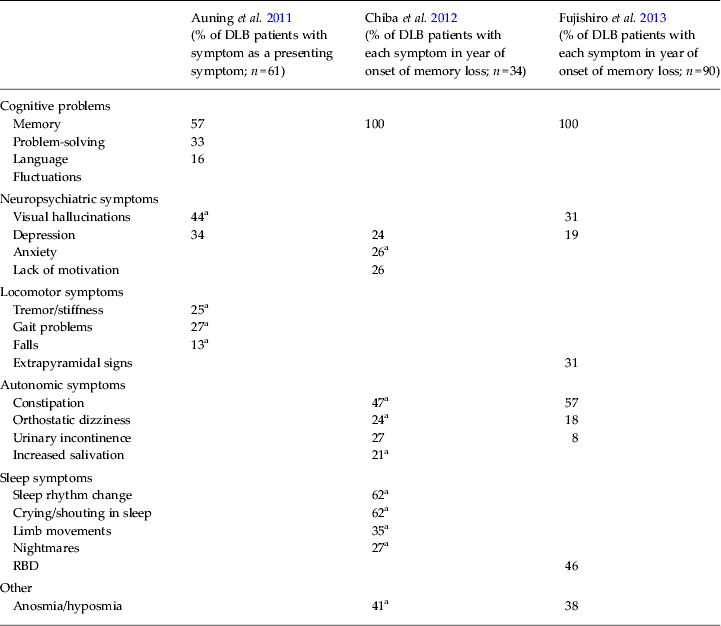
Three studies (Auning et al. Reference Auning, Rongve, Fladby, Booij, Hortobagyi, Siepel, Ballard and Aarsland2011; Chiba et al. Reference Chiba, Fujishiro, Iseki, Ota, Kasanuki, Hirayasu and Satoa2012; Fujishiro et al. Reference Fujishiro, Iseki, Nakamura, Kasanuki, Chiba, Ota, Murayama and Sato2013) have asked patients with DLB and/or their carers to retrospectively report on the early symptoms of DLB (Table 2).
The prevalence of key symptoms in three clinical studies of prodromal DLB

DLB, Dementia with Lewy bodies; RBD, rapid eye movement (REM) sleep behaviour disorder.
a Significantly more common than Alzheimer's disease (AD) comparison group (no comparison group in Fujishiro et al. Reference Fujishiro, Iseki, Nakamura, Kasanuki, Chiba, Ota, Murayama and Sato2013).
Auning et al. (Reference Auning, Rongve, Fladby, Booij, Hortobagyi, Siepel, Ballard and Aarsland2011) interviewed carers of patients newly diagnosed with mild DLB about the presenting symptoms of DLB (MMSE > 20; n = 61). Visual hallucinations (44%), gait problems (28%), tremor/stiffness (25%) and a tendency to fall (13%) were significantly more common in DLB compared with an AD control group whereas memory problems were significantly less common. Fluctuating cognition was not offered as an option for a presenting symptom. Carers did have the opportunity to report symptoms not on the preselected list but any other reported symptoms were infrequent (<10%).
Chiba et al. (Reference Chiba, Fujishiro, Iseki, Ota, Kasanuki, Hirayasu and Satoa2012) asked patients and carers to fill in a survey of predefined symptoms without any additional instructions. They looked at the temporal onset of symptoms relative to memory loss. This was to allow comparison of DLB (n = 34) and AD (n = 32), both of which are associated with progressive memory impairment. The most common symptoms present in the same year as the onset of memory loss were sleep rhythm change (62%), crying/shouting in sleep (62%), anosmia/hyposmia (41%), constipation (47%) and limb movements in sleep (35%) (Table 2). Of those symptoms that were more common in DLB than AD, the earliest to develop were constipation (mean = 9.4 years before memory impairment), crying/shouting during sleep (4.9 years), limb movements during sleep (3.9 years), anosmia/hyposmia (2.9 years) and nightmares (2.5 years). The three symptoms taken to be most representative of DLB (due to high prevalence in DLB and relatively low prevalence in AD/controls) were crying/shouting during sleep, constipation and anosmia/hyposmia. One or more of these symptoms differentiated DLB from AD with a sensitivity of 0.71 and a specificity of 0.81. Increasing the threshold to two or more symptoms resulted in a decrease in sensitivity to 0.38 but an increase in specificity to 0.97. The questionnaire did not enquire about parkinsonism, hallucinations or fluctuations.
The same group later assessed the presence and time of onset of core features and eight symptoms of LB disease in 90 patients with probable DLB (Fujishiro et al. Reference Fujishiro, Iseki, Nakamura, Kasanuki, Chiba, Ota, Murayama and Sato2013). There was no comparison group. As with the previous study, the presence of each symptom at the onset of memory loss was recorded. This study found rates of constipation, anosmia/hyposmia, RBD, depression and orthostatic dizziness comparable to their previous study (Table 2). Lower rates of urinary incontinence were found (8%), and syncope was relatively rare (7%).
This study confirmed that constipation, anosmia and RBD often precede the onset of memory loss by several years. Visual hallucinations and extrapyramidal symptoms each were present in around one-third of individuals at the onset of memory loss, although on average these symptoms developed 1.5 years after memory loss.
Post-mortem studies of prodromal symptoms of DLB
Some post-mortem studies of established DLB have retrospectively assessed the chronological development of symptoms. Ferman et al. (Reference Ferman, Boeve, Smith, Lin, Silber, Pedraza, Wszolek, Graff-Radford, Uitti, Van Gerpen, Pao, Knopman, Pankratz, Kantarci, Boot, Parisi, Dugger, Fujishiro, Petersen and Dickson2011) examined 98 patients with intermediate-high likelihood of DLB on post-mortem examination who had been part of a longitudinal study. On average, RBD preceded dementia by 6 years [with wide variation (s.d. = 12 years), possibly reflecting some cases with very early onset RBD]. Conversely, visual hallucinations and parkinsonism followed the estimated dementia onset by an average of 2.6 and 1.8 years respectively. Another Mayo Clinic post-mortem study examined 52 patients diagnosed during life with probable or possible DLB (Fujishiro et al. Reference Fujishiro, Ferman, Boeve, Smith, Graff-Radford, Uitti, Wszolek, Knopman, Petersen, Parisi and Dickson2008). The authors remarked that ‘RBD antedated the diagnosis of DLB in almost all cases in which RBD was noted’, whereas the presence of notable visual hallucinations followed the development of dementia by an average of 2.8 years.
Both of the above studies recruited subjects when they had already been diagnosed with dementia and prospectively collected information through regular clinical and neuropsychiatric assessments. Two further studies specifically recruited non-demented subjects for prospective follow-up. These studies reported a different pattern of symptom development in prodromal DLB.
Jicha et al. (Reference Jicha, Schmitt, Abner, Nelson, Cooper, Smith and Markesbery2010) enrolled cognitively normal patients for regular clinical follow-up and brain donation following death. Nine patients with neocortical DLB post-mortem and no significant AD or vascular pathology had an identified MCI phase during their illness. This group was compared with 12 patients with a post-mortem diagnosis of AD.
None of the AD-MCI group displayed parkinsonism, cognitive fluctuations or psychiatric symptoms (hallucinations/delusions/paranoia) during the MCI phase. Eight of nine MCI-DLB demonstrated at least one of these features concurrent with the MCI diagnosis (parkinsonism n = 5; fluctuations n = 3; psychiatric symptoms n = 4). MCI-DLB was associated with significant memory impairment but the group performed better on immediate recall than AD-MCI. They were worse on phonemic fluency and tended towards being worse at trail-making, but were better at the Boston Naming Test. It should be noted that, because of the strict inclusion criteria, these findings only represent the MCI phase of patients with later neocortical LB deposition (i.e. a subset of all those who have DLB, some of whom will not have cortical involvement) and without significant vascular or AD pathology.
In a similar study, Molano et al. (Reference Molano, Boeve, Ferman, Smith, Parisi, Dickson, Knopman, Graff-Radford, Geda, Lucas, Kantarci, Shiung, Jack, Silber, Pankratz and Petersen2010) identified eight patients from their research databases who had been prospectively followed up after a diagnosis of MCI, and later were found to have LB disease post-mortem (limbic or neocortical predominant). In the year of MCI diagnosis, or preceding this, five displayed parkinsonism and three had visual hallucinations whereas none displayed fluctuations. RBD was present in seven cases at the diagnosis of MCI, preceding it by up to 47 years. Seven cases developed dementia before death. Of these, five had parkinsonism, five had hallucinations and two had fluctuations before the development of dementia. The patients had a variety of MCI subtypes. Attention/executive function (n = 6) and visuospatial function (n = 6) were the cognitive domains most commonly affected.
Imaging findings in prodromal DLB
Six studies have performed imaging in MCI subjects who later developed DLB. In the study by Molano et al. (Reference Molano, Boeve, Ferman, Smith, Parisi, Dickson, Knopman, Graff-Radford, Geda, Lucas, Kantarci, Shiung, Jack, Silber, Pankratz and Petersen2010), three cases had serial magnetic resonance imaging (MRI). Compared with previously published data, hippocampal volumes at the time of MCI and the rate of hippocampal atrophy were within the range of cognitively normal subjects.
In a group of 170 patients with MCI, baseline subcortical hyperintensities on MRI were associated with an increased risk of developing mixed or vascular dementia, but not DLB or other dementia subtypes (Bombois et al. Reference Bombois, Debette, Bruandet, Delbeuck, Delmaire, Leys and Pasquier2008).
One study has performed positron emission tomography (PET) dopamine terminal imaging on subjects with MCI with follow-up for the development of DLB (Albin et al. Reference Albin, Burke, Koeppe, Giordani, Gilman and Frey2013). Of 27 MCI subjects, two had markedly reduced striatal 11C-dihydrotetrobenazine (DTBZ) binding. Both developed dementia at follow-up; one was classified as DLB, the other as frontotemporal dementia. However, three out of 25 MCI subjects with normal DTBZ scans also developed DLB.
Clerici et al. (Reference Clerici, Del Sole, Chiti, Maggiore, Lecchi, Pomati, Mosconi, Lucignani and Mariani2009) performed 18F-fluorodeoxyglucose (18F-FDG) PET on 16 patients with single domain aMCI and 14 patients with naMCI with executive dysfunction. These were compared with controls who were undergoing PET scans for cancer restaging. Of those who completed follow-up, one in 14 aMCI and five in 12 naMCI developed DLB. In a voxel-based analysis, the naMCI who developed DLB had heterogeneous patterns of hypometabolism compared to controls. The inferior and mesial frontal areas, anterior and posterior cingulate areas, and superior temporal and inferior parietal areas were most frequently involved. Frontal hypometabolism may have been expected, given that executive dysfunction was one of the inclusion criteria for the naMCI group. This may not be representative of all prodromal DLB.
Pardo et al. (Reference Pardo, Lee, Kuskowski, Munch, Carlis, Sheikh, Surerus, Lewis, McCarten, Fink, McPherson, Shah, Rottunda and Dysken2010) followed 19 army veterans with MCI for 3 years following baseline FDG-PET scans. Two developed DLB; both had an ‘AD-like’ pattern of hypometabolism (hypometabolism in medial parietal and lateral parietal regions) on visual inspection. Neither displayed occipital hypometabolism.
Another study performed MR spectroscopy, diffusion weighted imaging (DWI) and perfusion imaging on 119 patients with MCI (Fayed et al. Reference Fayed, Davila, Oliveros, Castillo and Medrano2008). After follow-up, subjects could be classified as AD (including mixed dementia, n = 49), Lewy body dementia (LBD) (n = 5; criteria not stated), MCI due to vascular disease (n = 15), MCI due to depression (n = 22) or MCI due to AD (n = 28). There were no differences between LBD and the other groups in baseline spectroscopy or perfusion findings. On DWI in the right hippocampus, the LBD group had higher baseline apparent diffusion coefficient (ADC) values compared with the three MCI groups, indicating greater white matter disruption. The difference between LBD and AD approached significance (p = 0.08). Values in the AD/mixed dementia group did not differ from the MCI groups. Baseline characteristics were not provided, so the findings could be due to differences between groups at baseline (e.g. age or severity of cognitive impairment).
RBD
RBD is associated with high rates of conversion to dementia. Longitudinal studies have estimated that over half of patients with RBD go on to develop a neurodegenerative disorder that is nearly always a synucleinopathy [e.g. Parkinson's disease (PD), PD dementia, DLB, multi-system atrophy] if followed up for more than a decade, rising to up to 93% if followed up over longer periods (Postuma et al. Reference Postuma, Gagnon, Vendette, Fantini, Massicotte-Marquez and Montplaisir2009; Iranzo et al. Reference Iranzo, Tolosa, Gelpi, Molinuevo, Valldeoriola, Serradell, Sanchez-Valle, Vilaseca, Lomena, Vilas, Llado, Gaig and Santamaria2013; Schenck et al. Reference Schenck, Boeve and Mahowald2013). In these studies, 14–39% of those who developed a neurodegenerative disorder were diagnosed with DLB.
Studies specifically looking at DLB with RBD have confirmed that RBD tends to precede cognitive symptoms by several years (Boeve et al. Reference Boeve, Silber, Ferman, Kokmen, Smith, Ivnik, Parisi, Olson and Petersen1998, Reference Boeve, Silber, Parisi, Dickson, Ferman, Benarroch, Schmeichel, Smith, Petersen, Ahlskog, Matsumoto, Knopman, Schenck and Mahowald2003). In some cases the gap is more than 25 years (Claassen et al. Reference Claassen, Josephs, Ahlskog, Silber, Tippmann-Peikert and Boeve2010). Core symptoms may develop earlier in DLB patients with RBD than in those without RBD (Dugger et al. Reference Dugger, Boeve, Murray, Parisi, Fujishiro, Dickson and Ferman2012).
Imaging in RBD to predict the development of DLB
Dang-Vu et al. (Reference Dang-Vu, Gagnon, Vendette, Soucy, Postuma and Montplaisir2012) performed technetium-99m ethylcysteinate dimer (99mTc-ECD) single photon emission computed tomography (SPECT) perfusion scanning on 20 patients with RBD who did not have dementia (although 13 had MCI), and compared these to 10 healthy controls. After an average follow-up of 3 years, five RBD subjects developed DLB (criteria not stated) and five PD. All those who developed DLB had an initial diagnosis of MCI. The PD/DLB group had increased baseline hippocampal regional cerebral blood flow (rCBF) compared to the RBD group that did not develop neurodegenerative disease. The five DLB patients had increased hippocampal rCBF compared with controls. There were no significant differences between the PD and DLB groups. The PD/DLB group was on average 4.8 years older than the RBD subjects who did not develop disease.
Iranzo et al. (Reference Iranzo, Lomena, Stockner, Valldeoriola, Vilaseca, Salamero, Molinuevo, Serradell, Duch, Pavia, Gallego, Seppi, Hogl, Tolosa, Poewe and Santamaria2010) performed striatal dopamine terminal binding of 123I-2β-carbomethoxy-3β-(4-iodophenyl)-N-(3-fluoropropyl)-nortropane (123I-FP-CIT) and transcranial echosonography of the substantia nigra in 43 patients with RBD. Eight patients later developed neurodegenerative disease (five PD, two DLB and one multi-system atrophy), all of whom had at least one abnormal imaging finding. Thirty per cent of those with an abnormal finding developed a neurodegenerative disease at 2.5 years, compared with none of those with two normal scans. Both DLB cases displayed substantia nigra hyperechogenicity and one had reduced striatal 123I-FP-CIT uptake at baseline.
Other biomarkers in RBD to predict the development of DLB
Postuma and colleagues commenced a longitudinal study of RBD in 2004. After several years they have been able to identify baseline symptoms and signs that were associated with the development of neurodegenerative disease. In their latest report (Postuma et al. Reference Postuma, Gagnon, Pelletier and Montplaisir2013), 32 of 91 RBD subjects in their cohort had developed neurodegenerative disease (11 probable DLB, four possible DLB, 17 parkinsonism). This group reported greater baseline levels of urinary dysfunction, erectile dysfunction and constipation than controls. They did not report more symptoms of orthostatic hypotension but did have a greater postural drop in blood pressure. These abnormalities were present ⩾4 years before the development of neurodegenerative disease. The results for the RBD group without neurodegenerative disease were intermediate between the controls and the disease group, possibly reflecting that some of this group were in the process of developing a neurodegenerative disease. Baseline postural hypotension and urinary dysfunction were significantly more common in the disease than in the non-disease RBD group. Electrocardiography (ECG) measures of autonomic dysfunction did not predict the development of neurodegenerative disease in RBD (Postuma et al. Reference Postuma, Lanfranchi, Blais, Gagnon and Montplaisir2010).
Motor abnormalities assessed by the Unified Parkinson's Disease Rating Scale (UPDRS), the alternate-tap test, the Purdue Pegboard and the timed up-and-go were all found to be abnormal in DLB at least 3 years before the diagnosis of dementia (Postuma et al. Reference Postuma, Lang, Gagnon, Pelletier and Montplaisir2012). These tests seemed to be abnormal for longer periods before the development of DLB than PD.
Patients who developed DLB or PD dementia had abnormal baseline colour vision and olfactory function, assessed using the Farnsworth-Munsell-100-Hue and University of Pennsylvania Smell Identification tests respectively (Postuma et al. Reference Postuma, Gagnon, Vendette, Desjardins and Montplaisir2011). These abnormalities were present at the first assessment, up to 5 years before the development of dementia. Those with both abnormal olfaction and colour vision had an estimated disease-free survival (i.e. no DLB, PD dementia or PD) of 18%, compared with 82% of those with normal function on both tests.
In general, each of the abnormalities discussed above had high specificity but low sensitivity in identifying those with RBD who would go on to develop neurodegenerative disease. The abnormalities were present some years before the diagnosis of disease and tended to progress slowly.
Discussion
Clinical presentation of prodromal DLB
The evidence suggests that DLB can be preceded by an MCI phase before the development of dementia. Two studies that followed up participants with MCI for the development of DLB (Fischer et al. Reference Fischer, Jungwirth, Zehetmayer, Weissgram, Hoenigschnabl, Gelpi, Krampla and Tragl2007; Palmqvist et al. Reference Palmqvist, Hertze, Minthon, Wattmo, Zetterberg, Blennow, Londos and Hansson2012), reported figures similar to reported rates of DLB in clinically diagnosed dementia samples (Vann Jones & O'Brien, Reference Vann Jones and O'Brien2014), although the rates varied greatly between studies, probably because of recruitment from different clinical populations.
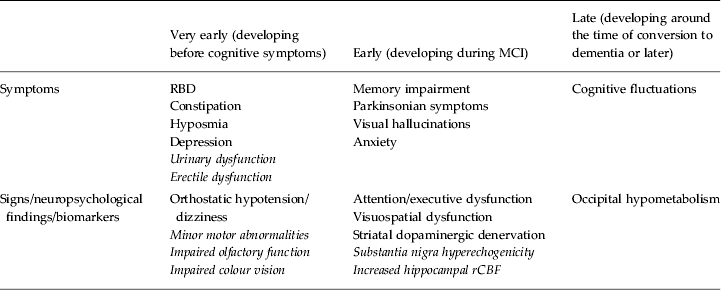
Although the data available are limited, the pattern of symptoms in prodromal DLB seems to differ from that of prodromal AD. Particular symptoms that are more frequent in prodromal DLB include RBD, autonomic dysfunction (including constipation and orthostatic dizziness), hyposmia, visual hallucinations and motor symptoms. Even without including core symptoms, prodromal DLB may be distinguished from prodromal AD with reasonable sensitivity and specificity (Chiba et al. Reference Chiba, Fujishiro, Iseki, Ota, Kasanuki, Hirayasu and Satoa2012). The earliest symptoms of DLB are constipation, RBD and hyposmia. RBD has been demonstrated to precede DLB by decades in some cases. Table 3 shows approximate temporal relationships between symptoms in prodromal DLB from the evidence currently available. The order of symptom development is similar to that reported in PD (Gaenslen et al. Reference Gaenslen, Swid, Liepelt-Scarfone, Godau and Berg2011).
Temporal order of symptom development in prodromal DLB

DLB, Dementia with Lewy bodies; MCI, mild cognitive impairment; RBD, rapid eye movement (REM) sleep behaviour disorder; rCBF, regional cerebral blood flow.
Items in italics reflect evidence from cohorts with RBD at baseline that may not be applicable to prodromal DLB as a whole.
Prodromal DLB can present with either amnestic or non-amnestic cognitive impairment (Fischer et al. Reference Fischer, Jungwirth, Zehetmayer, Weissgram, Hoenigschnabl, Gelpi, Krampla and Tragl2007; Clerici et al. Reference Clerici, Del Sole, Chiti, Maggiore, Lecchi, Pomati, Mosconi, Lucignani and Mariani2009; Molano et al. Reference Molano, Boeve, Ferman, Smith, Parisi, Dickson, Knopman, Graff-Radford, Geda, Lucas, Kantarci, Shiung, Jack, Silber, Pankratz and Petersen2010), although visuospatial and executive function may be particularly likely to be affected (Molano et al. Reference Molano, Boeve, Ferman, Smith, Parisi, Dickson, Knopman, Graff-Radford, Geda, Lucas, Kantarci, Shiung, Jack, Silber, Pankratz and Petersen2010). This is supported by findings in a recent study comparing neuropsychological measures at initial presentation (including MCI and mild dementia cases) (Yoshizawa et al. Reference Yoshizawa, Vonsattel and Honig2013). Those with ‘pure’ DLB pathology at post-mortem had greater visuospatial impairment and less memory impairment at initial assessment compared to ‘pure’ AD or mixed DLB+AD pathology groups.
There is conflicting evidence on when the core features of DLB develop. Two longitudinal post-mortem cohorts that recruited subjects with dementia found that core features developed after the onset of dementia (Fujishiro et al. Reference Fujishiro, Ferman, Boeve, Smith, Graff-Radford, Uitti, Wszolek, Knopman, Petersen, Parisi and Dickson2008; Ferman et al. Reference Ferman, Boeve, Smith, Lin, Silber, Pedraza, Wszolek, Graff-Radford, Uitti, Van Gerpen, Pao, Knopman, Pankratz, Kantarci, Boot, Parisi, Dugger, Fujishiro, Petersen and Dickson2011). Conversely, two longitudinal post-mortem studies that recruited subjects before the onset of dementia (Jicha et al. Reference Jicha, Schmitt, Abner, Nelson, Cooper, Smith and Markesbery2010; Molano et al. Reference Molano, Boeve, Ferman, Smith, Parisi, Dickson, Knopman, Graff-Radford, Geda, Lucas, Kantarci, Shiung, Jack, Silber, Pankratz and Petersen2010) and two retrospective interview studies (Auning et al. Reference Auning, Rongve, Fladby, Booij, Hortobagyi, Siepel, Ballard and Aarsland2011; Fujishiro et al. Reference Fujishiro, Iseki, Nakamura, Kasanuki, Chiba, Ota, Murayama and Sato2013) found that core symptoms commonly develop before the onset of dementia. These studies differed greatly in design and selection criteria, which may account for the differences in findings. The duration of dementia before death was notably different between some of the studies [⩽ 4 years in Molano et al. (Reference Molano, Boeve, Ferman, Smith, Parisi, Dickson, Knopman, Graff-Radford, Geda, Lucas, Kantarci, Shiung, Jack, Silber, Pankratz and Petersen2010) versus 8–10 years on average in the two cohorts that recruited dementia patients (Fujishiro et al. Reference Fujishiro, Ferman, Boeve, Smith, Graff-Radford, Uitti, Wszolek, Knopman, Petersen, Parisi and Dickson2008; Ferman et al. Reference Ferman, Boeve, Smith, Lin, Silber, Pedraza, Wszolek, Graff-Radford, Uitti, Van Gerpen, Pao, Knopman, Pankratz, Kantarci, Boot, Parisi, Dugger, Fujishiro, Petersen and Dickson2011)]. This suggests that the studies may have recruited cohorts that were not clinically similar, or that diagnostic thresholds were different between the studies.
From this evidence, it seems that most cases of prodromal DLB will display clinical and neuropsychological characteristics similar to established DLB. The exact proportion of cases that conform to this phenotype remains to be established. In those cases that do not conform, other biomarkers may be needed to identify prodromal DLB.
Biomarkers of prodromal DLB
There has been little investigation into the use of imaging and other biomarkers to identify prodromal DLB. Indeed, we did not find any studies that investigated cerebrospinal fluid (CSF) biomarkers in prodromal DLB. Autonomic symptoms are common in prodromal DLB (Chiba et al. Reference Chiba, Fujishiro, Iseki, Ota, Kasanuki, Hirayasu and Satoa2012); objective biomarkers of autonomic function such as postural hypotension could potentially be useful in the diagnosis of prodromal DLB.
Dopamine terminal imaging can be abnormal in mild DLB in the absence clinical features of parkinsonism, suggesting that it may have a role in identifying prodromal DLB (Auning et al. Reference Auning, Rongve, Fladby, Booij, Hortobagyi, Siepel, Ballard and Aarsland2011; Siepel et al. Reference Siepel, Rongve, Buter, Beyer, Ballard, Booij and Aarsland2013). The only paper to investigate this (Albin et al. Reference Albin, Burke, Koeppe, Giordani, Gilman and Frey2013) found that one of two MCI subjects with baseline striatal dopaminergic denervation later developed DLB. Three other subjects who developed DLB had normal dopamine terminal scans in the MCI phase. The same authors had previously reported a case of rapid striatal dopaminergic denervation around the time of onset of DLB (Albin & Koeppe, Reference Albin and Koeppe2006).
With regard to other imaging modalities, raised hippocampal diffusivity on DWI compared with controls was found in one study, but this was not significantly greater than in the prodromal AD group (Fayed et al. Reference Fayed, Davila, Oliveros, Castillo and Medrano2008). Surprisingly, the typical DLB pattern of occipital hypometabolism was not found in the few patients who had FDG-PET scans in the prodromal stage of the illness (Clerici et al. Reference Clerici, Del Sole, Chiti, Maggiore, Lecchi, Pomati, Mosconi, Lucignani and Mariani2009; Pardo et al. Reference Pardo, Lee, Kuskowski, Munch, Carlis, Sheikh, Surerus, Lewis, McCarten, Fink, McPherson, Shah, Rottunda and Dysken2010).
In summary, it seems that striatal dopaminergic innervation is abnormal in some, but not all, patients with prodromal DLB; occipital hypometabolism may be a less sensitive marker of DLB in the prodromal phase. Further research is needed to evaluate the usefulness of these imaging modalities and others known to be abnormal in established DLB, such as cardiac iodine-123-metaiodobenzylguanidine (123I-MIBG) scintigraphy.
RBD as a prodrome of DLB
RBD patients represent a particular cohort at risk for developing DLB. Poor olfaction and colour vision, autonomic and motor dysfunction, reduced striatal dopaminergic innervation on SPECT, substantia nigra hyperechogenicity and increased hippocampal perfusion may all help to predict those with RBD who will go on to develop DLB or PD (Iranzo et al. Reference Iranzo, Lomena, Stockner, Valldeoriola, Vilaseca, Salamero, Molinuevo, Serradell, Duch, Pavia, Gallego, Seppi, Hogl, Tolosa, Poewe and Santamaria2010; Postuma et al. Reference Postuma, Lanfranchi, Blais, Gagnon and Montplaisir2010, Reference Postuma, Gagnon, Vendette, Desjardins and Montplaisir2011, Reference Postuma, Lang, Gagnon, Pelletier and Montplaisir2012, Reference Postuma, Gagnon, Pelletier and Montplaisir2013; Dang-Vu et al. Reference Dang-Vu, Gagnon, Vendette, Soucy, Postuma and Montplaisir2012). None of these markers differentiate between those who will develop DLB and those who will develop PD. The evidence for these biomarkers is generally based on small DLB samples and none of the findings have been replicated. Findings in RBD groups may not be generalizable to the wider prodromal DLB population.
Limitations
With the exception of three retrospective symptom questionnaire studies (Auning et al. Reference Auning, Rongve, Fladby, Booij, Hortobagyi, Siepel, Ballard and Aarsland2011; Chiba et al. Reference Chiba, Fujishiro, Iseki, Ota, Kasanuki, Hirayasu and Satoa2012; Fujishiro et al. Reference Fujishiro, Iseki, Nakamura, Kasanuki, Chiba, Ota, Murayama and Sato2013), most of the evidence relates to small groups of DLB patients. Few findings have been replicated.
In general, the evidence is from clinical studies, without post-mortem verification of diagnosis. In some cases, this may have led to false positive or false negative results because of the misclassification of study subjects, and such misclassification would in turn affect the performance of biomarkers. Because of the heterogeneity of the data available, it is not possible at this stage to combine the data or objectively compare the reliability of conflicting findings. This prevents us from objectively testing whether DLB has a distinct prodrome using these data. Longitudinal studies are required, first to develop criteria for the prodrome of DLB and then to test their validity.
Conclusions
The evidence available, although limited, suggests that DLB has an identifiable prodromal phase in most cases. It may be possible to differentiate prodromal DLB from prodromal AD based on the presence of core and suggestive features of DLB, autonomic dysfunction and other biomarkers.
123I-FP-CIT and 123I-MIBG SPECT findings are abnormal in established DLB. It remains to be ascertained at what point in the evolution of the disease these findings become abnormal, and if these scans will be clinically useful in the identification of prodromal DLB.
Longitudinal studies are certainly needed to further characterize the clinical presentation of prodromal DLB and investigate the utility of biomarkers (including CSF biomarkers) in its identification. Interesting findings in RBD suggesting that olfactory, visual, autonomic and motor dysfunction, and hippocampal hyperperfusion and substantia nigra hyperechogenicity, may predict the development of DLB should be investigated in a ‘normal’ MCI group, not recruited in a specialist sleep disorders centre.
Characterization of the DLB prodrome is vital to enable the identification of DLB patients in the prodromal stage. This will facilitate research into the pathophysiology of prodromal DLB and the development of treatments aimed at halting or reversing these pathophysiological processes.
Acknowledgements
This work was supported by the National Institute for Health Research (NIHR) Newcastle Biomedical Research Unit based at Newcastle upon Tyne Hospitals National Health Service (NHS) Foundation Trust and Newcastle University. The views expressed are those of the authors and not necessarily those of the NHS, the NIHR or the Department of Health.
Declaration of Interest
J. O'Brien has acted as a consultant or received honoraria from GE Healthcare, Bayer Healthcare and Lilly, and has received a grant from Lilly for an investigator initiated study. A. Thomas has received grant funding from GE Healthcare for an investigator initiated study.