Introduction
In recent years, many studies have put an increasing emphasis on the public knowledge and risk perception of natural disaster, but only a few address the knowledge and practices of pet owners’ preparedness. Reference Hesterberg, Huertas and Appleby1,Reference Taylor, Lynch and Burns2 However, pet ownership is an identified risk factor consistently associated with evacuation failure in case of an emergency or disaster. Reference Heath, Kass and Beck3,Reference Brackenridge, Zottarelli and Rider4
Previous research indicates that households with pets are less likely to evacuate during disasters, but less literature is available concerning preparedness of pet owners. Reference Brown, Gargano and Parton5–Reference Douglas, Kocatepe and Barrett7 Knowledge of the pet owners’ preparedness about disasters and emergencies is of vital importance to effective disaster management. Reference Burningham, Fielding and Thrush8,Reference Shi, Visschers and Siegrist9
Disasters routinely elicit high levels of property damage and pose severe threats to life and well-being. Lack of attention to disaster warnings might lead to significant injuries in pets, which suggests a need to pay attention to disaster prevention and preparedness. Reference Pace and Montz10 Animals are impacted by the same disasters and emergencies as humans; however, in Europe, there is a gap in pet preparedness plans before and after a disaster. Reference Seyedin, Samadipour and Salmani11
In the present study, we sought to explore pet owner preparedness and ownership differences in knowledge and practices related to pet disaster preparedness.
Methods
A cross-sectional study was conducted between September and November 2018. A convenience sample of pet owners from North Portugal was recruited to participate. The targeted study population was local residents of Oporto Metropolitan Area, in the North region of Portugal. The criteria for the selection of participants included being older than 18 years and having 1 or more pets at the time of the survey. The sample size for this study was calculated according to the formula of survey sample size calculation, Reference Hajian-Tilaki12 assuming a 10% expected prevalence of pet owners with sufficient knowledge and practices, and therefore 138 participants were required. To allow for a 10% non-response, the lowest required sample size was 155 participants. A structured questionnaire was developed by the authors after a review of the literature combined with a consultation by Chukwuma et al., Reference Chukwuma, Poole and Okereke13 the sites of the Centers for Disease Control and Prevention (CDC), 14 and the American Veterinary Medical Association (AVMA). 15 The questionnaire collected information about demographic characteristics and knowledge and practices related to disaster and preparedness among pet owners. The survey was voluntary and anonymous. Information was collected from face-to-face interviews in a convenience sample in Oporto. This questionnaire was previously pre-tested to improve validity and reliability; that is, it was applied to 30 non-participant pet owners before the study was initiated to help improve clarity of the questions and ensure that the estimated time needed to complete the survey (approximately 10 minutes) was accurate. The questionnaire collected the following information: (1) demographic characteristics, such as gender, age, type of animal; (2) questions with closed-ended responses using a 6-point scale answers; (3) ranking from a 0–5 interval scale (0 = not at all important; to 5 = very important) with a higher score indicating knowledge; and (4) individual practices associated with disaster preparedness.
The Ethics Committee of University of Trás-os-Montes and Alto Douro (Vila Real, Portugal) has reviewed and approved the proposed use of human subjects in this survey (Doc12-CE-2019). A written informed consent was obtained from all participants after they were informed that their participation was voluntary and their refusal to participate would not have any negative consequences. Data collection and management were kept anonymous and confidential throughout and after the study.
Statistical Analysis
Data were analyzed using SPSS version 25.0 (IBM Corp, Armonk, NY) considering a probability of P < 0.05 as statistically significant. For descriptive purposes, χ2 test was conducted for each variable in the study looking at ownership differences. The t-test was conducted in order to examine the different types of pet owner differences relative to the importance attributed to an emergency preparedness pet disaster kit.
Results
A total of 155 pet owners participated in the study. The sample consisted of 74.8% women and 25.2% men. The age range of respondents was 17 to 66 years old. In the present study, 80.6% of respondents had dogs (even if they owned other pets), and 19.4% owned an animal other than a dog (ie, cat, rabbit, or birds). The majority of animals were vaccinated (89.0%) and dewormed (93.5%). Almost 50% (ie, 47.7%) of owners reported that their animals were identified with electronic identification. However, only 22.6% responded that their animals had a collar or tag with identification of their owners.
Knowledge and Practices About Disaster Preparedness in Pet Owners
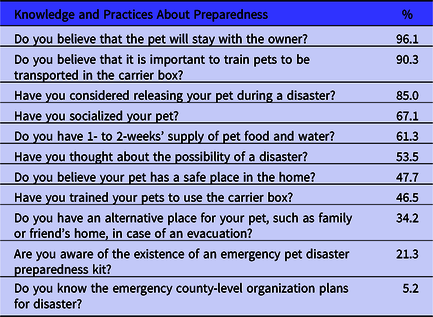
In the present study, 53.5% of interviewees had already thought about the possible occurrence of a disaster, whereas 46.5% never thought about such a possibility. In the case of a disaster, 96.1% of respondents believed that their pet would stay with them. Of the respondents, 47.7% believed that they had a safe place in their home where it was possible to keep their pets in a safe condition. Dog owners answered more often affirmatively (P = 0.009) (Table 1).
Knowledge and practices about pet owners’ disaster preparedness from Oporto, Portugal (n = 155)

About 21.3% of all respondents stated that they knew the existence of a pet disaster preparedness kit, and 40.6% stated that they could improve an at-home type of emergency medical kit suitable for animals. When asked of owners whether they had a 1- to 2-week supply of food and water, 61.3% answered affirmatively. When having asked respondents what they would do regarding caged or chained pets, more than 85% considered releasing them on the street in case of a disaster. Regarding the socialization of animals, 67.1% of the interviewees answered that their pets were socialized. Dog owners responded most often affirmatively (P = 0.003).
The vast majority of respondents (ie, 94.8%) reported not knowing the county-level plans for disaster. About 65.8% of respondents reported not having an alternative place, such as family or friends’ houses, for their animals to stay in case of an evacuation. Dog owners responded most often negatively compared with other pet owners (P = 0.046).
Regarding the animal carrier box, 46.5% of the interviewees answered that their pets were trained to use the box; however, 90.3% considered it was still important to train pets to be transported in the carrier box. Dog owners responded most often affirmatively compared with owners of animals of other species (P = 0.009).
Level of Importance Attributed to Items in an Emergency Pet Disaster Preparedness Kit
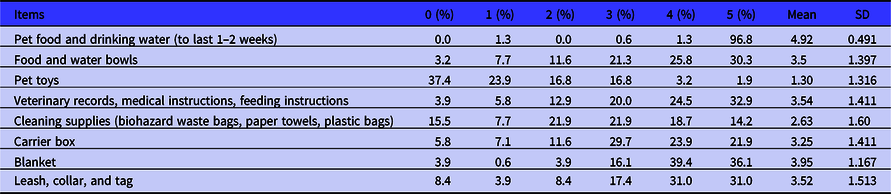
Respondents were asked the level of importance of items in an emergency pet disaster preparedness kit on a 6-point scale ranging from 0 (“not important”) to 5 (“very important”). The results are shown in Table 2. All items in the list were considered indispensable for animals in a pet disaster situation. However, it was not explained to respondents that all items were constituents of the kit.
Level of importance attributed to items in emergency pet disaster preparedness kit (n = 155) (0 = not at all important; to 5 = very important)

The great majority (98.1%) gave high importance to 1- to 2-week supply of pet food and drinking water (scores of 4 and 5, out of 5). The average for this item was 4.92. As for the importance given to food and water bowls, just over half (56.1%) attributed high importance (scores of 4 and 5). The average of this item was 3.5. Regarding the item, pet toys, 37.4% of respondents did not give it any importance (score of 0), and 40.7% gave it low importance (scores of 1 and 2). The average for this item was 1.30. Regarding veterinary records, medical instructions, feeding instructions of the animal, about half of the respondents (57.4%) gave it high importance. The average for this item was 3.54. Regarding cleaning supplies (plastic bags and litter boxes in the case of cats), only 32.9% attributed high importance (scores of 4 and 5). The average for this item was 3.5. As for the carrier boxes, 29.7% gave it a value of 3. It should be noted that 5.8% of respondents did not give any importance to it (score of 0). The average for this item was 3.25. More than three-quarters of respondents (75.5%) attributed high importance to blankets (scores of 4 and 5). The average for this item was 3.95. As for leashes and collars, 62.0% attributed high importance (scores of 4 and 5). The average for this item was 3.52.
Differences in Type of Pet Owner Preparedness Relative to the Importance Attributed to an Emergency Preparedness Pet Disaster Kit
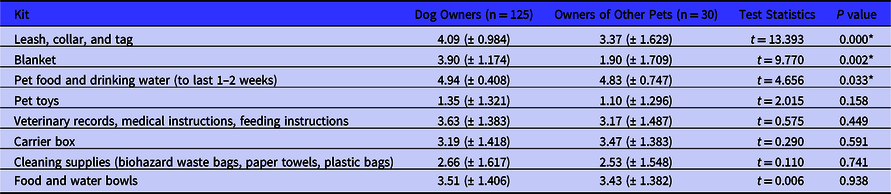
Regarding the average score, the t-test revealed that dog owners assigned a higher value to a 1- to 2-week supply of pet food and drinking water (t = 4.656; P = 0.033); leashes, collars, and tags (t = 9.770; P = 0.002); and blankets (t = 13.393; P = 0.000). No significant differences were found regarding the owner’s gender. Table 3 shows the differences between respondents who had dogs and the ownership of other animals.
Differences in type of pet owner relative to the level of importance attached to items in a pet disaster kit

* P < 0.05.
Discussion
The aim of the current study was to address variability in responses to disaster preparedness in Portuguese pet owners. In the European context of a disaster, Portugal is the country with the highest number of wildfires, second with the most burned areas. Reference Parente, Pereira and Amraoui16 Knowledge and correct practices are the most effective strategies to mitigate adverse effects. Reference Li, Wang and Xie17 Previous studies performed in human medicine suggest that many people are aware of disasters, but they have inadequate knowledge on how to prepare for a disaster. Reference Mahdaviazad and Abdolahifar18 In a world with a growing tendency toward pet ownership, Reference Thompson19 few studies have been conducted regarding pet owners’ preparedness in the scope of a disaster preparedness plan. It is important that owners are familiar with the different types of disasters that may affect their area of residence and consider the options available for care of their animals. 15 In the present study, regarding the respondents’ awareness of the possibility of disasters occurring in their area of residence, just over half answered they had already considered this hypothesis as possible. In a study of typhoons in Zhejiang, China, the results were similar, that is, 50.7% of respondents considered these events to be a threat to their health, and 42.2% further feared for their lives. Reference Zhang, Wang and Lin20
Before a disaster occurs, it is essential to make sure that animals wear a collar, tags, and electronic identification with a microchip providing detailed information. A primary goal of permanent identification of animals is to allow free-ranging owned animals to be re-united with their owners. Reference McGreevy, Masters and Richards21 Microchipping is a statutory requirement for dogs and cats in Portugal. However, less than half of the owners surveyed reported that their animals were electronically identified using a microchip, and even a smaller number reported that their animals wore collars or tags with identification. This is a result of concern because there are several studies on the increase of stray animals due to owners losing their pets after a disaster. Reference Thompson19,Reference Chadwin22–Reference Zottarelli24 As a result of Hurricane Katrina, the Louisiana Society for the Prevention of Cruelty to Animals (SPCA) estimates that 15 500 animals required rescue, and that 80–85% of these animals were never reunited with their owners. 25
Several studies have shown that attachment to pets is high, with many owners considering pets as members of their family, Reference White26 and may play an important positive and protective role for disaster victims. Reference Tanaka, Saeki and Hayama27 In the present study, in case of a disaster, almost all participants assumed they would want their pet to stay with them and would not want the animal to go to a shelter. A very similar percentage stated that they were unaware of the county-level organization plans of their area of residence, namely, if there were centers that would allow the family and their animals to be accommodated. This lack of information about management plans can make it difficult to rescue people who often refuse to leave the risk area without their pets with them during an evacuation. Reference Chadwin22,Reference Heath and Champion28,Reference Hunt, Bogue and Rohrbaugh29 In a study from the United States of America, 16.2% of elderly participants said that they would not evacuate without their pets and 8.1% would stay at home with their pets during an evacuation. Reference Rosenkoetter, Covan and Cobb30 In a study from New Zealand, 56% of pet owners would not evacuate without their pets, and 81% would be more likely to comply with an evacuation if there were evacuation shelters that would cater to pets. Reference Glassey31 After Hurricane Katrina, 44% chose not to evacuate because they did not want to leave their pets. Reference Taylor, Lynch and Burns2 In the present study, a majority of owners had multiple animals of different species (dogs, cats, and birds). In a disaster or emergency situation, this translates into complex evacuation scenarios and different pets with different needs, practical considerations, transportation, and destinations. Reference Taylor, Lynch and Burns2 However, emergency management groups frequently do not include companion animals in their evacuation plans. Reference Chadwin22
In case their pets were previously caged or chained, 85.2% of respondents considered releasing their animals in an emergency situation. This is a dangerous behavior because it increases the number of stray and abandoned dogs, which can become aggressive and bite, cause accidents, and die without care. Reference Warner23,Reference Mori, Tsubokura and Sugimoto32
Regarding the socialization of animals, 67.1% of the owners answered that all their animals were socialized with other animals or strange people (see Table 1). Dog owners were the ones who answered more often affirmatively to this question compared with owners of other animals, likely because dogs walk more in the streets than cats, interacting with different animals and people, and cats are wilder when compared with dogs.
In the present study, more than half reported not having an alternative place, such as family or friends’ houses, for their animals to stay in case an evacuation would be necessary. Most dog owners responded negatively (see Table 1). This may be due to the location where the questionnaires were held, which is the metropolitan area of Oporto, where the vast majority of the dwellings are in buildings with flats with little space, often not able to take on animals.
In the case of evacuation, everything must be in place to move the animals. Thus, keeping a carrier box and a leash for pets may expedite the time of evacuation. It is important to familiarize the animals with their carrier boxes in order to facilitate their entry and reduce the stress of the animals, but also to ensure a means of transport. Less than half of the owners reported that their pets were trained for the carrier box (46.5%). A majority of dog owners considered it important to train the animals to be transported in a carrier box. Previous studies have shown that owning insufficient carrier boxes has been identified as a significant impediment to pet evacuation, particularly for feline evacuation. Reference Heath, Kass and Beck3,Reference Heath, Voeks and Glickman33,Reference Heath and Linnabary34 Carrier boxes are important not only for the ease of transport of cats, but also of small dogs. In addition, a study in the Netherlands on cats housed in animal shelters found that having a box where they could hide was responsible for reducing cat stress, at least in the short term. Reference Vinkea, Godijn and Leij35 In the present study, the majority of owners attributed high importance to leashes and collars (scores of 4 and 5). Like carrier boxes, leashes are helpful if an evacuation is needed, as they allow owners to keep their dogs from running away or becoming lost, a circumstance which could hinder and delay evacuation, putting pets and owners at risk.
When designing a plan, organizing an emergency pet disaster preparedness kit is critical when it comes to safeguarding the health of pets. Owners should have an emergency pet disaster preparedness kit with non-perishable food and water storage for a period of at least 3–7 days and their containers, toys, blankets, cleaning supplies, a carrier box, and medical records. Reference Chukwuma, Poole and Okereke13–15 In the present study, only 21.3% of respondents said they knew of the existence of an emergency pet disaster preparedness kit. These values are very low and suggest unpreparedness in an emergency situation.
About 61.3% of owners said that they keep at home pet food and drinking water supplies available for a period of at least 1–2 weeks. In a study conducted in the human population of Auckland, New Zealand, the values were similar, and 53% of respondents believed to be self-sufficient, that is, they had a food and water supply for at least 3 days. Reference Rañeses, Richards-Chang and Richards36
In the present study, the level of importance that owners attributed to components of an emergency pet disaster preparedness kit was studied. A list was given to pet owners. All items provided were considered indispensable for animals in a disaster situation. Reference Chukwuma, Poole and Okereke13–15 Almost all respondents (98.1%) gave high importance to drinking water and food (with an average of 4.92). As this is a fundamental asset for ensuring animal health and survival, as in a disaster, the storage of food and drinking water may be unavailable for sale for a few days, it is considered that owners are aware of the importance of this topic. Regarding the importance attributed to water and food containers, just over half attributed high importance to it (with the average score of this item being 3.5). Although this item is not essential for animal survival, the existence of water and food containers facilitates meal times, keeps water ad libitum, and allows animals to be fed more hygienically. Regarding the item “toys,” 37.4% of the respondents did not give it any importance, while 40.7% gave it low importance. A study in the Netherlands found that the use of chewable toys by dogs in kennels stimulated their appetitive behavior and increased their level of physical activity, and decreased their stress levels, at least in the short term, thus promoting the welfare of dogs housed in kennels. Reference Schipper, Vinke and Schilder37 Regarding cats, it is important to understand that a playful behavior is natural in all cats, being a release of energy and stress that can help felines adapt to a new environment in a rescue shelter. Reference Ellis38 In the present study, the utility of toys was neglected by owners, most likely due to a lack of knowledge about the consequences of stress on animals. A situation where animals cannot remain relaxed causes an increase in adrenaline levels, which not only makes animals more responsive than normal, but also affects their ability to concentrate. As a result, animals have a much more reactive behavior toward their surroundings. In addition, prolonged or recurring stress affects the immune system of animals, making them more susceptible to disease. Reference Pagliarone and Sforcin39
Regarding the item “veterinary records, medical instructions, feeding instructions,” an average value of 3.54 was obtained, a situation that may be explained by the fact that it is not fundamental to the survival of the animals. However, in a disaster, it is important to keep the animal documents, especially copies of medical and vaccination records, animal photos, and 2 weeks’ worth of medication along with their instructions for administration with the owners. This will allow owners to check whether pet vaccination and deworming are up to date, as well as to save potentially more detailed information about animal health. 14
In the present study, respondents gave high importance to blankets. In fact, in a disaster situation, this item is important because hypothermia may occur as a consequence of exposure to cold air, especially wet fur, or soaking in cold water for a long period of time. Reference Dickerson, Mills and Hu40 A prolonged hypothermia situation can lead to the death of the animal, with a blanket being extremely important as a preventive measure. Reference Kleine, Hofmeister and Egan41
In this study, about half of the respondents had never thought that a disaster could ever happen, and results suggest that Portuguese pet owners are unprepared.
Limitations
The limitations and potential sources of bias in this study must be considered when pondering the results. This survey might have not adequately captured the owner population, since respondents were a convenience sample from the metropolitan region of Oporto. The second limitation is the self-report nature of this study and its cross-sectional assessment. The third limitation relates to the oversampling of dog owners. Therefore, studies should be conducted in other cities of the country in order to characterize geographical and cultural differences. Further investigation of these factors is warranted in deepening our understanding differences in reaction to disasters and emergencies.
Conclusions
Based on our findings, dog owners had higher attention to disaster prevention. According to results of the present study, it is suggested that the government should conduct educational activities and make updated information available for pet owners through multiple easy-to-follow forms. The county-level organizations, veterinary teaching hospitals, and other clinical centers should collaborate with veterinary public health authorities, in order to increase the knowledge and eliminate behavior gaps, as well as to improve pet owner preparedness.
Acknowledgments
This work was supported by the project UIDB/CVT/00772/2020 and funded by the Fundação para a Ciência e Tecnologia (FCT).
Author Contributions
ZP: conceptualization, investigation, methodology, writing the original draft, review, and editing. LC: writing, review, and editing. ACC: supervision, writing, review, and editing.
Conflict(s) of Interest
The authors declared no potential conflicts of interest with respect to the research, authorship, and/or publication of this paper.