1. Introduction
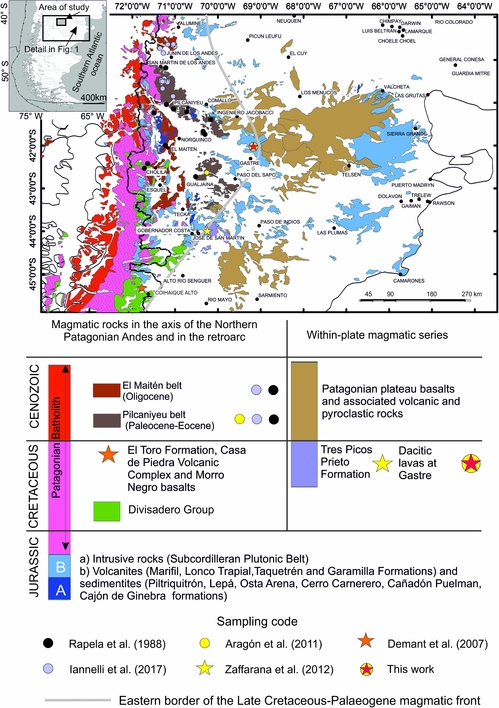
This work characterizes a previously unknown outcrop of Late Cretaceous porphyritic rocks near the area of Gastre in Northern Argentine Patagonia. It is based on petrographic, geochronological and geochemical data of representative samples located at latitude 42° 03′ 29.9″ S and longitude 69° 09′ 28.4″ W (samples G4-230 and G4-232) and at latitude 42° 03′ 35.01″ S and longitude 69° 09′ 27.965″ W (sample T3, Fig. 1). These rocks were previously included within the Early–Middle Jurassic calc-alkaline volcanic belt known as the Lonco Trapial Formation (Page & Page, Reference Page and Page1993; Zaffarana & Somoza, Reference Zaffarana and Somoza2012; Bouhier et al. Reference Bouhier, Franchini, Caffe, Maydagán, Rapela and Paolini2017).
Regional map showing the location of the Late Cretaceous outcrops of Gastre in the context of the Jurassic to Cenozoic main magmatic and sedimentary series.

The porphyritic rocks from Gastre were dated to between ~ 74 and 76 Ma (Table 1), when a gap or waning in activity was registered in the Northern Patagonian Batholith (this period ranged from 76 Ma to c. 40 Ma; Pankhurst et al. Reference Pankhurst, Weaver, Hervé and Larrondo1999; Suárez et al. Reference Suárez, De La Cruz, Bell and Demant2010; Echaurren et al. Reference Echaurren, Oliveros, Folguera, Ibarra, Creixell and Lucassen2017). The Patagonian Batholith is a main feature of the Andean cordillera; it extends between 40° and 53° S, and its episodically emplaced plutons represent subduction processes that took place in the continental margin from Early Jurassic to Pleistocene times (Pankhurst et al. Reference Pankhurst, Weaver, Hervé and Larrondo1999; Rolando et al. Reference Rolando, Hartmann, Santos, Fernandez and Etcheverry2002; Castro et al. Reference Castro, Moreno-Ventas, Fernández, Vujovich, Gallastegui, Heredia, Martino, Becchio, Corretgé, Díaz-Alvarado, Such, García-Arias and Liu2011).
Summary of geochronological data (errors given at 1σ level)

The age of the porphyritic rocks from Gastre coincides with the age of the upper section of the Tres Picos Prieto Formation, a basaltic sequence located at 44° S, near the locality of José de San Martín (Fig. 1; Di Tommaso, unpub. Trabajo Final de Licenciatura, Univ. de Buenos Aires, 1978; Franchi & Page, Reference Franchi and Page1980). Further southwest, in the Coihaique Alto region in Chile at 45° S, the volcanic rocks from the Casa de Piedra Volcanic Complex and the El Toro Formation also bear a similar Late Cretaceous age (Fig. 1; Demant, Suárez & De La Cruz, Reference Demant, Suárez and De La Cruz2007). The porphyritic rocks from Gastre bear a geochemical signature typical of subduction-derived magmas, which is also found in the Tres Picos Prieto basalts (especially in the upper section; Zaffarana, Lagorio & Somoza, Reference Zaffarana, Lagorio and Somoza2012) and in the volcanic rocks from the Coihaique Alto region (Demant, Suárez & De La Cruz, Reference Demant, Suárez and De La Cruz2007). Therefore, it is put forth that the porphyritic rocks from Gastre could represent an eastward shift in the position of the magmatic arc at 42° S, as they were erupted c. 270 km away from the axis of the magmatic arc (represented by the outcrops of the Northern Patagonian Batholith; Fig. 1). This eastward migration of the magmatic arc was probably the result of a slab-shallowing process; slab shallowing was also argued to explain the Late Cretaceous compressive deformation observed in the Gastre area (Echaurren et al. Reference Echaurren, Folguera, Gianni, Orts, Tassara, Encinas, Giménez and Valencia2016, Reference Echaurren, Oliveros, Folguera, Ibarra, Creixell and Lucassen2017; Savignano et al. Reference Savignano, Mazzoli, Arce, Franchini, Gautheron, Paolini and Zattin2016). Nevertheless, it should be noted that during Late Cretaceous times the magmatic arc regained its westward position further south at the latitude of the Coihaique Alto region (Fig. 1; Demant, Suárez & De La Cruz, Reference Demant, Suárez and De La Cruz2007).
2. Outcrop characterization and petrography
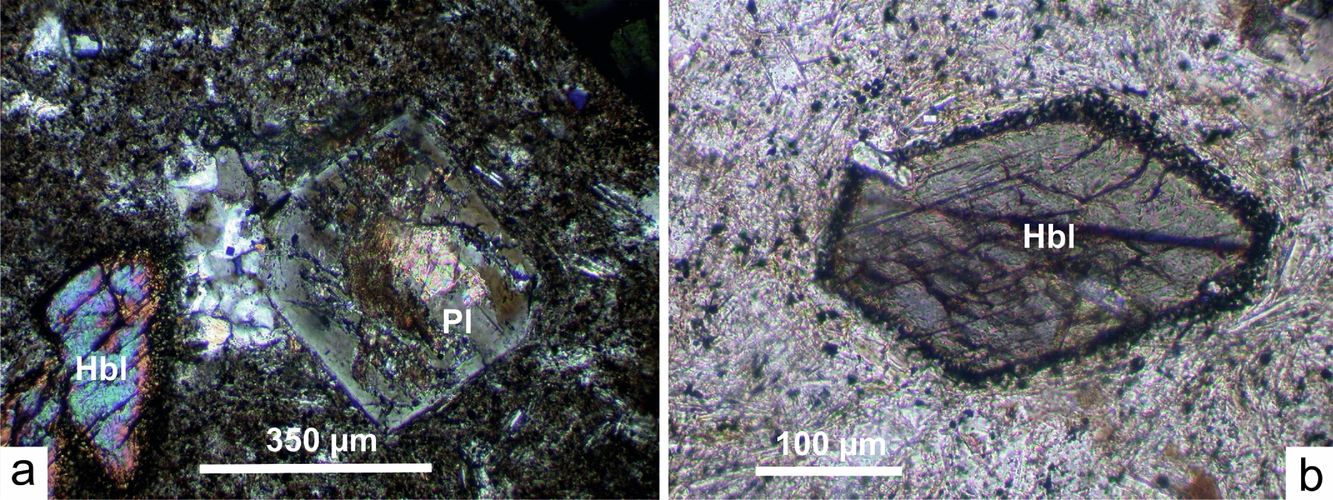
The porphyritic rocks from Gastre overlie the Lower to Middle Jurassic andesitic lavas and breccias of the Lonco Trapial Formation (Page & Page, Reference Page and Page1993; Zaffarana & Somoza, Reference Zaffarana and Somoza2012), which they notably resemble. Xenoliths of the Lonco Trapial lavas are found enclosed in these porphyritic rocks. They are composed of 30 % phenocrysts, which consist of hornblende (20 %) and plagioclase (10 %), and which are immersed in a pilotaxitic groundmass (Fig. 2). Hornblende phenocrysts are green pleochroic with euhedral prismatic sections up to 5 mm in length (Fig. 2). They are fresh and frequently twinned with occasional zonation and inclusions of apatite. They show resorption borders with a formation of small grains of opaque minerals in the rims (Fig. 2). Plagioclase laths (An50) can reach up to 1.7 mm in length; they are subhedral with frequent polysynthetic twinning and zonation, and also with a moderate alteration to clays, sericite, analcime veins and carbonatic patches (Fig. 2a). The angular interstices between the plagioclase grains are occupied by hornblende, opaque minerals, quartz and interstitial glass. The glass is replaced by alkaline feldspar and zeolites. Quartz is of secondary origin and is associated with alteration of carbonates and K-feldspar.
Petrography of the dacitic lavas at Gastre. (a) Hornblende and plagioclase phenocrysts. Photograph taken under crossed polars. (b) Detail of amphibole phenocryst with intense resorption border. Photograph taken under plane-polarized light. Mineral abbreviations after Whitney & Evans (Reference Whitney and Evans2010). Hbl – hornblende; Pl – plagioclase.

3. Analytical methods
Samples were selected based on their freshness, and amphibole single grain analyses were carried out on grains of the order of 251 and 178 µm in size (60–80 mesh grain size). The amphibole separates were sent to two different laboratories for 40Ar–39Ar age determination by furnace step-heating on single grains. Sample T3 was analysed at the Arizona Noble Gases Laboratory of the University of Arizona (USA), and sample G4-230 was irradiated at the Activation Laboratories Ltd (Actlabs), Ancaster, Ontario, Canada.
Whole-rock geochemical data were obtained at Actlabs, Canada (sample G4-230), at the Acme Analytical Laboratories (Acmelabs), Vancouver, Canada (sample T3) and at the Instituto de Tecnología Minera (INTEMIN; Servicio Geológico Minero Argentino), Argentina (sample G4-232). At Actlabs, the samples were analysed with the 4-Litho code procedure. Samples were first fused with lithium metaborate/tetraborate and then subjected to acid digestion. Major elements and some trace elements were determined by inductively couple plasma-optical emission spectroscopy (ICP-OES), whereas the rest of the trace elements were determined by inductively coupled plasma-mass spectrometry (ICP-MS). At Acmelabs samples were analysed with the 4B code procedure. Major and minor elements were determined by ICP-OES, and trace elements (Ba, Cs, Ga, Hf, Nb, Rb, Sr, Ta, Th, U, V, Zr, Y and REEs) by ICP-MS. In both cases, fusion with lithium metaborate/tetraborate flux was conducted upon completion of rock powder dissolution. At INTEMIN, major oxides were determined by X-ray fluorescence after fusion with lithium tetraborate, whereas trace element determination was performed with the ICP-MS technique.
4. Geochronology
Sample T3 revealed an easily interpretable, consistent dataset (Table 1; Table S1 in the online Supplementary Material available at http://journals.cambridge.org/geo). The age spectrum is characterized by a general U-shape, with initial high values (step 1 ~ 419 Ma; Fig. 3a; Table S1 in the online Supplementary Material available at http://journals.cambridge.org/geo) that decrease to ~ 76 Ma with ~ 10–90 % of gas released, followed by an increase in the final phase of gas release. The total gas age of this sample is 87.7 ± 0.3 Ma. Steps 7–11 (58 % of the 39Ar released) define a younger plateau age of 76.1 ± 0.4 Ma (Fig. 3a; Table 1). Steps 5–13 (87 % of the 39Ar released) define a valid isochron that yields an age of 68.6 ± 0.6 Ma. The isochron gives an initial 40Ar/36Ar isotopic composition of 283 ± 18, which does not suggest that excess argon is present. However, the U-shaped age spectrum, and the younger isochron age could suggest that excess argon is present. Ca/K values and radiogenic yields are consistently high, indicating outgassing of a homogeneous, unaltered amphibole mineral separate (Table S1 in the online Supplementary Material available at http://journals.cambridge.org/geo). The plateau age is considered the most accurate and reliable age as it roughly coincides with the age of the other sample shown below (Table 1; Fig. 3a).
40Ar–39Ar age spectrum and isochron obtained from single grains from the dacitic lavas at Gastre from sample (a) T3 and (b) G4-230.

Sample G4-230 yielded a well-behaved age spectrum and a plateau age of 74.3 ± 1.4 Ma on two steps of high temperature that encompass 96.7 % of the 39Ar released (last two steps out of five; Fig. 3b; Table 1; Table S1 in the online Supplementary Material available at http://journals.cambridge.org/geo). On the inverse isochron plot, all points form a linear regression, characterized by an age value of 75.2 ± 1.3 Ma, and a MSWD = 1.8 (Table 1; Fig. 3b). The three age values are broadly consistent, but the plateau age is considered as the most reliable one of this sample, as the Ca/K ratio in the last two steps is consistently high (Table 1; Table S1 in the online Supplementary Material available at http://journals.cambridge.org/geo).
5. Geochemistry
The results obtained by the three laboratories broadly match (Table S2 in the online Supplementary Material available at http://journals.cambridge.org/geo). The analysed samples show 64.07–64.5 % SiO2, 1.54–1.61 % K2O, 4.03–5.05 % Na2O and a Mg # of between 66.08 and 57.18 (anhydrous base, loss on ignition (LOI) contents between 3.51 and 1.40; Table S2 in the online Supplementary Material available at http://journals.cambridge.org/geo). On the TAS diagram, rocks are classified as dacites, very close to andesites (Le Bas et al. Reference Le Bas, Lemaître, Streckeisen and Zanettin1986), and as ryodacites/dacites according to the Winchester & Floyd (Reference Winchester and Floyd1977) diagram based on immobile elements.
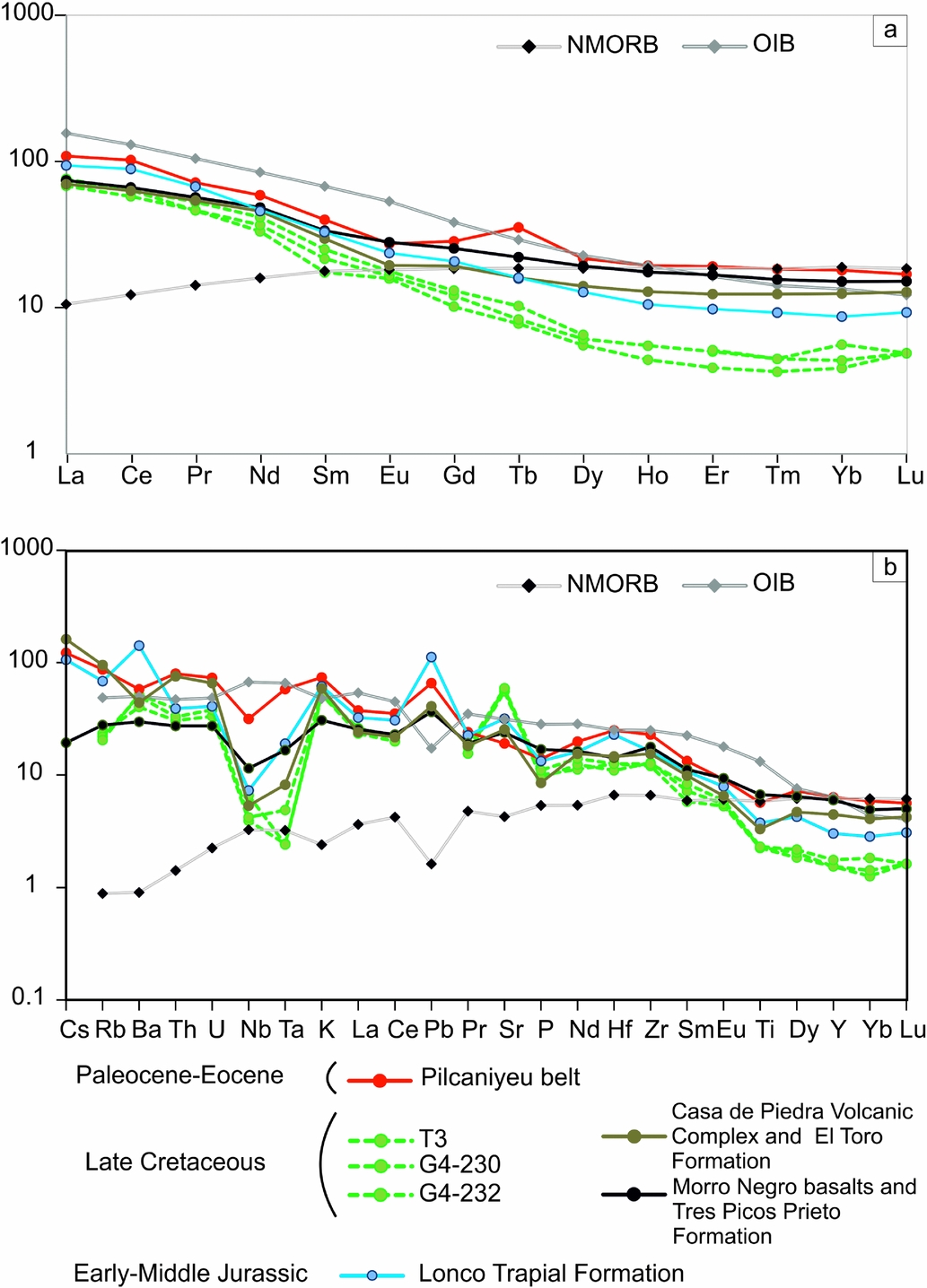
Chondrite-normalized rare earth element (REE) patterns of the samples are enriched in light REEs and depleted in heavy REEs ((La/Sm)N > 2 and (La/Yb)N > 10; Table S2 in the online Supplementary Material available at http://journals.cambridge.org/geo; Fig. 4a). Samples do not show negative Eu anomalies (Table S2 in the online Supplementary Material available at http://journals.cambridge.org/geo; Fig. 4a), suggesting an absence of plagioclase fractionation. Conversely, the middle and heavy REE slope denotes amphibole fractionation (Fig. 4a, b), suggesting that differentiation processes may have occurred at or near the base of the crust. On the other hand, chondrite-normalized heavy REE concentrations lower than 10 and Sm/Yb ratios > 3.5 are consistent with residual garnet in the source of these magmas (Table S2 in the online Supplementary Material available at http://journals.cambridge.org/geo). The Primordial Mantle normalized pattern of the samples bears enrichment in Rb, Sr, K, Ba, Th, U, La and Ce, and depletion in Nb, Ta, Ti, Dy, Y, Yb and Lu (Fig. 4b), showing a remarkable negative Ta–Nb anomaly. Trace element ratios of La/Ta > 25, Ba/Nb > 40, Ba/Ta > 450, Ta/Hf > 0.15 and La/Nb > 1 are typical of subduction environments (Table S2 in the online Supplementary Material available at http://journals.cambridge.org/geo).
Trace element composition of the dacitic lavas at Gastre. (a) REE pattern of the analysed rocks normalized to chondrite. (b) Primitive Mantle normalized multi-elemental plot. NMORB and OIB curves (Sun & McDonough Reference Sun, McDonough, Saunders and Norry1989) are shown for comparison, together with data from the Pilcaniyeu belt (Rapela et al. Reference Rapela, Spalletti, Merodio and Aragón1988; Aragón et al. Reference Aragón, D'Eramo, Castro, Pinotti, Brunelli, Rabbia, Rivalenti, Varela, Spakman, Demartis, Cavarozzi, Aguilera, Mazzucchelli and Ribot2011; Iannelli et al. Reference Iannelli, Litvak, Fernández Paz, Folguera, Ramos and Ramos2017), the Casa de Piedra Volcanic Complex averaged with the El Toro Formation (data from Demant, Suárez & De La Cruz, Reference Demant, Suárez and De La Cruz2007), the Morro Negro basalts averaged with the Tres Picos Prieto Formation (data from Demant, Suárez & De La Cruz, Reference Demant, Suárez and De La Cruz2007 and Zaffarana, Lagorio & Somoza, Reference Zaffarana, Lagorio and Somoza2012) and Lonco Trapial Formation (unpub. data). Chondrite normalization is from McDonough & Sun (Reference McDonough and Sun1995) and Primitive Mantle normalization is from Sun & McDonough (Reference Sun, McDonough, Saunders and Norry1989). All the comparisons were made with rocks whose SiO2 content is less than 70 %.

6. Discussion
The new geochronological data reported in this work indicate the occurrence of volcanic activity during Late Cretaceous times in Gastre in Northern Patagonia. It should be noted that the recent find of a tuffaceous deposit within the Paso del Sapo Formation, 70 km southeast of Gastre, for which a maximum sedimentation age of ~ 83 Ma was inferred (U–Pb in zircons; Echaurren et al. Reference Echaurren, Folguera, Gianni, Orts, Tassara, Encinas, Giménez and Valencia2016), provides another piece of evidence of volcanic activity during Late Cretaceous times in the region.
6.a. Comparison between the Late Cretaceous and the Early to Middle Jurassic rocks in Gastre
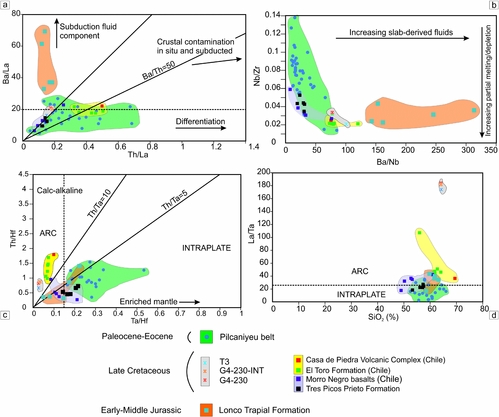
Until now, the Cretaceous volcanic rocks in Gastre had remained unnoticed, as their field and petrographic characteristics are very similar to those of the Early–Middle Jurassic andesites of the Lonco Trapial Formation. These rocks show higher total REE contents and higher levels of Ba, Rb, high-field-strength elements (HFSE) and light REEs than the Late Cretaceous dacites (Fig. 4a, b; pers. comm.). The Lonco Trapial volcanic rocks display higher Ba/Nb and Ba/La ratios (Fig. 5a, b), typical of subduction-related magmas (pers. comm.). However, some rocks from the Lonco Trapial Formation present Ta/Hf ratios higher than 0.15 (pers. comm.), suggesting an intraplate geochemical affinity, whereas the Ta/Hf ratios of the Late Cretaceous rocks are < 0.15, and therefore compatible with arc-derived magmas (Fig. 5c).
Trace element ratios of the dacitic lavas at Gastre showing their arc geochemical signature. (a) Plot of Ba/La v. Th/La. (b) plot of Nb/Zr v. Ba/Nb. (c) Plot of Th/Hf vs. Ta/Hf. (d) Plot of La/Ta vs. SiO2. Data from the Pilcaniyeu belt (Rapela et al. Reference Rapela, Spalletti, Merodio and Aragón1988; Aragón et al. Reference Aragón, D'Eramo, Castro, Pinotti, Brunelli, Rabbia, Rivalenti, Varela, Spakman, Demartis, Cavarozzi, Aguilera, Mazzucchelli and Ribot2011; Iannelli et al. Reference Iannelli, Litvak, Fernández Paz, Folguera, Ramos and Ramos2017), Casa de Piedra Volcanic Complex (Demant, Suárez & De La Cruz, Reference Demant, Suárez and De La Cruz2007), El Toro Formation (Demant, Suárez & De La Cruz, Reference Demant, Suárez and De La Cruz2007), Morro Negro basalts (Demant, Suárez & De La Cruz, Reference Demant, Suárez and De La Cruz2007), Tres Picos Prieto Formation (Zaffarana, Lagorio & Somoza, Reference Zaffarana, Lagorio and Somoza2012) and Lonco Trapial Formation (unpub. data) are shown for comparison; the chosen rocks had SiO2 content less than 70 %.

Regarding the depth of the source, while the Early–Middle Jurassic rocks have Sm/Yb ratios ranging from 2.5 to 5, which are compatible with the presence of amphibole or garnet in the residual source (pers. comm. and Bouhier et al. Reference Bouhier, Franchini, Caffe, Maydagán, Rapela and Paolini2017), Sm/Yb ratios of ~ 4 in the Cretaceous samples point to the presence of residual garnet in the source. Chondrite-normalized heavy REE concentrations of the Late Cretaceous rocks (as shown in Fig. 4a) also characterize their deeper source.
6.b. Possible origin of the Late Cretaceous volcanism in Gastre
A regional analysis of the location and geochemical features of the Cretaceous to Palaeogene magmatic rocks of Northern Patagonia is helpful to contextualize this newly found Late Cretaceous magmatism in Gastre. At least two hypotheses can be put forth with respect to its origin:
(a) This volcanism is equivalent to the Late Cretaceous volcanism in the Patagonia region (Tres Picos Prieto Formation), the already known northern outcrops of which are located at ~ 44° S (Fig. 1). The porphyritic rocks from Gastre are coeval with those of the upper section of the Tres Picos Prieto Formation, according to the ages provided by Di Tommaso (unpub. Trabajo Final de Licenciatura, Univ. de Buenos Aires, 1978). The volcanic rocks from the Tres Picos Prieto Formation are, in turn, broadly correlated with the magmatic record of the same age in the Coihaique Alto region, in the Chilean Patagonian Andes (the Casa de Piedra Volcanic Complex, the El Toro Formation and the Morro Negro basalts, although the latter are slightly younger; Demant, Suárez & De La Cruz, Reference Demant, Suárez and De La Cruz2007; Fig. 1).
(b) It may represent an early manifestation of the Palaeogene volcanism in the Chubut river area and in the Northern Patagonian Andes (Rapela et al. Reference Rapela, Spalletti, Merodio and Aragón1988; Aragón & Mazzoni, Reference Aragón and Mazzoni1997; Aragón et al. Reference Aragón, D'Eramo, Castro, Pinotti, Brunelli, Rabbia, Rivalenti, Varela, Spakman, Demartis, Cavarozzi, Aguilera, Mazzucchelli and Ribot2011; Iannelli et al. Reference Iannelli, Litvak, Fernández Paz, Folguera, Ramos and Ramos2017).
The Late Cretaceous magmatic rocks bear a well-defined subduction signature, whereas the Palaeogene rocks present a distinctive intraplate geochemical signature (the Late Cretaceous magmas show more negative Ta and Nb anomalies, lower levels of Hf, Zr and La, higher La/Ta, Th/Hf and Ba/Nb ratios and lower Ta/Hf ratios than Palaeogene magmas; see Figs 4a, b, 5a–d).
The Late Cretaceous rocks from Gastre display more distinct Nb–Ta anomalies, lower levels of Hf, Zr and La, higher La/Ta, Th/Hf and Ba/Nb ratios as well as lower Ta/Hf ratios than the Palaeogene samples (Figs 4a, b, 5a–d). It is noticeable that while the Late Cretaceous rocks bear a well-defined subduction signature, the Palaeogene rocks show a characteristic intraplate geochemical signature instead.
With regards to the Late Cretaceous volcanism, the rocks from Gastre show more geochemical similarities with those of the Casa de Piedra Volcanic Complex and the El Toro Formation, as shown by the La/Ta, Ta/Hf, Ba/Nb and Ba/La ratios (Fig. 5). La/Ta > 25 and Ta/Hf < 0.15 point to the influence of slab-derived fluids in the mantle source of these magmas. In turn, the Late Cretaceous rocks from the Tres Picos Prieto Formation display distinctly lower ratios of La/Ta (18–27) and of Ta/Hf (0.14–0.22), as well as Ba/La < 20 and Ba/Nb < 40 (Fig. 5), showing a geochemical signature transitional between arc and intraplate magmas (Zaffarana, Lagorio & Somoza, Reference Zaffarana, Lagorio and Somoza2012).
6.c. Tectonic interpretation
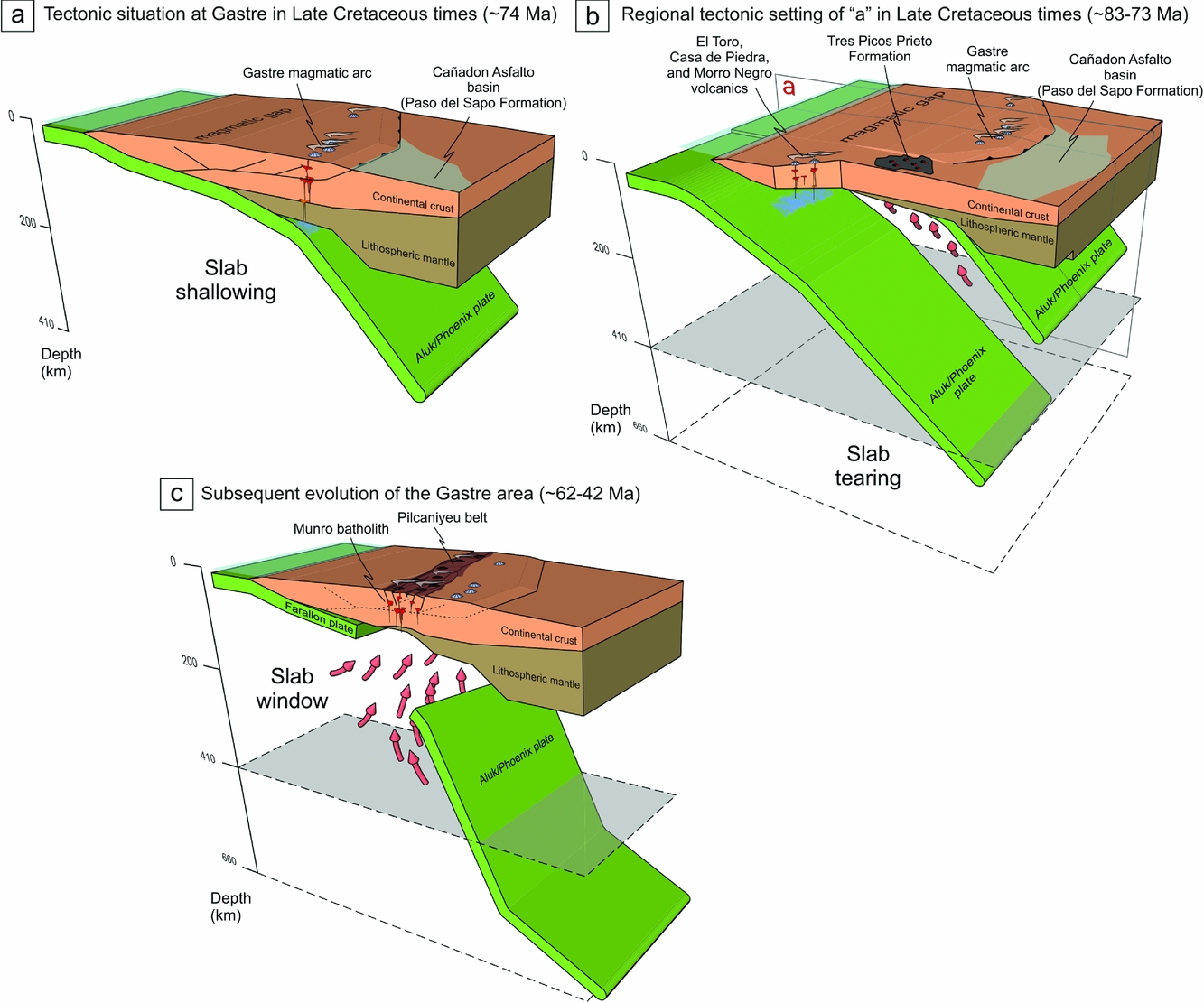
The calc-alkaline Late Cretaceous rocks from Gastre can be correlated with those from the Casa de Piedra Volcanic Complex and with those from the El Toro Formation in the Coihaique Alto region in Chile. It is worthy of mention that according to several studies concerning the Patagonian Batholith, there was a gap or decrease in its magmatic activity during Late Cretaceous times (Pankhurst et al. Reference Pankhurst, Weaver, Hervé and Larrondo1999; Suárez et al. Reference Suárez, De La Cruz, Bell and Demant2010; Echaurren et al. Reference Echaurren, Folguera, Gianni, Orts, Tassara, Encinas, Giménez and Valencia2016). The location of Gastre, about 250 km east of the present Southern Volcanic Zone of the Andes (Stern, Reference Stern2004) and around 500 km east of the trench, suggests a likely migration of the volcanic arc front towards the east during Late Cretaceous times (Fig. 6a). An increase in the depth of the source, suggested by the garnet-bearing source of the Gastre dacites, correlates well with crustal thickening. According to Karlstrom, Lee & Manga (Reference Karlstrom, Lee and Manga2014), crustal thickening could drive arc front migration while truncating the melt column at depth.
Schematic cartoons showing proposed tectonic processes and magmatic evolution for the study area. (a) Late Cretaceous slab shallowing related to the arc magmatism at the Gastre locality and related deformational belt and associated synorogenic basin. (b) Broad picture showing contemporaneous magmatism with a slab-tearing process allowing mantle flow sourcing the Tres Picos Prieto Formation. The age of ~ 83 Ma belongs to the tuffaceous intercalation in the Paso del Sapo Formation (Echaurren et al. Reference Echaurren, Folguera, Gianni, Orts, Tassara, Encinas, Giménez and Valencia2016), whereas the age of ~73 Ma corresponds to the youngest age of the volcanites reported in this work (Table S2 in the online Supplementary Material available at http://journals.cambridge.org/geo). The ages of the Tres Picos Prieto Formation from Di Tommaso (unpub. Trabajo Final de Licenciatura, Univ. de Buenos Aires, 1978) are within this range. (c) Post-orogenic and extensional magmatism related to ridge subduction and slab window generation. The age of ~ 60–42 Ma of the Pilcaniyeu belt was taken from Rapela et al. (Reference Rapela, Spalletti, Merodio and Aragón1988) and the age of ~ 62 Ma (within error) for the Munro Batholith was taken from Aragón et al. (Reference Aragón, Castro, Giacosa, Rodríguez, D'Eramo, Pinotti, Díaz-Alvarado, Aguilera, Cavarozzi, Demartis, Hernando, Fuentes, Ribot, Ibañez, Grosse and Báez2017).

In addition, several authors have proposed the existence of a Late Cretaceous compressive deformation in Northern Patagonia (Allard, Giacosa & Paredes, Reference Allard, Giacosa, Paredes, Leanza, Franchini, Impiccini, Pettinari, Sigismondi, Pons and Tunik2011; Folguera & Ramos, Reference Folguera and Ramos2011; García Morabito & Ramos, Reference García Morabito and Ramos2012; Gianni et al. Reference Gianni, Navarrete, Orts, Tobal, Folguera and Giménez2015; Echaurren et al. Reference Echaurren, Folguera, Gianni, Orts, Tassara, Encinas, Giménez and Valencia2016). They argued that an eastward migration of the arc magmatism could have been produced by a slab-shallowing process occurring in the central and Northern Patagonian Andes, a process probably associated with a general compressive deformation regime during Late Cretaceous times (García Morabito & Ramos, Reference García Morabito and Ramos2012; Spagnuolo et al. Reference Spagnuolo, Folguera, Litvak, Vera and Ramos2012; Gianni et al. Reference Gianni, Navarrete, Orts, Tobal, Folguera and Giménez2015; Echaurren et al. Reference Echaurren, Folguera, Gianni, Orts, Tassara, Encinas, Giménez and Valencia2016; Fig. 6a). Furthermore, thermochronological studies have revealed the existence of Late Cretaceous–Palaeogene exhumation ages in the Gastre region (Savignano et al. Reference Savignano, Mazzoli, Arce, Franchini, Gautheron, Paolini and Zattin2016), which can be associated with a compressive deformation stage, that was later followed by a post-orogenic collapse stage. Further southwest, by contrast, at the latitude of the El Toro Formation and the Casa de Piedra Volcanic Complex, a normal subduction regime must have been re-established (see regional tectonic framework depicted in Fig. 6b).
It is noteworthy that between both zones, near the locality of José de San Martín, the lavas of the Tres Picos Prieto Formation show an intermediate geochemical signature between intraplate and subduction magmas. The Late Cretaceous volcanism of the Tres Picos Prieto Formation could have been due to slab rollback leading to an effective trench retreat and its associated lithosphere extension, occurring soon after the Early Cretaceous contractional event (95–90 Ma; Somoza & Zaffarana, Reference Somoza and Zaffarana2008), as is suggested by Zaffarana, Lagorio & Somoza (Reference Zaffarana, Lagorio and Somoza2012). In the latter scenario, while the trench retreated to the west, a slab-tearing process in the Aluk/Phoenix oceanic plate could have created the conditions for the extrusion of the Tres Picos Prieto basalts (Fig. 6b). Slab tearing would have occurred owing to a change in the subduction angle, passing from flat at the latitude of Gastre, to normal further south, at the latitude of the Coihaique Alto region. Slab tearing allows the contamination of the subduction magmas with asthenospheric magmas derived from lateral asthenospheric flow. Lateral asthenospheric flow is a common feature along a wide subduction system like the Andes (Schellart et al. Reference Schellart, Freeman, Stegman, Moresi and May2007). This could have been the cause of the transitional geochemical character of the lavas of the Tres Picos Prieto Formation (Fig. 6b).
Late Cretaceous to recent mafic volcanism in Patagonia developed above a rapidly shearing asthenosphere, and therefore shear-driven upwelling (Conrad et al. Reference Conrad, Wu, Smith, Bianco and Tibbetts2010) seems to be a geodynamic process capable of contributing to the genesis of most of the back-arc to intraplate lavas in Patagonia, such as those of the Tres Picos Prieto Formation (Zaffarana, Lagorio & Somoza, Reference Zaffarana, Lagorio and Somoza2012). However, slab tearing particularly seems to be more suitable for triggering the extrusion of the Tres Picos Prieto lavas, considering the scenario depicted in Figure 6b. Figure 6 also emphasizes that different tectonic conditions coexisted along the continental margin during Late Cretaceous times.
It is worth highlighting that the timing of the collision of the Farallon-Aluk ridge with the continental margin is still under discussion and varies with the latitude, and while some authors relate it to Paleocene–Eocene times (Cande & Leslie, Reference Cande and Leslie1986; Ramos & Kay, Reference Ramos and Kay1992; Seton et al. Reference Seton, Müller, Zahirovic, Gaina, Torsvik, Shephard, Talsma, Gurnis, Turner, Maus and Chandler2012), further south, in the Coihaique Alto region in Chile, it is inferred that it occurred earlier, during Late Cretaceous–Palaeogene times (Espinoza et al. Reference Espinoza, Morata, Polvé, Bellen, Cotten, De La Cruz and Guivel2005; Demant, Suárez & De La Cruz, Reference Demant, Suárez and De La Cruz2007). The origin of the Tres Picos Prieto lavas was also ascribed to slab melting due to active Farallon-Aluk ridge subduction and slab window generation (Gianni et al. Reference Gianni, Navarrete, Orts, Tobal, Folguera and Giménez2015; Echaurren et al. Reference Echaurren, Folguera, Gianni, Orts, Tassara, Encinas, Giménez and Valencia2016). However, there is no slab melting signature in the Tres Picos Prieto basalts, as suggested by their relatively low Mg content and their high Sr/Y ratios, which plot away from the adakitic field (Zaffarana, Lagorio & Somoza, Reference Zaffarana, Lagorio and Somoza2012).
In a similar way, at the latitude of Gastre, the passage of the Farallon-Aluk ridge during Palaeogene times was also argued by Aragón et al. (Reference Aragón, Castro, Giacosa, Rodríguez, D'Eramo, Pinotti, Díaz-Alvarado, Aguilera, Cavarozzi, Demartis, Hernando, Fuentes, Ribot, Ibañez, Grosse and Báez2017) to explain the widespread extensional tectonic regime that prevailed during the effusion of the intraplate-derived magmas of the Pilcaniyeu Belt (60 to 42 Ma; Rapela et al. Reference Rapela, Spalletti, Merodio and Aragón1988; Aragón et al. Reference Aragón, Pinotti, Eramo, Castro, Rabbia, Coniglio, Demartis, Hernando, Cavarozzi and Aguilera2013) and the intrusion of the granitic magmas of the post-orogenic Munro Batholith (~ 62 Ma), as illustrated in Figure 6c.
7. Conclusion
The newly found Late Cretaceous dacites (~ 74–76 Ma) in Gastre, Northern Patagonia bear a calc-alkaline, arc-like geochemical signature and a deep, garnet-bearing source. Given that there was a magmatic decrease or gap in the arc activity during Late Cretaceous times at these latitudes, an eastward migration of the magmatic front is proposed in this period. Further south, the activity of the magmatic front must be inferred from the coeval, arc-derived magmas of the El Toro Formation and the Casa de Piedra Volcanic Complex, which are located close to the prior arc axis.
The eastward expansion of the arc at the latitude of Gastre correlates well with a regional compressive deformation event, supported by independent structural and thermochronological studies. The compressive deformation and the eastward arc migration are probably associated with a slab-shallowing process.
In a complementary way, the Late Cretaceous volcanism of the Tres Picos Prieto Formation, which bears transitional features between intraplate and subduction-related magmas, could have been triggered by a slab-tearing process in the Aluk-Phoenix oceanic plate due to the change in the subduction angle (from flat at the latitude of Gastre to normal at ~ 45° S), while the trench was retreating to the west. Different geochemical features of coeval volcanic rocks suggest that different tectonic conditions existed along the continental margin during Late Cretaceous times.
Acknowledgements
This work was financed by the Project PIP CONICET 112-200901-00766 and Project PICT 2014-1394. Gabriela Massaferro and Felipe Espinoza are thanked for reviewing this manuscript. Special thanks are given to Maria Helena Hollanda for helping with the geochemical analysis of one of the samples at Acmelabs, and to Romina Sulla for revising the English text.
Supplementary material
To view supplementary material for this article, please visit https://doi.org/10.1017/S0016756818000432