Technological innovation improves the quality of health care and affects healthcare costs (Reference Folland, Goodman and Stano5;12). In many countries, the government has focused on limiting the use and introduction of new medical technologies to restrain increases in healthcare spending (Reference Folland, Goodman and Stano5), making it difficult to determine an appropriate diffusion model for new technologies. This situation is especially true for computed tomography (CT) and a magnetic resonance imaging (MRI) equipment (Reference Olsson14). It is difficult to weigh the cost increases attributable to the use of new medical technologies against improvements in the quality and effectiveness of care provided by advanced medical technologies. Advanced diagnostic equipment, including MRI machinery, can identify diseases earlier than prior technologies (Reference Steinberg, Sick and Locke18), which may prevent disease manifestation or delay disease progression. Consequently, this early detection may also reduce healthcare utilization and the cost of care (12).Diagnostic advances have reduced misdiagnoses and improved prevention, treatment, and rehabilitation (7).
Korea has experienced a rapid increase in CT and MRI procurement over the past 10 years (7;Reference Hutubessy, Hanvoravongchai and Edejer10). National Health Insurance (NHI) in Korea has covered the use of MRI for all patients since 2005. Many factors related to the adoption of this high-priced new technology that have to be considered include the appropriateness of MRI costs, the quality of diagnosis, and other indications for MRI use. The rapid rate of procurement has been met with many changes in regulatory policy. The regulatory changes as well as changes in fee schedules for MRI and CT diagnoses have affected all regions of Korea equally. Although regional economies and the local needs of physicians and patients play roles in the diffusion of new technologies, the effects of regulatory changes are broadly equalized across Korea.
The Korean national health budget and general quality of health care may be influenced by the MRI diffusion rate and usage. Therefore, it is necessary to confirm the factors that are important in the adoption and diffusion of new medical technologies in Korea.
The main purpose of this study was to identify factors influencing the diffusion of MRI equipment in Korea. We identified an S-shaped diffusion pattern consistent with the pattern suggested by Rogers (Reference Rogers15). We also identified enabling and predisposing factors leading to technology diffusion. Lastly, we confirmed previously reported effects of regulatory changes on MRI procurement.
METHODS
Conceptual Model and Measures
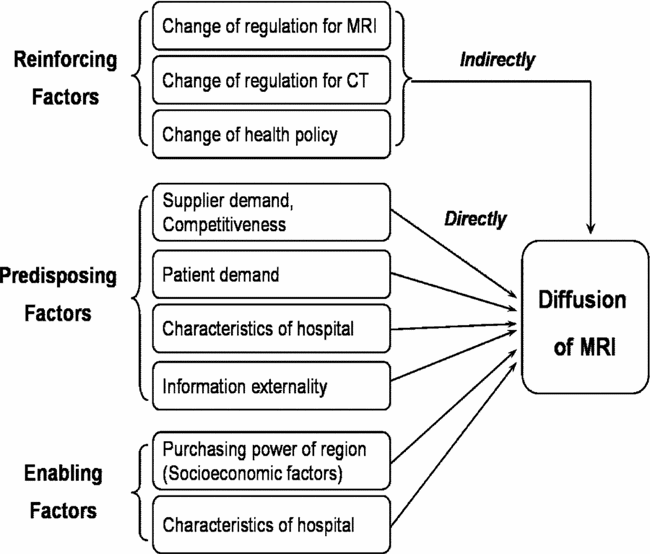
We selected factors on MRI diffusion based on reviewing much of the preceding literature and grouped factors into three dimensions based on the model by Oh et al. (Reference Oh, Imanaka and Evans13) and using an approach similar to that described by Banta (Reference Banta3). This process included identifying factors such as predisposing, enabling, or reinforcing (Figure 1). We defined the time of adoption as the number of elapsed months between September 1988 and the MRI installation date. As the end point of the study was July 2004, this period covered 190-months.
The research framework. MRI, magnetic resonance imaging; CT, computed tomography.
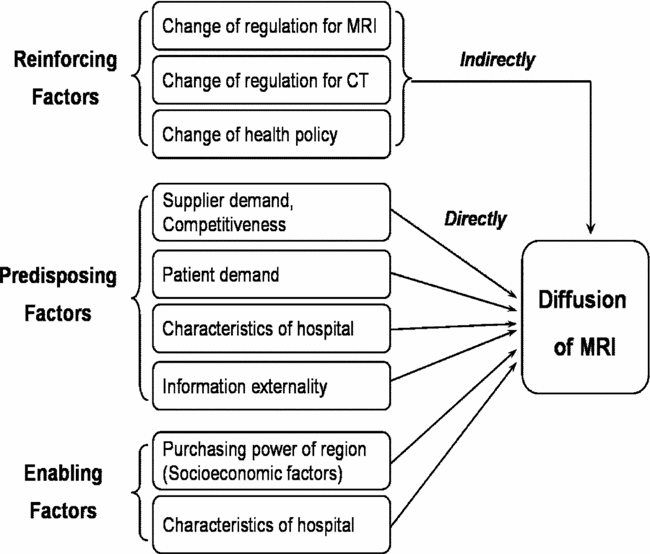
In this study, we defined predisposing factors as the supplier demand, customer (patient) demand, market competitiveness, and individual characteristics of hospitals. The supplier demand was estimated from the number of physicians and healthcare facilities per capita and the number of previously existing MRI units in the region (Reference Baker2;Reference Oh, Imanaka and Evans13;Reference Teplensky, Pauly and Kimberly19). The customer demand was the percentage of people over 65 years of age in a population in the region (Reference Baker2;Reference Oh, Imanaka and Evans13;Reference Slade and Anderson16). The number of regional MRI units was the MRI count in the region before the adoption of a new MRI by a given hospital (Reference Oh, Imanaka and Evans13). To gauge regional competition, we used the number of beds to calculate the Hirschman–Herfindahl Index for each region, which indicated the monopoly power in a particular region (Reference Yoon20). This measure reports low levels of competition as higher index values and high levels of competition as low index values. The presence or absence of a training program in radiology and the number of radiologists were considered reasonable proxies for measures of information externality (Reference Escarce4;Reference Folland, Goodman and Stano5).
We defined each hospital according to ownership type, size, the presence of a residency program, year of establishment, and the number of CTs and MRIs.Hospitals were categorized according to size as hospitals, general hospitals, and tertiary hospitals based on NHI fee standards. Hospital ownership was categorized as privately owned, government owned, or medical school (Reference Sloan, Valvona and Perrin17;Reference Teplensky, Pauly and Kimberly19). Training programs were classified according to whether a hospital possessed both a medical residency program and a medical internship program, or only an internship program (Reference Baker2;Reference Teplensky, Pauly and Kimberly19).
As enabling factors are functions of the regional and individual hospital purchasing power, they were separated into regional (environmental) and hospital (individual) components. The regional component was measured as the local per capita gross domestic product (GDP) and taxable income (Reference Baker2;Reference Slade and Anderson16); the individual hospital component was measured as the number of beds at the time of MRI installation (Reference Sloan, Valvona and Perrin17;Reference Teplensky, Pauly and Kimberly19).
To identify the effects of political change on MRI diffusion rates, we assigned four event points along a timeline and analyzed the factors reinforcing the adoption of MRI technology at each point. Event 1 corresponded to 27 November 1991, which was when the Korean government permitted MRI installations at general hospitals that had both a radiologist training program and more than 400 beds. Before that time, MRI installations were permitted only at tertiary hospitals. Event 2 was defined by the 1994 regulatory change that permitted hospitals with radiologists and 400 staffed beds to install MRI equipment even if those beds were affiliated with another hospital. At that time, it also became permissible for clinics to install CT units (8). Event 3 was defined by the 1996 decision to allow NHI to provide payments for CT procedures. The International Monetary Fund economic crisis in Korea in 1997 was assigned as Event 4. During that time, the Korean government abrogated the regulation of CT adoption, allowing clinics specializing in radiology to adopt MRI technology.
Data Collection
We used MRI registry data for July 2004 from the Ministry of Health and Welfare (MOHW) in Korea. All hospitals report their MRI acquisitions, including installation and manufacture dates and the location of all MRI units, to the MOHW. We collected information about hospital age, ownership type, bed count, and teaching status using a national hospital directory of the Korean Hospital Association (KHA). Regional data related to the number of physicians and hospitals, GDP per capita, population, and local taxable income per person were taken from the Korean National Statistical Office.
The initial sample size was 248 hospitals with training programs as of 31 July 2004. Of these 248, we excluded 16 mental hospitals. The final analyses were performed on 232 hospitals, 185 of which had adopted MRI technology as of 31 July 2004.
Analysis
We confirmed the factors that influenced the adoption time of MRI technology using Cox's proportional hazard model, which was calculated in SAS version 8.0. The Cox regression models the probability that adoption will occur at a specific time at an eligible hospital, without assuming a specific distribution underlying the timing of the event (Reference Teplensky, Pauly and Kimberly19). Cox's proportional hazard model does not analyze reinforcing factors, because it is difficult to directly model regulatory change. Therefore, we used a logistic regression model to analyze the factors that influenced the timing of adoption with respect to the timing of regulatory changes. We excluded the numbers of specialists and radiologists, because the correlation was significantly high between hospital size and these variables (cor = .838, .764).
RESULTS
Diffusion Pattern of MRI Technology in Korea
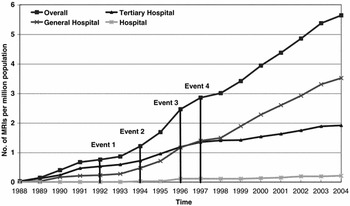
The first MRI in Korea was installed at the Seoul National University Hospital in September 1988. The number of MRI installations in Korea reached a total of 561 units by July 2004. Figure 2 gives a detailed pattern of MRI adoption by hospital size. For tertiary hospitals with advanced technologies and highly qualified staffs, the diffusion curve determined in this study fit the logistic patterns described in previous diffusion studies (Reference Escarce4;Reference Folland, Goodman and Stano5;Reference Hillman and Schwartz9;Reference Rogers15).
Diffusion pattern of magnetic resonance imaging units (MRIs) by hospital size.

Factors Affecting the Rate of Diffusion
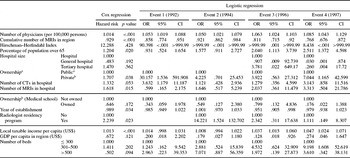
Table 1 shows the odds ratios for the adoption of MRI (hazard) using Cox's proportional hazard model to analyze factors influencing MRI diffusion. With regard to predisposing factors, five variables positively affected the diffusion rate, especially the number of physicians per 100,000 persons, presence of a radiology residency program, and the number of MRI units previously available at the hospital, whereas the cumulative number of MRI units and year of establishment negatively affected the diffusion rate. For enabling factors, we found that the local taxable income had a positive effect on the diffusion rate in both models.
Results of Cox Regression and Logistic Regression for Factors Influencing MRI Adoption, According to Event

Note.
a Nonprofit.
b For profit.
MRI, magnetic resonance imaging; OR, odds ratio; CI, confidence interval; GDP, gross domestic product.
We used a logistic regression model to analyze the impact that changes in related regulations and laws had on the MRI diffusion rate (Table 1). The number of physicians (positively) and the cumulative number of MRI units in the region (negatively) affected the diffusion of MRI in all the events.
DISCUSSION
In Korea, the overall diffusion rate for MRI technology before 1998 showed a sigmoid shape when viewed as a logistic curve, reflecting a classic diffusion pattern of new technology. However, MRI diffusion rates have accelerated since 1999, and the overall diffusion rate curve was linear from 1988 to 2004. Baker (Reference Baker2) also showed a linear diffusion rate curve for MRI technology in the United States between 1983 and 1993. The Korean MRI diffusion rate between 1988 and 1994 was somewhat conservative, and the MRI diffusion curve increased sharply after 1994. MRI diffusion in the United States began accelerating 3 years after its first adoption. Thus, the Korean MRI diffusion rate was slower than that in the United States.
The analysis based on hospital size, revealed that tertiary hospitals followed a sigmoidal curve during the early years of MRI adoption. The fact that most tertiary hospitals are associated with a medical school and have several beds and highly qualified physicians probably influenced this early growth with respect to MRI technology. The rapid MRI diffusion rate at tertiary hospitals might also have been influenced by a strong desire to acquire new technologies to increase the number of patients and yield greater revenues (Reference Baker and Wheeler1;Reference Friedman and Goes6;Reference Sloan, Valvona and Perrin17).In addition, technically advanced facilities can more easily recruit proficient physicians, benefiting the reputation of the hospital (Reference Friedman and Goes6;Reference Teplensky, Pauly and Kimberly19). In the Korean market, tertiary hospitals tend to compete for technological preeminence.
The findings from this study were consistent with the results of other studies (Reference Friedman and Goes6;Reference Oh, Imanaka and Evans13;Reference Olsson14;Reference Slade and Anderson16;Reference Teplensky, Pauly and Kimberly19). The number of physicians per capita in a given region is a good proxy variable for physician demand, because competition is proportional to the number of physicians (Reference Oh, Imanaka and Evans13). This study suggests that the number of local physicians was proportional to the local rate of MRI diffusion. This result agrees with the results of previous studies, which suggested that hospitals with more competition in a region adopted MRI technology more rapidly (Reference Baker and Wheeler1;Reference Baker2;Reference Friedman and Goes6;Reference Oh, Imanaka and Evans13).
A low level of extant MRI units in a region predicted a higher probability that new MRI equipment would be adopted in that region, which is consistent with a technological preeminence competition model. Furthermore, it appears to refute the “bandwagon” model, in which MRI units might be acquired to compete with hospitals already possessing similar equipment (Reference Friedman and Goes6). The percentage of the population over the age of 65 years was used as a proxy for the degree of patient demand. We found that patient demand affects the MRI diffusion rate. This result is consistent with a study by Oh et al.(Reference Oh, Imanaka and Evans13), which suggested that patient demand affected the adoption of MRI.
Older hospitals showed greater rates of acquisition. Older hospitals place considerable importance on their reputation within local markets (Reference Sloan, Valvona and Perrin17) and often have greater purchasing power (Reference Lee11). Both of these factors could enable the adoption of new technologies. The existence of a radiology residency program was related not only to the prominence of the physicians in a hospital but also to information externality (Reference Escarce4;Reference Folland, Goodman and Stano5). Thus, information externality, a factor previously reported to influence the adoption of new technologies (Reference Folland, Goodman and Stano5), affected the adoption of MRI technology in Korea.Additionally, privately owned hospitals were more likely than nonprofit hospitals to be early adopters of MRI technology, particularly at Event 1.Early adopters represent opinion leaders within their markets and enhance their reputations by defining the safety and efficacy of new technologies (Reference Folland, Goodman and Stano5). Considering that more than 80 percent of hospitals in Korea are privately owned, the likelihood that a private hospital will adopt a new technology may be related to its desire to position itself as a technological leader in a competitive and volatile environment (Reference Teplensky, Pauly and Kimberly19).
We confirmed that hospitals in regions with high per capita taxable income were much more likely to be early adopters of MRI (Reference Slade and Anderson16). We suggest that regional purchasing power is an important factor leading to the adoption of MRI technology.
We indirectly identified reinforcing factors, such as the effects of regulatory changes, by comparing the results of Cox's proportional model with those of the logistic model. Most of the variables that influenced MRI adoption in the Cox's proportional model also affected adoption rates in the logistic regression model.
To the best of our knowledge, this is the first study to identify the factors affecting MRI diffusion on a nationwide scale in Korea. However, there were some limitations to the study. First, we could not include the hospital budget in hospital purchasing power; the KHA database, from which hospital financial data were taken, was missing a lot of data. Therefore, we used hospital size as a proxy of purchasing power. Second, we could not include the costs of MRI, because these data were often not included in the national MRI registry.
We advocate a more directed approach to understanding the diffusion rate and patterns, focusing specifically on predisposing, enabling, reinforcing factors. Furthermore, investigation is warranted regarding whether these findings extend to the situation since 2005, when NHI in Korea first covered the use of MRI for all patients.
POLICY IMPLICATIONS
Although Korea has the highest MRI adoption rate in Asian countries (Reference Hutubessy, Hanvoravongchai and Edejer10), results of this study suggest that MRI adoption is likely to increase continually in the future. Patient demand, physician demand, purchasing power in the hospital and the region, and information externalities are factors influencing MRI adoption. It is necessary to manage MRI diffusion at a national level, because acquisition of MRI requires a large capital investment, which can increase healthcare costs.
CONTACT INFORMATION
Myung-Il Hahm, PhD (hmi@ncc.re.kr), Researcher, Eun-Cheol Park, MD, PhD (ecpark@ncc.re.kr), Director, National Cancer Control Research Institute, National Cancer Center, 809 Madu1-dong, Ilsandong-gu, Goyang-si, Gyeonggi-do, 410-769, Republic of Korea
Sun-Hee Lee, MD, PhD (lsh0270@ewha.ac.kr), Professor, Department of Preventive Medicine and Public Health, Ewha Women's University, 911-1 Mok-dong, Yangcheon-gu, Seoul, 158-710, Republic of Korea
Chung Mo Nam, PhD (cmnam@yumc.yonsei.ac.kr), Associate Professor, Department of Preventive Medicine and Public Health, Hye-Young Kang, PhD (hykang@yumc.yonsei.ac.kr), Assistant Professor, Hoo-Yeon Lee, MD, PhD (lhy135@yumc.yonsei.ac.kr), Assistant Professor, Graduate School of Public Health, Woo-Hyun Cho, MD, PhD (Corresponding author) (whcho@yumc.yonsei.ac.kr), Professor, Department of Preventive Medicine and Public Health, Yonsei University College of Medicine, 134 Shinchon-dong, Seodaemun-gu, Seoul, 120-752, Republic of Korea