




No CrossRef data available.
Article contents
Executive function as a predictor of inattentive behavior after traumatic brain injury
Published online by Cambridge University Press: 01 July 2005
Abstract
Emerging evidence from recent studies using laboratory and naturalistic attention tasks suggests that individuals with traumatic brain injury (TBI) may have a deficit mainly in strategic control of attention. In the present study, we tested the hypothesis that inattentive behavior after TBI could be predicted by performance on psychometric measures of executive function. A group of 37 individuals with moderate to severe TBI were assessed with previously validated naturalistic measures of attention. A battery of neuropsychological tests was also administered to assess various aspects of executive function. Seven measures of executive function and 10 variables reflecting inattentive behavior were combined to form 1 executive and 3 inattentive behavior (IB) composite scores. Three predictors (executive composite, current disability scores, and age) were associated, at the univariate level, with one of the IB composites reflecting frequency and duration of off-task episodes. A stepwise multiple regression procedure indicated that the executive composite was the only significant predictor of the IB composite. Additional post-hoc regression analyses suggested that the relationship was not likely to be mediated by processing speed. The current study supports the hypothesis that executive function, measured by commonly used neuropsychological tests, significantly predicts certain aspects of inattentive behavior in real-world tasks after TBI. (JINS, 2005, 11, 434–445.)
Keywords
Information
- Type
- Research Article
- Information
- Journal of the International Neuropsychological Society , Volume 11 , Issue 4 , July 2005 , pp. 434 - 445
- Copyright
- © 2005 The International Neuropsychological Society
INTRODUCTION
Difficulties with attention are among the most prevalent cognitive sequelae of traumatic brain injury (TBI) (Auerbach, 1986; McKinlay et al., 1981; van Zomeren & van den Burg, 1985; Whyte et al., 1998a). A significant proportion of TBI patients with moderate to severe TBI report such difficulties more than 2 years post trauma (Gronwall, 1987; Ponsford et al., 1995). In mild TBI, problems in concentration may be the only cognitive symptoms (Zasler, 1996). Despite this consensus on the prominence of inattentive symptoms in this population, however, researchers have yet to provide a clear model of this deficit (Bate et al., 2001; Ponsford & Kinsella, 1992; van Zomeren & Brouwer, 1994; Whyte, 1998).
One of the difficulties facing researchers arises from the fact that human attention is multi-factorial (Mirsky et al., 1991; Posner & Petersen, 1990; van Zomeren & Brouwer, 1994) and is implemented with a complex interaction between goal-directed (top-down) and stimulus-driven (bottom-up) control mechanisms (Corbetta & Shulman, 2002; Yantis, 2000). Despite this complexity, previous experimental studies on attentional processes in TBI have demonstrated several distinguishable subcomponents of attention to be deficient in this population, including sustained attention (Loken et al., 1995; Stuss et al., 1994; Whyte et al., 1995), focused attention (Godefroy et al., 1996; van Zomeren, 1981; Whyte et al., 1998b) and divided attention (Hartman et al., 1992; McDowell et al., 1997; Park et al., 1999; Stuss et al., 1989). In contrast, individuals with TBI were reported to be largely unimpaired in tasks tapping phasic arousal (Whyte et al., 1997a) or endogenous orienting in the Posner paradigm (Bate et al., 2001).
Another challenge in elucidating the nature of attention deficit in TBI is related to the general problem of ecological validity of neuropsychological measures of complex cognitive functions (Hart & Hayden, 1986; Kerns & Mateer, 1996; Sbordone, 2001). While clinicians and family members base their judgments on behavioral observation in naturalistic environments, most research to date has focused on laboratory measures of information processing and traditional neuropsychological tests. These cognitive measures, however, may either under- or over-estimate the level of impairment in the natural environment. This is partly because most traditional measures of attention are designed to assess particular features of attention in a highly structured setting, rather than measuring aspects of higher level control such as staying on task for a protracted period of time, or attending to conversation in a distracting environment. Yet these are the types of deficits most likely to be noted by clinicians, family members, and persons with TBI.
Previous work in our laboratory led to the development of naturalistic but quantifiable and reliable measures of inattentive behavior of individuals with TBI (Whyte et al., 1996; Whyte et al., 2000). In those studies, participants' behavior was videotaped as they were performing three types of independent tasks. During the work session, a research assistant performed 12 naturalistic distracting behaviors. Subsequent coding analysis with sub-second accuracy revealed that individuals with TBI showed more frequent off-task behavior than controls, both in the presence of specific environmental distractors and also during undistracted times. These results suggest that inattentive behavior after TBI may be related to difficulties in strategic and voluntary aspects of attention necessary in a less structured environment.
The pattern of results from the laboratory and naturalistic attention tasks mentioned above prompted some researchers to hypothesize that individuals with TBI have a deficit mainly in goal-directed, strategic control of attention rather than the autonomous, stimulus-driven component (Whyte, 1998; see also Bate et al., 2001; Park et al., 1999). This, in turn, may suggest a potential role of so-called executive function in explaining inattentive behaviors observed in TBI. In fact, many daily activities require a coherent interaction between executive and attention function. The ability to set, maintain, and change goals in accordance with current tasks will affect the top-down control over sustaining, focusing, and dividing attention. Recent studies of experimental psychology have started to demonstrate this complex interplay (Downing, 2000; Pratt & Hommel, 2003). Given that (1) impairment in executive function is among the hallmark deficits in individuals with TBI (Levine et al., 2000; Mattson & Levin, 1990; Stablum et al., 1996); and (2) the neuropathology of TBI makes prefrontal cortex particularly vulnerable (Adams et al., 1980; Blumbergs et al., 1989), it would be reasonable to expect impairments in the strategic deployment of attentional resources in this population.
Defining and measuring executive function, however, has also proven challenging to researchers. Executive function encompasses diverse capacities such as initiating and maintaining goals, inhibiting irrelevant responses, discovering rules and monitoring thoughts and actions. No single measure of executive function is recognized as a “gold standard” and no consensus on the classification scheme of executive function has been established (Baddeley, 1998; Levine et al., 1995; Royall et al., 2002). Even the debate over whether executive function should be considered as a single faculty or multiple components continues both at the neuronal and cognitive levels (Baddeley, 1996; Duncan et al., 1997; Duncan & Owen, 2000; Miller, 2000; Wood & Grafman, 2003). In addition, measuring executive function distinguishable from attention is not an easy task due to the significant overlap between these two constructs. Despite these difficulties, investigating the relationship between executive and attention functions is worthwhile for refining our understanding of the impairments in these two important cognitive domains following TBI. This endeavor is likely to involve theoretical attempts to distinguish between these two constructs and also empirical exploration of the patterns of relationship between measures from different levels within each cognitive domain.
As part of a larger project (Whyte et al., 2004), we assessed attentional function of individuals with TBI at multiple levels including real-world observational measures that were validated in our earlier studies (Whyte et al., 1996, 2000). A battery of neuropsychological tests was also administered to assess various aspects of executive function. The purpose of the present study is to examine the relationship between executive function as measured by neuropsychological tests and validated measures of real-world attentiveness. It was hypothesized that executive function, measured by neuropsychological tests may serve as a significant predictor of one or more inattentive behaviors manifested by individuals with TBI, over and above more global factors that would be expected to predict real-world attention deficits such as overall severity of brain injury, age, and pre-injury intellectual level.
METHODS
Research Participants
Data for the current study were obtained from participants in a larger on-going project investigating the effects of specific medications on attention deficits among individuals with TBI. Part of the results from the project have been published previously (Alban et al., 2004; Whyte et al., 2004). Full details of subject recruitment procedure and inclusion/exclusion criteria can be found in these articles. Participants were recruited from a variety of clinical sources and research registries. To be included, participants had to be between the ages of 16 and 60 years, and to have a history of non-penetrating traumatic brain injury of at least moderate severity at least 3 months prior to enrollment. Severity level was defined by significant and well-documented loss or alteration of consciousness following injury (i.e., lowest Glasgow Coma Scale (GCS) score of less than 12, or prospectively documented post-traumatic amnesia (PTA) of greater than 1 hr), or focal abnormality on a neuroimaging study that was attributable to traumatic injury. A subjective complaint of attention difficulties by the participant, treating clinician, or caregiver was also required. Potential participants were excluded if they had a history of premorbid neurologic disease, psychosis, major affective disorder, mental retardation, Attention Deficit Hyperactivity Disorder; if they were currently abusing alcohol or recreational drugs, or if their history of using these substances was judged as severe enough to contribute independently to cognitive impairment. Persons who were taking psychoactive medications other than anticonvulsants were also excluded. Participants and/or their involved caregivers (depending on the participant's cognitive capacity) provided informed consent.
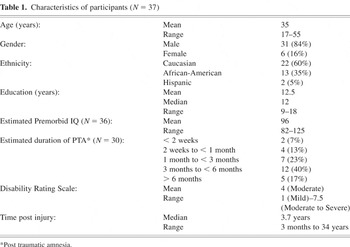
Table 1 summarizes the demographic, injury and disability characteristics of the 37 participants with TBI included in the final analysis. Thirty-one of these subjects had participated in our previously reported clinical trial study using methylphenidate (Whyte et al., 2004). Additional data from 6 participants recruited for another portion of the same project (a bromocriptine trial) were also included in the current study. Disability Rating Scale scores (DRS, Rappaport et al., 1982) at the time of testing were determined for all participants. This measure, which assesses overall level of disability in self-care, home and occupational role function, was used as a proxy measure of overall injury severity rather than an acute injury measure such as GCS, since most participants were many months or years post injury. Duration of post-traumatic amnesia was estimated retrospectively by querying participants regarding their first post-traumatic memory. No participants were in PTA at the time of assessment. There were two individuals who reported PTA of less than 2 weeks and had no GCS scores available. However, uncomplicated mild TBI was ruled out by the fact that both subjects had subdural hematomas requiring evacuation. Premorbid intellectual functioning was estimated using the North American Adult Reading Test (NAART, Blair & Spreen, 1989). As is typical of research on moderate to severe TBI, the majority of participants were male. Except for the exclusion of children and elderly participants, the distributions of age, education level and ethnicity were typical of adult TBI samples in metropolitan areas. In keeping with the exclusion for premorbid cognitive limitations, estimated premorbid IQs all fell within the average to high average range. It may be seen in Table 1 that the typical participant was several years post injury, exhibited a moderate level of functional disability and reported a significant degree of post-traumatic amnesia.
Characteristics of participants (N = 37)

Measures and Procedure
Data collection on attention measures was integrated into a day activity program infrastructure in the context of a larger study as described previously (Whyte et al., 2004). Subjects participated in either a 6-week methylphenidate trial or an 8-week bromocriptine trial. Each crossover drug study included 3 placebo and 3 medication weeks, during which participants' attentional behaviors were observed in a classroom every weekday. Participants were also taken from the classroom for 1 hr each day to do a variety of individual attention assessment tasks, including the Inattentive Behavior Task described below. Only placebo data were used for the purpose of the present study.
Tests of executive function
As part of the initial screening, a battery of neuropsychological tests was administered to all participants. Eight neuropsychological tests were originally included in the test battery to assess different aspects of executive function. As a measure of verbal working memory with manipulation component, the Digits Backward section of the Digit Span subtest of the Wechsler Memory Scale III (Wechsler, 1997) was included. Brown-Peterson Auditory Consonant Trigrams (Brown, 1958; Peterson & Peterson, 1959) served as a working memory measure with an interference component and Petrides' Self-Ordered Pointing Task (Petrides & Milner, 1982) was selected as a measure of a working memory test with self-monitoring demands. Two fluency measures were administered: The Controlled Oral Word Association (COWA; Benton & Hamsher, 1983) test for verbal fluency, and Regard's 5-Point Test for design fluency (Regard et al., 1982). These fluency tasks are considered to measure cognitive flexibility, initiation, and response inhibition (Lee et al., 1997; Randolph et al., 1993; Troyer, 2000). Trail Making Test–Parts A and B (TMT, Reitan & Wolfson, 1985) were administered, with Part B included as a measure of mental flexibility and divided attention. The Stroop Test (Trenerry et al., 1989) provided a measure of selective attention and inhibition of habitual responding. The Wisconsin Card Sorting Test (Heaton & the PAR Staff, 1993) was administered as a test requiring abstract concept formation, rule discovery, and shifting cognitive set.
Inattentive behavior task (Whyte et al., 1996, 2000)
In this task, the participant was asked to perform three tasks at a worktable, including making a collage, sorting items into their correct bowls, and working on a complex jigsaw puzzle, while being videotaped. During the session a research assistant carried out a series of naturalistic distractions (e.g., making a phone call, playing a noisy computer game, dropping a book), on cue from taped messages delivered through a concealed earphone. The videotapes were coded at a later time to identify the beginning, end, and duration of each off-task event, external distraction, and period of the task during which the research assistant gave directions. Off-task events were defined with respect to direction of eye gaze, as described previously (Whyte et al., 2000). Rates of off-task behavior were calculated separately for each task, as events/minute of task time. The average duration of off-task events in each session was also calculated, by dividing the total off-task time by the number of off-task events. Inter-rater reliability for this coding method was high (mean Kappas above .8) as previously reported (Whyte et al., 2000, 2004).
Classroom attentiveness observation (Whyte et al., 2004)
Four 1-hr classroom sessions were held each weekday, during which observational data on on-task behavior were collected in both individual and group tasks. Participants were observed for attentiveness as they participated in classroom activities. Data collection occurred during a group activity and an individual activity in both the morning and the afternoon, however some participants' laboratory data collection sessions were scheduled to conflict with one of the classroom sessions of a given type. During individual sessions, the participant was asked to carry out independent work (e.g., reading a book, working on crossword puzzles or individual craft projects), in the same room with other participants. During group sessions, activities such as playing board games, discussing current events, and participating in lectures, which required the interaction and involvement of all participants, were conducted. For both types of session, a set of rules that defined the appropriate targets of attention was laid out by the classroom therapist before the activity began. For example, in a group activity with structured turn-taking, responding during someone else's turn or failing to respond during one's own turn were both coded as off-task behavior. During each session, a research assistant sat in the classroom to observe and code off-task behavior. The research assistant wore a vibrating watch that provided a silent cue once per minute. A random sequence of participant identification codes was pre-printed on a data collection sheet. Each minute, when the watch cued, the research assistant looked at the appropriate participant and coded whether, at that moment, he or she was on or off-task according to operationalized written behavioral criteria. Data were collected on off-task behavior as measured by eye-gaze, speaking, and being out of seat. However, only the eye-gaze data are reported here because scores in the other two domains were frequently at ceiling. On-task eye gaze was defined based on whether or not the research participant was looking at the appropriate task materials (for individual tasks), or the task-relevant speaker or materials (for group tasks). Agreement between pairs of raters coding attentiveness in classroom activities was high (mean Kappa above .9) as previously reported (Whyte et al., 2004).
Choice reaction time task (Miller, 1970; Whyte et al., 2004)
This task was selected to examine speed of processing as a potential confounding variable (see Results). In this task, the participant was required to press a number key on the numeric keypad of the computer keyboard in response to presentation of a digit on the screen. There were three blocks in this experiment, in which there were two, four, or six possible digits. Response keys not being used during a given block were covered to make clear to the participants that the number of choices varied. The number stimulus remained on the screen until the participant responded. After each response, there was a 1000 ms blank interval, followed by an 800 ms presentation of a central fixation cross. This was followed by the presentation of the potential digit set in a random array for 1000 ms. Finally, an auditory tone signaled the simultaneous brightening of one of the digits to identify it as the target. A regression slope of mean reaction time for correct responses versus the natural logarithm of the number of choices available served as the index of processing speed, based on evidence that the steepness of this slope is an index of speed of mental processing—that is, steeper = slower (cf. Posner, 1986).
Data Analysis
Development of inattentive behavior (IB) composite scores
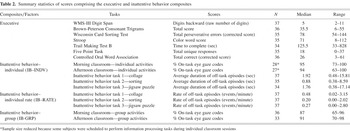
In order to reduce type I error and increase signal to noise ratio, we developed composite scores for both attention and executive domains. However, the relatively small sample size precluded use of a multivariate method such as factor analysis for data reduction. In our previously reported study (Whyte et al., 2004), we used a combination of a priori reasoning and Spearman's rank-order correlations to build composite factor scores. A total of 10 naturalistic attention measures from classroom attentiveness observation and the Inattentive Behavior Task were reduced to three composite scores. The same composite scores for the IB measures were used for the present study (Table 2). Percentage scores of on-task eye-gaze codes from individual morning and afternoon sessions, together with the average durations of off-task episodes from three inattentive behavior tasks formed the “inattentive behavior–individual (IB–INDV)” composite. Rates of off-task episodes from three inattentive behavior tasks built the “inattentive behavior–individual rate (IB–RATE)” composite. The third composite named as “inattentive behavior–group (IB–GRP),” was comprised of two percentage scores of on-task eye-gaze codes from morning and afternoon group activity sessions. The IB composites were retained as three separate scores, rather than combining them further into a single composite as done for the executive measures (see below). This was done because we reasoned that executive function might be related differently to these measures in interesting ways, and combining the IB scores would have obscured those differences.
Summary statistics of scores comprising the executive and inattentive behavior composites

Development of executive composite score
Previous attempts to identify factors within the executive function domain, using exploratory factor analytic methods, have resulted in different numbers of factors and different patterns of intercorrelation among the same test scores, presumably due to different sets of tests comprising the data set, different subject samples, etc. (for review, Miyake et al., 2000; Royall et al., 2002). In attempting to use a correlation matrix to sort the executive scores in our own sample into conceptual factors (as we had done for the attention scores), we did not see a clear-cut pattern. Most of the measures intercorrelated only moderately, and some measures that correlated strongly with one another were not correlated with the same other measures. We therefore decided to build a global index of executive function using a summary score from each test instead of attempting to identify distinct executive subcomponents. In the course of preliminary data analysis, however, the Self-Ordered Pointing Task was found to be the only task that yielded non-significant difference from demographically matched controls (data not shown) and was subsequently excluded from the composite to increase the sensitivity of the composite to the executive impairment of individuals with TBI. These remaining seven tests and their summary scores are presented in Table 2 along with the statistics summarizing performance by individuals with TBI.
Some participants did not complete all seven executive tests due to expressive aphasia, motor limitations, or scheduling difficulties. No tests were omitted due to participant inability in the domain under study (i.e., severe executive dysfunction). Participants who missed four or more tests were excluded from the final analysis. Among the 37 participants included in the final analysis, 4 participants missed one test, 2 participants missed two tests, and 1 participant missed three. Composite scores were developed by ranking the individual scores and dividing by the maximal possible rank for each test (in order to compensate for minor differences in sample size across different measures). As a result, the adjusted ranks ranged from zero to 1.0 for all tests. The final executive composite score was then computed by averaging rank scores of all available tests for a participant. Composite scores for the IB factors were computed in the same fashion.
Statistical analysis
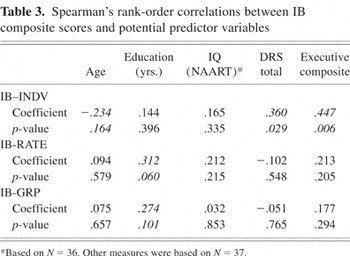
The small sample size did not allow inclusion of all candidate independent variables of interest simultaneously in a multiple regression model. Thus, data analysis proceeded in two steps. In the first step, Spearman correlations were calculated between dependent variables (three IB composite factor scores) and a set of potential predictors of inattentive behavior (executive composite score, age, years of education, premorbid IQ, and DRS total score). Candidate independent variables passing a criterion of p < .20 were selected as predictors in the next step of multiple regression. In the second step of the analysis, multiple regression analysis was conducted to examine the explanatory power of the selected independent variables in predicting IB composite factor score(s). Additional post-hoc correlation and regression procedures followed to refine our understanding of the initial regression results.
RESULTS
Table 3 shows the bivariate Spearman correlation coefficients and corresponding p values between the three IB factor composites and potential independent variables. Correlations that passed the criterion of a p value of .20 are shown as italicized in the table. For IB–INDV composite, three variables were selected: age, DRS total, and executive composite. For the IB–RATE and IB–GRP composites, only years of education was selected. Since we were specifically interested in the explanatory power of executive function, no further analysis was performed for the latter two IB composites. Thus, the subsequent regression analysis was confined to the IB–INDV factor and focused on the relationship between this factor and its potential predictors—that is, executive composite, DRS score, and age.
Spearman's rank-order correlations between IB composite scores and potential predictor variables

Executive Function as a Predictor of Inattentive Behavior
A step-wise multiple regression model was constructed by entering the selected independent variables (executive composite, DRS score, and age) as explanatory variables to predict the IB–INDV composite. Before conducting the regression, Spearman correlation coefficients among predictor variables were first calculated to detect collinearity problems. Age showed non-significant correlations with the executive composite (−.237, p = .158) and DRS (.024, p = .890). The executive composite and DRS total score were moderately correlated (−.430, p = .008).
The results from the regression are summarized in the upper panel of Table 4. As shown in the table, only executive composite was retained in the final model, accounting for about 19% of the variance. Results were the same using both forward (probability of F to enter = .05) and backward (probability of F to remove = .10) procedure, indicating reliability of the solution.
Multiple regression analyses for IB–INDV composite

Knowing that the executive composite is a significant predictor, we next constructed a post-hoc simultaneous regression model using the same variable set to see whether the executive composite remained significant after controlling for injury severity and age. Results of the full model, summarized in the lower panel of Table 4, showed that the executive composite now was marginally significant. This might be explained by the fact that the executive composite and DRS score had a moderate degree of correlation (see Discussion). Despite the marginal significance, the executive composite remained the most significant predictor of the IB–INDV composite.
The pattern of results from the multiple regression analyses indicates that a composite score comprised of neuropsychological tests of executive function may be the best predictor of inattentive behavior among a set of demographic, premorbid IQ, and injury severity variables.
Is the Relationship Between Executive Function and Inattentive Behavior Due to Speed of Processing?
The fact that executive function was a significant predictor only for the IB–INDV factor is worth noting. On the surface, the IB–INDV composite consists of two frequency scores and three duration scores (Table 2). However, the frequency of on-task eye gaze codes may also reflect the duration of each off-task behavior, because long off-task episodes might be more likely to be captured by the “spot checks” sampling method we utilized. In contrast, the IB–RATE composite is a pure frequency measure, since the coding method used seeks to identify each off-task episode regardless of duration. If IB–INDV is more closely related to duration of off-task episodes than to their frequency, then its prediction by executive composite might have two alternative interpretations. First, this could reflect an impairment in the ability of the individuals with TBI to return to the task at hand promptly once distracted. In fact, maintaining an appropriate goal state and shifting attention quickly back to the current goal after distraction can be regarded as an important part of executive function. An alternative explanation, however, is that since individuals with TBI are slow at a wide range of tasks (Ponsford & Kinsella, 1992; van Zomeren, 1981) they may just be slow at the act of looking up from a task and then down again resulting in longer off-task episodes (Whyte et al., 2000).
To test the hypothesis that processing speed might underlie the observed relationship between the executive and IB–INDV composites, two post-hoc analyses were conducted. First, we adopted a separate processing speed measure—the slope measure from the choice reaction time task (see Methods)—and conducted a regression analysis to see whether the executive composite would still remain as a significant predictor after controlling for processing speed. The CRT slope was chosen as an index of cognitive processing speed for two reasons: (1) it controls for motor speed and other higher cognitive aspects of the task, providing a relatively “pure” processing speed measure at the response selection stage; and (2) the CRT task has been shown to be sensitive to brain damage (Miller, 1970), and to be sensitive to methylphenidate treatment, which flattens the slope and also speeds RTs in other tasks (Whyte et al., 1997b, 2004). A simultaneous multiple regression model was constructed with the executive composite and CRT slope measure as two predictors for the IB composite. Spearman correlation coefficients showed the two predictors were moderately correlated (−.402, p = .014). Analysis of the standardized regression coefficients showed that both predictors approached significance (the executive composite: β = .319, t = 2.01, p = .053; CRT slope: β = −.300, t = −1.89, p = .068). These results indicate that while processing speed measured with CRT slope is a potentially significant contributor to the IB–INDV composite, it does not exclusively mediate the relationship between the executive and the IB composite.
The second method we employed to test the processing speed hypothesis involved dividing tests of executive function into two categories according to whether or not the scoring of the task depended on timed (speeded) performance. We assumed that if the relationship between executive function and attention was due to cognitive speed, then the observed relationship would be seen only with the speeded executive function tests: TMT–B, Stroop, COWA, and Five Point Task. Thus, an executive composite built only with scores from the three unspeeded tasks (WCST, Backward Digit Span, and Brown-Peterson Trigrams) would no longer serve as a significant predictor of inattentive behavior. This division into speeded/unspeeded tasks might be seen as arbitrary since all cognitive tasks could be said to have a speed component. For example, in performing Digits Backward, one must work quickly enough to prevent forgetting of the material held in working memory. However, we used an operational definition of “speeded” in subdividing executive measures; that is, whether the tasks were performed under time pressure.
A step-wise regression model was constructed by using the same set of independent variables (unspeeded executive composite, DRS score, and age) as explanatory variables to predict the IB–INDV composite. Spearman's correlation coefficients between the unspeeded executive composite and DRS score was not significant (−.263, p = .116). The results of the regression showed that only the unspeeded executive composite was retained in the final model accounting for about 14% of the variance [F(1,35) = 5.62, p = .023]. Results were the same using both forward (probability of F to enter = .05) and backward (probability of F to remove = .10) procedure. These results indicate that the unspeeded executive composite, presumably having less proportion of processing speed component, still served as a significant predictor of the IB–INDV factor.
DISCUSSION
The purpose of the present study was to determine whether neuropsychological tests of executive function predict inattentive behavior of individuals with TBI in a naturalistic setting. Our findings can be summarized as the following: (1) executive function measured by neuropsychological tests is a significant predictor of some aspects of naturalistic inattentive behavior in individuals with TBI; (2) executive function approached significance in explaining variance of inattentive behavior over and above the overall level of disability and age; and (3) processing speed did not account for the observed relationship between the executive and IB composites.
The present study adds to the growing body of literature demonstrating the ecological validity of neuropsychological tests of executive function (Bell-McGinty et al., 2002; Boyle et al., 2003; Burgess et al., 1998; Cahn-Weiner et al., 2000; Hanks et al., 1999; Hart et al., 2003; Rapport et al., 1998; Vriezen & Pigott, 2002). To date, tests of executive function have mostly been validated against behavioral rating scales or real-world behaviors that may be difficult to measure in a reliable fashion. The current study provides a unique example of an association between neuropsychological measures of executive function and naturalistic inattentive behavior measured with validated observational methods.
The fact that only the IB–INDV composite of the three IB factors was predicted by the executive composite merits further discussion. One might argue that the lack of relationship between the executive and the IB–RATE factor may be explained by psychometric properties of the measures. For example, the IB–RATE composite might have a more restricted range of raw data, resulting in a less stable ranking structure across testing sessions. If so, IB–RATE should have lower test–retest reliability, which in turn could produce a spuriously low correlation with any variable including the executive composite. To test this possibility, the test-retest reliability of the average score of three rate measures was calculated from each participant's first two test sessions of inattentive behavior task. The reliability of the pooled rate scores, defined by Spearman's correlation between the two sessions, was actually higher than that of the pooled duration scores used for the IB–INDV composite (correlation coefficient .768 vs. .521). This result indicates that the IB–RATE composite's lack of relationship with executive function is not explained by reliability alone.
As pointed out in the results section, the IB–INDV composite may be a factor largely reflecting the duration of off-task episodes. The fact that the current study found that only this measure—but not the pure frequency measure (IB–RATE)—was significantly predicted by executive function, could be explained if the following are true: (1) duration of off-task behavior mainly reflects a top-down component of attention—voluntary shifting of attention back to the task; (2) frequency of off-task behavior largely reflects a bottom-up mechanism of attention—automatic shift of attention to a distractor in the environment; and (3) executive function exerts its influence mainly on the top-down and voluntary aspect of attention. This explanation is in line with a recent neural model of attention distinguishing two orienting systems—dorsal frontoparietal (top-down) and ventral right frontoparietal (bottom-up) network (Corbetta & Shulman, 2002). Thus, while previous research has shown that individuals with TBI have both abnormally frequent off-task episodes and abnormally long ones, compared to controls (Whyte et al., 2000), it may be only the latter that are strongly influenced by executive function.
It is also worth noticing that the executive composite did not predict the off-task behavior in the group sessions. It is possible that the duration of off-task behaviors during individual work tasks is determined primarily by the participant's internal goal state—dependent on executive function, whereas those same behaviors during group sessions may be more related to the nature and salience of distracting behaviors produced by other group members. It is also possible that the classroom therapist or other group members could have helped redirect attention of distracted individuals to the ongoing activity by providing verbal/nonverbal feedback, reducing burden on their executive function. If these were true, it would not be surprising to find that tests of executive function predicted the IB–INDV factor better than the IB–GRP.
The current study is subject to potential weaknesses that could limit the applicability of the findings. First, it should be noted that the executive composite in the present study showed a marginal significance as a predictor of the IB–INDV factor after controlling for level of disability (DRS) and age variables. This result leaves ambiguities regarding the true predictive power of the executive composite. One interpretation is simply that executive function is not a strong predictor after controlling for injury severity and age. Another possibility is that the DRS total score is not an ideal severity control variable, because DRS total score includes psychosocial adaptability (employability) and level of functioning subscales that are themselves likely to reflect the executive capacity of patients. A measure of injury severity uncontaminated by executive function might be utilized in future studies to help clarify this issue.
Second, the two post-hoc analyses conducted in an attempt to control for the potential confounds of processing speed should not be regarded as conclusive. Confounding by speed of processing is a complicated issue, especially when the location and extent of the slowed information processing stages are unclear (see Spikman et al., 2004; van Zomeren & Brouwer, 1994). Future studies investigating cognitive slowing at specific information processing stages under a theoretically explicit framework (e.g., additive factor model) are warranted (cf. Bashore & Ridderinkhof, 2002).
Third, our settings for observing inattentive behavior were quasi-naturalistic rather than fully naturalistic, in the sense that participants performed predefined tasks in a testing room (or classroom) in the presence of a video camera and/or one or more research assistants. However, the amount of structure that our settings had was necessary to clearly define off-task behaviors. Nevertheless, efforts to quantify inattentive behavior in a more naturalistic environment should be continued.
Fourth, besides the fact that the current study has a small sample size, our participants may not be a representative sample of individuals with moderate to severe TBI. As pointed out in our previous article (Whyte et al., 2004), a large number of potential participants had to be screened to identify the small number of subjects who met the inclusion and exclusion criteria and were willing to commit 6–8 weeks of their time. Thus, individuals who returned to employment or were too impaired to travel, or those with premorbid neurologic deficits or current psychoactive drug treatment were underrepresented in the sample.
Last, as mentioned in the methods section, the IB composites were averaged from the three placebo weeks in a crossover design clinical drug trial. One may be concerned about any carry-over effects of medication during placebo periods. However, this is not likely to weaken the conclusion of the present study, considering the fact that the majority of participants in this study received methylphenidate, which is short-acting (Challman & Lipsky, 2000) and that clear performance differences were found between placebo and medication periods in our previous study (Whyte et al., 2004).
ACKNOWLEDGMENTS
The authors wish to thank Patricia Grieb-Neff, Anthony Risser, Christopher Gantz, Monica Hopson, Joseph Alban, Natosha Bailey, Vonetta Drakes, Kelly Card, and Vivian Ly for their contributions to data collection and analysis. This study is supported in part by Grant R01NS39163 from the NINDS, NIH, and Grant R24HD39621 from the NCMRR, NICHD, NIH. Both grants were awarded to the second author.
References
REFERENCES
Adams, J.H.,
Graham, D.I.,
Scott, G.,
Parker, L.S., &
Doyle, D.
(1980).
Brain damage in fatal non-missile head injury.
Journal of Clinical Pathology,
33,
1132–1145.Google Scholar
Alban, J.P.,
Hopson, M.M.,
Ly, V., &
Whyte, J.
(2004).
Effect of methylphenidate on vital signs and adverse effects in
adults with traumatic brain injury.
American Journal of Physical Medicine and Rehabilitation,
83,
131–137.Google Scholar
Auerbach, S.H.
(1986).
Neuroanatomical correlates of attention and memory disorders in
traumatic brain injury: An application of neurobehavioral subtypes.
Journal of Head Trauma Rehabilitation,
1,
1–12.Google Scholar
Baddeley, A.
(1996).
The fractionation of working memory.
Proceedings of the National Academy of Sciences of the United States
of America,
93,
13468–13472.Google Scholar
Baddeley, A.
(1998).
The central executive: A concept and some misconceptions.
Journal of the International Neuropsychological Society,
4,
523–526.Google Scholar
Bashore, T.R. &
Ridderinkhof, K.R.
(2002).
Older age, traumatic brain injury, and cognitive slowing: some
convergent and divergent findings.
Psychological Bulletin,
128,
151–198.Google Scholar
Bate, A.J.,
Mathias, J.L., &
Crawford, J.R.
(2001).
The covert orienting of visual attention following severe traumatic
brain injury.
Journal of Clinical and Experimental Neuropsychology,
23,
386–398.Google Scholar
Bell-McGinty, S.,
Podell, K.,
Franzen, M.,
Baird, A.D., &
Williams, M.J.
(2002).
Standard measures of executive function in predicting instrumental
activities of daily living in older adults.
International Journal of Geriatric Psychiatry,
17,
828–834.Google Scholar
Benton, A.L. &
Hamsher, K.
(1983).
Multilingual Aphasia Examination.
Iowa City, IA:
AJA Associates.
Blair, J.R. &
Spreen, O.
(1989).
Predicting premorbid IQ: A revision of the National Adult Reading
Test.
Clinical Neuropsychologist,
3,
129–136.Google Scholar
Blumbergs, P.C.,
Jones, N.R., &
North, J.B.
(1989).
Diffuse axonal injury in head trauma.
Journal of Neurology, Neurosurgery and Psychiatry,
52,
838–841.CrossRefGoogle Scholar
Boyle, P.A.,
Malloy, P.F.,
Salloway, S.,
Cahn-Weiner, D.A.,
Cohen, R., &
Cummings, J.L.
(2003).
Executive dysfunction and apathy predict functional impairment in
Alzheimer disease.
American Journal of Geriatric Psychiatry,
11,
214–221.Google Scholar
Brown, J.
(1958).
Some tests of the decay theory of immediate memory.
Quarterly Journal of Experimental Psychology,
10,
12–21.Google Scholar
Burgess, P.W.,
Alderman, N.,
Evans, J.,
Emslie, H., &
Wilson, B.A.
(1998).
The ecological validity of tests of executive function.
Journal of the International Neuropsychological Society,
4,
547–558.Google Scholar
Cahn-Weiner, D.A.,
Malloy, P.F.,
Boyle, P.A.,
Marran, M., &
Salloway, S.
(2000).
Prediction of functional status from neuropsychological tests in
community-dwelling elderly individuals.
Clinical Neuropsychologist,
14,
187–195.Google Scholar
Challman, T.D. &
Lipsky, J.J.
(2000).
Methylphenidate: Its pharmacology and uses.
Mayo Clinic Proceedings,
75,
711–721.Google Scholar
Corbetta, M. &
Shulman, G.L.
(2002).
Control of goal-directed and stimulus-driven attention in the
brain.
National Review of Neuroscience,
3,
201–215.Google Scholar
Downing, P.E.
(2000).
Interactions between visual working memory and selective
attention.
Psychological Science,
11,
467–473.Google Scholar
Duncan, J.,
Johnson, R.,
Swales, M., &
Freer, C.
(1997).
Frontal lobe deficits after head injury: Unity and diversity of
function.
Cognitive Neuropsychology,
14,
713–741.Google Scholar
Duncan, J. &
Owen, A.M.
(2000).
Common regions of the human frontal lobe recruited by diverse
cognitive demands.
Trends in Neurosciences,
23,
475–483.CrossRefGoogle Scholar
Godefroy, O.,
Lhullier, C., &
Rousseaux, M.
(1996).
Non-spatial attention disorders in patients with frontal or
posterior brain damage.
Brain,
119 (Pt 1),
191–202.Google Scholar
Gronwall, D.
(1987).
Advances in the assessment of attention and information processing
after head injury. In
H.S. Levin &
J. Grafman (Eds.),
Neurobehavioral recovery from head injury (pp.
355–371).
London:
Oxford University Press.
Hanks, R.A.,
Rapport, L.J.,
Millis, S.R., &
Deshpande, S.A.
(1999).
Measures of executive functioning as predictors of functional
ability and social integration in a rehabilitation sample.
Archives of Physical Medicine and Rehabilitation,
80,
1030–1037.Google Scholar
Hart, T. &
Hayden, M.E.
(1986).
The ecological validity of neuropsychological assessment and
remediation. In
B.P. Uzzell &
Y. Gross (Eds.),
Clinical neuropsychology of intervention (pp.
21–50).
Boston:
Martinus Nijhoff Publishing.
Hart, T.,
Millis, S.,
Novack, T.,
Englander, J.,
Fidler-Sheppard, R., &
Bell, K.R.
(2003).
The relationship between neuropsychologic function and level of
caregiver supervision at 1 year after traumatic brain injury.
Archives of Physical Medicine and Rehabilitation,
84,
221–230.Google Scholar
Hartman, A.,
Pickering, R.M., &
Wilson, B.A.
(1992).
Is there a central executive deficit after severe head
injury?
Clinical Rehabilitation,
6,
133–140.Google Scholar
Heaton, R.K., &
the PAR Staff.
(1993). Wisconsin Card Sorting Test:
Computer Version 2.
Kerns, K.A. &
Mateer, C.A.
(1996).
Walking and chewing gum: The impact of attentional capacity on
everyday activities. In
R.J. Sbordone &
C.J. Long (Eds.),
Ecological validity of neuropsychological testing (pp.
147–169).
Delray Beach, FL:
Gr Press/St Lucie Press, Inc.
Lee, G.P.,
Strauss, E.,
Loring, D.W.,
McCloskey, L., &
Haworth, J.M.
(1997).
Sensitivity of figural fluency on the Five-Point test to focal
neurological dysfunction.
Clinical Neuropsychologist,
11,
59–68.CrossRefGoogle Scholar
Levine, B.,
Stuss, D.T., &
Milberg, W.P.
(1995).
Concept generation: Validation of a test of executive functioning in
a normal aging population.
Journal of Clinical and Experimental Neuropsychology,
17,
740–758.Google Scholar
Levine, B.,
Robertson, I.H.,
Clare, L.,
Carter, G.,
Hong, J.,
Wilson, B.A.,
Duncan, J., &
Stuss, D.T.
(2000).
Rehabilitation of executive functioning: an experimental-clinical
validation of goal management training.
Journal of the International Neuropsychological Society,
6,
299–312.Google Scholar
Loken, W.J.,
Thornton, A.E.,
Otto, R.L., &
Long, C.J.
(1995).
Sustained attention after severe closed head injury.
Neuropsychology,
9,
592–598.CrossRefGoogle Scholar
Mattson, A.J. &
Levin, H.S.
(1990).
Frontal lobe dysfunction following closed head injury. A review of
the literature.
Journal of Nervous and Mental Disease,
178,
282–291.Google Scholar
McDowell, S.,
Whyte, J., &
D'Esposito, M.
(1997).
Working memory impairments in traumatic brain injury: evidence from
a dual-task paradigm.
Neuropsychologia,
35,
1341–1353.Google Scholar
McKinlay, W.W.,
Brooks, D.N.,
Bond, M.R.,
Martinage, D.P., &
Marshall, M.M.
(1981).
The short-term outcome of severe blunt head injury as reported by
relatives of the injured persons.
Journal of Neurology, Neurosurgery and Psychiatry,
44,
527–533.Google Scholar
Miller, E.
(1970).
Simple and choice reaction time following severe head injury.
Cortex,
6,
121–127.Google Scholar
Miller, E.K.
(2000).
The prefrontal cortex: No simple matter.
Neuroimage,
11,
447–450.Google Scholar
Mirsky, A.F.,
Anthony, B.J.,
Duncan, C.C.,
Ahearn, M.B., &
Kellam, S.G.
(1991).
Analysis of the elements of attention: A neuropsychological
approach.
Neuropsychology Review,
2,
109–145.Google Scholar
Miyake, A.,
Friedman, N.P.,
Emerson, M.J.,
Witzki, A.H.,
Howerter, A., &
Wager, T.D.
(2000).
The unity and diversity of executive functions and their
contributions to complex “Frontal Lobe” tasks: A latent
variable analysis.
Cognitive Psychology,
41,
49–100.Google Scholar
Park, N.W.,
Moscovitch, M., &
Robertson, I.H.
(1999).
Divided attention impairments after traumatic brain injury.
Neuropsychologia,
37,
1119–1133.CrossRefGoogle Scholar
Peterson, L. &
Peterson, M.J.
(1959).
Short-term retention of individual verbal items.
Journal of Experimental Psychology,
58,
193–198.Google Scholar
Petrides, M. &
Milner, B.
(1982).
Deficits on subject-ordered tasks after frontal- and temporal-lobe
lesions in man.
Neuropsychologia,
20,
249–262.Google Scholar
Ponsford, J. &
Kinsella, G.
(1992).
Attentional deficits following closed-head injury.
Journal of Clinical and Experimental Neuropsychology,
14,
822–838.CrossRefGoogle Scholar
Ponsford, J.L.,
Olver, J.H., &
Curran, C.
(1995).
A profile of outcome: 2 years after traumatic brain injury.
Brain Injury,
9,
1–10.Google Scholar
Posner, M.I.
(1986).
Chronometric explorations of mind.
New York:
Oxford University Press.
Posner, M.I. &
Petersen, S.E.
(1990).
The attention system of the human brain.
Annual Review of Neuroscience,
13,
25–42.Google Scholar
Pratt, J. &
Hommel, B.
(2003).
Symbolic control of visual attention: The role of working memory and
attentional control settings.
Journal of Experimental Psychology: Human Perception and
Performance,
29,
835–845.Google Scholar
Randolph, C.,
Braun, A.R.,
Goldberg, T.E., &
Chase, T.N.
(1993).
Semantic fluency in Alzheimer's, Parkinson's, and
Huntington's disease: Dissociation of storage and retrieval
failures.
Neuropsychology,
7,
82–88.Google Scholar
Rappaport, M.,
Hall, K.M.,
Hopkins, K.,
Belleza, T., &
Cope, D.N.
(1982).
Disability rating scale for severe head trauma: Coma to
community.
Archives of Physical Medicine and Rehabilitation,
63,
118–123.Google Scholar
Rapport, L.J.,
Hanks, R.A.,
Millis, S.R., &
Deshpande, S.A.
(1998).
Executive functioning and predictors of falls in the rehabilitation
setting.
Archives of Physical Medicine and Rehabilitation,
79,
629–633.CrossRefGoogle Scholar
Regard, M.,
Strauss, E., &
Knapp, P.
(1982).
Children's production on verbal and non-verbal fluency
tasks.
Perceptual and Motor Skills,
55,
839–844.CrossRefGoogle Scholar
Reitan, R.M. &
Wolfson, D.
(1985).
The Halstead-Reitan Neuropsychological Test Battery.
Tuscon, AZ:
Neuropsychology Press.
Royall, D.R.,
Lauterbach, E.C.,
Cummings, J.L.,
Reeve, A.,
Rummans, T.A.,
Kaufer, D.I.,
LaFrance, W.C., Jr., &
Coffey, C.E.
(2002).
Executive control function: a review of its promise and challenges
for clinical research. A report from the Committee on Research of the
American Neuropsychiatric Association.
Journal of Neuropsychiatry and Clinical Neurosciences,
14,
377–405.Google Scholar
Sbordone, R.J.
(2001).
Limitations of neuropsychological testing to predict the cognitive
and behavioral functioning of persons with brain injury in real-world
settings.
NeuroRehabilitation.
16,
199–201.Google Scholar
Spikman, J.M.,
van der Naalt, J.,
Van Weerden, T.W., &
Van Zomeren, A.H.
(2004).
Indices of slowness of information processing in head injury
patients: tests for selective attention related to ERP latencies.
Journal of the International Neuropsychological Society,
10,
851–861.Google Scholar
Stablum, F.,
Mogentale, C., &
Umilta, C.
(1996).
Executive functioning following mild closed head injury.
Cortex,
32,
261–278.Google Scholar
Stuss, D.T.,
Stethem, L.L.,
Hugenholtz, H.,
Picton, T.,
Pivik, J., &
Richard, M.T.
(1989).
Reaction time after head injury: Fatigue, divided and focused
attention, and consistency of performance.
Journal of Neurology, Neurosurgery and Psychiatry,
52,
742–748.Google Scholar
Stuss, D.T.,
Pogue, J.,
Buckle, L., &
Bondar, J.
(1994).
Characterization of stability of performance in patients with
traumatic brain injury: Variability and consistency on reaction time
tests.
Neuropsychology,
8,
316–324.Google Scholar
Trenerry, M.R.,
Crosson, B.,
DeBoe, J., &
Leber, W.R.
(1989).
Stroop Neuropsychological Screening Test.
Odessa, FL:
Psychological Assessment Resources, Inc.
Troyer, A.K.
(2000).
Normative data for clustering and switching on verbal fluency
tasks.
Journal of Clinical and Experimental Neuropsychology,
22,
370–378.Google Scholar
van Zomeren, A.H.
(1981).
Reaction time and attention after closed head injury.
Groningen, The Netherlands:
Krips Repro Meppel.
van Zomeren, A.H. &
van den Burg, W.
(1985).
Residual complaints of patients two years after severe head
injury.
Journal of Neurology, Neurosurgery and Psychiatry,
48,
21–28.Google Scholar
van Zomeren, A.H. &
Brouwer, W.H.
(1994).
Clinical neuropsychology of attention.
London:
Oxford University Press.
Vriezen, E.R. &
Pigott, S.E.
(2002).
The relationship between parental report on the BRIEF and
performance-based measures of executive function in children with moderate
to severe traumatic brain injury.
Child Neuropsychology,
8,
296–303.Google Scholar
Wechsler, D.
(1997).
Wechsler Memory Scale–3rd edition.
New York:
The Psychological Corporation.
Whyte, J.,
Polansky, M.,
Fleming, M.,
Coslett, H.B., &
Cavallucci, C.
(1995).
Sustained arousal and attention after traumatic brain injury.
Neuropsychologia,
33,
797–813.Google Scholar
Whyte, J.,
Polansky, M.,
Cavallucci, C.,
Fleming, M.,
Lhulier, J., &
Coslett, H.B.
(1996).
Inattentive behavior after traumatic brain injury.
Journal of the International Neuropsychological Society,
2,
274–281.Google Scholar
Whyte, J.,
Fleming, M.,
Polansky, M.,
Cavallucci, C., &
Coslett, H.B.
(1997a).
Phasic arousal in response to auditory warnings after traumatic
brain injury.
Neuropsychologia,
35,
313–324.Google Scholar
Whyte, J.,
Hart, T.,
Schuster, K.,
Fleming, M.,
Polansky, M., &
Coslett, H.B.
(1997b).
Effects of methylphenidate on attentional function after traumatic
brain injury. A randomized, placebo-controlled trial.
American Journal of Physical Medicine and Rehabilitation,
76,
440–450.Google Scholar
Whyte, J.
(1998).
Attentional function after traumatic brain injury: What's
impaired, what's preserved and why? In
J. Ponsford,
P. Snow, &
V. Anderson (Eds.),
International perspectives in traumatic brain injury. Proceedings of
the Fifth International Association for the Study of Traumatic Brain
Injury (pp.
154–159).
Bowen Hills, QLD:
Australian Academic Press.
Whyte, J.,
Fleming, M.,
Polansky, M.,
Cavallucci, C., &
Coslett, H.B.
(1998b).
The effects of visual distraction following traumatic brain
injury.
Journal of the International Neuropsychological Society,
4,
127–136.Google Scholar
Whyte, J.,
Hart, T.,
Laborde, A., &
Rosenthal, M.
(1998a).
Rehabilitation of the patient with traumatic brain injury.
In
J.A. DeLisa &
B.M. Gans (Eds.),
Rehabilitation medicine: Principles and practice
(3rd ed., pp.
1191–1239).
Philadelphia:
Lippincott-Raven Publishers.
Whyte, J.,
Schuster, K.,
Polansky, M.,
Adams, J., &
Coslett, H.B.
(2000).
Frequency and duration of inattentive behavior after traumatic brain
injury: Effects of distraction, task, and practice.
Journal of the International Neuropsychological Society,
6,
1–11.Google Scholar
Whyte, J.,
Hart, T.,
Vaccaro, M.,
Grieb-Neff, P.,
Risser, A.,
Polansky, M., &
Coslett, H.B.
(2004).
Effects of methylphenidate on attention deficits after traumatic
brain injury: A multidimensional, randomized, controlled trial.
American Journal of Physical Medicine and Rehabilitation,
83,
401–420.Google Scholar
Wood, J.N. &
Grafman, J.
(2003).
Human prefrontal cortex: processing and representational
perspectives.
National Review of Neuroscience,
4,
139–147.Google Scholar
Yantis, S.
(2000).
Goal-directed and stimulus-driven determinants of attentional
control. In
S. Monsell &
J. Driver (Eds.),
Control of cognitive processes: Attention and performance
XVIII (pp.
73–103).
Cambridge, MA:
The MIT Press.
Zasler, N.
(1996).
Neuromedical diagnosis and management of postconcussive
disorders. In
L. Horn &
N. Zasler (Eds.),
Medical rehabilitation of traumatic brain injury (pp.
133–170).
Philadelphia:
Hanley & Belfus.
Characteristics of participants (N = 37)
Summary statistics of scores comprising the executive and inattentive behavior composites
Spearman's rank-order correlations between IB composite scores and potential predictor variables

Multiple regression analyses for IB–INDV composite
 You have
Access
- 27
- Cited by