Introduction
The mirid bug (Hemiptera: Miridae) includes pests of cacao, particularly the endemic species Helopeltis bakeri Poppius in the Philippines. This species infests young shoots and cacao pods, and it was first noted in Mt. Makiling, Luzon, and Sulop, Mindanao (Stonedahl, Reference Stonedahl1991). It has also been linked to Gossypium sp. (cotton) in Victorias, Negros. Recent surveys revealed that cacao pods from Sariaya in Quezon Province and Camarines Sur exhibited signs of infestation by a particular species (Serrana et al., Reference Serrana, Ormenita and Almarinez2022). The mirid bug feeds on the terminal branches of the cacao plants, which can cause dieback and lead to premature pod drop. This increases the risk of secondary infections and attracts other pests, such as cacao pod borers (Lepidoptera). If infestations are not addressed, they could reduce cocoa yield by as much as 75% within three years.
One focal point of interest in insect pest management (IPM) is the use of non-synthetic chemical controls that utilise the pest species’ own chemical secretions or pheromones. Pheromones are a class of semiochemicals that facilitate intraspecies communication. Identification, isolation, extraction, and synthesis of sex pheromones can lead to the development of lures for use in traps that eliminate or significantly reduce the need for chemical pesticides (Seybold and Donaldson, Reference Seybold and Donaldson2016). The effectiveness of a sex pheromone-based lure can be attributed to its specificity, ability to evoke long-distance responses, and persistence in the field (Foster and Harris, Reference Foster and Harris1997; Regnier and Law, Reference Regnier and Law1968). In IPM, sex pheromones can be used to detect and monitor the temporal distribution of endemic or invasive pests. However, identifying sex pheromones in heteropteran species is difficult due to the abundance of defensive secretions and the challenge of locating a specific gland that produces the pheromone (Aldrich, Reference Aldrich1988; Wheeler, Reference Wheeler2001).
The production of sex pheromones is aligned with the reproductive receptivity of both sexes. Therefore, understanding the mating behaviour of the species is crucial before identifying its sex pheromone (Groot et al., Reference Groot, Wal, Schuurman, Visser, Blommers and Beek1998; Okutani-Akamatsu et al., Reference Okutani-Akamatsu, Watanabe and Azuma2009; Smith, Reference Smith1977). A detailed description of an organism’s behaviour can be effectively illustrated through ethograms, which depict the sequence of species-specific behaviours or actions the organism displays. Identified behavioural elements must be mutually exclusive and objective, ensuring that they avoid functional references to their actual purpose to improve inter-observer reliability (Foster and Harris, Reference Foster and Harris1997; MacNulty et al., Reference MacNulty, Mech and Smith2007). Different species of mirids have distinct reproductive behaviours, allowing for species differentiation (Drijfhout and Groot, Reference Drijfhout and Groot2001; Okutani-Akamatsu et al., Reference Okutani-Akamatsu, Watanabe and Azuma2009).
This study presents the copulation behaviour of H. bakeri Poppius under laboratory conditions. We first identified the sex maturation rate of H. bakeri by noting the time it completed its coloration and exhibited sexual dimorphism; this is essential to identify the age at which the species will likely produce the sex pheromone. We utilised this information to conduct a sequential analysis of copulation behaviour. This approach is essential for identifying which sex is responsible for producing the sex attractant. We identified, through wind tunnel assays, a specific period within a 24-h cycle (12 h of daylight and 12 h of night) that showed peak attraction for virgin females at different maturity ages. It is assumed that this is the time of day when the sex pheromone is released (Landolt, Reference Landolt1997). This information helps determine the time for pheromone collection relevant for identification, synthetic production, and bioassays testing.
Materials and methods
Laboratory colony
The H. bakeri used in this study were stock populations maintained in the rearing laboratory of the Biological Control and Research Unit at the De La Salle Science and Technology Complex in Canlubang, Laguna, Philippines, from January 2017 to May 2018. Male and female mirid bugs were allowed to feed, mate, and oviposit (females) on bouquets of Ipomoea batatas (L.) Poir. The shoots of this plant are highly palatable and served as a suitable feeding medium for both nymphal instars and adult mirid bugs. Shoot cuttings measuring 10 to 12 inches were placed in 250 ml Erlenmeyer flasks filled with water and sealed with cotton. These flasks were then placed inside collapsible cages with chiffon screening (18 × 12 × 18 inches) and maintained at a temperature of 27 ± 1°C, 60–72% relative humidity (RH), and a photoperiod of 12 h light and 12 h dark. After 72 h, the shoots were replaced, and the stalks were examined for the presence of eggs using a stereomicroscope (Nikon SMZ1000 Zoom). The trimmed shoots that contained eggs were transferred to 30 ml vials with water for placement into nymphal emergence cages. These emergence cages were supplied with fresh I. batatas bouquets daily, allowing the emerging nymphs to feed (Serrana et al., Reference Serrana, Ormenita and Almarinez2022).
Sexual maturation period and copulation behaviour
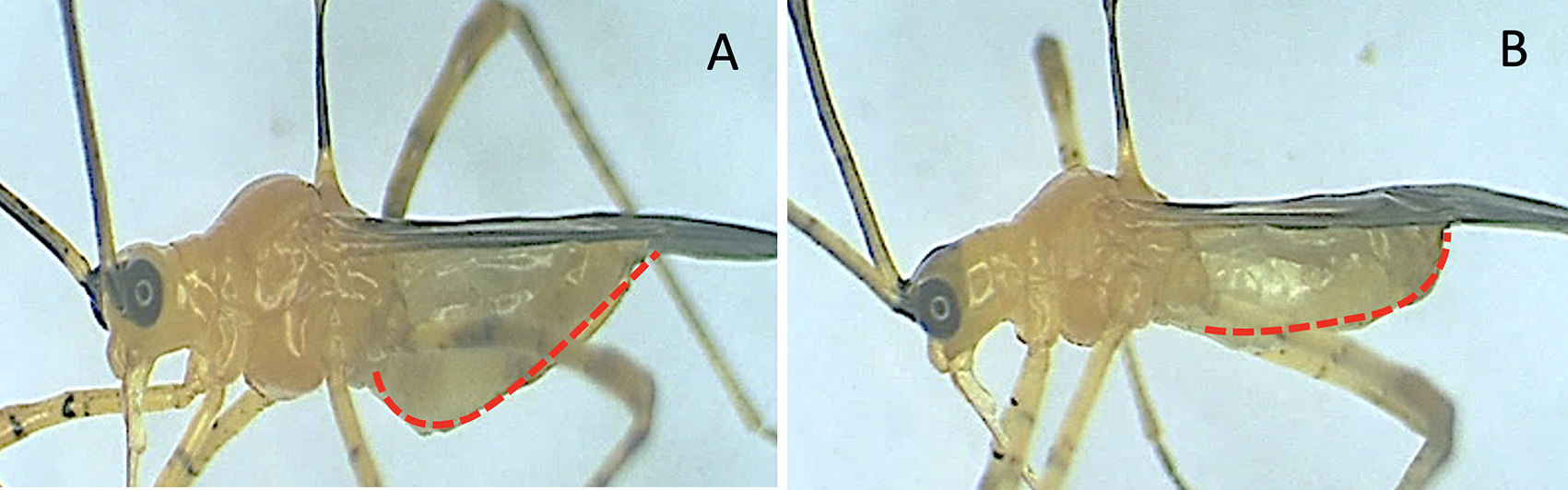
To assess the period of sexual maturation, fifth instar nymphs of H. bakeri were placed individually in clear plastic vials and provided with fresh shoots of I. batatas daily. Each container was labelled with the date the nymph molted into its adult winged form. This species displays sexual dimorphism, observed as early as after its final molt from the fifth nymphal stage. In females, the abdomen and last sclerite are larger and tapered at the caudal end, while males have smaller and more lobular sclerites (fig. 1). The time for each of the sexes to complete their coloration was observed and averaged.
Sexes of newly molted Helopeltis bakeri poppius (<24 h) from final (5th) nymphal stage are indistinguishable based on their size and the shape of the (A) female and (B) male insects’ abdomen (outlined in red dashed lines).

The study of copulation behaviour was based on the ages of mature and immature insects. Each mature virgin pair (npair = 15) was placed in a clear plastic arena (D: 6.0 cm; H: 3.5 cm) which was lined at the bottom with clean filter paper. The mating behaviour of each pair was observed for 30 min. If mating did not occur within this time frame, the pair was replaced with another virgin pair. In the control setups, the same procedure was observed in immature females and mature males (npair = 15). All components of the copulation arena were replaced after every mating pair. The mating behaviour was recorded using a Sony Handycam (HDR-PJ720), and video outputs were used in the behaviour sequential analyses of male and female insects. Only the virgin pairs that copulated were subjected to sequential behaviour analysis. The duration of copulation for the successful mating pairs was also recorded.
Frequency of male attraction
The attraction of H. bakeri to females was studied using a wind tunnel designed by Tavera et al. (Reference Tavera, Dela Cruz, Santos, Amalin and Janairo2023). The tunnel was divided into two sections: an upwind section and a downwind section (see Supplementary Figure 1). It was constructed using polyethylene sheets and PVC pipes and maintained an airflow speed between 25 and 35 cm/s. Delta traps made from clear acetate sheets (see Supplementary Figure 2) were placed in the upwind section. Each trap consisted of two parts: one section contained a female insect, while the other was lined with glue trap paper. Cotton balls soaked in a 10% honey-water solution were placed in the section with the female to provide food. This choice was made to avoid attracting males with scents from host plants. The traps were positioned at the end of the upwind section and hung 30 cm above the tunnel floor. The tunnel was kept in a room maintained at 25-30°C with 55% relative humidity.
Five experimental setups were utilised, each differentiated by the time elapsed since the completion of final molting (24 h, 48 h, 72 h, 96 h, and 120 h) for both male and female subjects. In each setup, the upwind partition of the six traps contained two virgin females. Thirty virgin males, of the same age as the virgin females, were placed on the downwind side of the tunnel. To provide food for the males, cotton soaked in a 10% honey-water solution was placed in the downwind section of the wind tunnel. Each setup was observed for 24 h under a simulated 12:12 h light-dark cycle, and the number of males inside the trap was recorded every hour.
Sequential analysis of behaviour
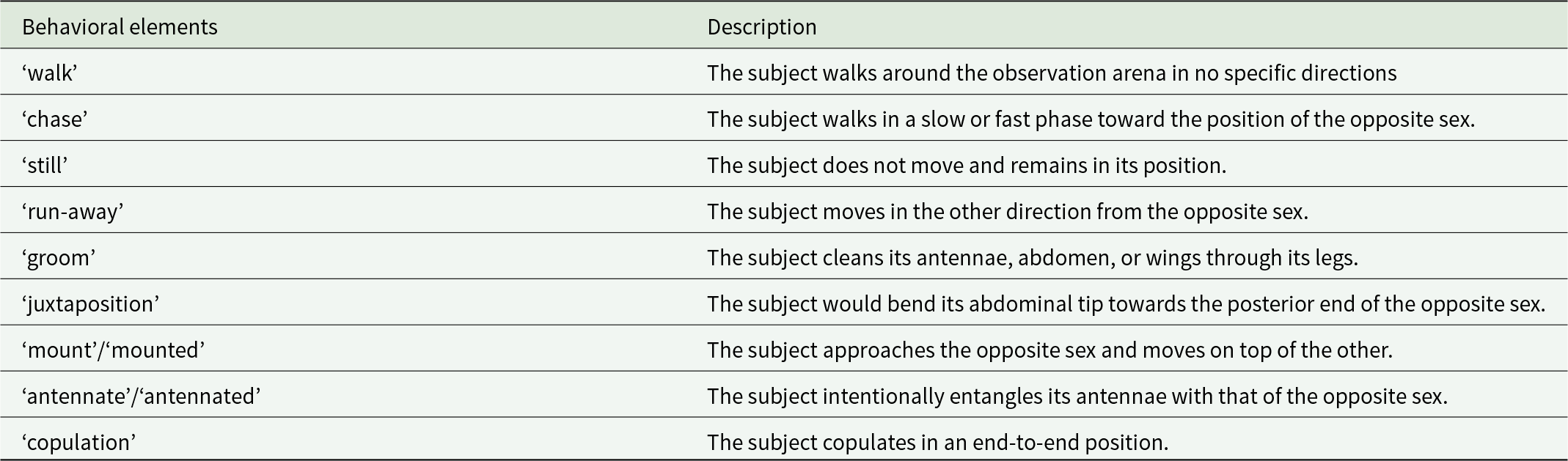
We used the Behavioral Observation Research Interactive Software v. 7.4 (Friard and Gamba, Reference Friard and Gamba2016) to transcribe the copulation behaviour from the recorded videos based on behaviour-specific elements (table 1). Our ethogram included nine behaviours observed in male and female H. bakeri, which were based on copulation behaviour studies of Lygocoris pabulinus (L.) (Groot et al., Reference Groot, Wal, Schuurman, Visser, Blommers and Beek1998) and Stenotus rubrovittatus (Okutani-Akamatsu et al., Reference Okutani-Akamatsu, Watanabe and Azuma2009). The copulation behaviours were then summarised into adjacency matrices using the igraph network analysis package in R following Green and Patek (Reference Green and Patek2018). The electronic supplementary materials provide the R code for executing the sequential analysis technique (Supplementary Materials 4,5). The igraph network analysis package summarised the behavioural sequence data into adjacency matrices for the male and female insects. Each row and column in the adjacency matrix represented one of the eight copulation behavioural elements. It summarised all the intra-individual behavioural transitions that occurred in the contests (npair = 15).
Close-range copulation behavioural elements of Helopeltis bakeri Poppius

The transition rate for each behavioural change was calculated using the ratio of preceding behaviour to subsequent behaviour. Green and Patek (Reference Green and Patek2018) developed a permutation procedure in R to assess whether a specific behavioural transition occurred more frequently than would be expected by chance. This method involved fixing the first column (preceding behaviour), maintaining the relative frequency of behaviours, and randomly sampling the second column (subsequent behaviour) (see Supplementary Materials 6 and 7). Through this permutation process, behavioural transitions between different behaviours were randomised. The procedure was repeated 10,000 times to create a null distribution of random transitions. A significant transition was determined when the observed transition frequency exceeded the 95% quantile of the null distribution of random transitions. The significant behavioural transitions from the contests were then visualised as network graphs using the igraph package.
The converted matrices that show significant transitions into graph objects were visualised as networks. In these networks, individual behaviours are represented as vertices (circles), while the edges (arrows) indicate statistically significant transitions between these behaviours. The sizes of the vertices are grouped into five categories based on the scaled degree, which indicates the percentage of total reproductive behaviour represented by a single behavioural element. Similarly, the sizes of the edges are grouped into five categories based on transitional probability, calculated as the number of times a transition occurs from one behaviour to another divided by the total number of transitions from that behaviour to all other behaviours. Higher values indicate more likely transitions.
Statistical analysis
All statistical analyses were conducted using R (Version 2023.03.1 + 446). An independent t-test from the tidyverse package was employed to assess the differences in the hours taken by male and female subjects to complete their coloration, indicating reproductive maturity. The Kruskal-Wallis test from the MultNonParamTest package was utilised to evaluate differences in the frequency of male visitations to females of varying ages (measured in hours from the date of the final molt). Significant means were further analysed using Dunn’s Test from the dunn.test package. Prior to statistical analysis, all data were tested for normality using the Shapiro-Wilk Test implemented through the dplyr and car packages.
Results
Sexual maturation period
Table 2 shows the sexual maturation duration of male and female H. bakeri. Independent t-tests showed that the number of hours of colour completion from the final molting of both sexes was not significantly different (p > 0.05). Furthermore, both sexes exhibited maturity at an average of ∼75 h or ∼3 days. A complete colour change was observed in both the dorsal and ventral regions, with the sternum changing colour later than the pronotum. In male specimens, the black coloration of the sternum and pronotum indicates maturity. This information was utilised to assess the age of mating pairs observed during close-range pre-copulation behaviour.
Sexual maturation duration of Helopeltis bakeri Poppius reared on Ipomoea batatas (L.) Poir. Shoots in the laboratory at 27 ± 1°C and L12:D12

* Means followed by the same letter did not differ significantly by independent t-test (p < 0.05).
Copulation behaviour sequence analysis
Laboratory copulation observations conducted from 7:00 AM to 6:00 PM revealed that mating pairs that are both >72 h old, exhibited copulation. This confirms the assumption that the sexual maturation of this species can be determined through the identification of the time it will complete its coloration. This indicates that both sexes must be fully developed and coloration definitive for copulation to proceed.
A total of 12 successful matings were subjected to behaviour analyses. Under the current experimental conditions, no calling behaviour was observed. The duration of male pre-copulation behaviour was specifically described, as it is the initial phase that leads to copulation. During a 30-min observation period, the following neutral behaviours were recorded: ‘walking’ with an average duration of 1.1 ± 1.3 min, ‘grooming’ lasting 2.0 ± 2.3 min, and ‘stillness’ at 2.74 ± 4.5 min, which were the longest lasting behaviours. Copulation-related behaviours included ‘chase’ at 0.6 ± 0.7 min, ‘antennate’ at 0.10 ± 0.1 min, ‘mount’ at 1.6 ± 2.7 min, and ‘juxtaposition’ at 1.0 ± 2.6 min. In total, the pre-copulation behaviour lasted an average of 9.1 ± 14.3 min. The copulation times for successful mating pairs were subsequently recorded, lasting an average of 167.0 ± 77.1 min.
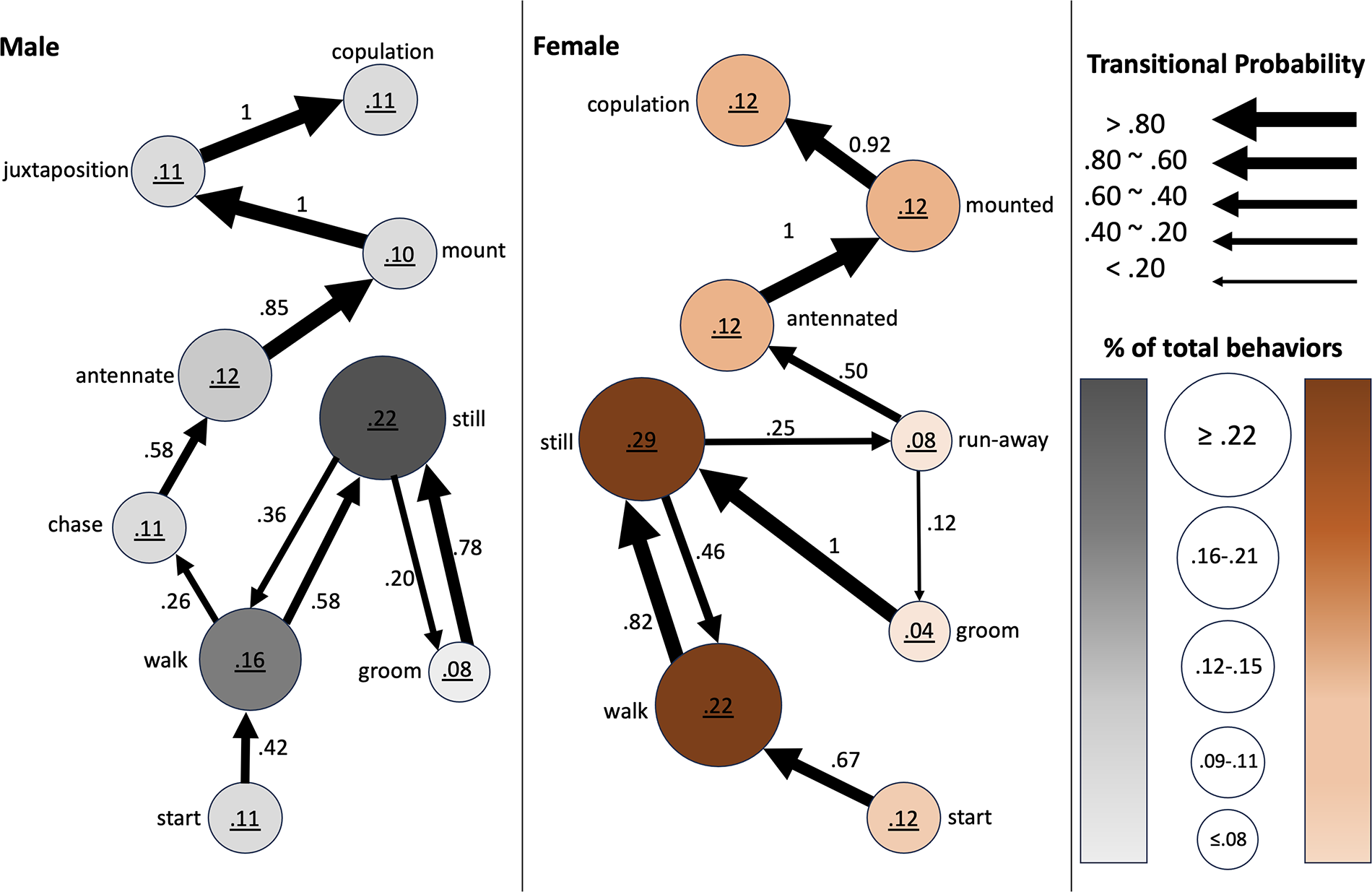
The results of the permuted adjacency matrices for the male (Table S1) and female (Table S2) mating pairs were simplified to include only the behaviours that occurred more frequently than expected. The transition data were then plotted using the igraph package and presented as graph objects (fig. 2).
Sequential analyses of pre-copulation behaviours of male and female Helopeltis bakeri Poppius in the laboratory at 27°C and L12:D12. Circles represent behavioural elements; circle size and colour are scaled to the percentage of total contest behaviours. Arrows represent significant behavioural transitions; non-significant behavioural transitions are not shown; arrow width is scaled to the transitional probability of the behaviours.

Fig. 2 illustrates the copulation behaviour, which followed a variable sequence of actions, categorised by sex. The male’s pre-copulation behaviour began with ‘walking,’ which occurred 42% of the time (indicating the transitional probability from ‘start’ to ‘walk’). After walking, the male would either remain ‘still’ (58%) or ‘chase’ (26%). When the male was ‘still,’ he could either revert to ‘walking’ (36%), engage in ‘grooming’ (20%) or remain ‘still’ again (78%). When the male chose to ‘chase,’ he would then move to ‘antennate’ (58%), followed by ‘mounting’ (85%). During the ‘mount’ behaviour, the male’s rostrum probes the back of the female, which leads to ‘juxtaposition’ (100%) and ultimately results in ‘copulation’ (100%), characterised by an end-to-end position.
The female’s pre-copulation behaviour began with a ‘walk’ (67%) around the observation arena. Following the ‘walk,’ the female would often be ‘still’ (82%) and might either return to ‘walk’ (82%) or proceed to ‘run away’ (25%). From this point, the female could either ‘groom’ (12%) and then become ‘still’ (100%), or she might be caught by the male, leading to ‘antennation’ (50%). This antennation behaviour always preceded ‘mounting’ (100%), which then led to ‘copulation’ (92%).
The courtship behaviour can be summarised into four phases: arousal, mounting, copulation, and termination of copulation.
Arousal
In the presence of light, sex identification primarily occurred through visual stimuli. Typically, the male was observed grooming, walking, or remaining still in the copulation arena. Meanwhile, both the male and female moved their antennae, which may indicate that they were sensing or gathering information from their environment.
When the female approached the male, he became tense and actively pursued her. A receptive female generally exhibited passive behaviour, whereas a non-receptive female fled or attempted to distance herself by bending her abdomen away from the male. After several attempts, the male successfully positioned himself behind the female.
At times, the male intentionally entangled his antennae with those of the female, limiting her mobility and prompting her to allow him to mount. This courtship phase was brief and did not involve complex behaviours.
Mounting
The male would immediately mount the female by approaching from behind. It was observed that the male’s rostrum was raised, lightly stroking the side or the dorsal part of the female’s thoracic shield. At the same time, the male bent its abdominal tip towards the posterior end of the female, moving it ventrolaterally due to the laterally twisted structure of its copulatory organ’s circular disc. The aedeagus, which is the male’s copulatory organ, was seen to be erect as the male moved its abdomen side to side until it achieved insertion into the female’s genital chamber.
Copulation
Once the male’s aedeagus entered the female’s genital chamber, the male twisted around, and copulation occurred in an end-to-end position. The male curled his abdomen beneath the female’s abdomen, allowing their genitalia to connect at the base of the female’s ovipositor. He inserted his ejaculatory organ into the female’s genital opening and attached himself to her two parameres. During mating, the pairs did not feed and showed limited movement unless disturbed.
Termination of copulation
The separation of the mating pair occurred suddenly, and they struggled for a few seconds before fully detaching. Afterwards, both individuals moved away and began to feed immediately. Some were observed grooming their antennae, appendages, and genitalia. While no experiments were conducted to explore the possibility of multiple mating partners, it was noted that females tended to mate multiple times.
Under the current experimental conditions, the close-range pre-copulation behaviour of H. bakeri did not show any distinct calling behaviour from either the male or female. However, it was noted that in all reproductively mature mating pairs, the male actively pursued the female prior to copulation.
Frequency of male attraction
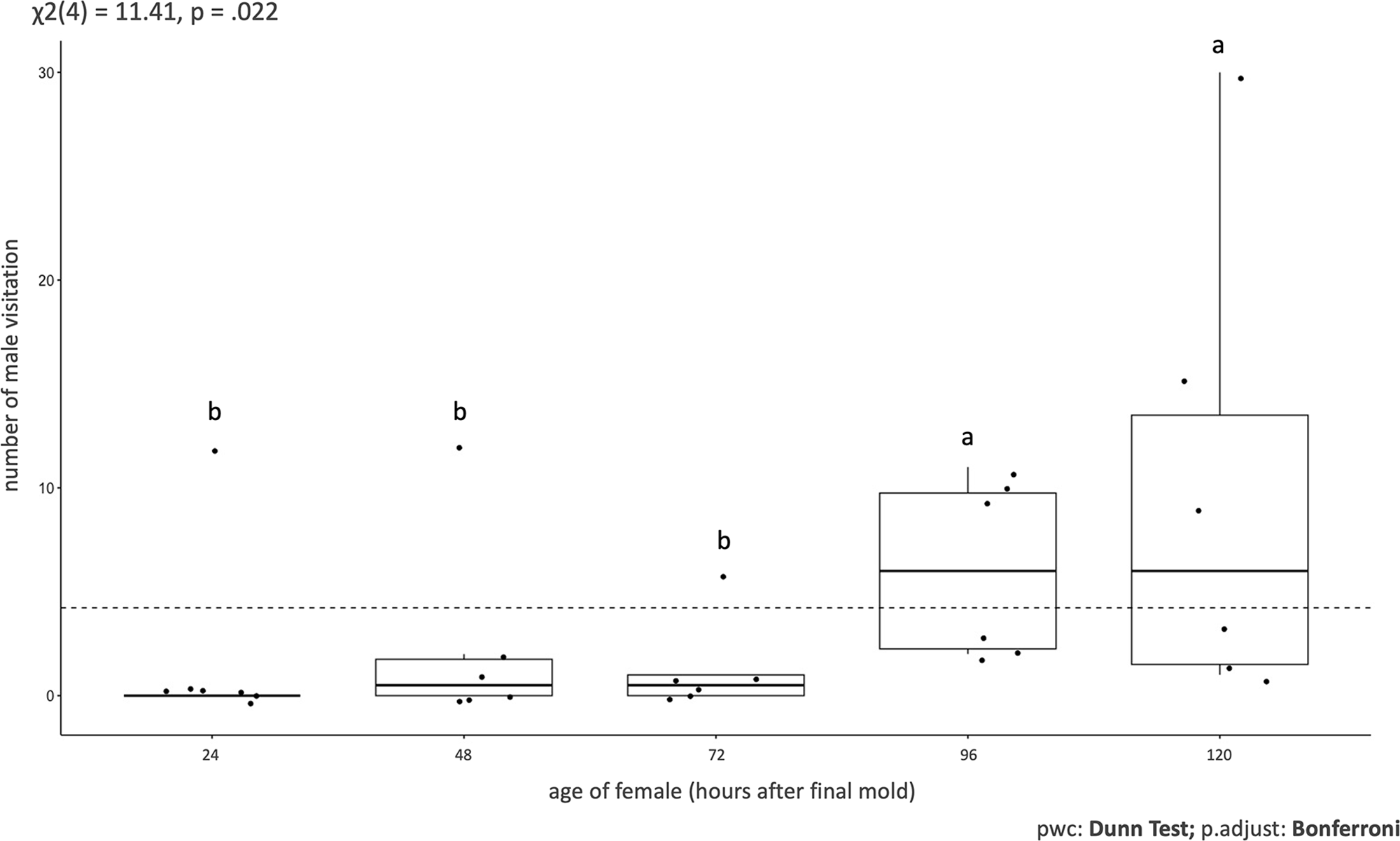
The Kruskal-Wallis test revealed a significant difference in the frequency of male attraction among females of different ages (H = 11.409, df = 4, p = 0.022). Dunn’s test showed that 120 and 96 h had the highest number of visitations relative to other age groups. However, those two ages did not differ from each other (see fig. 3 and Table S3).
Male visitation frequency across different ages (hours after final molt) of female H. bakeri in the laboratory at 27°C and L12:D12. Black dots represent raw data. Ages followed by the same letter did not differ significantly by post hoc Dunn test (p < 0.05).

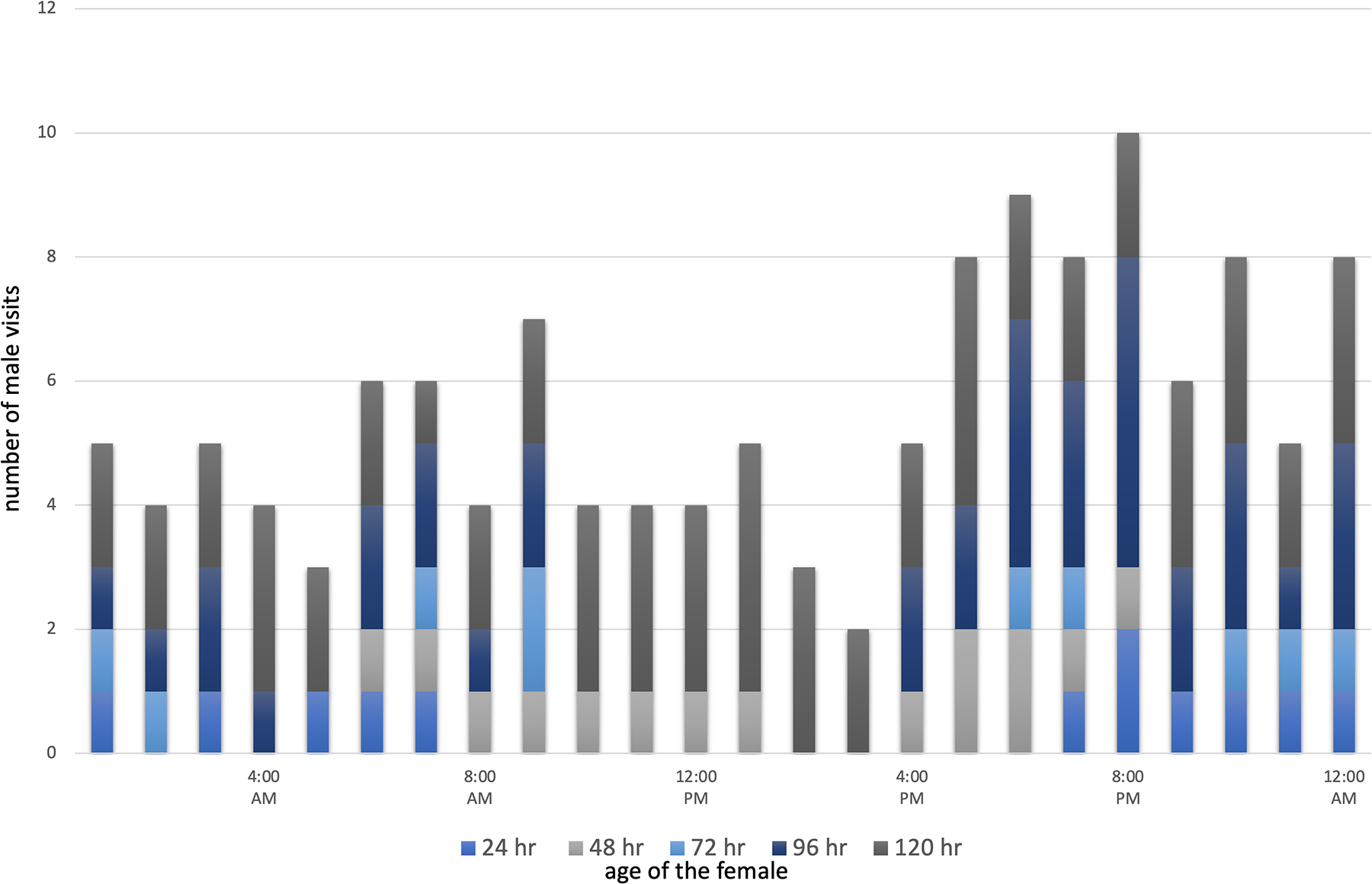
Fig. 4 shows the number of male visitations per hour over a 24-h period for different age groups of females. The 120-h age group attracted the most male visitations throughout the day, with peak visitation occurring at 9:00 PM. This was followed by the 96-h age group, which also received considerable attention. The number of male visitations to 96-h to 120-h-old females peaked between 2:00 PM and 12:00 AM and then declined in the following hours. In contrast, 24-h and 48-h-old females received the fewest male visitations, followed by the 72-h-old females.
Hourly count in 24 h of the number of male H. bakeri attracted to different aged females. The ages of the females are indicated by the number of hours after the date of final molting from the fifth instar stage.

Discussion
H. bakeri displayed sexual dimorphism shortly after completing its final molt from the nymphal stage, as indicated by the differing shapes of their abdomens (fig. 1). On the other hand, sexual maturation only occurs after the organism completes its development, which is marked by the finalisation of its colour. Sexual maturation is essential for copulation, as this is when the reproductive structures of male and female insects fully develop (Kitsunezuka et al., Reference Kitsunezuka, Okutani-Akamatsu, Watanabe and Oku2013). Both males and females reach maturity approximately 75 h after their final molt. Reproductive reciprocity has also been observed in several species of mirid bugs (Dwomoh et al., Reference Dwomoh, Afun and Ackonor2008; Smith, Reference Smith1977; Sundararaju et al., Reference Sundararaju, Bakthavatsalam, John and Vidyasagar1994; Ugine, Reference Ugine2012). This is crucial, as the onset of sexual maturity coincides with the release of sex pheromones, the appearance of mature eggs, and the age at which mating first occurs (Boivin and Stewart, Reference Boivin and Stewart1982; Smith, Reference Smith1977).
Pheromone release is believed to be highest during the hours when males are attracted to delta traps containing virgin females. Males entering the delta trap area with females of the same age were recorded over a 24-h period. The wind tunnel tests showed that males were mainly attracted to females aged 96 and 120 h (fig. 3), with peak visits occurring between 2:00 PM and 12:00 AM. Organisms that are active during dawn and dusk are known as crepuscular species. Since sex pheromones stimulate male searching behaviour, their maximum secretion is assumed to occur during this period. Species may evolve to exhibit crepuscular behaviour as predators often adapt their activity patterns to coincide with the times when their prey is most available. In contrast, the prey learns to avoid these peak periods. Additionally, pheromone release may be triggered by changes in humidity or light intensity (Smith, Reference Smith1977). A recent study utilised the crepuscular nature of H. bakeri to understand the role of β-caryophyllene as a kairomone as bioassays were conducted from 6:00 PM to 7:00 PM (Tavera et al., Reference Tavera, Dela Cruz, Santos, Amalin and Janairo2023).
Based on the H. bakeri behaviours recorded between 7:00 AM and 6:00 PM, a total of 12 copulations were observed from mating pairs that were 72-120 h old (from final molting). No copulation was observed in the immature and mature mating pairs.
We identified nine behavioural elements in the copulation of H. bakeri. The courtship behaviour of the male can be summarised into four phases: arousal, mounting, copulation, and termination of copulation (table 1). Under the current experimental conditions, neither the male nor the female displayed calling behaviour. Therefore, visual and acoustic stimuli may have a different role in later stages of communication (Borges et al., Reference Borges, Jepson and Howse1987). A close-range sex pheromone may be involved in this copulation stage. Close-range sex pheromones are often less volatile than long-range ones (Blomquist et al., Reference Blomquist, Tillman-Wall, Guo, Quilici, Gu and Schal1993; Drijfhout and Groot, Reference Drijfhout and Groot2001). This low volatility significantly influences the insect’s choice of landing and settling areas (Carlson et al., Reference Carlson, Mayer, Silhacek, James, Beroza and Bierl1971). Without these pheromones, incoming males might not proceed to copulate or enter traps used for pest monitoring and control (Cardẽ et al., Reference Cardẽ, Baker and Roelofs1975; Kennedy, Reference Kennedy, Shorey and McKelvey1977). The female H. bakeri engages in grooming behaviour before copulation, which involves rubbing its legs against its antennae, wings, and abdomen. Although these areas are unlikely to be where the sex pheromone gland is located, grooming helps to transfer sex pheromones across various parts of the female’s body, improving the chemical dispersion (Drijfhout and Groot, Reference Drijfhout and Groot2001). Female Lygocoris pabulinus (L.) were observed to produce cuticular volatile extracts from their legs that elicit a strong response in males, which is characterised by specific courtship behaviours (Groot et al., Reference Groot, Wal, Schuurman, Visser, Blommers and Beek1998).
The role of antennae in detecting chemical stimuli from the environment has been observed prior to copulation, particularly among the male H. bakeri. The receiver’s antenna is equipped with odorant binding proteins (OBPs), which serve as ‘molecular carriers’ that solubilise and transport odorants to the olfactory receptors located in the olfactory neuronal membrane. Some OBPs in the antennae are responsible for the perception of sex pheromones and are called pheromone-binding proteins (Yuan et al., Reference Yuan, Ding, Gu, Sun, Zhu and Liu2015). Its destruction would interrupt the receiver’s response to the signaller (Dong et al., Reference Dong, Sun, Liu, Gu, Zhou, Yang, Dhiloo, Gao, Guo and Zhang2017, as cited by Sun et al., Reference Sun, Wang, Wang, Dong, Xiao and Zhang2017). This was considered in copulation pairs, as broken antennae could have influenced the species’ observed behavioural traits.
Conclusion
This study is the first record of the reproductive behaviour of H. bakeri under lab conditions. We did not observe any calling behaviour under the current experimental conditions. However, it is possible that such behaviours may be identified in future research conducted under different circumstances. Nonetheless, the information obtained from this study is valuable for understanding reproductive behaviour and serves as a foundation for identifying, extracting, and formulating pheromone traps that could be utilised in managing this insect pest. Understanding the oviposition behaviour and site preference of Ipomoea batatas as a rearing medium for this species will enhance current lab protocols for its mass production. Future studies should focus on using the parameters established in this research to identify the sex attractant of the species in a laboratory setting. This study provides a foundation for further exploration, and it is crucial to understand how various field factors may influence the behaviour of the insect being studied. Additionally, this understanding will help validate potential sex attractants identified through laboratory bioassays. Therefore, it is important also to test the effectiveness of any discovered attractants in field conditions.
Supplementary material
The supplementary material for this article can be found at https://doi.org/10.1017/S0007485325000185.
Acknowledgements
Technical assistance was provided by the Biological Control Research Unit personnel, De La Salle University – Science and Technology Complex, Biñan, Laguna, Philippines. This research was funded by the Philippine Council for Agriculture, Aquatic and Natural Resources Research and Development (PCAARRD) – Department of Science and Technology (DOST) under the Cacao Pest Management Program (Biological-based Approaches).
Competing interests
The authors are not involved in organisations with financial or non-financial interest in the topic discussed in this manuscript.