The worldwide spread of economic and political liberalism was the defining feature of the late twentieth century. Free-market-oriented economic reforms—macroeconomic stabilization, liberalization of foreign economic policies, privatization, and deregulation—took root in many parts of the world. At more or less the same time, a “third wave” of democratization and liberal constitutionalism washed over much of the globe. Most economists believe the gains to developing countries from the liberalization of economic policies to be in the hundreds of billions of dollars. But they also acknowledge the instability and human insecurity sometimes left in liberalization's wake.1
Political scientists argue that the rise of democracy has contributed to the betterment of both human rights and international security.2Doyle 1986.
Some commentators focus on the exercise of American power. According to this line of argument, the hegemonic United States—often acting through the Bretton Woods international economic institutions it helped create after World War II—has used a combination of carrots (political and military support, as well as preferential access to U.S. markets) and sticks (from strings attached to financial assistance to threats of military coercion) to impose its vision for political and economic liberalism on the rest of the world. Others see the decentralized process of technologically induced globalization at work. Sharp declines in the ability of governments to control cross-border movements of goods, services, and capital are thought to have forced countries to compete with each other for investment and market share by enacting political and economic reforms that reduce governmental constraints on finance and firms. Still another line of argument focuses more on the emergence of influential ideologies, from monetarism to glasnost, which may have little to do with political power or market dynamics.
This symposium puts these processes under the analytic microscope. We are interested primarily in how a given country's policy choices are affected by the prior choices of other countries, sometimes mediated by international organizations and private transnational actors. There is considerable variation in the spread of liberal policies across time and space, which the contributors to this symposium exploit to explore the processes underpinning liberalization. Our principal objective is to shed light on the causal mechanisms that explain the timing and geographic reach of liberal innovations. What has caused these new policies to diffuse across time and space?
The contending approaches to liberalization we outline share the assumption that national policy choices are interdependent—that governments adopt new policies not in isolation but in response to what their counterparts in other countries are doing. In this introduction, we review four distinct mechanisms through which interdependent decision making may take place—coercion, competition, learning, and emulation. We begin by describing the patterns of liberalization that we seek to explain. We then move on to distinguish interdependent decision making by national governments from the null hypothesis of independent decision making, which has been for decades the workhorse approach in comparative and international political economy. We then elaborate the four classes of diffusion hypotheses found in the literature, which are subsequently tested alongside one another and developed in the other articles in this symposium. We end by previewing the findings of the coming articles.
The Spread of Economic and Political Liberalism
We define liberalism conventionally. Economic liberalism, in the classic rather than the American sense, refers to policies that reduce government constraints on economic behavior and thereby promote economic exchange: “marketization.” Political liberalism refers to policies that reduce government constraints on political behavior, promote free political exchange, and establish rights to political participation: “democratization.”
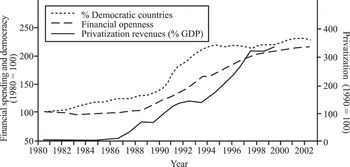
There is no doubt that both forces have been powerful facets of the global political economy in recent decades. Figure 1 documents this trend on three key indicators of liberalization in the 1980s and 1990s. The privatization of state-owned enterprises went from an iconoclastic policy idea in Margaret Thatcher's 1979 British election manifesto to a major element of economic policy in both developed and developing countries over the course of twenty years.3
Brune et al. 2004.
Simmons and Elkins 2004.

Political and economic liberalization around the world
But the scope of liberalization was not limited to economic policy. Perhaps the headline political statistic of the late twentieth century was that the proportion of democratic countries in the world more than doubled between 1980 and 2000, from under 30 percent to almost 60 percent (while the number of sovereign states in the world also doubled to roughly 200).5
Przeworski et al. 2000.
Moreover, all three curves in Figure 1 follow the classic S-shaped logistic curve associated with the diffusion of innovation, beginning with hesitant early moves to liberalize in only a few countries, followed by a rapid escalation in the trend, and finally a leveling off. In less than a generation, a new equilibrium level of liberalism appears to have been established in each realm.
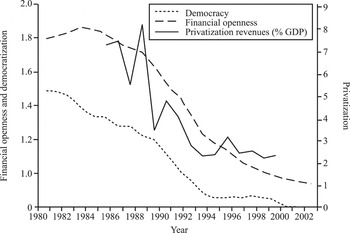
Figure 2 demonstrates that in addition to this broad trend toward political and economic liberalism, there was considerable convergence in national trajectories.6
For recent reviews of the “convergence” literature, see Heichel, Pape, and Sommerer 2005; and Knill 2005.

Variations in liberalization around the world (SD/mean)
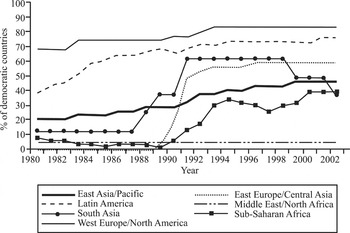
It is important to note, however, that these broad global trends toward liberalism belie substantial variations in the paths pursued by countries in different parts of the world. Figures 3 to 5 break down the global averages presented in Figure 1 by geographic region. As students of democracy know well, there have been three waves of democratization in recent decades (see Figure 3). Latin American countries began to democratize in the 1970s, to the point where today the region is almost as democratic as North America and Western Europe. The same kind of pattern, though less pronounced, was apparent in East Asia and the Pacific. A second wave of democratization centered around the fall of the Berlin Wall and the subsequent velvet revolutions in the former Soviet bloc between 1989 and 1991—but it should also be noted that the pace and extent of democratization was almost as great, and began just a few years earlier, in South Asia. The number of democracies in Sub-Saharan Africa also began to increase in 1989, though that region still lags behind Eastern Europe and Central Asia. The Middle East and North Africa saw no significant democratization in the 1980s and 1990s.

Regional variations in democracy
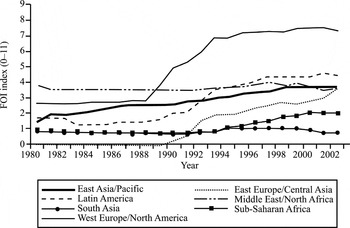
Figure 4 presents data on the openness of national economies to international financial flows with respect to foreign direct investment (FDI); the buying and selling of stocks, bonds and currencies across national borders; and international bank lending. The most dramatic feature of this figure is the rapid march among the countries of North America and Western Europe toward complete financial openness. The same general trend, though muted, applies in Central Europe, East Asia, and Latin America. There were small moves toward capital mobility in Sub-Saharan Africa, but only in the mid- and late 1990s. Financial policy remained relatively closed in the Middle East and in South Asia in the 1980s and 1990s.

Regional variations in financial openness
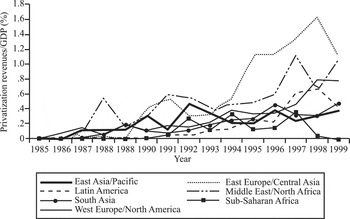
Finally, Figure 5 presents data on regional variations in privatization. Given that the data are measured in terms of the prices at which state-owned assets were sold (relative to gross domestic product [GDP]), it is not surprising that these curves are less smooth. Nonetheless, it is clear that privatization took off earlier and was more pronounced in Eastern Europe and Central Asia, Latin America and North America, and Western Europe than elsewhere. The radical and thoroughgoing nature of the velvet revolutions in the former Soviet countries is readily apparent in the case of privatization, no doubt in large measure because these countries had the most state-owned assets to sell in the 1990s.

Regional variations in privatization
Figures 3 to 5 demonstrate that despite the global trend toward liberalism, there were important differences in the trajectories of different parts of the world—differences across regions, over time, and among different dimensions of liberalization. The Middle East and North Africa did not liberalize much, if any, in the 1980s and 1990s. Latin America democratized and marketized gradually over the whole period, whereas the shift from state socialism to capitalist democracy was much more abrupt in Eastern Europe.
What kinds of dynamics produced these “regional effects”? Growing literatures in political science and sociology point to different explanations for such policy clustering, which we dub “diffusion.” We now define diffusion and distinguish it from alternative causal forces.
Policy Diffusion—and Its Alternatives
International policy diffusion occurs when government policy decisions in a given country are systematically conditioned by prior policy choices made in other countries (sometimes mediated by the behavior of international organizations or even private actors or organizations). Theories of diffusion have pointed to diverse mechanisms ranging from Bayesian learning to rational competition through hegemonic domination to unthinking emulation of leaders. Theories of diffusion encompass a wide array of assumptions about who the primary actors are, what motivates their behavior, the nature and extent of the information on which they base decisions, and their ultimate goals.
But what theorists of diffusion explicitly reject is the notion that processes of policy change can adequately be understood by conceiving of national governments as making decisions independently of each other. Policy independence is thus the null hypothesis that motivates our project.7
Compare, for example, Lenschow, Liefferink, and Veenman 2005.
Przeworski et al. 2000.
Collier 1999.
Linz and Stepan 1996.
O'Donnell, Schmitter, and Whitehead 1986.
A small literature has developed that takes seriously the international diffusion of democracy,12
but little has been done to date to fashion an integrated model or to test competing hypotheses. The political economy literature, perhaps more surprisingly, is also dominated by research that assumes independent policy choice. Political economists have analyzed restrictions on cross-border capital flows as tools of economic repression13Giovannini and De Melo 1993.
Clark 2002.
Keefer and Stasavage 2002.
Hallerberg 2002.
Bernhard and Leblang 2002.
Broz 2002.
In the past twenty years, an important strand of research in political economy has linked domestic policy choice with constraints, pressures, and opportunities generated by the international economy. Gourevitch studied the impact of position in the international economy on domestic responses to economic crisis.20
Gourevitch 1986.
Rogowski 1989.
Frieden 1991.
Keohane and Milner 1996.
Frieden and Rogowski posited the simplest possible argument to explain economic liberalization in recent decades. They contend that “exogenous easing,” such as declining transport and communication costs, has greatly increased the opportunity costs of closure.24
Frieden and Rogowski 1996.
Garrett and Lange 1995.
Our intention is not to deny that relative prices and other factors exogenous to the decision-making environment in any one country affect policy choice. But from our perspective, the critical analytic point is that exogenous shocks—such as changing world prices—are a commonly experienced phenomenon to which governments must decide how to respond. Their responses are no doubt influenced in a “bottom-up” fashion by conditions and institutions within their countries.26
See, for example, Gilardi's study of the diffusion of independent regulatory agencies (2005).
Mechanisms of Global Diffusion
Interdependent decision making has long informed the study of international relations and international political economy. There is an affinity between the recent game theory revolution in the social sciences and international policy diffusion.27
Lake and Powell 1999.
Elkins and Simmons 2005.
Malinowski 1944, iii., 17.
Thomas et al. 1987.
Kaminsky and Reinhart 2000.
But which of these processes is the most important, and under what circumstances does each operate? How can we distinguish among them, both theoretically and empirically? Next we sketch four discrete diffusion mechanisms that are amenable to rigorous empirical testing.
Coercion
One prominent explanation for the spread of economic and political liberalism involves a distinctly antiliberal mechanism: coercion. Powerful countries can explicitly or implicitly influence the probability that weaker nations adopt the policy they prefer by manipulating the opportunities and constraints encountered by target countries, either directly or through the international and nongovernmental organizations (NGOs) they influence. Whether direct or mediated, this mechanism may involve the threat or use of physical force, the manipulation of economic costs and benefits, and/or even the monopolization of information or expertise—all with the aim of influencing policy change in other countries. Coercive diffusion involves power asymmetries that the strong exploit to impose their policy preferences on weaker countries.34
Essentially hierarchical in nature, coercion is a form of “vertical diffusion” discussed in much of the literature on federalism and European regionalism. See, for example, Daley and Garand 2005; and Gilardi 2005.
Coercion theorists begin by assuming that a powerful nation has an intentional motive to stimulate policy change in another country or countries. Most also assume that weaker countries would prefer to resist were it not for the foreign influence.35
This is not always easy to establish empirically, even in cases where it is broadly assumed that governments are being coerced. Vreeland 2003, for example, argues that governments often accept IMF loans because they want conditions externally imposed on them, rather than the other way around. See Drazen 2002, for a similar argument.
There are many variations on this basic theme. Dominant countries may exercise power bilaterally36
The United States, for example, is putting significant bilateral pressures for policy liberalization on the would-be members of the Central American Free Trade Agreement; see Financial Times, 17 December 2003, The Americas, 2. On the Mexico-European Union Political and Economic Association Agreement of December 1997, which ultimately led to a free-trade agreement in March 2000, see Sanahuja 2000. The European Commission and the United States have demanded privatization in developing countries in exchange for further agricultural liberalization. See “A privatisers' hit list: European commission demands to deregulate services spell disaster for the developing world,” The Guardian (London), 18 April 2002.
The IMF and the World Bank, along with various US government agencies, are seen as exemplars of coercive liberalization, through various forms of conditional lending and other assistance. On the “Washington consensus”, see Williamson 1993.
Various forms of “soft” coercion may be common in the diffusion of policy liberalization. The policies of powerful governments often constitute focal points in policy coordination games with multiple equilibria.40
See, generally, Schelling 1960. Garrett and Weingast 1993 demonstrate the importance of Germany as a focal point in the European Union.
Simmons 2001.
Gruber 2000 provides the example of Mexican liberalization in the wake of the US-Canada Free Trade Area.
Softer still, powerful countries may be closely aligned with theories, information, or ideas that favor particular policy moves, such as liberalization. With a sort of Gramscian ideological hegemony, dominant actors can influence others through ideational channels without exerting physical power or materially altering costs or benefits. By virtue of their central positions in policy networks, more powerful countries may be influential in the framing of policy discussions.43
Hira 1998. Practically every international financial institution—from the Bank for International Settlements to the International Monetary Fund to the various regional institutions—has a research department engaged in the dissemination of economic models favored by economists in wealthy, core countries. See de Vries 1997; and Polak 1997.
How can one demonstrate that coercion (in its harder and softer manifestations) actually explains policy change? In order to make the case, one must identify the coercive actors, show that these actors support the policy in question, and demonstrate the channel through which the powerful influence policy change across borders. If the International Monetary Fund (IMF) is the hypothesized source of influence (acting as a de facto agent of the leading nations that influence the organization), empirical tests should demonstrate that the IMF favored the policy in question and that countries adopting the policy were particularly dependent on IMF largesse. Similarly, studies linking policy diffusion to soft coercion should show that the policy ideas actively promoted by strong countries are more likely to be put into practice in weaker countries structurally or situationally dependent on them.
Competition
Competition is a more decentralized mechanism for policy diffusion than coercion. Theorists of competition-based diffusion stress the differential attractiveness of certain policies to investors and buyers in international markets. Competition arguments are typically applied to economic policies, though there is some evidence that investors and even buyers in the global marketplace have preferences for certain political systems, sometimes for liberal democracy and sometimes for benevolent authoritarianism.44
Students of competitive diffusion elaborate the policy moves through which governments compete with each other for internationally mobile capital and export-market share. Simplifying regulatory requirements, ameliorating investment risks, and reducing tax burdens are often viewed as policy choices that can, quite quickly, make an investment locale more attractive, exports more competitive, and an economy more vital. The mechanisms underlying competitive diffusion are broadly the same for theorists who see competition as a positive force promoting efficient policy tools and those who see competition producing a “race to the bottom” as countries slash taxes, social spending, and environmental and labor regulations to win over investors and export markets.Competitive theories of the diffusion of liberalization must stipulate why competition among countries, and not just “efficiency” within them, drives the spread of a particular policy. After all, economic efficiency is likely to be an important element in the decision calculus of governments. The question is: how and why might competition among countries elicit a particular policy change? The conventional wisdom is that in the absence of competition, governments often prefer extensive market regulation and large public economies, which can help them to achieve economic stability, pursue social purposes such as the redistribution of wealth and risk, and collect rents. As long as competing jurisdictions have similar levels of regulation and public investment, the thinking goes, those controlling mobile factors of production can choose along locations on these dimensions. This is how a high regulation equilibrium can be sustained.
The high regulation equilibrium may be destabilized, however, once a government from a competing jurisdiction breaks ranks and begins to liberalize, regardless of the reason. When a country's policy choice gives it an edge in attracting foreign investment or in selling to export markets, competitors will have strong incentives to give up policy tools they favor on political or social grounds and follow suit—for fear of large-scale losses of investment and jobs. This of course happens whether the new policy actually creates favorable circumstances, or whether investors and global buyers merely believe that it creates favorable circumstances.
Competition theorists share some important assumptions. First, they assume that the policy under examination has the potential to affect the flow of international production and capital or the attractiveness of a nation's exports. Absent this assumption, there would be no reason to respond to the policies of another government; nothing tangible would be at stake.
Second, they assume that the policies that diffuse have consequential effects in the short- to medium term. The longer it takes for a specific policy to affect international business activity, the less likely a government will be to give up a favored policy tool. Governments, after all, do not have infinite time horizons.
Third, competitive models assume an information-rich (in fact, close to perfect) environment. Competitive models of diffusion assume that it is possible for governments (and analysts) to determine which countries compete with each other, in which markets, and how intense the competition is. Governments are also assumed to know how policy changes in other countries will affect the global economic landscape and how this will in turn affect welfare in their own countries. Diffusion by competition is expected to increase the more intense the economic competition between countries and the more a given policy instrument is expected to influence that competition.
Finally, whereas coercion theorists assume that the most important relationships in diffusion processes are vertical, competition theorists assume that the most important relationships are horizontal. The policies of one's economic equals are more important than the policies of the economic powers. Policy liberalization should spread most readily among units that are similar on important competitive dimensions, among the Davids and among the Goliaths but not necessarily from the Goliaths to the Davids of the world.
That jurisdictions compete in their formulation of economic policies is hardly a new insight. This dynamic has been documented extensively at the subnational level,45
with respect to a wide range of phenomena ranging from tax concessions to the introduction of lotteries.46 Competitive models are increasingly employed in studies of regional integration, for example in the context of the European Union.47See, for example, Sinn and Ochel 2003.
See Garrett 1998; Garrett and Mitchell 2001; Garrett 2001; Kaufman and Segura-Ubiergo 2001; and Rudra 2002. The evidence for a race to the bottom in social spending under conditions of greater openness in these studies is decidedly mixed.
See Genschel 2002; Rodrik 1997; and Oates 2001. After a decade of careful research, however, the empirical evidence on whether international market exposure has made taxes more regressive remains inconclusive. See Baldwin and Krugman 2004; Garrett and Mitchell 2001; and Swank 1992 and 1998.
Unfortunately, however, most studies of global competition do not test the theory directly but assume that indicators of “openness” suffice to capture the pressures governments experience to alter their fiscal or social policies.50
See, for example, Neumayer and de Soysa's 2006 fine test of liberalization's effect on labor standards and practices.
Spatial models measuring the “distance” between two competitors are an especially promising way to proceed empirically. Such spatial models are explained in a recent article by Beck, Gleditsch, and Beardsley 2006.
Competition models should specify as precisely as possible the areas in which governments can be expected to be sensitive to the policies of their peers. Exporters, for example, are likely to be most influenced by policy changes in other countries that affect input costs, such as wages. A policy that reduces labor costs in a competitor country should lead domestic exporters to lobby their government for an “equal playing field.” Foreign direct investors are sensitive to a range of transaction costs flowing from the political risks and contractual hazards inherent in operating a firm in a foreign jurisdiction.52
Henisz 2000.
See Elkins, Guzman, and Simmons 2006.
Gastanaga, Nugent, and Pashamova 1998.
Mosley 2003.
Simmons and Elkins 2004.
Competitive diffusion should be more pronounced among countries located within the same competitive networks. That is, one might expect a country to be much more influenced by the policy choices of its trading partners, countries with which it competes for trade in third countries, and countries with similar export profiles, than by the policies of countries that are not part of its commercial network. Competition for capital is harder to measure because networks may be more latent than those revealed in trade patterns. Competition for FDI could be a function of the degree to which countries share the same export partners, or the extent to which countries send the same kinds of products abroad. The more similar two countries are on these dimensions, the more competitive for FDI they are likely to be and the greater the weight of country A's policy in predicting country B's.57
See, for example, Elkins, Guzman, and Simmons 2006.
Simmons and Elkins 2004.
In sum, the empirical task facing the competition approach to international policy diffusion is twofold. First, one must identify the network(s) of countries that compete in different markets. Second, proponents must demonstrate that changes in the policies of the members of a competitive network increase the probability of similar changes in other countries in the network—with the pace and probability of change an increasing function of “proximity” in the network (measured by similarities in trade profiles, per capita income, and so on).
Learning
Learning refers to a change in beliefs or change in one's confidence in existing beliefs, which can result from exposure to new evidence, theories, or behavioral repertoires.59
See the very useful review of the learning literature, especially as it has been applied to foreign policy decision making, by Levy 1994.
Philip Tetlock, for example, argues that learning can be hierarchical, but that most foreign policy learning takes place at the tactical level: political decision makers reconsider their basic strategic assumptions and orientation only after repeated failures to generate a tactical solution. See Levy 1994, 286.
Elkins and Simmons 2005.
Three approaches have been useful in understanding social learning: political science perspectives on social knowledge; Bayesian learning from economics, and the work on channeled learning developed largely by sociologists. In political science, Haas's work has drawn attention to the generation of social knowledge, or “the sum of technical information and of theories about that information which commands sufficient consensus at a given time among interested actors to serve as a guide to public policy designed to achieve some social goal.”62
Haas 1980, 367–68.
Haas 1992.
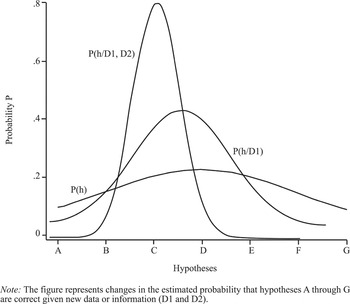
Economists take a more objectivist and individualistic view. They focus on the process of Bayesian updating, in which individuals add new data to prior knowledge and beliefs to revise their behavior accordingly. With new information, the probable range of hypotheses that might explain those data is likely to shift and also to narrow. The more consistent the new data, the more likely an actor's probability estimates of the truth of various hypotheses are to converge on a narrow range of possibilities—and ultimately policies. Figure 6 illustrates the basic Bayesian mechanism. The flattest curve represents an actor's initial estimate of which of several possible relationships is true. The wide dispersion indicates a good deal of uncertainty, but Hypothesis D is initially viewed as most likely. New data allow for a revision of the probability that D is true. In this case, the first round of new data causes the actor to believe that D and C are equally probable. Another round of observed data solidifies the belief in the probability of C. Bayesian learning has the effect of shifting both the mean and the dispersion of beliefs about the true nature of relationships in the world. In Figure 6, additional information shifted actors' beliefs in hypothesis D toward hypothesis C. At the same time, certainty about this assessment solidified in the face of new information.

Bayesian updating
It is important to note, however, that nothing in the Bayesian learning mechanism guarantees that actors will converge on “the truth.” The process merely describes the way in which new information affects actors' probability assessments. Just as an individual can “learn” a theory in physics that is later disproven, nations can take the wrong lessons from the policy experiences of others or can learn a wrong-headed theory. Exactly what actors learn will be influenced by a number of factors, including the source of new information and how it is processed.
Bayesian learning is a “rational” process in the sense that actors are assumed to make optimal use of available information—weighting learning in terms of objective similarities among cases (countries), extracting the right signal from the mass of noise, and so on. However, the aggregation of these individual choices may not be socially optimal. Economists recognize that sequential social learning can be responsible for “herd behavior,” as was evident in successive international financial crises in the 1990s. More generally, models in which actors learn from the decisions of a small number of leaders and suppress their private information tend to lead to Pareto-inefficient outcomes.64
One of the central issues in any learning model is how “data” are gathered and interpreted. Where do new data D1 and D2 in Figure 6 come from? It is obviously impossible for any actor to collect and process all information that might bear on a particular set of hypotheses. Information is costly, and actors are faced with a sampling problem. March and Simon argued long ago that the rationality of individual decision makers is bounded by their capacity to assemble and evaluate relevant evidence of the efficacy of a policy approach.65
March and Simon 1993.
Several important studies indicate the importance of learning within communications networks in the policy arena.68
The international relations literature has recognized a role for channeled learning outside of the policy realm. For example, with respect to coup contagion, see Li and Thompson 1975.
Haas 1959.
Quirk 1994.
To name but a few: Eising 2002 attributes the spread of liberalization in the electricity sector in Europe to learning facilitated by the Council of the European Union. Nye 1987 found that international institutions reinforced learning with respect to nuclear policy through their use of rules and standard operating procedures. Kahler 1994 has noted that the international financial institutions shape learning to reinforce their policy preferences.
How might one devise tests for the influence of learning on policy diffusion? There are good reasons to suppose that learning has occurred when we see highly successful policy changes in country A, followed by similar changes in countries B and C. That is, measurable policy success should increase the probability of adoption elsewhere. In the case of privatization, for example, higher rates of investment and economic growth and lower deficits would suggest that the policy worked at the national level. Over time, the ratio of these measures among privatizers relative to nonprivatizers should predict future privatization efforts. It may be that learning happens at the global level, and it may be that it happens among groups of peers who share information and whose experiences are more relevant to each other—among neighbors, cultural groups, or states at the same level of development. Similar to firms that have sunk investments in particular technologies,74
See, for example, Atkeson and Kehoe 2001.
On the likelihood of incremental change in the absence of a dramatically successful model, see Schneider and Ingram 1988.
Learning theories suggest that information about policy success or failure abroad will influence the probability of policy change at home. The information may be acquired rationally, dispassionately, and completely, as in strict Bayesian models. It might be mediated through existing communication networks. Information might flow more quickly among peer groups of countries whose experiences are deemed most relevant to each other. In all cases, however, evidence of success increases the likelihood of adoption elsewhere. As we discuss below, this connection to some reasonable measure of “success” becomes more tenuous as one moves away from learning and toward diffusion processes based on emulation.76
Many researchers find that learning and emulation are not necessarily mutually exclusive. See, for example, Meseguer 2005.
Emulation
Sociologists have studied policy diffusion through the lens of “social construction” since the late 1970s.77
The first sustained analysis appeared in Meyer and Hannan 1979. For reviews of the literature, see Strang and Meyer 1994; Dobbin 1994; Rogers 1995; and Strang and Soule 1998.
Weber 1978, 4.
The “world polity” approach draws on the Weberian view of an increasingly global culture comprising broad consensus on the set of appropriate social actors (individuals, organizations, and nation-states have replaced clans, city-states, fiefdoms), appropriate societal goals (economic growth and social justice have replaced territorial conquest and eternal salvation), and means for achieving those goals (tariff reduction and interest rate manipulation have replaced plunder and incantation). Meyer suggested that a view on what is “appropriate”—in terms of actors, goals, and policy means—has diffused from country to country around the globe, first in the West and then elsewhere.80
Boli-Bennett and Meyer 1978.
Social construction became an established paradigm in international relations research in the latter 1990s.83
For proponents, understanding how public policies become socially accepted is the key to understanding why they diffuse. Social acceptance of a policy approach can happen in several ways. Powerful countries may serve as exemplars.84Haveman 1993.
Two other causal processes seem clearly to fit into the emulation category. First, groups of experts (epistemic communities, discussed above under social learning) may become advocates for a given policy, providing seemingly disinterested and objective analysis of its benefits. Students of epistemic communities postulate that policy professionals, academics, international nongovernmental organizations (INGOs), and NGOs can influence governments to adopt new policies simply by making arguments for them.85
Epistemic communities not only help to define new solutions to existing problems (for example, central bank independence as a solution to inflation) but also identify new problems and propose solutions to them (for example, global warming and the Kyoto protocols). The epistemic community of American economists is often seen to have played a critical role in economic liberalization in Latin America and beyond.86Numerous studies have purported to show, for example, the influence of “Chicago boys” in economic policy change in Latin America, either directly or indirectly. See Drake 1994; Harberger 1997; Montecinos 1997; and Murillo 2002.
Whereas conventional logic-of-development arguments suggest that countries will adopt certain programs when they are developmentally ready for them, world polity theorists have found that countries embrace new norms for symbolic reasons, even when they cannot begin to put them into practice. This is particularly true of social welfare policies and human rights. Strang and Chang, for example, find that large numbers of countries ratified International Labor Organization treaties guaranteeing welfare rights, but that only in developed countries did ratification lead to increased welfare expenditures. Developing countries signed the treaty even though they lacked the resources to carry through. This may not represent bad faith so much as the power of new international norms even in countries that are not developmentally capable of implementing them.87
Strang and Chang 1993.
The other principal emulation approach draws on reference group theory in social psychology. From this perspective, individuals emulate the behavior of their self-identified peers, even when they cannot ascertain that doing so will in fact be in their best interests. At the international level, sociocultural linkages (common language, history, religion, and so on) may contribute to “psychological proximity” among nations.88
Rose 1993.
Simmons and Elkins 2004.
A test of these constructivist arguments might begin with a look at the effect of participation in NGOs, INGOs, professional communities, and other groups that actively promote new policy norms. One might also test for the effect of shared cultural values by examining the effect of shared cultural heritage, language, and religion, controlling for effects of competition, learning, and coercion. The availability of good, longitudinal data on a wide range of economic, trade, political, and other factors has made these kinds of nuanced tests of hypotheses possible in recent years. Net of coercion, competition, and learning, do the ideas of leading epistemic communities or advocacy groups have effects? Some of the studies reported in this symposium show that they do.
Four Varieties of Liberalism
The articles in this symposium explore these four diffusion mechanisms with respect to four different classes of policy: liberalization of international economic transactions (bilateral investment treaties), domestic economic policy liberalization (tax policy), liberalization of the role of government (public-sector downsizing), and political liberalization (democratization). Here we provide a brief policy-by-policy preview.
International Economic Transactions: The Spread of Bilateral Investment Treaties
Zachary Elkins, Andrew Guzman, and Beth Simmons explore the diffusion of bilateral investment treaties that seek to improve foreign investors' legal redress in countries where local regulatory and legal practices may appear to put foreign investment at risk. The article finds considerable evidence for diffusion through competition. Developing countries are much more likely to sign a bilateral investment treaty (usually with a developed country) when their prime competitors for trade and investment have done so. Other mechanisms may also be at play. Coercion is not ruled out: countries that draw on the resources of the IMF tend to be much more likely to sign bilateral investment treaties (BITs), which may reflect a degree of pressure to do so. They also find some evidence of learning from the success of other developing country signers: in years when BITs were most strongly associated with FDI inflows, other countries were more likely to sign BITs as well. However, Elkins, Guzman, and Simmons find no evidence of emulation through region, common language or colonial history. They conclude that competitive pressures are likely the strongest engine of diffusion in this area.
Domestic Economic Liberalization: The Diffusion of Tax Schemes Internationally
Why have governments increasingly implemented domestic policies that seem to favor marketization over governmental intervention? Duane Swank examines the diffusion of new “market-conforming” corporate tax structures in the OECD following the adoption of a new tax regime in the United States in 1986. Swank argues that competition was the major driver of diffusion because the U.S. tax changes were most closely followed in other developed economies with similar political economic structures to those in America—that is, the institutions of liberal (uncoordinated) market institutions. According to Swank, competition with the United States for investment was the driving force of policy change among these countries, but not among the coordinated market economies of northern Europe. These countries came to adopt reforms similar to those enacted by President Ronald Reagan because the United States is the dominant host and supplier of capital investment throughout the developed world. The market for FDI in coordinated market economies, in contrast, operates more independently from the U.S. and is driven by other considerations.
Liberalization of the Structure of Government: The Diffusion of Public-Sector Downsizing
Chang Kil Lee and David Strang examine public-sector downsizing in the 1980s and 1990s in the OECD. As in the case of “market conforming” tax policies, there is no evidence of coercion. But unlike Swank, Lee and Strang do not believe that competition was the main driver of reductions in public-sector employment. Instead, they focus on an interesting learning process. In the context of the dominance of neoliberal thinking about the efficacy of downsizing, countries took strong signals from evidence that downsizing worked to improve economic performance but heavily discounted evidence showing that bigger public sectors were good for growth (by providing collective goods such as education and infrastructure undersupplied by markets). Lee and Chang thus propose a hybrid emulation and learning dynamic in which an influential epistemic community defined downsizing as a solution to the problem of poor economic performance, which in turn catalyzed only one type of learning—countries ignored evidence that was inconsistent with the new received wisdom but acted on evidence that was consistent with it.
Political Liberalization: The International Spread of Democracy
The final article examines political liberalization. Kristian Gleditsch and Michael Ward examine the diffusion of democracy and begin with the observation that the process of democratization has been geographically clustered. Given that most of the domestic correlates of democracy (levels of income, education, and so on) tend to change slowly, there is a strong prima facie case to be made that democracy spreads by some sort of regional diffusion. What is the nature of the diffusion? Gleditsch and Ward contend that coercion is the most important driver of this dynamic, though in a way that is quite different from the core-periphery archetype. In the case of democratization, powerful prodemocracy groups in neighboring countries apparently represent an effective power resource for would-be democratizers. Conversely, civil conflict in neighboring countries reduces the capacity of democratizers elsewhere in the region. Power operates here, but it is localized power resources available to pro- and antidemocracy groups within nations that matter.
Conclusion
How is it that we have come to live in such a globalized world? This is one of the most fundamental and puzzling questions we can ask as social scientists examining political and economic policy developments over the past half-century. How did marketization in its various guises gain a significant foothold in a growing number of countries? How and why have the various trappings of political liberalization—from elections to human rights—become important governing principles in most (though certainly not all) regions of the world?
Coercion, competition, learning, and emulation are distinct—and we think powerful—concepts.90
For a recent argument that these (and possibly other) diffusion mechanisms can in fact all be subsumed within a single theoretical framework, see Braun and Gilardi 2006.
The articles that follow provide a fascinating set of windows on the fundamental processes underlying globalization. No one denies that the underlying processes are complex, but our strategy in this volume is to contribute to knowledge of a complex whole through well-defined and rigorously executed studies that engage the basic framework set out in this introduction. This introduction is of course only a starting point for the inquiries that follow. Each piece adds its own rich insights to the issue area, adapting and amending the mechanisms set out above in appropriate and creative ways.
While each substantive article has its creative take on diffusion, all of the contributing scholars have pooled their intellectual efforts by working through a fairly consistent set of alternative mechanisms as well as testing for the “null hypothesis” of independent decision making. Swank's article on tax liberalization covers important domestic political and economic explanations (the political orientation of the government, for example) that could be independently responsible for a more market-friendly tax policy, and controls for trade competition, as well as other diffusion mechanisms. The Elkins, Simmons, and Guzman article on bilateral trade agreements explicitly controls for the influences of liberalization in the region as well as liberalization trends in those states most likely to compete for global capital. The willingness of these authors to engage several common alternative hypotheses elucidates the diffusion of policies that have enhanced the global flow of capital over the past several decades.
Finally, the article on political liberalization presents strikingly complementary findings. Gleditsch and Ward's work on the diffusion of democracy gives the null hypothesis (independent national factors) a real fighting chance, taking on “social requisites” theory. They find that the essentially domestic explanation is not quite as convincing as various diffusion influences on the prospects of political liberalization. To be sure, their explanations differ greatly: Gleditsch and Ward concentrate on the political resources provided by democratizing neighbors.
Very few symposia address as broad a topic in as comprehensive a way as does this collection of articles. All of the contributions address “liberalization,” but additional insights are gleaned by comparing marketization with democratization. Both may have their ideational explanations, but marketization, these studies seem to suggest, tends also to be subject to stronger competitive factors that are not as clearly present in explaining democratization. It is interesting to note that among the economic policy topics, competitive pressures can be found not only for external liberalization, but for domestic policy changes as well. This suggests that political economy explanations should begin seriously to resituate the study of domestic institutions and politics in a broader global or at least regional framework. Finally, this collection of articles allows for some interesting comparisons of global processes with regional ones. Two articles—those by Swank and Lee and Strang—focus exclusively on the OECD countries. These regional articles are quite telling in the context of the broader project. Swank's article, for example, highlights the robustness of competitive pressures, which seem to be at work within the OECD as well as globally (as Elkins, Guzman, and Simmons demonstrate). The article by Lee and Strang shows that particular ideas account (asymmetrically) for much policy diffusion.
The goal of this volume is to theorize and test explanations of policy liberalization that involve interdependent decision making among governments. Large clusters of scholarship have tended, in our view, to be too domestic in orientation. The interdisciplinary nature of this project has been helpful in this regard. Not only is it useful for “political economy” approaches to liberalization to become resituated in a politically dynamic international economy; it is also useful to understand the nature of the international setting itself. Collaboration between political scientists and sociologists has usefully exposed areas of overlap as well as challenged scholars to think about how to incorporate and test alternative explanations from other disciplinary traditions. The articles that follow represent our efforts to understand, confront, and test explanations that seem promising without undue deference to disciplinary boundaries.