Introduction
Clinostomum complanatum is a common digenetic trematode found in tropical and subtropical regions, commonly infecting ardeiid birds which serve as their definitive hosts. However, sporadic human infections, which reflect the zoonotic potential of this parasite, have also been reported (Chung et al., Reference Chung, Moon, Kong, Choi and Lim1995; Kitagawa et al., Reference Kitagawa, Oda, Totoki, Washizaki, Oda and Kifune2003; Park et al., Reference Park, Kim, Joo and Kim2009).
The excysted progenetic metacercarial stage of this parasite has been reported in several species of fish (Dias, Reference Dias2002). In India, where the prevalence of fish infection can be as high as 98–100% (Siddiqui & Nizami, Reference Siddiqui and Nizami1982), metacercariae are commonly found in the peritoneal cavity of the fish Trichogaster fasciatus.
In a number of earlier studies, various laboratory models have been explored for the transformation and establishment of experimental infections using metacercariae (Fried & Foley, Reference Fried and Foley1970; Abidi & Nizami, Reference Abidi and Nizami1987; Larson & Uglem, Reference Larson and Uglem1990), including the use of C. complanatum as a model parasite (Uglem et al., Reference Uglem, Larson, Aho and Lee1991; Bonnet et al., Reference Bonnet, Steffen, Trujano-Alvarez, Martin, Bursey and McAllister2011; Rizvi et al., Reference Rizvi, Alam, Rizvi, Hasan, Alam, Zafar, Fatima, Shareef, Banu, Saleemuddin, Saifullah and Abidi2011a, Reference Rizvi, Alam, Parveen, Saleemuddin and Abidib). An obvious advantage of this parasite is that it takes a very short time for in vivo transformation from the metacercarial stage to the ovigerous adult form, and therefore it could be a preferred organism for in vivo studies on maturation and host–parasite interactions.
In the present study, the rabbit eye has been used as the in vivo habitat for the transformation of C. complanatum metacercariae into ovigerous adult worms.
Materials and methods
Clinostomum complanatum progenetic metacercariae were isolated aseptically from the body cavity of T. fasciatus and transferred into 100 mm phosphate-buffered saline (PBS) pH 7. After rapid washing in PBS containing 1% penicillin G and streptomycin, the worms were rinsed several times in PBS.
Four adult male albino rabbits were used for the in vivo transformation experiments. After inducing anaesthesia, a conjuctival incision (length 3 mm) was made in the superior and inferior fornices to expose Tenon's capsule, followed by a 2–4 mm incision in the Tenon's capsule to expose the preseptal (preorbital) space. Ten worms were aseptically transferred into each incision with a soft brush. The attached ovigerous worms were harvested from the site of infection in the rabbit eye on days 4 and 8 post infection, using a soft paintbrush. All four rabbits used in the experiment survived the procedure.
The fresh progenetic metacercariae from T. fasciatus and adult ovigerous worms from the infected rabbit eyes were harvested and permanent whole mount slides were prepared, following staining with borax carmine. Slides were photographed with a Nikon Stereozoom microscope fitted with a 5 megapixel digital camera. Voucher specimens were deposited in the Museum of the Department of Zoology, Aligarh Muslim University, Aligarh, India. Percentage recovery was defined as: (the number of living, motile adult ovigerous worms obtained/the total number of progenetic metacercariae implanted) × 100.
Results and discussion
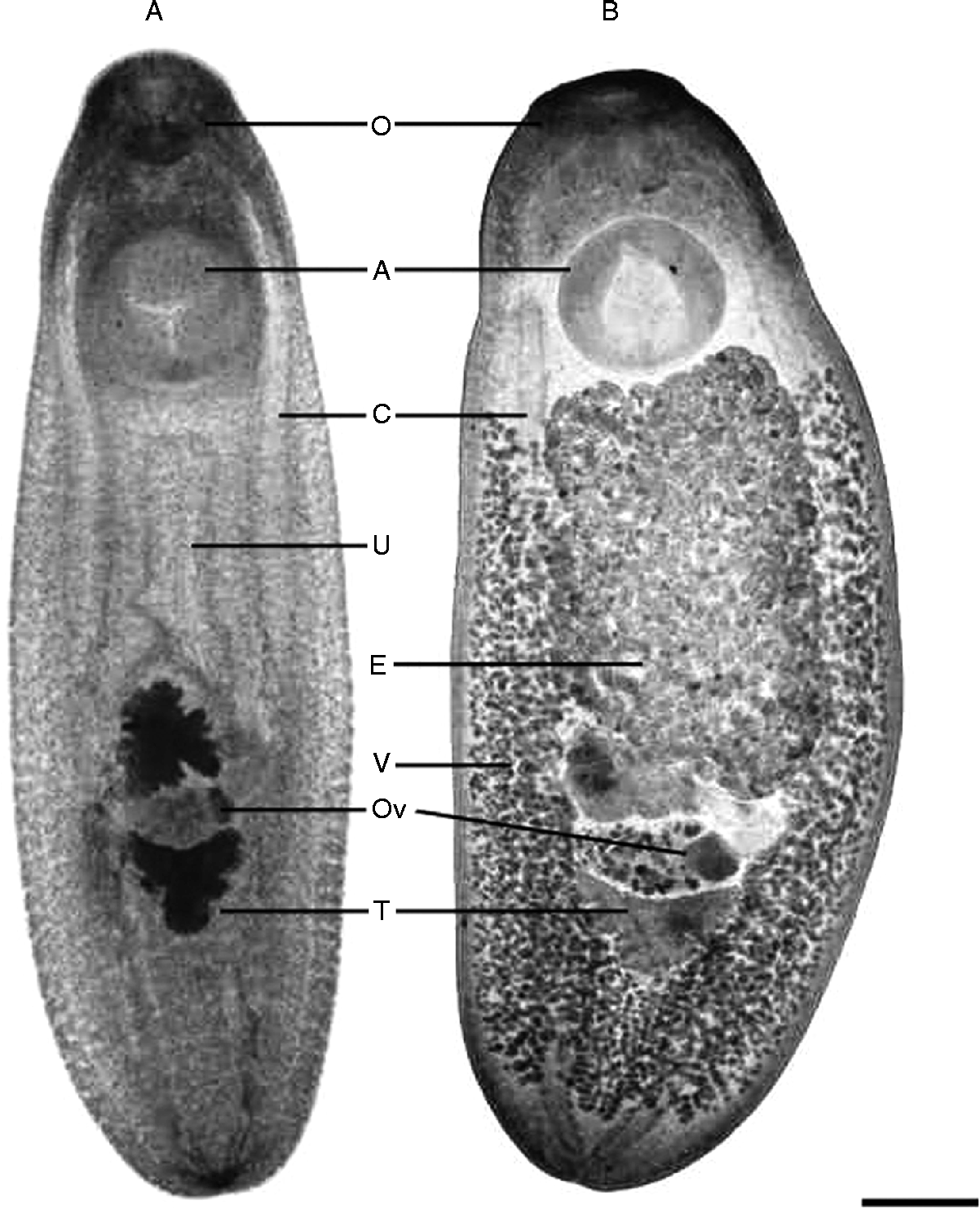
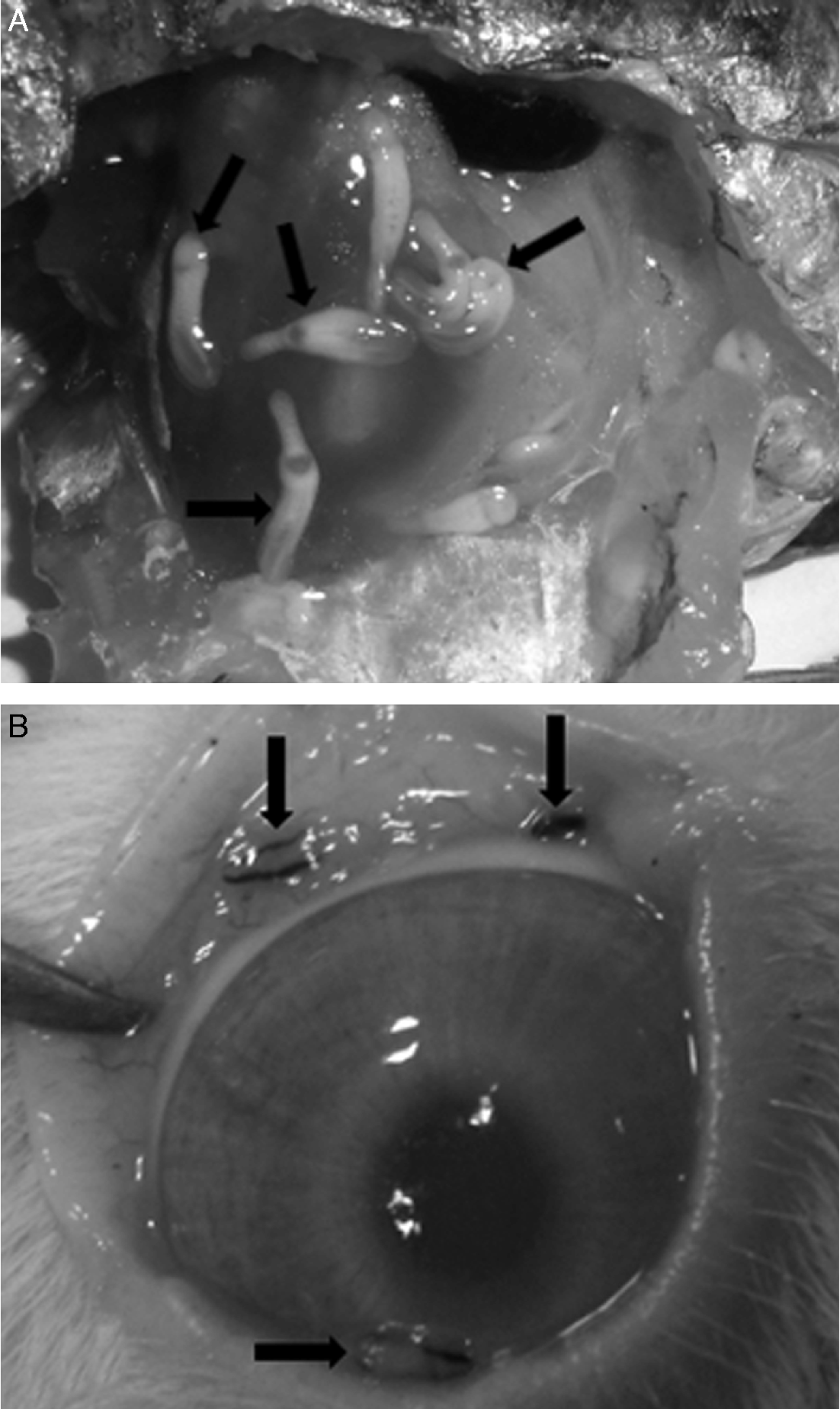
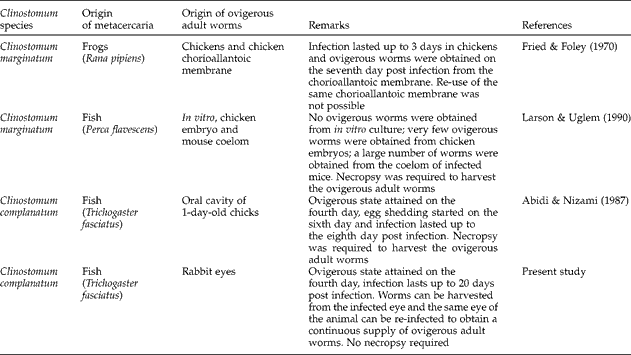
The successful establishment and transformation of the implanted progenetic metacercariae of C. complanatum in the rabbit eye, and subsequent recovery of the mature ovigerous adult worms (figs 1 and 2), suggests that the rabbit eye model for the in vivo transformation of C. complanatum is a better choice compared to other laboratory models described previously (table 1). An isolated report on human ocular infection with this parasite (Tiewchaloern et al., Reference Tiewchaloern, Udomkijdecha, Suvouttho, Chunchamsri and Waikagul1999) indicates that the rabbit eye model could also be clinically important.
The progenetic metacercaria (A) of C. complanatum obtained from the body cavity of T. fasciatus, and the ovigerous adult worm (B) obtained from the rabbit eye 8 days post infection. O, Oral sucker; A, acetabulum; C, caecum of the intestine; U, uterus; E, eggs; V, vitellaria; Ov, ovary; T, testis. Scale bar = 648 μm.

(A) The excysted progenetic metacercariae (arrows) of C. complanatum in the body cavity of T. fasciatus. (B) The ovigerous adult worms (arrows) attached to the rabbit eye 8 days post infection.
A comparison of the experimental models available for obtaining ovigerous adult worms of Clinostomum species in the laboratory.
The microscopic examination of the worms recovered from the rabbit eye (fig. 1B) revealed that their maturation pattern appeared to be consistent with previous reports on in vivo maturation of this parasite (Abidi & Nizami, Reference Abidi and Nizami1987; Larson & Uglem, Reference Larson and Uglem1990).
In the present study ten worms were implanted in the left eye of each of the four rabbits, from which one worm was harvested on day 4 post infection from each animal. On day 8 post infection, eight worms each were recovered from two rabbits and nine worms each from the remaining two rabbits. Thus a total of 38 worms were recovered from the four rabbits, with a recovery of 95%.
Worms attained the ovigerous state in rabbit eyes on day 4 post infection, with morphologically normal eggs being visible in the uteri. However, on day 8 post infection, the uteri were full of mature eggs. Infection in the rabbit eye lasts up to 20 day post infection which, for long-term experiments on trigger switches and immune responses of the host, is clearly an advantage over the avian model.
Although ardeiid birds are the natural definitive host of this parasite, reports of human infections (Chung et al., Reference Chung, Moon, Kong, Choi and Lim1995; Tiewchaloern et al., Reference Tiewchaloern, Udomkijdecha, Suvouttho, Chunchamsri and Waikagul1999; Kitagawa et al., Reference Kitagawa, Oda, Totoki, Washizaki, Oda and Kifune2003; Park et al., Reference Park, Kim, Joo and Kim2009) and the successful establishment of infection in the rabbit eye are clear proof of the zoonotic potential/loose host specificity of C. complanatum. It can therefore be concluded that the developmental triggers for in vivo maturation are not restricted to class Aves.
It is suggested that the ‘C. complanatum–rabbit eye’ model can be used to advance understanding of the influence of physiological, genetic and other biotic factors, as well as differential gene expression, involved in tissue remodelling, and the role of exogenous cues/trigger molecules produced by the host for initiation and progression of in vivo transformation. Taking all the advantages together, we wish to propose the suitability of this model not only as a classical laboratory model for classroom teaching of the developmental biology of trematode parasites, but also to investigate molecular interactions at the host–parasite interface and screening of chemotherapeutics that may interfere with in vivo transformation.
Acknowledgements
The authors wish to thank the Chairman, Department of Zoology, Professor M. Hayat, and Dr Farman ur Rehman for extending microscopy facilities, Mr Sarfaraz for technical help and Mr Azam for taking care of the animals during the experiment. A.R. and M.M.A. wish to thank the Department of Biotechnology, New Delhi for their studentships.