Introduction
In insects, body temperature depends on the ambient temperature; and physiological functions, behaviour (e.g. flight, foraging, courtship, mating, oviposition) and fitness (e.g. developmental rate, lifespan, fecundity, gametogenesis) are directly affected by its fluctuations. As in all ectothermal organisms, insects show an optimal temperature preference to which their physiological functions are best adapted (Angilletta et al., Reference Angilletta, Niewiarowski and Navas2002; Chown & Terblanche, Reference Chown and Terblanche2006). At temperatures higher than optimal, insects are stressed and activity costs are higher, inducing behavioural and physiological changes that often affect fitness (Angilletta et al., Reference Angilletta, Niewiarowski and Navas2002; Chown & Terblanche, Reference Chown and Terblanche2006).
Global climatic change involves not only an increase in average temperatures, but also an increase in the intensity and frequency of extreme climatic events such as heat waves (Easterling et al., Reference Easterling, Evans, Groisman, Karl, Kunkel and Ambenje2000). Parasitoid insects represent a third trophic level, as they develop inside of their insect hosts that generally feed on plants. Parasitoids are keystone species that must deal with their own thermal stress, as well as that of their host. As such, it is to be expected that higher temperatures can have a severe impact on such organisms (Hance et al., Reference Hance, van Baaren, Vernon and Boivin2007; van Baaren et al., Reference van Baaren, Le Lann, van Alphen, Kindlmann, Dixon and Michaudin press). Data on the direct impact of heat stress at sub-lethal temperatures on the parasitoids' fitness are relevant in the face of global climatic warming.
Exposure to a sub-lethal temperature results in the death of weaker individuals. Insects that survive heat shock may pay the cost in their life history traits. Indeed, heat resistance may induce a number of physiological changes whose cost can be expressed by a reduction in reproductive output, a decrease or even delay in growth if immature stages are exposed, and/or changes in mating behaviour and in lifespan (Krebs & Loeschcke, Reference Krebs and Loeschcke1994; Patton & Krebs, Reference Patton and Krebs2001; Rohmer et al., Reference Rohmer, David, Moreteau and Joly2004; Jørgensen et al., Reference Jørgensen, Sørensen and Bundgaard2006; Sisodia & Singh, Reference Sisodia and Singh2006). However, the cost of resisting heat stress is not always a decline in life history traits. Indeed, previous studies have shown that stresses can produce a hormetic effect that generally increases longevity and can occur in males (Sørensen et al., Reference Sørensen, Kristensen, Kristensen and Loeschcke2007) as well as in females (Lithgow et al., Reference Lithgow, White, Melov and Johnson1995; Khazaeli et al., Reference Khazaeli, Tatar, Pletcher and Curtsinger1997; Hercus et al., Reference Hercus, Loeschcke and Rattan2003; Gomez et al., Reference Gomez, Bertoli, Sambucetti, Scannapieco and Norry2009) and sometimes in both sexes (Scannapieco et al., Reference Scannapieco, Sørensen, Loeschcke and Norry2007). However, the hormesis of longevity may increase the cost of fitness by lowering fecundity due to trade-offs (Maynard Smith, Reference Maynard Smith1958; Hercus et al., Reference Hercus, Loeschcke and Rattan2003). Males and females can differ in their heat resistance, and the largest sex is generally the most resistant because a larger size resists dehydration better (Hadley, Reference Hadley1994).
Sometimes, heat shock in adults affects their progeny (parental effect), reducing the rate of egg hatching (Silbermann & Tatar, Reference Silbermann and Tatar2000) or inducing changes in morphology (Andersen et al., Reference Andersen, Pertoldi, Scali and Loeschcke2005). However, other studies did not record any effect on progeny after exposing their parents to high temperatures (Hercus et al., Reference Hercus, Loeschcke and Rattan2003; Huang et al., Reference Huang, Chen and Kang2007).
Here, we tested the impact of heat shock on the life history traits of adults of the aphid parasitoid Aphidius avenae Haliday (Hymenoptera: Aphidiidae) and on the later repercussions for their progeny. We simulated an unpredictable heat shock to which individuals were never before exposed. As this type of heat stress can provoke the death of half of the population, we hypothesized that it would affect the life history traits of the survivors. We measured the impact on mating ability, fecundity, adult lifespan and viability, developmental rates and the sex ratio (SR) of the progeny. Because A. avenae females are larger than males (Le Lann, unpublished data), we expected that females would be more resistant to heat stress than males. We also expected greater longevity (hormesis) and reduced fecundity because of an existing trade-off between these two traits in parasitoids (Ellers et al., Reference Ellers, Driessen and Sevenster2000). Finally, we hypothesized that the progeny of heat-shocked individuals would have lower viability or would be affected in the time needed to develop due to a negative parental effect.
Material and methods
Insects
Aphidius avenae is an endoparasitoid of the grain aphid Sitobion avenae F. (Hemiptera: Aphididae). Sitobion avenae originated from a single parthenogenetic female (SA1 clone, INRA-zoology collection) collected in 1990 from a cereal crop near Rennes (Brittany, France). Aphidius avenae originated from S. avenae mummies collected from the same site in June 2006. Aphids and parasitoids were kept in Plexiglas boxes (50×50×50 cm) in climate rooms at 20±1°C, 60±10% RH and a 16L:8D photoperiod. Aphids were reared on winter wheat Triticum aestivum, cultivar ‘Boston’, provided by the Saaton Union Research Society (France). Each week, wheat plants infested by aphids were regularly introduced into the culture of parasitoids and honey was provided ad libitum.
To obtain standardized parasitoids for experiments, aphid mummies were collected from the culture and placed individually in gelatine capsules until the emergence of adult parasitoids. After emergence, the parasitoids were enclosed individually in micro-cages (L=100 mm, Ø=15 mm, with gauze at one end), containing moistened cotton and droplets of honey and were maintained in the climatic conditions mentioned above.
Heat exposure
To test the resistance of parasitoids to heat stress, we adapted the glass column designed by Powell & Bale (Reference Powell and Bale2006) (fig. 1). The parasitoids were introduced into the inner chamber using an aspirator. The air temperature of the inner chamber was controlled using an ethylene glycol stream heated in a thermostated bath (Haake K F3, Karlsruhe, Germany). The air temperature of the inner chamber was monitored using a thermal probe linked to a thermometer (sensitivity: 0.1°C) (Tempscan, Comark, Beaverton, Oregon, USA). Preliminary experiments showed that the temperature was equal throughout the column. We also recorded the relative humidity in the tube, which was constant at 50±10%.
Glass column used to expose the parasitoids to heat shock.

Twenty-seven male and 34 female A. avenae, each 24-h old, were tested for their resistance to heat exposure. All of the males (and in a second run, all of the females) were placed into the glass column at room temperature (≈20°C). The inside temperature was gradually increased from 25°C to 36°C at 1°C per minute, and then held constant at 36°C. The parasitoids are frequently exposed to this temperature during the summer near Rennes (source: Météo France). We terminated the heat exposure after 47 min (males) or 60 min (females) when 50±10% of the parasitoids were considered to be dead because they showed no leg or antennae movement. This state corresponds to the heat stupor point, which is very close to lethal temperature in many insects (Vannier, Reference Vannier1994). The individuals were removed from the tube and observed every 30 min during 6 h to estimate the time of recuperation, if any. During this time, water and honey were placed near the survivors. Dead individuals were discarded, and the survivors were placed individually into micro-cages with water and honey. It took several hours for the heat-shocked survivors to recover, during which time they remained motionless. They started to walk 4–6 h after exposure but were still unable to fly. After 24 h, the survivors completely recovered.
Mating
Twenty-four hours after heat exposure, the survivors (12 males and 12 females) were placed individually into glass tubes (L=6.5 cm, Ø=1 cm) with an untreated, 48-h-old individual (the same age as the survivors) of the opposite sex. When no mating occurred within 10 min, the untreated individual was removed and a new, untreated one was placed in the tube with the survivor. Untreated pairs were used as controls in the same conditions, i.e. 12 untreated females were placed into tubes with untreated males, and the males were replaced if no mating occurred. The same procedure was used for 12 untreated males that were placed into tubes with untreated females. A maximum of three partners was offered before we declared the tested individual unable to mate. Mating behaviour was video-recorded with a camera (Panasonic WV-PS03/C, Osaka, Japan) mounted on a binocular microscope (Olympus SZX-ILLD200, Center Valley, Pennsylvania, USA). The time spent in the tube before mating and the duration of the copulation were recorded (in seconds).
Oviposition and parasitism rate
After mating, each female (treated and control) was isolated individually for 24 h in a micro-cage containing one wheat plantlet infested with 24 aphids. After 24 h, we placed the females individually into micro-cages with water and honey ad libitum. The parasitized wheat aphids were maintained in the climatic conditions described earlier.
Three to four days after the experiment, 12 aphids were chosen randomly and dissected in 70% ethanol under a binocular microscope and the parasitoid larvae counted to check for parasitism.
Length of development, viability and the sex ratio of the progeny and adult longevity
The 12 remaining aphids not selected to measure oviposition and parasitism rates were kept on wheat plantlets in a climate room until the mummification of the parasitized aphids. Each mummy was then isolated in a gelatine capsule until the parasitoid emerged. The numbers of mummies, their viability, the total time needed for the parasitoids to develop (from oviposition to the emergence of the adults) and the sex ratio (SR) of the progeny were registered.
The mortality rate of the adults used in the mating experiments (untreated and survivors) was checked twice each day to measure their lifespan.
Statistical analysis
All statistical analyses (Wilcoxon test (W) and Chi-square (χ2)) were conducted with R version 2.4.0 (R Development Core Team, 2006).
Results
Mating and parasitism rate
Twenty-four hours after exposure, only 58.33% of the surviving females (χ2=17.43, df=1, n=12, P<0.001; control 91.66%) and 50% of the surviving males (χ2=4, df=1, n=12, P<0.05; control 75%) were able to mate successfully with an untreated individual. No significant differences were found in the time spent in the tube before mating (untreated pairs: 193±41; untreated females with surviving males: 172±64, W=30.5, ns; untreated males with surviving females: 139±34, W=32, ns; mean±SE), nor in the duration of copulation between treatments (untreated pairs: 59±3; untreated females with surviving males: 64±4, W=40, ns; untreated males with surviving females: 60±4; W=46, ns; mean±SE). In pairs unable to mate, some males did not show any courtship behaviour (i.e. flapping their wings).
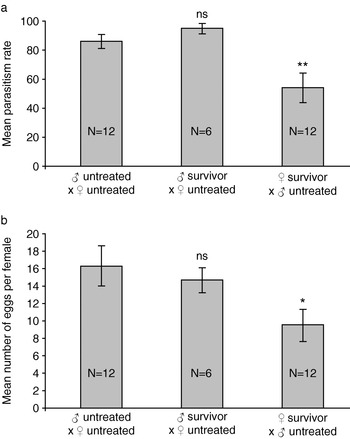
Surviving females that mated with untreated males parasitized fewer hosts and laid fewer eggs than untreated females that mated with untreated males, while untreated females that mated with male survivors did not show significant differences with untreated pairs (fig. 2a, b).
(a) Mean parasitism rate per mated female (±SE); (b) Mean number of eggs laid per female (±SE) in the different types of mating situations set up between untreated individuals and survivors. The number of mated females (N) tested per treatment is indicated inside of the bars, ♂: males, ♀: females. Significance of the Wilcoxon test: * P<0.05; ** P<0.01; ns, not significant.

No significant differences were found in the mean number of mummies produced per female between the different treatments (untreated pairs: 6.7±0.9, n=76; untreated females mated with surviving males: 5.2±1, n=31, W=39, ns; surviving females mated with untreated males: 6.4±0.9, n=64, W=53, ns; mean±SE).
Viability, developmental rate and sex ratio of the progeny
The viability of the offspring of untreated pairs was significantly higher than for the offspring of female survivors (95.8% vs. 84%, respectively; χ2=6.63; P=0.01) but not from the offspring of male survivors (95.8% vs. 89%, respectively; χ2=2.31; ns).
The untreated males emerged before the untreated females (protandry). In contrast, the female offspring of the surviving males emerged before the offspring of either sex from the untreated pairs, while the developmental rate for the other offspring from the surviving individuals did not statistically differ from their respective controls. The numbers of offspring obtained from male or female survivors did not significantly differ from the numbers of offspring obtained from the control pairs (fig. 3).
Mean developmental rate (±SE) for the male (filled bars) and female (open bars) progeny of the parasitoids according to the different types of mating situations set up between untreated and surviving parents. The number of individuals (N) tested per treatment is indicated inside of the bars; ♂: males, ♀: females. The significance of the Wilcoxon test: *** P<0.001; * P<0.05; ns, not significant. Significant differences in development time between males and females are indicated in brackets.

No differences were found in the offspring's sex ratio (untreated pairs: SR=0.37, n=71; offspring of male survivors: SR=0.27, n=28, χ2=0.41, ns; offspring of female survivors: SR=0.47, n=25, χ2=0.34, ns).
Lifespan
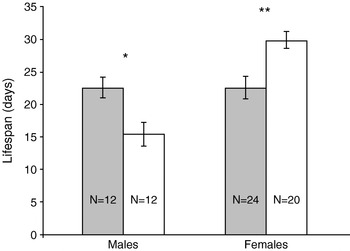
Untreated males and females had the same lifespan (22.6±1.6 days (n=12) and 22.6±1.7 days (n=24), respectively), but the longevity of the survivors was sex dependent. Male survivors lived approximately seven days less than untreated males (15.4±1.8 days (n=12); W=116, P<0.05) and female survivors lived approximately seven days longer than untreated females (29.9±1.3 days (n=20); W=358, P<0.01) (fig. 4).
Mean lifespan (±SE), of untreated (filled bars) and treated (open bars) male and female parasitoids. The number of individuals (N) tested per treatment is indicated inside of the bars. Significance of the Wilcoxon test: ** P<0.01; * P<0.05.

Discussion
Our results show that after a sub-lethal heat shock that leads to about a 50% mortality rate, the fitness of the survivors is strongly affected. Moreover, the two sexes respond differently and their progeny is also affected. This response to stress by both adults and their progeny may have ecological consequences.
Impact of heat exposure on the fitness of survivors
Our results also show that the mating capacities of both sexes were affected after heat shock. Males and females can, thus, both be the cause of their mates' failures. Normally, virgin females produce pheromones that stimulate both upwind flight and elicit close-range courtship behaviour by males (McClure et al., Reference McClure, Whistlecraft and McNeil2007). In our observations, we noted that some males did not show any courtship behaviour (i.e. flapping their wings). This might be due to anatomical injuries produced by the sub-lethal thermal stress that could affect muscular contractions, flight ability and fertility (Rohmer et al., Reference Rohmer, David, Moreteau and Joly2004; Krebs & Thompson, Reference Krebs and Thompson2005). Patton & Krebs (Reference Patton and Krebs2001) have also shown that after heat stress in male Drosophila sp., the heat shock proteins (HSP) in the thoracic muscles were lower than those in the head or in the abdomen, and that this is correlated with flight and courtship disruption. McNeil & Brodeur (Reference McNeil and Brodeur1995) have shown that the courtship behaviour in males of the aphid parasitoid Aphidius nigripes is elicited by a short-range female pheromone consisting of cuticular lipids. In insects, these cuticular compounds are known to be altered by changes in temperature (Gibbs et al., Reference Gibbs, Louie and Ayala1998). It has been shown, for example, that heat shock can alter the mating behaviour in Drosophila sp. (Markow & Toolson, Reference Markow, Toolson, Barker, Stamer and MacIntyre1990). So, the lack of courtship behaviour might be explained by changes in the production and/or dispersion of female pheromones, by the misdetection of pheromones by males or by the absence of or inefficient courtship by males. As both pheromones and courtship are essential to conspecific identification, and because mating with heterospecific individuals is costly, slight variations in these signals could easily result in a failure to mate and are counter-selected (Dobzhansky & Gould, Reference Dobzhansky and Gould1982).
Surviving females laid fewer eggs, but survived seven days longer than the control females. The reduction in fecundity may be due to the direct cost of heat stress resistance as reported for D. melanogaster and for the parasitoid T. carverae (Krebs & Loeschcke, Reference Krebs and Loeschcke1994; Scott et al., Reference Scott, Berrigan and Hoffmann1997). However, as A. avenae tends to be synovigenic (i.e. can still mature eggs after their emergence) (Jervis et al., Reference Jervis, Heimpel, Ferns, Harvey and Kidd2001), the maturation of the eggs may have been interrupted by the heat stress induced at 24-h old, and the energetic resources that were not invested in egg production may then have been allocated to the lifespan of the female survivors. The possible hormetic effect observed in females (i.e. greater longevity after heat stress) is not uncommon (Lithgow et al., Reference Lithgow, White, Melov and Johnson1995; Khazaeli et al., Reference Khazaeli, Tatar, Pletcher and Curtsinger1997; Hercus et al., Reference Hercus, Loeschcke and Rattan2003; Gomez et al., Reference Gomez, Bertoli, Sambucetti, Scannapieco and Norry2009). Stronger females (that live longer) may also have been selected after heat shock.
Different impact on males and females
Our results show that females are more resistant to damage than males. Females have to be exposed to heat stress for a longer time to obtain a 50% mortality rate, and the lifespan of female survivors is longer than for male survivors. The better resistance to high temperatures in females is not unusual. This specificity may be due to a high concentration of HSPs in the ovaries and embryonic tissues and may explain why they suffer less damage than males (Palter et al., Reference Palter, Watanabe, Stinson, Mahowald and Craig1986; Folk et al., Reference Folk, Zwollo, Rand and Gilchrist2006; Krebs & Thompson, Reference Krebs and Thompson2006). Moreover, a larger size is better for resisting dehydration (Hadley, Reference Hadley1994). Parasitoid females are larger than males, which may explain their greater resistance to high temperatures. Also, the haplo-diploidy in parasitoids might be an important factor in differences in resistance between males and females. Indeed, females, with their double set of chromosomes, could be less sensitive to stress-induced damage to DNA; and diploid cells can repair damage through recombination. A combination of the three factors could be involved in this sex-dependant response.
Effect on the progeny of survivors
Heat shock in females seems to produce a significant decrease in the viability of mummies but not in the offspring of male survivors, which points to a possible maternal effect. Magiafoglou & Hoffmann (Reference Magiafoglou and Hoffmann2003) studied the parental effect of cold shock in Drosophila serrata, for which also only the progeny of stressed females showed a lower rate of viability. Further studies are necessary to understand this difference in viability between the progeny of stressed males and females.
Our results show that the male progeny of the survivors develop more quickly than the male progeny of the control individuals, with, as a consequence, less protandry in stressed individuals. According to Quicke (Reference Quicke1997), protandry is an adaptive trait in parasitoids because late-emerging males are likely to encounter only females that have already mated, and most female parasitoids mate only once. In Aphidius ervi, females are able to mate immediately after emergence, while males need several hours to become sexually mature. In such conditions, early-emerging males have a better chance of encountering virgin females and of increasing their probability of mating (He et al., Reference He, Wang and Teulon2004). However, when adults are heat-exposed, the time between the emergence of both male and female progeny is significantly shorter than for the progeny of untreated adults. This may imply that males are not yet sexually mature when females emerge and could result in a male-biased sex ratio in the next generation due to the production of males by unmated females.
Ecological consequences of an unpredictable heat shock
Our results show three major consequences of heat stress lasting about one hour at 36°C. First, there was a high rate of mortality (around 50%). Second, there was a decrease in the fitness of the survivors. Finally, there was a lower level of protandry in the progeny, probably leading to a more male-biased sex ratio in the next generation. The rate of immediate mortality could also be increased by the behaviour of survivors in the hours following the stress. Indeed, after heat shock, A. avenae survivors were unable to move for several hours, something that makes them more vulnerable to predation.
The temperatures used in our experiments can be easily reached during heat waves (source: Météo France) in natural ecosystems, and the experimental length of exposure is relatively short in comparison to the duration of the maximum temperature during a day. Such a drastic reduction in reproductive output and the high rate of mortality observed could result in the severe crash of parasitoid populations. Even if parasitoids are able to survive because they certainly find shelter in cooler microhabitats during the hotter hours of the day, such results are good estimators of the impact of a higher incidence of heat waves. Although it is certain that climate change will bring about changes in host-parasitoid systems, the precise outcomes are difficult to predict. Most models of host-parasitoid interactions predict an increase in pest outbreaks with climate change (Bezemer et al., Reference Bezemer, Jones and Knight1998; Cannon, Reference Cannon1998), which indicates that parasitoids may be less resistant than their hosts.
Further investigations are needed to elucidate the physiological mechanisms that underlie the changes produced by such heat stress on the fitness and life history traits of A. avenae.
Acknowledgements
We are grateful to Anne-Marie Cortesero and the members of her laboratory, Ecobiologie des Insectes Parasitoïdes, at the University of Rennes 1 for hosting us during a part of this study. We would also like to thank Jeff Bale for donating the glass column used in our experiments and Andrea Dejean for proofreading the manuscript. This research was supported by a grant to Cécile Le Lann from the Ministère de l'Enseignement Supérieur et de la Recherche, by the Programme Amazonie II of the French Centre National de la Recherche Scientifique (project 2ID), by the COMPAREVOL program (Marie Curie Excellence Chair, http://comparevol.univ-rennes1.fr/) and by the ECOCLIM program founded by the Région Bretagne.