1 Introduction
Most health systems, but especially publicly funded national health systems, are in constant need of reform to align with health system users’ values, namely latent expectations of health system improvement. However, it is unclear how to keep health service decisions linked with such broader expectations, especially given the multi-dimensional attributes of health care programmes. Clearly defined methodologies are called for, especially in times of spending cuts and increasingly conservative decision making. However, measuring health system values is challenging and the lack of a robust method often obstructs the evaluation of health care policy reforms. The societal reluctance to rely on these valuations has been paramount in the critique against the mainstream approach (health technology assessment) to policy making at a health system level, its evaluation. In this paper, we develop a new methodology to evaluate the multiple dimensions of health care programmes.
Some scholars claim that in publicly funded health systems, at least at a societal level, there are several dimensions of value above and beyond ‘health gain’ (Olsen, 1997). Even when focussing on health gain alone, there is only so much change we can attribute to the health system (Murray and Frenk, Reference Murray, Lauer, Tandon and Frenk2000). Given the need to target multiple dimensions of benefit, it is not an easy task to decide how best to classify such value dimensions. The latter is the case as health care programmes within a priority-setting process are heterogeneous in terms of dimensions identified (both existing and potential values). In such cases, certain health programme dimensions ought to be pitted against other health system goals (e.g., reducing waiting lists matter to avoid individuals moving from publicly funded health systems to the private sector).
This paper lays out the design of a methodology aimed at identifying, categorising and validating health system value dimensions which can then be used to assess the performance of national health systems. In the first instance, we describe an open ended direct focus group revelation method which elicits a list of opportunities for improvements, which were subsequently classified into health system values. We implicitly draw on a multi-attribute utility framework (Keeney and Raiffa, Reference Keeney and Raiffa1993), and then validate a list of value dimensions employing a questionnaire in which participants identify programmes expected to attain the value dimensions previously elicited. Our results reveal a number of value dimensions, which we reduced to three using factor analysis techniques. A validation exercise using statistical analysis allows us to test whether participants’ value revelation is consistent with qualitative findings from a focus group exercise.
The next section provides the background, including a perspective. In Section 3, we describe the conceptual framework, followed by the empirical strategy in Section 4. Section 5 reports the results and the paper ends with a discussion.
2 Background
2.1 Health system performance indicators
The measurement of health system performance has been a big topic of debate particularly following the publication of the World Health Organisation (WHO) health system performance index (Abelson et al., Reference Abelson, Forest, Eyles, Smith, Martin and Gauvin2007). However, in designing performance measures it is unclear how dimensions of value coincide with peoples’ values. Some studies, such as Murray and Frenk (Reference Murray, Lauer, Tandon and Frenk2000), provide a specification of health system goals, which is a first step to operationalise a measure of performance. In this paper, we offer an alternative methodology. First, we do not distinguish between ‘instrumental’ and ‘intrinsic’ sources of value, insofar as they both interrelated. Second, an important difference lies in that we validate what ‘health system value’ is perceived to be by the population. Different beneficiaries might place varying weight on different dimensions of value. Hence, such measures of value ought to be related in some way to measures elicited by the population itself. There have been some attempts of this both in the context of developing and developed countries (Costa-Font et al., Reference Costa-Font, Forns and Sato2015; Costa-Font et al., 2016; Costa-Font and Rovira, 2005). However, previous research focusses on elicitation methodologies rather than on the identification of value dimensions.
As a natural response of western systems governed by elitism, there is growing demand for involving citizens in policy development to ensure that decisions are legitimate, and reflect broad social values. This entails including patients, service users (or ‘consumers’) and the general public when making decisions, and aims to ensure that all decisions are informed, transparent and legitimate (Handler et al., Reference Handler, Issel and Turnock2001; Abelson et al., Reference Abelson, Giacomini, Lehoux and Gauvin2003). However, typical elicitation experiments lack realism, and often reduce the decision-making question to a handful of programmes which do not capture the set of value trade-offs that health systems regularly make. Indeed, some decisions (e.g., investment in prevention rather than medicines) are grounded on specific social values. Hence, the elicitation of health system values could help towards making normative decisions less problematic.
Limited available research has been devoted to designing elicitation instruments and methodologies that do not conflict with prevailing collective decision-making nature of European health systems (Abelson et al., Reference Abelson, Forest, Eyles, Smith, Martin and Gauvin2007). On a macro-level, elicitation instruments ought to ask communities to express their preferences between alternative health system goals. The challenge, however, is how to assess health systems that are extremely complex, especially when they are collectively funded and pursue multi-dimensional goals.
Franken and Koolman (Reference Franken and Koolman2013) developed a multi-attribute choice technique to elicit goal valuations using a ‘choice experiment’, which allows the indirect elicitation of health system dimensions. One downside of these methods alongside other stated preference techniques is the so-called ‘hypothetical bias’ (where participants respond differently in hypothetical scenarios as opposed to realistic decision-making contexts), given that choice experiment conditions are generally hypothetical, and often not perceived as ‘realistic’. Another potential problem is that individuals often construct their preferences ‘on the spot’, when requested, rather than understanding the consequences of different courses of actions, and hence observed values are likely to be sensitive to the elicitation methods employed to identify values dimensions. The latter can be overcome using a deliberation method (Handler et al., Reference Handler, Issel and Turnock2001), or alternatively, natural experiments where individuals make judgements on a real decision and are asked to make trade-offs.
2.2 Classifying health system values
In analysing dimensions of latent expectations of value from health systems, one can use different definitions such as Murray and Frenk (Reference Murray, Lauer, Tandon and Frenk2000). From a value standpoint, it is possible to identify sources of value that refer to the process of health care delivery (‘process utility dimensions’). Hence, it is possible to distinguish health care utility derived from interactions between people and the health system (‘how people are treated by the health system’), and utility (or values) obtained from certain health system institutions (‘how the health system allocates resources and how redistributive decisions are taken’) (Costa-Font et al., Reference Costa-Font, Forns and Sato2015).
In addition to process-related utility values, equity or distributional values consider that the health system can influence the distribution of health care use, and more widely, health outcomes. Income-related equity dimensions incorporate the idea that individuals might care about how health care reforms influence access to health by those with lower income, or how they affect the economic well-being of individuals (e.g., whether individuals become impoverished as a result of co-payments, etc.). Equity in health care financing has previously been used to rate health systems (Murray et al., Reference Murray and Frenk2000). However, in defining equity values, one must make implicit assumptions of a common ideology (Richardson et al., Reference Richardson, Wildman and Robertson2003).
3 Data and methods
3.1 Research instruments
The goal of this project is to reveal and validate a number of dimensions of (national) health system values to inform policy. This is a difficult endeavour because individuals do not necessarily have a broad and well-defined idea of what they can expect from the health system. Hence, it appears that deliberative and participatory techniques are required to make sure that individuals understand the meaning of ‘health system value’ reasoning. In participatory exercises, participants can focus on the specific questions under discussion, and identify ‘reasoned values’ (Costa-Font et al., Reference Costa-Font, Forns and Sato2015). Alternative techniques, including survey methods, were considered, but were thought to produce even less reasoned responses (and ratings); however, they can be used to indirectly reveal health system values. Another important advantage of deliberative methods for this particular exercise lies in that health system values can be described as ‘holistic’ and not ‘specific to programmes’. Hence, as mentioned before, often preference elicitation techniques suffer from a ‘hypothetical bias’ (Aadland and Caplan, Reference Aadland and Caplan2006), where individuals value a standalone programme rather than considering the wider knock-on effects on health systems. Among the potential alternative methods considered, focus groups are suitable for identifying a wider list of benefit dimensions. As we describe below, focus groups are not absent from issues themselves, but allow for a considered identification of the different sources of health system value.
3.2 Methods and design
We describe an experiment to identify and validate a narrow list of health system value dimensions. The elicitation mechanisms employed were individual based, but mediated by the group, and were followed, by a questionnaire.
In the first step, we divided participants into eight groups (as explained above) which were purposefully heterogeneous but homogenous enough within to allow for a discussion with equal chance of participation and viewpoints. The goal was to elicit very precise questions about the health system from a focus group representing a small-scale social group. Participants in different groups were selected following pre-defined socio-demographic characteristics (as defined in Figure A1). In the facilitator’s manual, ethical considerations were discussed in a specific section, and adequate ethical clearance was obtained. Participants signed a consent form and Oral Interventions were transcribed after the session, and later, results were coded based on such transcriptions. Importantly, participants were asked not to take a simple user/consumer perspective in participating in the different exercises, but to pretend to be a member of a specialised ‘citizens’ board’ with the aim of voicing opinions to the moderator who followed experiment guidelines. We are aware that data focus group participants generate are unique and require ample transcription and processing, and hence, are not unbiased.Footnote 1 Hence, in designing the experiment we attempted to minimise such biases by specifying the moderator should not intervene or take position in the discussion, and focus on steering the discussion including all participants. Given that discussion took place in groups that share some common features, participants were equipped with information-processing information to balance potential differences between groups due to social background and/or education levels.
In the second step, we attempted to validate the value dimensions elicited in the focus group exercise using a questionnaire and the design of a realistic decision-making reform at the time of the study. We first gathered expert advice from health care planners of the Catalan health service (although the experiment could be based on any collectively funded health system), to design a number of new potential programmes that attained such values. Subsequently, we designed and implemented a ‘validation exercise’ to review whether participants were able to reveal previously elicited values from the programmes designed and identify its dimensions. To examine the results of such exercise, we employ data reduction statistical techniques which reduce the long list of health programmes to a manageable number. The latter qualifies as a ‘validation exercise’ insofar as it allows us to test whether the dimensions elicited in the focus group coincide with those individuals identified in the realistic reform exercise.
3.3 Data and participants’ characteristics
The experiments took place in Barcelona between 2000 and 2004, in the context of an expansive health reform. We expected to undertake a follow-up exercise but this did not happen due to limited funding. Participants were selected from a wide range of pre-established backgrounds (although grouped later according to similar group characteristics), given that the purpose here was to extract as much information as possible without priming considering external validity beyond the country-specific setting. The choice of the different groups was to ensure some degree of heterogeneity such as high-/low-skilled young participants, middle-aged individuals with and without children, older age participants, both high- and low-income individuals, and one representative from an interest group, namely a group of trade unionists. Groups were both urban and non-urban as well as gender balanced. As mentioned, the variety in participant characteristics means we obtain more dynamic and varied responses, whilst containing potential ‘apprehension biases’ resulting from discussing experiences or thoughts that are perceived to be at the other extreme of that of other participants (Smithson, 2000). Before the meeting, participants were given a briefing on the nature of the exercise to provide the necessary context.
Groups were composed of 8–15 participants, and participants were recruited after a careful segmentation of the population so that each group represented a different socio-economic group in the specific area of the study (Catalonia). Details are found in Table A1 of Online Appendix II. Recruitment was carried out by experienced social scientists that identified a group that either was already meeting regularly for some other purpose, or that could be called upon from an existing group. As is standard practice, a reference guide was developed and a facilitator’s manual was drawn up. The focus groups discussed general questions which were part of a template the moderator had to follow. These questions include some information the basic organisation of the Catalan health service and health system. We then proceeded to ask at least the three following questions: ‘How do you judge the health system (in general)?’, ‘What in your view does the health systems do very well?’ and ‘What are the main problems of the health system in your view?’ These questions led to others depending on the dynamic of the focus group.
We expected every participant to contribute to the discussion with both views and arguments and the moderator guidelines explicitly required the involvement of all participants. Simultaneously, a basic questionnaire of the experiment was prepared and mailed to a single contact person in each group which was filled in by group members (before and during the group), after which all information was then made anonymous and processed. The outcome of this step was the identification of a long list of both positive and negative values. Importantly, for the discussion session, the concept of a ‘health system value’ was defined in a broad sense as ‘any increase in value resulting from a new health care programme’. The outcomes that every participant revealed were defined as ‘positive’, or ‘negative’, represented by a positive (+) and negative (−) mark, respectively. We did not define the value dimensions ourselves but instead recoded the reported information. The raw output of this exercise was a two hour (typed) recorded conversation, which was consequently converted into text and interpreted as a list of health system values.
3.4 Validation exercise
Once health system values were identified and categorised, we proceeded to validate value dimensions using a validation exercise. We first drew upon advice from health system policy makers (working for the Catalan government at the time), to define a number of health system programmes, which were expected to attain those values identified in Table A2. Three policy makers (acting as advisors) were consulted, and asked to independently define programmes that would attain at least one of the desired health system values, and that would be ‘realistic enough to consider implementing’ based on their experience in health programme design. Advisors were asked to define a precise description of the programme, but with the understanding that the list would not be exhaustive although the final list of programmes was expected to cover all value dimensions. Policy makers were asked to provide as much information on health care programmes as possible, including its cost (see Figure A1), and were asked to validate the final programme list upon collection of the input of all three advisors.
Once the programme list was designed, the first exercise of the validation process consisted of a direct rating of health system value dimensions each programme would attain. The rating was explained in a visual analogue scale format where the highest and lowest rate could be identified to ensure rating comparability. Sessions lasted about two hours and participants were invited for refreshments and feedback from the first exercise. Before every session, participants were requested to fill in a personal questionnaire, such that socio-demographic information is available for each participant. Participants rated the programmes based on the attainment of five value dimensions: coverage, accessibility, quality, public health and social concerns.
A second exercise was to validate that the public is able to identify a list of value dimensions in programmes designed to attain those values, which was a more limited exercise than the one carried out before (as per Figures A2 and A3 in the Online Appendix). Hence, participants were informed of values identified in the original experiment (in Figure A1 in the Online Appendix), and were asked to associate a number of values to each programme. This was done using a participant survey (in order to quantify the qualitative results) drawing on pre-specified cards where every programme and values were briefly described. Every programme (conveying a health care system improvement) was briefly described to each respondent in separate information cards, randomly.Footnote 2 Examples of the description and the cards can be found in Figures A1 and A2 in the Online Appendix. Subsequently, four random groups were also asked to rate on a 1–7 scale the degree of values from each programme. The exercise drew some initial difficulties. To identify each category with their value, we were required to explain what we meant by ‘health system value’. At the same time, we gave examples of possible situations and experiences and allowed participants to comment in order to ensure that they had understood correctly. We then asked to list, in order of preference, the most important values within a health system.
Subsequently, we undertook descriptive statistical analysis of the ratings obtained, this allowed to reduce the number of health system value dimensions identified in the questionnaire using data reduction techniques. Specifically, we used principal components analysis (PCA) (a data reduction methodology) for the data obtained in the validation stage where each participant associated a health system value to each health programme. PCA allows for the identification of the principal directions in which the data varies which are linear combinations of the original variables. The main limitation is that since values are computed in terms of rating rather than cardinally, results do not show large sensitivity to value variations, and therefore tends to limit the explanatory power of the regression results (thus results should be interpreted with caution). We therefore identified the values significantly associated to the overall value without computing its implicit value.
4 Results
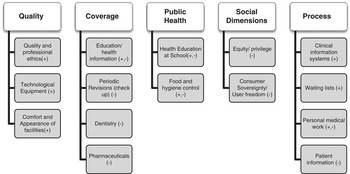
Upon transcribing the results of the different focus group discussions, we proceeded to describe in a single figure the most important outcomes. Specifically, Figure 1 reports the full list of values identified by the focus groups. The list is organised into five broad groups, with some subcategories. Values with a (+) were regarded as ‘attained health system value’, and those with a (−) were regarded as areas where the health system needs improvement, and hence a health system programme could be implemented to address them. The list of values is broad and includes coverage, accessibility, quality, public health social cohesion, process and public health. This list can be interpreted as a transcription which reflects the outcome of the focus group discussion, but one which is not value free. Furthermore, it reports a descriptive non-weighted list of health system values, and hence does not necessarily reflect each dimension’s strength. Thus, although informative, it is deemed as excessively detailed and unmanageable, especially if we are interested in identifying dimension of value to integrate into a wider decision-making framework. From this first exercise, it is important to highlight the heterogeneity of value dimensions which include process-related benefits, as well as other categories such as public health, quality and equity and social considerations.
Health system values classification. Note: This figure shows the value classification resulting from of a set of focus groups where participants were asked to elicit the values perceived from the Catalan Health System.

As explained, before moving onto validating such a list, we involved health system policy makers to design programmes that fulfilled the list of benefits described in Figure 1. A list of 10 programmes is described in Table 2A.
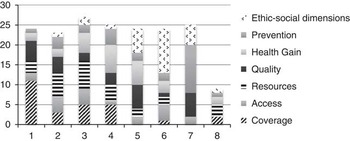
Following this, we proceeded to directly validate the values in Figure 2 by examining ratings of different health system values on each programme. Figure 2 reports the average ratings of the exercise for each value dimension in each group and indicate that only a handful of benefit dimensions are rated highly. Some groups seemed to place high value on coverage or prevention (group 7) whilst groups 5 and 6 value equity and resource dimensions of value. The list of values included the following dimensions: prevention and health gain; resources and coverage as process gains; and social consideration for access as a form of equity.
Ratings of health system values by different participant groups. Note: The figure shows the average rating of health system values listed in Table A1. Average ratings to the following question: ‘What do you value from a health system?’ by different groups as defined in Table A1. Specifically, (1) refers to lower middle-class retirees, (2) refers to white collar workers, (3) refers to blue collar workers, (4) is made up of middle-class rural workers, (5) includes graduate students, (6) refers to higher income community members, (7) refers to trade union affiliates and finally (8) is made up of working class mothers.

The first exercise gave rise to a long transcription of discussions, which was carefully scrutinised and compared to the values identified in the second exercise of indirect value elicitation. Some of the comments are worth reproducing as they provide some contextual information. For instance, the difficulties of understanding the above mentioned rating exercise became apparent when we asked participants to reveal scores for each category.Footnote 3
Given that we collected individual information, we were able to run some cross-tabulations to check whether any specific individual characteristics were driving the results. We find some evidence that those who ranked coverage as a top priority appeared to be financially constrained themselves, and likely perceived prioritising coverage would increase accessibility to services for themselves. In contrast, those who rated the need to improve certain services commented that their answers were motivated by overcrowded public health care services. Those who valued investment in the health system, under what we term ‘resources’, were more likely to argue that without adequate infrastructure and staff, people could not be given services. Also, they thought that prioritising resources secured greater financial resources for technology, which would ultimately lead to better streamlining, testing and diagnosis, reduce waiting times and generally solve problems faster. Public health was intensively discussed and highly ranked by all. Finally, references to cancer programmes and check-ups led to significant health gain value dimensions, whereas life styles, bonuses and odontology show a positive coefficient for non-health value dimensions, in particular those dealing with equity values. Results lead us to conclude that the types of health programmes that would have been designed by policy makers, to some extent, are on the whole reflecting the main health system values previously mentioned.
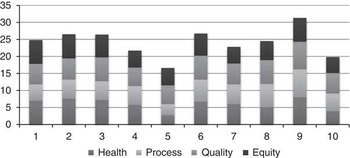
Figure 3 reports the average rating of the questions listed in Figure A2 where individuals ranked different health system programmes from 1 to 10. The ratings have the same score extremes and hence are compatible across programmes; however, given the exploratory nature of the exercise we are not interested in the statistical properties of each dimension. Instead, Figure 3 reveals that from the list of health system programmes defined, almost every group managed to identify some improvement in almost all the dimensions listed. However, it is remarkable that health gain was highly valued by some but not for all. In contrast, process, equity and quality consistently appear to rank highly even though statistical significance between dimensions is not regarded as the primary goal of this exercise.
Average health system value ratings of each health care programmes designed by health policy makers. Note: The figure displays on the Y axis the average rank ranging from 1 to 10, and on the X axis the programmes listed which were elicited from values identified in Figures 1 and 2. The full programme list can be found in the Online Appendix in Table A2.

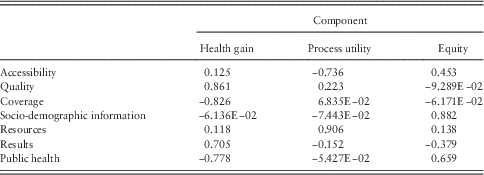
Finally, Table 1 contains the result of PCA using a varimax rotation where three dimensions account for >90% of the variability in factors underpinning an individual’s values ratings. Responses from PCA were recorded on a seven-point scale, 1–7. We use a 0.6 loading factor as the cut-off point to assess whether or not an item is used to construct a factor. The validity indicators displayed acceptable resultsFootnote 4 – and the three dimensions were conceptualised as health gain, process utility and equity according to the underlying coefficients.
Health system dimensions reduction from value ratings (principal components analysis)

Note: Extraction method: principal component analysis.
Rotation method: varimax with Kaiser normalisation.
Rotated component matrix: rotation converged in five iterations.
The table reports the principal component analysis of the values associated with each programme listed in Table A2 by participants.
This suggests that health system value identification can be revealed by individuals, and that a priori description of health values by decision makers might lead to incomplete dimensions. However, the commonly held view that a handful of value dimensions trump the rest, as elaborated in Murray and Frenk (Reference Murray, Lauer, Tandon and Frenk2000), seems to hold overall when health system value dimensions are elicited, as we report in this paper.
5 Discussion
Health care decision makers are increasingly faced with trade-offs between health care programmes that attain an array of health and non-health values. To date, there is limited guidance on how these decisions can be informed but some methodologies can be developed to elicit value dimensions. The identification of the source and values of public health systems is at the core of many health system reforms. Some progress has been made on the discussion of methodologies that assist the prioritisation of different health programmes (Wiseman et al., Reference Wiseman, Mooney, Berry and Tang2003); however, there is limited research on the adequate methodology to assess what programmes health systems should incorporate. An important feature is that the decision frameworks in such value elicitation methods ought to be ‘realistic’. Arguably, ‘realism’ in the methodological approach is likely to reduce the bias in identifying values, and to engage participants who might otherwise believe that some of the existing techniques are of little use beyond academia (Sacramento Health Care Decisions, Reference Smithson2006). If health system programmes are designed to attain or satisfy certain ‘latent’ values (as perceived by users), then the key question is what value dimensions a health system should focus on. This has been the goal of this paper.
This paper reports what we believe to be an operative methodology to identify health system values in a European setting. Additionally, we show an implementable validation exercise to confirm that the exercise is meaningful in such settings. Specifically, we have initially employed a qualitative technique to identify a list of health system values, followed by a quantitative methodology to rate such dimensions and further employ data reduction techniques to validate them using a questionnaire and PCA in a realistic health care reform setting. Given the setting of the study refers to a well-established and publicly funded health system, we believe that our results are generalisable to national health systems generally.
Overall, the findings of the study suggest that both actual and/or potential users of the health system in Catalonia are able to consistently identify a set of heterogeneous health system value dimensions beyond health gain. However, to make the list operational, some of these values dimensions were reduced to a manageable wider category. Non-health gains refer to ‘process’ and ‘social-or equity-related’ values. Hence, in making health care decisions, policy makers should pay attention to the effect of health care programmes on both the process of health care delivery, and the distributional effect of such values. However, the weight that each magnitude ought to receive is specific to the social values in each setting.
One limitation of value elicitation methods such as the one reported here is that distributional values may differ from those revealed under a (theoretical) ‘veil of ignorance’ (where individuals are not aware of their position in society). Hence, the revealed health system values presented here reflect a combination of both ‘experienced’ and ‘expected’ values, and hence might be reflective of the heterogeneity of individual’s experiences and biased by them. Furthermore, another constraint is that this exercise is limited to the identification of a list of values rather than their strengths. Hence, it is complementary to other preference elicitation mechanisms (e.g., choice models) which identify the strength of each benefit at every point in time. One can envisage this exercise as the first stage before choice exercises and implemented to estimate the trade-off between dimensions of value. Furthermore, it is important to note that our study took place long before austerity cuts to the health budget took place. If the same exercise was to be repeated today, it might produce a different value list. Examining how different those dimensions of value score at times of austerity is an empirical question for further research. Finally, we limit our methodology to purely health system values, however, the health system might produce effects outside the health sector and hence those values would not be identified.
6 Conclusion and implications
Given that health system reform decisions require the identification of a set of health programmes entailing (welfare) improvements, one should ultimately find out individuals’ valuations of health system value. Otherwise, there is a risk that reform (the subset of health care programmes introduced) is not really perceived as improving health system value. The empirical identification of such value dimensions is not a trivial question. This paper draws upon a methodology to both identify and validate such value dimensions in European health systems.
We find that although health care programmes do satisfy a long list of values, such values can be reduced to three dimensions (validated using data reduction techniques), namely (i) ‘health gain’, (ii) health care process and finally, (iii) health care equity. These dimensions are consistent with some dimensions identified in the World Health Report (Murray et al., Reference Murray and Frenk2000), which proposed three objectives (health, fair financing and responsiveness). However, we find that our participants’ views are broader and include other objectives than those found in the World Health Report. The three dimensions identified indicate that publicly funded health systems ought to combine improving population health with attention to how health care is improved, and who receives such care. Hence, a single goal health policy is unlikely to attain the desired welfare effects. There are at least three implications. First, focussing only on improving health gain will not necessarily capture health system performance fully. Second, health system performance ought to include measures of health care process which are typically missed in WHO performance exercises, and possibly, other country or cultural specific dimensions of value. This is especially the case when the methodology may not capture differences across countries with different levels of social and economic development. Finally, although we identify three dimensions of value, a further step is to understand the trade-offs made in setting priorities and making health systems choices. That is, identifying the specific weights that different measures of values have in different countries and systems.
Acknowledgement
We are very grateful to the comment of two referee reports and the editor. All errors are our own fault and the usual disclaimer applies.
Supplementary material
To view supplementary material for this article, please visit https://doi.org/10.1017/S1744133117000032