INTRODUCTION
Seahorses are cryptic, secretive, shy fish that are superbly evolved to live in a variety of habitats. They have an upright posture with a prehensile tail that can only be unlocked in the most extreme conditions. They blend into the background with the ability to grow and reabsorb spiny appendages depending on their habitat. The incubation of eggs by male sygnathids is of wide interest. Carcupino et al. (Reference Carcupino, Baldacci, Mazzini and Franzoi2002) compared the male brood pouch in three syngnathid species. Hippocampus guttulatus eggs are brooded for about 1 month before the hatchlings are expelled (Koldewey, Reference Koldewey2005).
In 1994 Garrick-Maidment set up the British Seahorse Survey, now run by The Seahorse Trust and is the longest running survey of syngnathids in the world. The aims of the survey are to understand more about their distribution and behaviour around the UK and Ireland. To date there are over 600 records of seahorses, the combined effort of thousands of volunteers. Seahorses range from the Shetland Isles to the south coast of England and from the North Sea to the UK west coast and around Ireland (Garrick-Maidment, Reference Garrick-Maidment1998; Pinnegar et al., Reference Pinnegar, Stelzenmuller, Van der Kooij, Engelhard, Garrick-Maidment and Righton2008). The depth-range is equally broad, from <1 m to 77 m depth. Two species of seahorse are found in the British Isles: the spiny (Hippocampus guttulatus, Cuvier, 1829) and the short snouted (Hippocampus hippocampus Linnaeus, 1758), both widely distributed and both specializing in differing habitats due to subtle differences in the shape of the snout, body and their dietary needs (Garrick-Maidment, Reference Garrick-Maidment1998, Reference Koldewey2007).
In the UK and Ireland seahorses are found in a wide variety of habitats from silt to rocky areas and from macroalgae to seagrass (Garrick-Maidment, Reference Garrick-Maidment2007). They are superbly adapted to this variety of habitats through their camouflage, ability to change colour and cryptic behaviour which makes them extremely difficult to find. Hippocampus guttulatus is predominantly associated with seagrass (Zostera spp., 43% records) and algal habitats whilst H. hippocampus has a broader range of habitats.
Hippocampus hippocampus is on the OSPAR priority list of threatened and endangered species (ICES, 2003). On 6 April 2008 both native species and the habitat in which they live received full protection under a variation to Schedule 5 of the Wildlife and Countryside Act (1981). There is now an urgent need to obtain more information on the behaviour and ecological requirements of the two species.
In 2004 Hatcher and Trewhella discovered a pregnant male H. guttulatus off South Beach, Studland Bay, Dorset. During searches in 2008 some 40 sightings of seahorses (mainly H. guttulatus but also H. hippocampus) in this area provided a unique opportunity to study seahorses at the only known breeding location for both indigenous species in the UK. In 2009 The Seahorse Trust devised a project to tag seahorses in situ to increase our understanding of individual seahorse behaviour, fidelity of breeding pairs, frequency of pregnancy, habitat and seasonal movements.
MATERIALS AND METHODS
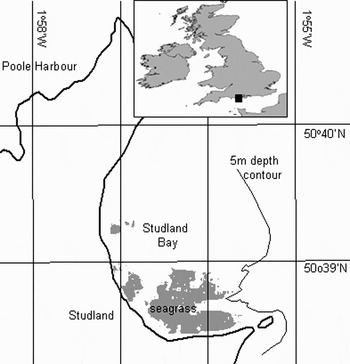
This study of tagged seahorses was carried out in the south-western part of Studland Bay, Dorset on the central south coast of England (Figure 1). The sandy bay is shallow (dropping to 5 m depth 2 km from the shore), and well protected from the prevailing south-west winds, making it an ideal habitat for a dense seagrass bed of Zostera marina, Linnaeus, covering some 50 ha. The shelter and proximity to the port of Poole make it a popular anchorage.
Location of the seagrass study site in southern Studland Bay, Dorset.

Within the bay an area 75 × 75 m of seagrass, delineated by existing mooring buoys, was routinely and systematically searched by SCUBA divers. Water depth ranged from 1–3 m below chart datum with a spring tidal range of 2 m. Between May and September 2009, the site was visited weekly and often more frequently by a large team of volunteer and project divers totalling 129 volunteer days and 235.5 man hours of underwater observation. It typically required 2–3 man hours of searching to find each seahorse, reflecting the density of the seagrass and blade length, often <1 m.
Once located the seahorses were captured, photographed, tagged (as described below) and released immediately in exactly the same spot without being brought to the surface at any time. The positions (±3 m) at which seahorses were captured and sighted were recorded using small global positioning system (GPS, Garmin Etrex) units attached to surface marker buoys towed by the divers (Collins & Baldock, Reference Collins and Baldock2007). Subsequently tagged seahorses were only handled by licensed personnel for the purpose of reading the tag number. Observations made by volunteers did not involve handling the animals. Records were made of the density of the seagrass at the sighting locations, seahorse posture and small scale movements including feeding and interaction of pairs.
Seahorses are very difficult to study in the field (Curtis et al., Reference Curtis, Moreau, Marsden, Bell, Martin-Smith, Samoilys and Vincent2004; Lucy Woodall and Maria Mc Glynn, personal communications) and with the exception of a few animals that have very distinctive markings, making them difficult to identify as individuals (Morgan & Bull, Reference Morgan and Bull2005).
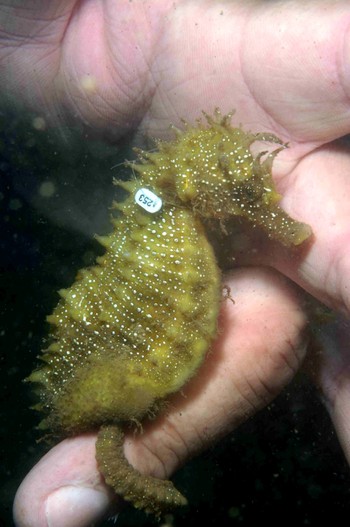
Floy Tag Inc. (Seattle, USA) FTF-69 tags were employed after extensive research including successfully keeping one tagged female H. guttulatus in a deliberately complicated tank environment for four years without entrapment or abrasion. The small (5 × 3 mm) plastic numbered tag was fitted underwater, held around the neck of the seahorse by an elasticated nylon cord and laid unobtrusively in place (Figure 2). Many UK aquaria (Sealife Centres, Blue Reef, Blue Planet and National Marine Aquarium) have used this method to mark individual seahorses without detrimental effects (Koldeway, Reference Garrick-Maidment2005). Lipton & Thangaraj (Reference Lipton and Thangaraj2007) found no significant differences in growth between similarly tagged and untagged groups of Hippocampus kuda. In the present study the only problem was algal growth obscuring the number on the tag but this is soon cleared by scraping with a thumb nail.
A tagged Hippocampus guttulatus.

In 2009 members of The Seahorse Trust were issued with licenses under the Wildlife and Countryside Act (1981) to start studying and tagging seahorses at the Studland site. As part of the licensing agreement conditions, initially just three seahorses were tagged and recovered to check on the effect of the tags. Subsequently permission was obtained to tag further individuals.
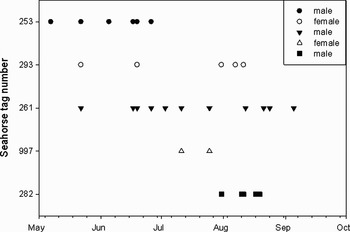
A total of five H. guttulatus have been tagged and re-sighted a total of 29 times (Figure 3) with no adverse reactions to the handling and tagging. When the first seahorse (adult male, No. 253) was tagged it remained very calm during the whole process that took two minutes. Once tagged he was measured and photographed and would not release himself from the tagger's finger having to be gently prised off. Similar reactions were recorded for the subsequent taggings. When all of the seahorses were placed back into the seagrass, they settled on the spot quickly and returned to their previous behaviour, including feeding.
Dates of initial tagging and re-sightings of seahorses during 2009.

RESULTS
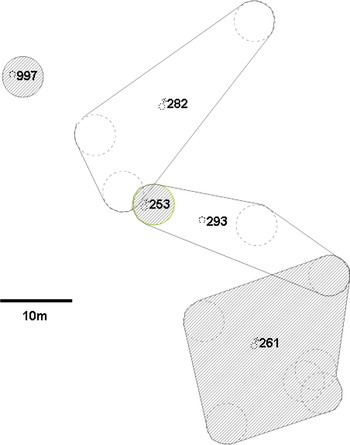
Out of the five tagged seahorses there were two pairs and one single male; the two males in the tagged pairs have been re-sighted most frequently, particularly male No. 261 (Figure 3). Both of these males were repeatedly found within metres of a seabed feature through the summer. Plotting the GPS co-ordinates (including circles of GPS error, ±3 m) for all animals as polygons indicates home ranges up to 30 m across (Figure 4). There is overlap in home range of a female (No. 293) with two males (Nos 253 & 261). Allowing for the positional uncertainty in the GPS positions, these home range areas over the summer, cover 30–400 m2 (average 167 m2).
Locations of the 5 tagged seahorses (males: Nos 253, 261 & 282 and females: Nos 997 & 293). The circles denote the GPS positional error and solid lines denote the inferred home ranges during the period of observation (see Figure 3).

Both the males (Nos 253 & 261) were adults with fully developed pouches but not pregnant when first tagged in May. The mature female (No. 293) was located less than 2 m away from the male (No. 261) in dense seagrass. The courtship display of one pair has been recorded on video, believed to be a first in the British Isles for this species. The female swam 1 m towards the male at the edge of the seagrass then both swam about 1 m into dense seagrass and started an elaborate display. They held their snouts close to their trunks, with tails entwined, the male swaying, jerking backward and forward for 15 minutes before separating but still staying close for several more minutes. All three tagged males have been repeatedly pregnant. The longest series of observations was of No. 261 which was continuously pregnant from late May to early September.
One surprising observation made and photographed by Trewhella and Hatcher, was the possible courtship display between individuals of different species. The female H. guttulatus and pregnant male H. hippocampus had their tails entwined, both exhibiting courtship coloration. A pregnant male H. guttulatus was within 1 m of the pair. In captivity it has been known that species can inter-breed but this has never been observed in the wild.
DISCUSSION
The home ranges found in this study (30–400 m2) are larger than found by other workers. Foster & Vincent (Reference Foster and Vincent2004) cite unpublished data from Curtis which show home ranges for H. guttulatus of 0.005–67 m2. In southern Portugal, Curtis & Vincent (Reference Curtis and Vincent2006) pooled home ranges for this species finding an average size of 19.9 ± 12.4 m2.
Based on the known duration of pregnancy (Koldewey, Reference Garrick-Maidment2005) and the apparently constant incubation of eggs, it would be reasonable to assume that in Studland Bay the reproductive cycle is repeating approximately once a month. The observed, repeated pregnancy of one male from May to September suggests up to five cycles of egg brooding per year. Typical production is 300–500 fry per brood (Curtis, Reference Curtis2007) equating to about 2000 per male per year. Assuming survival to maturity is 0.2% (Amanda Vincent, personal communication) each male has the capability of producing five or more surviving offspring per breeding season. Curtis (Reference Curtis2007) similarly estimated the potential reproductive rate of the dwarf seahorse, H. zosterae.
The site at Studland has long been a natural sheltered anchorage used by visiting day pleasure craft and yachts that are seeking shelter from storms and high winds. During the summer months, numbers of visiting craft may exceed 200 vessels per day. There are about 30 fixed moorings at the site so the majority of vessels anchor into the seagrass, often damaging the seagrass habitat by leaving scars from dragging and lifting their anchors (Ceccherelli & Campo, Reference Ceccherelli and Campo2002). The heavy long chains of the fixed moorings sweep the seabed, maintaining bare patches of up to 15 m across. The negative impact of anchors and moorings on the sediment cohesion and infauna is discussed by Collins et al. (Reference Collins, Mallinson and Suonpaain press). Seagrasses are well known for their ability to bind the seabed together and reduce wave action thus providing a natural coastal defence role (Bos et al., Reference Bos, Bouma, de Kort and van Katwijk2007; Widdows et al., Reference Widdows, Pope, Brinsley, Asmus and Asmus2008). In Studland Bay, concerns arise from increasing use by boats causing unsustainable damage to the seagrass leading to its eventual decline. If this happens then the seagrass habitat will decline along with its associated species. Around the world the solution to anchoring in fragile habitats is the provision of fixed, low impact moorings which minimize damage to the seabed habitat.
The first part of the tagging project has been successful; relocating all five tagged H. guttulatus several times during a seven month period. No adverse effects from tagging and handling have been observed. The successful relocation of individuals is largely due to fidelity to small home ranges (30 m across). The three tagged males were all pregnant and on one occasion the courtship display was recorded. Information on their breeding ecology (Foster & Vincent, Reference Foster and Vincent2004) will hopefully contribute to establishing management plans for this unique site.
This study has demonstrated the value of volunteer survey divers. Although they are not licensed to handle the seahorses, their observations have been proven to be invaluable and the study would not have been so successful without them. There are plans to continue the project to gain insights into the overwinter movements of seahorses, anticipating movement offshore and return the following year.
ACKNOWLEDGEMENTS
The tagging project was supported by a grant from the Heritage Lottery Fund to The Seahorse Trust. Apart from this funding, the research received no specific grant from any funding agency, commercial or not-for-profit sectors. Invaluable background information has been supplied by seahorse researchers in the UK: Amanda Vincent, Heather Koldewey and Lucy Woodall; and internationally: Maria McGlenn, Spain; Dave Harasti, Australia; Paul Camilleri, Malta. Many volunteer divers have contributed to this project, notably: Mike Markey, Lin Baldock, Susanne Munnelly and Helen McNee.