Introduction
During the last two decades, an increased interest for automatic associations has also spread to the field of psychopathology (e.g. de Houwer, Reference de Houwer2002). This kind of research is inspired by recent information-processing models that emphasize the importance to distinguish between more deliberate (i.e. explicit) and more automatically activated cognitions. Both types of cognitions are believed to have different functional qualities (e.g. Gawronski & Bodenhausen, Reference Gawronski and Bodenhausen2006). Explicit cognitions are assumed to reflect the outcome of the weighting of propositions and their corresponding ‘truth’ values (i.e. validation processes), whereas automatic associations are assumed to follow from direct activation of simple associations in memory, independent of their truth value. While explicit cognitions tend to predict more deliberate, controlled behaviors, automatic associations seem to play an important role in guiding relatively spontaneous, uncontrollable behaviors (e.g. Spalding & Hardin, Reference Spalding and Hardin1999; Egloff & Schmukle, Reference Egloff and Schmukle2002; Huijding & de Jong, Reference Huijding and de Jong2006), the kind of behaviors that are also critically involved in psychopathology where patients often report symptoms being unpredictable and uncontrollable (e.g. Mayer et al. Reference Mayer, Merckelbach and Muris2000).
Dysfunctional automatic associations are not, by definition, present in psychological disorders and sometimes automatic associations diverge from their explicit equivalents (e.g. de Jong et al. Reference de Jong, van den Hout, Rietbroek and Huijding2003; de Raedt et al. Reference de Raedt, Schacht, Franck and De Houwer2006; Brauer et al. Reference Brauer, de Jong, Huijding, Laan and Kuile2009). Moreover, in the cases where dysfunctional automatic associations do co-occur with dysfunctional explicit cognitions, this does not imply that automatic associations are redundant, since they tend to predict different kinds of behavior (see e.g. Asendorpf et al. Reference Asendorpf, Banse and Mücke2002; Huijding & de Jong, Reference Huijding and de Jong2006). In addition, treatment-induced changes in explicit associations do not necessarily imply similar changes in automatic associations or vice versa (e.g. Huijding & de Jong, Reference Huijding and de Jong2009). Starting from this, it seems possible that persistent automatic associations at least partially account for the persistence and/or return of psychopathological symptoms.
Cognitive theory points to the importance of negative schemas with regard to ‘the self’ in the onset and maintenance of psychopathology (e.g. Clark et al. Reference Clark, Beck and Alford1999). In line with this, several studies provided evidence for a relationship between automatic self-associations and various types of psychopathological symptoms, such as symptoms of obsessive compulsive personality disorder (Weertman et al. Reference Weertman, Arntz, de Jong and Rinck2008) and chronic pain (Grumm et al. Reference Grumm, Erbe, von Collani and Nestler2008). There is also considerable support for the notion that automatic self-anxious associations are involved in anxiety (Egloff & Schmukle, Reference Egloff and Schmukle2002; Gamer et al. Reference Gamer, Schmukle, Luka-Krausgrill and Egloff2008). Yet, thus far, studies testing the role of automatic self-anxious associations typically compared a ‘pathological’ group with a healthy control group. It remains, therefore, to be tested whether these self-associations reflect disorder/anxiety-specific automatic associations or should be considered as more general characteristics that are shared by other psychological disorders as well. Following this, we included depressed individuals as a clinical control group and tested whether enhanced automatic self-anxious associations are typically involved in anxiety disorders (ADs) but not in depression.
Although there is already supportive evidence that automatic self-anxious associations are involved in anxiety and anxious behavior (Egloff & Schmukle, Reference Egloff and Schmukle2002), little is known about automatic self-depressive associations and the link with depression. Yet, analogous to self-anxious associations in ADs, self-depressive associations may be especially relevant for guiding relatively spontaneous depressed behaviors, thoughts and feelings and may thus help to explain the uncontrollability and persistence of these symptoms. Therefore, the second goal of this study was to examine whether patients with a current major depressive disorder (MDD) are specifically characterized by automatic self-depressive associations.
The third goal was to investigate whether dysfunctional automatic self-associations represent a relatively stable characteristic that remains unchanged even after recovery of anxiety and/or depressive disorder. Therefore, we examined whether individuals remitted from an AD, a major depression or both were still characterized by enhanced automatic self-depressive/anxious associations. If dysfunctional automatic self-associations are a stable cognitive feature of affective disorders, we would expect them to be still present in remitted individuals.
Two Implicit Association Tests (IATs; Greenwald et al. Reference Greenwald, McGhee and Schwartz1998) were used to obtain measurements of automatic self-anxious and self-depressive associations. Data were collected among patients and non-clinical controls as part of The Netherlands Study of Depression and Anxiety (NESDA) (see www.nesda.nl). This is the first study that explores the specificity of automatic self-associations in such a large-scale, clinical sample. We hypothesized that (remitted) depressive patients would be characterized by enhanced automatic self-depressive associations and (remitted) anxious patients by enhanced automatic self-anxious associations.
Method
This study was carried out in the context of the NESDA (Penninx et al. Reference Penninx, Beekman, Smit, Zitman, Nolen, Spinhoven, Cuijpers, de Jong, van Marwijck, Assendelft, van der Meer, Verhaak, Wensing, de Graaf, Hoogendijk, Ormel and van Dyck2008), a multi-center, longitudinal cohort study designed to examine the long-term course and consequences of anxiety and depressive disorders. This study concerns the baseline measurement conducted from September 2004 to February 2007. The study protocol was approved centrally by the Ethical Review Board of VU Medical Center Amsterdam and subsequently by local review boards of each participating center/institute.
Participants
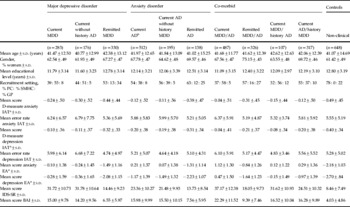
Recruitment of respondents took place in the general population, in general practices and in mental health care institutions and included a range of psychopathology: controls without symptoms or disorders; individuals at risk because of prior episodes; sub-threshold symptoms or family history; individuals with a current first or recurrent depressive or anxiety disorder. Across the recruitment setting, uniform inclusion and exclusion criteria were used. A general inclusion criterion was an age of 18–65 years. Only two exclusion criteria existed: (1) primary clinical diagnosis of a psychiatric disorder not subject of NESDA, which would largely affect course trajectory: psychotic disorder, obsessive compulsive disorder, bipolar disorder or severe addiction disorder; (2) not being fluent in Dutch. In total, 2981 participants [66.5% female; mean age 41.9 years, standard deviation (s.d.) 13.0] were included, of which 652 were non-clinical controls without present or past diagnosis. We chose to focus on individuals with a current (during the past month) or past diagnosis of major depressive disorder and/or a current or past AD (general AD, panic disorder, social phobia and agoraphobia). The different groups and their characteristics can be found in Table 1 (see also Penninx et al. Reference Penninx, Beekman, Smit, Zitman, Nolen, Spinhoven, Cuijpers, de Jong, van Marwijck, Assendelft, van der Meer, Verhaak, Wensing, de Graaf, Hoogendijk, Ormel and van Dyck2008).
Means and standard deviations (s.d.) of the self-report and automatic measures as a function of group

PC, Primary care; SMHC, specialized mental health care; GP, general population; IAT, Implicit Association Test; EA, explicit associations; MDD, major depressive disorder; AD, anxiety disorder; IDS-SR, Inventory of Depressive Symptoms self-report; BAI, Beck Anxiety Inventory.
a Positive effects indicate a relatively stronger automatic/explicit association between me and anxious/depressed.
b Social phobia (n=128); panic disorder (n=129); agoraphobia (n=63); generalized anxiety disorder (n=50); more than one anxiety disorder (n=142).
Measures
Implicit Association Test
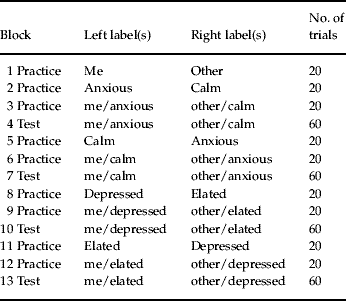
The IAT is a computerized reaction time task originally designed by Greenwald et al. (Reference Greenwald, McGhee and Schwartz1998) to measure the relative strengths of automatic associations between two contrasted target concepts and two attribute concepts. Words from all four concept categories appear in mixed order in the middle of a computer screen and participants are instructed to sort them with a left (Q) or right (P) response key. The premise here is that the sorting becomes easier when a target and attribute that share the same response key are strongly associated than when they are weakly associated (e.g. an anxious person should find it easier to categorize words of ‘me’ and ‘anxious’ with the same button than ‘me’ and ‘calm’). The category labels are visible in the upper left and right-hand corners of the screen during the whole task (for an example, see https://implicit.harvard.edu/implicit). Following the design of Egloff & Schmukle (Reference Egloff and Schmukle2002), two IATs were constructed to measure automatic self-anxious associations and automatic self-depressive associations. For both IATs, target labels were ‘me’ and ‘other’ (cf. Pinter & Greenwald, Reference Pinter and Greenwald2005). Attribute labels were ‘anxious’ and ‘calm’ for the anxiety IAT and ‘depressed’ and ‘elated’ for the depression IAT. Each category consisted of five stimuli (see Appendix A). Both IATs consisted of two critical test blocks that were preceded by practice blocks (see Table 2). The order of category combinations was fixed across participants to reduce method variance. This is assumed to enhance the sensitivity of the IAT as a measure of individual differences, which is important in view of the prospective design of the NESDA (cf. Asendorpf et al. Reference Asendorpf, Banse and Mücke2002; Schnabel et al. Reference Schnabel, Banse and Asendorpf2006; Steffens & König, Reference Steffens and König2006).
Arrangement of the different Implicit Association Test blocks

To obtain explicit equivalents of the automatic associations, participants rated all IAT attribute stimuli on a 5-point scale (1=hardly/not at all, 5=very much) (i.e. ‘For each word please indicate to what extent you think it generally applies to you’).
Diagnostic assessment and other measures
Depressive and anxiety disorders were determined by means of the lifetime Composite International Diagnostic Interview (CIDI) (WHO version 2.1, Robins et al. Reference Robins, Wing, Wittchen, Helzer, Babor, Burke, Farmer, Jablensky, Pickens, Regier, Sartorius and Towle1989), which classifies diagnoses according to DSM-IV criteria (APA, 2001). Participants with a current disorder suffered from this disorder during the past month. People were considered remitted when they currently no longer met the criteria, but had a depressive or anxiety episode in the past. The CIDI is used worldwide and WHO field research has found high inter-rater reliability (Wittchen et al. Reference Wittchen, Robins, Cottler, Sartorius, Burke and Regier1991), high test–retest reliability (Wacker et al. Reference Wacker, Battegay, Mullejans, Schlosser, Stefanis, Rabavilas and Soldatos2006) and high validity for depressive and anxiety disorders (Wittchen et al. Reference Wittchen, Burke, Semler, Pfister, Von and Zaudig1989; Wittchen, Reference Wittchen1994). In order to conduct the study, over 40 research assistants (psychologists, nurses and residents in psychiatry) were trained during 1 week by the fieldwork coordinator. Interviewer performance was monitored by checking a random selection of about 10% of all taped interviews. In addition, a continuous monitoring system of interviewer variances and interviewer-specific item non-response was maintained through computer analyses in SPSS (SPSS Inc., Chicago, IL, USA).
Severity of depressive symptoms was measured with the 30-item Inventory of Depressive Symptoms Self-Report version (IDS-SR; Rush et al. Reference Rush, Gullion, Basco, Jarrett and Trivedi1996). Severity of anxiety symptoms was measured using the 21-item Beck Anxiety Inventory (BAI; Beck et al. Reference Beck, Epstein, Brown and Steer1988). We used total scale scores of these questionnaires as indices for severity of depressive and anxiety symptoms.
Procedure
The assessment lasted between 3 and 5 h and was conducted on 1 day. During the assessment, first the CIDI, then the IATs and explicit ratings were obtained. In between and afterwards, other measurements were collected, but these are not of interest for the present study (for a detailed description, see Penninx et al. Reference Penninx, Beekman, Smit, Zitman, Nolen, Spinhoven, Cuijpers, de Jong, van Marwijck, Assendelft, van der Meer, Verhaak, Wensing, de Graaf, Hoogendijk, Ormel and van Dyck2008). Each participant completed the anxiety IAT, followed by the depression IAT. After that, they explicitly rated the attribute words that were used in the IATs. Respondents were compensated with a €15 gift certificate and travel expenses.
Data analyses
Data reduction
IAT scores were computed according to the now widely used algorithm proposed by Greenwald et al. (Reference Greenwald, Nosek and Banaji2003). We report the D4-measure. Reaction times above 10 000 ms were discarded and error trials were replaced with the mean reaction times of the correct responses in the block in which the error occurred plus a penalty of 600 ms. For the anxiety IAT, the IAT effect was calculated by subtracting mean reaction times of block 3 from block 6 (practice) and block 4 from block 7 (test). The means of these two effects were divided by their pooled standard deviation based on all responses in blocks 3, 4, 6 and 7. Analogously, the IAT effect was calculated for the depression IAT, based on blocks 9, 10, 12 and 13. Positive IAT effects indicate relatively fast responses when ‘me’ shared the response key with either ‘anxious’ or ‘depressed’. For descriptive purposes, mean scores (ms per block per group) are summarized in Appendix B. Split-half reliabilities of the present IATs were good, with Spearman-Brown corrected correlations between test halves of 0.82 for the depression IAT and 0.87 for the anxiety IAT (test halves were based on trials 1, 2, 5, 6, 9, 10, etc. v. 3, 4, 7, 8, 11, 12, etc.).
To compute explicit association effects, mean ratings of calm (elated) IAT-stimuli were subtracted from mean ratings of anxious (depressed) IAT stimuli. Hence, positive effects indicate strong explicit associations between ‘me’ and ‘anxious’ (or ‘me’ and ‘depressed’). The internal consistency of the explicit self-association measures was good, with Cronbach's α 0.94 for the difference scores of anxious and calm words and 0.95 of depressed and elated words.
Statistical analyses
The anxiety and depression IATs could not be compared directly, because different attribute concepts were used and because the order of IATs was fixed. Therefore, univariate analyses of variance (ANOVA) were run on automatic self-anxious and self-depressive associations with group as between-subject factor. The univariate tests were conducted with α<0.05. The Bonferroni procedure was used to control for the inflation of type 1 errors arising from testing multiple planned comparisons. For comparison reasons, all tests were repeated with explicit self-anxious and self-depressive associations as dependent variables. Finally, stepwise regression analyses were used to explore whether automatic associations had predictive validity for symptom severity as measured by the BAI and IDS-SR over and above explicit self-beliefs.
Results
Descriptives
Missing values
Due to technical problems, IAT data for 129 participants were missing. Furthermore, 10 participants were discarded from all analyses because more than 10% of the IAT trials were below 300 ms (Greenwald et al. Reference Greenwald, Nosek and Banaji2003), suggesting that they were trying to respond too rapidly. Five participants were discarded because of unusual D-scores (>5 s.d. divergent from mean), which were explained by a very slow overall responding tendency (>4000 ms) and/or high error rates (>28.8%). The mean D-scores and standard deviations of the IATs and the explicit associations are reported in Table 1.
Construction of groups
As can be seen in Table 1, groups were constructed based on different combinations of current and past diagnoses of major depression and anxiety disorders. We first constructed groups of participants with a current MDD, a current AD or both (irrespective of their history) and included a non-clinical control group.
Second, we examined whether people who were remitted from MDD, AD or both were still characterized by higher levels of automatic self-anxious/depressive associations. We constructed groups with remitted patients (MDD, AD or both) and compared them with patients with a current diagnosis and controls. To keep the comparisons straightforward, we examined MDD and AD groups separately. Additionally, we compared current and past co-morbid groups with controls and also included participants with a current MDD with a history of AD and, similarly, participants with a current AD who had a history of MDD.
Correlations
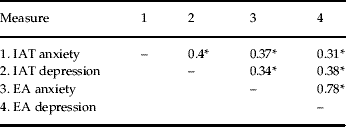
The correlations between automatic and explicit self-associations are shown in Table 3. Further exploration for separate groups revealed similar patterns of automatic-explicit correlations.
Correlation matrix of automatic and explicit self-anxious and self-depressive associations over all participants (n=2837)

IAT, Implicit Association Test; EA, explicit associations.
* Correlation is significant at the 0.01 level (two-tailed).
Are anxious patients characterized by automatic self-anxious associations?
A four-group (current MDD, current AD, current AD/MDD, control) ANOVA on automatic self-anxious associations showed a significant main effect for group [F(3, 1926)=92.04, p<0.001, partial η2=0.13]. As expected, the anxious group showed significantly stronger automatic self-anxious associations (i.e. a relatively faster response when ‘me’ and ‘anxious’ shared the response key) than both the depressed and the control group [anxious v. depressed: t(793)=3.32, p=0.001, d=0.24; anxious v. controls: t(1005.69)=12.79, p<0.001, d=0.76]. The co-morbid group inclined towards a higher score than did the anxious group [t(997)=2.23, p=0.03, d=0.16].
Are depressed patients characterized by automatic self-depressive associations?
A similar four-group ANOVA on self-depressive associations showed a significant main effect for group [F(3, 1926)=98.54, p<0.001, partial η2=0.13]. As expected, the depressed group showed significantly stronger automatic self-depressive associations than the control group [t(929)=12.23, p<0.001, d=0.86] and the anxious group [t(793)=3.42, p=0.001, d=0.27]. The co-morbid group again inclined towards a higher score than did the depressed group [t(656.87)=2.08, p=0.04, d=0.16]. However, future research has to show whether this trend represents a robust phenomenon.
The ADs (general AD, panic disorder, social phobia and agoraphobia) were compared on both IATs. There was no significant main effect of group (p's>0.1), indicating that automatic self-anxious and automatic self-depressive associations were very similar for the various ADs.
Are remitted patients still characterized by automatic self-anxious/depressed associations?
Major depressive disorder
A three-group (current MDD, remitted MDD, control) ANOVA on IAT depression showed a significant main effect for group [F(2, 1151)=49.64, p<0.001, partial η2=0.08]. Remitted participants showed significantly lower self-depressive associations than participants with a current depression [t(504)=6.41, p<0.001, d=0.52]. However, remitted patients still scored significantly higher than the controls [t(976)=3.55, p<0.001, d=0.24].
Anxiety disorder
A three-group (current AD, remitted AD, control) ANOVA on IAT anxiety showed a significant main effect for group [F(2, 978)=47.98, p<0.001, partial η2=0.09]. Remitted participants showed significantly lower automatic-self-anxious associations than participants with a current AD [t(322.05)=4.80, p<0.001, d=0.52]. However, remitted patients still showed significantly stronger self-anxious associations than the controls [t(784)=2.56, p=0.01, d=0.24].
Co-morbid
A five-group (remitted AD/MDD, current AD/MDD, current AD/remitted MDD, current MDD/remitted AD, control) ANOVA on IAT depression showed a significant main effect for group [F(4, 1880)=70.43, p<0.001, partial η2=0.13]. Remitted MDD/AD participants showed significantly weaker automatic self-depressive associations than participants with current MDD/AD and participants with current MDD who were remitted from AD [remitted AD/MDD v. current AD/MDD: t(811)=5.76, p<0.001, d=0.56; remitted AD/MDD v. current MDD/remitted AD:t(431)=3.04, p<0.01, d=0.37]. However, remitted patients still scored significantly higher than did the controls [t(972)=8.22, p<0.001, d=0.53]. No significant difference was found in automatic self-depressive associations between participants remitted from AD/MDD and participants with current AD who were remitted from MDD (p=0.80).
A five-group (remitted AD/MDD, current AD/MDD, current AD/remitted MDD, current MDD/remitted AD, control) ANOVA on IAT anxiety showed a significant main effect for group [F(4, 1880)=72.30, p<0.001, partial η2=0.13]. Remitted participants showed significantly lower automatic self-anxious associations compared with all groups of participants with current disorders [remitted AD/MDD v. current AD/MDD: t(811)=7.77, p<0.001, d=0.56; remitted AD/MDD v. current AD/remitted MDD: t(641)=5.12, p<0.001, d=0.40; remitted AD/MDD v. current MDD/remitted AD: t(431)=3.17, p<0.01, d=0.36]. However, remitted patients still scored significantly higher than the controls [t(972)=5.72, p<0.001, d=0.40].
Do the groups differ similarly on explicit equivalents?
Similar univariate ANOVA were run, but this time with explicit self-anxious and self-depressive associations as dependent variables instead of automatic self-associations. In line with the trend for the automatic measurements, the co-morbid group scored significantly higher than did the anxious group on explicit self-anxious associations and higher than the depressed group on explicit self-depressive associations (p's<0.001). However, we observed a difference for participants remitted from AD/MDD, who had significantly weaker explicit self-depressive associations than the participants with current AD who were remitted from MDD [t(641)=6.39, p<0.001, d=1.09]. Apart from this difference, the analyses revealed a similar pattern of results as with the automatic measures.Footnote 1Footnote †
Are automatic associations predictive for symptom severity?
First, explicit self-depression associations were entered in a regression model to predict the score on IDS-SR. This was shown to be significant [F(1, 2828)=3586.20, p<0.001, R 2 change=0.56]. Then, IAT depression was added to the model and was shown to be predictive for IDS-SR over and above explicit self-depression associations [F(1, 2827)=18.12, p<0.001, R 2 change=0.003]. Second, explicit self-anxiety associations were entered in a regression model to predict the score on BAI, which was also shown to be significant [F(1, 2835)=2343.17, p<0.001, R 2 change=0.45]. Next, IAT anxiety was predictive for BAI over and above explicit self-anxiety associations [F(1, 2834)=23.51, p<0.001, R 2 change=0.005].
Discussion
This study represents the first research into disorder-specificity of automatic self-associations in ADs and depression. The main findings can be summarized as follows: (i) patients with an AD showed stronger automatic self-anxious associations than did depressed patients and controls; (ii) similarly, patients with a major depression showed stronger automatic self-depressive associations than did anxious patients and controls; (iii) participants with co-morbid AD and MDD displayed both strong automatic self-anxious and self-depressive associations; (iv) although people remitted from a disorder showed weaker automatic self-associations than people with a current disorder, their automatic self-anxious/depressed associations were still significantly stronger than those of the control group; (v) although the effects were small, automatic associations significantly predicted the severity of anxious and depressive symptoms over and above explicit self-beliefs.
In line with current views stressing the potential importance of dysfunctional automatic associations in the etiology and maintenance of affective disorders (e.g. Beevers, Reference Beevers2005; Haeffel et al. Reference Haeffel, Abramson, Brazy, Shah, Teachman and Nosek2007), the present study clearly shows that patients and healthy controls do differ with regard to automatic self-associations. Consistent with the hypothesis that negative self-schemas are important in the onset and maintenance of psychopathology (e.g. Clark et al. Reference Clark, Beck and Alford1999), automatic self-anxious and automatic self-depressive associations differentiated between depressed and anxious patients, whereas the co-morbid group displayed high scores on both types of automatic self-associations. These results further strengthen earlier findings that the IAT can measure more specific associations than simple positive–negative evaluations (cf. Teachman et al. Reference Teachman, Gregg and Woody2001; Rüsch et al. Reference Rüsch, Lieb, Göttler, Hermann, Schramm, Richter, Jacob, Corrigan and Bohus2007). However, at the same time, the results suggest that next to disorder-specific factors, common factors underlie both anxiety and depressive disorders, which is underlined by the high correlations that were found between anxiety and depressive measures. Although the differences between the groups on explicit equivalents were generally in the same direction, the correlations between the implicit and explicit measurements were only moderate. This is consistent with other studies (e.g. Hofmann et al. Reference Hofmann, Gawronski, Gschwendner, Le and Schmitt2005) and in accordance with the starting point that different memory processes form the basis of explicit and automatic cognitions (Gawronski & Bodenhausen, Reference Gawronski and Bodenhausen2006).
A second goal was to investigate whether dysfunctional automatic self-associations represent a relatively stable characteristic that remains unchanged after recovery of AD and/or depressive disorder. Results showed that remitted individuals automatically associated themselves stronger with anxious and/or depressive words than healthy controls. Although the differences were small to moderate, this pattern of results is consistent with the view that negative self-associations may form a stable cognitive feature for affective disorders. However, it remains unclear whether it indeed concerns pre-morbid vulnerability, a ‘scar’Footnote 2 that remained as a result of a prior episode, which may set people at risk for recurrence of symptoms, or both. To arrive at more solid conclusions in this respect, an important next step would be to complement these cross-sectional data with a longitudinal approach to examine the alleged role of dysfunctional automatic associations in the onset and maintenance of anxiety and depressive symptoms.
At the same time, remitted individuals showed weaker automatic self-anxious/depressive associations than individuals with a current disorder. This could indicate that automatic self-associations also relate to the severity of current symptomsFootnote 3, which is supported by the fact that remitted individuals show less anxious and depressive symptoms than individuals with a current disorder, but somewhat more symptoms than the control group. However, the present correlational data are silent with regard to the direction of this relationship. Therefore, it remains to be tested whether automatic associations lead to symptoms, or vice versa, or whether automatic associations are merely epiphenomena of a disorder. Furthermore, it would be important to test the predictive validity of automatic associations for the recurrence of anxiety and depressive episodes. It is possible that treatment might differentially influence automatic and explicit cognitions. As a result, unaffected, residual, dysfunctional automatic self-associations may play an important role in the recurrence of spontaneous, uncontrolled depressive and anxiety symptoms (cf. Huijding & de Jong, Reference Huijding and de Jong2009).
Interestingly, in comparison with patients with a single current AD or major depression, the current co-morbid patients inclined towards a higher score on automatic self-anxious and self-depressive associations. For explicit self-associations a similar pattern was evident. This pattern of findings is in accordance with current and previous observations that co-morbid patients also report relatively severe symptoms (see also Hecht et al. Reference Hecht, Von and Wittchen1990; Roy-Byrne et al. Reference Roy-Byrne, Stang, Wittchen, Ustun, Walters and Kessler2000; Bruce et al. Reference Bruce, Yonkers, Otto, Eisen, Weisberg, Pagano, Shea and Keller2005) and provides further evidence for the link between the strength of implicit self-associations and the severity of symptoms. However, it could also constitute a general vulnerability to develop both MDD and AD.
Limitations
Some comments are in order with regard to the limitations of the present study. First, the order of the anxiety IAT and the depression IAT, and the order of the category combinations within both IATs, was fixed. Although this has clear advantages with regard to the enhancement of the sensitivity of the IAT as a measurement of individual differences (cf., Asendorpf et al. Reference Asendorpf, Banse and Mücke2002; Schnabel et al. Reference Schnabel, Banse and Asendorpf2006; Steffens & König, Reference Steffens and König2006), this procedure also has some important drawbacks. IAT effects tend to decrease with the number of IATs presented to a participant (Greenwald et al. Reference Greenwald, Nosek and Banaji2003). Consequently, the present fixed order hampers direct comparison of both IATs. Furthermore, it makes it hard to interpret the absolute value of the IAT outcomes, which means that the negative IAT indices that we found do not simply imply stronger self-calm/elated associations. The negative indices could also be caused by order effects resulting in the zero point not being an actual ‘zero point’. However, it seems that this ambiguity is not critical in the present context, because our focus was primarily on the relative differences in automatic associations between groups. Second, it is important to note that the IAT is only one of several instruments that are often used to index automatic associations (for a critical overview, see e.g. de Houwer, Reference de Houwer, Wiers and Stacy2006) and, although the psychometric properties of the IAT have been well tested during the past decade, the IAT is not without its critics (e.g. Fiedler et al. Reference Fiedler, Messner and Bluemke2006). Finally, the correlations between automatic measures and between explicit self-association measures were higher than between automatic and explicit measures of self-anxiety associations and between automatic and explicit measures of self-depressive associations. This may indicate that the method variance is rather high. However, the present pattern of results may also be due to a greater ‘conceptual overlap’ between implicit and explicit measures.
Conclusions and future directions
The present study produced the first evidence that automatic self-anxious and automatic self-depressive associations are differentially involved in ADs and/or MDD. These findings point to the potential importance of automatic self-associations in the understanding of underlying cognitive mechanisms of affective disorders. In addition, the present study provided tentative evidence consistent with the notion that enhanced self-anxious and self-depressive associations can be considered as relatively stable features of affective disorders. An important next step would be to complement these cross-sectional data with a longitudinal and/or experimental approach to elucidate further whether automatic self-associations might indeed have a differential predictive value for the onset, maintenance and recurrence of anxiety and/or depression. This could generate fresh starting points in order to improve and develop tailored interventions that might contribute to more effective treatment of depression and anxiety.
Acknowledgements
The NESDA study was supported by the Geestkracht Program of The Netherlands Organization for Scientific Research (ZON-MW, grant number, 10-000-1002) and matching funds have come from participating universities and mental health care organizations (VU University Medical Center, GGZ Buitenamstel, GGZ Geestgronden, Leiden University Medical Center, GGZ Rivierduinen, University Medical Center Groningen, University of Groningen, Lentis, GGZ Friesland, GGZ Drenthe). We thank Brenda Penninx, PhD and Jan Smit, PhD for their vital contributions to the NESDA study, Bert Hoekzema for technical support, Rafaele Huntjens, PhD for statistical advice and PSY-opleidingen Noord Oost for financial support of the first author.
Declaration of interest
None.
Appendix A: Implicit Association Test stimulus words

Words are translated from Dutch.
Appendix B: Mean scores per block of IAT reaction times

IAT, Implicit Association Test; MDD, major depressive disorder; AD, anxiety disorder.
The mean reaction times (ms) were calculated for the correct responses. The unweighted mean between practice and test trials is reported.