Introduction
Depression is common across the lifespan, affecting approximately one in five individuals over the age of 50 years (Volkert et al., Reference Volkert, Schulz, Härter, Wlodarczyk and Andreas2013). Dementia affects 5–7% of the global population aged over 60 years, with 35.6 million people living with dementia in 2010 (Prince et al., Reference Prince, Bryce, Albanese, Wimo, Ribeiro and Ferri2013). Both depression and dementia contribute substantially to the global burden of disease in those aged over 60 years, with evidence to suggest that this burden has increased in recent decades (Prince et al., Reference Prince, Wu, Guo, Robledo, O'Donnell, Sullivan and Yusuf2015). Evidence also suggests that depressive symptoms and cognitive decline frequently co-occur in older individuals (Byers and Yaffe, Reference Byers and Yaffe2011; Bunce et al., Reference Bunce, Batterham, Christensen and Mackinnon2014). However, the nature of this relationship is complex and poorly understood (Reppermund and Tsang, Reference Reppermund, Tsang, Baune and Tully2016).
Understanding the mechanisms underpinning the relationship between depression and cognition is important, especially in the context of both the prevention and treatment of these disabling disorders. As such, several mechanisms linking depression and cognition have been proposed, with the most prominent being vascular disease (Byers and Yaffe, Reference Byers and Yaffe2011). There is evidence for a bidirectional relationship between vascular disease and depression. Both small and large vessel diseases have been shown to predate and predict the occurrence of late-life depression (Fang and Cheng, Reference Fang and Cheng2009; Reppermund et al., Reference Reppermund, Zhuang, Wen, Slavin, Trollor, Brodaty and Sachdev2014; van Sloten et al., Reference Van Sloten, Sigurdsson, Van Buchem, Phillips, Jonsson, Ding, Schram, Harris, Gudnason and Launer2015; Reppermund and Tsang, Reference Reppermund, Tsang, Baune and Tully2016; van Agtmaal et al., Reference Van Agtmaal, Houben, Pouwer, Stehouwer and Schram2017), whilst prior depression has also been related to an increased risk of vascular disease (Ferketich et al., Reference Ferketich, Schwartzbaum, Frid and Moeschberger2000; Liebetrau et al., Reference Liebetrau, Steen and Skoog2008). Vascular disease is also associated with cognitive impairment and decline (Vermeer et al., Reference Vermeer, Prins, Den Heijer, Hofman, Koudstaal and Breteler2003; Prins et al., Reference Prins, Van Dijk, Den Heijer, Vermeer, Jolles, Koudstaal, Hofman and Breteler2005; Vemuri et al., Reference Vemuri, Lesnick, Przybelski, Knopman, Preboske, Kantarci, Raman, Machulda, Mielke and Lowe2015). The inter-relationships between depression, cognition and vascular disease have been formalised in the ‘vascular depression’ hypothesis (Krishnan et al., Reference Krishnan, Hays and Blazer1997; Alexopoulos et al., Reference Alexopoulos, Meyers, Young, Campbell, Silbersweig and Charlson1997a, Reference Alexopoulos, Meyers, Young, Kakuma, Silbersweig and Charlson1997b; Sneed and Culang-Reinlieb, Reference Sneed and Culang-Reinlieb2011; Taylor et al., Reference Taylor, Aizenstein and Alexopoulos2013; Valkanova and Ebmeier, Reference Valkanova and Ebmeier2013). According to this hypothesis, vascular disease disrupts frontostriatal networks associated with both mood and cognition, leading to the observed inter-relationships between depression, cognition and vascular disease.
Prospective studies, however, indicate that the relationship between neurocognitive disorders and depression appears to be independent of the effects of vascular disease. In one study, the prospective relationship between depression and mild cognitive impairment (MCI) was not altered by adjusting for a history of vascular events, subclinical vascular disease or magnetic resonance imaging (MRI) evidence of vascular disease (Barnes et al., Reference Barnes, Alexopoulos, Lopez, Williamson and Yaffe2006). In another prospective study, the relationship between depression and Alzheimer's disease was not explained by vascular risk factors or a history of stroke (Luchsinger et al., Reference Luchsinger, Honig, Tang and Devanand2008). Meanwhile, depressive symptoms have also been shown to prospectively predict cognitive decline and dementia in older people independently of small vessel disease, including cerebral white matter hyperintensities, lacunes and microbleeds (Saczynski et al., Reference Saczynski, Beiser, Seshadri, Auerbach, Wolf and Au2010; Verdelho et al., Reference Verdelho, Madureira, Moleiro, Ferro, T O'Brien, Poggesi, Pantoni, Fazekas, Scheltens and Waldemar2013; van Uden et al., Reference Van Uden, Van Der Holst, Van Leijsen, Tuladhar, Van Norden, De Laat, Claassen, Van Dijk, Kessels and Richard2016). A small body of prospective research has therefore accumulated that indicates that depressive symptoms predict cognitive decline and incident neurocognitive disorders independently of vascular disease. Two of these studies, however, were conducted in individuals selected on the basis of existing small vessel disease (Verdelho et al., Reference Verdelho, Madureira, Moleiro, Ferro, T O'Brien, Poggesi, Pantoni, Fazekas, Scheltens and Waldemar2013; van Uden et al., Reference Van Uden, Van Der Holst, Van Leijsen, Tuladhar, Van Norden, De Laat, Claassen, Van Dijk, Kessels and Richard2016), whilst a third study did not include imaging data (Luchsinger et al., Reference Luchsinger, Honig, Tang and Devanand2008).
Given international trends towards population ageing (Lutz et al., Reference Lutz, Sanderson and Scherbov2008), and the considerable burden of disease associated with depression, cognition and vascular disease (Murray et al., Reference Murray, Vos, Lozano, Naghavi, Flaxman, Michaud, Ezzati, Shibuya, Salomon and Abdalla2012; Ferrari et al., Reference Ferrari, Charlson, Norman, Patten, Freedman, Murray, Vos and Whiteford2013; Prince et al., Reference Prince, Wu, Guo, Robledo, O'Donnell, Sullivan and Yusuf2015), it is critical that we have a better understanding of the prospective inter-relationships between these disabling disorders using data from well-characterised older cohorts. The current study therefore aims to investigate these inter-relationships within a cross-sectional and longitudinal framework using two waves of data from the Sydney Memory and Ageing Study (MAS), an ongoing prospective study designed to examine the prevalence, longitudinal course and risk and protective factors of cognitive impairment and decline in older, community-dwelling individuals (Sachdev et al., Reference Sachdev, Brodaty, Reppermund, Kochan, Trollor, Draper, Slavin, Crawford, Kang and Broe2010). Based on the existing evidence, it was hypothesised that: (1) at wave 1, there will be an association between depressive symptoms and indicators of cerebrovascular disease; and (2) that both depressive symptoms and indicators of cerebrovascular disease will be independently associated with lower global cognition, with both contributing meaningfully to global cognition at wave 1. When looking at changes from wave 1 to wave 2, it was further hypothesised that: (3) wave 1 indicators of cerebrovascular disease will predict a greater increase in depressive symptoms over time; (4) conversely, depressive symptoms at wave 1 will predict an increase in cerebrovascular disease over time; and (5) more wave 1 depressive symptoms and cerebrovascular disease will be independently associated with declines in global cognition from wave 1 to wave 2, with both contributing meaningfully to declines in cognition over time.
Methods
Participants were recruited from the electoral roll of the Eastern suburbs of Sydney, Australia between 2005 and 2007 as part of the MAS. Detailed methods and recruitment process are published elsewhere (Sachdev et al., Reference Sachdev, Brodaty, Reppermund, Kochan, Trollor, Draper, Slavin, Crawford, Kang and Broe2010). Briefly, 1037 participants aged between 70 and 90 years were assessed using a detailed neuropsychological and medical assessment. Exclusion criteria were dementia (according to DSM-IV criteria), developmental disabilities, psychotic symptoms, schizophrenia or bipolar disorder, multiple sclerosis, motor neuron disease, progressive malignancy and inadequate English to complete a psychometric assessment. The cohort is followed up every 2 years with comprehensive face-to-face assessments.
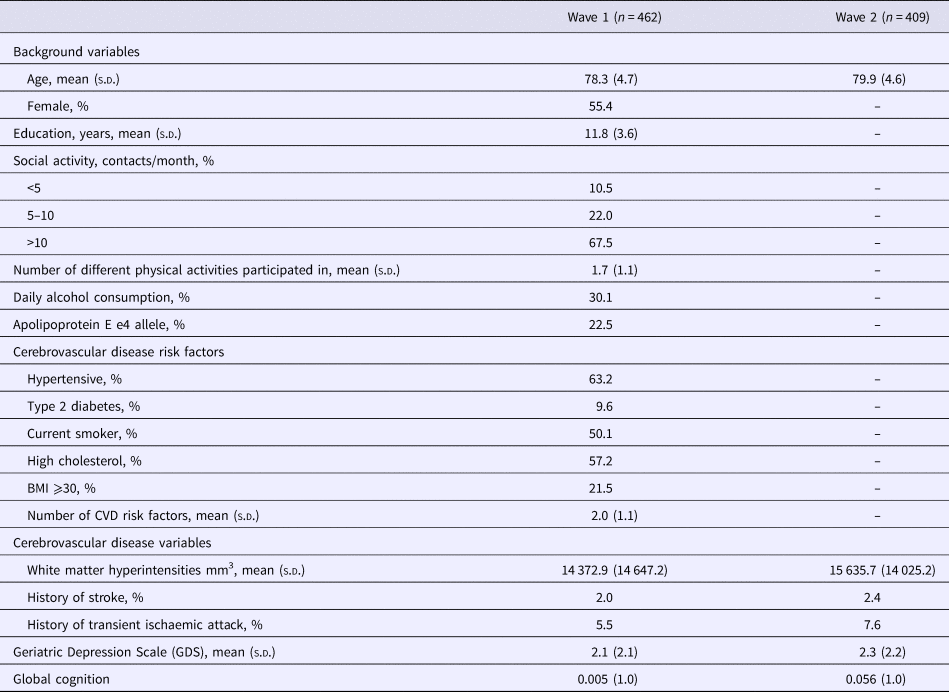
The current study reports findings from waves 1 and 2 when MRI data were collected. All participants without contraindications (pacemaker, metallic implant or foreign bodies, cochlear implants, ferromagnetic homeostatic clips, claustrophobia) were invited to undergo MRI scans. A total of 462 participants agreed to and were eligible for MRI brain scans at wave 1. When compared with those who had an MRI scan done, participants who did not agree to or were ineligible for an MRI were older [79.1 years (s.d. = 4.9) v. 78.3 years (s.d. = 4.7), t = 2.9, p = 0.004] and had fewer years of education [11.3 years (s.d. = 3.3) v. 11.8 years (s.d. = 3.6), t = −2.3, p = 0.024]. There were no differences between these groups with regard to gender, baseline depression scores or baseline global cognition scores (p > 0.05).
Neuropsychological measures
Attention and speed of information processing were measured with the Digit Symbol Test (Wechsler, Reference Wechsler1997) and the Trail Making Test A (TMT-A) (Reitan and Wolfson, Reference Reitan and Wolfson1993). Executive functioning was measured with the Trail Making Test B (TMT-B) (Reitan and Wolfson, Reference Reitan and Wolfson1993) and the Controlled Oral Word Association Test (FAS) (Benton, Reference Benton1967). Memory and learning was assessed using the Rey Auditory Verbal Learning Test (RAVLT) (Rey, Reference Rey1964), Logical Memory delayed recall (Story A) (Wechsler, Reference Wechsler1997) and Benton Visual Retention Test (BVRT) Recognition format (Benton et al., Reference Benton, Sivan and Spreen1966). The language domain was assessed by the Boston Naming Test (BNT) 30-item version (Fastenau et al., Reference Fastenau, Denburg and Mauer1998; Kaplan et al., Reference Kaplan, Goodglass and Weintraub2001) and semantic fluency (Animals task) (Spreen and Bennett, Reference Spreen and Bennett1969). Visuospatial abilities were assessed with Block Design (Wechsler, Reference Wechsler1981). The tests were categorised into domains on an a priori basis according to the principal cognitive function they represented according to convention and theory (Weintraub et al., Reference Weintraub, Salmon, Mercaldo, Ferris, Graff-Radford, Chui, Cummings, Decarli, Foster and Galasko2009). Raw scores were converted to Z-scores, based on the means and s.d.s of a normal cognition reference group derived from the cohort at wave 1. Domain scores were calculated by averaging the Z-score of the component tests. Global cognition scores were obtained by averaging the assessed domain Z-score.
Depression measure
Current depressive symptoms were assessed with the 15-item short form of the GDS (Yesavage et al., Reference Yesavage, Brink, Rose, Lum, Huang, Adey and Leirer1983), a self-rating questionnaire shown to be reliable and valid for the assessment of depressive symptoms in older populations. A higher score (range: 0–15) indicates more symptoms of depression and a cut-off of six has been established to indicate clinically relevant symptoms of depression (Herrmann et al., Reference Herrmann, Mittmann, Silver, Shulman, Busto, Shear and Naranjo1996). The GDS does not include somatic and sexual items, and has been validated for use in individuals with mild impairment of cognition (Yesavage et al., Reference Yesavage, Brink, Rose, Lum, Huang, Adey and Leirer1983). In the MAS, we used the GDS with item 9 as described in Brink (Brink, Reference Brink1982). As the GDS is a self-rated questionnaire, there were some missing data. Provided that 80% or more of the questions were answered, scores were prorated (raw score/items completed × total number of items).
Indicators of cerebrovascular disease
Two indicators of cerebrovascular disease were considered in the current study. The first was total white matter hyperintensity (WMH) volume (mm3) as determined by MRI scanning (described below). The participants were also asked about a history of both stroke and transient ischaemic attack (TIA). These variables (coded dichotomously as yes or no) were based on participant self-report and collected as part of a comprehensive medical history interview. Due to the low prevalence of both stroke (n = 9; 2.0% of the sample) and TIA (n = 25; 5.5% of the sample) at wave 1, these two self-report items were combined to create a composite variable representing a history of either stroke or TIA (coded dichotomously as yes or no).
MRI data acquisition
About half of wave 1 scans were acquired from a Philips 3T Intera Quasar scanner (Philips Medical Systems, The Netherlands), and the other half wave 1 and all wave 2 participants were scanned on a Philips 3T Achieva Quasar Dual scanner. A dummy variable indicating scanner has been used in all statistical analyses to account for any scanner differences. The two scanners were set to the same parameters: T1-weighted MRI – TR = 6.39 ms, TE = 2.9 ms, flip angle = 8°, matrix size = 256 × 256, FOV (field of view) = 256 × 256 × 190 and slice thickness = 1 mm with no gap in between, yielding 1 × 1 × 1 mm3 isotropic voxels. T2-weighted FLAIR – TR = 10 000 ms, TE = 110 ms, TI = 2800 ms, matrix size = 512 × 512, slice thickness = 3.5 mm without gap, and in plane resolution = 0.488 × 0.488 mm. T1-weighted and FLAIR scans of the participants were processed with our in-house WMH extraction pipeline for the whole brain WMH volumes. The algorithm has been described previously (Wen et al., Reference Wen, Sachdev, Li, Chen and Anstey2009).
Control variables
A range of background demographic and clinical control variables were also considered. These included: self-reported age, sex, years of education, social activity (number of face-to-face contacts per month), number of physical activities participated in the past month, current drinking status and APOE E4 status (determined by peripheral blood or saliva deoxyribonucleic acid). Cerebrovascular risk factors were also included: diabetes (self-report of diabetes diagnosed by a medical practitioner or current anti-diabetic medication use as determined by Pharmaceutical Benefits Scheme data), hypertension (determined by a mean systolic blood pressure at or above 160 mmHg or a mean diastolic blood pressure at or above 95 mmHg as determined during medical examination), self-reported current smoking status, self-report of high cholesterol as diagnosed by a medical practitioner and obesity (BMI ⩾30 as determined during medical examination). Initial model-building analyses focused on models with and without the cerebrovascular risk factors included as control variables (results available on request). The inclusion of these variables had minimal impact on the main relationships between cognition, depressive symptoms and cerebrovascular disease, so these were maintained as control variables in all subsequent analyses.
Statistical analysis
All statistical analyses were conducted using SPSS version 24. To investigate wave 1 relationships, linear regression models were implemented. All wave 1 models controlled for sex, APOE status, age, years of education, physical activity, social activity, BMI, hypertension, smoking, diabetes, cholesterol and alcohol consumption. To investigate prospective relationships, generalised estimating equations were implemented, controlling for the same background variables as listed above, as well as assessment occasion which was entered as a categorical variable. An unstructured residual covariance structure was selected as the best covariance structure to model the within-subject dependencies. For the categorical outcome variable (a history of stroke/TIA), a binomial distribution with a logit link function was specified and an unstructured covariance structure was used to model the within-subject dependencies. In all analyses, continuous predictor variables were mean centred. The WMH and GDS data were skewed and therefore log transformed when included as the dependent variable in all analyses.
Results
Depressive symptoms
Participants reported an average of 2.1 and 2.3 symptoms of depression at waves 1 and 2, respectively (Table 1). According to the standard cut-off of 6 on the GDS, 31 (6.7%) participants met criteria for current probable depression at wave 1, whilst 34 (7.4%) met criteria at wave 2. Of those meeting criteria for probable depression at wave 2, 19 (4.1% of the sample) participants had not met criteria at wave 1. According to PBS data, 36 participants had a current prescription for antidepressant medications at wave 1, all of whom met criteria for probable depression according to the GDS.
Description of background characteristics, CVD variables, depression and cognition across the two waves of the Sydney Memory and Ageing Study

Cross-sectional relationships
These results are summarised in Table 2 and Figure 1. When included simultaneously as predictors in a regression model, higher WMH volume [b = 0.003, t (414) = 3.09, p = 0.002] was associated with depressive symptoms at wave 1 (model 1), but a history of stroke/TIA was not [b = −0.062, t (414) = −1.28, p = 0.202]. Post hoc analyses which entered a history of stroke/TIA in a model without WMH volume also indicated that a history of stroke/TIA was not associated with wave 1 depressive symptoms. Depressive symptoms at wave 1 was associated with lower wave 1 global cognition [b = −0.073, t (413) = −3.31, p = 0.001] (model 2). When both CVD measures were included as predictors in the same model, the presence of stroke or TIA at wave 1 was also associated with lower wave 1 global cognition [b = −0.378, t (413) = −2.19, p = 0.029] as was higher WMH volume [b = −0.012, t (413) = −4.10, p < 0.001] (model 3). In the model which entered both depressive symptoms and the indicators of cerebrovascular disease simultaneously, depressive symptoms [b = −0.058, t (413) = −2.64, p = 0.009] and higher WMH volume [b = −0.011, t (413) = −3.77, p < 0.001] remained statistically significant predictors of lower global cognition, whereas the effects of stroke or TIA reduced slightly and no longer reached statistical significance [b = −0.328, t (413) = −1.90, p = 0.058] (model 4).
Cross-sectional relationships between wave 1 depression, cognition and vascular disease in the Sydney Memory and Ageing Study (MAS; n = 462). Numbers displayed are unstandardized regression coefficients.

Unstandardised regression coefficients (b) from analyses investigating cross-sectional (wave 1) relationships between depression, cerebrovascular disease and cognition in the Sydney Memory and Ageing study (n = 462)

TIA, transient ischaemic attach; GDS, Geriatric Depression Scale; WMH, white matter hyperintensities.
a All analyses controlled for sex and APOE status, as well as baseline age, years of education, physical activity, social activity, BMI, hypertension, smoking, diabetes, cholesterol and alcohol consumption.
b Analysis conducted using log transformations of GDS score.
c Numbers displayed are unstandardized regression coefficients.
*p < 0.05; **p < 0.01.
The model that included both depressive symptoms and the indicators of cerebrovascular disease (adjusted R 2 = 0.277) (model 4) explained more variance than the model that only included depressive symptoms [adjusted R 2 = 0.248; ΔR 2 = 0.032; F (1,398) = 9.12, p < 0.001] (model 2) and the model that only included the indicators of cerebrovascular disease [adjusted R 2 = 0.266; ΔR 2 = 0.012; F (1,398) = 6.98, p = 0.009] (model 3). When investigating the cross-sectional relationships with cognition, these findings provide evidence to suggest that depressive symptoms and cerebrovascular disease are independent predictors of cognition, with both contributing meaningfully to global cognition at wave 1.
Longitudinal relationships
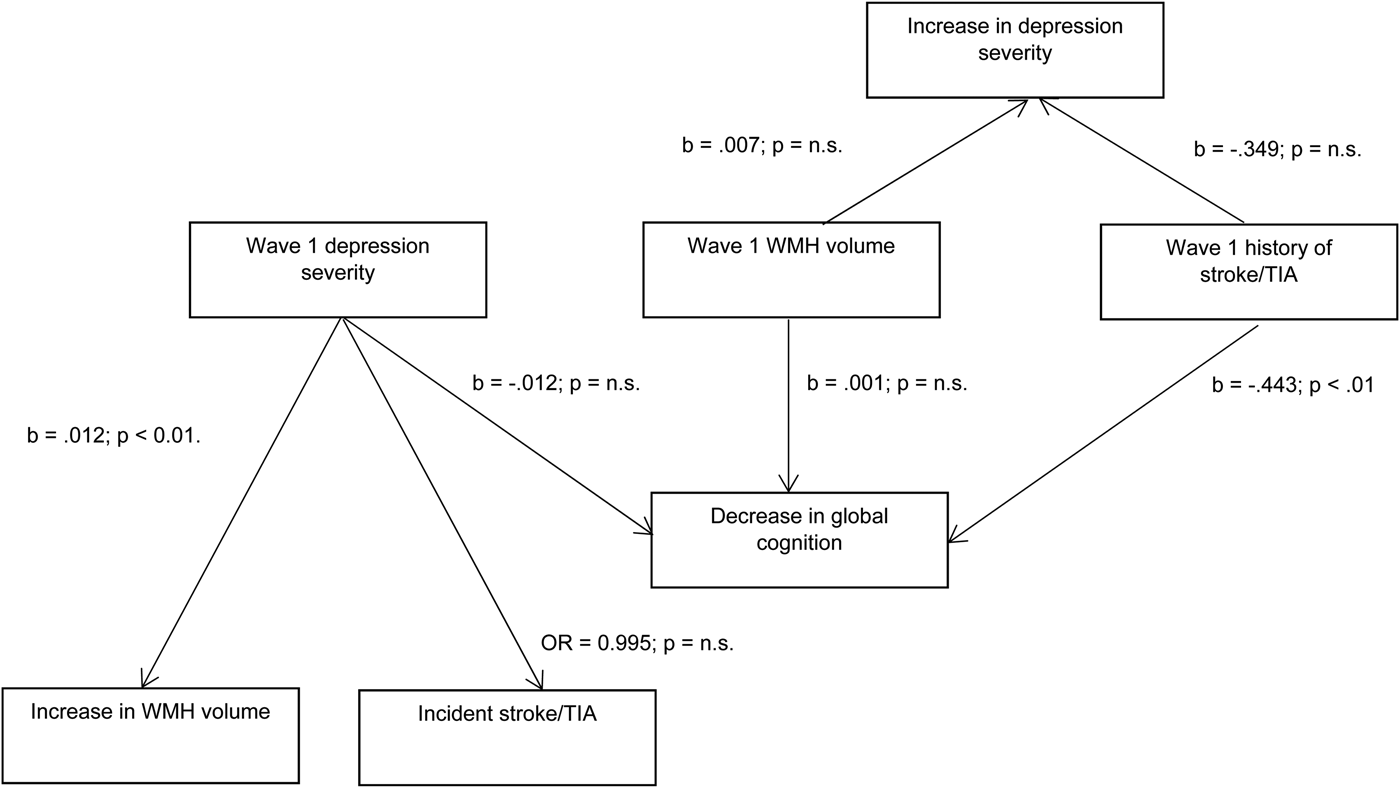
Table 3 and Figure 2 show a summary of these results. A history of stroke/TIA [time interaction: b = −0.011, t (384.0) = −0.230, p = 0.818] and WMH volume [time interaction: b = 0.069, t (387.5) = 0.081, p = 0.935] at wave 1 did not predict increases in depressive symptoms from wave 1 to 2 (model 1). Post hoc analyses which entered a history of stroke/TIA and WMH volume in separate equations also indicated that there was no statistically significant relationship between either indicator of cerebrovascular disease and depressive symptoms over time. Depressive symptoms at wave 1 predicted an increase in WMH volume over time [time interaction: b = 0.012, t (265.9) = −3.291, p = 0.001] (model 2). When investigating the effect of depressive symptoms on changes in the incidence of stroke/TIA over time, a model which included all of the background control variables could not be estimated, possibly due to the very low incidence of stroke/TIA between waves 1 and 2 (n = 6) and missing data on these variables. A model which included assessment occasion and depressive symptoms along with the basic demographic control variables (age, sex, education and APOE E4 status) could be estimated, and indicated that depressive symptoms at wave 1 was not associated with the incidence of stroke/TIA from wave 1 to 2 (time interaction: odds ratio = 0.995; CI 0.949–1.043; p = 0.820) (model 3). Depressive symptoms at wave 1 predicted a greater decline in global cognition from wave 1 to 2 [time interaction: b = −0.027, t (373.5) = −2.16, p = 0.032] (model 4). With interactions with both CVD variables included together in the model, a history of stroke/TIA at wave 1 was also associated with a greater decline in global cognition from wave 1 to 2 [time interaction: b = −0.460, t (361.2) = −4.45, p < 0.001]; however, WMH volume at wave 1 was not associated with a decline in global cognition [time interaction: b = 0.001, t (362.3) = −0.520, p = 0.603] (model 5). Post hoc analyses which no longer adjusted for a history of stroke/TIA also indicated that WMH volume was not associated with a decline in global cognition from wave 1 to 2. In the model that included both depressive symptoms as well as the indicators of cerebrovascular disease, depressive symptoms at wave 1 was no longer a statistically significant predictor of a decline in global cognition over time [time interaction: b = −0.012, t (359.7) = −0.96, p = 0.336], whereas the presence of stroke or TIA at wave 1 remained statistically significant [time interaction: b = −0.443, t (360.6) = −4.28, p < 0.001] (model 6). Post hoc analyses which only adjusted for total WMH severity and not a history of stroke/TIA indicated no attenuation in the relationship between depressive symptoms and cognitive decline, indicating that it was a history of stroke/TIA that largely had an impact on the relationship between depressive symptoms and cognitive decline.
Prospective relationships between depression, cognition and vascular disease in the Sydney Memory and Ageing Study (MAS; n = 462 at wave 1, n = 409 at wave 2). Numbers displayed are unstandardized regression coefficients.

Unstandardised regression coefficients (b) and odds ratio from analyses investigating prospective relationships between depression, cerebrovascular disease and cognition in the Sydney Memory and Ageing study (n = 462 at wave 1)

TIA, transient ischaemic attack; GDS, Geriatric Depression Scale; WMH, white matter hyperintensities; CI, confidence interval.
a All analyses controlled for sex and APOE status, as well as baseline age, years of education, physical activity, social activity, BMI, hypertension, smoking, diabetes, cholesterol and alcohol consumption.
b Analysis conducted using log transformations of WMH volume and GDS score.
c Numbers displayed are unstandardized regression coefficients.
d Represents odds ratio.
*p < 0.05; **p < 0.01.
There were large increases in model fit when comparing the model that included depressive symptoms only (Schwarz's BIC = 1691.076) (model 4) with the model that included both depressive symptoms and the cerebrovascular indicators (Schwarz's BIC = 1618.352) (model 6), but no appreciable difference when comparing the fuller model with the model that included cerebrovascular indicators only (Schwarz's BIC = 1614.327) (model 5). When examining declines in global cognition over time, these findings indicate that depressive symptoms at wave 1 does not increase model fit over and above that already provided by the presence of cerebrovascular disease at wave 1.
Discussion
Using data from a well-characterised cohort of older individuals, the current study investigated the cross-sectional and prospective inter-relationships between depressive symptoms, cognition and vascular disease. Wave 1 depressive symptoms were associated with higher WMH volume but not a history of stroke/TIA. Whilst it was hypothesised that a history of stroke/TIA would be associated with depressive symptoms at wave 1, the lack of a statistically significant relationship is possibly due to the low rates of stroke/TIA in the current study and a subsequent lack of power. Wave 1 depressive symptoms were also associated with lower wave 1 cognition. The relationship between wave 1 depressive symptoms and cognition was independent of the indicators of cerebrovascular disease. There were some unexpected findings when examining the prospective inter-relationships between these health problems. Cerebrovascular disease was not found to predict increases in depressive symptoms over time, whilst depressive symptoms predicted increasing WMH severity over time, but not incident stroke/TIA. When examined in separate models, depressive symptoms and a history of stroke/TIA, but not WMH volume, predicted declines in cognition over time. When investigated in a combined model, a history of stroke/TIA remained a statistically significant predictor of cognitive decline, however, depressive symptoms did not. These unexpected findings are discussed in more detail below.
This study indicated that whilst WMH volume was associated with depressive symptoms at wave 1, neither WMH volume nor a history of stroke/TIA predicted an increase in depressive symptoms over time. Pooled effect sizes from reviews of the literature indicate that, overall, baseline WMHs are associated with increases in depressive symptoms and the incidence of major depression over follow-up (Wang et al., Reference Wang, Leonards, Sterzer and Ebinger2014; van Agtmaal et al., Reference Van Agtmaal, Houben, Pouwer, Stehouwer and Schram2017). However, the prospective evidence base is small and individual studies report conflicting results. The most recent review of the relationship between WMH and depression, for example, included only eight prospective studies, three of which found no evidence of a statistically significant relationship between WMH at baseline and incident depression (van Agtmaal et al., Reference Van Agtmaal, Houben, Pouwer, Stehouwer and Schram2017). Similarly, meta-analyses and reviews have consistently indicated that stroke is associated with the onset of depressive symptoms (Gordon and Hibbard, Reference Gordon and Hibbard1997; Whyte and Mulsant, Reference Whyte and Mulsant2002; Ayerbe et al., Reference Ayerbe, Ayis, Wolfe and Rudd2013; Hackett and Pickles, Reference Hackett and Pickles2014), although this association is not as strong amongst community samples (Robinson and Jorge, Reference Robinson and Jorge2015). The prospective analysis also indicated that a history of stroke/TIA was not associated with an increase in depressive symptoms from Wave 1 to 2. Prospective investigations of individuals with post-stroke depression indicate that the onset of depressive symptoms usually occurs not long after the acute event, with a significant proportion then recovering from depression in subsequent assessments. The prevalence of post-stroke depression, however, appears stable over extended periods of time because the proportion of those who remit are replaced with a similar number of new cases (Ayerbe et al., Reference Ayerbe, Ayis, Wolfe and Rudd2013). This is consistent with the current findings which indicate that a history of stroke/TIA was not related to a change in depressive symptoms over time.
This study also found no evidence to suggest that depressive symptoms at wave 1 predicted an increase in cerebrovascular disease over time. Whilst meta-analyses indicate that depression is associated with an increased risk of vascular disease (Van der Kooy et al., Reference Van Der Kooy, Van Hout, Marwijk, Marten, Stehouwer and Beekman2007), including stroke morbidity and mortality specifically (Pan et al., Reference Pan, Sun, Okereke, Rexrode and Hu2011), many of the component studies included in these meta-analyses report non-significant relationships. The current findings are consistent, for example, with those from the Framingham Study, where depressive symptoms were not associated with an increased risk of stroke/TIA in participants over the age of 65 years (Salaycik et al., Reference Salaycik, Kelly-Hayes, Beiser, Nguyen, Brady, Kase and Wolf2007). It should be noted that the vast majority of the studies examining this relationship excluded individuals reporting a stroke or TIA at baseline, and generally involved much larger samples with sufficient power to detect an association between depression and low incidence events such as stroke and TIA (Pan et al., Reference Pan, Sun, Okereke, Rexrode and Hu2011). Given the relatively small sample size in the current study, and the small number of incident strokes or TIAs, the current study would be underpowered to detect any statistically significant associations between wave 1 depression and incident stroke/TIA.
Surprisingly, the findings from the current study also indicate that macrovascular, but not microvascular, pathology is related to decline in cognition from wave 1 to 2. The prospective relationship between WMH volume and cognitive decline is relatively robust (Vermeer et al., Reference Vermeer, Prins, Den Heijer, Hofman, Koudstaal and Breteler2003; Prins et al., Reference Prins, Van Dijk, Den Heijer, Vermeer, Jolles, Koudstaal, Hofman and Breteler2005; Prins and Scheltens, Reference Prins and Scheltens2015), although there are some inconsistencies in the literature (Brickman et al., Reference Brickman, Muraskin and Zimmerman2009; Debette and Markus, Reference Debette and Markus2010). The current study investigated cognitive decline over a relatively short timeframe (~2 years) and there is some suggestion that small vessel disease may not produce acute symptoms but rather a slow decline in cognitive function that may become apparent over longer term follow-up (Leblanc et al., Reference Leblanc, Meschia, Stuss and Hachinski2006). Amongst stroke patients, on the other hand, cognitive impairment is often evident immediately following the ischaemic event, with high rates of recovery over the following 12 months. However, progressive deterioration is then seen in the overall stroke population in the subsequent months and years (Leblanc et al., Reference Leblanc, Meschia, Stuss and Hachinski2006). The findings from the current study are consistent with these differential effects of microvascular and macrovascular effects on cognitive impairment in the short- and long-term.
This study also found that depressive symptoms did not predict a decline in cognition when adjusting for the effects of a history of stroke/TIA. Previous research focusing on the prospective inter-relationships between depression, cognition and vascular disease consistently indicates that depression and vascular disease provide independent contributions to cognitive decline. However, there are very few prospective studies investigating this relationship, with particularly few investigating the attenuating effect of stroke/TIA on the relationship between depression and subsequent cognitive decline (Barnes et al., Reference Barnes, Alexopoulos, Lopez, Williamson and Yaffe2006; Luchsinger et al., Reference Luchsinger, Honig, Tang and Devanand2008). The current results indicate that at least some aspects of cognitive dysfunction in late-life depression result from vascular changes rather than state or trait aspects of depression (Barch et al., Reference Barch, D'Angelo, Pieper, Wilkins, Welsh-Bohmer, Taylor, Garcia, Gersing, Doraiswamy and Sheline2012). This is consistent with previous research that has shown that both executive dysfunction and WMH burden predict poor response to antidepressants in older samples (Kalayam and Alexopoulos, Reference Kalayam and Alexopoulos1999; Alexopoulos et al., Reference Alexopoulos, Meyers, Young, Kalayam, Kakuma, Gabrielle, Sirey and Hull2000; Alexopoulos et al., Reference Alexopoulos, Kiosses, Murphy and Heo2004; Baldwin et al., Reference Baldwin, Jeffries, Jackson, Sutcliffe, Thacker, Scott and Burns2004; McLennan and Mathias, Reference Mclennan and Mathias2010; Sheline et al., Reference Sheline, Pieper, Barch, Welsh-Boehmer, Mckinstry, Macfall, D'Angelo, Garcia, Gersing and Wilkins2010; Morimoto et al., Reference Morimoto, Gunning, Murphy, Kanellopoulos, Kelly and Alexopoulos2011; Sneed et al., Reference Sneed, Culang-Reinlieb, Brickman, Gunning-Dixon, Johnert, Garcon and Roose2011; Khalaf et al., Reference Khalaf, Edelman, Tudorascu, Andreescu, Reynolds and Aizenstein2015), and that cognitive deficits in late-life depression persist after remission of depressive symptoms (Butters et al., Reference Butters, Becker, Nebes, Zmuda, Mulsant, Pollock and Reynolds2000; Nebes et al., Reference Nebes, Butters, Mulsant, Pollock, Zmuda, Houck and Reynolds2000; Nebes et al., Reference Nebes, Pollock, Houck, Butters, Mulsant, Zmuda and Reynolds2003; Butters et al., Reference Butters, Whyte, Nebes, Begley, Dew, Mulsant, Zmuda, Bhalla, Meltzer and Pollock2004; O'Brien et al., Reference O'Brien, Lloyd, Mckeith, Gholkar and Ferrier2004; Nakano et al., Reference Nakano, Baba, Maeshima, Kitajima, Sakai, Baba, Suzuki, Mimura and Arai2008). Treatment strategies focusing on non-pharmacologic interventions for late-life depression have shown greater promise (Jorge et al., Reference Jorge, Moser, Acion and Robinson2008; Areán et al., Reference Areán, Raue, Mackin, Kanellopoulos, Mcculloch and Alexopoulos2010; Alexopoulos et al., Reference Alexopoulos, Raue, Kiosses, Mackin, Kanellopoulos, Mcculloch and Areán2011; Goodkind et al., Reference Goodkind, Gallagher-Thompson, Thompson, Kesler, Anker, Flournoy, Berman, Holland and O'Hara2015), and may be the focus of future research.
Strengths of this study include its large sample size; detailed evaluation of vascular disease, including vascular events, vascular risk factors and cerebral MRI; the use of a comprehensive neuropsychological battery to assess a range of cognitive functions; and the possibility of carefully controlling for other variables implicated in cognition and depression. At the same time, our interpretations are limited by the relatively small number of individuals with clinically significant depressive symptoms. We assessed depressive symptoms with the self-rated GDS and not with a standardised clinical interview that would have enabled a clinical diagnosis of depression. However, depressive symptoms not fulfilling rigorous diagnostic criteria are highly prevalent in elderly people and their consequences are similar to those of major depression (Beekman et al., Reference Beekman, Deeg, Braam, Smit and Van Tilburg1997; Reppermund et al., Reference Reppermund, Brodaty, Crawford, Kochan, Slavin, Trollor, Draper and Sachdev2011). Only a proportion of potential participants finally participated in the study, and our sample cannot therefore be considered as truly representative of the older population. We also excluded individuals with a diagnosis of dementia or a score <24 on the Mini Mental State Examination (MMSE) (Folstein et al., Reference Folstein, Folstein and Mchugh1975) and the cohort is likely to be higher functioning than a truly representative sample.
Research has consistently shown that depressive symptoms are a risk factor for cognitive decline. It is estimated that nearly 10% of cases of dementia worldwide (equivalent to nearly 3.6 million people) are potentially attributable to depression (Barnes and Yaffe, Reference Barnes and Yaffe2011). Whilst the pathways linking depression and cognition are poorly understood, several mechanisms are currently being investigated (Freiheit et al., Reference Freiheit, Hogan, Eliasziw, Patten, Demchuk, Faris, Anderson, Galbraith, Parboosingh and Ghali2012). These include inflammatory processes and hypothalamic–pituitary–adrenal axis function (Taylor et al., Reference Taylor, Aizenstein and Alexopoulos2013). Early work associated with the vascular depression literature emphasised the role of vascular disease and vascular risk factors (Krishnan et al., Reference Krishnan, Hays and Blazer1997; Alexopoulos et al., Reference Alexopoulos, Meyers, Young, Campbell, Silbersweig and Charlson1997a). A few prospective studies, however, showed that depressive symptoms remained a strong predictor of neurocognitive disorders, such as dementia and MCI, after adjusting for vascular disease. The current study reports contrasting findings, providing impetus for future research to further explore the vascular mechanisms underpinning the relationship between depression and cognition.
Acknowledgements
The authors thank the many research assistants and administrative assistants who contributed to data gathering. The authors are grateful to the participants for their enthusiastic support.
Financial support
This work was supported by a National Health and Medical Research Council of Australia (NHMRC) Program Grants (ID 350833 and 1093083). Dr Mewton is supported by an Australian Rotary Health Postdoctoral Fellowship.
Conflict of interest
None.