


Introduction
Efforts to extend working lives have raised concerns about growing social inequalities in older age. Since the early 2000s, many countries have introduced measures to mitigate the consequences of population ageing, particularly by raising statutory retirement ages and restricting early exit pathways (Ebbinghaus and Hofäcker Reference Ebbinghaus and Hofäcker2013). Employment rates of older workers and effective labour market exit ages have indeed increased (Eurostat 2019; Organisation for Economic Co-operation and Development (OECD) 2019). However, scholars have noted growing inequalities among socio-economic groups induced by these measures (e.g. Radl Reference Radl2013; Tophoven and Tisch Reference Tophoven and Tisch2016; Visser et al. Reference Visser, Gesthuizen, Kraaykamp and Wolbers2016; Kuitto and Helmdag Reference Kuitto and Helmdag2021), since they tend to affect vulnerable workers, such as those with incomplete or part-time careers, more strongly than workers with stable full-time careers. Vulnerable workers generally have lower pension build-up and savings (Peeters et al. Reference Peeters, Debels, Verschraegen and Berghman2008; OECD 2017), increasing the need to work longer. Yet, they also have fewer opportunities to continue working in later life (Visser et al. Reference Visser, Gesthuizen, Kraaykamp and Wolbers2016; Leinonen et al. Reference Leinonen, Chandola, Laaksonen and Martikainen2020), limiting their possibilities to accumulate additional income and pension rights. Measures to extend working lives may therefore reinforce existing inequalities among socio-economic groups. Differences in labour market exit between vulnerable workers and more advantaged workers are not yet well understood. This study therefore examines differences in the timing of labour market exit by type of employment history.
Previous research has shown a social gradient in the timing of labour market exit, but the role of employment history remains understudied. Studies usually distinguish socio-economic groups by education (e.g. Visser et al. Reference Visser, Gesthuizen, Kraaykamp and Wolbers2016; Leinonen et al. Reference Leinonen, Chandola, Laaksonen and Martikainen2020; Mäcken et al. Reference Mäcken, Präg, Hess and Ellwardt2022) or occupational class (e.g. Radl Reference Radl2013; Leinonen et al. Reference Leinonen, Chandola, Laaksonen and Martikainen2020). Findings indicate that lower-educated workers exit the labour market earlier than higher-educated workers, possibly owing to poorer health, higher risk of job loss, lower employability and unfavourable working conditions (Visser et al. Reference Visser, Gesthuizen, Kraaykamp and Wolbers2016; Leinonen et al. Reference Leinonen, Chandola, Laaksonen and Martikainen2020; Mäcken et al. Reference Mäcken, Präg, Hess and Ellwardt2022), or simply because earlier labour market entry enables earlier retirement in some countries. Regarding occupational class, studies show that skilled manual workers tend to exit the labour market the earliest, while the higher salariat, petty bourgeoisie and farmers exit the latest (Radl Reference Radl2013). Despite the rich body of literature on socio-economic position and labour market exit, few studies have adopted a lifecourse perspective and incorporated employment histories.
Following the lifecourse perspective, this study assumes that inequalities in the timing of labour market exit are related to earlier employment patterns. One source of inspiration for this assumption is the cumulative advantage/disadvantage model (Crystal and Shea Reference Crystal and Shea1990), which is frequently referred to as a mechanism for inequality (DiPrete and Eirich Reference DiPrete and Eirich2006; Halpern-Manners et al. Reference Halpern-Manners, Warren, Raymo and Nicholson2015). It posits that early-life advantages and disadvantages persist in later life and are magnified over time, increasing later-life inequality (DiPrete and Eirich Reference DiPrete and Eirich2006; Crystal et al. Reference Crystal, Shea and Reyes2017). Labour market disadvantages, such as employment interruptions, can have adverse effects on re-employment chances (Luijkx and Wolbers Reference Luijkx and Wolbers2009), quality of subsequent jobs (Gangl Reference Gangl2004) and opportunities to accumulate savings and pension rights (Visser et al. Reference Visser, Gesthuizen, Kraaykamp and Wolbers2016), resulting in accumulated disadvantages in later life, such as late-career employment instability (Fournier et al. Reference Fournier, Zimmermann and Gauthier2011), lower net worth (Halpern-Manners et al. Reference Halpern-Manners, Warren, Raymo and Nicholson2015), lower pension income (Peeters et al. Reference Peeters, Debels, Verschraegen and Berghman2008) and poorer outcomes in other life domains, such as health (Wahrendorf et al. Reference Wahrendorf, Hoven, Goldberg, Zins and Siegrist2019). Conversely, labour market advantages, such as continuous full-time employment, can enhance earnings, job security and career opportunities (Seo Reference Seo2021), improving later-life outcomes (OECD 2017). Hence, over time, the gap between advantaged and disadvantaged groups is widened rather than reduced.
This study contributes to the literature in two ways. First, it analyses the differences between socio-economic groups in timing of labour market exit from a lifecourse perspective by incorporating employment histories from early to mid-career. While educational level and occupational status have provided valuable insights into socio-economic differences in exit behaviour, employment histories can provide additional information about the labour market (dis)advantages accumulated throughout the career. Analysing the association with labour market exit can help unravel whether these (dis)advantages persist in later life and which groups of people might be vulnerable in older age. Second, it applies sequence and cluster analysis to derive a typology of employment histories. Prior studies often used summary indicators to operationalise employment histories, such as the sum of years spent in unemployment or in full-time or part-time employment (e.g. Drobnič Reference Drobnič2002; Bennett and Möhring Reference Bennett and Möhring2015; Worts et al. Reference Worts, Corna, Sacker, McMunn and McDonough2016; König Reference König2017) or the number of lay-offs over the career (Flippen and Tienda Reference Flippen and Tienda2000; Visser et al. Reference Visser, Gesthuizen, Kraaykamp and Wolbers2016). Others used binary indicators for experiencing specific career events or episodes, such as unemployment (Trentini Reference Trentini2021), involuntary job loss (Raymo et al. Reference Raymo, Warren, Sweeney, Hauser and Ho2011) or part-time work (Damman et al. Reference Damman, Henkens and Kalmijn2011). However, given the growing occurrence of discontinuous careers and atypical work (Bennett and Möhring Reference Bennett and Möhring2015), some scholars argue that these indicators may not capture the complex nature of previous employment trajectories as they lack information on timing, duration and sequencing of labour market situations (Halpern-Manners et al. Reference Halpern-Manners, Warren, Raymo and Nicholson2015; Duberley and Carmichael Reference Duberley and Carmichael2016). Alternatively, some studies used sequence and cluster analysis to group similar employment histories in relation to labour market exit (e.g. Han and Moen Reference Han and Moen1999; Madero-Cabib et al. Reference Madero-Cabib, Gauthier and Le Goff2016; Visser et al. Reference Visser, Gesthuizen, Kraaykamp and Wolbers2016; Zanasi et al. Reference Zanasi, Sieben and Uunk2020; Glaser et al. Reference Glaser, Di Gessa, Corna, Stuchbury, Platts, Worts, McDonough, Sacker and Price2024). This study classifies employment histories in a similar manner, and derives a typology of employment histories using retrospective data from the Survey of Health, Ageing and Retirement in Europe (SHARE). Additionally, it applies survival analysis to examine the risk of labour market exit between ages 50 and 70, by type of employment history.
The study focuses on Belgium, which provides an interesting case for at least two reasons. First, Belgium has a Bismarckian social security system linking pension entitlements to work history (Werbrouck Reference Werbrouck2019). Belgian statutory pension levels depend on previous wages or revenues as well as career length (European Commission 2024a), and career length is a criterion for gaining early access to the statutory pension. Consequently, the inequalities from heterogeneous employment histories persist into old age. Although the pension system includes instruments to buffer the adverse effects on pension income of non-employment and part-time employment, these may not fully offset all disadvantages. Second, the average effective labour force exit age and employment rates of Belgian older workers are among the lowest in Europe (OECD 2023). Understanding which groups of people, based on their employment histories, exit the labour market when is therefore important. To the best of my knowledge, this is the first study to examine early to mid-career employment trajectories of Belgian men and women and their association with labour market exit.
This study complements prior studies on labour market exit with similar approaches in several respects. Some studies examined different outcome variables, such as retirement age rather than labour market exit in the broader sense (Han and Moen Reference Han and Moen1999; Madero-Cabib et al. Reference Madero-Cabib, Gauthier and Le Goff2016; Tambellini Reference Tambellini2023). Some used different employment states in their sequence analysis (Visser et al. Reference Visser, Gesthuizen, Kraaykamp and Wolbers2016; Zanasi et al. Reference Zanasi, Sieben and Uunk2020; Glaser et al. Reference Glaser, Di Gessa, Corna, Stuchbury, Platts, Worts, McDonough, Sacker and Price2024; Tambellini Reference Tambellini2023), such as a combination of activity rate and pension investments (Madero-Cabib et al. Reference Madero-Cabib, Gauthier and Le Goff2016). Others focused on men or women only (Visser et al. Reference Visser, Gesthuizen, Kraaykamp and Wolbers2016; Zanasi et al. Reference Zanasi, Sieben and Uunk2020; Tambellini Reference Tambellini2023). Most studies included older cohorts (Han and Moen Reference Han and Moen1999; Madero-Cabib et al. Reference Madero-Cabib, Gauthier and Le Goff2016; Glaser et al. Reference Glaser, Di Gessa, Corna, Stuchbury, Platts, Worts, McDonough, Sacker and Price2024), whereas this study also includes younger cohorts, potentially to capture different employment histories considering the rise in female labour force participation in the past decades. Additionally, some used other methods than survival analysis for their multivariate analyses (Han and Moen Reference Han and Moen1999; Zanasi et al. Reference Zanasi, Sieben and Uunk2020; Tambellini Reference Tambellini2023; Glaser et al. Reference Glaser, Di Gessa, Corna, Stuchbury, Platts, Worts, McDonough, Sacker and Price2024), which has the advantage here of being able to estimate the risk of labour market exit for individuals who have not exited yet. Finally, most focused on other countries than Belgium.
The article proceeds as follows. The next section outlines the Belgian context, followed by the theoretical framework and the research design. Then, the results are presented. The article ends with the conclusions and discussion.
The Belgian context
Pension system
The Belgian pension system consists of three pillars: statutory public pensions; occupational pensions organised at the company or industry level; and private savings-based pensions (Peeters et al. Reference Peeters, Debels, Verschraegen and Berghman2008). Discussing the second and third pillar in detail goes beyond the scope of this article, but relevant to note is that access to occupational pensions is not automatically granted to all workers, and pension build-up may vary substantially. For instance, access to collective company pensions is significantly lower among workers with fixed-term contracts than with permanent contracts, and although part-time workers are equally likely to participate as full-time workers, their accrued pension levels are lower (Peeters et al. Reference Peeters, Debels, Verschraegen and Berghman2008). Additionally, flexible and part-time workers do not compensate for their lower pension levels by higher participation in third-pillar pensions (Peeters et al. Reference Peeters, Debels, Verschraegen and Berghman2008). This section focuses on the first pillar since it is the principal part of the Belgian pension system (Federal Planning Bureau 2023) and has the most straightforward link with employment history.
The public pension system consists of separate schemes for employees, the self-employed, and civil servants. In all three, employment history and previous earnings play a role in calculating the pension, in accordance with the Bismarckian tradition, but with substantial differences. Employee pensions are based on yearly gross wages (capped if exceeding a set maximum), divided by 45 (as 45 years is considered a full career) and multiplied by 60 per cent (individual rate) or 75 per cent if the retiree has a dependent spouse (family rate) (European Commission 2024a). Pensions for the self-employed are calculated similarly, but based on business revenue. This generally results in lower pensions than employee pensions owing to lower social contributions and limited access to credits for non-employment periods (European Commission 2021). Tenured civil servants receive the most generous pensions, based on the average wage earned in the last ten years of the career (last five years for those born before 1962), that is, the reference wage. For every year worked as a tenured civil servant, they build up 1/60th of that amount, resulting in 75 per cent of the reference wage after 45 years of service, with specific groups, such as railway personnel and teachers, receiving more beneficial fractions (Federal Pensions Service n.d.a, Federal Pensions Service n.d.b).
Over time, the system became more redistributive than contributory (Jousten et al. Reference Jousten, Lefèbvre, Perelman and Pestieau2015; Werbrouck Reference Werbrouck2019) with the introduction of social corrections, such as minimum pensions, derived pensions for those without sufficient own pension rights but with a (previous) spouse, and assimilated periods (Peeters and De Tavernier Reference Peeters and De Tavernier2015; European Commission 2021). These last are specific periods of non-work, including unemployment, sickness and care leave, during which the accrual of pension rights is safeguarded (Peeters et al. Reference Peeters, Debels, Verschraegen and Berghman2008; European Commission 2021).
Besides old-age pensions, various social security programmes can lead to de facto permanent labour market exit, such as disability insurance, unemployment benefits and social assistance. Relevant to note is that older unemployed individuals (initially from age 50, which increased to 58 in 2002 and 60 in 2013) are exempted from active job search (Steunpunt Werk en Sociale Economie 2015). Additionally, in certain sectors and under certain conditions, older workers who became unemployed could receive unemployment benefits with a company supplement. In specific cases, the minimum eligibility age was 50 (De Brouwer and Tojerow Reference De Brouwer and Tojerow2024). Until 2012, this was referred to as ‘conventional early retirement’ or ‘bridge pension’, although it was technically not a pension. Access has gradually been restricted, and since 2025 it is only granted for medical reasons, from age 58 (Rijksdienst voor Arbeidsvoorziening 2026).
Vulnerable groups
Despite social corrections, several groups remain vulnerable. First, these include individuals with incomplete careers and part-time workers, since assimilated periods apply only to specific types of career interruption and for a limited number of years, and the minimum pension can be unattainable if they fail to meet the career requirements (Peeters et al. Reference Peeters, Debels, Verschraegen and Berghman2008). Additionally, they generally have lower accrual levels in the second and third pension pillar than full-time workers (Peeters et al. Reference Peeters, Debels, Verschraegen and Berghman2008). Second, the self-employed constitute a vulnerable group, since assimilated periods play only a marginal role in their pension build-up and their pensions are the least adequate (European Commission 2021). Third, women are particularly vulnerable owing to the cumulative effect of gender inequalities over the lifecourse. Despite the increased female labour force participation rates, women still carry the lion’s share of the care burden throughout their lifecourse and suffer the consequences of gender stereotypes on their labour market opportunities (European Institute for Gender Equality (EIGE) 2025). This is reflected in a higher likelihood of being in part-time employment or out of the labour force entirely, and in the under-representation of women in leadership roles and other better-paid jobs (European Institute for Gender Equality (EIGE) 2025). The financial impact of these gender inequalities in employment and earnings accumulates over time, resulting in women being more financially vulnerable than men and less often financially independent (European Institute for Gender Equality (EIGE) 2025). Single people, particularly divorced women, also face higher poverty risks in older age since there is no partner in the household to pool the risks of ageing, and derived pension rights from the ex-spouse do not always sufficiently protect against economic hardship (Peeters et al. Reference Peeters, Debels, Verschraegen and Berghman2008; European Commission 2021). Other potentially vulnerable groups include blue-collar workers (Dewilde Reference Dewilde2012) and migrants (Neels et al. Reference Neels, De Wachter and Peeters2018).
Despite the reduced link between contributions and pension benefits, employment histories remain fundamental to the Belgian social security system (Werbrouck Reference Werbrouck2019). The pension system still implies that full employment without interruptions is the standard (Peeters et al. Reference Peeters, Debels, Verschraegen and Berghman2008; Werbrouck Reference Werbrouck2019). Moreover, a recent pension reform will further strengthen the importance of reaching a minimum number of working years to receive a minimum pension (European Commission 2024a).
Retirement age and employment rates
The statutory retirement age was 65 until January 2025, rising to 66 from 2025 and 67 from 2030 (European Commission 2024a). The female statutory retirement age was progressively raised from 60 to 65 between 1997 and 2009, aligning it with men’s. The statutory retirement age for the respondents in this study (born between 1947 and 1967) is 65 for those born in 1959 or earlier, 66 for those born between 1960 and 1963, and 67 for those born in 1964 or later. Retirement at the statutory retirement age is mandatory for tenured civil servants only, although they can apply for an extension of their contract (Federal Public Service Policy and Support 2025; OECD 2025).
Early retirement is possible from age 60 but career conditions have tightened over the years. Until 2012, an early pension could be claimed after a career of 35 years, but this condition was raised to 42 years in 2016 and to 44 years currently (European Commission 2024a; European Commission 2024b). Until 2012, tenured civil servants could claim an early public pension at age 60 after five years of professional activity, but since 2013 the same conditions apply to all three schemes (Government of Flanders n.d.). While there is no penalty for early retirement, shorter careers generally result in lower pensions (European Commission 2021).
Employment rates of Belgian older workers have improved substantially in recent decades, but remain relatively low. For Belgian men between ages 55 and 64, the employment rate increased from 35.1 per cent in 2001 to 62.2 per cent in 2023. For women, the employment rate increased from 15.5 per cent to 53.4 per cent. Despite these improvements, Belgium lags behind the European Union’s average employment rates of 70.1 per cent for men and 58.1 per cent for women in 2023 (OECD 2024). Average effective labour market exit ages remain relatively low at 61.1 for men and 61.3 for women between 2017 and 2022, with Belgium surpassing only France and Luxembourg (OECD 2023).
Theoretical framework
Cumulative (dis)advantage model
The cumulative (dis)advantage model helps understand how inequalities increase over the lifecourse. Advantages and disadvantages in domains such as education, health, income and career position tend to accumulate over time and magnify inequalities between individuals or groups (DiPrete and Eirich Reference DiPrete and Eirich2006; Crystal et al. Reference Crystal, Shea and Reyes2017). For instance, early advantages, such as favourable childhood circumstances, increase the likelihood of attaining higher educational levels, which improves access to good jobs, resulting in higher income and better pension coverage, and non-monetary benefits such as better health, contributing to increased inequalities in later life (Crystal and Shea Reference Crystal and Shea1990; Crystal et al. Reference Crystal, Shea and Reyes2017). Although social changes can moderate this process of diverging outcomes, it tends to be a stable phenomenon (Dannefer Reference Dannefer2003).
Applied to employment trajectories, the effects of labour market (dis)advantages in earlier years may persist and be magnified in later years (Flippen and Tienda Reference Flippen and Tienda2000). Disadvantages such as employment interruptions and part-time employment are negatively related to re-employment chances (Luijkx and Wolbers Reference Luijkx and Wolbers2009), income (Dewilde Reference Dewilde2012) and pension accrual (Visser et al. Reference Visser, Gesthuizen, Kraaykamp and Wolbers2016), contributing to cumulative disadvantages at older ages, such as employment instability (Fournier et al. Reference Fournier, Zimmermann and Gauthier2011), and lower net worth and pension income (Peeters et al. Reference Peeters, Debels, Verschraegen and Berghman2008; Halpern-Manners et al. Reference Halpern-Manners, Warren, Raymo and Nicholson2015). Conversely, advantages such as stable and full-time careers are associated with better job positions, higher earnings, greater employment security (Bennett and Möhring Reference Bennett and Möhring2015) and continuous pension contributions (Madero-Cabib et al. Reference Madero-Cabib, Gauthier and Le Goff2016), resulting in advantageous later-life outcomes. The accumulation of labour market advantages and disadvantages over the lifecourse contributes to diverging employment patterns and ‘increased inequalities between the better off and those less privileged’ (Bennett and Möhring Reference Bennett and Möhring2015, 216). While employment histories do not predetermine later-life employment outcomes, one can expect a powerful association between them (Holman and Walker Reference Holman and Walker2020).
The model does not specify the mechanisms driving the association between employment history and labour market exit, but findings from existing studies point in two directions, discussed later. In short, some groups exit the labour market earlier if accumulated disadvantages reduce their attachment to the labour market and limit the options for continued work in later life, while others exit the labour market later if accumulated disadvantages create financial necessity to continue working.
Labour force attachment
In the first scenario, accumulated disadvantages are associated with earlier labour market exit owing to weaker labour force attachment. The literature regularly cites the labour force attachment hypothesis, which states that individuals with stronger labour force attachment earlier in life are more likely to maintain their attachment in later years (e.g. Pienta et al. Reference Pienta, Burr and Mutchler1994; Glaser et al. Reference Glaser, Di Gessa, Corna, Stuchbury, Platts, Worts, McDonough, Sacker and Price2024). This may be related to intrinsically rewarding careers, the ability to combine work and family, or strong work orientation (Pienta et al. Reference Pienta, Burr and Mutchler1994). The mechanism is particularly relevant for women, who are more likely to experience care-giving-related employment interruptions or part-time work (Harris and Fasbender Reference Harris and Fasbender2026). Continuous work in earlier stages of the career, for instance during child-rearing, strengthens attachment to the labour force and helps accumulate work experience and other advantages that enhance career prospects (Drobnič et al. Reference Drobnič, Blossfeld and Rohwer1999) and reduce later-life unemployment risk (Bennett and Möhring Reference Bennett and Möhring2015). In contrast, non-employment and part-time work are associated with limited opportunities for skill development (Luijkx and Wolbers Reference Luijkx and Wolbers2009), higher risk of experiencing poorer-quality work or unemployment later on (Hoven et al. Reference Hoven, Wahrendorf, Goldberg, Zins and Siegrist2020; Mäkinen et al. Reference Mäkinen, Tanskanen, Ojala and Pyöriä2023) and fewer opportunities for career advancement (Mäkinen et al. Reference Mäkinen, Tanskanen, Ojala and Pyöriä2023).
Empirically, this mechanism is reflected in findings that career interruptions and part-time work earlier in life are associated with earlier labour market exit. For instance, Drobnič Reference Drobnič2002 found for German women that a higher number of years in unemployment before age 50 was associated with earlier retirement. Glaser et al. Reference Glaser, Di Gessa, Corna, Stuchbury, Platts, Worts, McDonough, Sacker and Price2024 showed that British women with long employment interruptions for family care before age 54 were less likely to be in paid employment between ages 55 and 64 than women who had been in full-time work throughout their employment history. Damman et al. Reference Damman, Henkens and Kalmijn2011 showed that Dutch men who worked part-time before age 50 retired earlier, and, similarly, König Reference König2017 found that Danish women who worked part-time for at least ten years before age 50 exited the labour market earlier than women with shorter or no part-time work periods.
Compensation
In the second scenario, accumulated disadvantages are associated with later labour market exit owing to financial necessity. In this context, the compensation hypothesis is frequently cited (e.g. König Reference König2017; Riekhoff and Järnefelt Reference Riekhoff and Järnefelt2017); it states that individuals who have experienced career interruptions or worked part-time may extend their working lives to compensate for lower lifetime earnings, savings and pension rights. From this hypothesis follows that individuals whose employment histories are characterised by non-work episodes or part-time employment accumulate financial disadvantages throughout their career, creating a financial necessity to continue working later in life. In contrast, continuous full-time workers may have accumulated sufficient pension rights and other financial resources to exit the labour market before the statutory retirement age, should they prefer to do so. Again, women may be particularly vulnerable, since employment interruptions and part-time work are more common among women than among men. Especially divorced women face a higher poverty risk in older age (Peeters and De Tavernier Reference Peeters and De Tavernier2015) and are more likely to work longer to compensate for their lower pension accrual (Riekhoff and Järnefelt Reference Riekhoff and Järnefelt2017).
There is empirical evidence that career interruptions and part-time work earlier in life are associated with later labour market exit. Visser et al. Reference Visser, Gesthuizen, Kraaykamp and Wolbers2016, for instance, found that Dutch men with part-time work histories were less likely to retire early than men who worked full-time, presumably owing to their lower accumulated pension wealth and savings. Similarly, König Reference König2017 found that Swedish women who worked part-time for at least ten years during mid-life exited the labour market later than women with shorter or no part-time work periods, which was seen as evidence for the compensation hypothesis. Madero-Cabib et al. Reference Madero-Cabib, Gauthier and Le Goff2016 showed that Swiss individuals with long non-employment periods who later returned in mostly part-time employment were more likely to retire late, possibly owing to having fewer opportunities to invest in pension funds or accumulate savings for retirement. Riekhoff and Järnefelt Reference Riekhoff and Järnefelt2017 found that experiencing unemployment spells between ages 47 and 56 increased the likelihood of remaining employed until at least age 64 among Finnish women. The current study does not directly test the aforementioned hypotheses, but uses them to interpret the results.
Definition of labour market exit
Labour market exit is increasingly seen as a process involving multiple transitions, including repeated exits and re-entries, and shifts to part-time work, rather than a single unidirectional transition from employment to retirement (Mutchler et al. Reference Mutchler, Burr, Pienta and Massagli1997; Tang and Burr Reference Tang and Burr2015). This makes the operationalisation of labour market exit challenging, as no indicator is fully able to capture the complexity of the exit process (Tang and Burr Reference Tang and Burr2015; Fisher et al. Reference Fisher, Chaffee and Sonnega2016).
In this study, labour market exit is defined as leaving one’s last job without returning to paid work during the observation period. Besides (early) retirement, this definition includes unemployment, sickness or disability, and economic inactivity, which is why the term labour market exit is preferred over retirement. The measure is based on self-reported employment status, which is frequently used in sociological research (e.g. Radl Reference Radl2013; Trentini Reference Trentini2021; Tambellini Reference Tambellini2023). Its strength is that it respects the diversity in exit trajectories by taking into account that individuals may exit the labour market through other pathways besides (early) retirement. A possible drawback is that self-reported employment status is subjective and may not match the actual labour market situation. Furthermore, since many respondents had not reached the statutory retirement age by the end of the observation period, some observed exits may be only temporary, potentially underestimating the timing of labour market exit.
Research design
Data and sample
This study uses data from Wave 7 of the Survey of Health, Ageing and Retirement in Europe (SHARE), a panel survey among people aged 50 and over from 27 European countries and Israel (Börsch-Supan et al. Reference Börsch-Supan, Brandt, Hunkler, Kneip, Korbmacher, Malter, Schaan, Stuck and Zuber2013). Waves 3 and 7 include retrospective questions (also known as the SHARELIFE questionnaire) regarding work history, which are organised into a retrospective file named the Job Episodes Panel (JEP), with yearly observations for each respondent from birth until the age of participation in SHARELIFE (Brugiavini et al. Reference Brugiavini, Orso, Genie, Naci and Pasini2019; SHARE-ERIC 2024a).
Wave 7 (release 9.0.0) provides the analytic sample and background characteristics, and was merged with employment history data from JEP (SHARE-ERIC 2024f). Respondents who participated in SHARELIFE in Wave 3 had missing observations in JEP in the years between Waves 3 and 7, which were supplemented using employment status reported in the subsequent Waves 4 to 7 (SHARE-ERIC 2024b, SHARE-ERIC 2024c, SHARE-ERIC 2024d, SHARE-ERIC 2024e).
The sample consists of Belgian respondents between ages 50 and 70 at the time of the interview in 2017; they were born between 1947 and 1967. Those younger than 50 (−55) and older than 70 (−1,835) were excluded. This age range captures the ages when most workers exit the labour market, particularly between ages 60 and 67. Because of the broadness of the age range, earlier as well as later exits are included in the analyses. Additionally, respondents who (almost) never understood the retrospective questions were excluded (−60). Only respondents with at least one year of paid work since age 50 (i.e. at least one observation of paid work in JEP) were included; thereby excluding 526 respondents. Most of them were female (76.1%) and their mean age was 61.6 years. At age 50, these respondents were economically inactive (64%), sick or disabled (20%), unemployed (15%) or in education (less than 1%). At age 48, one-tenth of this group (10.5%) were still working, which declined to 4.9 per cent at age 49. Finally, seven respondents were excluded because of missing weights. The final sample consists of 2,417 respondents: 1,212 men and 1,205 women with a (weighted) mean age of 60.0 years. The majority, 1,854 respondents, answered the SHARELIFE-questionnaire in Wave 7, and 563 respondents did so in Wave 3. After reshaping into long format, the dataset contains 22,252 person-year observations.
Methodology
Sequence and cluster analysis were used to classify individual employment histories from ages 15 to 49. Six employment states were coded: in education, working full-time, working part-time, unemployed, sick or disabled, and economically inactive. Since each respondent is at least 50 in 2017, age 49 is chosen as the upper limit to have sequences of equal length. In JEP, each respondent has their individual sequence of yearly employment states. Sequence analysis calculates for every pair of sequences in the data how similar they are to each other, expressed as a ‘distance’, which is defined as the minimum combination of substitutions, insertions and deletions required to convert one sequence into the other (Abbott and Tsay Reference Abbott and Tsay2000). Various distance measures can be used to this end (see Halpin Reference Halpin2012 for a comparison). Here, Lesnard’s dynamic Hamming distance measure was chosen because it does not distort the temporal patterns within sequences, and it preserves the timing and ordering of labour market situations and transitions (Lesnard Reference Lesnard2010; Glaser et al. Reference Glaser, Di Gessa, Corna, Stuchbury, Platts, Worts, McDonough, Sacker and Price2024). The sequence analysis results in a distance matrix of 2,417 by 2,417, since the sample consists of 2,417 individuals. The SADI package (Halpin Reference Halpin2014, Reference Halpin2017) in Stata 16 was used to perform sequence analysis and the SQ package was used to produce index plots (Brzinsky-Fay et al. Reference Brzinsky-Fay, Kohler and Luniak2006).
Then, cluster analysis (Ward’s linkage) grouped similar employment histories, using the distance matrix. The Duda–Hart index was inconclusive, but after comparing various cluster solutions, including the clusters’ silhouette widths and qualitative assessments of the meaningfulness of additional clusters, five clusters were chosen. Average silhouette widths provide a measure of clustering validity and show whether observations fit well within their cluster (Rousseeuw Reference Rousseeuw1987). The five-cluster solution includes one very heterogeneous cluster, but including more clusters does not lead to meaningful split-offs. As the results section will show, this cluster (5) is characterised by discontinuities and multiple changes in employment states throughout the career. Robustness checks using Optimal Matching with a standard substitution cost matrix resulted in similar clusters (see online Supplementary material S1). In an additional robustness check, clusters were created separately for men and women (see online Supplementary material S2), but it was decided to keep them together to avoid making ex ante assumptions about gender differences in employment histories and to allow women to appear in predominantly male clusters and vice versa.
To estimate the risk of labour market exit between ages 50 and 70 by type of employment history, survival analysis was used. An important advantage of this method is that it is able to deal with censoring in the data and allows time-varying explanatory variables to be included (Alison Reference Alison1982). Nearly half the sample (1,106 respondents) was right-censored, meaning that they had not exited the labour market yet at the time of the interview in 2017. Since the data are available in yearly intervals, discrete-time survival models were estimated using a logit link (Singer and Willett Reference Singer and Willett2003).
The baseline hazard function was specified by testing various specifications of age: linear, quadratic, logarithmic and a general specification. The latter, that is, age dummies, provided the best model fit based on log likelihood and information criteria AIC and BIC (see online Supplementary material S3). As a robustness check, the analyses were also carried out with the second-best specification, the natural logarithm of time, which produced very similar results (see online Supplementary material S4). Importantly, since the hazard cannot be estimated for time intervals with no events (Jenkins Reference Jenkins2008), and to avoid dropping these intervals from the estimation, the first two time points (ages 50 and 51) are combined as well as the last two time points (ages 69 and 70), because no exits are observed at age 50 or at age 69. The proportionality assumption was tested and deemed not violated, so interactions between the clusters and age were not included in the survival models.
Measures
The dependent variable is the timing of labour market exit. This binary variable takes value 0 if the respondent is continuously (self-)employed during the observation period, or if they become non-working at some point but return to the labour market before the end of the observation period. It takes value 1 when the respondent stops working (becomes unemployed, sick or disabled, inactive, early retired or retired) and does not return to the labour force in the remaining observation time. This is considered the failure event in survival analysis. Importantly, survival analysis can account for right-censoring, but it cannot account for respondents who exited the labour market during the observation period and returned thereafter.
The main independent variable is type of employment history. As explained earlier, five types of employment history have been found using sequence and cluster analysis. These will be described in the Results section.
Previous research has identified various factors associated with labour market exit. These include gender (Pienta et al. Reference Pienta, Burr and Mutchler1994), marital status (Drobnič Reference Drobnič2002), cohort (Glaser et al. Reference Glaser, Di Gessa, Corna, Stuchbury, Platts, Worts, McDonough, Sacker and Price2024), socio-economic status (Visser et al. Reference Visser, Gesthuizen, Kraaykamp and Wolbers2016; Riekhoff Reference Riekhoff2018) and health (Reeuwijk et al. Reference Reeuwijk, Van Klaveren, Van Rijn, Burdorf and Robroek2017), which are included as control variables to estimate the association between employment histories and labour market exit net of these factors. Three demographic variables were operationalised. Female is included as a binary indicator. Marital status is included as a time-varying indicator based on the responses given in Waves 1 to 7, comprising six categories: married and living together with spouse (reference group); registered partnership; married, living separated from spouse; never married; divorced; and widowed. Five birth cohorts are included: 1947–1951 (reference group), 1952–1955, 1956–1959, 1960–1963 and 1964–1967. Additionally, two socio-economic variables were operationalised. The highest attained educational level was based on the 1997 International Standard Classification of Education (ISCED-97) and divided into three categories: low (ISCED-levels 0 to 2), medium (ISCED-levels 3 and 4) and high (ISCED-levels 5 and 6). Status in employment in main job was operationalised based on the reported job type of the self-assessed main job: employee (reference group), civil servant or self-employed. If information about which job was the main job was missing, the last known status was used. Finally, subjective health is included as a time-varying indicator based on the responses given in Waves 1 to 7, comprising five categories: excellent (reference group), very good, good, fair and poor. Lastly, as explained earlier, age dummies were included to specify the baseline hazard function.
Results
Types of employment history
Before analysing labour market exit, the five employment history clusters are described. Figures 1 and 2 visually present the clusters, and Table 1 provides weighted sample statistics. Figure 1 shows the chronograms for each cluster, depicting the distribution of employment states from ages 15 to 49. Figure 2 shows the index plots, depicting individual employment trajectories as horizontal lines, rather than the general distribution of states by age. Note that individual employment histories within clusters are not identical, but similar enough to be clustered together.
Distribution of employment states from ages 15 to 49, by cluster (chronograms).

Figure 1 Long description
Five chronograms display the distribution of employment states between ages 15 and 49 for five distinct employment history clusters. The first cluster is labelled “Late entry, full-time work”, the second “Medium-late entry, full-time work”, the third “Early entry, full-time work”, the fourth “Part-time work” and the fifth “Discontinuous career”. Coloured areas represent six different employment situations: in education, working full-time, working part-time, unemployed, sick or disabled, and economically inactive. The x-axis shows age and the y-axis shows the proportion of individuals in each state.
Individual career sequences, by cluster (index plots).

Sample statistics by employment history cluster, weighted

Table 1 Long description
Table presenting weighted descriptive statistics for the five employment history clusters and for the total sample. Variables included are: the number of observations; percentage females; mean age in Wave 7; birth cohort; marital status in Wave 7; educational level; statuses in employment in the main job, namely, employee, civil servant or self-employed; mean subjective health in Wave 7; and characteristics of employment histories between ages 15 and 49, including years spent in education, full-time work, part-time work, unemployment, sickness or disability, and economic inactivity; and mean number of spells per sequence. Bottow rows report statistics about the subsample for whom labour market exit is observed in the data, including the number of observations, and mean age and marital status at time of labour market exit.
The first three clusters are characterised by nearly continuous full-time work after labour market entry. Their main difference lies in the age at which individuals left full-time education, corresponding to differences in educational attainment. Table 1 shows that in cluster 1 (Late entry, full-time work), most individuals are higher-educated (91.0%) and male. They started working around age 23, worked full-time almost continuously and rarely experienced part-time work or non-employment. Almost half were civil servants in their main job (45.2%).
Cluster 2 (Medium-late entry, full-time work) includes individuals who started working around age 19, with mostly medium (41.0%) or high (47.9%) educational levels. They generally worked full-time continuously. Economic inactivity is concentrated at the beginning of the career, but on average it plays a marginal role. The cluster is almost gender-balanced (44.9% female) and almost half were employees in their main job (47.0%).
Cluster 3 (Early entry, full-time work) mostly consists of individuals with lower educational levels (61.5%) who entered the labour market relatively early, around age 16. Similar to the first two clusters, they worked full-time nearly continuously. Over three-quarters are male and the majority were employees in their main job (60.8%).
Cluster 4 (Part-time work) is characterised by a few years of full-time work in the early career, followed by virtually continuous part-time work. Most individuals are female (77.5%). They entered the labour market around age 19, and most have medium (37.1%) or high (41.2%) educational levels. There is some incidence of unemployment and economic inactivity, particularly from their twenties to mid-thirties. Relatively few were self-employed in their main job (7.1%).
Cluster 5 (Discontinuous career) is the most heterogeneous cluster. This was reflected in a poor average silhouette width and is also somewhat visible in Figures 1 and 2. What the individuals in Cluster 5 have in common and what sets them apart from individuals in the other clusters is that their careers are characterised by discontinuities. They had frequent changes in employment status, with an average of 4.3 spells per sequence, compared to 2.1 to 2.8 in the other clusters, and spent relatively many years in non-employment, particularly in economic inactivity and unemployment (respectively, 5.1 and 2.7 years on average). Between ages 15 and 49, they spent an average of 15.3 years in full-time employment and 7.2 years in part-time employment. The cluster is mainly female (76.5%) and has a nearly equal distribution across educational levels.
The occurrence of ‘sick or disabled’ is quite low in all clusters. This is partly because the clusters pertain to early to mid-life, while the prevalence of sickness and disabilities generally increases with age. Additionally, selecting respondents who worked at least one year since age 50 excludes people who never performed paid work or stopped working before age 50 owing to poor health. Thus, the occurrence of sickness or disability is likely underestimated.
Finally, the bottom three rows in Table 1 provide information about the respondents who exited the labour market without returning during the observation period (between age 50 and their age in Wave 7). Their mean age at the time of exit was below 60 in all clusters except Cluster 1, implying that they were unlikely to qualify for an early public pension and may have exited through other social benefits or via their spouse’s pension. Another possibility is that some of these respondents returned to the labour market after the observation period, in which case the timing of labour market exit is underestimated.
Timing of labour market exit
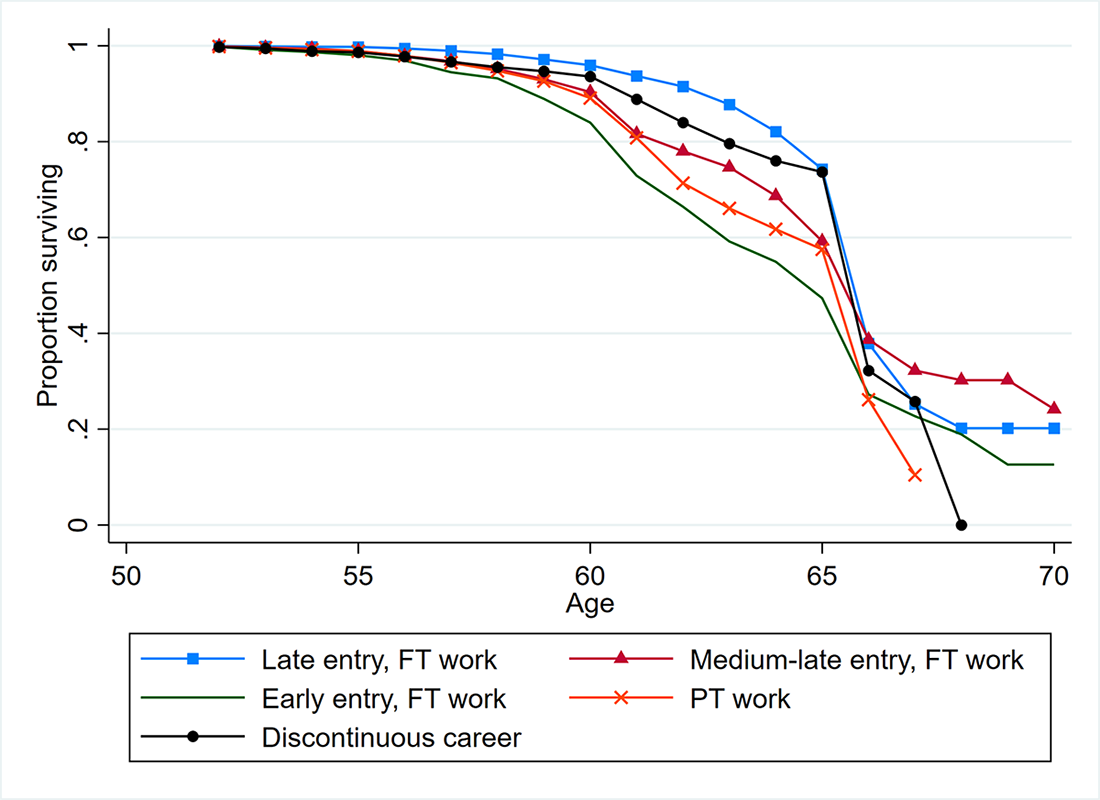
Before moving to the multivariate analyses, Figure 3 presents the observed survival rates by cluster. Until age 60, survival rates are quite high in most clusters. Thereafter, they decline more rapidly, particularly in the Early entry, full-time work-cluster, where the decline starts around age 58 and is steeper than in the other clusters. The sharpest decline appears around age 65, the statutory retirement age for most respondents. The clusters Late entry, full-time work and Discontinuous career seem to exit the latest. As mentioned earlier, public pensions can be claimed from age 60 if certain career conditions are met, which may explain the declining survival rates from that age. Exits before age 60 may involve other programmes such as disability insurance or unemployment benefits.
Observed survival rates, by cluster. Note: ‘Proportion surviving’ refers to the proportion not experiencing the failure event of interest, which is labour market exit in the context of this study.

Table 2 presents the discrete-time survival models. Model 1 includes the employment history clusters only, and Model 2 adds the control variables. Odds ratios and average marginal effects are reported. The latter facilitate comparison across models (Mood Reference Mood2010). The Discontinuous career-cluster (Cluster 5) serves as the reference group, since individuals in this cluster have the most vulnerable employment histories. Additional Wald tests assessed all pairwise differences between clusters (see online Supplementary material S5).
Logistic regression models on labour market exit; weighted estimates, odds ratios (OR) and average marginal effects (AME) displayed, with robust standard errors in parentheses

Table 2 Long description
Table reporting logistic regression models on labour market exit. Results are presented as weighted odds ratios and average marginal effects, with robust standard errors in parentheses. Three models are shown. All three models include age dummies (estimates not displayed) and the five employment history clusters, with cluster 5 “Discontinuous career” as the reference category. Model 2 adds control variables, and Model 3 additionally includes interactions between employment history cluster and gender. The bottom rows show the constant, number of observations, pseudo R-squared, AIC, BIC and log likelihood for each model.
Note: Age dummies included in each model, not displayed. Significance levels: ***p < 0.01, **p < 0.05, *p < 0.1.
Age dummies are included in both models, but not shown. The estimates are statistically significant on a 1 per cent level, increasing consistently with a slight peak at age 60 and high peaks at ages 65 and 66, followed by a sharp decline, indicating that the risk of labour market exit increases with age and peaks at the statutory retirement age.
Figure 3 illustrated the observed cluster differences in survival rates; Model 1 now estimates the relationship between employment history types and labour market exit, without controlling for known predictors of labour market exit. Individuals in the Late entry, full-time work-cluster have substantially lower odds of exiting the labour market between ages 50 and 70 than those in the Discontinuous career-cluster, while individuals in the Early entry, full-time work-cluster have considerably higher odds than the reference group. The timing of labour market exit for the Medium-late entry, full-time work- and Part-time work-clusters does not differ significantly from the reference group.
Model 2 shows that these patterns largely persist when controlling for gender (female), marital status, cohort, education, status in employment in the main job and subjective health. The Late entry, full-time work-cluster (Cluster 1) is the only one with lower odds of exiting the labour market than the reference group. The odds ratio of 0.664 indicates that, at any age between 50 and 70, individuals in this cluster are 33.6 per cent less likely to exit than individuals in the Discontinuous career-cluster. This aligns with the labour force attachment hypothesis. Their higher educational levels and steady labour market engagement may have led to advantages that keep them engaged at older ages, such as employment security, higher incomes, advantageous extra-legal benefits, intrinsically rewarding jobs and lower risk of work-related disabilities. However, this is an assumption and cannot be inferred from the model. Comparing Models 1 and 2, the reduced average marginal effect after adding control variables suggests possible partial mediation (MacKinnon et al. Reference MacKinnon, Krull and Lockwood2000). Adding each control variable one by one (not reported) indicates that the association between the Late entry, full-time work-cluster and labour market exit slightly weakens after adjusting for cohort, education, status in the main job and health. Their later exit is partly explained by these characteristics.
Clusters 2 and 3 point in the opposite direction. Individuals in the Medium-late entry, full-time work-cluster (Cluster 2) and the Early entry, full-time work-cluster (Cluster 3) are, respectively, 30.2 per cent and 66.3 per cent more likely to exit the labour market between ages 50 and 70 than the reference group. Their continuous work histories make them more likely to qualify for early or full pensions, whereas those in the Discontinuous career-cluster may have insufficient work history to draw a full pension and low pension build-up in the three pension pillars, increasing the need for the latter to continue working out of financial necessity, consistent with the compensation hypothesis. Comparing Models 1 and 2 and looking at the individual coefficients of the control variables (not reported), the association between the Early entry, full-time work-cluster and labour market exit is partly explained by marital status, cohort, education and health. For the Medium-late entry, full-time work-cluster, on the other hand, the slightly larger average marginal effect in Model 2 suggests a possible suppression effect (MacKinnon et al. Reference MacKinnon, Krull and Lockwood2000).
The estimate for the Part-time work-cluster is not statistically significant. Wald tests (see Supplementary material S5) confirm that this cluster does not differ from the Discontinuous career-cluster in timing of labour market exit, or from the Medium-late entry, full-time work-cluster. However, the Wald tests and a reproduction of Model 2 with the Part-time work-cluster as reference group indicate that the cluster does differ significantly (p < 0.01) from Clusters 1 (Late entry, full-time work; OR = 0.568) and 3 (Early entry, full-time work; OR = 1.424).
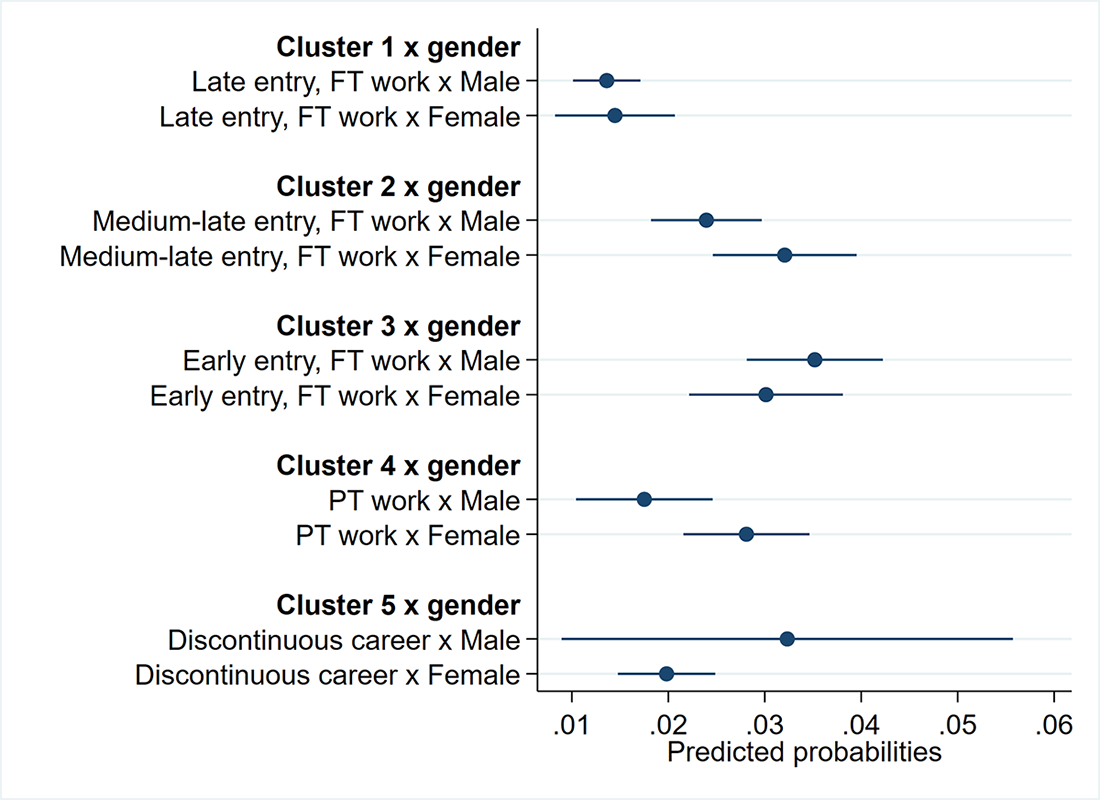
Lastly, we examine the estimates of the control variables in Model 2. Interestingly, the coefficient for gender (female) is not statistically significant, but, since women more often than men have disadvantaged employment histories, there may be an interaction between employment histories and gender. Model 3 in Table 2 includes these interaction effects. Additionally, since interactions in non-linear models cannot be evaluated based on the regression coefficients alone, predicted probabilities are plotted in Figure 4 (Ai and Norton Reference Ai and Norton2003; Mize Reference Mize2019). The predicted probabilities to exit the labour market are higher for women than for men in Clusters 2 and 4, holding all other covariates at their means, and lower for women in Cluster 3, although the latter interaction effect does not seem to be statistically significant. With regard to marital status, Model 2 indicates that people with a registered partnership or who were never married have lower odds of exiting the labour market than married individuals living with their spouse. Regarding birth cohort, younger cohorts generally have lower odds of exiting the labour market than the oldest cohort, possibly reflecting the increasingly strict conditions to draw an early pension, or improved labour market opportunities for older workers. Regarding educational level, higher-educated individuals have lower odds of exiting the labour market than lower-educated ones, but individuals with medium or low levels of education do not differ significantly. The findings for status in employment in the main job indicate that the self-employed have substantially lower odds of exiting the labour market than employees, possibly owing to lower pension accrual levels or preferences for continued work. Civil servants do not differ significantly from employees, despite their generally more generous pensions. Finally, poorer subjective health is associated with higher odds of labour market exit; for instance, these odds are 2.9 times higher for individuals in poor health than for those in excellent health.
Predicted probabilities of labour market exit by type of employment history and gender.

Figure 4 Long description
Separate predicted probabilities are presented for men and women in each of the five clusters. The y-axis lists the combinations of each cluster by gender. For instance, “Late entry, full-time work” by male, and below that “Late entry, full-time work” by female, and so on for the remaining four clusters. The x-axis displays predicted probabilities between 0.01 and 0.06.
Conclusions and discussion
This study examined how the timing of labour market exit in Belgium varies across groups with different employment histories. In a context of increasing socio-economic inequalities and stricter retirement policies, it is important to understand how workers with discontinuous or part-time careers differ from workers with continuous full-time careers in timing of labour market exit. This is particularly relevant in Belgium, where pension eligibility and benefits are linked to career length and wages.
Five employment history types were identified using sequence and cluster analysis. The results show various differences in timing of labour market exit. First, individuals who entered the labour market relatively late and worked almost continuously full-time exit the latest. Their stable employment histories likely reflect advantages, such as employment security, favourable working conditions and rewarding work, that also support continued work at later ages. This is in line with the labour force attachment hypothesis, suggesting that stronger labour force attachment earlier in life fosters attachment in later years, and aligns with the finding of Glaser et al. Reference Glaser, Di Gessa, Corna, Stuchbury, Platts, Worts, McDonough, Sacker and Price2024 that British women with continuous full-time employment histories were more likely to be in paid work between ages 55 and 64 than women with family-related career breaks.
Second, two clusters of individuals who also worked full-time nearly continuously but entered the labour market early or medium-late (respectively, around ages 16 and 19) exit earlier than individuals with discontinuous careers (the reference group), possibly because they are able to meet the career requirements for an early pension. These findings also reflect a social gradient in timing of labour market exit, as these two clusters have lower educational levels than the cluster that entered the labour market late, and may have experienced poorer working conditions and higher unemployment risk, posing constraints on extending working lives (Mäcken et al. Reference Mäcken, Präg, Hess and Ellwardt2022). The associations remain statistically significant after controlling for education, indicating that the social gradient goes beyond education alone.
Third, the cluster of individuals with discontinuous careers and the cluster of part-time workers occupy an intermediate position. The Discontinuous career-cluster is considered the most vulnerable since they accumulate various disadvantages, such as lower lifetime earnings and pension accrual, and insufficient career length to claim an early pension. Although social corrections in the Belgian pension system moderate the negative effects of employment interruptions on public pension rights to some extent, individuals with discontinuous careers still exit the labour market relatively late (only those in the Late entry, full-time work-cluster exit later), which is consistent with the compensation hypothesis that posits that people with interrupted careers may need to defer labour market exit to compensate for lower levels of financial resources. This finding aligns with the finding of Madero-Cabib et al. Reference Madero-Cabib, Gauthier and Le Goff2016 that individuals who were out of the labour force long term to focus on family tasks were more likely to retire later, which they attribute to having fewer opportunities to invest in pension funds or otherwise save for retirement. The cluster of part-time workers does not differ significantly from the Discontinuous career-cluster.
The study has several limitations. First, cluster analysis classifies complex sequence data into comprehensible types of trajectory, but involves a risk of over-simplification (Unterlerchner et al. Reference Unterlerchner, Studer and Gomensoro2023), so it is important to remember that the clusters include individuals with similar but not identical employment histories. Second, the work history data were available in yearly intervals, excluding shorter (non-)employment spells. Administrative data could provide more detailed insight into the diversities of employment histories. Third, potential sources of bias include recall errors, which arise when respondents have trouble recalling when events took place (Havari and Mazzonna Reference Havari and Mazzonna2015). For SHARELIFE, recall errors regarding employment status are relatively low in Belgium and among respondents younger than 70 (Garrouste and Paccagnella Reference Garrouste, Paccagnella and Schröder2011). Additionally, selection effects such as the healthy worker effect should be considered. Given that workers in poor health are less likely to remain in the workforce than healthy workers (Fisher et al. Reference Fisher, Chaffee and Sonnega2016), and that there are socio-economic inequalities in life expectancy and prevalence of disability (Renard et al. Reference Renard, Scohy, De Pauw, Jurčević and Devleesschauwer2022), individuals with better health and higher socio-economic status may be over-represented in the study. Fourth, the study focused on the supply side, but the demand side also plays a role in labour force participation at older ages. Future studies could include organisational and institutional factors (Engelhardt Reference Engelhardt2012). Finally, the study includes marital status in the analyses, but future studies on labour market exit could analyse partners’ employment trajectories, as Visser and Fasang Reference Visser and Fasang2018 did for Dutch couples.
Nonetheless, the findings of this study highlight that employment histories help understand why some workers extend their careers while others exit the labour market earlier. This study shows that having long, stable full-time careers is not the reality for a large part of the population. As pension reforms further restrict early exit pathways and link pension rights more strongly to employment history, social inequalities may be reinforced if the diversity in employment histories and the associated cumulative (dis)advantages are overlooked.
Supplementary material
The supplementary material for this article can be found at https://doi.org/10.1017/S0144686X26100968.
Acknowledgements
The author thanks Tim Goedemé and Koen Decancq for their helpful feedback on previous versions of the manuscript, and the anonymous reviewers for their insightful and constructive comments.
The article uses data from SHARE Waves 3, 4, 5, 6 and 7 (DOIs: 10.6103/SHARE.w3.900, 10.6103/SHARE.w4.900, 10.6103/SHARE.w5.900, 10.6103/SHARE.w6.900, 10.6103/SHARE.w7.900); see Börsch-Supan et al. Reference Börsch-Supan, Brandt, Hunkler, Kneip, Korbmacher, Malter, Schaan, Stuck and Zuber2013 for methodological details. This article uses data from the generated Job Episodes Panel (DOI: 10.6103/SHARE.jep.900), see Brugiavini et al. Reference Brugiavini, Orso, Genie, Naci and Pasini2019 for methodological details. The Job Episodes Panel release 9.0.0 is based on SHARE Waves 3 and 7. The SHARE data collection has been funded by the European Commission, DG RTD through FP5 (QLK6-CT-2001-00360), FP6 (SHARE-I3: RII-CT-2006-062193, COMPARE: CIT5-CT-2005-028857, SHARELIFE: CIT4-CT-2006-028812), FP7 (SHARE-PREP: GA N°211909, SHARE-LEAP: GA N°227822, SHARE M4: GA N°261982, DASISH: GA N°283646) and Horizon 2020 (SHARE-DEV3: GA N°676536, SHARE-COHESION: GA N°870628, SERISS: GA N°654221, SSHOC: GA N°823782, SHARE-COVID19: GA N°101015924) and by DG Employment, Social Affairs & Inclusion through VS 2015/0195, VS 2016/0135, VS 2018/0285, VS 2019/0332, VS 2020/0313, SHARE-EUCOV: GA N°101052589 and EUCOVII: GA N°101102412. Additional funding from the German Federal Ministry of Education and Research (01UW1301, 01UW1801, 01UW2202), the Max Planck Society for the Advancement of Science, the US National Institute on Aging (U01_AG09740-13S2, P01_AG005842, P01_AG08291, P30_AG12815, R21_AG025169, Y1-AG-4553-01, IAG_BSR06-11, OGHA_04-064, BSR12-04, R01_AG052527-02, R01_AG056329-02, R01_AG063944, HHSN271201300071C, RAG052527A) and from various national funding sources is gratefully acknowledged (see www.share-eric.eu).
Financial support
This research was supported by Belgian Science Policy (BELSPO) [EF/211/CO-SHARE] and Research Foundation – Flanders (FWO) [I000723N]. The funding institutions played no role in the design, execution, analysis and interpretation of data, or the writing of the study.
Competing interests
The author declares no competing interests.
Ethical standards
This study uses secondary data from the Survey of Health, Ageing and Retirement in Europe, which has been ethically reviewed and approved. See section 3.11 ‘How is SHARE ethically approved?’ at https://share-eric.eu/data/faqs-support.





 Open access

