Introduction
Child maltreatment is a prevalent and grave issue that levies destructive consequences for individuals, families, and society (Cicchetti, Reference Cicchetti2013). In 2018, 678,000 children were victims of child maltreatment (USDHS, 2019) and an estimated 37% of all children in the United States experience a Child Protective Services (CPS) investigation by the age of 18 (Kim, Wildeman, Jonson-Reid, & Drake, Reference Kim, Wildeman, Jonson-Reid and Drake2017). The attributable costs of the deleterious effects of child maltreatment are enormous, with an estimated $428 billion annual economic burden in the United States (Peterson, Florence, & Klevens, Reference Peterson, Florence and Klevens2018). This estimation represents the insidious, enduring, and multifaceted sequelae of the, often chronic, stress resulting from child maltreatment. For example, child maltreatment can derail development across multiple domains of functioning (e.g., neurobiological, psychological, cognitive, social) and these pernicious effects can initiate negative developmental cascades that persist throughout the life course (Cicchetti & Toth, Reference Cicchetti and Toth2016; Gunnar & Quevedo, Reference Gunnar and Quevedo2007). As such, the resultant adverse consequences of this unique form of relational stress are diverse (e.g., greater burden of psychological and physical disease, reduced human capital, increased criminal offending) and require intervention from several systems (e.g., social services, educational system, hospitals, criminal justice system; Cicchetti, Reference Cicchetti2013). For these reasons, studies that aim to discover how individuals develop and function adaptively and maladaptively when confronted with child maltreatment are integral to the amelioration of this problem.
Developmental psychopathology
A developmental psychopathology framework is critical to understanding the risk and resilience patterns that unfold across the life span for maltreated individuals (Toth & Cicchetti, Reference Toth and Cicchetti2013). This perspective suggests that child maltreatment represents a severe violation of the expectable caregiving environment that deprives individuals of the promotive ingredients necessary for multifaceted and multilevel adaptation (Cicchetti & Lynch, Reference Cicchetti, Lynch, Cicchetti and Cohen1995). This stress compromises normative development in myriad ways across the lifespan. Accordingly, experiences of child maltreatment can undermine the successful resolution of stage-salient tasks in childhood and adolescence. In turn, prior disturbances in development become organized into a probabilistic pattern of dysfunction, thwarting the individual's subsequent efforts to positively negotiate multidimensional developmental tasks in successive life stages, eventuating in poor outcomes in multiple spheres of functioning (Shonk & Cicchetti, Reference Shonk and Cicchetti2001).
Nevertheless, maltreated children do not ineluctably experience unfavorable outcomes, and some experience positive outcomes despite these adversities. Developmental psychopathologists are likewise interested in those individuals who grow up under the stressful conditions of child maltreatment and do not experience impaired development – that is, individuals who are resilient (Masten, Reference Masten2001). Resilience has been conceptualized as a dynamic process encompassing positive adaptation and competent functioning for an individual, despite the context of significant adversity (Luthar, Cicchetti, & Becker, Reference Luthar, Cicchetti and Becker2000). To date, the principles of developmental psychopathology have resulted in significant contributions to the understanding of resilient functioning following child maltreatment (see Cicchetti, Reference Cicchetti2013 for review).
Developmental competence in emerging adulthood
The majority of research investigations on resilient outcomes following the stress of child maltreatment have assessed developmental outcomes in the periods of childhood, adolescence, or adulthood (Cicchetti, Reference Cicchetti2013). However, less is known about the effects of child maltreatment on the developmental period of emerging adulthood (McMahon, Reference McMahon2014; Schulenberg, Sameroff, & Cicchetti, Reference Schulenberg, Sameroff and Cicchetti2004). This is partly due to the relative infancy of emerging adulthood as a recognizable life stage (Arnett, Reference Arnett2000, Reference Arnett2014; Furstenberg, Reference Furstenberg2016; Schulenberg et al., Reference Schulenberg, Sameroff and Cicchetti2004). Research interest in this period has accelerated in the last decade (Burt & Paysnick, Reference Burt and Paysnick2012), and there have been recent efforts to apply a developmental psychopathology perspective on child maltreatment to this developmental period (McMahon, Reference McMahon2014). However, there have been a relative paucity of longitudinal investigations on the transitions to adulthood with maltreated and nonmaltreated individuals (Toth & Cicchetti, Reference Toth and Cicchetti2013).
Emerging adulthood refers to the elongated transitional period following adolescence and extending roughly between the ages 18–29, and is both demographically and subjectively distinct from early adulthood (Arnett, Reference Arnett2000; Sussman & Arnett, Reference Sussman and Arnett2014). During this stage, individuals are legally defined as adults and have reached physical and sexual maturity. However, normative societal and subjective expectations regarding this period embrace instability, transition, and exploration in several domains of functioning (e.g., romantic commitments, higher education, full-time employment, etc.; Arnett, Žukauskienė, & Sugimura, Reference Arnett, Žukauskienė and Sugimura2014).
Emerging adulthood can represent a period of growth and opportunity, where individuals are unburdened with adult responsibilities and freed to explore diverse life paths and make meaningful developmental progress (Sussman & Arnett, Reference Sussman and Arnett2014). For those who have experienced the stress of child maltreatment, this may represent a developmental “turning point” where they are able to recover from previous setbacks and reset developmental trajectories (Cicchetti, Reference Cicchetti2013; Rutter, Reference Rutter1989, Reference Rutter1996). Conversely, this period can also create conditions of vulnerability, as it is marked by a high degree of uncertainty and instability (Arnett, 2014; Sussman & Arnett, Reference Sussman and Arnett2014). The loosened societal constraints and ambiguous expectations may leave some feeling directionless and indecisive. Further, this period represents a time when the onset of psychopathology peaks, and engagement in risky behaviors is at a highpoint (McMahon, Reference McMahon2014). Thus, one could less idyllically depict this developmental epoch as a time when individuals are left to navigate a treacherous landscape of risk, and the added stressors of this transition may overwhelm the compromised development of more vulnerable individuals, such as those who have endured the stress of maltreatment (McMahon, Reference McMahon2014; Schulenberg et al., 2004).
The transition to adulthood represents an important period to investigate competent functioning with high-risk samples yet functioning at this stage should be contextualized by previous functioning in earlier stages. A longitudinal approach to competence is critical to understanding the developmental progression of functioning over time (Masten & Coatsworth, Reference Masten and Coatsworth1998; Waters & Sroufe, Reference Waters and Sroufe1983). This requires that the current functioning of the emerging adult be considered within the context of the unfolding of prior functioning and the distal influences that contribute to proximal experiences (Schulenberg et al., Reference Schulenberg, Sameroff and Cicchetti2004). Examining functioning over time can identify individuals who maintain adaptive capacities or experience enduring challenges (i.e., continuity), as well as those who exhibit unstable functioning profiles that shift between periods of competence and developmental setbacks (i.e., discontinuity; Cicchetti & Rogosch, Reference Cicchetti and Rogosch1997; Schulenberg et al., Reference Schulenberg, Sameroff and Cicchetti2004). Further, because resilience is a multiply determined developmental process (Rutter, Reference Rutter2012), studies that investigate several possible predictors of functioning across developmental time points can be particularly informative.
Child maltreatment and developmental competence in emerging adulthood
A limited number of studies have investigated multidimensional developmental competence in emerging adulthood with prospective samples of maltreated and nonmaltreated individuals (Allwood & Widom, Reference Allwood and Widom2013; DuMont, Widom, & Czaja, Reference DuMont, Widom and Czaja2007; McGloin & Widom, Reference McGloin and Widom2001; Mersky & Topitzes, Reference Mersky and Topitzes2009; Negriff et al., Reference Negriff, Gordis, Susman, Kim, Peckins, Schneiderman and Mennen2019; Thornberry, Henry, Ireland, & Smith, Reference Thornberry, Henry, Ireland and Smith2010).Footnote 1 For instance, McGloin and Widom (Reference McGloin and Widom2001) examined a large group of emerging adults (676 maltreated and 520 nonmaltreated, demographically similar comparison children) across eight domains of resilient functioning, defined as: successful employment, housing stability, high school graduation, social activity, absence of psychopathology, substance abuse, criminal offending, and violence perpetration. Based on their classification of resilience (i.e., individuals who met competence criteria on six of the eight domains), 22% of individuals with maltreatment histories demonstrated resilience, compared to 33% (males) and 51% (females) of the nonmaltreated individuals.
Investigating the same sample as McGloin and Widom (Reference McGloin and Widom2001), and utilizing the same conceptualization and criteria for resilience, DuMont et al. (Reference DuMont, Widom and Czaja2007) examined the progression of resilience from adolescence to emerging adulthood among maltreated individuals. Specifically, they found that approximately half of maltreated children exhibited resilience in adolescence, and nearly one-third demonstrated resilience in young adulthood. Additionally, they reported continuity of resilience in more than half of the resilient individuals. Consistent with McGloin and Widom (Reference McGloin and Widom2001), female participants were more likely to be resilient.
Additionally, Mersky and Topitzes (Reference Mersky and Topitzes2010) conducted a prospective examination of associations between child maltreatment and a multidimensional index of resilience in emerging adulthood, including the domains of educational and economic attainment, criminal offending, substance misuse, psychopathology, and general life satisfaction. Utilizing a threshold of favorable outcomes on five or more of the indices, maltreated individuals were significantly less likely than nonmaltreated individuals to attain more multifaceted functioning on five or more domains; however, they demonstrated resilient functioning in isolated domains.
Together these studies indicate that emerging adults with histories of child maltreatment are less likely to show adaptive functioning across multiple domains. They also collectively suggest that the development of psychopathology and maladaptation is not deterministic or universal among all maltreated individuals. The methods employed thus far to study resilience and developmental competence among maltreated emerging adults have included calculating the number of domains in which competence is exhibited and/or defining an index of resilience. These have laid important groundwork in our understanding of multifaceted competence, or lack thereof, among maltreated individuals. However, they are limited because they do not study the naturally occurring patterns of competence across multiple domains and often assume adaptive functioning in each domain is weighted equally.
Conceptualizing resilience
Resilience is a complex, multidimensional construct that rarely manifests as universal adaptation across developmental spheres of functioning (Cicchetti, Reference Cicchetti2013; Luthar et al., Reference Luthar, Cicchetti and Becker2000; Masten & Tellegen, Reference Masten and Tellegen2012). Rather, there is typically heterogeneity in resilient outcomes for vulnerable individuals, such that perturbations in one developmental domain do not preclude adaptive functioning in another (Luthar et al., Reference Luthar, Cicchetti and Becker2000). Within the extant literature, several empirical studies have attempted to examine the resilient outcomes of maltreated individuals across multiple domains of adaptive functioning (Bolger & Patterson, Reference Bolger and Patterson2003; Cicchetti & Rogosch, Reference Cicchetti and Rogosch1997, Reference Cicchetti and Rogosch2009; Cicchetti, Rogosch, Lynch, & Holt, Reference Cicchetti, Rogosch, Lynch and Holt1993; McGloin & Widom, Reference McGloin and Widom2001; Mersky & Topitzes, Reference Brody, Yu, Miller and Chen2009). Still, even among studies examining the multidimensionality of resilience, there is considerable variation in the operationalization of resilience and the strategies used to assess the construct. For example, there is a lack of consensus on: (a) the number of domains to consider; (b) whether or not to prioritize success in certain domains as more or less indicative of resilience; (c) whether to hierarchically categorize domains of competence; or (d) whether to integrate multiple domains of functioning into composite indexes of resilience (see Luthar et al., Reference Luthar, Cicchetti and Becker2000 for review of techniques).
Person-centered methods represent a unique and promising approach to investigating developmentally relevant, naturally occurring multidimensional constructs, such as resilience (Bergman & Magnusson, Reference Bergman and Magnusson1997; Lanza & Cooper, Reference Lanza and Cooper2016; Sterba & Bauer, Reference Sterba and Bauer2010). Rather than determining resilient functioning based on variability on single variables or domains of functioning, person-centered approaches can discern and describe unobserved subgroups of individuals who may present with heterogeneous patterns of adaptive and maladaptive functioning across multiple developmental domains (Lanza & Cooper, Reference Lanza and Cooper2016). Thus, identifying prototypical patterns of developmental competencies addresses a central tenet of a developmental psychopathology framework of resilience – that competence in one domain of functioning only gains meaning in relation to the individual's functioning in other developmental domains (Bergman & Magnusson, Reference Bergman and Magnusson1997; Cicchetti, Reference Cicchetti2013; Luthar et al., Reference Luthar, Cicchetti and Becker2000).
Developmental tasks perspective
From a developmental tasks perspective (Havighurst, Reference Havighurst1972; Masten & Coatsworth, Reference Masten and Coatsworth1998; Roisman, Masten, Coatsworth, & Tellegen, Reference Roisman, Masten, Coatsworth and Tellegen2004; Schulenberg, Bryant, & O'Malley, Reference Schulenberg, Bryant and O'Malley2004; Sroufe, Reference Sroufe1979), there are salient developmental tasks that represent standards of adaptive functioning, which are contextualized by biological capabilities and sociocultural expectations for that life stage (Roisman et al., Reference Roisman, Masten, Coatsworth and Tellegen2004). Several common developmental task domains have been identified in studies investigating the period of emerging adulthood, including educational attainment, work, romantic relationships, peer friendships, conduct/delinquency, and psychopathology (Schulenberg et al., Reference Schulenberg, Sameroff and Cicchetti2004; Shiner & Masten, Reference Shiner and Masten2012; Roisman et al., Reference Roisman, Masten, Coatsworth and Tellegen2004).
Biology and developmental competence
Resilience and developmental competence are multilevel constructs that encompass both psychosocial and biological factors (Cicchetti, Reference Cicchetti and Curtis2007; Cicchetti & Rogosch, Reference Cicchetti and Rogosch2009; Curtis & Cicchetti, Reference Curtis and Cicchetti2003). Recently, a literature has emerged that suggests positive psychosocial and biological outcomes may actually be divergent among low-income, Black emerging adults (Brody et al., Reference Brody, Yu, Chen, Miller, Kogan and Beach2013; Brody, Yu, & Beach, Reference Brody, Yu and Beach2016; Brody, Yu, Miller, & Chen, Reference Brody, Yu, Miller and Chen2016; Chen et al., Reference Chen, Yu, Siliezar, Drage, Dezil, Miller and Brody2020). Specifically, several studies have demonstrated that Black youth and emerging adults who evince psychosocial competence under conditions of severe stress (i.e., poverty) often incur a physical toll in the form of greater allostatic load (Brody et al., Reference Brody, Yu, Chen, Miller, Kogan and Beach2013; Chen, Miller, Brody, & Lei, Reference Chen, Miller, Brody and Lei2015), chronic disease (Brody et al., Reference Brody, Yu, Miller and Chen2016; Gaydosh, Schorpp, Chen, Miller, & Harris, Reference Gaydosh, Schorpp, Chen, Miller and Harris2018), low-grade inflammation (Chen et al., Reference Chen, Yu, Siliezar, Drage, Dezil, Miller and Brody2020) and/or accelerated epigenetic aging (Brody et al., Reference Brody, Yu, Miller and Chen2016). This pattern of findings, termed “skin deep resilience,” details how a sole reliance on external metrics of competence may mask covert physiological suffering and inaccurately presume that high-achieving young adults do not require support (Chen et al., Reference Chen, Yu, Siliezar, Drage, Dezil, Miller and Brody2020). Therefore, when assessing developmental competence among low-income Black individuals, it is important to obtain data on both overt psychosocial adjustment and covert physiological distress to best capture the multilevel experience of both success and suffering (Brody et al., Reference Brody, Yu, Chen, Miller, Kogan and Beach2013).
Current study
The aim of the current study was to examine multifaceted patterns of competence among a sample of socioeconomically disadvantaged, racially and ethnically diverse emerging adults, many with a history of child maltreatment. We sought to determine not only patterns of competence across multiple developmental domains, but also to identify childhood precursors to these patterns of adaptation and maladaptation. Importantly, to complement our psychosocial assessment of competence, we also assessed the presence of physiological distress using a common biomarker of low-grade inflammation, C-reactive protein (CRP). Although CRP does not reflect a specific disease, it is a useful index of health because of its association with several chronic diseases (Miller, Chen, & Parker, Reference Miller, Chen and Parker2011). We aimed to examine whether profiles of psychosocial competence following stress and adversity would be differentially associated with concurrent physical health, as indexed by levels of CRP. To be consistent with skin-deep resilience theory, we examined CRP among Black participants only. We anticipated that Black participants who evinced psychosocial competence in the face of adversity would also experience physiological costs, as indexed by higher levels of CRP.
The framework for measuring competence in developmental task domains was modeled after the work of Schulenberg et al. (Reference Schulenberg, Sameroff and Cicchetti2004); c.f. Roisman et al., Reference Roisman, Masten, Coatsworth and Tellegen2004; Shiner & Masten, Reference Shiner and Masten2002), which conceptualized the maintenance and attainment of developmental competencies in task domains during the transition to emerging adulthood. Specifically, Schulenberg et al. (Reference Schulenberg, Sameroff and Cicchetti2004) identified seven task domains (education, work, financial autonomy, romantic involvement, peer involvement, substance use avoidance, and citizenship) and then rated subjects’ level of achievement in each domain with a score of 1 = stalling, 2 = maintaining, or 3 = succeeding. Subjects were assigned to one score (1, 2, or 3) for each exclusive domain. As Schulenberg et al. (Reference Schulenberg, Sameroff and Cicchetti2004) have aptly stated, rating individuals on developmental task attainment is inherently subjective and tenuous business, even when based on established norms, and any ratings should be considered “descriptive, rather than prescriptive” (p. 1123). Determinations of developmental competence are not universal or uniform and are culturally and historically bound. It is for these reasons we elected to first start with the previously established Schulenberg et al. (Reference Schulenberg, Sameroff and Cicchetti2004) framework as a foundation for creating our multiple developmental domains and ratings. Next, we modified our defined levels of developmental competence for each domain to account for the disadvantaged contexts (i.e., low income) in which the study participants resided. Contending with challenges and stressors related to poverty (e.g., access to resources) can lead to shortened or modified transitions to emerging adulthood (Furstenberg, Reference Furstenberg2016). For example, among low-income individuals, the experience of education is sometimes more of a winding process of breaks between periods of active enrollment, rather than a linear progression (Silva, Reference Silva2016). As such, determinations of competence in the educational domain should be adjusted to reflect these normative progressions. Further, labels for what constitutes competent or resilient functioning differ among studies, and these labels are particularly critical with high-risk samples, where overly stringent criteria for competence can set an unrealistic qualifying threshold that ultimately excludes vulnerable individuals (McGloin & Widom, Reference McGloin and Widom2001). When investigating resilience in the context of severe adversity, average, or even subaverage, functioning may justify a label of competence in certain domains (Luthar et al., Reference Luthar, Cicchetti and Becker2000). Thus, we adjusted the domain expectations and thresholds for the succeeding rating in domains in order to better assess variation in developmentally and contextually relevant tasks (Arnett, Reference Arnett2014; Furstenberg, Reference Furstenberg2016).
Ultimately, we created competency domains in the following areas of emerging adult development: success in school achievement, work, and friendships, and avoidance of substance misuse, externalizing problems, and internalizing symptoms. These developmental task domains are highly congruent with literature and theory on salient developmental tasks in emerging adulthood (Arnett, Reference Arnett2000; Arnett et al., Reference Arnett, Žukauskienė and Sugimura2014; Roisman et al., Reference Roisman, Masten, Coatsworth and Tellegen2004; Schulenberg et al., Reference Schulenberg, Sameroff and Cicchetti2004). Despite its relevance, romantic involvement was not included as a developmental task domain because the current study did not measure the shifting norms and complexities of contemporary romantic relationships common in emerging adulthood (e.g., online dating, use of social media and texting, casual sexual relationships, and delays of cohabitation and deep commitment; see Shulman & Connolly, Reference Shulman and Connolly2013).
Method
Participants
Participants (N = 418) were from a longitudinal follow-up study of emerging adults who participated in a research summer camp program as children. The original study (Wave 1) included 680 low-income maltreated (n = 360) and nonmaltreated (n = 320) children aged 10 to 12 (M = 11.28, SD = .97). The original sample was racially and ethnically diverse (71.6% Black, 11.8% Caucasian, 12.6% Hispanic, 4.0% biracial/other race) and evenly distributed by gender (50.1% male). The majority of children were from single parent families (68.7%) with a history of receiving public assistance (96.1%).
Participants for the current study included 418 of the original study participants. At Wave 2, emerging adults were on average 19.68 years old (SD = 1.15), 48.8% male, 54.1% with a history of childhood maltreatment. The majority (77.8%) of participants identified as Black, 10.9% White, 3.6% another race, and 7.7% Latino/Latina.
Analyses (chi-square and t tests) were conducted comparing demographic variables for the emerging adult participants included in this study to the participants who did not complete Wave 2 measures. There were no differences between the participants on child maltreatment status, family income, child gender, race, ethnicity, or age at Wave 1. Moreover, there were no differences between participants in this study and those who did not complete the Wave 2 measures on childhood IQ, depressive symptoms, and externalizing symptomatology.
Informed consent was obtained from parents of maltreated and nonmaltreated children for their child's participation in the summer camp research program and for examination of any Department of Human Services (DHS) records pertaining to the family. Children in the maltreated group were recruited through a DHS liaison who examined CPS reports to identify children who had been maltreated and/or were part of a family with a history of maltreatment. The DHS liaison contacted a random sample of eligible families and explained the study. Parents who were interested in having their child participate provided signed permission for their contact information to be shared with project staff. These families were representative of those receiving services through DHS. Comprehensive reviews of all DHS records for each family were conducted. Maltreatment information was coded by trained research staff and a clinical psychologist, using the Barnett, Manly, and Cicchetti (Reference Barnett, Manly, Cicchetti, Cicchetti and Toth1993) nosological system for classifying child maltreatment. Coding is based on all available information and does not rely on DHS determinations.
Because maltreating families primarily have low socioeconomic status (SES) (National Incidence Study – NIS-4; Sedlak et al., Reference Sedlak, Mettenburg, Basena, Peta, McPherson and Greene2010), nonmaltreating families were recruited from those receiving Temporary Assistance to Needy Families (TANF) in order to ensure socioeconomic comparability between maltreated and nonmaltreated families. A DHS liaison contacted a random sample of eligible nonmaltreating families with no DHS maltreatment history or preventive services and described the project. Parents who were interested in participating signed a release allowing their contact information to be given to project staff for recruitment. The families were recruited as nonmaltreated families after comprehensive DHS record searches confirmed the absence of any documented child maltreatment. Families who received preventative DHS services due to concerns over risk for maltreatment were not included within the nonmaltreated comparison group. Mothers of children recruited for both the maltreatment and no maltreatment groups were interviewed by trained research assistants using the Maternal Child Maltreatment Interview (Cicchetti, Toth, & Manly, Reference Cicchetti, Toth and Manly2003). This was used to further verify a lack of CPS involvement among the children recruited for the nonmaltreatment group. Moreover, for the nonmaltreatment group, records were reviewed in the year following camp participation to assure that all information had been assessed.
For the follow-up at Wave 2, a variety of strategies were used to relocate and recruit participants. Records of last known addresses, extensive public internet searches (e.g., LexisNexis), contact information from medical records, and neighborhood canvasing were part of a comprehensive recruitment design. Additionally, the DHS liaison was again utilized to locate participants through access to DHS records. The living situation of participants was varied and the developmental timing (i.e., 18–20 years of age) created unique challenges when recontacting this sample. Many participants were in a transitory period, either living with their families of origin or just beginning to live independently, which resulted in fewer participants being registered in public databases.
Procedures
At Wave 1, children attended a weeklong day camp from 9:00 a.m. to 4:00 p.m. and participated in both traditional camp activities and research assessments (for detailed descriptions of camp procedures see Cicchetti & Manly, Reference Cicchetti, Manly, Brody and Sigel1990). At camp, children were assigned to groups of eight (four maltreated and four nonmaltreated children) same-age and same-sex peers. Each group was led by three trained camp counselors who were unaware of the maltreatment status of the children and the hypotheses of the study. The intensive staff to child ratio allowed for counselors to closely interact with children. During the 35 hr of interaction throughout the camp week, counselors got to know children well. After providing assent, children participated in research assessments that occurred throughout the week of recreational activities. Trained research assistants conducted individual research sessions in which questionnaires and other research measures were administered.
At Wave 2, emerging adult participants were individually interviewed in private interview rooms by trained research assistants who were unaware of the participant's maltreatment group status and the research hypotheses. The participants completed a variety of assessments including self-report measures and a diagnostic clinical interview.
Measures
Modeling the work of Schulenberg et al. (Reference Schulenberg, Sameroff and Cicchetti2004), we defined competency as a three-level variable for all domains (except for work, which was defined as a two-level variable) considering the context-specific norms of the study population. Levels were defined as: 1 = stalling (not meeting appropriate developmental expectations in this area); 2 = maintaining (at developmentally appropriate level in this area); 3 = succeeding (exceeding expectations in this area). Criteria and cut-points for the ratings in each domain were determined by establishing the two extreme groups first, via expert consensus from four doctoral-level researchers, leaving the middle group for the rest of sample, with the objective of having at least 20% of the sample represented in each category (as described by Schulenberg et al., Reference Schulenberg, Sameroff and Cicchetti2004). The following section summarizes each domain, provides a rationale for ratings, and lists the measurement items that informed each domain.
Domains
The Substance Use domain focused on excessive use, as experimentation with substances in emerging adulthood is a typical developmental behavior (Sussman & Arnett, Reference Sussman and Arnett2014). Participant use was assessed across a range of substances, including alcohol, marijuana, and other illicit drugs. Information was obtained from the following measures:
Diagnostic Interview Schedule (DIS-IV: Robins et al., Reference Robins, Cottler, Bucholz and Compton1995). The DIS-IV is a structured clinical interview designed to be administered by lay interviewers, via computer software, to provide clinical psychiatric diagnoses (based on DSM-IV criteria; APA, 1994). The Alcohol and Substance Use modules provided detailed information on participant alcohol and drug use patterns, as well as abuse and dependence symptoms and disorder diagnoses. The variables related to diagnoses and number of diagnostic symptoms were used to define domain criteria.
Frequency of Alcohol and Substance Use (Hussong & Chassin, Reference Hussong and Chassin2004). This 12-item questionnaire assesses frequency of alcohol and substance use. Subjects rate their use on an 8-point scale (none to daily) in the past year. Variables related to binge drinking and number of illicit drugs used in the past year were used as domain criteria. Binge drinking was classified as five (four for females) or more drinks at one time.
Rating criteria. Participants were classified as: stalling (N = 204; 48.8%), if they met criteria for substance use disorder or had at least one marijuana dependence symptom on the DIS-IV, or if they reported using two or more illicit drugs in the past year; maintaining, if they reported binge drinking at a minimum of “1–2 times per week” up to “1–2 times in the past year” and only used one illicit drug in the past year (N = 64; 15.3%); succeeding, if they had no substance use or dependence symptoms and no alcohol binging (N = 139; 33.3%).
Conduct domain ratings refer to criminal, aggressive, or generally antisocial behaviors occurring in the past year. Information was obtained from the previously described DIS-IV (Robins et al., Reference Robins, Cottler, Bucholz and Compton1995) using the Diagnostic and Statistical Manual of Mental Disorders, fourth edition (DSM-IV )symptoms for antisocial personality disorder (ASPD).
Rating criteria. Participants were categorized as follows: stalling – the presence of three or more symptoms of ASPD (N = 169; 40.4%); maintaining – one or two symptoms of ASPD (N = 138; 33%); succeeding – no symptoms of ASPD (N = 100; 23.9%).
Internalizing domain ratings were based on current or lifetime DSM-IV diagnoses of any internalizing disorders (major depressive disorder, dysthymia, mania, generalized anxiety disorder, or posttraumatic stress disorder) on the DIS-IV (Robins et al., Reference Robins, Cottler, Bucholz and Compton1995) and depressive symptoms obtained from the Beck Depression Inventory-II (BDI-II; Beck, Steer, Ball, & Ranieri, Reference Beck, Steer, Ball and Ranieri1996).
Beck Depression Inventory – II (BDI-II; Beck et al., Reference Beck, Steer, Ball and Ranieri1996). The BDI-II is a 21-item self-report measure of depressive symptoms. Participants rated their experiences in the last two weeks by choosing one of four statements pertaining to different symptoms of depression (e.g., sadness, pessimism, self-criticism). Items were scored from 0 to 3, with higher scores reflecting endorsement of more severe symptoms. A sum score of the 21-items was used as Internalizing domain criteria. The BDI-II has good psychometric properties (Dozois, Dobson, & Ahnberg, Reference Dozois, Dobson and Ahnberg1998; Wang & Gorenstein, Reference Wang and Gorenstein2013), including test–retest reliability scores ranging from 0.73–0.96 and strong convergent validity with other depression measures (Wang & Gorenstein, Reference Wang and Gorenstein2013).
Rating criteria. Participants were rated as follows: stalling (N = 141; 33.7%), if they currently met DSM-IV diagnostic criteria for any of the described internalizing disorders or if they had a BDI-II sum score >19; maintaining (N = 102; 24.4%), if they had previously met DSM-IV criteria for a lifetime diagnoses of any of the described internalizing disorders but were currently in recovery or their BDI-II sum score ranged from 12–19; succeeding (N = 164; 39.2%), if they had no lifetime diagnoses of an internalizing disorder and BDI-II sum scores <12.
The School domain ratings focused on educational attainment and ratings were adjusted to fit norms of a high-risk urban sample. Information was obtained by asking participants for the highest level of education attained.
Rating criteria. Participants were rated as: stalling, if they had obtained an 11th grade education or less (N = 158; 37.8%); maintaining, if they had obtained a GED or High School diploma (N = 180; 43.1%); and succeeding, if they had obtained education greater than a High School diploma (N = 78; 18.7%).
The Friends domain rating referred to participant report on the number and quality of current peer relationships using the Adult Self-Report (ASR; Achenbach, Reference Achenbach1991). The ASR is a widely used scale that is normed for adaptive and problem functioning. Specifically, participant responses on the following two items were used as rating criteria: (a) “About how many close friends do you have?” (rated from 0 to 4+); (b) “I have trouble keeping or making friends” (rated from 0 = not true to 2 = very true).
Rating criteria. Participants were rated as: stalling, if they reported zero friends or any trouble keeping or making friends (N = 113; 27%); maintaining, if they reported one close friend and no trouble keeping or making friends (N = 56; 13.4%); and succeeding, if they reported having two or more close friends and no trouble making or keeping friends (N = 236; 56.5%).
The Work domain was based on current employment status and set as a two-level domain because no clear categories emerged from the variety of employment possibilities in the transition to emerging adulthood in an economically disadvantaged sample. For example, some participants were attending school and working part-time (or not at all) and others had entered the full-time workforce following secondary school. For this reason, we avoided distinctions related to full- or part-time status and categorized participants as stalling in this category if they had no job (N = 204; 48.8%) and succeeding if they had any type of job (N = 215; 51.4%).
Childhood predictors of latent class membership
Wechsler Intelligence Scale for Children, Fourth Edition (WISC-IV; Wechsler, Reference Wechsler2003). Children's cognitive functioning was assessed using six subtests of an abbreviated version of the WISC-IV (Sattler et al., Reference Sattler, Dumont and Coalson2016). A Full-Scale IQ (FSIQ) was ascertained along with two factors: Verbal Comprehension (subtests: similarities, vocabulary, comprehension) and Perceptual Reasoning (subtests: block design, picture completion, matrix reasoning). The FS-IQ was used as a predictor of latent class membership.
Teacher Report Form (TRF; Achenbach, Reference Achenbach1991). The Teacher Report Form of the Child Behavior Checklist is a 113- item reporting scale used to assess behavioral problems in children. Items are scored from 0 = not true, 1 = somewhat or sometimes true or 2 = very true or often true. Two camp counselors independently completed this measure for each child after a 35-hour week of direct observation and interaction with children. The broadband externalizing subscale (average intraclass correlation [ICC] among pairs of raters was .83) was used as a predictor of latent class membership.
Child Depression Inventory (CDI; Kovacs, Reference Kovacs1983). The CDI is a widely used 27-item self-report questionnaire to assess depressive symptomatology in school-age children. For each item, children choose from among three option statements, depicting increasing levels of depressive symptoms, in order characterize their experiences in the past two weeks. The CDI has strong psychometric properties (Kovacs, Reference Kovacs1992). The 27 items were summed, and the symptom score was used as a predictor of latent class membership.
Maltreatment Classification System (MCS; Barnett, Manly, & Cicchetti, Reference Barnett, Manly, Cicchetti, Cicchetti and Toth1993) is a comprehensive coding system that includes standardized ratings of childhood maltreatment dimensions. The MCS was applied to children's official CPS records from birth to Wave 1. MCS-reliable coders rated presence of four subtypes of maltreatment: sexual abuse, physical abuse, emotional maltreatment, and neglect. Four subtypes of neglect are defined by the MCS, including: lack of supervision, failure to provide, moral/legal neglect, and educational neglect. Maltreatment status was determined by presence or absence of any of the four subtypes of maltreatment and was used as a predictor of latent class membership.
Biological correlates of psychosocial competence
Salivary C-reactive protein (CRP)
To evaluate the skin-deep resilience theory (Brody et al., Reference Brody, Yu, Miller and Chen2016) and assess the presence of physiological distress that may accompany psychosocial competence in some individuals, we collected CRP. This biomarker of low-grade inflammation was used as an index of physical health. Saliva samples were collected via passive drool once per day for two days in the morning. All samples were assayed for CRP at the Institute for Interdisciplinary Salivary Bioscience Research (IISBR) lab at the University of California-Irvine using a commercially available immunoassay without modification to the manufacturer's recommended protocol. The test volume was 15 μl, with a range of standards from 93.75 to 3,000 pg/ml. Samples were thawed to room temperature, centrifuged at 3,000 rpm for 15 min to remove mucins, and diluted 1:10 prior to assay. Log-transformations were conducted on each value to address skew and kurtosis and were then averaged across days resulting in a mean CRP value. Importantly, previous research has demonstrated a moderate-to-strong association between salivary CRP correlates with plasma CRP (Ouellet-Morin, Danese, Williams, & Arseneault, Reference Ouellet-Morin, Danese, Williams and Arseneault2011).
Data Analytic Plan
Latent class analysis (LCA) serves as a person-centered statistical tool for understanding and describing heterogeneous populations and is therefore well-suited to address heterogeneity of developmental competency profiles in emerging adulthood. All analyses were conducted with Mplus7 Version 1.4 (Muthén & Muthén, Reference Muthén and Muthén2012). Full information maximum likelihood (FIML; Arbuckle, Marcoulides, & Schumacker, Reference Arbuckle, Marcoulides and Schumacker1996) was used to estimate the small amount (<5%) of missing data on latent class indicators. Trichotomous (three-level) variables describing level of developmental competence in substance use, externalizing, internalizing, friendship, and the school domains, where 0 = stalling, 1 = maintaining, and 2 = succeeding. The work domain was represented with a binary variable (0 = no job, 1 = job), for a total of six indicators for the categorical latent class solutions presented.
Multiple fit indices were used to select the best-fitting class solution. Lower values on Akaike information criterion (AIC; Akaike, Reference Akaike1987), Bayesian information criterion (BIC; Schwarz, Reference Schwarz1978), and adjusted Bayesian information criterion (aBIC; Sclove, Reference Sclove1987) indicate a relatively better fitting class solution. However, these comparative fit indices may point to the selection of different models; best practice is to use fit indices in conjunction with other indicators of a stable and replicable class solution (Collins & Lanza, Reference Collins and Lanza2010; Dziak et al., Reference Dziak, Jachimczyk and Kulesza2017). Higher entropy values indicate greater separation, or distinction, between classes within a solution. A significant bootstrap likelihood ratio test (BLRT) indicates that the k class solution is a significantly better fit than the k−1 model (Collins & Lanza, Reference Collins and Lanza2010; McLachlan & Peel, Reference McLachlan and Peel2000). Selection of a best-fitting model depended on individual fit indices, interpretability of the classes in a given solution, and empirical identification, or the ability for a given class solution to produce reliable parameter estimates. Interpretability of the class solution was based on the sample percentage estimated to populate each class and item response probabilities on individual indicators (here, the six variables representing competency domains). Solutions with class proportions below 5% of the sample are not optimal because of the lower chance of generalizability and replication. In this study, item response probabilities for each indicator are interpreted as the proportion of individuals within a latent class categorized in each competency level within domains.
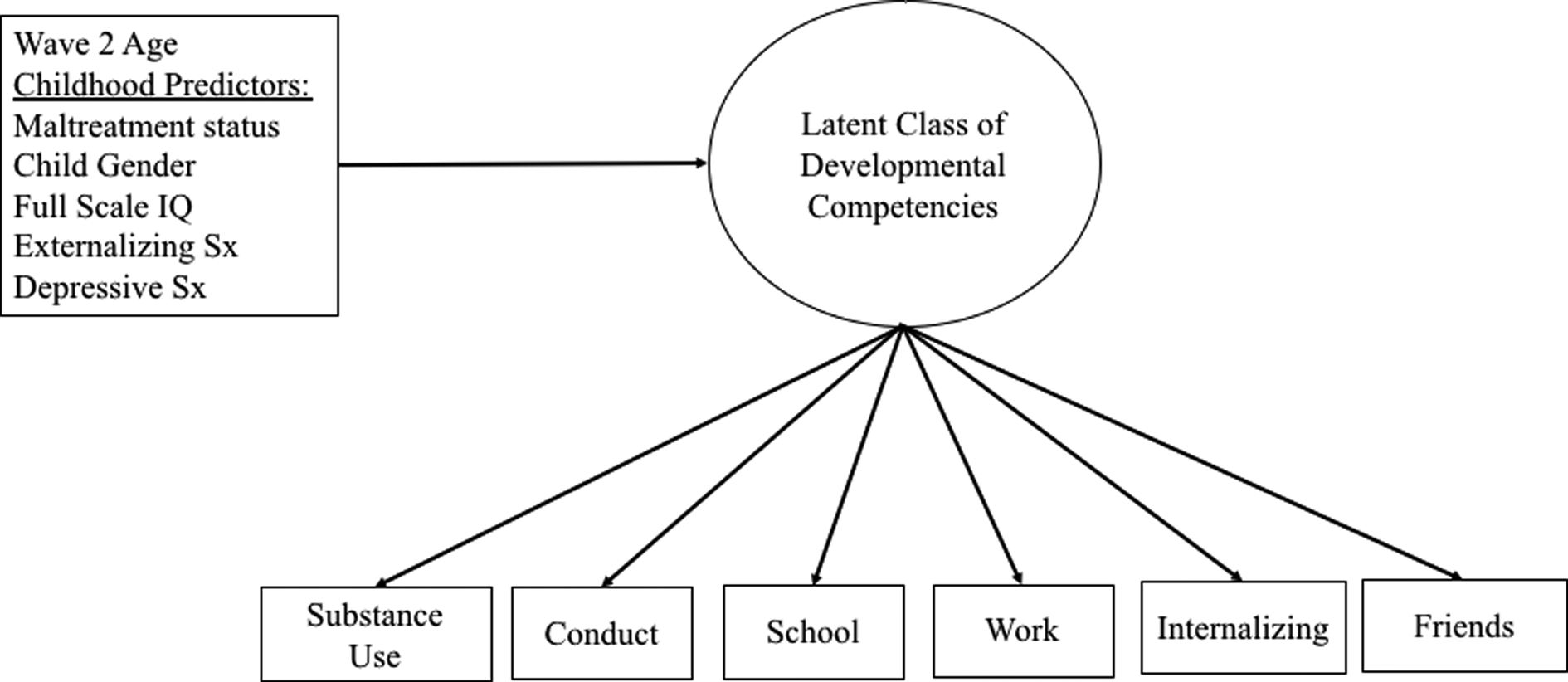
After a latent class solution was selected, childhood predictors of latent classes were entered simultaneously using the recommended 3-step procedure (Mplus R3STEP method; Asparouhov & Muthén, Reference Asparouhov and Muthén2014; Vermunt, Reference Vermunt2010). Predictors included childhood maltreatment (presence/absence), childhood full-scale IQ, childhood externalizing symptoms, child-rated depressive symptoms, and gender. Multinomial logistic regressions were then interpreted for each set of class comparisons (e.g., Class 1 vs. 2; Class 1 vs. Class 3, etc.) for each predictor. In this analysis, 21 cases missing on predictors of latent classes and were therefore not included in this part of the analysis. Figure 1 shows the conceptual model of this analysis.
Conceptual figure of latent class analysis and predictors of class membership.

Last, we used a classify–analyze approach to examine the association between latent class membership and CRP to determine whether a pattern of multifaceted competence may accompany higher levels of CRP, thus indicating a biological cost to the pattern of resilience. Specifically, we generated a categorical latent class variable, using the maximum-probability assignment method, wherein each participant received a modal class assignment based on the class for which they had the highest posterior probability of membership (Bray, Lanza, & Tan, Reference Bray, Lanza and Tan2015; Nagin, Reference Nagin2005). Using the resultant latent class variable (which treats membership as known), we conducted an analysis of covariance (ANCOVA) to examine mean CRP differences across classes. These analyses were conducted with participants who identified as Black, to be consistent with the skin-deep theory of resilience (Brody et al., Reference Brody, Yu, Miller and Chen2016). The decision was made to examine differences in CRP levels across competence classes, as opposed to modeling CRP as an indicator of latent class, because of the reduction in sample size that occurred as a result of selecting only Black participants, and because of the limited generalizability inherent in using a subsample of emerging adults.
Results
Latent class analysis
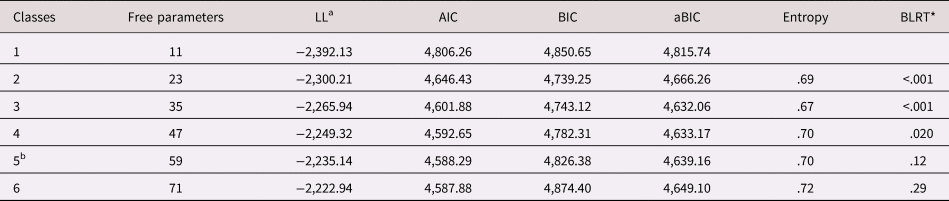
Latent class analysis was conducted with one to six classes. Based on comparative fit indices, identification of class solutions, and interpretability of item response probabilities, the four-class solution was retained. The four-class solution had a significant BLRT test, indicating that it provided a better fit to the data than the three-class solution. Although the three-class solution showed good comparative fit, comparability of aBIC values between the three- and four-class solution, difficult interpretability of the three-class solution, and the significance of the BLRT test indicating that the four-class solution fit the data better all factored into the decision to retain the four-class solution. Of note, the BLRT is a comparative fit index that has performed well in simulation studies identifying correct mixtures (Nylund, Asparouhov, & Muthén, Reference Nylund, Asparouhov and Muthén2007; Tofighi & Enders, Reference Tofighi and Enders2008), furthering our confidence in this fit index and the decision to retain the four-class solution. five-class solution was not identified, precluding it from selection as the final class solution. Table 1 documents fit indices for each (1–6) class.
Latent class analysis fit information for estimation of 1–6 classes

a Loglikelihood for class solution.
b This class solution converged but had a nonpositive definite in the first-order derivative product matrix, indicating problems with model identification.
* p values for the bootstrap likelihood ratio test comparing n class solution fit to n−1 class solution.
aBIC = adjusted Bayesian information criterion; BLRT = bootstrap likelihood ratio test
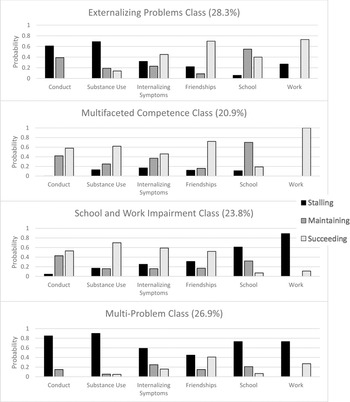
Characterizations of each of the four classes are based on item response probabilities, which indicated the proportion of individuals within each class who likely would fall in each competence level for each domain. Item response probabilities within each class are presented graphically in Figure 2.
Item response probabilities for the four-class solution. Probabilities range from 0.0 to 1.0. High probabilities (near 1) indicate a high proportion of class members fall in that category within the domain.

Multifaceted Competence Class (20.9%): This class is characterized by a high probability (.58–1.0) of succeeding in work, friendships, substance use, and conduct problems. This class is also marked by a high probability (.70) of maintaining (or meeting developmental expectations) at school. This class is marked by a very low probability of stalling in any of the competence domains; stalling probabilities across domains range from 0.0 to .17.
Work/School Impairment Class (23.8%): This class is marked by very high probability (.61–.89) of stalling in work and school. Members of this class also show a high probability of succeeding in substance use and internalizing domains (.59–.70), suggesting that they may have difficulties in work and school, but these problems are not coupled with psychopathology or substance use.
Externalizing Problems Class (28.3%): Prominent features of this class are high levels of stalling in conduct and substance use problems (.61–.69). However, individuals in this class have a high probability of success in the friend (.70) and work (.73) domains. They show low levels of stalling in the school (.058) and internalizing (.32) domains.
Multi-Problems Class (26.9%): This class demonstrates a high probability of stalling across conduct problems, substance use, internalizing symptoms, school achievement, and work (59–.90). Individuals in this class have variability in the friend domain. This class is not marked by high succeeding in any domain (0.0–.41).
Prediction of latent classes
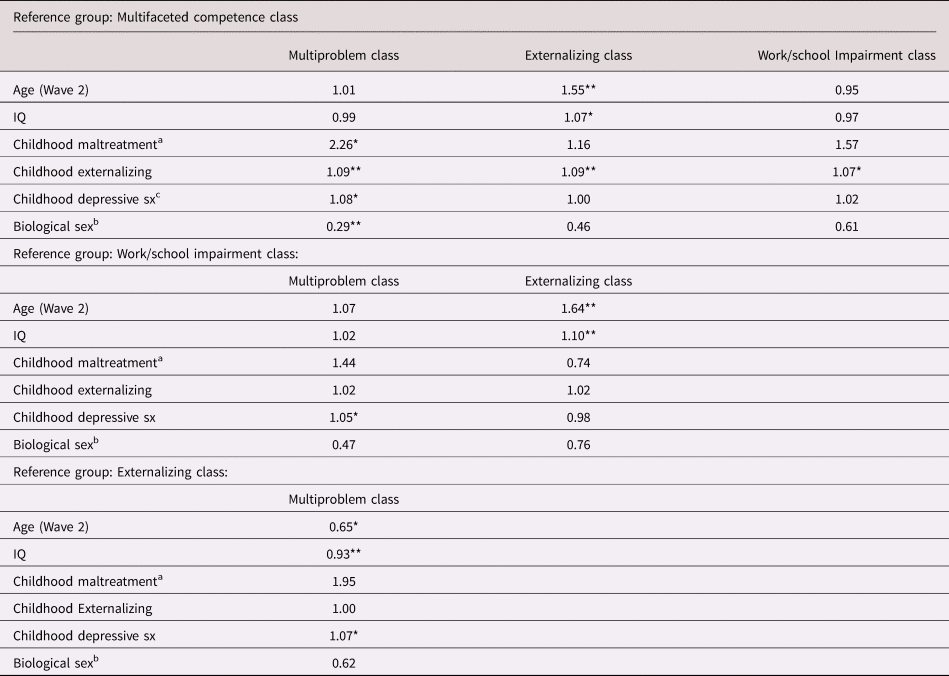
Using the automated three-step approach (R3STEP command) in Mplus, maltreatment status, gender, childhood IQ, childhood externalizing symptoms (rated by camp counselors), child-reported depressive symptoms, and age at Wave 2 were entered as predictors of competency profile classes. Odds ratios for multinomial logistic regressions are presented in Table 2.
Odds ratios for prediction of latent class membership

Notes: Results are presented as odds ratios. Odds ratios significantly higher than 1 indicate that higher scores on the predictor increase odds of class membership and odds ratios significantly lower than 1 indicate lower scores on the predictor increase odds of class membership relative to the reference group.
a Maltreatment was coded 0 = no childhood maltreatment, 1 = maltreatment.
b Sex is coded 1 = male, 2 = female; significant odds ratios less than 1 indicate male increases odds of membership in that class as compared to reference class. *p < .05, **p < .01.
c sx = symptoms.
Compared to the Multifaceted Competence class, individuals in the externalizing class tended to be older at Wave 2 (OR = 1.55, p = .006). Higher childhood IQ (OR = 1.07, p = .026) and greater levels of externalizing in childhood (OR = 1.09, p = .003) also increased odds of membership in the Externalizing Problems class as compared to the Multifaceted Competence class. Greater childhood externalizing predicted membership in the Work/School Impairment class as compared to the Multifaceted Competence class (OR = 1.07, p = .024). A number of predictors increased the odds of membership in the Multi-Problem class as compared to the Multifaceted Competence group; greater levels of externalizing in childhood (OR = 1.09, p = .001), greater childhood depressive symptoms (OR = 1.08, p = .018), and maltreatment experienced in childhood (OR = 2.26, p = .038) all increased the odds of membership in the Multi-Problem group.
Compared to the Work/School Impairment class, older age (OR = 1.64, p = .006) and higher childhood IQ (OR = 1.10, p < .001) predicted membership in the Externalizing Problems class. Additionally, compared to the Externalizing Problems class, odds of membership in the Multi-Problem class increased with younger age at Wave 2 (OR = .65, p = .017), lower childhood IQ (OR = .93, p = .002) and greater levels of childhood depressive symptoms (OR = 1.07, p = .026). Finally, compared to the Work/School Impairment class, greater depressive symptoms in childhood increased odds of membership in the Multi-Problem class (OR = 1.05, p = .032).
CRP and competence class membership
The unique and interactive effects of latent class membership and biological sex on CRP levels were examined using a 4 (Multifaceted Competence, Externalizing Problems, Work/School Impairment, and Multi-Problems classes) × 2 (male vs. female) ANCOVA with child maltreatment status included as a covariate. Consistent with previous literature on skin-deep resilience (Brody et al., Reference Brody, Yu, Miller and Chen2016), we examined this phenomenon among Black participants. Thus, the 323 participants who identified as Black were included in analysis. Individuals from this subgroup who did not provide salivary samples were excluded from analysis, resulting in a final subgroup of 234 participants. Excluded participants did not significantly differ from included participants on any study variables or latent class membership. Main effects of latent class (F (3, 224) = 1.68) and biological sex (F (1, 224) = .127) on CRP levels were nonsignificant. Nonmaltreated individuals experienced higher CRP levels (F (1, 224) = 6.33, p = .01). The interaction of latent class membership and biological sex was significant (F (3, 224) = 3.67, p = .01). Results of pairwise multiple comparisons revealed that Black male participants in the Multifaceted Competence class exhibited significantly higher levels of CRP (M = 3.67) than Black male participants in the Work/School Impairment (M = 3.28; LSD, p < .05) and Multi-Problem classes (M = 3.10; LSD, p < .01).
Distribution of child maltreatment across classes
In addition to examining whether maltreatment status predicted class membership, we also used the known class variable that was generated with the maximum-probability assignment method to examine the distribution of individuals with a history of maltreatment across classes. Among individuals who experienced child maltreatment, 20.3% were members of the Multifaceted Competence class, 24.3% in the Externalizing Problems class, 23.4% in the Work/School Impairment class, and 32.0% in the Multi-Problems class. Among nonmaltreated individuals, 29.7% were members of the Multifaceted Competence class, 31.3% in the Externalizing Problems class, 18.8% in the Work/School Impairment class, and 20.3% in the Multi-Problems class. Maltreated individuals were significantly less likely to be in the Multifaceted Competence class (χ2(1) = 4.92, p < .05) and more likely to be in the Multi-Problem class (χ2(1) = 7.20, p < .01) when compared to nonmaltreated individuals.
Discussion
The current study prospectively charted the developmental progression of economically disadvantaged maltreated and nonmaltreated children from childhood to emerging adulthood, and examined patterns of competence across multiple developmental domains of functioning central to the period of emerging adulthood. Latent class analysis revealed four distinct classes of functioning: (a) a class with multifaceted competence across domains (Multifaceted Competence); (b) a class exhibiting multifaceted maladaptation across domains (Multi-Problem); (c) and two classes with mixed patterns of competence and maladaptation (Externalizing Problems and Work/School Impairment). Consistent with the prior literature, individuals with a documented history of child maltreatment were less likely than nonmaltreated individuals to demonstrate multifaceted patters of competence (i.e., be represented in the Multifaceted Competence class) and more likely to demonstrate aggregate maladaptation across domains in emerging adulthood (i.e., be represented in the Multi-Problem class). However, maltreated and nonmaltreated individuals were equally likely to be in the two groups of emerging adults marked by mixed competence and maladaptation. This highlights that many children exhibit diverse patterns of resilient functioning in spite of the stress associated with child maltreatment experiences. In addition to child maltreatment, several other indicators differentially influenced group membership in the four classes of competence, including childhood depressive symptoms and externalizing symptoms, IQ, age, and biological sex. Importantly, results also revealed that Black men who demonstrated a pattern of multifaceted psychosocial competence also evidenced higher low-grade inflammation, suggesting a physiological cost to adaptation in the context of stress among these men.
Classes of psychosocial competence
We still possess relatively little knowledge about the development of resilient or competent functioning in emerging adulthood, especially among those with adverse stressful childhood experiences, such as child maltreatment (Cicchetti, Reference Cicchetti2013; McMahon, Reference McMahon2014). Our findings advance this literature by empirically identifying prototypical patterns of resilient functioning across several domains. This approach is similar, albeit different, from previous studies in which investigators have conceptualized resilient functioning across diverse domains and subsequently labeled an individual as resilient (or not) based on predetermined qualifications, such as competence in a certain proportion of domains or some combination of adaptive and average functioning across salient spheres (Cicchetti & Rogosch, Reference Cicchetti and Rogosch1997, Reference Cicchetti and Rogosch2009; McGloin & Widom, Reference McGloin and Widom2001; Mersky & Topitzes, Reference Mersky and Topitzes2010). Specifically, we did not attempt to specify a priori criteria to indicate overall resilience or competence (e.g., positive functioning on four of five domains). Instead, we determined levels of adaptation within each domain (i.e., stalling, maintaining, succeeding) and then allowed unobserved subgroups of individuals to emerge based on aggregations of naturally occurring, multifaceted functioning. This approach is more descriptive than prescriptive and functioning in one domain is not accorded more importance than others. It should be noted that there are strengths and limitations to the myriad methods of conceptualizing developmental competence, and each approach offers unique information. We briefly review the descriptive classes before discussing the differential prediction of childhood factors on class membership.
Patterns of developmental competence
Person-centered analysis revealed four distinct classes of emerging adult functioning among our sample of socioeconomically disadvantaged and racially and ethnically diverse participants. Notably, individuals were relatively evenly disbursed across the four classes, with the smallest class containing 20.9% of the sample and the largest class containing 28.3%, suggesting substantial diversity in patterns of competence across the six domains.
Multifaceted competence class
This class represents a pattern of relative global competence across all six domains. Specifically, individuals in this class had a very low probability of stalling in any domain and a high probability of exceeding developmental expectations in four domains (work, friendships, substance use, and conduct problems). For example, all individuals within this class were employed and approximately 90% had graduated high school, which represents a remarkable number when contextualized by typical rates among disadvantaged individuals (de Brey et al., Reference de Brey, Musu, McFarland, Wilkinson-Flicker, Diliberti, Zhang and Wang2019; Silva, Reference Silva2016). Additionally, 70% of individuals in this class reported very positive peer affiliation.
Notably, approximately half of the sample reported current or recovered internalizing psychopathology or mild-moderate current depressive symptoms. This finding is consistent with previous research demonstrating that impressive profiles of behavioral competence (e.g., domains of education, friendships, and employment) among those who have endured significant stress may be accompanied by covert psychological distress (e.g., depressive symptoms), representing a potential cost of resilient functioning (Luthar & Zelazo, Reference Luthar and Zelazo2003). Additionally, because all participants were economically disadvantaged – a potent predictor of internalizing problems (Inaba et al., Reference Inaba, Thoits, Ueno, Gove, Evenson and Sloan2005) – it is not surprising that internalizing symptoms are present, even within the class demonstrating relative competence across domains. However, the presence of this class is important, as this pattern of reasonable competence across many domains of functioning is relatively rare in high-risk, low-income samples (Vanderbilt-Adriance & Shaw, Reference Vanderbilt-Adriance and Shaw2008).
It is worth highlighting that the Black male participants in the Multifaceted Competence class also evidenced significantly higher levels of CRP, or low-grade inflammation, than the Black male participants in the Work/School Impairment and Multi-Problem classes. This important finding is consistent with an increasingly robust literature demonstrating that some Black emerging adults who evince high psychosocial competence (e.g., fewer depressive symptoms and externalizing behaviors, greater educational attainment and personal income) under conditions of stress may also experience greater physiological consequences in the form of higher levels of CRP (Chen et al., Reference Chen, Yu, Siliezar, Drage, Dezil, Miller and Brody2020), higher allostatic load (Brody et al., Reference Brody, Yu, Chen, Miller, Kogan and Beach2013, Reference Brody, Yu, Miller and Chen2016), poorer cardiometabolic health (Chen et al., Reference Chen, Miller, Brody and Lei2015), accelerated epigenetic aging (Brody et al., Reference Brody, Yu, Miller and Chen2016; Miller et al., Reference Miller, Yu, Chen and Brody2015), and greater risk for respiratory illness following a viral challenge (Miller et al., Reference Schulenberg, Sameroff and Cicchetti2016). As with previous literature, this pattern of findings suggests that, for low-income Black males, psychosocial competence in emerging adulthood may be a skin-deep phenomenon wherein individuals who are achieving observable success by conventional markers (i.e., education, mental health, interpersonal functioning, and employment) may also incur outwardly undetectable physical consequences, as indexed by higher levels of CRP, that pose substantial risk for subsequent disease (Brody et al., Reference Brody, Yu, Chen, Miller, Kogan and Beach2013).
To explain the pattern of skin-deep resilience found in both the current study and previous research, it has been theorized (Brody et al., Reference Brody, Yu, Chen, Miller, Kogan and Beach2013; Chen et al., Reference Chen, Yu, Siliezar, Drage, Dezil, Miller and Brody2020) that Black individuals living in the extremely stressful context of poverty must deploy particularly high levels of work ethic, striving, self-control, and a general unrelenting determination to succeed (termed “John Henryism;” James, Reference James1994) in order to maintain psychosocial competence in the presence of the myriad structural barriers and stressors unique to their lived experience (e.g., economic disadvantage, systemic oppression, discrimination, and racism). In turn, the physical demands of this intense persistence can result in health consequences (see Brody et al., Reference Brody, Yu, Miller and Chen2016). Further evidence for this theoretical explanation is reflected by the higher levels of CRP in Black male participants in the current study who attained developmental competence across multiple spheres.
Notably, we did not find a pattern of skin-deep resilience for Black female participants. Previous research has suggested that patterns of skin-deep resilience and John Henryism may differ based on biological sex (Duggan, Jennings, & Matthews, Reference Duggan, Jennings and Matthews2019; Subramanyam et al., Reference Subramanyam, James, Diez-Roux, Hickson, Sarpong, Sims and Wyatt2013). Though it is still unclear why sex differences may emerge, females tend to experience more resilient outcomes than male counterparts (DuMont et al., Reference DuMont, Widom and Czaja2007; McGloin & Widom, Reference McGloin and Widom2001), and Black males experience lower educational attainment than Black females (de Brey et al., Reference de Brey, Musu, McFarland, Wilkinson-Flicker, Diliberti, Zhang and Wang2019), suggesting that attainment of psychosocial competence may co-occur with greater physiological stress for Black males. Future research is warranted to explore differential patterns of skin-deep resilience based on biological sex.
Work/school impairment class
The very high probability of stalling in the work and school domains is a prominent feature of this class. Ninety-one percent of individuals in this class were unemployed and 61% did not finish high school. However, members of this class also had a high probability of exceeding developmental expectations related to substance use and internalizing symptoms, and a very low probability (<5%) of reported conduct problems. Thus, although these individuals are more likely to have difficulties with work and school, these problems were not coupled with psychopathology or substance use, indicating that diverse clustering of competent functioning across domains is not universal or uniform (Schulenberg et al., Reference Schulenberg, Sameroff and Cicchetti2004). This pattern is consistent with the concept of selective resilience (i.e., adaptation within one domain does not necessarily extend to others). It is also possible that members of this class are experiencing the nonlinear trajectories of education and employment that are common in low-income samples during emerging adulthood (Silva, Reference Silva2016), whereby their current educational and occupational statuses are transitory (Sussman & Arnett, Reference Sussman and Arnett2014).
Externalizing problems class
This group of individuals is identifiable by the high levels of externalizing problems. Specifically, 61% of individuals reported three or more diagnostic symptoms of ASPD and no members of this group avoided ASPD symptoms entirely. Similarly, 69% of individuals either met criteria for a substance use disorder or exhibited at least one symptom of substance dependence. Despite the high rates of externalizing problems, individuals in this class were likely to be interpersonally competent and doing well in the school (~94% graduated high school) and employment domains (73% employed), suggesting that these domains were unaffected by other challenges. Notably, 40% of individuals in this class reported involvement in higher education or vocational training. The pattern in this class is consistent with investigations that have found that positive educational experiences can be protective in buffering cascading effects for individuals with externalizing symptoms (Allwood & Widom, Reference Allwood and Widom2013; Nikulina & Widom, Reference Nikulina and Widom2019; Smith, Park, Ireland, Elwyn, & Thornberry, Reference Smith, Park, Ireland, Elwyn and Thornberry2013). Additionally, because emerging adulthood represents a period of peak substance use and the possible continuation of impulsivity and sensation-seeking that is common to adolescence (Masten et al., Reference Masten, Burt, Roisman, Obradović, Long and Tellegen2004), the high rates of externalizing behaviors and substance use in this class may simply reflect normative exploratory behaviors that have reached an apex, and will soon decline as individuals mature (Schulenberg et al., Reference Schulenberg, Sameroff and Cicchetti2004).
Multiproblem class
This class is marked by an aggregation of maladaptation, with a high probability of stalling in the domains of conduct problems, substance use, internalizing symptoms, school achievement, and work. Contrasted with other classes, individuals in this class have a particularly high probability of having three or more ASPD symptoms (85%), having significant substance abuse or dependence problems (90%), and current internalizing psychopathology (59%). Although there is variability within the friendship domain, 60% of individuals reported only one close friend or less, and approximately 45% report no close friends or consistent trouble keeping and making friends. As previous work has shown, maladaptation in various domains of functioning can aggregate together and initiate negative cascades that affect other domains (Masten & Cicchetti, Reference Masten and Cicchetti2016; Schulenberg & Maslowsky, Reference Schulenberg and Maslowsky2009).
Childhood predictors
A developmental psychopathology perspective requires that the current functioning of an individual be considered within the context of distal influences (Sameroff, Reference Sameroff2010). Thus, the current study utilized a longitudinal design to examine childhood predictors of membership within the four latent classes: child maltreatment, childhood internalizing and externalizing symptoms, IQ, sex, and age.
Child maltreatment
Child maltreatment significantly differentiated membership in the Multi-Problem class, compared to the Multifaceted Competence class. Therefore, the often-chronic stress associated with child maltreatment resulted in the strongest influence in limiting patterns of global competence across domains and increasing the aggregation of maladaptation across domains. This finding is consistent with the extant literature on the developmental impact of child maltreatment on competence that suggests that child maltreatment rarely ends in global resilience (Cicchetti, Reference Cicchetti2013; Cicchetti & Rogosch, Reference Cicchetti and Rogosch1997; Cicchetti & Rogosch, Reference Cicchetti and Rogosch2009; McGloin & Widom, Reference McGloin and Widom2001; Mersky & Topitzes, Reference Mersky and Topitzes2010). Across these studies, maltreated children are disproportionately represented in profiles exhibiting an absence of competent strivings (or the least competent groups) and less likely to exhibit patterns of high resilient functioning or cross-domain adaptation. Nonetheless, individuals who experienced child maltreatment did exist in the Multifaceted Competence group, highlighting the fact that some individuals are able to experience more global patterns of competence following maltreatment. The current findings add to the literature demonstrating that child maltreatment exerts negative influences on developmental domains, over and above the stress of poverty, by using a methodological design that accounts for economic disadvantage (Aber & Cicchetti, Reference Aber and Cicchetti1984; Cicchetti & Rogosch, Reference Cicchetti and Rogosch1997; McGloin & Widom, Reference McGloin and Widom2001; Trickett & McBride-Chang, Reference Trickett and McBride-Chang1995).
That maltreated children are more likely to exhibit challenges across multiple domains of functioning in emerging adulthood is not surprising, given the multilevel, multidomain sequelae of child maltreatment (Cicchetti & Toth, Reference Cicchetti and Toth2016). Regarding the domains assessed in the current study, several investigations have demonstrated an association between child maltreatment and maladaptive conduct behaviors in emerging adulthood (Nikulina & Widom, Reference Nikulina and Widom2019). Similarly, findings from multiple prospective studies of maltreated and nonmaltreated individuals suggest that emerging adults with maltreatment histories have significantly lower rates of high school graduation and overall educational attainment compared to nonabused peers (Allwood & Widom, Reference Allwood and Widom2013; Jaffee et al., Reference Jaffee, Ambler, Merrick, Goldman-Mellor, Odgers, Fisher and Arseneault2018; Noll et al., Reference Noll, Shenk, Yeh, Ji, Putnam and Trickett2010; Smith et al., Reference Smith, Park, Ireland, Elwyn and Thornberry2013). Further, although instability in employment is common during the transition to adulthood, individuals who experienced child maltreatment are at increased risk of employment problems during this period (Allwood & Widom, Reference Allwood and Widom2013; Currie &Widom, Reference Currie and Spatz Widom2010; Fergusson, McLeod, & Horwood, Reference Fergusson, McLeod and Horwood2013). Finally, a substantial body of research has documented that the stress of child maltreatment increases the risk for internalizing psychopathology (Fergusson et al., Reference Fergusson, McLeod and Horwood2013; Hagan, Roubinov, Mistler, & Luecken, Reference Hagan, Roubinov, Mistler and Luecken2014; Humphreys et al., Reference Humphreys, LeMoult, Wear, Piersiak, Lee and Gotlib2020), problematic substance use (Fergusson et al., Reference Fergusson, McLeod and Horwood2013), and negative peer relationships (Dishion, Reference Dishion, Dishion and Snyder2016; Handley, Russotti, Rogosch, & Cicchetti, Reference Handley, Russotti, Rogosch and Cicchetti2019) in emerging adulthood.
Despite the disconcerting finding that individuals who experience maltreatment are more likely to display impaired functioning across several developmental domains, child maltreatment did not differentially predict membership in other classes, indicating substantial variability in patterns of competence. Our findings provide evidence for heterogeneity in resilient functioning (Luthar et al., Reference Luthar, Cicchetti and Becker2000), and multifinality in adaptive processes, following child maltreatment (Cicchetti & Rogosch, Reference Cicchetti and Rogosch1996).
For example, maltreated children were equally as likely as nonmaltreated individuals to be in the Externalizing Problems and Work/School Impairment classes in emerging adulthood. Although the labels for the Externalizing Problems and Work/School Impairment classes accentuate shared features of maladaptation, members of these classes also manifest competence in some domains. For instance, individuals in the Externalizing Problems class display competent levels of functioning in peer friendships, school, and work that coexist alongside conduct and substance use problems. Similarly, membership in the Work/School Impairment class is marked by resilient outcomes in the domains of psychopathology and substance use. These findings indicate that the deleterious effects of child maltreatment on friendship, school, work, internalizing and externalizing psychopathology, and substance use are not inevitable, and exemplify that some individuals function competently even after maltreatment (Cicchetti, Reference Cicchetti2013). As such, evidence that maltreated children struggle to adjust within precise spheres of development should not obscure the possibility that they thrive within other domains (Luthar et al., Reference Luthar, Cicchetti and Becker2000). Furthermore, uneven patterns of competent functioning across domains may still constitute resilient functioning, and the mixed patterns observed in this study may represent more realistic expectations for high risk groups (Vanderbilt-Adriance & Shaw, Reference Vanderbilt-Adriance and Shaw2008).
Childhood symptomatology
Lower levels of childhood externalizing symptomatology differentiated membership in the Multifaceted Competence class from all other classes (e.g., Externalizing Problems, Work/School Impairment, and Multi-Problem). This suggests that high-risk children who do not display externalizing behaviors in childhood may be buffered from the snowballing of risk that may emerge from these behavior problems, as children develop into adolescents and then emerging adults. Interestingly, the influence of childhood externalizing symptoms was not uniform across the other three subgroups. For example, although childhood externalizing symptoms increased the odds of membership in the Work/School Impairment class (compared to the Multifaceted Competence class), members of this class had a very low probability of conduct problems in emerging adulthood (i.e., discontinuity of symptoms). For individuals in this class, it is possible that the childhood externalizing symptoms represented childhood-limited symptoms that resolved during the transition to adulthood (Odgers et al., Reference Odgers, Moffitt, Broadbent, Dickson, Hancox, Harrington and Caspi2008). However, childhood externalizing symptoms, even when time limited, can set in motion a cascade of negative academic outcomes that extends across the life course, possibly accounting for the work/school impairments for these individuals.
Conversely, the present findings indicate continuity of externalizing symptoms throughout development for the Externalizing Problems and Multi-Problem classes. Despite this shared risk, members of these two classes display very different patterns of functioning, with members of the Externalizing Problems class demonstrating competence in all other domains except substance use, and members of the Multi-Problem class exhibiting global maladaptation. One reason that members of the Externalizing Problems class may be able to succeed in other domains, despite the consistent externalizing symptoms, is that their unique combination of outcomes may become protective. For example, competence in the educational domain predicts desistance in conduct behaviors across the life course (Allwood & Widom, Reference Allwood and Widom2013; Loeber, Stouthamer-Loeber, Van Kammen, & Farrington, Reference Loeber, Stouthamer-Loeber, Van Kammen and Farrington1991; Zingraff, Leiter, Johnsen, & Myers, Reference Zingraff, Leiter, Johnsen and Myers1994). It is possible that the current investigation is observing individuals in the Externalizing Problems class while they are in the midst of a developmental turning point, where the protective effects of positive functioning in interpersonal, academic, and work domains will begin, or continue, to lessen the effects of the externalizing symptoms as they continue to transition to adulthood (Jaffee et al., Reference Jaffee, Ambler, Merrick, Goldman-Mellor, Odgers, Fisher and Arseneault2018; Jung, Herrenkohl, Skinner, & Rousson, Reference Jung, Herrenkohl, Skinner and Rousson2018; Nikulina & Widom, Reference Nikulina and Widom2019).
Although greater childhood externalizing symptomatology differentiated membership in the Externalizing Problems, Work/School Impairment, and Multi-Problems classes (in reference to the Multifaceted Competence class), greater childhood depressive symptomatology only differentiated membership in the Multi-Problems class (in reference to all other classes). This suggests that the comorbidity of childhood externalizing and internalizing symptoms may uniquely account for the broad pattern of maladaptation observed in this class. The experience of the broad spectrum of psychopathology during childhood likely sets into motion widespread negative sequelae across multiple domains of developmental functioning that continue to snowball over time, leading to multifaceted maladaptation. For many, the transition to adulthood represents a period when socioemotional difficulties begin to attenuate; for others, it can be a time when difficulties consolidate into enduring patterns of maladaptation (Schulenberg & Zarrett, Reference Schulenberg, Zarrett, Arnett and Tanner2006). The latter may be true for individuals in this class, as they exhibit a persistent pattern of multidimensional psychopathology that extends from childhood to emerging adulthood, which may ultimately infiltrate all spheres of functioning and consolidate dysfunction across developmental domains.
IQ
Higher childhood IQ uniquely predicted membership in the Externalizing Problems class when contrasted with each of the other three classes (IQ differences were not significant in any other class contrasts). It is possible that IQ represents a set of core cognitive resources that protect against the negative effects of elevated conduct behaviors and substance use, allowing individuals in this group to do well in all other domains. This interpretation would be consistent with studies documenting the protective effects of IQ in resilient outcomes (Luthar & Zelazo, Reference Luthar and Zelazo2003; Masten et al., Reference Masten, Hubbard, Gest, Tellegen, Garmezy and Ramirez1999; Masten et al., Reference Masten, Burt, Roisman, Obradović, Long and Tellegen2004; Nikulina & Widom, Reference Nikulina and Widom2019). Alternatively, the increased externalizing problems in this class may represent environmentally adaptive behaviors that are conditional responses to disadvantaged contexts (Belsky, Reference Belsky2019). That is, individuals who have the greatest cognitive resources are able to flexibly and selectively adjust their behavior to match their context (i.e., externalizing behaviors in disadvantaged contexts; Frankenhuis, de Vries, Bianchi, & Ellis, Reference Frankenhuis, de Vries, Bianchi and Ellis2020) while preventing negative spillover to other domains of functioning.
Biological sex
Female participants were significantly more likely to be in the Multifaceted Competence class when compared to the Multi-Problem class. This biological sex finding is consistent with studies demonstrating that men are more vulnerable to negative outcomes in several developmental domains in adulthood (DuMont et al., Reference DuMont, Widom and Czaja2007; McGloin & Widom, Reference McGloin and Widom2001). In prior studies, these sex differences were not related to maltreatment type, or the selection of domains assessed (e.g., criminal offending; McGloin & Widom, Reference McGloin and Widom2001). Further research is needed to elucidate sex differences in resilience, especially in maltreatment samples.
Implications
The current findings have implications for developmental science, policy, and prevention. We identify the existence of subgroups of individuals living in highly stressful contexts who exhibit unique patterns of multidimensional competence and maladjustment. Future studies investigating resilience with individuals developing in contexts with greater levels of socioeconomic and psychosocial risk should consider the benefits of using a person-centered approach which is useful in situations in which maladaptive outcomes are probabilistic, multifaceted, and common. For example, one advantage to identifying person-centered patterns of competence across domains of functioning is that it prevents against minimizing adverse outcomes in one domain when celebrating adaptations in others (i.e., competence in one domain only gains meaning in relation to the individual's functioning in other domains; Luthar et al., Reference Luthar, Cicchetti and Becker2000). Also, this approach does not require that an individual demonstrate multidomain functioning to be classified as resilient. Instead, approaches such as LCA allow for a more holistic picture of individuals’ lives and reflects the value in finding patterns where individuals may be succeeding in one arena, meeting developmental expectations in some spheres, and struggling in others.
The present results affirm that the deleterious effects of child maltreatment can endure and persist into emerging adulthood, where maltreatment increases the risk for individuals to experience an accrual of maladaptation across functional domains. These confirmatory findings reinforce the need to invest in maltreatment prevention (Cicchetti & Toth, Reference Cicchetti and Toth2016; Gunnar & Fisher, Reference Gunnar and Fisher2006). Child maltreatment indisputably inflicts adverse consequences, but children are not uniformly affected (Cicchetti & Rizley, Reference Cicchetti and Rizley1981). As evidenced by the four classes resulting from this investigation, maltreatment can eventuate in diverse outcomes and heterogeneous patterns of multidomain competence. Therefore, when seeking to identify resilient individuals and design interventions to promote resilience, personalized and tailored approaches may be especially impactful in uniquely supporting subgroups of maltreated individuals by matching interventions to their distinct needs in some domains and strengths in others (as contrasted with universal, “one-size-fits-all” approaches). Additionally, the results of this study highlight the multifaceted risk of comorbid childhood internalizing and externalizing psychopathology. Individuals who exhibit multidimensional symptoms in childhood may benefit from transdiagnostic interventions, delivered early, to prevent the spreading of maladaptation to multiple domains (McLaughlin, Colich, Rodman, & Weissman, Reference McLaughlin, Colich, Rodman and Weissman2020).
Finally, our results support the concerning notion that Black males who attain positive adjustment following adversity may experience hidden costs in terms of higher levels of low-grade inflammation (Brody et al., Reference Brody, Yu, Miller and Chen2016; Chen et al., Reference Chen, Yu, Siliezar, Drage, Dezil, Miller and Brody2020). Thus, it is important to attend to multilevel processes and potentially provide health-promoting interventions for individuals who may be characterized as doing well by virtue of their psychosocial competence but are experiencing negative consequences underneath the skin, with a specific emphasis on psychosocial interventions that have demonstrated efficacy in reducing inflammation (Brody et al., Reference Brody, Yu, Miller and Chen2016; Schakel et al., Reference Schakel, Veldhuijzen, Crompvoets, Bosch, Cohen, van Middendorp and Evers2019; Shields, Spahr, & Slavich, Reference Shields, Spahr and Slavich2020).
The study results and implications should be contextualized by the existing limitations. First, although we attempted to provide cogent explanations for our operationalization of resilience and criteria for competence within each domain, the field still lacks a universal definition of resilience. Additionally, our list of domains is not exhaustive, and an assessment of romantic relationship functioning is notably absent due to the complexity of this domain in emerging adulthood. Future studies should continue to define best practices for assessing competence in this domain during the transition to adulthood (see Shulman & Connolly, Reference Shulman and Connolly2013). As developmental psychopathologists, we would be remiss if we did not acknowledge that resilience (or lack of) is not immutable, and our assessment of functioning in emerging adulthood represents one portion of what is likely an evolving and dynamic process of adaptation and maladaptation that will continue throughout the life cycle (Toth & Cicchetti, Reference Toth and Cicchetti2013). Prospective studies that follow maltreated and nonmaltreated individuals from childhood to adulthood are needed. Finally, our study focuses on psychosocial outcomes and future work would benefit from multilevel analysis that incorporates biological processes (Cicchetti, Reference Cicchetti2013).
Despite its limitations, the present investigation encompasses considerable strengths. First, much of the research on child maltreatment and resilience is cross-sectional or employs a short-term longitudinal design. Prospectively following maltreated and nonmaltreated individuals from childhood to emerging adulthood, while also controlling for poverty within the study design, is critical and rare (Cicchetti, Reference Cicchetti2013). Second, we utilized a multimethod, multiinformant design that incorporates self-reports, other-informant observations, performance tasks, and coded records. Finally, our application of latent class analysis to identify naturally occurring multidimensional competence patterns among high-risk maltreated and nonmaltreated individuals is novel.
Conclusion
Emerging adulthood represents a developmental epoch marked by uncertainty and instability, when young people are trying to “take hold of some kind of life” (Schulenberg et al., Reference Schulenberg, Sameroff and Cicchetti2004). Individuals at high risk for challenges across domains, such as those who grew up in the stressful context of child maltreatment and poverty, may falter during this period, and consolidate previously compromised development into enduring patterns of dysfunction. However, many also go on to demonstrate domain-specific competence and impairment. It is critical to consider the complexity of adaptive functioning and resilience within the context of development to further elucidate heterogeneous patterns and diverse developmental outcomes that follow adversity and advance our knowledge of healthy psychosocial and biological development.
Financial Statement
This research was supported by grants received from the National Institute on Drug Abuse (R01DA17741), National Institute of Child Health and Human Development (P50-HD096698), the Spunk Fund, Inc., and the Klaus J. Jacobs Research Prize to Dante Cicchetti
Conflicts of Interest
None.