Introduction
In June 2010, I travelled the 13-hour journey from the Sri Lankan capital Colombo up the A9 road towards Jaffna town in the Jaffna (Yalpannam) peninsula. It was a sobering journey. From the north central town of Vavuniya upwards marked the beginnings of former rebel-held territory and the site of the last climactic battles between the Sri Lankan government and the separatist guerrillas, the Liberation Tigers of Tamil Eelam (LTTE, hereafter referred to as ‘the Tigers’) in May 2009 which ended a civil war that had lasted for nearly 30 years. The road wove through cordoned-off mined areas, small ragtag settlements of returnees, and well-built army and police camps. Next to the road ran the remains of what was formerly Sri Lanka's most popular passenger railway line, the Northern Railway Line on which its signature train, the ‘Yal Devi’, ran express from Colombo to Jaffna. Opened for through-traffic in 1905, the Northern Railway Line closed in 1990 when the first Eelam war broke out and the Tigers removed all the tracks from Vavuniya upwards. Since then, the Northern Railway Line has never taken the through route. However, despite its destruction, fieldwork in Sri Lanka in 2002 revealed that the noticeboards (even after many changes) in Colombo Fort Station continued to announce the fares and the route to Jaffna, a symbolic statement of a seemingly undivided and sovereign territory, even though many of its subjects in those areas lived parallel lives. Accordingly, after victory in 2009, the Sri Lankan state immediately announced its intention to rebuild the railway line, though by late 2011 very little new track had actually been laid. The Northern Railway Line thus still stands as a compelling symbol (even in its absence) by which to understand wartime Sri Lanka through its pre-and post-history.
This paper takes the train as a form of social compact in which the life of the individual, the community, and the state became integrally intertwined. It focuses on two dimensions of what the Northern Railway Line enabled in Sri Lanka: first, a physical and symbolic representation of stateness, and, secondly, the pursuit of mundane everyday life. These two are embedded within Sri Lanka's landscapes and its histories of colonial and post-colonial rule and the ethnic conflict, riots, and war which inextricably shaped the railway's journeys and passengers. The paper considers the construction, the life, and the afterlife of the railway.
First, it will be argued (as has been done elsewhere) that large-scale projects and transportation networks such as railways and roads are potent representations of stateness for the colonial, post-colonial, and would-be ‘rebel’ state. Railways are more often thought of as large-scale, high-tech technological artefacts rather than the smaller everyday technologies that are the themes of other papers in this special issue. Secondly, the paper will highlight the ways in which railways also make particular kinds of everyday life possible and how, in being woven into routine daily and weekly journeys, the Northern Railway Line also became intertwined with the changing circumstances and histories of its mainly Tamil passengers within an increasingly ethnicized national landscape. In the aftermath of its closure, the railway has come to symbolize the quest for the desired normalcy of the past, an aspiration towards an everyday experience that the younger generations have never had and which has, as a consequence, become a potent force in their lives.
Assembling stateness
The railway epitomized modernity in nineteenth-century Europe.Footnote 3 In Britain, the construction and running of railways produced massive cultural and social effects, generating new sources of power and capital as well as experiences of mass travel (and thus togetherness and exclusion with and from others). Most of all, it created a sense of being ‘Victorian’ and an identification with Victorian technology.Footnote 4 The latter would be re-presented as an aspect of Britain's ‘civilizing mission’ in colonies where railway building began early (as in India from the early 1850s) and where modernity was seen as the preserve of the colonizer rather than the colonized, and not something that was shared.Footnote 5
‘Intelligent engineering’
Legitimacy at the heart of modern state, Mukerji argues, is the silent but continually demonstrated ability for ‘intelligent engineering’, a technological capacity, and control over the built environment.Footnote 6 The US 2001 World Trade Center bombing thus symbolized an attack on a place that epitomized American technological sophistication and economic control.Footnote 7 The physical world, she points out,
has been politically more than a repository of resources with politico-economic value. It has been a place to demonstrate intelligence, a collective cognitive capacity to dominate that has been a foundational and legitimating principle of power. Engineered locales – from cities to water supplies and military installations – are places where power is exercised and the technical capacity for it is palpably demonstrated.Footnote 8
For Mukerji the development of infrastructure in modern Western states was not an inevitable result of rational politico-economic growth but the very motive force of the state project.Footnote 9 In a similar vein, Goswami argues that British rule in India was physically instantiated and deployed through the construction and regulation of large-scale newly built environments—what she calls ‘state works’. These ‘state works were to speak for themselves in the language of objective reality: they would stand as the incontrovertible evidence of the modernizing project of the colonial state’.Footnote 10 Of these, she suggest, railways were the most exemplary form, given that the ‘late-nineteenth-century colonial imagination figured railways as the universal vehicle for its self-proclaimed program of “moral and material progress”’.Footnote 11 The railways provided a seemingly exemplary space for British moral and intellectual power through a demonstration of their ingenuity, modernity, and technological prowess.
Indeed, railways, Kerr argues, had a dual action in colonial India: they were simultaneously process and product, central in creating what we know as modern India, and also in initiating a whole set of debates about how to make India modern and how railways should make India modern.Footnote 12 The construction and running of railways in colonial India, he points out, created a large labour force, established new markets for food, shaped and reshaped landscapes across India, redistributed power over the land, and strengthened British rule in India by enabling the movement of files, troops, and administrators. Moreover, and most significantly, the growth of the railways gave colonial administrators and Indian nationalists a way of mapping and imagining India's vast surface area as one country brought together within one, albeit tentacular, railway grid.Footnote 13 In a very real sense, railways, like roads, provided the means for the simultaneous circulation of people and the extension of state sovereignty.Footnote 14 The representations of India as one country, one nation, and one traversable entity was made ‘an ontological reality’ by the immense physical presence of the railways, the tracks, stations, and so on.Footnote 15
In other words, railways were not the effect of an already-established state power over a given place, but a source for constructing power over that place. Stateness and sovereignty can be viewed as requiring constant performance rather than being fixed and omnipotent.Footnote 16 Technological prowess was, and remains, part of the attempt to instantiate and perform stateness. This capacity of the railways to become an arena for the demonstration of state power and prowess over the environment is central to understanding what the railways signified in Sri Lanka and so to understand why destroying the railway could be so potent an act for the separatist guerrilla group, the Tigers.
Colonial Ceylon
The history of road-building and then railway building in Ceylon closely followed the history of the consolidation of the rule of the British, the third and last of the island's European colonizers,Footnote 17 and its three phases: military conquest, economic and political expansion, and finally the management of ‘native life’. The British defeated the interior kingdom of Kandy in 1815 and unified the island for the first time as a single political and spatial territory under one common administration, with Colombo as its centre.Footnote 18 One of the first major works undertaken by the new regime was to build roads through the mountainous Kandyan kingdom, through terrain deliberately kept inaccessible by former monarchs.Footnote 19 By the 1830s every town of significance for the colonial authorities was thereby connected to Colombo and Kandy.Footnote 20 The second phase of colonial road and rail construction was commercial—to serve the plantation economy and to establish Colombo as the connection between the hinterland, the colony, and the metropolis.Footnote 21 Nineteenth-century road building and railway construction was, however, very uneven: the majority of roads lay in the Kandyan highlands,Footnote 22 and so, too, the railways that followed in 1867 were primarily built in the upland area where the coffee and later tea plantations were established and run by the European planter community.
The 1833 Colebrooke-Cameron reforms are of the greatest significance in understanding Ceylon's colonial ‘state-space’,Footnote 23 and they instituted three far-reaching transformations. First, the British administration understood Ceylon's enormously socially heterogeneous population to be the result of the empirical variations produced by race, an idea newly popularized in Victorian society.Footnote 24 Linguistic differences between Sinhalese and Tamil defined the boundaries of race, following the popularity of nineteenth-century philological and racial theories about the common stock of those speaking the same language.Footnote 25 Different kinds of overlapping, segmented identities within what were named as Sinhalese and Tamil groups (i.e. differing caste groups and geographical and regional variants, such as interior versus highland, Jaffna versus Batticaloa, low-country Sinhalese versus Kandyan Sinhalese) became incorporated into these larger racial categories.Footnote 26 The reforms created limited ‘native’ representation in the Legislative Council solely on the basis of communal representation. Racial differences came to have ‘practical significance. . . [and] difference became formally instituted in legal and political procedures’.Footnote 27
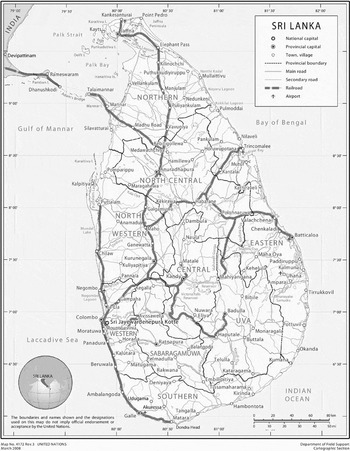
Secondly, the island was reorganized into five, and later in 1889 into nine, provinces. The provinces were administered through either Sinhalese or Tamil, depending on the preponderance of speakers. The codification of different customary laws was also mapped onto territories so that regions became ethno-linguistic areas with common codes of property, caste, and kinship (for example, the Thesawalamai of the Jaffna Tamils, the Mukkuva code of the eastern Tamils, Kandyan customary law). Legal and political administration depended on the seeing the island as a patchwork of different places, each with its own distinct people, customs, and language. So enduring was this legacy that the boundaries of the contemporary map of Tamil Eelam promoted by the Tigers follows the boundaries of the 1889 British Northern Province almost exactly (see Figure 1).Footnote 28
Map of Sri Lanka.

Thirdly, the reforms of 1833 abolished monopolies and established a capitalist plantation sector. This new colonial economy introduced a novel set of social actors, from the European planters to new indigenous elites, all struggling for recognition and linkages to the state, and who recognized each other through a melange of race, caste, and region.Footnote 29 Initially, encouraged by the colonial state, European coffee, and then later tea, plantations dominated the island's economy.Footnote 30 However, by the end of the nineteenth century, new ‘industries’—including coconut and rubber plantations and ancillary activities—helped create a new Sinhalese bourgeoisie, comprising both the established Govigama (farming) caste and the upwardly mobile castes of the Karava (fishermen and women), Durava (toddy-tappers), and Salegama (cinnamon-peelers).Footnote 31 Coconut and rubber became major plantation crops for non-Europeans, especially Karava landowners and entrepreneurs.Footnote 32 Half of the rubber estates were Ceylonese from their inception and Ceylonese ownership continued to rise.Footnote 33 These plantations lay not in the hill-country but in the southern and central areas around Colombo.
The other significant new elite consisted of the indigenous English-educated professional class. One of the foremost groups among the new educated middle class was the Jaffna Tamil clerks and government civil servants. While the Jaffna peninsula was entirely peripheral to the emerging plantation economies, the establishment of missionary schools, the riskiness of cash-crop production, land scarcity, and overpopulation led to the emergence in the nineteenth century of Jaffna's premier resource—education.Footnote 34 Well-educated English-speaking Jaffna Tamils travelled all around the island and to other British colonial territories as civil servants, overseers, and so on, becoming ‘a nation of pen-pushers’ at a time when ‘there was a great demand for pen-pushers all over the British Empire’.Footnote 35 As E. B. Denham related in 1911, ‘the majority of Jaffnese obtain employment in Colombo and in the Far East as clerks, overseers, and conductors on estates. [T]hey make excellent accountants.’Footnote 36 Significantly, many of these Jaffna Tamils became railway clerks: the railways in Singapore and Malaya were famous for their Jaffna Tamil staff.Footnote 37
All three of these new elites—European, Sinhalese, and Tamil—were central to the debates around railway construction. Unlike India, with its powerful purse, the Crown colony of Ceylon could not afford to build a wholesale network of railways: instead it built railways sequentially, with funds for each line having to be negotiated with the Colonial Office in London.Footnote 38 Rather than being considered as an inevitable expansion of the existing network, every line was thought of as benefiting a particular district or social group. Railway construction thus became an arena in which the value of being connected to Colombo to certain economies, people, and places was extensively debated. For the new elites, not having railways demonstrated their physical remoteness and political distance from Colombo and so from the state itself. Moreover, the railway was the great sign of modernity—to be on the railway grid, to live in a place with a railway, was to be a modern political subject.
Railways for whom?
The first railway line between Kandy and Colombo was opened in 1867 after prolonged agitation by the planters.Footnote 39 Three years later, new extensions were secured to Matale, Nawalapitiya, Nanuoya, Haputale, and Uda-Pussellawa, all lines that favoured planters’ interests. By the 1870s other elites began to campaign for their own lines, the Southern and the Northern Railway Lines. These were in turn opposed by the European planting community which found, by 1898, that it was no longer regarded as the principal ‘public’ by the Colonial Office in London. Eager to maintain colonial rule against the movement for self-representation, the Colonial Office had moved by this time into a more intimate management of ‘native’ life and economy.Footnote 40 For example, the Southern Railway Line serving the (Ceylonese) coconut lands between Galle and Colombo was seen to be, as Governor Gregory remarked, ‘for the benefit of the natives’, intended to open up coastal towns to new markets and enable movement in and out of Colombo.Footnote 41 Construction on the Southern Railway Line began in 1875, and, despite delays and opposition, it opened for through-traffic in 1895. The Northern Railway Line, which experienced a similar staggered pattern of growth, faced even greater opposition, but its origins showed the strength of local identification with its creation.
The Northern Railway Line was the longest in Ceylon, running 211 miles through the heart of the island. From Colombo it ran through the dry zone of the island into the peninsula and on to Jaffna town, terminating at Kangesanturai on the sea. Rather than helping the planters, it served small-scale agriculture and passenger traffic. The first plan for such a line was touted in 1885 by a body of individuals at a public meeting in Jaffna, and from this emerged the self-appointed Jaffna Railway Committee, composed of eminent professionals, missionaries, and respected men prominent in Jaffna society.Footnote 42 The Jaffna Railway Committee issued two memorials (in 1887 and 1889) and gave evidence to two special commissions. Both the 1887 and 1889 requests were turned down by the Governor, Sir Arthur Gordon. The final report of the special commission appointed in 1890 by Gordon's successor, Sir Arthur Havelock, was controversially signed by only two of its members and only authorized the construction of a railway from Colombo to Polgahawela in the belief that Jaffna did not justify a railway extension.Footnote 43 Renewed agitation resulted in another special commission in 1895 whose report recommended building the whole railway line.Footnote 44 Sir J. West Ridgeway, who arrived in Ceylon as Governor in 1896, was a railway enthusiast and he pushed decisively for the construction of the railway. The through route was opened on 1 August 1905, under Governor Blake. Thus, it took, all told, from the first Jaffna Railway Committee memorial in 1887, 19 years for the project to be completed.
While the railway line was judged to be important, the halt in the proceedings in 1890 crucially concerned Jaffna's status as the terminal point. The many documents relating to the Northern Railway Line produced by colonial officials and ‘experts’, by the Jaffna memorialists, letter-writers, journalists, etc., contained arguments not about the railway's economic benefit, but about Jaffna, the place, its ‘industrious’ people, and whether it ‘deserved’ a railway. A prominent claim was that the Jaffna peninsula was in economic and political decline, having been neglected by the colonial state. For members of the Jaffna Railway Committee the desire for a railway was a desire for modernity and the everyday presence of the state. The memorial presented in 1887 to Gordon, the visiting Governor, begins, ‘This visit, hasty though it necessarily is, makes us rejoice to think that the north for the future is going to be considered and treated as a portion of the Colony. . . the north is not known because it is cut off from the rest of the Island. It is so far removed from the centre of Government, that the cry of its people does not always reach the capital.’ This distance—political, social, and physical—was to be bridged by that archetypal symbol of contemporary modernity, the railway. ‘The wants of Jaffna are many,’ it continued, ‘but we beg to submit, that in our humble opinion, there is no measure which will remove so many of our grievances as the joining of the north and the south by means of the railway.’Footnote 45
Campaigners tried to appeal to the government's desire for economy by promising that such a line would connect to Mannar and thus provide a good ‘coolie route’ from the Indian port of Rameshwaram. Encouraged by the railway, Jaffna Tamils would also move downwards to settle and revitalize the north-central dry zone area of the Vanni (later the headquarters of the Tigers quasi-state).Footnote 46 However, although the extension to Mannar was built, large-scale colonization of the dry zone did not occur until 1995, after occupation by the Tigers. However, as was mostly understood at the time, and was referred to obliquely in the relevant documentation, the railway would in fact primarily serve the Jaffna Tamil clerks and traders, allowing them to return home speedily. When the railway was finally opened on 1 August 1905, a large public meeting was held in Kandy comprising Jaffna Tamils resident in the Central Province. The chief speaker, Daniel Joseph, pointed out that the Northern Railway Line, in contrast to the old mode of travelling, which he called ‘tedious and cumbersome’, was ‘a great boon to Jaffnese in and out of Jaffna’, making it possible ‘to travel to Jaffna in a single day’.Footnote 47 Jaffna Tamils could now ‘go home’ more easily.Footnote 48 In his comments on the 1911 census, Denham noted of the railway that ‘the passenger traffic is heavy, especially at the holiday seasons, when there is an exodus of clerks from Colombo to their homes in Jaffna.’Footnote 49
In practice, the railway did not succeed in removing Jaffna from its peripheral place in the island's economy, and in the post-colonial era the peninsula continued to be economically marginal. But the Northern Railway Line did become a passenger line par excellence. While the first half of this paper has concentrated on how railways could come to stand in for the performance and demand for state power, it is useful also to remember that railways do not invoke only the memory of those who construct them; they also create passengers who weave railways into their own cultural imaginations, social hierarchies, and individual biographies. These cultural imaginations and biographies for Jaffna Tamils, and indeed for all Sri Lankan Tamils, were increasingly structured by the ethnicization of identity and space, which, though first made salient in the colonial era, assumed immense importance in Sri Lanka's post-colonial nation. The second half of this paper will consider the railway lived as an everyday reality, inhabited with journeys small and large for Jaffna's mobile population, but also coloured with violence and increasing fear of ethnic conflict.
The Yal Devi days
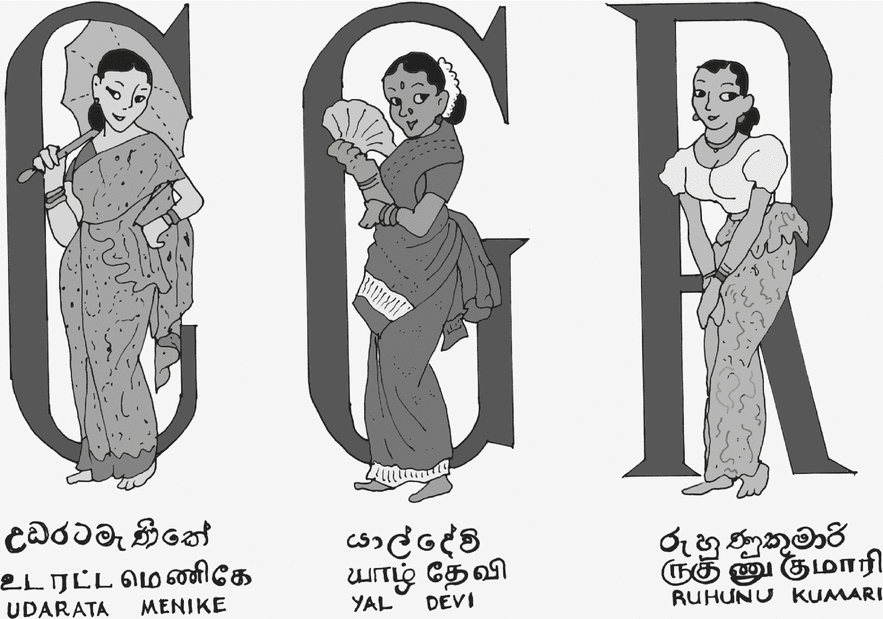
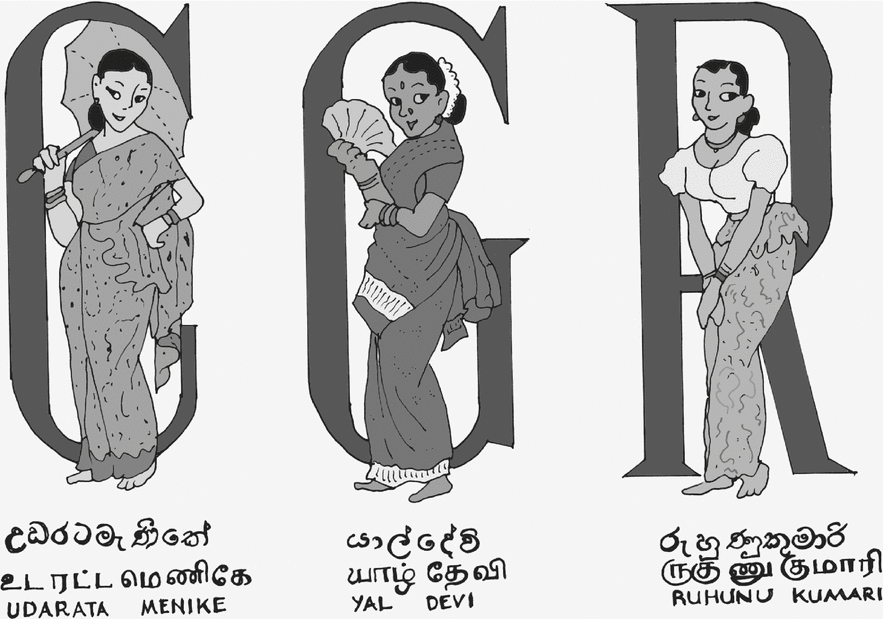
In March 1956, three new Express lines were unveiled, symbols of the new post-colonial nation's renewal and mastery over formerly colonial technology. Sri Lankan express trains are conventionally feminine and so these three were called the Yal Devi (the Jaffna Yalpannam goddess, sometimes called the ‘Queen of the North’, running from Colombo to Jaffna), Ruhunu Kumari (the ‘Southern Princess’, from Colombo to Galle), and the Udarata Menike (the ‘Upcountry Girl’, from Colombo to Kandy). The longest route, the Yal Devi, was considered the premier line and, famously, the Yal Devi express always left from Platform 1 at 5.45 am, its early departure an indication of its importance. These express trains were thought of and affectionately talked about as anthropomorphized personalities; they were also casually ethnicized. A striking example is a government poster from the 1960s,Footnote 50 showing the three ‘CGR Belles’ (Ceylon Government Railway) (see Figure 2). They are depicted here as seductive women of different ethnicities. The Yal Devi is dressed as a traditional Tamil woman with an ‘Indian-style’ sari, a vermilion mark on her forehead, pierced nose, and flowers in her hair. Ruhunu Kumari is dressed in the traditional low-country lungi and blouse. Udarata Menike is depicted in the traditional Kandyan-style sari which many Sinhalese women now adopt as a Sinhalese ‘sari’, leaving behind the lungi and blouse which only older southern women now wear. The destinations—Kandy, Galle, Jaffna—are seen as places belonging to different types of people, thus ethnicizing the ‘CGR Belles’. While this followed from the colonial understanding of Ceylon as composed of regions differentiated by race, custom, and ethnic ‘character’ (explored above), in post-colonial Sinhala and Tamil nationalism this conjoining of place and people came to mean, however, the development of opposing territorial identities, something more extensive and immutable.
‘The CGR Belles’.
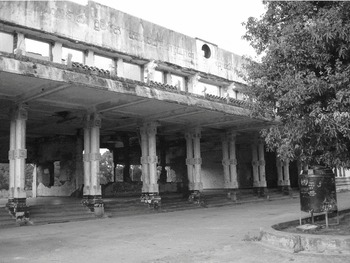
Jaffna Railway Station in June 2010.

In fact, the Yal Devi's 34-year running life did become intimately intertwined with the lives of the Jaffna Tamils who claimed it as their railway and their relationships to the many others who were passengers on it. The death of the Yal Devi and its complex afterlife will be dealt with in the following section; here the paper will concentrate on its life. The Yal Devi represented both the profound mobility of people and the immobility of ethnic allegiances that has come to characterize (among others) contemporary Jaffna Tamil and, increasingly, Sri Lankan Tamil identity. It transported people from one end of the island to the other and represented circulation and movement, as well as the increasing ethnic segregation and fragmentation of Sri Lanka. This is most concretely exemplified in the way in which the Yal Devi became entangled within the anti-Tamil riots, particularly those that took place in 1977.
In post-colonial Ceylon the colonial racial categorizations became most consequential in the distinction between minority Tamil speakers and the majority community of Sinhalese (now constituting 74.5 per cent of the population).Footnote 51 Tamil speakers are subdivided into different communities: the largest, central to the ethnic conflict, are the Sri Lankan Tamils, who account for approximately 11.9 per cent of the population (down from 12.7 per cent as a result of major out-migration and deaths caused by the war); the second are the Sri Lankan Muslims comprising 8.3 per cent of the population; and third most significant are the Malaiyaha Tamils (hill-country Tamils), representing 4.6 per cent of the population and who are the descendants of South Indian plantation labour. The presence of such a diversity of ethnic groups alongside the growth of strong Sinhala and later Tamil nationalism has formed a history of Sri Lanka whereby a nominally multi-ethnic state has nonetheless been dominated by mono-ethnic nationalist visions. This has been very well documented, so the account here is brief.Footnote 52
The Yal Devi was opened in a climactic year. In 1956 a new nationalist coalition led by S. W. R. D. Bandaranaike came to power under the ‘Sinhala only’ slogan and the country experienced its first anti-Tamil riots. Independence in 1948 had been a handover to a cosmopolitan, ethnically mixed English-speaking elite.Footnote 53 By 1956, Bandaranaike (from the same class as his predecessors) was propounding a new nationalist and populist vision which harnessed a discontented rural Sinhalese lower middle class constituency who felt they had experienced few of the benefits of independence.Footnote 54 The ‘Sinhala only’ policy that propelled Bandaranaike's election victory advocated that the language of government and education be changed from English to Sinhala, a move that would enfranchise a whole new generation of young people. However, the ‘Sinhala only’ policy was simultaneously an anti-Tamil minority policy, setting a dangerous trend within Sri Lankan politics, and protests against the prioritization of Sinhala led to anti-Tamil riots. The policy was finally amended in 1958, though at the cost of the assassination of Bandaranaike by a monk who thought he had conceded too much to minority feeling. From the beginning, Sri Lanka's post-colonial history was dominated by populist policies which brought into being a comprehensive universal welfare state, providing free education, healthcare, and other benefits for its (multi-ethnic) population. At the same time, this was underpinned by a strong Sinhala nationalist rhetoric which privileged the majority community as the intended beneficiaries of these reforms.
The 1958 riots were the first, but not the last, anti-Tamil riots. They were followed by riots in 1977, 1981, and the largest in 1983. Both Sri Lankan and Malaiyaha Tamils were affected in these riots, though it was around the former that separatist movements began to form in 1970s, when a plethora of small Tamil militant movements with various acronyms—including the Tigers—arose under the larger umbrella of fighting for Tamil self-determination and a Tamil homeland, Tamil Eelam.Footnote 55 The secretive, highly disciplined, and militarily effective Tigers emerged supreme in 1986, violently proscribing or absorbing other Tamil militant groups. This marked the beginnings of war proper between the Sri Lankan state, the Indian army (1987–90), and the Tigers from the mid-1980s onwards. While both the Northern and Eastern provinces were joined in the notion of a Tamil homeland, it was the Jaffna peninsula that was central to the rise of Tamil nationalist politics and militancy, its dominance being much resented by eastern Tamils.
Many Jaffna Tamils tell long and elaborate stories about the Yal Devi and the way it featured in their everyday lives. One apocryphal story is that of the farmers who supposedly used the whistle of the train as a time-keeping device. With its cheap tickets, the Yal Devi was constantly used, with people travelling south for work, on holiday trips, family visits, and to attend university. The most regular passengers were still the Jaffna Tamil clerks and civil servants who took the train down to Colombo and came back home to Jaffna for the weekends. Others more permanently resident in Colombo brought their families back for temple festivals and for holidays, thus keeping themselves culturally secured in Jaffna. The train promised the convenience and pleasure of moving outside Jaffna but with the assurance that returning there was cheap and easy. Another story is of the sight of Tamil men travelling up from Colombo who at Medawachchiya, the first stop in the Northern Province, would take off their shirt and trousers and don their veshti (dhoti), as a sign that they were officially now ‘home’.Footnote 56
As ethic conflict deepened, this feeling of comfort soon became overlaid with a sense of vulnerability and danger. After the 1956 riots and throughout the 1960s and 1970s, Tamils tell of speaking less openly and loudly in Tamil on the Yal Devi after leaving the stops in the Northern Province on the route down to Colombo. For example, EliathambyFootnote 57 travelled very frequently on the Yal Devi in his university days as a student at Peradeniya University in Kandy. He remembered with relish the dread that stationmasters held for the termly return of the students with their many pranks. He recalls that his attempts to skip paying for tickets and his secret drinking ‘all stopped in 1958’. The students had become too self-conscious about being Tamil and no longer wanted to draw attention to themselves on the long journey from the south to the north.
However, Eliathamby's most indelible memory of the train was when, as a grown man in August 1977, he was waiting in Colombo Fort station for the overnight train from Jaffna to arrive. This was a tense election year. The socialist Sri Lankan Freedom Party had been replaced by a new United National Party (UNP) government. The landslide victory had left the Tamil United Liberation Front as the official opposition: the party had also recently declared its support for a separate Tamil state and still believed (mistakenly) that it could control and manipulate Tamil militant groups.Footnote 58 Eliathamby was waiting for his wife and two children to come from Jaffna using their reserved special seats. After many hours of delay, the train rolled in. Many of the carriages, he relates, were empty, some bespattered with blood. Some passengers alighting from the train were reeling and marked. There was no sign of his wife and children. Eliathamby finally found the railway staff who had travelled down on the train and checked their list of reserved seating. It was with great relief that he realized that his wife and children had not been on the train; their names were not marked as having boarded.Footnote 59 He walked outside the station and into the anti-Tamil riots raging across Colombo. There had been violent police action in Jaffna followed by small reprisal attacks on policemen by militants, provoking a clampdown.Footnote 60 False rumours rapidly spread of alleged Tamil violence against Sinhalese living in Jaffna.Footnote 61 The results were tragic. When the train reached Anuradhapura, Tamil passengers were attacked. Violence moved down to Colombo and up to hill country areas, resulting in about 300 dead and 25,000 displaced. J. R. Jayewardene, the new President of Sri Lanka, gave a speech in which he said that, though the deaths were regrettable, the action had come out of a natural reaction to Tamil separatist claims.Footnote 62
In September, Eliathamby took the train back to Jaffna. It was not the first train back (which would have been ‘crazy’), but the second. He carried a sharpened penknife hidden in his clothes. The passengers returning to Jaffna were all subdued and sombre. The journey captured the way in which the train was now imagined as travelling over ground that was seen as becoming increasingly divided into Tamil and Sinhalese territory. Stops marked the stages in this terrain. Anuradhapura was perceived as a border region, the site of the beginning of dangerous Sinhalese territory, an impression created by the 1977 riots which moved minorities out of Anuradhapura, and made the porous identities of those living in the interstitial dry-zone areas more Sinhalese. By the time the worst riots occurred in 1983, Tamils already considered the train too dangerous: the Yal Devi was now seen as the Jaffna train that took Tamils home across rural Sinhalese areas.
What the anti-Tamil riots most fundamentally brought about was a feeling of being under attack just for being Tamil.Footnote 63 This served to unite Tamils of all classes and castes behind a nationalist vision that suggested that Tamils needed their own homeland because they could not live ‘safely’ with the Sinhalese, who were pushing an increasingly territorialized identity onto the Tamils. However, as Tambiah points out, one of the reasons that so many Tamils were in fact vulnerable to attack in riots was because most Sri Lankan Tamils were highly mobile across the island and lived outside of the areas that were seen as the natural Tamil homeland. Tambiah shows that in 1981, 47 per cent of Tamils, including both Sri Lankan and Malaiyaha Tamils, lived outside the Northern and Eastern provinces, mainly for purposes of employment and earning a livelihood. Malaiyaha Tamils in particular lived clustered in the plantation areas in the heart of a mainly Sinhalese population.Footnote 64 The riots demonstrated both the enormous vulnerability of the Tamils and brutally revealed the hybridity and fluidity of minority residence in the island. This contradiction between the increasing polarization of identities alongside a high degree of movement continued in the war years. The struggle to establish Tamil Eelam, a stable Tamil homeland, has gone hand-in-hand with immense internal displacement and a massive refugee diaspora of Tamils (who in turn helped fund the separatist Tigers). The train bore the marks of all of these contradictions. Its vulnerability in riots established ethnic boundaries. Yet it was also a popular form of travel for all communities, thus producing multiple intimacies and possibilities. The Yal Devi was filled not only with Tamils but also with Sinhalese passengers who came to visit family and friends resident in Jaffna, such as the famous Sinhalese bakers, and engage in tourism all along the dry-zone and up into the peninsula. It served, as contemporary post-war state propaganda celebrates (for its own reasons), as a major site of intimate life between different communities.
On the one hand, the Yal Devi fostered the ways in which Jaffna was recognized as a distinct place and as a ‘home' to be returned to, but it also stood for movement, connection, and travel across boundaries. The new post-colonial national space for minorities was experienced simultaneously through increasing movement and travel across the island as well as through segregation and fragmentation. It is at this point then we turn to the Yal Devi's death and the way its afterlife in Tamil memories recall not the danger of riots but the celebration of travel, connectedness, and freedom.
The railway as absence
On 19 January 1985 the Tigers bombed the Yal Devi, killing 11 civilians and some armed soldiers. In the following years they launched intermittent attacks on the railway and took up sections of the track. After the signing of the Indo-Lanka Accord to enforce a new devolution package brokered by the Indians, the Indian peacekeeping forces entered the north and east in 1987. Their peacekeeping mission broke down after the Tigers began hostilities and they resorted to a full-scale insurrectionary war. The Indians repaired the train tracks in the period of their occupation (1987–90). In 1990, the Indians withdrew after the Tigers and the Sri Lankan government reached a secret agreement against India and peace talks began. The railway briefly opened again for service in 1990. But by June 1990 the Tigers had broken the ceasefire, abducting and killing policemen at stations across the north. The railway's future was clearly in jeopardy. The Tigers set fire to the Yal Devi at the northern station of Kilinochchi on 13 June 1990. No train has travelled the through route between Jaffna to Colombo since then.
The Tigers, by weaving the destruction of the railway line into days of attacks against police stations, made it clear that they understood the railway as a symbol of the connection to Colombo. As has been argued earlier, if railways were sources, and not effects, of state power, then they were always potentially structures where stateness could be made and unmade. The railway demonstrated through its uniforms, its stations, and everyday monumental presence a history of state-construction continuing from the colonial state to its post-colonial successor. If the railway bore the marks of a state, then its destruction showed the superimposition of another actual or incipient state order. The remains of railway bridges and the railway beds stripped of track remained potent reminders of the capability and presence of the Tigers. Strips of the North-central Province, marked by the gouged-out railway, became a no man's land, ringed on both sides with parallel checkpoints and border guards. The Tigers had a newly bounded place in which to rule.
They began immediately in 1990 to set up a parallel ‘state of Tamil Eelam’ in the areas under their control and experimented with building a civil administrative structure in Jaffna. It was pushed out of Jaffna in 1995 after the failure of another round of peace talks and a renewed campaign by the Sri Lankan army. Instead they moved into the northern Vanni region and the town Kilinochchi became their capital. In the Vanni they consolidated their administrative structure into customs and visa controls, an official judiciary, police force, and taxation among others. Until the Tigers' defeat in 2009, the north had what Stokke describes as a ‘de facto dual state structure’ with the Tigers running a full state-like administration in the northern and eastern areas under their control, and also exercizing ‘considerable influence on state institutions and officials in the government-controlled parts of the North-East province’.Footnote 65 Areas within their control also operated with this dual structure.Footnote 66 However, the Tigers concentrated on the military and coercive aspects of their state with relief organizations also channelling funds to maintain their military structure. In fact, this quasi-state was bizarrely made possible because the Sri Lankan state maintained that it still had sovereignty over areas that it did not in reality control. The state continued to pay the salaries of all government employees, including teachers, doctors, and civil servants in areas controlled by the Tigers. In addition, it sent rations to areas that it was bombing, creating victims and beneficiaries simultaneously. It remained committed to acting, in effect, as an island-wide sovereign state. The railway boards at Colombo Fort station thus continued to pretend that the railway still ran northwards beyond Vavuniya. The state's refusal to accept the Tigers as a quasi-state and the latter's inability to move beyond an extractive and coercive mode meant that neither the basic recognition of mutual governance that is necessary to run railways across ‘borders’ nor the large-scale funding to restore a primarily welfare function meant that the Northern Railway Line was buried at the heart of the political deadlock that haunted Sri Lanka.
If, as was argued earlier, for ordinary Tamils, the railway recalled a history of chosen movement, conviviality, and mobility, then its absence during the civil war made it a poignant symbol both of the dual security and control apparatus of the Tigers and the Sri Lankan state and the advent of the forced mass displacement that came to dominate Tamil life.Footnote 67 These controls and the concomitant longing for freedom of movement is illustrated in the life story of Vasantha, a young Jaffna Tamil woman in her thirties who left Jaffna in 1998 to become a refugee in London.Footnote 68 Vasantha and her family, like many others, were trapped in the peninsula after 1991 by the harsh Tigers' pass-laws. Obtaining a pass if you were between 10 and 35, the prime Tigers' recruiting ages, was near impossible: Vasantha was 12. A family could only depart by either leaving their child behind or finding another, equivalent child as a guarantee of their return. The only people able to circumvent these pass-laws were those who were able to pay expensive agents connected to the Tigers, or, in some cases, who agreed to smuggle an undercover Tigers cadre through Sri Lankan Army checkpoints. This inability to leave the peninsula during the years 1990–95 was talked about by all the young Jaffna Tamils interviewed as a pervasive experience of Tigers' control.Footnote 69 Those who made it out to Colombo found in turn that they were the targets of intense state surveillance: in wartime, and even post-war in 2010, Tamils had to carry police certificates testifying to their place of residence, as young men and women were continually picked up in police raids as potential terrorists.Footnote 70
Alongside heavy control over individual movement, the war was also characterized by mass displacement: one in two Tamils has been displaced more than once and around one in four Tamils now lives abroad.Footnote 71 Vasantha talked emotionally first of watching the Tigers' forced expulsion of all Muslims from the north in 1990,Footnote 72 and then her own involuntary expulsion in the October 1995 exodus when all Tamils were made to leave Jaffna by the Tigers in order to clear Jaffna city before its occupation by the Sri Lankan Army.Footnote 73 In addition to military battles, state aerial bombardment and the creation of high security zones has also served to create constant internal displacement. When Vasantha left Jaffna in 1998 after the death of her father due to illness and her mother to Tigers bomb, she followed thousands of other Tamils who have left Sri Lanka as refugees and who form one of the most established contemporary refugee diasporas.Footnote 74
Vasantha described living in Tigers-controlled Jaffna as intensely claustrophobic—‘a place where everything is controlled’—but where they knew little else outside of the Tigers who were their ‘government’. The only Sinhalese people they saw were soldiers. However, she recalled that after the Sri Lankan army takeover of Jaffna in 1995, her family were among the 200,000 Tamil who defied the Tigers and returned,
Everybody's idea was, if you go in there then you can get out wherever you want to go. If you go into the area controlled by the government then you can move; there is no pass system. As soon as they started running planes or running trains. You see a lot of families were separated but they were stuck because the LTTE would not let them out.
In reality, the dream of freedom of movement under government control proved to be illusory with Jaffna covered in checkpoints and under military control. Yet the dream of ordinary movement, as opposed to wartime forced displacements, was that of boarding a train to a destination that you yourself had chosen. This was imaginable for those who had grown up in pre-war Sri Lanka where the most familiar well-travelled route between the north and the south was on the Yal Devi. But almost all of those born after 1980 have never ridden the Northern Railway Line. In many conversations the railway repeatedly represents what distinguished pre-war Jaffna from the wartime Jaffna experience. An interviewee in 2003 described her sadness at her daughter's experiences in the war by telling me how her daughter had never ridden the Yal Devi. Vasantha's first train journey was in London, as she told me,
I never had got a train in my life before I got here. You know my mother would tell stories and it was like magical days, but that was normality I just didn't know that was normality.
Thus, the Northern Railway Line, as it appeared in civilian conversations and the stories told, represents two things. First, it stands for the worlds that generations no longer share—the dizzying transformation of Jaffna's physical and social landscapes because of the war. Secondly, it stands for a desire, the possibility of an individual being able to choose the mundane movement of a railway journey. Even in general interviews with Tamils about wartime life, the railway makes surprising appearances in narratives. For ordinary Tamils its closure and absence remained a marker of the struggle for ordinary life in the war-zone. In both its presence and its absence, it came to stand in for an everyday life that could now no longer be taken for granted.
Trains were, thus, more than the vehicles of statecraft, whether for the colonial state or for the Tigers. Public transportation in the form of trams, buses, and trains were not only state-projects and works: they also simultaneously wove themselves into the written and oral stories, biographies, and journeys of ordinary people. These institutions and objects are constantly reowned and appropriated by passengers, whose imaginations and stories about trains make trains, routes, lines, and stations not into entities fixed in maps of state power or incapacity, but into living physical and cultural presences.Footnote 75 For those stuck in a war zone, the train signified something that exceeded the limits of the present as they knew it until 2009. If such monumental structures as railways are to be understood as everyday technologies, then it is in this capacity: to make everyday lives, to be a mundane reality for northern Sri Lankan Tamils rather than a much dreamt about absence. This question of everyday lives unmarked by war has now returned centre stage after the brutal defeat of the Tigers by the Sri Lankan state in 2009, a thought that seemed unimaginable during the fieldwork that was undertaken in 2003 and 2004.
A ticket to the heart?
The defeat of the Tigers culminated in the elimination of its senior leadership and the death of thousands of civilians trapped between the Tigers' forces holding them hostage and the army bombarding them with heavy weaponry.Footnote 76 On 23 March 2009, even before the last battles, the Sri Lankan state launched a new programme called ‘Uthuru Mithuru’ (the ‘Yal Devi Friendship Project’), and announced that it was rebuilding the Northern Railway Line, mainly through donations from ordinary people.Footnote 77 The opening ceremony was held in all three languages and the special guest was the internationally renowned cricketer, Muttiah Muralidharan. Sensing its victory and the re-establishment of its sovereignty, the Sri Lankan state had immediately turned to the ever-potent symbol of the railway. When in July 2009 the Omanthai railway station north of Vavuniya was opened for construction, the government was still detaining 285,000 Tamils trapped in makeshift camps for ‘security clearance’, at least half of whom had been detained for over a year. In the last two years, no clear programme for political reform or devolution has been introduced.
The Uthuru Mithuru project has produced two official videos. The first (made in 2009) comprises two stories, one Sinhalese, one Tamil, remembering journeys and cross-ethnic friendships on the Yal Devi train from Colombo and Jaffna respectively.Footnote 78 An English segment follows with a potted history of the Northern Railway Line and the Yal Devi, the ‘backbone for national unity and integration’. It ends with a promise to rebuild the railway and thus the ‘bond severed’ between north and south. In September 2009 a television commercial was aired on all channels at 8.05 pm. The commercial began with two boys, one ‘Tamil’ and one ‘Sinhala’, pretending to play cricket (Sri Lanka's other symbol of national integration) while waiting for the Yal Devi. The Yal Devi is depicted as filled with passengers from all communities.Footnote 79 Deep into the journey, the train halts abruptly and the carriages separate. The passengers dismount and unite to push together the carriages. The message of ordinary people harmoniously coming together and so rejoining Sri Lanka is unmistakable. My research on the railway, begun in 2003, suddenly presented itself in Sinhala nationalist form! These videos illustrate exactly how well the Sri Lankan state understands, as this paper has argued, first, that the rebuilding of the railway represents the re-extension of state sovereignty over the island, and, secondly that the Yal Devi is a potent symbol for ordinary people of a peaceful post-war everyday life.
New movements are occurring. Displaced people are slowly being resettled. Thousands of Sinhalese tourists travel up in buses to explore the north and Tamil expatriates (and Sinhalese tourists) poured into the Nallur Kandasamy Temple festival in 2011. However, for Tamils, the return of the Yal Devi, if and when it happens, would signal the capacity of the state to assume meaningful civilian functions and recognize northern and eastern Tamils as full citizens and the resumption of free and easy travel, without the military checkpoints stationed along the A9 road. To date, the Sri Lankan army shows no sign of withdrawing troops from the peninsula nor of slackening its comprehensive surveillance apparatus directed at Tamils. Not least, railway construction, like the promised reconciliation processes, has halted. The train has not moved beyond the military checkpoint Omanthai, just beyond Vavuniya, since August 2010. In addition, some newspapers have reported that the money collected for Uthuru Mithuru from schoolchildren and government employees is missing.Footnote 80 Despite official denials,Footnote 81 the outcome of these inquiries is unclear. In January 2011 the government instead turned over the rebuilding of the line from Omanthai onwards to Ircon, an Indian contractor, partly funding it through the soft loans given by the Government of India for railway reconstruction. My attempt to buy a ticket in 2011 as part of the government scheme to allow diasporics to contribute also failed as the Sri Lankan Embassy in Washington had sold the 100 tickets they had been sent in 2010 and had no information on the programme or on future tickets.
Meanwhile, Jaffna railway station remains in ruins. However, even within the ruins, lives continue. The station is now inhabited by the Sri Lankan Army—and one displaced Tamil family allowed in by the soldiers, the father with a rusted mechanical leg, the mother without legs and the fingers of one hand, and their charming and shy six-year-old daughter. The railway station was occasionally used as a holding place where displaced people slept or as a security shed for travellers to Colombo to have their bags checked. Every morning, more than a hundred families arrive at the station to use the public toilets. They belong to a Dalit community who are not allowed to build toilets on state land in Jaffna Town where they have lived for around 40 years and, because they are Dalits, they have no access to any other place. They represent the other kinds of turmoil and constrained circumstances of Jaffna Tamils. The railway station remains, even now, a public space.