


In many Christian traditions, during the service of Holy Communion the minister serves a consecrated piece of bread and utters: ‘This is the body of Christ.’Footnote 1 Likewise, the minister may serve a cup of wine and utter: ‘This is the blood of Christ.’Footnote 2 In giving these utterances a literal interpretation, theologians have articulated real presence (RP) theories of the doctrine of Christ's presence in the Eucharist. These theories often include attempts to provide a robust explication for the metaphysical state of affairs that undergirds the aptness of the minister's utterances. In this article, I offer a construal of the metaphysics of RP that falls into the ‘impanation’ family of explications.Footnote 3 Since impanation theories take their cue from theories of their near homophone, the incarnation, the first part of this article sketches some of the recent discussion in analytic Christology. Second, I situate impanation as a via media between two other families of RP explications, transubstantiation and consubstantiation. I then trace the genealogy of impanation to distinguish this view into two specific types. This leads to the bulk of the article, which is an exposition of one type of impanation as a coherent and attractive articulation of RP that is parallel to a model of the incarnation. In order to show this type's coherence and attractiveness I make use of the notion of enabling externalism. Finally, I raise two potential objections to the type of impanation I put forth, but my responses to these objectives give me the occasion to highlight further this view's coherence, attractiveness, and consistency with the incarnation.
Incarnational preliminaries
Contemporary models of the metaphysics of the incarnation
The metaphysics of the incarnation of God the Son as Jesus Christ has been a fruitful locus of recent work in philosophical theology.Footnote 4 With some exceptions, most authors of the contemporary literature take both the Niceno-Constantinopolitan Creed (ad 381) and the Definition of Chalcedon (ad 451) as normative guidelines for explicating the metaphysics of the incarnation. These authors attempt to make sense of a ‘two natures, one person’ Christology whereby Jesus Christ is one person who is both fully divine and fully human. In this section, I review a few key distinctions that have recently been made in order to arrive at various models of the incarnation. My purpose here is not to settle the issue in the contemporary discussion, but rather simply to lay a foundation for the incarnation-like model of RP that I will present subsequently.
A first distinction made in the literature regarding various metaphysical models of the incarnation is between those perspectives that fall under, according to Jonathan Hill's taxonomy, ‘transformationalist’ or ‘relational’ models.Footnote 5 This first level of distinction between views of the incarnation enters in response to the question ‘what does it mean to become human?’ when we say that in the incarnation ‘God became human.’Footnote 6 Transformationalists hold that ‘to become human means being transformed into a human … just as a caterpillar becomes a butterfly by being transformed into one’ (Hill (Reference Hill, Marmodoro and Hill2011), 8). Contrary to this meta-family of views is the relational family of models. These models hold that becoming human ‘means entering into a certain kind of relationship with a human being – or, rather, with something that would have been a human being had it not been in such a relationship’ (ibid., 10).Footnote 7 Thus, the relational modeller will attempt to describe the ways in which the divine nature and an instance of a human nature are related appropriately in the incarnation.
Within the relational family, a distinction has been made between what has been termed, ‘concretism’ and ‘abstractism’.Footnote 8 If relational models hold that there exists some important relation between the divine nature and an instance of human nature, the concretist/abstractist distinction rests on different conceptions of nature. Abstractists (tend to) hold that, at bottom, a nature is a property or cluster of properties. Concretists (tend to) hold that, at bottom, a nature is a concrete particular that bears properties.
The discussion between abstractist and concretist models of the incarnation is ongoing, and my purpose here is not to settle this dispute. I am simply going to follow the concretist family lineage for the purpose of putting forth my analysis of RP. So, let us leave aside the abstractists and pursue the concretist model further.
On the concretist view, one might simply hold that Christ, having two natures, is composed of two parts: the concrete particular divine nature and a concrete particular instance of human nature. This would be a ‘two-part, concrete compositionalist’ explication of the incarnation.Footnote 9 However, a prominent view in recent discussion has conceived of humans as themselves composed of two parts, an immaterial part (soul or mind) and a material part (body). Thus, if we pursue this family of views we end up with three parts that compose Christ: the divine nature, a human soul, and a human body, thus the term ‘three-part, concrete, compositionalism’ (3pCC, my abbreviation).
Three-part, concrete, compositional Christology
Although 3pCC and similar Christological models are not without troubles,Footnote 10 3pCC represents a popular view on the metaphysics of the incarnation in the current discussion, as well as being a model with strong representation in the tradition. In order to expound the 3pCC model of the incarnation, I offer some definitions that have been employed in the literature. For instance, God the Son (abbreviated by Leftow (Reference Leftow, Marmodoro and Hill2011) as ‘GS’) denotes the second person of the Trinity, the Word of the Father, the logos asarkos understood as independent of (not just prior to) the incarnation.Footnote 11 God the Son is a divine person with a divine nature, one of three hypostases of the divine nature. 3pCC theorists hold that a human nature comprises a human body (again following Leftow (Reference Leftow, Marmodoro and Hill2011), ‘B’) and a human soul (‘S’).Footnote 12 The soul and body of a human are parts of a human's nature.
The question of how a human soul and body constitute a human nature has typically been left open in the literature. Both Platonic/Cartesian (dualist) and Aristotelian (hylomorphic) background stories have been employed in this regard.Footnote 13 Typically the supposition is that whatever the relation is that obtains in regular human natures (i.e. those not assumed by God the Son) between their bodies and souls is the same relation that obtains between a human body and a human soul at the incarnation; let us denote this relation as the natural union (NU). Another oft-used term is Christ to denote the whole composed of God the Son, a human body, and a human soul; thus this view is a three-part, concrete particular, compositional model of Christ. On this terminology, ‘Christ’ is not a name for God the Son, understood as logos asarkos, but only for God the Son in his incarnate relationship with (S+ B). Hence, ‘Christ’ refers to the composite whole. The relation obtaining between GS and the (S+ B) composite is denoted by the term hypostatic union (HU). The first plus sign in the following equation represents HU:Footnote 14
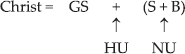 This terminology in the recent discussion is an attempt to highlight the ‘two natures, one person’ guidelines that the conciliar statements lay down for discussing the incarnation. In what follows, I will simply adopt the 3pCC model of the metaphysics of the incarnation as I begin my exposition of a theory of RP.
Types of real presence
In the Eucharist, according to RP theories, more concrete particulars enter into relations with Christ, namely the sacramental elements of bread and wine. Let ‘E’ refer to these objects either collectively or individually (as bread or wine). A question that any RP theory faces is just what are the relational dynamics that obtain between E and the rest of the concrete particulars that compose Christ? As Marilyn McCord Adams puts the point: ‘Any doctrine of real presence will have to face the metaphysical issue of how and whether one body can exist under another’ (Adams (Reference Adams1991), 200). For instance, one theory of RP, transubstantiation, posits that one body, B, ‘exists under’ another, E, in that E is transformed into B, thereby bringing about the cessation of E's existence. This is despite the fact that all the empirical features of E continue to exist and none of the empirical features of B come to exist at the location formerly occupied by E. In this case, there is no relation between E and B; there is only a relation between B and the empirical features of E.Footnote 15 While this state of affairs may be metaphysically possible, it is certainly metaphysically exotic. If a simpler metaphysical explication of RP is possible or if an RP theory could utilize the resources of incarnational metaphysics (also exotic, but with the weight of Ecumenical Councils behind it), that theory would seem to be more attractive.Footnote 16
An RP theory like consubstantiation would hold that there are actually two bodies, B and E, at the location of E, with B being ‘in, with, and under’ E; the relation obtaining between B and E would be co-location.Footnote 17 This might seem to be the RP theory most analogous to the incarnation, for orthodox Christology holds that there are two natures present in Christ, so why not two bodies at the Eucharist? The trouble is that the co-location of one physical concrete particular and two non-physical concrete particulars, as in 3pCC Christology, is much easier to account for metaphysically than the co-location of two physical concrete particulars.Footnote 18 Further, even if co-location were a metaphysically viable option, co-location is a much less robust kind of union than HU. Thus, an RP theory with the incarnational relational dynamics as its guiding principle will seek a union between E and Christ more analogous to HU than simple co-location.
Types of impanation
The Nicene/Chalcedonian explication of the incarnation plots a middle road between, among other positions, Docetism and Nestorianism; Christ does not just seem to be human, but nor is he two co-located persons. Rather, Christ is one person who is fully human and fully divine. Impanation theories of RP take incarnational metaphysics as their theological North Star. Thus, impanation attempts an RP via media between transubstantiation and consubstantiation by maintaining the realities of B and E and articulating a robust sense of the union between the two. However, as Adams (Reference Adams2006) has shown, impanation typically comes in two varieties. These two varieties are distinguished by (a) the relation by which E is joined to the other concrete particulars of Christ and (b) to which concrete particular E is joined.
The first variety of impanation is what I call Type-H Impanation; the ‘H’ stands in for ‘hypostatic’, which is the kind of union that obtains. This view holds, as Adams states, that in the Eucharist, ‘the Divine Word assumes the Eucharistic bread the way that He assumes the human nature’ (ibid., 305). Likewise, ‘just as the Divine Word becomes in-carnate (en-fleshed) when it assumes a particular human nature into hypostatic union with itself, so the Divine Word becomes im-panate (em-breaded) when – at the moment of consecration – it hypostatically assumes the Eucharistic bread nature on the altar’ (ibid., 296). In our terminology, in the Eucharist E is hypostatically united to GS in a similar manner as GS is hypostatically united to (S+ B).Footnote 19 Thus, Type-H Impanation plus 3pCC entails that at the Eucharist Christ becomes composed of another part, a Eucharistic part.
Prior to the Eucharistic consecration:
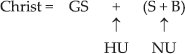
After the consecration:
 The astute observer will note that 3pCC has become 5pCC, Christ being composed of GS, (S+ B), and E, which itself is composed of an instance of bread nature and wine nature. On Type-H Impanation, E is joined by hypostatic union to GS.
The second variety of impanation is what I call Type-S Impanation; the ‘S’ stands for ‘sacramental’. This view holds that the union that is formed in the Eucharist is one between the sacramental elements and the body of Christ. Adams, utilizing some medieval metaphysical terminology, articulates this view:
Like a human soul, the human body of Christ is not a complete individual substance, but only part of one. If one allows with Ockham that God could make an individual substance nature depend on a substance part, then one could say that the human body of Christ is the proximate assumer of the bread nature. (ibid., 306)
According to this view, the union obtains between E and B. In the spirit of HU and NU, let us denote this union as a generic ‘sacramental union’ (SU).Footnote 20 Thus:
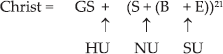
Note that Type-S Impanation posits specifically that E enters into a union relation with B, not (S+ B). On Type-S Impanation, E does not enter into a relation with the human nature of Christ, but rather specifically the human body of Christ. This is in an attempt to give a robust explanation for the liturgical utterance when said of E, ‘This is the body of Christ.’Footnote 22 Thus, on Type-S Impanation, E is joined by sacramental union to B.
Type-H and Type-S Impanation are two theories for explicating RP. Both posit the continued existence of the bread and the wine, contra transubstantiation; both posit a robust union between E and its proximate assumer, contra consubstantiation. The types differ on which concrete particular of the composite Christ is the proximate assumer, which entails a different type of union: hypostatic in Type-H and sacramental in Type-S. In what follows, I will leave aside Type-H Impanation and pursue an explication of Type-S Impanation as a model of RP that is both parallel to and works with a particular construal of 3pCC Christology.
Type-S Impanation, the incarnation and enabling externalism
Type-S Impanation states that at the Eucharist a union, SU, obtains between E and B. This union needs to be intimate enough that it underwrites the metaphysical state of affairs that the liturgical locution ‘This is the body of Christ’ expresses. The nature of SU as it achieves this desideratum is the subject of this next section. Taking a cue from incarnational dynamics, Type-S Impanation holds that SU is analogous to HU; thus, it will be counted an advantage of an explanation of SU if that kind of explanation fits the HU relational dynamics. One way of articulating 3pCC Christology has been to conceive of (S+ B) as an instrument of GS. In applying this notion to the Eucharist, one way of explicating Type-S Impanation is to think of E as an instrument of B. Therefore, SU, like one theory of HU, is a kind of instrumental union.
Enabling externalism
Richard Cross has defended an instrumental model of 3pCC, which draws insight from Duns Scotus's theory of cognition. The whole theory and particular issue Scotus addresses need not concern us; what is pertinent is the example and explanation Scotus uses in addressing his problem. This illustration describes a state of affairs wherein an instrument properly becomes part of the body that uses it:
the motive power in a hand can use a knife to cut up a body, in so far as [the knife] is sharp. If this sharpness were in the hand as its substance, then the hand could use it for the same operation, and nevertheless it would be accidental to the hand (in so far as the motive power is in it) that sharpness is in it, and vice versa, because sharpness gives the hand no perfection pertaining to [motive] power. (Cross (Reference Cross, Marmodoro and Hill2011), 190)Footnote 23
Cross comments:
The idea is that the knife and the body form something with a unity as tight as would obtain in the case that the blade were straightforwardly a part of the body (in the manner, say, of Johnny Depp's Edward Scissorhands character). The knife and the body become one subsisting thing. (ibid.)
Whereas relations of formal causality might be sufficient for unity, Cross comments, they need not be seen as necessary. Unity, indeed identity (the forming of one subsisting thing), might be achieved by relations of efficient causality (ibid.). Scotus expresses a type of vehicle or enabling externalism wherein an object that is external to the body is used by the body to perform some function. The external object enables the body to perform an action that in its current state it could not perform alone.
We can further probe the notion of enabling externalism by attending to the seminal article in the philosophy of mind by Andy Clark and David Chalmers (Reference Clark and Chalmers1998), ‘The extended mind’. In their description of the Extended Mind Thesis (EMT), Clark and Chalmers offer the Parity Principle to push against the prejudice that all cognitive processes are done in the head. Here I offer that principle as slightly revised by Clark in a subsequent publication:
If, as we confront some task, a part of the world functions as a process which, were it to go on in the head, we would have no hesitation in accepting as part of the cognitive process, then that part of the world is (for that time) part of the cognitive process. (Clark (Reference Clark and Menary2010), 44)
In their article, Clark and Chalmers offer an illustration that has come to be the canonical story of the EMT in action. An Alzheimer's patient, Otto, uses a notebook to record pieces of information that he wishes to remember. Every time he has information he may want later (say, the address of a museum he will visit later in the day), he writes that down in his notebook. In this way, the notebook has become part of Otto's mind.
Following Susan Hurley (Reference Hurley and Menary2010), let us refer to the object that is extended as the ‘extended entity’ (what I term: X-entity) and the object that is being extended onto as the ‘enabling entity’ (what I term: N-entity). Thus, the Parity Principle can be made more generic to cover all instances of enabling externalism:
If activity A were done by an X-entity, we would accept A to be an X-entity process. If A were done utilizing an N-entity, then that N-entity is part of the X-entity process, and, for that time, the N-entity is part of the X-entity.
The Parity Principle is the same conceptual move which Cross shows Scotus making in his illustration of the cognitive process. If the sharpness of a knife were in the hand (à la Edward Scissorhands), then we would accept the cutting as a bodily process. Or as we might restate the Parity Principle for this case:
If cutting were done by the hand (alone), we would accept cutting to be a bodily process. If cutting were done utilizing a knife, then the knife is a part of the bodily process, and, for that time, the knife is a part of the body.
Applied to the incarnation and the Eucharist
Cross suggests that the notion of enabling externalism can be applied to Christ's incarnation.Footnote 24 The human nature of Christ, (S+ B), enables GS to act in the human sphere as a human, something GS as divine could not do. Because of this efficiently causal or instrumental unity, (S+ B) and GS form one entity, that is, the one person who is the composite Christ. Cross states:
By being an instrument of the Word, the human nature and the Word become one subsisting thing … just as the knife becomes (in effect) a part of the body. The body extends itself to include the knife; the Word extends himself to include the human substance. (Cross (Reference Cross, Marmodoro and Hill2011), 190)
The act of extension is the relation of efficient causality obtaining between the agent and the instrument. Just as the knife enables Scotus's hand to cut,Footnote 25 (S+ B) enables GS to act as a human; just as in cutting the knife becomes a part of Scotus's hand, in the incarnation (S+ B) becomes a part of Christ.
The application of this view of instrumentality to Type-S Impanation ought to be clear. We can appropriate Cross's comments, ‘the body extends itself to include the knife’, as Christ extends his body and blood to include the bread and wine; B extends itself to include E. Thus, we can see parallel instances of extension and parallel instances of unities forming for various X- and N-entities in the execution of specific activities (A):
For Scotus's knife:
A: cutting
X-entity: Scotus's hand
N-entity: Scotus's knife
In the canonical EMT illustration:
A: cognition
X-entity: Otto's mind
N-entity: Otto's notebook
In the incarnation:
A: human activities
X-entity: GS
N-entity: (S+ B)
In the Type-S Impanation explication of the Eucharist:
A: bodily presence of Christ
X-entity: B
N-entity: E
According to Scotus's exposition of enabling externalism, X-entities and N-entities form ‘one subsisting thing’. However, this explanation preserves both the unity and differentiation of X- and N-entities. This is an important distinction, lest on application to the incarnation one falls into a monophysite heresy like Eutychianism and fall afoul of the Chalcedonian requirement that Christ's two natures are unified ‘without confusion’. Rather, in a similar manner as a hand is both different from and forms ‘one subsisting thing’ with a body, so too is the dynamic among N- and X-entities.
Likewise, in application to Type-S Impanation, E becomes a part of B when B uses E and thereby forms ‘one subsisting thing’ as B extends itself to include E. Recall my Type-S Impanation schematic:
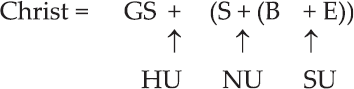 This enabling externalist exposition is able to describe HU and SU as instrumental unions whereby one entity extends itself onto another: GS to (S+ B) and B to E.Footnote 26 These dynamics show impanation as the via media between transubstantiation and consubstantiation that I noted previously. Contra transubstantiation, on this theory both E and B maintain their existence, while, contra consubstantiation, Type-S Impanation exposited by enabling externalist instrumentality provides a more robust union than mere co-location. Additionally, it seems an advantage to Type-S Impanation that it can utilize the resources of the metaphysics of the incarnation in a manner these other RP theories cannot.
The ‘too permissive’ objection
In the next two sections, I raise two potential objections to my enabling externalist presentation of Type-S Impanation. By addressing these objections, I hope to show further this view's coherence, attractiveness, and relation to the incarnation.
The first objection to the enabling externalist explanation of Type-S Impanation is that it is too permissive. If we grant that any time a body uses an instrument, that instrument becomes a part of the body, does that not make every object that Christ ever used part of his body? For example, when Christ made a whip of cords to drive out the moneychangers from the Temple in John 2, are we to suppose, via the Parity Principle, that the whip of cords became part of Christ's body? According to Scotus's theory and the EMT-inspired Parity Principle, yes, during the use of the whip of cords by Christ, the whip was straightforwardly part of Christ's body. In fact, according to the theory, any use of any object by Christ makes that object part of Christ's body for the duration of the use.
However, it seems as though there is something more intimate going on when Christ at the Last Supper or ministers standing in persona Christi utter the sentence of E, ‘This is my body.’ Thus, while granting that on enabling externalism any object used by Christ is part of his body, I suggest there is a subset of those objects that may properly receive the predication ‘is the body of Christ’. To advance this suggestion, I think I can identify an intuition that we have that there is a distinction to be made between what I will call common and private instruments. For instance, in the knife illustration, it seems that there is something more intimate about Edward Scissorhands's use of his scissor-hands than Scotus's use of his knife. Even though they are instances of the same instrumental union, my intuition is that the unity between Edward's body and his scissors is more intimate than that of Scotus's body and his knife. But what could be more intimate than forming ‘one subsisting thing’?
Looking back to Christology for help, I think this ‘too permissive’ objection is the same kind of objection to which Thomas Aquinas responds in his defence of his instrumental model of 3pCC.Footnote 27 So, first let me review Thomas's model of the HU. In his explication of the HU, Thomas looks to the NU between body as soul as an analogue. Thomas states: ‘the rational soul is united to the body both as to matter and as to an instrument’ (Thomas (Reference Thomas and O'Neil1264), IV.41.10). Of course, HU cannot be an instance of the first kind of relation (that of matter and form), so he looks to the second, the instrumental relation, as a possible explication of HU in the spirit of the NU. Thus, Thomas's view of HU holds that (S+ B) is the instrument of GS.
At this point, however, the ‘too permissive’ objection enters. For, Thomas holds that all instances of human nature can be instances of divine instrumentality: ‘For all men are related to God as instruments of a sort’ (ibid., IV.41.11). But clearly, Thomas does not want to hold that God is incarnate in every human nature, hence the need for a more intimate instrumental relation that obtains in the instance of the incarnation. Therefore, Thomas makes the distinction between common and private instrumentality. For example, with respect to the instrumental relation between the soul and (a) an axe or (b) its hand, Thomas makes this observation:
For this axe is not the soul's very own instrument, as this hand is, for by an axe many can operate, but this hand is deputy to this soul in its very own operation. For this reason the hand is an instrument of the soul united to it and its very own, but the axe is an instrument both external and common. (ibid.)Footnote 28
We might say that axes are common instruments. But some instruments are owned by their users, and this ownership relation is a condition that brings about instances of private instrumentality; thus Thomas's emphasis on the hand being the ‘very own’ (proprium) instrument of the soul.
Thomas uses this distinction to meet the ‘too permissive’ objection in the case of his instrumental view of 3pCC. He states that even though all humans are related to God as instruments of a sort, these are instances of common instrumentality. All humans (but one) are ‘extrinsic and separated instruments … God does not move them only to operations which are His very own, but to the operations common to every rational nature’ (ibid.).Footnote 29 But (S+ B) is owned by Christ; it is his very own nature. Thus, Thomas can say: ‘Therefore, the human nature of Christ is related to God as his own conjoined instrument, just as the hand is to the soul’ (ibid., my translation and emphasis). Thus, when we refer to Christ's human nature, (S+ B), we ought not to refer to it as just a human nature, but it is his human nature, his private instrument, the human nature of or belonging to Christ. It is Christ's very own.
A similar explanation undergirds the intuition that we have with respect to the other objects of extension we have been considering. For example, Edward Scissorhands moves his scissor-hands as his very own. This ownership relation brings about the private instrumentality that is a more intimate union than occurs in the common instrumentality of when Scotus uses a knife. Scotus could put down the knife, cause a cessation in the efficient unity between his hand and the knife, and then his brother Franciscan could pick up the knife and form his own unity with that knife. Edward has a greater level of intimacy with the scissors of his hands because there is a greater level of ownership of that object. Likewise, then, the Type-S Impanation theorist can hold that in a similar manner as Christ owns (S+ B) does an ownership relation occur between Christ's body and E, making E the private instrument of B. Thus, the ownership relation helps to clarify the intuition we have that there is a more intimate unity among the following items (where ‘a’ terms are private instruments and ‘b’ terms are common instruments):
(a) Edward Scissorhands and his scissor-hands
versus
(b) Scotus and his knife
Or
(a) GS and (S+B)
versus
(b) GS and every other human nature
Or
(a) Christ's body and the Eucharistic elements, (B+E)
versus
(b) Christ's body and the whip of cords in John 2
The ‘parthood’ objection
Type-S Impanation is very comfortable with referring to the consecrated E as parts of Christ, specifically parts of Christ's body. However, the liturgical utterance that is the impetus for RP theories is not ‘This is part of Christ’ or ‘This is part of the body of Christ’ but ‘This is the body of Christ.’ Does not an RP theory require that recipients receive the whole body of Christ in the Eucharist? Why should we be satisfied with a metaphysical state of affairs that only gets us part of the body of Christ?
First, this is not a uniquely impanation trouble; another popular explication of RP, transubstantiation, faces a similar allegation. However, Thomas Aquinas argued that by ‘real concomitance’ Christ's soul and divinity are also where his body and blood are (Thomas (Reference Thomas1274), III.76.1). That is, since there are real unions among the various concrete particulars of the whole Christ, wherever the body is, so too are the rest of the parts that are unified to that specific part. If you have before you B, then by NU you have S, and by HU you have GS. This same route of defence is open to Type-S Impanation. When this view speaks of E as part of B, we ought not to think of E as a severed hand. E only becomes a part of B as it is being used by B. Thus, as any other part of B is united to S and GS, so too is E united to S and GS by way of its efficient union with B. So, the parthood objection is no worse for Type-S Impanation than it is for transubstantiation.
Second, from the perspective of the recipient, moving from part to whole just seems to be the dynamic that is in play throughout interactions with God. For instance, in the first chapter of the Fourth Gospel, John notes that Christ is the portrayal of the Father: ‘No one has ever seen God [i.e. the Father]; the only begotten God [i.e. Christ], who is in the bosom of the Father, he has made him known.’ And similarly later in the Gospel, in response to Philip's request that Christ show the Father to the disciples, Christ says: ‘Whoever has seen me has seen the Father.’ What the disciples saw (14:9) and what directly was ‘made … known’ (1:18) was (S+ B), the private instrument of God the Son. The first object of the disciples’ perception was Christ's human body (B), the private instrument of Christ's human soul (S). The disciples looked at the one who spoke to them and perceived B. A perceiver conceptually moves from body to soul, in the case of Christ, from B to S. But whereas in regular humans the chain stops at S, in the case of Christ one moves from B to S to GS. Through the person of God the Son, a perceiver arrives at the divine nature, the very nature that is shared by all three hypostases of the Trinity, such that the perceiver can finally arrive at God the Father. Thus, this route – B → S → GS → divine nature → the Father – makes apt Christ's statement ‘Whoever has seen me has seen the Father.’
If this analysis can make sense of this Christological/Trinitarian statement, it can also work to defeat the parthood objection to Type-S Impanation. A faithful recipient of the Eucharist receives E, consecrated instances of bread and wine natures. But E is sacramentally united to B (a private instrument of B). At this point, a recipient can jump onto the aforementioned chain from Christ's body to his soul and then on in to the Trinitarian relations at the heart of the divine nature. Perhaps it is even possible to appropriate Christ's words to Philip to hold that, in the case of the Eucharist, ‘Whoever has seen E has seen the Father.’
Thus, Type-S Impanation is just as comfortable referring to the consecrated elements as parts of Christ's body as the concrete, compositional Christologist is in referring to S or B as parts of Christ. This is the same comfortability that one favourably inclined towards enabling externalism would feel in referring to Sue's prosthetic arm as part of Sue's body or Otto's notebook as part of Otto's mind. Likewise, in many of these cases, we have linguistic conventions in place that allow us, under the appropriate conditions, to refer to a part of a whole by the name of the whole. We can point to the human body of Christ and say, ‘That's Christ’; we can point to Sue's body and say, ‘That's Sue’; we can point to Sue's leg and say, ‘That's Sue's body’; and, on this theory of RP, we can point to the consecrated elements at the Eucharist and say, ‘This is the body of Christ.’ We must keep in mind that this referential state of affairs is a liturgical given; the Eucharistic liturgies just give us the phrase, ‘This is the body of Christ.’ Type-S Impanation according to my instrumental explication provides a metaphysical story that facilitates a literal interpretation of this liturgical utterance.
Conclusion
As an explication of RP, Type-S Impanation presents an attractive via media between transubstantiation and consubstantiation. Where transubstantiation has to deal with the metaphysically exotic notion of the empirical features of one entity being present at the location where in reality that entity is not, Type-S Impanation merely says that those empirical features of E are the features of one part of B. Likewise, whereas consubstantiation has difficulty showing a real union beyond co-location between E and B, Type-S Impanation, explicated as an instance of enabling externalism, shows how an efficient union obtains between B and E as E serves as the private instrument of B. This state of affairs provides a metaphysical backstory for a literal interpretation of the liturgical utterance ‘This is my body.’ Further, the instrumental relation that obtains in Type-S Impanation is a similar relational dynamic as might be used to explicate the 3pCC interpretation of the two natures of Christ. The similarity between Type-S Impanation and the incarnation serves not only to show the coherence of Type-S Impanation, but also to raise the attractiveness of Type-S Impanation as underwriting the real presence of Christ in the Eucharist.Footnote 30


