The deleterious long-term sequelae of pulmonary insufficiency after trans-annular patch repair of Tetralogy of Fallot is well documented.Reference Bouzas, Kilner and Gatzoulis1, Reference Puranik, Tsang and Lurz2 Current surgical techniques focus on preservation of pulmonary valve competence even at the expense of mild residual right ventricular outflow tract obstruction by limiting the use of trans-annular extension and restricting the length of the incision to the distal infundibular portion of the right ventricle.Reference Vida, Angelini and Guariento3–Reference Logoteta, Dullin and Hansen7 This approach has resulted in an increased incidence of residual obstruction often requiring peri-operative revision of the repair and substantial trans-annular patch with resultant pulmonary insufficiency and its negative consequences.Reference Stewart, Backer, Young and Mavroudis4–Reference Logoteta, Dullin and Hansen7 The addition of a bidirectional Glenn shunt in this situation shifts the intercept of pressure–volume curve downward and to the left, allowing a marginally narrow or borderline right ventricular outflow tract to become functionally adequate with resultant drop in trans-pulmonary gradient, right ventricular stroke work and energy expenditure.Reference Ascuitto, Ross-Ascuitto, Wiesman and DeLeon8 Pressure and volume unloading of pulmonary ventricle by supplementary bidirectional Glenn shunt has been documented in detail in canine modelReference Zias, Mavroudis, Cook, Makarewicz, Backer and Hernandez9 and has been used effectively in comparable clinical situations to decrease trans-pulmonary gradient, intra-cavity pressure and right ventricular stroke workReference Mavroudis, Backer and Kohr10–Reference Malhotra, Reddy and Qiu12 Utilising these previous studies, we devised a surgical strategy of adding bidirectional Glenn shunt to an intra-cardiac Tetralogy of Fallot repair in order to reduce significant residual post-bypass right ventricular outflow tract obstruction and mitigate the need for revision. A literature search showed only sporadic cases of Tetralogy of Fallot managed by this line of action and no documented series specifically of Tetralogy of Fallot patients. In this report we review early and midterm clinical results of supplementary bidirectional Glenn shunt in cases of Tetralogy of Fallot who had significant post-bypass residual right ventricular outflow tract obstruction after standard trans-atrial and trans-pulmonary artery repair.
Materials and methods
This study was approved by the Institutional Ethical Review Board of Armed Forces Institute of Cardiology and National Institute of Heart Diseases, Rawalpindi, Pakistan. It is a single surgeon experience. Beginning in January, 2011 we introduced a surgical strategy of managing significant residual right ventricular outflow tract obstruction after standard Tetralogy of Fallot repair by incorporating supplementary bidirectional Glenn shunt to avoid revision of the repair. The criteria for adding bidirectional Glenn shunt to the repair was post-bypass right to left ventricular peak systolic pressure ratio of ≥ 0.8. Patients managed by this strategy during period from 1 January, 2011 to 31 June, 2018 were included. All patients were diagnosed by echocardiography and cardiac catheterisation. Major aortopulmonary collateral arteries were embolised before surgery. Patients who had right ventricle to pulmonary artery conduit or pulmonary valve replacement as a part of Tetralogy of Fallot repair were excluded. Patients were regularly followed up at 6 weeks, 3 months, and then every 6 months, and a final follow-up was carried out during July, 2018. Patient characteristics, peri-operative parameters, post-operative echocardiographic findings along with early and medium-term outcomes measured in terms of survival and NYHA functional class were analysed.
Surgical strategy
Standard trans-atrial and trans-pulmonary artery approach was employed. Limited trans-annular patch was used if pulmonary valve annulus z score was less than −2 to achieve annular size corresponding to the expected z score, carefully avoiding over sizing. Post-bypass right ventricular to left ventricular peak systolic pressure was measured with perfusion cannulas still in place. If pressure ratio was ≥ 0.8, a bidirectional Glenn shunt was added to the repair. For performing the bidirectional Glenn shunt, cardiopulmonary bypass was re-established, superior caval vein was transacted at its junction with right atrium and was anastomosed to right pulmonary artery. Post-bypass right ventricular to left ventricular peak systolic pressure ratio was measured again, and in all cases we were able to achieve a pressure ratio of ≤ 0.75, thus avoiding revision. The azygous vein was left open if it had not already been ligated during previous modified Blalock–Taussig shunt. In cases of bilateral superior caval vein, right anastomosis was done first followed by re-assessment of pressure ratio with the provision of adding left-sided bidirectional Glenn shunt if pressure ratio was still > 0.75.
Echocardiographic and doppler studies
Comprehensive echocardiographic and doppler interrogation of the repair was done both in early post-operative period, at the time of discharge, and in follow-up. Specifically we assessed trans-pulmonary gradients, pulmonary insufficiency, biventricular functions, and flow characteristics of bidirectional Glenn shunt. Pulmonary insufficiency was estimated by colour flow mapping using visual assessment of regurgitation jet in relation to the outflow tract diameter and by ratio between time–velocity integrals of diastolic and systolic flow. Pulmonary insufficiency was graded as none, mild (less than 25%), moderate, and severe.
Final follow-up assessment
Clinical state of patients was assessed by obtaining a detailed history with emphasis on generalised wellbeing, participation in normal physical and sport activities, and performance in school. Based on the responses, patients were assigned an NYHA functional class. Other information obtained were the use of anti-failure medications or any other associated problem. Thorough physical examination was carried out with special reference to heart rate/rhythm, blood pressure, breath rate, facial or upper body swelling, and presence of de-compressing veno-venous collaterals. A 12-lead ECG, along with oxygen saturation monitoring and comprehensive echocardiographic and doppler studies, was also carried out.
Statistical analysis
Microsoft Excel and IBM SPSS Statistics version 22 were used to manage and analyse the data. Continuous variables were expressed as mean with standard deviation (Mean± SD), while categorical variables were expressed as frequencies and percentages. Chi square and paired sample t test were used to test significance. A p-value of <0.05 was considered statistically significant.
Results
Early outcome
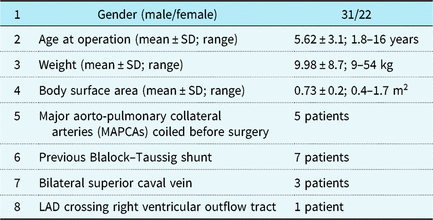
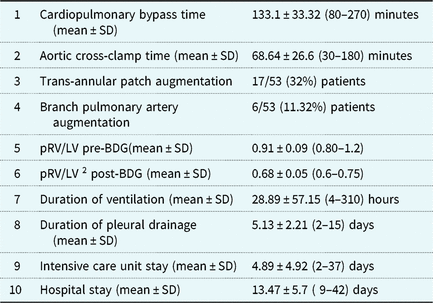
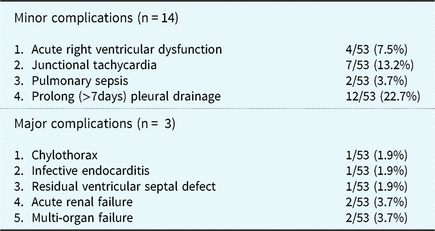
A total of 582 Tetralogy of Fallot repairs were performed during the study period of which 53 (9.1%) received supplementary bidirectional Glenn shunt. Patient’s characteristics and peri-operative parameters are given in Tables 1 and 2, respectively. Mean right ventricular to left ventricular peak systolic pressure ratio before supplementary bidirectional Glenn shunt was 0.91 ± 0.09 (Range 0.8–1.2) which decreased to 0.68 ± 0.05 (Range 0.6–0.75) after, a mean drop of 25.3%. This reduction was statistically significant (p < 0.001) and resulted in avoidance of repair revision in all the cases. Mean superior caval vein pressure at the time of admission to ICU was 16.7 ± 3.02 but decreased significantly by the time of discharge from ICU (13.51 ± 2.19 mmHg; p< 0.001). None of the patients had any discernible signs of superior caval vein syndrome post-operatively like facial, upper body swelling, or upper body discoloration. There were no re-explorations for excessive bleeding or re-interventions for residual right ventricular outflow tract obstruction. Almost two-third (68%) of the patients had smooth post-operative recovery without any complication. Complications occurred in 17 (32%) patients (Table 3). The most common complication was prolonged (≥ 7 days) pleural drainage seen in 14 (26.4%) patients. All were managed conservatively with tube drainage and aggressive diuresis.
Patient characteristics

SD = standard deviation; LAD = left anterior descending artery.
Peri-operative data (n = 53)

SD = standard deviation; pRV/LV = Right to left ventricular pressure ratio; BDG = bidirectional Glenn shunt.
Complications

A 30-day and hospital discharge mortality was 3.7% (2/53) for the bidirectional Glenn shunt group and 4.2% (25/582) in the standard Tetralogy of Fallot repair patients (p > 0.8). No death was directly related to the performance of the bidirectional Glenn shunt. One patient developed infective endocarditis resulting in ventricular septal patch dehiscence and vegetation in right ventricular outflow tract. Reoperation was performed but multi-organ failure secondary to severe sepsis occurred and the patient expired on 24th post-operative day. The second patient developed severe pulmonary oedema after extubating due to additional ventricular septal defects missed on initial evaluation. Re-operation was performed for closure of the residual defects; however, the patient had persistent low cardiac output, developed multi-organ failure, and died.
Discharge findings
At the time of discharge, all the patients were in stable condition with no evidence of superior caval vein syndrome or veno-venous collaterals. Discharge EKG showed normal sinus rhythm in 7/51 (13.7%) patients and sinus rhythm with right bundle branch block in 44/51 (86.3%). QRS duration was <180 ms in all cases. Mean oxygen saturation on air was 94.5%±1.9 (range 93–97). Echocardiographic studies at the time of discharge showed good biventricular functions in all patients with no regional wall abnormality. One patient (1.7%) had non-significant 2 mm restrictive residual ventricular septal defect. Trans-pulmonary gradients ranged from 24 to 45 mmHg with a mean of 32.11 ± 5.62 mmHg. Pulmonary insufficiency was graded as none to mild in 88.2% (45/51) and moderate in 11.8% (6/51). The bidirectional Glenn shunt was patent in all patients with laminar biphasic flow pattern (reversal of flow in superior caval vein during systole and ante-grade flow to pulmonary artery during rest of the cycle).
Follow-up
Follow-up was completed in all 51 survivors by July, 2018. Follow-up period ranged from 0.5 to 90 months with a mean of 36.12 ± 25.15 months. There was no interval intervention (Catheter based or surgical) or death. All the patients were in NYHA functional class 1. There was no clinical evidence of high superior caval vein pressures or development of veno-venous collaterals. Oxygen saturation ranged from 92 to 95% on air. Normal sinus rhythm was seen in 7 patients (7/51; 13.7%) and sinus rhythm with right bundle branch block was observed in 44 patients (44/51; 86.3%). QRS duration was < 180 ms in all cases. Echocardiographic studies showed good biventricular functions with significantly decreased mean trans-pulmonary gradient compared to the values at the time of discharge (25.64 ± 5 versus 32.11 ± 5.62 mmHg; p < 0.001) ranging from 18 to 36 mmHg. There was no increase in pulmonary insufficiency in any patient. All bidirectional Glenn shunts were functioning satisfactorily with retrograde flow in superior caval vein during systole and ante-grade flow into pulmonary artery during diastole.
Discussion
Trans-annular patch augmentation of a hypoplastic pulmonary valve annulus with disruption of pulmonary valve complex in Tetralogy of Fallot repair is associated with increased incidence of early and late pulmonary insufficiency with documented deleterious short- and long-term sequelaeReference Bouzas, Kilner and Gatzoulis1, Reference Puranik, Tsang and Lurz2 This has resulted in the emergence of various technical modifications that focus on minimising the use of trans-annular patch and limiting the length of the extension to distal infundibular portion of right ventricle.Reference Vida, Angelini and Guariento3–Reference Logoteta, Dullin and Hansen7 This right ventricular outflow tract-sparing approach has led to an increased occurrence of residual right ventricular outflow tract obstruction with a reported incidence of up to 12% in peri-operative period.Reference Bové, François and Van De Kerckhove5–Reference Logoteta, Dullin and Hansen7 The Boston Children’s Hospital group recently published their results with the intra-operative balloon dilatation of the pulmonary annulus rather than a trans-annular patch. The study revealed that 15.4% required re-operation for residual right ventricular outflow tract obstruction and that freedom from moderate or worse pulmonary insufficiency was only 77% at 1 year post-operatively and 43% by 5 years post-operatively.Reference Hofferberth, Nathan and Marx13 Our study showed that gradients decreased over time, no one requiring re-operation, and pulmonary insufficiency had not increased at a mean follow-up period of 3 years.
The most critical point in Tetralogy of Fallot repair is the assessment of diameter of the right ventricular outflow tract as it determines the requirement for trans-annular patch. Intra-operative gauging is usually done by sizing the outflow tract with Hegar dilators. The adequacy of the right ventricular outflow tract is assessed on the basis of pulmonary valve annulus z score. The recommended cut-off z value for a trans-annular patch varies widely among different studies ranging from –1.3 to –4 and does not guarantee against not having significant residual stenosisReference Stewart, Backer, Young and Mavroudis4, Reference Logoteta, Dullin and Hansen7, Reference Awori, Leong, Artrip and O’donnell14 StewartReference Bové, François and Van De Kerckhove5 used z value of –4 as a cut-off value and had to resort to intra-operative conversion to a trans-annular patch in 6.8% (6/88) cases after initial attempt at valve sparing procedures due to high right to left ventricular peak systolic pressure ratio of more than 0.8. They also reported 6% (5/82) re-operations for residual stenosis in patients who underwent pulmonary valve sparing procedures during follow-up. Kaushal and colleaguesReference Kaushal, Radhakrishanan and Dagar6 observed 12% peri-operative revisions after standard trans-atrial and trans-pulmonary artery repair. LogotetaReference Logoteta, Dullin and Hansen7 reported 12.6% peri-operative revisions for residual right ventricular outflow tract obstruction. Similarly BoveReference Bové, François and Van De Kerckhove5 have reported a 4% incidence of peri-operative revision to trans-annular patch after initial non-trans-annular patch repair and 12% incidence of re-operations for residual right ventricular outflow tract obstruction during a mean follow-up period of 7.5 years. Peri-operative revision usually requires trans-annular patch augmentation or extension of trans-annular incision which negates the original plan of preserving pulmonary valve integrity. We have, in this study, shown that addition of a bidirectional Glenn shunt in this setting will significantly reduce the severity of residual obstruction with reduction in right ventricular to left ventricular peak systolic pressure ratio, minimising the need for revision with excellent early and medium term results.
Our strategy is based on sound physiological principles and experimental and clinical data from other workers in comparable situations.Reference Ascuitto, Ross-Ascuitto, Wiesman and DeLeon8–Reference Malhotra, Reddy and Qiu12 The rationale for adding a bidirectional Glenn shunt in the presence of residual right ventricular outflow obstruction is to deliver superior caval vein blood directly to the lungs with decreased pressure work for the right ventricle. This reduction in energy expenditure would allow right ventricle to work more efficiently contributing to the long-term functioning of the heart. Based on canine model, Zias et alReference Zias, Mavroudis, Cook, Makarewicz, Backer and Hernandez9 have given a very detailed description of the effects of bidirectional Glenn shunt on right ventricular mechanics and pulmonary circulation. They concluded that the bidirectional Glenn shunt was highly effective in volume unloading of the right ventricle with significant reduction in right ventricular stroke work. Moreover, they also highlighted that in the presence of right ventricular pressure overload supplemental bidirectional Glenn shunt substantially improves left ventricular output and systemic blood pressure. These findings suggest that in patients with residual right ventricular outflow tract obstruction addition of a bidirectional Glenn shunt can be very helpful. Ascuitto et alReference Ascuitto, Ross-Ascuitto, Wiesman and DeLeon8 documented significant reduction in peak systolic right ventricular pressures, stroke work, and trans-pulmonary gradients in patients with residual pulmonary outflow obstruction after adding a supplementary bidirectional Glenn shunt. Their study population also included Tetralogy of Fallot patients. Mavroudis and colleaguesReference Mavroudis, Backer and Kohr10, Reference Mavroudis and Backer11 reported successful outcome using this strategy to pressure unload pulmonary ventricle faced with residual obstruction in patients with congenitally corrected transposition of great arteries having ventricular septal defect and pulmonary outflow obstruction. They were able to avoid the use of an extra-cardiac conduit in their cases using this strategy.
Our study population was a select group of severe forms of Tetralogy of Fallot with hypoplastic pulmonary valve annuli who despite standard Tetralogy repair as per institutional protocols (limited trans-annular extension for pulmonary annulus z score ≤ –2) still had significant right ventricular outflow tract obstruction at the time of weaning from cardiopulmonary bypass. If patients had not been managed by this strategy, they would have required revision with insertion or extension of trans-annular patch or use of right ventricle to pulmonary artery conduit. There were twoReference Puranik, Tsang and Lurz2 deaths but none could be attributable to the procedure, and the mortality rate was similar to the recently published results.Reference Sandoval, Carreño and Novick15 The incidence of major complications was low (3%). The incidence (4/53; 7.5%) of important early post-operative right ventricular dysfunction in our series was quite low, and we believe this could be due to the beneficial effects of bidirectional Glenn shunt on right ventricular mechanics with volume and pressure unloading of right ventricle leading to decreased trans-pulmonary gradient and right ventricular stroke work.Reference Ascuitto, Ross-Ascuitto, Wiesman and DeLeon8, Reference Zias, Mavroudis, Cook, Makarewicz, Backer and Hernandez9 The very low incidence of significant pulmonary insufficiency (11.8%) in early post-operative period and in follow-up was expected as reported by others as well after pulmonary valve sparing techniques.Reference Stewart, Backer, Young and Mavroudis4, Reference Bové, François and Van De Kerckhove5, Reference Logoteta, Dullin and Hansen7 The echocardiographic trans-pulmonary gradients at the time of discharge decreased significantly to a mean of 25.64 ± 5 mmHg in follow-up (p < 0001). Kaushal and Stewart also have demonstrated a significant decrease in peak trans-pulmonary gradient over time in patients who had pulmonary valve sparing procedures.Reference Stewart, Backer, Young and Mavroudis4, Reference Kaushal, Radhakrishanan and Dagar6 These gradients are slightly higher but with the emergence of new evidence suggesting that mild to moderate residual stenosis is beneficial for long-term right ventricular functions.Reference Latus, Gummel and Rupp16, Reference Freling, Willems and van Melle17 We believe that this mild right ventricular outflow tract obstruction could in fact be protective against right ventricular dilation in the long term as evident by excellent heath condition of children in flow-up with no disability or limitation in everyday activities. The bidirectional Glenn shunt is a relatively simple and commonly performed procedure for single ventricle palliation in our institute. It does not require aortic cross-clamping and can easily be completed during re-warming phase in 20–30 minutes.Reference Hussain, Saleem, Inam-ullah, Younus and Rashid18 A potential disadvantage of this strategy is creating reversal of flow in superior caval vein with elevated venous pressures which might lead to the development of pleural effusions and de-compressing collateral venous channels from the superior caval vein to the inferior caval vein.Reference Kogon, Plattner, Leong, Simsic, Kirshbom and Kanter19 We had 14 (26.4%) patients who had pleural drainage for more than 7 days, but all were managed conservatively successfully without any residual problem. We have found no evidence of any de-compressing venous channels or upper body venous hypertension in our patients so far, but a longer follow-up is needed.
The data from The Society of Thoracic Surgeons DatabaseReference Al Habib, Jacobs and Mavroudis20 and European Association for Cardio-Thoracic Surgery Congenital DatabaseReference Sarris, Comas, Tobota and Maruszewski21 showed a very high incidence of trans-annular patch repair of 52 and 57.5%, respectively, in Tetralogy repair. We believe that the back-up strategy of a supplemental bidirectional Glenn shunt in the setting of residual right ventricular outflow tract obstruction would encourage the surgeons to limit the extent or refrain altogether from performing a trans-annular patch repair in borderline cases, and this may help in avoiding unnecessary valve annular complex destruction. This strategy can be of great value in situation where important coronary artery crosses right ventricular outflow tract making the use of ventriculotomy and extended trans-annular patch difficult. One case in our series had left anterior descending artery crossing the right ventricular outflow tract; we were able to avoid right ventriculotomy and right ventricle to pulmonary artery conduit by performing trans-atrial trans-pulmonary repair with supplementary bidirectional Glenn shunt.
Conclusion
Addition of a bidirectional Glenn shunt significantly reduced the severity of residual right ventricular outflow tract obstruction after standard trans-atrial and trans-pulmonary Tetralogy repair, thus minimising the need for revision of repair. Addition of this tool in the surgical armamentarium will help the surgeons feel more confident in avoiding a trans-annular patch in borderline cases.
Acknowledgements
The authors wish to express their sincere and heartfelt appreciation to the paediatric cardiac intensive care unit nurses for their constant vigilance and compassionate care of our little patients.
Financial Support
This research received no specific grant from any funding agency, commercial or not-for-profit sectors.
Conflicts of Interest
None.
Ethical Standards
No human or animal experimentation was conducted in this study which was approved by the Institutional Ethical Review Board of the Armed Forces Institute of Cardiology and National Institute of Heart Disease.