The work society
This article examines the role welfare states play in reducing working-time and challenging the work ethic, before offering a strategy of how a less work-focused society can be realised. This is a small but growing area of interest in social policy research, captured recently by debates around universal basic income (UBI) and the shorter working week (Chung, Reference Chung2022). What these perspectives share is a focus on how social policies can help move beyond the ‘work society’. The article first explores what is meant by the ‘work society’ and shows how welfare states have historically affected working-time. Subsequently, three policy ideas for working-time reduction are presented: universal basic income, the shorter working week, and a broader category of ‘lifetime’ approaches. The main argument of the article is for the latter, lifetime perspective as the most persuasive strategy for reducing working-time.
What is work?
An initial question is what is meant by the ‘work society’ and ‘work’ itself, which can be defined in many ways. Perhaps the most common understanding of work is activity performed for income: either immediately or in future hope, such as networking. However this definition ignores the diverse range of unpaid forms of work, such as caring, domestic labour, and volunteering, that are necessary for the functioning of societies. There are also activities usually not thought of as forms of work but are nevertheless referred to using the language of work. People may ‘work’ on their running technique or ‘work’ in the garden. Frayne (Reference Frayne2015), drawing on Gorz (Reference Gorz1989), argues there are three ways work can be understood. First, there is work performed in exchange for money or anticipation of future income. Second, there is unpaid work that has a clear social benefit or necessity. And third, there is work related to self-development, such as hobbies, crafts, skills, and interests.
In making the case for working less, it is not the aim of this article to outline policies to bring about less time for socially necessary or personally enriching forms of ‘work’. Rather, the aim is reducing the most consuming form of work: that performed in return for income. The pervasive presence of this type of work is what Weeks (Reference Weeks2011) describes as the ‘work society’. It is vital, however, to acknowledge the centrality of this form of work to the functioning of advanced welfare states. This is something that working-time reduction (WTR) advocates must remain cognisant of; if WTR was to be associated with declining productivity, a lower tax take, more unemployment, and lower wages then the outcome would be profound stress inflicted on the capacity of welfare states to provide social security and social services. The aim and design of WTR thus needs to be considered alongside the broader functioning of advanced economies. This is a central component of the argument of this article: that a lifetime perspective on WTR better acknowledges broader economic priorities when compared to alternatives such as UBI.
The work society
There is significant variation around the world when it comes to time spent at work, with countries in the Global South tending to have significantly higher annual working hours. In China and India, annual working hours were approximately 2,150 hours in 2017 compared to 1,757 in the US and 1,354 in Germany (Our World in Data, 2023). As such, debates on working-time regulation vary substantially between developing and developed welfare states, with different economic, labour market, and cultural challenges. The article is subsequently focused on WTR in advanced welfare states (for a discussion of working time more globally, see Lee et al., Reference Lee, McCann and Messenger2007).
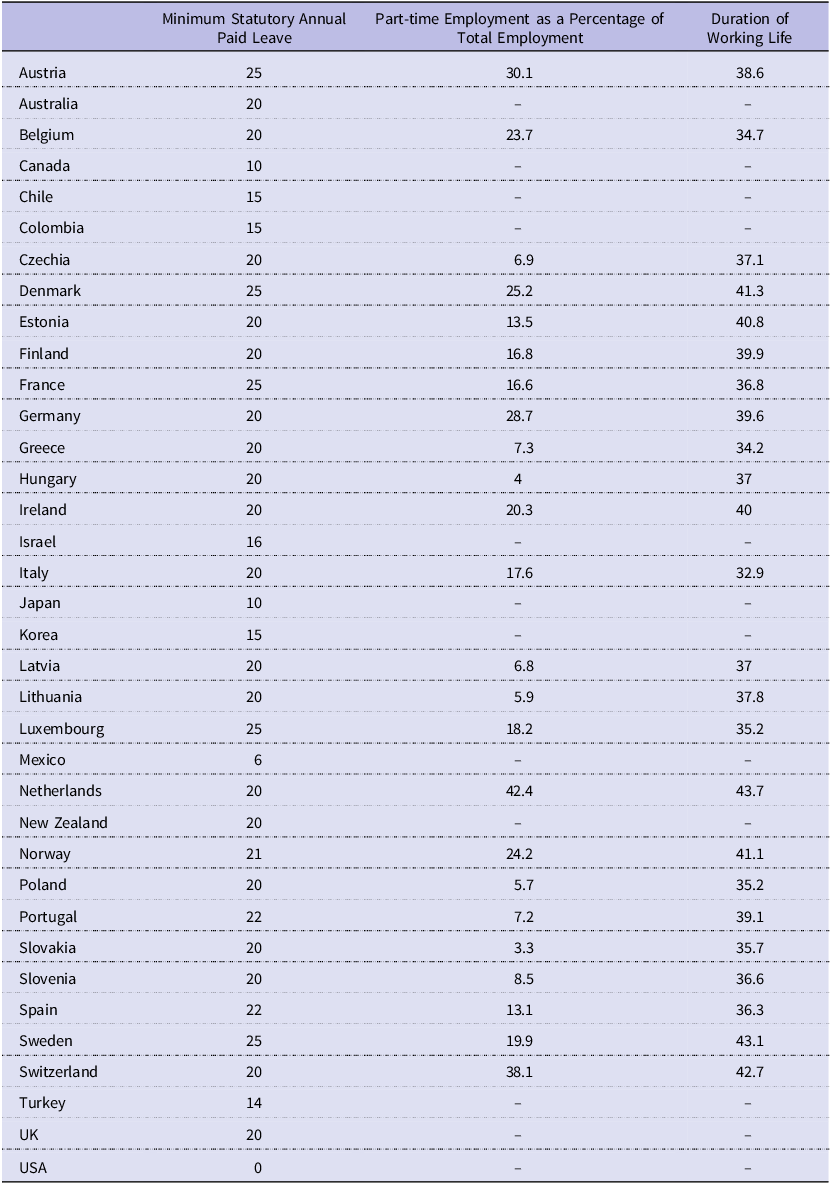
In advanced welfare states, full-time hours (Skidelsky, Reference Skidelsky2019; Eurostat, 2023a; OECD, 2023a) tend to be lowest in north-western European countries like Denmark (38.1 hours) and Norway (37.5 hours). Working hours are highest in the English-speaking welfare states like New Zealand (42.3 hours), the US (41.4 hours) and the UK (41.2 hours). Such hours are far from the prediction of Keynes (Reference Keynes1932), who famously prophesised technological advance would lead to a huge reduction in daily work to three hours. Working time was reduced between 1870 and 1950, with declines of over forty per cent in countries like Belgium, Denmark, the Netherlands, and Sweden (Our World in Data, 2023). Since 1950 though, and especially since 1980, most countries have seen the speed of WTR slow. Had WTR continued at the same pace as the early twentieth-century, current full-time hours would be around thirty-four (Skidelsky, Reference Skidelsky2019). This has emphatically not been the case; looking at the US for example, annual working hours fell by thirty-six per cent between 1870 and 1950 but by just two per cent between 1980 and 2017. Working hours are just one measure of Weeks’ ‘work society’. Other indicators include annual vacations, part-time work, and the duration of working life, which are presented in Table 1. On all there is large variation. Thus whilst many countries offer twenty-five days of annual vacation, the US offers zero (OECD, 2021); over a third (42.4 per cent) of all Dutch employment is part-time whilst less than ten per cent is in Greece (Eurostat, 2023b); and an Italian can expect to work just over thirty years compared to a Swede’s forty-three (Eurostat, 2023c). This demonstrates working-time is best thought of not solely as the length of the working day or week but by what happens over a lifetime. This argument – conceptualising WTR through the lens of a lifetime – is a central contention of this article.
Variation in working time indicators in OECD countries

Table 1 Long description
A table comparing working time indicators across OECD countries. The table has 3 columns and 30 rows. The columns are labeled Minimum Statutory Annual Paid Leave, Part-time Employment as a Percentage of Total Employment, and Duration of Working Life. The rows are labeled with country names. Row 1: Austria, 25, 30.1, 38.6. Row 2: Australia, 20, -, -. Row 3: Belgium, 20, 23.7, 34.7. Row 4: Canada, 10, -, -. Row 5: Chile, 15, -, -. Row 6: Colombia, 15, -, -. Row 7: Czechia, 20, 6.9, 37.1. Row 8: Denmark, 25, 25.2, 41.3. Row 9: Estonia, 20, 13.5, 40.8. Row 10: Finland, 20, 16.8, 39.9. Row 11: France, 25, 16.6, 36.8. Row 12: Germany, 20, 28.7, 39.6. Row 13: Greece, 20, 7.3, 34.2. Row 14: Hungary, 20, 4, 37. Row 15: Ireland, 20, 20.3, 40. Row 16: Israel, 16, -, -. Row 17: Italy, 20, 17.6, 32.9. Row 18: Japan, 10, -, -. Row 19: Korea, 15, -, -. Row 20: Latvia, 20, 6.8, 37. Row 21: Lithuania, 20, 5.9, 37.8. Row 22: Luxembourg, 25, 18.2, 35.2. Row 23: Mexico, 6, -, -. Row 24: Netherlands, 20, 42.4, 43.7. Row 25: New Zealand, 20, -, -. Row 26: Norway, 21, 24.2, 41.1. Row 27: Poland, 20, 5.7, 35.2. Row 28: Portugal, 22, 7.2, 39.1. Row 29: Slovakia, 20, 3.3, 35.7. Row 30: Slovenia, 20, 8.5, 36.6. Row 31: Spain, 22, 13.1, 36.3. Row 32: Sweden, 25, 19.9, 43.1. Row 33: Switzerland, 20, 38.1, 42.7. Row 34: Turkey, 14, -, -. Row 35: UK, 20, -, -. Row 36: USA, 0, -, -.
Recent developments in the organisation of work have further contributed to the expansion of the work society (Gorz, Reference Gorz1999). A fifth of European commuters spend over ninety minutes travelling to work daily (Giménez-Nadal et al., Reference Giménez-Nadal, Molina and Velilla2022) and evidence shows commuting time has increased since the 1990s (Kirkby and LeSage, Reference Kirkby and LeSage2009). This is important as commuting has a well-established, negative relationship with well-being and the enjoyment of leisure (Clark et al., Reference Clark, Chatterjee, Martin and Davis2020). Technology has reduced commuting for some by making home-working easier, but this is a double-edged sword and has enhanced work intensity for some. In the early Covid-19 lockdowns, DeFilippis et al. (Reference DeFilippis, Impink, Singell, Polzer and Sadun2020) found the average working day increased by 8.2 per cent for people working from home. Such is the scale of technological change – and the difficulty in ‘clocking in and clocking off’ – that the French Government introduced a legal right to ‘switch off’ from work in 2017. Other countries like Ireland, Italy, and Spain look set to follow suit.
Technology is not just about the intensity of work but the added control it gives employers. In an ethnography of UK call-centre workers, Woodcock (Reference Woodcock2017) argues technology has heightened worker surveillance in numerous ways, including data collection on employee performance, output, and behaviour. Woodcock (Reference Woodcock2017: 50) describes this a ‘computerised development of Taylorist management principles’, with technology enabling an ‘unprecedented level of surveillance’. Other industries have introduced innovative technologies to monitor workers: Amazon patented wristbands to track warehouse employees (Solon, Reference Solon2018), computer programme TeamViewer mirrors employees’ laptops to office PCs (Morrison, Reference Morrison2020), and Sneek software photographs home-workers’ faces every few minutes. Technology is also used to collect employee health data, with companies encouraging or compelling workers to track health via wearable devices (Bearne, Reference Bearne2021). What these stories demonstrate is whilst technology may offer more flexibility and autonomy, employers – utilisng the same tools – can use it to enhance control and surveillance.
Finally, the work society has been strengthened by a transformation in workers’ rights over recent decades. Whilst trade union density varies widely in OECD countries, what all have in common is declining unionisation (OECD, 2022). In the UK for example, unionisation peaked in 1979 with 13.2 million members; by 2019 this had nearly halved to just 6.7 million (ONS, 2022). Faced with declining membership and political power, unions have largely retreated to what De Spiegelaere and Piasna (Reference De Spiegelaere and Piasna2017) describe as ‘defensive’ positions: protecting jobs and wages and promoting ‘better’ work (see also Weeks, Reference Weeks2011). This has come at the expense of more radical aims around WTR, which unions once pursued aggressively (Aronowitz and Cutler, Reference Aronowitz and Cutler1998; Frase, Reference Frase2016). A cause and consequence of union decline is the increase in precarious work, with one in ten EU-15 workers employed in precarious jobs (Kretsos and Livanos, Reference Kretsos and Livanos2016) and EU data showing insecure, atypical, and anti-social experiences of work are relatively common. An effect of these new realities is some workers are more conservative in switching jobs (Resolution Foundation, 2022): a reluctance indicative of fear of change, lack of bargaining power, or an appreciation to have any job at all. Another effect of workplace anxiety is the long-hours culture in many professions, which values presence and visibility over productivity. Across the OECD (2023b), 11.6 per cent of workers report very long weeks working over fifty hours. This culture is linked to the phenomenon of ‘presenteeism’: the act of reporting for work despite being ill. Together, long-hours culture and presenteeism are part of a phenomenon of performative hard work: the desire to present loyalty and dedication to your job. In this environment, work-related mental illness is common. In the UK, it is estimated 900,000 workers suffer work-related stress, depression, or anxiety (HSE, 2022), whilst the Japanese have a name for the most serious consequences: karōshi (death by overwork).
The work ethic and the welfare state
These trends have contributed to a growing critical movement against the beliefs of the work ethic. These are ingrained norms in most societies, where Gorz (Reference Gorz1999: 57) argues:
Never has the ideology of work-as-value been proclaimed, flaunted, reiterated so unashamedly…Never has the irreplaceable, indispensable function of labour as the source of social ties, social cohesion, integration, socialisation, personalisation, personal identity, and meaning been invoked so obsessively.
The foundations of the work ethic contain numerous beliefs, such as less work would make us poorer and there is a unique moral value to work. Yet the core tenet of the work ethic can be summarised as ‘work is good for people.’ This is a belief – or ‘official morality’ (Weeks, Reference Weeks2011: 38) – held by many, for whom work has a profound, socially integrative function. This is what Jahoda (Reference Jahoda1982) described as the essential ‘latent functions’ of employment – time structure, social contact, status, collective purpose, and activity – that paid work becomes the primary source of in industrial societies. The ubiquity of these beliefs makes the task of WTR difficult, yet the work ethic has not always been so dominant. Early reformers sought to challenge the intensity and volume of work, yet over the course of the past century this ambition has been largely neglected (Hermann, Reference Hermann2015). Subsequently, discussions of WTR have been minimal in debates around contemporary social policy; this contrasts to earlier reformers who were clear that the balance between work and free time was not fixed and inevitable but politically contested. Early campaigns for WTR resulted in hours falling from an average of eighty to sixty hours in the nineteenth-century and then down to forty hours over most of the twentieth-century (Beckett, Reference Beckett2018).
Recently though, the work ethic has been reinforced and the resistance to work typifying early labour movements has dissipated. Since the 1990s, a notable social policy phenomenon has been ‘labour market activation’: programmes designed to reinforce the responsibility to work and consolidate the bond between social security and employment obligations. In the UK, successive governments strengthened work-related responsibilities via benefit sanctions, the imposition of conditionality for disabled people and lone parents, and active labour market programmes (ALMPs): targeted, mostly mandated, re-employment schemes. The evidence on the labour market and wider outcomes of activation is mixed and depends on ALMP type, the outcomes considered, and the degree of conditionality (Card et al., Reference Card, Kluve and Weber2017; Vooren et al., Reference Vooren, Haelermans, Groot and Maassen van den Brink2019; Pattaro et al., Reference Pattaro, Bailey, Williams, Gibson, Wells, Tranmer and Dibben2022). This hints at a second aim of activation: less re-employment and more enforcing a commitment to work. Whilst the ‘activation turn’ in social policy has socio-economic drivers (Bonoli, Reference Bonoli2007), ideology is paramount. These include neoliberal critiques of welfare’s ‘perverse’ incentives (Murray, Reference Murray1990), socially conservative views on the morally corrupting effects of benefits (Mead, Reference Mead1986) and 1990s’ third-way social democracy (Bonoli and Powell, Reference Bonoli and Powell2002). Much of the Left and Right have been united in support of activation, creating a policy hegemony given international backing by the EU, International Monetary Fund and OECD (Armingeon, Reference Armingeon2007).
There has simultaneously been a shift in how politicians talk about unemployment, benefits, and work. Anti-benefit discourse increased under the UK Conservative-Liberal Democrat coalition of 2010–2015; with public spending cuts requiring public buy-in, politicians repeatedly argued how welfare encouraged dependency and discouraged hard work. This was a marriage of convenience between economic liberals like the Chancellor George Osborne and true believers like Iain Duncan Smith. Whilst Chancellor, Osborne (Reference Osborne2013) argued how ‘there is nothing kind about parking people…on benefits (and…) nothing fair about a something-for-nothing culture’. Simultaneously there was a synergy between welfare politics and popular culture, which Jensen (Reference Jensen2014) described as ‘poverty porn’. Programmes like Benefits Street (Channel 4, 2014) and We All Pay Your Benefits (BBC, 2013) constructed a conservative, neoliberal ‘common sense’ around welfare dependency. National media contributed to this environment, with Turn2Us (2012: 43) showing newspapers shifted towards a ‘scrounger discourse’, focusing on ‘large families on benefits, bad parenting, antisocial behaviour (and) people who have never worked or haven’t worked for a long time’. Unsurprisingly public opinion research estimated a profound shift in welfare attitudes starting in the late-1990s and peaking in the mid-2010s. This cannot be explained by changes in the economic cycle alone, suggesting a more ‘discursive, ideological shift in how we think and conceptualise unemployment’ (Sage, Reference Sage2012: 366). Indeed as the post-2010 economy floundered, welfare attitudes hardened to those without work. There was thus a complex web intertwining political rhetoric, social policy, popular culture, media, and public opinion. In an analysis of political speeches since the 1980s, O’Grady (Reference O’Grady2017) places politicians as the chief instigators: ‘as the public heard increasingly harsh rhetoric, their opinions altered’.
There is evidence this environment is now changing and public opinion has softened (NatCen, 2023). Covid-19 also exposed many problems with labour markets and initiated a cultural reaction against some work demands, highlighted by pressure to maintain homeworking, the so-called Great Resignation (Klotz, Reference Klotz2022), and small but significant ‘antiwork’ subcultures. There is also evidence that broader public attitudes to work have changed in some countries, with Duffy et al. (Reference Duffy, May, Wright and Hewlett2023) finding that the belief it would be a ‘good thing if less importance were placed on work’ has increased in numerous advanced welfare states like Canada, Germany, and the UK since the 1980s. This view is especially prevalent in younger generations. There is also evidence that a shorter working week would be popular amongst the public, although this comes with the caveat of maintaining present levels of pay (Autonomy, 2020). Simultaneously a new school of critical voices has emerged, seen in think-tanks like Autonomy (2019), the European Trade Union Institute (ETUI) (De Spiegelaere and Piasna, Reference De Spiegelaere and Piasna2017), and the New Economics Foundation (NEF, 2018) (2010; academic theorists (Gorz, Reference Gorz1999; Weeks, Reference Weeks2011; Hochschild, Reference Hochschild2012; Hunnicutt, Reference Hunnicutt2013; Frayne, Reference Frayne2015; Frase, Reference Frase2016; Srnicek and Williams, Reference Srnicek and Williams2015; Graeber, Reference Graeber2018; Spencer, Reference Spencer2022), empirical researchers (Kamerāde et al., Reference Kamerāde, Wang, Burchell, Balderson and Coutts2019; Sage, Reference Sage2019) and popular social science books (Mason, Reference Mason2015; Bregman, Reference Bregman2017). There are at least five common threads between these accounts. The first is economic changes – including flexibility, insecurity, and deindustrialisation – have compromised the promises of what work provides: not only income but well-being, health, and social status. The second is new technologies degrade the experience of work (e.g. via enhanced surveillance) but also generate opportunities for WTR; many tasks can now be completed more efficiently by machines. The third is that climate change necessitates a change in how people work to less energy- and consumption-intensive forms (King and Van Den Bergh, Reference King and Van Den Bergh2017). Fourth, WTR promotes gender equality via a more equal distribution of paid and unpaid labour. The fifth and final thread is WTR is, on its own, inherently good and does not require justification by claims of productivity, efficiency, or unemployment rates (Weeks, Reference Weeks2011). This is an argument about freedom, the good life, and happiness. Frayne (Reference Frayne2015: 216) puts it simply: ‘people are happier when they have more time to do the things they want to do’.
Many critics of work, however, remain vague on how WTR can be realised by social policy (e.g. see proposals in Gorz, Reference Gorz1999; Weeks, Reference Weeks2011; Frayne, Reference Frayne2015), often advocating provocative, performative ‘demands’ designed to stimulate public debate. There is also an absence of acknowledgement of the broader economic effects of WTR and the requirement to maintain an effective labour market that supports the functioning of the welfare state and public services. Yet the real-world role of the welfare state in WTR is not a new idea. Esping-Andersen (Reference Esping-Andersen1990) famously conceptualised this as decommodification; welfare states could be differentiated by which services and benefits weakened labour market dependence. For Esping-Andersen, the English-speaking welfare states – with low benefits and means-testing – were where citizens’ well-being was most fundamentally linked with work. Alternatively the social democratic states were the most decommodifying: providing ‘equal benefit to all, irrespective of prior earnings, contribution or performance’. Esping-Andersen’s analysis was rooted in the post-war world, yet recent interest in WTR is part of the same social democratic legacy of decommodification: welfare policies designed to enable people to work fewer hours and be less dependent on employment for quality-of-life. Whether a basic income or retirement ages, advocates propose welfare systems that free people from employment for the living of a good life. The recent campaign for WTR thus shares much with an older demand for the provision of social rights in capitalist economies.
Beyond the work society: three strategies
This section analyses how welfare states can contribute to WTR: enabling less work without significant drops in income. In the WTR debate, two policies have captured public attention: UBI and the shorter working week (SWW). This section outlines both strategies, concluding whilst both are important and viable strategies for WTR, there is a third strategy – a lifetime perspective – that should also be considered. This is because the broader welfare state affects working-time in a range of ways. Whether healthcare is universal or not affects employment dependence; benefit generosity determines reliance on work for survival; and parental leave shapes how much time parents can spend with new-borns. Consider a society where healthcare is only available via employers, unemployment benefits and paid parental leave are non-existent, and state retirement ages are over seventy. This society would entwine survival deep within employment. The key point, and argued below, is that when considering policies for WTR there is more on the table than UBI or the SWW.
Universal basic income
UBI has gained significant global attention recently as a solution to a range of socio-economic challenges (Sloman, Reference Sloman2018). UBI is an individual, regular cash payment provided to all citizens. Crucially, UBI is unconditional: it is not dependent on job-search activity, employment, or means-testing. This gives UBI unique advantages over other ideas it competes against; it is simple to understand, radical, wide-ranging in appeal, and can supposedly remedy an extensive list of socio-economic problems. These include unemployment, automation, gender equality, climate change, benefit ‘traps’, poverty, and work insecurity (Dimick, Reference Dimick2017). A further aspiration of UBI is to bring about WTR: it could provide the choice to reduce working hours and increase time spent in freely chosen meaningful activities. UBI has radical roots; in its early formulations it was largely associated with idealist, utopian, and revolutionary thinkers such as Robespierre and Paine (Sloman, Reference Sloman2018). More recently though, UBI has advanced into more pragmatic, mainstream political circles: what Sloman (Reference Sloman2018) calls the ‘fifth wave’ of UBI as a response to global economic problems. This is indicative of how, in times of disruption, once radical social policies take on unexpected persuasion.
The core question for this article is whether UBI has the capacity to bring about the goal of WTR and, when considering this, a tension emerges between two models of UBI. The first model is a modest weekly sum payable to all, replacing most existing benefits. The limited, minimalist nature of this model is its selling point: compared to alternatives it would be cheaper, more practical to implement and likelier to garner public support. There have been numerous minimalist proposals in recent years. For most working-age adults, the Royal Society for the Arts (RSA, 2015) suggests a weekly payment of seventy-one pounds and Compass propose (2019) sixty pounds, with higher levels for older people and families with children. The minimalist Compass proposal however is seen as a seed to an eventual, more generous UBI. Elsewhere, Finland’s highly publicised guaranteed income experiment had a value of around €129 per week. The downside, at least vis-à-vis WTR, is modest payments would be insufficient to enable meaningful WTR. Ikebe (Reference Ikebe2016) makes this point, arguing a modest UBI – or a ‘non-liveable basic income’ – would maintain labour market reliance.
The second model is a more generous UBI: a ‘liveable basic income’ (Ikebe, Reference Ikebe2016) that goes significantly beyond social assistance levels (i.e. the RSA and Compass models above) and replaces a substantial proportion of median income from work. This version was supported by Gorz (Reference Gorz1999), who proposed a UBI ‘both unconditional and adequate for a decent existence’ as opposed to a ‘minimum income, which permits mere subsistence’ (Levitas, Reference Levitas2001: 459). There are two examples of UK pilots employing this model. First, the Welsh Government is providing care leavers with £1,280 per month for two years after their eighteenth birthday. Second, Autonomy (2023a) is leading a pilot in two English towns where thirty participants will receive £1,600 per month for two years. These pilots provide participants with 53.5 and 66.9 per cent of post-tax, median full-time income in the UK (ONS, 2023). The 2016 Swiss UBI referendum also proposed a generous scheme of 2500 CHF (£1,755) per month. The generous model, however, is less commonly proposed by advocates. It holds greater potential economic risks and would have significantly higher costs compared to a minimalist UBI, and thus require a corresponding tax rise an order of magnitude greater. Bergmann (Reference Bergmann2004) argues this would leave governments unable to invest in other welfare state services and in reality there is a choice between either a generous UBI or a generous welfare state: having both is not possible. It would also court more political and public controversy (White, Reference White1997). Social attitudes research shows ambiguous views on the likely popularity of a generous UBI. Whilst there is evidence the public would support some form of basic income (Kirk, Reference Kirk2022), decades of social attitudes research shows public aversion to the much higher tax settlement a generous UBI would necessitate (Hirsch, Reference Hirsch2015), belief in the importance of work as a social institution (Sage, Reference Sage2019), and the prioritisation of notions of deservingness, contribution, and reciprocity as fundamental principles of the welfare state (Van Oorschot, Reference Van Oorschot2006). Nevertheless, a generous UBI holds greater potential for enabling meaningful WTR. It is only with an adequate, guaranteed safety net that significant decisions about WTR can be made.
Until recently there has been little evidence for researchers to analyse the effects of UBI on labour market behaviour. The only ongoing, long-term UBI in an advanced welfare state is the Alaska Permanent Fund (Widerquist and Howard, Reference Widerquist and Howard2012) which, despite its longevity, has ‘not been systematically examined’ in terms of its ‘impact on the economic, social and political landscape’ (Goldsmith, Reference Goldsmith, Widerquist and Howard2012: 84). Forget (Reference Forget2011) argues guaranteed income programmes, trialled in parts of North America in the 1970s, showed significant, downward trends on working hours but only for secondary earners: especially women with children and newborns. This suggests a modest UBI could lead to WTR but primarily via mothers dropping out of the labour market or reducing their working hours to finance longer maternity leaves. Robeyns’ (Reference Robeyns2001) argues this point, claiming if UBI is implemented in a context of gendered divisions it could reinforce inequalities. The case for UBI has gained momentum over the last decade though with various global trials, pilots, and experiments. Programmes have been undertaken in the countries noted above, as well as low- and middle-income countries like Brazil, India, and Kenya (Coote and Yazici, Reference Coote and Yazici2019). This has produced new evidence for researchers to examine UBI’s potential for WTR. Some results show little if any effect on reducing work incentives. Indeed some schemes have increased employment as a stated aim of trials. Speaking to The Guardian (2018), Marjukka Turenen from the Finnish Kela agency said an aim of their trial was to see if it ‘increases the incentive for people to take on work’ (Kangas et al., Reference Kangas, Jauhiainen, Simanainen and Ylikännö2020). The results of Finland’s experiment were compromised by other policy changes, but the broad verdict was it had very little effect on employment rates one way or another; if anything, there may have been a small increase in employment amongst UBI recipients of around six extra working days per year (Hiilamo, Reference Hiilamo2022).
This prompts the question of the raison d’être of UBI: is it to increase employment or reduce working-time? This depends on UBI’s generosity: it must be sufficient to provide the choice to work fewer hours. This is noted by Sloman (Reference Sloman2018), describing this tension as between the technocratic and transformative supporters of UBI, and Spencer (Reference Spencer2018: 9) who argues a minimalist UBI is a ‘prop to consumption and a means to support work …it offers no radical break with the present’. A minimalist UBI could be less a challenge to the authority of employment and more an activation tool designed to encourage more work. Still, a form of UBI could be a powerful tool for WTR. Set at a sufficiently high level, UBI would provide people with the freedom to cut working hours. There is however a paradox at the heart of basic income: the more probable, yet minimalist, UBI is the one far less likely to change societies’ work dynamics.
Shorter working week
Like UBI the SWW has also gained attention recently (Beckett, Reference Beckett2018; NEF, 2018; Pang, Reference Pang2019). In the last decade there have been high-profile European SWWs in Belgium, Germany, Iceland, and Sweden (Autonomy, 2019). Elsewhere the trial of a four-day week at Perpetual Guardian in New Zealand gained international media attention (McClure, Reference McClure2022). Most recently, a six-month 2022 trial took place in the UK with sixty-one companies and 3000 workers (Autonomy, 2023b). What is important is that both the Autonomy and Perpetual Guardian trials maintained pay at 100 per cent. This emphasises that the aim of the SWW, and WTR more broadly, is not to see work itself disappear and unemployment rise, but to redress the long stagnation in time spent at work. Whilst these studies are novel, the SWW does have a longer history. This includes the 1974 UK three-day week, the 1998–2008 French 35-hour week (Askenazy, Reference Askenazy2013) and the 1993–1999 Volkswagen 28.8-hour-week in Germany (Seifert and Trinczek, Reference Seifert and Trinczek2000). There have also been many ‘work-life balance’ initiatives, which often involve some form of WTR (Kinman and Jones, Reference Kinman and Jones2008), as well as the mass expansion of part-time work the Netherlands (Visser, Reference Visser2002). An SWW is often imagined as the transition from a five-day work schedule to a four-day one, yet it encompasses more than the four-day alternative (King and Van Den Bergh, Reference King and Van Den Bergh2017). At its core, it involves a reduction in weekly hours by the equivalent of one full workday without – ideally – lower pay. Whilst this could be achieved by eliminating one entire day, different approaches are possible, (e.g. two afternoons per week). The critical feature of the SWW lies in the reduction of each working week by approximately one-fifth.
As with UBI, we must ask two questions of the SWW: (a) will it result in WTR? and (b) is large-scale implementation probable? This first question appears self-explanatory given WTR is seemingly an inevitable effect of the SWW, unlike UBI where it may be a by-product. There are, however, questions over whether the SWW reduces actual work intensity, which is not solely determined by hours but by factors like sector, management expectations, autonomy, and scheduling. De Spiegelaere and Piasna (Reference De Spiegelaere and Piasna2017) point to research that an SWW can increase work intensity and stress in certain conditions (see also Piasna, Reference Piasna2015), arguing WTR must be matched by additional employment (Akerstedt et al., Reference Akerstedt, Olsson, Ingre, Holmgren and Kecklund2001) and autonomy over working hours to reduce work intensity. This was illuminated by findings from the French thirty-five-hour week, with Fagnani and Letablier (Reference Fagnani and Letablier2004) reporting an SWW resulted in a worse work-life balance for those made to accept non-standard shifts in exchange for fewer hours. Similar findings regarding stress were found in Germany (Seifert and Trinczek, Reference Seifert and Trinczek2000).
There are also doubts about the likelihood of a large-scale, nationwide SWW. Like UBI, there are ideological currents running against it (Hussen, Reference Hussen2023) and in the current cost-of-living crisis, the problem perceived by many is too little work (‘underemployment’, see Bell and Blanchflower, Reference Bell and Blanchflower2021) or pay. Fear of falling living standards following a SWW is a long-standing caveat (NEF, 2010) and, in the present crisis, the idea of working less may fall on deaf ears. This emphasises the precedence of maintaining full pay alongside shorter hours, which is a central tenet of the UK’s four day week campaign group. There are also questions around which industries a SWW would suit. As Skidelsky (Reference Skidelsky2019) observes, many firms experimenting with a SWW are similar: project-based, knowledge jobs in areas like PR and advertising. These models could not be applied to all types of work. We arrive then at a similar paradox to that facing UBI: the more radical and transformative version of the SWW – a society-wide, immediate, and large cut in working hours – would be the most costly, disruptive, and less feasible. Contrastingly the more probable model of the SWW – a small, scattered, and incremental reduction in hours – may have little impact on work intensity or broader public support for WTR.
This second approach – encompassing either (a) an individual-by-individual and/or (b) an employer-by-employer basis – seems more likely than a collectively agreed and nationally legislated SWW. It also emphasises personal choice over working hours, yet such choice is not equally and freely made; women, for example, are far more likely to ‘choose’ part-time work due to family responsibilities. Indeed a recent trial showed a significant skew towards female participants (Autonomy, 2023b). There is thus a risk an individual-by-individual SWW would cultivate gender inequalities (De Spiegelaere and Piasna, Reference De Spiegelaere and Piasna2017). The second employer-based SWW could be beneficial for eligible workers but evidence suggests an employer-led SWW may be concentrated in smaller organisations with a higher proportion of graduates (Autonomy, 2023b). As Chung (Reference Chung2022: 555) argues, this will maintain the ‘stigmatisation of workers who cannot, or are thought to be unable to, work long hours’. Most supporters of the SWW thus agree implementation should not be devolved to the individual- or company-level. Relatedly, the SWW is often framed by businesses in economic terms: as a tool for greater productivity, efficiency, and profit. Andrew Barnes of Perpetual Guardian, which recently trialled and then permanently introduced a four-day week, argues ‘right at the heart of this is a rational business decision’ (McClure, Reference McClure2022). The radical goal of working less is subsequently repackaged as a tool for doing more work. WTR thus remains the gift of a benevolent employer rather a right for all. If its business case wanes, then workers could find such gifts withdrawn.
There is no doubt an SWW has the potential for WTR whilst simultaneously improving quality-of-life. The Swedish trial of 2015–2016 is evidence of this, where a six-hour working day for nursing staff found participants had more energy, were more satisfied with their health, experienced less stress and fatigue, and took fewer sick days (Lorentzon, Reference Lorentzon2017). Autonomy’s (2023b) recent trial with sixty-one companies saw ninety-two per cent continue with the SWW; thirty per cent did so permanently. However the conditions, roll-out, and model are critical. There is also the problem the SWW is often framed in terms of economic benefit. As with UBI, there is again a choice of two models: a collective, significant SWW as a right to all or a minimalist, employer-by-employer/individual-by-individual SWW for far fewer. And again as with UBI, the most likely option is the least transformative.
A shorter working life
A third way of realising WTR is by considering less work throughout a lifetime. Many contemporary ideas around WTR focus on the present moment, yet we can also consider WTR not just as the working day or week but as a year, decade, or entire life. This broadens the potential for welfare state solutions: from considering how an afternoon or day can be freed to how weeks, months, or years can instead. This could be more liberating but also more viable and palatable to public opinion. Providing all with a UBI or adding an extra day to the weekend are perceived as radical proposals to some and are unseen in many – if any – advanced welfare states. These are ambitious and innovative policies but politically, economically, and culturally they face complex implementation obstacles. Yet lowering retirement ages, increasing national holidays, or expanding paid parental leave sound less subversive and disruptive. Despite this appearance however, such policies have a radical potential for expanding free time; indeed, many historic reductions in working-time have been achieved over years or lifetimes. In France, for example, workers used numerous ways to reduce working hours, this included a reduction in the length of the day (thirty-one per cent) but also taking extra days off a month (twenty-one per cent). This reflects how there are numerous policy designs for WTR (King and Van Den Bergh, Reference King and Van Den Bergh2017). This section now highlights three, short case studies of how shorter working lives have already been achieved in advanced welfare states.
The first example is of a widely available right to career breaks: compensated, periodic, and extended spells away from work. Although largely associated with academic sabbaticals, some have argued career breaks should be extended to more workers (Carr and Tang, Reference Carr and Tang2005; Bell and Gaffney, Reference Bell and Gaffney2012). Gorz (Reference Gorz1999) describes this as the right to ‘discontinuity’: to intermittent periods of work and non-work to bring about a society of ‘multi-activity’. Since 1985 Belgium has offered the right to one-year career breaks, during which workers are safeguarded from unemployment and able to resume the same position once they return. Unlike the academic sabbatical, where the beneficiary is expected to undertake research, Belgian workers are free to spend career breaks as they wish. Additionally, some workers are entitled to extend career breaks for up to five years. They can also split up the one-year period into shorter blocs and, crucially, receive state allowances during their leave. This corresponds with Gorz’s (Reference Gorz1989: 98) idea of ‘continuous income for discontinuous work’.
A second example is shared parental leave backed by generous benefits. Sweden is a pioneer here, providing 480 days of paid parental leave per child that can be divided however parents choose. Crucially, ninety days is reserved for each parent and cannot be transferred. Swedish parental leave benefits are also generous, with eligible parents receiving 195 days at 77.6 per cent of earnings up to a maximum equivalent of €48,000. Studies indicate “almost all families use paid Parental Leave in Sweden” (Duvander and Löfgren, Reference Duvander and Löfgren2021: 581), with estimates that fathers – who across the world traditionally take little time off work following the birth of a child – take an equivalent of seven weeks each. Other Nordic countries such as Iceland and Norway have implemented comparable policies (Windwehr et al., Reference Windwehr, Duvander, Ellingstæter, Eydal, Humer and Nakazato2022), with less generous – and less effective – schemes in countries like the UK (Birkett and Forbes, Reference Birkett and Forbes2019).
A final example of a shorter working life can be seen in variation in annual leave entitlement and statutory holidays (King and Van Den Bergh, Reference King and Van Den Bergh2017). Table 1 above shows how much statutory entitlement to time off work varies in OECD countries. The US is an outlier in terms of statutory paid leave. Whilst many US employees receive around ten paid leave days, the US has no legal requirement for employers to offer any paid leave. In contrast, north and west European countries have the most generous statutory paid leave policies. Annual holiday entitlement is rarely talked about in social policy and WTR, however the difference between living in a miserly or a generous country can stack up over a lifetime. The difference between Austria and Canada is an average of nineteen days per year. Over a full-time working life of thirty-five years, this transpires to 665 days: or just under two additional years off work. There is scope for policy creativity, too; Schor (Reference Schor1992), for example, proposes allowing workers to forego wage rises in return for more annual leave.
Together these three examples are not concrete proposals of ideal WTR schemes that can be easily applied elsewhere. Belgian career breaks for example are estimated to have low take-up, especially amongst men (Vandeweyer and Glorieux, Reference Vandeweyer and Glorieux2008), and there have been difficulties in ‘exporting’ the Nordic model of shared parental leave (Windwehr et al., Reference Windwehr, Duvander, Ellingstæter, Eydal, Humer and Nakazato2022). Other policies can also be included in this mix. Generously funded adult higher education would allow people to take career breaks to retrain, as would unemployment benefits with high replacement rates and no conditionality. Universal basic services (Institute for Global Prosperity, 2017) – an extension of the free-at-the-point-of-need, universal principle to services including food, transport, and technology – would make it realistic to live on lower incomes and thus reduce working hours. Together, all such policies are examples about how the conversation on WTR can be broadened out from the SWW and UBI.
Conclusion
This article has argued widespread social policy change is required to effectively reduce working-time. It has explored how welfare states have historically affected working-time and examined UBI and the SWW as conduits for WTR. It has also looked beyond these to analyse ways in which working time has been reduced in advanced welfare states through, for example, parental leave policies, sabbaticals, and annual leave entitlements. The article concludes with a strategy for a ‘lifetime’ perspective on WTR, whereby the goal of lower working hours is imagined and achieved over a whole life. This, it is argued, holds the best hope for a gradual, but profound, change in social and cultural norms around working-time. Such an approach could ultimately see lifetime measures as the beginning of a long-term strategy to transform norms around work and eventually incorporate more radical measures like UBI and the SWW.
There are several reasons why a lifetime, welfare state perspective is necessary to effectively reduce working-time. First, whilst critics like Gorz (Reference Gorz1999) are dismissive of public opinion, the work ethic remains deeply embedded in our economic, cultural, and social systems. It is not something that can be easily changed by individuals or employers acting alone. As De Spiegelaere and Piasna (Reference De Spiegelaere and Piasna2017: 81) argue, ‘the role of culture cannot be underestimated’: hearts, minds, and souls must be challenged and the ‘socially determined nature of work preferences’ (Dimick, Reference Dimick2017: 490) transformed. Critics of work should learn from the cultural success of the work ethic itself, which has proven malleable in the face of social change by adapting to new moralities: from asceticism, consumerism, social mobility, and self-realisation to its co-option by progressive movements like feminism and socialism (Weeks, Reference Weeks2011).
Second, the economic impact of such policies would be far less of a shock to existing structures and, subsequently, enable the continued functioning of public services and social security systems. There is a greater economic risk from a generous UBI or SWW in terms of the plausible repercussions for productivity, taxation, and employment levels. A generous UBI, for example, could have harmful labour market effects, including significantly increased unemployment and business closures. The article, however, interrogates and critiques arguments for UBI from just one perspective: vis-à-vis its aim to reduce WTR. Unfortunately, there is not enough space in the article to include additional, detailed critiques of some of the other potential consequences of UBI. This includes adverse economic effects but also considerations of gender equality and the financing of other public services. These economic considerations of WTR policy are vital; whether a UBI, parental leave or Universal Basic Services, such policies will require investment and healthy public finances. Thus a lifetime perspective can achieve two goals: less economic risk and more congruity with public opinion.
Third, policy proposals should also consider people’s motivations for working less (Balderson et al., Reference Balderson, Burchell, Kamerāde, Wang and Coutts2020) and incorporate these into policy design. One of the advantages of WTR is the capacity to appeal to a broad coalition across class, sex, and generations. Policies like UBI and the SWW should inspire the drive for incremental changes with the aim of ‘getting there’ in the long run. The question then is how to introduce incremental changes to make something like a generous UBI likely. This will involve challenging and changing social norms and reducing the amount of work people do over a lifetime. A lifetime perspective also recognises people’s needs and priorities change over time. For example, parents may want extended parental leave to look after new-borns, whilst older people may want earlier retirement. A lifetime perspective thus recognises the diversity of ways to reduce working-time. These would not be easy to implement but are essential in achieving a more sustainable, equal, and healthy society. By making more time for less work, we can create more space for leisure, family, community, and life itself.