1. Introduction
The crown jewel of the WTO, the Dispute Settlement Mechanism (DSM) has generally been heralded as a success story. From the foundation of the current dispute settlement system in 1995, there have been over 400 disputes brought to the WTO and a large majority of them have reportedly been resolved (Chaudoin et al., Reference Chaudoin, Kucik and Pelc2016). Yet, a closer look reveals that compliance with adverse panel rulings varies greatly in terms of how long the defendant WTO Members take to bring their domestic legislation in line with their WTO commitments (e.g. Young, Reference Young, Blavoukos and Bourantonis2010; Davey, Reference Davey2005). In order to account for the variance in WTO Members’ record of compliance with WTO panel rulings, scholars have shed light on a number of plausible factors: power asymmetries between the litigants, the threat of retaliation wielded by the complainants, defendants’ domestic political institutions, and the role of mobilized interest groups. Although these works have significantly improved our understanding of compliance across WTO Members, they neglected a large gap by not accounting for WTO Members’ behavior across disputes. Therefore, the current explanations proposed with respect to compliance fall short in explaining WTO Members’ propensity to implement WTO panel rulings in good faith and in a timely manner, and the large majority of the disputes between highly democratic WTO Members remain unexamined.
The literature on compliance thus faces two shortcomings which this article intends to address. Firstly, perhaps the most acute problem of this literature is the absence of a systematic investigation of the potential impact of import-dependent firms active in global and regional value chains. With the ever-increasing fragmentation of production processes across the globe, integration into value chains increases demand for lower trade barriers in order for firms to enjoy value added trade (Jensen et al., Reference Jensen, Quinn and Weymouth2013). Even though this strand of the literature has pointed to the evidence that integration into value chain networks positively impact bilateral trade liberalization (Manger, Reference Manger2012), no study has examined the potential impact of these networks at the multilateral level – let alone within the cornerstone of the multilateral trade regime, the WTO DSM. Secondly, from a legal perspective, it has only been proposed that legislative actions seem to take longer to implement than executive actions (Wilson, Reference Wilson2007; Brewster and Chilton, Reference Brewster and Chilton2014). Yet, no study has systematically examined how the defendants’ form of implementation, required to correct WTO-inconsistent measures, may explain delays in compliance at the WTO DSM.
This article aims to remedy these shortcomings by examining the impact of the degree to which firms are integrated into regional and global value chains, and by taking into account the variation in defendants’ forms of implementation to explain WTO Members’ compliance with adverse panel rulings. I argue that WTO Members are more likely to swiftly implement panel rulings when disputes target measures that involve firms highly integrated into regional and global production networks. For these firms, trade liberalization assures unrestricted access to imports. They may either import intermediate goods to be used in their production processes or import finalized products for retail sales, and in both cases their import-dependence engenders a preference for low import tariffs without quotas, which willlower their operation costs and maximize their profits (Eckhardt, Reference Eckhardt2013). Therefore, if a WTO dispute touches upon their interests, these firms are expected to demand the removal of import-restricting trade barriers, and their political mobilization potentially changes the domestic balance of interests in favor of swift compliance.
The article proceeds as follows. I start by critically reviewing the literature on compliance and the so-called regional and global value chains. In the second section, I explain my theoretical framework stemming from the new dynamics brought by the expansion of regional and global value chains as well as the variation in the level of complexity of the forms of implementation that may impact compliance. In the third section, I test the validity of my argument with two comparative case studies in which the US and Canada acted as defendants at the WTO DSM. I conclude with a summary of my findings and their implications for the study of compliance and value chains.
2. Literature review
The nascent literature on compliance with WTO rulings has proposed a number of factors that can explain WTO Members’ (non)compliance behavior in WTO litigation by borrowing from International Relations (IR) theories. In the tradition of regime theory, neoliberal institutionalists have maintained that states comply in order to uphold their reputation, and because they fear retaliation from more powerful partners and therefore avoid reneging on their agreements (e.g. Zangl, Reference Zangl2008; Bown, Reference Bown2004; Mavroidis, Reference Mavroidis2012). Others have followed the so-called democratic peace theory and argued that democracies are more rule abiding (e.g. Milner and Moravcsik, Reference Milner and Moravcsik2009). Furthering the debate on why democracies comply (or resist policy change), others have argued that the number of veto players whose consent is necessary to make domestic policy changes is a determinant for WTO Members’ ability to comply (Poletti and De Bièvre, Reference Poletti and De Bièvre2014; Young, Reference Young, Blavoukos and Bourantonis2010). Focusing on the domestic political ramifications of WTO disputes, other studies have contributed to the debate on the internal dynamics of WTO Members and claimed that governments largely follow the preferences of firms and sectors affected by the disputes and resist compliance by responding to the protectionist pressure of mobilized interests (Spilker, Reference Spilker2012).
Even though the literature has proposed the aforementioned explanations to explain WTO Members’ compliance record, two shortcomings remain. Firstly, the growing importance of transnational chains of production in the form of global and regional value chains has not been taken into account regarding the politics of WTO dispute settlement. The trade liberalizing impact of value chain networks has generally been noted (Stephenson, Reference Stephenson2013; Baldwin, Reference Baldwin2012). Scholars have shown that firms and sectors active in value chains mobilize and push for bilateral trade liberalization so that they can enjoy value added trade with their offshoring partners (Peterson and Thies, Reference Peterson and Thies2011; Manger, Reference Manger2012; Eckhardt and Poletti, Reference Eckhardt and Poletti2016) and that preferential trade agreements tend to be ‘deeper’ between trade partners consisting of these highly international firms (Orefice and Rocha, Reference Orefice and Rocha2014; Kim, Reference Kim, Dür and Elsig2015). Moreover, import-dependent firms have been noted as distinct political-economic actors in the domestic political settings of WTO Members (Curran, Reference Curran2015) and have been shown to press their trade liberalizing preferences regarding import restrictions (Eckhardt, Reference Eckhardt2013). Their political activity, in turn, has been shown to change the domestic constellation of trade-related interests in WTO Member economies, reinforcing the interests of domestic actors who demand maintaining low trade barriers (Dunoff and Moore, Reference Dunoff and Moore2014). Therefore, considering the trade liberalizing impact of production chains and how they incentivize import-dependent firms, their potential impact on the multilateral setting of the WTO remains a surprising gap in the literature.
Secondly, studies on compliance have primarily focused on political factors and although WTO Members regularly explain in proceedings that more complex forms of implementation would take them much longer to comply with, no study has considered this potential explanatory factor.Footnote 1 The only work, to my knowledge, that considers somewhat similar legal sources of variation in explaining compliance at the WTO simply argues that administrative actions are easier to implement than legislative ones (Brewster and Chilton, Reference Brewster and Chilton2014). Yet, neither these scholars nor others have attempted to explain if more complex forms of implementation take longer to implement or not.
This study aims to address these two shortcomings by examining the impact of global value chains as well as the variance in the forms of implementation on WTO Members’ compliance with adverse panel rulings. I demonstrate that WTO members comply with adverse panel rulings more swiftly if the affected parties to the dispute are home to firms integrated into international networks of production. When disputes target measures involving these international firms, they are able to mobilize in favor of compliance and the domestic balance of interest shifts in favor of swift implementation. Thus, even in the face of legal complexity, governments cater to the demands of mobilized domestic political groups that favor compliance.
3. A theory of compliance
3.1 The role of integration into value chains in inducing compliance
What is the impact of the unprecedented expansion in global production networks on the political economy of compliance? I develop an argument in this section that rests on two important assumptions. Firstly, I assume that WTO Members generally aim to abide by their international commitments. This assumption stems from the largely accepted view that international law is mostly complied with, especially international trade law under the auspice of the WTO (Henkin, Reference Henkin1968; Chayes and Chayes, Reference Chayes and Chayes1993, Eckhardt and Elsig, Reference Eckhardt and Elsig2015). WTO Members want to avoid incurring reputational costs and do not benefit from disrupting a system based on reciprocity (Tomz, Reference Tomz2007; Fearon, Reference Fearon1994; Keohane, Reference Keohane1984; Axelrod, Reference Axelrod1984). Therefore, unless there is a compelling reason why they should resist complying, it is reasonable to expect them to be in favor of keeping their trade liberalizing commitments in place as a default position.
Secondly, I assume that governments implement trade policy based on the demands of domestic economic actors who mobilize and press for their policy preferences. Policymakers respond to lobbying because they rely on the political support of their constituencies and avoid making political enemies by catering to their demands – a largely accepted view in the political economy literature (Grossman and Helpman, Reference Grossman and Helpman1994; Shaffer, Reference Shaffer2003).
In turn, domestic economic actors have their own preferences. Traditionally, trade policymakers steer a course between two opposing groups with differing preferences, one led by import-competing producers that favor protection, and the other led by exporters that favor market access and trade liberalization. However, with the ever-increasing expansion of production networks, today's international trade also consists of import-dependent firms that are integrated into regional and global value chains, which reinforce the ranks of the groups that favor a very open trading system.
Hence, when mobilized import-competitors press governments to resist policy changes in response to an adverse WTO ruling, cooperative equilibria in the form of trade liberalization commitments may be disrupted and governments will face an incentive to resist policy changes. Yet, when import-dependent firms counter-mobilize in favor of compliance, the domestic political conditions are much more conducive to swift implementation of panel rulings as their mobilization increases the domestic political costs of non-compliance. This leads to my primary independent variable that affects the outcome of swift implementation: affected firms’ degree of integration into production networks.
In order to measure firms’ level of integration into value chains, I take two properties into account: their import-dependence and their number of foreign affiliates. A number of works in the field of international political economy have established that trade in intermediate goods and services is the most straightforward measure of value chain integration (Eckhardt and Poletti, Reference Eckhardt and Poletti2016; Amador and Cabral, Reference Amador and Cabral2014: 19). Moreover, offshoring and affiliate–parent trade have also been highlighted as an important determinant of firms’ international orientation (Bernard and Jensen, Reference Bernard and Jensen1995). Thus, I first single out affected firms in WTO disputes based on their observed lobbying activity, assess whether or not they are dependent on imports – either to process intermediate and final goods or to sell finished products – and lastly analyze whether or not they have international affiliates.
I accordingly consider firms to be political actors that press their preferences and influence policy outcomes (Jensen et al., Reference Jensen, Quinn and Weymouth2015; Antràs and Helpman, Reference Antràs and Helpman2004; Helpman et al., Reference Helpman, Melitz and Yeaple2004; Osgood, Reference Osgood2016). Building on the insight that sectors’ product differentiation and firms’ heterogeneous productivity can explain international trade patterns (Melitz, Reference Melitz2003), scholars have pointed out that sectors are not united in their support or opposition to trade and firms hold diverging preferences. This literature has also pointed out that besides having trade liberalizing preferences, the firms integrated into value chains prioritize lobbying in favor of strong investment clauses in PTAs to secure smooth trade flows across various countries along a value chain (Kim et al., Reference Kim, Milner, Bernauer, Osgood, Spilker and Tingley2016). I extend this argument beyond PTAs and apply it to compliance with existing rules – in this case, the WTO agreements. I too argue firms want to avoid disruptions to their value chains, and show that they mobilize and demand the removal of such measures, when these disruptive trade policies are challenged at the WTO. In addition, scholars working in this tradition have convincingly demonstrated that highly productive firms who engage in export are more likely to benefit from trade liberalization and they are the biggest supporters of trade liberalization and PTAs (Baccini et al., Reference Baccini, Pinto and Weymouthforthcoming; Osgood et al., Reference Osgood, Tingley, Bernauer, Milner and Spilker2016). This implies that such exporters are also likely to support compliance at the WTO due to a potential threat of retaliation via market closures (Bown, Reference Bown2004). Yet, I primarily focus on the role of import-dependent firms whose trade liberalizing preferences are likely to be in line with exporters who also wish to lower trade barriers – creating a strong domestic coalition for trade liberalization (Eckhardt and Poletti, Reference Eckhardt and Poletti2016; Yildirim, Reference Yildirim2016).
Moreover, in line with the literature I also consider these global firms as capable of mobilizing with relative ease. Firstly, international firms that are integrated into value chains tend to be the most productive and profitable ones (Helpman et al., Reference Helpman, Melitz and Yeaple2004), which means they have the financial resources to undertake comprehensive lobbying activities. Secondly, these firms face fewer collective action problems, as they tend to operate in specialized markets with high concentration (Kim, Reference Kimforthcoming). In addition, for firms in differentiated markets, political activity may be undertaken by single firms acting on their own with the support of affiliates, subsidiaries, and arm's length suppliers (e.g. Lanz and Miroudot, Reference Lanz and Miroudot2011; Jensen et al., Reference Jensen, Quinn and Weymouth2013) or, alternatively, the interests of firms may align for particular products used as inputs in production processes, and in those instances they would get into a coalition with other importers asking for the removal of the challenged trade barriers (e.g. Gilligan, Reference Gilligan1997).
Thus, in the context of the WTO, when a dispute touches upon the interests of these firms, they are triggered to mobilize and press for compliance because a targeted trade restrictive measure increases these firms’ costs of production, so they have a clear interest in bringing a swift resolution to the dispute. With import-dependent firms pressing their pro-compliance preferences, the domestic costs of non-compliance are much higher for policymakers and therefore the defendant WTO Members implement panel rulings without delay.
I expect these firms to obtain their trade policy preferences in the presence of a WTO dispute relative to a domestic policymaking setting. Even before a dispute is initiated, firms are more likely to mobilize in response to a loss incurred because of an enacted trade barrier, instead of to a potential gain from lobbying for trade liberalization in the first place (Goldstein and Martin, Reference Goldstein and Martin2000). This means that they are more likely to enter into a trade liberalizing coalition after the enactment of trade barriers in general. More importantly, firms’ incentives to mobilize are also greater during a WTO dispute. The initiation of a WTO dispute instigates these actors to overcome their collective action problems and enter into an alliance as their losses become even more certain and they have higher expectations that their lobbying will be successful. In the presence of a WTO dispute, policymakers face a potential threat of retaliation in addition to lobbying from import-dependent firms. Therefore, a dispute serves as a tool to do away with a policy measure that is perceived to generate costs. This is also why the compliance phase of the WTO litigation proceedings allows policymakers to respond to the demands of import-dependent firms. Faced with an actual threat of retaliation and domestic actors pressing for compliance, policymakers’ political calculus shifts in favor of trade liberalization because an adverse panel ruling works as a domestic cover for policymakers to refuse the demands of protectionist actors.
3.2 Different forms of implementation that may impact WTO Members’ record of compliance
From a legal perspective, compliance with adverse panel rulings may sometimes take longer because defendants employ a complex form of implementation. Since panels at the WTO DSM do not make policy proposal or legislative amendments, defendants are practically free to implement panels’ recommendations in ways they seem fit (Mavroidis, Reference Mavroidis2000). Article 3.7 of the Dispute Settlement Understanding (DSU) clearly states that the withdrawal of the measures found to be WTO-inconsistent is the first objective. Yet, this objective is simply a desirable outcome and does not invoke a legally binding suggestion; therefore, defendants often opt to modify the challenged measure instead of revoking it – bringing partial implementation (e.g. Pauwelyn, Reference Pauwelyn2000). Even though the panels may suggest the removal of the WTO-inconsistent measure or suggest other ways to implement the recommendations of the panels, this rarely occurs and ultimately the defendants can choose the legal form of implementation, as stated in Article 19.1 of the DSU.Footnote 2
It is important to note that complexity has been used with a different meaning in the literature, with Sattler et al. (Reference Sattler, Spilker and Bernauer2015) referring to ‘complexity’ of the dispute itself and Guzman and Simmons (Reference Guzman and Simmons2002) referring to whether or not the dispute is about regulatory, behind-the-border measures or of more of a ‘tradable’ nature such as tariffs and quotas.
By contrast, I focus on the form of implementation and whether or not more complex forms of implementation create legal-administrative trouble for a defendant, causing it to take longer to carry out. In this article, I consider forms of implementation to be ‘complex’ based on three factors. First, I examine whether or not the implementing measure is an administrative or a legislative action. This is simply because administrative actions can be promulgated much faster than legislative ones (Wilson, Reference Wilson2007). Secondly, I consider the technical complexity of the measure in drafting it – e.g. if it requires developing new standards. Thirdly, and last, I examine the procedural steps involved in enacting the new measure, such as public hearings, committee meetings, and risk assessment procedures. Therefore, in cases where the form of implementation chosen by the defendant is a relatively complex one involving a legislative change, then we would expect there to be a longer time before there was compliance. In contrast, we can expect relatively simple measures – e.g. executive or administrative measures – that do not require longer legislative procedures to be implemented faster. This leads to my second independent variable that affects the outcome of swift compliance: the degree of complexity of the form of implementation.
I demonstrate that even in the face of legal complexity, the defendant WTO Members cater to the demands of mobilized domestic political actors by fast tracking legislative procedures. Even though we would expect legally complex forms of implementation to take longer to be enacted, I argue that this is not always the case. If the targeted measures involve firms that are integrated into value chains, which mobilize and press for compliance, the defendants swiftly comply with panel rulings even in the face of legal complexity. In contrast, defendant WTO Members delay compliance even when utilizing legally less complex forms of implementation if the targeted measures involve firms that demonstrate little or no integration into value chains.
The mechanism I thus far outlined is especially relevant for democratic WTO Members. In disputes where the defendant is a consolidated democracy, the impact of mobilized domestic actors would be essential as democracies would be more likely to respond to their constituencies’ demands (e.g. Mansfield et al., Reference Mansfield, Milner and Rosendorff2002). Therefore, the argument made in this article serves to extend the literature that seeks to explain the behavior of WTO Members by conducting an analysis focusing on the role of domestic politics, adding a potentially crucial factor that needs to be taken into account in addition to the aforementioned explanations of compliance.
4. Analysis: determinants of compliance with adverse panel rulings at the WTO DSM
In order to demonstrate the likelihood of my proposition, I conduct two in-depth comparative case studies. Following the logic of factor-centric research design, I select two case comparisons on the basis of my two independent variables – i.e. two factors that would theoretically impact the outcome of swift compliance (Gschwend and Schimmelfennig, Reference Gschwend and Schimmelfennig2007). I thus pick cases that reflect the interaction of both the affected firms’ degree of integration into value chains and the complexity of the form of implementation chosen by the defendants. My case selection also allows me to control for the aforementioned sources of variation found in the literature with regard to compliance at the WTO DSM. Firstly, I control for the complainants’ retaliatory capacity and examine disputes where the defendants were highly export dependent on the complainant. Secondly, I control for the defendant's level of democracy and examine disputes where the defendants were consolidated democracies. Thirdly, I control for the power differences between the defendants and the complainants, and thus examine disputes where the disputants’ GDPs were either equal or the complainant had more economic power over the defendant. By controlling for these sources of variation, I am able to point out the potential impact of my two explanatory variables, i.e. affected firms’ degree of integration into value chain networks and the complexity of the chosen form of implementation. In order to do so, I conduct case studies using process tracing. In addition to scholarly publications, policy oriented research, and secondary sources, such as media reports, I rely on two sets of data for my analysis. Firstly, I focus on official records from the WTO secretariat, non-governmental organizations (NGOs), and WTO Members such as dispute resolution memorandums, transcripts of legislative hearings, and lobbying reports. Secondly, I turn to position papers, public statements, and lobbying spending statements made available by firms before, during, and after a WTO dispute.
By conducting two case comparisons in which the US and Canada acted as defendants, the external validity of my argument may be challenged since I examine only a few cases. Yet, a case study analysis is particularly appropriate for the posed research question because determining compliance, the form of implementation, and the value chain integration of affected firms require an in-depth analysis of the dispute settlement cases. Also, without a detailed examination, gaging these sources of variation would have been extremely difficult and a large-n study beyond the scope of this study.
5. Case studies: explaining the behavior of the US and Canada at the WTO DSM
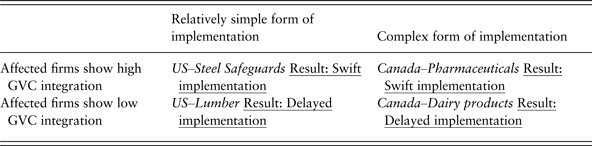
The two comparative cases I studied reflect the necessary variation in my explanatory variables. In the first sub-section, I examine US responses to two disputes where the implementing measures were both executive actions – relatively simple forms of implementation – but the affected firms’ value chain integration varied greatly. I demonstrate that even when employing simple forms of implementation, the US record of compliance was significantly different and can be explained by the affected firms’ integration into global production networks. In the second sub-section, I examine the responses of Canada to two disputes where the affected firms’ value chain integration was equally high, but the implementing measures were different – an administrative action in one and a more complex legislative change in another. I show that even in the face of legal complexity, Canada brought swift compliance, which can be explained by the mobilized firms’ high integration into international production networks, which meant the firms favored swift implementation and pressed for their preferences to policymakers. The selected cases’ variance in my two independent variables as well as their expected outcome is outlined in Table 1.
Characteristics of the selected cases and expected results

6. The impact of affected firms’ integration into value chains and swift compliance despite simpler forms of implementation
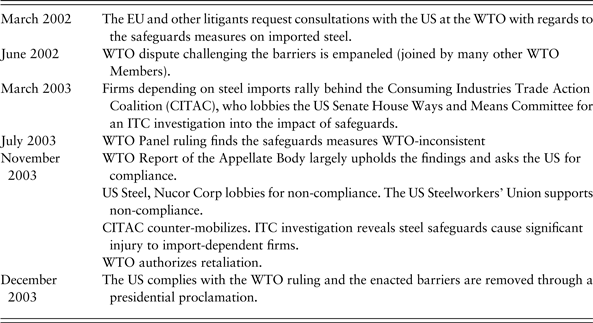
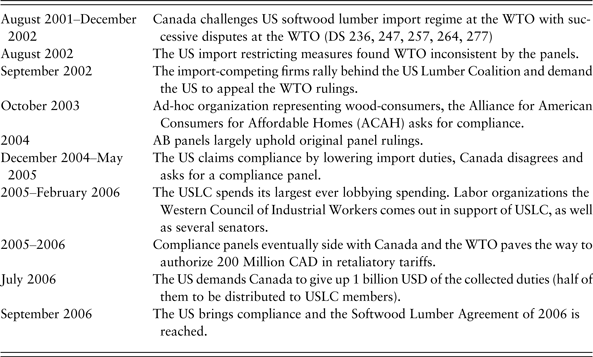
I start by comparing the response of the United States in the US–Steel Safeguards dispute lodged by the EU to its response in the US–Softwood Lumber disputes tabled by Canada.Footnote 3 The US complied with the panel rulings in both of these disputes with executive actions, a presidential proclamation in the Steel Safeguards dispute and an executive agreement in the Softwood Lumber disputes. Yet, the time it took for the US to implement the WTO panels’ rulings in these two cases varied greatly; while in the Softwood Lumber disputes it took the US some three years to comply with the panels’ recommendations, the steel dispute ended in compliance after only a few months – see Tables 2 and 3 for the timelines of these two disputes.Footnote 4 An examination of these two cases reveals that the domestic political environment with respect to US–Steel Safeguards favored swift implementation, due to the fact that the affected firms, which were highly integrated into global value chains, mobilized and lobbied policymakers for compliance. The dispute triggered the mobilization of import-dependent firms that were using imported steel products for their productions. The knock on effect of the barrier raised on the request of the US steel sector prompted them to mobilize and demand compliance in order to access cheaper imports. In contrast, the US–Softwood Lumber disputes resulted in compliance being extremely delayed because domestic interests favored protectionism. The lumber sector in the US was characterized by very low import-dependence, consisting of firms that showed little or no integration into value chains. These import-competing firms favored protectionism in order to shield their domestic production from foreign competition. Without any substantial opposing pressure, the government of the US catered to the demands of the lumber sector by resisting compliance.
Overview of US–Steel Safeguards

Overview of US– Lumber

6.1 The US's swift implementation of panel rulings: the importance of firms’ integration into value chains
In response to the demands of the domestic steel sector that rallied behind the American Iron & Steel Institute, the United States Trade Representative (USTR), Robert Zoellick, petitioned a Section 201 investigation to be carried out by the International Trade Commission (ITC) in June 2001 in order to determine the alleged injury caused by imports to US steel firms (USITC, 2001; Read, Reference Read, Perdikis and Read2005). The objective of the investigation was to establish whether or not the US should impose emergency safeguard measures to a broad range of steel imports and protect the US steel sector from further harm. The investigation found ‘substantial injury’ being caused by a number of imported steel products and the ITC made several recommendations as a remedy (USITC, 2001). Considering the economic downturn of 2000, the poor competitive condition of the US steel sector, and to appease his constituencies in the face of the upcoming mid-term elections, President George W. Bush announced on 5 March 2002 that the US would impose several safeguard measures on steel imports, up to 30% tariffs and some additional tariff quotas – measures that were significantly harsher than the recommendations of the USITC (Bush, Reference Bush2002).
Unsurprisingly, the safeguard measures generated harsh responses from the US's major trade partners, especially from the EU, which tabled a WTO dispute in June 2002, later joined by Brazil, China, Japan, Korea, New Zealand, Norway, and Switzerland, which initiated separate disputes and argued that the imposed safeguard measures on steel violated a number of GATT articles as well as the WTO Agreement on Safeguards.Footnote 5 The WTO panels found that even though US steel sector was negatively affected by imports to a certain extent, the enacted safeguard measures were inconsistent with both GATT 1994 and WTO Agreement on Safeguards – a decision appealed by the US and mostly upheld by the Appellate Body (AB).Footnote 6
The WTO dispute spurred political mobilization of import-dependent firms that were integrated into value chain networks, and which had been fiercely opposing the safeguard measures since the complaint was lodged at the ITC. Firms that were consuming steel products, especially the manufacturers of motor vehicles and vehicle parts, argued that they were harshly affected by the safeguard measures, given their impact on production costs. Rallying behind the Consuming Industries Trade Action Coalition (CITAC), which created a ‘steel task force’ to lift the ban on steel imports, steel consumers ‘strongly urged the Bush Administration to review immediately the economic impacts and unintended consequences of its decision to impose steel tariffs and act to end this tax on steel-using industries as quickly as possible’ (CITAC, 2002). Indeed, safeguard measures not only caused the price of certain steel products to increase by some 20%, but certain steel products were not readily available due to the tariff quotas and the domestic producers could not replace these specialized components (Francois and Baughman, Reference Francois and Baughman2001). As the WTO dispute proceeded, the members of the CITAC ‘steel task force’ continued their lobbying efforts and gathered the support of over 60 members of the US House of Representatives and convinced the Ways and Means Committee to request an ITC investigation into the impact of the safeguards on steel consumers,Footnote 7 which later highlighted the adverse effects of the measures on steel prices, as well as employment in the steel-consuming sectors (USITC, 2003). Testifying to the Joint Economic Committee of the Congress, US Federal Reserve Chairman, Alan Greenspan, also sided with CITAC members, asking for the removal of the tariffs on steel products (Greenspan, Reference Greenspan2003).
As the WTO dispute progressed, firms that were integrated into global value chains continued putting pressure on the US government to lift the WTO-inconsistent measures. During a heated debate in US House of Representatives’ Subcommittee on Trade, Mitsubishi, along with the global car-parts manufacturer Delphi and Metaldyne, pleaded with the US government for the safeguard measures to be removed. These import-dependent firms heavily criticized the domestic steel producers for the injury they had caused to their operations. In the words of the CEO of Metaldyne:
They do not understand, or worse choose to ignore, how the manufacturing supply chain works, particularly in the automotive sector. The truth of the matter is that domestic steel producers are neither approved sources, nor in some cases do they have the capacity or capability to supply some of our requirements despite what they told the Department of Commerce that they could. (Leuliette, Reference Leuliette2003)
The coalition of firms requesting the removal of the safeguard measures further included other steel consumers, such as Sharp, Energizer, and many small and medium-sized enterprises.Footnote 8 Therefore, the pressure on the government to withdraw the safeguard measures was mounting rather quickly.
In response, the domestic steel producers counter-mobilized, but met with no success. The American Iron & Steel Institute, which was behind the original ITC investigation, as well as major American producers such as the Nucor Corporation and the US Steel Corporation, worked together with the United Steel Workers Association (USWA) to put pressure on the government to keep the safeguard measures in place (Read, Reference Read, Perdikis and Read2005). The president of USWA, who was arguing that it was not time ‘to be inflicting further damage on the steel industry’, came out, unsurprisingly, in opposition to compliance with the WTO panel ruling, and stated that steel workers’ retirement schemes and health benefits depended on the tariffs being kept.Footnote 9 In contrast, CITAC starkly opposed any continuing imposition of duties and the President of the association pleaded ‘for the sake of the US manufacturing sector, it's time to end the tariffs now’ after increasing its lobbying spending with almost half a million USD from 2001 to 2003.Footnote 10 In addition, vehicle-parts manufacturers, including Metaldyne, Dura Automotive Systems, Textron, similarly demanded the lifting of the barriers.Footnote 11
Facing the possibility of authorized retaliation from the EU and with domestic conditions heavily tilted in favor of compliance, the US swiftly implemented the panel ruling and the USTR Robert Zoellick announced on 4 December 2003 that US safeguard measures were to be lifted because ‘the domestic costs of the measures now outweighed their benefits’ (Zoellick, Reference Zoellick2003). Even though it was general knowledge that President Bush prolonged the dispute in order to garner support for the upcoming 2004 elections, compliance with the WTO ruling was much faster thanks to the mobilization of firms integrated into production networks. These firms’ efforts incentivized the US government to remove trade restricting barriers in a timely fashion, rather than to resist compliance until at the least the election was over in late 2004.
In conclusion, the domestic conditions were conducive for compliance because firms that were heavily integrated into value chain networks were able to mobilize and demand the removal of the trade barriers. The position of these firms stemmed from their wish to access imports without quotas and tariffs. Since the safeguard measures increased their cost of production, these import-dependent firms quickly mobilized and pressed their preferences on US policymakers. The policymakers, in turn, were able to overcome the pressure from the import-competing firms and the domestic balance of interests was tilted in favor of immediate compliance.
7. The US's delayed compliance despite a simple form of implementation
In contrast to its behavior in the US–Steel Safeguards dispute, the US responded to the adverse panel rulings in US–Softwood Lumber disputes with protracted non-compliance. Despite utilizing an executive measure to correct its WTO-inconsistent import regime on softwood lumber from Canada, the US government resisted complying with the WTO rulings for some three years until finally it changed the relevant domestic policies through the Softwood Lumber Agreement (SLA) in 2006.Footnote 12 A close examination of the US's response to these successive disputes launched by Canada reveals that the domestic balance of interests in the US heavily favored non-compliance. The softwood lumber sector in the US was characterized by very low import-dependence and consisted of import-competing firms who were mobilized via the US Lumber Coalition (USLC) and pressed for protectionist measures. There were only a few retailer firms that counter-mobilized in an ad-hoc manner against USLC and demanded a lifting of the import barriers. Therefore, the domestic balance of interests favored the import-competing producers and the US resisted complying with the adverse panel rulings for some three years, even though the WTO-inconsistent measures were modified with an executive agreement without the involvement of the Congress, which should have been capable of implementing the panels’ recommendations much faster.
It would be futile to attempt to examine the entirety of the ‘lumber saga’ between the US and Canada in this article. This ‘grandfather of all trade disputes between the US and Canada’ consisted of six different WTO lawsuits, several NAFTA disputes, and dates back to the 1960s.Footnote 13 I will only focus on the formal WTO disputes that were initiated by Canada between 2000 and 2002, which were all resolved via the SLA signed by both parties in 2006. The six WTO disputes lodged by Canada against the US mainly targeted the US Department of Commerce's (USDOC) treatment of export restraints as subsidies and its calculations of anti-dumping (AD) and countervailing duties (CVDs).Footnote 14 The WTO disputes were all initiated by Canada at the request of the Canadian softwood lumber producers when the US–Canadian Softwood Lumber Agreement of 1995 expired in 2001. This executive agreement was to be renewed by the US President; however, after garnering intense lobbying from the USLC, which received the support of some 51 senators directly asking the President not to renew it (Zhang and Laband, Reference Zhang and Laband2003: 408), the agreement was discontinued.
The termination of the agreement meant that the Canadian exporters of softwood lumber faced combined duties of 27%, which prompted the Canadian government to bring the issue to international adjudication with the help of its domestic lumber sector (Charron, Reference Charron2005). In response to the challenge brought by Canada with regard to the treatment of export restraints as subsidies, the WTO panels in Lumber I and Lumber II exonerated the US.Footnote 15 However, consecutive panels mainly found that the USDOC's determination of injury and calculations of ADs and CVDs were inconsistent with the US's obligations under the SCM Agreement and the WTO Anti-Dumping Agreement – although the panels reiterated that Canadian lumber was indeed subsidized.Footnote 16 The decisions of the panels were largely upheld by the AB in all the disputes, which meant that, as of August 2004, the US had to change its import regime with regards to softwood lumber from Canada or face authorized retaliation.
However, the US resisted compliance for almost three years. The USLC, composed of large timber and lumber producers across the US, such as Sierra Pacific Industries, Potlatch Corp., and Plum Creek Timber Corp.,Footnote 17 engaged in intense lobbying both throughout the disputes and after the panel rulings to make sure the US did not cave into to the demands of the Canadian lumber exporters. As the dispute was progressing, USLC pressed and convinced the US government to appeal the WTO decision in 2002, which found the US calculation of subsidies WTO-inconsistent, with the chairman of the coalition calling the panel's decision ‘ridiculous’ (USLC, 2002). As the appeals phase of the dispute went on, the US and Canada negotiated for a settlement, but met with no success. The USLC, which was continuing its campaign to protect US producers, stated that Canadians ‘have further undermined fair and free trade’ (USLC, 2002a) and lobbied the US government for further changes in the levels of tariffs on lumber as well as a reduction in the proposed cap on Canadian market share in the US lumber sector (USLC, 2003). The demands of USLC were angrily rejected by the Canadians, with Pierre Pettigrew, then-trade-minister of Canada, stating that their differences were too large and the USLC ‘have excessive demands, once again’ that Canada was not willing to meet.Footnote 18
Around the time the negotiations were halted, the WTO AB circulated its ruling on two different disputes that largely upheld the findings of the original panels.Footnote 19 In response, the US attempted to satisfy its trade partner by revising the USDOC calculations and lowering the CVD duties to around 13%, bringing the combined duties down to roughly 20% (Briggs et al., Reference Briggs, Laaksonen-Craig, Niquidet and van Kooten2005), which it said brought its softwood import regime into compliance. Canada heavily disagreed and subsequently asked a compliance panel to rule on the USDOC's revision. Meanwhile, there was some counter-mobilization from the US consumers of lumber and tinder, which rallied behind the Alliance of American Consumers for Affordable Homes and the National Home Builders Association, which asked the USDOC to comply with the WTO rulings and lower the AD duties applied to lumber from Canada (ACAH, 2003). Although the prompt formation of this coalition to pressure the government was a clear indication of import-dependent firms’ ability to mobilize, they were unable to convince the US government to change its domestic policies, as they were very small in number and had limited capital. In contrast, USLC stepped up its lobbying activities, and massively increased its reported spending on lobbying from USD 360,000 in 2001 to 737,000 USD in 2004 and a staggering 1.4 million USD in 2005 – the largest amount it had ever spent in a single year.Footnote 20 It became clear that the efforts of the USLC were bearing fruit as in the US Senate Committee on Commerce, Science, and Transportation hearing, the chairing senators Burns, Smith, and Snowe, who were representing the lumber-producing states of Montana, Oregon, and Maine, were all supporting the USLC.Footnote 21 Moreover, the labor organization representing sawmills and lumber producers, the Western Council of Industrial Workers, also sided with the coalition.Footnote 22
Still resisting the liberalization of its softwood lumber trade, the pressure upon the US government to comply with its international commitments was mounting quickly by the end of 2005. The Article 21.5 panels established at the request of Canada mostly found on 1 August 2005 that the US was in non-compliance and Canada requested the authorization to impose 200 million CAD in retaliatory tariffs.Footnote 23 In addition, with NAFTA panels also finding the US at fault and USLC losing its domestic litigation battle against the Canadian exporters (Reif, Reference Reif2007), the US was facing ever-more pressure to change its domestic policies and bring them into line with its international commitments.
The US eventually brought compliance in September 2006 after a fresh round of negotiations that disproportionately benefited the USLC.Footnote 24 It was revealed in early 2006 that the US had collected around 5.4 billion USD in duties from Canadian exporters since 2001. The Canadians were arguing that in addition to a change in US domestic policy, the collected duties should be transferred back to Canada; but the US was demanding that some of the collected duties be distributed to US producers as compensation. Although Canada was unhappy with the arrangement, both sides reached a framework agreement in July 2006 and it was revealed that 1 billion USD would remain in the US, of which half would be distributed to US producers (Fergusson, Reference Fergusson2011). With the US lumber lobby being satisfied with four years of protection and a cash inflow of 500 million USD, the US finally changed its import regime on softwood lumber from Canada with the Softwood Lumber Agreement of 2006, which brought the US into line with its WTO commitments and put an end to the disputes of the 12 September.
In conclusion, I can surmise that the US compliance with adverse panel rulings in the US–Softwood Lumber disputes was protracted because the majority of the firms affected by the dispute mobilized in favor of protectionist measures. Operating in a highly concentrated lumber market with major producers competing with imports, the US lumber producers were able to press the policymakers to back their protective demands. Even though the negotiated resolution to the dispute was a domestic policy change in the form of an executive agreement, the US strongly resisted implementing the panel rulings for some three years before finally meeting its trade partner's demands.
Although the US's early resistance to compliance could potentially be attributed to the Bush administrations’ efforts to garner support from the US lumber producers for the upcoming 2004 election, post-election behavior of the US remained unchanged. The administration resisted compliance even in the face of retaliation two years after the election period; therefore, it would be safe to assume that electoral concerns were not decisive in shaping the US's behavior regarding compliance in the US–Softwood Lumber disputes against Canada.
7.1 Canada's response to WTO litigation: the importance of firms’ integration into global value chains and the form of implementation
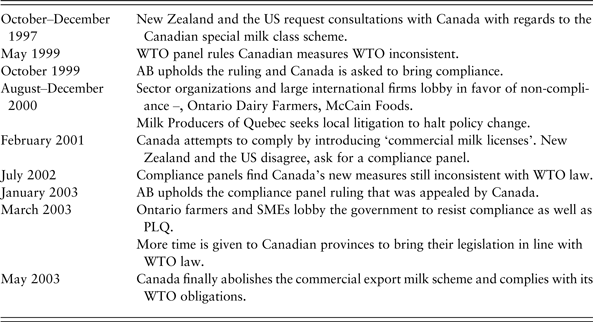
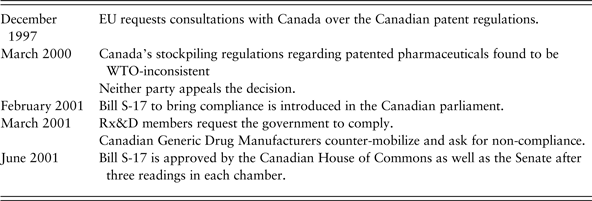
Having examined the US’ responses to two disputes involving simpler forms of implementation, where the US’ record of compliance significantly differed due to the affected firms’ integration into value chains, I now turn to examine two disputes launched against Canada, both of which instead involved complex forms of implementation. I examine the dairy products dispute tabled by the US and New Zealand and the dispute involving patent protection of pharmaceutical products lodged by the EU. Both of these disputes resulted in an adverse panel ruling and Canada implemented the panels’ recommendations in response to both decisions with complex regulatory changes. However, the timeframe for implementation in Canada - Patent Protection of Pharmaceutical Products was much faster than in Canada–Dairy Products – see Tables 4 and 5 for these two disputes’ timelines in comparison.Footnote 25 This variation can be explained by the affected firms’ integration into value chains, which mobilized with their subsidiaries and affiliates and pressed policymakers to comply with the adverse ruling. A close examination of these two cases thus shows that in the absence of mobilized domestic interest groups in favor of swift implementation, policymakers who face protectionist pressures prolong compliance, and in those cases the complexity of the form of implementation increases the delay in the compliance process. However, even in the face of complexity, WTO Members promptly comply with adverse panel rulings if the affected domestic firms are integrated into value chains, whose mobilization changes the domestic balance of interests in favor of swift implementation.
Overview of Canada–Dairy Products

Overview of Canada– Pharmaceuticals

7.2 Delayed compliance with protectionist pressures and a complex form of implementation
On 8 October 1997, the United States, later joined by New Zealand, requested consultations with Canada over its dairy export scheme and its administration of the tariff rate quota on imported milk products. The source of the dispute was the Canadian ‘special milk class’ scheme, which the complainants argued was indirectly subsidizing exporters. This different milk classification system in Canada was the product of the Comprehensive Agreement on Special Class Pooling that was hailed by the Canadian Dairy Commission (CDC) in response to the Uruguay Agreement in 1995. Canada attempted to replace its old dairy export subsidy scheme by introducing ‘special milk classes’ that classified milk based on its end use put by the processors – e.g. either for domestic consumption or for exporting – and producers whose dairy products destined for exports effectively bought milk at a cheaper price (Cox et al., Reference Cox, Le Roy, Goddard, Loyns, Meilke, Knutson and Yunez-Naude2001). The complainants thus argued that Canada indirectly subsidized milk exports and was in violation of several WTO agreements.Footnote 26
After unsuccessful consultations between the parties, the dispute entered the adjudicative phase of the DSM and resulted in a six-year legal battle where Canada delayed complying with the adverse rulings of the panel until mid-2003 – after a failed attempt at correcting its illegal export regime in 2001 and two different compliance panels with appeal procedures.Footnote 27
Canada's response to litigation was primarily shaped by several domestic actors across Canada who sought protection, including some multinational firms and the Dairy Farmers of Ontario (DFO) and Federation of Milk Producers of Quebec (PLQ), who represented individual firms that accounted for 90% of the affected dairy producers (Verheul, Reference Verheul2003). Along with the federal umbrella organization Dairy Farmers of Canada, the state-supported dairy sector was in close cooperation with the Canadian policymakers in complying with the WTO ruling (Krikorian, Reference Krikorian2005). When the WTO AB upheld the panel ruling that the Canadian measures were indeed violating WTO law in late 1999 , the PLQ called an extraordinary meeting in Quebec, where some 2,000 individual milk producers attended and protested the government's original plan to comply with the ruling by eliminating ‘special milk classes’ (PLQ, 2000, 2013). The organization also requested an injunction to suspend the newly proposed regulation in local courts (ibid.).Footnote 28 In Ontario, individual farmers expressed their fear of losing subsidies,Footnote 29 and one of the largest agri-food companies, McCain Foods, spoke strongly against changing the export subsidy program. Their CEO, appearing before the Canadian House of Commons Standing Committee on Foreign Affairs and International Trade, argued that with policy change they ‘would be unable to continue to export’ certain products and with their lost export sales, they ‘could also lose domestic Canadian markets as well’ (Park, Reference Park1999). In response, Canadian officials opted to deregulate dairy exports to implement the panel ruling by replacing the ‘special milk class system’ with ‘commercial export milk’ licenses that were issued to producers. The new system practically kept the subsidies in place and was immediately rejected by the complainants who claimed ‘Canada just re-arranged the chairs on the deck of the Titanic’ (Krikorian, Reference Krikorian2005: 936) and even Canadian officials expressed their doubt as to the WTO compliance of the new measures (USDA, 2000).
In a surprise decision, the AB ruled in December 2001 that ‘it was unable to complete the analysis of the claims’,Footnote 30 which was hailed as a victory by Canadian authorities, attributed to the ‘close cooperation with the industry and the provinces’ that ‘validated’ the position of Canada.Footnote 31 Yet, the second compliance panel requested by the US and New Zealand concluded after the AB ruling that the Canadian system of ‘commercial export milk’ licenses was still inconsistent with WTO law.Footnote 32 With this final ruling adopted, and facing up to 70 million USD in authorized retaliation from the US and New Zealand, Canada was facing more pressure to brings its dairy export regime into compliance with its WTO commitments but the domestic dairy sector in Canada continued its request to delay compliance.
In Ontario, the Georgian Bay Company, a politically active large producer of dairy products, directly lobbied different levels of the government and also mobilized some 100 small farmers against compliance.Footnote 33 In response, the DFO stated that it was proposing a plan that would ‘minimize the impact of the ruling’ (Coukell, Reference Coukell2003). PLQ on the other hand gave a direct harsh response to the ruling. The chairman of the PLQ criticized the government in the House of Commons Standing Committee hearing on the final WTO ruling, arguing that ‘the Government of Canada must now make a choice and it must clearly decide whether it wants to protect supply management or whether it wants to abandon one of its production sectors, which would then disappear’ (Belzile, Reference Belzile2003). Eventually, however, both Ontario and Quebec, along with the other Canadian provinces, expressed that they would bring their provincial legislation in line with WTO law because the majority of the dairy production was still catered to domestic demand. The Department of Foreign Affairs and International Trade made it clear that they would seek an even more flexible timetable for the dairy sector to adjust to the elimination of subsidies (Burney, Reference Burney2003). Finally, in May 2003, Canada complied with the WTO ruling and announced that all subsidies to the dairy sector were to be eliminated and ‘commercial export milk’ licenses were no longer to be issued.
In addition to unfavorable domestic conditions, Canada's delay in compliance was also influenced by the complex form of implementation that was required to bring Canada in line with its WTO commitments. The ‘special milk classes’ scheme was administered by a federal body – the Canadian Dairy Commission – by each province separately. Therefore, invalidating that export subsidy program required separate provincial regulatory changes as well as a federal modification. For Canada's first attempt to comply with the adverse panel ruling in 1999, Quebec, Ontario, Prince Edward Island, New Brunswick, Nova Scotia, Alberta, British Columbia, Manitoba, and Saskatchewan all had to make changes in their provincial legislation (Vinet, Reference Vinet2000).Footnote 34 This meant that stakeholder meetings, committee meetings, and sub-committee meetings and public consultations needed to be held in each different province. Essentially, compliance with the ruling required all the provinces to bring their own legislation in line with Canada's WTO commitments, and even though the federal Department of Agriculture and Agri-Food Canada ‘could provide some advice on the broad guidelines, the reality is that the responsibility for developing the actual programs and the responsibility for implementing these programs for export really rested at the provincial level’ (Vinet, Reference Vinet2000). When federal members of the Parliament asked about the provinces’ progress with regards to implementation, the DFAIT director who was also advising the provinces answered: ‘it all depends on the results of negotiations at the provincial level, and at this point in time we're not in a position to say whether Ontario will be ready before New Brunswick or Quebec before Alberta. It's just not there’ (Saint-Jacques, Reference Saint-Jacques2000).
In sum, complying with the adverse panel ruling in Canada–Dairy Products proved to be a difficult task for Canada because the domestic conditions were unfavorable to a swift trade liberalizing policy change, and the form of implementation required to correct the WTO-inconsistent dairy export subsidy regime was a complex one. As a result, Canada delayed complying with the WTO ruling for almost six years, reportedly impairing the US and New Zealand trade up to 70 million USD every year (USDA, 2001).
7.3 Swift implementation in the face of complexity: Canada–Pharmaceuticals dispute
On 19 December 1997, the EU requested consultations with Canada over its 1993 amendment to the Patent Act, which allowed drug manufacturers to avoid conferring rights to patent owners of certain generic pharmaceutical products. The source of the dispute was two provisions in the 1993 amendment. First, the Canadian legislation now allowed generic drug manufacturers to ‘stockpile’ patented pharmaceutical products when they were anticipating the expiration of patents so that they could enter the market with full inventory immediately after the end of the patent term (Gifford, Reference Gifford2004).Footnote 35 Second, the changes to the Canadian Patent Act also included a provision that allowed generic drug manufacturers to prepare their own submissions for regulatory review during a patent term – the so-called ‘regulatory review provision’ (Patent Act, 55.2(1), 1993). The EU argued that these two provisions prevented patent protections on products during their full patent terms and thus were violating Articles 27.1, 28, and 33 of the TRIPS Agreement.
The panel ruled in favor of the EU with regard to the stockpiling provision in the Canadian Patent Act but found the regulatory review provision to be in line with the TRIPS Agreement. Neither party appealed the decision, and Canada swiftly complied with the panel ruling by repealing the stockpiling provision via Bill S-17 on 14 June 2001 within 14 months of the adoption of the panel report.Footnote 36 Therefore, even though Canada chose a complex form of implementation to comply with the panel ruling – a legislative action that required three different readings in the Canadian Senate as well as the House of Commons, public hearings, and committee meetings – the procedures proceeded very quickly and there were no delays in implementation.Footnote 37
The reason why Canada was able to quickly comply with the panel's recommendation in this dispute was because the targeted measure involved Canadian pharmaceutical manufacturers that were dependent on imports from abroad, which mobilized and lobbied the Canadian government to comply with the panel ruling. In the year 2000, overseas imports accounted for 75% of the Canadian domestic pharmaceutical market – most of which consisted of chemicals used in the production of pharmaceutical products (Lexchin, Reference Lexchin2001). The domestic pharmaceutical sector in Canada mainly consisted at the time of subsidiaries and affiliates of primarily research-based multinational companies, which provided billions of dollars in investment to the Canadian economy (Gifford, Reference Gifford2004), such as GlaxoSmithKline, Bayer, and Novartis. These companies rallied behind the association of Canadian Research Based Pharmaceutical Companies (Rx&D) – which is now known as ‘Innovative Medicines Canada’ – and fully supported Bill S-17 in order to comply with the WTO ruling. The pharmaceutical lobby was already known to have supported several high-ranking members of the government, including the Deputy Prime Minister John Manley, mostly through donations to their campaigns (Lexchin, Reference Lexchin2005). Therefore, their influence in the Canadian government was quite accepted. Unsurprisingly, they were engaged in direct lobbying for the successful enactment of several pieces of legislation, including Bill S-17, that benefited patent holders with a large lobbying team that included the former advisor to the Canadian deputy prime minister (Lobby Canada, 2001). During the Proceedings of the Standing Senate Committee on Banking, Trade and Commerce, Rx&D and members demanded that the government comply with the ruling by taking ‘rapid steps to correct’ the WTO-inconsistent measure (Baumgartner, Reference Baumgartner2001). The association argued that it was ‘the right thing to do to increase the research-based pharmaceutical industry's international competitiveness … and the first step in advancing the government's innovation agenda’ (Ibid). Such appeals to the ‘innovative’ nature of the pharmaceutical industry were clearly linked with Rx&D's investment promises, and the continuing investment into research was conditional upon the political climate in Canada. Indeed, the members of the association had previously kept their promise of a substantial increase to their investment, amounting to some 500 million USD (Jordan, Reference Jordan2005: 44), as long as patents remained protected in Canada. Therefore, these international firms exercised a strong pull on the direction of policy because they were bringing employment, investment, and they directly contributed to the politicians’ campaigns. Thus, when a dispute touched upon the interests of these firms, their mobilization was followed by a very quick response from the Canadian government, which catered to their demands without delay.
In response, the Canadian Generic Drug Manufacturers Association (CDMA) engaged in counter lobbying but met with no success. The organization was already quite small in size and in capital, as opposed to Rx&D, and although the president of the organization warned that Bill S-17 ‘contributes to the steadily worsening legal and regulatory environment for generic drugs in Canada’ (Keon, Reference Keon2001), the bill met surprisingly little opposition from different factions within the Canadian legislature. Despite requiring three different readings in the Senate and the House of Commons, with different sub-committee meetings, Bill S-17 passed within four months of its introduction. A similar account describes the legislative process of the above-mentioned Bill C-17 – a bill that provided extra protection to patented pharmaceuticals in Canada – it was a statutory act that was fast tracked by Ottawa senators whose political livelihood benefited greatly from international pharmaceutical companies.
Consequently, I surmise that Canada's response to the adverse panel ruling in Canada–Pharmaceutical Patents was shaped by the interests of the mobilized pharmaceutical firms, which greatly favored compliance. These import-dependent firms entered into a coalition with other international firms that shared their interests in accessing cheaper imports and protecting patented products. With the domestic conditions conducive to compliance, the Canadian policymakers swiftly implemented the WTO panel's decision even in the face of legal complexity.
8. Conclusion
In this article, I demonstrated that WTO Members’ swift compliance with adverse panel rulings is much more likely when the targeted measures affect firms integrated into regional and global value chains. The reason, I posit, is that the mobilization of firms integrated into value chains in response to a WTO dispute changes the domestic balance of interests in favor of compliance.
I started with the assumption that WTO Members have a natural tendency to comply with WTO rulings and that governments are susceptible to pressure from mobilized political actors. Therefore, even though WTO Member governments would prefer to comply with panel recommendations, pro-protectionist mobilized constituencies may tie their hands with respect to meeting their WTO commitments. Since policymakers want to avoid making political enemies, they cater to the demands of firms and sectors that compete with imports.
However, the domestic balance of interests changes when import-dependent firms that are integrated into value chains enter the stage. When, and if, a dispute involves measures restricting these firms’ imports, they mobilize in favor of compliance. With the introduction of these firms, the political cost of non-compliance increases and policymakers are faced with domestic conditions that are much more favorable to swift implementation – even in the face of complexity.
I tested my theory in two comparative case studies and examined the responses of the US and Canada to WTO litigation. Through the case studies, I was able to demonstrate that despite similar forms of implementation, the US's record of compliance was very different in two disputes where the affected firms’ integration into value chains varied strongly. In contrast, I showed that in two disputes where the affected firms’ level of integration remained equally high, Canada brought swift compliance, despite different forms of implementation.
These findings have several important implications. Firstly, WTO Members’ swift implementation of panel rulings depends on domestic political conditions being favorable to a change in policy. The analysis offered here thus contributes to the literature that focuses on the domestic political dimension of WTO disputes. By highlighting the impact of mobilized political actors – i.e. firms – that press for swift implementation, I proposed an alternative determinant of compliance that the literature has yet to incorporate. Secondly, I showed that the current growth in international production networks have consequences for the political economy of WTO dispute settlement. Integration into regional and global value chains has so far been examined in light of bilateral agreements, with the exclusion of the multilateral trading regime. I showed that the firms that are active in value chains also mobilize domestically in response to WTO disputes, which resonates with the growing number of works that examine import-dependent firms’ domestic political activity in WTO Member economies (Curran, Reference Curran2015; Eckhardt, Reference Eckhardt2013). Lastly, I also showed the legal sources of variation – i.e. the form of implementation – do not decisively cause delays in implementation. Even in the face of legal complexity, WTO Members comply with adverse panel rulings swiftly if the domestic political benefits of compliance outweigh its costs.