Introduction
Cognitive impairment is common among persons with multiple sclerosis (MS), and clinical screening of cognitive status is needed (for review, Rocca et al., Reference Rocca, Amato, De Stefano, Enzinger, Geurts, Penner and Filippi2015). The Paced Auditory Serial Addition Test (PASAT) is a common tool used to assess cognitive status in MS patients. Indeed, the PASAT is included within the Multiple Sclerosis Functional Composite (Cutter et al., Reference Cutter, Baier, Rudick, Cookfair, Fischer, Petkau and Confavreux1999), as well as the Brief Repeatable Battery (Rao, Reference Rao1990), and the Minimal Assessment of Cognitive Function in MS (Benedict et al., Reference Benedict, Fischer, Archibald, Arnett, Beatty, Bobholz and Munschauer2002). The PASAT measures multiple cognitive domains including sustained attention, working memory, and information processing speed (Tombaugh, Reference Tombaugh2006). During the PASAT, patients listen to a continuous string of 60 single-digit numbers while adding each new digit to the previous digit and responding aloud with the answer. MS patients have no difficulty performing single-digit arithmetic (e.g., 5+6); however, we posit that PASAT performance in MS is predicted by overall mathematical ability (see Chronicle & MacGregor, Reference Chronicle and MacGregor1998; Tombaugh, Reference Tombaugh2006). This is because persons with greater mathematical ability have more rapid access to math facts as crystallized knowledge (e.g., 5+6=11), versus persons with lesser mathematical ability who engage in more laborious processing of mathematical quantities (e.g., [5+6]=[5+5+1]=[10+1]=11) (Grabner et al., Reference Grabner, Ansari, Reishofer, Stern, Ebner and Neuper2007; Price, Mazzocco, & Ansari, Reference Price, Mazzocco and Ansari2013). Rapid access to math facts should afford a benefit in the context of MS-related processing speed decline and the speed demands of the PASAT.
Herein, we investigate whether mathematical ability (ranging from addition to calculus) predicts PASAT performance in MS patients. Previous work has linked PASAT performance to higher education (Benedict, Morrow, Weinstock Guttman, Cookfair, & Schretlen, Reference Benedict, Morrow, Weinstock Guttman, Cookfair and Schretlen2010) and intelligence (Sumowski, Chiaravalloti, & DeLuca, Reference Sumowski, Chiaravalloti and DeLuca2009), which are both frequently used as proxy measurements of cognitive reserve. The relationships between Education and PASAT performance as well as Intelligence and PASAT performance may be explained by higher mathematical ability. We will, therefore, also examine whether relationships between both education and intelligence (proxies of general ability) and PASAT performance are mediated through domain-specific knowledge (mathematical ability), which may present a domain-specific aspect of cognitive reserve (for review Sumowski & Leavitt, Reference Sumowski and Leavitt2013). Our findings will advance our understanding of variability in PASAT performance.
Methods
Sample
Forty-five MS patients without an exacerbation or current corticosteroid use within the previous 4 weeks, and no history of serious psychiatric illness, learning disability, or other neurologic conditions (three males; age: 47.8±8.5 years; disease duration: 13.3±7.2 years; education: 15.0±2.2 years; phenotype: 30 RRMS, 8 SPMS, 7 PPMS) participated. Kessler Foundation IRB approved this study and written informed consent was obtained before participation.
Intelligence
The Wechsler Test of Adult Reading (www.pearsonclinical.com) was used to estimate premorbid intelligence. Norm-referenced standard scores indicate average intelligence (106.8±11.6).
PASAT
The 3- and 2-s versions of the PASAT were administered and total correct responses were summed for each task (45.9±11.3 and 34.9±11.8, respectively). We also created a total PASAT score as the sum of these two trials (80.8±22.3). [After the PASAT administration we confirmed through untimed examination that all patients knew the answers to all single-digit arithmetic pairing. As such, differential PASAT performance was not due to inability to perform single-digit arithmetic.]
Mathematical Ability
The Calculation Subtest of the Woodcock-Johnson-III Tests of Achievement (www.riversidepublishing.com) was used to measure mathematical ability. This is a standardized math test covering simple mathematical skills through advanced algebra and trigonometry. Norm-referenced standard scores indicate average mathematical ability (100.0±10.1).
Statistical Analyses
Analyses were performed via SPSS 21.0 along with the PROCESS Macro 2.13 (Model No. 4) (Hayes, Reference Hayes2013), using raw scores. We conducted a regression based path analysis and bootstrapping (random resampling) to compute 95% confidence intervals and test whether mathematical ability mediates the relationship between (a) intelligence and PASAT performance as well as (b) education and PASAT performance (reported separately below). Follow-up analyses investigated PASAT 3- and 2-s trials separately. Significance of mediation was tested using 5000 bias corrected bootstrap samples and a 95% confidence interval.
Results
Intelligence Mediation Model
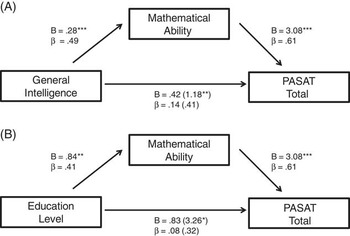
Multiple linear regression analyses revealed that Intelligence was positively associated with PASAT total (β=.41; p=.005), and Mathematical Ability (β=.49; p<.001). The relationship between Mathematical Ability and PASAT was also positive (β=.61; p<.001). The confidence interval for the indirect effect through Mathematical Ability did not include zero (β=.76; CI95=.28, 1.45) (Figure 1). The confidence interval for the direct effect of Intelligence on PASAT did include zero (β=.42; CI95=−.39, 1.23). These analyses indicate that Mathematical Ability fully mediates the relationship between Intelligence and PASAT total performance.
Top Panel 1A: Mediation model showing Mathematical Ability fully mediated the relationship between Intelligence and PASAT total. Direct effect of Intelligence (R2=.17) and indirect effect through the mediator (R2=.39). Bottom Panel 1B: Mediation model showing Mathematical Ability fully mediated the relationship between Education Level and PASAT total. Direct effect of Education Level (R2=.10) and indirect effect through the mediator (R2=.38). Note. Coefficient presented in parentheses indicates direct effect. B=unstandardized values. β=standardized values, *p<.05, **p<.01, ***p<.00. The standardized beta weights presented in the text are equivalent to the correlation coefficient.

Education Mediation Model
The same approach was used to test the mediation model for Education. Education was positively associated with PASAT total (β=.32; p=.03), and Mathematical Ability (β=.41; p=.005). As in the Intelligence Mediation Model above, the relationship between Mathematical Ability and PASAT was positive. The confidence interval for the indirect effect through Mathematical Ability did not include zero (β=2.43; CI95=.81, 5.16), however, the confidence interval for the direct effect of Education on PASAT did include zero (β=.83; CI95=−1.95, 3.61). Mathematical Ability fully mediates the relationship between Education and PASAT total performance (Figure 1).
Follow-up Analyses
The findings for both models remained reliable when predicting the 2- and 3-s trials of the PASAT separately.
Discussion
The current findings demonstrate that general mathematical ability is correlated with PASAT performance among MS patients (β=.61; p<.001), even though all patients demonstrated knowledge of single-digit math facts. Often the PASAT is described as a measure of sustained attention, working memory, and information processing speed (Tombaugh, Reference Tombaugh2006). The present findings suggests that the PASAT also measures domain-specific mathematical knowledge in MS. Thus, MS patients with superior mathematical ability are at an advantage when the PASAT is used as a measure of cognitive status. For example, a patient with high mathematical ability may experience symptoms of cognitive decline. However, when this same patients’ performance on the PASAT is used as an index of cognitive ability, they may not reach the threshold of classification for cognitive impairment. This could be because the patient can access mathematical facts easier than someone with lower mathematical ability. Domain-specific mathematical ability differentially contributes to performance on the PASAT, which may result in inaccurate clinical assessment and classification of cognitive functioning in MS.
Neuroimaging research in healthy individuals may provide some insight as to why domain-specific knowledge impacts PASAT performance because some evidence suggests that engagement from different brain regions is moderated by mathematical ability. Neuroimaging research shows that healthy persons with greater mathematical ability rely moreso on the left inferior parietal lobule during simple addition tasks, which is consistent with rapid access to math facts stored as crystallized knowledge (Grabner et al., Reference Grabner, Ansari, Reishofer, Stern, Ebner and Neuper2007; Price et al., Reference Price, Mazzocco and Ansari2013). In contrast, persons with lesser mathematical ability rely moreso on other brain regions (e.g., frontal lobe) involved in online processing of mathematical quantities (Grabner et al., Reference Grabner, Ansari, Reishofer, Stern, Ebner and Neuper2007; Price et al., Reference Price, Mazzocco and Ansari2013). In the contexts of MS-related processing speed decline and speed demands of the PASAT, more rapid access to math facts (e.g., 5+6=11) affords an advantage during the PASAT. Clinically, our findings indicate that some of the individual variability in PASAT performance across patients is unrelated to MS disease, and, therefore, represents a source of unwanted error in clinical practice. This of course is only a preliminary explanation and additional research in MS samples are necessary to understand the neural processes involved in math ability and how those processes relate to performance on the PASAT.
Together with the patient burden associated with the PASAT (Tombaugh, Reference Tombaugh2006), our findings further support the discontinuation of the PASAT as a measure of cognitive status in MS patients. We did not examine alternative neuropsychological measures in the current study; however, other researchers have made comparisons between the Symbol Digit Modalities Test (SDMT) and the PASAT to classify cognitive impairment in MS (Brochet et al., Reference Brochet, Deloire, Bonnet, Salort-Campana, Ouallet, Petry and Dousset2008; Drake et al., Reference Drake, Weinstock-Guttman, Morrow, Hojnacki, Munschauer and Benedict2010; Sonder, Burggraaff, Knol, Polman, & Uitdehaag, 2014). Specifically, these researchers have suggested that the SDMT supplement (Brochet et al., Reference Brochet, Deloire, Bonnet, Salort-Campana, Ouallet, Petry and Dousset2008) or even replace the PASAT in the MS Functional Composite (Drake et al., Reference Drake, Weinstock-Guttman, Morrow, Hojnacki, Munschauer and Benedict2010). Recent longitudinal evidence corroborates this suggestion because the SDMT is a more sensitive, valid and reliable tool than the PASAT (López-Góngora, Querol, & Escartín, Reference López-Góngora, Querol and Escartín2015; Sonder et al., 2014). Our findings, that the PASAT is fully mediated by calculation ability, further support the discussion about eliminating the PASAT in the cognitive assessment of MS patients.
An important limitation of the present study is that the sample was disproportionately female (93%), which limits the generalizability of the findings.
The relationships between Education and PASAT performance as well as Intelligence and PASAT performance were mediated by calculation ability. Regarding cognitive reserve (for review in MS Sumowski & Leavitt, Reference Sumowski and Leavitt2013), the current findings may represent an instance of domain-specific reserve. That is, persons with specific expertise (e.g., accounting, computer programming) may better retain functioning within their sphere of expertise. Findings may, therefore, inform vocational planning, as it may be better for MS patients to remain within their areas of expertise, even if they reduce their time or workload, rather than engaging in part-time work outside of their sphere of expertise.
Acknowledgments
The authors declare that there is no conflict of interest. J.S. partially supported by NMSS Grant MB0024. Study supported by NIH R00 HD060765 to J.F.S. The authors have no conflicts of interest to report.