Introduction
New Zealand's population, like that of other developed countries, is ageing. Worldwide the proportion of older people in the population is increasing at a rate of 2.6 per cent per year, considerably faster than the current 1.2 per cent annual growth in the population as a whole. At this rate, the number of people over 60 years of age is expected to reach 2 billion by 2050.Footnote 1 In New Zealand, the Ministry of Social Development estimated in 2011 that the number of people over 65 years of age in New Zealand would almost double to over one million by the year 2031, making up more than 20 per cent of the population (Ministry of Social Development 2011).
Two commonly discussed concerns regarding this population ageing trend are: (a) how to manage the economic consequences of the changing ratio of ‘working age’ to ‘retirement age’ people; and (b) how to create a good quality of life for the ageing population. Discussions of the ageing population are often accompanied by concerns that such demographic changes will lead to an increased burden on society. While this may be true to some extent, one of the characteristic features of the ageing population is that older cohorts are much wealthier now than were previous generations of older people. In the United States of America (USA), older people control as much as 80 per cent of financial assets and dispose of up to 50 per cent of their discretionary income (Coleman, Hladikova and Savelyeva Reference Coleman, Hladikova and Savelyeva2006; Leventhal Reference Leventhal1997; Moschis, Bellenger and Curasi Reference Moschis, Bellenger and Curasi2003; Ruffenach Reference Ruffenach2004–5). Similar figures of 77 per cent of all US financial assets and 77 per cent of disposable income are reported by Gordon, Moser and Warren (Reference Gordon, Moser and Warren2002) and Lu and Seock (Reference Lu and Seock2008). In the United Kingdom (UK), where Ahmad (Reference Ahmad2002) estimated that the over 50-year-olds would make up about 35 per cent of the population by 2011, it has been estimated that the over fifties spend 18 per cent more than the UK population on average. In Australia, the over 65 population is expected to double to 25 per cent of the total population by 2051 and the over 85 s will be the fastest growing segment of the population (Pettigrew, Mizerski and Donovan Reference Pettigrew, Mizerski and Donovan2005). Australian seniors control almost 25 per cent of the nation's disposable income and 39 per cent of Australia's wealth (Pettigrew, Mizerski and Donovan Reference Pettigrew, Mizerski and Donovan2005). In New Zealand, 65 per cent of over 65 s own their homes without mortgages compared with 23 per cent of the general population, and their consumption expenditure is expected to more than quadruple to NZ $45.7billion by 2051 (Ministry of Social Development 2011). These figures suggest that the ‘burden’ argument may be exaggerated.
Moreover, these figures show that the older population group presents great opportunities for business and service organisations that are willing to cater to its needs. This group has been found to not only have significant purchasing power, but also to be willing to use it (Grougiou and Wilson Reference Grougiou and Wilson2003; Moschis, Curasi and Bellenger Reference Moschis, Curasi and Bellenger2004; Riesenwitz and Iyer Reference Riesenwitz and Iyer2007; Szmigin and Carrigan Reference Szmigin and Carrigan2000a; Thomas and Peters Reference Thomas and Peters2009). Myers and Lumbers (Reference Myers and Lumbers2008: 298) note that with regard to retailing, ‘older shoppers are soon going to be the most important group of consumers in terms of retail spend’. Nummelin (Reference Nummelin2005) adds that the importance of this group is not only in its being able to finance its own consumption but also its ability to finance the consumption of others, such as children and grandchildren.
Given the profitable opportunities that this consumer group offers, how well are New Zealand businesses and service organisations meeting the needs of this consumer group? Most of the relevant research has been conducted in the USA and Europe, particularly the UK. This literature, covering areas such as marketing, retailing and commerce, suggests that businesses and service organisations have in the past ignored the older consumer group and concentrated their marketing and advertising campaigns instead on younger consumers. Unlike younger consumers, older consumers were seen as being set in their ways and not willing to try new products (Hauser and Scarisbrick-Hauser Reference Hauser and Scarisbrick-Hauser1995; Lumpkin and Greenberg Reference Lumpkin and Greenberg1982; Lumpkin, Greenberg and Goldstucker Reference Lumpkin, Greenberg and Goldstucker1985; Silvester Reference Silvester2003; Szmigin and Carrigan Reference Szmigin and Carrigan2000b). Thompson and Thompson (Reference Thompson and Thompson2009) described older consumers as not being ‘promiscuous’ consumers, not liking new experiences, having fixed tastes, being unable to cope with technology and having a fixed brand repertoire. Lambert-Pandraud, Laurent and Lapersonne (Reference Lambert-Pandraud, Laurent and Lapersonne2005) found that older consumers tended to consider fewer brands, fewer dealers, fewer models and repurchased a brand more frequently when they bought a new car. Explanations for this apparent brand loyalty by older consumers include simply being more risk averse as one ages (Moschis Reference Moschis2003), and being the result of older consumers' accumulated knowledge of different brands (Lambert-Pandraud, Laurent and Lapersonne Reference Lambert-Pandraud, Laurent and Lapersonne2005). In contrast, Coleman, Hladikova and Savelyeva (Reference Coleman, Hladikova and Savelyeva2006) suggest that brand loyalty varies by product category more than by age, and that older consumers are willing to try new products.
Another explanation for the neglect of older consumers focuses on the nature of the advertising industry. That most advertising executives are in their thirties has led to the belief that industry executives have been unable to identify with older consumers and therefore have not seen the need to target them or use them in advertisements (Carrigan and Szmigin Reference Carrigan and Szmigin1998, Reference Carrigan and Szmigin1999a, Reference Carrigan and Szmigin1999b; Long Reference Long1998). The use of older models in advertisements is also believed to alienate younger consumers, who are the advertisers' primary target audience. Carrigan and Szmigin (Reference Carrigan and Szmigin1999b: 321), in defence of advertisers, suggest that advertisers may only be ‘creative conduits for clients who themselves do not wish to associate their products with the older population, and continue to require youthful images for their commercials’. However, given the increasing proportion of wealthier older consumers, it may be in the interests of advertisers to revise their practices. As Myers and Lumbers (Reference Myers and Lumbers2008) and Szmigin and Carrigan (Reference Szmigin and Carrigan2000a) argue, it is not chronological age that matters but cognitive age. Older consumers tend to perceive themselves as being on average 10–15 years younger than their chronological age, and tend to behave as such and purchase goods and services aimed at younger consumers. Having older models in advertisements would then encourage older consumers to spend more. Riesenwitz and Iyer (Reference Riesenwitz and Iyer2007: 207) argued that ‘with the exception of cognitive age, there were no significant differences between younger and older baby boomers regarding a large number of salient behavioural variables’, and cautioned against a strategy of segmenting baby-boomers into younger and older boomers for marketing purposes. However, Meneely, Burns and Strugnell (Reference Meneely, Strugnell and Burns2009) and Cox, Cox and Anderson (Reference Cox, Cox and Anderson2005) argue that advancing age brings about changes in consumers' needs and abilities, some of which are beyond the control of the individual yet will impact on the consumer's food-related behaviour in terms of purchase, preparation and consumption. This argument suggests that chronological age is probably a good market segmentation variable. On the other hand, Uncles and Lee (Reference Uncles and Lee2006) found age-based differences in product category purchasing but no differences in brand purchasing within a product category.
There has, however, been increasing recognition that the elderly consumer market is not a homogenous market and that effectively marketing to this consumer market requires more sophisticated ways of segmenting it. This has led to the development of market segmentation methods based on a wide range of social, biological, physical, psychological and consumer behaviour characteristics of elderly consumers. Among these methods are segmentation methods using gerontographic variables (see Moschis Reference Moschis1992; Moschis and Mathur Reference Moschis and Mathur1993), Sudbury and Simcock's (Reference Sudbury and Simcock2009) multivariate segmentation model, and Hayes and Finney's (Reference Hayes and Finney2014) model based on expenditure categories.
The gerontographic model (see Moschis Reference Moschis1992; Moschis and Mathur Reference Moschis and Mathur1993) identifies four distinct categories of older consumers – healthy hermits, ailing outgoers, frail reclusives and healthy indulgers. Each of these categories has different characteristics, for example in their attitudes to use of credit, access to marketing information, shopping, leisure activities, social involvement, level of personal health, level of wealth, and so on. Applications of this model include Moschis, Bellenger and Curasi (Reference Moschis, Bellenger and Curasi2003), Moschis, Curasi and Bellenger (Reference Moschis, Curasi and Bellenger2004), Gonzalez and Paliwoda (Reference Gonzalez and Paliwoda2006), Moschis, Ferguson and Zhu (Reference Moschis, Ferguson and Zhu2011) and Nimrod (Reference Nimrod2013).
Sudbury and Simcock's (Reference Sudbury and Simcock2009) multivariate segmentation model is an empirically based segmentation model of the older consumer market in the UK that uses a range of criteria and differentiates the segments on a range of socio-demographic factors, including both chronological and cognitive age. This model clusters older consumers into five distinct categories: solitary sceptics, bargain-hunting belongers, self-assured sociables, positive pioneers and cautious comfortables. As with the gerontographic segments, the identified clusters have different characterstics, including consumer behaviours that can be exploited for targeted marketing.
Hayes and Finney (Reference Hayes and Finney2014) use 12 broad expenditure categories based on the 2010 Living Costs and Food Survey to segment the older consumer market in the UK. Their analysis clusters older consumers into six clusters: conservative consumers, foodies, smokers, burdened by bill, socialites, and recreation and clothing. The clusters are characterised by different spending patterns in the 12 expenditure categories used. A common feature of these segmentation models is that they acknowledge the diversity of the older consumer market, segment it using a wide range of criteria, and recommend using this diversity for effective marketing to this increasingly large and wealthy market.
Such models go a long way in addressing the issue of the older consumer group not being a homogenous group and therefore being a difficult group to market to. The diversity of the group, resulting from differences in working patterns, parenthood and marital status, career experiences, and economic status which made it harder to predict their retail behaviour compared to younger consumers, is explicitly taken into account in such segmentation models.
To tap into this growing older and wealthier consumer group profitably, research suggests understanding the shopping needs of older consumers, especially the need for ‘courteous, friendly and efficient store staff’ (Pettigrew, Mizerski and Donovan Reference Pettigrew, Mizerski and Donovan2005: 308), special assistance services (Moschis, Curasi and Bellenger Reference Moschis, Curasi and Bellenger2004), and communication and interaction with, and helpfulness of staff (Hare, Kirk and Lang Reference Hare, Kirk and Lang2001). Hare, Kirk and Lang found that although there was a feeling among older consumers of staff being pleasant and courteous, negative shopping experiences were as a result of staff being ‘unpleasant, miserable and disinterested’ (2001: 34). They also noted negative experiences in relation to staff not packaging bags properly or not being helpful enough in locating products (see also Hare Reference Hare2003; Meneely, Strugnell and Burns Reference Meneely, Strugnell and Burns2009; Pettigrew, Mizerski and Donovan Reference Pettigrew, Mizerski and Donovan2005; Richardson and Zorn Reference Richardson and Zorn2012). Moschis, Curasi and Bellenger suggest training retail staff to memorise regular customers' in-store needs and product preferences as this strategy ‘has been shown to increase repeat business in the restaurant industry’ (2004: 131).
Older consumers have been found to prefer to be served by other older store staff members than by younger staff. This is especially so in service areas that are high in search qualities (e.g. clothing retail), those high in experience qualities (e.g. hairdressing) and those high in credence qualities (e.g. banking and dentistry). Wagar and Lindqvist (Reference Wagar and Lindqvist2010) suggest that these services are ‘age-sensitive’ services that affect the appearance of the customer and that a service provider of a similar age to the customer would better understand the customer's needs (see also Churchill, Collins and Strang Reference Churchill, Collins and Strang1975). This research suggests that having older staff members is likely to increase positive shopping experiences for older consumers and is good for retailers.
Other positive shopping experience-enhancing features in the literature include store environment-related features such as comfortable seating areas that offer opportunities for socialising, and clean personal convenience facilities (Hare, Kirk and Lang Reference Hare, Kirk and Lang2001; Kim, Kang and Kim Reference Kim, Kang and Kim2005; Meneely, Strugnell and Burns Reference Meneely, Strugnell and Burns2009; Moschis, Curasi and Bellenger Reference Moschis, Curasi and Bellenger2004). Familiarity with store layout and product location in supermarkets has been associated with positive shopping outcomes for older consumers, leading to repeated custom (Meneely, Strugnell and Burns Reference Meneely, Strugnell and Burns2009). Product-related features include smaller packages for pre-packed products, especially those with a shorter shelf-life, and larger and easier to read price tags and product labels (Hare, Kirk and Lang Reference Hare, Kirk and Lang2001; Meneely, Strugnell and Burns Reference Meneely, Strugnell and Burns2009).
This paper investigates the experiences of older New Zealand consumers in dealing with various businesses and service providers. Specifically, we consider two research questions: (a) How satisfied or dissatisfied are older people with their customer service experience, and what are the factors associated with dissatisfaction? and (b) What prompts older people to want to change service providers? Developing a greater understanding of these two questions is important. If older customers are satisfied with their interactions with businesses and service organisations, then New Zealand businesses and service organisations will continue to benefit from the older consumers' spending on their goods and services. If not, then there is a significant cost to the businesses and service organisations for not providing adequate services that meet the needs of older consumers that encourage them to spend more. As the older consumer group is increasingly wealthier, the cost of not servicing it adequately could be substantial unrealised sales.
Data and methods
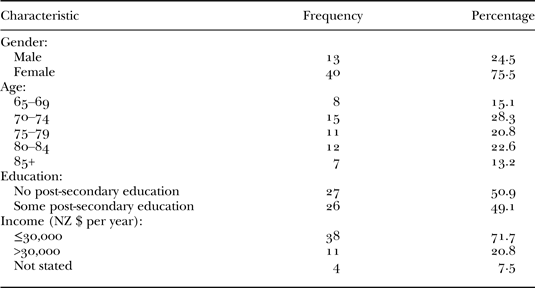
A sample of 53 older people, aged 65–96 years, was recruited from community, church, recreational and service organisations in Hamilton, New Zealand (population 130,000), through face-to-face presentations at each organisation's normal weekly or monthly meeting. Table 1 summarises the demographic characteristics of the respondents. Most research participants were women, in the 75 and older age group, well educated (mostly vocational or university education), with moderate incomes.
Demographic characteristics of sample

Between January and June 2010, each research participant kept a written record of some of their interactions with organisations over a six- to eight-week period in an observation log, or ‘Olog’ (Koopman-Boyden and Richardson Reference Koopman-Boyden and Richardson2013), a combination of a structured observations schedule (Hardwick and Worsley Reference Hardwick and Worsley2011) and an event-contingent diary (Bolger, Davis and Rafaelli Reference Bolger, Davis and Rafaelli2003). Research participants were each issued with Olog booklets which contained 20 Olog templates. A template consisted of 12 questions: ten structured and two unstructured. The ten survey-style structured questions asked participants to indicate: (a) the type of interaction they engaged in (e.g. face to face, telephone); (b) the purpose of the interaction; (c) the role they played in it (e.g. as a customer, volunteer, employee or member); (d) the frequency of their interaction with the organisation in question; and (e) their actual, expected and ‘usual’ levels of satisfaction with this and similar interactions. In addition, research participants were asked to consider, if they were to undertake this activity again, whether they would return to the same organisation or organisational representative or make a change. A total of 496 observations were recorded in the Ologs. Excluding those involved in the pilot survey (where the structured Olog questions were slightly different), a total of 374 observations from 44 respondents were recorded, and form the base data-set for our quantitative analysis below.
In addition to the Ologs, research participants participated in a series of three focus group meetings to discuss selected documented interactions. The first meeting outlined the parameters of the research, and explained and distributed the Ologs. At the second meeting, held one to two weeks later, each research participant selected one positive and one negative interaction from their own Olog for discussion. Following the sharing of individual experiences, the group was invited to discuss the typicality of these interactions as well as the types of organisations in which they most often encountered positive or negative experiences. The third meeting, held four to five weeks after the second meeting, repeated a similar process with each participant sharing one positive and one negative interaction, after which the group considered whether their age made a difference in how they were treated. This final session with each group was digitally recorded (with participants' permission), and later transcribed. In all, 30 such sessions were held with a total of 53 older people (i.e. ten groups of approximately five older people each meeting on three separate occasions). The mixed-methods approach adopted, combining Olog and focus group data, is further described in Koopman-Boyden and Richardson (Reference Koopman-Boyden and Richardson2013). This research project received ethical approval from the University of Waikato Ethics Committee.
Methods
A mixed-methods approach was adopted in analysing the data, involving both quantitative and qualitative analysis. The nature of the data is important for our approach to the quantitative analysis. Notwithstanding the convenience nature of the sample, each Olog observation cannot be treated as independent because different research participants may have systematically different preferences, expectations and resulting levels of satisfaction with their interactions with organisations. In other words, the standard assumption of the independence of observations that linear or logistic regression models rely upon is violated (Albright and Marinova Reference Albright and Marinova2010). Therefore, the nesting of Olog observations within individuals must be accounted for in the quantitative analysis. To account for the nested nature of the data, we use multi-level mixed-effects logistic regression models, where the explanatory variables were specified at two levels: (a) variables specific to each Olog observation or interaction (i.e. variables that will apply to a single interaction between an older person and an organisation); and (b) variables specific to each individual (i.e. variables that will apply to all interactions involving that research participant).
As we are interested in the degree of customer dissatisfaction in this paper, we initially specified logistic regression models with three different dependent variables: (a) whether the respondent was neither satisfied nor very satisfied with the interaction (1 = neither satisfied nor dissatisfied; dissatisfied; or very dissatisfied); (b) whether the interaction was below the expected level of satisfaction (1 = below expected satisfaction); and (c) whether the interaction was below the ‘usual’ level of satisfaction (1 = below ‘usual’ satisfaction).
The multi-level mixed-effects models were all implemented such that the individual-level variables are specified as random effects, while the interaction-level variables are specified as fixed effects and are the primary variables of interest to the analysis (Albright and Marinova Reference Albright and Marinova2010). The number of random effects that can be simultaneously included in such models is limited, so a number of preliminary models were first estimated, each of which included a single individual-level variable. Individual-level variables that were found to be statistically significant in this first-stage univariate analysis (not shown below) were included in the final estimation, and differed depending on which dependent variable the model was estimated for.
A second logistic regression model was specified to investigate the decision to switch to an alternative provider. This followed a similar methodology to the previous models (multi-level mixed-effects logistic regression). The dependent variable in this instance was the decision to ‘go to a different organisation in the future’ following the respondent's experience in that interaction (1 = yes). The key explanatory variable (a fixed effect) was dissatisfaction with their experience (as defined earlier). Again, various random effects were tested along with the ‘below expectations’ and ‘below usual satisfaction’ variables, and only the final and preferred estimation is presented in the following section. All regression models and statistical analyses were performed using Stata version 11 (Stata Corp).
In addition to the quantitative analysis described above, qualitative material from the open-ended Olog questions and focus group discussions was examined to further inform the research results, particularly in terms of identifying key factors that contribute to interaction satisfaction and dissatisfaction. The qualitative analysis adopted a grounded theory approach and involved the coding and categorising of statements articulated by each participant in relation to each interaction incident. The details scrutinised included: participants' evaluations of the interaction (e.g. as satisfying and positive or dissatisfying and negative); the context in which the interaction occurred, particularly the type of organisation and the mode of interaction; details of the incident, including the practices of the organisation, the actions of the organisational representative, and the older person; and the interaction outcome. Each interaction incident was allocated a unique number and entered into a spreadsheet along with the participant's demographic details. Each incident was compared and contrasted and key contributors to interaction quality were identified. The primary focus in this paper is on dissatisfying interactions, with quotes selected from the focus group transcriptions reproduced in the discussion section of the paper. All quotes are anonymised to protect the privacy of the research participants. For details on the factors contributing to the quality of all interactions, see Richardson and Zorn (Reference Richardson and Zorn2012).
Results
Older people's experiences as customers
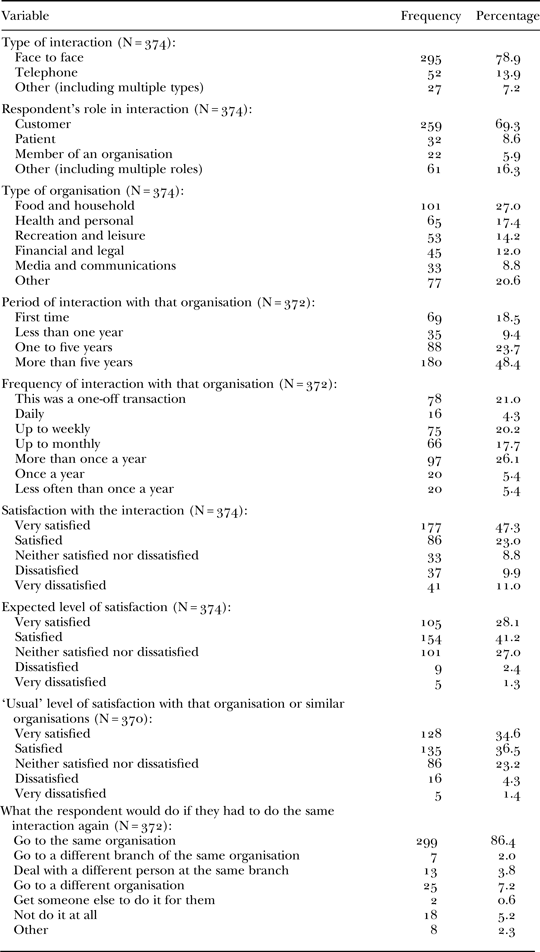
The Olog data collected for this project provides rich information on the experiences that older people have had as customers. In particular, it provides data on the satisfaction experienced by the older person and the willingness of each older person to continue interacting with the organisation. A summary of the Olog data is provided in Table 2. Most interactions were face to face or over the telephone, and most respondents' role in the interaction was as a customer or patient. Most respondents had been interacting with that organisation for more than five years, and most were satisfied or very satisfied with the interaction. The median response to the satisfaction question was ‘satisfied’ (the second-from-top level in a five-level scale of satisfaction), as it was for the expected level of satisfaction and the ‘usual’ level of satisfaction with that organisation or similar organisations. Most respondents would go to the same organisation again if they had to engage in the same interaction again, although it should be noted that in many instances there may be little choice for the respondent (e.g. dealing with a city council).
Summary of interactions recorded in respondents' observation logs
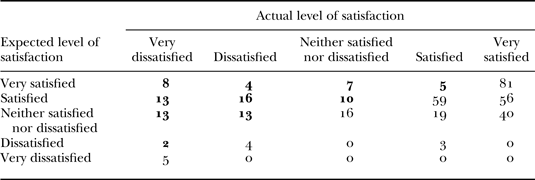
Despite the overall high levels of satisfaction as shown in Table 2, the satisfaction that respondents reported from their interactions was often below their expected level or ‘usual’ level of satisfaction they received, as shown in Table 3. Bold values represent the interactions where satisfaction was below expectations; in total there were 91 interactions (24.3%) that were below the expected level of satisfaction. In contrast, there were 118 interactions (31.6%) that were above the expected level of satisfaction, almost all of which (96) occurred when the respondent was ‘very satisfied’ despite expecting a lower level of satisfaction.
Comparison of actual with expected level of satisfaction from interactions
Note: Bold values represent the interactions where satisfaction was below expectations.
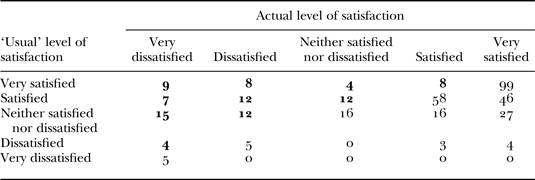
Almost identical results are obtained by comparing the actual level of satisfaction with the ‘usual’ level of satisfaction the respondents receive from interactions with that organisation or similar organisations, as shown in Table 4. In this table, bold values represent the interactions where satisfaction was below the ‘usual’ level of satisfaction; in total there were 91 interactions (24.3%) that were below the ‘usual’ level of satisfaction, and 96 interactions (25.7%) that were above the ‘usual’ level of satisfaction.
Comparison of actual with ‘usual’ level of satisfaction from interactions
Note: Bold values represent the interactions where satisfaction was below the ‘usual’ level of satisfaction.
Factors affecting older people's dissatisfaction with organisational interactions
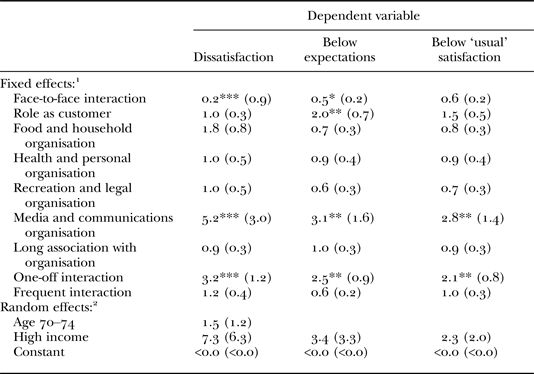
The final regression estimations from the quantitative analysis are shown in Table 5, for three measures of dissatisfaction: (a) whether the respondent was neither satisfied nor very satisfied with the interaction; (b) whether the interaction was below the expected level of satisfaction; and (c) whether the interaction was below the ‘usual’ level of satisfaction. In general, face-to-face interactions were associated with less dissatisfaction within our sample of older people than other modes of interaction (telephone, email, etc.), with 76 per cent lower odds of reported dissatisfaction, and 46 per cent lower odds of satisfaction being below expectations. Respondents' role as customer (as opposed to other roles such as a patient, or a member of an organisation) was associated with more than double the odds of satisfaction being below expectations, but was not significantly associated with dissatisfaction more directly measured. Media and communications organisations were clearly associated with lower levels of satisfaction in interactions, with more than five times higher odds of dissatisfaction, more than three times higher odds of satisfaction being below expectations, and more than 2.7 times higher odds of satisfaction being below the ‘usual’ level of satisfaction for that organisation or similar organisations. One-off interactions were also associated with greater levels of dissatisfaction compared with interactions that were more frequent, and these interactions had 3.2 times higher odds of leading to dissatisfaction, 2.5 times higher odds of satisfaction being below expectations, and more than double the odds of being below the ‘usual’ level of satisfaction.
Results from multi-level mixed-effects models of dissatisfaction
Notes: 1. Odds ratios with standard errors in parentheses. 2. Variances with standard errors in parentheses.
Significance levels: * p < 0.1, ** p < 0.05, *** p < 0.01.
The qualitative analysis identified that satisfaction resulted from participants achieving what they wanted from the interaction, perceiving themselves to be in control and/or enjoying the encounter. Staff actions contributing to satisfaction included acknowledging and listening to the older person, being considerate and respectful of them, and actively facilitating their goal achievement. Examples included: greeting the client in a genuinely warm and friendly manner, addressing regular customers by name, providing opportunities for the customer to ask questions and listening to their concerns, offering assistance, and having the necessary technical knowledge to do the job well for the customer.
Dissatisfaction tended to occur in situations where the customer's desired or expected outcome was not achieved. Key factors contributing to dissatisfaction were participants' perceptions that the organisation's systems inhibited their ability to achieve their objective (e.g. only automated self-service delivery points were provided); or where the level of service offered was deemed inadequate or inappropriate (e.g. the staff member's tone of voice was perceived as patronising or their actions were dismissive or they became impatient).
The effect of dissatisfaction on the decision to switch to alternative organisations
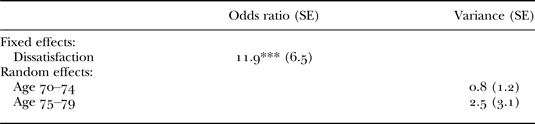
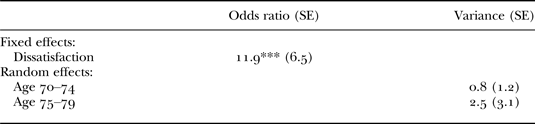
The final regression estimation results for the respondent's decision to switch to an alternative provider are shown in Table 6. The results demonstrate that older people have nearly 12 times higher odds of reporting that they will go to a different organisation in the future if they were less than satisfied with their interaction than if they were satisfied or very satisfied.
Results from multi-level mixed-effects models of the choice to go to a different organisation
Note: SE: standard error.
Significance level: *** p < 0.01.
Discussion
Overall, our results demonstrate high levels of satisfaction with interactions within our sample of older people: respondents were satisfied or very satisfied with more than 70 per cent of their interactions. Similarly, most interactions were at or above the expected level of satisfaction for our sample. However, the levels of satisfaction reported here are much lower than those in earlier research, such as Bernhardt (Reference Bernhardt1981), who found satisfaction levels exceeding 80 per cent. Some of this difference is no doubt due to measurement differences and differences in sampling method and the method of eliciting the satisfaction data; however, there may be important cohort differences between our sample and earlier research. Compared to earlier generations, older people are now wealthier and have more opportunities to engage in market activity and therefore have increased chances of encountering unsatisfactory consumer experiences (Bernhardt Reference Bernhardt1981). Lee and Soberon-Ferrer (Reference Lee and Soberon-Ferrer1999) found that when the number of transactions made by older people were adjusted accordingly, dissatisfied older consumers were also just as likely as dissatisfied younger consumers to engage in complaining actions. Phau and Baird (Reference Phau and Baird2008) found that there is a positive relationship between age and complaining behaviour. This seems to contradict earlier findings that described the elderly as a ‘quiet majority’ who were unable or unwilling to seek redress (Bernhardt Reference Bernhardt1981; Warland, Hermann and Willits Reference Warland, Herrmann and Willits1975). More recent support for this view is given in Grougiou and Pettigrew (Reference Grougiou and Pettigrew2009).
Despite the overall high levels of satisfaction in our sample, a large proportion of interactions resulted in dissatisfying experiences for our sample of older customers. About 11 per cent of interactions resulted in an older person who was ‘very dissatisfied’ with the interaction, and a further 9.9 per cent were ‘dissatisfied’. This suggests that service organisations and retailers are still falling well short of satisfying standards of customer service for all of their older clients and customers.
This dissatisfaction with organisational interactions for older people was most associated with interactions that were not face to face, and with interactions that would not be repeated. This may be due to the impersonal nature of these interactions, and a preference for face-to-face interactions that was explicitly noted in the qualitative data from the Olog and focus groups:
Face to face you can see the person, you can interact, you can watch the body language and you can see that they don't understand or they misconstrue, then you can repeat it [your request] in a different way. Over the phone you can only go by the voice and they usually read off a script anyway, they are not listening to you, they just want to go through their little script.
I don't always like using the telephone. I like to face up and see them, and then you can discuss any detail and, if things aren't understood, well, it gives one a chance to really explain what the problem is, if there is one.
I like to be face to face, because my hearing is not always the best and the noise affects that on the phone, and I like to see who I am sort of working with.
While a preference for face-to-face interactions to reduce misinterpretation could be equally true of younger clients and customers, the last quote suggests one reason why telephone interactions may lead to lower levels of satisfaction for older people. Hearing impairment creates a structural barrier to clear communication for many older people, which can easily lead to misinterpretations and consequent dissatisfaction with the interaction. However, our quantitative results demonstrate that all types of interactions that are not face to face are associated with higher levels of dissatisfaction on average. This includes not only telephone interactions, but also letters, emails and a combination of interaction modes. As these other modes share only the relatively impersonal nature characteristic with telephone conversations, it may be that older people simply desire more personal connection with organisations and their representatives.
Older people's preference for personalised dealings with organisations can be explained in several ways, including familiarity – it is the way older people have traditionally interacted, flexibility – it offers the opportunity to ‘read’ multiple cues in a situation and adjust accordingly, as one of the above quotations indicates, and sociability – it accommodates a need many have for social connectedness. But perhaps most importantly, personal interactions appear to provide older people (and others) with an opportunity to achieve the three primary goals of communication (Cheney et al. Reference Cheney, Christensen, Zorn and Ganesh2004) more effectively than do more transactive encounters, such as exchanges with call centre staff. The three goals are: (a) getting the task done, e.g. having a computer problem fixed; (b) being treated in a positive way, e.g. being treated as a competent person; and (c) building a relationship, e.g. being seen as worth investing time and effort in. The focus groups identified that not being able to achieve one or more of these goals contributed to dissatisfying interactions.
Further evidence of less than satisfactory communicative encounters can be found in our sample's dealings with media and communications organisations. Our sample of older people was significantly less satisfied with their interactions with media and communications organisations than with all other types of organisations. Partly, these interactions were unsatisfactory to the older sample because media and communications organisations typically interact with their customers by telephone and/or email (and not face to face). However, the dissatisfaction with media and communications organisations was statistically significant over and above the effect of not interacting face to face. The qualitative data support this:
…the person at the other end who was not fluent in English at all, and I pride myself that I can understand people, but I found it very difficult and this has happened each time I have had to get assistance with a problem … I was given a number, it didn't work, I had to go through the whole thing and they had to begin the thing again with the attendant problems re language again…
I was somewhat apprehensive because I thought what if I get someone whose English I don't understand, but it wasn't too bad. She was a New Zealander I would say, but she didn't seem to understand my problem, said that I haven't heard of that before, almost as if, she wasn't calling me a liar, but how can that possibly happen with our product? She said, I will ask my supervisor or ask somebody if there is anything we can do about it. I was waiting a while, I didn't mind that, but her attitude was bit, in the sense that she didn't disbelieve me, but she found it hard that could happen, didn't really know what to do about it.
Our results demonstrate that media and communications firms need to work harder to deal with customer enquiries from older people in a way that does not alienate them and leave them dissatisfied with the interaction. Given the nature of the industry, moving to face-to-face communication is unlikely to occur, but improving the training of call centre staff to deal with queries in a way that is less alienating for the customer, such as attending to the three communicative goals discussed above, would likely improve customer satisfaction, particularly among older people.
Similarly, one-off interactions (i.e. those that will not be repeated in the future) do not allow rapport to build between the organisation's representatives and the older person, leaving the relationship impersonal and often failing to satisfy the older person. Organisations and their representatives might not feel the need to engage fully when the interaction is short and will not be repeated. Or they may feel that the cost associated with this effort exceeds the potential benefit associated with improved customer service. However, failing to ensure good customer service for older people in these interactions inevitably leads to lower satisfaction for the older customers.
Finally, dissatisfied customers are more likely to indicate an intention to switch to an alternative organisation, and our quantitative results strongly support this assertion within our sample of older people. The qualitative analysis indicates that the primary reasons for switching were dissatisfaction with the level of technical knowledge or relational skills of the service provider (i.e. an inability to get the task done) and the sense that they personally and/or their needs were being ignored or not adequately addressed (i.e. they were not treated in a positive way). The following statements are indicative:
At [café] about a month ago, I stood there waiting, and people came up and got served, and about the fifth person came up and got served ahead of me and I said, ‘Oh for god's sake I have turned invisible, I never thought it would happen to me!’ They just looked at me. I have never gone back there.
After a very unsatisfactory appointment with the local GP [general practitioner], I told them that I would not be going back and wasting my money on this fool … I could go back, but I am not going to eat humble pie for that man. I guarantee they are losing patients right, left and centre. I am not a stroppy person, particularly with a doctor. Anyway, I have now got to go around to the other medical centre in town and ask if they have a vacancy with another doctor, and if they say no, then I will have to go out of town.
The consequences of poor customer service for older people are the same for organisations as poor customer service with other groups – loss of future business and profit opportunities. However, the factors that contribute to poor customer service experiences for older people, particularly the old-old, may well be different in that many older people still value relationships, relational skills and personalised interactions. If these elements are deemed too costly for some organisations to provide, these organisations may prefer to offer them to targeted customer segments only, such as older people who recognise and appreciate them.
Finally, we should note that the research approach applied here has limitations. First, the sample size is small and limited to a single city in New Zealand. The main effect of the small sample size is that the quantitative analysis is not as robust as it would be had a larger sample been included. Moreover, the small sample size limits the number of covariates that could be included in the analysis. However, the small sample size provides advantages in terms of providing the opportunity for more in-depth qualitative analysis of the results – a larger sample may not have allowed for robust discussion in focus groups that supports many of the quantitative results. On the other hand, the small sample size may have contributed to differences in the results obtained from the quantitative and the qualitative analyses in terms of the role of age in interaction quality. The qualitative analysis identified that participants over 80 years of age were more inclined to feel that age was a factor in the assistance and consideration showed to them by staff than were younger participants but they also perceived that their age played a part in their being overlooked and marginalised. Also, in terms of their responses to unsatisfactory situations, older participants tended to withdraw rather than force the issue, whereas younger participants tended to complain more often and were more persistent in pursuing their complaints to a resolution. By contrast, the quantitative analysis did not find a statistically significant within-group difference between older and younger participants in relation to these issues or their intention to change service providers.
Second, the sample consists of a relatively high number of older, well-educated women with moderate incomes. The high proportion of female participants can perhaps be explained by higher female longevity rates and the greater tendency for women than men to be involved in community organisations, the primary source of participants for the project. Participation in community organisations is also associated with both educational and income level (Koopman-Boyden and van der Pas Reference Koopman-Boyden, van der Pas, Koopman-Boyden and Waldegrave2009). Thus, we cannot make robust claims about the customer experiences of men and, as we do not have a comparison group of younger people, we cannot say for certain whether the customer experiences of this older group are different from those of younger people.
Conclusions
In this paper, we considered two research questions: (a) How satisfied or dissatisfied are older people with their customer service experience, and what are the factors associated with dissatisfaction? and (b) What prompts older people to want to change service providers? Overall, older people are generally satisfied with their interactions with organisations, but with a significant proportion of dissatisfaction as well. Impersonal interactions, as well as those that are one-off, rather than repeated, and those that are not conducted face to face, prompted the highest levels of dissatisfaction. Among organisations, media and communications organisations provided the most dissatisfying interactions. Finally, dissatisfaction was a key driver of the older people's stated preference to change organisations. Thus, organisations who want to retain or attract older people as customers or clients must improve the customer service experience for this important and valuable group.
Acknowledgements
The authors thank the research participants for their readiness to participate in the research project. This research was funded by the Ministry of Business Innovation and Employment under research contract number UOWX0901. The funder played no role in the design, execution, analysis and interpretation of the data, or writing of this study. All authors contributed to the conception and design, or analysis and interpretation of data, and to the drafting of the article and revising it critically for important intellectual content. All authors have approved this version of the article. This research project received ethical approval from the University of Waikato Ethics Committee.