Cardiorespiratory fitness has an independent beneficial effect on the cardiovascular system.Reference Kodama, Saito and Tanaka 1 Fit subjects have a lower risk for cardiovascular disease and lower mortality rates.Reference Seals, Desouza, Donato and Tanaka 2 , Reference Liu, Sui and Lavie 3 In contrast, low cardiorespiratory fitness is regarded as major risk factor for cardiovascular disease.Reference Kodama, Saito and Tanaka 1 Carotid intima-media thickness and arterial distensibility are independent predictors of cardiovascular disease and are well-established markers to identify early atherosclerotic changes of the arterial wall.Reference Lorenz, Markus, Bots, Rosvall and Sitzer 4 Pathologically altered arteries are characterised by an abnormal increase in wall thickness and loss of elasticity.Reference Urbina, Williams and Alpert 5 These alterations are already present in inactive children and adolescents.Reference Veijalainen, Tompuri and Haapala 6 Promotion of cardiorespiratory fitness should therefore start as early as possible, in order to prevent children from becoming inactive adults at cardiovascular risk.Reference Magnussen, Smith and Juonala 7
Findings on the association between cardiorespiratory fitness and carotid intima-media thickness in children are scarce. Ried-Larsen et alReference Ried-Larsen, Grontved, Froberg, Ekelund and Andersen 8 and Pahkala et alReference Pahkala, Laitinen and Heinonen 9 observed no significant association between cardiorespiratory fitness and carotid intima-media thickness in adolescents aged 15 and 17 years, respectively. In adults, there are studies reporting no significant influence of cardiorespiratory fitness on carotid intima-media thickness.Reference Popovic, Puchner, Endler, Foraschik, Minar and Bucek 10 – Reference Rauramaa, Halonen and Vaisanen 13 Others have reported the opposite but only in high-risk patientsReference Thijssen, Cable and Green 14 or in men but not in women.Reference Ferreira, Twisk and Van Mechelen 15 Regarding arterial distensibility, an inverse correlation with arterial stiffness has been observed in childrenReference Veijalainen, Tompuri and Haapala 6 , Reference Ried-Larsen, Grontved, Froberg, Ekelund and Andersen 8 , Reference Boreham, Ferreira, Twisk, Gallagher, Savage and Murray 16 , Reference Sakuragi, Abhayaratna and Gravenmaker 17 and adults.Reference Ferreira, Twisk, Stehouwer, van Mechelen and Kemper 12 , Reference Boreham, Ferreira, Twisk, Gallagher, Savage and Murray 16 , Reference Howden, Weston and Leano 18 Comparison between exercise-trained subjects and sedentary controls revealed more distensible arteries in trained subjects.Reference Schmidt-Trucksass, Schmid and Brunner 11 , Reference Laurent, Marenco, Castagna, Smulyan, Blacher and Safar 19
Resistance training positively modifies traditional cardiovascular risk factors.Reference Williams, Haskell and Ades 20 The influence of resistance training or strength, respectively, on carotid intima-media thickness and arterial distensibility is not clear. A particular study on adolescents observed no increased carotid intima-media thickness after resistance training for 12 weeks.Reference Croymans, Krell and Oh 21 In children, Melo et alReference Melo, Santa-Clara and Santos 22 reported an inverse relationship between muscular strength and carotid intima-media thickness. For arterial distensibility and strength, no study in children has been reported thus far. Findings in adults are contradictory, with studies reporting that resistance training increases arterial stiffness,Reference Williams, Haskell and Ades 20 , Reference Fahs, Smith and Horn 23 leads to no change,Reference Cortez-Cooper, Anton, Devan, Neidre, Cook and Tanaka 24 , Reference Yoshizawa, Maeda and Miyaki 25 or to reduced stiffness.Reference Fjeldstad, Bemben and Bemben 26 , Reference Okamoto, Masuhara and Ikuta 27
Owing to contradictory findings of the influence of cardiorespiratory fitness on vascular parameters, and the lack of studies on the effect of strength on vascular parameters in children, this study aimed to investigate the relationship between cardiorespiratory fitness and strength and carotid intima-media thickness and arterial distensibility in a large cohort of boys and girls aged between 7 and 17 years.
Materials and methods
Data collection was part of the prevention project “Sternstunden der Gesundheit”, a cross-sectional prospective study conducted from October, 2012 to July, 2013 in Berchtesgadener Land, Germany. Healthy children (n=1017, 483 boys/534 girls) aged 7–17 years were included to establish reference percentiles for carotid intima-media thickness and distensibility measuresReference Weberruss, Pirzer and Bohm 28 and to investigate cardiorespiratory fitness and strength. The study was approved by the ethics committee of the Technische Universität München (5490/12), and informed written consent was obtained from parents of children younger than 14 years of age and from both parents and children ⩾14 years.
Data on carotid intima-media thickness, arterial distensibility, and cardiorespiratory fitness and strength were available for n=697 healthy school children (376 girls) aged 7–17 years. Owing to technical problems, data on carotid intima-media thickness were lost for n=281 subjects and on arterial distensibility for n=89 subjects. In addition, eight students could not participate in fitness testing, owing to injuries or no proper sportswear.
Anthropometric measurements were performed by trained staff, according to standardised guidelines. 29 Body weight and height were measured to the nearest 0.1 kg and 0.1 cm, respectively, without shoes and with light clothes (seca 799, seca, Hamburg, Germany). Body mass index was calculated using the ratio of mass (kg) to height2 (m2). Standard deviation scores for body mass index refer to German reference values.Reference Kromeyer, Wabitsch, Kunze and Geller 30
Carotid intima-media thickness and arterial distensibility were assessed with semi-automated B- and M-mode ultrasound (ProSound Alpha 6, Aloka/Hitachi Medical Systems GmbH, Wiesbaden, Germany), using a high-frequency linear array probe (5–13 MHz). After a 15-minute rest period, subjects were examined in the supine position, with their neck slightly extended and their head turned 45° opposite the site being scanned. Carotid intima-media thickness was measured in B-Mode according to the Mannheim consensusReference Touboul, Hennerici and Meairs 31 on the common carotid artery far wall, 1 cm proximal to the bulb at end diastole. Distensibility was assessed at the same location in real time M-mode with high-precision vascular echo tracking. In total, four measurements were performed for each subject, two on the left and two on the right common carotid artery, and the mean value out of the four measurements was calculated. Cardiac cycle was simultaneously monitored with a three-lead electrocardiogram.
Common carotid artery distensibility was defined by arterial compliance, elastic modulus, stiffness index β, and pulse wave velocity β according to the following formulae, 32 where D is the change in vessel cross-sectional area and BP is blood pressure.
 $${\rm Arterial}\,\,{\rm compliance}{\, \equals}\,\pi (D_{{{\rm max}^{2} }} {\minus}D_{{{\rm min}^{2} }} )\,/\,[4({\rm BP}_{{{\rm max}}} {\minus}{\rm BP}_{{{\rm min}}} )]$$
Arterial compliance defines the ability of the artery to increase its volume in response to a given increase in blood pressure. It is the inverse of arterial stiffness.
 $${\rm Elastic modulus{\, \equals}\,(BP}_{{{\rm max}}} {\minus}{\rm BP}_{{min}} )\,/\,[({\rm D}_{{{\rm max}}} {\minus}{\rm D}_{{min}} \,/\,{\rm D}_{{min}} )]$$
Elastic modulus increases with increasing stiffness of the vessel and is high in blood pressure dependency.
 $${\rm Stiffness}\,\,{\rm index}\,\,{\rm \beta }{\, \equals}\,{\rm ln}({\rm BP}_{{{\rm max}}} \,/\,{\rm BP}_{{{\rm min}}} )\,/\,[(D_{{{\rm max}}} {\minus}D_{{{\rm min}}} )\,/\,D_{{{\rm min}}} ]$$
Stiffness index β increases with increasing stiffness of the vessel but is low in blood pressure dependency.
 $${\rm Pulse}\,\,{\rm wave}\,\,{\rm velocity}\,\,{\rm \beta }{\, \equals}\,\surd(\left( {\beta {\times}{\rm BP}_{{{\rm min}}} } \right)\,/\,\left( {2\rho )} \right)$$
Pulse wave velocity is the speed at which the forward pressure wave is transmitted from the aorta through the vascular tree. In this study, pulse wave velocity β was assessed as local pulse wave velocity of the common carotid artery.
Blood pressure was measured oscillometrically (Mobil-O-Graph®, I.E.M., Stolberg, Germany) on the left arm, after subjects had rested for 10 minutes in the supine position.
All measurements were performed by two experienced testers. Variability between testers was assessed with the coefficient of variation in 27 subjects measured by both testers. For carotid intima-media thickness, the coefficient of variation was 4.79%, and 3.54% for distensibility, calculated as average coefficient of variation of arterial compliance (4.47%), elastic modulus (3.42%), stiffness index β (4.92%), and pulse wave velocity β (1.37%).
Cardiorespiratory fitness and strength were assessed with the test battery FITNESSGRAM 33 : (1) cardiorespiratory fitness as number of laps in a 20-metre shuttle run at increasing speed, (2) upper body strength by push-ups, and (3) abdominal strength by curl-ups, as well as (4) lower back strength by trunk lift. Children were tested one by one by trained staff, following standardised test instructions. 33 The test–re-test reliability for FITNESSGRAM is reported with a κ coefficient of 0.64 for cardiorespiratory fitness, 0.48 for push-ups, and 0.56 for curl-ups.Reference Morrow, Martin and Jackson 34 For cardiorespiratory fitness, three categories were calculated for each age group and for boys and girls separately.Reference Lee, Blair and Jackson 35 The categories were “low fit” (<20th percentile), “normal fit” (20th–80th percentile), and “very fit” (>80th percentile). For strength testing, children were defined as either being within the healthy fitness zone or not – that is, needs improvement zone – according to age- and sex-specific criterion-referenced standards. 33 Results of strength testing were combined into one category for correlation and multiple regression analysis: healthy fitness zone for children within the normal range for all three tasks and needs improvement zone for children failing in one or more of the categories.
Data were analysed using IBM SPSS statistics for Windows, version 21.0 (IBM SPSS Statistics for Windows, version 22.0, IBM Corp., Armonk, NY, United States of America). After testing for normal distribution, differences between boys and girls and between boys and girls in different age groups were analysed by independent samples t-test or Mann–Whitney U-test. The influence of cardiorespiratory fitness and strength on vascular data was analysed by bivariate correlation, controlled for sex, age, body mass index, and blood pressure. A multivariate stepwise linear regression was performed to account for the independent influence of cardiorespiratory fitness, strength, body mass index, and blood pressure on vascular data. For cardiorespiratory fitness, differences in vascular status between different fitness levels were analysed by one-way analysis of variance with Bonferroni post hoc correction. To control for age differences in parameters, sex- and age-specific standard deviation scores were applied in this analysis.Reference Weberruss, Pirzer and Bohm 28 Data are expressed as mean value±standard deviation; a p-value of <0.05 was considered to be statistically significant.
Results
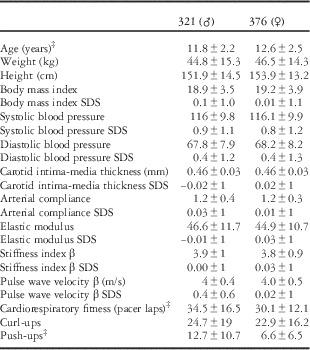
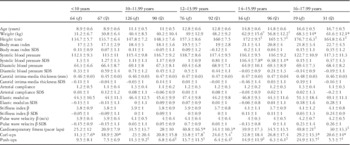
Carotid intima-media thickness, arterial distensibility, cardiorespiratory fitness, and strength were assessed in n=697 children (376 girls). Girls were significantly older than boys (12.6±2.5 years versus 11.8±2.2 years, p<0.001), and no significant differences were observed for anthropometric measures and cardiovascular data. Boys performed significantly better in push-ups (12.7±10.7 versus 6.6±6.5, p<0.001) and had better cardiorespiratory fitness (34.5±16.5 versus 30.1±12, p<0.001), whereas girls performed better in trunk lift (25.9±5.9 versus 23.6±5, p<0.001). Anthropometric and cardiovascular data, cardiorespiratory fitness, and strength testing results for the entire study population and separate age groups are displayed in Tables 1 and 2, respectively. Among all, 78.2% (246 boys/299 girls) of children were normal weight, 7.2% (30/20) were overweight, 6.6% (19/27) were obese, and 8.1% (26/30) were underweight.
Subject characteristics in absolute values and standard deviation scores (SDS).

‡p<0.001
Subject characteristics in absolute values and standard deviation scores (SDS) for different age groups.

*p<0.05, †p<0.01, ‡p<0.001
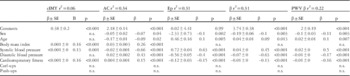
More than half of the children, 59.8% (192/225), were classified as normal fit, 21.2% (71/77) as low fit, and 18.9% (58/74) as very fit. Partial correlation, controlled for sex, age, body mass index, and blood pressure, revealed cardiorespiratory fitness to be significantly correlated with all cardiovascular parameters: for carotid intima-media thickness, r=0.14; arterial compliance, r=0.16; elastic modulus, r=−0.15; stiffness index β, r=−0.13; and pulse wave velocity β, r=−0.14 (p<0.001). No significant correlation was observed for push-ups and curl-ups, respectively, with cardiovascular parameters. No significant correlation was observed for the combined strength parameter (healthy fitness zone/needs improvement zone): carotid intima-media thickness, r=0.03 (p=0.38); arterial compliance, r=0.04 (p=0.33); elastic modulus, r=−0.02 (p=0.58); stiffness index β, r=−0.02 (p=0.58); pulse wave velocity β, r=−0.03 (p=0.42). In the multivariate regression analysis, cardiorespiratory fitness was significantly associated with all cardiovascular parameters, and push-ups and curl-ups had no independent influence on cardiovascular data (Table 3). Cardiorespiratory fitness and strength tasks were positively correlated with body dimensions. Correlation coefficients, controlled for age, sex, and blood pressure, were r=−0.19 (curl-ups) and −0.29 (push-ups) for body mass index, r=−0.13 and r=−0.21 for waist-to-hip ratio, and r=−0.21 and r=−0.31 for waist-to-height ratio (p<0.001). Furthermore, cardiorespiratory fitness and strength were intercorrelated (r=0.35 for curl-ups; r=0.54 for push-ups, p<0.001).
Stepwise multivariate regression analysis for carotid intima-media thickness (cIMRT) and arterial distensibility with sex, age, body mass index, blood pressure, cardiorespiratory fitness, push-ups, and curl-ups.

AC=arterial compliance; β=stiffness index β; Ep=elastic modulus; PWV β=pulse wave velocity β
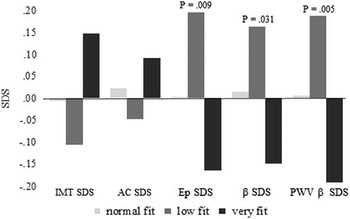
Regarding cardiorespiratory fitness categories, 192 boys and 225 girls were defined as normal fit, 71 boys and 77 girls as low fit, and 58 boys and 74 girls as very fit. Comparison between the three categories revealed no significant differences for carotid intima-media thickness or arterial compliance. Regarding elastic modulus, stiffness index β, and pulse wave velocity β, very fit subjects had significantly reduced stiffness parameters compared with subjects with a low fitness level (expressed as standard deviation scores): elastic modulus 0.16±1.02 versus 0.19±1.17, p=0.009; stiffness index β −0.15±1.08 versus 0.16±1.1, p=0.03; pulse wave velocity β standard deviation scores −0.19±1.02 versus 0.19±1.14, p=0.005 (Fig 1).
Sex- and age-specific standard deviation scores for vascular parameters. Subjects with cardiorespiratory fitness (CRF) <20th percentile were defined as low fit, subjects with CRF >80th percentile as very fit, and those in between as normal fit. AC=arterial compliance; β=stiffness index β; cIMT=carotid intima-media thickness; Ep=elastic modulus; and PWV β=pulse wave velocity β and different fitness levels; SDS=standard deviation scores.

Discussion
Carotid intima-media thickness in this study was positively associated with cardiorespiratory fitness, independent of sex, age, body mass index, and blood pressure. These results are in contrast with studies in childrenReference Ried-Larsen, Grontved, Froberg, Ekelund and Andersen 8 , Reference Pahkala, Laitinen and Heinonen 9 and in adults.Reference Popovic, Puchner, Endler, Foraschik, Minar and Bucek 10 – Reference Rauramaa, Halonen and Vaisanen 13 As the artery’s functional parameters such as arterial compliance, elastic modulus, stiffness index ß, and pulse wave velocity ß were not impaired, we state a functional arterial adaptation in our subjects, mediated by exercise that is similar to muscular adaptation to a training stimulus. Cuspidi et alReference Cuspidi, Lonati, Sampieri, Leonetti and Zanchetti 36 found significantly higher carotid intima-media thickness in athletes and borderline hypertensive individuals and assumed that the arterial wall may undergo similar adaptations as the athlete’s heart. According to Giannattasio et al,Reference Giannattasio, Failla and Grappiolo 37 this exercise-induced increase in carotid intima-media thickness affects more distensible tissues than less elastic components.
The results of the multivariate regression analysis revealed systolic blood pressure, body mass index, and cardiorespiratory fitness as independent predictors of carotid intima-media thickness. The extent to which cardiorespiratory fitness influences carotid intima-media thickness is similar to that of body mass index; however, these parameters may address different aspects of arterial wall thickening. Overweight and obesity are generally associated with an increased risk for cardiovascular disease, whereas cardiorespiratory fitness has a beneficial effect on the cardiovascular system.Reference Lee, Blair and Jackson 35 , Reference Cote, Phillips, Harris, Sandor, Panagiotopoulos and Devlin 38 , Reference Ruiz, Castro-Pinero and Artero 39
Parameters of arterial distensibility were positively associated with cardiorespiratory fitness, which is in accordance with other studies in children.Reference Ried-Larsen, Grontved, Froberg, Ekelund and Andersen 8 , Reference Pahkala, Laitinen and Heinonen 9 , Reference Boreham, Ferreira, Twisk, Gallagher, Savage and Murray 16 , Reference Sakuragi, Abhayaratna and Gravenmaker 17 Furthermore, cardiorespiratory fitness was an independent predictor of all parameters of arterial distensibility, indicating a reduced cardiovascular risk in fit children.Reference Ferreira, Twisk and Van Mechelen 15 In comparison between children of different cardiorespiratory fitness categories, children within the lowest fitness category showed significantly increased stiffness parameters – elastic modulus, stiffness index β, and pulse wave velocity β – compared with very fit children. In contrast to Ferreira et alReference Ferreira, van de Laar, Prins, Twisk and Stehouwer 40 and Pahkala et al,Reference Pahkala, Laitinen and Heinonen 9 these results indicate that in childhood and adolescence low cardiorespiratory fitness is already associated with increased carotid stiffness. Mechanisms leading to this improved arterial distensibility could be mediated by increased shear stress and nitric oxide release, which positively modify vasodilatory response of the vessel wall and lower blood pressure and heart rate.Reference Sakuragi, Abhayaratna and Gravenmaker 17 , Reference Li, Hanssen, Cordes, Rossmeissl, Endes and Schmidt-Trucksass 41 , Reference Cornelissen, Buys and Smart 42 This results in lower mechanical stress on the arterial wall and reduces cardiovascular risk. In accordance with other studies,Reference Pahkala, Laitinen and Heinonen 9 – Reference Schmidt-Trucksass, Schmid and Brunner 11 , Reference Laurent, Marenco, Castagna, Smulyan, Blacher and Safar 19 no significant differences could be found between cardiorespiratory fitness categories and carotid intima-media thickness or arterial compliance for boys and girls.
We did not observe a significant correlation between strength and vascular parameters. Thus far, only one study has addressed carotid intima-media thickness and strength in children and found an independent association between the two parameters.Reference Melo, Santa-Clara and Santos 22 In this study, strength was independently associated with carotid intima-media thickness. The authors connect increased strength with improved insulin sensitivity and reduced glucose levels, whereas insulin resistance on the other hand is associated with a pre-atherogenic profile in adolescents.Reference Burns, Lee and Arslanian 43 A lower cardiovascular risk associated with increased strength was shown in two other studies.Reference Artero, Ruiz and Ortega 44 , Reference Steene-Johannessen, Anderssen, Kolle and Andersen 45 In both studies, as well as the study by Melo et al,Reference Melo, Santa-Clara and Santos 22 strength was assessed as maximum strength measured via handgrip testReference Melo, Santa-Clara and Santos 22 , Reference Artero, Ruiz and Ortega 44 , Reference Steene-Johannessen, Anderssen, Kolle and Andersen 45 and standing long jump.Reference Artero, Ruiz and Ortega 44 , Reference Steene-Johannessen, Anderssen, Kolle and Andersen 45 In our study, muscular endurance was measured and not maximal strength, which could account for opposite findings. Another reason could be the different age groups that were studied. Melo et alReference Melo, Santa-Clara and Santos 22 examined children aged 11–12 years, whereas our age range was from 7 to 17 years. Thus, our results might be influenced by factors related to age and puberty.Reference Hidvegi, Illyes and Benczur 46 , Reference Ahimastos, Formosa, Dart and Kingwell 47
Other studies that applied FITNESSGRAM categorised subjects according to sex- and age-dependent criterion-reference standards, either being within the healthy fitness zone or not.Reference Marques, Santos, Ekelund and Sardinha 48 , Reference Morrow, Tucker, Jackson, Martin, Greenleaf and Petrie 49 These standards were derived from a large US sample. 33 , Reference Welk, Going, Morrow and Meredith 50 To avoid bias due to different ethnical and social backgrounds, we decided to treat FITNESSGRAM results as continuous variables. Mentioned studies by Morrow et alReference Morrow, Tucker, Jackson, Martin, Greenleaf and Petrie 49 and Marques et alReference Marques, Santos, Ekelund and Sardinha 48 report a relationship between time spent in moderate-to-vigorous physical activity and higher odds to achieve the healthy fitness zone. In our study, strength tasks were positively correlated with cardiorespiratory fitness and also with body dimensions. It is likely that children with high levels of cardiorespiratory fitness participate in activities that influence both aerobic capacity as well as strength, both of which lower cardiovascular risk.Reference Artero, Ruiz and Ortega 44 , Reference Steene-Johannessen, Anderssen, Kolle and Andersen 45 , Reference Ruiz, Castro-Pinero and Artero 39
In conclusion, cardiorespiratory fitness is associated with healthier arteries, shown by a positive correlation between cardiorespiratory fitness and arterial compliance and an inverse correlation between cardiorespiratory fitness and stiffness parameters. For carotid intima-media thickness, we propose a positive functional adaptation mediated by cardiorespiratory fitness. Strength did not affect carotid intima-media thickness and stiffness parameters. As cardiovascular disease begins in childhood, prevention should start as early in life as possible with a focus on cardiorespiratory fitness.Reference Ried-Larsen, Grontved, Froberg, Ekelund and Andersen 8 , Reference Ferreira, Twisk and Van Mechelen 15 , Reference Cruickshank, Rezailashkajani and Goudot 51
Limitations of the study
In total, 1017 healthy school children were included in this study. According to the ethics guidelines, study participation was voluntary, which may have led to a bias in the selection of study participants. Children participated in this study as part of a school prevention project, and measurements were performed in a school setting, with one class each day (9am–1pm). Owing to this set time frame, we could not assess pubertal status and we could perform only one blood pressure measurement. That is why children were not classified as being hypertensive or not. Owing to an initial problem in the storage process of ultrasound data, we lost 281 carotid intima-media thickness measurements and 89 distensibility measurements.
Acknowledgements
This study was conducted as cooperation between the Technische Universität München and Ludwig-Maximilians-Universität München.
Financial Support
This study was funded by Sternstunden e.V. (non-profit organisation) and district office Berchtesgadener Land.
Conflicts of Interest
None.
Ethical Standards
The study was approved by the ethics committee (5490/12) of the Technische Universität München. All procedures performed in studies involving human participants were in accordance with the ethical standards of the institutional and/or national research committee and with the 1964 Helsinki declaration and its later amendments or comparable ethical standards. This article does not contain any studies with animals performed by any of the authors. Informed written consent was obtained from all parents of children younger than 14 years and from both parents and children ⩾14 years.