Introduction
In Britain, Calicium corynellum (Ach.) Ach. is considered Critically Endangered. It receives the highest conservation priority [listed on both Schedule 8 of the Wildlife and Countryside Act (JNCC 2013) and as a Biodiversity Action Plan (BAP) species] as a consequence of its rarity, combined with dramatic population declines over recent decades (Woods & Coppins Reference Woods and Coppins2012), having disappeared from two of its four known sites. However, there is uncertainty concerning the identification of the entity referred to as C. corynellum in Britain, and, therefore, hereafter in this paper it will be treated as C. aff. corynellum. Questions about the distinctiveness of this material in Britain have arisen, partly because its common congener, C. viride Pers., has been recorded on trees overhanging saxicolous populations of C. aff. corynellum, but also because the morphology of British material is very similar to the common C. viride, which differs only in its substratum. If the closely-monitored populations on rock actually represent a saxicolous form of C. viride, conservation attention should be redirected to other species, where conservation actions and limited resources would be better spent.
Authentic Calicium corynellum is very similar to the widespread C. viride, but according to authoritative sources, differs in several characters. Calicium corynellum has short apothecial stalks (0·3–0·6 mm), a flat hypothecium, white pruina on the exciple, a spore width of 4·5–6·0 µm, a more leprose thallus and grows on rocks. By contrast, C. viride has longer apothecial stalks (1·1–2·2 mm), a convex hypothecium, brown pruina, wider spores (6–7 µm), a more granular thallus and grows on bark, or rarely on rock (Tibell Reference Tibell1999; Smith et al. Reference Smith, Aptroot, Coppins, Fletcher, Gilbert, James and Wolesley2009). Spores of C. viride are reported to be deeply and irregularly cracked (Tibell Reference Tibell1999), but no description of C. corynellum spores could be located. Chemical differences are also reported for these two species, with usnic acid present in C. corynellum, and epanorin in C. viride together with rhizocarpic acid present in both (Tibell Reference Tibell1999).
Although these differences are sufficient for distinguishing well-developed material of the two species, morphological characters can be quite difficult to interpret, especially since the common C. viride is very variable. Its apothecial stalks range from being nearly absent (except in section) to rather tall (as reported here), while thallus texture and hypothecium shape are rather subjective, and the distinctive brown pruina on the exciple is sometimes lacking.
Confusion also exists about the conservation status of C. aff. corynellum in Britain, with the species only recently added to Schedule 8 in England and Wales, and only proposed for addition to this Schedule in Scotland. Plants (and lichens) listed on Schedule 8 are afforded the highest legal protection possible in Britain, prohibiting wilful destruction or picking. Although these actions are probably not real threats for most vulnerable lichens, it is the only extant legal protection possible for these species. A more practical designation, that of a BAP species, is based on carefully assembled documentation summarizing the biology, distribution and threats, together with details of potential management strategies that could be employed to promote population persistence or increase population numbers. In either case, having one or both of these high-profile listings means that conservation resources are directed towards such species. A detailed account of this species’ distribution and ecology can be found in Simkin (Reference Simkin2003).
The main purpose of the present study was to test the null hypothesis of no difference between C. aff. corynellum and C. viride in Britain using a comparison of their ITS sequences as a complement to the morphological and chemical characters listed previously. In practice, support for this null hypothesis would be the finding that some or all sequences of C. aff. corynellum are as similar to sequences of C. viride as they are to each other, with no distinct sequence clustering by putative species (i.e. a barcoding approach; e.g. Kelly et al. Reference Kelly, Hollingsworth, Coppins, Ellis, Harrold, Tosh and Yahr2011). This line of evidence would suggest that these two species, as currently known in Britain, are not taxonomically distinct, particularly if no other morphological, chemical, ecological, or other evidence supports their separation. Without study of the type material of both species, the general taxonomic distinction between the species per se is impossible to assess, and therefore this study will only address their distinctiveness in Britain, with ramifications for conservation designations here.
The alternate hypothesis is that British C. aff. corynellum sequences form a distinct and well-supported clade and are each other’s closest relatives (due to fixed differences between sequence groups). Many molecular studies of lichens find evidence of such sequence clusters, and these are taken as evidence of cryptic speciation (e.g. Crespo & Pérez-Ortega Reference Crespo and Pérez-Ortega2009). Often, previously overlooked morphological evidence in support of these groups can then be discovered once the clusters are known. Evidence in favour of this alternative hypothesis would give weight to the taxonomic distinctiveness of British C. aff. corynellum. Its genetic relatedness to authentic C. corynellum is a separate question not treated here.
This study uses the official fungal barcoding marker, the nuclear internal transcribed spacer (ITS) (Schoch et al. Reference Schoch, Seifert, Huhndorf, Robert, Spouge, Levesque and Chen2012), which across the Fungi in general has strong resolving power. As shown by Schoch et al. (Reference Schoch, Seifert, Huhndorf, Robert, Spouge, Levesque and Chen2012), more than 73% of tested species are successfully distinguished using ITS sequences in pairwise comparisons. Although single-marker studies may not be sufficient to describe a species’ phylogeny (Taylor et al. Reference Taylor, Jacobson, Kroken, Kasuga, Geiser, Hibbett and Fisher2000), ITS has been used successfully in many genera of fungi, including Calicium, to confirm the identity of specimens and even to recognize new species (e.g. Tibell Reference Tibell2006).
Materials and Methods
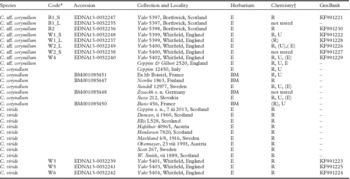
Samples were collected in 2013 from the only two extant British populations of C. aff. corynellum (Table 1). Three apothecia (from a possible several hundred) of C. aff. corynellum were collected from each of two gravestones in Borthwick, Midlothian (Scotland) and from one gravestone in Whitfield St John, Northumberland (England). From a second gravestone in Whitfield St John, two separate collections of three apothecia each were made, 30 cm apart (W1, W2). Collections of C. viride were made from mature sycamores (Acer pseudoplatanus) as near as possible to the C. aff. corynellum populations. Spores from authentic C. corynellum from European (non-British) herbarium collections were used for comparison (Table 1).
Specimens of Calicium examined with accession numbers and collection and chemical information.

* Codes are first letter of locality, number of collection at site, followed by apothecial stalk length code: L for long stalk, S for short stalk.
† Chemistry: R=rhizocarpic acid, U=usnic acid, E=epanorin. Codes enclosed by parentheses indicate trace amounts.
All samples were examined using dissecting and light microscopes at ×10–1000. Photographs were produced using Zeiss AxioVision software set up on a Stemi 2000C dissecting microscope at ×25. For spores, ocular micrometer width measurements were made using hand-cut sections mounted in water and squashed to spread the spores. Only fully mature spores were measured, with 10 spores from specimens from E and BM corresponding to the descriptions of true C. corynellum and C. viride for comparison with C. aff. corynellum (Table 1). The significance of differences in spore width was tested using a linear mixed model in R. Specimen identity was treated as a random effect to control for pseudoreplication. SEM analysis of spores was carried out using a thin smear of spores dabbed on sticky-carbon discs mounted on stubs and spread using a cleaned soft brush. These were sputter-coated for 30 s using an Emitech K575X Sputter Coater and examined and photographed using a LEO Supra 55VP Scanning Electron Microscope at ×5000–10000.
Thin-layer chromatography (TLC) followed standard procedures of Orange et al. (Reference Orange, James and White2001) using solvent systems B and C, but with emphasis on examination of pulvinic acid derivative spots prior to acid and heat treatment, when colours show up best (Santesson Reference Santesson1967). In addition to the material collected for the molecular study, specimens corresponding to the descriptions of C. corynellum and C. viride from E and BM were included for comparison (Table 1). Control lanes on each plate included Lecanora epanora (Coppins 847, E; epanorin, rhizocarpic and zeorin) and Psilolechia lucida (I. Carroll, Castle Barnard, E: rhizocarpic only) in addition to controls for atranorin, stictic and norstictic acids. All specimens sampled were checked for morphology, and five of the C. viride specimens sampled had been confirmed by L. Tibell. All six tested C. corynellum specimens from Europe had whitish to yellowish excipular pruina with stalks usually up to 0·2 mm (exceptionally 0·3 mm).
For each DNA extraction, a portion of an apothecium was sampled, retaining the remainder for microscopy. For collections B1, W1 and W2, two separate apothecia were extracted in separate tubes as replicates to try to mitigate for potential difficulties arising from scanty starting material and to test whether long-stalked versus short-stalked apothecia belong to different entities. In eight cases where the thallus was not obviously contaminated by co-occurring lichens, a piece of the vegetative thallus was also included in the extraction. A standard CTAB extraction was used, following Doyle & Doyle (Reference Doyle and Doyle1990), with several small modifications: no PVPP was used, and half-volumes of all solutions were used to compensate for the small amount of starting material. After final precipitations, DNA was suspended in 50 µl dH2O and extractions were quantified using Nanovue, according to the manufacturer’s instructions (GE LifeSciences).
DNA was diluted so that working samples contained 2–5 ng/µl, with 1–2 µl used for each amplification reaction. ITS was amplified with ITS1F (Gardes & Bruns Reference Gardes and Bruns1993) and ITS4 (White et al. Reference White, Bruns, Lee and Taylor1990) primers, using Bioline PCR Buffer (1×), 2 µM dNTPs, 2·5 mM MgCl, 1 ng/µl BSA, 0·8 mM primers, and 1 U Bioline Taq in 25 µl reactions. Cycling conditions for ITS were 94 ºC for 5 min, followed by 35 cycles of 94 ºC for 45 s, 52 ºC for 60 s, and 72 ºC for 90 s, with a final 10 min at 72 ºC. PCR products were cleaned using Exosap following the manufacturer’s instructions (Affymetrix). Sequencing reactions were performed with 0·5 µl BigDye per reaction, the same primers, and were analyzed at the University of Edinburgh GenePool facility.
For sequences with high background, cloning was performed by ligating ITS amplicons into pGEM-T Easy vectors (Promega) and blue-white screening according to the manufacturer’s instructions. Amplification of the ITS from 11 white colonies and one blue negative control was carried out using the same primers as for initial PCR.
Sequences were assembled and edited and final alignments were produced using Geneious v. 6.1.4, including all newly generated sequences and those obtained from GenBank for a set of 10 Calicium species represented by at least two unique sequences (e.g. Tibell Reference Tibell2006; Kelly et al. Reference Kelly, Hollingsworth, Coppins, Ellis, Harrold, Tosh and Yahr2011). An alignment of the 49 full-length sequences was produced using MAFFT (with the I-LNSi setting; Katoh & Toh Reference Katoh and Toh2005), and a matrix of uncorrected p distance was calculated for all pairwise uncorrected p distances using Mesquite v. 2.74 (Maddison & Maddison Reference Maddison and Maddison2011). Ambiguous sites were determined using default parameters in GUIDANCE (Penn et al. Reference Penn, Privman, Landan, Graur and Pupko2010) and removed prior to analysis. The best-fit substitution model and parameter estimates were selected using jModeltest 0.1.1 (Darriba et al. Reference Darriba, Taboada, Doallo and Posada2012), using the corrected AIC (Posada Reference Posada2009) for each of the three partitions, ITS1, 5.8S and ITS2. The alignment was subjected to neighbour-joining and model-based building algorithms to look for sequence clusters corresponding to recognized taxa following Kelly et al. (Reference Kelly, Hollingsworth, Coppins, Ellis, Harrold, Tosh and Yahr2011), and the data were bootstrapped 1000 times to calculate node support. The maximum likelihood tree was estimated using PHyML (Guindon & Gascuel Reference Guindon and Gascuel2003) in Geneious v 6.1.4 for a single partition containing all sites using GTR, and estimated gamma shape parameter and proportion of invariant sites. Clustering was also assessed with MrBayes v.3.04 (Ronquist & Huelsenbeck Reference Ronquist and Huelsenbeck2003), using best-fit models for each partition, four chains (three with default heating), random starting trees, sampling every 1000 generations, and flat priors. Potential scale reduction factors, average deviation of splits and plots of log-likelihood versus generations were used to determine if stationarity had been reached. Two independent, 10 million generation runs were carried out. To test sensitivity to different alignments, PRANK (Löytynoja & Goldman Reference Löytynoja and Goldman2010) and CLUSTAL alignments with and without ambiguous sites were also subjected to the same analyses.
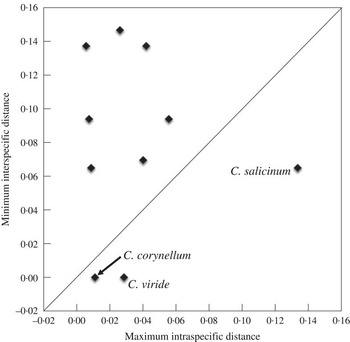
The distinctiveness of the species was also examined using a conservative barcoding analysis, the presence or absence of the barcoding gap sensu Meier et al. (Reference Meier, Zhang and Ali2008): that is, whether the maximum pairwise genetic distance within a species (the two most dissimilar samples of a given species) is smaller than the minimum pairwise distance between it and closely related species. It asks the question: is variation within the species in question smaller than that between it and close relatives, as expected for discrete and monophyletic lineages? Minimum interspecific pairwise difference was plotted against maximum intraspecific distance for each species.
Results
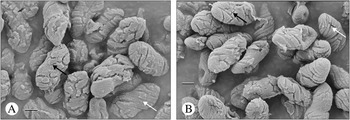
Three sets of specimens were examined morphologically and chemically, corresponding to C. viride and C. corynellum, in addition to British C. aff. corynellum. Spore width did not vary significantly when comparing C. aff. corynellum with C. viride (t=−0·030, P=0·977) and with C. corynellum (t=0·753, P=0·467), both with 11 df: spores of C. aff. corynellum were 5·8±0·6 µm wide (reported as average±standard deviation; n=41), compared with C. corynellum (5·9±0·9 µm, n=60), while C. viride spores were 5·8±0·6 µm wide (n=30). In addition, ornamentation of spores was not markedly different, with spores from both bark (C. viride) and rock (C. aff. corynellum) having spiral ridges when semi-mature, and irregularly and deeply cracked surfaces when mature (Fig. 1), as with C. corynellum (see Supplementary Material Figure S1, available online). Constrictions between cells of the spores were also apparent in both putative taxa. Small sample sizes (especially the small numbers of specimens) limit the breadth of conclusions to be drawn from this spore size study.
SEM images of Calicium spores. A, Calicium. aff. corynellum; B, C. viride. Both species show characteristic spiral ridging (white arrows) when semi-mature, and deep, irregular to areolate cracking (black arrows) when mature. Scales: A & B=2 µm.

No morphological characters are consistently different between C. viride and C. aff. corynellum. For example, all specimens of C. aff. corynellum studied had either no pruina or more frequently a brown pruina on the lower outside of the exciple. Stalk length measurements (though few) were also completely overlapping, with long (>1mm) and short (sessile) stalks in both putative taxa (data not shown). Other characters, such as shape of hypothecium and thallus texture, are rather subjective and no consistent differences could be discerned in this study (although all thalli studied were more evenly verruculose to granular compared with the more leprose C. corynellum from Europe).
Chemistry of 12 accessions of C. viride, seven accessions of C. aff. corynellum, and six specimens of C. corynellum were examined by TLC. Using Lecanora epanora as a control, rhizocarpic acid and epanorin were easy to distinguish in solvent B. However, the expected distinction in chemistry between the Calicium species tested here (rhizocarpic and usnic acids for C. corynellum, and rhizocarpic acid and epanorin for C. viride) was not evident. Instead, all accessions of C. viride from Scotland and Europe, in addition to four of twelve saxicolous collections (C. aff. corynellum from Britain or C. corynellum from Europe), contained only rhizocarpic acid. Three accessions on rock had rhizocarpic and usnic acids, and five had rhizocarpic acid and epanorin with or without usnic acid (Table 1).
A total of 10 new ITS sequences were generated, seven for C. aff. corynellum and three for C. viride, all of which were 593 aligned bp in length after trimming the upstream small subunit and downstream large subunits of the nuclear rDNA (435 bp with ambiguous sites removed). One sequence, EDNA13-0032247, was not full-length but was identical, except at a single position along its 346 bp sequence, with another full-length sequence (EDNA13-0032248), both from C. aff. corynellum. Despite vegetative thalli appearing uncontaminated at ×20 under the dissecting microscope, six of the eight samples with vegetative thalli included in the extraction returned sequences with high background. Cloning of those sequences revealed mostly high matches with contaminant fungi previously isolated from soil or air (23 clones produced 7 different sequences); only one clone matched with high probability and near exact sequence match with a co-occurring lichen, Cliostomum griffithii, which is typically epiphytic but here was isolated from rock.
A total of 17 sequences from C. viride and C. aff. corynellum were analyzed, including six British specimens of each. For authentic C. corynellum, no sequences were available in GenBank and no sequences from it have so far been obtained. The remaining five sequences come from C. viride from Denmark, Argentina and India. Distances between pairs of C. aff. corynellum sequences ranged from 0–1·1%. Pairwise distances for the C. viride sequences were more variable as they were from a much wider area, ranging from 0–2·9% difference across the entire geographical range. Distances ranged between 0–1·0% difference in Scottish and European (Denmark) material, with those from India and Argentina more distant. Pairwise distances between C. aff. corynellum and C. viride ranged from 0–2·6%.
Tibell (Reference Tibell2006) reports on ‘signature sequence stretches’ (SSS); these are 7- or 8-bp motifs found only within a single species of Calicium. For C. viride, 6 such SSS are known, and 5 of these are found in all newly produced C. viride and C. aff. corynellum sequences, with the last SSS motif found in all but three C. aff. corynellum and two C. viride sequences.
Examining the ‘barcode gap’ (i.e. comparing the maximum divergence within species sequences with the minimum divergence between species) shows that all Calicium species studied have wider differences between species than within species, as expected, with the exception of C. aff. corynellum versus C. viride (two points below the 1:1 line near the origin in Fig. 2). Examination of the sequences and distance matrix confirms that the closest relatives of some C. aff. corynellum sequences are found in C. viride, and vice versa. The barcode gap is also absent for C. salicinum, a species previously demonstrated to be polyphyletic (Tibell Reference Tibell2006).
Plot of the ‘barcode gap’, showing minimum interspecific distances versus maximum intraspecific pairwise distances for all Calicium species included in the comparison. Each point represents a comparison between two putative species, with the expectation that between-species distance is larger than within-species (i.e. those species above the 1:1 line shown are said to have a barcode gap).

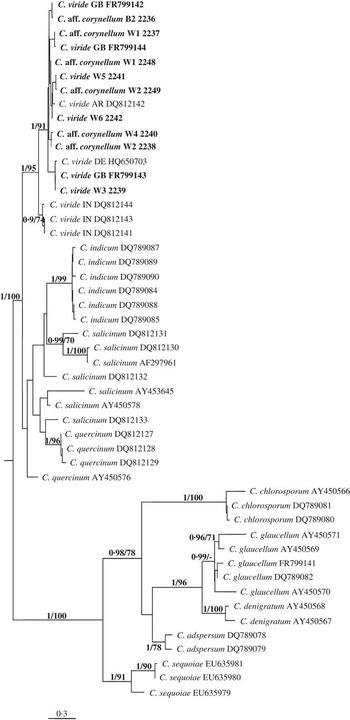
All independent BI runs converged after only c. 10 000 generations, and support values were similar across analyses (and alignments, but with lower support using MUSCLE and CLUSTAL alignments; data not shown). Sequences clustered according to species with strong statistical support (over 70% bootstrap and PP over 0·95) for 6 out of 10 included taxa in ML analyses, with only C. salicinum, C. quercinum, C. viride, and C. aff. corynellum not supported as distinct sequence clusters (Fig. 3). Calicium salicinum and C. quercinum formed polyphyletic groups, while C. viride and C. aff. corynellum sequences were intermixed in a large well-supported clade. This group was further subdivided into two well-supported lineages, one of which contained C. viride from Britain, Denmark, and Argentina, along with C. aff. corynellum sequences, while the other contained all the C. viride sequences from India. The strong support for this latter clade provides some limited evidence of incipient speciation or cryptic speciation for this group of sequences (Molina et al. Reference Molina, Crespo, Blanco, Lumbsch and Hawksworth2004; Leavitt et al. Reference Leavitt, Esslinger, Divakar and Lumbsch2012), which share a set of fixed differences and are each other’s closest relatives.
Clustering of Calicium accessions according to Bayesian inference, shown using the lowest log-likelihood tree. Support values are posterior probability followed by bootstrap, and only values over 0·9 PP/70% bootstrap support are shown. Newly generated British sequences from this study are shown in bold, identified by codes and the last four digits of accession numbers (Table 1). Country codes are given for all other C. viride sequences, GB=Great Britain, DE=Denmark, AR=Argentina, IN=India. All other sequences were retrieved from GenBank.

Discussion
Neither the morphological nor the chemical or molecular studies reported here provide evidence that the British material of putative C. corynellum is taxonomically distinct from its common congener C. viride. No morphological characters or chemical characters consistently differentiate C. aff. corynellum from C. viride. Instead, C. aff. corynellum has features that place it comfortably within the morphological variation expected of C. viride, with brown excipular pruina and short to long stalks. Based on sequence data, it is shown that individual samples of C. aff. corynellum in Britain may be more closely related to C. viride than they are to other C. aff. corynellum specimens. No cluster of sequences corresponds to either C. viride or C. aff. corynellum, except the cluster of three C. viride sequences from India, which suggests this lineage may be distinct. These observations support the hypothesis that C. aff. corynellum in Britain is likely to be a rock-inhabiting form of the more common epiphyte C. viride; the saxicolous habit may also elicit development of a different chemistry, although this should be tested with additional specimens. This study cannot rule out the possibility that these two taxa are recently diverged, with only weakly differentiated morphology (not apparent in the British material) and non-differentiated ITS sequences. Nevertheless, this scenario is much less frequently reported than the opposite case, in which sequence divergence without obvious morphological differentiation is found (e.g. Leavitt et al. Reference Leavitt, Fankhauser, Leavitt, Porter, Johnson and St Clair2011, Reference Leavitt, Esslinger, Spribille, Divakar and Lumbsch2013; Lumbsch & Leavitt Reference Lumbsch and Leavitt2011). Based on the current available evidence, the most plausible scenario is that C. aff. corynellum in Britain is likely to be C. viride which has colonized stonework from nearby epiphytic populations, while ‘real’ C. corynellum, with short-stalked and white-pruinose apothecia is known only outside of Britain (Table 1).
How much information is enough to ‘de-list’ a conservation priority species? In some cases, one or several lines of evidence will provide support for the existence or importance of a taxon. In Britain, for example, populations of Usnea florida are still tracked because they are considered important ecological indicators for high-humidity, old-growth habitats (Woods & Coppins Reference Woods and Coppins2012), despite their genetic indistinctness from the much more common U. subfloridana (Articus et al. Reference Articus, Mattsson, Tibell, Grube and Wedin2002). In that case, ecological evidence may support U. florida as an indicator of declining habitats and it has therefore been tracked separately by those most familiar with the species and its conservation challenges. In other cases, such as in this one, none of the examined and available lines of evidence provides resolution to separate similar taxa. Until verified C. corynellum from the type locality can be sequenced and assessed under the genealogical concordance method using several loci (Taylor et al. Reference Taylor, Jacobson, Kroken, Kasuga, Geiser, Hibbett and Fisher2000), the taxonomic status of the British material and authentic C. corynellum itself will remain in question. The precautionary principle mandates that we continue to track these populations ‘just in case’ the evidence here is not strong enough; in that case, a decision must be delayed until more data are collected. However, in Britain there are no morphological, molecular, or ecological data supporting the separation of C. aff. corynellum and C. viride. It remains to be seen how the conservation community will view the evidence presented here, but in light of the constant battle for resources, it would seem that the saxicolous Calicium in British churchyards might not merit special conservation status.
Scottish Natural Heritage (SNH) and the Royal Botanic Garden Edinburgh jointly funded this project. Natural England’s Wildlife and Conservation Unit provided permit number 20130527 to collect C. aff. corynellum in England. David Genney from SNH is thanked for motivating the study, as well as for providing useful feedback on the project and manuscript. Chris Ellis designed and implemented the linear mixed model for spore size differences in R; Janet Simkin generously offered her knowledge of the details of the population histories and species biology; Sandy Coppins provided good company and help locating populations in the field; and Frieda Christie provided technical assistance with SEM examinations. My warm thanks go to them all.
Supplementary Material
For supplementary material accompanying this paper visit http//dx.doi.org/10.1017/S0024282915000146