Introduction
From 1850 until 1930 the Australian capital cities of Sydney, Brisbane, Melbourne, Adelaide and Perth evolved from little more than towns into major metropolises, each with their own complement of suburbs. Suburbs were a significant component of this growth and over the era became the dominant organizational element of metropolitan areas.Footnote 1 Understanding Australian urbanization during this period and beyond therefore requires an understanding of the nature of these suburbs.
Anglosphere accounts of suburban growth during this period were for most of the second half of the twentieth century understood within the light of an assumed morphology. This morphology argues that the spread of the mercantile city and the medieval city that preceded it were constrained by the technology of their age which created a powerful economic advantage for residents and businesses to be close to the city centre because of their agglomerations of services, infrastructure, transport facilities, workplaces and labour supply.Footnote 2 The first group able to break with the friction of the centre were the bourgeoisie who began moving to the ‘cool green rim’ of the cities in the early nineteenth century.Footnote 3 It was also assumed that the aspiration for a suburban life crossed social classes, but the ability to do so was restricted by the high cost of commuting. However, as transport technology improved, first in the form of horse-drawn omnibuses and then motorized rail, an increasing proportion of the middle classes and some of the lower middle classes were able to make the move into the suburbs.Footnote 4 This middle-class flight began the development of the streetcar suburb, which was itself superseded by the automobile suburb or technoburb post-1950.Footnote 5
In the morphology, streetcar suburbs were spatial manifestations of the bourgeois family model, which had at its core the separation of sexual spheres between the masculine world of business and employment, and the feminine world of home and family.Footnote 6 The suburb was a rejection of the public life of the gathering places of the city and their associated crowds, hustle and bustle, uncontrolled mixing of classes, pollution and vices. In the open spaces of the suburbs, the middle-class family found pleasure in the solitude and the calm of nature.Footnote 7 Suburbs were consequently domestically focused, virtually free of commerce, industry and public places and dependent on the inner areas for economic, social and cultural resources.Footnote 8
Since the 1990s, a number of scholars have claimed this common morphology is conclusively wrong.Footnote 9 Lewis and Harris argued that it had held sway in urban planning, sociology and urban history due to a blinkered adherence to a politically expedient theory advanced by the Chicago School of Sociology.Footnote 10 The alternative thesis was that industry and commerce was able to break clear of the friction of the centre well before the 1950s and that the sharp distinction between urban and suburban had not been made by writers of the time. Industry, motivated by a need for elbowroom, cheap land fit for modern plant and machinery and a desire to obtain a workforce isolated from inner-city militants, began the move to the suburbs in the nineteenth century. As industry moved, workers followed, initially as commuters from the inner city then as residents.Footnote 11 As places with significant and increasing numbers of households and businesses, suburban locations were attractive places for retailers, service providers and small industries to establish.Footnote 12 Consequently, most cities of the era were poly-nuclear conurbations, and their suburbs were often economically and socially as diverse as the cities they surrounded.
This article examines the relevance of the common morphology and the alternative thesis in Australian urban development. It begins with a literature review of academic histories of suburban development in Australia. The history of Australian urban development will then be analysed via a case-study of suburban development in Adelaide, South Australia, from 1850 to 1930. The case-study will use census data, popular newspaper articles of the time, as well as local and oral histories produced by municipal governments throughout the twentieth century to look for evidence in support of either the cool green edge thesis or diversity in economic and social activity.
The growth of the Australian metropolis, 1850–1930
In Australia, the term suburb has long been used to describe areas beyond the immediate jurisdiction of the central city and its local government. Consequently, suburbs in Australia have their own typology within a greater metropolitan area.In this typology, they are often categorized as being inner, middle or outer, based solely on their juxtaposition to the centre rather than density, form, or levels of social or economic activity.Footnote 13 The Chicago School thesis and the central role of bourgeois aspirations and middle-class flight in suburban development had considerable currency in academic histories and analysis of this typology prior to the twenty-first century.Footnote 14 In these accounts, there was a mercantile central business district (CBD) of trade, commerce, civic and cultural life at the core surrounded by a ring of declining inner suburbs, sometimes described as slums, containing industry, vice, poverty and poor sanitation.Footnote 15 Beyond these inner suburbs, there was the great bulk of the city; that is, middle-class suburbs from where breadwinners would commute to city employment. Most accounts of the suburbs tended to describe places of domesticity, church, gardens and serenity, fitting the notion of the bourgeois suburb perfectly.Footnote 16 In these accounts, the industrialization of the suburbs, did not occur until the long boom after World War II when growth in private motor vehicle ownership was able to connect low-density suburban housing with extensive suburban manufacturing plants.Footnote 17
DavisonFootnote 18 articulated this widely held view of Australian urbanization when he argued that suburban growth of this period was driven by a desire for domestic privacy, natural semi-rural surroundings, private ownership and social exclusiveness. However, as Australian cities had few high-density centres or teaming slums of their own, Davison argued that the middle classes of Australia were not finding a haven in the suburbs from their own inner cities, but rather those of the British Isles from where most of the population had come within a single generation. He cites as evidence information distributed in the British Isles at the time used to attract potential settlers. These documents referred to the ability of ordinary folk on modest incomes to afford a cottage and land in the suburbs. The middle-class suburban life was consequently a motivation to move half-way around the world and not just to the edge of town.Footnote 19
Mullins described the wide acceptance of the Chicago School morphology in Australia as a transplanted history of ‘western urbanisation with constant patterns, theories and morphologies’.Footnote 20 Renate Howe concurs, claiming that Australian urban analysis has regularly drawn upon ‘British and American traditions of social analysis of which the Chicago School of urban sociology was one of the most influential’.Footnote 21 Nevertheless, some scholars before and since the 1990s have referred to commercial diversity in Australian street car suburbs. There are accounts of suburbs across the metropolises of the era containing industry and lively and crowded agglomerated parades of shops, pubs, churches, dance halls, libraries, picture houses, hawkers and sporting clubs.Footnote 22 In a recent work, Davison pointed out just because the suburb was intended to foster tranquillity, domesticity and middle-class virtues, there is no reason to assume that they subsequently did so. Although built by the visions of exogenous forces, once constructed, suburbs had the potential to move in diverse directions subject to endogenous dynamism.Footnote 23 In addition, many local and oral histories, published by municipal governments and local history groups, tended to describe their suburbs as places of considerable and diverse economic and social activity, much more akin to Harris and Lewis’ thesis than that of the cool green edge.Footnote 24
In 1991, Frost argued that while the Chicago School model could account for the growth during this period in Brisbane and Sydney it did not sufficiently account for the nature of suburban growth in Melbourne, Adelaide and Perth.Footnote 25 While he argued that there were a number of reasons for this, the most critical was that from their earliest days Melbourne, Perth and Adelaide had ports located a considerable distance from their mercantile cores and, given the choice between the port and the city centre, industry generally found it more advantageous to locate close to the port. This meant that the mercantile centres of trade, colonial administration and commerce were set apart from the physical infrastructure of the port and its industrial labour force.Footnote 26
This separation meant that rail lines were laid between city centres and their ports early in their development, allowing the possibility of ribbon development along the route. The separation of port and city also meant the transition zone and its working-class housing, industry and vice grew well away from the central business district and their mercantile and government functions. Frost argues that the peculiarities of these three cities resulted in different classes residing in different directions from the centre, primarily related to the position of the port and rail lines rather than distance. In Adelaide, industrial working-class areas went west towards the port, while the middle classes went south and east towards the greenery of the hills.Footnote 27
Beginning with a study of inner-city Brisbane, Mullins and Kynaston articulated a further factor at play in suburban development.Footnote 28 They claimed that the suburban home, far from being the final separation of work and home, actually brought about their reintegration and the rise of what they described as an urban peasantry. The suburban backyard allowed substantial domestic economies to develop, devoted to tasks such as the growing of fresh fruit and vegetables, animal keeping, food processing and building and repairing household items.
Urban development in metropolitan Adelaide, 1850–1930
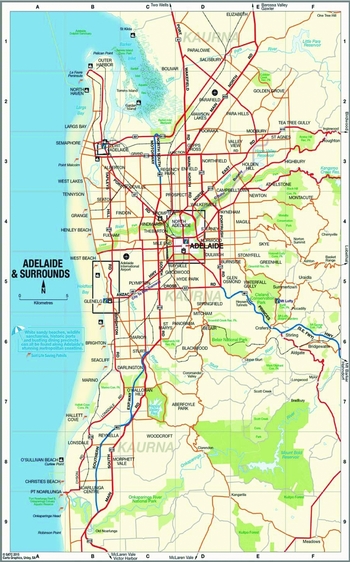
Urban development in Adelaide, the capital of the colony of South Australia, was planned from the outset but followed an unusual course for a number of reasons. First, the original plan for Adelaide surrounded the central square mile with a 400-metre-wide belt of parkland on all sides creating a clear demarcation between the city within and the settlements beyond (Figure 1). Secondly, as Frost noted, the mercantile and government centre was placed over 10 km from the colony's major port.Footnote 29 The mercantile centre also held a central position on a plain that stretched 20 km from north to south and 10 km east to west (Figure 1). Beyond the parklands, the Adelaide plains initially developed as a location of intensive agriculture and horticulture to provide for the growing city. In this rapidly developing semi-rural landscape, a number of towns and villages were planned and built. The central position of the city centre would subsequently allow suburban growth to occur relatively evenly in all directions. Fundamental to the governance of the early settlement were the philosophies of Edward Wakefield, the most important of which was that land be sold to free settlers and the proceeds used to subsidize the passage of labouring classes.Footnote 30 This commodification of the land led to speculation on a massive scale almost immediately after the first titles were issued.Footnote 31
Adelaide metropolitan area
The zenith of speculation occurred during the 1870s and early 1880s, when, in a similar fashion to cities in the USA and elsewhere in Australia, landowners formed private companies to develop commuter rail and tram routes radiating out from the city centre to surrounding towns and villages.Footnote 32 These new lines passed through paddocks for most of their journey but in doing so substantially increased their land value. In a short burst of tram development, Adelaide went from having no tramlines to having over 50 km radiating out in every direction. Commuter stations were also constructed on the Port Adelaide rail line and country rail links that crossed the Adelaide plains.
This speculative phase was short-lived and was immediately followed by economic collapse and depression, which resulted in widespread insolvencies, bankruptcies and asset devaluation.Footnote 33 The enduring legacy of this speculative boom and bust was inexpensive land adjacent to public transport in close proximity to the city centre. Such was the abundance of the land supply that from the 1880s until the 1950s, other than for a few years in the late 1920s, quarter acre allotments in the suburbs of Adelaide could be bought for 60–80 pounds, the equivalent of 2 or 3 months’ income for an unskilled labourer.Footnote 34
Abundant and inexpensive suburban land was to have a major impact on the urban development of Adelaide for the first half of the twentieth century. Cheap land reduced the monetary incentive to convert rural and other low-intensity land uses to urban, leaving the suburban landscape dotted with market gardens and other agricultural pursuits for generations. It also allowed small-scale speculator/developers to purchase land beyond their immediate needs, which they could subsequently subdivide and develop over the long term. Land was also plentiful and affordable for industrial and commercial uses.
The overall effect was that the transfer of early suburbs from rural to urban landscapes was slow and incremental, often taking upwards of 50 years.Footnote 35 Confirmation of this slow evolution is contained in census statistics.Footnote 36 In the period from 1922 to 1947, the original inner municipalities of Hindmarsh, Norwood, St Peters, Port Adelaide and Thebarton were still adding dwellings at around 1.2 per cent per annum, while Unley in the inner south was growing at 2 per cent per annum. This growth occurred at a time when greenfield suburban areas beyond the inner ring in the municipalities of Mitcham, Colonel Light Gardens, Burnside, Payneham, West Torrens, Woodville and Prospect were well established and growing.
The impact of abundant and inexpensive land beyond its boundaries also had a notable impact on the central city of Adelaide. The central Adelaide municipality never evolved to a stage of intensive residential development, instead dwelling growth transferred to surrounding suburbs. As a result, the Adelaide municipality's population reached its historical peak of 43,000 in 1911 and declined thereafter.Footnote 37 Despite its declining residential population, the City of Adelaide maintained a paramount position in mercantile trade, government, culture, large-scale commerce and education. Until the 1960s, it also remained the principal location of metropolitan Adelaide's large stores, markets, hotels, cultural and entertainment venues.Footnote 38
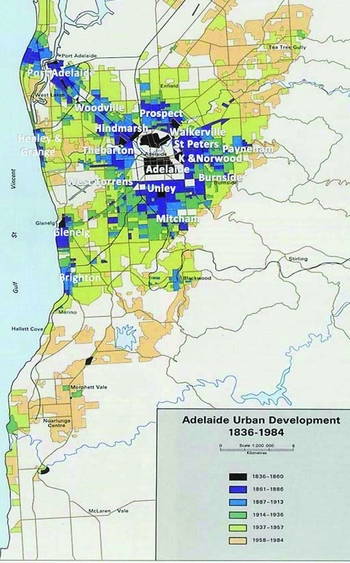
After 1900, the great bulk of Adelaide's metropolitan population growth was to occur in streetcar suburbs centred on the villages that had developed over the Adelaide plains in the latter half of nineteenth century. Thus, while the government of South Australia, based within the city centre, was responsible for delivering infrastructure such as schools, police, post offices and later water and sewerage, the 17 suburban municipal governments of the Adelaide Plains held the major responsibility for metropolitan development (Figure 2).Footnote 39
Adelaide urban development 1836–1984 and 17 municipalities

All these suburban municipalities had their own governments and were separated physically for most of their early development from the centre and each other, thus they developed in a relatively independent fashion and constructed their own sense of identity. This sense of difference and identity remained until the 1930s and beyond. Throughout the twentieth century, every municipality commissioned the writing of at least one local history. Added to these were independently written local histories and the widespread undertaking of oral history projects. Together, there were over 30 local histories written over the course of the twentieth century. Such is the proliferation, the history of the Adelaide Metropolitan area is written largely as the story of 17 distinct places each with their own pioneers, industrialists, political leaders, visionaries and activists, rather than a single polity.Footnote 40
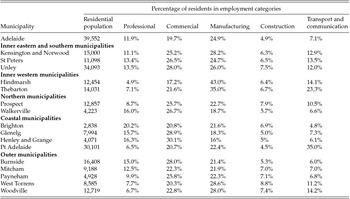
None of the histories presented an image of quiet domesticity, dependence and commuting. Indeed, both official and unofficial histories and the recollections in oral histories tend to convey the opposite. They describe villages and adjacent rural land gradually evolving from rural beginnings into urban environments over many decades. The places described in this evolution were patchworks of large and small dwellings, builders’ yards, manufacturers, large and small commercial premises, market gardens, artisan workshops, pubs, sporting clubs and churches and a diversity of classes. Walkerville, the municipality with the highest proportion of professional residents and largest houses (Tables 1 and 2), was described as having its own food and drink processors, blacksmiths, slaughterhouses, tanneries, furniture makers and clothing makers.Footnote 41 A similar picture was painted in the neighbouring municipality of St PetersFootnote 42 and the other eastern municipalities of Kensington and NorwoodFootnote 43 and Burnside (Figure 3).Footnote 44
Employment data

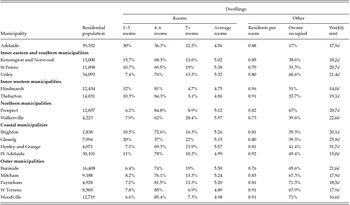
Dwelling data

Source: Australian Bureau of Statistics, Census: Part XXI, South Australia: Dwellings in Local Government Areas (Canberra, 1921), 1636–8.
Jetty Road ‘high street’ in suburban Glenelg 1926

All municipalities were also referred to as containing one or more significant town centres. This is evident in reflective accounts found in oral histories as well as remnant built form and photographs from the period. In suburban locations, commerce, services and so forth were primarily but not exclusively agglomerated in high-street precincts that rose in intensity adjacent major tram or train stops. Local histories and oral testimonies describe suburban ‘high streets’ as places of diverse social, commercial, recreational and civic activity. Each suburban centre, particularly those where the seats of local government were found, had an array of pubs, offices, theatres, dance halls, cinemas and retail premises that attracted crowds of people day and night. Hawkers and buskers also augmented the street life of many of these places.Footnote 45 Eastern Norwood and Western Thebarton were described as places where shops and recreation facilities of all descriptions were in abundance.Footnote 46 While the Port Adelaide town centre at the turn of the century was described as a city of a size and activity to rival the Adelaide CBD.Footnote 47
A statistical snapshot of these centres taken in the 1950s presented a comprehensive picture of these evolved suburban centres. In total there were over 300 agglomerated centres across the metropolitan area serving a population of around 500,000, furnishing 11.5 shops for every 1,000 residents. There were four major centres, one each in Norwood, Unley, Port Adelaide and Glenelg, with over 170 shops each. There were eight centres with between 50 and 120 shops and a further 290 small centres with an average of 12 shops. These figures did not include non-retail premises such as offices, theatres and hotels.Footnote 48
Beyond the centres and the street, the twin foci of suburban life until World War I were either the church or the pub. Both appeared to be locked in competition to provide the social, recreational and entertainment needs of surrounding residents. Pubs offered pursuits such as gambling, billiards, darts, quoits, skittles and cards. They also organized dances, concerts and sporting events such as football games, boxing tournaments and horse and dog racing. In addition, they provided space for the commercial activities of many small businesses. It was common at the time for personnel to be hired, business meetings to take place and transactions managed all within the confines of the local pub. Churches alternatively provided sports, dances, musical and theatrical groups, literary groups, Sunday schools and picnics.Footnote 49 In addition, each municipality had their own sporting teams, particularly Australian Rules football and cricket. There were also bowls, lacrosse and tennis clubs and, after World War I, Returned Serviceman's League clubs became a common feature of most suburbs.Footnote 50
The thesis of diverse and self-contained suburbs was also evident in public transport use. Despite having an extensive, inexpensive and reliable public transport network, per capita public transport use in metropolitan Adelaide was relatively low.Footnote 51 It averaged out at 1.5 return journeys per person, per week, well short of a figure that would have indicated substantial commuting or a need to travel large distances for recreation, work or other transactions.Footnote 52 Although car ownership spiked briefly in the late 1920s, for the vast majority of people walking and cycling remained the principle means of transport until the second half of the twentieth century.Footnote 53
Employment data taken from the 1921 census, the last before the Great Depression and World War II, analysed in conjunction with the low levels of public transport use, provides little support for the thesis of middle- and upper-middle-class commuters living on the cool green edge of the metropolis (Table 1). There is some support for Frost's thesis of industry and the working classes moving west and the middle classes heading south and east.Footnote 54 However, it is a matter of proportion rather than an absolute. While employment in manufacturing was disproportionately higher in the inner western municipalities of Hindmarsh and Thebarton, it was nevertheless a significant proportion of the residing workforce in all municipalities. For example, residents in the eastern municipalities of Kensington and Norwood, St Peters and Burnside or the southern municipalities of Unley and Mitcham were as likely to be working in manufacturing as the residents of Port Adelaide or Adelaide (Table 1).
In all of the municipalities, there was a general consistency in the proportion of residents working in employment categories. Consistent with self-contained communities, people working in transport and communications lived in greatest numbers in the municipality of Port Adelaide, where the city's major port was located, and Thebarton, which contained the main rail yards. Again, it was a matter of proportion as workers in these categories resided in high numbers in all municipalities. People working in building and construction were spread relatively evenly across the metropolitan area. Consistent with people living close to work, the numbers were lowest in the oldest settlements of Adelaide, Port Adelaide and Glenelg, and highest in the then growing outer municipalities of Woodville, West Torrens, Mitcham and Payneham (Table 1).
Given the importance of the Adelaide CBD as a mercantile, commercial and government hub, it is in the categories of professional and commercial occupations where one could expect to find the highest prevalence of commuting from affluent suburbs into the core. It is evident that there were more people working in these occupations residing in eastern, southern and coastal municipalities than in western municipalities, or the central municipality of Adelaide itself. However, it was again a matter of proportion, as the numbers of people working in commerce was spread relatively evenly across all municipalities. It was only professional employment where there were large differences between municipalities. Nevertheless, in the small municipalities of Brighton, Henley and Grange and Walkerville, where proportionally higher numbers of professionals resided, residents working in manufacturing and construction still outnumbered the professional classes.
A comparison of male incomes in 1933 (income data were not tallied in censuses prior to 1933) also points to low-income earners (those earning less than £108 per annum) being a significant proportion of residents in all municipalities. These figures would have been considerably higher in 1933 than in 1921 due to the advent of the Great Depression. Low-income earners ranged from 47 per cent of earners in outer Mitcham and 40 per cent in outer eastern Burnside at the low end to 61 per cent in both Port Adelaide and Hindmarsh at the high end. Between these extremities, low-income earners made up 56 per cent of earners in Thebarton in the inner west, 53 per cent in Woodville in the outer west, 60 per cent in Kensington and Norwood in the inner east and 47 per cent in Unley in the inner south.Footnote 55 Census data provide no evidence of an economically subdued, affluent and dependent cool green suburban edge, then. The lack of commuting and spread of employment across municipalities is consistent with Harris and Lewis’ thesis of economically strong and diverse suburbs with diverse mixes of industry, commerce and class.
Housing
Throughout much of the period, housing finance was available to low and average wage earners via building societies on reasonable terms.Footnote 56 The price of a house in the suburbs was also cheap by today's standards. A new five-roomed house cost the equivalent of three to four years’ income for an unskilled male labourer, while a quarter acre of land cost the equivalent of three to four months’ earnings.Footnote 57 This combination of cheap land and houses meant that home ownership was more common than renting.Footnote 58
The most significant feature of suburban residential development was the low price of the land compared to building costs. In most suburbs, north, south, east or west, a quarter acre allotment typically cost less than 10 per cent of the total cost of building a five-roomed house. Half acre allotments were also readily available and often cost little more than 13 per cent of the total.Footnote 59 While there was some variation in the price of land between suburbs, by far the greatest differentials were within suburbs. For example, in Parkside in the 1890s, allotments with a parklands frontage cost more than three times those facing internal streets.Footnote 60 The cost of building was also similar across the metropolitan area because, as often commented on at the time and evident via a cursory look at these suburbs today, the housing styles and building materials used were similar in most suburbs.Footnote 61
The building of one's own home was also central to suburban evolution and the domestic economy. A large proportion of houses during this period were either self-built or built with large contributions from the owners. The building process was often slow and incremental and while the house was being planned and constructed, it was common for owners to live on the land in temporary shacks, often for many years.Footnote 62 It was also quite common for people to purchase land well in excess of their own needs that could be subdivided and built upon later.Footnote 63
The advertised prices of established homes at the time indicated reasonable equity between suburbs, regardless of location. In the 1920s, homes of comparable size and age sold for similar prices whether east or west of the city or in the inner or outer ring. In general, the largest price differences were determined by first the number of rooms and second, age. Older houses sold for less than new houses and three-roomed homes sold for significantly less than four- to six-roomed houses regardless of location.Footnote 64 Therefore, room numbers give an indication of the value and price of housing and proportions of housing, sizes in a given municipality are a good gauge of wealth and social mix.
While some municipalities had a greater proportion of small dwellings (one to three rooms), and others larger dwellings (seven plus rooms), it was a matter of proportion, as dwellings with four to six rooms made up well over half of the housing stock in all municipalities. In the central Adelaide municipality, 30 per cent of dwellings had one to three rooms, the greatest proliferation of small homes in the metropolitan area. Nevertheless, even here, 56 per cent of dwellings had four to six rooms and 12 per cent had more than seven rooms (Table 2). In addition, across the suburbs, the average number of rooms per dwelling and the number of residents per room within households did not vary significantly regardless of distance or direction from the city centre (Table 2).
Unlike the costs of land and houses, rents did vary from municipality to municipality with little relation to the average size and age of premises. At the low end, Port Adelaide with a large transport-based workforce and Hindmarsh with a large industrial workforce stand out. While at the high end, the cool blue edge of Glenelg and Henley and Grange on the coast seemed to have greatest allure for renters (Table 2). However, for the municipalities between, the differences were less than 20 per cent and followed no obvious pattern in regard to proximity to, or direction from, the city centre. Outer suburbs, despite offering larger dwellings, were generally as cheap as, or cheaper than, inner suburbs and central Adelaide. Mitcham on the southern edge, Payneham in the outer east and Woodville and West Torrens in the outer west all had rents cheaper than Unley in the inner south, Thebarton in the inner west and Kensington and Norwood in the inner east.
The price and distribution of house sizes, rents and incomes points to a spread of classes across suburban municipalities east, west, south or north of the centre. Social differences, like employment categories and male income, tended to be a matter of proportion rather than exclusivity with variable sized pockets of poverty and affluence in all areas. The choice of suburban municipality was thus likely to be far more complex than income and social aspiration alone, if at all. Motives such as family background and custom, as well as proximity to work, family, church, friends, recreation and economic opportunities were likely to be more influential.
The urban peasantry
Jan de Vries,Footnote 65 NicolaidesFootnote 66 and ParrFootnote 67 noted that in the period from 1850 to 1930, the phenomena of household units producing supplementary consumption and income from the home was widespread in a number of countries. However, there is conjecture regarding its nature, extent and significance.Footnote 68 In Australia, particularly Adelaide, the large size of suburban backyards provided economic opportunities particularly for agricultural production and processing.
Gaynor'sFootnote 69 research found evidence of backyard production in all Australian capitals throughout the era. However, as Mullins observed earlier, the significance of backyard production is not available in the statistical record or referred to in economic analysis.Footnote 70 A search for evidence of backyard production and the urban peasantry therefore requires a gleaning of local and oral histories, biographies and the press for anecdotal accounts and incidental references as to its nature and prevalence and whether the means and motive for backyard production existed. At the macro-level during the period, Adelaide had phenomena and features likely to give rise to an urban peasantry. As noted previously, suburban allotments of a quarter or half acre were common and affordable. Water, an extremely important commodity in Adelaide, where summers are hot, long and dry, was by the 1880s piped to most houses, while backyard wells were common.Footnote 71 It was also very uncommon for married women to be in formal work.Footnote 72
In addition, employment for many male breadwinners was irregular but predictable due to the nature of industry in South Australia where, up until the 1940s, manufacturing and port activities revolved around the processing of seasonal primary produce. The output of capital goods manufacturers and engineering companies were also inextricably bound to these sectors as providers of machinery for agricultural production, handling and processing.Footnote 73 In a low-wage economy of fluctuating employment, the backyard had the potential to be a significant provider of family consumption. As compared to today's prices, the cost of food as a proportion of income was high. For example, the price of a loaf of bread was equivalent to $9 today, a dozen eggs $24, milk $12 per litre and meat from $30 to $60 a kilo.Footnote 74 Hence, for the low or average income earner providing food for the then average household of five, if bought, would have consumed a large proportion of their income.
With both the means and incentives to do so, it is not surprising that there are frequent referrals to backyard production in local histories, biographies, oral history projects and newspaper articles from the period. Oral accounts of residents reflecting on their earlier lives in the suburbs of Adelaide recounted that ‘nearly every household' undertook some sort of backyard production.Footnote 75 There are numerous references to householders growing fruit, vegetables, herbs and spices as well as keeping pigeons, fowls, pigs and cows for eggs, milk and meat.Footnote 76 There is also substantiation that the practice was prevalent and widespread. Seaside Glenelg despite its comparatively high rents and property values was described as a ‘paradise for pigs’ and the backyard slaughter of animals was reportedly common.Footnote 77 Poultry production was also reported as being carried out in ‘almost every backyard’,Footnote 78 while a large amount of the metropolitan milk, butter and cheese supply was reported as coming from backyard cowsheds.Footnote 79 Dr Llewelyn Davey described his 1891 Payneham home as having sheds and stables, fruit and vegetable gardens and livestock.Footnote 80 In the then new suburbs of Parkside in the 1880s, it was estimated that 75 per cent of all homes were growing fruit and vegetables in their substantial rear yards.Footnote 81 There is also evidence of backyard production in problems reported in the local press such as plagues of flies and rats, poor sanitation, noise and noxious odours. These reports reflected an image of suburban life very different from the cool green edge image of idyllic rural tranquillity.Footnote 82
Moreover, the weekend newspaper, the Mail, in the first decades of the twentieth century contained a section called ‘The suburban half acre’. This large section of the paper dispensed advice on raising animals and growing flowers, fruit and vegetables in the backyard. It also ran numerous advertisements for items indispensable to backyard production such as chickenfeed, seeds and tools.Footnote 83 There is also evidence that backyard production went well beyond ‘peasant’ production and became income-generating commerce. In various historical accounts, there are references to peddlers selling a diversity of fresh produce door-to-door and the widespread growing of almonds as a cash crop for sale to confectionary makers.Footnote 84 In the Mail, contributors to ‘The suburban half acre’ boasted of the considerable revenue they received from sales of their backyard production.Footnote 85
An illuminating early account of the commercial potential of backyard production was contained in Parson's History of Hindmarsh in its reference to the humble beginnings of one of the municipality's most famous sons, John Brooker.Footnote 86 In the 1880s, John Brooker claimed to be earning £60 a year from his suburban half acre, an amount he expected to rise to over £100 once his fruit trees had matured. Mr Brooker at the time was working full time and claimed he produced the bounty in his spare time with little assistance (for reference he was married and had three sons and a daughter). At this time, £100 was equivalent to the annual income of an unskilled labourer and over double what a female could expect to earn in most jobs. Hence, a half acre or a quarter acre lot had the potential to provide significant income.
There is also considerable evidence that household production went beyond agriculture. There are numerous references in local histories to domestic production such as making clothes, food processing, soft drink making, brewing, distilling and winemaking.Footnote 87 Other backyard industries referred to in suburban histories included the manufacture of pottery, jewellery, boats and confectionery. Tradespeople and carters commonly used backyards and sheds for storage, stabling and the manufacture of tools and fittings.Footnote 88 Carriage and coach manufacturers in 1913 complained of ‘unfair’ competition from backyard operators.Footnote 89
Conclusion
The growth of Adelaide from 1850 to 1930 supports Nikolaides’ assertion that the concept of the bourgeoisie suburb of leisure, home and family driven by aspiration and social mobility was ‘an illusion from the start’.Footnote 90 The accounts of commercial, recreational and industrial activity in all municipalities points to each suburban municipality evolving and eventually becoming economically diverse and relatively self-contained, with most residents living, socializing and working locally. Each evolving municipality had significant levels of commerce and manufacturing with differences between municipalities being a matter of proportion rather than exclusivity.
The suburb also provided social, cultural, entertainment and recreation opportunities equivalent to those of a similarly sized town. All of the suburban centres described in local and oral histories were referred to as significant gathering places in their own right and unambiguously urban. What is more, none was static. The initial development of suburbs was exogenous and attached to the demands and growth of the city via immigration and a high birth rate. However, once established, local factors created an endogenous dynamic able to tap into the ideas, initiatives, resources and consumption of the local population.
Suburbs were also places of household production able to add to household consumption and income. Rather than being the final blow to the family income model, the suburb brought about its revitalization via backyard production. Backyard production allowed married women in particular to generate produce and income for their family. In doing so, women lived a life far from the passive domesticity and consumption reflected in the bourgeois suburb. Thus, the desire for a quarter acre or half acre allotment in the suburbs was, for many, due to its productive potential, not a desire for a bourgeois family life of quiet domesticity and leisure in semi-rural retreats.