In Islamic jurisprudence one of the duties of the state is hirasatud-din wa siyasatud-dunya: guarding religion and managing the world. Guarding religion from the people who would tarnish, damage, and destroy it. In Indonesia, there is religious freedom but there cannot be freedom to defile religions that are followed by other citizens, either by harassment, undermining doctrine, or through activities that cause social conflict as was done by the deviant sects.
——Maman Abdurrahman, Chair of Persatuan Islam (Persis)Footnote 1INTRODUCTION
Since the fall of President Soeharto in 1998, Indonesia has played host to a curious form of internecine conflict: Islamist vigilante groups have been attacking members of a small, socially marginal Muslim sect called Ahmadiyah. Ahmadiyah is a controversial sect with followers around the globe. Many Sunni Muslims charge that Ahmadis are not true Muslims due to their belief that their founder, Mirza Ghulam Ahmad, was a prophet. The vigilantes claim that Ahmadiyah is damaging Islam by propagating the belief that another prophet came after Muhammad and have dubbed Ahmadiyah a “deviant sect,” invoking a 1965 presidential decree that demands all Indonesians adhere to one of the six religions sanctioned by the state: Islam, Protestantism, Catholicism, Hinduism, Buddhism, and Confucianism. For over ten years, the pillars of Indonesian democracy—the state, the police, and Muslim civil society—have been either unwilling or unable to stop the attacks.Footnote 2
What explains the prolonged violence toward Ahmadiyah?Footnote 3 What, if anything, is significant about the targeting of Ahmadis? The leading explanation treats the attacks as a product of democratization, decentralization, and the influence of small but vocal vigilante groups like the Islamic Defender's Front (FPI) and Hizb ut-Tahrir Indonesia, who use the issue to gain public support. As the International Crisis Group explained, “With the advent in 2005 of direct local elections including at the district level, hardline groups have found it expedient to lobby locally for policy changes, from banning alcohol to closing Ahmadiyah mosques.”Footnote 4 Human rights advocates have lambasted the state for bowing to pressure from these hardline groups.Footnote 5 Against U.S. Secretary of State Hillary Clinton's lauding of Indonesia for its democratic transition, longtime human rights advocate Andreas Harsono branded Indonesia “no model for Muslim democracy” due to the state's unwillingness to protect religious minorities.Footnote 6
This explanation for intolerance toward Ahmadiyah is consistent with assumptions about the moderate character of Islam in Indonesia and the secular state; scholars have long argued that in contrast to Middle Eastern states, in the world's largest Muslim-majority country Islamist movements have failed to find a foothold.Footnote 7 For example, the historian Robert Elson asserts that Islam exerted little influence on Indonesian politics before independence in 1945 and thereafter remained “marginalized and relatively unimportant in a political sense” and “greatly overshadowed by a form of political thinking usually called ‘secular nationalism.’”Footnote 8 Yet this assumption is not supported by empirical data. Contemporary surveys with leaders of Muslim civil society suggest that rather than being tolerant toward Ahmadis, an overwhelming majority believes Ahmadis should not be allowed to hold public office, build houses of worship, or teach Islamic studies.Footnote 9 Those same leaders, however, believe that Christians and Hindus should be permitted greater religious and political freedom. Ahmadiyah, it would seem, marks the boundary of Indonesia's much-lauded “generally tolerant brand of Islam.”Footnote 10
Nor is intolerance toward Ahmadis a recent by-product of democratization; it preceded the establishment of the state in 1945 and continues to reflect its policies. The first closing of an Ahmadiyah mosque in Indonesia was by order of the Regent of Batavia in 1936.Footnote 11 Leading Muslim organizations deemed Ahmadiyah heretical in the 1920s and 1930s, and in 1980 and 2005 the quasi-governmental Indonesian Council of Ulamas (MUI) and its regional bodies issued fatwas against the sect.Footnote 12 Municipal and provincial government bans on Ahmadiyah occurred throughout the 1970s, 1980s, and 1990s.Footnote 13 According to the Ministry of Religion (MORA), religion is a privileged category, and syncretic movements like the Javanese kepercayaan and heterodox movements like Ahmadiyah have long been refused recognition.Footnote 14 Despite claims to being a “secular democracy,” the state is fully involved in the firm demarcation of religious orthodoxy.
In this essay, I suggest an alternative reading of intolerance of Ahmadiyah by excavating overlooked aspects of the tangled relationship between religion and nationalism. I suggest that the privileging of religious orthodoxy and the truncated pluralism of the Indonesian state constitute a theoretically neglected form of religious nationalism that I dub “godly nationalism.” The term “religious nationalism” is usually invoked as a conceptual placeholder for particular instances of Jewish, Islamic, Hindu, Christian, or Buddhist nationalism. Yet in demanding that citizens believe in God, while being ambivalent as to which path to God they should choose, Indonesia's brand of nationalism is exclusively religious but not particular.
I theorize godly nationalism as an imagined community bound by a common, orthodox theism and mobilized through the state in cooperation with religious organizations in society.Footnote 15 As long as citizens believe in one of the state-sanctioned pathways to God, they become full members of civil society and receive state protection and other benefits of citizenship. Conversely, the advocacy of disbelief is actively discouraged; not only are disbelievers thought incapable of ethical behavior, they are thought to make belief in God more difficult for the rest of society by confusing true beliefs with false ones, propagating falsehoods, and undermining religious education. For a godly nation to endure, it must privilege some beliefs and prosecute acts of deviance as blasphemy.
Like other forms of nationalism, Indonesia's godly nationalism is a product of specific practices; I demonstrate that the persecution of heterodox and liminal faiths brings together groups that are otherwise at odds due to differences in religious doctrine, political interests, or economic class. In that respect, the answer to my question, “What, if anything, is significant about the targeting of Ahmadis?” is that intolerance and nation building are part of a mutually constitutive process. The campaign against Ahmadiyah is part of a broader effort by civil society and the state to constitute the nation through belief in God. In that respect, contemporary intolerance to Ahmadiyah is merely the most recent manifestation of a longstanding effort to promote godly nationalism while dislodging secular or Islamic alternatives.
Indonesia is not the only country to host debates over belief in God, religious freedom, and blasphemy. In one prominent case, the High Court of Egypt convicted a professor of Arabic language and literature, Nasr Hamid Abu Zayd, of apostasy on the grounds that he was no longer a Muslim because he supported liberal ideas. The international human rights community decried the verdict against Abu Zayd as an affront to freedom of religion, and labeled his accusers “intellectual terrorists.”Footnote 16 Such accusations of ideological intolerance are often read backward into debates over blasphemy. Yet, focusing on the ideological origins of intolerance overlooks the productive, community-forming practices that acts of exclusion make possible. Instead, I suggest that the debates over blasphemy are an attempt to affirm (by Muslim civil society) or disrupt (by liberals) norms and laws that help constitute the nation through belief in God. While highlighting the productive effects of intolerance may be normatively discomforting to scholars, ignoring the results of intolerance means misunderstanding a long-standing and perhaps increasingly common form of nationalism.
In the next section I describe the trajectory of scholarship on religion and nationalism to highlight overlooked areas. Two empirical sections on “Productive Intolerance” that follow focus on key events in twentieth-century Indonesia to illuminate the coming together that the exclusion of heterodoxy enables: “Part I” explores primary-source archival material on the history of Ahmadiyah and its relation to early state formation. “Part II” shows how godly nationalism was institutionalized in 1965, and then draws upon ethnographic observations from the most important court hearing on religion and politics during Indonesia's post-1998 democratic period. I conclude the article by drawing parallels to other cases and intervening in a recent debate about religious freedom and imperial intervention.
NATIONALISM AND RELIGION
Studies of nationalism in the postcolonial period overwhelmingly rely on Benedict Anderson's definition of an “imagined political community—and imagined as both inherently limited and sovereign.”Footnote 17 Anderson argues that beginning with the French Revolution and print-capitalism, groups of people began to see themselves as connected with other people through their linguistic and cultural practices. Nationalism developed slightly differently in postcolonial states: secular schools created an educated indigenous upper class; the census created categories of racial groups with which to organize formal political institutions; maps defined the nation's political boundaries, along which narratives of conquest and control were woven; and museums manufactured the archaeological truths of the nation.Footnote 18
Anderson's conception of modern nationalism has been criticized for ignoring religion. In an influential early critique, Peter van der Veer suggested religious practice and discourse may be a constitutive part of national identity rather than epiphenomenal or a smokescreen for hoary political interests. He focused on everyday practices, including conversion, pilgrimages, and the deployment of religious symbols, to argue that the activities that underpin nationalism are dynamic rather than a relic of colonialism.Footnote 19
Since the late 1990s, accounts of religion and nationalism that emphasize hybridity and fluidity have become dominant and, in doing so, have challenged the secularity of core concepts in political theory.Footnote 20 Drawing on a comparison of Asian and European nationalism, van der Veer and Hartmut Lehmann suggest that hybridity is not the exception but the norm.Footnote 21 Van der Veer moreover suggests that the modern subject is produced alongside the modern public, and both are infused with religion. Likewise, in critiquing the history of nationalism, Partha Chatterjee suggests that classical nationalist historiographies often hide the religious solidarities that underpin national loyalties.Footnote 22
While the first generation to rethink religion and nationalism crossed religious lines, the second has drawn its inspiration more from the Muslim world. Talal Asad built on his earlier work on the anthropology of Islam by arguing that the social solidarities of the Muslim umma (community) neither mimic nor compete with nationalism, since the modern community is theologically rather than territorially defined, self-governing rather than unified by an overarching political unit, and produced through embodied ritual rather than the formal institutions of the modern state.Footnote 23 Asad's student, Charles Hirshkind, echoed van der Veer in suggesting that the ethical sensibilities cultivated by modern religious movements redefine the boundaries between public and private, religious and secular. In doing so, religious movements return religious authority to the public sphere but do not undermine nationalism.Footnote 24
Like Hirshkind and van der Veer, Lisa Wedeen focused on everyday practices rather than formal doctrine or nationalist historiography. She argued that nationalism is no more static than any other aspect of culture. Drawing on the synthesis of theological and nationalist imagining in the Yemenese newspaper al-Īmān, Wedeen persuasively argued against teleological conceptions of secularism as either following religious nationalism or competing with it.Footnote 25
In parallel to these advances on Anderson's conception of nationalism, scholars of Indonesia have developed sophisticated alternative visions. Among the more underappreciated theoretical critiques of Anderson is Michael Laffan's 2003 book Islamic Nationhood and Colonial Indonesia, which maps the writings of Muslims from Southeast Asia who studied in the Hijaz and Cairo during the late nineteenth century. Once abroad, Laffan found, members of the emergent Indonesian Muslim ecumene felt a heightened sense of belonging to Muslim Southeast Asia, and upon their return their periodicals al-Imam and al-Munir were instrumental in forming a sense of community.Footnote 26 The subtitle of al-Imam, “The voice of Indies Muslims who love their religion and their homeland,” captures the reformers' overlapping commitments.Footnote 27 Rather than working against nationalism, Laffan suggests, Islamic reform played a key role in the imagining of the Indonesian umma.
More recently, Chiara Formichi and Kevin Fogg, though they emphasize the repeated failures of Islamists in national politics since the 1950s, have shown how religious and national commitments can be coterminous. While Elson claims, “Islamist ideas were late in emerging in modern Indonesia, and long remained marginal to Indonesians' ideas of what their nation should be and do,”Footnote 28 Formichi shows how, in fact, pan-Islamic and then Indonesian Islamic nationalist ideals endured beyond the late colonial period in the writings of the influential leader of Darul Islam, Kartosuwiryo.Footnote 29 On the grassroots level, Fogg reveals how pious Muslims experienced the 1945 revolution as an explicitly Islamist struggle, even while their leaders in Jakarta were hopelessly fractured by theology, political practice, and an inability to pass their legislative agenda.Footnote 30 Fogg, Formichi, and Laffan demonstrate that Islamism was crucial to the coming together of the Indonesian nation, and thus provide a vital historical corrective to Anderson's vision of the triumph of secular nationalism.
That said, insofar as Fogg, Formichi, and Laffan delegate religious nationalism to the dustbin of history or the geographic and intellectual periphery of national politics, these advances are incomplete. As I will show, Indonesian nationalism continues to be rooted in religious solidarities even while it is not an Islamic state. My argument challenges scholarly conceptions of the triumph of the “secular” state and the failure of its counterpart, the Islamic state, by mapping the genealogy of the godly state and its concurrent practices.Footnote 31
As Indonesian politicians often point out, the Pancasila state is not secular. Pancasila is the basis of Indonesian national ideology; its five principles are belief in God, humanitarianism, national unity, social justice, and democracy as expressed through representatives of the people. In the 1950s, both secular nationalists and Islamists saw Pancasila as an alternative to Islamic nationalism. In the 1970s, Soeharto made it the ideological pillar of the regime and forced civil society organizations to pledge their allegiance to it. In the 1980s, opponents of the regime articulated a diverse set of goals employing the language of Pancasila. In a thoughtful text, Douglas Ramage described this hybridity and embraced Pancasila as supportive of nation building and democratization, and a bulwark against an Islamic state.Footnote 32 Yet Ramage ignores the place of heterodox faiths and the inherent limits of tolerance in a state that makes belief in God obligatory while defining religion narrowly. He celebrates the non-Islamic aspect of Pancasila but ignores the non-secular element. Similarly, Saiful Mujani and R. William Liddle tweak the definition of secular actors so as to include those who identify with Pancasila and its demand that adherents possess “belief in the one high God.”Footnote 33 Like Ramage's view, this surprising redefinition is made possible by the endurance of a false binary between Islamic and secular nationalism. Since Pancasila is not Islamic, the reasoning goes, it must be secular.
Luthfi Assyaukanie, however, provides a hint of a middle category by delineating three “models” of state-Islam relations. The first is an Islamic democratic state governed by Islamic law. The second is a secular liberal democratic state. The third model is a religious democratic state. Importantly, in differentiating the religious democratic state from the liberal democratic state, Assyaukanie notes that followers of heterodox faiths are not recognized in the former.Footnote 34 Yet Assyaukanie's sympathies are with the liberals and, as a result, he does not discuss the limits of his third model. This is likely deliberate, since making the state secular and liberal would demand a radical restructuring of Indonesian nationalism.
In what follows, I build on the work of van der Veer, Asad, Wedeen, Laffan, and Assyaukanie to argue that Indonesia contains a form of nationalism that is neither Islamic nor secular, but rather exclusively and assertively religious. Active state support for religion did not die in 1945 with the failure of the Jakarta Charter and the state's embrace of Pancasila, or in 1952 with the rejection of Islamic law, or in 2002 when the parliament again rejected the incorporation of Islamic law into state law, or with the repeated failures of Islamists in electoral competition despite moderating of their demands. Rather, the privileging of religion is made manifest through state support for religious orthodoxy over liminal and heterodox faiths.
I define godly nationalism as an imagined community bound by a common, orthodox theism and mobilized through the state in cooperation with religious organizations in society. Godly nationalists feel that belief in God is a civic virtue that accrues both individual and social benefits. For individuals, belief in God brings an enlightened understanding of the world that is preferable to premodern beliefs such as animism, heterodox beliefs, or secular worldviews. Individuals who believe in God are seen to be wiser, more compassionate, generous, and tolerant. The archetype of a good citizen is one who believes in God and uses that belief to motivate his or her behavior. Likewise, social and political institutions are thought to perform better if individuals working within them believe in God.
While belief in God is a goal for good citizens, it is not necessarily based on coercion. Godly nationalism may be formally established by the state and coercively enforced by the police, bureaucracy, and courts, such as through personal status laws based on religious principles and limits on individual freedom. Alternatively, godly nationalism may be informally policed though social norms, religious organizations, media, and the family. Regardless of the degree to which godly nationalism is enforced, belief in God is seen as a virtue that should be promoted through education, ethical guidance, and social norms. A godly nation limits individual freedoms so as to ensure that disbelievers do not tarnish, damage, or destroy the world's religions.
Godly nationalism should not be conflated with being compatible with but contrary to secular nationalism, as Hirshkind and Asad contend is the case with religious nationalism. Rather, godly nationalism occupies one middle position between religious and secular nationalism. Nor does this make Indonesia an example of the ambiguity that accompanies modern secularism. In contrast to religious nationalism, godly nationalism is plural; the state promotes belief in God through multiple religions. In contrast to secular nationalism, godly nationalism is predicated on theological rather than geographic or ethnic exclusion; liminal groups, heterodox groups, and nonbelievers are denied the full benefits of citizenship. While Hussein Agrama's astute reading of Egypt suggests that the blurring of the religious and the secular serves the expanding regulatory capacity of the modern state, I detail an alternative that is not necessarily moving toward either liberal secularism or theocracy.Footnote 35 Godly nationalism is also distinct from Robert Bellah's “civil religion.”Footnote 36 The state is not the focus of worship in godly nationalism; it is rather the conduit for religious belief, guiding its citizens toward proper faith and behavior.
In the next section, I delve into key events in the history of religion and politics in Indonesia to flesh out the argument that godly nationalism is an overlooked form of nationalism, in which intolerance toward heterodoxy constitutes the nation. I show that the earliest contacts between Ahmadiyah representatives and Muslim organizations were respectful but soured quickly, culminating in Ahmadiyah's exclusion from membership in the country's first important Muslim political coalition. This act of exclusion helped to congeal the fractious Muslim groups and contributed to the institutional foundation for the postcolonial state, thereby demonstrating the productive power of exclusion for generating solidarity in the emergent nation.
PRODUCTIVE INTOLERANCE, PART I
Ahmadiyah is a small Muslim sect that originated in Qadian, South Asia, in the late nineteenth century and spread to Sumatra and Java in the 1920s. The movement's founder, Mirza Ghulam Ahmad, was a controversial figure who made two claims that ran counter to mainstream Sunni doctrine. First, against the Sunni Muslim belief that the prophet Jesus had not died a natural death but had been taken from the earth by God and would return to earth on Judgment Day, Mirza Ghulam Ahmad held that Jesus had died a natural death and could not return. His second, related claim was that he was the Mahdi, the prophesied messiah of Islam heralding Judgment Day.Footnote 37
From 1923 to 1929, Ahmadiyah and the leading Islamic reformFootnote 38 movement, Muhammadiyah, were able to work together based on a shared commitment to Islamic modernism.Footnote 39 After 1925, however, Muhammadiyah leaders began to ask whether these two Ahmadiyah beliefs—that Jesus died a natural death and that Ghulam Ahmad was a prophet or “renewer”—were sufficiently deviant to be considered non-Muslim.Footnote 40 In 1928 Muhammadiyah's central board declared that, because Ahmadis believed in a prophet after Muhammad, it would be forbidden to teach the views of Ahmadiyah, and the next year the religious council proclaimed that members of any group that believed in a prophet after Muhammad were unbelievers.Footnote 41 After the split, Ahmadis became objects of ridicule and were removed from their positions in Muhammadiyah.Footnote 42
Another Islamic reform group, Persis, underwent a similar evolution from embracing to repudiating Ahmadiyah.Footnote 43 From 1930 into 1931, Persis extolled Ahmadis as leaders of Islamic reform, promoted their founding principles, circulated speeches from the Ahmadiyah Lahore congress,Footnote 44 and published letters from Muslims who had been tempted to convert to Christianity but were “reclaimed to Islam” by Ghulam Ahmad.Footnote 45 In June 1931, however, Persis leader Ahmad Hassan published a critical study of Ahmadis, which examined whether they believed that Muhammad was the final prophet.Footnote 46 Ghulam Ahmad's claim to prophethood rested on the notion that other prophets could be sent by God to reform religion.Footnote 47 Ahmad Hassan followed up by challenging the Ahmadiyah Qadian to three nights of public debate in which he interrogated Ahmadiyah representatives on whether the prophet Jesus had died, and thus whether he could return to earth on Judgment Day.Footnote 48 A second round of debates was held in November 1934. Between these two debates, Persis published an open letter to Ahmadiyah leaders, describing its disputes with Ahmadi belief and practice.Footnote 49 Persis invited the Ahmadiyah members to read foundational Ahmadiyah texts and see the teachings, and offered to visit Ahmadis’ homes. The March 1934 edition of Pembela Islam featured articles in which the beliefs of Ahmadiyah were derided, not merely categorized as outside mainstream belief.Footnote 50 An article on the opposite page told why Ahmadiyah doctrine betrays the pillars of Islam and declared its fundamental beliefs erroneous.Footnote 51 This marked the first instance when Ahmadiyah was designated deviant (aliran sesat) by an Islamic organization. In later years the Indonesian state would echo this designation.
Designating Ahmadiyah a deviant sect was the first step toward excluding its members from Muslim civil society. In various articles in 1936, the Persis magazine Al-Lisaan labeled Ahmadiyah followers apostates, non-Muslims, and crazy, and repeatedly called Ghulam Ahmad a false prophet, liar, and deceiver. Seventeen Ahmadis who had left Ahmadiyah and joined Persis were celebrated.Footnote 52 The back cover of the April issue featured a photograph of an Ahmadiyah Qadiani mosque in Batavia that had been closed by decree of the regent, and in June the magazine announced formation of the Anti-Ahmadiyah Committee, aimed at calling the issue of Ahmadiyah to the attention of Muslims.Footnote 53 Similarly, the Committee for the Elimination of Ahmadiyah in Medan was formed in November 1935 to issue a fatwa against Ahmadiyah.Footnote 54 The staff at the office of marriage in Medan subsequently refused to marry Ahmadis and prohibited them from entering prayer houses, mosques, or other Islamic sites.Footnote 55 In 1936, the Sultan of Deli in East Sumatra, the region's religious leader, determined that Ahmadis could not be buried in Muslim cemeteries, and in 1937 in Bukittinggi, 180 ulama declared that Ahmadiyah Qadiani were non-Muslims.Footnote 56 On multiple occasions, Al-Lisaan stated that Ahmadiyah was a “British tool” for destroying Muslims.Footnote 57 In short, by the end of 1936 Ahmadiyah had been pushed outside of the theological and social boundaries of the umma. In the coming years, as shared opposition to Ahmadiyah provided the glue for Muslim organizations to work together politically, the policies of the nascent Indonesian state would formalize Ahmadiyah's marginalization.
Like Muhammadiyah, the traditionalistFootnote 58 Islamic organization Nahdlatul Ulama (NU) warned its followers that Ahmadiyah denied the articles of faith.Footnote 59 In a debate between NU and Persis on the practices of taklid (adherence to legal precepts set by the early schools of jurisprudence) and ijtihad (setting aside precedent in favor of a new interpretation), Ahmadiyah was cited as a problem that resulted from independent reasoning by individuals untrained in Islamic law.Footnote 60 Persis, meanwhile, used the question of Ahmadiyah to attack the NU practice of talkin (giving instructions to the deceased).Footnote 61 As with NU and Muhammadiyah in the late 1920s, Ahmadiyah's deviance was one of the few issues on which NU and Persis took a similar stance.Footnote 62 And when Sukarno was accused of being an Ahmadi, he too used the Ahmadi question as an opportunity to denounce his enemies. He wrote that while he admired Ahmadiyah for its rationalism and modernism, it was also “devoted to British imperialism.”Footnote 63
This opposition to Ahmadiyah enabled a coalition that other pressing issues facing the Muslim community—Dutch colonialism, the dissolution of the caliphate, the restrictions on religious propagation, and opposition to Christian missionaries—did not. Throughout the 1920s and early 1930s, events in which the major Muslim organizations came together were marked by clashes rather than cooperation.Footnote 64 In 1935, however, NU leader Kiai Wahid Hasjim called for traditionalists and reformists to set aside their differences concerning minor questions: “Do not make the differences [in fur'iyah] a reason for disunity, discord, treachery … while our religion is one and the same, Islam! Our mazhab is one and the same, Sjafi'i! Our region is one and the same, Djawa! All belong to Ahlu Sunnah wal-Djama'ah.”Footnote 65 Hasjim's use of the term Ahlu Sunnah wal-Djama'ah is instructive, since Sunni Muslims used it to describe themselves, usually in distinction to the Shi'ite and other sects.Footnote 66
Despite the growing cooperation of modernist and traditionalist Muslims, NU maintained its distance when the modernists created the Great Islamic Council of Indonesia (MIAI) in 1937. Two issues kept NU from joining. First, the meeting was framed as a continuation of previous congresses, in which modernists had derided traditional practices. NU's response was to propose that the previous congresses be treated as merely “provisional” regarding future policies. The MIAI leadership agreed, and NU joined the 1939 meeting.Footnote 67 The second issue was that Ahmadiyah Lahore attended. NU questioned why Ahmadiyah was permitted to join MIAI when leading Muslims from both inside and outside Indonesia had made it clear that the organization was outside Islam.Footnote 68 From 1938 into early 1939, NU published a three-part essay on Ahmadiyah that focused on its collusion with British imperialism and Ghulam Ahmad's claim to prophecy.Footnote 69 This brought the issue of Ahmadiyah to a head, and at the 1939 MIAI meeting it was resolved: “During the proceedings of the Second MIAI Executive Council in Jombang, a question arose which demands answering: is the door of MIAI open to the Achmadijah? To the question, the Executive Council gave the answer: the doors of MIAI are closed to the Achmadijah.”Footnote 70
From 1925 to 1939, then, Muhammadiyah, Persis, and NU pushed Ahmadiyah from the center of Muslim civil society to outside the incipient community united around MIAI.Footnote 71 And while MIAI lasted only from 1937 to 1943, it profoundly influenced the nationalist movement. As Mizan Sya'roni wrote, “Its establishment marked a turning point in the history of the Indonesian Islamic movement in particular and the nationalist movement in general, since the federation was a pioneer in the drive for Islamic and to some extent national unity.”Footnote 72 Indeed, the coalition of Islamic organizations established in MIAI endured through the Islamic political party Masyumi, which, like MIAI, did not accept Ahmadiyah Lahore when it applied to be a member in the 1950s.Footnote 73
From 1942 to 1943, the occupying Japanese transformed MIAI from an Islamic federation into the political party Masyumi and embedded it in the institutional structures of the proto-state through the Office of Religious Affairs, which became the MORA. Harry Benda notes that by 1944, “The Masyumi … had for all intents and purposes become part of the government itself.”Footnote 74 When the Japanese occupation ended the following year, the Islamic organizations that had formed MIAI only seven years earlier became the governing religious authorities in the new state. Since the MORA's creation, those organizations’ control over the ministry and its penetration into every level of government have allowed it to shape the meaning of religion and its place in public life. The ministry's mission included: (1) to make belief in the One and Only God an operative principle in public life; (2) to be watchful that every inhabitant is free to adhere to his own religion and to worship according to his own religion; and (3) to assist, support, protect, and promote all sound religious movements.Footnote 75 The first task is a reference to the national ideology of Pancasila, with belief in God as the first principle. The second professes freedom of religion, but the meaning of the Indonesian word for religion, agama, is narrower than its English equivalent. Agama was defined in 1952 as a monotheistic religion with belief in the existence of One Supreme God, a holy book, a prophet, and a way of life for its adherents.Footnote 76 This definition closely resembled Muhammadiyah's definition of religion.Footnote 77 Islam, Roman Catholicism, and Christianity (Protestantism) were recognized as religions in 1951, while Hinduism and Buddhism were later included under pressure from Sukarno.Footnote 78 The third task suggests the limits of official tolerance—“unsound” movements like Ahmadiyah were designated deviant streams (aliran sesat, from the Persis designation of 1935) or faiths (kepercayaan) rather than religions.Footnote 79
Since the 1950s, adherents to deviant streams and faiths have been pressured to join the “sound” religious movements.Footnote 80 In 1954, the MORA set up a special section for the Supervision of Faith Movements in Society (Pakem) that monitored heterodox, heretical, and apostate faiths.Footnote 81 As I will show in the next section, the policing of heterodoxy got a boost in authority in 1965 when President Sukarno affirmed that there were only six recognized religions and declared that any group that threatened these religions should be prohibited.
This history reveals that opposition to Ahmadiyah, as a heterodox faith, stretched across theological and political cleavages in Muslim civil society. To Muhammadiyah, Ahmadiyah was a fifth column within Islam. To Persis, Ahmadiyah stubbornly held onto beliefs that perverted the pillars of Islam. To NU, Ahmadis were apostates and stewards of imperialism. That Ahmadis deny the pillars of Islam while calling themselves Muslim has provoked opposition across the diverse Muslim world;Footnote 82 different groups dislike Ahmadiyah for diverse reasons, but nearly everyone agrees on their distaste for the sect. This history further suggests that intolerance is a productive part of the process of transforming a latent identity into one that is politically salient, bringing new attitudes to the fore and enabling new political institutions to emerge. I now turn to showing how these patterns of productive intolerance endure in contemporary, democratic Indonesia.
PRODUCTIVE INTOLERANCE, PART II
The final years of the Sukarno administration were marked by tensions between Indonesia and its new neighbor, Malaysia. Sukarno saw Malaysia and its British military bases as an outpost of counterrevolutionary imperialism, and he mobilized the public behind a campaign of confrontation (konfrontasi), consisting of mass demonstrations, low-level military engagement, and support for revolutionary movements in Southeast Asia. Mass organizations proclaimed their support for Sukarno as the president, leader of the revolution, and commander in chief.Footnote 83
Sukarno also sought to mobilize support as the self-proclaimed leader of the Muslim world. On 27 January 1965, he signed Presidential Order No. 1: “Every person shall be prohibited from deliberately before the public telling, encouraging, or soliciting public support for making an interpretation of a religion adhered to in Indonesia or performing religious activities resembling the activities of such religion when the interpretation and activities are deviant from the principal teachings of such religion.”Footnote 84 Sukarno's “blasphemy law” formalized the orthodox definition of religion that the Islamic organizations had long sought.Footnote 85 Mystical sects were only marginally tolerated; they were recognized as a category of faith (kepercayaan) rather than as religions, and were not entitled to resources from or protection by the state.Footnote 86
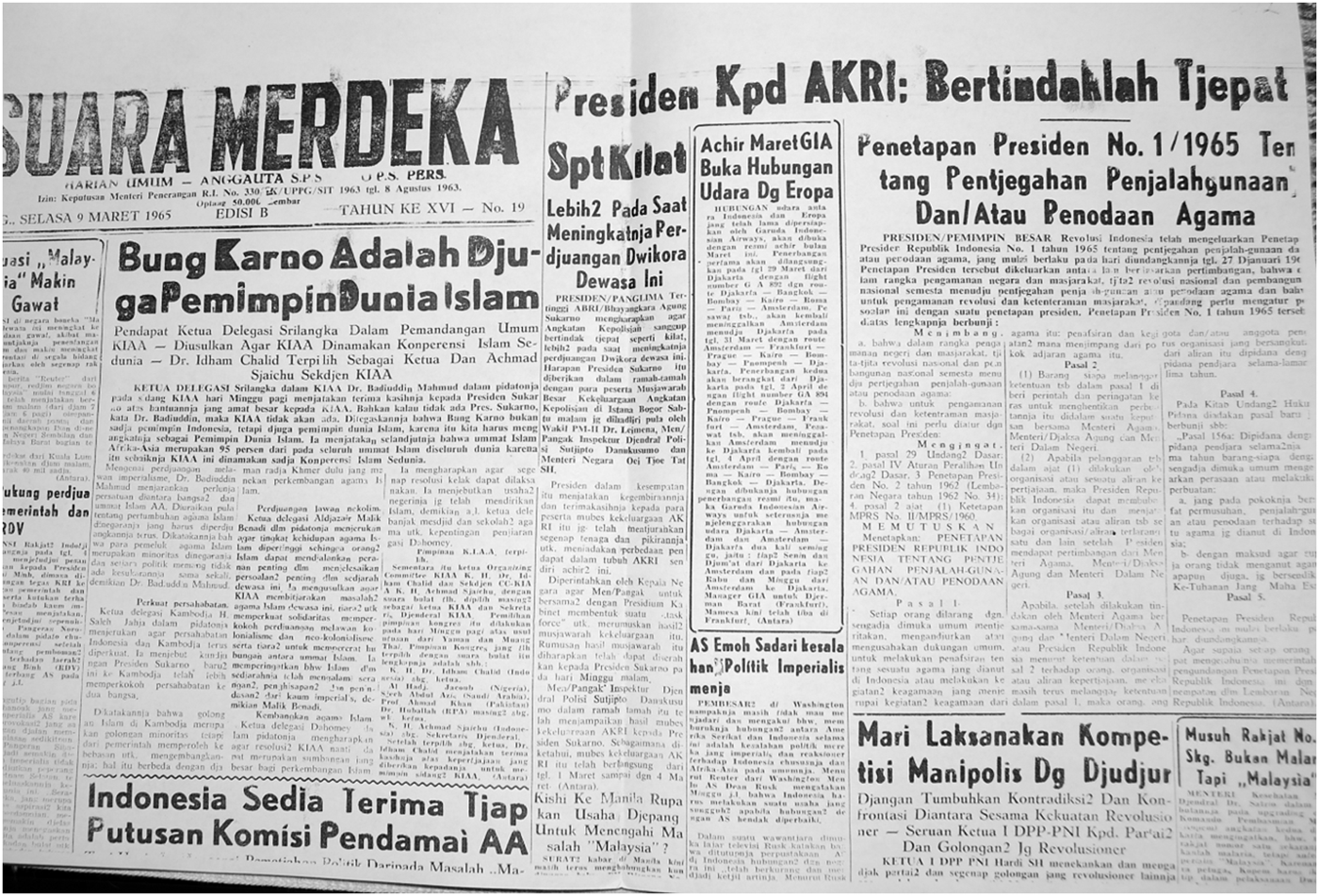
Six weeks after the signing, the law was publicly announced, flanked by a joint statement by NU, Muhammadiyah, Partai Sarekat Islam Indonesia, the traditionalist group Jamiatul Washliyah, and the Indonesian Joint Trade Union declaring their support for Sukarno's broader agenda of revolution, confrontation, and NASAKOM (Sukarno's shorthand for uniting the streams of national politics: nationalism, religion, and communism).Footnote 87 In March 1965, Sukarno hosted a sequel to the 1955 Asia-Africa Conference in Bandung, the international body that became the Non-Aligned Movement. At this Islamic Asia-Africa Conference, leaders from thirty-two countries awarded Sukarno the title “Champion of Islam and Freedom in Asia and Africa.”Footnote 88 The front page of the newspaper shown in figure 1 encapsulates what Sukarno was trying to do; the right side announces the law against blasphemy, while the left headline introduces Sukarno's speech: “Bung Karno Is Also Leader of The Islamic World.” By demarcating the boundaries of tolerance, Sukarno brought together and placed himself at the head of a coalition of organizations, just as MIAI had done in 1939. In another act of productive intolerance, Sukarno strengthened the framework for godly nationalism put into place by the Muslim organizations, the MIAI, and the MORA.
Front page of Suara Merdeka with headlines, “Sukarno Is Also Leader of the Islamic World” and “Presidential Order No. 1/1965 Regarding the Prevention of Abuse and/or Desecration of Religion.”

Since 1965, the organization of godly nationalism has become more formally institutionalized in the state.Footnote 89 Laws concerning personal identity are based on membership in one of the six recognized religions inscribed on each individual's identification card. The state privileges recognized religions, and any educational institution under the auspices of the MORA receives funding while being subject to oversight. Other ministry mechanisms for promoting and controlling orthodox religious belief include support for mosques, guidance in Qur'an recitation, and organization of religious ceremonies. Most of the ministry's work focuses on Islamic development, although there are also offices for Protestant, Catholic, and Hindu/Buddhist affairs.Footnote 90
While the institutional structure of religion crystallized in 1965, two new developments have since arisen: the creation of the Indonesian Council of Ulamas (MUI) and the emergence of a new generation of intellectuals. In 1975, Soeharto created the MUI to co-opt domestic organizations and represent the government abroad in the Organization of Islamic States (OIC) and the World Muslim League (Rabithah Alam Islamy Kerohanian). The MUI was the first state agency to disseminate the views of the OIC. In April 1974, the OIC urged Muslim governments to declare the Ahmadis a non-Muslim minority, which led to anti-Ahmadi resolutions in Jordan, Mauritania, and Mecca, and exacerbated conflicts in Pakistan.Footnote 91 The MUI issued its own fatwa ten years later when it decried Ahmadiyah as a heretical sect. In 2005 it reissued its fatwa against Ahmadiyah with the support of vigilante groups FPI and Hizb ut-Tahrir Indonesia, as well as Persis.Footnote 92 While the content of MUI sentiment harks back to the 1930s, the current scale of mobilization against Ahmadiyah is greater than ever before.Footnote 93
Since the 1970s, Indonesia has also witnessed a growing presence of intellectuals with liberal leanings, including former Muhammadiyah chairs Syafii Maarif and Amien Rais, former NU chair and former Indonesian president Abdurrahman Wahid, and the Islamic intellectual Nurcholish Madjid.Footnote 94 They influenced young scholars who today are prominent in promoting liberal notions of tolerance. These two developments have contributed to polarizing contemporary public opinion even while the origins of intolerance of Ahmadiyah and its institutional manifestation can be traced to the 1930s and 1960s.
In 2001–2002, local government bans on Ahmadiyah and physical attacks on Ahmadiyah mosques launched the most recent debate about heterodoxy.Footnote 95 In response, a group of human rights activists began researching legal remedies to the state discrimination against heterodox groups.Footnote 96 The activists gained momentum with the involvement of the National Alliance for Freedom of Religion and Belief (AKKBB), a network of interfaith organizations that in May 2008 published an advertisement calling for respect for Ahmadiyah, and held a rally that was attacked by four hundred vigilantes.Footnote 97 In 2009, the coalition of Indonesian activists submitted a petition to the Constitutional Court to strike down the 1965 blasphemy law.Footnote 98
In positive legal terms, the activist's petition questioned whether the blasphemy law was consistent with the 1945 constitution. Article 28e, paragraph 1, provides that “Every person shall be free to adhere to a religion and to worship in accordance with his/her religion.” Paragraph 2 states, “Every person shall have the right to the freedom to hold a belief, to express his/her thoughts and attitude in accordance with his/her conscience.” These obligations are echoed in the International Covenant on Civil and Political Rights, which Indonesia acceded to in 2006. The opponents to the petition—the government and the interested parties who submitted evidence—pointed to clauses in the constitution that recognize the state's right to limit individual rights to promote the community's values. Article 28j, paragraph 2, states, “In exercising his/her rights and freedom, every person must be subject to the restrictions stipulated in laws and regulations with the sole purpose to guarantee the recognition of and the respect for rights and freedom of other persons and to fulfill fair demand in accordance with the considerations of moral and religious values, security, and public order in a democratic society.” The opponents pointed to laws from 1964, 1970, 2003, 2004, and 2009 that affirm the centrality of belief in the One and Only God by the state. They argued that since 1950–1951, when Mohammad Natsir was prime minister, promoting belief in God had been a part of the educational curriculum for all public institutions, helping to unify the country's diverse groups. While acknowledging that promoting belief in God could limit individual religious freedom, they suggested that only external practices (forum external) were limited, not internal faith matters (forum internal).Footnote 99
Subsuming the legal arguments was a set of abstract debates: how to govern religion, how to balance protecting religious freedom and promoting belief in God, whether groups can democratically curtail their own rights, and whether determining religious truth is less subjective than other policy issues. The petitioners argued, “The blasphemy law forces the state to determine the proper stream of religion: which is deviant, and which is an acceptable religion. When the state is involved in this decision it is no longer neutral. This is the problem.”Footnote 100 This second set of debates shows how arguments over the blasphemy law produced a consensus about the proper relationship between God and nation in Indonesia. Heterodoxy is excluded from that relationship.
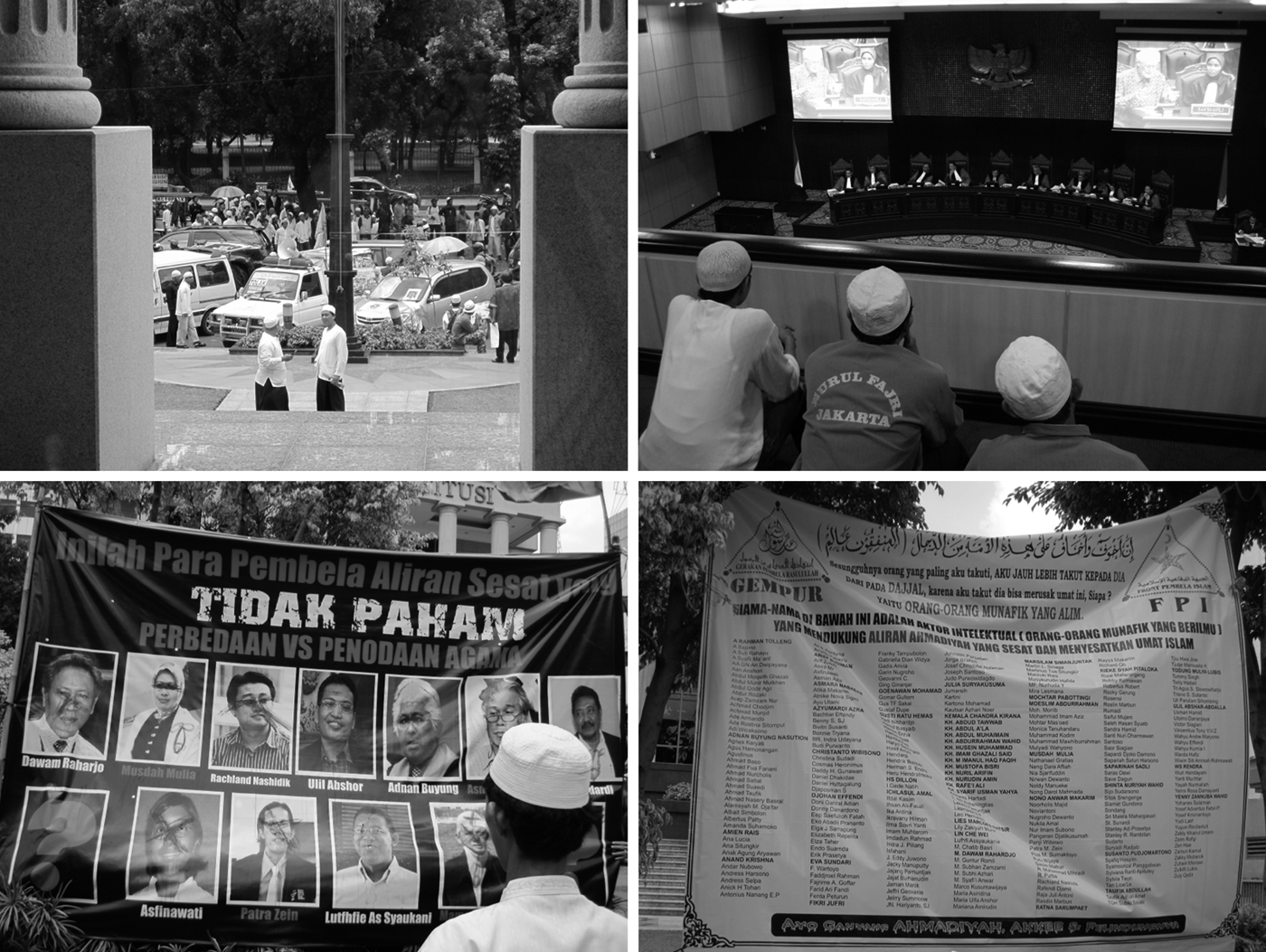
Although both the AKKBB and the petitioners emphasized the need to expand religious freedom in the country to protect the Ahmadis,Footnote 101 no Ahmadis were present in the courtroom. One of the lawyers for the petitioners, Uli Parulian Sihombing, stated that their inclusion would be “too sensitive.”Footnote 102 His caution was inspired by the presence of vigilantes who dominated the courtroom's second floor and the courthouse's front lawn, and hung banners naming activists that they judged apostates.Footnote 103Figure 2 displays the vigilante groups creating a tense atmosphere at the court. Yet an equally important reason for prudence in the court was the petitioners' call for a radical reformulation of the social contract that prominent leaders of civil society believed to be in place.Footnote 104 Sihombing called for the state to be neutral in all matters of faith; as described already, the contemporary state privileges orthodoxy over heterodoxy. By excluding the Ahmadis, the petitioners hoped to sidestep the thorny question of whether the state must become secular in order to be neutral.
Top left and right show vigilante groups dominating the courthouse's lawn and the courtroom's upper level. The banner at bottom left reads, “These are the defenders of heretics: They do not understand religious difference versus the defamation of religion.” It shows photos of prominent activists, which are smeared with feces, some in the shape of genitalia. The bottom right banner reads, “The names below are intellectuals (hypocrites of learning) in favor of the heretic Ahmadiyah and thereby [they] lead Muslims to deviance…. Let us crush the AHMADIYAH, AKKBB, AND THEIR PATRONS.” The names are those of signatories to the AKKBB petition of 2009. Author's photos, Constitutional Court Building, Jakarta, 10 Feb. 2010.
As a result of their exclusion, the Ahmadis were discussed as an example of the necessity of promoting proper belief in God. Amidhan from the MUI testified that human rights and religious freedom had nothing to do with the Ahmadi question because Ahmadiyah was not a recognized religion; if it were, members would be free to practice their faith.Footnote 105 Dr. Atho Mudzhar, a professor of Islamic law and head of the Office of Research and Development in the MORA, testified for the government that the Ahmadis were permitted to their internal beliefs, but the state was obligated to prohibit the dissemination of deviant religious beliefs in order to promote belief in God.Footnote 106 Sudarsono, from the Ministry of Internal Affairs, testified that belief was a matter of internal faith in which the state could not intervene. The expression of faith, however, was a public matter that could be restricted, as with the successful ban on the Ahmadiyah.Footnote 107 During brief mentions of violence toward Ahmadiyah by the intellectual Azymardi Azra, as well as Dr. Kunthi Treiewiyanti and Dr. Yunianti Chuzaifah of the National Commission on Women, the crowd on the second floor screamed at the witnesses until the chief justice threatened to clear the gallery and the lawyer for the MUI signaled for his allies to quiet down.Footnote 108 In sum, while the petitioners intended to support Ahmadiyah, the witnesses' testimony focused on the state's obligation to promote belief in God and prevent blasphemy.
Ahmadiyah's exclusion allowed the interested parties and the state to proclaim their commitment to a limited form of pluralism without extending religious freedom to heterodox faiths. Muhammadiyah supported maintaining the blasphemy law, and implicitly referenced its support for the ban on Ahmadiyah: “Muhammadiyah believes that freedom of religion or religious freedom is not freedom without limits.”Footnote 109 Abdul Mu'ti, one of the leading advocates for tolerance in Muslim civil society, read from a “Guide to an Islamic Life for Members of Muhammadiyah” to exemplify Muhammadiyah's commitment to virtuousness with non-Muslim neighbors. The guide is a vivid expression of both the centrality of tolerance to Muhammadiyah's values and how Ahmadiyah falls outside tolerable limits: “Islam teaches mutual respect and freedom to practice, but not by mixing religions and not by insulting the religious beliefs of others.”Footnote 110
Mu'ti's scholarship further confirms this relationship. His book Kristen Muhammadiyah describes the curriculum of Muhammadiyah schools in areas where the population is overwhelmingly Christian or Buddhist. Teachers of any faith can provide instruction in secular subjects to students of any religion, while the doctrines of each specific religion are taught by a member of that religion.Footnote 111 In a 2009 interview, former Muhammadiyah chair Syafii Maarif touted Mu'ti's research as an example of the group's tolerance, while also making it clear that there would never be a book titled “Ahmadiyah Muhammadiyah.”Footnote 112
In its court testimony, NU also supported pluralism while emphasizing that freedom of religion has limits:
From the Islamic perspective on wellbeing, religious freedom is not a new thing. Long before the Western world's campaign to guarantee the freedom of religion, Islam has for fifteen centuries guaranteed [religious freedom] using verses of the Qur'an, the Hadith, and practices of the Prophet and his companions demonstrating that granting religious freedom in Muslim society is religiously compulsory, just like religion is obligatory.… But something that should be underlined is that this freedom to express diverse beliefs or practices concerns subjects related to fur'iyah, the branches.… The position and attitude of companions of the Prophet and the scholars are clear and firm on matters concerning the usuliyah: those differences of opinion or interpretation of religious practices that oppose points of religious doctrine, especially those ideologies and ideas that differ from the main/basic teachings of religion and are raised in a provocative manner to foment anarchy. If the problem concerns fur'iyah, then we will witness a high tolerance and appreciation by scholars against parties who have different views; yet the Islamic scholars will demonstrate an uncompromising attitude in matters of usuliyah.Footnote 113
The lawyer for NU, Asrul Sani, built on the usuliyah/fur'iyah distinction to argue for democratically delineating the boundary between the two. Under Sani's proposal, witnesses would be able to provide their opinions, lawyers argue their cases, and justices rule in a transparent manner:
The State has the right to determine if religious groups are deviant and force them to choose among the recognized religions.… The majority can decide in a democratic, transparent manner if a group is outside Islam. Catholics could object to Jehovah's [Witnesses] and ban them, Protestants could object to Mormons and ban them. Each community can regulate themselves…. [The problem of Ahmadiyah] could be solved if they were declared non-Muslim. As it stands, they are not entitled to the protection of being Muslim.Footnote 114
Sani's proposal would allow the state to promote belief in God while creating a system for the definition of orthodoxies that could change over time. It would also allow the state to expand the scope of recognition to other religions; heterodox groups would be able to become orthodox and receive state support and protection.Footnote 115 Although illiberal, his proposal attempted to balance the state's mandate to promote belief in God with the protection of minorities.Footnote 116
While the National Protestant Council and National Catholic Council called for the law to be either revoked or revised, most representatives of the country's minority groups supported the law. Matakin, the High Council for the Confucian Religion in Indonesia, advocated maintaining the blasphemy law on the grounds that it helped protect the minority religions, although it also sought to extend the law to include “small religions.”Footnote 117 The government's witness for the Buddhists, Philip K. Wijaya, argued that the law was important to protect minority religions and maintain peace between sects of the same religion.Footnote 118 The representative of the Indonesian Buddhist Community testified that the 1965 law was key to maintaining tolerance in the country.Footnote 119 Yanto Jaya of the Indonesian Hinduism Society supported the law on the grounds that its revocation would lead to violence.Footnote 120
As in the 1930s, Persis enthusiastically backed the eradication of heterodoxy. Persis chair Maman Abdurrahman argued that the law was consistent with the values of the republic: “Indonesia is not a secular state that ignores the values of religion in national life and tolerates blasphemy. The founders of the Republic of Indonesia consciously made sure that religion was integral to the founding of the Republic.”Footnote 121 Persis leader Amin Djamaluddin listed ten examples of deviant sects whose leaders had declared themselves prophets or tried to merge multiple religions into one. He reported these cases to the police, who successfully applied the blasphemy law and imprisoned the leaders.Footnote 122 Rather than being unconstitutional, he argued, the blasphemy law was more important than ever.
The trial did include testimony about victims of the 1965 law. Arnold Panahal, from one kepercayaan group, The Coordinating Authority for Faith Organisations, described how kepercayaan followers have been discriminated against since the end of the colonial period. They are denied access to funding for their schools, cannot list their religion on their ID cards, are prohibited from entering the military, and often refuse to send their children to school because the state would force them to register and be educated in one of the recognized religions.Footnote 123 Representatives of other kepercayaan groups testified that the 1965 law degrades their beliefs, discriminates against them in favor of orthodox faiths, and leads to their stigmatization in society. They pointed to the elucidation of the law that treats kepercayaan as problems to be solved rather than beliefs that must be respected.Footnote 124
The response to the testimony of kepercayaan groups played out in a session when the chief justice asked the parties whether faith in God without subscribing to one of the six religions should be recognized. The answer came from Dra. Hj. Nurdiati of the Irena Center Foundation, which is dedicated to preventing religious conversions from Islam: The regulations of the MORA are clear; kepercayaan is not a religion but only a cultural practice. She went on to say that that the country had experience with another people without religion: the Indonesian Communist Party (PKI). And just like the PKI, groups that do not believe in religion should be banned and their members socialized into belief in God.Footnote 125 Azam from the Indonesian Council for Islamic Propagation said that because kepercayaan consisted of practices stemming from culture rather than religion, their experiences were irrelevant to the law and only germane to the Department of Tourism.Footnote 126
Two routine court practices reinforced the marginality of heterodox groups. At the start of each session, the chief justice asked the day's witnesses what religion they followed and then swore them in under their respective faiths. On 3 March 2010, the petitioners presented a witness, Sardy, who followed a kepercayaan faith. When it was time for the swearing-in, the chief justice asked, “What would you like to swear on?” and Sardy replied, “Pancasila.” The courtroom erupted in laughter, and there was a moment of confusion while the court figured out what to do. Eventually the chief justice replied, “There is no oath for Pancasila,” and proceeded to swear Sardy in on the basis of a personal oath: “I promise to state the truth and nothing but the truth.”Footnote 127
Similarly, most witnesses began and ended their statements with greetings from their respective faiths. For example, orthodox Muslims opened their statements with “Assalamu alaikum” (peace be unto you), to which the audience reciprocated with “Waalaikum salam” (and also unto you). More secular Muslims said both “peace be unto you” and “good morning.” The five participants that adhered to kepercayaan began and ended their statements with rahayu (a Javanese expression of greeting) and sangkalangkong (thank you). While the chief justice reciprocated the kepercayaan greetings on two occasions, none of the other judges or participants acknowledged them. To the contrary, the kepercayaan greetings were challenged. Dr. Eggy Sudjana of the Fraternal Body of the Islamic Scholars for Madura Schools mocked the use of rahayu as an artifact of an outdated culture.Footnote 128 Only greetings based on religious or secular vernacular were deemed appropriate.
By the end of the trial the outcome was certain; eight of the nine justices and the overwhelming majority of witnesses supported the continued exclusion of heterodox faiths from state recognition. Recognition that the heterodox faiths had been discriminated against would have necessitated a redefinition of the meaning of religion in the state, reorganization of the MORA, redistribution of the state patronage system, and an end to the privileging of religious organizations like NU and Muhammadiyah as the backbone of civil society. The judges pointed to these organizations as partners of the state: “Indonesia as a country which upholds the concept that religion is not separated from the state has the MORA which serves and protects the growing and development of religions fairly.… religious organizations that are deeply rooted and have historical foundation are parent organizations of religions recognized in Indonesia. It is these religious organizations that in the end shall be able to become partners of the state in creating religious social order to respect and tolerate one another.”Footnote 129
The decision reaffirmed the existing structure of religion-state relations, and a consensus emerged that the law is vital to promoting the core national value of belief in God. A representative from the Irena Center summarized:
Honored Justices of the court, my name is named Sulaiman Zachawerus, the son of a mother from Ternate and the father from Sanger Talaud, both of whom were Christian from a family of Christians. The only Muslim in the Zachawerus family is me…. Although the law is being appealed by the petitioners, for us this is a blessing in disguise. Because before now, Act no. 1 of 1965 was lost. But now it is a blessing because laymen everywhere will know that we have a law against blasphemy. And they will know that religion is the ultimate concern of humanity, the preeminent concern of every human being. And after [today], if religion is disgraced, then the cost is their soul.Footnote 130
The consensus that Zachawerus, NU, Muhammadiyah, Persis, the minority religions, and the justices helped constitute is plural, modern, and godly. Outside the courtroom, former NU chair Hasyim Muzadi has been a vocal critic of the vigilante group FPI and has refused its repeated requests to engage in dialogue.Footnote 131 Inside the courtroom, FPI and NU were on the same side.
Some of the country's most public proponents of pluralism excluded Ahmadis from the jurisdiction of tolerance and characterized the blasphemy law as irrelevant to freedom of religion even while denying the political quality of this move. In the interview I conducted with Shaafi Maarif in 2009, I asked him the following: “Muhammadiyah is vocal in defending the rights of the Christians and Catholics. Why not Ahmadiyah?” Maarif responded: “Because Muhammadiyah sees this as politics! If Muhammadiyah is involved in defending Ahmadiyah, they will be seen as entering partisan politics. Muhammadiyah was fed up with politics in the 1960s when we exited Masyumi.”Footnote 132 Maarif defines the political in a way that allows him to deny Muhammadiyah's responsibility for the status quo, deny its exclusion of Ahmadiyah, and embrace the liberal injunction to avoid mixing religion and politics. His statement resonates with scholarship on the Islamic revival, where Saba Mahmood suggests that liberal secularism and Islamism compete on terrain that is often considered apolitical but is crucial for demarcating the influence of these two movements.Footnote 133 By excluding the Ahmadis, the discussion in the courtroom shifted from religious freedom and discrimination to a different set of priorities: promoting belief in God, maintaining the state's religious identity while respecting pluralism, distinguishing internal freedom from external freedom, combating deviant beliefs through law rather than violence, and protecting the dignity of religion. This is a vocabulary imbued with commitments to pluralism while differentiated from that of the ostensibly secular West:
The constitution of the Unitary State of the Republic of Indonesia does not allow any possibility for a campaign for the freedom of non-religion, freedom of anti-religion as well as any possibility to insult or defile religious teaching or holy books serving as sources of religious beliefs or to defile God's name. This element constitutes one of the elements marking the existence of a principal difference between the constitutional state of Indonesia and the constitutional states of the West. Accordingly, in the implementation of state administration, the formation of law, and the implementation of government and judicature, the basis of belief in God and teaching as well as religious values serve as a benchmark to determine whether or not a certain law is good, or even whether or not a certain law is constitutional.Footnote 134
Rather than overturning the law, the case helped create a broad, institutionalized, and durable consensus on the values of state and society as rooted in godly nationalism.
CONCLUSION
We have to be able to differentiate between democracy and moral deviation.
——Hasyim Muzadi, Chair of Nahdlatul Ulama from 1999 to 2010Footnote 135Indonesia's successful transition to democracy has not been accompanied by an increase in individual religious freedom. The promotion of belief in God and the exclusion of heterodox faiths help unify the country's diverse population behind a common theism: the state mobilizes religion against secessionist movements, in favor of economic development through family planning, against Islamist militants, and in civic education.Footnote 136 While the vigilante groups use antidemocratic violence, they share a common goal with those large swaths of civil society seeking to live in a nation where belief in God is part of the “overlapping consensus” necessary for a functioning democracy.Footnote 137 Their goal is a polity where individuals, organizations, and the state are partly responsible for one another's moral condition rather than it being the domain of self-determining individuals.Footnote 138
Godly nationalism is not limited to Indonesia. Globally, majorities in over twenty countries say that belief in God is necessary for a person to have good values.Footnote 139 These attitudes are not only influential in the private sphere; nine out of ten Americans would vote for a presidential candidate who is Catholic or Jewish, and eight out of ten for one who is Mormon, yet only 54 percent would vote for one who is an atheist.Footnote 140 Likewise, in a speech to commemorate the four hundredth anniversary of the King James Bible, British Prime Minister David Cameron sought to link citizenship in Britain with holding strong religious values, whether Christian or another faith: “Those who say being a Christian country is doing down other faiths simply don't understand that it is easier for people to believe and practise other faiths when Britain has confidence in its Christian identity.”Footnote 141 Cameron suggests that religious values like belief in God underpin national values; here he echoes the arguments of the Indonesian modernist intellectual Mohammed Natsir, who in the 1950s argued that Islamic nationalists, not secular nationalists, provided the best protection of minority Christians due to their shared devotion to God.Footnote 142 Cameron, like Natsir, sought to create a system of godly nationalism where diverse faiths are mobilized by the state and society is bound by a common theism.
Recent work on religious freedom has stressed its place in the production of a global power differential between imperial states and the developing world. Mahmood persuasively argues that the demarcation of groups as “minorities” is both descriptive and useful for projects of Western imperialism.Footnote 143 Mahmood's comments elucidate the situation in Indonesia, where Christian missionaries have used the guise of religious freedom as an entry point for the conversion of Muslims. It was not an Islamist vigilante but rather Indonesia's most outspoken spokesperson for liberal Islam, Ulil Abshar Abdalla, who expressed this sentiment most succinctly: “Even I think that too much liberalism is bad, like with the freedom of religion. That is how the Christians have spread their proselytization, via ‘freedom of religion.’ When I was in Washington, D.C., I met with a group of Christians and they had a very sophisticated operation to promote freedom of religion. But I think this is not the same freedom that I am talking about. That is Christianization.”Footnote 144 Abshar Abdalla distinguishes between the right of Indonesians to explore their country's diverse belief systems and the right of foreign organizations to build churches in Muslim villages. He supports the first but not the second.
Yet there is more to the debates over religious freedom and religious blasphemy than imperial domination. The war against blasphemy under way in Indonesia is part of a productive effort by Muslim civil society to further develop a system of godly nationalism and communal toleranceFootnote 145 while avoiding the templates of liberal secularism or theocracy. Indonesia's Muslim civil society values the country's religious diversity but does not want to sanitize the public sphere of religion in order to promote liberal values; its vision for a godly democracy aims to balance individual rights, group rights, religious pluralism, and belief in God. Putting this vision into practice is difficult at a time when liberal secularism is equated with tolerance, and religion is synonymous with intolerance, but the rising influence of pious democrats in Tunisia, Turkey, and the United States hints toward a future of godly nations.