The ability to interpret behavior in terms of psychological states (i.e., social cognition) is required for complex social interactions early in life (Astington, Reference Astington1993; Hughes, Reference Hughes2011), and our ability to interact smoothly with others is a cornerstone of mental health (Keltner, Oatley, & Jenkins, Reference Keltner, Oatley and Jenkins2013). In the current study, we examined the environmental determinants of early manifestations of social cognition and the mechanism that links distal and proximal risks to these developmental outcomes.
Social–Cognitive Processes in Infancy and Childhood
Although the exact age at which infants understand behavior by attributing mental states to others remains a topic of debate (for a review, see Baillargeon, Scott, & He, Reference Baillargeon, Scott and He2010), it is clear that by about 18 months children recognize themselves and others as similar yet distinct individuals who may possess different perspectives and orientations to events and objects in the environment (Moore, Reference Moore, Brownwell and Kopp2007). It is around this time that children are able to objectively recognize themselves in a mirror (Brownell, Zerwas, & Ramani, Reference Brownell, Zerwas and Ramani2007; Nielsen & Dissanayake, Reference Nielsen and Dissanayake2004), display empathic and prosocial behaviors (Warneken & Tomasello, Reference Warneken and Tomasello2006; Zahn-Waxler & Radke-Yarrow, Reference Zahn-Waxler and Radke-Yarrow1990), and engage in cooperative interactions with others (Warneken, Chen, & Tomasello, Reference Warneken, Chen and Tomasello2006). These social–cognitive skills can be thought of as “precursors” to more advanced forms of social cognition, such as theory of mind (ToM; Charman et al., Reference Charman, Baron-Cohen, Swettenham, Baird, Cox and Drew2000; Rochat & Striano, Reference Rochat and Striano1999). They are considered precursory because they rely on cognitive processes that developmentally precede a full-fledged understanding of others' minds. At 18 months, infants' ability to understand others as unique psychological beings requires two underlying processes: first, children must understand that others have subjective experiences of the world that may be different from their own; and second, they must recognize that they themselves are an objective entity (Barresi & Moore, Reference Barresi and Moore1996; Moore, Reference Moore, Brownwell and Kopp2007). Together, these mental processes scaffold the emergence and maturation of various social–cognitive skills, including joint attention, empathy, cooperation, and self-recognition, as outlined below.
Joint attention refers to the ability of individuals to selectively and jointly attend to an object or event. It includes aspects of alternating eye gaze, following another person's attention, and directing the attention of others. Although infants can use their own gaze and gestures to direct the attention of others beginning at about 9 months, their capacity to coordinate attention with others in order to engage in a shared social activity is not fully established until 15 to 18 months (Tomasello & Carpenter, Reference Tomasello and Carpenter2007; Tomasello, Carpenter, Call, Behne, & Moll, Reference Tomasello, Carpenter, Call, Behne and Moll2005). In addition, Charman et al. (Reference Charman, Baron-Cohen, Swettenham, Baird, Cox and Drew2000) have shown that joint attention at 20 months is predictive of ToM at 44 months, thereby implicating this skill as an early precursor to ToM. Another putative precursor to ToM is empathy. According to Zhan-Waxler and colleagues (Zahn-Waxler & Radke-Yarrow, Reference Zahn-Waxler and Radke-Yarrow1990; Zahn-Waxler, Radke-Yarrow, Wagner, & Chapman, Reference Zahn-Waxler, Radke-Yarrow, Wagner and Chapman1992), empathy refers to an individual's ability to experience others' affective and/or psychological states. These researchers have provided evidence that children's prosocial behavior is associated not only with empathic concern for the distress of others but also with attempts to label and understand another's distress by making appropriate comments or asking insightful questions. Furthermore, Charman et al. (Reference Charman, Swettenham, Baron-Cohen, Cox, Baird and Drew1997) showed that, compared to normal and developmentally delayed children, 20-month-old children with autism demonstrate marked impairment on tasks assessing empathy, thus suggesting that empathy is a core social–cognitive ability in the second year of life. A third social–cognitive precursor is cooperation. According to McCabe, Houser, Ryan, Smith, and Trouard (Reference McCabe, Houser, Ryan, Smith and Trouard2001), cooperation requires the ability to mutually infer each person's mental state in order to form shared expectations regarding gains, and to make cooperative choices in accordance with those gains. Dunn, Brown, Slomkowski, Tesla, and Youndblade (Reference Dunn, Brown, Slomkowski, Tesla and Youngblade1991) have shown that ToM at 40 months is related to ratings of children's cooperative behavior 7 months earlier (Perner, Ruffman, & Leekam, Reference Perner, Ruffman and Leekam1994). Moreover, in a study examining children's cooperative responses in a prisoner's dilemma game, Sally and Hill (Reference Sally and Hill2006) showed that children who passed the false-belief tasks also tended to be more cooperative than those who failed such tasks. These results implicate early cooperation as another antecedent to ToM. Finally, self-recognition has been identified as an early-emerging social–cognitive ability that some have argued is a prerequisite to successfully make inferences regarding the experiences of others. Gallup (Reference Gallup1998) argues that “an organism that can become the object of its own attention … finds itself in the novel position of being able to make inferences about comparable states of awareness in others” (p. 3).
The coincident temporal onset of these precursor skills at 18 months may reflect a universal conceptual change in children's social cognition at this stage of development. Further evidence for a link between these skills comes from research showing that they correlate (Bischof-Köhler, Reference Bischof-Köhler2012; Dawson et al., Reference Dawson, Toth, Abbott, Osterling, Munson and Estes2004; Nichols, Fox, & Mundy, Reference Nichols, Fox and Mundy2005; Velichkovsky, Reference Velichkovsky1995). In addition, a potential neurological link between these precursory abilities is suggested by research showing that children with autism (a condition characterized by deficits in ToM and social cognition) perform poorly on tasks assessing these skills compared to normal controls (Charman et al., Reference Charman, Swettenham, Baron-Cohen, Cox, Baird and Drew1997; Cohen & Volkmar, Reference Cohen and Volkmar1997). In support of this view, brain imaging studies now show that the same neural substrates involved in ToM (Gallagher & Frith, Reference Gallagher and Frith2003) are also involved in joint attention (Williams, Waiter, Perra, Perrett, & Whiten, Reference Williams, Waiter, Perra, Perrett and Whiten2005), cooperation (McCabe et al., Reference McCabe, Houser, Ryan, Smith and Trouard2001), empathy (Vollm et al., Reference Vollm, Taylor, Richardson, Corcoran, Stirling and McKie2006), and self-recognition (Kircher et al., Reference Kircher, Senior, Phillips, Rabe-Hesketh, Benson and Bullmore2001). Collectively, these results point to an underlying cytoarchitecture that subserves these putative social–cognitive precursors as well as later ToM.
In sum, social cognition at 18 months can be described by a collection of emerging behaviors that are precursory to more advanced forms of social understanding, and include joint attention, empathy, cooperation, and self-recognition. Some researchers have proposed that these social–cognitive skills are supported by various forms of intention understanding (e.g. Moore, Reference Moore, Brownwell and Kopp2007), which provides a cognitive account of the interrelatedness of these skills. In the current study, we operationalize social cognition at 18 months as a collection of these precursor skills. Our goal is to consider how these early manifestations of social cognition may be shaped by distal and proximal environmental experience.
A Sociocultural Perspective on Social–Cognitive Development
Social cognition across childhood has been linked to numerous biopsychosocial factors. For example, social cognition (including ToM) develops in several distinct stages, which can be mapped onto advancements in neurocognitive functioning, including the orbitofrontal cortex (Stone, Baron-Cohen, & Knight, Reference Stone, Baron-Cohen and Knight1998), anterior cingulate cortex (Vogeley et al., Reference Vogeley, Bussfeld, Newen, Herrmann, Happe and Falkai2001), temporal–parietal cortex, and amygdala (Siegal & Varley, Reference Siegal and Varley2002). Various regions of the prefrontal cortex have also been implicated in ToM development (Spreng, Mar, & Kim, Reference Spreng, Mar and Kim2009). In addition to these maturational changes, behavioral genetics studies have shown that a large portion of the variability in ToM performance at age 5 is attributable to shared environmental factors (Hughes et al., Reference Hughes, Jaffee, Happe, Taylor, Caspi and Moffitt2005). Some “hybrid” models of social–cognitive development hold that innate mechanisms may guide the development of early social–cognitive competencies, whereas environmental influences may become more pertinent as children's social horizons are broadened throughout life (Meltzoff, Gopnik, & Repacholi, Reference Meltzoff, Gopnik, Repacholi, Zaelazo, Astington and Olson1999). There is a surprising paucity of literature examining how social-environmental factors contribute to children's social cognition before the preschool period.
Many have argued that children's understanding of others' minds is rooted in social interaction (see Fernyhough, Reference Fernyhough2008). The earliest and most important of these interactions are those that occur with caregivers. Several components of social interaction seem critical for the development of social cognition. One set of parental responses includes concepts such as engagement, attunement, contingency, reciprocity, and sensitivity. These elements of parenting have been found to predict ToM performance in the preschool period (Ereky-Stevens, Reference Ereky-Stevens2008; Hughes, Deater-Deckard, & Cutting, Reference Hughes, Deater-Deckard and Cutting1999; Meins, Fernyhough, Russell, & Clark-Carter, Reference Meins, Fernyhough, Russell and Clark-Carter1998; Symons & Clark, Reference Symons and Clark2000). One potential function of these aspects of parenting may be to motivate the child to participate in social interactions due to the reward provided by positive interpersonal experience. Another set of parental responses that have been related to social cognition are those that supply children with the cognitive tools that are required for representing their own and others' internal states. These include behaviors such as maintaining the child's focus of interest (Landry, Smith, Swank, & Guttentag, Reference Landry, Smith, Swank and Guttentag2008), talk about the mind (Laranjo, Bernier, Meins, & Carlson, Reference Laranjo, Bernier, Meins and Carlson2010; Ruffman, Slade, Devitt, & Crowe, Reference Ruffman, Slade, Devitt and Crowe2006; Taumoepeau & Ruffman, Reference Taumoepeau and Ruffman2006), reflection (Fonagy, Steele, Steele, Moran, & Higgitt, Reference Fonagy, Steele, Steele, Moran and Higgitt1991), mind-mindedness (Meins et al., Reference Meins, Fernyhough, Wainwright, Das Gupta, Fradley and Tuckey2002), and autonomy support (Bernier, Carlson, & Whipple, Reference Bernier, Carlson and Whipple2010). Together, these various dimensions of parenting may simultaneously recruit children into social interactions and motivate them to stay engaged, while also providing the cognitive stimulation and alternative perspectives that are needed to learn about others' minds (Fernyhough, Reference Fernyhough2008). In the current study, our measure of parental behavior includes both of these elements.
Language skills are believed to mediate or enhance the development of other cognitive processes, such as the ability to represent and reason about others' internal experiences (Fernyhough, Reference Fernyhough2008). From this perspective, cultural influences on social understanding can be conceived of as specific patterns of social interactions and culturally derived semiotic systems (e.g., language) that are essential to social–cognitive development. These views corroborate those of Nelson (Reference Nelson, Astington and Baird2005), who emphasized how emergent language faculties contribute to children's capacity to construct mental representations. However, other accounts of environmental influences on social–cognitive development do not feature language as a central mediator of social understanding, instead arguing that early forms of social cognition are paired with a unique motivation for interpersonal interactions that in turn espouse more advanced representational thinking (Tomasello et al., Reference Tomasello, Carpenter, Call, Behne and Moll2005). Taken together, children's acquisition of social–cognitive competencies likely involves a language-mediated mechanism, but there may also be a pathway that is independent from language-based processing (see Jenkins & Astington, Reference Jenkins and Astington1996).
Distal and Proximal Social–Environmental Influences on Social–Cognitive Development
A sociocultural perspective on the development of social cognition implies more than simply examining parental influences on children. Bronfenbrenner (Reference Bronfenbrenner1979) argued that development occurs within embedded “layers” of context. The proximal layer of influence involves the relationships in which the child takes part and includes processes in parenting described above. Such proximal influences are embedded within distal structures, such as the economic and cultural communities that have a bearing on the way parents carry out parenting tasks. Models that test the way in which distal factors are associated with children's outcomes through proximal processes have been referred to as indirect effect or mediation models (MacKinnon, Fairchild, & Fritz, Reference MacKinnon, Fairchild and Fritz2007; Preacher & Hayes, Reference Preacher and Hayes2008). Because they take account of multiple levels of influence simultaneously, these models provide a more comprehensive account of the ways in which distal and proximal aspects of the environment are associated with development.
Social disadvantage, broadly construed, is the distal factor most strongly associated with a wide range of children's outcomes, including psychopathology, language, and social/cognitive adjustment (Hackman & Farah, Reference Hackman and Farah2009; McLoyd, Reference McLoyd1998; Okun, Parker, & Levendosky, Reference Okun, Parker and Levendosky1994). Distal risks that have been linked to aspects of children's cognition include socioeconomic disadvantage (Bradley & Corwyn, Reference Bradley and Corwyn2002), low parental education (Cutting & Dunn, Reference Cutting and Dunn1999), single-parent and stepfamily status (Amato, Reference Amato2001), parental psychiatric health (Rohrer, Cicchetti, Rogosch, Toth, & Maughan, Reference Rohrer, Cicchetti, Rogosch, Toth and Maughan2011), and adversity in the parents' background (Bailey, DeOliveira, Wolfe, Evans, & Hartwick, Reference Bailey, DeOliveira, Wolfe, Evans and Hartwick2012). Distal risks treated independently do not capture the degree of risk exposure experienced by children. For instance, Dong et al. (Reference Dong, Anda, Felitti, Dube, Williamson and Thompson2004) investigated the co-occurrence of 10 environmental risks, and they found that these risks were significantly more likely to occur together than to occur alone. Cumulative risk indices have been constructed to test the idea that development is affected by the accumulation of environmental risk rather than the occurrence of a single and specific risk. Cumulative risk measures have been found to explain more variance in child outcomes than any single factor (Flouri & Kallis, Reference Flouri and Kallis2007).
As risks accumulate, parents' ability to provide support, attention, and sensitivity to their children is reduced (Ayoub et al., Reference Ayoub, O'Connor, Rappolt-Schlictmann, Vallotton, Raikes and Chazan-Cohen2009; Burchinal, Roberts, Zeisel, & Rowley, Reference Burchinal, Roberts, Zeisel and Rowley2008; Burchinal, Vernon-Feagans, Cox, & Investigators, Reference Burchinal, Vernon-Feagans and Cox2008). Although support has been found for a pathway from cumulative risk to child psychopathology through parenting (Cabrera, Fagan, Wight, & Schadler, Reference Cabrera, Fagan, Wight and Schadler2011; Lengua, Honorado, & Bush, Reference Lengua, Honorado and Bush2007; Trentacosta et al., Reference Trentacosta, Hyde, Shaw, Dishion, Gardner and Wilson2008), this pathway has never been examined for early social cognition.
Understanding the contextual influences on social–cognitive development is important for the study of developmental psychopathology because of the established links of social cognition with psychopathology (Baron-Cohen, Reference Baron-Cohen1989, Reference Baron-Cohen and Baron-Cohen1997; Baron-Cohen, Leslie, & Frith, Reference Baron-Cohen, Leslie and Frith1985; Buitelaar, Van der Wees, Swaab–Barneveld, & Van der Gaag, Reference Buitelaar, Van der Wees, Swaab-Barneveld and Van der Gaag1999; Hughes & Ensor, Reference Hughes and Ensor2006; Pilowsky, Yirmiya, Arbelle, & Mozes, Reference Pilowsky, Yirmiya, Arbelle and Mozes2000; Schenkel, Marlow-O'Connor, Moss, Sweeney, & Pavuluri, Reference Schenkel, Marlow-O'Connor, Moss, Sweeney and Pavuluri2008; Wang, Wang, Chen, Zhu, & Wang, Reference Wang, Wang, Chen, Zhu and Wang2008) and social functioning (Dunn & Cutting, Reference Dunn and Cutting1999; Slaughter, Dennis, & Pritchard, Reference Slaughter, Dennis and Pritchard2002). There are inconsistencies with respect to the strength and consistency of these relationships (Hughes, Cutting, & Dunn, Reference Hughes, Cutting and Dunn2001; Hughes, White, Sharpen, & Dunn, Reference Hughes, White, Sharpen and Dunn2000), and the mechanisms of association (including moderators) are not yet understood; but it is likely that social cognition is one of the many contributing factors to the development of psychopathology.
Goals of the Present Study
We tested a model in which cumulative environmental risk is associated with children's social cognition at 18 months through its effect on parenting. In this model, we examined whether cumulative risk at Time 1 (T1; children are ~2 months) is associated with a change in maternal behavior from T1 to Time 2 (T2; children are 18 months). By controlling for maternal behavior at T1 and examining change in maternal behavior, we are better able to argue for the causal role of cumulative risk on parenting difficulties. We then examined whether maternal responsivity is related to children's social cognition at T2. At T1, the measurement of maternal sensitivity is largely affective; however, as Landry et al. (Reference Landry, Smith, Swank and Guttentag2008) have shown, as mothers focus and expand their children's interests, sensitivity takes on a strong cognitive element. Thus, at T2 we enhanced the measurement of sensitivity by adding a cognitive component. To differentiate this construct from T1 sensitivity, we called the T2 variable maternal “responsivity.” It was hypothesized that maternal responsivity at T2 would be associated with children's social cognition at 18 months. On this note, it would have been ideal to examine the effect of responsitivity on change in children's social cognition (for instance, from 18 to 24 months); however, it was not within the capacity of the study to carry out two visits so close in time on such a large sample.
Consistent with Vygotskian theory, strong links have been shown between language and social cognition (Astington & Jenkins, Reference Astington and Jenkins1999; Hale & Tager-Flusberg, Reference Hale and Tager-Flusberg2003; Milligan, Astington, & Dack, Reference Milligan, Astington and Dack2007), and it is possible that language serves to augment social cognition. Thus, another hypothesis of the present study was that part of the association between maternal responsivity and social cognition would operate through children's concurrent language ability. The direct relationship between social disadvantage and social cognition has been found to be inconsistent, though the majority of evidence suggests that factors such as low socioeconomic status and parental education place a child at risk for poor social–cognitive outcomes (see Lucariello, Durand, & Yarnell, Reference Lucariello, Durand and Yarnell2007). Based on this literature, we hypothesized that there would be a significant association between cumulative risk and social cognition at 18 months, but that this relationship would operate fully through maternal behavior and child language, as outlined above.
Method
Sample
All women giving birth to infants in the cities of Toronto and Hamilton between February 2006 and February 2008 were considered for participation. Families were recruited through a program called Healthy Babies Healthy Children, run by Toronto and Hamilton Public Health Units, which contacts the parents of all newborn babies within several days of each newborn's birth. Inclusion criteria for participation in the Kids, Families and Places intensive sample (IKFP) included an English-speaking mother, a newborn who weighed >1500 g, and two or more children who were <4 years old. Thirty-four percent of families approached agreed to take part. At T1 (infants were 2 months old), 501 families took part in data collection. These families were followed up at T2, at which point the youngest child in each family was about 18 months old (which represented the target age). Due to sample attrition, data were available for 397 of the original 501 children at T2. Of these 397 children, no social–cognitive data was available for 23 of them. The mean age of children at T2 was 1.60 years (SD = 0.16). There were 254 boys and 247 girls in total at T1.
The sample is highly diverse including a wide range of ethnicities (European N = 280, 55.9%; East and Southeast Asian, N = 60, 12%; South Asian, N = 72, 14.4%; Black N = 46, 9.2%; Other N = 43, 8.6%) and nearly half immigrants (N = 233, 46.5%). It includes families with significant risk: income below $20,000 (N = 45, 9.5%), teen mothers at birth of first child (N = 31, 6.2%), and single-parenthood (N = 32, 6.4%). Families were drawn from a wide range of neighborhoods (census tracts with between 7% and 49% single-parent households, based on Statistics Canada 2006 census data). We compared the IKFP sample at T1 with the general population of Toronto and Hamilton, limiting the census data to women between 20 and 50 years of age and having at least one child. The comparison was based on five indicators: immigrant status, number of persons in the household, family type, and mother-reported income and education. The IKFP sample was similar to the general population in terms of number of persons in the household (M = 4.52, SD = 1.01, vs. M = 4.13, SD = 1.22) and personal income ($30,000–39,999 vs. census population mean = $30,504.16, SD = $37,808.12); however, the IKFP sample had fewer nonintact families (lone parent: 5% vs. 16.8%; stepfamilies: 4.3% vs. 10.3%), fewer immigrants (47% vs. 57.7%), and more educated mothers (53% had a bachelor's degree compared to 30.6% in the general population).
Procedure
The current study was embedded within a larger longitudinal study, the goals of which were to examine genetic and environmental influences on children's socioemotional development through the investigation of within-family differences. The study design combined the strengths of epidemiological methodology (large and diverse sample, multiple siblings, and home visits) with the strength of developmental methodology (tasks developed in the laboratory and detailed microsocial observational data). Two trained interviewers visited each family's residence for approximately 2 hr at two time points: when the target child was 2 months old and again at 18 months old. Data collection included a survey (both parents and siblings to a maximum of four children), age-appropriate developmental tasks for target children and their next-in-age sibling at T2, and observational measures of mother–child interactions. Because the goal of the present study relates to social cognition at 18 months, only data for the target child are examined.
Measures
Cumulative risk index (T1)
The cumulative risk index was based on five contextual risks known to be associated with parenting difficulties and more troubled child behavior. The risks coded from T1 data were mothers' education, depression, history of physical and sexual abuse in childhood, and lack of organization and safety in the home. Family status risk (i.e., stepfamily and single parent) was assessed at T2 because 16 families had changed status between T1 and T2. For details on the measurement of each risk, see (Meunier, Boyle, O'Connor, & Jenkins, Reference Meunier, Boyle, O'Connor and Jenkins2013). Following previous studies (Whipple, Evans, Barry, & Maxwell, Reference Whipple, Evans, Barry and Maxwell2010), the dichotomous classification of risk exposure was determined by a statistical cutoff (e.g., 25th percentile) for the continuous variables and on the basis of existing categories for categorical variables. The cumulative risk index ranged from 0 to 5. From the total sample, 42.3% presented no risk (0), 31.2% presented one risk (1), 16.1% presented two risks (2), and 10.3% presented three or more risks (3–5).
Maternal sensitivity (T1)
Maternal sensitivity at T1 was assessed using the Maternal Behavior Q-Set (Pederson, Moran, Sitko, & Campbell, Reference Pederson, Moran, Sitko and Campbell1990). Mothers were videotaped interacting with their babies for 15 min (i.e., three 5-min periods): no toys; mom playing with a toy; and a divided attention task in which the mom completed a questionnaire while she was with the infant. Maternal sensitivity was coded by a total of six coders, all trained extensively on the Maternal Behavior Q-Set. All coders began coding independently when they achieved a Cronbach α of >0.75 with the expert. The average reliability across coders was α = 0.82.
Maternal responsivity (T2)
Observational data were gathered at T2 on mother–child interactions for 15 min across three tasks (5 min each): no toys, a structured teaching task, and a wordless picture book task. Three domains of sensitivity were coded using the Parent–Child Interaction System of global ratings (Deater-Deckard, Pylas, & Petrill, Reference Deater-Deckard, Pylas and Petrill1997) and the Coding of Attachment Related Parenting (CARP; Matias, Scott, & O'Connor, Reference Matias, Scott and O'Connor2006). The sensitivity code (CARP) measured the degree to which the parent responded to the child's verbal and nonverbal signals, supported the child's autonomy, showed warmth, and demonstrated an ability to see things from the child's point of view. Mutuality (CARP) is a dyadic code and is compatible with the concept of the “goal-corrected partnership” (Bowlby, Reference Bowlby1982). Mutuality was indexed by reciprocity in conversation (e.g., a conversation that “goes somewhere” and is a genuine dialogue), affect sharing, joint engagement in task, and open body posture. Positive control (Parent–Child Interaction System of global ratings) captures the parent's positive means of getting the child to do something that she wanted him or her to do through the use of praise, explanations, open-ended questions, and rewards. Each of these three domains (sensitivity, mutuality, and positive control) was rated on a 7-point scale, with higher scores indicating higher levels of that behavior. Coders were trained to criterion, and then 10% of the interactions were double-coded. Reliability was checked throughout the coding period to guard against rater drift. Interrater reliability was high (α = 0.940). These three measures were used to create a latent variable that we termed maternal responsivity.
Social cognition (T2)
Tasks normally administered in a controlled laboratory setting were administered during the home visit at T2. Because data collectors had less control over the environment, some children were missing data on tasks due to nonadministration, child noncompliance, lack of visibility (e.g., child went off camera), parent intrusion (e.g., directing child's attention), or tester administration error (e.g., not following the standardized protocol) as shown in Table 1. The statistical modeling techniques described below are ideal for handling missing data and minimize bias in the estimates.
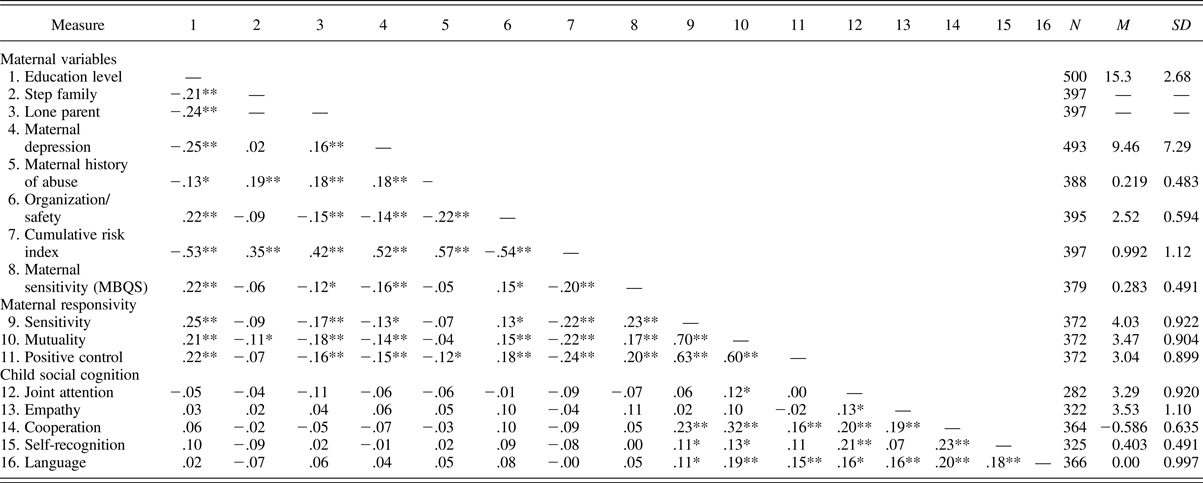
Correlations, mean scores, standard deviations, and number of participants for study variables

Note: MBQS, Maternal Behavior Q-Set.
*p < .05. **p < .01.
Joint attention
This was measured in terms of children's ability to follow the gaze of an adult interviewer (Carpenter, Nagell, & Tomasello, Reference Carpenter, Nagell and Tomasello1998), using a gaze-following task from the Early Social Communication Scale (Mundy et al., Reference Mundy, Delgado, Block, Venezia, Hogan and Seibert2003). The child sat with his or her mother across from the experimenter. Two colorful posters were placed beside the child and two behind the child. The tester ensured she had the attention of the child by calling the child's name, tapping the table, or gently touching the child. She then proceeded to point to the four posters in a systematic order: tester's left, left-behind, right, right-behind. The point consisted of the tester turning her entire torso, visually orienting to a poster and keeping her elbow in contact with her body. During the pointing trial, if the child did not immediately redirect his or her attention to the poster, the tester proceeded to say the child's name three times. If the child still did not redirect his or her attention, the tester paused before redirecting attention to the child. This task was administered twice throughout the home visit, separated by another activity, for a total of eight possible “respond-to-joint-attention” observations for each child. A trained coder viewed videotapes and coded children's ability to redirect attention to the focal object along a 4-point scale. If the child immediately redirected attention to the poster after the tester's point, the child received a score of 4. If the child redirected attention after the tester said his or her name, the child received a score of 3. If the child delayed redirection of attention until after the tester's point was finished, but before the next trial commenced, the child received a score of 2. If the child failed to redirect attention to a poster, he or she received the lowest score of 1. Interrater reliability was α = 0.94. A task analysis revealed significant mean differences between side point (M = 3.90, SD = 0.27) and behind point (M = 3.30, SD = 0.91) trials, t (279) = 11.8, p < .01, suggesting that following side points is a simple task for most 18-month-olds. Furthermore, only behind points correlated significantly with children's concurrent vocabulary (r = .22, p < .01), indicating more robust construct validity for the behind-point trials in the current sample. Thus, for each child, only the four observations of the behind trials were used as the measure of “respond-to-joint-attention” observations. We took the mean score for each of the four trials, resulting in a maximum score of 4 (perfect score of 4 on all four trials).
Empathy
This was measured as the child's responsiveness to the feigned distress of an adult interviewer. At standard points during the home interview, the interviewer pretended to hurt her knee and finger, as well as to drop and ostensibly break her favorite toy (“Mickey,” a magnetic toy monkey, whom the child met at the beginning of the testing session). Two coders watched all empathy events and rated children on six statements based on their reaction to the interviewer's distress. A thin-slice coding method was used (Ambady, Bernieri, & Richeson, Reference Ambady, Bernieri and Richeson2000; Ambady & Rosenthal, Reference Ambady and Rosenthal1992), which is a global or impressionistic rating of the child's behavior. This method has been used successfully in rating child behavior (Prime, Perlman, Tackett, & Jenkins, Reference Prime, Perlman, Tackett and Jenkins2013). Based on the thin-slice methodology, coders are encouraged to make general judgements about children using all available information from the empathy events, and their final ratings are averaged to decrease the impact of a single observer's judgment (Ambady et al., Reference Ambady, Bernieri and Richeson2000). Empathy ratings were based on an adaptation of an empathy scale developed by Kochanska, DeVet, Goldman, Murray, and Putnam (Reference Kochanska, DeVet, Goldman, Murray and Putnam1994). Five items were removed from that scale because they referred to elicitors for which our raters had no information (reactions to movie characters or animals being hurt). The rated items included “will try to comfort or reassure another in distress,” “likely to offer toys or candy to crying playmate even without parental suggestion,” “can tell at just one glance how others are feeling,” “likely to ask what's wrong when seeing someone in distress,” “will feel sorry for other people who are hurt sick or unhappy,” and “is not likely to become upset if a playmate cries,” each of which was rated on a 7-point scale from 1 (extremely untrue) to 7 (extremely true). The internal consistency was 0.98 for Coder 1 and 0.96 for Coder 2. Although interrater agreement in thin-slice methodology is not normally reported, agreement between coders was high (α = 0.82).
Cooperation
Children's cooperation skills were measured with two previously developed cooperation tasks: trampoline and double tubes (Warneken et al., Reference Warneken, Chen and Tomasello2006). These tasks assess the extent to which children cooperate with the tester toward a goal, requiring the child to change his/her behavior to succeed. Four cooperation measures were taken. For the first measure, the trampoline task, the child was invited by the tester to help make a bear dance on a handheld trampoline. Failure to cooperate by holding up their end led to the collapse of the trampoline. The first 10 s of the task were allowed as a learning phase, and were not coded. Subsequently, discrete 10-s intervals were coded on a 5-point scale, up to a maximum of 80 s (8 total intervals). The scale ranged from 1 (no success) to 5 (high engagement), and the mean of the intervals was taken. For the second measure, the double tubes tasks, the child was invited to help the experimenter complete a sequence of actions in which she rolled a ball down one of two tubes and asked the child to catch it at the bottom. In contrast to the trampoline task, the child was required to engage in different but complementary behavior to the tester to achieve the goal. Therefore, to be successful, the child cannot simply imitate the tester. The first catch trial was allowed as a learning phase, and was not coded. Subsequently, each catch invitation was coded on a 5-point scale, with a maximum of 8 trials coded. The scale ranged from 1 (no attempt) to 5 (complete success), and the mean of the 8 trials were computed for each child. After the trampoline and double tubes tasks were completed, coders rated a global cooperation score for each task. The global cooperation score was coded along a 4-point scale, based on percentage of the task the child was cooperative (0%–25%, 26%–50%, 51%–75%, and 76%–100%). A mean global score on these two tasks was computed as the third measure. Finally, coders rated the number of times a child was uncooperative throughout the trampoline and double tubes tasks, from none (0) to 3 or more times (3). These items were reverse coded. Ten percent of videotapes were double coded by independent coders, and the mean interrater reliability across all cooperation tasks was α = 0.86 (range = 0.68–0.96). All of the items loaded significantly onto the same factor, explaining 47% of the variance, with item loadings ranging from 0.54 to 0.76. A composite cooperation variable was constructed by taking the mean of the standardized scores across all cooperation measures.Footnote 1 Internal consistency of the items making up the composite was α = 0.71.
Self-recognition
During the cooperation task, the interviewer surreptitiously marked children with a large colored sticker at the front of their head on the hair (so that they could not feel it being placed). Children were then placed in front of a mirror and allowed to look at themselves for 30 s. This was a dichotomous code. If a child demonstrated any self-directed behavior (either reaching for the sticker or verbally acknowledging its presence, with or without prompting), the child received a score of 1. If the child did not recognize the sticker at all, he or she received a score of 0. Thus, this score was a conservative estimate of the child's ability to recognize him/herself in the mirror.
Language
The MacArthur–Bates Communicative Development Inventories (CDI) was used at T2 to measure children's language ability (Fenson et al., Reference Fenson, Dale, Reznick, Bates, Thal and Pethick1994). The CDI is a mother-reported measure of children's expressive vocabulary. Mothers report on both English and the child's heritage language, and we took the maximum score. Studies of the CDI have shown that it is a valid and reliable measure for typically developing children (Dale, Reference Dale1991; Dale, Bates, Reznick, & Morisset, Reference Dale, Bates, Reznick and Morisset1989) and children with language delays (Heilmann, Weismer, Evans, & Hollar, Reference Heilmann, Weismer, Evans and Hollar2005). Words spoken ranged from 0 to 100 (M = 26.5, SD = 20.1). Scores used in analysis were residualized for age and gender.
Plan of analysis
Descriptive statistics and bivariate relationships among the measures were examined. Although the primary distal predictor was a cumulative risk index, these indices can mask the effects of single variables within the index. As a result, we have included all individual variables that comprised the cumulative risk index in the tables and correlation matrix. We also included all variables that were used as indicators of the social cognition construct and the maternal responsivity construct, even though these were unobserved latent variables in the main analysis.
The analysis was carried out using Mplus, version 6.1 (Muthén & Muthén, Reference Muthén and Muthén2010). First, the measurement model for social cognition and maternal responsivity was tested. A measurement model is a confirmatory factor model that accounts for the covariance between all latent variables in the model, and enables a determination of whether the manifest variables relate only to the latent variables they were supposed to represent (Cole & Maxwell, Reference Cole and Maxwell2003). Second, structural equation modeling was carried out to examine the direct and hypothesized indirect effects. The process of examining indirect effects even in the absence of a direct predictor–outcome association is acceptable when the theoretical model is suggestive of such a mechanism (MacKinnon, Lockwood, Hoffman, West, & Sheets, Reference MacKinnon, Lockwood, Hoffman, West and Sheets2002). Indirect effects were tested using the delta method (Sobel, Reference Sobel1982), which is the default in Mplus 6.1. The delta method calculates the standard error of the product of two variables, which can then be used to determine the significance of the indirect path. This method is widely used in applied statistics for obtaining approximate standard errors and confidence intervals of parameters in structural equation modeling (Raykov & Marcoulides, Reference Raykov and Marcoulides2004). We report standardized direct and specific indirect effects.
Full information maximum likelihood estimation (FIML) was utilized for all analyses. This method offers significant improvements over traditional approaches for handling missing data (Acock, Reference Acock2005). For structural equation modeling, FIML has been shown to be superior to listwise deletion, pairwise deletion, and imputation in terms of convergence, parameter bias, and model fit (Enders & Bandalos, Reference Enders and Bandalos2001). In addition, FIML has been shown to handle up to 50% missing data without biasing the estimates (Graham & Schafer, Reference Graham and Schafer1999). None of the variables in the current study showed such high levels of missingness. For the current study, maximum likelihood estimation with robust standard errors was chosen because it produces parameter estimates with standard errors and a χ2 statistic that are robust to nonnormality and nonindependence of the observations when missing data are present (Muthén & Muthén, Reference Muthén and Muthén2010).
Results
Preliminary analysis
The means and standard deviations of the measures and the bivariate correlations between the measures are reported in Table 1. As expected, the cumulative risk index was significantly associated with all measures of maternal responsivity in the expected direction. Moreover, all three aspects of maternal responsivity were related to children's cooperation and language. Only mutuality was significantly associated with children's joint attention abilities, whereas none of the parenting measures were associated with children's empathy. All of the social–cognitive skills were significantly related to one another in the expected direction with the exception of empathy and self-recognition, which were not significantly associated with one another. Maternal sensitivity at T1 was unrelated to any of the social–cognitive behaviors at T2.
Stage 1: Testing the measurement model for social cognition
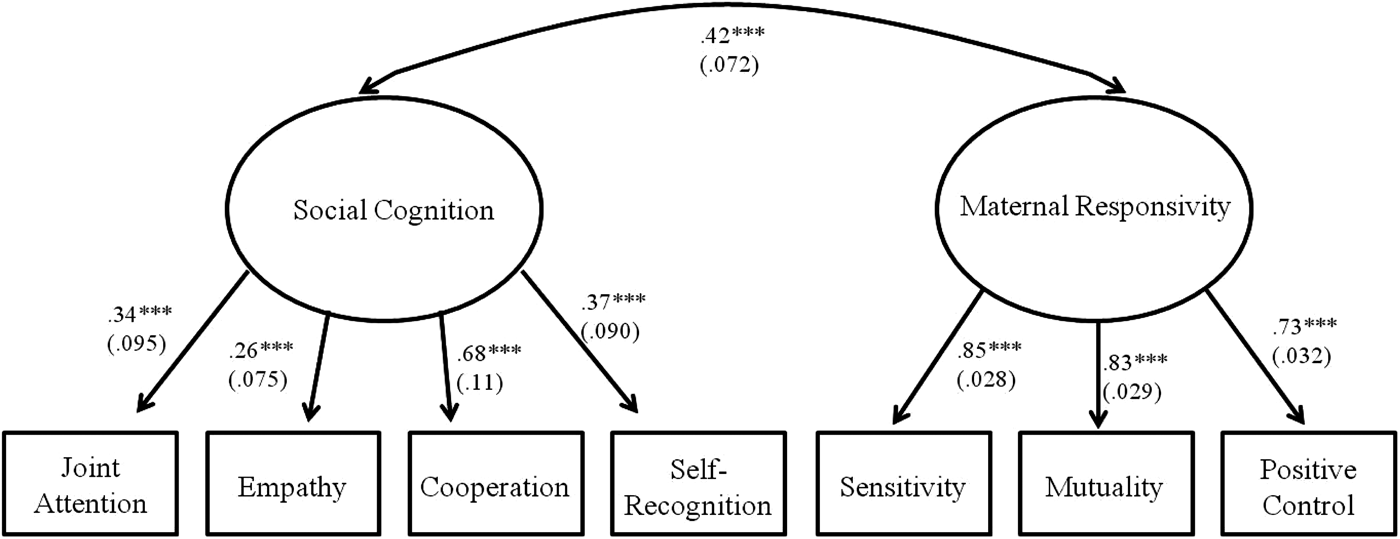
Confirmatory factor analysis was used to examine the factor structure for the social cognition and maternal responsivity latent variables. The use of maximum likelihood estimation with robust standard errors provides mazimum likelihood parameter estimates with standard errors and an adjusted χ2 test statistic that are robust to deviations from normality (Brown, Reference Brown2006). The social cognition latent factor was indicated by joint attention, empathy, cooperation, and self-recognition; and the maternal responsivity factor was indicated by sensitivity, mutuality, and positive control. As recommended by Cole and Maxwell (Reference Cole and Maxwell2003), these two latent factors were allowed to correlate with one another in the measurement model. The measurement model fit the data well: comparative fit index (CFI) = 0.98, Tucker–Lewis index (TLI) = 0.96, standardized root mean square residual (SRMR) = 0.040, and root mean square error of approximation (RMSEA) = 0.048. The 90% confidence interval for RMSEA was (0.016, 0.078), and PCLOSE (i.e., the probability that RMSEA ≤ 0.05) was 0.50. Hu and Bentler (Reference Hu and Bentler1999) have recommended goodness of fit cutoff values of 0.95 for CFI and TLI, 0.08 for SRMR, and 0.06 for RMSEA. All of the abovementioned fit indices for the measurement model were either equal to or better than these recommended cutoffs. Furthermore, all of the model-estimated loadings onto each latent were positive and significant at the p < .001 level (see Figure 1). This demonstrates that joint attention, empathy, cooperation, and self-recognition form one coherent construct of social cognition at 18 months.Footnote 2 Similarly, the construct of maternal responsivity is well represented by mutuality, sensitivity, and positive control.
Measurement model for the social cognition and maternal responsivity latent constructs. For social cognition, each of the indicators is a skill that indexes the ability to understand the independent experiences of others, or the objectivity of oneself. Joint attention, empathy, and cooperation reflect different forms of intention understanding. Each loading can be interpreted as a standardized regression coefficient. All loadings for each latent were significant at the p < .001 level.
Stage 2: Testing the proposed indirect paths: The structural model
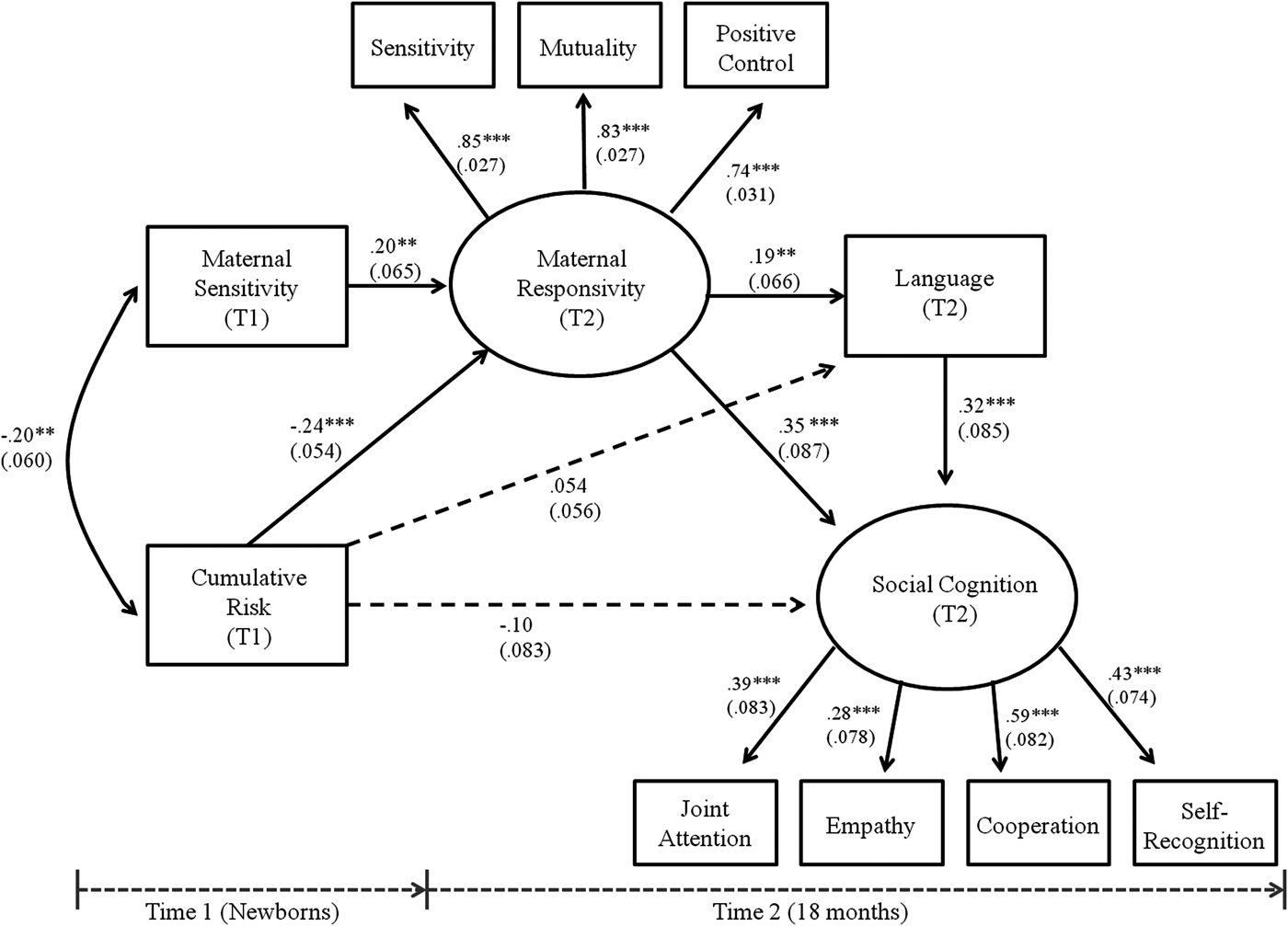
The structural model was tested next and is shown in Figure 2. The hypothesized model fit the data well: CFI = 0.98, TLI = 0.97, SRMR = 0.038, and RMSEA = 0.031. The 90% confidence interval for RMSEA was (0.00, 0.05), and the PCLOSE value was 0.95. Because there was slight variability in children's age at T2, we also ran the model covarying age with social cognition. The model fit remained similar (and acceptable) for all indices. It is possible to see in Figure 2 that T1 maternal sensitivity significantly predicted T2 maternal responsivity, and cumulative risk at T1 predicted maternal responsivity at T2 (after controlling for T1 maternal sensitivity). It is also clear that maternal responsivity at T2 predicted both children's social cognition and their language at T2, and that child language predicted children's social cognition.
Hypothesized model on the relations among distal cumulative risk, maternal responsivity, child language, and social cognition at 18 months. Standardized regression coefficients are presented atop each path line (standard errors are presented in brackets). **p < 0.01, ***p < .001. All other paths are nonsignificant.
There was a statistically significant total effect of cumulative risk at T1 on social cognition at T2 (β = –0.18, p = .029). However, on inclusion of the maternal responsivity and child language, the direct effect of cumulative risk on social cognition was not significant (β = –0.10, p = .24), suggesting the presence of mediation. The total indirect effect was significant (z = –2.36, p = .018). Regarding the hypothesized specific indirect effects, after controlling for T1 sensitivity, the indirect effect of cumulative risk at T1 on social cognition through maternal responsivity at T2 was significant (z = –2.84, p = .004). There was also a significant indirect effect from cumulative risk to maternal responsivity to social cognition that operated through children's language at T2 (z = –2.12, p = .034). As expected, there was no direct association between cumulative risk at T1 and children's social cognition at T2 (β = –0.10, p = .24). There was also not a significant association between T1 maternal sensitivity and T2 social cognition (β = –0.06, p = .50). Thus, the effect of cumulative risk on social cognition operated through maternal responsivity at T2, and some of that effect operated via children's concomitant language skills.
Secondary analysis
Because language and social cognition were measured concurrently in the present study, we examined the possibility that the indirect effects reported above remained when language and social cognition were reversed in the structural model, that is, contextual risk operated through social cognition to affect child language. Fit indices were similar. There was a significant indirect effect of cumulative risk to maternal responsivity to language that operated through social cognition (z = –2.42, p = .015); however, the indirect effect of cumulative risk to language through responsivity (i.e., not through social cognition) was not significant (z = –0.47, p = .64).
Discussion
The current study was designed to investigate links between contextual adversity and children's early social cognition, which was operationalized as a set of precursor “skills” at 18 months. Strengths of the study included the longitudinal design, the large and diverse sample of children, the task-based measurement of children's social cognition, and observations of maternal behavior. Combining an epidemiological design with a developmental process design did, however, result in two limitations. First, data collection was not frequent enough to track change in early social cognition (Carpenter et al., Reference Carpenter, Nagell and Tomasello1998). Second, because data collection occurred in the home in order to maintain diversity and reduce sample attrition, it meant that interviewers had less control over data collection than when children are tested in a laboratory setting, resulting in the loss of some data on certain tasks.
The results showed that cumulative social risk measured when children were 2 months old was indirectly associated with their social cognition at 18 months through maternal responsivity. These findings are consistent with the idea that social experience shapes children's cognitions (see Fernyhough, Reference Fernyhough2008). From this perspective, social cognition may actually be restructured by the internalization of multiple perspectives that are derived from interactions with others (Tomasello et al., Reference Tomasello, Carpenter, Call, Behne and Moll2005). Primary among those interactions early in life are the ones that occur with caregivers. The current results suggest that when parents are responsive to their child's needs, facilitate engagement in activities, and provide explanations and questions during social exchanges, they may actually be offering the alternative orientations toward reality that are important for the internal reconstruction of cognition, thereby promoting a representational understanding of others.
At the same time, parents differ in their parenting behaviors based on an array of social circumstances. Mothers who were abused as children (Banyard, Reference Banyard1997; Silvern, Reference Silvern1994), are single (Martinez & Forgatch, Reference Martinez and Forgatch2002), have low education (Brody & Flor, Reference Brody and Flor1998), suffer from depression (Lovejoy, Graczyk, O'Hare, & Neuman, Reference Lovejoy, Graczyk, O'Hare and Neuman2000), or whose home environments are chaotic and disorganized (Dumas et al., Reference Dumas, Nissley, Nordstrom, Smith, Prinz and Levine2005) are more likely to provide negative forms of care. Many of these distal risks co-occur with one another. Bronfenbrenner's and others' ecological perspective of development urges the use of process-oriented research that identifies relationships between these distal ecological factors, proximal processes, and child outcomes (Bronfenbrenner & Morris, Reference Bronfenbrenner, Morris, Lerner, Damon and Lerner2006). In line with this view, the current study is the first to show that an accumulation of social risks is negatively associated with children's social–cognitive skill development through less responsive maternal behavior. It is also interesting to note that cumulative risk predicted change over time in maternal behavior, suggesting a causal effect on parenting. These results are consistent with the notion that it is the extent of disadvantage, rather than exposure to individual risks, that is detrimental to children's outcomes (Dong et al., Reference Dong, Anda, Felitti, Dube, Williamson and Thompson2004; Trentacosta et al., Reference Trentacosta, Hyde, Shaw, Dishion, Gardner and Wilson2008).
It is important to discuss the elements of parenting measured in the current study and speculate on the process through which those behaviors might foster children's social cognition. First, we see continuity in maternal sensitivity from the time that children are 2 months until they are 18 months. This continuity, although significant, is relatively weak. This is probably explained by the difficulty of measuring sensitivity when babies are very young (i.e., they initiate few actions to which their mothers can respond). Second, our measurement of sensitivity when children were 18 months was expanded to include cognitive elements. Thus, the kinds of parenting behaviors measured may have been qualitatively different at each developmental age.
That maternal sensitivity when children were 2 months (T1) was unrelated to social cognition at 18 months suggests that the kinds of parenting behaviors operating during this stage (e.g., warmth, contingent responding, and positive affect) are either insufficient to foster social cognition in the absence of cognitively challenging behaviors, or children of this age are not yet capable of internalizing the information garnered from those interactions. It may be that a certain level of cognitive sophistication (including language development) is required to fully integrate these social inputs, or that typical maturational milestones (e.g., the advent of independent locomotion) are needed to elicit the cognitively challenging parental responses that promote social cognition. Explicating these complex processes is a ripe area for future research.
The components of responsivity in the current study were sensitivity, mutuality, and positive control. All of these dimensions of parenting made contributions to the responsivity latent construct, and each was associated with the cumulative risk index. Thus, it appears that distal social risk is related to multiple dimensions of parenting behavior, and these various dimensions of parenting are jointly related to social cognition. In the current study, we are unable to differentiate which of these parenting components is relatively more or less predictive of social cognition, nor was this a goal of the present study. Recent reviews discuss the various elements of parenting that seem to be associated with different types of social–cognitive development, with a particular emphasis on parental discourse and conversational interactions (de Rosnay & Hughes, Reference de Rosnay and Hughes2006; de Rosnay & Murray, Reference de Rosnay, Murray, Mayes and Lewis2012). Discourse in this regard implies an overall responsive orientation toward the child, and conversational interactions are likely most effective when they are appropriate and occur within the context of warm, supportive relationships (Denham, Zoller, & Couchoud, Reference Denham, Zoller and Couchoud1994; Meins et al., Reference Meins, Fernyhough, Wainwright, Das Gupta, Fradley and Tuckey2002). In general, when the mother treats her child as an autonomous, thinking and feeling being, positive outcomes are engendered. This attitude has been referred to as sensitivity, reflective functioning, insightfulness, intersubjectivity, and affect attunement, all of which are concerned with the emotional quality of relationships (de Rosnay & Hughes, Reference de Rosnay and Hughes2006). In line with these concepts, the maternal responsivity construct of the present study did not tease apart conversational versus qualitative aspects of parenting on social cognition. Instead, these results suggest that parenting behaviors come as a package, each making important (though perhaps different) contributions to children's social–cognitive development.
Numerous parental behaviors were captured in the broad dimensions of parenting that comprised responsivity in the current study. Sensitivity measured responsiveness to the child's verbal/nonverbal signals, behaviors that may promote the child's motivation to take part in social interactions owing to the support and reinforcement that comes from such exchanges. Higher levels of maternal warmth have been shown to predict lower child negativity and more child engagement (Ispa et al., Reference Ispa, Fine, Halgunseth, Harper, Robinson and Boyce2004). When children are more engaged, other elements of sensitivity such as mind-mindedness, facilitation, and autonomy-promotion may provide the alternative perspectives that enhance social cognition. The same is true for positive control, which consists of giving praise, explanation, and asking open-ended questions. For example, asking the child how he/she would like to begin a task suggests that there may be more than one way to start, a situation that promotes consideration of more than one perspective. Finally, mutuality was a dyadic code that indexed the quality of interaction and reciprocity. Kochanska, Forman, Aksan, and Dunbar (Reference Kochanska, Forman, Aksan and Dunbar2005) provide evidence that a mutually responsive orientation between a mother and her child augments the internalization of moral conduct and cognition, and a similar mechanism may operate in the internalization of experience that begets social cognition. For now, these suppositions remain speculative, and further evidence is needed to determine the exact nature and extent to which different parenting dimensions contribute to individual differences in social cognition.
Another finding of the present study is that the effect of adversity on social cognition operated, in part, through children's concomitant language skills. This result is consistent with the Vygotskian concept of semiotic mediation, in which psychological tools such as language augment children's ability to represent and reason about the mental states of others (Nelson, Reference Nelson, Astington and Baird2005; Vygotsky, Reference Vygotsky1997). It is also consistent with the proposal that social cognition depends on language acquisition and social experience (Garfield, Peterson, & Perry, Reference Garfield, Peterson and Perry2001), and the idea that internalization of dialogue involves the accommodation of multiple perspectives that facilitate social understanding (Fernyhough, Reference Fernyhough2008). Thus, children who have acquired the capacity for internalized dialogues are better able to understand a range of epistemic, affective, and conative perspectives, which would manifest as more advanced social–cognitive skills. This does not necessarily mean that children as young as 18 months are capable of reflectively considering multiple perspectives, but rather that emergent language faculties allow for partially internalized dialogues that precede a full-fledged understanding of mind. As language develops, the ability to construct internal dialogues is enhanced, leading to more sophisticated forms of social awareness.
To build on these ideas, the present study suggests that maternal responsivity may enhance social cognition by augmenting the language skills that allow children to internalize the various perspectives that derive from social interaction. Again, however, our concurrent measurement of social cognition and language at 18 months precludes suppositions of directionality. It is possible that the ability to engage in dialogue is itself dependent on some social–cognitive capacities. For example, Morales et al. (Reference Morales, Mundy, Delgado, Yale, Messinger and Neal2000) have shown that infants' joint attentional abilities at 6 months are positively related to their expressive vocabulary at 18 months. As shown in our secondary analysis, reversing language and social cognition in the structural model revealed that maternal responsivity was also indirectly related to language through social cognition. This finding parallels the notion that the social–cognitive skills that underlie language development may themselves rely on it (Tomasello et al., Reference Tomasello, Carpenter, Call, Behne and Moll2005). Thus, early-emerging forms of social cognition may help facilitate language development, and language may reciprocally provide the psychological tools required for the internalization of social experience that advances social cognition (Astington, Reference Astington, Levinson and Enfield2006).
However, it is important to note that the indirect effect of cumulative risk to social cognition through maternal responsivity did not operate exclusively through children's language. This means that there is a unique component of maternal responsivity involving sensitivity, mutuality, and positive control that is associated with social cognition independent of language. This finding is consistent with de Rosnay and Hughes's (Reference de Rosnay and Hughes2006) suggestions that the social environment and children's linguistic competence make independent contributions to social cognition. This unique parenting component may entail the opportunity to experience alternative perspectives and orientations, or it may involve some other mechanism, such as improving attachment security or mother–child attunement (Meins, Reference Meins2004). Although the nature of this mechanism is currently unresolved, the overarching idea is clear: parental characteristics and the quality of parent–child interactions cultivate an environment in which concepts of the mind can be explored, discussed, and practiced in a way that builds social–cognitive competency. Future studies would benefit from conducting a more systematic examination of how social experience facilitates social cognition, independent of language.
Finally, the social–cognitive precursors that were measured at 18 months were chosen for assessment on the basis that they were key precursors to more advanced forms of social awareness (i.e., ToM). As mentioned in the Introduction, it has been suggested that these skills index children's nascent ability to understand the intentions of others (Moore, Reference Moore, Brownwell and Kopp2007). The latent variable modeling approach used in the current study supports the idea that these skills cohere and may be accounted for by a foundational cognitive capacity. However, we cannot say why they cohere or that their coherence occurs because of intention understanding per se. Evidence from social neuroscience suggests that a range of social–cognitive abilities may share an underlying neural architecture (see the introductory section). It is interesting to note that this distributed network, which includes the paracingulate cortex and orbitofrontal cortex, has also been shown to be involved in intention understanding during social interactions (Walter et al., Reference Walter, Adenzato, Ciaramidaro, Enrici, Pia and Bara2004). Thus, although further evidence is needed to substantiate the claim that early precursory skills reflect various forms of intention understanding, this rich literature adds support to the notion that there are continuities in social cognition from infancy through childhood, and a shared neural network may support the maturation of early-emerging abilities into more advanced mentalizing skills as children develop. To the extent that early intention-related skills are related to further social–cognitive growth (Aschersleben, Hofer, & Jovanovic, Reference Aschersleben, Hofer and Jovanovic2008; Wellman, Lopez-Duran, LaBounty, & Hamilton, Reference Wellman, Lopez-Duran, LaBounty and Hamilton2008), efforts to promote skill development in these areas may prove effective in mitigating the adverse effects of poor social cognition on child adjustment (Hughes & Lecce, Reference Hughes and Lecce2010). The results of the present study suggest that one potential target for intervention and social policy may be to support mothers who are less responsive to their infants in order to help them build the social–cognitive skills that are essential for their psychosocial health and development.