The birth of a child with disabilities is undoubtedly stressful for a parent but the amount of stress parents face have differential impacts on every parents in regards to the types of diagnosis, severity of the disorder, coping resources and coping strategies, socio-economic status, community or social support, etc. These factors are greatly responsible for the adapting parents or primary caregivers of children with disabilities to their society (Hodapp, Dykens, & Masino, Reference Hodapp, Dykens and Masino1997; Reddon, McDonald, & Kysela, Reference Reddon, McDonald and Kysela1992; Sanders & Morgan Reference Sanders and Morgan1997). Compared to the strain placed upon parents of typically developing children, parents of children with intellectual and physical disabilities more often experience higher level of stress. Research has shown that parents of children with intellectual disabilities experience higher levels of stress and depression compared to parents of normally developing children (Blacher, Shapiro, Lopez, & Diaz, Reference Blacher, Shapiro, Lopez and Diaz1997; Carpiniello, Piras, Pariante, & Carta, Reference Carpiniello, Piras, Pariante and Carta1995; Cushner-Weinstein et al., Reference Cushner-Weinstein, Dassoulas, Salpekar, Henderson, Pearl, Gaillard and Weinstein2008; Hoare, Harris, Jackson, & Kerley, Reference Hoare, Harris, Jackson and Kerley1998; Sanders & Morgan Reference Sanders and Morgan1997). Many studies examining the stress and emotional adjustment of parents of children with autism documented that compared to parents of children with other disorders or with parents of normally developing children, parents of autistic children have higher levels of stress, anxiety and depression (Baker-Ericzen, Brookman-Frazee, & Stahmer, Reference Baker-Ericzen, Brookman-Frazee and Stahmer2005; Feldman et al., Reference Feldman, McDonal, Serbin, Stack, Secco and Yu2007; Hastings et al., Reference Hastings, Kovshoff, Ward, degli Espinosa, Brown and Remington2005a; Smith, Seltzer, Tager-Flusberg, Greenberg, & Carter, Reference Smith, Seltzer, Tager-Flusberg, Greenberg and Carter2008) and lower levels of well-being (Baker et al., Reference Baker-Ericzen, Brookman-Frazee and Stahmer2005). This stress could have a negative impact on parents, leading to depression, anger, anxiety, and marital discord (Bromley, Hare, Davison, & Emerson, Reference Bromley, Hare, Davison and Emerson2004; Higgins, Bailey, & Pearce, Reference Higgins, Bailey and Pearce2005). In combination with this, restrictions in personal life of these types of parents may be a factor contributing to a higher risk of low sense of coherence and depression (Hodapp, Dykens, & Masino, Reference Hodapp, Dykens and Masino1997). Brobst, Clopton, and Hendrick (Reference Brobst, Clopton and Hendrick2009) examined relationship quality and parental stress for 45 caregivers (25 couples whose child had ASD and 20 couples without a developmental disorder). Parents of children with ASD reported more parental stress and greater trouble with child behavior problems and lower total social support and relationship satisfaction than did parents in the comparison group. Uskun and Gundogar (Reference Uskun and Gundogar2010) found in their study that among the stressful experiences, parents gave the highest points to ‘attitudes of society towards disabled people’; ‘having limited free time’ and ‘financial problems’.
While considering the traditional and modern attitudes towards the individuals with developmental disabilities in Asia, a variety of religious and cultural superstitions and rituals revolve around the disabled population. Although many families may identify with biomedical causes of illness and disability as defined by disability professionals, they may also often link disability with religious or folk explanations believing that a child’s mental problems and behaviors derive from curses placed on the child by God and Fate, the Spell, the Evil Spirit (Armstrong & Ager, Reference Armstrong and Ager2005; Diken, Reference Diken2006). Muslims in Bangladesh, Pakistan (Miles, Reference Miles2007), Turkey (Diken, Reference Diken2006), and Egypt (Endrawes, O’Brien, & Wilkes, Reference Endrawes, O’Brien and Wilkes2007) believe in djinns (evil spirits) and blame them for disabilities their child suffers. They often take their child to a “gila” or “fakir,” (i.e., saint) expecting that their child will come round soon through amulets or other traditional healers treated by the “fakir”. Modern science cannot either prove or disprove the existence of djinns, but scientific evidence usually leads to theories that make no reference to either djinns or shrines (Miles, Reference Miles2007).
The majority of children with disabilities in Bangladesh are cared for at home by their families. For a large number of children with disabilities treatment at home is not equitable or supportive. Families, often very poor, are concerned about the economic, social and educational dimensions associated with having a child with disabilities and often see the child as a burden. With limited knowledge and support, families often keep them sequestered at home, in some cases to avoid shame, and many children are neglected or exploited (UNICEF, 2009). The Government and non-governmental organizations (NGOs) in Bangladesh are working to increase support to families caring for children with disabilities, through policy development, training and social protection mechanisms. As reported by the Ministry of Social Welfare in 2012, 1,720 children with disabilities are residing in institutions and 280 students with disabilities are residing in residential schools. The institutional care environment in most cases is inadequate and violates many rights of the child. While the Government provides free health services at the community level, these include lack of sufficient drugs, staff shortages and poor prioritization of spending and pervasive problems of management and coordination (Government of Bangladesh, National Institute of Population Research and Training, NIPORT; Mitra and Associates and ICF International, 2012). In addition, many medical professionals and health care workers are not yet sensitized and educated on disability issues. In Bangladesh, most areas of progress concern children with developmental and neurological impairments. The Global Autism Public Health Bangladesh initiative, started in July 2011 is taking systematic steps to address issues related to autism and other neuro-developmental disabilities. Another major initiative is establishment of Shishu Bikash Kendra (Child Development Centres) in government tertiary medical colleges for early assessment, diagnosis and intervention for children identified with potential developmental delays. These centers also offer training and support for parents of children with disabilities. Rehabilitation services in Bangladesh are provided by the Government under direction of the MOSW and by NGOs. They are separate from mainstream health services and vary greatly in quality (Global Autism Public Health (GAPH) Bangladesh, 2012).
In Bangladesh children with disabilities have clearly been among the most marginalized when it comes to education. It was reported (CSID and Cambridge Consortium, 2002) that out of an estimated 1.6 million children with disabilities in the primary school age group, only 4 per cent had access to education in areas with no disability services. Despite some achievements in inclusive education, the concept and practice is at a nascent stage of development in Bangladesh. Awareness and understanding of inclusive education is limited, and the mainstream school system is not well equipped to meet the varied needs of children with disabilities (CSID and Cambridge Consortium, 2002). These scenarios regarding supports and services, education systems and society’s attitudes and beliefs towards intellectually disabled children in Bangladesh perspective are largely responsible for their primary caregivers to be stressed in nurturing these differently able children.
Only a few studies have examined in a global way the adaptation of parents of children with ASD (Jones & Passey, Reference Jones and Passey2005; Pakenham, Sofronoff, & Samios, 2005) or other intellectual disabilities (Saloviita, Itaelinna, & Leinonen, Reference Saloviita, Itaelinna and Leinonen2003). These studies are based on the Double ABCX model of stress and adaptation (McCubbin & Patterson, Reference McCubbin, Patterson, McCubbin, Sussman and Patterson1983) and demonstrate the model’s effectiveness in predicting adaptation. The Double ABCX model proposes that the adaptation outcome (factor xX) depends on interrelations between several factors: stressors or characteristics of children (factor aA); social support or resources (factor bB); perception or definition of the stressor (factor cC); and coping strategies (factor BC). The model postulates that the last three factors could reduce the negative impact of the characteristics of the child on parental adaptation.
One factor in ABCX model that is believed to play a significant role in adaptation is the “perception of the problem”, evaluated by the variable sense of coherence (SOC). Antonovsky (Reference Antonovsky1987) in salutogenetic perspective suggests that Sense of Coherence (SOC) enables people to resolve tension in a health-promoting manner, to reflect about their external and internal resources, to identify and mobilize them, and to promote effective coping by finding solutions. But it is true that SOC alone does not explain overall health or psychological well-being of an individual. Here the necessity of the double ABCX model lies to explain the impact of other factors for the psychological well-being of a person. Saloviita et al. (Reference Saloviita, Itaelinna and Leinonen2003) showed that the most important predictor of parental stress for parents of children with disabilities is a negative definition of the situation. Pottie and Ingram (Reference Pottie and Ingram2008) conducted a study investigating daily stress, coping, and well-being in parents of children with autism and the authors suggest that social support can potentially enhance well-being and devalue daily distress in parents of children with autism. Multiple regression analysis used by Jones and Passey (Reference Jones and Passey2005) revealed that coping style and parental locus of control relating to control of the child were the most significant predictors of parental stress. Likewise, Pakenham et al. (2005) found that better maternal adjustment was related to higher levels of qualitative social support and emotional approach coping and lower levels of child behavior problems, stress appraisals, and passive avoidant coping.
The aim of the present study was to explore whether the Double ABCX model of stress and adaptation (McCubbin & Patterson, Reference McCubbin, Patterson, McCubbin, Sussman and Patterson1983) can promote a better understanding of: (1) the relationship between perceived stress and social adaptation of the primary caregivers of typically developing children and children with intellectual disabilities; (2) how much variations children’s ‘disability types’ and ‘severity of disability’ could create in perceived stress and social adaptation of the primary caregivers of intellectually disabled children; (3) how much variations caregivers’ ‘educational qualifications’ and ‘financial status’ could create in perceived stress and social adaptation of the primary caregivers of intellectually disabled and typically developing children and (4) how much variations ‘perception of social support’, ‘definition of the stressor’ and ‘coping strategies’ can create in stress and adaptation of the primary caregivers of intellectually disabled children above and beyond the effects of other predictors.
The following theoretical assumption was tested: (1) the stress and adaptation outcome depend on interrelations between several factors such as stressors or characteristics of children, social support or resources, perception or definition of the stressor and coping strategies.
Method
Participants and procedures
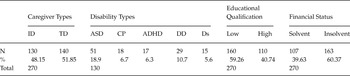
Primary caregivers of typically developing children and children with intellectual disabilities living in the urban and rural areas of Chittagong, Bangladesh participated in this study. The term primary caregivers used in this study refer to the mothers or fathers of Intellectually Disabled (ID) and typically developing children whom served as parental figures for these children and were responsible for their day-to-day care and maintenance. Participants were recruited from different mental health centers of Chittagong Area, Bangladesh that provided services and care to the ID children. After discovering the difficulties of ID children in between 3 to 5 years of age from psychiatric or child development units of government medical college hospitals or private clinics, primary caregivers of these children admitted their children to these mental health centers where they received cares until reach the age of eighteen. While recruiting participants, the study was carried out in accordance with the particular set of ethical standards of behavioral research considering informed consent, de-identification and potential identification of participants and organizations. Before approaching the measures utilized in the study, participants were provided a consent form which made necessary clarifications about the purpose of the research assuring the participants that highest confidentiality and research ethics would be maintained for sharing, storing, preserving and using the data in the long-term. Primary caregivers who showed their interest and agreed to give information through consent form, provided necessary measures inserting into an envelope after making necessary clarifications about the responses to these measures. 130 parents or primary caregivers (67 mothers and 63 fathers) of ID disabled children backed their answers to these measures in a prepaid envelope. Based on the diagnostic criteria of APAs DSM-IV (TR), the trainers or supervisors of these mental health centers categorized ID children as two diagnostic groups i.e., children with a primary diagnosis of ID with autism (n = 51) and children with a primary diagnosis of ID without autism (n = 79) as shown in Table 1. The control group comprised of 140 (78 mothers and 62 fathers) conveniently selected primary caregivers of normal children living in the same geographical area whose age and gender distributions were tried to keep similar to that of study group. Necessary clarifications about the purpose and confidentiality of the study were made and the measures same to that of study group were provided to the primary caregivers of control group. These participants returned their responses to these measures in a prepaid envelope. The mean age of the participants used in this study was 33.34 with a minimum of 25 and maximum of 52 years of age. Participants of both study and control groups possessed similar demographic characteristics. Parents or primary caregivers of both intellectually disabled and typically developing children were their biological fathers and mothers. Among the participants of both study and control groups, fathers were the service holders working outside the home and mothers were full housewives. Their educational qualifications were categorized as high and low. Caregivers whose educational qualifications were up to H.S.C. levels, considered as low educated and caregivers who completed their graduation or post graduation, considered as highly educated. Participants were asked to put Tick (√) mark in the appropriate box of response alternatives to each statement of the measures utilized in the study. They also were requested not to omit any item in the questionnaire and assured that there was no right or wrong answer and had no time limit for attempting the items. Each participant took about 35 to 40 minutes to fill up the questionnaires used. Case control design was used for the present study and the collected data were analyzed using SPSS for windows (version 19.0) computer program.
Number of caregivers of children according to caregiver types, children’s disability types, caregivers’ educational qualifications and financial status

Note: ID = Intellectually Disabled; TD = Typically Developing; ASD = Autism Spectrum Disorders; CP = Cerebral Palsy; ADHD = Attention Deficiency Hyperactivity Disorder; DD = Developmental Delay; Ds = Down syndrome.
Measures
Instruments used in this study are as follows:
-
a) Demographic and Personal Information Sheet: A demographic and personal information sheet used to collect information of the participants include: primary caregiver types (mothers/fathers), children’s disability types, severity of disability (high/low), caregivers’ profession, caregivers’ age, caregivers’ educational qualifications, financial status (solvent/insolvent), care receiver’s gender, care receiver’s age, etc.
-
b) Structured Interview Schedule (SIS): Participants in this study were interviewed through a ‘Structured Interview Schedule’ containing pre-categorized closed questions of fixed responses. This interview schedule contained questions relating to whether the social support network or resources available in the community were supportive or unsupportive for the primary caregivers of intellectually disabled children (i.e., perception of obtaining support), perception of disability i.e., whether peoples or society’s attitudes towards families of ID children create an extra burden on their primary caregivers (yes/no), primary caregivers’ perception of accepting the challenge of rearing disabled child (positive/negative perception). This structured interview schedule was administered only on the primary caregivers of intellectually disabled children. This schedule reflects the sense of coherence level of the primary caregivers of intellectually disabled children through their perception of the problem.
-
c) Perceived Stress Questionnaire, PSQ ( Reference KeyaKeya, 2006 ) developed the perceived stress scale culturally appropriate to Bangladesh. This scale was used in the present study to measure perceived stress of the primary caregivers of intellectually disabled and typically developing children of Bangladesh. The scale contains 20 items in a 5 point Likert form. Higher scores in this scale indicate high perceived stress and lower scores indicate low perceived stress of the respondents. The internal consistency of the PSQ was determined using Cronbach’s Alpha reliability. Cronbach’s alpha of the total scale was acceptably high (α = .77). The PSQ was constructed with 20 items as an internally consistent and reliable measure of perceived stress. Temporal stability of the scale was established using test-retest method (r = .73). Content and criterion related validity was studied for the PSQ and scores on PSQ were found to be much higher. Thus, the developed PSQ was shown to be psychometrically sound in all cases with a Likert scoring method and seemed to be a valid questionnaire for measuring stressful experience. Respondents were asked to rate each item on a 5point scale with not at all (0), a little bit (1), a moderate amount (2), quite a bit (3), and a great deal (4) as response categories. Item no. 7. 9. 10, 11 and 12 were reversed prior to the scoring.
-
d) Social Adjustment Scale ( Reference Mahmuda and ParvinMahmuda & Parvin, 2005 ) developed the social adjustment scale culturally appropriate to Bangladesh. This scale used in the present study to measure social adaptation of the primary caregivers of intellectually disabled and typically developing children of Bangladesh. The scale comprised of 11 statements on a 5 point Likert form. Higher scores in this scale indicate poor social adjustment and lower scores indicate better social adjustment of the respondents. Split-half and Cronbach’s alpha were computed as measures of reliability. The spilt- half reliability of this scale was found to be .76 (p < .01). Cronbach’s alpha was computed as a measure of reliability which was .74 for this scale (p < .01). Content validity of the scale was checked by 6 judges who were the teachers of Psychology, Sociology, Women Studies departments and Social Welfare and Research Institute of Dhaka University, Bangladesh. All items retained in the scale were judged by the experts. The scores of each negative statement ranged from 4 to 1 for ‘strongly agree’, ‘agree’, ‘disagree’ and ‘strongly disagree’. The score was reversed for positive statements i.e., 1 to 4 for ‘strongly agree’ to ‘strongly disagree’. Total score of social adjustment for any individual participant was obtained from the sum total of scores on 11 statements. The maximum possible score of this scale is 44 and the minimum is 11. Higher score indicates poor adjustment and lower score indicates better adjustment of the participants.
Results
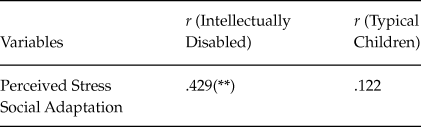
As shown in Table 2, Perceived stress and social adaptation scores of the primary caregivers of intellectually disabled children were significantly positively associated (r = .429, p < .01). That is, feeling of more perceived stress (e.g., higher scores indicate more perceived stress) is exhibited through poor social adaptation (e.g., higher scores indicate poor social adjustment) and vice versa in case of the primary caregivers of intellectually disabled children.
Correlation coefficients between perceived stress and social adaptation scores of the primary caregivers of intellectually disabled and typically developing children

** Correlation is significant at the .01 level (2–tailed).
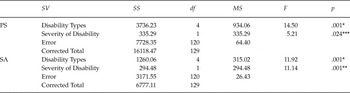
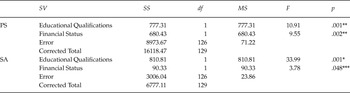
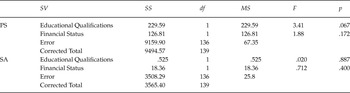
As shown in Table 3, responses were provided by the primary caregivers of intellectually disabled children through significant variations in perceived stress (PS) and social adaptation (SA) in terms of children’s ‘disability types’ (F = 14.50, df = 4/120, p < .001 for PS; F = 11.92, df = 4/120, p < .001 for SA) and ‘severity of disability’ (F = 5.21, df = 1/120, p < .05 for PS; F = 11.14, df = 1/120, p < .01 for SA). Similarly, findings of the study as shown in Table 4, reveal that Perceived Stress (PS) and Social Adaptation (SA) of the primary caregivers of intellectually disabled children were significantly influenced by their educational qualifications (F = 10.91, df = 1/126, p < .01 for PS and F = 33.99, df = 1/126, p < .001 for SA) and financial status (F = 9.55, df = 1/126, p < .01 for PS and F = 3.78, df = 1/126, p < .05 for SA). But educational qualifications and financial status as shown in Table 5 did not create any impact in perceived stress and social adaptation of the primary caregivers of typically developing children.
Analysis of Variance representing Perceived Stress (PS) and Social Adaptation (SA) of the primary caregivers of intellectually disabled children in terms of children’s ‘disability types’ and ‘severity of disability’

* p < .001, **p < .01, ***p < .05.
Analysis of Variance representing Perceived Stress (PS) and Social Adaptation (SA) of the primary caregivers of intellectually disabled children in terms of caregivers’ ‘educational qualifications’ and ‘financial status’

* p < .001, **p < .01, ***p < .05.
Analysis of Variance representing Perceived Stress (PS) and Social Adaptation (SA) of the primary caregivers of typically developing children in terms of caregivers’ ‘educational qualifications’ and ‘financial status’

p > .05 (not significant).
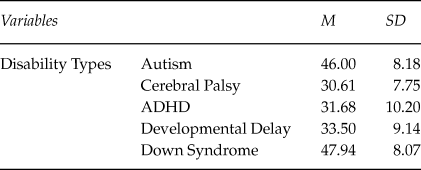
As shown in Table 6, primary caregivers of autistic children showed more perceived stress (M = 46.00) compared to the caregivers of children with cerebral palsy (M = 30.61), ADHD (M = 31.68) and developmental delay (M = 33.50). Similarly, primary caregivers of children with Down syndrome showed more perceived stress (M = 47.94) compared to the caregivers of children with cerebral palsy (M = 30.61), ADHD (M = 31.68) and developmental delay (M = 33.50).
Means and standard deviations on perceived stress scores of the primary caregivers of intellectually disabled children in terms of disability types

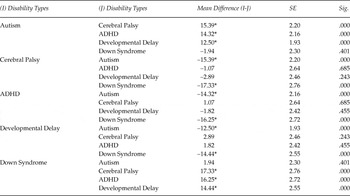
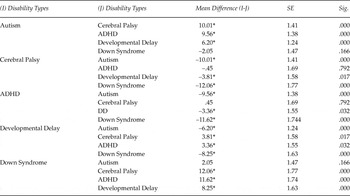
While considering the perceived stress of the primary caregivers of intellectually disabled children, significant mean differences as shown in Table 7 at .05 level of significance through post hoc test (LSD) were found between the caregivers of autistic children and caregivers of children with cerebral palsy; caregivers of children with ADHD and caregivers of autistic children; and caregivers of children with developmental delay and caregivers of autistic children. Similarly, in Table 7, significant mean differences in perceived stress at .05 level of significance through post hoc test (LSD) were also found between the caregivers of children with down syndrome and caregivers of children with cerebral palsy; caregivers of children with ADHD and caregivers of children with Down syndrome; and caregivers of children with developmental delay and caregivers of children with Down syndrome.
Post Hoc test (LSD) for children’s disability types on perceived stress scores of the primary caregivers of intellectually disabled children

Based on observed means, *the mean difference is significant at the .05 level.
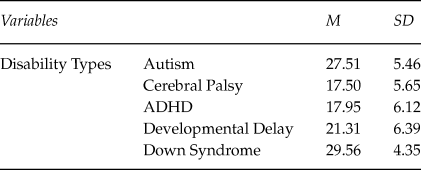
As shown in Table 8, primary caregivers of autistic children showed poor social adaptation (M = 27.51) compared to the caregivers of children with cerebral palsy (M = 17.50), ADHD (M = 17.95) and developmental delay (M = 21.31). Similarly, primary caregivers of children with Down syndrome showed poor social adaptation (M = 29.56) compared to the caregivers of children with cerebral palsy (M = 17.50), ADHD (M = 17.95) and developmental delay (M = 21.31) Again, primary caregivers of children with developmental delay showed poor social adaptation (M = 21.31) compared to the caregivers of children with cerebral palsy (M = 17.50) and ADHD (M = 17.95).
Means and standard deviations on social adaptation scores of the primary caregivers of intellectually disabled children in terms of disability types

While considering the social adaptation of the primary caregivers of intellectually disabled children, significant mean differences as shown in Table 9 at .05 level of significance through post hoc test (LSD) were found between the caregivers of autistic children and caregivers of children with cerebral palsy; caregivers of children with ADHD and caregivers of autistic children; and caregivers of children with developmental delay and caregivers of autistic children. As shown in Table 9 significant mean differences in social adaptation at .05 level of significance through post hoc test (LSD) were also found between the caregivers of children with down syndrome and caregivers of children with cerebral palsy; caregivers of children with ADHD and caregivers of children with Down syndrome; and caregivers of children with developmental delay and caregivers of children with Down syndrome. Findings reflected in Table 9 also showed significant differences in social adaptation at .05 level of significance through post hoc test (LSD) between the caregivers of children with developmental delay and caregivers of children with cerebral palsy; and caregivers of children with developmental delay and caregivers of children with ADHD.
Post Hoc test (LSD) for children’s disability types on social adaptation scores of the primary caregivers of intellectually disabled children

Based on observed means, *the mean difference is significant at the .05 level.
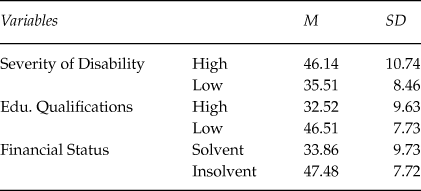
Mean scores on perceived stress in terms of educational qualifications and financial status of the primary caregivers of intellectually disabled children as shown in Table 10 reveal that caregivers with low educational qualifications (M = 46.51) and poor financial conditions (M = 47.48) expressed more perceived stress compared to the caregivers with high educational qualifications (M = 32.52) and good financial status (M = 32.52). Results reported in Table 10 also reveal that primary caregivers whose children’s severity of disability was high significantly showed more perceived stress (M = 46.14) compared to the caregivers whose children’s severity of disability was low (M = 35.51).
Means and standard deviations on perceived stress scores of the primary caregivers of intellectually disabled children in terms of severity of disability, educational qualifications and financial status

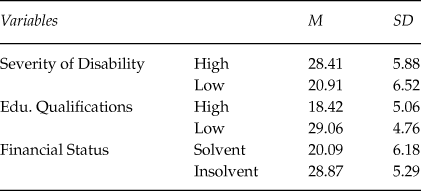
Mean scores on social adaptation in terms of educational qualifications and financial status of the primary caregivers of intellectually disabled children as shown in Table 11 shows that caregivers with low educational qualifications (M = 29.06) and poor financial conditions (M = 28.87) exhibited poor social adaptation compared to the caregivers with high educational qualifications (M = 18.42) and good financial status (M = 20.09). Results reported in Table 11 also reveal that primary caregivers whose children’s severity of disability was high significantly showed poor social adaptation (M = 28.41) compared to the caregivers whose children’s severity of disability was low (M = 20.91).
Means and standard deviations on social adaptation scores of the primary caregivers of intellectually disabled children in terms of severity of disability, educational qualifications and financial status

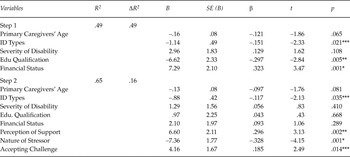
The hierarchical multiple regression as shown in Table 12 reveals that at step 1, among the five predictors of perceived stress, ‘disability types’, ‘caregivers’ educational qualifications’ and ‘financial status’ contributed significantly to the regression model (F = 23.98, df = 5/124, p < .001) and accounted for 49% variations in perceived stress of the primary caregivers of intellectually disabled children. Adding or introducing the other three predictors ‘perception of support’, ‘definition of stressor’ and ‘coping strategies’ in step 2, explained an additional 16% variation in perceived stress above and beyond the effects of the predictors in step 1. This change in R 2 entering the three predictors in step 2 after controlling for the effects of other predictors, was statistically significant (F = 17.94, df = 3/121, p < .001).
Summary of hierarchical regression analysis for variables predicting perceived stress of the primary caregivers of intellectually disabled children

* p < .001, **p < .01, ***p < .05.
Step 1: R 2 = .49, (F 5, 124 = 23.98, p < .001); Step 2: ΔR 2 = .16, (F 3, 121 = 17.94, p < .001).
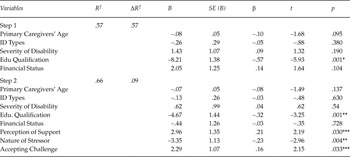
The hierarchical multiple regression presented in Table 13 reveals that at step 1, among the five predictors of social adaptation, caregivers’ educational qualifications contributed significantly to the regression model (F = 33.33, df = 5/124, p < .001) and accounted for 57% variations in social adaptation of the primary caregivers of intellectually disabled children. Adding or introducing the other three predictors ‘perception of support’, ‘definition of stressor’ and ‘coping strategies’ in step 2, explained an additional 9% variation in social adaptation above and beyond the effects of the predictors in step 1. This change in R 2 entering the three predictors in step 2 after controlling for the effects of other predictors, was statistically significant (F = 9.96, df = 3/121, p < .001).
Summary of hierarchical regression analysis for variables predicting social adaptation of the primary caregivers of intellectually disabled children

* p < .001, **p < .01, ***p < .05.
Step 1: R 2 = .57, (F 5, 124 = 33.33, p < .001); Step 2: ΔR 2 = .08, (F 3, 121 = 9.96, p < .001).
Discussion
Findings of the study supported the theoretical assumption that the adaptation outcome depends on interrelations between several factors such as stressors or characteristics of children, social support or resources, perception or definition of the stressor and coping strategies. Primary caregivers of typically developing children usually have more time to think about their personal interests or goals as they have to take less stress or pressure to the rearing of their children. But the primary caregivers of ID children must have to maintain a close monitoring or supervision to the rearing or nurturance of their children and thus their personal interests and freedom become restricted. This creates social incompetence and lower sense of coherence among these primary caregivers that is reflected through a positive association between their perceived stress and social adaptation scores but no association in stress and adaptation was found in case of the caregivers of typically developing children. In the findings of the present study, feeling of more perceived stress and poor social adaptation were higher among the primary caregivers of autistic children and caregivers of children with Down syndrome compared to the caregivers of other intellectual disabilities like cerebral palsy, ADHD and developmental delay. Previous studies consistent with this finding documented that compared to parents of children with other disorders or with parents of normally developing children, parents of autistic children have higher levels of stress, anxiety and depression (Baker et al., Reference Baker-Ericzen, Brookman-Frazee and Stahmer2005; Feldman et al., Reference Feldman, McDonal, Serbin, Stack, Secco and Yu2007; Hastings et al., Reference Hastings, Kovshoff, Ward, degli Espinosa, Brown and Remington2005a; Smith et al., Reference Smith, Seltzer, Tager-Flusberg, Greenberg and Carter2008).
Educational qualifications and financial status did not create any significant impact in perceived stress and social adaptation of the primary caregivers of typically developing children but education and financial status created variations in perceived stress and social adaptation of the primary caregivers of intellectually disabled children. High education and financially solvent situation of the primary caregivers of intellectually disabled children helped them to reduce the negative effects of stress and adaptation to a great extent. These findings are in line with the previous studies of Uskun and Gundogar (Reference Uskun and Gundogar2010), CSID and Cambridge Consortium (2002) and UNICEF (2009).
It was found from the findings of the study that caregivers’ perception of obtaining support was significant predictor of stress and adaptation of the primary caregivers of intellectually disabled children. Findings of the study showed that primary caregivers who perceived the peoples of the society as supportive towards their families and intellectually disabled children, interpreted the stressor as a non-stressor which helped them to possess a strong sense of coherence compared to caregivers who perceived the stressor as an acute stressor due to their perception of the peoples of society as unsupportive towards their families and intellectually disabled children. Consistent with this finding are the studies of Pakenham et al. (2005), Pottie and Ingram (Reference Pottie and Ingram2008) and Brobst et al. (Reference Brobst, Clopton and Hendrick2009).
The salutogenetic perspective proposed by Antonovsky (Reference Antonovsky1987) suggests that it is impossible to foresee what consequences a specific stressor has on an individual’s health without knowing something about that person’s view of her/himself and the world. In this study, Primary caregivers who did not perceive society’s neglecting attitude towards their families as an extra burden felt less perceived stress and exhibited better social adaptation compared to those who perceived this as an extra burden due to their low SOC level. Thus, in this study, caregivers’ perception of disability or definition of the stressor as a stronger predictor significantly influenced their stress perception. By and large, Antonovsky (Reference Antonovsky1987) argued, the person with a strong SOC is more likely to define a possible stressful event or situation as a non-stressor, and to assume that she or he can adapt to the demand, than a person with a weak SOC. Consistent with this, it was found from the present study that primary caregivers perception of the challenge of rearing ID children was a significant predictor of their stress perception and social adaptation. Primary caregivers who positively perceived the challenge of rearing their ID children, showed less perceived stress and better social adaptation compared to their negative perception possessing counterpart. Several studies also revealed that the lower SOC level of an individual is significantly associated with higher stress and poor social adaptation (Antonovsky & Sagy, Reference Antonovsky and Sagy1986; Cohen & Dekel, Reference Cohen and Dekel2000; Pallant & Lae, Reference Pallant and Lae2002).
Thus, it is clear from the findings of the present study discussed above that the three predictors ‘perception of obtaining support’, ‘definition of the stressor’ and ‘ability to accept challenge or coping strategies’ explained significant amount of variations in perceived stress (16%) and social adaptation (9%) of the primary caregivers of intellectually disabled children above and beyond the effects of other predictors (i.e., primary caregivers’ age, disability types, severity of disability, caregivers’ educational qualifications and financial status). The proposition of the Double ABCX model that the stress and adaptation outcome depend on interrelations between several factors like social support or resources, perception or definition of the stressor, and coping strategies have been supported by the findings of the present study. The model’s another proposition that the last three factors could reduce the negative impact of the characteristics of the child on parental adaptation and stress have also been proved through significant R 2 change after entering these three predictors in the regression model above and beyond the effects of the characteristics of the child and other variables.
The present study has certain limitations. It is unexplored from the findings of the study whether parents having ID child were the only child of the family or any other normally developing child existed in their family prior or after the birth of that disabled child. Based on the presence or absence of a typically developing child with the intellectually disabled one in a family, create differences in perceived stress and social adaptation of the primary caregivers of ID children due to the variations of their sense of coherence level. As social support networks vary from region to region due to the variations of community resources, this study would reflect the findings in a more representative way if it would be possible to recruit participants covering other regions instead of recruiting participants only from Chittagong area, Bangladesh.
The present study aimed to explore whether the Double ABCX model of stress and adaptation can promote a better understanding of how much variations ‘perception of social support’, ‘definition of the stressor’ and ‘coping strategies’ as three predictors can create in stress and adaptation of the primary caregivers of intellectually disabled children above and beyond the effects of other predictors.
Findings of the study suggest that the interrelating factors mentioned in the Double ABCX model of stress and adaptation are significant predictors to create variations in perceived stress and social adaptation of the primary caregivers of children after controlling for the effects of other variables on parental experiences. Implication of the study may be that it would focus on risk factors associated with familial and social environments of the primary caregivers of ID children and would emphasize on protective factors to enhance social and economic support network of the primary caregivers of ID children through awareness and intervention trainings including the caregivers and significant members of the society. This, in turn, would help to reduce primary caregivers’ perceived stress and make them socially more adaptable and confident.