Implications
Crossbreeding in the hill enterprise may become an important option to improve flock output as opposed to the purebreeding currently practised in the majority of cases. However, using alternative sire breeds in hill environments requires careful consideration, given its implications for ewe and lamb survival, which represents a major economic and welfare cost to the industry. Consequently, this paper evaluates the effects of crossing sire breeds (Scottish Blackface, Swaledale, Cheviot, Lleyn and Texel) on ewe performance, lamb output and lamb growth performance up to weaning, with special reference to ewe dystocia and lamb survival, in hill sheep systems.
Introduction
The hill sector plays a vital role within the sheep industry being an important source of maternal lines for the lowland sector as well as producing sheep meat. For example, it has been estimated that hill sheep breeds genetically contribute 27% of total UK lamb carcase production (Pollott and Stone, Reference Pollott and Stone2006). In addition, hill sheep grazing can play an important role in promoting flora and fauna diversity (ADAS, 2007). However, the economic sustainability of hill sheep farming is under question due to relatively low levels of ewe productivity recorded within flocks and poor carcass characteristics of hill sheep breeds (Carson et al., Reference Carson, Irwin and Kilpatrick2001) together with the withdrawal of European Union (EU) subsidy payments linked to sheep production.
To underpin the future sustainability of the hill sheep sector, research is required to develop systems with improved levels of flock output. The potential for within breed improvement is clear (Conington et al., Reference Conington, Bishop, Grundy, Waterhouse and Simm2001); however, the level of performance recording on hill farms remains frustratingly low, despite extensive technology transfer initiatives. For example, less than 0·01 of the total number of lambs from hill breeds born each year are performance recorded (Conington et al., Reference Conington, Bishop, Grundy, Waterhouse and Simm2001), and there are hill breeds, such as the Swaledale, that have no flocks registered for performance recording at all (Pullar, Reference Pullar2003). This highlights the need to look for other options available to hill farmers to increase the output.
The potential for improvement in output through crossbreeding has been demonstrated (Carson et al., Reference Carson, Irwin and Kilpatrick2001) and there appears to be a readiness among hill sheep producers to adopt changes in flock breeding structures to exploit the benefits of heterosis and complementarity introduced through crossbreeding. The Scottish Blackface is the predominant hill sheep breed used in the United Kingdom and Ireland, and is also used in other parts of the world. However, there is a paucity of scientific information on the effect of moving from purebreeding to crossbreeding on ewe dystocia and lamb survival, growth and development with Scottish Blackface ewes. Increasingly, skilled labour is becoming a limiting resource on hill farms; hence data on the effects of crossing sire breed on intervention required at lambing and lamb survival, as well as growth and carcass quality, is highly relevant for the sheep sector in selecting breeds for crossbreeding programmes. In particular, there is limited information on the relative performance of using Swaledale and Lleyn sires, breeds that are of significant importance in the United Kingdom. Therefore, scientific data are required on the relative performance of a range of breeds with selected traits in the hill sector to enable the most effective crossbreeding programmes to be developed.
In view of this background, a large-scale programme was initiated to examine the potential for crossbreeding (maternal and individual) to improve the level and quality of lamb output from the hill sheep sector. Using alternative breeds in hill environments requires careful consideration given implications for ewe and lamb survival, as mortality represents a major economic and welfare cost to the industry (Conington et al., Reference Conington, Bishop, Waterhouse and Simm2004; Dwyer, Reference Dwyer2008). Consequently, the aim of this study was to evaluate the effects of crossing sire breeds, selected for hardiness (Swaledale), maternal and carcass traits (Cheviot and Lleyn) and carcass traits (Texel) on ewe performance, lamb output and lamb growth performance up to weaning, with special reference to ewe dystocia and lamb survival, when mated to Blackface ewes under hill conditions.
Material and methods
Animals and management
This study was carried out over three breeding seasons, (October 2001 to July 2004) on six hill farms, located in the main hill regions of Northern Ireland. The study involved 1200 Scottish Blackface ewes in years 1 and 2 and 774 ewes in year 3. On each farm, groups of 26 (year 3) to 40 (years 1 and 2) purebred Scottish Blackface ewes were crossed with Blackface, Swaledale, North Country Cheviot, Lleyn and Texel sires by natural service (year 1) and artificial insemination (AI; years 2 and 3). The mating groups were smaller in year 3, because the female F1 population started lambing and limited resources. In each year, the ewes (including replacement ewes in years 2 and 3) were balanced for ewe live weight, body condition score (Russel, Reference Russel1984) and age across the five crossing sire breeds. The mean live weight and body condition score of the ewes at mating were 51 ± 0.2 kg and 3.4 ± 0.01 kg, respectively. All ewes were mated commencing in late October to mid-November, following movement to improved pasture.
The sire breeds investigated in this study were Scottish Blackface, Swaledale, Cheviot, Lleyn and Texel rams. With the exception of the Swaledale, all sires were selected on the basis of their selection indices to represent the top 10% of recorded animals. No performance recording was undertaken for the Swaledale breed during the period when animals were sourced for this study. In the first year of the study, single-sire mating groups were used on each farm (i.e. one ram per breed on each farm). In the second and third years, semen was collected from a total of nine sires of each breed and inseminated fresh into oestrus-synchronised ewes of each of the mating groups. The rams allocated to each of the farms in year 1 remained on the farm, with the exception of the replacement of a Texel and a Swaledale ram for health reasons and death, respectively. In years 2 and 3, these rams were used again in single-sire mating groups to cover ewes that did not hold to AI service.
Measurements
Live weights (to the nearest 0.5 kg) and body condition scores (Russel, Reference Russel1984) of ewes were recorded by the same individual 1 week before mating, approximately 6 weeks before and 7 weeks after lambing and at weaning. At lambing, date was recorded, along with number of lambs born (alive and dead) and sex of lamb(s). The level of lambing difficulty was assessed on an ordinal scale of 1 to 4. The lambing difficulty scores increased in line with the amount of assistance required; a score of 1 represented a situation where no assistance at lambing was required, a score of 2 represented little help given at lambing (i.e. ewe most likely could have lambed herself) and scores of 3 and 4 represented manual delivery, difficult or very difficult (i.e. including veterinarian intervention) birth, respectively. Furthermore, the reason for manual delivery was recorded (i.e. oversized and/or malpresentation of lamb(s)) for each ewe. Lambs were weighed (to the nearest 0.1 kg) once foetal fluids had dried after birth, and thereafter, they were weighed (to the nearest 0.5 kg) at approximately 7 weeks of age and at weaning (19 weeks).
Statistical analysis
In total 860, 850 and 563 ewes, in years 1, 2 and 3, respectively, were recorded at lambing in the study, producing a total of 3451 lambs over the 3-year period. One Swaledale ram died on a farm in year 1 at the beginning of the mating season, and as no new Swaledale ram could be sourced at short notice for that year; the remainder of ewes were mated to a Texel ram. Lambing difficulty scores were re-categorised into a binary response variable: dystocia (0 = no assistance or little help at lambing, 1 = manual delivery) for data analysis.
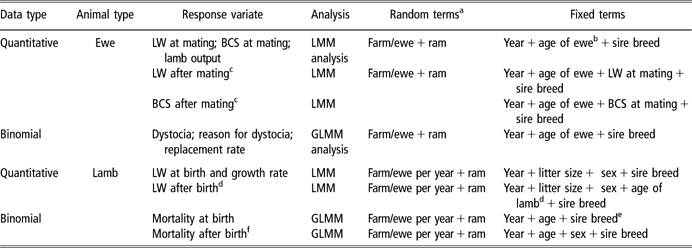
All statistical analyses were carried out using the statistical package GenStat 11 (VSN International Ltd, Hemel Hempstead, UK). Given the unbalanced nature of the data set, the residual (or restricted) maximum likelihood procedure was used to analyse linear mixed models for quantitative (i.e. continuous) data or analyse generalised linear mixed model for binary data (assuming a binomial distribution and logit-link function). The models and analyses, with the random and fixed model terms, used are described in Table 1. Ewe body weight and body condition at 6 weeks pre-lambing, 7 weeks post-lambing and at weaning were adjusted for body weight or body condition at mating, respectively, to take account of the initial difference in size and condition of ewes in the mating groups. Lamb weights at approximately 7 weeks of age and at weaning were adjusted for age of lambs at that time.
Types of analysis and equations for the statistical models used

LW = live weight; BCS = body condition score; LMM = Linear mixed model; GLMM = generalised LMM.
aRandom terms were assumed to follow normal distribution.
bAt 2, 3, 4, 5 and 6 years.
cMeasured at 6 weeks pre-lambing, at 7 weeks post-lambing and at weaning.
dMeasured at 7 weeks post-lambing and at weaning.
eSex excluded due to bias resulting from a high number of missing values for dead lambs.
fMortality of lambs in the periods from birth to 7 weeks of age and from 7 weeks to weaning.
To determine the fixed effect factors contributing to ewe dystocia and lamb mortality (other than sire breed), a best subset selection regression analysis was carried out. The Akaike information criterion (AIC) was calculated and the model with the smallest AIC among all competing models was deemed the best model. If this model contained any fixed terms with probabilities (based on Chi-statistics) of P > 0.1, the next best subset model (i.e. lowest AIC) was chosen without these terms. Once the model was chosen, the appropriate random effect terms (i.e. farm/ewe + ram) were added to the models. All fixed effects were subsequently re-examined using a Wald statistic, and only variables/factors with an associated P ⩽ 0.1 were included in the final models (Table 2). For each model, adjusted odds ratios were computed with associated 95% confidence intervals.
Final model terms after the variable selection process (best subset selection regression analysis)Footnote a

a After adding the appropriate random effects terms, fixed terms with a Wald statistic of P > 0.1 were dropped from the final model.
b Random terms were assumed to follow normal distribution.
c At 2, 3, 4, 5 and 6 years of age.
d Sex excluded due to bias resulting from a high number of missing values for dead lambs.
e Assessed on an ordinal scale of 1 to 4 (1 = no assistance at lambing, 4 = very difficult manual delivery (including veterinarian intervention)).
f From mating to 6 weeks pre-lambing.
g Within season.
h 6 weeks pre-lambing.
To display the effect of birth weight on dystocia and lamb mortality at birth, linear mixed models were carried out, using same fitted fixed effects as described before, adding either birth weight and its quadratic function or litter size. From the resultant fitted models, predictions were formed from the estimated parameters in the model, and these were presented graphically.
Results
Ewe live weight and body condition score
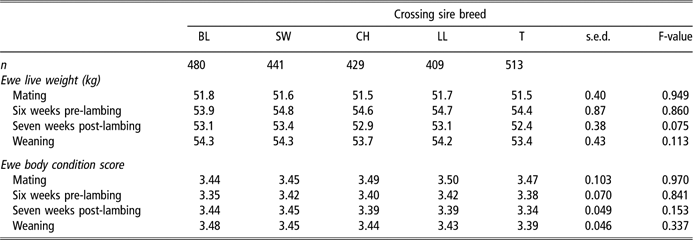
Ewe live weight and body condition score data throughout the reproductive cycle are shown in Table 3. At 6 weeks pre-lambing, all ewes had similar live weight. Ewes mated to Texel sires tended to have lower live weights at 7 weeks post-lambing compared with ewes mated to Blackface, Swaledale and Lleyn sires (P < 0.1), with ewes mated to Cheviot sires intermediate. At weaning, this difference in live weight could still be seen, although this was not statistically significant. All ewes had similar body condition scores throughout the reproductive cycles.
Live weight and body condition score of ewes throughout the reproductive cycle

BL = Blackface; SW = Swaledale; CH = Cheviot; LL = Lleyn; T = Texel.
Effects of crossing sire breed
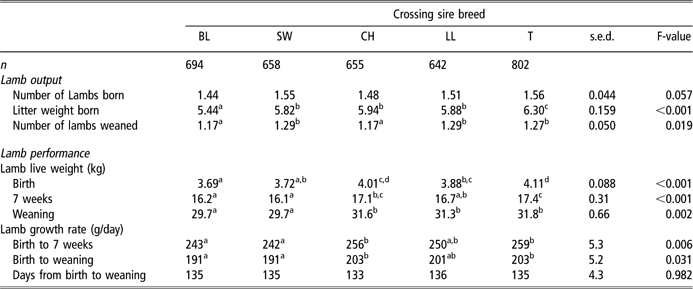
The effect of crossing sire breed on lamb output and growth performance is presented in Table 4. Litter size (number of lambs born per ewe lambed), although not statistically significant, tended to be greater for ewes mated to Swaledale and Texel sires compared with Blackface (P < 0.1) sires. Ewes mated to Blackface and Texel sires produced the smallest and greatest litter weight, respectively (P < 0.01). Ewes mated to the other crossing sire breeds produced similar litter weights. Ewes mated to Swaledale, Lleyn and Texel sires produced a greater number of lambs at weaning per ewe lambed (P < 0.05) than ewes mated to Blackface and Cheviot sires.
The effect of crossing sire breed on lamb output and lamb growth performance

BL = Blackface; SW = Swaledale; CH = Cheviot; LL = Lleyn; T = Texel.
Means within rows with different superscripts are significantly different (P < 0.05).
Sire breed had a significant effect (P < 0.001) on lamb birth weight. Blackface-sired lambs had lower birth weights than that of Lleyn (P < 0.05), Cheviot and Texel-sired (P < 0.001) lambs. Similarly, Swaledale-sired lambs had lower birth weights than that of Cheviot (P < 0.01) and Texel-sired (P < 0.001) lambs, but similar to that of Lleyn-sired lambs. Overall, at weaning, lamb live weights were lower in Blackface and Swaledale-sired lambs compared with Cheviot, Lleyn and Texel-sired lambs (P < 0.01). From birth to 7 weeks, growth rates in Blackface and Swaledale-sired lambs were lower than Texel-sired lambs (P < 0.05). Overall, the growth rates from birth to weaning tended to be lower in Blackface and Swaledale-sired lambs compared with that of Lleyn, Cheviot and Texel-sired lambs (P < 0.1)
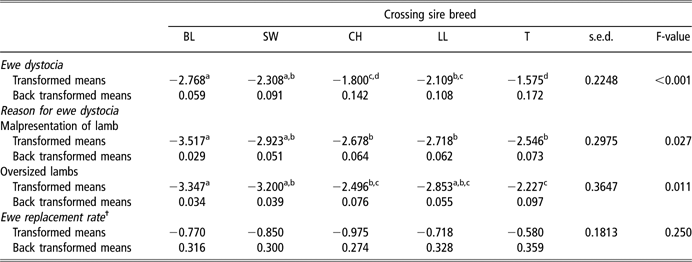
Crossing sire breed had a significant effect (P < 0.001) on the incidence of dystocia (Table 5). The proportion of ewes with dystocia was lower when mated to Blackface compared with the ewes mated to Lleyn (P < 0.01), Cheviot and Texel sires (P < 0.001). A lower incidence of dystocia was also found for ewes mated to Swaledale compared with Cheviot (P < 0.05) and Texel sires (P < 0.001), and for ewes mated to Lleyn compared with Texel sires (P < 0.01). Most of this crossing sire breed effect on dystocia was attributable to differences in lamb size (P < 0.05). However, some of the differences in dystocia were caused by malpresentation of lamb, the incidence of which was lower for ewes mated to Blackface sires compared with ewes mated to the other crossing sire breeds (P < 0.05). The replacement rate for the ewes allocated to each of the crossing sire breeds over the first 2 years is presented in Table 5. The replacement rate, which includes ewes that were culled or died, was not affected by crossing sire breed.
The effect of crossing sire breed on ewe dystocia (proportion of ewes) and ewe replacement rate

BL = Blackface; SW = Swaledale; CH = Cheviot; LL = Lleyn; T = Texel.
Means within rows with different superscripts are significantly different (P < 0.05).
†Number of ewes died plus number of ewes culled over the first 2 years of study.
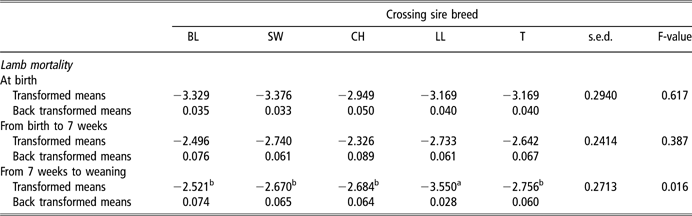
Sire breed had no significant effect on lamb mortality at birth (Table 6). There was also no overall significant effect of sire breed on mortality from birth to 7 weeks of age. Mortality from 7 weeks of age to weaning was lower for Lleyn-sired lambs compared to that of lambs sired by the other breeds (P < 0.05). Overall, mortality ranged between 12% to 19% among the lamb genotypes (P < 0.05), with lower mortality for Lleyn- compared with Blackface- and Cheviot-sired lambs (P < 0.05).
The effect of crossing sire breed on lamb mortality (proportion of lambs)

BL = Blackface; SW = Swaledale; CH = Cheviot; LL = Lleyn; T = Texel.
Means within columns with different superscripts are significantly different (P < 0.05).
Factors affecting dystocia and lamb mortality
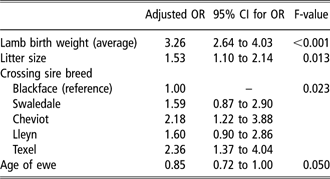
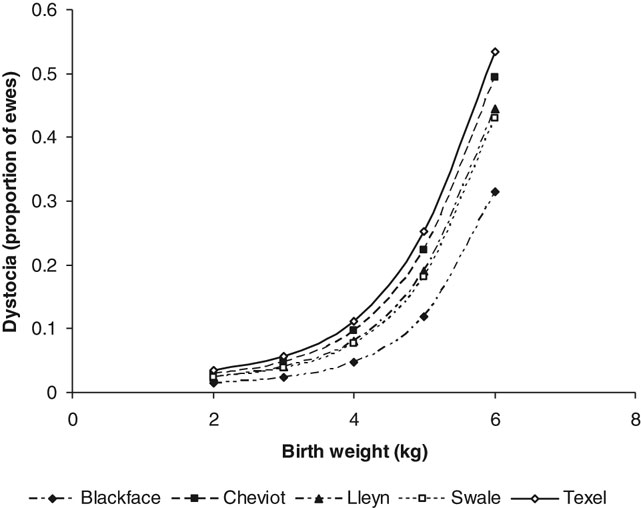
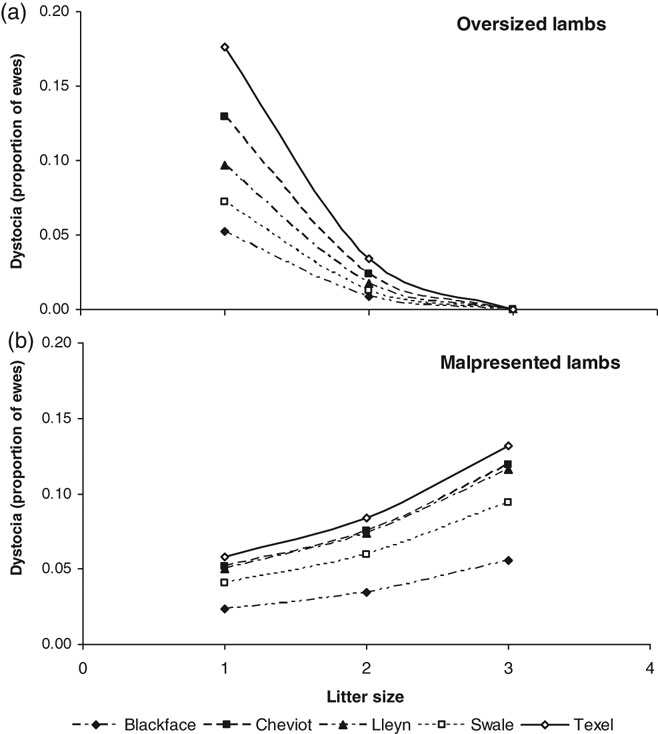
In multiple-regression models (Table 7), lamb birth weight (P < 0.001), litter size (P < 0.01), crossing sire breed (P < 0.05) and age of ewe (P = 0.050) were associated with incidence of dystocia. The relationship of ewe dystocia with birth weight is shown in Figure 1, indicating that the incidence of dystocia started to increase once birth weight increased above 4 kg. Oversize was the predominant cause of dystocia with single lambs, with malpresentation more prevalent in multiple litters (Figures 2a and b).
Key factors which influence the incidence of ewe dystocia

OR = odds ratio; Cl = confidence interval.
Relationship of dystocia at birth with birth weight for the different sire breeds.

Relationship of dystocia (caused by either oversized lambs (a) or malpresented lambs (b); with litter size for the different sire breeds.

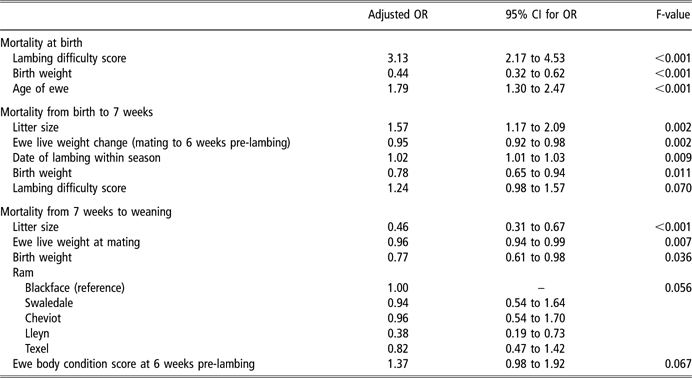
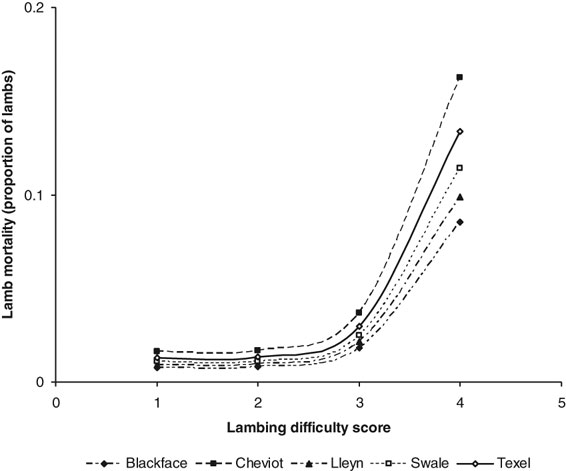
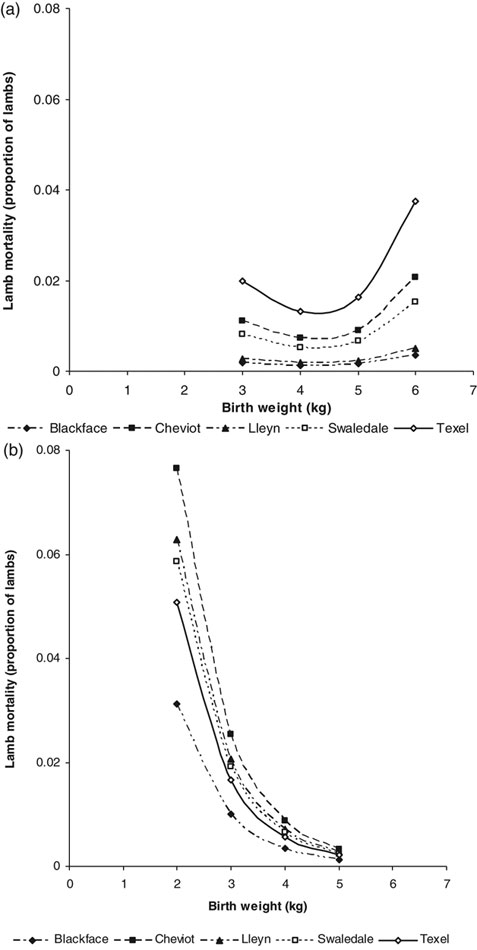
The factors associated with mortality at birth (Table 8) were found to be lambing difficulty score (P < 0.001), lamb birth weight (P < 0.001) and age of ewe (P < 0.001). The relationship between mortality at birth and lambing difficulty score (Figure 3) indicates that only lambing difficulty scores above 2 (defined as dystocia in this study) had a significant effect on mortality. The relationships between mortality and individual birth weight for lambs that were born in single or multiple litters are presented in Figures 4a and b, respectively.
Factors significantly attributing to lamb mortality at birth, from birth to 7 weeks of age, from 7 weeks of age to weaning

OR = odds ratio; Cl = confidence interval.
Relationship of lamb mortality at birth with lambing difficulty score for the different sire breeds. Lambing difficulty assessed on an ordinal scale of 1 to 4 (score 1 = no assistance at lambing, score 4 = very difficult manual delivery (including veterinarian intervention)).

Relationship of mortality at birth with birth weight for single-born lambs (a) and for multiple-born lambs (b) for the different sire breeds.

The factors associated with mortality of lambs between birth and 7 weeks of age (Table 8) were litter size (P < 0.01), ewe live weight change from mating to 6 weeks pre-lambing (P < 0.01), date of lambing within season (P < 0.01) and birth weight (P = 0.01). Lambing difficulty score also tended to be associated with lamb mortality between birth and 7 weeks of age (P = 0.079).
The factors associated with mortality of lambs between 7 weeks of age and weaning (Table 8) were found to be litter size (P < 0.001), ewe live weight at mating (P < 0.001) and birth weight (P < 0.05). Sire breed also tended to affect lamb mortality between 7 weeks of age and weaning (P = 0.093).
Discussion
Effects of crossing sire breed
There are significant potential benefits from switching from traditional purebreeding to crossbreeding in hill ewe flocks, by exploiting the benefits of heterosis through the use of crossing sire breeds with complementary characteristics. This study is unique in that it evaluates the performance of Blackface ewes under hill conditions when mated to a range of crossing sire breeds, selected for hardiness (Swaledale), maternal and carcass traits (Cheviot and Lleyn) and carcass traits (Texel) under hill conditions.
There have been relatively few studies investigating the potential for individual heterosis effects on embryo survival and litter size. McGuirk and Bourke (Reference McGuirk and Bourke1978) observed a positive effect on litter size, whereas Boujenane et al. (Reference Boujenane, Bradford and Famula1991) found no such effects, this may be due to difference in prolificacy of the sheep breeds used in the two studies. In this study, the litter sizes recorded in ewes mated with Swaledale and Texel sires were slightly higher, which may be the result of positive effects of heterosis on embryo survival, as each of the sire breeds were allocated to a group of ewes balanced for age, live weight and condition score, and managed similarly within the same production system.
Most, but not all, of the observed effects of sire breed on the incidence of dystocia could be attributed to birth weight; and birth weight was the largest risk factor associated with ewe dystocia. Higher lamb birth weights increase the risk of incompatibility between maternal pelvic size and lamb dimensions (Noakes, Reference Noakes2001), but the relative importance of the foetus size and maternal pelvis to dystocia and lamb mortality may differ in different populations (Haughey et al., Reference Haughey, George and McGuirk1985). In this study, the differences in the proportion of ewe dystocia caused by oversized lambs between the sire breeds was in line with their respective differences in lamb birth weight. However, this study also found a significant effect of sire breed on ewe dystocia caused by lamb malpresentation, independent of birth weight, which is in agreement with Grommers et al. (Reference Grommers, Elving and Vaneldik1985). The slightly higher incidence of malpresentations in ewes mated to Swaledale sires could be explained by a larger litter size. Malpresentations at birth can also be related to lamb sex, birth weight (Dwyer, Reference Dwyer2003) and ewe parity (Woolliams et al., Reference Woolliams, Wiener and Macleod1983); however, none of these factors explained the higher incidence of malpresentation of Cheviot-, Lleyn- and Texel-sired lambs compared with the purebred Blackface lambs. The lamb itself can actively contribute to its ease of delivery; it has been suggested that less activity in utero may increase the risk of malpresentation at birth (Dwyer, Reference Dwyer2003), and foetal activity may differ between lamb genotypes (Dwyer et al., Reference Dwyer, Lawrence, Brown and Simm1996). Indeed, it could be that foetal activity was restricted in these larger foetal genotypes within the intra-uterine environment of Blackface ewes. Shape of the lamb may also be important, for example, the increased shoulder width of Texel-sired lambs (Speijers et al., Reference Speijers, Carson, Dawson and Gordon2009) may also contribute to lambing difficulties.
The incidence of dystocia for ewes bred pure to Blackface (6%) was within the range (1% to 10%) previously reported for Scottish Blackface ewes in hill conditions (Carson et al., Reference Carson, Irwin and Kilpatrick2001; Noakes, Reference Noakes2001). The economic and welfare constraint of an increased incidence of dystocia associated with crossbreeding depends on its contribution to lamb mortality and ewe productivity, as well as its direct effect on labour requirements. In cattle, dystocia has been shown to affect subsequent reproductive performance and increase the likelihood of culling (Tenhagen et al., Reference Tenhagen, Edinger and Heuwieser1999). In this study, while sire breed had very significant effects on the incidence of dystocia (up to 17% with Texel sires), differences were not large enough to affect subsequent ewe fertility (results not presented) or ewe replacement rate. Furthermore, in this study, there was no effect of sire breed on neonatal mortality. Thus, the beneficial effects of individual heterosis on neonatal mortality (Sidwell et al., Reference Sidwell, Everson and Terrill1962; Sidwell and Miller, Reference Sidwell and Miller1971) may have balanced the detrimental effects of the increased incidence of dystocia associated with crossbreeding. Mortality in lambs from 7 weeks of age to weaning showed benefits of crossbreeding, with mortality lower in Lleyn-sired compared with pure Blackface lambs. The lower mortality with Lleyn-sired lambs occurred both in single- and multiple-born lambs, and was not associated with sex or birth weight differences. This study is the first to investigate the effect on lambing intervention and lamb mortality of using Lleyn sires on Blackface ewes and is particularly relevant to the industry due to the increasing numbers of this breed in the UK industry.
There is little scientific information on the impact of sire breed on changes in live weight and body condition at different stages of the annual cycle. Results of this study indicate that ewes crossed with Texel tended to have lower live weight at 7 weeks post-lambing compared with ewes in other mating groups. This increase in body weight loss post-lambing was associated with relatively high litter weights and growth rates with Texel-sired lambs. The increased nutritional demand of high growth potential terminal sire breed lambs has led to questions on the use of Texel sires on hill-bred ewes (Robinson, Reference Robinson2002). The ability to meet nutritional demands of ewes bred with heavier sire breeds, such as the Texel, will depend on hill conditions. Therefore, this option of crossbreeding may be more suitable for farms that have fewer constraints to improvements in production, such as the availability of better quality pasture or a greater area of improved pasture. This study found that although, ewe live weight may have been slightly effected in early lactation with the use of Texel compared with Blackface or Swaledale sires, differences were relatively small, and by mating, those differences had disappeared. Moreover, there was no effect on body condition scores throughout the reproductive cycle among the different sire breed mating groups, and thus, their body reserves did not appear to have been depleted.
The variation in lamb birth weight and growth performance reflects to a large degree the differences in mature body weight of the sire breeds used, which is consistent with the high correlation between lamb birth weights and subsequent growth rates (Wolf, Reference Wolf1980). Previous reports also found increased lamb weights and growth rates for Blackface ewes crossed with heavier Texel or Cheviot breeds compared with those purebred (Wiener and Hayter, Reference Wiener and Hayter1974; Carson et al., Reference Carson, Irwin and Kilpatrick2001). In addition, Lleyn-sired lambs were also heavier at birth and at weaning compared with purebred Blackface lambs. There was no apparent advantage in birth and weaning weights among the Swaledale-sired lambs compared with the purebred Blackface lambs, contradicting previous observations that the Swaledale was better than Blackface for lamb performance (Donald et al., Reference Donald, Read and Russell1963; Al-Nakib et al., Reference Al-Nakib, Bateman, Findlay, Smtth and Thompson1997). However, the growth rates from birth to weaning of purebred Blackface lambs were higher than those found previously for purebred Blackface lambs (Carson et al., Reference Carson, Irwin and Kilpatrick2001), which may show the improved genetic potential of the Blackface rams used in this study compared with previous studies. This highlights that the benefits of crossbreeding in terms of lamb growth performance would even be greater when compared with average Blackface sires.
Other factors affecting dystocia and lamb mortality
Besides lamb birth weight and sire breed, litter size and age of ewe were also the risk factors for dystocia. The increased risk of dystocia occurring with increased litter size is in line with the finding that multiple litters had higher incidence of malpresentation at birth. The age of ewe also had a small effect on the incidence of ewe dystocia, with younger ewes having higher risk of dystocia. This is consistent with the inexperience at lambing of young (primiparous) ewes and their disadvantage when delivering lambs that are too large for them (Woolliams et al., Reference Woolliams, Wiener and Macleod1983; Grommers et al., Reference Grommers, Elving and Vaneldik1985).
Ewe dystocia, as expected (e.g. Gunn, Reference Gunn1968; Holst et al., Reference Holst, Fogarty and Stanley2002; Casellas et al., Reference Casellas, Caja, Such and Piedrafita2007), increased the risk of lamb mortality; every increase in lambing difficulty score was found to be more than double the likelihood of lamb(s) dying at birth (defined as from birth to tagging within 24 h of birth, that is, perinatal mortality). This effect of dystocia on mortality at birth is predictably stronger in single-born lambs, as their heavier birth weights predispose them to dystocia and its associated birth trauma (Gama et al., Reference Gama, Dickerson, Young and Leymaster1991). However, even lighter lambs that have suffered dystocia have an increased risk of not surviving because of inhibited neonatal behaviour (Dwyer, Reference Dwyer2003) and thermoregulatory ability (Slee and Springbett, Reference Slee and Springbett1986). The effect of lambing difficulty could still be seen in the early postnatal period (from birth to 7 weeks of age), although not as strong.
Lambs with low birth weight, more common in multiple-born lambs, are at higher risk of starvation and hypothermia than heavy lambs (Dalton et al., Reference Dalton, Knight and Johnson1980; Gama et al., Reference Gama, Dickerson, Young and Leymaster1991). In agreement with previous studies (Holst et al., Reference Holst, Fogarty and Stanley2002; Sawalha et al., Reference Sawalha, Conington, Brotherstone and Villanueva2007), results of this study indicate a quadratic relationship between lamb birth weight and mortality, with lighter and heavier lambs at highest risk of mortality, emphasising the importance of optimising, rather than maximising, birth weight (Everett-Hincks and Dodds, Reference Everett-Hincks and Dodds2008). The optimum birth weight range has been suggested to lie between 3 and 5.5 kg (Dalton et al., Reference Dalton, Knight and Johnson1980; Nowak and Poindron, Reference Nowak and Poindron2006; Casellas et al., Reference Casellas, Caja, Such and Piedrafita2007) for both single-born and multiple-born lambs, which supports the findings from this study. The increased mortality risk of lighter lambs was observed throughout the study (i.e. from birth to weaning), although its effect slightly lessened as lambs’ age increased.
In this study, the sex of lamb could not be included in the model for mortality at birth, because of the high number of missing values (i.e. sex) for lambs that died at birth, which tended to bias the data. However, for the lambs that died at birth and had sex recorded the ratio of males to females was 1 : 2, which follows published literature (Dalton et al., Reference Dalton, Knight and Johnson1980; Morris et al., Reference Morris, Hickey and Clarke2000). This is probably mostly due to its effect on birth weight (Nash et al., Reference Nash, Hungerford, Nash and Zinn1996; Holst et al., Reference Holst, Fogarty and Stanley2002). The effect of age of ewe on lamb mortality has been shown by many authors to be important; often reported to generally decline with age up to the fourth or fifth parities (Dalton et al., Reference Dalton, Knight and Johnson1980; Morris et al., Reference Morris, Hickey and Clarke2000; Sawalha et al., Reference Sawalha, Conington, Brotherstone and Villanueva2007). In this study, the opposite was found. The increase in litter size and birth weight with increasing age would account for most of the higher mortality observed with older ewes in this study. In addition, lamb deaths due to malpresentation are found to be relatively common in older ewes (Woolliams et al., Reference Woolliams, Wiener and Macleod1983).
In the early postnatal period (from birth to 7 weeks of age), an increase in litter size almost doubled the risk of lamb mortality, which agrees with previous reports (Sawalha et al., Reference Sawalha, Conington, Brotherstone and Villanueva2007). Other risk factors for lamb mortality at this stage were ewe live weight change from mating to 6 weeks pre-lambing and date of lambing. Ewes losing more weight during pregnancy had lower body condition scores at 6 weeks pre-lambing, and this may be indicative of inadequate nutrition or physiological problems or both, resulting in low birth weights (Robinson et al., Reference Robinson, Rooke and McEvoy2002) or reduced udder development and subsequent decreased colostrum and milk production (Mellor et al., Reference Mellor, Flint, Vernon and Forsyth1987; Bizelis et al., Reference Bizelis, Charismiadou and Rogdakis2000), thereby increasing lamb mortality rates. Ewes lambing later within the season had lower live weights 6 weeks pre-lambing and had higher lamb mortality than ewes lambing earlier. As well as being in lower body condition score, later lambing ewes have the disadvantage of build-up of infectious agents in the lambing environment, fatigue in lambing personnel and competition for resources, all of which could have detrimental effects on lamb mortality.
During the later postnatal period (from 7 weeks of age to weaning at 19 weeks), unlike in the early postnatal period, single lambs were at increased risk of not surviving; this can be explained by different management between single and multiple litters at this time. Ewes with their single lambs are returned to the higher areas of hill farms, often with more challenging and difficult conditions, whereas ewes with twin lambs are kept on marginal and/or improved areas in milder and more favourable conditions for longer.
Ewe body condition score at mating influenced ewe replacement rate greatly; ewes that were in a body condition score of ⩽3 had smaller litters, lower total weight lambs weaned and were twice as likely to disappear from the flock (either through culling or dying) than ewes with higher condition scores at mating (results not presented). The negative effect of poorer body condition at mating on lambing rates and weaned lamb production is in agreement with earlier work (Carson et al., Reference Carson, Irwin and Kilpatrick2001), and reinforces the importance of ensuring ewes are in ‘target’ body condition score at mating and throughout the reproductive cycle (Robinson et al., Reference Robinson, Rooke and McEvoy2002), especially for ewes carrying multiple litters and/or mated to heavier crossing sire breeds.
Conclusions
Since 2005, sheep farmers receive support payments irrespective of production, with payments increasingly being linked to demands to meet statutory environment and animal welfare regulations. This will limit stocking rates in many hill areas, and therefore, individual animal performance has assumed an added importance in the economic performance of sheep flocks. In this situation, choice of crossing sire breed in the hill enterprise may become an important option as opposed to the purebreeding currently practised in the majority of cases.
Using sires from larger breeds, such as Lleyn and Texel, within the Blackface ewe flock can increase the number of lambs weaned per ewe-mated and lamb growth rates, with no apparent detrimental effects on lamb survival. However, using these larger crossing sire breeds on Blackface ewes can increase the incidence of ewe dystocia; although this may not affect ewe replacement rate, it will significantly increase the need for assistance at lambing time.
Acknowledgements
The authors are indebted to the following hill sheep producers for their dedicated help and cooperation in undertaking this study: Mr S. Montgomery, Mr M. McHenry, Mr S. Maginn, Mr R. Duffin, Mr S. Wharry and Mr I. Buchanan. Thanks are also due to Mr D. Irwin, Dr D. Kilpatrick and the staff of the sheep unit and biometrics department. The authors also gratefully acknowledge the Department of Agriculture and Rural Development (DARD) for Northern Ireland and AgriSearch (farmer levy funding) who provided funding for this project.