


Introduction
Policy instruments are at the forefront of achieving policy goals, yet there is still much to learn about the factors that make them publicly and politically acceptable. Gaining a deeper understanding of the differences in public support for various policy instruments and the contexts in which they are embraced is essential. This is particularly important given that tackling complex issues frequently necessitates the use of effective instruments that might face significant opposition from different societal groups (Drews and Van den Bergh Reference Drews and van den Bergh2016). For instance, implementation of restrictive parking regulations and road tolls illustrates policy instruments that, despite being widely recognized for their environmental effectiveness, tend to garner limited public support (Christiansen Reference Christiansen2020; Doherty et al. Reference Doherty, Paterson, Plows and Wall2003; Kallbekken and Sælen Reference Kallbekken and Sælen2011).
We use the term public acceptance to refer to citizens’ stated support for or opposition to a proposed policy intervention before implementation (Salamon Reference Salamon2002, p. 24). This understanding is distinct from behavioral compliance after implementation and from broader notions of political legitimacy, although public acceptance may contribute to both. In the experiment, acceptance is measured as respondents’ self-reported level of support for each proposed transport policy package on a seven-point scale.
The challenge of garnering public support is often cited as the significant hindrance in the implementation of policies designed to address complex governmental issues (Wicki et al. Reference Wicki, Huber and Bernauer2020). One promising approach to overcoming this hurdle is the concept of policy packaging. In this article, we define a policy package as an intentionally designed bundle of multiple policy instruments – typically a primary instrument combined with one or more ancillary instruments – aimed at advancing a shared policy goal (Givoni et al. Reference Givoni, Macmillen, Banister and Feitelson2013; Howlett and Rayner Reference Howlett and Rayner2013). Policy packages are closely related to policy mixes and policy assemblages, but our use of the term emphasizes deliberate bundling and public evaluation of the bundle as a unit. Whereas policy mixes often describe the broader configuration of instruments within a policy sector, and policy assemblages may refer to more loosely connected or evolving constellations of policies, our empirical focus is narrower: how citizens respond to intentionally designed combinations of one primary instrument and different ancillary instruments.
The article speaks to three related bodies of research. First, it contributes to the policy design and policy instrument literature, which examines how governments select and combine instruments to address complex policy problems (Howlett and Rayner Reference Howlett and Rayner2007; Salamon Reference Salamon2001; Schneider and Ingram Reference Schneider and Ingram1990). We contribute to this literature by examining how citizens evaluate combinations of instruments rather than individual instruments in isolation. Second, the article contributes to research on policy packaging and policy mixes, which emphasizes the importance of combining instruments in ways that are coherent, effective, and politically feasible (Givoni et al. Reference Givoni, Macmillen, Banister and Feitelson2013; Howlett and Rayner Reference Howlett and Rayner2013; Kern et al. Reference Kern, Rogge and Howlett2019). Our contribution is to examine how package size and the coherence between primary and ancillary instruments shape public acceptance. Third, the article contributes to research on public acceptance of climate-related transport policy, particularly restrictive car-use instruments such as road tolls, parking charges, parking restrictions, and street closures (Drews and Van den Bergh Reference Drews and van den Bergh2016; Eliasson and Jonsson Reference Eliasson and Jonsson2011; Wicki et al. Reference Wicki, Huber and Bernauer2020). We extend this literature by studying acceptance in smaller and medium-sized cities, where car dependency is high and alternatives to car use may be less competitive.
Against this background, the study examines three related questions concerning the public acceptance of transport policy packages. First, we examine whether adding ancillary instruments to a restrictive primary instrument increases acceptance. Second, we examine whether this effect depends on the type of primary instrument and the coherence between primary and ancillary instruments. Third, we examine whether prior local experience with similar restrictive instruments conditions acceptance. The study is guided by the following research questions:
RQ1: What is the effect of adding ancillary instruments to a restrictive car-use instrument on public acceptance?
RQ2: How does this effect vary by primary instrument type and by the coherence between primary and ancillary instruments?
RQ3: How does prior local experience with similar restrictive transport instruments condition public acceptance of policy packages?
These research questions structure the hypotheses developed in the literature section: H1 addresses package size and corresponds to RQ1; H2a and H2b address primary instrument type and package coherence and correspond to RQ2; and H3 addresses local experience and corresponds to RQ3. To answer these questions, we use a randomized survey experiment among citizens in five Norwegian cities. Empirically, the experiment operationalizes policy packages as combinations of one primary transport instrument and zero to three ancillary instruments. This design allows us to estimate how public acceptance varies by package size, package composition, primary instrument type, and local context. The study thereby provides insights into how policy packaging can increase public acceptance of restrictive transport policies across different urban contexts.
Literature and theoretical framework
Policy package design and public acceptance: existing research
The literature on policy design emphasizes that governments rarely rely on single instruments when addressing complex policy problems. Instead, public policies often consist of combinations of instruments that interact in shaping both effectiveness and political feasibility (Howlett and Rayner Reference Howlett and Rayner2007; Howlett et al. Reference Howlett, Mukherjee and Woo2015; Howlett Reference Howlett2019; Rogge and Reichardt Reference Rogge and Reichardt2016). Policy packaging refers to the deliberate bundling of instruments in ways that may increase effectiveness, reduce unintended consequences, and mitigate opposition (Givoni et al. Reference Givoni, Macmillen, Banister and Feitelson2013; Howlett and Rayner Reference Howlett and Rayner2013). From the perspective of public acceptance, this means that citizens may evaluate not only the primary instrument itself, but also whether the broader package appears effective, fair, coherent, and locally appropriate.
This perspective is particularly relevant for climate-related policy. Effective climate instruments often impose visible and concentrated costs while producing benefits that are broader, long-term, and more diffuse. Existing research shows that acceptance of climate and environmental policies depends on perceived costs, fairness, effectiveness, revenue use, political trust, and compensation (Drews and Van den Bergh Reference Drews and van den Bergh2016; Fairbrother Reference Fairbrother2019; Huber et al. Reference Huber, Wicki and Bernauer2020; Kallbekken and Sælen Reference Kallbekken and Sælen2011). Studies of environmental taxes and related instruments suggest that acceptance may increase when revenues are earmarked for publicly valued purposes, when information about revenue use is provided, or when negatively affected groups are compensated (Baranzini and Carattini Reference Baranzini and Carattini2017; Beiser-McGrath and Bernauer Reference Beiser-McGrath and Bernauer2019; Heres et al. Reference Heres, Kallbekken and Galarraga2017; Sælen and Kallbekken Reference Sælen and Kallbekken2011; Schuitema and Steg Reference Schuitema and Steg2008). At the same time, the literature also shows that packaging does not automatically increase acceptance: the effect depends on what is added and how citizens interpret the package (Andreassen et al. Reference Andreassen, Kallbekken and Rosendahl2024; Fesenfeld et al. Reference Fesenfeld, Wicki, Sun and Bernauer2020; Wicki et al. Reference Wicki, Fesenfeld and Bernauer2019).
Climate-related transport policy provides a particularly useful setting for studying these mechanisms because many effective instruments directly affect everyday mobility. Road tolls, parking charges, parking space reductions, and street closures can reduce car use, but they also impose costs or restrict access. Prior research on transport policy acceptance shows that citizens’ support is shaped by perceived personal costs, reduced accessibility, inconvenience, fairness, effectiveness, trust, revenue use, and the availability of alternatives (Aasen and Sælen Reference Aasen and Sælen2022; Albalate and Bel Reference Albalate and Bel2009; Börjesson et al. Reference Börjesson, Eliasson, Hugosson and Brundell-Freij2012; Eliasson and Jonsson Reference Eliasson and Jonsson2011; Eliasson Reference Eliasson2014; Hysing and Isaksson Reference Hysing and Isaksson2015; Hansla et al. Reference Hansla, Hysing, Nilsson and Martinsson2017; Wicki et al. Reference Wicki, Huber and Bernauer2020). Transport policy research has also emphasized that measures to reduce car use often need to be combined in packages to address congestion, pollution, emissions, and accessibility concerns simultaneously (Banister Reference Banister2008; Givoni Reference Givoni2014; Justen et al. Reference Justen, Fearnley, Givoni and Macmillen2014; Marshall and Banister Reference Marshall and Banister2000). Such packages may include improved public transport, cycling infrastructure, green space, road-related adjustments, or equity measures (Eriksson et al. Reference Eriksson, Garvill and Nordlund2008; Givoni Reference Givoni2014; Wicki et al. Reference Wicki, Huber and Bernauer2020).
However, the effects of such packages are unlikely to be uniform. Existing research therefore provides strong reasons to expect that policy packaging can increase public acceptance, but it also leaves three issues insufficiently understood. First, most studies examine packages with a fixed number of instruments, leaving less knowledge about whether adding more ancillary instruments has an additive effect on acceptance. This issue also relates to broader debates about over- and under-design in policy mixes and the number of instruments required to address complex policy problems (Fesenfeld Reference Fesenfeld2025; Howlett Reference Howlett2018; Rogge et al. Reference Rogge, Kern and Howlett2017). Second, existing studies show that the type of instruments matters, but less is known about how citizens respond to different combinations of primary and ancillary instruments. Third, most studies focus on national-level acceptance or large urban contexts, whereas less is known about acceptance in smaller and medium-sized cities. This matters because such cities may be more car-dependent, have less competitive public transport alternatives, and experience congestion and local pollution as less visible or urgent policy problems (Lunke et al. Reference Lunke, Fearnley and Aarhaug2023; Nordbakke and Lunke Reference Nordbakke and Lunke2021). At the same time, smaller cities are also expected to contribute to national and international climate targets (Müller-Eie and Kosmidis Reference Müller-Eie and Kosmidis2023).
Theoretical argument: package size, coherence, and local experience
Our study mainly tests and refines existing arguments about policy packaging using new experimental data from smaller and medium-sized cities. The study refines existing arguments about policy packaging by bringing together three explanatory factors that are often treated separately: package size, package composition and coherence, and local experience. Our core argument is that public acceptance of climate-related transport policy packages depends on how citizens interpret the balance between the burden imposed by the primary instrument and the benefits, compensation, or public value signaled by the ancillary instruments.
The first mechanism concerns package size. Adding ancillary instruments may increase acceptance because it increases the likelihood that citizens identify some benefit in the package. A larger package may include improvements to public transport, cycling infrastructure, green space, road improvements, or equity measures, and thereby appeal to a broader range of citizens. From a rational choice perspective, ancillary instruments can make a restrictive primary instrument more acceptable by increasing perceived benefits or compensating for imposed costs. At the same time, adding more instruments may increase cognitive demands. In line with bounded rationality, citizens may rely on heuristics and focus on salient features of the package, especially the perceived cost, fairness, or restrictiveness of the primary instrument (Fesenfeld Reference Fesenfeld2025; Kahneman Reference Kahneman2003). We therefore treat package size as an empirical question rather than assuming that more instruments always increase acceptance.
H1: Policy packages with more ancillary instruments will generally receive higher public acceptance than packages with fewer ancillary instruments.
The second mechanism concerns the type of primary instrument and the coherence between primary and ancillary instruments. Policy instrument scholars have long emphasized that instruments differ in their underlying behavioral assumptions, degree of coerciveness, and mode of intervention (Salamon Reference Salamon2001; Schneider and Ingram Reference Schneider and Ingram1990; Vedung Reference Vedung, Bemelmans-Videc, Rist and Vedung1998). In this study, we distinguish between price-based instruments, which increase the monetary cost of car use while preserving the option to drive, and access-restricting instruments, which directly reduce access to parking spaces or streets. Road toll increases and parking charge increases are price-based instruments, while parking space reductions and street closures are access-restricting instruments. We expect this distinction to matter because access-restricting instruments directly limit mobility options, whereas price-based instruments maintain formal access but make car use more expensive.
At the same time, citizens are unlikely to evaluate the primary instrument in isolation. Ancillary instruments may increase acceptance when they provide visible compensatory benefits, offer attractive alternatives to car use, make the public value of the package clearer, or directly mitigate the burden imposed by the primary instrument. For example, public transport improvements may be perceived as more relevant when a policy increases the cost of car use, while improved parking facilities outside closed streets may be perceived as more relevant when street access is restricted. Packages may be less acceptable when the ancillary instruments appear weakly connected to the burden created by the primary instrument or when the overall package appears incoherent.
H2a: Access-restricting primary instruments will receive lower acceptance than price-based primary instruments because they directly limit mobility options rather than only increasing the cost of car use.
H2b: Ancillary instruments that more directly mitigate the burden created by the primary instrument will increase acceptance more than ancillary instruments with a weaker connection to that burden.
The third mechanism concerns local experience. Acceptance of restrictive transport instruments may depend on whether citizens have prior experience with similar instruments. Prior exposure may normalize the instrument, reduce uncertainty about its consequences, and make the purpose of the policy more familiar. This is particularly relevant for road tolls, where previous studies show that acceptance may change over time after implementation (Börjesson et al. Reference Börjesson, Eliasson, Hugosson and Brundell-Freij2012; Christiansen Reference Christiansen2020). Cities may also vary in residents’ perceptions of the need for restrictive transport policy, sometimes described as “crisis understanding” (Tørnblad et al. Reference Tørnblad, Westskog and Rose2014). We therefore expect public acceptance of policy packages to be conditioned by local experience with similar restrictive instruments.
H3: Acceptance of restrictive transport policy packages will be higher in cities with longer prior experience with similar restrictive instruments, particularly road tolls.
Taken together, these hypotheses conceptualize public acceptance as shaped by what is added to a package, how well the added instruments fit the primary instrument, and the local context in which citizens evaluate the package. This framework allows us to examine whether policy packaging increases acceptance in general, whether some combinations are more acceptable than others, and whether prior local experience conditions how citizens respond to restrictive transport policy packages.
Policy context
Norway aims to reduce its greenhouse gas emissions by 55 percent by 2030, compared to 1990 levels (Ministry of Climate and Environment 2021). As part of this national objective, the Norwegian Parliament has set a specific target for urban regions: zero growth in private car usage. Achieving this goal presents a significant challenge, particularly in the face of expected economic growth and increasing populations in and around urban areas.
Norway is also a theoretically relevant case because climate and transport policy occupy a prominent position in public and political debate. The country combines ambitious climate targets with high levels of mobility and dispersed settlement patterns (Ministry of Climate and Environment 2021). Norway also has unusually high electric vehicle uptake, which may reduce emissions from private cars but does not remove broader concerns related to congestion, land use, parking, local environmental impacts, and car dependency (Halse et al. Reference Halse, Hauge, Isaksen, Johansen and Raaum2025; Nordbakke and Lunke Reference Nordbakke and Lunke2021). At the same time, public transport, cycling, and walking remain less competitive alternatives to car use in many smaller Norwegian cities (Lunke et al. Reference Lunke, Fearnley and Aarhaug2023; Nordbakke and Lunke Reference Nordbakke and Lunke2021). This combination makes Norway a demanding but theoretically useful case for studying public acceptance of restrictive car-use instruments: citizens may recognize the importance of climate policy while also questioning the need for additional restrictions when vehicle electrification is already advanced.
This study focuses on five smaller cities in Norway, each with approximately 60,000 inhabitants, although they differ somewhat in terms of population density and urban structure. Like many smaller cities globally, these cities exhibit high levels of car dependency, while public transport and cycling represent a relatively small share of overall transportation. These variations, as highlighted by Lunke et al. (Reference Lunke, Fearnley and Aarhaug2023), underscore differences in key factors such as public transport competitiveness.
A crucial consideration is whether these cities share similar transportation policy goals, as alignment in political objectives is essential for studying the effects of similar policy instruments. Despite some differences in density and infrastructure, the cities have comparable transportation goals. Thus, the same policy instruments examined in this study, such as road tolls and restrictive parking policies, are relevant for helping these cities meet their transportation and environmental targets – most notably, the zero-growth target for personal car usage. The five cities were selected as comparable small-to-medium-sized Norwegian urban areas where restrictive transport instruments are politically relevant for achieving local and national transport-climate goals. The case selection therefore follows a most-similar logic: the cities are broadly similar in population size, car dependency, and policy relevance, which makes them suitable for studying how citizens respond to the same experimentally varied policy packages across comparable urban contexts.
At the same time, the cities are not identical. They vary in prior experience with restrictive transport instruments, especially road tolls, as well as in toll levels, timing of implementation, parking charges, and the competitiveness of alternatives to car use. This variation is important because prior exposure to restrictive instruments may shape public acceptance. Sandefjord, which has no road toll system, is therefore not treated as a separate “test case,” but as an analytically useful contrast to cities with longer experience of tolling. Tolling is thus one relevant contextual dimension, particularly for H3, but not the sole variable of interest. The main experimental variables remain package size, primary instrument type, and the composition of ancillary instruments.
From the transportation research literature, road tolls and restrictive parking instruments (which can include raising parking costs and reducing parking availability) are considered among the most effective strategies for reducing emissions and car use (Christiansen et al. Reference Christiansen, Engebretsen, Fearnley and Hanssen2017; Inci Reference Inci2015). Road tolls and parking charges are price-based instruments because they increase the monetary cost of car use while preserving the option of driving. Another increasingly relevant instrument involves making urban streets car-free, a policy that not only contributes to environmental goals but also promotes more livable and attractive urban spaces (Nieuwenhuijsen and Khreis Reference Nieuwenhuijsen and Khreis2016). This approach is regarded as an access-restricting instrument because it prohibits driving in designated areas altogether. To meet their environmental and transportation goals, the cities studied here must implement similar policy instruments, which are the focus of this article.
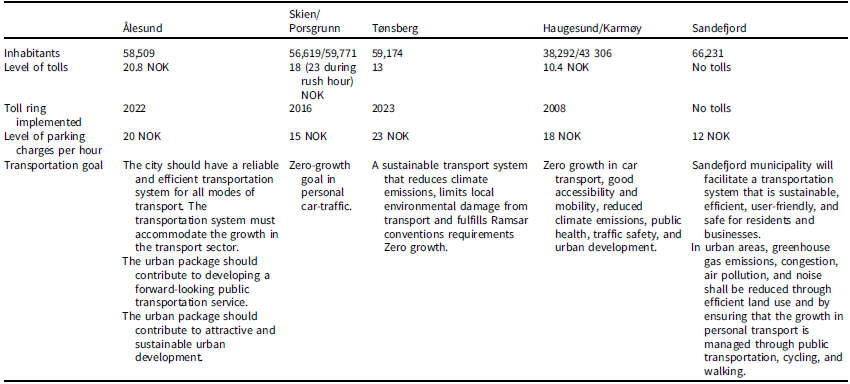
Table 1 below provides a summary of key characteristics for the five cities, including toll rates, parking charges, and transportation goals. These indicators highlight the varying approaches to transportation management across the cities and offer a foundation for assessing the acceptance of policy instruments.
Contextual background
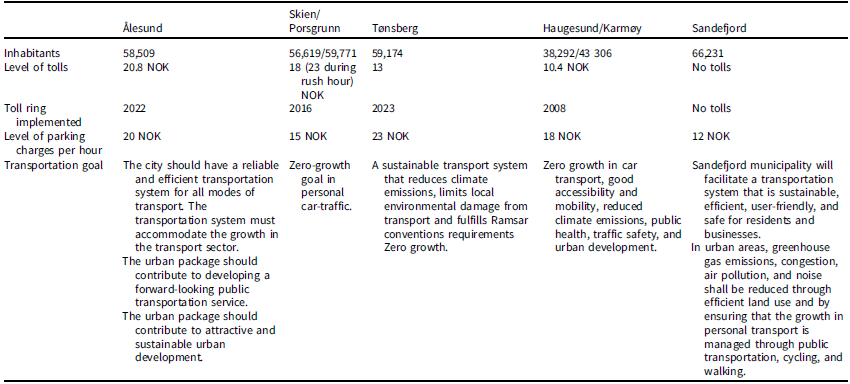
Table 1. Long description
Table comparing population, toll levels, toll-ring implementation, parking charges and transport goals in five Norwegian city areas.
The high car dependency in these cities presents a significant challenge for implementing restrictive transportation policies. A larger share of the population relies on cars for daily mobility, making policies such as road tolls and parking restrictions more directly impactful and, potentially, more controversial. Additionally, the ancillary instruments designed to offset these restrictions, such as improved public transportation, are often less attractive in smaller urban areas where public transport networks tend to be less developed and competitive (Lunke et al. Reference Lunke, Fearnley and Aarhaug2023).
However, challenges such as congestion, while present, are generally less severe in these smaller cities compared to larger urban regions. This may reduce the urgency for certain restrictive instruments, making public acceptance harder to achieve. On the other hand, Norway also provides a setting where politicians benefit from relatively high levels of political trust (Haugsgjerd and Segaard Reference Haugsgjerd and Segaard2020), which could play a critical role in fostering acceptance for both restrictive policy instruments and broader policy packages. The high level of trust in local politicians and institutions may help counterbalance the potential resistance to policies perceived as burdensome.
This study tests the relevance of policy mechanisms in a typical setting of smaller, car-dependent cities. The findings from this study have the potential to offer insights that are not only valuable for Norwegian cities but also applicable to similar urban contexts globally, where car dependency and political trust intersect with the need to implement environmentally sustainable transportation policies.
Data, measurement, and methods
The project and questionnaire were notified to Sikt, the Norwegian Agency for Shared Services in Education and Research. The survey was administered via SMS to residents aged 18 years and older in the five municipalities included in the study. Contact information was obtained by purchasing telephone numbers for residents registered in these municipalities. Respondents received an SMS invitation with a link to the survey, and responses were collected using the survey platform Walr. Participation was voluntary, and respondents were informed about the purpose of the study and the handling of personal data before answering the questionnaire. By proceeding to the questionnaire, respondents provided informed consent. The survey experiment was not preregistered. The hypotheses and analytical strategy were developed before the main analyses were conducted, but no formal preregistration was filed.
A total of 35,500 inhabitants in five cities were invited to participate through SMS. Respondents that were willing to participate followed an individual link to the survey. A total of 3,484 answered the whole survey, achieving a response rate of 9.8 percent. While this is a relatively low response rate, it is not unusual for surveys of this kind. The response rate raises concerns about potential self-selection bias. Individuals more interested in policy-related issues or transportation policies may have been more likely to respond. This could lead to overestimating acceptance levels for some policy packages, as those less supportive may have opted out of participating.
While the sample is broadly representative in terms of age and gender, the slight overrepresentation of older males may influence the generalizability of the results, especially considering that attitudes towards restrictive transportation policies may vary by other factors such as income, education, and car ownership. Unfortunately, we were unable to assess these variables in the full sample. This limitation should be considered when interpreting the results, particularly regarding potential non-response bias. Table 2 compares the invited sample with the respondents who completed the survey in terms of gender, mean age, and sample size.
Response rate compared to the full sample

Table 2. Long description
The invited sample contained 35,500 people, of whom 50.3 percent were male and the mean age was 55.13 years. The completed survey contained 3,484 respondents, of whom 53.3 percent were male and the mean age was 57.76 years. The completed sample therefore has a slightly higher male share and is about 2.6 years older on average than the invited sample.
Additionally, the study’s focus on smaller cities means that the results may not fully apply to larger urban areas or cities with different transportation infrastructures. Nonetheless, the findings offer important implications for similar car-dependent cities globally, particularly those aiming to reduce emissions through restrictive transportation policies.
Experimental approach
To investigate public acceptance of different transportation policy packages, we employed a randomized controlled trial (RCT), which allowed us to causally assess the impact of different policy combinations on public acceptance. Although conjoint analysis is a common method for studying preferences, we opted for an RCT due to its ability to isolate causal effects and reduce confounding factors. By randomly assigning respondents to various policy package treatments, we aimed to ensure that any observed differences in acceptance were due to the policy mix itself, rather than other variables.
Respondents were randomly assigned to either the control group or one of several treatment groups. The control group received no information about auxiliary instruments, while the treatment groups were exposed to different combinations of policy instruments. Randomization was performed using an algorithm that ensured true random assignment, which helped mitigate selection bias by aiming to make groups comparable in all respects except for the variation in policy packages.
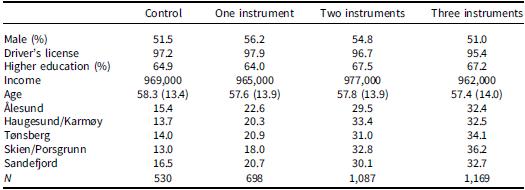
To verify that the randomization was successful, we conducted balance tests across key factors as demography (age, gender, education, income, car ownership and geography). Table 3 presents the characteristics of the treatment and control groups.
Characteristics and comparison of treatment and control groups
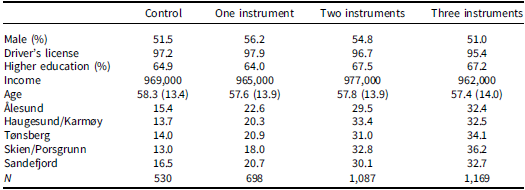
Table 3. Long description
The invited sample contained 35,500 people, of whom 50.3 percent were male and the mean age was 55.13 years. The completed survey contained 3,484 respondents, of whom 53.3 percent were male and the mean age was 57.76 years. The completed sample therefore has a slightly higher male share and is about 2.6 years older on average than the invited sample.
Survey design
The survey was designed into two parts. The first segment gathered data on respondents’ travel behavior and employment status. The second part introduced the experimental conditions, which focused on transportation policy packages. Each respondent was presented with the following prompt: “Imagine that road tolls increase in your city from [current toll level] to [increased toll level].” We adjusted the toll increase by 15 percent based on each city’s current toll levels to reflect real-world differences. We consciously avoided using percentages as we believe it is more difficult for respondents to assess the exact impact of percentages compared to actual increase in NOK.
Respondents were then randomly assigned to different treatment groups, with variations in the text following the toll increase scenario. For example:
“And the revenue from the toll increase will be used to:”
-
• Improve public transport services
-
• Develop more green belts and improve walkability
-
• Build more bicycling infrastructure
-
• Invest in new roads
-
• Compensate low-income groups
The control group did not receive any additional information regarding how the toll revenue would be used. Treatment groups were exposed to one, two, or three auxiliary instruments in combination. After reading the scenario, respondents were asked to rate their acceptance of the policy on a 7-point Likert scale, where 1 indicated strong opposition and 7 indicated strong support. This scale was chosen to capture a nuanced understanding of respondents’ attitudes towards each policy package.
We applied the same logic to other transportation policies, such as a 15 percent increase in parking charges: “Imagine that parking charges increase from [current parking level] to [increased parking level],” and the closing of streets to cars: “Imagine that some roads in the city center are closed to cars.” Each policy scenario was paired with variations in the auxiliary instruments:
“And the area closed to cars will be used to:”
-
• Improve public transport services
-
• Develop more green belts and improve walkability
-
• Build more bicycling infrastructure
-
• Improve parking facilities outside the streets
-
• Ensure disabled access to these streets
A final policy scenario asked respondents to imagine a 10 percent reduction in parking spaces in the city center, with the same auxiliary instruments as in the previous scenario.
Analytic strategy
We analyze the experimental data using ordinary least squares (OLS) regression models with public acceptance as the dependent variable. Public acceptance is measured on a seven-point scale ranging from strong opposition to strong support. The main explanatory variables are the number of ancillary instruments included in the package, the type of primary instrument, the type of ancillary instruments, and respondents’ city of residence.
The randomized design allows us to estimate the causal effect of experimentally assigned package characteristics on public acceptance. To test H1, we estimate models comparing acceptance across packages with zero, one, two, and three ancillary instruments. To test H2a, we compare acceptance across price-based and access-restricting primary instruments. To test H2b, we estimate models including indicators for different types of ancillary instruments and combinations of ancillary instruments. To test H3, we examine whether acceptance varies across cities with different prior experience of restrictive transport instruments, particularly road tolls. Since city of residence is not randomly assigned, these contextual analyses should be interpreted as evidence of systematic local variation rather than as causal estimates of city-level effects.
All models are estimated both with and without controls for key respondent characteristics, including gender, age and education. The main results are presented graphically in the results section, while full regression estimates are reported in the appendices.
Results
This section presents the empirical results in the order of the hypotheses. We first examine whether adding ancillary instruments increases public acceptance of restrictive transport policies. We then assess whether acceptance varies by primary instrument type and by the coherence between primary and ancillary instruments. Finally, we examine whether acceptance differs across local contexts with different prior experience of restrictive transport instruments.
Package size and public acceptance
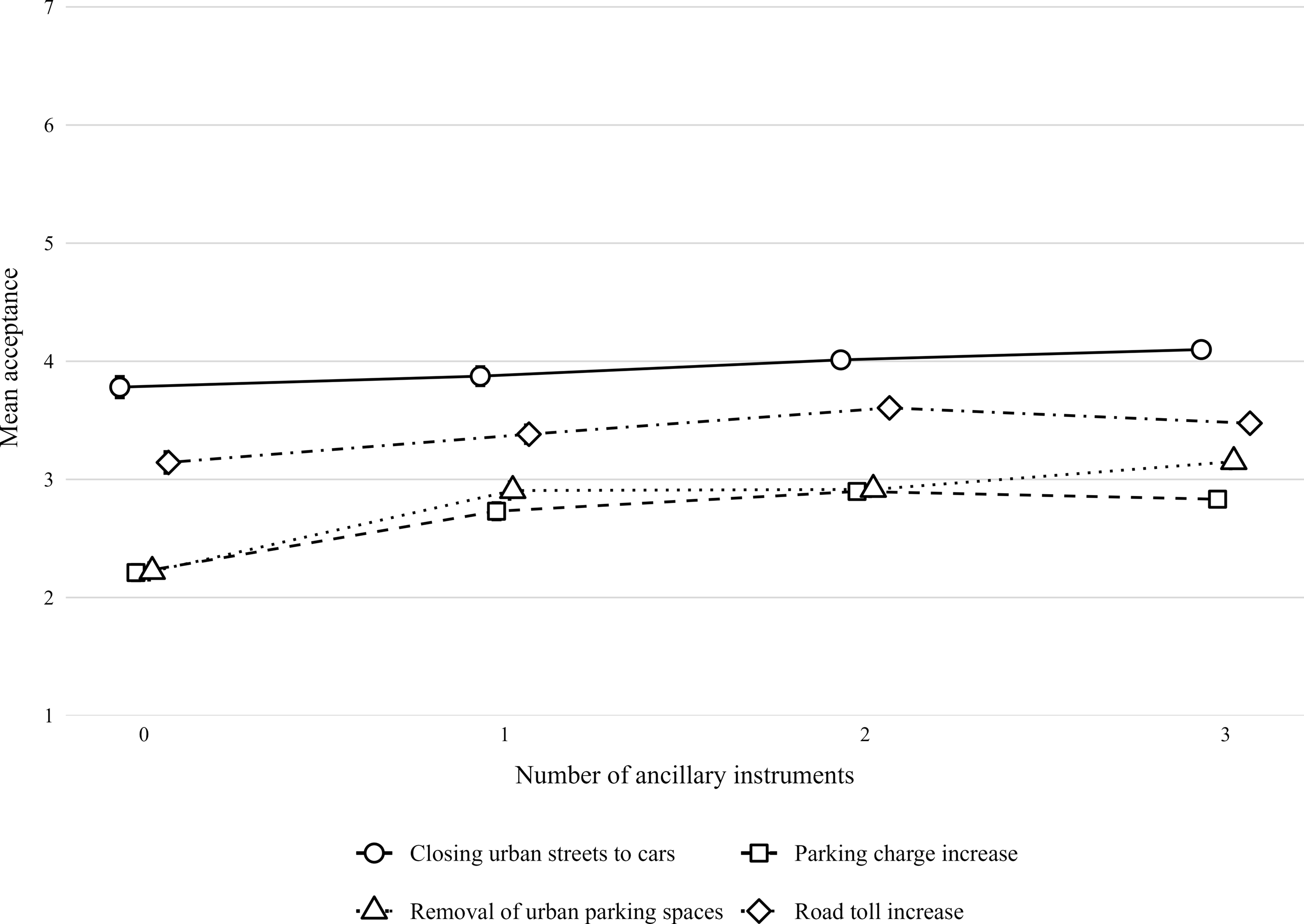
This section tests H1, which follows from the expectation that ancillary instruments may increase acceptance by adding compensatory benefits or making the public value of the package more visible. Figure 1 presents mean acceptance by the number of ancillary instruments included in the policy package. Overall, the results provide support for H1. Adding ancillary instruments generally increases public acceptance compared with presenting the primary instrument alone. This pattern is visible across all four primary instruments, although the magnitude of the increase varies.
Mean acceptance of policy packages by number of ancillary instruments. Points show observed means; error bars indicate ±1 standard error.
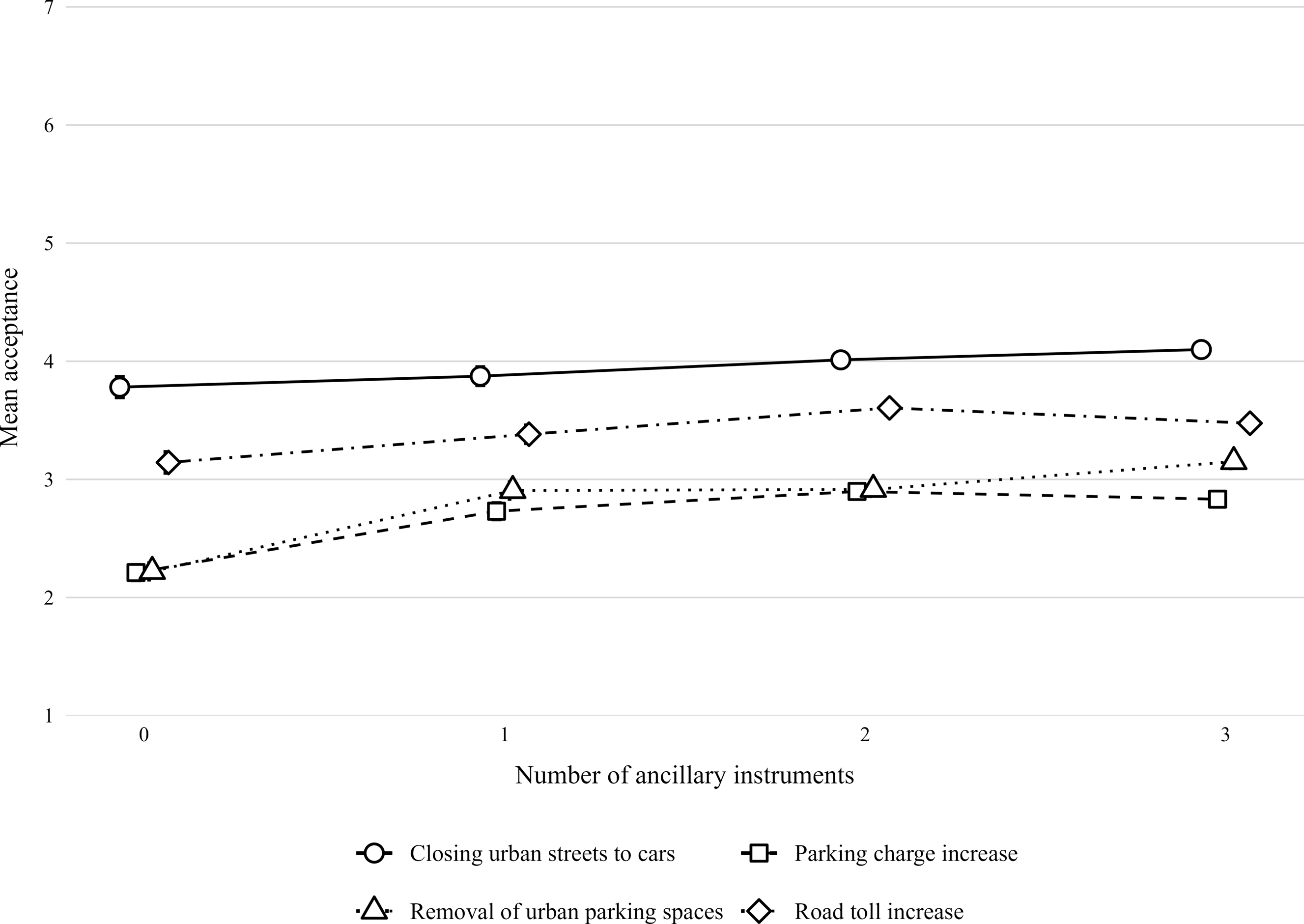
Figure 1. Long description
The x-axis shows zero to three ancillary instruments and the y-axis shows mean acceptance from 1 to 7. Mean values for zero, one, two and three ancillary instruments are: closing urban streets to cars, 3.78, 3.87, 4.01 and 4.10; parking charge increase, 2.21, 2.73, 2.90 and 2.83; removal of urban parking spaces, 2.22, 2.91, 2.92 and 3.15; road toll increase, 3.14, 3.38, 3.61 and 3.48. Street closures have the highest acceptance throughout. Parking charges and road tolls peak with two ancillary instruments and then decline slightly, while acceptance of parking-space removal continues to rise.
The clearest increase is observed for the removal of urban parking spaces, where acceptance rises substantially when three ancillary instruments are included. Road toll increases and parking charge increases also become more acceptable when ancillary instruments are added, although acceptance stabilizes or decreases slightly when moving from two to three ancillary instruments. For street closures, the increase is more modest, and the difference between the control condition and packages with one ancillary instrument is small.
These results suggest that policy packaging can increase public acceptance, but they also show that the effect of adding instruments is not purely additive across all primary instruments. More instruments generally help, but the size of the effect depends on the primary instrument to which they are attached.
Primary instrument type and public acceptance
This section tests H2a (Figure 1), which expects access-restricting instruments to receive lower acceptance than price-based instruments because they directly limit mobility options rather than only increasing the cost of car use. The evidence is mixed. Parking space reductions receive relatively low acceptance, which is consistent with the expectation that instruments directly restricting access may face opposition. However, street closures receive higher acceptance than expected and are more accepted than both parking charge increases and parking space reductions.
This indicates that access-restricting instruments do not uniformly receive lower acceptance than price-based instruments. One possible interpretation is that street closures may be perceived as producing visible public benefits, such as safer and more attractive urban spaces, whereas parking space reductions may be experienced more directly as a loss of convenience. Road toll increases receive higher acceptance than parking charge increases, even though both are price-based instruments. This suggests that the distinction between price-based and access-restricting instruments is useful, but not sufficient on its own to explain variation in acceptance. The perceived purpose, visibility, and public value of the instrument also appear to matter.
Overall, H2a receives only partial support.
Package composition and coherence
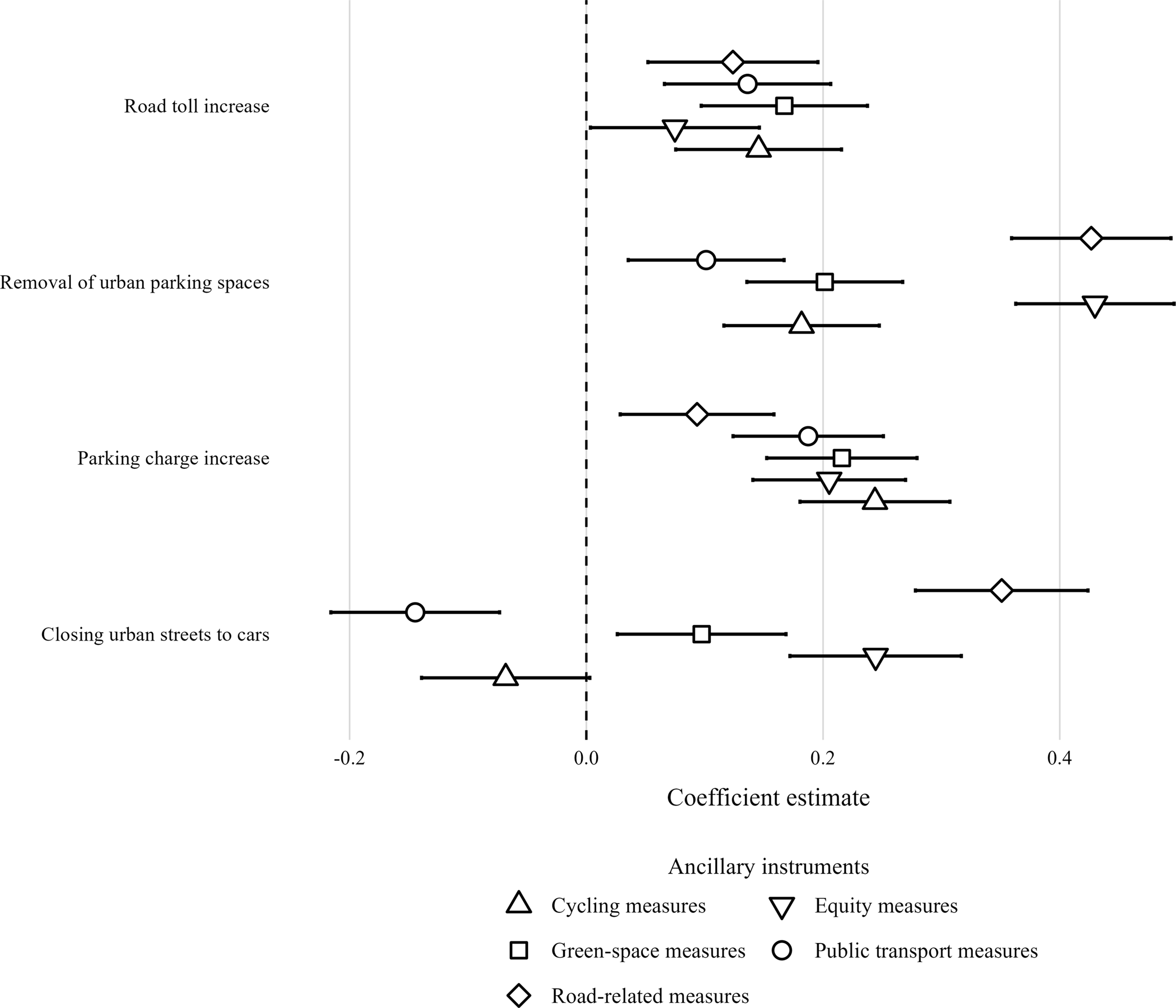
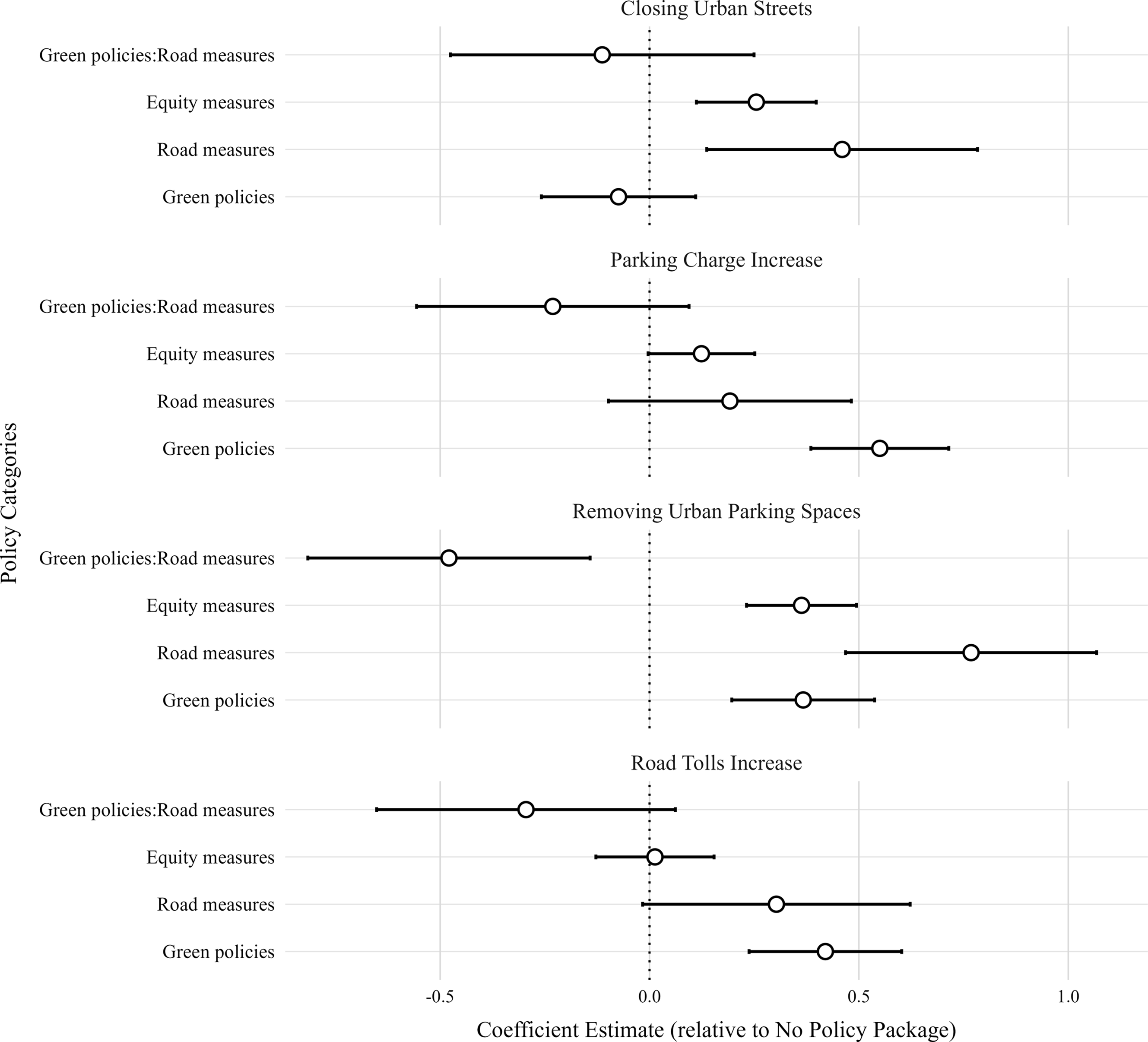
Figures 2 and 3 examine whether the type and combination of ancillary instruments shape public acceptance. These analyses address H2b, which expected ancillary instruments that directly mitigate the burden created by the primary instrument to increase acceptance more than less directly related instruments.
Estimated effects of ancillary instruments on public acceptance. Points show OLS coefficient estimates; horizontal bars indicate ±1 standard error. The condition without ancillary instruments is the reference category.
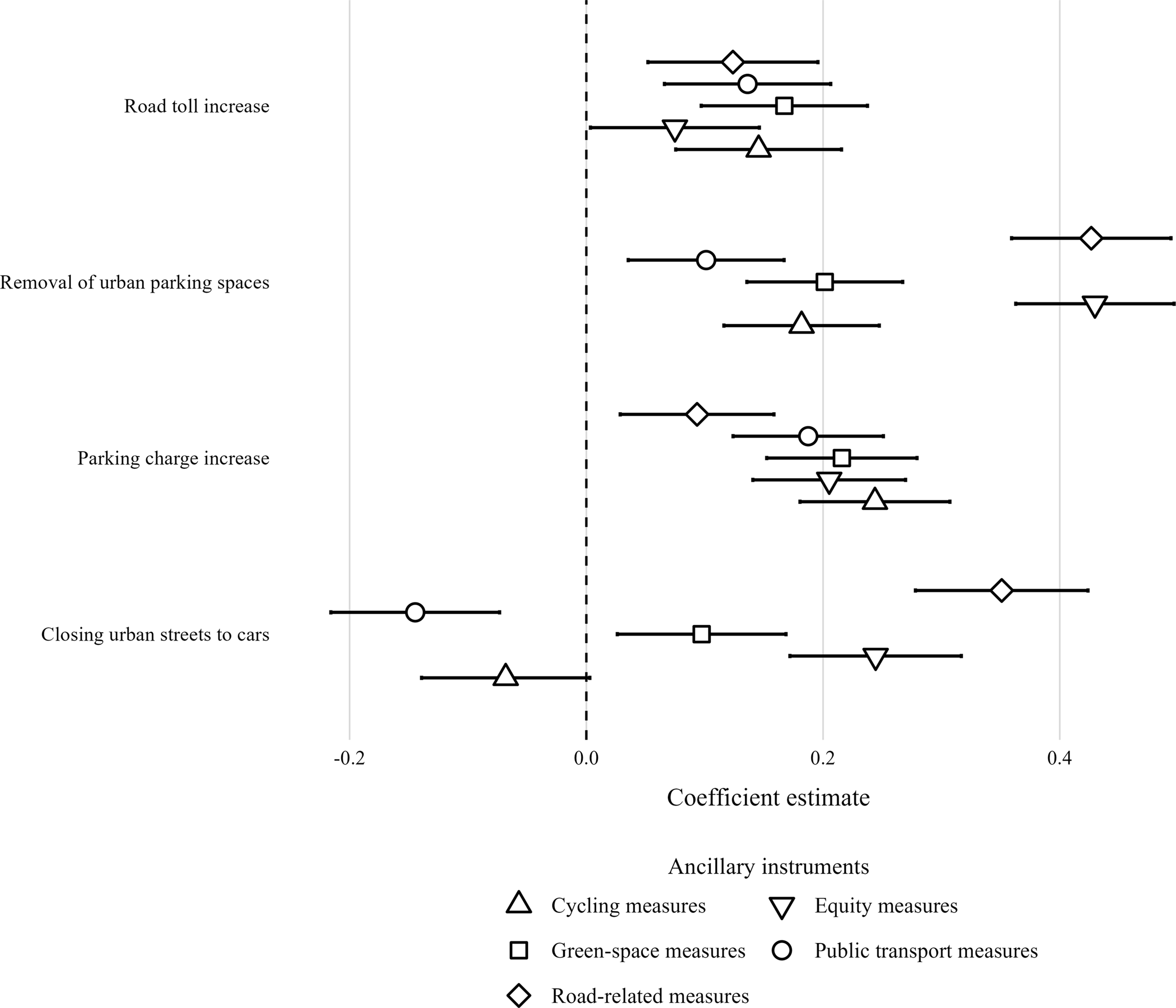
Figure 2. Long description
The plot shows controlled OLS coefficients relative to no ancillary instrument. For road toll increases, coefficients for public transport, green, cycling, road and equity measures are 0.128, 0.163, 0.158, 0.129 and 0.079. For parking-charge increases they are 0.181, 0.212, 0.251, 0.097 and 0.207. For street closures they are -0.152, 0.086, -0.061, 0.357 and 0.244. For removal of parking spaces they are 0.096, 0.193, 0.191, 0.436 and 0.431. Road and equity measures have the largest positive effects for the two access-restricting instruments. Public-transport and cycling measures are negative for street closures.
Estimated effects of broad policy package categories and the interaction between green and road-related measures. Points show adjusted OLS coefficient estimates; horizontal bars indicate 95percent confidence intervals.
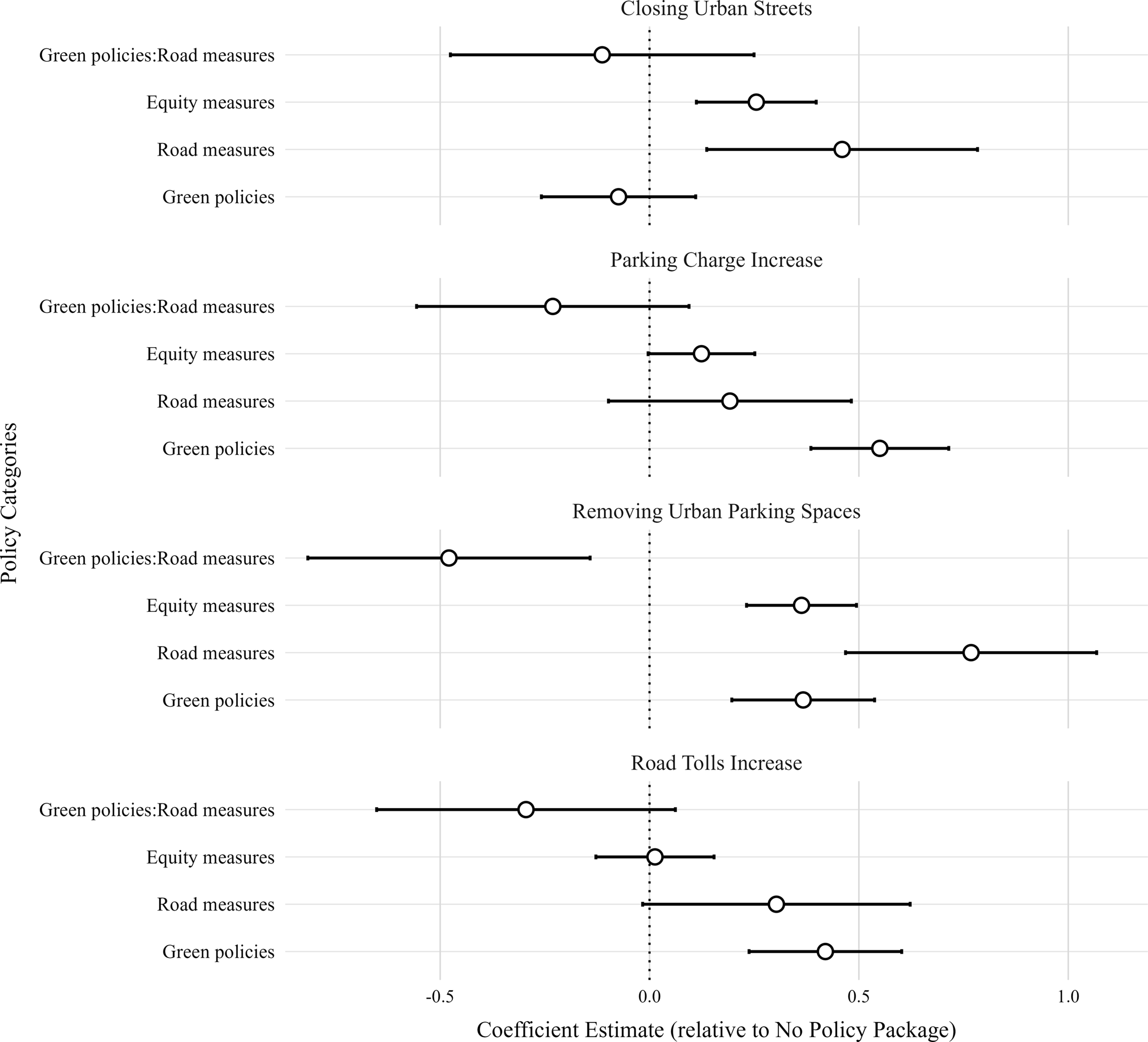
Figure 3. Long description
Points are adjusted OLS coefficients and bars are 95% confidence intervals. For road toll increases, green, road, equity and green-by-road coefficients are 0.420, 0.303, 0.013 and -0.295. For parking-charge increases they are 0.550, 0.192, 0.124 and -0.231. For street closures they are -0.074, 0.460, 0.255 and -0.113. For removal of parking spaces they are 0.367, 0.768, 0.363 and -0.479. Green measures are strongest for price-based instruments, while road and equity measures are strongest for access restrictions. The interaction is negative in all four models and statistically significant for removal of parking spaces.
The results show that package composition matters. For road toll increases, all types of ancillary instruments increase acceptance compared with the control condition, but the effects are relatively small and the strength of the statistical evidence varies across ancillary instruments. This suggests that road tolls are somewhat responsive to packaging, but less dependent on the specific type of ancillary instrument than the more access-restricting instruments.
For parking charge increases, green, cycling, public transport, and equity instruments all increase acceptance. Road-related instruments have a weaker effect. For parking space reductions and street closures, the pattern is more differentiated. Road-related and equity instruments have particularly strong positive effects for parking space reductions and street closures, suggesting that acceptance increases when ancillary instruments directly address the burdens imposed on car users or affected groups.
The results also show that some combinations may reduce acceptance. For street closures, ancillary investments in public transport and cycling infrastructure have negative or weak effects, whereas green space, equity measures, and road-related adjustments increase acceptance. Similarly, Figure 3 shows that combining green and road-related instruments does not always produce additive effects. In some cases, particularly for parking space reductions, the positive effect of green instruments is reduced when road-related instruments are included.
The pattern of results provides partial support for H2b. Acceptance is not only shaped by the number of ancillary instruments, but also by whether the added instruments are perceived as relevant and coherent in relation to the primary instrument. Simply adding more instruments is therefore not always sufficient. The added instruments appear more likely to increase acceptance when they mitigate the primary instrument, provide credible alternatives, or signal broader public value.
Local experience and context
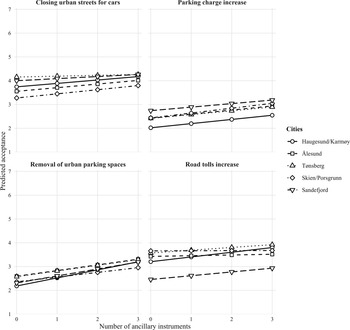
Figure 4 examines whether acceptance varies across local contexts. This analysis addresses H3, which expected acceptance to be higher in cities with longer prior experience of similar restrictive instruments, particularly road tolls.
Predicted acceptance by number of ancillary instruments, primary instrument, and city area.
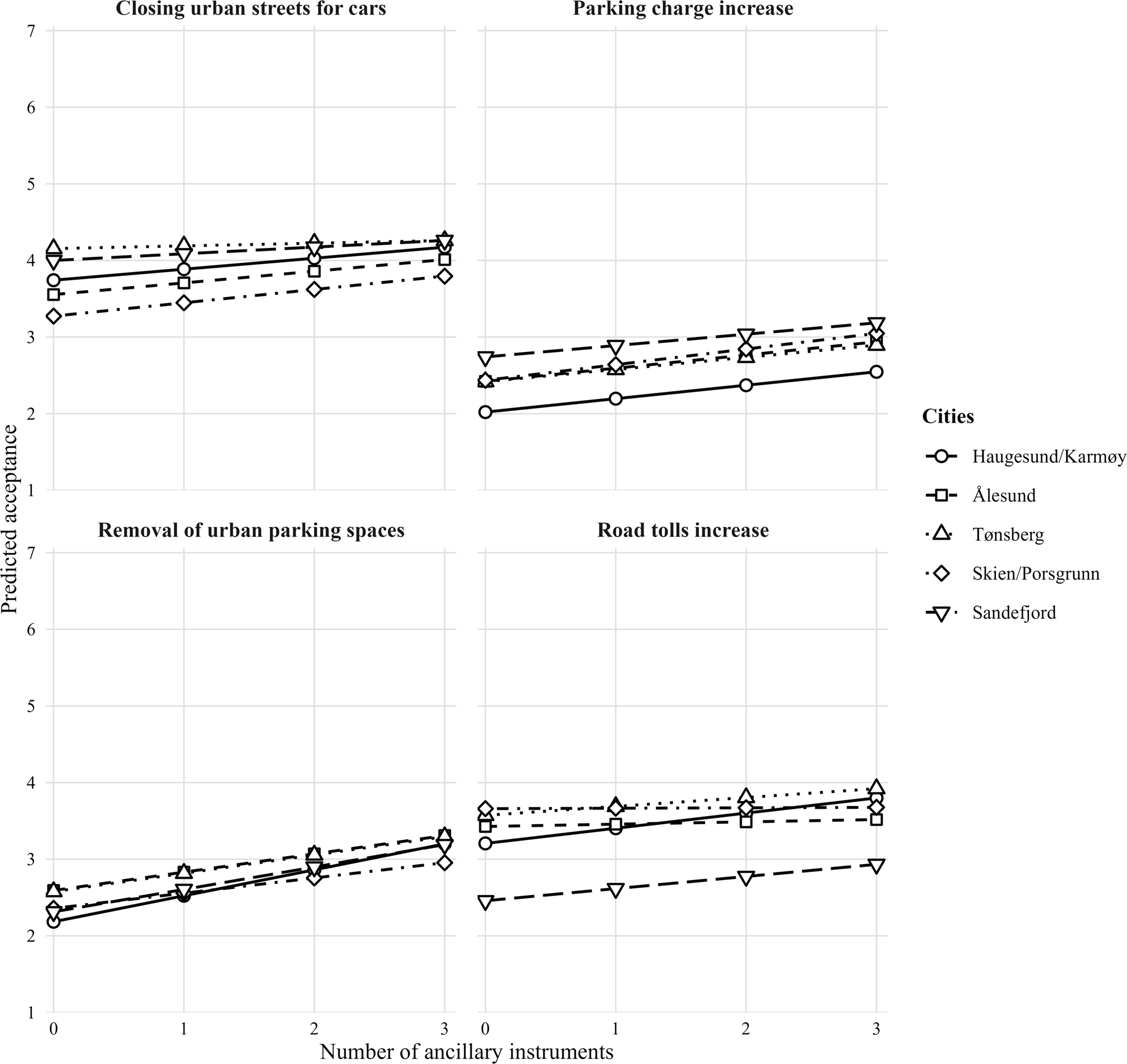
Figure 4. Long description
Each panel shows predicted acceptance from zero to three ancillary instruments for Haugesund/Karmøy, Ålesund, Tønsberg, Skien/Porsgrunn and Sandefjord. Street closures have the highest predicted acceptance, roughly 3.3 to 4.3, and increase slightly in all cities. Parking-charge acceptance rises from about 2.0–2.7 to 2.5–3.2, with Haugesund/Karmøy lowest and Sandefjord highest. Parking-space removal rises from about 2.2–2.6 to 2.9–3.3. Road-toll acceptance rises in every city, but Sandefjord remains markedly lower, from about 2.4 to 2.9, while the other cities range from about 3.2–3.7 initially to 3.5–4.0 with three ancillary instruments.
The results indicate that local context matters. The most notable finding concerns road tolls. In Sandefjord, where no road toll system is currently implemented, acceptance of road toll increases is significantly lower than in cities with prior experience of tolling. This pattern supports H3 and suggests that prior exposure to restrictive instruments may normalize the instrument or reduce uncertainty about its consequences.
There are also differences across cities for other instruments, although these differences are less systematic. For example, acceptance of street closures is higher in Tønsberg than in Sandefjord in the control condition, and acceptance of parking charge increases differs between Porsgrunn/Skien and Haugesund/Karmøy. However, variation is weaker for the removal of urban parking spaces.
Overall, the findings suggest that policy packaging effects are not universal across local contexts. Prior experience with similar instruments appears particularly important for road tolls, while other forms of local variation may reflect differences in urban structure, transport alternatives, and perceived need for restrictive car-use policies.
Discussion and conclusion
This study examined how policy package size, package composition, and local experience shape public acceptance of restrictive climate-related transport policies. The analysis contributes to three strands of research: policy packaging and public acceptance, policy design and policy mix coherence, and local variation in acceptance of restrictive transport instruments. Overall, the findings show that policy packaging can increase acceptance, but also that the effect depends on what is added, how the ancillary instruments relate to the primary instrument, and the local context in which the package is evaluated.
First, the study contributes to research on policy packaging and public acceptance by showing that adding ancillary instruments generally increases acceptance of restrictive transport policies. This finding supports previous studies emphasizing that policy packages can increase the political feasibility of costly or controversial policies (Fesenfeld et al. Reference Fesenfeld, Wicki, Sun and Bernauer2020; Wicki et al. Reference Wicki, Fesenfeld and Bernauer2019; Wicki et al. Reference Wicki, Huber and Bernauer2020). In our study, acceptance tends to increase when restrictive primary instruments are combined with one or more ancillary instruments. This is particularly visible for parking space reductions, where acceptance is substantially higher when the primary instrument is accompanied by several ancillary instruments. The finding suggests that citizens do not evaluate restrictive instruments only in isolation, but also consider whether the broader package provides compensatory benefits, credible alternatives, or wider public value.
At the same time, the results also nuance the assumption that adding more instruments automatically increases acceptance. Although package size matters, the effect is not uniformly additive across all primary instruments. For some instruments, acceptance stabilizes or decreases slightly when moving from two to three ancillary instruments. This finding relates to broader discussions about policy design complexity and the risks of over-design in policy mixes (Fesenfeld Reference Fesenfeld2025; Howlett Reference Howlett2018; Rogge et al. Reference Rogge, Kern and Howlett2017). Larger packages may increase the probability that citizens identify some benefit, but they may also increase cognitive demands or make the policy package appear less focused. The study therefore suggests that package size should be treated as an empirical question rather than as an automatic route to higher acceptance.
Second, the study contributes to policy design research by showing that the composition and coherence of policy packages matter for public acceptance. Policy design scholarship has long emphasized that policy mixes should be evaluated not only by the instruments they contain, but also by how these instruments interact and fit together (Cejudo and Michel Reference Cejudo and Michel2021; Howlett and Rayner Reference Howlett and Rayner2007; Howlett and Rayner Reference Howlett and Rayner2013; Kern et al. Reference Kern, Rogge and Howlett2019). Our findings support this argument from the perspective of public acceptance. Some ancillary instruments increase acceptance more than others, and their effects vary depending on the primary instrument to which they are attached. For example, road-related and equity-oriented ancillary instruments have relatively strong positive effects for parking space reductions and street closures, while some green or public transport-oriented instruments have weaker or even negative effects for street closures.
This suggests that public acceptance depends partly on whether citizens perceive the package as internally coherent. Ancillary instruments appear more likely to increase acceptance when they directly mitigate the burden created by the primary instrument, provide credible alternatives, or signal broader public value. Conversely, ancillary instruments may have limited or negative effects when they appear weakly connected to the restriction being introduced. This is important because one possible policy takeaway from studies of policy packaging is simply to “add more elements” to a policy package. Our findings suggest a more specific conclusion: policymakers should not add ancillary instruments indiscriminately. The type and relevance of the added instruments matter.
Third, the study contributes to research on public acceptance of climate-related transport policy by examining restrictive car-use instruments in smaller and medium-sized cities. Much of the existing literature has focused on national-level variation, cross-national comparisons, or larger urban areas (Börjesson et al. Reference Börjesson, Eliasson, Hugosson and Brundell-Freij2012; Eliasson and Jonsson Reference Eliasson and Jonsson2011; Fesenfeld Reference Fesenfeld2025; Wicki et al. Reference Wicki, Fesenfeld and Bernauer2019). By contrast, this study examines smaller and medium-sized Norwegian cities, where car dependency is high and alternatives to car use may be less competitive. This context is important because restrictive transport instruments may be experienced as more burdensome where public transport, cycling, and walking are less attractive substitutes for car use.
The findings show that acceptance varies across local contexts. Most notably, acceptance of road toll increases is lower in Sandefjord, where no toll system is currently implemented, than in cities with prior experience of road tolls. This supports the expectation that prior local experience with similar restrictive instruments may shape acceptance. The finding is consistent with previous research showing that attitudes toward congestion charging and road pricing may change over time and with experience (Börjesson et al. Reference Börjesson, Eliasson, Hugosson and Brundell-Freij2012; Christiansen Reference Christiansen2020). More broadly, it supports research emphasizing that local context, institutional arrangements, prior policy experiences, and perceived problem pressure can influence public acceptance of restrictive transport policies (Tønnesen Reference Tønnesen2015; Tørnblad et al. Reference Tørnblad, Westskog and Rose2014; Westskog et al. Reference Westskog, Amundsen, Christiansen and Tønnesen2020).
The study also has practical implications for policymakers. Restrictive transport instruments are often necessary for achieving climate and transport goals, but they may face public opposition because they impose visible costs or reduce accessibility. Our results suggest that strategically selected ancillary instruments can make such policies more acceptable. However, the findings also indicate that public acceptance depends on strategic alignment between the primary and ancillary instruments. Packages that make the public value of the primary instrument clearer, provide visible compensatory benefits, or directly address the burden imposed on affected groups are more likely to increase support. This is particularly relevant for access-restricting instruments such as parking space reductions and street closures, where perceived fairness and accessibility concerns may be especially important.
The study has several limitations. First, the experiment measures stated public acceptance before implementation. It does not measure behavioral compliance, long-term legitimacy, or actual political support during implementation. Public acceptance may change once citizens experience the instruments in practice, especially for policies such as road tolls where previous studies show that attitudes can shift over time (Börjesson et al. Reference Börjesson, Eliasson, Hugosson and Brundell-Freij2012). Second, the study examines policy packages with up to three ancillary instruments. This allows us to study whether adding instruments has an additive effect, but it does not identify the point at which additional instruments may produce diminishing returns or cognitive overload. Third, the study focuses on five smaller and medium-sized Norwegian cities. This makes it possible to study policy packaging in comparable urban contexts, but the findings should not be generalized uncritically to larger metropolitan areas or to countries with different institutional, political, or transport conditions.
A further limitation is that the study identifies variation across cities but does not fully explain the mechanisms behind all local differences. Prior experience with road tolls appears important, but other contextual factors may also matter, including public transport competitiveness, car dependency, political trust, urban form, and perceived urgency of local transport and climate problems. Future research should therefore examine more directly how such contextual factors condition acceptance of restrictive transport policy packages. Comparative studies including both smaller and larger cities would be particularly useful for assessing whether policy packaging works differently across urban contexts.
Future research should also examine how citizens interpret package coherence. The present study infers coherence from the relationship between primary and ancillary instruments, but future studies could measure citizens’ perceptions of coherence, fairness, effectiveness, and relevance more directly. This would help clarify why some combinations increase acceptance while others have weaker or negative effects. Finally, future research should examine whether acceptance is sustained over time. Policy packages may increase initial support, but long-term acceptance may depend on implementation quality, communication, experienced benefits, and whether promised compensatory instruments are actually delivered.
In conclusion, policy packaging can increase public acceptance of restrictive climate-related transport policies, but its effects are conditional. The study shows that package size matters, but that more instruments are not always better. It also shows that package composition and coherence are central: ancillary instruments are most likely to increase acceptance when they mitigate burdens, provide credible alternatives, or signal broader public value. Finally, the study demonstrates that local experience matters, particularly for road tolls. These findings contribute to a more nuanced understanding of policy packaging by showing that public acceptance depends not only on whether policies are bundled, but on how they are bundled and where they are proposed.
Supplementary material
The supplementary material for this article can be found at https://doi.org/10.1017/S0143814X26101287
Data availability statement
Replication materials are available in the Journal of Public Policy Dataverse at https://doi.org/10.7910/DVN/F15YQX
Acknowledgements
This article was written as part of the SUSTAIN project. We thank the SUSTAIN project group for helpful discussions and feedback. We also thank the anonymous reviewers for their constructive comments and suggestions. The authors also used OpenAI ChatGPT-5.6, accessed via ChatGPT, for language editing and assistance in preparing and checking R code. The authors independently verified and edited all outputs and take full responsibility for the scientific content of the article.
Funding statement
This work was supported by the Research Council of Norway for a project entitled SUSTAIN. Project number 326784.
Competing interests
The authors declare none.
Declaration of generative AI and AI-assisted technologies in the writing process
During the preparation of this article, the authors used OpenAI ChatGPT-5.6 to assist with language editing and the preparation and checking of R code used to reproduce the figures. The authors independently verified the statistical specifications, numerical results, code, references, and final text, edited all outputs as necessary, and take full responsibility for the content of the publication.



 Open access

