

1. Introduction
It is no secret that the unemployed are today under greater pressure to seek and accept employment than just a few decades ago. Much research has shown that many countries have made the receipt of unemployment benefits conditional on being actively seeking employment and being available for a wide range of jobs, and that claimants who fail to comply with these requirements often face harsher sanctions than before. This trend toward stricter unemployment benefit conditionality has been identified as one central element of the turn toward more employment-friendly or ‘activating’ social and labour market policies (Reference Barbier and Ludwig-MayerhoferBarbier & Ludwig-Mayerhofer, 2004; Reference BonoliBonoli, 2013; Eichhorst, Kaufmann, & Konle-Seidl, Reference Eichhorst, Kaufmann and Konle-Seidl2008). Others have seen this trend as a part of a more radical transformation of the welfare state into a ‘workfare state’ (Reference JessopJessop, 1993, Reference Jessop1999; Reference PeckPeck, 2003; Reference Peck and TheodorePeck & Theodore, 2000; see also Vis, Reference Vis2007), and have suggested that workfare policies like tighter benefit conditionality are being promoted and thereby diffused across countries through ‘fast policy transfer’ regimes (Reference PeckPeck, 2002, Reference Peck2011; Reference Peck and TheodorePeck & Theodore, 2010).
The notions of an activation turn or a rise of a workfare state imply that there must have been significant changes over time. Yet, since previous research has either relied on small-N qualitative evidence on a selected sample of countries (e.g. Clasen & Clegg, Reference Clasen, Clegg, Clasen and Siegel2007), which do not permit us to draw any general conclusions about cross-national patterns, or on cross-sectional data (e.g. Reference LangenbucherLangenbucher, 2015), which do not reveal changes over time, we still lack a clear picture of how and in which respects the unemployed have become under greater pressure over the last decades. We also do not know much about whether rules have simply become stricter, or if other important dimensions of change identified in the literature like the adaptation of social security systems to the emergence of ‘new social risks’ (Reference BonoliBonoli, 2005; Reference Clasen and CleggClasen & Clegg, 2011; Häusermann & Palier, Reference Häusermann and Palier2008) are also reflected in reforms of eligibility conditions for unemployment benefits. This means, in sum, that the exact shape and extent of a key element of recent welfare state change remains to a significant extent obscure to us, which obviously also severely limits our ability to develop causal theories to explain the changes that have taken place.
This paper addresses this gap. It draws on a novel comparative dataset on availability and job-search conditions and sanction rules in 21 advanced democracies between 1980 and 2012 and examines in which respects the unemployed have actually come under greater pressure to seek and accept employment. While the data confirm that conditions and sanctions for the unemployed have overall become stricter over the last three decades, they also provide a more fine-grained and qualified picture of what has happened – and of what has not happened. One finding is that, while the unemployed are clearly under greater pressure to actively seek work, it is not the case that they are also required to accept all available jobs. More flexibility is often expected of claimants when it comes to the occupations they are ready to work in, yet countries still impose limits on the wages and conditions claimants need to accept. The second main finding is that there has also been an at least limited adaptation of availability conditions to changing labour markets and societies. In particular the needs of working parents and religious and ethnic minority groups are now more commonly acknowledged. A final notable trend is that many rules become increasingly precise and detailed, which may not directly strengthen claimants' rights but at least makes procedures more predictable and transparent. In sum, we find a very multifaceted pattern of change that cannot be boiled down to a single trend toward greater conditionality or de-commodification and, in consequence, are faced with several interesting research questions.
The remainder of this paper is structured as follows: The next section presents the dataset in more detail. The third section, the main part of this paper, shows how unemployment benefit conditions and sanctions have changed since 1980. A final section concludes and outlines some (of the many) possible avenues for future research.
2. Measuring the conditionality of unemployment benefits across space and time
In this paper, I make use of an original dataset that has been purposefully assembled to provide a comprehensive picture of the development of unemployment benefit conditions and sanctions across countries and over time (Reference Knotz and NelsonKnotz & Nelson, 2015). The dataset covers 21 core-OECD countries between 1980 and 2012 (Australia, Austria, Belgium, Canada, Denmark, Finland, France, Germany, Greece, Ireland, Italy, Japan, the Netherlands, New Zealand, Norway, Portugal, Spain, South Korea, Sweden, Switzerland, and the United Kingdom).Footnote 1 Following earlier studies (Reference HasselpflugHasselpflug, 2005; Ministry of Finance Denmark, 1998; Reference VennVenn, 2012), it includes measurements of the configuration of three central legal provisions:
a Availability requirements, also referred to as the definition of suitable employment, regulate whether and to what extent claimants can be required to accept employment in other occupations, whether employment can be refused because the wage would be too low, and whether a number of other reasons would be considered valid reasons for not accepting an offer of employment.Footnote 2
b Job-search and reporting requirements regulate whether and how frequently the job-search activities of claimants are checked, and whether claimants have to sign jobseeker agreements.
c Sanction rules are provisions that regulate whether, for how long, and to what degree claimants can be disqualified from receiving benefits for voluntary unemployment, the first, second, third, and ‘repeated’ refusals of offers of suitable employment, failures to attend meetings at the employment service or benefit administration, and failures to report sufficient evidence of job-search activities.
The data collection, which was conducted over the course of more than one year, was based principally on primary historical documents, in particular historical legislation, regulations, guidelines, and policy manuals, which were retrieved from legislative databases, national archives, and libraries. Each country's last fundamental revision of their main unemployment benefit, social security, or labour market policy statute prior to 1980 was used as a starting point for the data collection.Footnote 3 Once these documents were identified, the next step was to locate the relevant paragraphs or sections within them. Subsequently, the changes that were made to these provisions were traced by inspecting all relevant amendments to the main statutes up until 2012. In some cases, certain rules and requirements were either not specified in primary legislation or were only very generally worded (see also Grubb, Reference Grubb2000, pp. 160–161). In these cases, it was necessary to retrieve and inspect more specific regulations, guidelines, and manuals to reconstruct the development of these provisions over time.Footnote 4 Previous studies (among others Clasen & Clegg, Reference Clasen, Clegg, Clasen and Siegel2007, Reference Clasen and Clegg2011; Reference HasselpflugHasselpflug, 2005; Ministry of Finance Denmark, 1998; Reference VennVenn, 2012) were also used to guide the data collection and to cross-check the findings.
Interpreting legal statutes is of course not always a straightforward task. To rule out that any provisions were misinterpreted or important changes overlooked, detailed summaries of the historical development of the relevant statutes in each country were compiled (the summaries amounting to between 20 and 60 pages) and carefully assessed for accuracy and completeness by at least external expert reviewer per country.Footnote 5 The qualitative information from the reviewed and, where necessary, corrected summaries was subsequently converted into quantitative data using a standardised coding scheme (see below and the supplementary materials).
Like all datasets, this one has some limitations. One of these is that the dataset covers only the main unemployment benefit scheme in each country (which are typically earnings-related unemployment insurance schemes, the exceptions being the means-tested benefit schemes in Australia and New Zealand). Not covered are the additional and usually means-tested unemployment or social assistance schemes operated in most countries (see e.g. Reference KvistKvist, 1998), where availability- and job-search conditions may be considerably stricter (Reference CleggClegg, 2007). Collecting data on these benefit schemes as well would have been prohibitively time-consuming, not least because these schemes are often administered on sub-national levels (state, regional, or even municipal) and retrieving the necessary historical documents from many small and often also remote localities can be very difficult if not impossible.
Second, the data do not show how these rules are applied in practice. This means that the data I use here can only show the statutory strictness of these rules, but not necessarily their actual strictness as experienced by individual claimants or case workers. The reason is here as well that obtaining any relevant information is often very difficult, especially when going back in time to the early 1980s and earlier. This, however, is less of a problem than it may seem. For one, the fact that the implementation of these rules is not taken into account may be problematic for studies concerned with the social and economic effects of stricter benefit conditionality (for a more detailed discussion see Reference GrubbGrubb, 2000). For a study like mine, however, which is concerned with institutional changes in a welfare state programme, data on statutory rules are ideally suited. Furthermore, while it would of course be unreasonable to argue that all rules are always and in all cases applied in the exact same way (given the findings by e.g. Schram, Soss, Fording, & Houser, Reference Schram, Soss, Fording and Houser2009), it also seems somewhat extreme to argue that, in modern and advanced democratic countries, legal statutes have little bearing on bureaucratic practices. At a minimum, statutory rules set enforceable limits for both claimants and caseworkers that neither will be able to transgress without risking penalties. At least in this respect, statutory rules do convey meaningful information about the administration of unemployment benefits in a given country.
Finally, there are cases where it becomes difficult to fully reflect the complexity of some provisions in numerical data. First, the requirements for occupational mobility differ sometimes between workers of different skill levels, with more skilled workers enjoying a greater degree of protection. Second, there are cases where the strictness of sanctions varies over the unemployment spell, i.e. where the long-term unemployed face harsher sanctions when refusing an offer of employment. Third, claimants in some countries are required to accept successively lower wages the longer they remain unemployed. In the end, however, these needed to be broken down to a single, comparable figure. In the first two cases, I calculate the simple average over all defined periods. In the third case, I calculate a weighted average of the degree of wage protection over the unemployment spell.Footnote 6
3. The development of conditions and sanctions over time
The first part of this section will focus on major trends in how suitable employment is defined (‘availability conditions’). Here, I analyse only some of all possible criteria for suitable employment, but the three that are shown are selected because of their theoretical relevance for comparative welfare state research. First, whether or not workers can limit their availability to their previous occupation (the degree of occupational protection) and whether or not they can refuse work offering significantly lower wages (wage protection) are important not only because their configuration can have major effects on claimants' incomes but also since they determine the degree to which workers' skill investments are protected, an important concept in the prominent Varieties of Capitalism approach (Estévez-Abe, Iversen, & Soskice, Reference Estévez-Abe, Iversen, Soskice, Hall and Soskice2001). Second, since the adaptation or ‘re-calibration’ of social protection systems to the emergence of ‘new social risks’ has been identified as one major dimension of welfare state change (e.g. Reference BonoliBonoli, 2005), I check to what extent reasons such as lacking skills, having caring responsibilities, or having ethical and moral objections to work tasks are considered valid reasons to reject job offers.
The second part of this section is concerned with how job searches and other activities are monitored and regulated. It is here where we see a very noticeable ‘activation turn’ since the 1990s. The third part will focus on sanctions for refusing offers of employment. This part will highlight two trends: First, sanctions have become stricter, but also increasingly detailed and precise. In the final part, I move away from single provisions and, using aggregate indicators that make use of all the available information in the dataset, show the overall trend in the strictness of conditions and sanctions.
Countries differ with regard to whether they allow claimants to refuse employment in other occupations. Some countries define a ‘permitted period’ (as it is called in the United Kingdom) during which claimants are not required to accept employment in other occupations, but after which claimants are then expected to widen the range of jobs they are available for. Some countries, on the other hand, allow claimants to refuse employment in other occupations for as long as they claim benefits, while a third group requires claimants to accept employment in other occupations from the start.
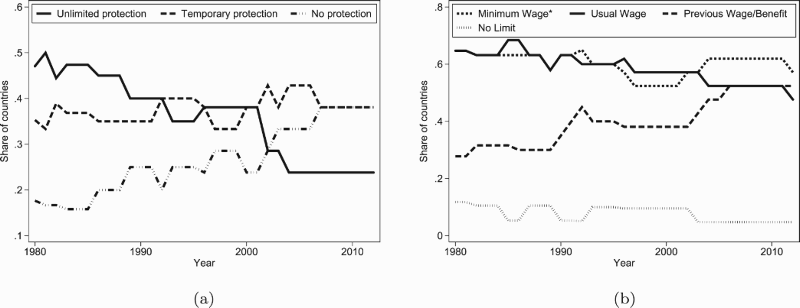
As Graph (a) in Figure 1 shows, there has been a general decrease in the degree of occupational protection in OECD countries.Footnote 7 As of 1980, around half of the countries allowed claimants to refuse employment in other occupations for as long as they claimed benefits (‘unlimited protection’). This share has decreased significantly since then and an increasing share of countries now requires claimants to be available for employment in other occupations from the start (‘no protection’). Around a third of all countries allows claimants to look for work in their own occupation for a permitted period (‘temporary protection’). This share has, despite clear ups and downs, remained rather constant. This being said, some of the countries in this group have changed the length of this period. Whenever this has happened, the length of this period was on average reduced by around 6 weeks (not shown). A final aspect to be mentioned is that even coordinated market economies in Western Europe, where one would think that protecting skill investments should have remained a priority (Estévez-Abe et al., Reference Estévez-Abe, Iversen, Soskice, Hall and Soskice2001), have retrenched occupational protection provisions. Germany, for instance, has abolished a provision that permitted claimants to limit their availability in 1997 (Reference Ebbinghaus and EichhorstEbbinghaus & Eichhorst, 2007; Reference SellSell, 1998). I will return to this in the Conclusion.
Occupational and wage protection. (a) Occupational Protection, (b) Wage protection.

Claimants may now be under greater pressure to accept work outside of their previous or usual occupation, but are they also under the same pressure to accept lower wages? As can be seen in Graph (b) Figure 1, it has always been uncommon to specify no lower limit on the wage claimants have to accept and most countries define at least limit on the wage claimants have to accept (note also that countries may specify multiple limits). In addition, the share of countries that does not specify any limits has actually decreased slightly since 1980.
Employment that pays less than the statutory minimum wage or applicable collective agreements is considered unsuitable in around 60 percent of all countries, a share that has not changed much since 1980. Suitable wages can also be defined, somewhat vaguely, as the ‘usual wage’ in the respective profession or area. It has become less common to define suitable wages this way, however. The most precise way to define a suitable wage is to define it in relation to the claimant's previous wage or the current benefit, and it has actually become more common to specify lower wage limits this way since 1980.Footnote 8 Knowing how countries define suitable wages says, of course, not everything about the degree of wage protection since much hinges also on what an acceptable ratio of the offered to previous earnings or what exactly would be considered a ‘usual wage’ (for which no information is available). In any event, it should be safe to say that there has been no complete retrenchment of wage protection provisions in OECD countries. In fact, countries define suitable wages now increasingly precisely.
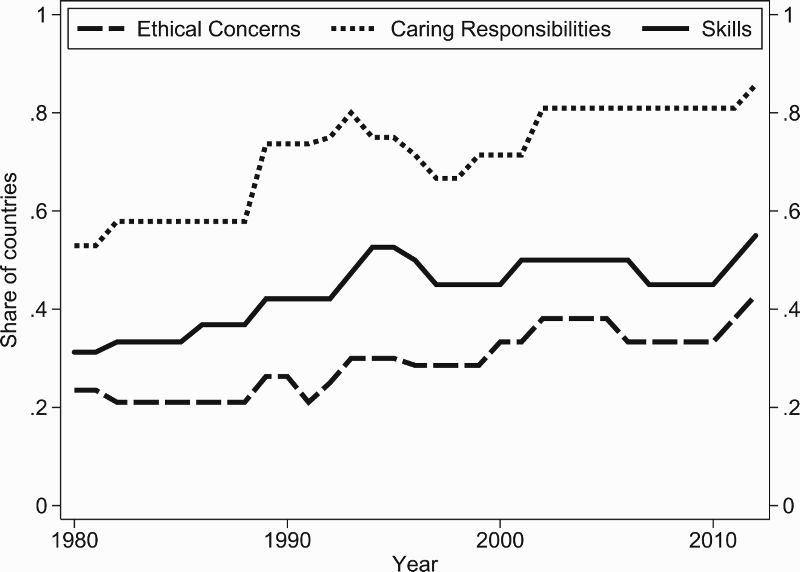
Countries usually also specify a list of other reasons for which offers of employment could be considered unsuitable for a claimant. I consider the following three: whether caring responsibilities would have to be neglected, whether the claimant possesses sufficient skills, and whether the type of work would contradict the claimant's ethical, moral, or religious convictions.Footnote 9 Figure 2 shows that more countries recognise these as valid reasons than three decades ago. This is not to suggest that this is the case for all other potentially valid reasons. But what this does show is that there has been more going on than simply a retrenchment of existing provisions. Instead, there has also been what Pierson (Reference Pierson and Pierson2001, p. 425) called a ‘recalibration’ or ‘updating’ of unemployment benefit schemes, whereby the rules governing the access to benefits are adapted to changing needs. In the case of availability conditions, there has been at least a limited adaptation to changing family structures, more culturally diverse labour forces, and to growing numbers of workers with redundant skills (cf. Reference BonoliBonoli, 2005). And, in these respects, the rights of claimants have actually been strengthened.
The ‘updating’ of availability criteria. Notes: ‘Ethical concerns’ includes also religious or moral concerns.

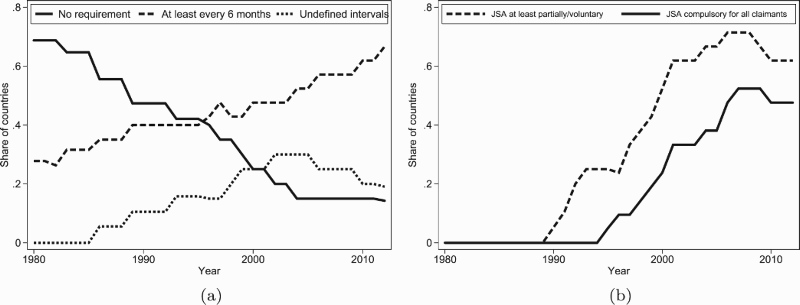
The definition of suitable work only covers a part of the obligations of unemployment benefit claimants. The second main group of conditions claimants may have to comply with are job-search and reporting requirements, to which I move now. Graph (a) in Figure 3 shows how job-search reporting requirements developed. As of 1980, around 70 percent of the countries in the dataset did not have systematic checks of claimants' job-search activities, reflecting also the fact that in many countries claimants needed only to be ‘passively’ available for employment. This share has dropped markedly since then to less than 20 percent as of 2012, while more and more countries have adopted rules that require claimants to report in at least undefined intervals. Since the turn of the century, however, this share has also decreased. The share of countries with relatively clearly specified requirements, defined here as at least semi-annual check-ups, has been growing steadily since 1980.Footnote 10 In sum, while in this case as well requirements have certainly become stricter, they have also become more clearly defined.
The trend toward stricter requirements for active job search. (a) Reporting requirements, (b) Jobseeker agreements.

Another increasingly popular instrument to regulate claimants' job-search and other activities are so-called jobseeker agreements (JSA).Footnote 11 These binding agreements define which activities claimants need to undertake and how they are helped by their caseworker, and are usually signed by both parties, hence implying reciprocal agreement to the terms (see e.g. OECD, 2007, pp. 226–8). Often, if claimants refuse to cooperate, their case workers are also entitled to create a binding plan unilaterally.
As Graph (b) in Figure 3 shows, these agreements have spread very rapidly among OECD countries since the early 1990s. Many countries introduced this first as a voluntary instrument or for specific claimant groups (e.g. those younger than 25 or the long-term unemployed) before eventually making it compulsory for all claimants. The recent decrease in the share of countries that use this instrument should not be misinterpreted as a return to greater leniency. In two countries, New Zealand and Korea, previously used and still somewhat reciprocal agreements were replaced by ‘claimant commitment forms’, which claimants have to sign and which simply state the claimant's responsibilities and the potential consequences for failing to comply.
Having presented notable developments of the conditions attached to benefit receipt, I now move on to sanction rules. Countries typically specify sanction provisions for a range of possible situations, including self-induced unemployment, refusals of suitable offers of employment, and failures to conduct or report mandated job-search activities. Due to limitations in space, I will focus on the development of sanctions for refusals of employment.
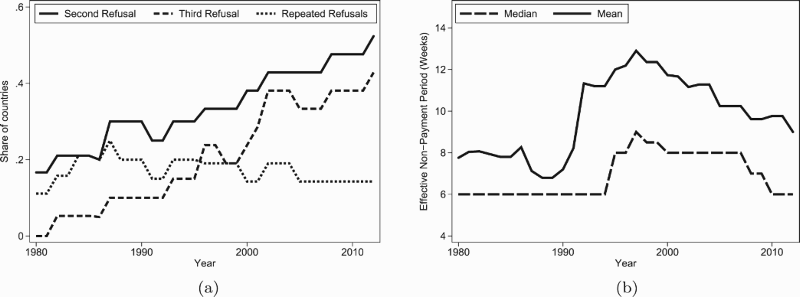
Sanctions for refusals of employment exist in all countries. A first respect in which countries differ, however, is again how detailed and specific these rules are. Some countries have only a generic rule for ‘a’ refusal of employment, treating the first instance of a refusal the same way as all subsequent ones. Others have additional rules for cases where claimants ‘repeatedly’ refuse offers of employment, yet leave it unclear how many subsequent refusals would be considered a case of repeated or persistent refusal. Still others have specific rules for an initial, a second, and also a third refusal of employment, and this group has, as shown in Graph (a) in Figure 4, grown significantly over the last decades. At the beginning of the 1980s, most countries specified only a sanction for ‘a’ refusal of suitable employment, which would apply to the first as well as any subsequent refusals. Some countries also specified additional sanctions for ‘repeated’ refusals, but specific schedules were rare. Less than 20 percent of all countries had specific rules for the second refusal, and no country had specific rules for the third refusal. During the 1990s and 2000s, a number of countries then introduced stepwise sanctioning schedules. In 2010, around 50 percent of all countries had specific rules for the second refusal, and around 40 percent also specified rules for the third refusal. Overall, hence, we see also in the case of sanctions a trend toward increasingly detailed and specific rules.
The changing strictness and specificity of sanction rules. (a) The changing configuration of sanctioning rules. (b) The average disqualification period for an initial refusal. Notes: Graph (b) depicts the maximum disqualification period for a first refusal of suitable employment (where rules for subsequent refusals are defined), or for ‘a’ refusal (where no additional rules are defined).

The now pertinent question is of course whether sanctions have also become stricter over time. In order to compare the strictness of sanctions, one first needs to deal with the fact that sanctions can take various forms (see also Grubb, Reference Grubb2000, pp. 154–157). In some cases, claimants lose a part (e.g. 25 percent) of their benefits for some defined period of time. In others, claimants are completely disqualified, but again also for some defined period of time. In still other cases, claimants are completely disqualified from claiming unemployment benefits once they commit an infraction.Footnote 12 In the case of sanctions for initial refusals of employment, the most common type of sanction is a stop or reduction of benefit payments for some period of time.Footnote 13
To obtain a comparable measure of how much of their benefit payments claimants can lose, I calculate an effective disqualification period, which is the length of any period for which benefits are reduced or not paid multiplied by the share of the benefit that is withheld. If payments are completely stopped for a certain number of weeks, the effective period will simply be equal to that number of weeks. If benefits are reduced by 25 percent for some time, then the effective disqualification period is one quarter of the overall sanctioning period.Footnote 14
In Graph (b) in Figure 4, I show the development of the average effective disqualification period for a first refusal of an offer of suitable employment between 1980 and today. In addition, I also present the median effective disqualification period to deal with some outlying cases where countries had either very harsh or very lenient rules.Footnote 15 The average effective disqualification period in 1980 was around 8 weeks. It then decreased slightly just before 1990 (reflecting a change to much milder sanctions in Italy), and then increased massively between 1990 and 1992 (reflecting the introduction of much harsher sanctions in the United Kingdom and Belgium). Interestingly, the average disqualification period increased only up to a certain point (about 13 weeks in the late 1990s), and then decreased again to around 10 weeks in 2010. There is less variation in the median, but the overall pattern is the same: a rather rapid increase during the 1990s is followed by a stepwise decrease during the 2000s.
The fact that the average sanction for an initial refusal became more lenient after the end of the 1990s is at least to some extent linked to the increasingly detailed and specific formulation of sanctioning rules described above. A number of countries have, when they introduced more specific, stepwise sanctioning schedules, often combined this with a decrease in the strictness of sanctions for a first refusal. As shown in Table 1, the effective disqualification period was reduced by on average more than four weeks whenever additional, more specific rules for subsequent refusal were introduced (middle row). In contrast, when no additional rules were introduced, the effective disqualification period was increased by three and a half weeks (third row). One such reform was introduced in Germany in the early 2000s, when the previous rule that claimants could be disqualified for eight weeks for any refusal of employment was replaced by a schedule that provided for initially lower but increasing disqualification periods. The first refusal would then result in a disqualification for four weeks, the second for eight weeks, and the third for twelve weeks.

Table 2, finally, shows that sanctions become increasingly harsh the more often a claimant refuses an offer of employment, which is hardly unexpected. The initial refusal of an offer of employment results, on average, in an effective disqualification period of around ten weeks. The second refusal is, on average, punished by a disqualification of around 15 weeks, or an almost 50 percent longer maximum disqualification period. The third refusal results in an on average twice as long disqualification period as the first (around 20 weeks). The rather unspecific case of a ‘repeated’ refusal only results in a disqualification period that is three weeks longer than that for an initial refusal. This arguably results from the fact that this type of sanction was more common in the 1980s, when disqualification periods were also typically shorter.

In the final part of the analysis, I move from specific provisions to the overall strictness of conditions and sanctions. Building on earlier studies on unemployment benefit conditionality (Reference AllardAllard, 2005; Reference HasselpflugHasselpflug, 2005; Reference LangenbucherLangenbucher, 2015; Ministry of Finance Denmark, 1998; Reference VennVenn, 2012), I construct an indicator of the overall conditionality of unemployment benefits. As in these earlier studies, the indicator is constructed by first scoring the strictness of several sub-categories of availability- and job-search conditions and the different types of sanctions on common ordinal scales, and then aggregating these scores into an indicator of the overall conditionality of unemployment benefits.
My indicator differs in a few respects from those in earlier studies. First, I use a more fine-grained and slightly adjusted (but still ordinal) coding scheme to capture as much of the variation in the data as possible.Footnote 16 Second, while some earlier studies have assigned weights to each of the components of the indicator, I weigh all components equally. The motive for weighing the different components in earlier studies was that different types of conditions and sanctions were assumed to have differently strong effects on the behaviour of claimants, which the indicator should reflect (Ministry of Finance Denmark, 1998, p. 9). Later studies (Reference LangenbucherLangenbucher, 2015; Reference VennVenn, 2012) have, however, refrained from assigning weights as there is no strong theoretical reason for why certain aspects should be more important than others.
Besides the lack of a clear reason for applying weights, there is also a strong reason against applying weights. Consider that what the indicators try to measure is, in essence, the strictness of certain provisions (sanction rules, job-search requirements, etc.) that are contained in statutory rules (e.g. an unemployment benefit act). Importantly, statutes do not give greater importance to some provisions over others – there is nothing that makes sanction rules inherently more important than job-search requirements. Each simply regulates a separate aspect of the obligations of unemployment benefit claimants and the failures to comply with these obligations. Put bluntly, statutes do not assign weights. And, therefore, neither should we.
Again following Venn (Reference Venn2012) and Langenbucher (Reference Langenbucher2015), I construct not only one single indicator for the overall conditionality, but also two additional sub-indicators that measure more specific aspects. The first additional indicator I construct measures the overall strictness of benefit conditions (job-search and availability requirements). The second indicator measures the strictness of benefit sanctions. The indicators of the strictness of benefit conditions and benefit sanctions are, respectively, calculated as the summed scores of the component indicators. The indicator of the overall conditionality of benefits, in turn, is the product of the conditions and sanctions indicators.Footnote 17 All indicators are rescaled to range between 0 (very lenient) and 1 (very strict).I explain the calculation of the indicators in more detail in the supplementary materials.
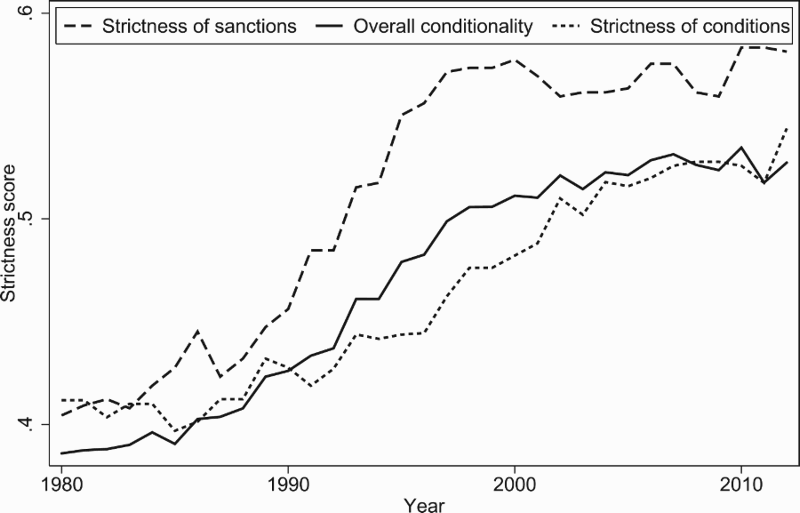
Figure 5 shows the average strictness of conditions, sanctions, and the overall conditionality of unemployment benefits in OECD countries since 1980. The existing literature would suggest that the ‘activation turn’ really gained momentum in the late 1980s and early 1990s (e.g. Reference BonoliBonoli, 2010; Reference WeishauptWeishaupt, 2011), which suggests that a strong increase in benefit conditionality should be visible around this point in time. And, in fact, the data show such a significant increase in the strictness of sanctions, the strictness of conditions, and consequently the overall conditionality of unemployment benefits after around 1990. Having said this, it is important to point out that the average scores increased from a level of around 0.4 in 1980 to around 0.5 in 2012. Seen against the entire range of the variable, the increase was hence not that strong. This reflects in part the fact that, as shown above, many provisions were not tightened and others were relaxed. To adapt a famous quote: Rumors of the demise of decommodifying unemployment benefits are not without substance, yet potentially exaggerated.
The increasing conditionality of unemployment benefits.

4. Summary & conclusions
The 1980s and the following two decades have been a period in which the rights and responsibilities of the unemployed were rebalanced. Until now, however, we lacked a clear picture of how in particular claimants' responsibilities – availability and job-search conditions and sanctions – have changed. The purpose of this paper was to provide a more detailed picture of this central dimension of welfare state change. It showed that there has indeed been an increase in the strictness of benefit conditions and sanctions, which is most clearly visible in the cases of requirements for occupational mobility and job-search and reporting requirements. The unemployed are clearly under greater pressure to actively seek work and to be willing to change occupations than they used to be three decades ago.
But the assessment that a harsh ‘workfare regime’ is emerging would not do justice to the extent to which rules have been tightened overall (which has been rather limited, as shown in the last part of the analysis) and to the multifaceted nature of the changes that have been introduced. For one, some protective provisions have been expanded in a number of countries. In particular the concerns of working parents or religious and ethnic minorities are more often explicitly acknowledged in the statutory rules, which indicates that at least some ‘recalibration’ of benefit systems has taken place. Another key aspect in which these rules and provisions have been changed was that they have become more specific and more detailed. Differentiated sanctioning schedules are one example, another one are wage protection provisions, which have become more precisely defined in many countries. Whether or not this trend toward more precise rules has really strengthened the position of claimants depends of course on the actual content of the rules. What can be said, however, is that the recent reforms have at least limited the degree of discretion granted to their caseworkers, and have therefore made the application of these rules more predictable.
Having revealed some important patterns and changes in benefit conditions and sanctions, I want to close by proposing some potential avenues and hypotheses for future research. First of all, it seems that while the increasing strictness of conditions and sanctions is an important aspect to be explained, there are also other developments that are equally important for researchers to study (cf. Reference Clasen and CleggClasen & Clegg, 2011). Second, some tentative explanations for the developments shown here can be formulated. The decline in the degree of occupational protection, for instance, may be a response to the pervasive and significant changes in skill demand across all advanced economies due to technical change and computerisation, affecting in particular workers in typical ‘routine’ occupations (Reference Goos, Manning and SalomonsGoos, Manning, & Salomons, 2014). Simply put, these workers, once they become redundant and unemployed, may face severe difficulties finding employment in their original occupations. Since transitions into other occupations may often result in significant declines in status and income for the affected and will thus often be resisted (e.g. Iversen & Cusack, Reference Iversen and Cusack2000; but see Reference Oesch and BaumanOesch & Bauman, 2015), and since the costs of long-term unemployment may at some point have exceeded any potential economic benefits from maintaining strong protections for workers' skill investments, governments may eventually have resorted to tightening occupational mobility requirements. Similar reasons may also be behind the equally linear restrictions of job-search and reporting requirements. Given the greater difficulties in finding employment faced by some claimant groups, governments may have chosen to exert greater pressure on claimants to actively look for work (Reference BonoliBonoli, 2013; Reference Clasen and CleggClasen & Clegg, 2011).
An important contributing factor may also have been the diffusion of new ideas and policies across countries (Reference WeishauptWeishaupt, 2011), which seems particularly likely in the case of the proliferation of Jobseeker Agreements.Footnote 18 A testable hypothesis would be, for instance, that new ideas and templates for policy reforms spread between close trading partners and in particular in the context of significant economic turbulence (see e.g. Reference JahnJahn, 2006). If that were the case, such diffusion patterns should be detectable in the data used here. In addition, it would also be worthwhile to investigate more in detail by whom policies are being diffused and which alternatives are thereby being neglected or even pushed aside. In particular the literature on ‘fast policy transfer’ regimes, which has pointed to increasingly institutionalised networks of experts, technocrats, and international organisations and their possibly significant influence on the diffusion of workfare policies across countries (Reference PeckPeck, 2002, Reference Peck2011; Reference Peck and TheodorePeck & Theodore, 2010), provides important insights that can be built and expanded on.
Particularly intriguing are furthermore also the significant deviations from the overall trend toward greater strictness that are visible when looking at certain availability requirements, in particular the requirement to accept lower wages and the consideration of ‘new social risks’. A possible explanation is that the restrictions in occupational protection and job-search requirements on the one side and the maintenance of wage protection and expansion of protections for new social risk groups on the other side are politically linked in the sense that restrictions of the former are traded against relaxations in the latter respects to reduce political resistance to such reforms. Such quid-pro-quo deals have been identified in other areas of welfare state reform, notably old-age pensions (Häusermann, Reference Häusermann2010), and there are good reasons to assume that similar dynamics could also be at work here (Häusermann, Reference Häusermann, Bonoli and Natali2012; Reference Knotz and LindvallKnotz & Lindvall, 2015; Reference LindvallLindvall, 2017). Investigating whether and under which circumstances such deals take place would be an interesting avenue for further research.
Finally, the increasing specificity of sanctioning provisions and the accompanying partial relaxations may be the result of attempts by governments to tighten the enforcement of sanctions on the ground. Grubb (Reference Grubb2000, p. 155) already speculated that more lenient sanctioning statutes may be enforced more vigorously since caseworkers are less reluctant to impose more lenient penalties on claimants. At least in the case of Germany, there is also evidence that such motivations were behind the introduction of a stepwise sanctioning schedule and the partial relaxation of sanctions (Reference Bruttel and SolBruttel & Sol, 2006, pp. 76–77).
These conjectures are, at this point in time, of course only tentative. Yet, with new and more comprehensive data in hand, we can now engage in more comprehensive and systematic analysis of the changes in benefit conditionality and their determinants.
Acknowledgments
The dataset used in this paper was compiled in collaboration with Moira Nelson (Lund University). The data on Greece were collected by Varvara Lalioti, the data on Portugal were collected by Luis Gonzales da Silva, the data on Japan were collected by Takeshi Yanagisawa, the data on Italy were collected by Stefano Sacchi and Patrik Vesan, and the data on the Netherlands were collected by Albertjan Tollenaar, Gijsbert Vonk, and a research assistant. Alexandra Keidel Fernandez assisted in the collection of the data on Spain. I am also grateful to all country experts who reviewed the collected data and provided valuable feedback. Many people have commented on several occasions on various previous versions of this paper. Previous versions of this paper were presented at the InGRID Expert Workshop on ‘Development and Dissemination of Social Policy Indicators’ in Stockholm, November 19–21, 2014, at the Department of Social Policy and Intervention at the University of Oxford on May 19, 2015, and at the International Conference on Welfare Reform at the Australian National University, Canberra, September 17–18, 2015. I am thankful to all the seminar and conference participants as well as to Per Andersson, Thomas Brambor, Johan Bo Davidsson, Gerda Hooijer, Silja Häusermann, Johannes Lindvall, Jelle Visser, and Anna Wilsson for helpful comments. All errors are of course mine.
Disclosure statement
No potential conflict of interest was reported by the author.