A multilevel approach to examining the consequences of environmental adversity is consistent with an ecological–transactional analysis of development (Belsky, Reference Belsky1980; Bronfenbrenner, Reference Bronfenbrenner1977; Cicchetti & Lynch, Reference Cicchetti, Lynch, Cicchetti and Cohen1995; Cicchetti & Valentino, Reference Cicchetti, Valentino, Cicchetti and Cohen2006; Sameroff & Chandler, Reference Samerfoff, Chandler and Horowitz1975). The complex ways in which ecological systems interact with each other and with the individual necessitates careful multilevel investigation to identify factors that shape the individual's response to adversity.
Stress associated with adversity has been implicated as a contributing factor to a variety of somatic health problems and psychiatric disorders, particularly mood disorders (McEwen, Reference McEwen2003). By examining individual differences in the responses of autonomic systems, it may be possible to identify groups of people disposed to stress-related pathology. Cardiovascular parameters like heart rate and blood pressure often have been examined as indicators of the physiological stress response and as risk factors for somatic disease and psychopathology (Chida & Hamer, Reference Chida and Hamer2008). A more specific index of autonomic cardiac regulation has received attention recently for its association with stress-resilience and emotion regulation processes (Porges, Reference Porges2001). The variable of interest is a phenomenon known as respiratory sinus arrhythmia (RSA), and it can be indirectly assessed by measuring the high-frequency component of heart rate variability.
RSA is a naturally occurring rhythm in heart rate that may be understood as the synchronization between heart rate and spontaneous breathing (DeGeus & Van Doornen, Reference De Geus, Van Doornen, Fahrenberg and Myrtek1996). Typically, heart rate tends to accelerate during inspiration and decelerate during expiration. RSA is an indicator of parasympathetic activity, and the amplitude of RSA can be quantified to provide a sensitive index of the impact of the myelinated vagus nerve on the heart (Porges, Reference Porges1995). High levels of RSA indicate a relatively high amount of respiration-linked variability in heart rate that may promote more efficient pulmonary oxygen perfusion under resting conditions (Yasuma & Hayano, Reference Yasuma and Hayano2004), which in turn may facilitate social engagement by the oxygen-dependent central nervous system (Porges, Reference Porges2007).
In response to nonresting and challenging, or potentially threatening, conditions, RSA may decrease, reflecting a shift toward sympathetic nervous system dominance and acceleration of heart rate in order to mobilize metabolic resources. The resulting increase in heart rate facilitates a rapid increase in arousal and engagement in the environment and promotes an increase in metabolic output and behavioral activity to meet the demands of the environment (Porges, Reference Porges2001; Propper & Moore, Reference Propper and Moore2006; Skowron et al., Reference Skowron, Loken, Gatzke-Kopp, Cipriano-Essel, Woehrle and Van Epps2011). Lowering of RSA during a challenging situation has been related to a number of positive outcomes in infants and older children (Eisenberg et al., Reference Eisenberg, Fabes, Karbon, Murphy, Wosinski and Polazzi1996; Huffman et al., Reference Huffman, Bryan, Del Carmen, Pederson, Doussard-Roosevelt and Porges1998; Porges, Doussard-Roosevelt, Portales, & Greenspan, Reference Porges, Doussard-Roosevelt, Portales and Greenspan1996). These findings suggest that regulation of RSA may facilitate behavioral and attentional control linked to different arousal states (Posner & Rothbart, Reference Posner and Rothbart2000).
By assessing RSA during various resting and challenge conditions, it is possible to measure the dynamic regulation of RSA through an active vagal brake. The myelinated vagus nerve functions as a brake in which rapid inhibition and disinhibition of vagal tone to the heart can quickly mobilize or calm an individual (Porges et al., Reference Porges, Doussard-Roosevelt, Portales and Greenspan1996). The myelinated vagus actively inhibits the sympathetic nervous system's influences on the heart and dampens hypothalamic–pituitary–adrenal (HPA) axis activity (see Porges, Reference Porges2001). Functionally, the vagal brake enables the individual to rapidly engage and disengage with objects and people in the environment. As a result, the amplitude of RSA is not constant. The vagal bake is released or lessened to support the metabolic requirements for mobilization in response to challenge. Conversely, the vagal brake is applied or increased to facilitate social engagement and calm, restful states. As a result, RSA varies as a function of the behavioral and psychological demands of different environmental conditions, and the amplitude of RSA provides an assessment of the state of the vagal brake (Porges, Reference Porges2007).
Porges (Reference Porges2004) proposes that a neural process of neuroception allows the individual continuously to monitor and evaluate risk in the environment and modulate vagal output. In safe environments, RSA is regulated to facilitate complex social engagement strategies. However, when danger or threat is perceived, mylenated vagal control of the heart gives way to the sympathetic nervous system and limbic structures that control fight, flight, and freezing behaviors (Porges, Reference Porges2007). When the threat passes and the environment is perceived to be safe, parasympathetic control of the heart resumes and RSA increases again.
Effective use of the vagal brake system has been associated with better control over arousal and therefore an increased ability to maintain homeostasis in the face of changing environmental demands (Propper & Moore, Reference Propper and Moore2006). Porges (Reference Porges2001, Reference Porges2007) suggests that the dynamic control of physiological response has important implications for regulating emotions associated with heightened and prolonged arousal (typically experienced as anger, fear, or agitation), and thus allows the individual to engage in appropriate social interaction. Because of the association of RSA to general regulatory ability, this system is of interest in understanding the relationship between early adversity and the ability to regulate arousal, which likely has implications for risk for maladaptive and pathological outcomes as children develop (Skowron et al., Reference Skowron, Loken, Gatzke-Kopp, Cipriano-Essel, Woehrle and Van Epps2011). The modulation of RSA appears to be a general correlate of psychopathology across both internalizing and externalizing phenomena (Beauchaine, Reference Beauchaine2001).
Baseline levels of RSA are thought to represent the extent of an individual's regulatory capacity (Porges, Reference Porges1998, Reference Porges2001). Low baseline RSA is a common correlate of psychopathology, and seems to reflect reduced flexibility in responding to challenge (Beauchaine, Gatzke-Kopp, & Mead, Reference Beauchaine, Gatzke-Kopp and Mead2007). In particular, studies that have compared resting RSA levels between patient populations and healthy control groups indicate that significantly lower levels of resting RSA have been reported among depressed (Kemp et al., Reference Kemp, Quintana, Gray, Felmingham, Brown and Gatt2010) and anxious patients (Thayer, Friedman, & Borkovec, Reference Thayer, Friedman and Borkovec1996).
However, approaches that focus on RSA at a single point in time fail to capture individual differences in responding to environmental demands, which may be important for predicting adaptation under stress. RSA is a dynamic and stress-responsive phenomenon, increasing or decreasing in order to effectively manage metabolic resources according to environmental demands (Ottaviani, Shapiro, Davydov, & Goldstein, Reference Ottaviani, Shapiro, Davydov and Goldstein2008). RSA reactivity, the change in RSA observed when transitioning from a resting state to an active state, has been examined across various laboratory tasks. The suppression or reduction of RSA in response to challenge is generally considered to reflect an adaptive response by increasing task engagement without compromising control (e.g., El-Sheikh et al., Reference El-Sheikh, Kouros, Erath, Cummings, Keller and Staton2009).
Multiple studies support the link between aberrant RSA reactivity patterns and risk for both externalizing (El-Sheikh, Hinnant, & Erath, Reference El-Sheikh, Hinnant and Erath2011) and internalizing problems (Boyce et al., Reference Boyce, Quas, Alkon, Smider, Essex and Kuppfer2001; Greaves-Lord et al., Reference Greaves-Lord, Tulen, Dietrich, Sondeijker, van Roon and Oldehinkel2010). In particular, research indicates a link between excessive vagal suppression and psychopathology (Calkins, Graziano, & Keane, Reference Calkins, Graziano and Keane2007), especially in cases involving early exposure to adversity (e.g., Obradović, Bush, Stamperdahl, Adler, & Boyce, Reference Obradović, Bush, Stamperdahl, Adler and Boyce2010). Conversely, RSA augmentation (i.e., increased parasympathetic activation) in response to challenge has been observed in some settings, and it can be functional when individuals are required to suppress arousal in the service of social engagement (Butler, Wilhelm, & Gross, Reference Butler, Wilhelm and Gross2006). However, this less typical response also has been linked to problematic behavior, especially among children who have experienced early adversity in the form of child neglect or domestic violence (Katz, Reference Katz2007; Skowron et al., Reference Skowron, Loken, Gatzke-Kopp, Cipriano-Essel, Woehrle and Van Epps2011).
While less frequently examined, there is also evidence that RSA recovery, the change observed when returning from an active state to a resting state, may be important for distinguishing those at risk for behavioral health problems. Specifically, deficient RSA recovery has been associated with internalizing problems among children (Boyce et al., Reference Boyce, Quas, Alkon, Smider, Essex and Kuppfer2001) and social anxiety (Movius & Allen, Reference Movius and Allen2005), cognitive rumination (Key, Campbell, Bacon, & Gerin, Reference Key, Campbell, Bacon and Gerin2008), and negative affective states (Waugh, Panage, Mendes, & Gotlib, Reference Waugh, Panage, Mendes and Gotlib2010) among adolescents and young adults. Together, these results suggest that aberrant RSA response patterns during both reactivity and recovery phases may be associated with risk for psychopathology.
Genetic Influence on Heart Rate Variability
Several genetic polymorphisms have been associated with visceral regulation related to heart rate and respiration.
Endothelial nitric oxide synthase gene (eNOS)
eNOS is an important mediator of cardiovascular homeostasis through its role in the production of nitric oxide. Nitric oxide has well-recognized vascular effects, and it significantly influences autonomic nervous system activity (Culotta & Koshland, Reference Culotta and Koshland1992). Nitric oxide is synthesized by several nitric oxide synthase enzymes, including eNOS. The endothelium, or inner lining, of blood vessels uses nitric oxide to signal the surrounding smooth muscle to relax, thus resulting in vasodilation and increasing blood flow (Huang et al., Reference Huang, Huang, Mashimo, Bloch, Moskowitz and Bevan1995). Nitric oxide is highly reactive and diffuses freely across membranes, making it an ideal signaling molecule. In humans, it has been shown to augment vagal control of the heart (Binkley, Nunziatta, Liu-Stratton, & Cooke, Reference Binkley, Nuziatta, Liu-Stratton and Cooke2005).
The human gene encoding eNOS is localized on chromosome 7q36. A polymorphism of the promoter region of the eNOS gene is associated with a reduction of eNOS activity. Research indicates that variations in this gene may contribute to autonomic imbalance (Binkley et al., Reference Binkley, Nuziatta, Liu-Stratton and Cooke2005). A polymorphism of the gene has been associated with spontaneous coronary artery spasm, potentially because of decreased eNOS expression and nitric oxide production. A reduction in nitric oxide synthesis has been associated with the T to C polymorphism of the eNOS promoter, and patients who are homozygous for the C allele show autonomic imbalance compared to patients who are heterozygous or homozygous for the T allele (Binkley et al., Reference Binkley, Nuziatta, Liu-Stratton and Cooke2005). In particular, individuals homozygous for the CC polymorphism of the eNOS promoter have lower amplitude RSA (Brinkley et al., Reference Binkley, Nuziatta, Liu-Stratton and Cooke2005).
Human research has shown a significant increase in measures of sympathetically influenced low-frequency heart rate variability in patients homozygous for the T to C (i.e., CC) transition polymorphism. Conversely, there is a significant reduction in the ratio of parasympathetically governed high-frequency heart rate variability to total heart rate variability in patients homozygous for the polymorphism. As a result, there is a shift toward increased sympathetic activity in patients homozygous for the polymorphism as reflected by the ratio of low-frequency heart rate variability to high-frequency heart rate variability (Binkley et al., Reference Binkley, Nuziatta, Liu-Stratton and Cooke2005).
Similar research has highlighted the role of other versions of eNOS genes. For example, polymorphisms of the eNOS G894T gene have been linked to difficulties regulating heart rate and blood pressure. The presence of the T allele of this gene has been implicated in pathological conditions, including greater risk for hypertension (Shankarishan, Borah, Ahmed, & Mahanta, Reference Shankarishan, Borah, Ahmed and Mahanta2014). Conversely, homozygosity of the G allele is associated with lower diastolic blood pressure during a physical challenge (Nunes, Barroso, Pereira, Krieger, & Mansur, Reference Nunes, Barroso, Pereira, Krieger and Mansur2014). It appears that the presence of the T allele alters the structure of eNOS and affects its activity by decreasing production of nitric oxide, which ultimately leads to higher blood pressure (Shankarishan et al., Reference Shankarishan, Borah, Ahmed and Mahanta2014).
A somewhat surprising finding in at least one study was a significant gene–environment interaction between eNOS and behavioral risk factors like chewing tobacco and consuming alcohol. Specifically, the GG genotype was associated with increased risk for hypertension among individuals who used tobacco or consumed alcohol (Shankarishan et al., Reference Shankarishan, Borah, Ahmed and Mahanta2014). The molecular effect of the GG polymorphism on eNOS enzyme function in this case is still not clear, although several mechanisms have been proposed including stimulation of the sympathetic nervous system and inhibition of nitric oxide (Randin, Reference Randin, Vollenweider, Tappy, Jéquier, Nicod and Scherrer1995; Yamada, Reference Yamada, Noborisaka, Ishizaki, Tsuritani, Honda and Yamada2004).
Nitric oxide can also be produced by eNOS within the central nervous system. However, it remains to be determined whether and how nitric oxide release from eNOS can interact directly with neuronal signaling. Animal models show that neocortical long-term potentiation and neurotransmitter release are disrupted in mice lacking the endothelial nitric oxide gene (Haul, Godecke, Schrader, Haas, & Luhmann, Reference Haul, Godecke, Schrader, Haas and Luhmann1999; Kano, Shimizu-Sasamata, Huang, Moskowitz, & Lo, Reference Kano, Shimizu-Sasamata, Huang, Moskowitz and Lo1998; Wilson, Godecke, Brown, Schrader, & Haas, Reference Wilson, Godecke, Brown, Schrader and Haas1999), but the exact cause of these deficiencies is not known.
It is interesting that tests of male mice lacking the endothelial nitric oxide gene (eNOS –/–) revealed an almost complete elimination of some types of aggressive behavior in response to a controlled threat (Demas et al., Reference Demas, Kriegsfeld, Blackshaw, Huang, Gammie and Nelson1999). Even in the rare circumstances when these mice did display aggression, its latency was 25 to 30 times longer than eNOS-typical mice. Once again, it is not clearly understood why eNOS –/– mice exhibit low levels of aggression. However, the lack of aggressive (“fight”) behavior in response to threat suggests that eNOS may play a role in modulating arousal and behavioral/physiological response to stress. The research findings indicate that eNOS is involved in long-term potentiation in multiple brain structures within rodents, because eliminating it results in impairment of neocortical and hippocampal long-term potentiation in mice (Haul et al., Reference Haul, Godecke, Schrader, Haas and Luhmann1999; Wilson et al., Reference Wilson, Godecke, Brown, Schrader and Haas1999), may indicate that eNOS somehow plays a role in mouse neuroception.
GABA(A) receptor subunit alpha-6 gene (GABRA6)
The glucocorticoid component of the stress response has been the subject of scientific investigation because of the wide-ranging pathological consequences that result from excess glucocorticoid exposure, including mood and anxiety disorders, and cognitive impairment (Uhrat, McCaul, Oswald, Choi, & Wand, Reference Uhart, McCaul, Oswald, Choi and Wand2004). Exposure to stress activates the HPA axis and the sympathetic adrenomedullary system, which are regulated by neuronal pathways, including the inhibitory GABA system.
GABA is the chief inhibitory neurotransmitter in the mammalian brain, where it acts at GABA-A receptors. It plays a central role in reducing neuronal excitability throughout the central nervous system. In humans, GABA is also directly responsible for the regulation of muscle tone (Watanabe, Maemura, Kanbara, Tamayama, & Hayasaki, Reference Watanabe, Maemura, Kanbara, Tamayama and Hayasaki2002).
Research has shown that variations in the GABRA6 gene are associated with risk for pathology, including anxiety (Arias et al., Reference Arias, Aguilera, Moya, Sáiz, Villa and Ibáñez2012), drug and alcohol dependence (Han et al., Reference Han, Bolo, Daniels, Lyoo, Min and Kim2008), and schizophrenia (Duncan et al., Reference Duncan, Webster, Rothmond, Bahn, Elashoff and Shannon Weickert2010). More specifically, the T1521C single nucleotide polymorphism (SNP) in GABRA6 has been shown to attenuate both the HPA axis and autonomic reactivity during the Trier Social Stress Test (Uhart et al., Reference Uhart, McCaul, Oswald, Choi and Wand2004). Cortisol, diastolic blood pressure, and mean blood pressure responses to this social stressor were significantly greater in subjects homozygous or heterozygous for the T allele of GABRA6 compared to subjects homozygous for the C allele. Along these same lines, the T allele of the T1512C polymorphism has been linked with dimensions of anxiety, including greater harm avoidance, than C allele carriers (Arias et al., Reference Arias, Aguilera, Moya, Sáiz, Villa and Ibáñez2012). Finally, subjects homozygous for the C allele score significantly lower on extraversion compared to subjects homozygous or heterozygous for the T allele (Uhart et al., Reference Uhart, McCaul, Oswald, Choi and Wand2004). Taken together, these results are indicative of gene-mediated regulation of the stress response. In particular, the T1521C polymorphism in the GABRA6 gene appears to be associated with attenuation in hormonal and blood pressure responses to psychological stress.
Environmental Influences on Stress Response
Through the process of neuroception, the individual is continuously monitoring the environment for evidence of safety versus threat. It is not surprising, then, that a number of studies have demonstrated links between chronic exposure to threat and subsequent alterations in physiological response.
Current conceptualizations about allostatic load (McEwen & Wingfield, Reference McEwen and Wingfield2003) suggest that chronic stress (such as child maltreatment, domestic violence, and growing up in violent neighborhoods) may adversely affect multiple, interrelated stress-mediating systems. A number of studies demonstrate such links across a variety of physiological responses. Several studies report evidence of physiological hypoarousal associated with chronic exposure to threat and challenge. Exposure to neighborhood violence has been associated with lower baseline heart rates in school-age children at rest (Krenichyn, Saegert, & Evans, Reference Krenichyn, Saegert and Evans2001), and in lower heart rates in adolescents in response to watching depictions of media violence (Cooley-Quille, Boyd, Frantz, & Walsh, Reference Cooley-Quille, Boyd, Frantz and Walsh2001). Moreover, harsh parenting may exacerbate some of these physiological reactions. Children exposes to high levels of neighborhood violence who also had experienced harsh parenting showed significantly lower systolic and diastolic blood pressure than did children whose parenting had not been as harsh (Krenichyn et al., Reference Krenichyn, Saegert and Evans2001).
In contrast, there also is evidence of hyperarousal in response to chronic exposure to threat. For example, African American children who either witnessed or were victimized by violence were less likely to show a normal drop in blood pressure at night (Wilson, Kliewer, Teasley, Plybon, & Sica, Reference Wilson, Kliewer, Teasley, Plybon and Sica2002) compared to nonexposed children. In addition, Heim et al. (Reference Heim, Newport, Heit, Graham, Wilcox and Bonsall2000) found increased heart rate responses to stress in adults with a history of childhood abuse, whereas children exposed to high levels of family stress show increased preejection period reactivity on laboratory challenges (Ellis, Essex, & Boyce, Reference Ellis, Essex and Boyce2005). College-aged participants who had been exposed to neighborhood violence show significantly higher levels of arousal, as measured by galvanic skin conductance and blood pressure volume, in response to viewing movie clips depicting violence (Frost & Stauffer, Reference Frost and Stauffer1987).
While there is broad evidence for the impact of chronic stress on a wide array of physiological systems, there also is more specific evidence linking experiences of threat and adversity to alterations in RSA. At least one study reports increased vagal reactivity among individuals exposed to long-term adversity. Dale et al. (Reference Dale, Carroll, Galen, Hayes, Webb and Porges2009) reported that self-reported history of abuse was associated with greater RSA reactivity and an inability to rapidly reengage vagal regulation following a physical challenge. This pattern is consistent with research that shows greater RSA reactivity among infants with insecure avoidant attachments compared to those with secure attachment (Hill-Soderlund et al., Reference Hill-Soderlund, Mills-Koonce, Propper, Calkins, Granger and Moore2008). Taken together, the findings are consistent with clinical impressions that abused individuals may have a lower threshold for a physiological response that supports fight or flight behaviors in response to stress, and may have difficulty shifting from mobilization strategies to states of calm (Dale et al., Reference Dale, Carroll, Galen, Hayes, Webb and Porges2009).
In contrast, several studies show a different association between experiences of adversity and RSA response. For example, there is evidence that victims of child maltreatment manifest lower absolute levels of RSA in both resting and challenge conditions (Miskovic, Schmidit, Georgiades, Boyle, & MacMillan, Reference Miskovic, Schmidt, Georgiades, Boyle and MacMillan2009; Skowron et al., Reference Skowron, Loken, Gatzke-Kopp, Cipriano-Essel, Woehrle and Van Epps2011). In addition, several studies report that children exposed to early chronic adversity in the caregiving environment, including physical and sexual abuse, hostile and controlling caregiving, parental distress and substance use, and poverty, are significantly more likely to display lower levels of vagal withdrawal and less RSA reactivity in response to challenge (Calkins, Smith, Gill, & Johnson, Reference Calkins, Smith, Gill and Johnson1998; Conradt et al., Reference Conradt, Degarmo, Fisher, Abar, Lester and Lagasse2014; Dale et al., Reference Dale, Carroll, Galen, Hayes, Webb and Porges2009). Lower levels of RSA at rest and reduced RSA reactivity during challenge have been predictive of poor outcomes in children due to an underregulation of sympathetic nervous system activity (Beauchaine et al., Reference Beauchaine, Gatzke-Kopp and Mead2007). There even is evidence that higher levels of RSA may offer protection against the effects of maltreatment on problem behavior (Gordis, Feres, Olezeski, Rabkin, & Trickett, Reference Gordis, Feres, Olezeski, Rabkin and Trickett2010). However, research suggests that early experiences of chronic threat and challenge can alter the growth trajectory of RSA regulation (Conradt et al., Reference Conradt, Degarmo, Fisher, Abar, Lester and Lagasse2014), resulting in some children displaying less growth in RSA regulation over time (Rigterink, Katz, & Hessler, Reference Rigterink, Katz and Hessler2010). Regardless of whether children experience early adversity, children with decelerations in RSA reactivity display increases in behavioral dysregulation as they mature (Conradt et al., Reference Conradt, Degarmo, Fisher, Abar, Lester and Lagasse2014). Even children who display a typical drop in RSA in response to challenge may be at increased risk for poor outcomes if this system is not coordinated with other physiological systems. For example, Shenk, Noll, Putnam, and Trickett (Reference Shenk, Noll, Putnam and Trickett2010) report that victims of childhood sexual abuse were more likely than others to show asymmetry in RSA and cortisol responses to challenge. In these cases, the individual displayed appropriate RSA reactivity, but it was matched with a blunted cortisol response. These poorly coordinated, asymmetrical physiological responses predicted higher levels of depression and antisocial behavior in young adulthood (Shenk et al., Reference Shenk, Noll, Putnam and Trickett2010).
Finally, some children exposed to early adversity exhibit a very different pattern of vagal response. For example, rather than lowering RSA in response to challenge, some children display increased levels of RSA during challenge conditions. This upregulation, reflecting a pattern of vagal augmentation, has been seen in children exposed to domestic violence (Katz, Reference Katz2007) and children raised in foster care following experiences of abuse (Oosterman, de Schipper, Fisher, Dozier, & Schuengel, Reference Oosterman, de Schipper, Fisher, Dozier and Schuengel2010). For some children, chronic exposure to fearful conditions may interfere with sympathetically mediated mobilization strategies associated with fight or flight behaviors. The result may be a disruption in more organized responses to challenge. Along these lines, vagal augmentation in threat-exposed children has been linked to disordered attachment and conduct-disordered behavior (Katz, Reference Katz2007; Oosterman et al., Reference Oosterman, de Schipper, Fisher, Dozier and Schuengel2010).
Gene–Environment Interactions and Differential Response to Adversity
Not all children respond to conditions of chronic adversity in the same way. Research on the relationship between RSA and childhood adversity reveals a number of different, and seemingly contradictory, physiological responses. The concept of differential susceptibility provides a useful framework for understanding the plasticity observed in RSA responses across different studies (Belsky & Pluess, Reference Belsky and Pluess2009). Individual differences in genetic makeup and biological predisposition undoubtedly interact with uniquely specific experiences to shape the developmental response of each person. As a result, research on Gene × Environment (G × E) interactions has become increasingly common and useful.
Already, there have been numerous important studies examining the interactions between specific environmental pathogens and particular candidate genes (cf. Caspi, Hariri, Holmes, Uher, & Moffitt, Reference Caspi, Hariri, Holmes, Uher and Moffitt2010; Karg, Burmeister, Shedden, & Sen, Reference Karg, Burmeister, Shedden and Sen2011; Mehta & Binder, Reference Mehta and Binder2012). As useful as these studies have been, there is a need to examine more complex G × E models (Mehta & Binder, Reference Mehta and Binder2012). For example, examining G × G × E as well as G × E × E effects is likely to increase our understanding of important phenomena in a manner consistent with a multilevel analysis as prescribed by an ecological–transactional model.
Hypotheses
Based on the research reviewed above, the current study was guided by the following hypotheses in examining determinants of physiological regulation.
-
1. We expected that polymorphisms of the eNOS G894T and GABRA6 genes, as well as exposure to child maltreatment and neighborhood crime, would predict RSA variability in children.
-
2. We expected that polymorphisms in eNOS and GABRA6 would moderate the effects of child maltreatment and neighborhood crime on RSA variability in children.
-
3. We expected to identify complex interactions among genes and environmental pathogens, that is, (a) G × G, (b) E × E, (c) G × G × E, and (d) G × E × E, to further clarify the multilevel effects of environmental adversity on RSA variability.
Method
Participants
Participants in this investigation included 186 high-risk urban children and their caregivers from upstate New York. All children were living with their biological mothers at the time of enrollment. The sample was ethnically diverse, with African American, Latino, Caucasian, and biracial families represented (88.7% of the sample was non-Caucasian; see Table 1). Children were recruited as preschoolers at the age of 4 years (M age = 4.2, SD = 0.17) and were assessed again at age 9 (M age = 9.3, SD = 0.18).
Comparison of demographic characteristics

Recruitment of maltreated children (N = 93) focused on children who had been identified through the Department of Human Services (DHS) as having documented histories of physical neglect. A DHS staff member who was assisting with the project identified eligible children and made the initial contact with families to ascertain interest in participation and to obtain permission to share their contact information with the project team.
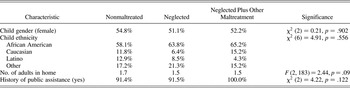
To obtain a demographically matched comparison group, nonmaltreating families (N = 93) were selected randomly from the county recipients of Temporary Assistance for Needy Families. Because the majority of maltreating families referred to Child Protective Services are socioeconomically disadvantaged and receiving public assistance (95.7% in the current study; Gaudin, Reference Gaudin and Dubowitz1999; Sedlak et al., Reference Sedlak, Mettenburg, Basena, Petta, McPherson and Greene2010), utilization of Temporary Assistance for Needy Families lists provided access to a demographically similar population. In the initial contact, consents were obtained to verify nonmaltreatment status by reviewing DHS central registry data. Medical records also were reviewed to confirm nonmaltreatment status. Maltreated and nonmaltreated children were demographically similar on a number of characteristics, including gender, ethnicity, number of adults in the home, and family history of public assistance (see Table 1).
Procedure
Parents of all maltreated and nonmaltreated children provided informed consent for their child's participation, as well as consent for examination of any DHS records pertaining to the family. Participating families completed initial assessments of children's functioning and the family environment, including demographic information on socioeconomic status, children's race, and ethnicity. Family addresses were obtained at age 4 to link with neighborhood crime statistics. Families were recontacted when the children turned 9, and follow-up visits assessed children's physiological response during periods of rest and challenge. Parents signed consent for their children's participation, including the obtaining of DNA samples from the children, as described below. In addition to parental consent, children gave assent for their participation at age 9.
Measures
Child neglect and abuse histories
Permission to review DHS records was obtained from all participating families. Histories of maltreatment were coded using the structured nosological system developed by Barnett, Manly, and Cicchetti (Reference Barnett, Manly, Cicchetti, Cicchetti and Toth1993). This classification system captures detailed information from Child Protective Services records by using a structured approach to obtain systematic data from the narrative and investigation determinations contained in DHS records (Manly, Reference Manly2005). This system provides independent confirmation of neglect and other forms of maltreatment through detailed coding of records. It captures information on the occurrence of multiple subtypes of maltreatment, including extensive information on severity, chronicity, perpetrator of maltreatment, and the developmental period during which it occurred. Neglect is coded when there is evidence that a caregiver has failed to exercise a minimum degree of care in meeting the child's needs or failed to take adequate precautions to ensure the child's safety. Neglect can range from frequently missed meals, unsanitary living conditions, and failure to provide adequate supervision to severe malnutrition, gross inattention to medical needs, or failure to supervise the child that resulted in life-threatening situations. Adequate reliability for coding of maltreatment subtypes and severity has been demonstrated, with intraclass correlations ranging from 0.81 to 1.0 across subtypes (Manly, Reference Manly2005).
Before the age of 4, 93 children had been maltreated and 93 children had no documented history of maltreatment as confirmed by a review of the records. Among the group of maltreated children, 47 children had documented cases of physical neglect (in the absence of other forms of maltreatment), including reports of lack of supervision, failure to provide, and moral/legal maltreatment (Barnett, et al., Reference Barnett, Manly, Cicchetti, Cicchetti and Toth1993). The remaining 46 maltreated children had experienced other forms of abuse prior to age 4 in addition to physical neglect; 28.3% had experienced physical abuse, 2.2% had experienced sexual abuse, and 80.4% had experience documented emotional maltreatment.
Neighborhood crime
Violence occurring in neighborhoods was assessed through the use of crime reports within census tracts. Government census tracts provide units of analysis for which numerous types of data are readily available. We focused on data pertaining to violent crime within census tracts. Children's addresses at age 4 were linked to annual police department crime statistics for the census tract in which they lived at that time. The number of violent crime incidents (including homicide, rape, aggravated assault, and robbery) for that current year was recorded for each geographic area. Across census tracts, incidents of violent crime ranged from 0 to 4 homicides (M = 0.71, SD = 0.88), 0 to 6 rapes (M = 1.56, SD = 1.38), 0 to 41 aggravated assaults (M = 13.6, SD = 8.77), and 2 to 66 robberies (M = 14.08, SD = 10.53). These data gave us an approximation of neighborhood conditions that provided a backdrop for children's exposure to violence. Although census tracts do not necessarily represent the neighborhood as it would be defined by the residents themselves (Coulton, Korbin, Su, & Chow, Reference Coulton, Korbin, Su and Chow1995), data based on census tracts have been used successfully in a number of studies examining the functioning of high-risk samples (Aber, Jones, Brown, Chaudry, & Samples, Reference Aber, Jones, Brown, Chaudry and Samples1998; Korbin, Coulton, Chard, Platt-Houston, & Su, Reference Korbin, Coulton, Chard, Platt-Houston and Su1998). A principle components factor analysis was used to create a weighted composite of neighborhood crime based on analyzing the homicide, rape, aggravated assault, and robbery data. A median split of the data was used to identify children who at age 4 were living in neighborhoods characterized by high versus low levels of crime.
RSA
When the children were 9 years old, they were brought to the lab for a follow-up assessment. During this visit, heart period was recorded continuously during the conditions described below via three electrodes with an ECG100C Electrocardiogram Amplifier (BIOPAC Systems, Goleta, CA) using Acknowledge data acquisition software to facilitate R-wave detection. The ground electrode was placed above the collarbone on the right side, and the two active electrodes were placed on the left side (ribs) at heart level and on the right lower abdomen.
Data were collected across three conditions. During the initial baseline, children sat quietly and for 5 min and watched a peaceful clip from a children's video (The Snowman). The video segment contained music and animation, but no spoken language. Following the completion of the video, children were administered three subscales from the fourth edition of the Wechsler Intelligence Scale for Children (i.e., digit span, coding, and block design). These tasks represented a cognitive challenge for the children. Finally, children watched a different 4-min clip from the same Snowman video. This final condition represented a second baseline. As a result, we were able to measure heart period variability in an initial resting state, during a subsequent challenge condition, and finally during a return to rest.
Throughout each condition, the electrocardiograph monitor was able to measure the R-R interval (heart period) to the nearest millisecond. The heart period data was stored for offline editing and analysis. Data files for each subject initially were input into CardioEdit software (Brain-Body Center, University of Illinois at Chicago, 2007) to visually display the sequential heart period data, and the data were then manually edited by a trained and reliable research assistant to remove R-wave detection artifacts (Porges & Byrne, Reference Porges and Byrne1992). RSA was quantified according to the technique established by Porges (Reference Porges1985; Porges & Bohrer, Reference Porges, Bohrer, Cacioppo and Tassinary1990). Using CardioBatch software (Brain-Body Center, University of Illinois at Chicago, 2007), this method detrends the data and accurately quantifies the variance in heart period within the estimated frequency band associated with spontaneous breathing. Finally, the natural logarithm of the variance is calculated as the measure of RSA (Riniolo & Porges, Reference Riniolo and Porges1997).
This method enables the calculation of RSA during relatively short time periods. The amplitude of RSA was calculated during sequential 30-s epochs. For each of the three conditions, the initial 30-s epoch was truncated. For the two baseline conditions, the subsequent 3.5 min of data were used for analysis. For the cognitive challenge, the subsequent 10 min of data were used. The average of the 30-s epoch values within each condition (i.e., baselines and cognitive challenge) was used in the data analysis.
DNA collection, extraction, and genotyping
Using an established protocol, trained research assistants obtained DNA samples from participants during their age 9 follow-up visit by collecting buccal cells with the Epicentre Catch-All Collection Swabs. Subsequently, DNA from the participants was submitted to the BioMedical Genomics Center at the University of Minnesota for quantity and quality testing and subsequent SNP genotyping. Using the conventional method, human genomic DNA was extracted with the Epicentre BuccalAmp DNA Extraction Kit (Epicentre, Catalog No. BQ0901SSC) and amplified using the Repli-g kit (Qiagen, Catalog No. 150043) per the kit instructions. Amplified samples were then diluted to a working concentration and genotyped for SNPs rs1799983 (eNOS) and rs3219151 (GABRA6) using predesigned TaqMan assays from Applied Biosystems, Inc. (Catalog No. C___3219460_20 and C__11263956_10, respectively). Individual allele determinations were made using these assays with TaqMan Genotyping Master Mix (Applied Biosystems, Catalog No. 4371357) and amplification on an ABI 9700 thermal cycler then analyzing the endpoint fluorescence using a Tecan M200 using JMP 10.0 (SAS, Inc.).
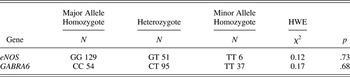
Genotype distributions for both SNPs included in the analyses are presented in Table 2. All genetic polymorphisms were in Hardy–Weinberg equilibrium.
Genotype frequencies and Hardy–Weinberg equilibrium (HWE) for eNOS and GABRA6

Ancestral proportion determinations
DNA samples were subjected to SNP genotyping of the Burchard et al. panel of 106 SNPs (Lai et al., Reference Lai, Tucker, Choudhry, Parnell, Mattei and Garcia-Bailo2009; Yaeger et al., Reference Yaeger, Alvial-Bront, Abdul, Nolan, Grann and Birchette2008), known to be informative for ancestry from Africa, Europe, and Native America. The SNPs were genotyped using the iPLEX platform from Sequenom Bioscience, Inc., which uses the Sequenom MassArray. The SNP genotyping results were then recoded and uploaded into STRUCTURE v2.3.4, which uses algorithms developed by Pritchard and colleagues (Falush, Stephens, & Pritchard, Reference Falush, Stephens and Pritchard2003, Reference Falush, Stephens and Pritchard2007; Hubisz, Falush, Stephens, & Pritchard, Reference Hubisz, Falush, Stephens and Pritchard2009). The data were uploaded into the software and set to analyze with an Admixture model of ancestry and initialization of the simulation on the Genetics of Asthma in Latino Americans cohort. The simulation was set to run with a burn-in of 10,000, 1000 MCMC reps, and assuming three populations within the group. The results of the simulations were subsequently identified as the percentage of association to each ancestry group (African, Native American, and European) based on the known ancestry of the Genetics of Asthma in Latino Americans cohort. It was possible, therefore, to generate three separate ancestry variables reflecting continuous proportion scores of the ancestrally important markers (AIMs) for each participant.
Results
Plan of analysis
We used repeated measures analysis of covariance (ANCOVA) to examine the influence of maltreatment status, neighborhood crime, and polymorphisms for each of the two candidate genes, and their two-way (G × E, G × G, and E × E) and three-way interactions (G × G × E and G × E × E) on individual differences in the amplitude of RSA across measurement conditions. Bonferroni-corrected contrasts were used in follow-up analyses to identify significant group differences and simple effects within any significant interaction effects.
Gender and ancestry were included as covariates in the ANCOVA model given the relevance of these potentially confounding variables in interpreting the results. Following the recommendations of Keller (Reference Keller2014), rather than simply control for these variables as covariates, we initially evaluated a model that included both gender and ancestry main effects and their interactions with maltreatment status, neighborhood crime, and genotypes. Before testing this model, we used the continuous AIMs scores as independent variables in a k-means cluster analysis in order to identify distinct ancestral groups, rather than rely on self-reported race to examine the effects of ancestry/ethnicity. Three groups were identified. The first group (n = 130) was highly homogeneous for the African ancestral markers (M African = 0.92, SD = 0.10). The second group (n = 32) was strongly homogeneous for the European ancestral markers (M European = 0.81, SD = 0.20). The third group (n = 24) was most strongly associated with the Native American ancestral markers (M Native American = 0.70, SD = 0.20). None of the interactions with gender or ancestry group were significant. Moreover, the other main effects and interaction effects involving the study's independent variable were all consistent with those same effects when the interactions with gender and ancestry group were excluded. Because we did not have specific hypotheses about interactions with gender or ancestry, for the sake of parsimony, we included gender and individual AIMs scores as covariates in the model. Those results are presented below.
Evidence for gene–environment correlations
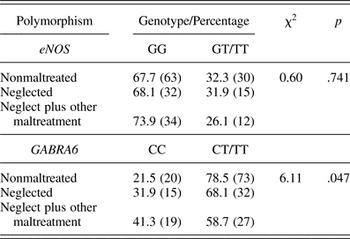
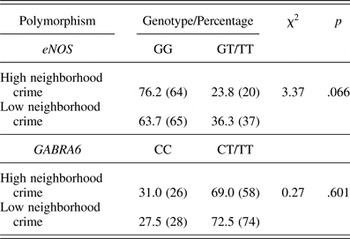
We examined whether there were differences between the maltreated and nonmaltreated groups on the frequency distributions of the eNOS and GABRA6 genotypes. Chi square analyses revealed that for eNOS, genetic variation was unrelated to maltreatment status (see Table 3). Conversely, the distributions of CC versus CT or TT variants of GABRA6 did differ according to maltreatment status, χ2 (2) = 6.11, p = .047. Homozygosity for the C allele of GABRA6 tended to be more common among maltreated children in this sample, suggesting possible evidence of a gene–environment correlation. Genetic variation on eNOS and GABRA6 was not associated with exposure to low versus high levels of neighborhood crime (see Table 4).
Comparison of genotype distributions based on maltreatment status (Ns)

Comparison of genotype distributions based on exposure to neighborhood crime (Ns)

Change in RSA and G × E effects
After controlling for the covariates, repeated measures ANCOVA with a Greenhouse–Geisser correction indicated that there was not a significant within-subject main effect of experimental condition on RSA, F (1.87, 299.59) = 1.05, p = .35. This suggests that RSA did not change in response to a cognitive challenge in a consistent way across all levels of the between-subject independent variables. Moreover, none of the between-subject variables themselves demonstrated significant overall effects on RSA: eNOS, F (1, 160) = 0.06, p = .81; GABRA6, F (1, 160) = 2.32, p = .13; maltreatment status, F (2, 160) = 0.41, p = .66; and neighborhood crime, F (1, 160) = 1.68, p = .20.
However, more than these main effects on RSA, the primary concern for the current study was whether genes, environments, and their coactions influenced RSA response to, and recovery from, challenge. Individual genotypes by themselves did not interact with experimental condition to influence changes in RSA: Condition × eNOS, F (1.87, 299.59) = 2.16, p = .12; Condition × GABRA6, F (1.87, 299.59) = 0.65, p = .52. However, a significant Condition × G (eNOS) × G (GABRA6) interaction was associated with change in RSA, F (1.87, 299.59) = 3.69, p = .029.
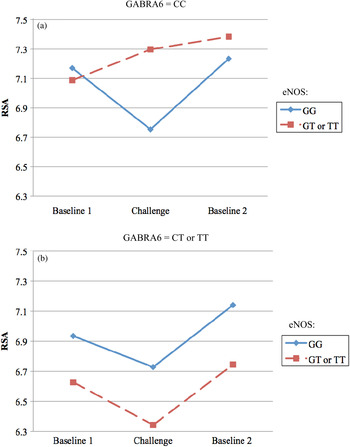
As seen in Figure 1, there are several simple effects of experimental condition on RSA for different combinations of the eNOS and GABRA6 genotypes. Specifically, for the GABRA6 CT or GT genotypes, there is significant change in RSA in response to challenge, as well as significant recovery in RSA following the challenge, regardless of the eNOS genotype (see Figure 1b). However, among children who were homozygous for the C allele of GABRA6, polymorphisms of eNOS were associated with differences in vagal regulation of the heart (see Figure 1a). Only homozygosity of the G allele of eNOS was associated with significant changes in RSA among the GABRA6 CC genotype group. The presence of the T allele of eNOS in the GABRA6 CC genotype was associated with no significant modulation of RSA in response to challenge.
(Color online) Change in RSA as a function of experimental condition, eNOS and GABRA6: (a) Condition × eNOS within the GABRA6 CC genotype group. (b) Condition × eNOS within the GABRA6 CT or TT genotype group. Group contrasts are the following: (a) eNOS = GG: challenge < baseline 1*** and baseline 2 > challenge***; eNOS = GT or TT: ns; and (b) eNOS = GG: challenge < baseline 1**, baseline 2 > challenge***, and baseline 2 > baseline 1**; eNOS = GT or TT: challenge < baseline 1** and baseline 2 > challenge**. **p < .01, ***p < .001.

There also was a simple effect of GABRA6 on RSA for one particular combination of experimental condition and eNOS genotype. For children who had either the GT or TT eNOS genotype, RSA measured during the challenge condition was significantly higher for the GABRA6 CC genotype than it was for the CT or TT genotypes, F (1, 160) = 3.97, p = .048 (see Figure 1a and b). Homozygosity for C allele of GABRA6 seems to have prevented a drop in RSA in response to challenge for those whose eNOS genotype includes the T allele, but not for those who are homozygous for the G allele of eNOS. The simple effects of eNOS on RSA within each combination of experimental condition and GABRA6 genotype were all nonsignficant.
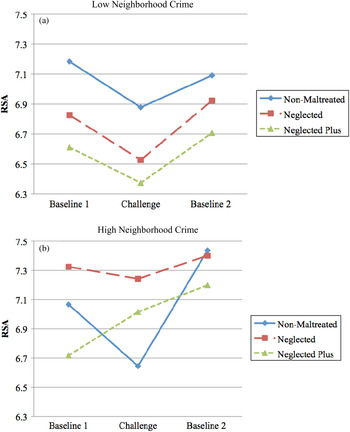
There were trends in the data suggesting that individual indices of environmental adversity affected vagal regulation of the heart in response to challenge, but the interactions between experimental condition and both maltreatment status, F (3.75, 299.59) = 1.87, p = .12, and neighborhood crime, F (1.87, 299.59) = 2.53, p = .08, did not exert a statistically significant effect on RSA. However, a significant Condition × E (maltreatment) × E (neighborhood crime) interaction did predict change in RSA, F (3.75, 299.59) = 3.49, p = .01. As shown in Figure 2, there are a number of simple effects of experimental condition on RSA for different combinations of maltreatment status and neighborhood crime. Specifically, when children lived in low-crime neighborhoods at age 4, they showed more consistent ability to modulate RSA in response to challenge at age 9 regardless of their maltreatment status (see Figure 2a). However, when children lived in high-crime neighborhoods, only nonmaltreated children showed significant modulation of RSA across conditions (see Figure 2b). The simple effects of neighborhood crime on RSA within each combination of experimental condition and maltreatment status, and the simple effects of maltreatment status on RSA within each combination of experimental condition and neighborhood crime were all nonsignficant.
(Color online) Change in RSA as a function of experimental condition, child maltreatment, and neighborhood crime: (a) Condition × Maltreatment Status within the low neighborhood crime group. (b) Condition × Maltreatment Status within the high neighborhood crime group. Group contrasts are the following: (a) nonmaltreated: challenge < baseline 1***; neglected: challenge < baseline 1* and baseline 2 > challenge*; neglected plus: baseline 2 > challenge*; and (b) nonmaltreated: challenge < baseline 1**, baseline 2 > challenge***, and baseline 2 > baseline 1*; neglected: ns; neglected plus: ns. *p < .05, ***p < .001.

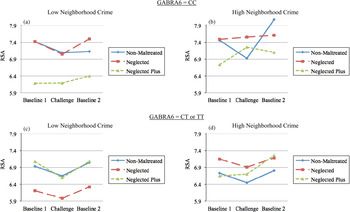
Finally, there was evidence that genes modified the effects of this E × E interaction with experimental condition. There was a significant Condition × G (GABRA6) × E (maltreatment) × E (neighborhood crime) interaction that predicted changes in RSA, F (3.75, 299.59) = 4.29, p = .003. Tests of the simple effects of experimental condition on RSA revealed that the interaction between child maltreatment and neighborhood crime predicted different patterns of change in vagal regulation depending on the child's GABRA6 genotype (see Figure 3).
(Color online) Change in RSA as a function of experimental condition, child maltreatment, neighborhood crime, and GABRA6 genotype: (a) Condition × Maltreatment Status within the low neighborhood crime and GABRA6 CC genotype group. (b) Condition × Maltreatment Status within the high neighborhood crime and GABRA6 CC genotype group. (c) Condition × Maltreatment Status within the low neighborhood crime and GABRA6 CT or TT genotype group. (d) Condition × Maltreatment Status within the high neighborhood crime and GABRA6 CT or TT genotype group. Group contrasts are the following: (a) nonmaltreated: challenge < baseline 1*; neglected: ns; neglected plus: ns; (b) nonmaltreated: challenge < baseline 1*, baseline 2 > challenge***, and baseline 2 > baseline 1*; neglected: ns; neglected plus: ns; (c) nonmaltreated: challenge < baseline 1*** and baseline 2 > challenge***; neglected: ns; neglected plus: challenge < baseline 1*** and baseline 2 > challenge**; and (d) nonmaltreated: challenge < baseline 1* and baseline 2 > challenge*; neglected: ns; and neglected plus: baseline 2 > challenge* and baseline 2 > baseline 1**. *p < .05, **p < .01, ***p < .001.

Specifically, within the GABRA6 CC genotype, only nonmaltreated children demonstrated statistically significant modulation of RSA in response to challenge (see Figure 3a and b). Neither of the maltreated groups of children with the CC genotype displayed significant changes in RSA across conditions. It is noteworthy that nonmaltreated children with the CC genotype who had lived in high-crime neighborhoods at age 4 demonstrated the most robust regulation of RSA, displaying a significant drop in RSA in response to challenge, followed by a significant increase in RSA after the challenge had passed (see Figure 3b). A different pattern emerged among children with the T allele of GABRA6 (see Figure 3c and d). Once again, nonmaltreated children displayed significant modulation of RSA across conditions. However, even children who had been neglected with additional maltreatment were able to modulate RSA if they had the T allele of GABRA6. This was especially true for these maltreated children if they had lived in low-crime neighborhoods at age 4, in which case they displayed a significant decrease in RSA followed by a significant increase (see Figure 3c). Although the data suggested trends in the modulation of RSA among CT or TT genotype children who had only been neglected, changes in their RSA scores across conditions were not significantly different.
Tests of the simple effects of neighborhood crime on RSA revealed a significant effect for one particular group. Children with the T allele of GABRA6 who had been neglected without other forms of maltreatment displayed significantly higher RSA across all three experimental conditions: baseline 1, F (1, 160) = 4.68, p = .032; challenge, F (1, 160) = 4.91, p = .028; baseline 2, F (1, 160) = 4.32, p = .039, if they had lived in high-crime neighborhoods at age 4 rather than low-crime neighborhoods (see Figure 3c and d). The effects of neighborhood crime for all other combinations of maltreatment status and GABRA6 genotype were nonsignificant. Likewise, the simple effects of maltreatment status on RSA for all combinations of neighborhood crime and GABRA6 genotype were nonsignificant. Finally, tests of the simple effects of the GABRA6 genotype on RSA revealed significant effects for some groups of children. In particular, neglected children who had lived in low-crime neighborhoods at age 4 displayed significantly higher RSA across all three experimental conditions: baseline 1, F (1, 160) = 4.83, p = .029; challenge, F (1, 160) = 3.97, p = .048; baseline 2, F (1, 160) = 4.96, p = .027, if they were homozygous for the C allele of GABRA6 rather than heterozygous for the T allele (see Figure 3a and c). In addition, nonmaltreated children who had lived in high-crime neighborhoods at age 4 showed significantly higher levels of RSA during the final baseline condition if they were homozygous for the C allele of GABRA6 rather than heterozygous for the T allele, F (1, 160) = 6.49, p = .012 (see Figure 3b and d).
None of the other repeated measures interaction effects that were tested were statistically significant: Condition × eNOS × Maltreatment Status, F (3.75, 299.59) = 0.44, p = .78; Condition × eNOS × Neighborhood Crime, F (1.87, 299.59) = 1.31, p = .27; Condition × GABRA6 × Maltreatment Status, F (3.75, 299.59) = 1.59, p = .18; Condition × GABRA6 × Neighborhood Crime, F (1.87, 299.59) = 0.35, p = .69; Condition × eNOS × GABRA6 × Maltreatment Status, F (3.75, 299.59) = 1.49, p = .21; Condition × eNOS × GABRA6 × Neighborhood Crime, F (1.87, 299.59) = 0.33, p = .70; Condition × eNOS × Maltreatment Status × Neighborhood Crime, F (3.75, 299.59) = 0.35, p = .83.
Discussion
Data from the current study provide evidence of complex multilevel interactions among objective neighborhood conditions, caregiving adequacy in the home, and children's genotype in predicting their physiological response to challenge. Of particular note for this multilevel analysis is the finding that neighborhood crime at age 4 played a consistent role in children's vagal response 5 years later. Crime rates were measured objectively via police reports within particular geographic regions. However, the children in this study were not necessarily victims of these crimes, and as 4-year-olds, they may have barely been aware of most of these crimes. Nonetheless, neighborhood crime, through its interaction with caregiving and children's genes, contributed to processes that shaped how individual children characteristically regulated their heart rate in response to challenge. The fact that such a distal ecological system could influence such a proximal biological system highlights the importance of multilevel analyses. In this case, it points out that in order to understand the impact of child maltreatment on children's development, it is critical to simultaneously examine the backdrop in which it occurs (e.g., neighborhood crime) and the endogenous characteristics of the individual to whom it is happening (e.g., genetic polymorphisms).
The importance of vagal regulation of the heart for adaptive functioning and its role in risk for psychopathology has been articulated by a number of researchers (Beauchaine, Reference Beauchaine2001; Beauchaine et al., Reference Beauchaine, Gatzke-Kopp and Mead2007; Porges, Reference Porges2001, Reference Porges2007). High levels of RSA and its reliable suppression or reduction are positive indices of social and emotional regulation (Porges, Reference Porges2007). In particular, withdrawal of the vagal break in response to challenge shifts neurological regulation of the heart to the sympathetic nervous system in order to provide the cardiac and metabolic output necessary for behavioral mobilization. When the challenge has passed, vagal pathways restore parasympathetic control of the heart to promote calm states and allow for social engagement. In the current study, this typical pattern of change in RSA was not consistently observed in our multirisk sample.
In contrast, low levels of RSA and its unreliable modulation appear to increase risk for difficulties in social and emotional regulation, and in some cases may contribute to psychopathology (Porges, Reference Porges2007). It seems likely that there may be an optimal level of vagal control of the heart that promotes calm states while simultaneously facilitating a preparedness to respond to perceived challenges (Beauchaine, Reference Beauchaine2001). Deficient levels of RSA may interfere with social engagement in nonchallenge conditions and, because RSA is already low, may limit the deployment of additional resources to constructively engage the environment in response to challenge.
However, because RSA is a dynamic system, it is important to consider how RSA changes from its baseline state. For example, excessive vagal withdrawal in response to challenge has been linked to a variety of behavior problem profiles (Calkins et al., Reference Calkins, Graziano and Keane2007). Beauchaine et al. (Reference Beauchaine, Gatzke-Kopp and Mead2007) has argued that when the vagal system is compromised, response strategies may shift to sympathetic nervous system mediated fight or flight response that activate strong approach or avoidance emotions. In contrast to excessive vagal withdrawal, some people show evidence of vagal augmentation in response to challenge. It has been argued that this increase in RSA may occur in the service of focused attention (Jacobson, Gottman, Shortt, & Wu, Reference Jacobson, Gottman, Shortt and Wu1995). For example, children who have been exposed to domestic violence, or who otherwise may be at risk for conduct problems, may be particularly sensitized to violence and may have become hypervigilant to signs of interpersonal threat. Several studies have reported evidence of vagal augmentation among such children (Calkins et al., Reference Calkins, Graziano and Keane2007; Katz, Reference Katz2007; Kwong, Bartholomew, Henderson, & Trinke, Reference Kwong, Bartholomew, Henderson and Trinke2003). If vagal augmentation is associated with hypervigilance and focused attention, it may suggest these children are paying especially close attention to violence and aggression in their environment, which may increase their encoding of aggressive behavior. As a result, a pattern of vagal augmentation may mediate the relationship between exposure to violence and the subsequent enactment of aggression and hostility toward others (Katz, Reference Katz2007).
Findings from the current study provide evidence of factors from multiple levels that may contribute to alterations in RSA and vagal regulation of the heart among maltreated children. To begin, there was evidence of a G × G interaction, regardless of children's maltreatment history, that predicted differences in RSA response across conditions. Among children with the T allele of GABRA6, similar patterns of significant RSA reactivity and recovery were observed regardless of the child's eNOS genotype. However, among children who were homozygous for the C allele of GABRA6, different polymorphisms of eNOS were associated with different patterns of vagal response. Children who were homozygous for the G allele of eNOS displayed a typical reduction in RSA during the cognitive challenge, followed by a reengagement of parasympathetic control of the heart after the challenge had ended, as evidenced by an increase in RSA to its previous level. Children with the T allele of eNOS displayed a different pattern. Although their initial level of RSA was similar to the G allele children, these children did not show a drop in RSA in response to the challenge, and their RSA remained unchanged after the challenge had passed. This pattern of unmodulated RSA (and possible vagal augmentation) may have been in service of increasing focused attention during the challenge. However, the molecular effects of the two polymorphisms associated with this atypical vagal response require further examination and explanation. The T allele of eNOS has been associated with decreased production of nitric oxide, which would impact vasodilation and blood flow (Huang et al., Reference Huang, Huang, Mashimo, Bloch, Moskowitz and Bevan1995). In addition, GABA is the chief inhibitory neurotransmitter in humans, and homozygosity for the C allele of the gene regulating this GABA-A receptor has been associated with less, or attenuated, physiological reactivity (Uhart et al., Reference Uhart, McCaul, Oswald, Choi and Wand2004). Taken together, it may be possible to develop a model indicating how these two genetic polymorphisms contribute to a reduction and alteration in RSA reactivity.
There also was evidence of an E (neighborhood crime) × E (child maltreatment) interaction associated with different patterns of RSA change across conditions. For example, RSA reactivity among maltreated and nonmaltreated children from low-crime neighborhoods was highly similar. However, maltreatment experiences were associated with different patterns of RSA reactivity among children whose families lived in neighborhoods characterized by high levels of crime when the children were 4 years old. It appears that the environmental toxin of child maltreatment may interfere with successful physiological regulation and modulation of RSA among children who are faced with the additional adversity of neighborhood crime.
It is important to note that this E × E interaction was qualified by its interaction with GABRA6. Among children who were homozygous for the C allele of GABRA6, only nonmaltreated children demonstrated the ability to modulate RSA in response to challenge. Evidence of vagal regulation was especially apparent among nonmaltreated children who had lived in high-crime neighborhoods at age 4, indicating that these children are able to deploy mobilization resources in response to challenge and then return to a state of homeostatic calm once the challenge has passed. In contrast, children who experienced child neglect, either in isolation or in combination with other forms of maltreatment, did not show changes in RSA across experimental conditions if they had the CC GABRA6 genotype, whether they came from high- or low-crime neighborhoods.
It is possible that this lack of RSA reactivity may represent a type of adaptation among maltreated children that is facilitated by the CC GABRA6 genotype. Children whose parents neglect and/or maltreat them may have learned that it is important to always be vigilant because they may not be able to count on their parents for help in time of need. Maintaining stable levels of vagal control may facilitate processes of neuroception that focus attention on signs of threat, and it is possible that homozygosity for the C allele of GABRA6 facilitates or potentiates attenuated vagal reactivity for these children. However, this particular adaptation to the environment may interfere with these children being able to appropriately deploy mobilization resources to engage the environment in response to threat, and may leave maltreated children who face additional environmental adversity, such as those living in violent neighborhoods, especially unprepared to cope with new challenges. Moreover, the amplitude of the initial RSA setpoint may be important to consider, especially when vagal reactivity is suppressed. A low RSA setpoint for maltreated children with the CC GABRA6 genotype may leave them in a less well-regulated, more sympathetically controlled physiological state with a compromised ability to deploy further resources for mobilization in response to challenge (Beauchaine, Reference Beauchaine2001). Taken together, these findings suggest that homozygosity for the C allele of GABRA6 may contribute to risk for psychopathology among neglected and multiply maltreated children due to its association with the attenuation of appropriate change in RSA in response to, and following, a challenge (Beauchaine et al., Reference Beauchaine, Gatzke-Kopp and Mead2007; Porges, Reference Porges2007).
In contrast, both nonmaltreated and maltreated children with the T allele of GABRA6 were able to modulate their RSA levels in response to challenge, although the trends in RSA for children who only experienced neglect were not statistically significant. The RSA levels of the neglected children in this study were less a function of experimental condition, and more a function of neighborhood crime and GABRA6 genotype. Among neglected children from low-crime neighborhoods, those with the CC GABRA6 genotype displayed significantly higher levels of RSA across all conditions than did those neglected children with the T allele of GABRA6. In addition, neglected children with the T allele of GABRA6 showed significantly higher RSA across all conditions if they had lived in a high-crime neighborhood at age 4, rather than a low-crime neighborhood. The vagal regulation of neglected children relative to that of those who have been multiply maltreated warrants further investigation.
It is also worth noting that there was evidence in the current study of a possible gene–environment correlation between GABRA6 and child maltreatment. Homozygosity for the C allele of GABRA6 was significantly related to maltreatment status, such that multiply maltreated children were mostly likely to be homozygous for the C allele, and nonmaltreated children were least likely. It is not clear how to interpret this correlation or specify its possible impact. It is possible that the correlation is passive in nature. Perhaps GABRA6 in the parents contributes to the caregiving environment they create, and these parents then contribute their genetic material to their children. It could be the case that the association between GABRA6 and child maltreatment reflects an evocative correlation in which the children's phenotype (based on their genotype) elicits a particular caregiving response. In either case, it is important to further investigate this possible gene–environment correlation so that we can properly interpret the G × E interactions reported in the current study (Eaves, Foley, & Silberg, Reference Eaves, Foley and Silberg2003; Mehta & Binder, Reference Mehta and Binder2012). In this regard, it is interesting to note that there is evidence that physically abusive and neglecting mothers have been found to exhibit significantly lower amplitude RSA (at baseline and in response to challenge) than nonmaltreating mothers (Skowron et al., Reference Skowron, Loken, Gatzke-Kopp, Cipriano-Essel, Woehrle and Van Epps2011). Although these investigators did not genotype their participants, the current study provided evidence that homozygosity of the C allele for GABRA6 was associated with attenuated RSA reactivity in maltreated children. It is possible that lower and attenuated RSA responses among maltreating mothers (Skowron et al., Reference Skowron, Loken, Gatzke-Kopp, Cipriano-Essel, Woehrle and Van Epps2011) may also be associated with polymorphisms of GABRA6, in which case the gene–environment correlation observed in the current study may be passive in nature. These issues warrant careful examination and replication in the future.
It should be noted that there has been some debate in the literature about the appropriate measurement of RSA (Denver, Reed, & Porges, Reference Denver, Reed and Porges2007; Lewis, Furman, McCool, & Porges, Reference Lewis, Furman, McCool and Porges2012). In particular, because RSA reflects coordination between cardiac activity and respiration, the assumption is that the frequency of respiration needs to be monitored (in addition to variability in heart period) in order to accurately measure the amplitude of RSA. The measure of RSA used in the current study did not incorporate a direct assessment of respiration. Rather, RSA was calculated following the procedure described by Porges (Reference Porges1985; Porges & Bohrer, Reference Porges, Bohrer, Cacioppo and Tassinary1990) based solely on data derived from heart period variability. A review of studies that compared the amplitude of RSA based on measures that included respiratory parameters and those that did not concluded that all the measures of RSA were highly intercorrelated. However, RSA quantification using the Porges–Bohrer method actually may have the strongest psychometric properties (Lewis et al., Reference Lewis, Furman, McCool and Porges2012).
As indicated above, it will be critically important in the future to understand more fully the complex and interacting molecular effects of particular genetic polymorphisms on the vagal regulation of maltreated children. Understanding these effects may help us to identify children who are most at risk for the atypical physiological responses to stress that may contribute to disregulated behavior and emotion. Moreover, findings from the current study confirm the importance of including multiple levels of analysis in studies of the effects of maltreatment (and other toxic environments). These findings suggest that more complex G × E interactions should routinely be examined, including G × G × E and G × E × E interactions. It will also be important for future studies to carefully examine potential gene–environment correlations and devise longitudinal strategies for effectively understanding the nature of these correlations in order to interpret apparent G × E interactions accurately. Along these lines, it may be wise for future studies of child maltreatment to genotype both parents and children when possible. However, such requests for genetic material will need to be handled with heightened sensitivity to any concerns that multirisk families may have.
It was also noteworthy that neighborhood crime at age 4 was consistently related to vagal regulation 5 years later, even though children may have been minimally, or indirectly, aware of this characteristic of their neighborhoods. Further examination of the processes through which this more distal ecological factor exerted influence on subsequent physiological response is warranted. Perhaps our measure of neighborhood crime acted as a proxy measure for more broad environmental stress that influenced the development of children's stress regulation systems. Data from the current study indicate that neighborhood crime interacted with child maltreatment in predicting RSA, and thus provided a backdrop in which maltreatment occurred for some children. However, how do these characteristics of communities interact with the capabilities and vulnerabilities of parents in ways that shape their caregiving and the subsequent development of their children? More fine-grained longitudinal studies are required to model these complex multilevel processes. For example, one thing that was not measured in the current study, and thus not controlled, was children's age 4 RSA reactivity. As a result, it is not possible to say with certainty that these early experiences of maltreatment and exposure to neighborhood crime actually changed children's pattern of RSA reactivity. Subsequent attempts to replicate the current findings should specifically examine change in RSA reactivity over time in order to specify the potential causal effects of adverse environments (interacting with genes) on physiological regulation.
Finally, findings from the current study have implications for intervention. Although improvements in parenting quality and declines in the recidivism of child maltreatment have been achieved through randomized controlled interventions (e.g., Chaffin, Funderburk, Bard, Valle, & Gurwitch, Reference Chaffin, Funderburk, Bard, Valle and Gurwitch2011), it remains true that child maltreatment is particularly resistant to intervention (Skowron & Reinneman, Reference Skowron and Reinneman2005). Mechanisms of change associated with effective interventions revolve around increasing parents’ positive social engagement with their children (Hakman, Chaffin, Funderburk, & Silovsky, Reference Hakman, Chaffin, Funderburk and Silovsky2009). However, positive social engagement with their children is exactly the issue that is problematic for maltreating parents, and it may be the case that atypical and maladaptive patterns of vagal regulation (Skowron et al., Reference Skowron, Loken, Gatzke-Kopp, Cipriano-Essel, Woehrle and Van Epps2011) interfere with some parents’ ability to effectively activate and regulate their social engagement systems with their children (Porges, Reference Porges2007). Findings from the current study indicate that parents’ extreme difficulties with appropriate social engagement with children, seen in the form of child maltreatment, may influence their children's vagal regulation, with cascading effects that impact children's behavioral and emotional regulation and risk for psychopathology. Moreover, the current study makes it clear that the impact of child maltreatment on children's physiological response is modified by additional factors at multiple levels of the ecology, including the neighborhood and the child's own genes.
As the transactions among these factors across multiple systems continue to be examined and understood, it suggests that interventions should be designed and implemented at multiple levels. For example, beyond reducing levels of crime within neighborhoods, helping families develop effective strategies to buffer themselves from the effects of crime may result in cascading effects on caregiving and on children's stress regulation. Because the data continue to indicate that people are differentially susceptible to particular environmental adversity, identifying both parents and children who are genotypically vulnerable to particular adversity may be an important step in designing individualized interventions. The goal of these approaches would be to promote healthier responses to stress and challenge that allow people to more effectively modulate arousal levels. The result would be more effective mobilization of cardiac and metabolic resources during times of challenge, and more efficient return to homeostasis and parasympathetic regulation during times of calm. Along these lines, the measurement of RSA reactivity might be an effective tool to help monitor an individual's progress through the course of intervention and identify areas of continued need. There even is some suggestive evidence that techniques such as the use of RSA biofeedback and progressive muscle relaxation may be effective in helping people moderate heart rate variability and reduce related symptoms of pathology (Lehrer, Smetankin, & Potapova, Reference Lehrer, Smetankin and Potapova2000; Zucker, Samuelson, Muench, Greenberg, & Gevirtz, Reference Zucker, Samuelson, Muench, Greenberg and Gevirtz2009). RSA is understood to be a dynamic system, and thus should be modifiable. If these techniques prove to be effective, it may help individuals who are vulnerable to disregulated stress responses, which are attributable to genetics, environmental adversity, or both, to more effectively modulate themselves in ways that allow them to meet the particular environmental challenges they encounter.