Introduction
During their professional career, music teachers develop strong ideas and theories about which musical content is suitable for a certain age group and how musical activities should be taught (Bremmer, Reference BREMMER and Schonmann2015; Loughran, Reference LOUGHRAN2010). Based on years of experience, they know ‘what works’ in their music classrooms and how to guide their pupils’ music learning process. The educational researcher Shulman (Reference SHULMAN1986, p. 9) recognised that teachers develop a unique kind of knowledge in and through practice that intertwines their content knowledge and pedagogical knowledge, calling it ‘pedagogical content knowledge’ (PCK). Shulman (Reference SHULMAN1986, p. 9) defined PCK as: ‘[t]he most useful ways of representing and formulating the subject that makes it comprehensible to others… Pedagogical content knowledge includes an understanding of what makes the learning of specific topics easy or difficult’.
Since being introduced, it has been assumed that research into PCK could improve teaching and learning in certain subject areas: the more teachers know about pupils’ learning difficulties regarding a specific topic, and the more varied the teaching strategies they have at their disposal, the more effectively they can facilitate learning that topic (Drechsler & Van Driel, Reference DRECHSLER and VAN DRIEL2008; Hill, Ball, & Schilling, Reference HILL, BALL and SCHILLING2008). The idea that research into PCK could provide a starting point for the improvement of teaching and learning unleashed a vast amount of research (Ball, Thames, & Phelps, Reference BALL, THAMES and PHELPS2008), with the majority of research studies done in the fields of mathematics and science education, and to a lesser extent in language education, social studies, physical education and music education (Ball et al., Reference BALL, THAMES and PHELPS2008; Millican, Reference MILLICAN2013; Berry, Depaepe, & Van Driel, Reference BERRY, DEPAEPE, VAN DRIEL, Loughran and Hamilton2016).
One of the consequences of this large amount of research is the recognition that there is no universally accepted conceptualisation of PCK (Hashweh, Reference HASHWEH2005; Park & Oliver, Reference PARK and OLIVER2008). Originally, Shulman (Reference SHULMAN1986, Reference SHULMAN1987) indicated ‘knowledge of teaching and learning a specific topic’ as being PCK. Since then, Grossman (Reference GROSSMAN1990) has added ‘pedagogical orientations towards teaching and learning a topic’ and ‘the curriculum in relation to a topic’ to its content, and Magnusson, Krajcik, and Borko (Reference MAGNUSSON, KRAJCIK, BORKO, Gess-Newsome and Lederman1999) have added ‘knowledge of assessment of a topic’. Concerning the nature of PCK, two main perspectives have surfaced over the years: a static perspective originating in a classic cognitivist view on cognition and a dynamic one that has its roots in the social-constructivist and situated cognition view (Depaepe, Verschaffel, & Kelchtermans, Reference DEPAEPE, VERSCHAFFEL and KELCHTERMANS2013; Berry et al., Reference BERRY, DEPAEPE, VAN DRIEL, Loughran and Hamilton2016).
Arguably, PCK’s flexibility as a concept has an advantage because it can be viewed from different perspectives (Bremmer, Reference BREMMER and Schonmann2015). This opens up the opportunity to explore whether the existing conceptualisations of PCK that mainly have been developed in the natural sciences (Ball et al., Reference BALL, THAMES and PHELPS2008; Berry et al., Reference BERRY, DEPAEPE, VAN DRIEL, Loughran and Hamilton2016) are applicable in different disciplines. In this article, I argue that the current conceptualisations of PCK neglect the role of the teacher’s body. In general, teachers’ gestures and above all their touch and body positioning in instructional communication have not been central to educational research (Alibali & Nathan, Reference ALIBALI and NATHAN2011; Simones, Rodger, & Schroeder, Reference SIMONES, RODGER and SCHROEDER2014). Yet, the music teacher’s body transmits and communicates about music (Bremmer & Nijs, Reference BREMMER and NIJS2020; Westerlund & Juntunen, Reference WESTERLUND, JUNTUNEN and Elliott2005) and, as such, can communicate part of the teacher’s PCK. This article, therefore, builds the argument that an embodied cognition approach can provide a basis for conceptualising PCK that suits music teachers and explicitly theorises a form of specialised knowledge that is key to the profession of teaching music (Vreugdenhil, Reference VREUGDENHIL2005; Young, Reference YOUNG2016).
Perspectives on PCK
Static and dynamic perspectives on PCK
In the systematic review of research on PCK in mathematics education (Depaepe et al., Reference DEPAEPE, VERSCHAFFEL and KELCHTERMANS2013) and the systematic review of research on PCK of preservice teachers throughout different disciplines (Berry et al., Reference BERRY, DEPAEPE, VAN DRIEL, Loughran and Hamilton2016), two main perspectives on PCK were found: a static and a dynamic one. Depaepe et al. (Reference DEPAEPE, VERSCHAFFEL and KELCHTERMANS2013) explicate that a static perspective has its origins in a classic cognitivist view in which PCK is seen as a form of factual knowledge about teaching and learning that can be learned and applied independent of the classroom. The dynamic perspective on PCK has its roots in social-constructivist or situated cognition views (Depaepe et al., Reference DEPAEPE, VERSCHAFFEL and KELCHTERMANS2013). From this perspective, PCK is situated and context-bound, dynamically shaped through interaction with the social and cultural classroom environment (Cochran, DeRuiter, & King, Reference COCHRAN, DERUITER and KING1993).
Both these current static and dynamic perspectives on PCK have been predominantly developed in the fields of mathematics and science education and have consequently been adopted in different fields of education, such as language, physical education and music education (Depaepe et al., Reference DEPAEPE, VERSCHAFFEL and KELCHTERMANS2013; Millican, Reference MILLICAN2013; Ward & Ayvazo, Reference WARD and AYVAZO2016). Berry et al. (Reference BERRY, DEPAEPE, VAN DRIEL, Loughran and Hamilton2016) critically note that in adopting these existing perspectives, other fields of education have lagged behind in developing domain-specific conceptualisations of PCK. Yet, different subject matters might elicit different pedagogical strategies and insights that could shed new light on PCK’s current conceptualisations (Bremmer, Reference BREMMER and Schonmann2015). For instance, subject matter within mathematics, science and language education has clearly observable symbols and concepts that are often laid down in visual curriculum materials, and teachers in these fields mainly employ a linguistic, aural and visual approach to teaching and learning (Kerka, Reference KERKA2002).
Music, however, cannot always be represented through language, nor can it always be taught and learned by pupils through linguistic means (Burnard, Reference BURNARD, Georgii-Hemming, Burnard and Holgersen2013; Van den Dool, Reference VAN DEN DOOL and Leung2018). McCarthy (Reference MCCARTHY2007, p. 7) notes that within music education, ‘we cannot ignore body movements and gestures in looking at how teachers and pupils act’. For instance, Young (Reference YOUNG2009, p. 119) describes that classroom music teachers can ‘act out the movement of melodies with movements that are spatially higher and lower’ to help children learn this connection. Teachers can draw the pupils’ attention to expressive qualities of the performed music through gestures (Davidson, Pitts, & Correia, Reference DAVIDSON, PITTS and CORREIA2001) or express the text of a song through gestures to help pupils memorise the text (Valerio et al., Reference VALERIO1998). So, if the music teacher’s body is a source of knowing about teaching and learning, this begs the question whether it should be given a more central role in the conceptualisation of their PCK, in addition to the social and contextual factors that already have been identified in its current dynamic conceptualisations.
An embodied cognition perspective on PCK
Piaget, Vygotksy and Bruner already developed influential theories on learning and development that stress the embodied and situated nature of cognition (Nijs & Bremmer, Reference NIJS, BREMMER, Young and Ilari2019). Building on those theories, contemporary researchers taking an embodied cognition approach want to emphasise the interplay between body and environment in shaping cognition (Gallagher, Reference GALLAGHER2005; Keijzer, Reference KEIJZER2009). From an embodied cognition perspective, cognition arises from bodily interactions with the surrounding world, and physical actions and gestures are not seen to be mere expressions of internal cognitive processes but rather viewed as part of cognitive activity (Bowman, Reference BOWMAN and Bresler2004; Keijzer, Reference KEIJZER2009). Moreover, knowledge itself is seen to be embodied, for example, gestures of teachers (Singer & Goldin-Meadow, Reference SINGER and GOLDIN-MEADOW2005).
Such an embodied cognition view allows research to focus on the music teacher’s body (Bremmer, Reference BREMMER and Schonmann2015). Within the broad and diverse frameworks of embodied cognition, in this study, the ‘dynamic embodied view of cognition’ (De Bruin & Kästner, Reference DE BRUIN and KÄSTNER2012, p. 541) was taken on PCK. This dynamic embodied view of cognition specifically distinguishes between online and offline embodied cognition (Brouillet et al., Reference BROUILLET, HEURLEY, MARTIN and BROUILLET2010; De Bruin & Kästner, Reference DE BRUIN and KÄSTNER2012). From this viewpoint, online cognitive processes emerge from bodily interactions with the social, cultural and physical environment, and cognition is grounded in and linked to sensorimotor activity (Brouillet et al., Reference BROUILLET, HEURLEY, MARTIN and BROUILLET2010; De Bruin & Kästner, Reference DE BRUIN and KÄSTNER2012). For instance, the music teacher’s body and gestures, the teaching activity, the age group, the pupils’ reactions and the space, all have the possibility to influence the way in which the teacher’s PCK develops and is communicated. Offline embodied cognition refers to the idea that when cognitive processes are disconnected from an environment where they originally took place, they will still be sensorimotor in nature and similar to the ones involved whilst actually interacting with that environment (Wilson, Reference WILSON2002; De Bruin & Kästner, Reference DE BRUIN and KÄSTNER2012). For instance, whilst planning or reflecting on a lesson beyond the classroom, the music teachers’ cognitive processes concerning PCK will resemble the ones experienced during the act of teaching and will contain emotional, visual, motor and auditive traces that were experienced during the original classroom event. In this study, both the music teachers’ online and offline embodied cognition was explored to gain a comprehensive understanding of their PCK.
This article sets out to explore the music teacher’s PCK viewed from this particular embodied cognition perspective and addresses the following question: ‘How can the content and nature of PCK of experienced Dutch specialist music teachers regarding the teaching and learning of rhythm skills of preschool pupils be conceptualised from an embodied cognition perspective?’ As PCK is generally viewed to be topic-specific (Shulman, Reference SHULMAN1987; Hashweh, Reference HASHWEH, Craig, Meijer and Broeckmans2013), the focus in this study was on rhythm skills. Rhythm is viewed as one of the most fundamental pillars of music as one can hardly find music without temporal organisation (Thaut, Reference THAUT2008). Rhythm can be defined as dividing and organising music ‘into coherent and comprehensible patterns and forms’ (Thaut, Reference THAUT2008, p. 6) that can differ between music cultures. As rhythm is such a fundamental feature of music, performing rhythm aspects vocally or instrumentally, synchronising (dance) movements to an external musical source or moving rhythmically and improvising in a rhythmic manner are designated as key elements in music education, including early childhood education (Gordon, Reference GORDON2003; Young, Reference YOUNG2009).
Methodology
Research design
A multiple-case studies approach within an interpretive paradigm was taken in this study. This approach offered the opportunity to explore the teachers’ PCK within the classroom context, over a longer period of time and through multiple research methods (Sandberg, Reference SANDBERG2005). The participants selected for this study were four female and two male music teachers, who all held a Dutch Bachelor Degree in Music Education and had a minimum of 4 years of teaching experience. They had to teach preschoolers (4- to 6-year-olds) in the Dutch educational system, develop their own curriculum regarding rhythm skills and teach in open spaces, for example, a playroom or gym. Verbal or written consent was obtained from all the participants who were involved directly or indirectly in this study (preschoolers, parents, music teachers and headmasters).
Research methods
The music teachers’ PCK in the classroom (online embodied cognition) was mapped through a stimulated recall interview (SRI) and two video analysis tasks. The teachers taught their regular music lesson of 30 minutes, focusing on rhythm skills. These teachers then used the SRI to recall their online embodied cognition during that lesson. After the SRI, two different teaching activities concerning rhythm skills were chosen from the video with a maximum length of 5 minutes. In the first video analysis task, the teacher was asked to indicate, describe and interpret their physical actions that could reflect the instructional sequence of the chosen rhythm activities. In the second task, the teacher viewed the same video fragments again and was asked to indicate, describe and interpret gestures that in themselves might blend pedagogy and content whilst teaching rhythm skills, or gestures that could blend pedagogy and content in combination with singing, chanting, performing or talking. These two video analysis tasks were first executed individually by the teacher and researcher and then co-analysed. The SRI lasted approximately one and a half hours, and each video task lasted approximately 2 hours (including the co-analysis) and all were audiotaped.
Afterwards, the music teachers’ PCK was explored beyond the classroom (offline embodied cognition). First, the teachers were asked to write down in a digital notebook what they believed to be their PCK regarding the rhythm skills of preschoolers over a time period of 2 to 3 weeks before they were interviewed. The semi-structured interview lasted approximately one and a half hours, consisted of interview questions that were derived from the literature on PCK, for example, questions about the curriculum, teaching, learning and assessment strategies, and was audiotaped.
Data analysis
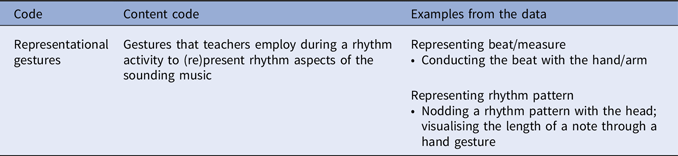
All data were transcribed verbatim, after which a thematic analysis (Braun & Clarke, Reference BRAUN and CLARKE2006) approach was used to analyse the data. First, the codes were derived directly from the data (inductive coding) but corroborated by the literature on PCK. A coding manual was developed with explanations of these codes. See Table 1 for an example of a code in the coding manual.
An example of a code in the coding manual

Secondly, after the data of three of the six teachers were analysed in this inductive manner and the coding manual was developed, intercoder agreement was applied. This meant that a second coder recoded part of the data with the goal to tighten the definitions of the codes in the manual and to develop possible new codes. For this purpose, text fragments and video fragments of every research method – 120 in total – were chosen at random and recoded. The second coder and researcher then checked whether the same or a different code had been applied to a fragment, and whether codes needed to be adjusted or added to the manual. Thirdly, the data of the last three teachers were coded with the codes from the manual (deductive coding).
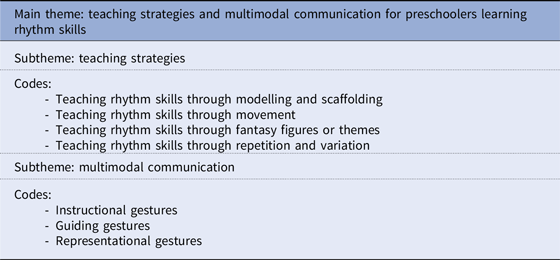
The fourth step of the analysis included the development of subthemes. In this phase, codes were clustered together into subthemes based on their shared characteristics. During the last step of the analysis, subthemes with shared characteristics were clustered into main themes and this process was informed by literature on PCK. In Table 2, an example is given of codes that were clustered into subthemes and consequently into a main theme.
Subthemes clustered into a main theme

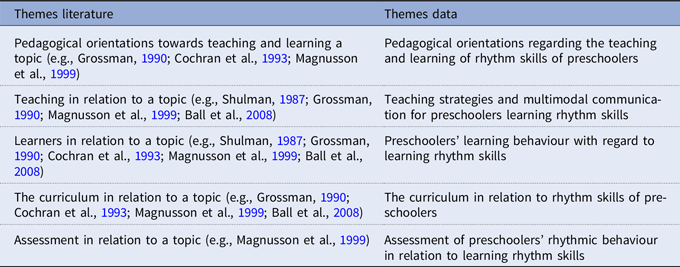
In Table 3, an overview is given of the main themes described in the literature on PCK and the main themes identified in the data.
Themes described in the literature and identified in the data

Findings
In this section, the five themes reflecting the music teachers’ PCK are described and illustrated with citations of the teachers.
Pedagogical orientations regarding the teaching and learning of rhythm skills of preschoolers
Three main pedagogical orientations were found in the data. All the teachers explained that imitational learning was central to their teaching: in their view, preschoolers learn rhythm skills through observing these skills of the teachers or peers and (unconsciously) imitate them without verbal instruction. All the teachers also mentioned experiential learning and described that preschoolers learn to develop a sense of rhythm through experiencing rhythm aspects with the whole body: ‘It is purely feeling by clapping, through instruments, but especially through their whole body’. Interestingly, when asked in the interviews, all the teachers replied that they did not have a background in a traditional music pedagogy such as Orff or Dalcroze, but their beliefs in experiential learning do align with those pedagogies (Campbell, Reference CAMPBELL1986). Furthermore, all the teachers explained that they developed a child-centred approach: they tried to work out ‘where the children are at’ rhythmically and help them move forward.
Teaching strategies and multimodal communication for preschoolers learning rhythm skills
This second theme covered the actual teaching strategies of these teachers. Moreover, based on the data, the multimodal communication teachers employed within a chosen strategy was added. To date, this is an overlooked aspect of PCK within literature.
The teaching strategy teachers frequently used was physical modelling, also called ‘imitational modelling’ (Metz Reference METZ1989, p. 52), which could be extended to ‘scaffolding’. All teachers noted they applied imitational modelling: ‘I will walk in front and the children walk in a line behind me and imitate my movements and the way I walk’. Teachers could stop modelling and start observing the preschoolers and where necessary, still guide the preschoolers verbally or non-verbally with gestures. In the last phase of an activity, they could observe the preschoolers and refrain from actively guiding the preschoolers: ‘I listen whether they [are] able to do it without me. So now I hand them some responsibility’.
Also, all the teachers employed whole-body movements as a teaching strategy to physically feel and learn rhythm skills: they have preschoolers walk, move or jump to rhythm aspects of music. Three teachers mentioned they used structured dance to develop rhythm skills and one teacher mentioned that he preferred to let preschoolers dance spontaneously to music because it gives them the opportunity to synchronise their movements to the music on their own terms. Furthermore, all the teachers applied a thematic approach to rhythm activities when they wanted to convey certain rhythmic movements in the preschoolers. They would verbally introduce a theme, for example, fairy-tale figures, farm animals or going on a holiday, and ask the preschoolers to take on a role that elicits certain rhythmic movements within the theme: ‘The children in that lesson then go to the beach. There [at the beach] you walk in different ways. So the sand is hot, therefore you walk quickly’. All the teachers also reported that the preschoolers need to be repeatedly exposed to the same rhythm activity over a period of time and need enough repetition within an activity to be able to develop a rhythm skill.
With regard to multimodal communication, these teachers employed gestures coexisting with language and music to facilitate the learning of rhythm skills. Three different types of gestures were found in the data that could reflect their PCK. The first were ‘instructional gestures’ that coexisted with language: all the teachers would often verbally explain and simultaneously act out a rhythm activity in advance with the use of gestures. During the rhythm activity, all the teachers employed ‘representational gestures’ that coexisted with music: their body and gestures represented rhythm aspects of the music, such as the beat, rhythm patterns and rhythmic phrasing. Lastly, ‘guiding gestures’ that coexisted with music were employed by all the teachers: during a music activity, they would cue preschoolers with gestures when and how to respond rhythmically, for example, the beginning of a new rhythmic movement or cueing an end of a rhythmic activity.
Teachers’ understanding of preschoolers’ learning behaviour with regard to learning rhythm skills
This theme covered what teachers understand to be learning difficulties and ‘typical’ preschooler behaviour in relation to learning rhythm skills. Concerning learning difficulties, all teachers mentioned that preschoolers can have trouble staying engaged during a rhythm activity. These teachers found they actively needed to keep preschoolers engaged through making sufficient variations within a rhythm activity. Four teachers also mentioned that preschoolers can find it hard to synchronise certain movements to rhythm aspects of music, for example, clapping. Then again, according to these teachers, some movements seemed less problematic to synchronise with music, for example, walking, although music has to be the right tempo, especially not too slow. Furthermore, four teachers noted that preschoolers find it easier to keep the beat than play melodic rhythms. A teacher hypothesised this is the case because keeping the beat seems to be connected to physiological processes: ‘Beat is in your body […] your breath, your heartbeat’.
Concerning their behaviour, four teachers reported preschoolers will tend to copy each other’s rhythmic behaviour even though they are allowed to improvise their own rhythmic music. Lastly, one teacher observed that preschoolers ‘become’ the music when learning rhythm skills, in contrast to 12-year-olds who refrain from becoming fully engaged with music. She notes that preschoolers ‘are that music […] but older children place themselves outside of the music. They have an opinion about it. Like: hmm, do I like it?’.
The curriculum in relation to the development of rhythm skills of preschoolers
This theme covered the teachers’ long-term approach to teaching rhythm skills. None of the teachers had written down their curriculum, but all of them had global ideas about their curriculum. Four teachers explained they have an overall idea about how the development of rhythmic skills of preschoolers unfolds, and they will offer a range of rhythm activities during the lesson and adapt these in such a manner that they can facilitate their development: ‘I also start [chanting] the rhythm pattern quite quickly in order to switch to a more difficult level’. This approach resulted in a developmental curriculum. The two other teachers mentioned that they provided a curriculum that could lay a broad musical foundation (including rhythm skills) during the preschool years. This resulted in a more content-orientated approach to the curriculum. Concerning curriculum goals, all of the teachers noted that preschoolers should be able to move to rhythm aspects of music, for example, to the beat of duple or triple metre, to rhythm patterns, to different tempi and to different styles. Furthermore, they all agreed that the preschoolers should be able to perform (e.g., clap or play) a steady beat, and three teachers noted that preschoolers should be able to sing a song with a steady beat.
Assessment of preschoolers’ rhythmic behaviour in relation to learning rhythm skills
This theme covered how teachers assess the rhythmic learning process of the preschoolers. All of the teachers only applied formative assessment. The focus of their assessment was to see whether or not the group or individuals were picking up on a rhythm skill during the lesson or over the course of time. The teachers assessed and provided feedback in a variety of ways. All the teachers would observe the pupils: ‘I keep my eyes open when they are all ticking with those sticks […], then I look around, like, who is doing it well?’
Furthermore, one teacher explained that he could relate the physical feeling that the rhythm activity evoked in his own body to what the preschoolers were doing during that rhythm activity; this provided him with additional information about the preschoolers’ performance: ‘you just feel when you are busy that children want to speed up [the rhythms]’. As a way of feedback, he would hold back his body and model a slower rhythmic tempo: ‘Then you automatically hold back. […] Then they copy that’. Two teachers reported that they also received haptic information about the preschoolers’ rhythmic development, for example, when they hold the preschoolers’ hands, they are able to feel the way the preschoolers join in with the swaying of the beat. Then they would apply ‘molding’ as a form of feedback (Weddle & Hollan, Reference WEDDLE and HOLLAN2010, p. 128): physically manipulate the learner’s body to guide physical performance, for example, a body part of a preschooler would be moved to the beat, thus providing the preschooler with haptic information about the beat.
Discussion
The findings in this section will be interpreted to expand the discussion on how the music teachers’ PCK can be conceptualised and how an embodied cognition approach to PCK relates to current conceptualisations of PCK.
The content of PCK
In conceptualising the content of the specialist preschool music teacher’s PCK, this study stresses the centrality of these teachers’ bodies as they took on different roles, such as model, guide, living curriculum and assessor during the teaching and learning process of rhythm skills.
For instance, with regard to the role of model, the theme ‘Teaching strategies and multimodal communication for preschoolers learning rhythm skills’ showed that teachers employed their bodies for imitational modelling. Interestingly, the video analysis made clear that teachers subtly used their bodies during the process of modelling: they emphasised their rhythmic movements more strongly when they wanted preschoolers to emulate a new rhythmic movement or they purposefully gazed at body parts that should be imitated, thus being able to redirect the preschoolers’ attention to relevant rhythmic movements.
Furthermore, the multimodal communication that the teachers employed within a chosen strategy was a newly found aspect of PCK and illuminated how these teachers’ bodies could take on the role of guide. For example, to communicate their instructions of a rhythm activity, teachers used instructional gestures coexisting with speech. This type of gesture might provide additional information for preschoolers (Kochman, Moelants, & Leman, Reference KOCHMAN, MOELANTS and LEMAN2014) and help them to understand the intention of a rhythm activity without having to fully rely on language (Nathan, Reference NATHAN, DeVega, Glenberg and Graesser2008). Furthermore, guiding gestures of teachers coexisting with music, such as cueing the beginning of a new rhythmic movement within a rhythmic activity, enabled preschoolers to synchronise their rhythmic movements with the teacher. By promoting synchronisation through guiding gestures, preschoolers are invited to connect to the bodies of their teachers and peers and to co-experience rhythm aspects of the sounding music. Moreover, the representational gestures of teachers, such as showing the beat through gestures, presented preschoolers with visual signposts of relevant rhythm aspects in the music. These types of gestures represent music in an embodied and concrete way and therefore can make rhythm aspects tangible for preschoolers (Fatone et al., Reference FATONE, CLAYTON, LEANTE, RAHAIM, Gritten and King2011).
The theme ‘Curriculum in relation to rhythm skills of preschoolers’ demonstrated that most of these teachers employed a developmental curriculum and could become ‘living curriculum material’ as they adapted the difficulty of a rhythm activity on the spot to the musical level of preschoolers and to their emotional state to keep them concentrated. Possibly, through performing rhythm activities faster or slower, teachers are able to regulate excited or inattentive behaviour of preschoolers and thereby enhance their attentional capacity (Swaine, Reference SWAINE2014).
Lastly, regarding the theme ‘Assessment of preschoolers’ rhythmic behaviour in relation to learning rhythm skills’, the teachers’ bodies play an important role when it comes to assessing rhythm skills. They listened to how the preschoolers performed rhythm skills but also ‘read’ the preschoolers’ bodies, by observing how they were performing those skills. These teachers also gained haptic feedback from touching the preschoolers (e.g., holding their hands) and provided moulding as a form of feedback through which preschoolers could adjust their rhythmic movements. In addition, as teachers often participated in rhythm activities, they were provided with the opportunity to relate the physical feeling the rhythm activity induced in their own body to what the preschoolers were doing during that activity. This suggests that music teachers can draw on multiple senses to gain information about the rhythmic development of preschoolers, enabling them to assess and provide feedback to the preschoolers in a non-verbal manner during the activity whilst keeping the flow of the music going.
The nature of PCK
Similar to the current dynamic views, in this research study, PCK is viewed as partly personally, socially and culturally defined and in part dependent of the school and classroom context (Cochran et al., Reference COCHRAN, DERUITER and KING1993; Depaepe et al., Reference DEPAEPE, VERSCHAFFEL and KELCHTERMANS2013). Yet, an embodied cognition perspective differs in two ways from the existing dynamic views. One difference is that from an embodied cognition perspective, PCK is not only viewed as a verbal form of knowing but rather a multimodal one distributed over the whole body: these teachers draw on sound, speech, gestures, touch and physical feelings to blend pedagogy and content. For instance, teachers could chant a rhythm pattern (sound), represent it through gestures and at the same time assess the tempo of the rhythm patterns through the physical feelings the preschoolers’ performance of the rhythm patterns evoked in their body.
A second difference is that PCK can be conceptualised as emerging from bodily interactions with the social and physical classroom environment, which might be clarified by the following example. The teachers in this study were physically active as a model in most of the rhythm activities and, together with the preschoolers, seemed to form an interactive and adaptive system (Steenbeek & Van Geert, Reference STEENBEEK and VAN GEERT2013). During the process of modelling, the preschoolers responded actively to their teacher, evoking physical responses in the teacher who could then adapt his or her way of modelling, in turn evoking possible new physical responses in the preschoolers. Thus, this modelling can be viewed as a bidirectional process rather than a unidirectional one (Downey, Reference DOWNEY2008) and seems to allow for the teachers’ PCK to emerge out of the bodily and social interaction with the preschoolers.
Conclusions
This study aimed to develop the concept of PCK that suits music teachers from an embodied cognition perspective. In conclusion, an embodied view on the content of their PCK broadens current conceptualisations to include gestures, physical feelings, touch and bodily ways of teaching and learning next to linguistic, aural and visual ones. As teachers often perform music during the act of teaching, their use of language diminishes when they chant or sing, and their bodies take on different roles in the teaching process through modelling, guiding the learning process through gestures, representing rhythm content through gestures, adapting rhythm skills on the spot and assessing those skills in a multisensory manner. The teachers’ bodies thus can become a mediating factor, bridging an abstract, sonic realm and a concrete, physical world.
An embodied cognition perspective on the nature of PCK builds on the social-constructivist and situated cognition perspectives in the sense that it is viewed as a dynamic way of knowing, too. Yet, it differs from those perspectives by viewing PCK as multimodal in nature. Thus far, social-constructivist and situated cognition perspectives have not systematically included the body in empirical research on PCK, leaving the role of teachers’ bodies to surface by chance.
Lastly, the findings of this study suggest a need to further understand how the role of the teacher’s body is essential in teaching music. As there is evidence that teachers’ bodies are important in teaching music, a body-based pedagogy could be established, which could be taught to preservice music teachers. Alibali and Nathan (Reference ALIBALI and NATHAN2011, p. 30) note that ‘an overwhelming emphasis’ on the verbal channel is still found in teacher education. However, raising the awareness of the relevance of the music teacher’s body could provide preservice music teachers with both practical, bodily teaching strategies and insight into a pedagogy that is key to the profession of music teachers. Once the role of the teacher’s body in teaching music is recognised, an embodied pedagogy built on empirical findings can be further developed.
Funding
This article was drawn from the PhD What the body knows about teaching music. The specialist preschool music teacher’s pedagogical content knowing regarding teaching and learning rhythm skills viewed from an embodied cognition perspective supported by the Amsterdam University of the Arts, the Netherlands.