Studies of old age have tended to focus on the losses that accompany the ageing process and on examining the extent to which such problems threaten older people's health and wellbeing, or the sustainability of the communities they belong to. However, despite the relevance of and need for such studies, recent decades have seen social scientific research take an alternative and more optimistic view on ageing. This new approach seeks to study how older people are able to avoid or overcome certain losses, to maintain important aspects of their life, or even to build new competences and achieve new gains until a very advanced age. This optimistic perspective on ageing aims to identify the factors that help people ‘age well’ and which enable increasing numbers to enjoy a healthy ageing over a greater number of years, not only in terms of the absence of severe illness and disability but also from a psychological and social point of view. Thus, far from the traditional stereotypes of decline, dependency and passivity, the focus has switched to exploring the potential (and the limits) of human development in the final decades of life.
This optimistic approach has influenced the public debate and political discourse on ageing. For instance, development in older age is one of the fundamental themes of the Madrid International Plan of Action on Ageing (United Nations 2002), a proposal that came out of the Second World Assembly on Ageing convened in Madrid by the United Nations in 2002. In the same vein, the World Health Organization (WHO) coined the term ‘active ageing’ in the late 1990s in order to convey a positive idea of older age and to guide policies aimed at its promotion (WHO 2002).
From a scientific stance a number of concepts have been proposed to study the notion of ‘ageing well’, for example, successful ageing, healthy ageing, productive ageing or competent ageing. Although each of these implies a slightly different approach to the gains and potential of ageing, the concept of successful ageing is probably the most influential and the one that has generated the most research lines. However, authors do not necessarily mean the same thing when referring to successful ageing, and neither has the concept been exempt from criticism.
Consequently, the first objective of this article is to review the different proposals that aim to define what successful ageing is and how it could be studied, highlighting their strengths and limitations, particularly from a developmental perspective. A second objective is to discuss the ways in which the concept of generativity applied to older age could offer some unique contributions that enrich the optimistic view of ageing from a developmental point of view and, at the same time, enable some of the limitations identified in the successful ageing approach to be overcome. Finally, challenges raised by the application of this concept to older age will be discussed.
The successful ageing approach
Successful ageing has been one of the most popular concepts in the gerontological literature over the last few years. However, there is as yet no common definition of what success means in relation to ageing, and different authors use different interpretative frameworks (see, for instance, Bowling Reference Bowling2007). Broadly speaking, proposals on successful ageing can be divided into two main groups: (a) models which define successful ageing as the achievement (or maintenance) of a certain state in the final decades of life; from this point of view, success is an outcome and, accordingly, the key lies in identifying which criteria are indicators of success in older age and how they are justified; and (b) models which conceive of successful ageing not as an outcome but in terms of the involvement in processes which enable the individual to adapt to the changing (and more threatening) conditions that arise as people age, thereby minimising losses and maximising gains.
Successful ageing as an outcome
Although the concept of successful ageing was first coined over 30 years ago (Butler Reference Butler1974), it began to be increasingly popular in the scientific and public debate about ageing following an article by John Rowe and Robert Kahn in Science (Rowe and Kahn Reference Rowe and Kahn1987). In this article it was argued that ageing and illness are two clearly different processes, and that one of the reasons why ageing research was biased towards the idea of loss and decline was that effects which strictly speaking are the product of illness were attributed to ageing.
Based on this distinction between ageing and illness, Rowe and Kahn (Reference Rowe and Kahn1987, Reference Rowe and Kahn1998) defined three types of ageing: (a) pathological ageing, which is characterised by the presence of severe illnesses that cause some kind of disability; (b) usual ageing, which occurs without severe illnesses but implies a higher risk of suffering them; and (c) successful ageing, a particularly good way of ageing defined by the presence of three criteria: firstly, a low risk of disease and disease-related disability; secondly, a high functional level, from both a mental and physical point of view; and lastly, an active engagement with life, including close relationships with others and continued participation in productive activities.
According to Rowe and Kahn's view, the criteria for ageing successfully are hierarchically related: not suffering from severe illnesses and disabilities is a requisite for maintaining high functional capacity, which, in turn, is necessary for active engagement with life. Only those older people who had attained the three criteria at the same time would be defined as ageing successfully, and would constitute a minority who had achieved an ideal ‘gold standard’ of ageing.
Rowe and Kahn's model has had an undeniably positive influence on the gerontological field. As well as being the driving force behind the popularisation of the term successful ageing, which has become a point of reference in public and political discourses on ageing, their model has contributed to the abandonment of the view of older age as being inextricably linked to an unavoidable chain of losses. It has also boosted interest in the biological, behavioural and social factors which determine the attainment of ageing well, and has encouraged the adoption of a new, preventive and optimistic approach to the final decades of life. This approach has shifted the focus of research away from those who suffer illness and disabilities as they age, and on to those who experience positive outcomes as they do so (Strawbridge, Wallhagen and Cohen Reference Strawbridge, Wallhagen and Cohen2002).
However, defining successful ageing as the attainment of certain desirable outcomes has also proved to be a problematic approach. For instance, some authors point out that establishing supposedly universal and objective criteria for ageing well runs the risk of creating a two-tiered view of the elderly, since only certain privileged minorities might aspire to meet the standards of success, which remain out of reach for those who, for whatever reason (e.g. presence of disabilities, social exclusion or very advanced age) are unable to meet these strict criteria (Angus and Reeve Reference Angus and Reeve2006; Becker Reference Becker1994; Holstein and Minkler Reference Holstein and Minkler2003; Scheidt, Humpherys and Yorgason Reference Scheidt, Humpherys and Yorgason1999). Thus, not only is pathological ageing excluded from the ideal model of ageing well, but the most frequent way of ageing, what Rowe and Kahn labelled as ‘usual ageing’, also falls short of the standard of success. Ironically, therefore, Rowe and Kahn's model of successful ageing might lead older people to aspire to an ideal model of ageing that may be unrealistic for many of them, and some of the most frequent ways of ageing could end up being viewed negatively, which is precisely what they sought to avoid when proposing a standard of ageing well (Dillaway and Byrnes Reference Dillaway and Byrnes2009; Lund and Engelsrud Reference Lund and Engelsrud2008).
The model proposed by Rowe and Kahn is also unsatisfactory from the point of view of social and behavioural sciences. The model of successful ageing prioritises the achievement of clinical and medically inspired criteria, while social and behavioural aspects (engagement with life, in Rowe and Kahn's model) occupy the lowest position in the hierarchy of success, thereby becoming irrelevant if the person does not previously have a high level of health and autonomy. Furthermore, the model only includes objective requirements to define successful ageing. Such requirements are externally established and measured, and overlook other important factors which affect ageing. Indeed, subjective criteria are not included in the model, which ignores how the ageing person assesses his/her own state and developmental lifecourse. Similarly, the model takes no account of the influence of social and cultural settings which contextualise individual ageing (e.g. Torres Reference Torres1999). These settings vary considerably in terms of the demands they require and the resources they offer, and at all events they influence both the way people age and the perception people have of their own ageing.
Lastly, the model also presents serious pitfalls from the point of view of development. Despite the positive image of ageing it promotes, the core of Rowe and Kahn's proposal is focused more on the absence of negative attributes (illness, disability, dependence) than on the attainment of new gains as people age. In this regard, it is a model which emphasises, at best, the maintenance of a healthy status quo that was achieved in earlier stages of life, but makes it difficult to conceive of growth as an ingredient that can also be part of ageing. Indeed, it is a perspective that places particular emphasis on risk prevention or recovery after loss, ignoring the agentic nature of the individual as an active actor capable of drawing lessons from losses and gains, of learning to live with unpleasant situations, or of establishing personal developmental goals and taking action in order to attain them.
Successful ageing as a process
Most of the above mentioned limitations of the model might be overcome were successful ageing to be regarded not as a final ideal state defined by a set of universal and mainly clinical criteria, but rather as the effective engagement in processes which enable the individual to reach certain desired states that are subjectively defined and dependent on the contextual and cultural conditions in which he/she ages (Baltes and Baltes Reference Baltes, Baltes, Baltes and Baltes1990; Baltes and Carstensen Reference Baltes and Carstensen1996; Freund and Riediger Reference Freund, Riediger, Lerner, Easterbrooks and Mistry2003).
A model of successful ageing along these lines has been proposed by what are known generically as life-span theories (Baltes, Lindenberger and Staudinger Reference Baltes, Lindenberger, Staudinger, Damon and Lerner1998; Riediger, Li and Lindenberger Reference Riediger, Li, Lindenberger, Birren and Schaie2006). These theories, which have their origin in the social and behavioural sciences (rather than in biology or medicine, as in Rowe and Kahn's model), contextualise ageing within a wider process of development across the lifespan, in which losses and gains co-occur. From this point of view, losses and gains are present throughout life, and what changes is the balance between them, which leans increasingly towards loss as the years go by, and particularly so in the final years of life. However, including ageing within a comprehensive view of development requires a redefinition of the very notion of development. Unlike traditional views of development, which restrict such a process to the attainment of gains and growth, the more comprehensive view includes two further goals: maintaining current states in risk situations, and loss regulation and damage control when decline is irreversible. These two aspects (maintenance and loss regulation) are particularly important in the second half of life, when the likelihood of experiencing gains is less and losses and threats become more prominent.
Thus, in the context of lifespan theories, ageing successfully means initiating adaptive processes in order to maximise the probability of obtaining new gains and to minimise the probability of experiencing losses, thereby maintaining those states which the individual deems to be satisfactory and avoiding the damaging effect of loss when it is inevitable. Beyond this general framework, lifespan theories differ in their specification of which adaptive processes are relevant and how they function (Boerner and Joop Reference Boerner and Joop2007).
Among these theories, perhaps the most influential has been what is known as the selection, optimisation and compensation (SOC) model (Baltes and Baltes Reference Baltes, Baltes, Baltes and Baltes1990; Freund and Baltes Reference Freund, Baltes and Fernandez-Ballesteros2007; Freund Reference Freund2008). This model proposes that successful ageing implies the coordinated application of three processes which enable the individual to take full and effective advantage of the available developmental resources (e.g. time, competences or material goods), which by definition are limited. These processes are: (a) selection, or focusing on certain goals and developmental courses while ignoring other ones; selection processes are activated by the presence of new tasks or demands which exceed the available resources (elective selection) or, alternatively, in response to a real or anticipated loss of resources (loss-based selection); (b) optimisation, or the attempt to acquire or improve the resources required to attain higher levels of functioning; and (c) compensation, or efforts to maintain functioning at a certain level when certain previously available resources have been lost.
From this point of view, the individual is assumed to be able to exert an active influence on his/her own developmental course by establishing goals and planning and executing actions aimed at their attainment. These goals, conceived of as states that people seek to obtain, maintain or avoid, are the motivational elements of behaviour, and act as triggers for the selection, optimisation and compensation processes by which the individual tries to establish, attain or maintain such desired estates (Freund and Riediger Reference Freund, Riediger, Mroszek and Little2006). Whereas selective election and optimisation enables individuals to focus on certain objectives in order to seek gains and growth, compensation and loss-based selection stem, respectively, from the maintenance of present states and the regulation of loss. All three processes function as development generators across the lifespan, with compensation and loss-based selection being particularly relevant during the ageing process.
The SOC model is a proposal about the functioning of the self, understood as a central executive that takes decisions and manages available resources in order to attain maximum efficiency in the balance between gain and loss, and according to objectives which people set for themselves at each moment of their lifecourse. This maximum efficiency, achieved by applying selection, optimisation and compensation processes, seems to be associated with optimal levels of wellbeing and life satisfaction (Chou and Chi Reference Chou and Chi2002; Staudinger et al. Reference Staudinger, Freund, Linden, Maas, Baltes and Mayer1999). However, unlike Rowe and Kahn's proposal, the SOC model does not identify universal criteria for ageing well, but rather emphasises the adaptive capacity of the individual. Thus, this model is able (as are all lifespan theories) to contemplate different developmental trajectories which could be labelled as successful provided they show an adequate balance between loss and gain, taking into account personal developmental goals, the changing pool of available means to attain them and the increasing restrictions which people face as they grow older. In this regard, one of the most important contributions of lifespan theories (and specifically the SOC model) is that they link ageing and development. Although their conception of development is certainly broad, since it includes not only gains but also maintenance and loss regulation, this link enables these models to consider growth as a component of ageing, offering at the same time an integrated view of the lifecourse in which the fundamental adaptive processes are common, regardless of the point in life which is being considered (Lerner Reference Lerner2008). Thus, successful ageing is only one instance of a more global process of successful development.
However, the very nature of these process-oriented types of models also implies certain limitations. Although they consider successful ageing as the application of a range of adaptive processes, they do so without attributing any specific direction or content to these processes, since they are supposed to be expressed in a multitude of different ways in everyday behaviour, in different periods of the lifespan and across different domains of functioning (Riediger and Ebner Reference Riediger and Ebner2007). This content-less approach means that this perspective, rather than being a theory as such, is a broad-range meta-theory which needs to be specified by other proposals that give meaning and direction to development in each lifestage, including the final ones. Lifespan theories have often used life satisfaction and wellbeing as criteria to indicate an efficient use of adaptive processes and, consequently, as indicators of successful ageing (e.g. Freund and Baltes Reference Freund and Baltes1998). The presence of optimum levels of subjective wellbeing and life satisfaction is unquestionably a desirable aim in old age, and including the subjective perspective of the ageing person is a welcome addition to the notion of ageing well, one which was absent in Rowe and Kahn's perspective. However, the exclusive use of these subjective criteria as indicators of successful ageing does not seem sufficient. In this regard it is important to consider what has been termed ‘the ageing paradox’, a phenomenon defined as ‘the presence of subjective wellbeing in the face of objective difficulties or other socio-demographic or contextual risks that intuitively should predict unhappiness’ (Mroczek and Kolarz Reference Mroczek and Kolarz1998: 1333). Due to the extraordinarily plastic and adaptive nature of the human mind, older people who objectively experience adverse life conditions (such as severe illness or lack of autonomy) rate their wellbeing in surprisingly positive terms, and subjective measures of wellbeing seem to be less affected by age than would be expected. Thus, the use of these kinds of indicators leads to the unlikely conclusion that regardless of the circumstances, all older people age in a very similar way, thereby underestimating both the presence of deficiencies in certain groups of older people and the potential for progress and improvement among other elderly groups.
It can be argued, therefore, that when viewing successful ageing from the perspective of adaptive processes it is necessary to take into account a set of normative criteria regarding success. Those criteria should be flexible enough to accommodate a range of personal preferences and social contexts which define different lifestyle profiles of older people. At the same time, they must be able to discriminate between more and less successful ways of ageing. In this regard, the concept of generativity applied to older age is particularly promising as a success indicator, since it implies the definition of a series of goals which guide the adaptive processes underlying successful ageing. Generativity in older age enriches these processes and provides a more complete and complex view of what it means to ‘age well’, since the generativity approach identifies certain motivations, goals and behaviours that could have meaning for some older people and which are integrated in a global view of how the self changes across the lifespan.
If generativity in older age is considered to be an indicator of successful ageing it could be seen, in addition to feeling well, as the key to growth and the attainment of greater maturity in the final decades of life, as compared to previous stages. This would enable ageing to be incorporated within a particularly ambitious view of development, one which goes beyond the emphasis on maintenance and loss regulation, and where gains and growth are regarded as essential ingredients of successful ageing.
What is generativity?
The concept of generativity is derived from the theory of Erik Erikson, who proposed that development across the lifespan is divided into eight stages, each one implying a certain challenge or developmental crisis (Erikson Reference Erikson1963, Reference Erikson1982). Generativity is the focus of the seventh stage, coinciding with middle adulthood. It is defined as the concern to nurture, guide and ensure the wellbeing of future generations and, ultimately, to leave a lasting legacy. This concern is based both on inner needs, rooted, according to Erikson, in instinctive motives, and on external social forces, and it becomes a social expectation when the person reaches mid-life. In Erikson's developmental model, successfully negotiating a certain stage strengthens the self and increases the likelihood that the individual is able to deal competently with the challenges of subsequent stages. Essentially, therefore, Erikson's proposal is a developmental theory in which the individual progressively acquires competences and greater maturity by actively overcoming a set of life crises.
In the case of generativity the competence at stake is care, which could be expressed through a diverse range of activities such as raising children, looking after dependants, educating and mentoring younger generations, producing services and goods, or being committed to civic and political issues. At all events, being generative means contributing to the maintenance and enhancement of the contexts in which the individual participates (families, communities, companies, etc.), reinforcing social institutions, enriching the social network and ensuring continuity across generations.
Following Erikson's writings, generativity was largely ignored in the scientific literature for at least two decades. When interest in the concept re-emerged in the 1980s, this was done without the psychodynamic theoretical assumptions that had lain behind Erikson's original proposals. John Kotre (Reference Kotre1984, Reference Kotre1995) was one of the authors who rediscovered the idea of generativity, his main contribution being to distinguish between two types: communal generativity, which implies nurturing and caring for other people and establishing bonds, and agentic generativity, related to the extension and strengthening of the self through leadership, productivity and creative activities. He also coined the concept of cultural generativity to refer to the adult interest in transmitting cultural instruments and ideas to subsequent generations.
However, perhaps the most influential author in the recovery of generativity as a concept for studying personal and social development in adulthood is Dan McAdams. He proposed a conceptual framework in which different generative elements are identified, such as inner needs, cultural demands, interests, objectives, behaviours or narratives (McAdams Reference McAdams and Lachman2001; McAdams, Hart and Maruna Reference McAdams, Hart, Maruna, Adams and de St. Aubin1998). A second important contribution of McAdams’ work lies in the variety of methodologies used to study generativity, which is consistent with the diverse generative phenomena included in his proposal. Specifically, McAdams has designed scales to assess both generative interest (the Loyola Generative Scale) and generative behaviours (the Generative Behaviour Checklist). Qualitative methodologies, such as incomplete sentences or life stories, have also been used to study generative objectives and generative narratives, respectively (McAdams and de St. Aubin Reference McAdams and de St. Aubin1992; McAdams et al. Reference McAdams, Diamond, de St. Aubin and Mansfield1997).
McAdams's proposals have also inspired interesting lines of research. For instance, different domains in which generativity is expressed have been identified (Morfei et al. Reference Morfei, Hooker, Carpenter, Mix and Blakeley2004; Peterson Reference Peterson2006; Peterson and Duncan Reference Peterson and Duncan1999), the antecedents and consequences of generativity have been explored (see, for instance, Grossbaum and Bates Reference Grossbaum and Bates2002; Hofer et al. Reference Hofer, Busch, Chasiotis, Kärtner and Campos2008), and individual ways of meeting (or not) generative challenges have been identified (Bradley Reference Bradley1997; Bradley and Marcia Reference Bradley and Marcia1998).
Generativity in older age
As mentioned above, Erikson's theory (and subsequent developments such as the work of McAdams) restricted generativity to middle adulthood. From this point of view, once adults have attained generativity they are ready to face the challenge of old age and achieve integrity, which implies reviewing one's life to find meaning and feeling that it has been worth living. However, Erikson's approach, which links life interests to specific chronological periods, is both too rigid and too simple, and it has been questioned from several points of view.
Firstly, some of Erikson's assumptions have been criticised on conceptual grounds. For instance, it has been argued that, rather than being replaced by new developmental issues, interests typically associated with a certain lifestage could, to some extent, maintain their importance throughout life (Bradley Reference Bradley1997). In the case of generativity this would mean that generative concerns and behaviours could persist beyond middle adulthood. This extension of generativity into older age was even proposed in Erikson's final writings (Erikson, Erikson and Kivnick Reference Erikson, Erikson and Kivnick1986), in which the concept of grand generativity was coined to explain the diverse and numerous generative-like behaviours shown by many older people. Such behaviours are related to helping and supportive activities which people develop as parents, grandparents, friends or mentors, at the same time as accepting the help of others and expressing their interest in perpetuating and transmitting knowledge and values to the next generation.
Secondly, from a demographic and social perspective, there are good reasons to believe that generativity might play a key role in the final decades of life. The profile of contemporary older age is dramatically different from the one which was usual 50 or 60 years ago, when Erikson proposed his developmental theory. New generations who enter older age are better educated than in the past, and they can expect to enjoy good health for more years. Such a change means that increasing numbers of older people are able to keep on contributing to their families, whether as grandparents offering child care (e.g. Hank and Buber Reference Hank and Buber2009), as parents providing their adult children with emotional support and material resources (e.g. Albertini, Kohli and Vogel 2007), or as caregivers for dependent relatives (e.g. Black et al. Reference Black, Schwartz, Caruso and Hannum2008) and also to their communities, by volunteering or participating in civic organisations (e.g. Narushima Reference Narushima2005). In fact, health and education are two of the main predictors of that kind of community involvement in later life (e.g. Gottlieb and Gillespie Reference Gottlieb and Gillespie2008). These socio-demographic trends, boosted by both the active ageing rhetoric and the optimistic view on ageing which was mentioned above, reinforce the idea that older people can play a significant role in the contexts in which they participate, thereby making these contexts more responsive to their contributions. This idea would seem to be confirmed by initial research on generativity in older age (Cheng Reference Cheng2009; Thiele and Whelan Reference Thiele and Whelan2008; Warburton and Gooch Reference Warburton and Gooch2007; Warburton, McLaughlin and Pinsker Reference Warburton, McLaughlin and Pinsker2006).
Finally, from an empirical point of view, doubts have been raised regarding the close association between generativity and middle adulthood. For instance, generative interests and activities also seem to be present in older age, and middle-aged people only surpass older people on some specific generative dimensions (McAdams, de St. Aubin and Logan Reference McAdams, de St. Aubin and Logan1993; Sheldon and Kasser Reference Sheldon and Kasser2001).
Consequently, generativity in older age can be conceived of as a set of interests, goals and activities that are relevant for older people and which give content to and guide the adaptive efforts described above. From this perspective, successful ageing includes the ability to engage efficiently in these adaptive processes so as to achieve meaningful goals, such as generative ones. These goals are intrinsically social and enable successful ageing to be extended beyond certain individual criteria related to health and autonomy, such as in the model of Rowe and Kahn, or certain intrapsychic processes, such as in lifespan theories.
Furthermore, generativity in older age offers a broad conceptual framework that includes a diverse set of activities and contexts which are both scientifically relevant and of unquestionable social and political interest. Indeed, the notion of generativity highlights the need to study the contributions made by older people to family functioning, as well as their commitment to civic activities, their role in intergenerational relationships or their involvement in training, capacity building and empowerment processes. In that sense, generativity in older age is a concept similar to active ageing (WHO 2002) or productive ageing (Bass and Caro Reference Bass, Caro, Morrow-Howell, Hinterlong and Sherraden2001), since all three emphasise the role of older people as resource providers rather than resource consumers, as a social asset rather than a social burden.
However, generativity in older age also involves a component related to personal development, growth and maturity, one which is absent in the concepts of active ageing and productive ageing, as well as in the successful ageing models described above. Thus, generativity in older age implies situating the final decades of life within a more traditional developmental framework, but one which is not exclusively anchored to the ideas of maintenance or loss regulation as in lifespan theories; rather, it is a developmental model that is even more optimistic and which highlights the gains which can be made in older age. Such gains may be experienced even when losses are also present, and losses may sometimes trigger new learning or a change in life priorities (Black and Rubinstein Reference Black and Rubinstein2009; de Medeiros Reference de Medeiros2009).
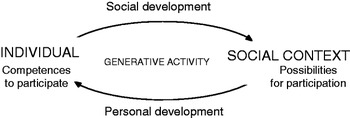
In sum, generativity in older age offers a way of coordinating two kinds of development (see Figure 1). Firstly, it addresses social and community development, since generative activities are geared towards care, maintenance of what has been achieved, and improving the lives of others around us and the social institutions in which we participate. Secondly, generativity also implies personal development, since generative activities and goals give meaning to people's lives and are a way of boosting their competences, skills and interests, which, in turn, broadens the range of generative activities that people may gain access to.
Generative activity implies an interplay between individual and social dimensions.

Such two facets of generativity, one more social and related to the idea of giving back and leave a legacy to next generations, and another one more individual and related to the personal benefits and strengthen the self, reflect the communal and agentic modes of generativity identified by Erikson and Kotre, and mentioned above. In addition, research on lay definitions of successful ageing has found that people include these two kinds of development in their view of ‘ageing well’. Apart from themes on health and psychological functioning, social contributions such as giving to others, being able to work after retirement or volunteering are perceived as part of successful ageing (Fernández-Ballesteros et al. Reference Fernández-Ballesteros, García, Abarca, Blanc, Efklides, Moraitou, Kornfeld, Lerma, Mendona-Numez, Mendoza-Ruvalcaba, Orosa, Paul and Patricia2010; Tate et al. Reference Tate, Lowen, Bayomi and Payne2009), as well as personal development-related ideas as self-growth and commitment in novel pursuits in later life (Reichstadt et al. Reference Reichstadt, Sengupta, Depp, Palinkas and Jeste2010)
Conclusion and perspectives
The present paper has described two different ways of understanding successful ageing. The first, represented by the model of Rowe and Kahn, has helped popularise the notion of successful ageing and has fostered a more positive view of older age. However, it has a distinctly clinical bias and is clearly insufficient from a psychological and developmental point of view. These limitations are overcome by the second perspective, which relates successful ageing to the application of certain adaptive processes for managing personal resources, which become increasingly scarce as we age. In this perspective, successful ageing forms part of a developmental framework which includes, in addition to growth, the maintenance of desirable states and the regulation of losses, two aspects which are particularly critical in the final decades of life.
However, it has been argued that the view of successful ageing based on adaptive processes could be complemented and enriched by taking into account the generative dimension of older age. In our view, such addition might lead to theoretical advancement in that area.
Firstly, generativity provides concrete and meaningful goals and activities upon which adaptive processes can operate, thereby bringing specificity to what may otherwise be too abstract and lacking in content. For instance, knowing generative concerns could help to understand what kind of goals are pursued and, if the resources are scarce, which ones will be selected to keep the core functioning of the self in older age. In a similar vein, if some or those goals are blocked by losses, generativity could also help to understand, and maybe predict, ways of compensation by setting alternative goals of similar generative value.
Secondly, generativity moves successful ageing on to a social level, since it would then be grounded not only on the effectiveness of intrapsychic processes but also on the contributions that older people can make to the contexts in which they participate, particularly family, work and community contexts. That is, successful ageing is not something older people can achieve by themselves, but it necessarily implies introducing social variables in the ‘ageing well equation’ and linking the success of older people as individuals with the success of the communities in which they are actively involved.
Finally, consideration of generativity in older age strengthens the link between successful ageing and personal development, particularly since development is then understood as the achievement of higher levels of maturity and personal growth, boosted by generative activities. The inclusion of generative goals and activities as success criteria means considering gains as a fundamental part of ageing well, what helps to compensate, at least to some extent, the bias towards maintenance and regulation of loss that characterises development in older age within the SOC model. In addition, taking into account maturity and personal growth makes it possible to go beyond traditional hedonic and present-oriented approaches to wellbeing as a subjective criterion of success, to consider other more developmental and future-oriented perspectives, rooted in the notion of eudaimonic wellbeing (e.g. Deci and Ryan Reference Deci and Ryan2008; Grossbaum and Bates Reference Grossbaum and Bates2002; Ryff and Singer Reference Ryff and Singer2008).
Such theoretical advancements would also have practical implications. For instance, they can boost policies to implement what could be labelled ‘generative-friendly contexts’, rich in opportunities for those older people who wish to keep on contributing to their families and communities. Also, taking into account generativity means to increase the visibility of the many contributions of older people, their view as a social asset instead of as a social burden, and the effective reduction of ageist attitudes.
In sum, generativity in older age is a promising framework for studying the positive social and individual aspects of ageing, and it has attracted a still incipient research interest in recent years. However, in order to foster continued interest along these lines, research on generativity in older age must address a set of challenges, the response to which will indicate to what extent generativity is a fruitful concept as regards successful ageing.
The first challenge has to do with clarifying which factors trigger or encourage generativity in older age, and what its main consequences are. Of key importance here is exploring the relationship with maturity and personal growth, since it is in this area, which has scarcely been studied so far, that one of the main contributions of generativity to successful ageing lies. Research in this regard should obviously take into account those aspects that have proved important for generativity in other lifestages, such as its different dimensions (e.g. agentic versus communal generativity, generativity in family versus in community contexts, etc.) or the different methodological approaches used to study the concept (qualitative versus quantitative). In this respect, it is particularly important to investigate the relationship between generative behaviours and generative motives and goals. Although generativity could be associated with a wide array of behavioural acts, at least theoretically they are only generative in nature if they are driven by generative motives or aimed to achieve generative goals. Otherwise, those acts might contribute to social development, but would not lead to personal development.
A second challenge refers to the developmental implications of generativity. For instance, more research is needed to identity elements of continuity and discontinuity of generativity in older age, in comparison to previous lifestages. In particular, it would be interesting to know to what extent the interest in and expression of generativity changes in the transition from middle adulthood (where, according to Erikson, generativity is the central issue) to older age. Furthermore, it is also necessary to consider how generativity changes during older age, and especially when people reach the so-called fourth age, since these final years of the lifespan present qualitatively different characteristics, ones which are far less positive and optimistic than those of early older age (Baltes and Smith Reference Baltes and Smith2003). In this context, it would be interesting to explore to what extent generativity throughout ageing coexists with, is complemented by, or is even substituted by other kinds of interests and activities that have been proposed as key elements of older age, such as integrity, interiority or gero-transcendence (Brown and Lowis Reference Brown and Lowis2003; Tornstam Reference Tornstam1996), the latter being concepts which share the assumption that older people are increasingly interested in themselves and their lifecourse following a process of disengagement from the social world. The balance between ‘looking inside’ forces and ‘looking outside’ generative interests remains unclear as yet.
Finally, research on generativity in older age also needs to clarify the relationship between generative goals and activities and the adaptive processes described from the lifespan perspective. Here it would be important to know how such adaptive processes are activated and applied in order to channel and respond to generative objectives and motives, and also how such objectives and motives should necessarily be adjusted as life circumstances change. In the present author's view, the key to a more inclusive and richer conception of successful ageing lies in the interplay between the self as resource manager – which enables the individual to adapt to changing contexts and maintain an efficient and satisfactory functioning – and the self as content, which defines meaningful goals and behaviours (which, at least in part, could be of a generative nature in older age). By adopting such a view we are also more likely to move definitively beyond a loss-centred and pessimistic perspective on ageing, linking instead the final decades of life to development and growth.
Acknowledgement
This article has been written with the support of grant PSI2009-10966, funded by the Spanish Science and Innovation Ministry.