Introduction
Sifting through unidentified and partly identified specimens in the Oregon State University herbarium, we found a minutely fruticose cyanolichen on soil that we had not seen before. Under the microscope it was revealed to be a Nostoc-containing cyanolichen with cortical cells shaped like jigsaw puzzle pieces, immediately suggesting Leptogidium contortum (Henssen) T. Sprib. & Muggia (photograph p. 288, McCune & Geiser Reference McCune and Geiser2009). While that species occurs in Oregon on trees, we knew of no occurrences on soil. Furthermore, the photobiont was not Rhizonema (Lücking et al. Reference Lücking, Lawrey, Sikaroodi, Gillevet, Chaves, Sipman and Bungartz2009; Cornejo et al. Reference Cornejo, Nelson, Stepanchikova, Himelbrant, Jørgensen and Scheidegger2016), as is found in L. contortum and L. dendriscum (Nyl.) Nyl., but a species of Nostoc. Based on the unusual combination of characters and the nearby location, we decided to try to find fresh material for further study.
The presumed collector of the original specimen was William C. Denison, long-time mycologist at Oregon State University, now deceased. Because the collecting location was quite vague, we asked his son, Tom Denison, if he knew anything of his father's explorations in that area. Tom did remember that their family took long hikes following the railroad grade up the Luckiamute River from Hoskins to the town of Valsetz. Valsetz no longer exists, and all that remains of the railroad are sections of the railroad bed where it has not been destroyed by road construction. Currently, the river is paralleled by a major logging road, with a slender riparian zone surrounded by young forests and clear cuts. Because the area is so heavily impacted by logging and road dust, we had only a slight hope of finding fresh material. However, we were pleasantly surprised to find not only a modern location for the unknown lichen, but also Gregorella humida (Kullh.) Lumbsch as an ecological associate of the new lichen (McCune & Stone Reference McCune and Stone2020).
Our first attempts at sequencing the ITS region of the new lichen gave surprising results: it blasted closest to Peltigera venosa (L.) Hoffm., but examination of an alignment with various Peltigera species revealed such large differences within the ITS region that we suspected a sequencing problem. Repeating the extraction and sequence yielded nearly identical results, prompting us to pursue the problem in earnest. The purpose of this paper is to present these results as a new monospecific genus Sinuicella (S. denisonii) in the Peltigeraceae, with affinities to Solorina and Peltigera but clearly falling outside of both.
Materials and Methods
We studied the original specimens collected in 1969 and the new collections from near Hoskins, Oregon with standard light microscopy. Thin sections and whole thalli were studied in material mounted in water, K/IKI, and IKI. Spores were measured at ×400. Microscopic photographs were taken with a Nikon Coolpix 995 digital camera through an Olympus BX40 microscope, coupled with an Optem 25-70-14-03s to the UVT-1X C-mount on the trinocular head, using magnifications up to ×400. Photographs under the dissecting microscope were created with the same camera and coupler to the SZ-CTV mount on the trinocular head of an Olympus SZ40 stereo microscope, using magnifications up to ×40 and photo stacking with Helicon Focus 6 (HeliconSoft, Ukraine).
Other than the historical specimen and collections from the new site, we have been unable to locate material elsewhere, either in the field or in regional herbaria. It is likely that the material, particularly if sterile, would have been filed under Leptogidium (Polychidium) contortum, because this species also has a jigsaw cortical structure, is similar in size, and has been of considerable regional interest since its early reports from North America by Brodo (Reference Brodo1995) and McCune et al. (Reference McCune, Rosentreter, DeBolt, Kaye, Liston, Love, Luoma, Meinke and Wilson1997). Over the decades we have studied most of the readily available material of Leptogidium contortum in regional herbaria and have not seen any other soil-dwelling material labelled under that name.
Thin-layer chromatography (TLC) was performed on the specimen D. Stone 10122 (OSC) using solvents A, B’ and C (Culberson & Ammann Reference Culberson and Ammann1979; Culberson & Johnson Reference Culberson and Johnson1982; solvent C is the same as solvent ‘TA’ of Holtan-Hartwig (Reference Holtan-Hartwig1993)). Four Peltigera specimens (P. britannica (Gyelnik) Holt.-Hartw. & Tønsberg, P. horizontalis (Hudson) Baumg., P. malacea (Ach.)Funck and P. retifoveata Vitik.) and three Solorina specimens (S. crocea (L.) Ach., S. octospora (Arnold) Arnold and S. saccata (L.) Ach.) were included as the reference samples for comparison.
We extracted DNA from a single specimen (Stone 10024) without grinding the thallus using the REDExtract-N-Amp Plant PCR kit by Sigma-Aldrich (St Louis, Missouri, USA). Details of PCR for ITS and LSU follow McCune et al. (Reference McCune, DiMeglio, Tønsberg and Yahr2019). Briefly, we amplified the fungal ITS region with primers ITS1F and ITS4, and the nuLSU region with primers AL2R and LR6 (Vilgalys & Hester Reference Vilgalys and Hester1990), with PCR annealing at 64 °C for 45 s; the mtSSU region was amplified with primers mrSSU1 and mrSSU3R, with PCR annealing at 53 °C for 1 min. We also amplified one region of the cyanobiont, rbcLX, with primers CX and CW (primers and PCR conditions follow O'Brien et al. (Reference O'Brien, Miadlikowska and Lutzoni2005)). PCR products were visualised with gel electrophoresis and successful samples were cleaned using ExoSAP-ITTM Affymetrix 78200, and subsequently sequenced with forward and reverse reads (Eurofins MWG Operon Inc., Kentucky, USA). At least two reads per region were combined into a consensus sequence.
Data matrices and phylogenetic analyses
We applied the Evolutionary Placement Algorithm (EPA; Berger & Stamatakis Reference Berger and Stamatakis2011) as implemented in the Tree-Based Alignment Selector toolkit (T-BAS version 2.1, available at http://tbas.hpc.ncsu.edu; Carbone et al. Reference Carbone, White, Miadlikowska, Arnold, Miller, Kauff, U'Ren, May and Lutzoni2017, Reference Carbone, White, Miadlikowska, Arnold, Miller, Magain, U'Ren and Lutzoni2019) using the Lecanoromycetes reference tree (Miadlikowska et al. Reference Miadlikowska, Kauff, Högnabba, Oliver, Molnár, Fraker, Gaya, Hafellner, Hofstetter and Gueidan2014a; Carbone et al. Reference Carbone, White, Miadlikowska, Arnold, Miller, Magain, U'Ren and Lutzoni2019) based on mtSSU and nuLSU sequences separately and combined. For each EPA analysis we used the GTR substitution model (Rodríguez et al. Reference Rodríguez, Oliver, Marin and Medina1990) with gamma distribution parameter (GTRGAMMA) and calculated likelihood weights with a placement cut-off distance of 10. Based on the EPA analyses, Sinuicella denisonii was consistently shown as sister to the clade representing the genus Peltigera (results not shown). This sister relationship was also confirmed by a follow up search of the best tree and bootstrap analyses (1000 replicates) (RAxML 8.2.12; Stamatakis Reference Stamatakis2006; Stamatakis et al. Reference Stamatakis, Hoover and Rougemont2008) as implemented in T-BAS v.2.1 via the CIPRES Science Gateway v.3.3 (Miller et al. Reference Miller, Pfeiffer and Schwartz2010, Reference Miller, Schwartz, Pickett, He, Klem, Scheuermann, Passarotti, Kaufman and O'Leary2015) based on the multilocus matrix for Lecanoromycetes. The newly added mtSSU and nuLSU sequences were realigned with MAFFT v.7.402 (Katoh & Toh Reference Katoh and Toh2010), the GTRGAMMA nucleotide substitution model was calculated, and the backbone constraint on the multifurcating Lecanoromycetes reference tree (where internodes with bootstrap support < 70% were collapsed) was implemented.
Based on the resulting RAxML phylogeny showing a sister relationship between Sinuicella and Peltigera (with 99% bootstrap support), we selected representatives from each family in the order Peltigerales together with two members (Lecidea and Porpidia) from the closely related order Lecideales (Miadlikowska et al. Reference Miadlikowska, Kauff, Högnabba, Oliver, Molnár, Fraker, Gaya, Hafellner, Hofstetter and Gueidan2014a) to root the tree. Single-locus alignments for three ribosomal RNA loci, nuSSU, nuLSU and mtSSU, and the protein coding RPB1 gene were downloaded from T-BAS v.2.1 (files associated with the Lecanoromycetes reference tree; Carbone et al. Reference Carbone, White, Miadlikowska, Arnold, Miller, Kauff, U'Ren, May and Lutzoni2017, Reference Carbone, White, Miadlikowska, Arnold, Miller, Magain, U'Ren and Lutzoni2019). We supplemented these data with six additional taxa from the Peltigerales (Spribille et al. Reference Spribille, Tønsberg, Stabentheiner and Muggia2014), which were not present in the Lecanoromycetes reference tree in T-BAS, giving a total of 47 species (see Supplementary Material Table S1, available online). All single-locus alignments were manually adjusted using Mesquite v.3.11 (Maddison & Maddison Reference Maddison and Maddison2015) with the option ‘Nucleotide with AA color’ for guiding the RPB1 alignment. Ambiguously aligned regions (sensu Lutzoni et al. Reference Lutzoni, Wagner, Reeb and Zoller2000) were delimited manually and excluded from subsequent analyses. The combined 4-locus, 47 species data set for the Peltigerales includes a single representative from most genera in all 10 families currently recognized in the order (Coccocarpiaceae, Collemataceae, Koerberiaceae, Lobariaceae, Massalongiaceae, Nephromataceae, Pannariaceae, Peltigeraceae, Placynthiaceae and Vahliellaceae; Lücking et al. Reference Lücking, Hodkinson and Leavitt2016). Six of the 47 species had two loci, 18 species had three loci, and 23 species had four loci (Supplementary Material Table S1).
To re-evaluate the phylogenetic placement of Sinuicella within Peltigeraceae and confirm its sister relationship to Peltigera, we used a 4-locus data set that includes ITS, nuLSU, ß-tubulin and RPB1, derived from a 7-locus data matrix (Chagnon et al. Reference Chagnon, Magain, Miadlikowska and Lutzoni2019) containing a single representative of every putative Peltigera species and selected species of the genus Solorina. To this data matrix we added the newly obtained ITS and nuLSU sequences for Sinuicella denisonii (Stone 10024), individuals of Solorina species for which at least one of the four loci was available in GenBank, and newly-generated sequences for two additional Solorina specimens. We expanded the outgroup by adding three members of the family Lobariaceae. All single-locus alignments were manually adjusted using Mesquite v.3.11 with the option ‘Nucleotide with AA color’ for guiding the protein-coding alignments. Ambiguously aligned regions (sensu Lutzoni et al. Reference Lutzoni, Wagner, Reeb and Zoller2000) were delimited manually and excluded from subsequent analyses. The final 4-locus data set for the Peltigeraceae includes 185 taxa, 13 of which are represented by a single locus, 45 by two loci, 45 by three loci, and 82 taxa by four loci (see Supplementary Material Table S2, available online).
To determine the phylogenetic identity of the Nostoc cyanobiont from Sinuicella denisonii (Stone 10024), we added its rbcLX sequence to a matrix containing 503 rbcLX haplotypes derived from Pardo-De la Hoz et al. (Reference Pardo-De la Hoz, Magain, Lutzoni, Goward, Restrepo and Miadlikowska2018) and Magain et al. (Reference Magain, Truong, Goward, Niu, Goffinet, Sérusiaux, Vitikainen, Lutzoni and Miadlikowska2018). These sequences represent a broad sampling of published symbiotic and free-living Nostoc from all currently recognized phylogroups within Nostoc Clade 1 and Clade 2, Subclades 1, 2 and 3 (sensu Otálora et al. Reference Otálora, Martínez, O'Brien, Molina, Aragón and Lutzoni2010; Magain et al. Reference Magain, Miadlikowska, Goffinet, Sérusiaux and Lutzoni2017a, Reference Magain, Miadlikowska, Mueller, Gajdeczka, Truong, Salamov, Dubchak, Grigoriev, Goffinet and Sérusiauxb, Reference Magain, Truong, Goward, Niu, Goffinet, Sérusiaux, Vitikainen, Lutzoni and Miadlikowska2018).
Maximum likelihood analyses using RAxML-HPC2 on XSEDE were performed at the nucleotide level on each data set (4 loci for Peltigerales, 4 loci for Peltigeraceae, and rbcLX for Nostoc) as implemented on the CIPRES Science Gateway. Optimal tree and bootstrap searches were conducted with the rapid hill-climbing algorithm for 1000 replicates with the GTRGAMMA nucleotide substitution model. Each data set was partitioned into subsets using PartitionFinder2 on XSEDE (Lanfear et al. Reference Lanfaer, Frandsen, Wright, Senfeld and Calcott2017) as implemented on the CIPRES portal, with greedy search and using the AICc (corrected Akaike Information Criterion) for model selection. The 4-locus data set for Peltigerales was partitioned into five subsets: mtSSU, nuSSU, nuLSU, RPB1-1st + 2nd codon positions, and RPB1-3rd codon position + intron. The 4-locus data set for Peltigeraceae was partitioned into two subsets: nuLSU + RPB1-1st + 2nd + intron + ß-tubulin-1st + 2nd + 3rd codon positions + ITS, and ß-tubulin introns + RPB1-3rd codon position. The rbcLX data set was partitioned into six subsets: rbcL-1st, rbcL-2nd, rbcL-3rd, rbcX-1st, rbcX-2nd and rbcX-3rd codon positions. Relationships receiving bootstrap support ≥ 70% were considered well supported.
Results
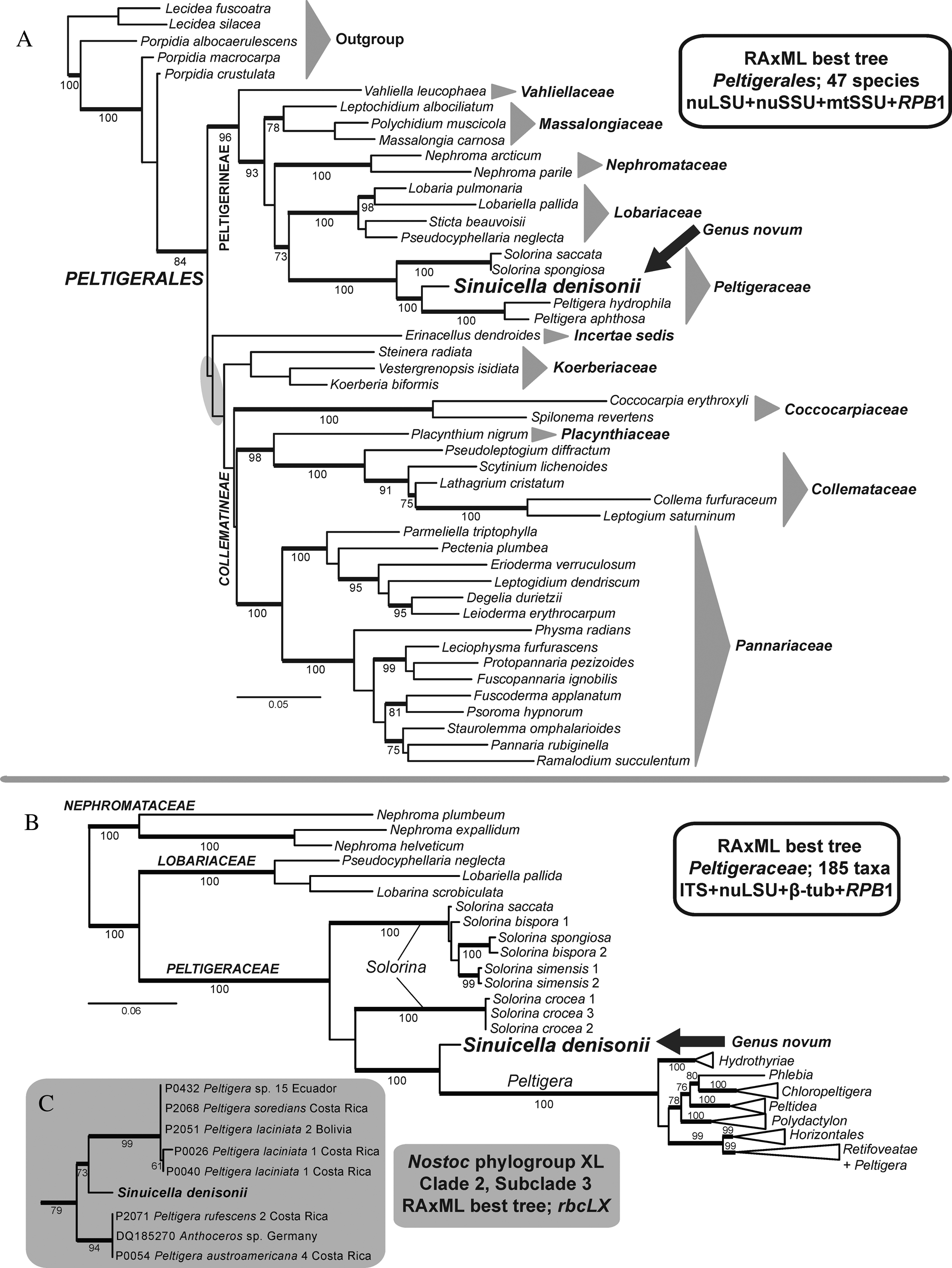
BLAST results (as of 3 May 2020) for Sinuicella sequences were inconclusive: the nuLSU and mtSSU sequences showed a low similarity (c. 94%, 100% coverage) to multiple species of Peltigera from various sections, while the ITS was most similar (91%, 100% coverage) to Solorina saccata. All EPA analyses using the Lecanoromycetes reference tree in T-BAS placed Sinuicella outside of currently delimited genera, sister to Peltigera (results not shown). This phylogenetic affiliation was confirmed by maximum likelihood inferences, first within the broader phylogenetic context of the order Peltigerales (Fig. 1A; Supplementary Material Table S1, available online) and then within the narrower context of the family Peltigeraceae (Fig. 1B; Supplementary Material Fig. S1, Supplementary Material Table S2, available online). This sister relationship of the genera Sinuicella and Peltigera was highly supported in both phylogenies (100%; Fig. 1A & B).
(see previous page). Phylogenetic placement of Sinuicella denisonii in the order Peltigerales (A) and the family Peltigeraceae (B), and its cyanobiont within Nostoc phylogroup XL of Nostoc Clade 2, Subclade 3 (C, in grey). A, phylogenetic relationships inferred from maximum likelihood (ML) analyses of a 4-locus data set (nuLSU + nuSSU + mtSSU + RPB1) for 42 species representing all recognized families within Peltigerales and five outgroup species from Lecideales. The two Lecidea species were used to root the tree (following Miadlikowska et al. Reference Miadlikowska, Kauff, Högnabba, Oliver, Molnár, Fraker, Gaya, Hafellner, Hofstetter and Gueidan2014a). Bootstrap support is provided for the internodes with values ≥ 70%, which are also shown with thick lines. The scale bar represents number of nucleotide substitutions per site. Classification follows Lücking et al. (Reference Lücking, Hodkinson and Leavitt2016). Internodes highlighted in grey represent uncertain placement of Koerberiaceae (currently a member of Peltigerineae) and Erinacellus (currently incertae sedis in Peltigerales). B, phylogenetic relationships inferred from ML analyses of a 4-locus data set (ITS + nuLSU + ß-tubulin + RPB1) for 185 taxa representing Peltigeraceae and six outgroup species from the closely related families Lobariaceae and Nephromataceae. Nephroma was used to root the tree (following Miadlikowska et al. Reference Miadlikowska, Kauff, Högnabba, Oliver, Molnár, Fraker, Gaya, Hafellner, Hofstetter and Gueidan2014a). Within-section relationships (sensu Miadlikowska & Lutzoni Reference Miadlikowska and Lutzoni2000) of the genus Peltigera were collapsed (see Supplementary Material Fig. S1, available online, for the complete phylogeny). Bootstrap support is provided for the internodes with values > 70%, which are also shown with thick lines. The scale bar represents number of nucleotide substitutions per site. C, Nostoc phylogroup XL part of Clade 2, Subclade 3 of the phylogeny that resulted from an ML analysis of the rbcLX data set which includes 504 representatives of free-living and symbiotic Nostoc (modified data set from Pardo-De la Hoz et al. (Reference Pardo-De la Hoz, Magain, Lutzoni, Goward, Restrepo and Miadlikowska2018) and Magain et al. (Reference Magain, Truong, Goward, Niu, Goffinet, Sérusiaux, Vitikainen, Lutzoni and Miadlikowska2018)). Names refer to the mycobiont with which the Nostoc associates. Bootstrap support is provided for the main internodes, and those with values > 70% are shown with thick lines. See Supplementary Material Fig. S2 (available online) for the complete Nostoc phylogeny with scale.

The cyanobiont from Sinuicella denisonii represents Nostoc phylogroup XL (Fig. 1C) within Nostoc Clade 2, Subclade 3 (Magain et al. Reference Magain, Truong, Goward, Niu, Goffinet, Sérusiaux, Vitikainen, Lutzoni and Miadlikowska2018). This highly supported phylogroup (79%) includes Nostoc associated with various Peltigera species from section Peltigera collected in Central and South America, and a symbiont of Anthoceros sp. (hornwort) from Germany (Fig. 1C; Supplementary Material Fig. S2, available online). The cyanobiont of Sinuicella denisonii is the only member of phylogroup XL known from North America. All rbcLX sequences in this phylogroup share an identical nucleotide sequence for the spacer region separating rbcL from rbcX. This spacer of the rbcLX locus cannot be aligned across all taxa included in this study and, therefore, was excluded from phylogenetic analyses.
The New Genus and Species
Sinuicella D. F. Stone, McCune & Miadl. gen. nov.
MycoBank No.: MB 836896
Thallus minutely fruticose, isotomic dichotomously branched, branches roundish in section; cortex with cells shaped like interlocking jigsaw puzzle pieces; medulla of isodiametric cells. Apothecia initially globose, expanding with age to a flattened disc, proper exciple minutely tomentose; spores hyaline, 1-septate, broadly fusiform with blunt ends. Photobiont Nostoc sp.
Monospecific; refer to species description for details.
Sinuicella denisonii D. F. Stone, McCune & Miadl. sp. nov.
MycoBank No.: MB 836898
Diagnosis as in the genus.
Type: USA, Oregon, Polk County, Wildwood Road, Hoskins to Valsetz, former railroad grade, near bridge, 44.75556°N, 123.5543°W, 172 m, on soil, 13 November 2018, D. Stone 10024 (holotype—OSC; isotypes—DUKE, WTU, UPS).
(Figs 2–4)
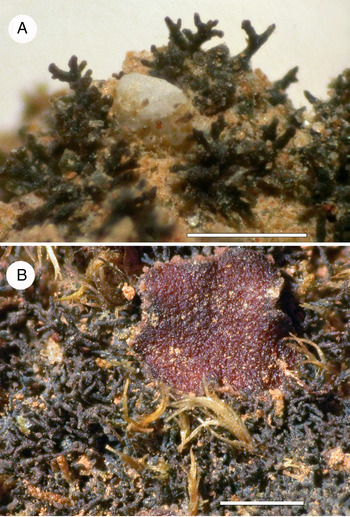
Sinuicella denisonii. A, habit (Stone 10024). B, apothecium (OSC 35280). Scales = 1 mm. In colour online.

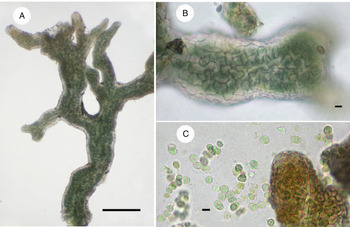
Sinuicella denisonii. A, whole mount of thallus branches (McCune 38618). B, surface view of jigsaw puzzle-shaped cortical cells (McCune 38618). C, photobiont (Nostoc) in squash mount (Stone 10024). Scales: A = 100 μm; B & C = 5 μm. In colour online.

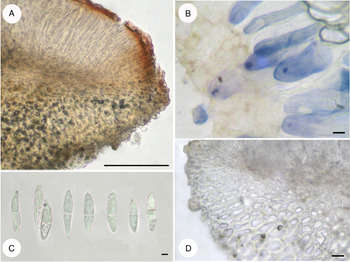
Apothecial details of Sinuicella denisonii (OSC 35280). A, apothecial section in water. B, asci in K followed by IKI. C, ascospores in K. D, proper exciple. Scales: A = 100 μm; B & D = 10 μm; C = 5 μm. In colour online.

Thallus minutely fruticose, indeterminate, spreading across bare soil, grey to nearly black (Fig. 2A); branching mostly isotomic, branches round to slightly flattened, 20–90 μm wide in water mount; prothallus not apparent; thallus cortex one cell deep, these cells vertically elongate and 15–30 μm high, on the outside surface appearing as interlocking puzzle pieces (Fig. 3B); medulla of densely packed cyanobacteria cells among isodiametric, angled hyphal cells up to 25 μm wide; vegetative propagules absent; photobiont Nostoc (Fig. 3C), phylogroup XL of Magain et al. (Reference Magain, Truong, Goward, Niu, Goffinet, Sérusiaux, Vitikainen, Lutzoni and Miadlikowska2018; GB rbcLX: MT944984).
Apothecia initiating as a spherical knob with little fruiting surface showing and proper exciple whitish and distinctly tomentose; disc expanding with age to 1.5 mm wide, circular when first expanded and becoming irregular in outline, the proper exciple torn and ragged, fruiting surface reddish brown and flat to slightly convex; base narrow at attachment to thallus; apothecial section POL−, K− except K+ pale yellowish brown in exciple and hypothecium; proper exciple well developed, radiate (Fig. 4A & D), cells with lumina narrowly elliptic near the upper edge to broadly elliptic to nearly isodiametric and up to 25 μm wide towards the base, cell walls 2.5 μm thick; hypothecium c. 90 μm tall overall, two layered, hyaline to pale brownish, the upper layer 25–55 μm thick, of randomly oriented hyphae, lower layer 35–40 μm thick, prosoplectenchymatous, of small pale brownish cells, ±gelatinized, the hyphal structure obscure; hymenium 150 μm tall; epihymenium c. 10 μm tall, pale reddish brown or orangish brown; paraphyses simple, cylindrical, 2 μm diam., some to 3 μm at the tips, others not enlarged, without defined coloration at tips but pale reddish brown similar to the epihymenium; asci cylindrical, K/IKI+ blue, with a K/IKI+ darker blue annulus (Peltigera type; Fig. 4B); ascospores at least 4 per ascus (up to 6 observed), hyaline, 1-septate, broadly fusiform with blunt ends, 25.3–45.0 × 6.6–11.0 μm (Fig. 4C; n = 29, mean length 35.0 ± 4.6 μm, mean width 8.6 ± 1.2 μm).
Pycnidia not seen.
Chemistry
No secondary metabolites were detected with TLC.
Etymology
The genus name ‘Sinuicella’ refers to the cells of the cortex which have curved protrusions in their outlines, similar to interlocking jigsaw puzzle pieces. The epithet ‘denisonii’ refers to William C. Denison, long-time mycologist at Oregon State University, now deceased. He was a pioneer in the use of lichens to monitor air quality in the United States.
Ecology and substratum
Sinuicella denisonii is so far known from soil in recently disturbed areas along Wildwood Road which follows the Luckiamute River between Fort Hoskins and the former town of Valsetz in the Coast Range of western Oregon. The known elevation range is so far narrow, at c. 172 m. It occurs in exposed to somewhat sheltered sites with high diversity and cover of early-successional bryophytes and lichens, but still with patches of bare, compacted, iron-rich reddish mineral soil of the Jory Series. The climate of this area is oceanic. The area receives an average of c. 198 cm of precipitation annually, with mean January and July temperatures of 4.9 °C and 18.2 °C, respectively (interpolation by ClimateWNA.com; 1981–2010).
Additional specimens examined
USA: Oregon: Polk County, collector unknown and presumed to be William Denison, 23 iii 1969, s. n. (OSC 35280); Polk County, Wildwood Road, Hoskins to Valsetz, former railroad grade, near bridge, 44.75556°N, 123.5543°W, 172 m, on soil, with Gregorella humida, 2019, McCune 38618 (OSC), D. Stone 10122 (OSC).
Discussion
Phylogenetic analysis of species across the Peltigerales (Fig. 1A) recovered two suborders (Miadlikowska & Lutzoni Reference Miadlikowska and Lutzoni2004): highly supported (96%) Peltigerineae (encompassing the families Lobariaceae, Massalongiaceae, Nephromataceae, Peltigeraceae and Vahliellaceae) and weakly supported (below 50%) Collematineae (encompassing the families Coccocarpiaceae, Collemataceae, Pannariaceae and Placynthiaceae). The delimitation of these suborders is consistent with published phylogenies (e.g. Miadlikowska & Lutzoni Reference Miadlikowska and Lutzoni2004; Miadlikowska et al. Reference Miadlikowska, Kauff, Hofstetter, Fraker, Grube, Hafellner, Reeb, Hodkinson, Kukwa and Lücking2006, Reference Miadlikowska, Kauff, Högnabba, Oliver, Molnár, Fraker, Gaya, Hafellner, Hofstetter and Gueidan2014a; Muggia et al. Reference Muggia, Nelson, Wheeler, Yakovchenko, Tønsberg and Spribille2011; Spribille et al. Reference Spribille, Tønsberg, Stabentheiner and Muggia2014). The phylogenetic placement of Koerberiaceae, currently classified in Peltigerineae (Spribille & Muggia Reference Spribille and Muggia2012; Lücking et al. Reference Lücking, Hodkinson and Leavitt2016) was not recovered (poor support in Fig. 1A) and the affiliation of Erinacellus, currently incertae sedis in Peltigerales (Spribille et al. Reference Spribille, Tønsberg, Stabentheiner and Muggia2014; Lücking et al. Reference Lücking, Hodkinson and Leavitt2016), remains unsettled (Fig. 1A). Despite differences in taxon sampling, loci sequenced and analyses performed, the existing phylogenies for Peltigerales are highly congruent. Most dissimilarities in the phylogenetic relationships are due to the lack of phylogenetic signal in some data sets.
The phylogeny restricted to the family Peltigeraceae, which includes all putative species of Peltigera and all available representatives of Solorina (Fig. 1B; Supplementary Material Fig. S1, available online), is in overall agreement with Chagnon et al. (Reference Chagnon, Magain, Miadlikowska and Lutzoni2019). We recovered the relationships among major clades in Peltigera, including the monophyly of the sections (Phlebia, Peltidea and Chloropeltigera) encompassing the tri-membered taxa (Miadlikowska et al. Reference Miadlikowska, Richardson, Magain, Ball, Anderson, Cameron, Lendemer, Truong and Lutzoni2014b; Chagnon et al. Reference Chagnon, Magain, Miadlikowska and Lutzoni2019). The only exception was the nested placement of section Retifoveatae within section Peltigera recovered here, instead of the usual sister relationship between these two (Miadlikowska et al. Reference Miadlikowska, Richardson, Magain, Ball, Anderson, Cameron, Lendemer, Truong and Lutzoni2014b; Chagnon et al. Reference Chagnon, Magain, Miadlikowska and Lutzoni2019); however, this nested relationship is not well supported.
The genus Solorina is not monophyletic, but its paraphyly caused by the separate lineage leading to S. crocea (see Miadlikowska & Lutzoni Reference Miadlikowska and Lutzoni2004) was weakly supported (below 50%). Although our phylogeny has the most extensive sampling of Solorina compared to published phylogenies, the majority is represented by less than four loci in the data matrix. Moreover, large portions of the sequences of the two spacers (ITS1 and ITS2) of the ITS locus were hardly alignable across the three genera (Peltigera, Sinuicella and Solorina) of the family Peltigeraceae and, therefore, were excluded from phylogenetic analyses. Monophyly of Solorina and the current delimitation of morphospecies within the genus (e.g. S. bispora is not monophyletic in our tree; Fig. 1B) should be re-evaluated based on revised taxon sampling and more extensive sequence data.
The highly supported phylogenetic placement of Sinuicella within Peltigeraceae (i.e. with Solorina and Peltigera) (Fig. 1A & B), is corroborated by the pronounced hemiangiocarpous development of the apothecia, which is characteristic of Peltigera and Solorina (Henssen Reference Henssen and Reynolds1981), and the presence of the Peltigera-type ascus apex (Honegger Reference Honegger1978; Bellemère & Letrouit-Galinou Reference Bellemère, Letrouit-Galinou and Reynolds1981) with its distinctive strongly amyloid ring (in Solorina the amyloid regions are more elongated).
Ascospore morphology also supports the placement of Sinuicella with Solorina and Peltigera. The ascospores of Sinuicella are intermediate between those genera, having the large size, broadly fusiform shape and single septum of most Solorina spores, but hyaline as in Peltigera, lacking the dark brown pigmentation of Solorina spores (Fig. 4C). Note that the asci of all three genera are of the Peltigera type with a distinctly dark blue-staining annulus in K/IKI (Fig. 4B).
A character that is atypical of most Peltigera and Solorina species is the cortex made of a single layer of cells. However, the cortex of aquatic lichen Peltigera hydrothyria Miadl. & Lutzoni does have only a single layer of cells, although these cells are not shaped like interlocking puzzle pieces. The shape of these cells is another unusual character of Sinuicella (Fig. 3B). Cells similar to these are seen in several other phylogenetically unrelated genera in the Pacific Northwest and are cases of convergent evolution (Muggia et al. Reference Muggia, Nelson, Wheeler, Yakovchenko, Tønsberg and Spribille2011). Nodobryoria species (Parmeliaceae, Lecanorales) have cells that are similarly shaped but have protruding lumps on the surface formed by short, anastomosed hyphae (Common & Brodo Reference Common and Brodo1995). Leptogidium thalli (Pannariaceae, Peltigerales) are more similar to Sinuicella in outward appearance, with a dichotomously branching thallus and interlocking cells forming the nearly smooth cortex (Muggia et al. Reference Muggia, Nelson, Wheeler, Yakovchenko, Tønsberg and Spribille2011). The convergent evolution of a polychidioid thallus in the two suborders of Peltigerales, Polychidium (Massalongiaceae, Peltigerineae) and Leptogidium (Pannariaceae, Collematineae), has already been demonstrated (Muggia et al. Reference Muggia, Nelson, Wheeler, Yakovchenko, Tønsberg and Spribille2011). Here we demonstrate convergent evolution of both the polychidioid thallus and interlocking cortical cells in phylogenetically unrelated Leptogidium (Collematineae) and Sinuicella (Peltigeraceae, Peltigerineae).
The identity of the cyanobiont of Sinuicella denisonii as the only North American representative of Nostoc phylogroup XL (Fig. 1C; Supplementary Material Fig. S2, available online) is puzzling, considering that all other members of that phylogroup were collected from South and Central America and Germany. However, Nostoc in phylogroups XXXIX (Magain et al. Reference Magain, Truong, Goward, Niu, Goffinet, Sérusiaux, Vitikainen, Lutzoni and Miadlikowska2018) and XII (Magain et al. Reference Magain, Miadlikowska, Goffinet, Sérusiaux and Lutzoni2017a) are similarly diverse in geographical origin, taxonomic identity of their partner/host, and biology (free-living versus symbiotic). For example, the latter group contains Peltigera cyanobionts from Asia (China and the Philippines) as well as Nostoc associated with the fungus Geosiphon pyriforme (Kütz.) v. Wettstein, the liverwort Blasia pusilla L., and the vascular plant Gunnera manicata Linden from Germany. Phylogroup XXXIX is not strongly supported in the global Nostoc phylogeny and may represent multiple taxonomic units (Magain et al. Reference Magain, Truong, Goward, Niu, Goffinet, Sérusiaux, Vitikainen, Lutzoni and Miadlikowska2018). It is possible that the unusual disjunct geographical pattern observed within phylogroup XL resulted from sampling bias, but homoplasy across very similar rbcLX sequences cannot be excluded. Phylogenetic analysis revealed further phylogenetic structure within phylogroup XL (with the cyanobiont of Sinuicella denisonii as the sole representative of one of three distinct, well-supported lineages; Fig. 1C). This phylogenetic pattern could indicate that each lineage represents an isolated, independently evolving population of Nostoc, rather than a single one with a broad, disjoint distribution. Sinuicella co-occurs with numerous Peltigera species (including members from section Peltigera) and multiple large populations of hornworts (probably Anthoceros fusiformis Aust.) and, therefore, all of these host species have the potential to share Nostoc phylogroup XL (to be explored in a future study).
The existence of Sinuicella denisonii at only one known location leaves us with the problem of having just one sequence of the species as well as a description that reflects a very small population. Two of the authors (BM and DFS) have searched extensively in the Pacific Northwest for small, soil-inhabiting lichens and have not found another site. However, it was originally found in 1969 and later by us at a location close to the original, at least indicating that it is extant and reproducing. Because it looks similar to several other species, including Leptogidium contortum and Polychidium muscicola (Sw.) Gray, there is a possibility that others have collected and misidentified it. Because it is small and cryptic, we feel that publishing the description will make others aware of its existence and is perhaps the best way to facilitate discovery of other sites.
Acknowledgements
We thank Claudia Corvalán for assistance with DNA extraction and PCR, Scott LaGreca for performing thin-layer chromatography, and François Lutzoni for proofreading the early version of the manuscript. Financial support was generously provided by the Lichen Herbarium Improvement Grant from Shirley Tucker. This study was partially supported by the National Science Foundation (NSF) awards DEB SG 1556995 and BEE 1929994 to JM.
Author ORCIDs
Daphne Stone, 000-0001-5266-4958; Bruce McCune, 0000-0001-5832-9528; Carlos J. Pardo-De la Hoz, 0000-0002-7898-0948; Nicolas Magain, 0000-0001-5409-9518; Jolanta Miadlikowska, 0000-0002-5545-2130.
Supplementary Material
To view Supplementary Material for this article, please visit https://doi.org/10.1017/S0024282920000584