A central issue in linguistics and SLA theory is why language acquisition seems to become more difficult—even impossible, according to some researchers—with age. After some 45 years of intense empirical research and scientific debate, the question of why children are more successful language acquirers than adults, and whether and why adult (or late) second language (L2) learners inevitably fall short of nativelikeness, still engages many students of language development, language learning, and language teaching.
The general theoretical context for this research has been Lenneberg’s (Reference Lenneberg1967) critical period hypothesis (CPH), which predicts that normal language acquisition from mere language exposure is no longer possible after a certain age. In Lenneberg’s specific hypothesis, 12–13 years were established as the critical age because, at the time, it was believed that puberty co-occurred with the maturation of the brain. For Lenneberg, the brain’s maturation was manifested by its lateralization, after which cerebral flexibility, or plasticity, seemed to become significantly reduced.
However, brain lateralization as a sign of maturation was soon the target of serious criticism by numerous researchers, not least of all when the lateralization process was found to be completed much earlier than at puberty (see, e.g., Krashen, Reference Krashen1973). Additionally, the relevance of puberty has been questioned frequently with reference to its elusiveness, variability, and relativity as a concept. Although ages 12–13 still appear often in SLA research, either as an observed cutoff point in studies of nativelike L2 ultimate attainment (UA; e.g., Abrahamsson & Hyltenstam, Reference Abrahamsson and Hyltenstam2008, Reference Abrahamsson and Hyltenstam2009) or as an a priori dividing point in studies comparing early and late learners (e.g., Flege, Yeni-Komshian, & Liu, Reference Flege, Yeni-Komshian and Liu1999; Montrul & Slabakova, Reference Montrul and Slabakova2003; van Boxtel, Bongaerts, & Coppen, Reference van Boxtel, Bongaerts and Coppen2005; van Wuijtswinkel, Reference van Wuijtswinkel1994; White & Genesee, Reference White and Genesee1996), lower ages of first exposure, such as 6–7 years, are sometimes mentioned as the maximum age if nativelike proficiency is to be expected as the typical outcome (e.g., Hyltenstam, Reference Hyltenstam and Harris1992; Johnson & Newport, Reference Johnson and Newport1989; Long, Reference Long1990). Some authors even suggest a pattern of L2 UA without a plateau and instead with a linear rather than nonlinear function of maturation from birth up to puberty or perhaps even to the midteens (Birdsong, Reference Birdsong and Birdsong1999; Hyltenstam & Abrahamsson, Reference Hyltenstam, Abrahamsson, Doughty and Long2003b). Additionally, neurocognitive correlates other than lateralization have been suggested, one of the most interesting so far being that of sequentially scheduled myelination processes that seem to correlate amazingly well with stages of first language (L1) development (e.g., Pulvermüller & Schumann, Reference Pulvermüller and Schumann1994).
Because the levels of UA among children and adults in the L2 have been shown to clearly differ from each other, both in relative terms (UA is higher in child learners than in adult learners) and in absolute terms (nativelike UA only seems to develop in child learners), a closely related research question has been whether children and adults actually use fundamentally different cognitive (or brain) mechanisms when approaching a new language. Some researchers (e.g., Bley-Vroman, Reference Bley-Vroman, Gass and Schachter1989; DeKeyser, Reference DeKeyser2000; Paradis, Reference Paradis2004, Reference Paradis2009) hold that even though children, within the critical period, acquire language automatically, incidentally, and implicitly from spoken (or signed) input via an innate and specialized capacity for doing so (e.g., through a language-acquisition device or universal grammar, as proposed by Chomskyan linguists), adults, or postcritical period learners (including most adolescents), must instead learn the new language through a conscious effort, intentionally and explicitly, using general cognitive learning strategies, often via formal instruction. According to this view, the neurocognitive system responsible for general cognition is not optimized for handling natural (spoken or signed) linguistic data in the same way as the innate language acquisition mechanism is, which is why most adults typically end up as nonnativelike speakers of their L2. In other words, the outcome of much of adult learning is explicit knowledge of grammar and pronunciation, something that is very difficult to use in normal language production and perception, whereas children primarily acquire implicit competence—that is, morphosyntactic and phonetic intuition—within the target language (similar or even identical to that of children acquiring a L1). The division between language-specific and general cognition may also explain how some extremely rare adult learners in fact approach nativelike levels in a L2—namely by making use of an unusually high aptitude for language learning, a trait that most researchers claim belongs to the general cognitive system (see DeKeyser, Reference DeKeyser2000; DeKeyser & Larson-Hall, Reference DeKeyser, Larson-Hall, Kroll and de Groot2005; Paradis, Reference Paradis2009; however, for alternative interpretations, see Abrahamsson & Hyltenstam, Reference Abrahamsson and Hyltenstam2008; Carroll, Reference Carroll1973; Ioup, Boustagui, El Tigi, & Moselle, Reference Ioup, Boustagui, El Tigi and Moselle1994).
The present study investigated, first, the relationship between AO and UA in Spanish-speaking learners of Swedish as a L2 and, second, the incidence of nativelikeness in the areas of grammar and phonology, with the use of tests of grammatical and phonetic intuition. The study also investigated whether children and adults approach the task of language acquisition in fundamentally different ways, that is, whether they acquire the language implicitly as an interdependent whole or learn it explicitly as independent parts of a whole (see Paradis, Reference Paradis2004, Reference Paradis2009).
THEORETICAL AND EMPIRICAL BACKGROUND
To date, it is possible to identify at least three main approaches in SLA research to the behavioral study of age effects, all of which have been used to draw indirect conclusions about maturational constraints and the CPH. The focus of attention has been either on (a) the relationship between learners’ AO and UA in the L2, (b) the relationship between AO and nativelike UA, or (c) the relationship between AO and the very process leading to a learner’s UA. What these approaches have in common is that, in one way or another, they focus on the learners’ AO in relation to their UA of the L2—that is, the different levels of proficiency that are eventually reached by learners as a result of their starting to learn the language at different ages.
Age of Onset and Ultimate Attainment
In the 1970s, some researchers (e.g., Snow & Hoefnagel-Höhle, Reference Snow and Hoefnagel-Höhle1977, Reference Snow and Hoefnagel-Höhle1978) investigated differences in the rate of acquisition of early and late learners. Because late learners were found to progress faster in the initial phases of L2 development, the conclusion was that the advantage that children held over adults in L2 learning was a myth and that the CPH (or at least Lenneberg’s version of it) must therefore be rejected. Later, in a review of the research up to that point, Krashen, Long, and Scarcella (Reference Krashen, Long and Scarcella1979) brought some order among age studies: They demonstrated that it was only short-term studies—that is, those studies with a focus on the initial rate of acquisition—that exhibited an older-learner advantage, whereas all long-term studies—that is, those investigating their participants’ AO of acquisition in relation to their UA in the L2—pointed to an unquestionable early-learner advantage; most importantly, Krashen and colleagues (see also Long, Reference Long1990, Reference Long2005) concluded that only long-term studies had any relevance for the CPH.
A large number of studies have compared the UA of groups of early and late L2 learners (e.g., Asher & García, Reference Asher and García1969; Bialystok & Miller, Reference Bialystok and Miller1999; DeKeyser, Reference DeKeyser2000; Flege et al., Reference Flege, Yeni-Komshian and Liu1999; Johnson & Newport, Reference Johnson and Newport1989; Munro & Mann, Reference Munro and Mann2005; Patkowski, Reference Patkowski1980). In every case, such studies have demonstrated a strong negative correlation between L2 learners’ AO of acquisition and some measure of their L2 proficiency—grammatical, phonological, or even both. For example, in the seminal study by Johnson and Newport (Reference Johnson and Newport1989), in which the intuition of English grammar (operationalized as the scores on a grammaticality judgment test [GJT]) of 46 Korean and Chinese long-term residents in the United States was correlated with the participants’ age of arrival in the country, showed (a) that there was a strong, negative correlation between AO and GJT scores among the early starters (AO 3–15; r = −.87, p < .01) with little individual variation; (b) that very early starters (AO 3–7) invariably performed like native control participants; and (c) that the negative correlation between AO and GJT scores disappeared (i.e., GJT scores could no longer be predicted from AO) after AO 15 (r = −.16, p > .05) and was instead replaced by great individual variation. Despite much criticism and some indisputable methodological shortcomings, the results of Johnson and Newport must still be seen as fairly robust today, insofar as no study has ever been able to show an entirely different AO function, although the exact correlation coefficient has varied between studies, as has the locus of any cutoff point on the AO continuum—very much depending on the focus of the study. Furthermore, the Johnson and Newport study showed that no other emotional or experiential factors could account for the variation in the results, and as yet, no other study has with any conviction demonstrated strong correlations between UA and independent variables alternative to AO, such as length of residence in the host country, age at testing, educational level, formal L2 studies, patterns or frequency of language input and use, and motivational, attitudinal, or affectional (etc.) factors.
Age of Onset and the Incidence of Nativelikeness
Another approach to investigating the CPH, or the age factor in general, has been to identify postpubescent or adult L2 learners who, despite a late start, perform like child L2 learners or native speakers on a certain test of L2 proficiency. The rationale behind this approach is that if it could be shown that individuals with a nativelike command of the L2 exist despite having learned it after the closing of an assumed critical period, then there can be no such period—at least not in the usual, biological sense. Coppieters (Reference Coppieters1987) investigated a group of highly successful and highly educated learners of French as a foreign language (FL), all of whom had no obvious foreign accent. However, despite their apparent nativelike command of French, the results of a semantic-syntactic judgment test showed that their overall results were significantly lower than the results of a native-speaker control group, and recorded spontaneous speech revealed that these learners produced errors on features that were mastered in the judgment test. In contrast, in a replication of the Coppieters study, Birdsong (Reference Birdsong1992) identified 15 out of 20 late FL learners of French—all highly selected for potential nativelikeness—who performed within the native-speaker range on a GJT. Additionally, several replications of the Johnson and Newport study have reported on some late learners whose grammaticality judgment scores fall within the range of native controls (e.g., Birdsong & Molis, Reference Birdsong and Molis2001; Flege et al., Reference Flege, Yeni-Komshian and Liu1999). In the area of phonology and pronunciation, studies by Bongaerts and his colleagues targeted both highly advanced FL university students (see Bongaerts, Reference Bongaerts and Birdsong1999, for an overview) and immersed adult L2 learners of Dutch in the Netherlands (Bongaerts, Mennen, & van der Slik, Reference Bongaerts, Mennen and van der Slik2000). In these studies, recorded sentences read aloud by the participants (as well as by native-control participants) were presented to panels of native judges who rated the pronunciation of these speakers on a 5-point scale (e.g., from very strong accent; definitely a nonnative speaker to no foreign accent at all; definitely a native speaker); the result of these studies has been that a small subset of participants—typically one or two individuals—pass for native speakers (see also Moyer, Reference Moyer1999, for similar results).
Although these learners should indeed be seen as extremely proficient L2 speakers, their apparently nativelike behavior is invariably revealed as being less than nativelike when scrutinized in greater detail. The first study to clearly illustrate this was Ioup and colleagues (1994), in which the UA of two extremely successful adult learners of L2 Egyptian Arabic, Julie and Laura, was investigated in terms of spontaneous, oral production, dialect differentiation, and grammatical intuition. In the production task and the two tests of Arabic dialect differentiation, both learners performed within the range of a native-speaker control group. However, even though both learners scored high on the three tests of grammatical intuition, their performance was significantly below that of the native controls. In a similar manner, Hyltenstam and Abrahamsson (Reference Hyltenstam, Abrahamsson, Fraurud and Hyltenstam2003) and Abrahamsson and Hyltenstam (Reference Abrahamsson and Hyltenstam2009) showed that all the adolescent and adult L2 learners of Swedish in these studies, although sounding nativelike in everyday conversation, performed significantly below the native-speaker range when their phonological, perceptual, grammatical, lexical, and other L2 abilities were investigated in detail. In fact, so far no study relying on a multivariate test design (including challenging tests and tasks, not just tests of very basic linguistic structures and trivial features) has been able to describe an adult L2 learner who, in every relevant respect, exhibits a L2 proficiency that is fully comparable to that of native speakers. This is why some researchers prefer to use the term near-native rather than nativelike when characterizing such learners (e.g., Abrahamsson & Hyltenstam, Reference Abrahamsson and Hyltenstam2008, Reference Abrahamsson and Hyltenstam2009; Hyltenstam & Abrahamsson, Reference Hyltenstam, Abrahamsson, Fraurud and Hyltenstam2003a, Reference Hyltenstam, Abrahamsson, Doughty and Long2003b; Long & Robinson, Reference Long, Robinson, Doughty and Williams1998).
Age of Onset and Implicit Acquisition versus Explicit Learning
A third way of investigating child-adult differences in L2 acquisition has been to focus on how differently aged learners arrive at their L2 knowledge. Do they learn the L2 through the same or different brain mechanisms? Is their ultimate L2 proficiency qualitatively the same or different in terms of origin, emergence, and representation? According to Bley-Vroman’s fundamental difference hypothesis (FDH), children and adults develop their L2 in fundamentally different ways: Whereas children make use of their innate and domain-specific language acquisition mechanisms, adults no longer have access to such mechanisms and instead must rely on domain-general learning strategies—that is, strategies belonging to the general cognitive system that are used for all kinds of learning and not language acquisition specifically. In Paradis’s (Reference Paradis2004, Reference Paradis2009) theory of L2 acquisition and bilingualism, L1 children and early L2 learners engage almost solely in incidental acquisition, which arises through procedural memory and leads to implicit competence (or linguistic intuition). Adolescent and adult L2 learners, on the contrary, who can no longer build new procedural representations to the same extent as children, learn the L2 intentionally and have to rely on declarative memory, which leads to explicit competence (or metalinguistic knowledge, in Paradis’s terminology). Incidental acquisition should affect the whole language system, and different parts of the system should thus develop simultaneously and unconsciously, whereas intentional learning should affect mostly those parts of the L2 in which the learner received explicit instruction and in which he or she took a special interest.
These issues have not been investigated, let alone corroborated, in any direct empirical way; rather, they have been explored indirectly through studies of language learning aptitude. Paradis (Reference Paradis2009) claimed that “some rare [adult] L2 speakers may achieve native-like proficiency . . . but by other means” (p. 118), and DeKeyser (Reference DeKeyser2000) and Abrahamsson and Hyltenstam (Reference Abrahamsson and Hyltenstam2008) were able to show that late learners with nativelike performances on various aspects of the L2 also perform well on standardized aptitude tests, which indicates that they draw heavily on general cognitive learning abilities (i.e., declarative memory, in Paradis’s terms) to compensate for the loss of (innate) specific language acquisition mechanisms (or procedural memory, in Paradis’s theory). Early learners, in contrast, are not dependent on declarative memory or any kind of heightened cognitive ability (or aptitude)—they acquire the L2 successfully through the availability of procedural memory alone. According to Paradis, “acquisition via procedural memory is available to everyone up to about 5 years of age, after which the use of procedural memory to acquire language rapidly declines and individuals rely on declarative memory” (p. 118). He further states that “some implicit linguistic competence in L2 can probably be acquired [by adults] in certain aspects of linguistic structure (syntax, morphology, phonology, in that order of probability) though not completely at any level” (p. 118) and that “the use of declarative memory to compensate for gaps in L2 implicit competence is reflected in the considerable inter-individual variability in attainment between [adult] L2 learners” (p. 118). If Paradis is correct, evidence should be found that adults’ learning of different aspects of the L2 is more sporadic, unsystematic, and fragmented, whereas children automatically and systematically develop aspects of all linguistic levels at the same time. Paradis (Reference Paradis2009) states that “the availability of procedural memory for acquiring language as a whole decreases with age” (p. 24). This means that the child learner unconsciously and incidentally approaches the L2 as an interconnected system (i.e., as a language), whereas the adult learner treats the different levels and sublevels of the L2 as independent puzzles, some of which the learner can choose to focus on in depth, and some of which can—consciously or unconsciously—be disregarded as either uninteresting, unnecessary, or unlearnable, if not left entirely unnoticed.
Aims and Hypotheses of the Present Study
This study investigated the UA of grammatical and phonetic intuition by Spanish-speaking L2 learners of Swedish, all of whom were long-term residents of Sweden and whose AO of L2 acquisition of Swedish was between 1 and 30 years. Morphosyntactic intuition was measured through an aural GJT and phonetic intuition by a test of categorical perception of voice onset time (VOT). The aim of the study was to add to the current knowledge on the relationship between AO and UA, the relationship between AO and the incidence of nativelike UA, and, finally, the relationship between AO and the underlying processes of language learning—that is, whether children and adults use fundamentally different mechanisms when acquiring a language. With these aims in mind, hypotheses 1–3 were formulated:
1. Age of onset will be the strongest predictor of UA for both morphosyntactic and phonetic intuition. More specifically, significant differences in mean results between native speakers, early L2 learners, and late L2 learners, as well as strong negative correlations between AO and UA, are expected for both GJT and VOT; weak or no correlations are expected between UA and the L2 participants’ present age (AGE), length of residence in Sweden (LOR) or amount of Spanish use (L1 USE).
2. (a)No late L2 learner will be found with nativelike results on both the morphosyntactic and the phonetic test.
(b) A majority of very early (i.e., preschool) L2 learners will have nativelike results on both the morphosyntactic and the phonetic test.
(c) Very few, if any, very early L2 learners will be found with nonnativelike results on both the morphosyntactic and the phonetic test.
(d) A majority of the late L2 learners will have nonnativelike results on both the morphosyntactic and the phonetic test.
3. Independently of the absolute level of UA (i.e., no matter where on the interlanguage continuum a learner’s system has stabilized), grammatical and phonetic intuition are expected to have developed simultaneously and to similar degrees in early L2 learners but not in late L2 learners. More specifically, it is predicted that the GJT and VOT measures will correlate positively for early learners only, not for late learners.
METHOD
Participants
The participants were recruited through a series of newspaper advertisements.Footnote 1 From a pool of approximately 700 L1 Spanish speakers of L2 Swedish and approximately 70 native speakers (NSs) of Swedish who volunteered, 200 L2 participants and 20 native controls were selected for the study. The L2 participants were selected in such a way that they were to be evenly distributed over an AO continuum ranging from 1 to 30 years. In other words, the sample consisted of six to eight participants at each AO.Footnote 2 All participants’ age at the time of the study was 21 or more (M = 40, range = 21–63), their LOR in Sweden was at least 15 years (M = 25, range = 15–46), and they reported no significant use of other languages than Spanish or Swedish during childhood. The most common country of origin was Chile (112 individuals), as the Chilean group is the largest Spanish-speaking immigrant group in Sweden, followed by Peru (22), Argentina (16), Spain (13), Colombia (12), Bolivia (8), Uruguay (8), Guatemala (2), Mexico (2), Cuba (1), Ecuador (1), El Salvador (1), Nicaragua (1), and Panama (1). In other words, the great majority of the participants (n = 187) originated from a Latin American country. All participants lived in or around the Stockholm area and had done so during most of their time in Sweden. A senior high school diploma was the lowest level of education, and the distribution of females and males was 117–83. The native Swedish control group was selected by matching age at the time of the study (M = 41.2 years), sex (12 women, 8 men), and educational level with the L2 group. No severe hearing impairments were reported by any of the participants, which was confirmed through hearing tests with an OSCILLA SM 910 screening audiometer, nor were any other language-related challenges such as dyslexia or stuttering.
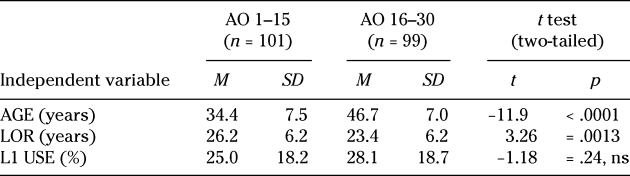
Because the aim of this study was to compare early and late learners, the sample of 200 L2 participants was divided into two halves: one that consisted of learners with AO 1–15 (n = 101) and one of learners with AO 16–30 (n = 99) (following the division between early and late learners made by, e.g., DeKeyser, Reference DeKeyser2000; Johnson & Newport, Reference Johnson and Newport1989; Patkowski, Reference Patkowski1980). As can be seen in Table 1, the mean chronological age at the time of the study was 34–35 years in the early-learner group and 46–47 years in the late-learner group, a difference that is statistically significant. Furthermore, there was a small yet statistically significant difference concerning LOR in Sweden: 26 versus 23 years, respectively. Self-reported daily use of Spanish (expressed in percentages) did not differ significantly between the groups: 25% versus 28%, respectively. The fact that the groups differed in age at the time of the study was unproblematic because there were no relevant reasons to believe that age as such would have an impact on the participants’ L2 intuitions (see results in MacKay, Flege, & Imai, Reference MacKay, Flege and Imai2006). In a similar manner, the small difference in LOR should have no significant impact on the participants’ L2 proficiency (as evidenced by the partial correlations in the Results section). The early AO group consisted of 60 women and 41 men, and the late AO group of 57 women and 42 men, but according to a Chi2 test, the difference was not statistically significant: χ2(1, 200) = 0.07, p = .89.
Background information (independent variables) on the 200 L2 speakers; comparisons between participants with AO ≤ 15 and ≥ 16 years (df = 198)
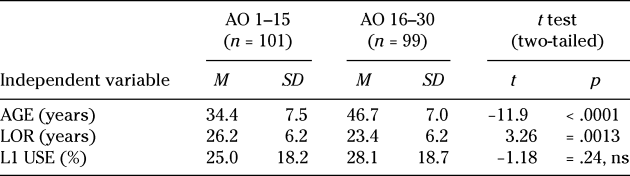
Note. AGE = chronological age; LOR = length of residence; L1 USE = L1 use.
Tests and Procedure
The tests reported on in this study, GJT and categorical perception of VOT, were part of a larger set of tests that also included VOT production, other (global) pronunciation tasks (e.g., word-list reading and story retelling), and a test of grammatical and semantic inferencing skills as well as a battery of four different language aptitude tests. The participants were tested individually for about 2–2.5 hr by a native Swedish assistant, and they were paid SEK 100.00 (Swedish kronor) and a lottery ticket worth SEK 25.00 (a total value of approximately $20.00).
The reason for choosing only two linguistic measures for the present study rather than reporting on the results of the whole test battery was the following: A previous study (Abrahamsson & Hyltenstam, Reference Abrahamsson and Hyltenstam2009) demonstrated that, with a test battery consisting of a variety of different phonetic-phonological, morphosyntactic, and lexical-semantic measures (10 altogether), any advanced and apparently nativelike adult L2 learner could be revealed as only superficially nativelike (or near-native) compared to a group of NSs. In contrast, in the present study, which focused on a normally distributed sample of learners rather than systematically searching for exceptionally successful learners, the purpose was to investigate whether two independent and fairly disparate linguistic measures—one of phonetic intuition and another of grammatical intuition—would suffice to reveal the nonnative background of average postcritical period L2 learners.
Furthermore, the rationale behind choosing GJT data rather than spoken or written language production data, and data from a VOT perception test rather than the participants’ own manifestation of the voicing contrast, was that this study aimed to investigate aspects of L2 speakers’ passive, unconscious, and implicit knowledge of Swedish grammar and pronunciation, without the need to draw indirect conclusions from performance data. Implicit language knowledge in the present study is equated with acquired, nonverbalized linguistic intuition, whereas explicit language knowledge corresponds to learned and, to a large extent, metalinguistic competence that can be verbally expressed by speakers.
The basic idea behind focusing on implicit rather than explicit knowledge is that implicit, unconscious, and incidental acquisition of language is what the CPH is actually concerned with: Lenneberg (Reference Lenneberg1967) stressed that what disappears at around puberty is the ability to attain “automatic acquisition from mere exposure” (p. 176), whereas the explicit language learning that adults typically engage in “through a conscious and labored effort” (p. 176), successfully or not, lies outside the scope of the CPH (see also discussion in DeKeyser, Reference DeKeyser2000).
Grammaticality Judgment Test (GJT).The auditory GJT (originally developed by Abrahamsson & Hyltenstam, Reference Abrahamsson and Hyltenstam2008, Reference Abrahamsson and Hyltenstam2009) used in this study included 80 sentences based on four morphosyntactic structures or features of Swedish grammar known to be particularly difficult for L2 learners: (a) subject-verb inversion (i.e., V2), (b) reflexive possessive pronouns, (c) placement of sentence adverbs in restrictive relative clauses, and (d) adjective agreement in predicative position (gender and number). Half of the sentences were grammatically correct and half were grammatically incorrect; faulty sentences contained only a single error. Each of these grammatical categories was represented by 20 sentences, 10 of which were ungrammatical (see the Appendix for examples of the sentences used).
The present GJT differed substantially from those used in previous age studies (e.g., Bialystok & Miller, Reference Bialystok and Miller1999; DeKeyser, Reference DeKeyser2000; Flege et al., Reference Flege, Yeni-Komshian and Liu1999; Johnson & Newport, Reference Johnson and Newport1989) and was originally designed to investigate near-native L2 speakers’ intuitions. Because the focus in studies of very advanced or near-native L2 speakers should not be on what they can do but rather on what they cannot do (Hyltenstam & Abrahamsson, Reference Hyltenstam, Abrahamsson, Doughty and Long2003a; Long, Reference Long1990), the test items consisted of sentences that were quite long and complex. Given the fact that the participants in the present study had been living in the L2 environment for at least 15 years (see 5 years in Johnson & Newport, Reference Johnson and Newport1989) and for 25 years on average, it was decided that demanding test items would more accurately gauge the participants’ L2 proficiency than items of the kind used in earlier studies (such as *Mary will goes to Europe next year, *When Sam will fix his car?; examples from Johnson & Newport, Reference Johnson and Newport1989), and ceiling effects would thus be avoided, even among the NS controls. Additionally, the use of a test with a high degree of difficulty and cognitive load even for NSs serves as a better means to distinguish between native and near-native intuitions and between near-native and clearly nonnative intuitions as well as between different degrees of near-nativeness, and this test can therefore be seen as a guarantee against conclusions based on underanalyzed data (see Abrahamsson & Hyltenstam, Reference Abrahamsson and Hyltenstam2008, Reference Abrahamsson and Hyltenstam2009; McDonald, Reference McDonald2006).
The stimulus sentences were recorded in an anechoic chamber by a female NS of Stockholm Swedish. The sentences were played through KOSS TX/PRO earphones in random order for all participants. Once a given sentence was presented, the test taker was granted a maximum of 10 s to indicate whether he or she perceived the sentence as grammatically correct or incorrect. Responses were submitted by pressing a green YES or a red NO button at any point during or after the sentence presentation. The next sentence was loaded and presented once one of the response buttons was pressed. If no response was submitted before time expired, a new sentence was presented; these cases were analyzed as incorrect responses. The test was designed and run in E-Prime v1.0 (Schneider, Eschman, & Zuccolotto, Reference Schneider, Eschman and Zuccolotto2002a, Reference Schneider, Eschman and Zuccolotto2002b) and took 15–20 minutes to complete.
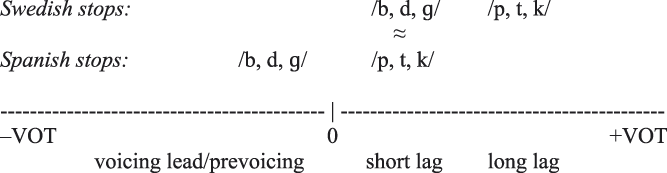
Categorical Perception of VOT.Voice onset time is defined as “the interval between the release burst of the stop and the onset of glottal vibration” (Lisker & Abramson, Reference Lisker and Abramson1964, p. 389). Swedish (like English) voiceless stops are produced as aspirated, long-lag stops (with relatively long, positive VOT values), whereas their voiced counterparts are realized as unaspirated short-lag stops (i.e., with short, positive VOTs). In Spanish, on the contrary, voiceless stops are realized as positive, short-lag stops, whereas voiced stops are produced with prevoicing (or voicing lead). As shown in Figure 1, this means that there is an overlap between the Swedish and Spanish voicing systems, where Swedish voiced /b, d, g/ are more or less identical to Spanish voiceless /p, t, k/. Due to this crosslinguistic variation, L2 learners often experience difficulty in accurately producing and perceiving L2 stops. Late learners have been shown to either transfer their native-language voice timing patterns to the L2 or, even more frequently, produce stops with VOTs intermediate to the VOT values of the L1 and L2. Early learners, however, often produce and perceive L2 stops in a more nativelike manner (e.g., Abrahamsson, Stölten, & Hyltenstam, in press; Flege, Reference Abrahamsson, Stölten, Hyltenstam and Haberzettl1991; Stölten, Reference Flege2005, Reference Stölten, Eriksson and Lindh2006; Williams, Reference Stölten, Ambrazaitis and Schötz1980).
The perception of stops has frequently been investigated with experiments of categorical perception. The results obtained from such experiments indicate that people typically separate an acoustic continuum into distinct, language-specific phonetic categories by perceiving sudden category shifts rather than continuous transitions between categories (e.g., Abramson & Lisker, Reference Abramson and Lisker1973). This means that NSs of Spanish and Swedish will have different loci on the VOT continuum concerning where the voicing categories separate.
Schematic representation of the VOT continuum, showing the relationship between Swedish and Spanish stops, with overlap between Swedish voiced and Spanish voiceless categories. “0” corresponds to the release of stop closure.

The present test, which measured the participants’ intuitions of where on the VOT continuum the category shift from Swedish voiceless /p/ to voiced /b/ occurs, was based on the minimal word pair par (“pair” or “couple”) and bar (“bar,” “naked” or “bare,” or “carry PRET”), which had been recorded in an anechoic chamber by a native female speaker of Swedish. Using the Soundswell software, a 5-ms-step VOT continuum ranging from −60 to +90 ms was created (for details, see Stölten, Reference Stölten, Ambrazaitis and Schötz2006; Stölten, Abrahamsson, & Hyltenstam, Reference Stölten, Abrahamsson and Hyltenstam2012). In a forced-choice identification task, the stimuli were presented binaurally through earphones (KOSS TX/PRO) at a comfortable listening level and in random order for each listener. The participants were told they were going to hear the words par and bar many times and in a mixed order, and they were asked to indicate for each test item which of the two words they heard. Each test item was presented with the carrier phrase Nu hör du . . . “Now you will hear . . .”, and by pressing one of two buttons, labeled PAR and BAR, respectively, the participants indirectly indicated whether they perceived the initial stop as voiceless or voiced. The test was designed and run in E-Prime (see previously) and took about 5 min to complete. The average category crossover points were calculated with the Probit Analysis function in SPSS.
RESULTS
The Effect of AO on UA: Group Comparisons and Correlations
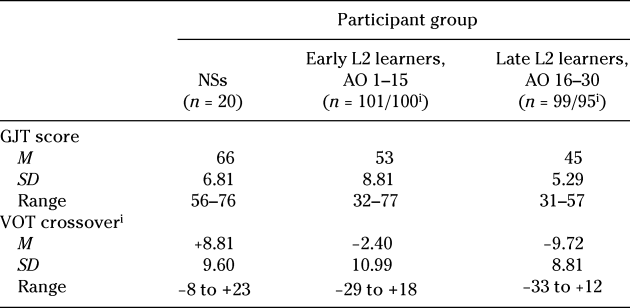
The results of the GJT and VOT test for the NSs, the early L2 learners (AO 1–15), and the late L2 learners (AO 16–30) are presented in Table 2. The NS mean score on the GJT was 66 (out of 80), and 53 and 45 for the early and late learners, respectively. A one-way ANOVA showed that there were statistically significant differences between the groups, F(2, 220) = 82.68, p < .0001, and post hoc tests confirmed that the differences between adjacent groups—that is, between the NSs and the early L2 learners and between the early and late L2 learners—were statistically significant, t = 7.33 and 7.81, respectively, p < .01 (using the Bonferroni correction to adjust for multiple comparisons). The effect size of the NS and early L2 group difference was very large (Cohen’s d = 1.65), whereas the effect size of the difference between the two L2 groups was large (d = −1.10). The mean crossover points on the VOT perception test were +8.81 ms for the NS group, −2.40 ms for the early L2 group, and −9.72 ms for the late L2 group. Again, an ANOVA test revealed statistically significant differences between groups, F(2, 215) = 32.97, p < .0001, and post hoc tests revealed statistically significant differences between the NSs and early L2 learners, t = 4.56, and between the two L2 groups, 5.09, p < .01 (with Bonferroni correction). Effect sizes of these differences were large (d = 1.09) and medium (d = −0.73), respectively.
GJT mean scores and VOT mean crossover points (ms) of NSs, L2 speakers AO 1–15, and L2 speakers AO 16–30
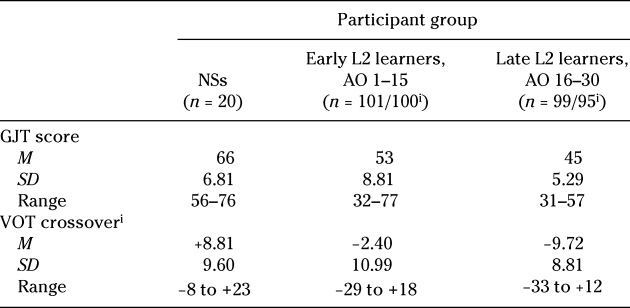
i Five participants (one in the AO 1–15 group and five in the AO 15–30 group) were removed from the VOT data due to missing or uninterpretable data.
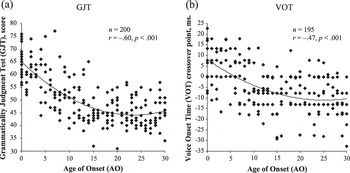
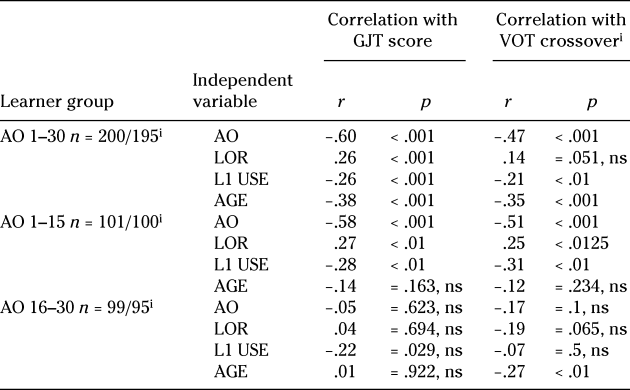
A more detailed representation of the age function is given in Figure 2, in which (a) GJT scores and (b) VOT crossover points (in ms) have been plotted against the participants’ AOs. An initial visual inspection of the data reveals an overall negative relationship between test results and AO, and the regression lines suggest that such a relationship is most prevalent on the left-hand sides of the scatter plots (i.e., for the early learners), but not on the right-hand sides (i.e., the late learners). These visual patterns are confirmed by the correlation coefficients shown in Table 3 (to account for multiple correlations, checking four independent variables—AO, LOR, L1 USE, and AGE—the Bonferroni correction was used, and the α level for these and upcoming correlations was set at p = .0125). The correlation between GJT and AO for the whole learner sample (n = 200) was strong, r = −.60 (Pearson’s), p < .001, whereas the correlation between VOT and AO (n = 195) was medium strong, r = −.47, p < .001. As shown, AO emerged as the strongest predictor of the learners’ UA of grammatical and phonetic intuition, and the correlations between GJT or VOT and any of the other three independent variables (i.e., LOR, L1 USE, and AGE) were weak and sometimes statistically nonsignificant (one apparent exception was the AGE variable). When the two AO groups were analyzed separately, it became clear that AO was a relevant predictor for the early-learner group only; for the late-learner group, AO appeared to have had no impact on their UA. The correlations between AO and GJT or VOT for the early L2 group were strong, r = −.58 and −.51, respectively, p < .001, whereas for the late L2 group, the correlation coefficients dropped to weak and nonsignificant levels, r = −.05 for GJT and −.17 for VOT, p higher than the α level (.0125) in both cases. In fact, none of the other independent variables correlated significantly with the test results in the late-learner group (again with the apparent exception of AGE, this time only for VOT).
GJT scores and VOT crossover points plotted against AO.

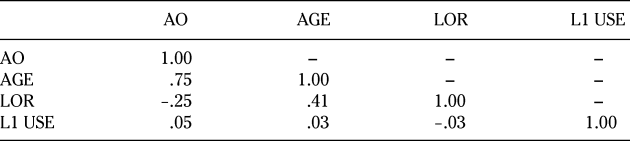
Simple correlations (Pearson’s r) between GJT scores–VOT crossover points and the independent variables AO, LOR, L1 USE, and AGE

i Five participants (one in the AO 1–15 group and four in the AO 15–30 group) were removed from the VOT data due to missing or uninterpretable data.
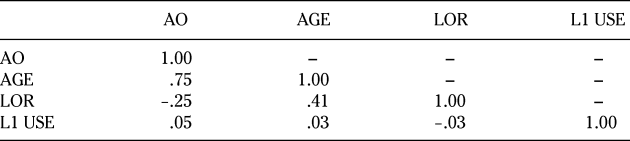
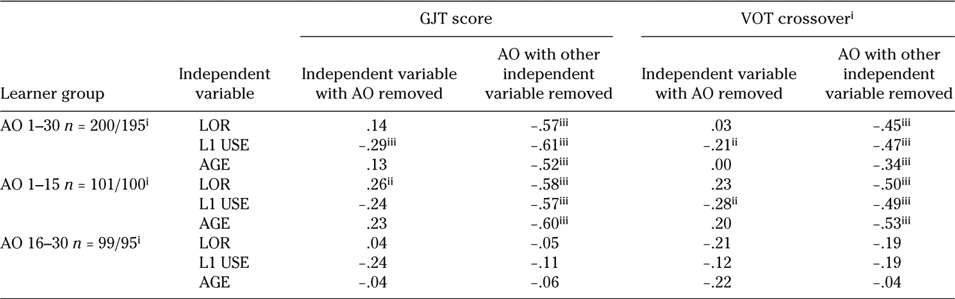
It is often held that AO is confounded with other independent variables. For example, lower AOs tend to coincide with longer residence in the new country, high amounts of L1 use are more common among late learners, and AO generally correlates closely with participants’ ages at the time of testing (see, e.g., Stevens, Reference Stevens2006). Therefore, it is often held that it is difficult to decide whether the AO function should be explained by maturation or by these other experiential factors that are hidden in the AO complex. Indeed, as shown in Table 1, participants in the AO 1–15 group were significantly younger than those in the AO 16–30 group (mean AGE = 34 vs. 46 years), and the AO 1–15 group had spent a few more years in Sweden than the AO 16–30 group (mean LOR = 26 vs. 23 years), although it should be noted that the amount of daily Spanish use was the same for both AO groups. In fact, as shown in Table 4, AO, LOR, and AGE tend to be interrelated in different ways, and AO and AGE in particular were highly correlated (r = .75, p < .001). To tease apart the different impacts of AO and the other independent variables, partial correlations were performed, which removed the effect of the confounding variable. These are presented in Table 5. As can be seen, when the effects of other independent variables are removed, AO clearly emerges as the strongest variable, with strong and highly significant correlations with both GJT and VOT—this is especially true for the AO 1–15 group, which was described as the real locus of AO effects. Most importantly, the effect of AGE has now dropped to nonsignificant levels, which is the case also for LOR and L1 USE, whereas the correlations between AO and GJT or VOT remain more or less unaffected at a robust −.50 to −.60 when the effect of confounding variables is removed. In contrast, none of the independent variables, including AO, can be used to explain the test results of the AO 16–30 group—here, other (probably individual) factors would account for the variation, such as language aptitude, motivation, and formal instruction.
Correlations between independent variables
First-order partial correlations of AO and other independent variables (LOR, L1 USE, AGE) with GJT-VOT results
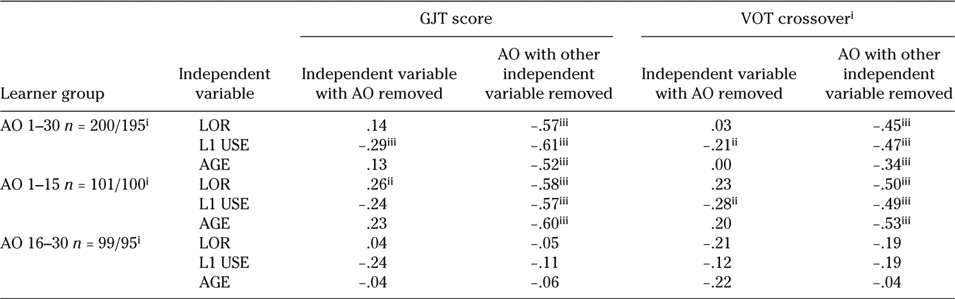
i Five participants (one in the AO 1–15 group and four in the 15–30 group) were removed from the VOT data due to missing or uninterpretable data.
ii = p < .0125 (= Bonferroni’s corrected α-level).
iii = p < .001.
AO and the Incidence of Nativelike Results
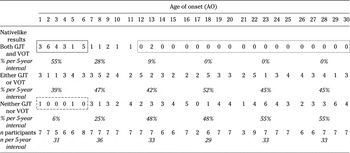
As for the incidence of nativelikeness when the two measures of GJT and VOT are combined and separated, respectively, Table 6 presents the numbers and the percentages of L2 participants who performed within the range of the 20 native control speakers on both, one, or none of the two measures of linguistic intuition.Footnote 3 A total of 30 participants had results within the range of the 20 NSs on both GJT and VOT. More than half (55%) of the participants with AO 1–5 had nativelike results on both tests, whereas 28% of participants with AO 6–10 and only 9% of those with AO 11–15 did. More specifically, most participants who passed as NSs on both GJT and VOT had an AO between 1 and 6 years (22 individuals; see the solid-line frame in Table 6), and none with nativelike results on both GJT and VOT had an AO beyond 13 years (see the long, dotted-line frame).
Number and percent nativelike individuals on both GJT and VOT, either GJT or VOT, and neither GJT nor VOT at different AOs and at 5-year AO intervals; n = 195 (5 of the 200 participants removed because of technical or instructional problems in the VOT task)

From the opposite perspective, Table 6 also reveals that only two individuals, or 6%, of the 31 participants with AO 1–5 were nonnativelike on both GJT and VOT, whereas the figure is 25% of those with AO 6–10. For participants with AOs 11–30, nonnativelike results on both GJT and VOT ranged between 48% (AOs 11–20) and 55% (AOs 21–30). More specifically, grammatical nonnativelikeness in combination with phonetic nonnativelikeness was almost never the case for participants with AOs 1–6 (there were two exceptions at AOs 1 and 5; see the dashed-line frame); however, nonnativelikeness on both GJT and VOT could be observed at all AOs beyond 6 years.Footnote 4
AO and the Relationship between GJT and VOT
The last data set to be presented has the potential of shedding some light on the question of whether L2 speakers with different AOs have approached the task of learning the new language via fundamentally different learning mechanisms or cognitive processes. It was predicted that, irrespective of the level of UA, the early learners would show evidence that their morphosyntactic and phonetic intuition had developed together (simultaneously) as an interdependent whole, although this would not necessarily be the case for late learners whose grammatical and phonetic skills could have developed independently of each other. This means that the GJT and VOT measures should be expected to correlate in the AO 1–15 group, but not in the AO 16–30 group.
Figure 3 presents the correlations between GJT and VOT results. In Figure 3a, all participants, including the NS group, are represented. It is possible to see that, in general, results on the GJT and the VOT do seem to correlate (r = .48, p < .001). However, unless a test-wiseness effect was involved, these two distinct measures should not be expected to correlate in NSs. That is, for a NS, who, by definition, has attained nativelike proficiency, a high result on a test of grammatical intuition should not imply a highly positive crossover point on the VOT continuum for stop consonants, nor should a negative VOT crossover point be expected to be associated with low grammatical intuition. In other words, as soon as two given linguistic features of the L1 have fully developed and crossed the finishing line, it is no longer possible to predict that results from tests of these features will correlate—at least as long as there is no causal relationship between them, which, of course, is not the case with the morphosyntactic structures of the present GJT and the voicing contrast investigated with the VOT test. Only via snapshots of ongoing L1 or L2 acquisition, or through the observation of learner systems that have stabilized somewhere along the interlanguage continuum, should such a relation be present; once native proficiency has been reached, any variation in grammatical and phonetic abilities should be random. Therefore, for the NSs high scores on the GJT and positive VOT crossovers would be expected—with little individual variation—but not necessarily a correlation between the two measures. As can be seen in Figure 3b, this is (in principle) what was found: Even though the total variation was somewhat greater than expected (e.g., no NSs were actually expected to locate the mean crossover point on the negative side of the VOT continuum), the plots are still gathered in the top-right corner of the figure, and no correlation between GJT and VOT was found (r = −.06, p = .80).
Scatterplots with Pearson’s correlations between GJT and VOT in (a) all participants (including the native speakers), (b) just the native speakers, (c) just the late learners, and (d) just the early learners.

Turning next to Figure 3c, it is possible to see that the late-learner plots are to be found at the bottom-left corner, indicating relatively low GJT scores and relatively negative VOT crossover points, as presented in previous sections. As expected, there was no correlation between the two measures (r = −.09, p = .39), possibly indicating that the learning of grammatical aspects at a certain level does not automatically imply learning of phonetic aspects at the same or even a similar level. On the contrary, as the scatter plot shows, those late learners with the most nativelike (i.e., positive) VOT crossover points also had low GJT scores (close to chance level), whereas those with the highest GJT scores (at around 55 to 57) also had negative VOTs.
Finally, in Figure 3d, the early learners have been extracted and plotted separately. As expected, there was a positive (medium strong) correlation between GJT scores and VOT crossover points (r = .44, p < .001), which possibly indicates that grammatical and phonetic intuitions have developed simultaneously. The problem is, however, that AO, which proved to have the strongest effect among the independent variables on both GJT and VOT, is probably having an indirect effect on this pattern as well; that is, it is not possible to be certain that the correlation between GJT and VOT is not just an artifact of the strong correlations between GJT and AO, and VOT and AO, respectively. In fact, a partial correlation between GJT and VOT with the effect of AO removed resulted in a much weaker correlation, r = .21, p = .04. Using the corrected α (p = .0125), this result is not statistically significant; it is only significant if the original α level (p = .05) is used. It should be noted, however, that despite the low correlation coefficient and low (or no) statistical significance, the AO 1–15 group was the only one among the three participant groups to exhibit any kind of relationship between GJT and VOT. At best, this may be an indication that different parts of the L2 develop with different rates and even by different means in early and late learners—at least, there is nothing in these data that would speak against such an interpretation.
DISCUSSION
In hypothesis 1, it was predicted that AO would be the strongest predictor of UA of both morphosyntactic and phonetic intuitions. This prediction was borne out by the data: There were large and statistically significant differences in mean results between NSs, early L2 learners, and late L2 learners on both the GJT and the VOT test as well as strong, negative correlations between AO and UA among the L2 participants. However, the AO effect was present in the early L2 group only, which is in absolute agreement with previous studies, for example, Johnson & Newport (Reference Johnson and Newport1989), who found a strong correlation between AO and GJT results up to the midteens on the AO continuum, but not beyond. The present study also found correlations between UA and the independent variables LOR, amount of L1 use, and current age, but these were significantly weaker than for AO or were statistically nonsignificant. In fact, and also in full agreement with previous research, it could be shown that when the effects of confounding variables were parceled out in the correlational analyses, the impact of AO on UA was virtually unaffected, whereas the effect of the other independent variables dropped considerably, often down to statistical nonsignificance.
In hypothesis 2, it was predicted that no participant with AOs beyond puberty would be found with nativelike results on both the GJT and the VOT test, whereas a majority of the early-childhood learners were predicted to have nativelike results on both tests. It was also predicted that few, if any, early-childhood learners, but a majority of late learners, would be found with nativelike results on neither of the tests. All aspects of this hypothesis were confirmed by the results. The lowest AO in which no participant was identified with nativelike results on both the GJT and VOT tests was 12, and AO 13 was the last point on the continuum at which nativelike results on both tests were obtained. This means that no completely nativelike behaviors were observed in this study among L2 learners who began their L2 acquisition after the age of 13—or after puberty, in Lenneberg’s (Reference Lenneberg1967) words. More than half of the learners beyond this AO exhibited nonnativelike results on both the GJT and the VOT test, whereas, obviously, the remaining late learners were nativelike on one of the measures. Furthermore, more than half of the participants who had begun their acquisition of Swedish between ages 1 and 6 exhibited nativelike results on both the grammatical and phonetic tests. In principle, the rest of the early-childhood learners (i.e., AO 1–6) were nativelike on at least one of the tests, and only two individuals in this AO range were nonnativelike on both tests. These results suggest that nativelikeness in both morphosyntactic and phonetic intuition is highly probable if L2 acquisition starts in early childhood (AO ≤ 6), relatively rare if it starts in later childhood (AO 7–13), and highly unlikely (or even impossible) if first L2 exposure occurs after puberty (AO > 13). Conversely, the data also show that nonnativelike intuition of both morphosyntactic and phonetic features is highly improbable if L2 acquisition begins during early childhood, relatively rare if it starts in later childhood, but quite common if it starts in the early teens or in adulthood. The results are also in absolute agreement with our previous studies and argumentation on AO and nativelike L2 UA, and they confirm the absolute need for studies aimed at investigating the CPH through the identification of nativelike late learners to employ several measures (at least more than one), preferably representing several (and again, at least more than one) linguistic levels (for discussion, see Abrahamsson & Hyltenstam, Reference Abrahamsson and Hyltenstam2009; Hyltenstam & Abrahamsson, Reference Hyltenstam, Abrahamsson, Fraurud and Hyltenstam2003a, Reference Hyltenstam, Abrahamsson, Doughty and Long2003b).
Finally, in hypothesis 3, it was predicted that the results on the GJT and the VOT test would positively correlate with each other for early learners only, but not for late learners (nor for NSs). Before discussing the results, it is necessary to briefly recapitulate the theoretical motivation for the hypothesis. Behind the prediction lies the assumption that grammatical and phonetic intuitions should develop more or less simultaneously and to a similar degree if the language has been acquired automatically, incidentally, and implicitly as an interdependent or interconnected whole, but not if it was learned consciously, intentionally, and explicitly as independent, separate parts of a whole. This, in turn, would potentially suggest that early and late L2 learners use fundamentally different systems: Although children automatically acquire the morphosyntactic and phonetic-phonological system “from mere exposure” (Lenneberg, Reference Lenneberg1967, p. 176) through innate, domain-specific mechanisms (Bley-Vroman, Reference Bley-Vroman, Gass and Schachter1989; DeKeyser, Reference DeKeyser2000) and by using mostly procedural memory resources (Paradis, Reference Paradis2009), adults have lost most of these abilities and instead must learn the L2 consciously, through formal instruction, and via their domain-general cognitive system, using mostly declarative memory resources. The consequence is that early learners develop implicit linguistic competence (or intuition) very similar to that of NSs, whereas adults typically end up with mostly explicit (some of which can be equated with metalinguistic) knowledge, which cannot be used as efficiently for spontaneous and effortless language production and perception.
The predictions of hypothesis 3 were at least partially borne out by the data, such that the only group that showed any sign of a positive correlation between the two tests was the early-learner group. In both the native group and the late-learner group, the GJT and VOT results were completely unrelated. However, the initially medium-strong correlation dropped considerably to a weak correlation when the confounded impact of AO was removed. Admittedly, whereas the age function (hypothesis 1), in terms of strong correlations between AO and different measures of UA, can be easily demonstrated using an experimental data set, as in the present case, and whereas the incidence of nativelike L2 behavior (hypothesis 2) is easily quantified before and after a certain AO, the investigation of possibly different acquisition or learning systems by L2 speakers with different AOs, all of whom were in the actual process of learning a long time ago (the mean LOR in this study was 24–25 years), is a far more difficult enterprise. Therefore, the empirical results as well as their theoretical interpretation are of a more suggestive and tentative nature. Nevertheless, the fact remains that the correlational pattern of the early-learner group was in accordance with the predictions, although its strength clearly left more to be desired.
SUMMARY AND CONCLUSIONS
In conclusion, this study confirmed previous research concerning the relationship between AO and UA in L2 acquisition as well as that between AO and the attainment of nativelike L2 competence (or intuition). First, strong, negative correlations between AO and UA were demonstrated for both grammatical and phonetic intuition as measured by a GJT and a test of categorical perception of VOT, but only among early learners (AO 1–15); among late learners (AO 16–30), AO was no longer predictive of UA (hypothesis 1). Second, nativelike intuitions of both grammatical and phonetic aspects ceased to occur at age 13, and the probability of performing within the native-speaker range on both these aspects of the L2 was greatest among those with AO 1–6 (hypothesis 2). Finally, the results also showed that only the early L2 learners showed any sign of having developed both grammatical and phonetic aspects of the L2 simultaneously, possibly indicating that these learners have acquired the L2 unconsciously, incidentally, and implicitly through domain-specific (i.e., linguistic) acquisition mechanisms. The late learners, in contrast, showed no sign of having developed grammatical and phonetic aspects simultaneously, possibly indicating that their approach to the task of learning a L2 had been more conscious, intentional, and explicit through the use of domain-general (i.e., cognitive) learning strategies (hypothesis 3).
The confirmations of hypotheses 1 and 2 underscore the robustness of earlier research results that concern the relationship between AO and UA in L2 acquisition. As such, they are also in agreement with the predictions made by Lenneberg’s (Reference Lenneberg1967) or Johnson & Newport’s (Reference Johnson and Newport1989) versions of the CPH. However, the conclusions concerning hypothesis 3 necessarily remain more speculative in nature: Not only did this study fail to present statistically significant results, but even the rationale behind the methodology employed to investigate this hypothesis may have been less solid than for the previous hypotheses. Nevertheless (or even because of this), the hypothesis that children and adults acquire or learn L2s in fundamentally different ways, using fundamentally different cognitive (or brain) mechanisms, should be highly prioritized in future CPH-related research. There is already an entirely clear answer to the question of whether children are more successful learners of L2s—what still remain are answers to the question why this is so.
APPENDIX
Four ungrammatical examples out of 80 grammaticality judgment items, grouped by structure type, and with English translation. Target structures are in bold, and correct forms are given in brackets.
1. Subject-verb inversion (V2)
*Med tanke på att den högkonjunktur landet gick mot var mycket tydlig man förstår [förstår man] kapitalägarnas uppfattning gällande ekonomiska skyddstullar.
“Given that the economic upturn the country was approaching was very obvious, one understands the capitalists’ position regarding protectionist tolls.”
2. Reflexive possessive pronouns
*De mest rutinerade kroppsbyggarna såg till att sina [deras] benmuskler utvecklades i samma takt som övriga muskler.
“The most experienced body builders made certain that their leg muscles developed at the same rate as their other muscles.”
3. Placement of sentence adverbs in relative clauses
*Fartyget rammade en eka som styrmannen observerade inte [inte observerade] på sin radar vilket fick katastrofala följder.
“The ship rammed a rowboat that the helmsman hadn’t noticed on his radar, which had catastrophic consequences.”
4. Adjective agreement in predicative position (example: AGR-num, plural)
*Skjulen som varit skymda av den höga stenmuren och därför inte existerat i folks medvetande blev nu helt blottlagd [blottlagda].
“The sheds that had been hidden by the high stone wall, and therefore nonexistent in people’s consciousness, were now suddenly entirely exposed.”