The psychopathology of perpetrators of IPV has been the focus of several studies in the recent decades. These studies have indicated that personality disorders (PDs) are the most predominant psychopathological problem in this population (e.g., Fernández-Montalvo & Echeburúa, 2008; Hamberger & Hastings, Reference Hamberger and Hastings1988, Holtzworth-Munroe & Stuart, Reference Holtzworth-Munroe and Stuart1994; Johnson et al., Reference Johnson, Gilchrist, Beech, Weston, Takriti and Freeman2006; Loinaz, Reference Loinaz2009; Saunders, Reference Saunders1992; White & Gondolf, Reference White and Gondolf2000). Although there are discrepancies, past studies generally have shown that the most prevalent PDs among perpetrators of IPV are the antisocial, narcissistic, borderline, obsessive-compulsive, dependent, and paranoid PDs (e.g., Fernández-Montalvo & Echeburúa, 2008; Johnson et al., Reference Johnson, Gilchrist, Beech, Weston, Takriti and Freeman2006; Langhinrichsen-Rohling, Huss, & Ramsey, Reference Langhinrichsen-Rohling, Huss and Ramsey2000; Loinaz, Reference Loinaz2009; Tweed & Dutton, Reference Tweed and Dutton1998; White & Gondolf, Reference White and Gondolf2000).
The Schema Therapy model proposes a number of early maladaptive schemas (EMSs) that underlie PDs (Young, Reference Young1999; Young, Klosko, & Weishaar, Reference Young, Klosko and Weishaar2003). EMSs consist of organized elements of past behaviors and experiences that shape a relatively cohesive and persistent body of knowledge and guide subsequent appraisals (Segal, Reference Segal1988). The EMSs proposed by Young comprise broad and profound patterns that include cognitions, emotions, and bodily sensations. These EMSs are deep-rooted and are inflexible in terms of beliefs about the self, others, and the world (Carr & Francis, Reference Carr and Francis2010).
Young identified 18 cognitive schemas grouped into five domains or categories (Young, Reference Young1999; Young et al., Reference Young, Klosko and Weishaar2003). The disconnection and rejection domain includes schemas that imply that one’s needs for security, empathy, nurturance, acceptance and respect will not be met. Some of the EMSs included in this domain are abuse/mistrust, emotional deprivation, and defectiveness. The impaired autonomy and performance domain includes schemas involving a negative view of one’s ability to succeed or function independently from others (e.g., dependence, vulnerability to harm, and failure schemas). The impaired limits domain includes schemas characterized by a deficiency in establishing internal limits, in assuming responsibilities for others and in forming long-term goals. These schemas also imply difficulty cooperating with others and respecting their rights. The EMSs included in this domain are insufficient self-control and entitlement. The other-directedness domain includes schemas that imply the search for attention, love, and approval through an emphasis on others’ satisfaction at the expense of one’s own needs (McGinn & Young, Reference McGinn, Young and Salkovskis1996). The EMSs included in this category are subjugation, self-sacrifice, and approval seeking. Finally, the overvigilance and inhibition domain includes schemas characterized by the suppression of feelings and impulses or the following of strict rules and expectations (e.g., the schemas of unrelenting standards and emotional inhibition).
Recent studies have provided evidence for the association between EMSs and PDs. Borderline PD has been the most frequently studied disorder in Schema Therapy, which has received a strong support in the treatment for this disorder (Rafaeli, Bernstein, & Young, Reference Rafaeli, Bernstein and Young2011). Individuals with borderline PD have frequent mood, thought and behavioral changes (DSM-IV-TR: American Psychiatric Association, 2000; Arntz & Genderen, Reference Arntz and Genderen2009). Because of this variability, these people can activate different EMSs at any given moment (Arntz & Genderen, Reference Arntz and Genderen2009). Borderline PD often appears to be associated with schemas of the disconnection and rejection domain (Arntz & Genderen, Reference Arntz and Genderen2009; Ball & Cecero, Reference Ball and Cecero2001; Jovev & Jackson, Reference Jovev and Jackson2004; Reeves & Taylor, Reference Reeves and Taylor2007). Dependent PD and related traits have mainly been associated with the domain of impaired autonomy and performance (e.g., the dependence schema; Schmidt, Reference Schmidt1994) and with the disconnection and rejection domain (e.g., the abandonment schema; Carr & Francis, Reference Carr and Francis2010; Gude, Hoffart, Hedley, & Rø, Reference Gude, Hoffart, Hedley and Rø2004; Nordahl, Holthe, & Haugum, Reference Nordahl, Holthe and Haugum2005; Petrocelli, Glaser, Calhoun, & Campbell, Reference Petrocelli, Glaser, Calhoun and Campbell2001; Reeves & Taylor, Reference Reeves and Taylor2007). Histrionic PD has been associated with the schema of subjugation within the other-directedness domain (Carr & Francis, Reference Carr and Francis2010) and has been associated negatively with schemas such as mistrust and social isolation of the disconnection and rejection domain (Carr & Francis, Reference Carr and Francis2010; Reeves & Taylor, Reference Reeves and Taylor2007). Antisocial PD is considered to be associated with the disconnection and rejection domain (Ball & Cecero, Reference Ball and Cecero2001) and with the impaired limits domain (Loper, Reference Loper2003). Obsessive-compulsive PD has been associated with the overvigilance and inhibition domain (Carr & Francis, Reference Carr and Francis2010; Jovev & Jackson, Reference Jovev and Jackson2004; Reeves & Taylor, Reference Reeves and Taylor2007; Schmidt, Reference Schmidt1994) and with the impaired autonomy and performance domain (Reeves & Taylor, Reference Reeves and Taylor2007). Paranoid PD has been associated with some EMSs from the disconnection and rejection domain, such as abuse (Carr & Francis, Reference Carr and Francis2010; Nordahl et al., Reference Nordahl, Holthe and Haugum2005; Reeves & Taylor, Reference Reeves and Taylor2007; Schmidt, Reference Schmidt1994), defectiveness and emotional deprivation (Nordahl et al., Reference Nordahl, Holthe and Haugum2005). Paranoid PD is also associated with the vulnerability to harm schema from the impaired autonomy and performance domain (Bernstein & Useda, Reference Bernstein, Useda and Lilienfeld2007). Narcissistic PD has been associated mainly with the EMSs in the impaired limits domain (Nordahl et al., Reference Nordahl, Holthe and Haugum2005; Reeves & Taylor, Reference Reeves and Taylor2007; Sines, Waller, Meyer, & Wigley, Reference Sines, Waller, Meyer and Wigley2008) and some EMSs from the disconnection and rejection domains (Reeves & Taylor, Reference Reeves and Taylor2007; Sines et al., Reference Sines, Waller, Meyer and Wigley2008). The symptoms of this PD have also been found to be associated with some EMSs from the overvigilance and inhibition domain, such as unrelenting standards (Petrocelli et al., Reference Petrocelli, Glaser, Calhoun and Campbell2001; Sines et al., Reference Sines, Waller, Meyer and Wigley2008), and negatively associated with EMSs from the other-directedness domain, such as self-sacrifice (Carr & Francis, Reference Carr and Francis2010).
Surprisingly, although personality disorders are highly prevalent among perpetrators of IPV, the presence of EMSs in this population has not yet been studied. EMSs share several characteristics with other cognitive and emotional traits that have been identified in perpetrators of IPV. For instance, the disconnection and rejection domain includes the mistrust and abandonment schemas, which are related to traits identified among perpetrators of IPV. The mistrust schema is similar to the hostile attribution biases often displayed by perpetrators (Dutton, Reference Dutton1986; Henning, Jones, & Holdford, Reference Henning, Jones and Holdford2005; Henning & Holdford, Reference Henning and Holdford2006; Holtzworth-Munroe & Hutchinson, 1993; Shields & Hanneke, Reference Shields and Hanneke1983). The abandonment schema is consistent with findings that indicate that batterers often overreact in situations that involve potential abandonment, rejection or jealousy (Dutton, Reference Dutton1988; Holtzworth-Munroe & Anglin, Reference Holtzworth-Munroe and Anglin1991; Holtzworth-Munroe & Hutchinson, 1993). In fact, real abandonment and break-ups are considered a risk factor for uxoricide (killing of the female partner; Daly & Wilson, Reference Daly and Wilson1988). Finally, the entitlement schema of the impaired limits domain is very close to narcissism, which predicts aggressive behavior in several fields (Baumeister, Bushman, & Campbell, Reference Baumeister, Bushman and Campbell2000; Bushman & Baumeister, Reference Bushman and Baumeister1998; Calvete, Reference Calvete2008; Fite, Raine, Stouthamer-Loeber, Loeber, & Pardini, Reference Fite, Raine, Stouthamer-Loeber, Loeber and Pardini2010). Moreover, according to several typologies of perpetrators of IPV, there is a subtype of perpetrator of IPV with traits of antisocial and narcissistic disorder (e.g., Johnson et al., Reference Johnson, Gilchrist, Beech, Weston, Takriti and Freeman2006; White & Gondolf, Reference White and Gondolf2000), which are characterized by entitlement and an unstable self-concept.
The purpose of the present study was to assess whether EMSs are associated with PD traits in a sample of perpetrator of IPV who have been convicted of this crime. The focus was on those PDs that are more prevalent among perpetrators according to previous research. We assessed those EMSs domains that share contents with the emotional and cognitive traits identified in the most common typologies of perpetrators (e.g., Chase, O’Leary, & Heyman, Reference Chase, O’Leary and Heyman2001; Dutton, Reference Dutton1988, Reference Dutton2007; Holtzworth-Munroe & Stuart, Reference Holtzworth-Munroe and Stuart1994; Johnson et al., Reference Johnson, Gilchrist, Beech, Weston, Takriti and Freeman2006; Tweed & Dutton, Reference Tweed and Dutton1998; White & Gondolf, Reference White and Gondolf2000): Disconnection and rejection, other-directedness, impaired limits, and impaired autonomy and performance. We expected that the disconnection and rejection schema domain would be associated with borderline, antisocial and paranoid PDs, the impaired limits domain would be associated with the antisocial, borderline and narcissistic PDs, the impaired autonomy and performance domain would be associated with the dependent and borderline PDs, and the other directedness domain would be associated with dependent PD.
Method
Participants
The sample consisted of 119 men convicted of intimate partner violence (IPV) in Spain. Of these convicted men, 58.8% had recently initiated a psychological intervention out-prison program and 41.2% had recently initiated an in-prison psychological intervention program at one of the three prisons in the Basque Country in Spain. The measurements were taken between April 2009 and April 2011. Participants were between 19 and 70 years old (M = 40.96; SD = 9.70). The nationalities of the participants were as follows: 58.2% Spanish, 11.9% Bolivian, 7.5% Colombian, 7.5% Ecuadorian, 4.5% Peruvian, 3%, Cuban, 3% French, 1.5% Portuguese, and 1.5% Salvadorian. The non-Spanish participants had a good knowledge of reading, writing and speaking in Spanish. We used the CTS-2 (Conflict Tactics Scales-2 -CTS2: Straus, Hamby, Boney-Mccoy, & Sugarman, Reference Straus, Hamby, Boney-Mccoy and Sugarman1996) to assess the type of violence committed by the participants before being reported to the authorities: 94.6% of the men admitted to having been psychologically abusive, 74.6% admitted physical violence, and 26.3% admitted acts of sexual coercion.
Measures
The Millon Clinical Multiaxial Inventory-III
(MCMI-III; Millon et al., Reference Millon, Millon and Davis1994) provides information about personality traits and possible PDs and about different clinical syndromes. This inventory has a high correspondence with the Diagnostic and Statistical Manual of Mental Disorders (e.g., APA, 2000), and it has been well researched and widely used (Craig, Reference Craig, Archer and Smith2008). The MCMI-III consists of 175 items with a dichotomous-response format (true or false) that assesses 24 personality and clinical scales (Millon et al., Reference Millon, Millon and Davis1994). In this study, we used the Spanish version (Cardenal & Sánchez, Reference Cardenal and Sánchez2007), which has adequate internal consistency (α coefficient: .65 –.88). We used the scales of the MCMI-III that assess those PDs that are most prevalent among perpetrators of IPV according to the literature; these included the paranoid, borderline, obsessive-compulsive, narcissistic, histrionic, antisocial, aggressive-sadistic, and dependent personality disorders.
The Schema Questionnaire-short form
(YSQ-SF, Young & Brown, 1994) was used to assess EMSs. The YSQ-SF consists of 75 items and assesses 15 cognitive schemas (5 items per schema). Participants rated items using a 6-point scale, ranging from 1 (completely untrue of me) to 6 (describes me perfectly). In this study, we selected only 10 of the 15 EMSs included in the YSQ-SF to make shorter the questionnaire and make easier the consent to participate (a total of 50 items). These EMSs belonged to the schema domains that according to the previous studies were more relevant to those personality disorder characteristics of perpetrators: disconnection and rejection, impaired autonomy and performance, other-directedness, and impaired limits. The domain of disconnection/rejection included the schemas of abandonment, mistrust, emotional deprivation, and defectiveness. In the present study, the domain of Impaired Autonomy and Performance was represented by the schemas of failure, dependence, and attachment. The schemas within the domain of impaired limits included the grandiosity and insufficient self-control. Finally, the schema of subjugation was included within the domain of Other-directedness. Whereas the majority of the studies have confirmed the EMSs factor structure of the YSQ, there is a great discrepancy about the schema domains structure (for reviews see Calvete, Orue, & Gonzalez-Diez, Reference Calvete, Orue and González-Díez2013; Kriston, Schäfer, von Wolff, Härter, & Hölzel, Reference Kriston, Schäfer, von Wolff, Härter and Hölzel2012). Overall, the disconnection/rejection and impaired autonomy schema domains are well supported by confirmatory factor analyses whereas findings for the other schema domains are mixed. For this reason, as a preliminary step, we examined whether the EMSs assessed in this study were explained by a four schema domains structure by means of confirmatory factor analyses (see results section). The alpha coefficients were .84, .78, .52, and .73 for disconnection and rejection, impaired autonomy and performance, other-directedness, and impaired limits domains, respectively.
Procedure
Permission was granted by the General Secretary of the Spanish Penitentiaries and the Instituto de Reintegración Social de Bizkaia (Social Reintegration Institute of Biscay) to conduct this study using men convicted of IPV. All participants signed an informed consent form after being informed about the voluntary nature of the study and its confidentiality and anonymity. Participants were also informed about the absence of prison or treatment benefits for participation and the absence of negative effects in the event of the refusal to participate. The questionnaires were completed in the cells of the incarcerated men and in the homes of the out-treatment cases. All participants were encouraged to ask questions if they had any trouble answering the items.
Results
General statistics and prevalence of personality disorders
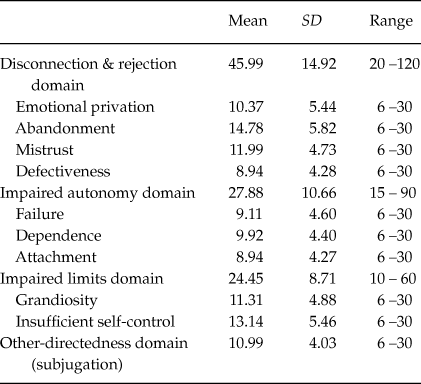
Table 1 shows the percentage of participants who met the criteria for clinical traits and/or possible personality disorders according to their scores on the MCMI-III. The results show that 27.7% of the sample of perpetrators had a possible PD (MCMI-III > 84) and that 57.1% met the criteria for clinical personality traits (MCMI-III > 74). The obsessive-compulsive PD was the most prevalent in the sample (11.4%), followed by the antisocial PD (6.1%) and the narcissistic and histrionic PDs (5.3% each). However, according to both scores (possible PD and clinical personality traits), the most predominant PD traits were the narcissistic (24.6%), followed by the obsessive-compulsive (21.9%) and paranoid PD traits (17.5%). The least prevalent PD traits in our sample for both scores were the aggressive-sadistic PD traits (3.5 %). Table 2 displays the means and standard deviations for the schemas and schema domains.
Percentages of Perpetrators of Intimate Partner Violence with Possible Personality Disorder and Clinical Personality Traits According to the MCMI-III

Note: The total percentages do not match the summation of percentages of all scales because there are men in the sample with more than one possible PD or clinical trait.
Descriptive statistics for Early Maladaptive Schemas and domains in Perpetrators of Intimate Partner Violence
Confirmatory factor analysis of the schema domains
A confirmatory factor analysis was conducted to assess the latent structure of the domains of the 10 EMSs measured in the study. The models were tested via maximum likelihood (ML) estimation with LISREL 8.8 (Jöreskog & Sörbom, Reference Jöreskog and Sörbom2006). Following the recommendations of a number of authors (e.g., Hu & Bentler, Reference Hu and Bentler1999), goodness of fit was assessed by the comparative fit index (CFI) and the non-normed fit index (NNFI), the root mean square error of approximation (RMSEA) and the standardized root-mean-square residual (SRMR). Generally, CFI and NNFI values of .95 or above, RMSEA values of .06 or less and SRMR values of .08 or less reflect that the model adequately fits the data. We used the effects-coding method proposed by Little, Slegers, and Card (Reference Little, Slegers and Card2006) to identify and set the scale of the latent variables. This method consists of constraining the set of indicator intercepts to sum to zero for each construct and the set of loadings for a given construct to average 1.0, which is the same as having them sum to the number of unique indicators. The hypothesized model consisted of a four correlated domain structure (disconnection/rejection, impaired autonomy, other-directedness, and impaired limits). This model showed adequate fit indexes, χ2(29, N = 119) = 46, CFI = .98, NNFI = .98, RMSEA = 0.072 (90% CI: .028, .10), SRMR = .059. We estimated two alternative models to compare with the hypothesized model. The first alternative model was similar to the hypothesized model but with the four factors uncorrelated. This model increased χ2 significantly, ∆χ2(6, N = 119) = 22, p < .001. The second model consisted of a unique factor. This model also increased χ2 significantly, ∆χ2(6, N = 119) = 17, p = .009. Thus, these results supported a four correlated schema domains structure.
Relationship among EMSs and PDs
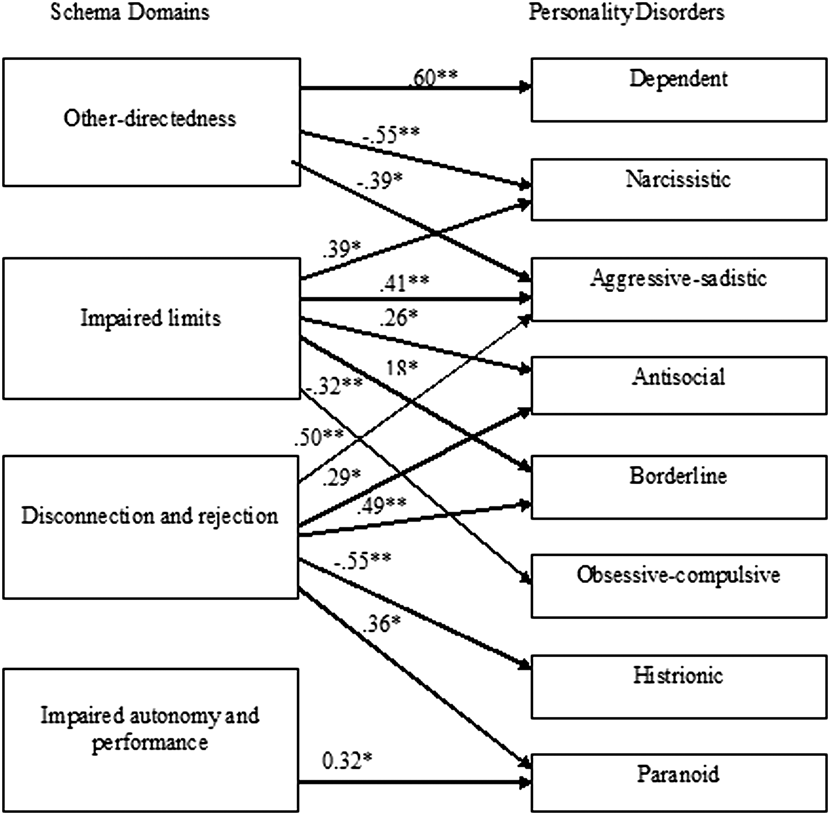
The hypothesized model included paths between schema domains and PD traits. Both the schemas domains and the PD traits were specified as correlated. The initially estimated model showed that some paths were not statistically significant. The model was re-estimated with only the significant paths, which are shown in Figure 1. This model showed excellent fit indexes, χ2 (18, N = 119) = 23.68, p = .17; SRMR = 0.060, CFI = 1, NNFI = .99, RMSEA = 0.053 (90% CI: .01, .10). The other-directedness domain was positively associated with the dependent PD traits and was negatively associated with the narcissistic and aggressive-sadistic PD traits. The impaired limits domain was positively associated with the narcissistic, aggressive-sadistic, antisocial and borderline PD traits and was negatively associated with the obsessive-compulsive PD traits. The disconnection and rejection domain was positively associated with the antisocial, aggressive-sadistic, borderline, and paranoid PD traits and was negatively associated with the histrionic PD traits. Finally, the impaired autonomy and performance domain was positively and uniquely associated with the paranoid PD traits.
Associations between early maladaptive schema domains and personality disorders. Values given are standardized coefficients. * p < .05, ** p < .001

Discussion
This study examined the prevalence of PD traits in a sample of men who committed violence against their partners and investigated the relationships among EMSs and PD traits. The results suggest that 27.7% of the perpetrators of IPV possibly display one of the eight PDs considered in this study and that 57.1% display clinical personality traits of at least one of these disorders. Thus, taking into account both the possible PDs and the clinical traits, 78.1% of the men in this study presented dysfunctional personality traits. It is important to consider both types of scores for clinical purposes because together they provide a more accurate indication of personality tendencies and styles (Gondolf, Reference Gondolf1999). These findings are consistent with those obtained in other previous studies that have used the same version of the MCMI (Gondolf, Reference Gondolf1999; Loinaz, Reference Loinaz2009), and indicate that the most prevalent PD traits among convicted perpetrators of IPV are the narcissistic (24.6%), obsessive-compulsive (21.9%), and paranoid (17.5%).
The participants displayed high scores on EMSs. For instance, in comparison with clinically depressed participants in a recent study by Halvorsen, Wang, Eisemann, and Waterloo (Reference Halvorsen, Wang, Eisemann and Waterloo2010), the perpetrators of IPV scored higher on the impaired limits domain and scored similarly on the disconnection and rejection domain. Moreover, perpetrators’ scores on all domains were higher than the scores obtained in a control group in Halvorsen and colleagues’ study.
Regarding the relationship between EMSs and PD traits, the results provide support for the Schema Therapy model, showing several significant paths that are consistent with the theoretical assumptions of the model (Young, Reference Young1999; Young et al., Reference Young, Klosko and Weishaar2003) as described below.
Narcissistic PD traits are positively associated with the impaired limits domain and negatively associated with the other-directedness domain. This finding supports the idea that individuals with these PD traits may try to exploit others to satisfy their own objectives and needs (Sperry, Reference Sperry2003) and may have difficulty recognizing others’ needs and feelings (Beck, Freeman, & Davis, Reference Beck, Freeman and Davis2004).
Antisocial and borderline PD traits have also been positively associated with the impaired limits domain. Furthermore, these PD traits have been associated with the disconnection and rejection domain. In the case of antisocial PD traits, our results are congruent with those obtained by Loper (Reference Loper2003) and Ball and Cecero (Reference Ball and Cecero2001) and support the idea that people with antisocial PD might have a defective and vulnerable self-concept, a hostile vision of others, mistrust of others’ intentions and a reliance on violent strategies as a solution to their problems (Beck, Reference Beck1999). Regarding borderline PD traits, our results support the lack of control as a characteristic of people with this disorder and their tendency to avoid being abandoned (DSM-IV-TR, 2000). Furthermore, these findings are consistent with the characteristics proposed for some types of perpetrators, such as those who have difficulties for self-regulating emotions (Chase et al., Reference Chase, O’Leary and Heyman2001; Holtzworth-Munroe & Stuart, Reference Holtzworth-Munroe and Stuart1994; Johnson et al., Reference Johnson, Gilchrist, Beech, Weston, Takriti and Freeman2006; Langhinrichsen-Rohling et al., Reference Langhinrichsen-Rohling, Huss and Ramsey2000; Tweed & Dutton, Reference Tweed and Dutton1998) and those characterized by entitlement and an unstable self-concept (e.g., Johnson et al., Reference Johnson, Gilchrist, Beech, Weston, Takriti and Freeman2006; White & Gondolf, Reference White and Gondolf2000).
Aggressive-sadistic PD traits were positively associated with the impaired limits and disconnection and rejection domains and was negatively associated with the other-directedness domain. These results should be viewed cautiously because no other research has examined the relationship between EMSs and aggressive-sadistic PD traits and because of the small number of subjects in our sample with traits of this disorder.
Paranoid PD traits are associated with the domains of disconnection and rejection and impaired autonomy and performance. These results imply that perpetrators of IPV with paranoid traits believe that others will intentionally not satisfy their needs. These beliefs could lead these men to lose self-control and react aggressively in situations in which they feel they are being harmed, cheated, humiliated or manipulated. These results agree with the cognitive traits attributed to individuals with this PD (Beck et al., Reference Beck, Freeman and Davis2004; Pretzer, Reference Pretzer1988; Shapiro, Reference Shapiro1965; Sperry, Reference Sperry2003). Likewise, our results are congruent with those of other studies that have considered the associations between this PD and EMSs (Carr & Francis, Reference Carr and Francis2010; Nordahl et al., Reference Nordahl, Holthe and Haugum2005; Reeves & Taylor, Reference Reeves and Taylor2007; Schmidt, Reference Schmidt1994).
Histrionic PD traits were negatively associated with the disconnection and rejection domain. This finding could be related to the idea that people with this PD tend to believe that their personal relationships are more profound and intimate than they actually are (DSM-IV-TR, 2000) and to these individuals’ perception that they are charming and deserve the attention of others (Beck et al., Reference Beck, Freeman and Davis2004). Obsessive-compulsive personality disorder traits have been negatively associated with the impaired limits domain, which is congruent with the criteria of the DSM-IV-TR (2000) for this PD: preoccupation with mental and interpersonal control.
Finally, the results of this study indicate that the other-directedness domain is positively associated with the dependent PD traits. This association implies that perpetrators of IPV with dependent PD traits emphasize others’ satisfaction to the detriment of their own needs, a behavior that is in accordance with their submissive behaviors stemming from the fear of abandonment or rejection as described in the DSM-IV-TR (2000). However, our results do not show evidence of a relationship between the impaired autonomy and performance domain and this PD, a relationship that has been found in other studies (Schmidt, Reference Schmidt1994).
This study has some limitations. Firstly, we used a self-administered questionnaire for the assessment of the PD traits, instead of a structural interview for personality disorders, which would had provide a more valid assessment of PDs. Self-report inventories have the risk of over or under diagnose PDs (Widiger & Samuel, Reference Widiger and Samuel2005). Nevertheless, the MCMI is one of the most widely used clinical instruments in research when assessing personality disorders (Craig, Reference Craig1999). Secondly, we did not assess all PD traits or EMSs because the questionnaires would have been too long, potentially reducing participation. Thus, we cannot conclude that other PD traits and EMSs are also characteristic of this population, although our results are highly consistent with previous research. Another limitation is the sample size. It would have been desirable to estimate the path analysis in a larger sample in order to obtain greater statistic power. Furthermore, our sample consisted of convicted perpetrators of IPV attending psychological interventions. Thus, the study should be replicated with samples of perpetrators without treatment. Furthermore, the cross-sectional design of the study precludes conclusions of causality between EMSs and PD traits. Future studies should address longitudinal relationships between these variables. Finally, the Schema Therapy model includes relevant hypothesis about the role of other variables such as the responses and strategies used by the individuals to cope with their early maladaptive schemas (Young et al., Reference Young, Klosko and Weishaar2003). Future research should examine the way in which compensation, surrender, and avoidance responses moderate the relationships among EMSs and PD traits.
Despite the limitations, this is the first study to examine the role of EMSs in PD traits in a sample of perpetrators of IPV. This study contributes to supporting the proposal that EMSs are involved in numerous dysfunctional personality traits and that EMSs may explain personality pathology (Young, Reference Young1999; Young et al., Reference Young, Klosko and Weishaar2003).
Psychological interventions with perpetrators of IPV are a controversial issue. Most programs are based on a mixed of psychoeducational and cognitive behavioral approaches within a gender-based context (e.g., Feder & Wilson, Reference Feder and Wilson2005; Tolman & Edleson Reference Tolman, Edleson, Stith and Straus1995). In recent years doubts have risen about the efficacy of those treatments regarding violence reduction. For instance, Babcock, Green, and Robie’s (Reference Babcock, Green and Robie2004) meta-analysis review showed a small effect, while the meta-analysis of Feder and Wilson (Reference Feder and Wilson2005) showed mixed results. Nevertheless, psychological interventions with perpetrators of IPV are important not only to prevent aggressive behaviors against the partners who have already been victimized, but also because of the possibility that these men will establish new intimate relationships in the future and could behave aggressively again. As Babcock et al. (2004, pp. 1049) suggested “the energies of treatment providers, advocates, and researchers alike may best be directed at ways to improve batterers’ treatment”.
Currently, most treatment programs with this population are based on approaches that do not consider the improvement of personality constructs or relief of personality disorder symptoms. If we consider the high prevalence of clinical traits and possible PDs in perpetrators of IPV, including previous studies (e.g., Hart, Dutton, & Newlove, Reference Hart, Dutton and Newlove1993; Fernández-Montalvo & Echeburúa, 2008; Gondolf, Reference Gondolf1999; Loinaz, Reference Loinaz2009), and the associations of these PD traits with the EMSs, we can conclude that psychological interventions in this population should include the assessment and modification of EMSs that underlie their behavioral problems, in order to provide a comprehensive intervention. In this regard, some studies have examined the efficacy of Schema Therapy in populations with Borderline PD (Farrell, Shaw, & Webber, Reference Farrell, Shaw and Webber2009; Giesen-Bloo et al., Reference Giesen-Bloo, van Dyck, Spinhoven, van Tilburg, Dirksen, van Asselt and Arntz2006; Nordahl & Nysæter, Reference Nordahl and Nysæter2005) and there is a major randomized clinical trial taking place in The Netherlands, with forensic patients with borderline, antisocial, narcissistic, and paranoid PDs, which are some of the most prevalent PDs among perpetrators of IPV. In this clinical trial, the effectiveness of Schema Therapy is being tested with regard to symptoms, violence, recidivism risk, and resocialization. Some early preliminary results indicate that Schema Therapy is a promising treatment for forensic personality disorders individuals (Bernstein, 2010).
Thus, although the results of this study should be taken with caution given the above-mentioned limitations, it seems appropriate to conclude that EMSs could be a factor to consider in future psychological interventions for perpetrators of intimate partner violence.
The authors are indebted with participating men and with the institutions that granted permission to conduct this study: The Spanish Secretaría General de Instituciones Penitenciarias (General Secretary of the Spanish Penitentiaries) and the Instituto de Reintegración Social de Bizkaia. Also the authors are indebted with the psychologists from Nanclares de la Oca, Martutene and Basauri Penitentiaries, as well as the psychologists from out-side prison programs (Gakoa) for their contribution to the data collection.