The association between class and political preferences is among the most well established in the social sciences. Around the world, people from a higher social class are generally more economically conservative and socially liberal. However, surprisingly little is known about whether these associations are causal, or about the mechanisms that explain them (Bengtsson, Berglund, and Oskarson Reference Bengtsson, Berglund and Oskarson2013; Svallfors Reference Svallfors2006). This is partly because it is difficult to identify causal mechanisms using cross-sectional data. Accordingly, we adopt an increasingly popular research design: using panel data to examine what happens to people's political beliefs when their circumstances – in this case their class – change (Margalit Reference Margalit2019). Unlike one-shot cross-sectional data, panel data provide repeated measures that make it possible to study individual-level changes in preferences. Panel data also provide more direct estimates of changing preferences than can be obtained from inferences drawn from rolling cross-sectional surveys. Using such data, Ares (Reference Ares2020) finds that moving between the working and middle classes increases an individual's economic conservatism. We build on and move beyond this by using a more fine-grained class schema and studying how class mobility affects a wider range of preferences and identities: economic values, attitudes toward gender equality and homosexual relationships, class identity and party choice.
Of these variables, the relationship between economic ideology and class is by far the most explored in previous work. The usual assumption is that the positive relationship between class and economic conservatism is caused by economic interests (Brooks and Svallfors Reference Brooks and Svallfors2010; Curtis and Andersen Reference Curtis and Andersen2015; Evans and de Graaf Reference Evans and De Graaf2013). Another possibility is that people's workplace experiences, such as their job autonomy, shape their economic preferences (Bengtsson, Berglund and Oskarson Reference Bengtsson, Berglund and Oskarson2013; Kitschelt and Rehm Reference Kitschelt and Rehm2014; Langsæther and Evans Reference Langsæther and Evans2020; Wilson and Maume Reference Wilson and Maume2016). Both of those perspectives share the assumption that something about jobs themselves, or the material interests associated with them, causes people of a particular class to hold certain views. An alternative possibility is that early life experiences shape enduring political attitudes, values and identities (Neundorf and Smets Reference Neundorf and Smets2017). Working-class parents are likely to have working-class children. They are, on average, more economically left wing and more socially conservative, and their values can be transferred to the child through socialization within the family, creating a persistent association between class and ideology in their children. Experiences such as early familial poverty also shape political values, and these experiences are unequally distributed among people in different classes (Finseraas Reference Finseraas2017; O'Grady Reference O'Grady2019; Van Deth, Abendschön and Vollmar Reference Van Deth, Abendschön and Vollmar2011).
Past cross-sectional studies have found class differences for a wide range of political preferences, such as economic left–right values (for example, Bengtsson, Berglund and Oskarson Reference Bengtsson, Berglund and Oskarson2013), ‘cultural’ values (for example, Langsæther and Stubager Reference Langsæther and Stubager2019), class identities (for example, Evans and Tilley Reference Evans and Tilley2017) and party choice (for example, Evans and de Graaf Reference Evans and De Graaf2013; Oesch and Rennwald Reference Oesch and Rennwald2018). However, to the best of our knowledge, Ares (Reference Ares2020) is the only published study to have used long-term panel data to examine the effects of class mobility. In this letter, we build on her work by showing that when people experience upward class mobility, they become slightly more economically conservative – but no other beliefs, identities or preferences change.
Our results suggest that the observed association between class and a range of identities, opinions and preferences at a given point in time is more likely to be caused by early life experiences and longer-term socialization than by the immediate material interests associated with jobs. They thus challenge the conventional wisdom that such preferences are primarily driven by economic self-interests. Below, we discuss our data and research design, then our results, followed by robustness checks.
Data and Design
We use panel data that tracked individuals from 1991–2007: the British Household Panel Study (BHPS). It is virtually the only long-term panel that regularly measured political preferences and identities alongside class mobility. Our independent variable categorizes respondents into four classes using the standard occupation-based Goldthorpe schema. These classes have different sources and levels of income, as well as employment relations, job security, career prospects and job autonomy (Goldthorpe and McKnight Reference Goldthorpe, McKnight, Morgan, Grusky and Fields2006). The four classes we use are Working Class respondents in unskilled or skilled manual occupations as well as unskilled non-manual roles. People in the Routine Non-manual class hold clerical and other non-managerial non-manual jobs. Those in the Lower Service class include supervisors, administrators and other mid-level service occupations. Finally, Higher Service workers are skilled professionals and managers. We exclude small business owners and farmers. We use four classes in order to focus on realistic amounts of class mobility that respondents genuinely experience.
Class mobility occurs when a person changes their occupation from one that is coded as one class to one that is coded as another. This implies a change in the person's market and work situation. When using an occupational-based class schema, this is by definition the only way that class mobility can occur. To examine the extent of class mobility, the Appendix shows a cross-tabulation of classes and transition probabilities per wave. There is quite substantial movement between classes over the course of the panel, with upward mobility more common than downward.
In our analysis, we compare cross-sectional differences between classes to fixed-effects regressions. The latter use only variation in class over time within individuals, showing the causal effects of class mobility based on the assumption that all unobserved heterogeneity is time invariant. Wave fixed effects control for time-specific factors, such as aggregate ideological change, that could confound the relationships. All regressions are specified with the routine non-manual class as the reference category. They therefore take the following form, capturing the effect of downward mobility from routine non-manual to working class, or upward from routine non-manual to the two service classes:
 $$Y_{it} = \beta _0 + \beta _1WC_{it} + \beta _2LS_{it} + \beta _3HS_{it} + \alpha _i + \delta _t + u_{it}$$
where i refers to individuals, t refers to waves, Y it is the outcome, WC it is the dummy for working class, LS it is the dummy for lower service class, HS it is the dummy for higher service class, α i is the individual fixed effect, δ t is the wave fixed effect and u it is the error term.
We estimate the effect of class mobility on five different outcome variables. Full details of the questions and response scales are provided in the Appendix. The first is a standard scale of left–right economic values from the BHPS, first developed and validated by Heath, Evans and Martin (Reference Heath, Evans and Martin1994) and widely adopted since in studying British politics (see, for example, Evans and Neundorf Reference Evans and Neundorf2020). It ranges from 1 to 5, with higher values indicating greater conservatism. Our next two dependent variables measure social conservatism: opposition to homosexuality or support for traditional gender roles (women staying at home while men go to work). They are standard five-point Likert scales, with higher values again indicating greater conservatism. Our fourth dependent variable captures subjective class identity: a dummy equalling 1 if the respondent considers herself to be working class and 0 otherwise. The fifth measures party preference: support for the Conservative Party vs. any centre-left party.Footnote 1
The dependent variables were not asked in every wave, meaning that our samples contain waves mostly spaced 2–3 years apart. We include all individuals who provided information on employment status and on the dependent variables in at least two waves. Sample sizes differ for each dependent variable, since they were asked in different waves. For example, the sample for our economic ideology models consists of 35,014 observations of 9,342 individuals, meaning that people were observed for 3.7 waves on average.
Main Results
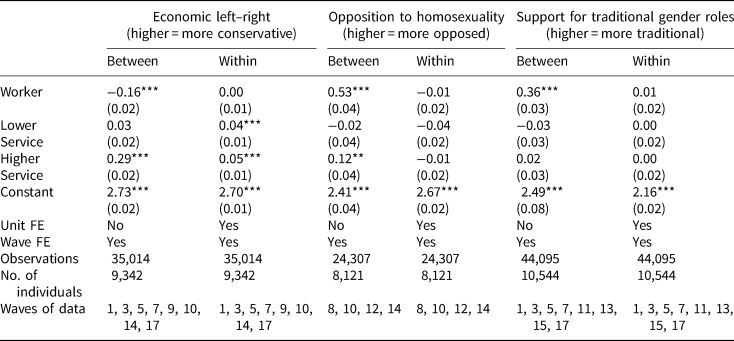
We first consider political attitudes and values (Table 1). In the cross-sectional between-effects model (Column 1), economic left–right differences between classes are quite substantial and statistically significant, except for routine non-manual vs. lower service classes. In the fixed-effects model (Column 2), there is no evidence that downward movement between the routine non-manual and working classes affects preferences, but upward mobility from the routine non-manual to both service classes does lead to increases in economic conservatism. However, these differences are substantively modest when compared to the pooled results from Column 1. Those in the higher service class are 0.29 points more conservative on the five-point scale than those in the routine non-manual class in cross-section, but upward mobility from routine non-manual to upper service leads to a rise of 0.05. The immediate impact of intra-generational mobility therefore accounts for less than one-fifth of the inter-class difference. Because Table 1 restricts the analysis to transitions from the routine non-manual class, in Appendix Figure A1 we show the relationship between class mobility and ideological change across all starting classes and all possible changes of class. Upward mobility from the working class is also associated with increased conservatism.
Class and political attitudes

Note: dependent variables are five-point scales. Standard errors in parentheses (clustered by individual for the fixed effects model). *p < 0.05, **p < 0.01, ***p < 0.001.
There are very strong cross-sectional class differences in attitudes to homosexuality and gender equality (Columns 3 and 5). Working-class people are substantially more likely to agree that homosexual relationships are wrong and that women should stay at home. However, there is no evidence that class mobility affects attitudes to homosexuality or gender equality (Columns 4 and 6). These results are consistent with the short-run effects of class mobility operating primarily through a rather limited economic self-interest mechanism. Class mobility does not affect beliefs that are plausibly unconnected to economics.
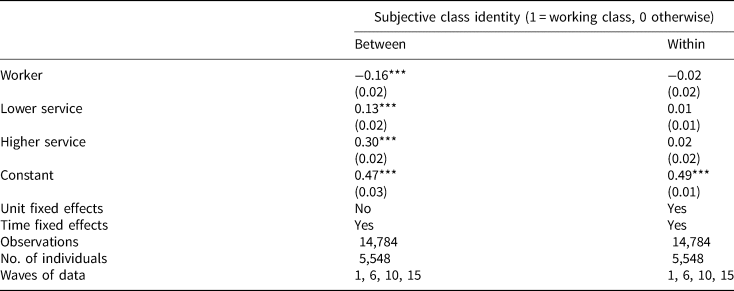
We now move on to class identity (Table 2). The between-effects model (Column 1) shows very large objective class differences in subjective class identity. Workers are 16 percentage points less likely to identify as middle class than routine non-manual employees. The lower and higher service classes are 13 and 30 percentage points more likely to do so, respectively. However, the fixed-effects model (Column 2) shows no evidence of class identity updating following a change in objective social class. Class identity, unlike economic values, seems to be set in stone. The fact that class identity is maintained even when people move upwards on the class ladder could explain why attitudinal updating is so limited.
Objective class and subjective class identity

Note: standard errors in parentheses (clustered by individual for the fixed effects model). *p < 0.05, **p < 0.01, ***p < 0.001.
The analysis so far has focused on short-term class mobility between two survey waves. People may need to spend a long time in their new class to adjust to their new position in society and change their views accordingly. Unfortunately, this is difficult to test with our data. Most individuals do not change class from wave to wave, and most do not remain in the panel for more than a few waves. There are therefore virtually no instances where people change class and can then be followed for many waves.
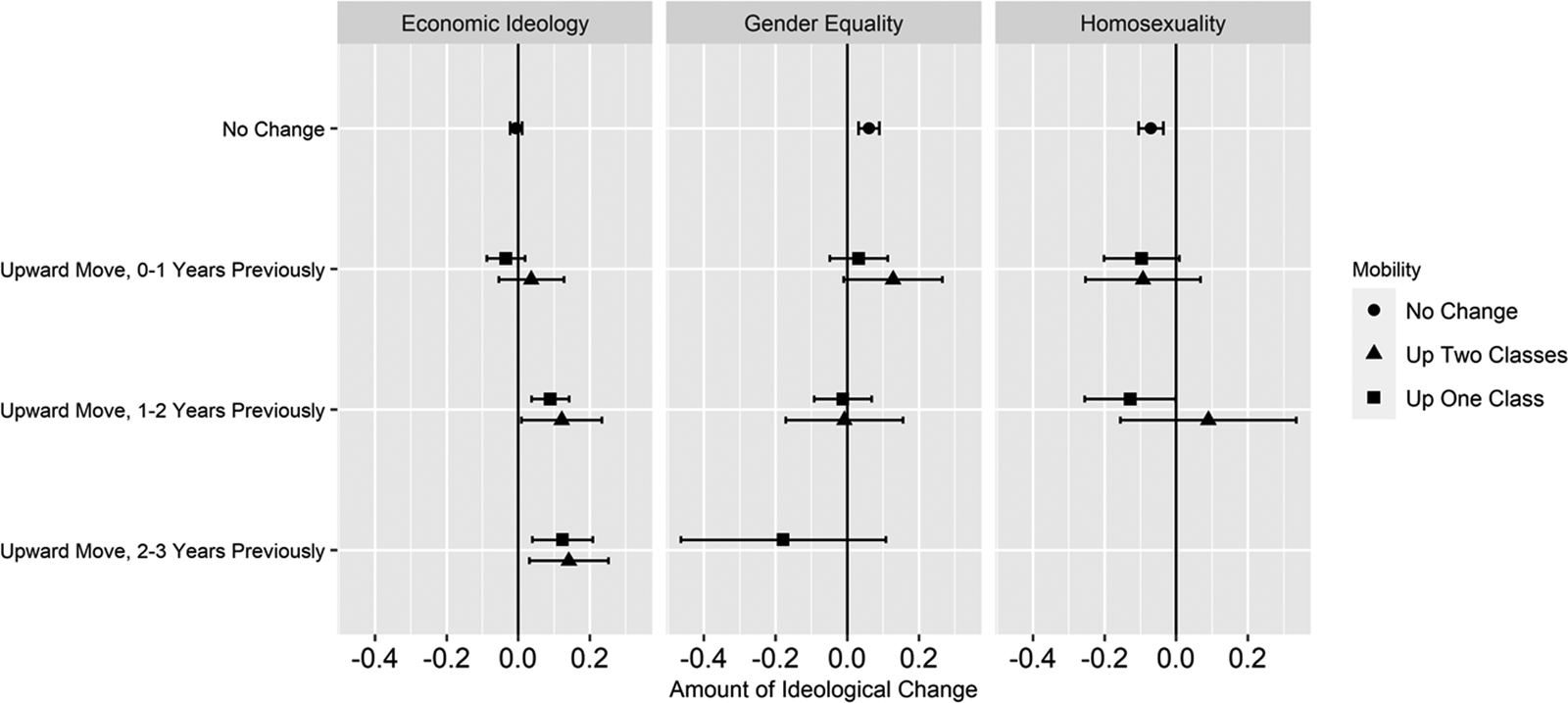
Instead, we provide limited evidence on the timing of effects, in two ways. First, there are gaps of two or more years between observations of respondents' ideologies in our panel, but we still have information on their class positions in the intervening years. Figure 1 therefore asks whether ideological change is more likely to occur between two waves when more time has elapsed since class mobility. For respondents who began in the routine non-manual class (matching the specification of our models), we show mean ideological change for those whose class changed 0–1 years ago, 1–2 years ago, or 2–3 years ago, comparing them to respondents who remained in the routine non-manual class between waves (the ‘no change’ group).Footnote 2 For economic ideology, there is some evidence of delayed effects. People who were upwardly mobile in the current year do not show any tendency to become more conservative. Such effects only begin after respondents have spent at least one year in their new class. For gender equality and homosexuality, we do not find any evidence that the effects become larger after more time, although small sample sizes mean that there is considerable uncertainty.Footnote 3
Upward class mobility from routine non-manual and changes in ideology, by timing of mobility
Note: mean changes and 95 per cent confidence intervals.

Secondly, we can follow a reasonable number of individuals for one wave after the initial wave in which class mobility occurs, for our larger economic ideology and gender equality samples. This analysis is shown in the Appendix. Economic ideological change is maintained in the wave after initial class mobility, but there is no evidence that it increases. There is no evidence of decreasing opposition to gender equality in either the first or second wave after mobility.
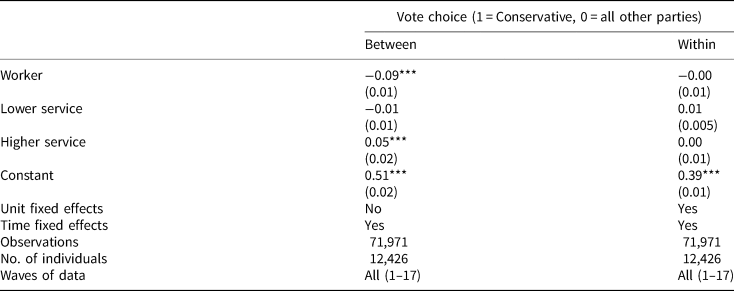
Finally, we consider party preference (Table 3). In line with previous findings, the between-effects model (Column 1) shows clear class differences in voting behaviour. Working-class people are 9 percentage points less likely to support the Conservative Party than routine non-manual employees and the lower service class, while higher service class workers are 5 percentage points more likely to do so. The fixed-effects model (Column 2) provides no evidence of updating of voting behaviour following class mobility. However, this study covers a period when ideological differences between the Conservatives and Labour were relatively small, due to Labour's re-positioning in the ideological centre under the leadership of Tony Blair. Class mobility could have larger effects on party choice during periods of greater polarization.
Class and party preference

Note: standard errors in parentheses (clustered by individual for the fixed effects model). *p < 0.05, **p < 0.01, ***p < 0.001.
Robustness
The results in Tables 1–3 show causal effects, assuming that all unobserved heterogeneity is time invariant. We now consider the robustness of our results to potential observed and then unobserved time-varying confounders. In addition, attrition might affect the results if people who leave the sample before completion are systematically different from those who do not. In the Appendix, we analyse attrition in detail and show that it is unlikely to pose a threat to our results.
Income and Education
First, we examine two other key observable characteristics that might also change when individuals change class: education and income. Since income is a post-treatment variable – it results from class mobility – we argue that it should not be included in the main specifications. Nonetheless, Appendix Tables A3–A5 replicate all the fixed-effects models from Tables 1–3 with the addition of controls for both education and income.Footnote 4 In all cases, the fixed-effects class coefficients remain unchanged.
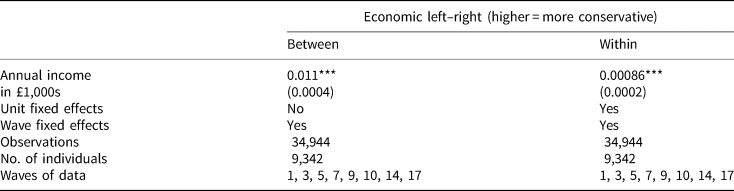
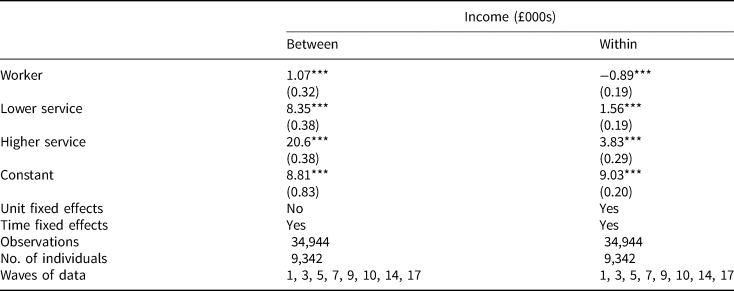
In fact, changes in income are rather weakly associated with ideological change. Table 4 shows cross-sectional as well as fixed-effects analyses of the relationship between income and economic ideology.Footnote 5 In the fixed-effects model, an increase in annual income of £1,000 leads to a change of 0.00086 scale units in economic conservatism. An individual's income would have to increase by £46,000 to have the same impact on ideology as a move from the routine non-manual to lower service classes. In reality, changes in class are not accompanied by changes in income that are anything close to this amount. Table 5 shows that moving from the routine non-manual to lower service class leads to an average increase in income of £1,560, and moving from the lower service to the higher service class leads to an average increase of £3,830.Footnote 6 These somewhat weak relationships between income change and ideological change on the one hand, and changes in income and class mobility on the other, explain why controlling for income does not reduce the class coefficients in our main model. This underlines the importance of studying class politics rather than simply income.
Income and economic left–right values (economic ideology sample)

Note: dependent variable is a five-point scale from 1–5. Standard errors in parentheses (clustered by individual for the fixed effects model). *p < 0.05, **p < 0.01, ***p < 0.001.
The relationship between class and income (economic ideology sample)

Note: dependent variable is binary, 1 = middle class/upper class, 0 = working class. Standard errors in parentheses (clustered by individual for the fixed effects model). *p < 0.05, **p < 0.01, ***p < 0.001.
Unobserved Time-Varying Confounders
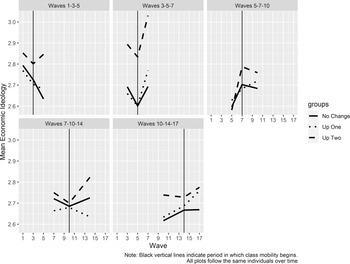
Our finding that economic conservatism is modestly updated following upward class mobility also depends on there being no unobserved time-varying confounders. Otherwise, it could (for instance) be the case that people who are already becoming more conservative for other reasons are more likely to experience upward class mobility. An observable implication is that those who experience class mobility and those who do not should have parallel trends in ideology in the periods before class mobility occurs. Figure 2 tests this assumption for the economic ideology model. All five panels in the figure follow the same individuals for three waves, covering the period before and after class mobility is experienced. To match our regressions, these are individuals who experienced upward class mobility from the routine non-manual class. Those who experienced no change in class form a control group. The figure shows the mean ideology for each group in each wave; the vertical black lines indicate when individuals started their movement into a new class.
Test for parallel trends: upward class mobility from the routine non-manual class and mean changes in left–right economic values

In all but two of the ten cases (those who moved upwards from routine non-manual to lower service between Waves 10 and 14, and those moving from routine non-manual to higher service between Waves 14 and 17), there is no evidence that those experiencing upward mobility were trending differently in terms of values from those experiencing no change in the period before the change occurred. To further check the robustness of our results, we estimated a new version of our fixed-effects model for economic ideology, excluding from the data the two groups with non-parallel trends identified in Figure 1. The results are unaffected by their removal, and are shown in Appendix Table A6.
Discussion
We have shown that upward class mobility is associated with a moderate increase in economic conservatism in the short run, and that this relationship is highly likely to be causal. However, economic ideology is the only thing that changes when people move up the class ladder. They do not become more tolerant of homosexual relationships or more supportive of gender equality, they do not become more likely to consider themselves more middle class, and they do not change their party preference. Our data is limited in what it can tell us about longer-term effects, but we found some evidence that there is a small delay before class changes affect economic ideology and that effects persist for at least a few years, but no evidence that attitudinal change on homosexuality or gender equality becomes more likely after more time has been spent in a new class. The effect of class mobility on economic ideology cannot be explained by the immediate resulting changes in income or by changes in education that occur alongside it. Instead, other class-related factors must play a role, such as expectations of future income, job security or workplace socialization, or other workplace characteristics that change people's perceptions of their own self-interest. In contrast, the relationship between attitudes on social/cultural issues and class is unlikely to be influenced by such mechanisms since no updating occurs.
The fact that updating only occurs with respect to economic values suggests that our measure of class change is meaningful and that we do not pick up non-class-derived influences on preferences. This offers some support for self-interest arguments about class differences in redistributive preferences. However, updating of economic ideology is much smaller than observed cross-sectional differences between classes. It is therefore not nearly sufficient to account for such class differences. Instead, it is plausible that cross-sectional economic ideological differences between classes are explained by early life experiences – including inter-generational mobility between parental and respondent class – that exert a persistent effect on preferences. A related reason for limited updating may therefore be that, as we have seen, individuals continue to subjectively identify with their old class even after upward class mobility. To the degree that preferences are influenced by identity, this is likely to weaken the impact of changes in objective class position.Footnote 7 Such ‘stickiness’ can also help explain why despite the shrinking proportion of the workforce holding working-class jobs, the proportion of people with a working-class identification in the UK has remained robustly high (Evans and Tilley Reference Evans and Tilley2017).
Likewise, party support also reflects identity-based and instrumental motives. Yet as we have seen, intra-generational mobility seems only to affect the latter component, and only moderately so. This may therefore explain the lack of an effect on party support. Another explanation is that our data were collected during a period when the differences between the main British parties were smaller than has been the case historically, or since. The effect could be larger under conditions of greater polarization. Future studies could explore this question if appropriate data become available.
Overall, our findings are more consistent with socialization-based theories explaining much of the correlation between class and political orientation. Instrumental redistributive preferences are (moderately) influenced by changes in class position, but other aspects of preferences and identity are not. This suggests that there is likely to be considerable elasticity in the relationship between changes in class distributions, political orientations and party strategies. Further insights into this dynamic are likely to require more detailed panel analyses of the links between class, preferences and party choice.
Supplementary material
Online appendices are available at https://doi.org/10.1017/S0007123420000599.
Acknowledgements
We would like to thank Alexandra E. Cirone and Henning Finseraas for thorough comments on previous drafts. We would also like to thank the three anonymous reviewers and the editor for their helpful comments and suggestions.
Data replication statement
Data replication sets are available in Havard Dataverse at: https://doi.org/10.7910/DVN/BTZ9UN