

Introduction
A quarter century ago, Edward Telles used a specially commissioned dataset from the Instituto Brasileiro de Geografia e Estatística (IBGE) to examine residential segregation by skin color in Brazil in 1980 (Reference TellesTelles 1992). He concluded that residential segregation among whites, browns (pardos), and blacks (negros) was only moderate by US standards. White-black dissimilarity was the highest, followed by brown-black, and then white-brown dissimilarity. Residential segregation was lowest for low-income groups and increased with increasing income level. For most of the white middle class, residential segregation was determined by the concentration of blacks and browns in low socioeconomic classes and in distinct regions of the country. Low-income urban areas and housing markets were strong predictors of overall residential segregation: segregation was significantly higher in urban areas with high occupational inequality, low mean income, high levels of housing turnover, and high homeownership.
In what follows we revisit and expand on Telles’s conclusions using a comparable dataset for the year of 2010. We explore whether residential segregation by race has changed over the three decades spanning 1980–2010 in Brazil. Understanding residential segregation in Brazil is important, given the negative economic and social consequences for the residents of segregated enclaves. Blacks who live in segregated areas have lower access to educational opportunities and lower earnings than their counterparts in more integrated areas, which results in severe economic disadvantage.
Residential segregation has been extensively researched in the United States since the beginning of the twentieth century (Reference DuncanDuncan 1957; Reference Farley and FreyFarley and Frey 1994; Reference Harrison and WeinbergHarrison and Weinberg 1992; Reference LiebersonLieberson 1980; Reference MasseyMassey 1985, Reference Massey1990, Reference Massey2004; Reference Massey and HajnalMassey and Hajnal 1995; Reference Schneider and LoganSchneider and Logan 1982). Segregation between whites and blacks in particular has permeated sociological research and is front and central in discussions of race relations in the United States. In Brazil, however, the study of residential segregation has been molded almost entirely by studies fostering the belief that it is social and educational differences among the lower and upper classes that determines residential patterns (Reference BaileyBailey 2009; Reference DanielDaniel 2006; Reference HenriquesHenriques 2001; Reference Jaccoud and BeghinJaccoud and Beghin 2002; Reference SilvaSilva 1994; Reference Silva and HasenbalgSilva and Hasenbalg 1992; Reference Telles and BaileyTelles and Bailey 2002; Reference Telles and LimTelles and Lim 1998). Few studies have attempted to analyze how racial differences can contribute to residential segregation (Reference AmaralAmaral 2013b; Reference Torres, Bichir, Roberts and WilsonTorres and Bichir 2009; Reference FrançaFrança 2010; Reference TellesTelles 1992).
Amaral (Reference Amaral2013b) examined three metropolitan areas, Recife, Belo Horizonte, and Porto Alegre, analyzing segregation between whites and nonwhites (browns and blacks combined). He found that in areas where the majority of residents were white, a high proportion of the population held at least a high school degree. Nonwhites lived farther away from the core of the municipalities and tended to live in more elevated places with less public infrastructure than whites. Since data on individual census tracts was not available from the 2000 Census, Amaral relied on data provided by IBGE for selected areas by groups of census tracts (áreas de ponderação). However, using a larger geographical area to calculate residential racial segregation can result in lower dissimilarity indexes, thus deflating the actual segregation (Reference Massey, Smelser, Wilson and MitchellMassey 2001).
Likewise, Torres and Bichir (Reference Torres, Bichir, Roberts and Wilson2009) used the 2000 IBGE census for the metropolitan region of São Paulo and found that residential segregation was greatest among the poorest and the highest income levels—families earning 0 to 3 minimum wages compared to those earning 20 or more minimum wages. Similarly, França (Reference França2010) used the 2000 census to analyze residential segregation in the city of São Paulo, concluding that residential segregation is greater in the upper stratum of society. These studies are limited in scope due to the lack of census tract data that had been made available to Telles (Reference Telles1992).
In this article, we obtained from IBGE a special tabulation of the 2010 census tract data for forty metropolitan areas to examine changes in residential separation by race extending to the 1980–2010 period.Footnote 1 To provide context, we first discuss the relations of race, skin color, and socioeconomic status in Brazil, and the changes that may have occurred in these relationships during the last three decades. We then discuss details of the 2010 dataset and the method used to measure racial segregation, followed by the 1980–2010 comparative results for the major metropolitan areas and the results by socioeconomic groups. Finally, we draw together the main conclusions and our speculations about causes.
Understanding Race Relations in Brazil
Brazil is a multiracial society with an incongruent position on race relations. On the one hand, it has been argued that Brazil is a racial democracy in which intermixture of Native, African, and European descendants gave rise to an interracial society where racism is claimed to be nonexistent (Reference Bastide and FernandesBastide and Fernandes 1955; Reference CamposCampos 2004; Reference FreyreFreyre 1956; Reference WagleyWagley 1963). On the other hand, when analyzing Brazil’s historical development, the true discriminatory nature of its social, cultural, political, and economic anatomy is revealed (Reference Nascimento and NascimentoNascimento 1989). Historically, the white elite promoted the myth of racial democracy to conceal concrete forms of racial discrimination, oppression, and abuse (Reference SkidmoreSkidmore 1993). In contrast to South Africa and the United States, Brazil never enacted segregation laws. As a result, the concept of race in Brazil is relative to other interracial systems. There is an overabundance of racial terms and their use is marked by high ambiguity (Reference HarrisHarris 1964; Reference TellesTelles 2014; Reference ValenteValente 2017). Race is a fluid concept best described as a color spectrum, where in order for someone to be black one has to be at the darker end of the spectrum and self-identify as black.
There are two schools of thought regarding racial inequality in Brazil. Some advocate the thesis proposed by Donald Pierson, which denies the existence of racial discrimination, claiming that racial inequalities are in fact the result of class or social inequalities (Reference AzevedoAzevedo 1996; Reference FrazierFrazier 1942; Reference HarrisHarris 1964; Reference PiersonPierson 1945; Reference WagleyWagley 1963). This theory fails to address the continuing socioeconomic disparity among racial groups in Brazil. Opposing this view, Bastide and Fernandes (Reference Bastide and Fernandes1955), Costa Pinto (Reference Costa Pinto1953), Nogueira (Reference Nogueira1985), and Cardoso and Ianni (Reference Cardoso and Ianni1960) defend the position that there is significant racial discrimination in Brazil. An invaluable contribution to this debate is the work of Carlos Hasenbalg and his colleagues, which provides empirical evidence to explain inequalities in social mobility among racial groups in Brazil (Reference Hasenbalg and BurglinHasenbalg 1979). Their research led to the formulation of a theory on the cumulative racial disadvantage of Afro-Brazilians over their life cycle. The theory surmises that race is an additional factor superimposed on class. Hasenbalg and Silva (Reference Hasenbalg, do Valle Silva, Lima, Hasenbalg and do Valle Silva1999, 218) note that “nonwhites are subject to a ‘process of cumulative disadvantages’ in their social trajectories.” For instance, from infancy, nonwhites have higher odds of being born poor and are more likely to suffer poverty than whites, their odds of attending school is reduced, and when they do attend school, they attend public schools that are not as academically rigorous as the private institutions attended by white students. As a consequence, nonwhites are less likely to go to college. The resulting low educational achievement leads to low-paying jobs, mainly in the informal sector, making it impossible for them to compete and move up the socioeconomic ladder. This results in a vicious cycle perpetuating poverty among Afro-Brazilians.
More recently, many scholars have empirically examined and validated Hasenbalg’s thesis (Reference Hasenbalg and do Valle SilvaHasenbalg and Silva 1988, Reference Hasenbalg, do Valle Silva, Lima, Hasenbalg and do Valle Silva1999; Reference RosembergRosemberg 1990; Reference Soares, Beltrão, de Oliveira Barbosa and FerrãoSoares et al. 2005), most focusing on inequalities in the labor market and on the significant income disparity by race, ceteris paribus (Reference Arias, Yamada, Luiz, Buvinic, Mazza and DeutschArias et al. 2005; Reference Beltrão, Sugahara, Peyneau and de Oliveira MendonçaBeltrão et al. 2003; Reference Campante, Crespo and LeiteCampante, Crespo, and Leite 2004; Reference HasenbalgHasenbalg 2006; Reference MonkMonk 2016). With the implementation of affirmative action law in federal universities in 2012, a few studies have focused on the pervasive racial inequality that afflicts the Brazilian educational system. These studies provide credence to affirmative action policies by showing that nonwhite students perform worse in university entrance exams than white students, even when controlling for family income, parents’ education, and other socioeconomic status indicators (Reference Heringer and JohnsonHeringer and Johnson 2016; Reference Mitchell-Walthour, Heringer and JohnsonMitchell-Walthour 2015; Reference ValenteValente 2016, Reference Valente2017). However, studies have shown that when given the opportunity, affirmative action students perform academically just as well as traditional students (Reference Valente and BerryValente and Berry 2017). Despite this growing body of research, many Brazilians still defend the idea that racial disparities, even in the case of housing access, are the result of socioeconomic status, perpetuating the idea that racial inequality is a social issue and not a matter of racial discrimination (Reference FryFry 2007; Reference KamelKamel 2006; Reference Van den Berghe and CashmoreVan den Berghe 2000). In reality, as a consequence of being trapped in a poverty cycle, nonwhites are forced to seek affordable housing far from urban centers, in areas characterized by the lack of basic infrastructure (energy, sewage, and water supply), in zones of precarious housing (favelas or shantytowns), and in many cases in illegal settlements (Reference Torres, Bichir, Roberts and WilsonTorres and Bichir 2009).
Explanations of Racial Residential Segregation
The rapid growth of urban centers in the last decades in Brazil has resulted in an unprecedented migration of rural workers and small-city dwellers drawn to large cities in search of opportunities. Cities like São Paulo and Rio de Janeiro gained international acclaim and became important financial and industrial centers, providing not only essential infrastructure and technology but education and job opportunities lacking in the rural areas. The tremendous influx of low-skilled and uneducated residents also had adverse effects: available jobs were quickly taken and the labor market saturated, resulting in fewer opportunities, underemployment, and poverty for successive waves of immigrants. Many found residence in the sprawling slums and poor areas around the peripheries of the cities (periferias) (Reference DavisDavis 1996). Wealthier residents distanced themselves—physically and socially—from neighborhoods perceived as dangerous (Reference CaldeiraCaldeira 2000). Most sought refuge in gated communities (condomínios fechados) which are very common in the larger metropolitan areas. Such protected spaces are reserved for those with greater purchasing power seeking better infrastructure, leisure, and security. As a result, inequality is manifested spatially in residential segregation. According to Graham and Marvin (Reference Graham and Marvin2001), this “splintering urbanism” severely curtails poor residents’ access to infrastructure, services, and utilities, and further lessens any efforts to incorporate them into the mainstream economy.
The stigma of poverty creates social and political disparities that result in segregation and uneven geographic development in urban areas (Reference AuyeroAuyero 1999; Reference HarveyHarvey 2005; Reference PerlmanPerlman 2010). In a country were the majority of the poor (both urban and rural) are nonwhite, this segregation also is sharply divided along racial lines. In Brazil, residential segregation connotes an abhorrent and explicit system of racial division (Reference TellesTelles 2004). As scholars have shown time and time again, race is a significant and irreducible constituent of social structure and relations and an important factor in the production of social inequality (Reference GuimarãesGuimarães 2002; Reference Hasenbalg and BurglinHasenbalg 1979; Reference Hasenbalg and do Valle SilvaHasenbalg and Silva 1988; Reference TellesTelles 2004, Reference Telles2014; Reference ValenteValente 2016, Reference Valente2017). As Nikole Hannah-Jones explains in the context of the US residential segregation,
housing is everything … there is an understanding that where you live affects every aspect of the quality of life that you will have. When you take the group of people upon which [a] racial caste system was built and you separate them and you ghettoize them, then you can just deny them all of the normal services that anyone else would receive … when you look at the effect of segregation on black folks, they’re more likely to live in areas with toxic waste and environmental issues …, in places where there are food deserts and no grocery stores. Their schools are the lowest-performing schools. They’re less likely to have infrastructure and investment placed in their communities … transportation, all of the things that people look for when they want to move into a house when they have choice are often denied these communities. If you don’t study race, it’s actually kind of remarkable the extent to which black communities are intentionally segregated and then intentionally cast aside for things most take for granted.” (National Public Radio 2018)
These observations are also pertinent to the Brazilian reality.
Theoretical Framework
There are three major theories, or frameworks, that can be used to understand why residential segregation occurs in Brazil and how it develops: assimilation, stratification, and resurgent ethnicity. The spacial assimilation framework is one of the earliest theories, positing that residential patterns are the result of economic, human, and capital accumulation or the lack thereof (Reference Chung and BrownChung and Brown 2007; Reference GordonGordon 1964; Reference Iceland, Sharpe and SteinmetzIceland, Sharpe, and Steinmetz 2005; Reference MasseyMassey 1985). Hence, segregation is a consequence of the differing socioeconomic status among racial groups that creates low assimilation of a minority group to the majority society (Reference MasseyMassey 1985). This particular theory is heavily used to explain Brazilian residential segregation (Reference Cardoso and IanniCardoso and Ianni 1960; Reference PiersonPierson 1939; Reference Costa PintoCosta Pinto 1953; Reference VasconcelosVasconcelos 2004). One of the first definitions in the Brazilian literature of segregation was given by Reference CorrêaRoberto L. Corrêa in 1989. He defined segregation as the “spacial expression of social class.” Corrêa claimed that segregation emerged due to “differences in each group’s capabilities to pay for their residencies” (Reference CorrêaCorrêa 1989, 62). His term “socio-spacial segregation” has become a core idea in Brazilian urban studies. This underscores a reluctance to use the term “racial segregation” where in some instances it is claimed that a racial divide does not exist (cf. Reference VasconcelosVasconcelos 2004). For example, in the context of Salvador, one of the blackest cities in Brazil, Pierson argued, “there is no deliberate segregation … spatial distribution is largely the consequence of economic sifting” (Reference PiersonPierson 1939, 532). This unwillingness to acknowledge the existence and scope of racial residential segregation stems from the myth of racial democracy and the fact that the Brazilian government never implemented segregation laws. As has been shown, “in the case of racial inequality in Brazil, as compared to the United States and South Africa, the outstanding singularity is the absence of racial segregation by law and the accompanying national culture of ‘racial democracy’ that has acted as a smoke screen to mask very stark racial inequities” (Reference Nascimento, Nascimento, Hamilton, Huntley, Alexander, Guimarães and JamesNascimento and Nascimento 2001, 106).
In contrast, the stratification theory posits that segregation emerges as a result of choices made for or against minority groups by majority groups because of their race or ethnicity (e.g., housing discrimination, racial stereotyping, and prejudicial preferences) (Reference Chung and BrownChung and Brown 2007; Reference Farley and FreyFarley and Frey 1994; Reference Logan and MolotchLogan and Molotch 2007; Reference Yinger, Goering and WienkYinger 1996). Surveys on racial attitudes in Brazil found that between 30 percent and 40 percent of whites said that they would not be willing to accept blacks or mulattoes as neighbors (Reference Bastide and FernandesBastide and Fernandes 1955; Reference Bastide and Van Den BergheBastide and Van Den Berghe 1957; Reference Cardoso and IanniCardoso and Ianni 1960). Therefore, nonwhites may experience blocked residential mobility and limited housing choice due to racial discrimination (Reference Massey and MullanMassey and Mullan 1984; Reference Pager and ShepherdPager and Shepherd 2008). More recent studies suggest that housing discrimination and racial prejudice does play a role in residential segregation in Brazil (Reference TellesTelles 2003).
Finally, the resurgence of ethnicity theory attempts to explain why some ethnic groups self-segregate even after improvement in socioeconomic status (Reference Chung and BrownChung and Brown 2007). It hypothesizes that racial minority preference in housing could be the result of in-group attraction. Ethnic communities are created due to cultural affinity or cohesion. Studies in Brazil, for example, have found that people of African origin in São Paulo and Rio de Janeiro tend to live in specific poor neighborhoods, close to other ethnic communities and Afro-Brazilian cultural, social, and religious institutions, such as capoeira and samba schools, and terreiros de candomblé (meeting places where the candomblé religion is practiced) (Reference RolnikRolnik 1989). This theory suggests that racial segregation may never be abated as racial cohesion regenerates segregation even when integration is socioeconomically feasible and housing discrimination has been receded (Reference Charles and de Souza BriggsCharles 2005; Reference ClarkClark 2002; Reference Krysan and FarleyKrysan and Farley 2002). People residing in traditional ethnic communities who experience an increase in socioeconomic status sometimes choose to remain in their community or to move to another racial community commensurate with their income (Reference Chung and BrownChung and Brown 2007).
Even though these theories provide different explanations to why residential segregation occurs, the Brazilian literature overwhelmingly uses assimilation theory to explain residential segregation. Only a few studies have analyzed racial segregation in Brazil in light of the stratification theory. Apart from socioeconomic status and ethnic preference, does racial discrimination play a role in residential segregation in Brazil? On this question, the Brazilian evidence has yet to be assembled, but analyzing trends in residential segregation between 1980 and 2010 may provide important insights.
Measuring Racial Residential Segregation
We measured racial residential segregation using the index of dissimilarity (Reference Massey and DentonMassey and Denton 1988), D, defined as the proportion of one group that would have to change census tracts to achieve the same spatial distribution as the other group (Reference Massey and DentonMassey and Denton 1988).Footnote 2 When two racial groups are evenly distributed throughout the urban area, D = 0, and when there is complete segregation, D = 1. Thus, the index of dissimilarity has the following form:

where n is the number of tracts or spatial units, X and Y are the metropolitan area populations of the groups being compared, and xi and yi are their respective populations in census tract i. The data is sourced from the 2010 Brazilian Census produced by IBGEFootnote 3 for the same set of thirty-five metropolitan areas used in Telles (Reference Telles1992), plus five additional metropolitan areas with populations over 350,000 thousand.Footnote 4
The 2010 Census ensured that respondents had to choose between five race categories, white (branca), black (negra), brown (parda), yellow (amarela-Asian), and indigenous (indígena), and answers were only accepted if the responses were the same as the established categories.Footnote 5 The main difference between how race was measured in the 1980 versus the 2010 Census is that in 1980, “indígena” was included in the “parda” category. In 1980, “parda” was measured as a race/color that was “different than white, black and yellow, such as mulata, mestiça, India, etc.” (IBGE 1980a, 1980b). However, most indigenous people were concentrated in the central-west region, which Telles excluded from his 1980 analysis. Hence, the results are comparable.
Table 1 compiles the results of the calculations and compares them with those provided by Telles (Reference Telles1992).Footnote 6 Segregation by race remains low and in most cases declined between 1980 and 2010.Footnote 7 Feira de Santana, Porto Alegre, and Caxias do Sul have some of the highest levels of white-black segregation, while Itabuna, São Luis, and Macapá have some of the lowest. Thirty years ago, only Barra Mansa/Volta Redonda had what is considered a low level of residential segregation for whites versus blacks. Today, several metropolitan areas document low levels of segregation: thirteen have low levels of white-black segregation, twenty-eight of white-brown segregation, and thirty-four of brown-black segregation; all remaining indexes show moderate segregation. No metropolitan area showed high levels of segregation, in contrast to the results of 1980, where areas like Joinville, for example, had high segregation between browns and blacks (.624); today segregation between these groups is considered moderate (.348).
Index of dissimilarity by metropolitan area, 2010 and 1980.

* Data from Telles (Reference Telles1992).
The mean segregation of whites versus blacks (.326) is slightly higher than that for whites versus browns (.262), a pattern observed in thirty-six of the forty metropolitan areas. In the remaining metropolitan areas, all located in the southeast, the white-black segregation index was lower than the brown-white index. White-black dissimilarity was the highest in all metropolitan areas in the north, northeast, central-west and south, and in twelve out of fifteen metropolitan areas in the southeast.
The mean index of brown-black segregation remains the lowest overall, although it has decreased since 1980 from .407 to .243. The brown-black index was the lowest of the three indexes in twenty-four metropolitan areas, particularly in the south and southeast. This shows a significant shift from 1980, when only sixteen metropolitan areas had a low index in the brown-black category. Overall, residential segregation has decreased in most metropolitan areas.
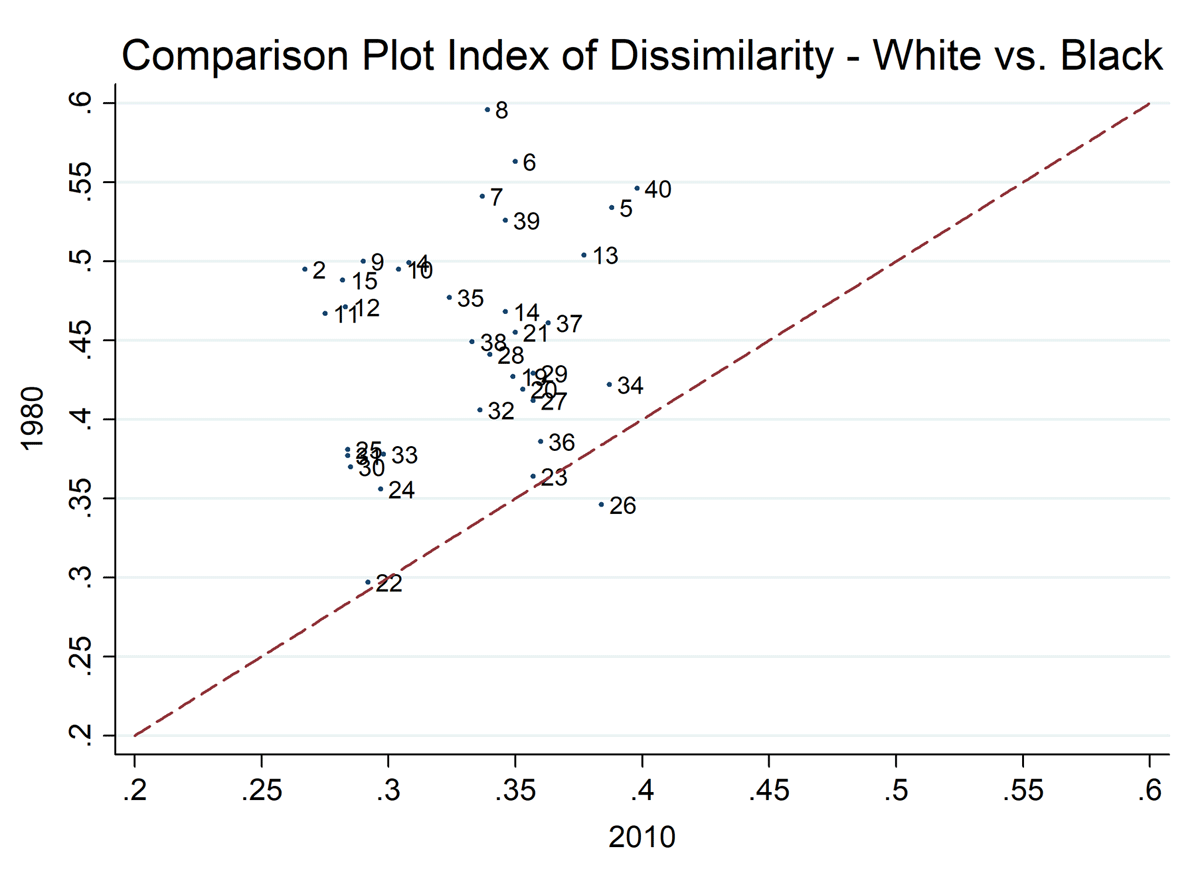
The comparative results for 1980 and 2010 become clear if the index values are plotted against each other in three graphs (Figures 1, 2, 3), for white-black, white-brown, and brown-black dissimilarities.Footnote 8 In Figure 1, most points lie above the diagonal line. Data points above the diagonal line indicate a reduction in the dissimilarity index, points below show an increase, and points on the diagonal line indicate when the 1980 and 2010 indexes are the same. Virtually all the points lie above the line, indicating widespread reductions in white-black residential separation. The most pronounced increase in separation was in Campos (26) in the southeast; the greatest decreases were in northeastern cities such as Natal (8) and Fortaleza (6); and two cities maintained almost the same level of white-black segregation, Juiz de Fora (23) and Barra Mansa/Volta Redonda (22).
Levels of white-black dissimilarity in 1980 and 2010 in thirty-five Brazilian metropolitan areas. Numbers refer to the list of cities in Table 1. Above the dotted line, dissimilarity was higher in 1980 than in 2010. Only one area showed increasing segregation, Campos (26), and two areas remained constant, Juiz de Fora (23) and Barra Mansa/Volta Redonda (22); all three areas are located in the southeast. The greatest reductions in segregation occurred in Natal (8) and Fortaleza (6) in the northeast.
Levels of white-brown dissimilarity in 1980 and 2010 in thirty-five Brazilian metropolitan areas. Above the dotted line, dissimilarity was higher in 1980 than in 2010. Segregation reduced for all areas, particularly in Caxias do Sul (40), Florianopolis (37), Joinville (39), and Teresina (9).

Levels of brown-black dissimilarity in 1980 and 2010 in thirty-five Brazilian metropolitan areas. Above the dotted line, dissimilarity was higher in 1980 than in 2010. All metropolitan areas showed reduced segregation. The greatest reductions in segregation occurred in Joinville (39) in the south and Natal (8) and Fortaleza (6) in the northeast.

A similar pattern is seen in white-brown separation (Figure 2), except in Ribeirão Preto (32), Sorocaba (31), and Campos (26) in the southeast region, where we observe a slight decrease in levels of white-brown segregation. Some of the highest reductions occurred in southern cities, particularly in Caxias do Sul (40), Florianópolis (37), and Joinville (39), and in Teresina (9) in the Northeast. Brown-black segregation decreased significantly in metropolitan areas such as Joinville (39) and Florianópolis (37) in the South, and in Natal (8) and Fortaleza (6) in the Northeast, as shown in Figure 3.
The reduction in the number of self-identified whites in the forty metropolitan areas, from 58.1 percent in 1980 to 48.88 percent in 2010, reflect the overall decline of self-identification as white in the Brazilian population in recent decades. Between 1872 and 1940 (see Table 2), the proportion of whites in the Brazilian population increased drastically because of a mass influx of European immigrants, accentuated by whitening policies. Many argue that this was driven by the belief that Brazil would only become a civilized society through the branqueamento or whitening of its population (Reference AndrewsAndrews 1996; Reference Camargo, Senra and de Paiva Rio CamargoCamargo 2010; Reference LovemanLoveman 2009; Reference SkidmoreSkidmore 1976). During the 1950s and 1960s, the reduction in European immigration, miscegenation, and high fertility rates among nonwhites gave rise to a mixed, browner population (Reference TellesTelles 2015). In recent decades, there have been many campaigns, promoted by Black Movement organizations, encouraging Afro-descendants to embrace their heritage and to identify as nonwhites in the census, as opposed to a lighter, embranquecida version of themselves (Reference AnjosAnjos 2013; Reference MarxMarx 1998; Reference WinantWinant 1992). With the creation of the Secretaria de Promoção de Políticas de Igualdade Racial (Ministry for the Promotion of Equal Racial Policies) in 2003, a surge in activism among the Black Movement permeating political parties, universities, and state/federal institutions, combined with the recent implementation of affirmative action policies in Brazil (Reference Mitchell-Walthour, Heringer and JohnsonMitchell-Walthour 2015), helped shape Afro-Brazilian racial identity and to some extent propelled many to acknowledge their mixed heritage. The sharp drop in the percentage of whites in Brazilian society seems to stem from this growth in racial consciousness, resulting in significant shifts in the way people perceive race and link their racial identity to African roots over time.
Distribution of total population % by racial groups.

Sources: Camargo (Reference Camargo, Senra and de Paiva Rio Camargo2010); IBGE (2010); Wood, Carvalho, and Horta (Reference Wood, de Carvalho and Horta2010).
Note: The race question was not included in the 1920 and 1970 census.
Socioeconomic Segregation
To account for the effects of social class on residential segregation, we separated racial groups by household income level and calculated dissimilarity indexes for white-black, white-brown, and brown-black.Footnote 9 By dividing the groups into income categories the sample size was reduced significantly. One issue that arises when measuring residential segregation using the dissimilarity index is that the measure can be biased upward when the group of interest is small (Reference Carrington and TroskeCarrington and Troske 1997; Reference WinshipWinship 1977). To mitigate this problem we only included in our analysis data for groups that had at least twice as many group members as census tracts.Footnote 10 As a result, for some income groups, particularly the highest, indexes could not be calculated because there were not sufficient blacks, and in some cases browns, in those categories. This was actually the case for the majority of metropolitan areas (thirty-one out of thirty-six) revealing a concentration of nonwhites in the low-income categories. This indicates that residential segregation of whites is essentially guaranteed by the absence of significant nonwhite middle and upper classes.
Table 3 compares our results with the seven metropolitan areas analyzed by income in 1980. In thirty years, segregation has decreased significantly for all income groups. In most areas, for 1980 and 2010, there is a pronounced increase in segregation as income increases. In Belo Horizonte this pattern is very distinct; there is little racial segregation among the poorest groups but as income increases, so do segregation levels. We observe high segregation among those in the highest income brackets, particularly for whites versus blacks (.411). We uncover similar patterns throughout most metropolitan areas listed in the online appendix (refer to the supplemental material). Segregation is higher among high-income households where housing options are greater. This suggests that racial segregation may not be a function of income differences in these areas, as many would like to claim. Moderate segregation persists regardless of income, as observed when analyzing the results for the combined index, which shows the indexes for the combined dataset of all areas merged together by income categories (refer to Table 10 in the online appendix). Twenty-five out of thirty-eight metropolitan areas have low to moderate segregation—low among the poorest categories, and moderate among the highest. These findings provide credence that in Brazil, the stratification theory can and should be used to understand residential segregation.
Index of dissimilarity for specific cities by income group, 2010 and 1980.
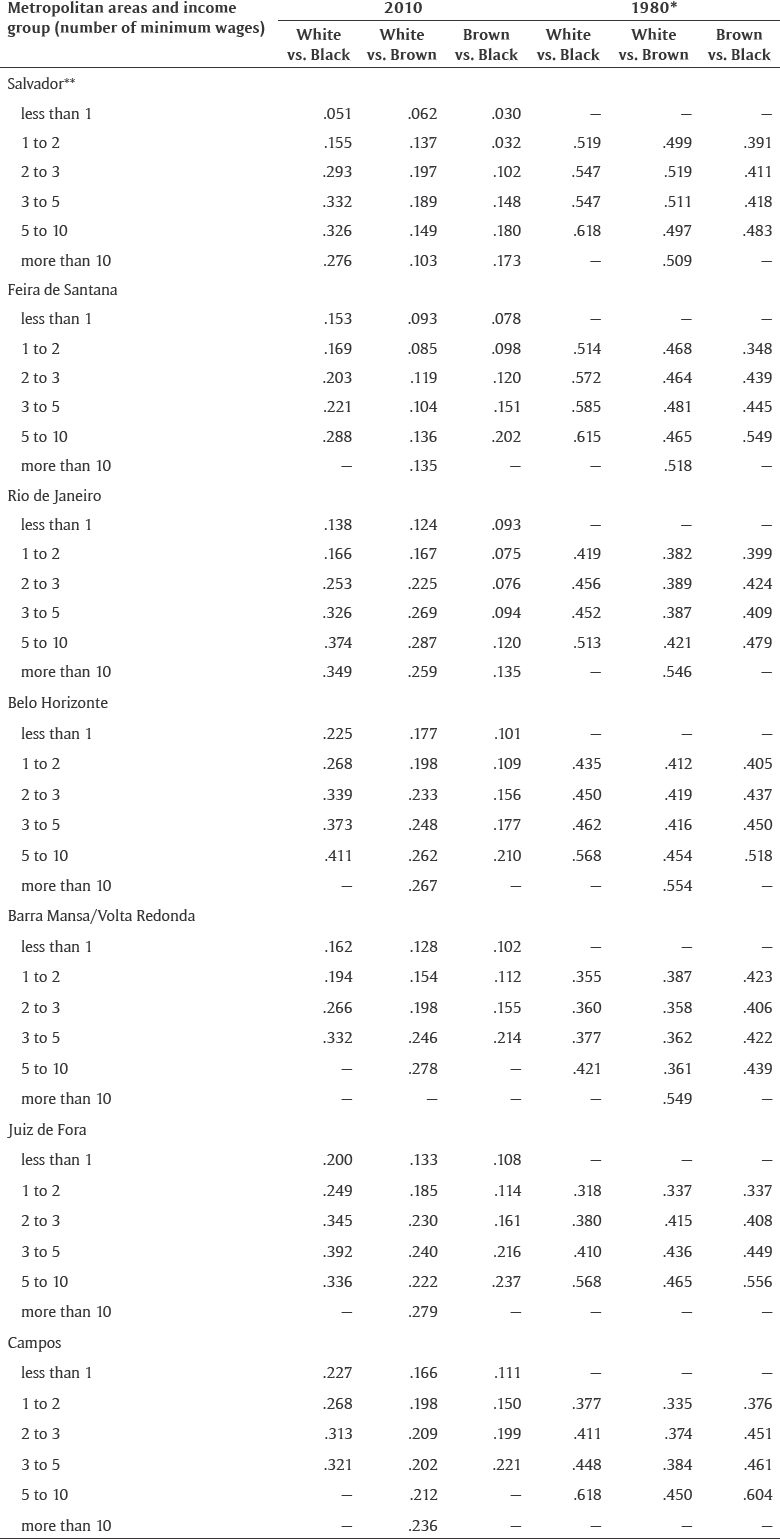
* Data from Telles (Reference Telles1992); the maximum income category in 1980 was 10 to 20 minimum wages, in the 2010 census this category is “more than 10 minimum wages.”
** Data for Salvador were only available at the subdistrict level; the remaining cities’ dissimilarity index was calculated at the neighborhood (bairros) level.
Discussion
Our analysis shows that residential segregation in Brazil has decreased in the thirty years from 1980 to 2010. Nonetheless, even when controlling for income categories, dissimilarity indexes remain low to moderate throughout. Why should this be?
Internal migration has been responsible for the rapid urbanization of Brazilian metropolitan areas in the last decades. From 1980 to 2010, Brazil’s urban population grew from 67.70 to 84.40 percent of the total population (Reference AmaralAmaral 2013a; IBGE 2010a). This migration is typically attributed to the poverty and lack of opportunities in the northeast region combined with a concentration of industries and job opportunities in the southeast, particularly in the state of São Paulo (Reference AmaralAmaral 2008). An important feature of this process is that migrants from the northeast tend to be nonwhite (mostly brown) and women (Reference AmaralAmaral 2013a). As increasingly more people move to the cities, limited housing spaces result in crowded, low-income areas. The predominantly white upper classes continue to segregate themselves, while the middle and lower classes have experienced the most significant decline in racial segregation, particularly white-black and white-brown segregation. Thus, the Afro-Brazilian middle class is becoming more spatially similar to middle-class whites than rich Afro-Brazilians are to rich whites. The low racial segregation among the poorest urban groups in Salvador, Feira de Santana, and Rio de Janeiro, for example, posits that the extremely limited residential choices make race irrelevant when choosing housing. Families who earn less than the minimum wage live in very precarious conditions, often in illegal settlements, where they are deprived of any choice. Racial segregation is therefore more likely to happen at the highest income levels, where an array of housing options is available and race can become a criterion in neighborhood selection.
The majority of the metropolitan areas have displayed higher levels of brown-black segregation in comparison to white-brown segregation. Coincidentally, studies have shown that in recent years, marriage between whites and browns has increased significantly, particularly in comparison to marriage between pardos and negros (Reference Ribeiro and do Valle SilvaRibeiro and Silva, 2009). The odds of whites and pardos getting married increased from .135 in 1960 to .239 in 1980, and to .411 in 2000, and the proximity between whites and pardos was significantly greater than that of pardos and negros. Given that marriage is, in general, an intimate and long-lasting relationship, the type of intermarriage—race, nationality, religion, socioeconomic status, and so on—can be used as a measure of barriers that separate racial groups, as well as of mutual acceptance of members of these groups (Reference Ribeiro and do Valle SilvaRibeiro and Silva 2009). This would certainly contribute to the reduction of segregation between whites-browns, as observed in this study.
Another possible explanation for the decline of white-brown residential segregation levels comes from the extensive literature on anti-blackness in Brazil (Reference AlvesAlves 2018; Reference Ribeiro and do Valle SilvaRibeiro and Silva 2009; Reference Hordge-FreemanHordge-Freeman 2015; Reference MitchellMitchell 2010; Reference Vargas, Jung, Vargas and Bonilla-SilvaVargas 2011; Reference NogueiraNogueira 2008; Reference NolenNolen 2015; Reference Roth-GordonRoth-Gordon 2017; Reference SheriffSheriff 2001; Reference TellesTelles 2014; Reference TwineTwine 1998). Pardos motivated by an ideology that promotes whitening are moving closer to white neighborhoods, marrying white partners, and are distancing themselves from blacks. Many blacks or browns (morenos or pardos) in Brazil do not identify with their African heritage and even discriminate against family members who have darker skin color and noticeable African phenotype, whom they perceive to be black (Reference Hordge-FreemanHordge-Freeman 2015).Footnote 11 As Alves (Reference Alves2018) noted, “as expected for a society organized around anti-blackness, other nonwhite individuals participated in anti-blackness politics. Some of them could unambiguously fall into the ‘negro’ category of the complex schema of racial classifications in Brazil, but would deny their blackness” (Reference AlvesAlves 2018, 90). Similarly, Roth-Gordon (Reference Roth-Gordon2017, 131) stated that, “within Brazilian racial ideology, the practice of embranquecimento emphasizes the inferiority and undesirability of blackness as the nation, families, and individuals needed to racially improve through their connections with whiter people and the acquisition of ‘whiter behaviors.’”
Although our findings demonstrate that segregation by race or income is decreasing, the indexes still show an overwhelmingly moderate racial segregation for the majority of metropolitan areas analyzed; after thirty years, residential segregation in Brazil can still be characterized as low to moderate. These results carry important implications for social theory: although socioeconomic status does not account for the residential segregation observed in Brazilian metropolitan areas, as suggested by some studies (cf. Reference CorrêaCorrêa 1989; Reference Costa PintoCosta Pinto 1953; Reference VasconcelosVasconcelos 2004), these segregation levels contribute to the general perception that race is not important in determining life chances and perpetuates an ideology that denies racism. Yet, as seen in Table 3 and in the online appendix, residential segregation among racial groups still occur among members of the same income group, particularly white-black segregation.
Future research on racial segregation in Brazil should consider analyzing racial segregation in a smaller scale. Recent studies using new quantitative indices of residential segregation that operate at the level of streets and next-door neighbors have shown that traditional measures of racial segregation can obscure a substantial amount of within-district segregation (Reference Grigoryeva and RuefGrigoryeva and Ruef 2015; Reference Logan and ParmanLogan and Parman 2017). Using a smaller geographical scale will probably reveal a more augmented level of racial segregation than what we observed, particularly in places like Rio de Janeiro and São Paulo, where nonwhite and white neighborhoods abut each other, as illustrated in Figure 4.
Paraisópolis shantytown in São Paulo, bordering the affluent Morumbi neighborhood. Photo by Tuca Vieira.
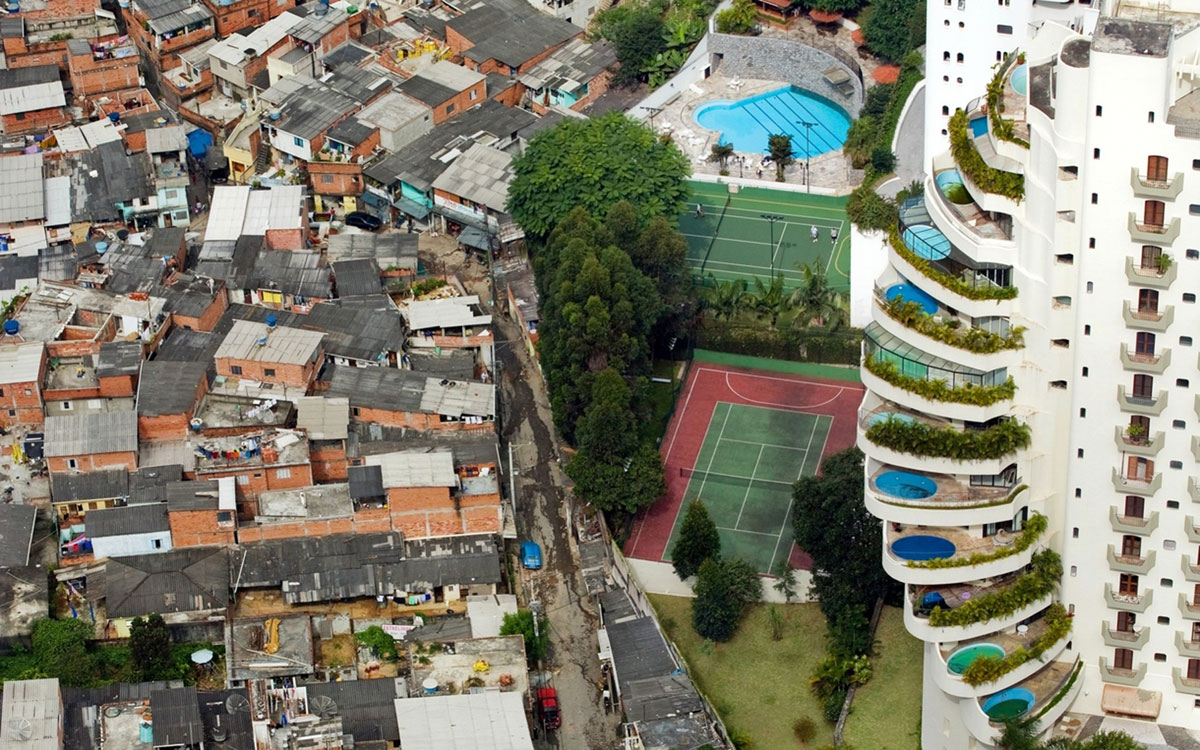
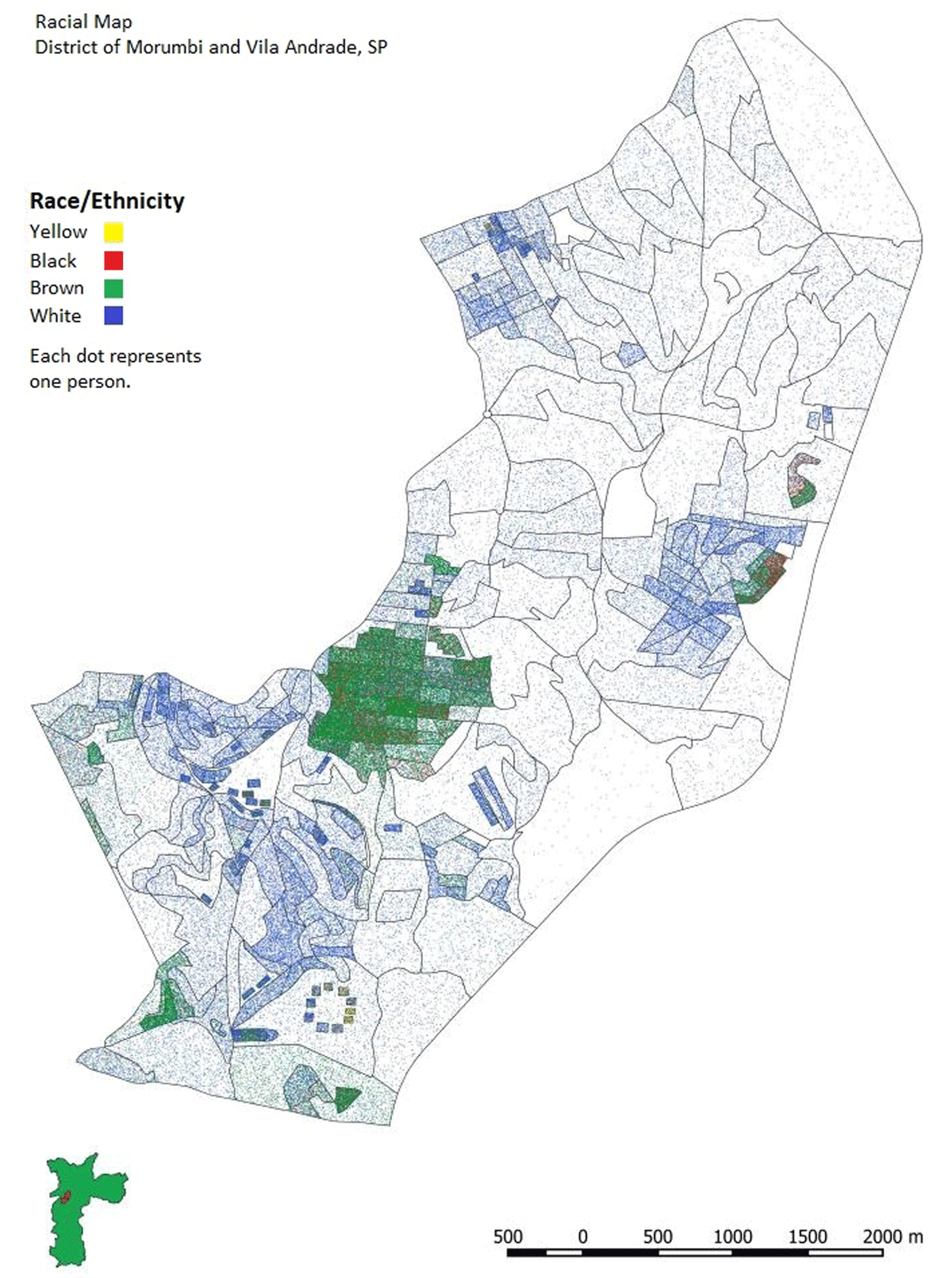
In many metropolitan areas, favelas (shantytowns), predominantly occupied by brown and black residents, are located alongside some of the most expensive real estate in Brazil. For example, Figure 5 exposes the racial distribution in the affluent districts of Morumbi and Vila Andrade in the city of São Paulo. Although the unit of analysis used to draw this map are census tracts, we can clearly observe that these two districts are predominantly white, and that browns and blacks are concentrated in a few areas, such as the Paraisópolis favela (the large green conglomerate in the left side of the map), the favela Real Parque in the right side of the map, and the Jardim Panorama favela, located above the Real Parque favela (Reference GusmãoGusmão, 2015a).
Racial map, district of Morumbi and Vila Andrade. Data source: IBGE 2010. Map created by Hugo N. Barbosa de Gusmão (Reference Gusmão2015a).
The same pattern emerges when examining Rio de Janeiro. The most prestigious neighborhoods in the south of Rio (Copacabana, Ipanema, Leme, Leblon, Gávea, Jardim Botânico, and Lagoa) are located along the beaches, where housing prices are the most expensive and residents are predominantly white, while blacks and browns are clustered together in poor neighborhoods and shantytowns clearly observable in Figure 6.
Racial map, neighboorhoods in the south zone of Rio de Janeiro. Data source: IBGE 2010. Map created by Hugo N. Barbosa de Gusmão (Reference Gusmão2015b).

Conclusion
In recent years, there has been a fair amount of debate about the extent to which US race relations and segregation patterns have come to resemble those of Latin America (e.g., Reference Bonilla-Silva, Glover, Krysan and LewisBonilla-Silva and Glover 2004; Reference SueSue 2009). The lower mean for residential segregation in 2010 across all dyadic comparison groups (white-black, white-brown, brown-black) might suggest that the racial pattern of housing in Brazil has become more fluid over the last couple of decades, while US residential segregation is still relatively high by comparison. At the same time, the substantial levels of segregation between whites and residents of color in the high-income areas of cities such as Rio de Janeiro and Belo Horizonte could be an indication that American-style segregation is taking root in some pockets of Brazilian society. In addition, studies of Latino segregation in the United States also find differences by race that parallel those observed in Brazil, with segregation between white Latinos and non-Hispanic whites being relatively low, segregation between black Latinos and non-Hispanic whites being quite high, and segregation between mixed-race Latinos and non-Hispanic whites falling in-between (Reference Iceland and NelsonIceland and Nelson 2008; Reference Iceland and WilkesIceland and Wilkes 2006).
This article provides evidence of a significant move toward racial equality and possible abatement in housing discrimination. However, despite the decline in racial segregation in recent decades, residential integration may not be sufficient to facilitate structural assimilation in political, economic, and educational domains. Grave disparities in income, educational achievement, labor force participation, and political representation between blacks and whites remain prevalent in the Brazilian society. While the findings in this study are encouraging, it remains to be seen whether residential gains can continue in years to come, and can facilitate other forms of structural integration.
Additional File
The additional file for this article can be found as follows:
• Appendix. Index of Dissimilarity for Specific Cities by Income Group. DOI: https://doi.org/10.25222/larr.83.s1
Acknowledgements
We thank the Instituto Brasileiro de Geografia e Estatística (IBGE) for providing us the dataset used in this article. In addition, our special thanks to Hugo Gusmão, who graciously allowed us to use his maps to illustrate current residential racial segregation in Brazil, and to Tuca Viera, who generously allowed us to use his beautiful and yet shocking photograph of Paraisópolis favela next to its wealthy neighbour, Morumbi, showcasing inequality in Brazil.




 Open access


