Between 1924 and 1930, Berlin's municipal government pursued an ambitious programme of urban expansion, driven by social reform measures. At the heart of this project, mirrored across many other towns and cities in Germany that were under Social Democratic control, were modern housing estates designed by a new generation of architects, intended to replace the country's notorious nineteenth-century inner-city tenements. This programme of house building and urban development has been frequently referred to by historians as the Republic's Neues Bauen (new building) programme.Footnote 1 In Berlin, chief urban planner Martin Wagner and leading architect Bruno Taut led the campaign to construct cheaper, healthier dwellings for the middle and working classes. Other components of this combined programme of urban expansion and social reform included extending public transport networks, and building public parks, sports fields and healthcare facilities.
The Neues Bauen programme was reliant upon governmental reform and large volumes of capital for its success. The Republic's constitution, drawn up in the historic town of Weimar in August 1919, went some way to fulfilling the first of these requisites. Article ten of the constitution gave the government greater power in the control of land rights, land distribution and the compulsory acquisition of land for housing.Footnote 2 The Reichssiedlungsgesetz (State Settlement Law), passed at the same time as the national constitution, set out the implications of the land reforms in greater detail. The law obliged Germany's federal states to set up non-profit-making building societies, and provided them with further powers to procure land through dispossession orders.Footnote 3 Finding the capital required to start the building programme was more problematic, given the economic crisis Germany found itself in after World War I. It was not until the stabilization of the German economy in late 1923, and the implementation of the Dawes Plan in 1924, which enabled significant amounts of foreign capital to flow into Germany, that building could begin. The five-year period between 1924 and 1929, a period often referred to by historians as Weimar Germany's period of ‘relative stability’, witnessed unprecedented levels of building activity in German cities.Footnote 4 Berlin was no exception, with around 140,000 new homes built in the city between 1924 and 1931.Footnote 5
With its coffers filled with funds, raised through a combination of foreign investment and a special tax on profits made on property during the hyperinflation of 1922/23, the municipal authorities in Berlin made significant acquisitions of land for development. These acquisitions included nearly 600 hectares of feudal estate in the south-eastern suburb of Britz, at a cost of nearly 6 million Reichsmarks, for the construction of two housing projects. One of these projects was Bruno Taut's celebrated Horseshoe estate, built between 1926 and 1932.Footnote 6 Inevitably, such wholesale transformations of land, driven by an aggressive policy of urban development and a sense of urgency in the need to improve inner-city conditions, disadvantaged some urban inhabitants, even if it improved the lives of many others. Berlin's statistical handbooks, published annually by the municipal authorities, record amongst other things the various types of land use found in each district of the city. These land use statistics indicate clearly that, aside from empty and undeveloped land, the city's garden colonies frequently had to concede space to new urban developments. Between 1925 and 1929, the total area occupied by garden colonies in Greater Berlin declined from 5,793 to 4,448 hectares, a reduction of nearly a quarter.Footnote 7
Germany's garden colonies in a wider European context
The 1925 figure of 5,793 hectares constituted over 6.5 per cent of the total area of the administrative district of Greater Berlin in the Weimar era, an area capable of containing enough garden plots to support over half a million of the city's 4 million inhabitants, or more than an eighth of the total urban population. These figures clearly indicate the significance of the garden colonies to the inhabitants of Berlin at this time, a significance that endures to the present day, and which many non-Germans may likely be surprised at.Footnote 8 We can improve our appreciation of the importance of the garden colonies to the inhabitants of Germany's towns and cities by situating them in the broader context of a European-wide movement. To do so requires us to look first at the German garden's origins: the so-called Schrebergärten that emerged in the 1860s, and named after the German physician and health campaigner Moritz Schreber. The Schrebergärten were allotment gardens, and their appearance on the outskirts of cities such as Berlin and Leipzig in the mid-nineteenth century coincided with allotments becoming established in many of the major urban centres of other European countries. The allotment gardens that grew on the outskirts of cities such as London, Moscow, Paris and Berlin all emerged from similar conditions and prerequisites. In many cases, they were first made possible by both the freeing up of land and labour. In Britain, the Enclosures Acts of the late eighteenth and early nineteenth centuries gave rise to the first allotments for the landless poor,Footnote 9 while in Russia, the abolition of serfdom in the 1860s saw increasing numbers of allotments appear in which ‘semi-feudal’ practices such as sharecropping persisted.Footnote 10 However, it is not with such preconditions that I am interested, but with a more universal, European-wide factor that contributed to the emergence of the allotments: namely, the wave of industrialization taking place across Europe during the nineteenth century. Europe's major urban centres were becoming increasingly populated by a manual workforce, most of whom had recently migrated from the surrounding countryside. These new members of the urban population, many of whom lived impoverished existences, set up allotments as a means of providing themselves with a reliable source of sustenance. The first allotments, then, were a product of proletarian culture; an ‘essentially urban phenomenon’, growing out of increasing working-class self-organization. They were also the product of a nascent socialist movement, whose creators were an industrial proletariat ‘only one generation removed from rural life’.Footnote 11
But the Schrebergärten of German cities such as Berlin and Leipzig went on to develop beyond most of their European equivalents, into the recognizable form of the Kleingarten colonies that still populate these cities today. German gardeners went further than most of their European counterparts in adapting the functional tool shed standing at the centre of the allotment into a more substantial structure: a summerhouse, transforming the allotment from a utilitarian, frequently patriarchal domain, into a family-orientated refuge and source of recreation. Only in neighbouring Denmark, and then, in the first years of the twentieth century, Sweden, did the garden colony evolve or appear in a similar form to that in Germany.Footnote 12 In many other European countries, the allotment simply did not evolve to quite the same extent. In British cities, the preponderance of Victorian terraced homes, with their private back gardens, negated any need for allotment sheds to develop into summerhouses, in which families could spend the day or sleep over. Likewise, in France, the allotment retained its principal function as a site of food production.Footnote 13 In Russia, the allotment system remained an integral component of proletarian urban life, but the dachas – once the exclusive domain of the aristocratic classes, but by the early twentieth century more accessible to a wider stratum of Russian society – still remained financially out of reach of the vast majority of workers.Footnote 14 If one wanted to evaluate the historic importance of allotments and garden colonies across the major European cities, one need only look at the spaces that today's allotments and colonies occupy. The allotment gardens of London and Paris are frequently squeezed into spaces impractical for more beneficial economic use: most commonly alongside railway embankments, and other irregularly shaped patches of land. By contrast, Berlin's garden colonies commonly occupy regularly shaped blocks of prime real estate, in close proximity to the city centre. Why the German gardens evolved as they did is not the prime focus of this study – though the question certainly merits closer attention elsewhere. One plausible explanation is the sharp dichotomy that permeated German thought in the late nineteenth century, between rural community (Gemeinschaft) and urban society (Gesellschaft). Borne out of this was a deep-rooted love amongst Germans of rural life, an ideology that situated the Landhaus (country home) at the centre of the German domestic ideal, and was deeply suspicious of urbanism and urban development in general.Footnote 15 Whatever the reasons, by the end of the nineteenth century, the German garden colonies had evolved into a highly organized network of clubs and associations, that could be found in most major towns and cities of the country, and whose members were predominately working class.
But despite the fact that Germany's garden colony culture has its roots in those dramatic and well-documented demographic shifts of the late nineteenth and early twentieth centuries, which saw the rise of our great modern cities, the development of the garden city movement, popular anti-urban sentiment and rural idealism, it has remained an important cultural form that has been largely overlooked by Anglo-American historians, because, I think, of the marginal status afforded to allotment gardens outside of Germany and the Scandinavian nations. Indeed, if one wants to assess the historical significance of the gardens to Germany's urban population, one should be prepared to explore Alltagsgeschichte (history of everyday life) accounts and oral histories to find relevant material, and this largely remains available only in the German language.Footnote 16 Which is a shame, because the growth in popularity of the garden colonies, from their emergence in the nineteenth century, to the peak of their popularity during the Weimar era, is an integral component of Berlin's historical urban development. Even more importantly, the garden colonies demand greater attention from urban historians because they offer an alternative perspective to our current understanding of Weimar Germany's programmes of urban development which, in Anglo-American studies, remain dominated by narratives focusing on the relocation of the inner-city population, from dingy tenements into bright, modern suburban housing estates, and especially those, in the case of Berlin, that had been designed by Bruno Taut.Footnote 17 This article seeks to address this blind spot by looking in detail at two particular instances of urban expansion in Weimar Berlin, placing an emphasis not on the modernization schemes in question, but on the displacement of garden colonies and their gardeners which they entailed.
The historical development of Berlin's garden colonies
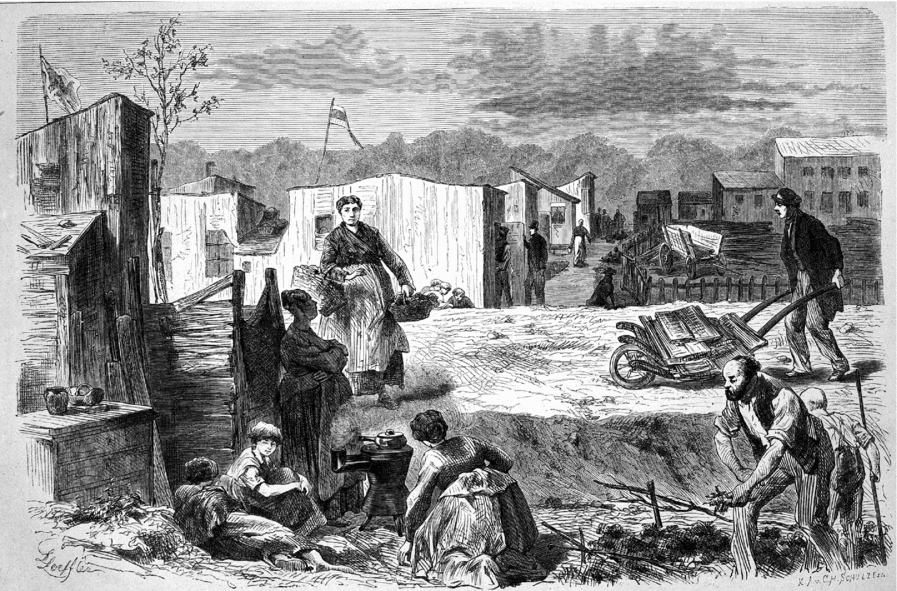
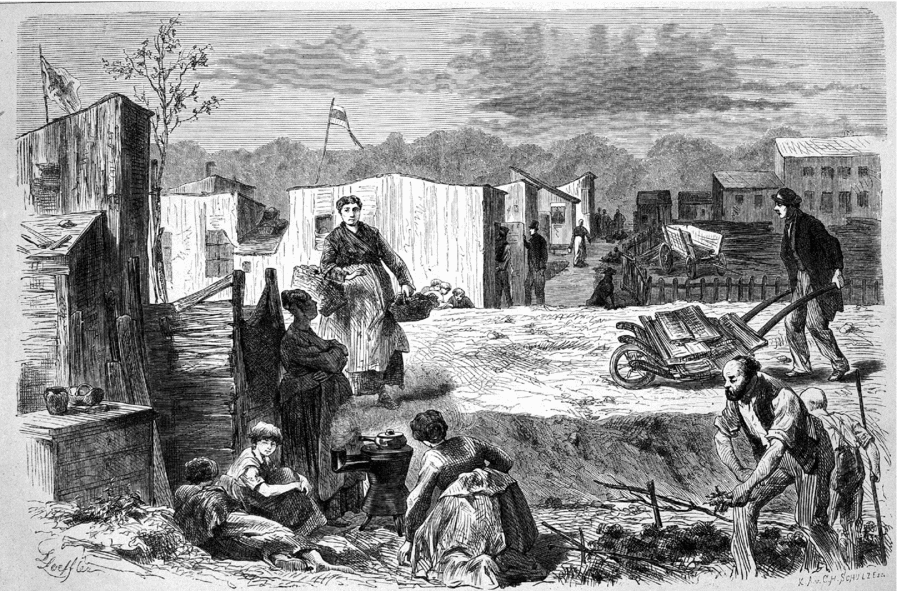
As already briefly discussed, Germany's garden colonies evolved markedly from their allotment garden origins, and it would be useful now to look in more detail at the historical development of the garden colonies. Still hugely popular in Germany's cities today, what is now known by Germans as the Kleingarten (small-garden) movement emerged in the nineteenth century. From around 1830 onwards, self-sufficient families living on the outskirts of cities such as Berlin and Leipzig set up allotment gardens in order to grow produce and keep livestock. By mid-century, social reformers across Germany were setting up allotments for the poorer inhabitants of urban areas. On the outskirts of Berlin, in the areas around Oranienburger Strasse and Prenzlauer Berg to the north and the Kottbuser and Schlesischen gates to the south, migrants grew vegetables and reared animals upon a landscape comprised largely of desolate sand dunes and marshland, amid the city's refuse dumps.Footnote 18 The early 1870s witnessed a massive influx of migrants into the city, attracted by the growing employment opportunities on offer in the city's new factories and foundries. Between 1871 and 1875, 155,000 immigrants arrived in Berlin.Footnote 19 This sudden influx precipitated an acute housing shortage, resulting in many allotment gardens outside the city walls becoming inundated and transformed into slums occupied by the poor and homeless. These settlements were given the name Barackenstädte, or barrack cities, by contemporaries (Figure 1). The worst of the slums collected outside of the city's Frankfurter and Landsberger gates to the east, and the Kottbuser gate to the south.Footnote 20 One contemporary observer, visiting a Barackenstadt beyond the Kottbuser gate in 1872, wrote:
Here, where the urban culture ends, a number of wooden huts stand on both sides of the route, most of which are thrown together from rough boards, similar to the tradesmen's stalls found at the annual markets. Here and there just a wooden frame, covered by canvas for protection against the weather, frequently with a floor made of just cardboard, scarcely covered by mulch.Footnote 21
L. Loeffler, Die Barackenstadt von Berlin, engraving, 1872. From M. Ring, ‘Ein Besuch in Barackia: Berliner Lebensbild’, Die Gartenlaube (1872), 458–61.
Unsurprisingly, tensions quickly emerged between Berlin's authorities and the slum dwellers. The authorities eyed the slums with concern, viewing them as hotbeds of villainy and subversive socialist ideas, while the slum inhabitants became increasingly exasperated at the lack of action being taken over the housing shortage. These tensions reached a climax in the summer of 1872, culminating in angry slum dwellers rioting through the city centre, prompting the police to clear by force the slums to the east of the city.Footnote 22
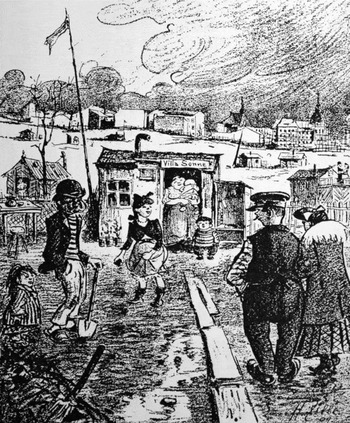
Over the following decades, the distinction between the Schrebergärten and the Barackenstädte became increasingly blurred. As migrant workers and their families found accommodation in the new but barely adequate tenements being built at the edges of the city, they dedicated any spare time they had to transforming the former slums into summerhouses and gardens. Here, the proletariat could escape from the ‘stone cages’ of the tenements and the ‘soot and iron [and the] pounding of the machines’ in the factories.Footnote 23 Families took increasing pride in their patch of land, building themselves a summerhouse (Laube) and planting flowers and crops. The summerhouses gave the colonies their new name: Laubenkolonien. The Berlin artist Heinrich Zille frequently drew romanticized scenes of proletarian life in the Laubenkolonien around the turn of the century, which emphasize the autonomous nature of working-class gardeners and the pleasure they derived from their gardens (Figure 2).
Heinrich Zille, Whoever Trusts in God and Filches Planks, Builds Himself a Fine Summerhouse!, c. 1900.
Source: G. Katsch and J.B. Walz (eds.) Kleingärten und Kleingärtner im 19. und 20. Jahrhundert (Leipzig, 1996). Thanks to Dr Debbie Lewer for her help in the translation of the caption.

The popularity of the garden colonies can be attributed to the fact that the vast majority of Berlin's industrial proletariat had until quite recently lived rural, agricultural lives. Between 1870 and 1910, Berlin's population soared from 824,000 to over 2 million, an increase largely brought about by inward migration from the rural hinterlands of Pomerania and Silesia, to the north and east of the city.Footnote 24 The gardens offered Berlin's industrial workforce a sustained connection to their earlier social customs, and a setting in which they could continue to appreciate the changing seasons, grow fresh produce and keep livestock.Footnote 25 The enduring importance of the gardens as a link to nature was reflected in the names later given to many colonies, for example, Grüne Allee (Green Alley), Freiheit (Freedom), Naturfreunde (Nature Friend) and Gute Ernte (Good Harvest).Footnote 26
Ironically, it was Berlin's unregulated, profits-driven building industry – responsible for creating the city's monstrous tenement blocks – that helped foster the burgeoning garden colony movement. Berlin's proletariat found respite from one by retreating to the other. Between 1871 and World War I, Germany's economy endured a roller-coaster ride of boom and bust, resulting in wildly fluctuating numbers of migrants arriving in cities like Berlin each year. These variations in turn had a profound effect upon the demand for housing, and upon construction costs and land prices. The Baulöwen (property magnates, or, more literally, building lions) who purchased tracts of land surrounding Berlin had to play the market with care and patience. If a landowner chose an economically inappropriate time to build housing, financial ruin was highly likely, but choosing the right time to begin construction could deliver handsome profits. Rather than leave their land lying fallow and unproductive while waiting for an opportune moment to commence development, landowners entrusted their plots to building societies who rented the land to gardeners. The two parties drew up leaseholds, subject to renewal on an annual basis, ensuring that the landowner had the opportunity to take back control of his land once a year, should the prospect of profitable development look encouraging. The uncertainty over the future did little to dull the ordinary Berliner's enthusiasm for the gardens. From one year to the next, they transformed their plots of sandy, unpromising soil into colourful, fertile spaces.Footnote 27
At the turn of the century, some 40,000 gardens lay around the edges of the city, ‘more or less distributed arbitrarily across any free spaces that were either state, church or private property’. These gardens could support 180,000 of Berlin's nearly 2 million inhabitants, or 10 per cent of the total urban population.Footnote 28 Moreover, under the auspices of the Social Democratic movement, the gardens had become increasingly organized affairs. Gardens collected together to form colonies, and gardeners set up loosely organized associations to represent their collected interests, particularly with regard to the renegotiation of the annual leasehold agreements.Footnote 29 Within the colonies, a recognizable spatial organization began to emerge. Capitalizing on their increasing popularity, the city's breweries set up Gartenlokale (beer gardens) in the colonies, which sat alongside a central square in which the garden associations organized special events, including children's festivals and, most important of all, the annual harvest festival.Footnote 30 As early as 1900, publishers began to exploit the growing popularity of the garden colonies, producing practical how-to guides for the discerning gardener. One handbook exclaimed that ‘surely nowhere else are the Laubenkolonien as familiar and esteemed as in the surroundings of Berlin’.Footnote 31
Then came World War I and the subsequent revolutionary and economic crises, which brought to an abrupt halt Berlin's rising fortunes and prosperity. However, the challenges encountered between 1914 and 1924 did little to dull the ordinary Berliner's enthusiasm for the garden colonies. On the contrary, the colonies reverted to their earlier principal function as a site of food production at a time when basic provisions were in short supply, and currency practically worthless. The new republican government was quick to recognize the important social role the gardens had played during the war. In July 1919, Reichspräsident Friedrich Ebert and his nutrition (Ernährung) minister Robert Schmidt signed the Reichskleingartengesetz (Small Gardens Act), which pledged to guarantee greater future protection for the colonies against the continued threat posed to them by property developers.Footnote 32 Two years later, garden supporters founded the Reichsverband der Kleingartenvereine Deutschlands (RKGD) (Union of German Small Garden Associations), an organization without political ties, which committed itself to establishing permanent, protected garden colonies. The RKGD recruited some 300,000 members across Germany in the space of three years.Footnote 33 By the end of 1929, Berlin alone had 853 Kleingarten associations with 66,750 members.Footnote 34 A Social Democratic publication from this year calculated that there were over 126,000 small gardens in the city, used by over half a million people – more than an eighth of the city's population.Footnote 35
It is crucial at this stage to acknowledge the important linguistic revision that occurred in official references to the garden colonies in the 1920s. Both the 1919 act and the 1921 association referred to the colonies as Kleingärten rather than Laubenkolonien, alluding to an important growing distinction between the two terms. On one hand, ministers and reformers promoted the Kleingarten colonies as official and organized affairs for Berlin's gardeners. Meanwhile, the older term Laubenkolonien became increasingly associated in the press with the unauthorized and ad hoc settlements created by the city's poorest inhabitants, which had their historic precedent in the slums of the 1870s. Workers’ papers such as the Arbeiter-Illustrierte-Zeitung were more inclined to refer to the gardens as Laubenkolonien, in which workers celebrated the harvest festival, or struggled to survive amid the continuing housing shortage.Footnote 36 By contrast, the Social Democratic daily newspaper Vorwärts, and the various monthly gardening magazines, preferred the term Kleingarten. Embodying this semantic shift was the magazine Der Laubenkolonist, first published in 1903 to represent the interests of gardeners around Berlin, and which changed its name in 1921 to Der Kleingärtner.Footnote 37 Throughout the twenties Berlin's authorities tacitly undertook a programme of Laubenkolonie clearances, a policy which was in fact the reverse side of their Neues Bauen programme of house building and establishing public parks and official Kleingarten colonies.
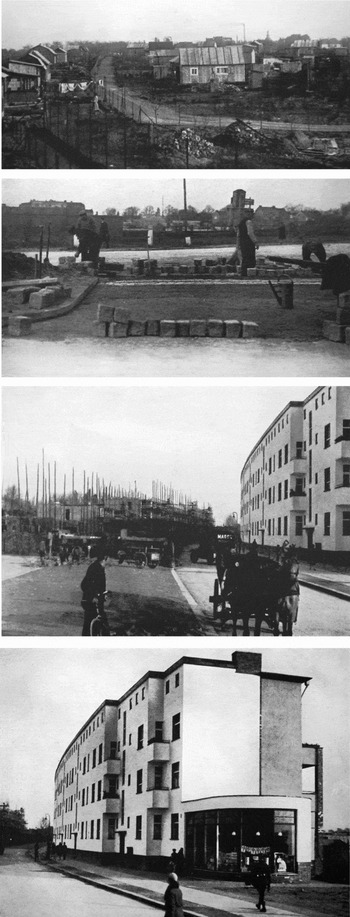
This implied programme is revealed in a sequence of photographs that accompanied an editorial feature in the March 1929 issue of Das neue Berlin, a short-lived journal dedicated to city planning, edited by Berlin's chief urban planner Martin Wagner and architectural critic Adolf Behne. The feature in question, an interview conducted by Behne with Wagner on the increasing financial difficulties facing housing production in Berlin, was accompanied by a sequence of photographs taken by the renowned Weimar photographer Sasha Stone (Figure 3).Footnote 38 The five photographs, distributed throughout the eight-page article, constructed a narrative of the transformation of land on the outskirts of Berlin, from makeshift huts and gardens into modern housing estate. The first photograph presented a panoramic view of allotments and huts in Weißensee, at that time still a predominantly rural district in north Berlin. The allotments are made up of rickety sheds and scrap heaps. An unmade track weaves through the plots and in one garden, a woman is hanging out her washing. In the second photograph, there is no sign or trace of the allotments. Instead, we see labourers constructing a new road surface, laying down paving stones upon a prepared gravel surface. In the third and fourth scenes, new housing blocks are shown during and after construction. The blocks in question comprised part of the Buschallee development, an estate of 568 flats designed by Bruno Taut, and constructed in Weißensee between 1928 and 1930.Footnote 39 The fifth and final photograph showed a furniture delivery van parked outside one of these new housing blocks. The continuity of the narrative is maintained throughout the photographs, and offers us an alternative perspective on Weimar Berlin's urban development programme, which also correlates to the broader aims of the new German republic, in other words: a desire to sweep away the old and create a modern ordered society.
Sasha Stone. Four photographs taken from M. Wagner, ‘Das Berliner Wohnungsproblem – ein Interview’, Das neue Berlin, 3 (1929), 50–7. Reproduced from: Das neue Berlin (facsimile) (Basel: Birkhäuser, 1988).

Garden colonies in Berlin-Wedding during the Weimar era
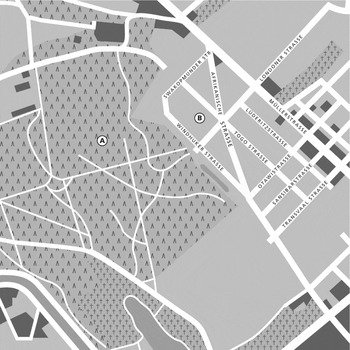
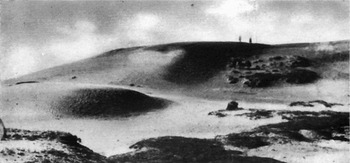
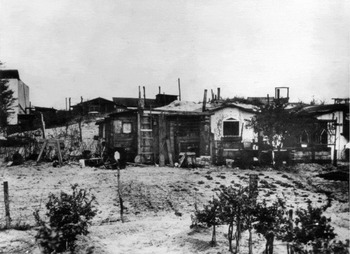
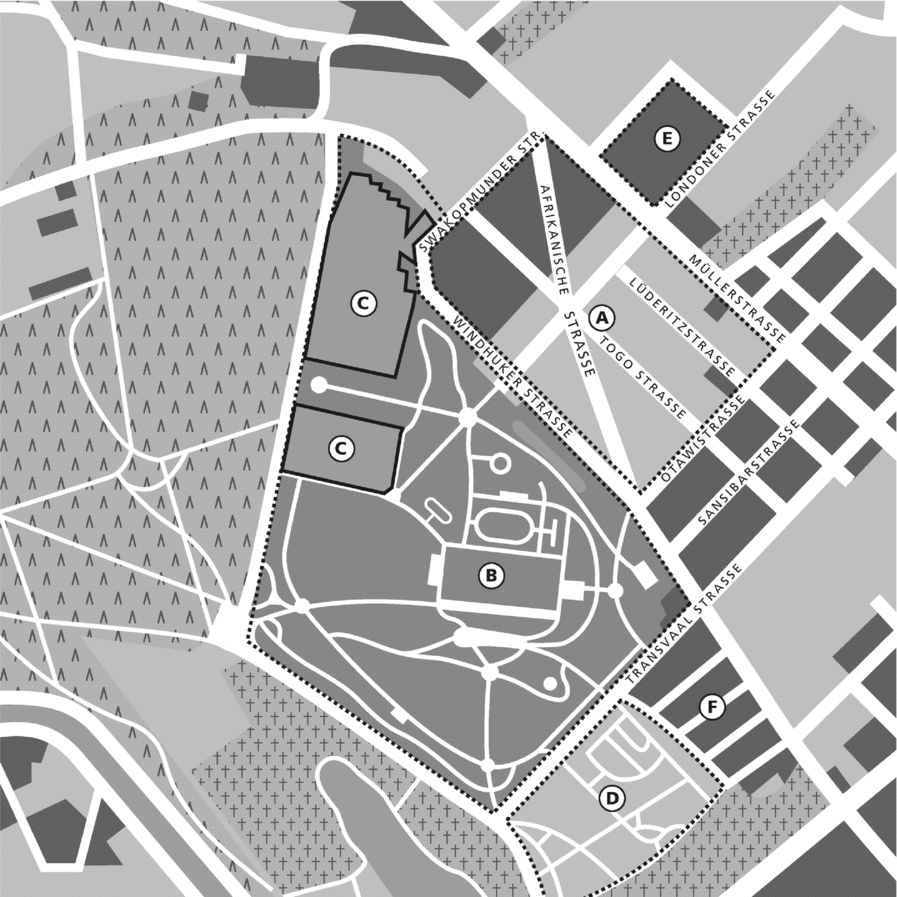
The effects of Berlin's urban development programme upon the garden colonies between 1924 and 1930, as suggested by Stone's photographs, can be illustrated by looking at developments in another district of north Berlin: Wedding. With a population of 350,000 inhabitants, Wedding was Berlin's most populous district, and had a distinctly industrial character. Two-thirds of Wedding's population were working class, and the district was home to some of Berlin's largest industrial organizations, including the electrical-engineering giant AEG. In 1924, there were in excess of 75,000 workers employed in Wedding's many factories.Footnote 40 During the late twenties the northern half of Wedding, which had largely escaped urban development until this point, underwent significant changes, with the construction of several large housing estates and a huge public park. Prior to the commencement of these projects, the majority of this area comprised large swathes of forest, meadows, marshes and sand dunes, into which urban development from the south and east was slowly beginning to encroach. The area I want specifically to study is shown in Map 1, which illustrates the extent of urban development (shown in black) in the area in 1925. Wedding's main thoroughfare, Müllerstrasse, can be seen in the top-right corner of the map. This route connected the centre of Berlin to the south with the outlying town of Tegel to the north. The western half of this area was dominated by the Jungfernheide forest (area A on the map). Directly to the east of the Jungfernheide lay a sandy wasteland known as the Rehberge (Figure 4).Footnote 41 Upon this area, a network of new streets had been arranged in the first years of the century, known by Berliners as the Afrikanisches or Kolonial Viertel (African or colonial quarter), reflecting Germany's one-time imperial ambitions on the African continent (area B). A number of garden colonies dominated swathes of this area, some of which were large and well-organized affairs, such as the Zur fröhlichen Rehberge colony that lay between Togostrasse and Müllerstrasse, while others were unauthorized settlements more closely resembling slums (Figure 5).
Development in the northern region of Wedding, c. 1925. Key: A Jungfernheide forest. B African quarter.

The Rehberge, c. 1925. From Bezirksamt Wedding von Berlin (ed.), Rechts und Links der Panke (Berlin, 1961), 58.

Otto Roth, Alte Laubenkolonie, Rehberge, Wedding, c. 1924. Landesarchiv Berlin, F Rep. 290, Nr 295261.

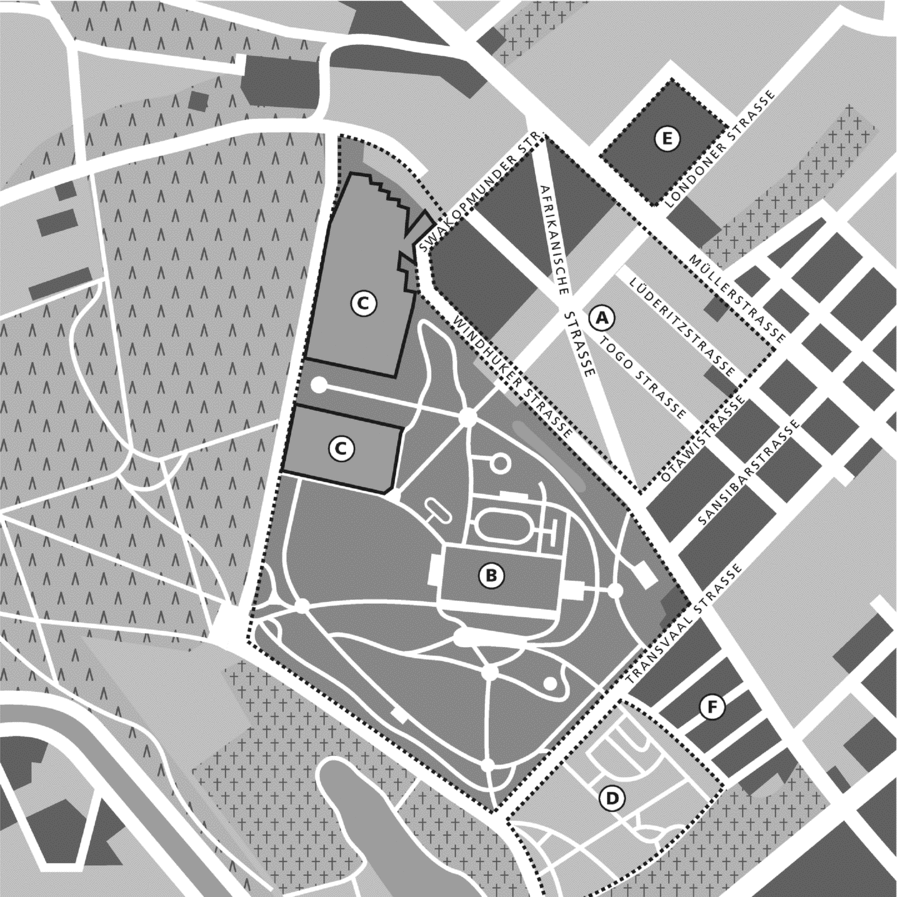
Map 2 shows the same area in 1932, transformed by numerous urban projects, including the Friedrich-Ebert housing estate (A), the Volkspark Rehberge (B), incorporating the Dauerkolonie (or permanent colony) Rehberge (C), the Goethepark (D), a combined streetcar depot and housing estate, designed by Jean Krämer (E), and the Jungfernheide homestead estate (F). The remainder of this article will concentrate on the planning decisions and execution of the first three of these projects: the Friedrich-Ebert estate, and the Volkspark and Dauerkolonie Rehberge, and the effect they had upon the gardeners and settlers who formerly occupied the land on which they were built.
Development in the northern region of Wedding, c. 1932. Key: A Proposed housing, including the Friedrich-Ebert estate. B Volkspark Rehberge. C Dauerkolonie Rehberge. D Goethepark. E BVG Streetcar depot. F Jungfernheide estate.
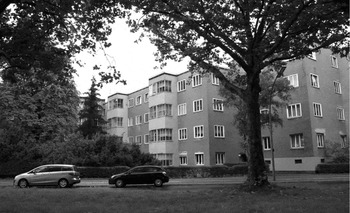
Proposals for the development of the Afrikanisches Viertel were first mooted in 1926 by a property development company, the Terraingesellschaft Müllerstraße, who owned the land in question. Development was thwarted after the company filed for bankruptcy, and it was not until 1928, when the Spar- und Bauverein Eintracht (Savings- and Building Society ‘Harmony’) purchased the land, that new plans started afresh. The society commissioned the Berlin architects Paul Mebes and Paul Emmerich – two of the city's most experienced housing designers – to come up with a proposal for the land, which was to comprise high-density housing and a school.Footnote 42 Rapidly rising land and building material prices meant that setting aside space amongst the housing blocks for gardens was no longer an economically viable option, and the final designs for the site proposed that three-quarters of its land be occupied by three- to five-storey housing blocks, arranged in parallel lines, in a fashion similar to other concurrent developments then underway in Berlin (Figure 6). The remaining quarter of the land was provisionally set aside for school buildings and playing fields. The implementation of Mebes and Emmerich's plans began in 1929 on the northern and eastern quarters of the site, which were to be filled with repeated rows of housing blocks. Mebes and Emmerich designed the blocks in the northern quarter, while Bruno Taut assumed responsibility for the design of the blocks in the eastern segment. These first two phases of development were completed in 1931, and were known collectively as the Friedrich-Ebert estate, in honour of the Republic's first president.
Friedrich-Ebert Estate, Wedding. Author's own photograph.

Even before work had began on this new estate, the garden colonists who occupied the land on which it was due to be built were well aware of their imminent fate. One commentator noted that these colonists, many of whom lived permanently in their huts, and who were ‘almost all workers, class-conscious proletariat’, were living in ‘an illusory world’:
The workers are farmers on notice. The land they have is only rented, and every day the monthly termination notice might arrive. The city needs this space for new housing blocks. The colonists will be evicted into the tenement districts. Overnight everything changes from splendour, and the land is churned up for a new world of stone.Footnote 43
The rapidly deteriorating economic conditions of 1929 indefinitely postponed further phases of building development in the Afrikanisches Viertel, which were to include more housing and a school in the area immediately south of the Friedrich-Ebert estate. It was not until 1936 that further housing was built upon the site. The revised plans, produced under National Socialist rule, abandoned the modern parallel blocks principle, reverting instead to building housing blocks around the edges of the plot. The original plans for a new school were abandoned entirely. The outcome of this planning change was that one garden colony, Zur fröhliche Rehberge, later renamed Kolonie Togo, was saved from clearance, and has remained on the site right up until the present day.Footnote 44
The remaining project to be looked at in more detail is the Volkspark Rehberge (containing the Dauerkolonie Rehberge), construction of which commenced in 1926, at a time when economic conditions were less volatile than they were to become in 1929, and less lucrative uses of urban land still remained viable. Berlin's municipal government purchased a portion of the feudal Jungfernheide estate in early 1926 at a cost of over 2 million Reichsmarks, with the intention of transforming the space into a vast public park.Footnote 45 The designer of the Volkspark Rehberge, Erwin Barth, envisioned his creation as a place of leisure and recuperation for Wedding's working-class population. The joy of these spaces, declared Barth, had become lost to the working classes, who visited them all too rarely. ‘The parks must have a social function’ he asserted.Footnote 46 The Berlin authorities set to work an army of unemployed labourers upon the Rehberge, transforming the area from ‘desert sand dunes’ into a series of compartmentalized and functional green spaces, of ‘spacious sports areas, broad meadows, and hills covered with trees and shrubs’.Footnote 47 The new park boasted numerous playing areas, paddling pools and sandpits for children, garden areas rich with plants and flowers for educational purposes, sports fields and a running track, a toboggan run for winter games, scenic walks and a new permanent garden colony.Footnote 48 Berlin's municipal authorities celebrated the opening of the park on 22 June 1929 with a Volksfest-style day of celebration. Just like the spaces of the park itself, the celebratory day was highly organized into various activities scheduled at specific times, and catering for children and adults of all ages. Relay races, gymnastics displays and other sports were staged alongside dancing and musical performances.Footnote 49
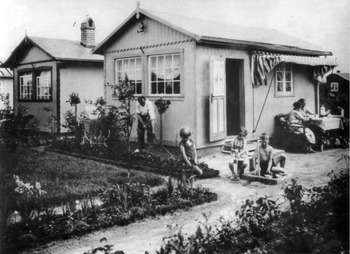
According to the writer Fritz Rück, the creation of the Volkspark Rehberge entailed the clearance of numerous garden colonies. Most of the gardeners and settlers displaced by the new park could not be relocated and, according to Rück, 348 disputes had to be settled by the Kleingarten court of arbitration.Footnote 50 Replacing the displaced gardens was a new type of colony known as a Dauerkolonie, or permanent colony. Several were proposed for Berlin, the first being intended as the centrepiece of the Volkspark Rehberge.Footnote 51 The Dauerkolonie Rehberge (Map 2, C) was wholly immune to the threat of urban development and, according to guidelines for the permanent colonies published in the magazine Kleingartenwacht in 1927, was expected to have cultural, healthful and recuperative benefits for the public, thus helping to ease pressure on the city's healthcare facilities.Footnote 52 In its organization and appearance, the Dauerkolonie was a far cry from the earlier Schrebergärten and Laubenkolonien. It was created under supervision from city officials and government experts, designed by planners and managed by the RKGD. The plots were laid out in an orderly grid, and the construction and positioning of each summerhouse, as well as the planting, was carefully prescribed by rules by which each owner had to abide (Figure 7). Candidates for a plot in the Dauerkolonie Rehberge were required to provide evidence of previous experience of keeping a garden, and had to agree to particular standards in the maintenance of their new plot. Though intended to serve the needs of Wedding's working classes, the costs involved in owning a Dauerkolonie plot excluded all but the most affluent workers. The RKGD demanded a 30 Reichsmarks deposit for a plot, followed by regular payments of 10 Reichsmarks a month.Footnote 53 New plot owners need not worry about building their own summerhouses, and instead had to choose from three different styles of prefabricated building, imaginatively titled Sonntagsfreude (Sunday Joy), Kinderland (Children's Land) and Erholung (Recovery).Footnote 54 Other regulations set out by the RKGD for the permanent colonies stipulated the maximum height of wooden fences, the width of paths, and cautioned against the keeping of animals such as rats and rabbits on sanitary grounds.Footnote 55 The dramatic difference between the older Laubenkolonien and the new Dauerkolonie was further reflected in the character of the gardeners tending their plots. One Berliner, whose parents moved from a Laubenkolonie threatened by the impending construction of the Friedrich-Ebert estate, to the Dauerkolonie Rehberge close by, recalled that: ‘The character of the garden colony changed. Instead of the old “Laubenpiepern” who were largely motivated out of social misery and were often non-native rural folk in their first and second generation, there quickly came more recreation-seeking, hobby-gardeners.’Footnote 56
Dauerkolonie Rehberge, Wedding. 1929. Landesarchiv Berlin, F Rep. 290, Nr 295266.

The wider struggle between garden colonies and housing in Berlin
The clearance of Laubenkolonien to make way for the Friedrich-Ebert estate and the permanent colony in the Volkspark Rehberge was not an isolated example in Berlin. At around the same time, another major housing development of 1,600 flats, earmarked for construction in nearby Charlottenburg, threatened over 800 garden plots. A report in the left-wing Neue Zeit newspaper from early 1927 reacted angrily to the ‘incomprehensible scheme’, relating that, in a planned protest meeting to be held by the association of garden colonies in Berlin Westend and Charlottenburg, gardeners who, ‘over many years of hard work [had] created fertile gardens out of a barren and sandy desert’, would be given the chance to voice their objections.Footnote 57 The most vociferous and condemnatory responses to garden clearances usually came from the Communist press, who attacked what they saw as bourgeois (Social Democratic) interference in an essential component of working-class urban culture. One report from the summer of 1929 described the imminent clearance of twenty-seven plots making up the colony Empor on the border of Wedding and Pankow, to make way for auto garages. The article emphasized the loss of the gardeners’ hard work; not just that year's harvest which was threatened with ruination, but also the labour invested over the course of the last 15 years. The blame for this scandal was laid firmly at the feet of Social Democratic city councillor Franz Czeminski: ‘Czeminski assumes that car garages are more important than gardens!’ mocked the report. ‘Why shouldn't he think that? He needs no recuperation in a garden colony.’Footnote 58
These reports of housing and commercial premises replacing garden colonies points towards the economic dimension of the debate that arose over the future of the garden colonies as the decade approached its end. Even the permanent garden colonies were not immune to the growing economic crisis. In 1927, one commentator noted how the price of a plot of land in Berlin, once earmarked for a proposed permanent garden colony, dropped dramatically compared to land elsewhere in the city, making such ventures potentially unattractive to developers.Footnote 59 This narrative has a particular contemporary resonance, as Berlin's present-day municipal authorities, steeped in massive debts, consider selling off land occupied by garden colonies to wealthy property developers.Footnote 60 The risks of such financial ventures in economically unstable times is high, however, as the developers of the Friedrich-Ebert estate found out for themselves when a high proportion of the estate's flats remained empty throughout the early thirties, their rents far exceeding the budgets of the majority of Berlin's proletarian population.Footnote 61 Meanwhile, a short distance away, and despite all the efforts of the municipal authorities, the unregulated Laubenkolonien continued to thrive. Their preponderance in the late twenties and early thirties, during which time it was estimated that up to 160,000 Berlin families lived among them,Footnote 62 serves as a reminder that, despite the Social Democrats' intentions of transforming the garden colonies into a sanitary leisure pursuit for the upright worker and his family, the more pressing needs of a roof over one's head and food on the plate meant that the Laubenkolonien – a throwback to the early years of Berlin's industrial expansion – continued to thrive unchecked at the edges of the city.