INTRODUCTION
The relationship between the patient and physician is at the heart of good medical care, and trust is an essential component of this relationship (Mechanic & Meyer, Reference Mechanic and Meyer2000; Pearson & Raeke, Reference Pearson and Raeke2000). This is particularly important in oncology practice, which often involves a diagnosis and prognosis that is difficult to accept, medical decisions without clear answers, and prolonged, potentially toxic treatments without guarantees for improvement. To enable the oncologist to better form a trusting relationship with the patient, this article describes four factors that influence patient trust. These factors are unavoidable outgrowths of the special circumstances that bring the patient and oncologist together. The importance of these factors will be highlighted with a clinical vignette.
METHODS
The four factors impacting trust that are highlighted in this article were initially synthesized from an informal literature review and observations made during the extensive medical communication teaching experiences of one of the authors (J.S.W.; Weiner et al., Reference Weiner, Gordon and Walerstein2001). For this article, the authors further explored the literature related to these four factors by conducting a more formal literature search using the keywords “trust”, “mistrust”, and “patient–physician relationship” on the OVID Medline database from 1980 through 2006. An iterative screening process was employed to assess each article's relevance by first examining the title, then the abstract, then the body of the paper. Articles deemed irrelevant could be excluded at each step in this iterative process. The clinical vignette was a report of an actual patient cared for by two of the authors (N.S. and U.I.). Because the patient's identity has been kept anonymous, the Institutional Review Board of Long Island Jewish Medical Center granted an “exempt status” to this work.
RESULTS
Four Factors that Challenge Trust
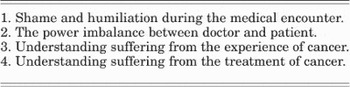
Four factors that may impact patient trust are summarized in Table 1. These four factors are explored below.
Four factors that impact trust

Factor 1: Shame and humiliation during the medial encounter
Lazare (Reference Lazare1987) has proposed that any experience of shame results from interaction of three factors: (1) the event that induces shame, (2) a vulnerable patient, and (3) a social context. What might cause a shame-inducing event for the cancer patient could be obvious, such as examining a mastectomy scar during a postoperative follow-up visit. However, a task that the oncologist may find innocuous, such as discussing constipation or diarrhea, could also induce shame for the patient. Because the oncologist cannot easily predict what might be a shame-inducing event, he or she must always be aware of its possible existence.
Shame also requires a vulnerable patient, in addition to a shame-inducing event. It is the patient, after all, who interprets the event as shameful—what is shameful to one person may not be to another. Even a patient with significant personal strengths might become “vulnerable” to specific aspects of the oncological encounter that disturb the patient's self-image (Weiner, Reference Weiner1996). For example, a patient who takes pride in her independence may find it shameful to ask her oncologist for an increase in her analgesic dose to treat metastatic bone pain.
Third, the social context of the medical encounter may induce conflict between the patient and staff that becomes shameful. For example, when the well-meaning resident physician tries to engage an actively dying patient in a “do not resuscitate” discussion, the physician may be performing a socially expected role. However, when the patient is not ready to die and refuses to discuss advance care planning, he or she may get labeled by staff as being “in denial.” This can be felt by the patient as hurtful or shameful (Weiner & Roth, Reference Weiner and Roth2006).
Social context also impacts the manner in which the patient experiences his or her disease. The lung cancer patient, for example, may feel ashamed by his or her failure to adopt preventive measures that are advocated by society, such as smoking cessation (Chapple et al., Reference Chapple, Ziebland and McPherson2004). The acquisition of AIDS leading to central nervous system lymphoma is another example. Finally, social context also impacts the manner in which the patient experiences the treatment of his or her disease. For example, mastectomy, orchiectomy, or even chemotherapy-induced allopecia can all be viewed as shameful within certain cultural norms.
A trusting relationship between patient and physician can help reduce shame. Realizing that disease and treatment are shame-inducing events, giving due respect to patients' autonomy and privacy, and creating a nonjudgmental atmosphere in which patients feel that they are being cared for are some of the ways that might help.
Factor 2: Power imbalance between the clinician and patient
The patient is vulnerable to emotional and physical intrusion whenever he or she sees a physician. The oncologist, through his or her social authority, decides what questions to ask, what parts of the patient's body to examine, which exploratory tests to order, and what noxious treatments to employ. The physician makes these recommendations generally with more medical knowledge than the patient. However, even when the patient is an oncologist, this power imbalance still exists, because it is the patient's life at stake. When the patient distrusts the oncologist's power, he or she fears its misuse or abuse. Such distrust ruptures belief in diagnosis, acceptance of prognosis, and adherence to treatment. This is all independent of whether the patient wishes to employ his or her autonomy through a parental or shared decision-making model (Charles et al., Reference Charles, Gafni and Whelan1999).
Factor 3: Suffering from illness
As Cassel (Reference Cassel1982) has argued, the responsibility of the physician is to assist the patient in alleviating suffering, which is indeed different than solely attempting to cure the patient of a disease. Cassel described suffering as the consequence of a physical or psychological threat to the integrity of a human being. In order to help the patient, the physician must not only know what the symptoms are but also what they mean to the patient (Cassel). For example, the patient doesn't personally experience suffering from objective “tumor pathophysiology,” but from the subjective experience of how the tumor impacts one's life. If the patient believes that the oncologist does not understand how his or her life is being specifically threatened by the cancer, how can the patient fully trust that the physician will be able to help?
Factor 4: Suffering from treatment
Physical and emotional suffering can result not only from disease, but also from treatment. The oncologist's failure to understand the personal impact of treatment-related suffering can result in cure of a disease, but also the creation of an intolerable condition in itself (Cassel, Reference Cassel1982), such as a salesman who develops urinary incontinence after a radical prostatectomy. When the oncologist fails to demonstrate an understanding of how his treatments have caused the patient to suffer, trust in future recommendations may be shattered.
Clinical Vignette Illustrating These Four Factors
Mr. GL, a 28-year-old previously healthy man, came to medical attention because of scrotal enlargement. The patient had neglected this condition until his family raised concerns that he seemed to be in great pain. He reluctantly agreed to see a primary care physician, who discovered two huge solid scrotal masses. They were highly suspicious for malignancy, based on physical exam and ultrasound.
The patient was referred to our institution, where he underwent bilateral orchiectomy. The pathology was consistent with seminomatous cancer involving both testicles. The medical oncologist diagnosed him with Stage II seminoma of the testes and started the patient on chemotherapy with cisplatin, bleomycin, and etoposide. We interviewed the patient during his hospital stay after he had undergone surgery and two cycles of chemotherapy. Our intent was to explore how his recent experiences affected him and how the factors listed above impacted his trust in physicians.
Factor 1: Shame and Humiliation
GL stated that he avoided coming to the physician after he initially noticed his enlarged scrotum, because “I got scared, and I don't like feeling that way.” He felt ashamed and angry at himself that he allowed his fear to delay the proper diagnosis, thus causing his cancer to progress. A private, independent man, GL resented the “mandatory” frequent visits to his doctors, this “necessary” hospitalization, and “exposing” his body to “strangers.” He found this loss of control humiliating.
Shame and humiliation were also observed in other ways. The patient's attending physician and medical oncology fellow were both women. During the initial consultation, he demonstrated hostility toward them, often cursing for no clear reason. He refused examination of his genital area and made disparaging comments about his physicians being women, because this made him feel “less of a man.” In addition, he feared that he was being casually discussed by health personnel in the hallway, so he hesitated to reveal symptoms to the physician or the nurse.
GL's oncology attending and fellow did not personalize GL's reactions. Rather, they reflected how difficult this experience must be for him. In addition, they repeatedly assured him that his privacy and autonomy would be cherished. Eventually, GL felt comfortable enough to complete his treatment and go into remission.
Factor 2: Power Imbalance
GL had been subjected to surgical and medical treatments that he had no scientific understanding of, yet he felt that he should be playing a major role in decision making: “It is my body that is being dealt with.” Nevertheless, he frequently missed medical appointments and did not report important symptoms. He explained this as his way of maintaining some control over his doctors. He felt his treatment was prescribed by doctors who “spoke medical jargon,” which he did not comprehend. This made him feel even less in control and resentful, because very few physicians took enough interest in him to use language that he could understand.
He perceived the physician's knowledge as a power she could potentially misuse. He related prior medical experiences where that occurred. The attending physician repeatedly emphasized that the patient's health was her most important concern. She spent much time educating the patient and she ensured his understanding and participation in decision making.
Factor 3: Suffering from the Disease
Even though GL's physical symptoms were well managed with treatment, the diagnosis of testicular cancer came as a thunderbolt to him and his family. He was young, active, and ambitious. His cancer caused GL to fear his own disability and possible death. He no longer felt “normal” and believed that he was being punished for his “erroneous past.” All this led to significant emotional suffering, which the staff addressed through psychosocial interventions and support. Repeated counseling sessions were required to help GL cope with the experience of his disease. Although we could not eliminate much of his suffering, he grew to appreciate that we understood and validated it.
Factor 4: Suffering from the Treatment
The recommended treatment for GL was bilateral orchiectomy and intensive chemotherapy. He was told that he might need chronic testosterone supplementation, and that he may not be able to procreate. He experienced hot flashes following the orchiectomy and had severe nausea from chemotherapy. GL told us that the suffering from the treatment was significantly more severe than that from the disease itself and he even considered forgoing the treatment on several occasions. The concepts of palliative care were utilized to identify and minimize the physical and psychological suffering from his treatment (Berger et al., Reference Berger, Portney and Weissman2002).
DISCUSSION
This article has described four factors that impact the cancer patient's trust in the oncologist: Shame and humiliation, power imbalance, suffering from illness, and suffering from treatment. In addition to these factors, other variables such as the physician's professionalism (Emanuel & Dubler, Reference Emanuel and Dubler1995; Farber et al., Reference Farber, Novack and O'Brien1997; Kao et al., Reference Kao, Green and Zaslavi1998; Working Party of the Royal College of Physicians, 2005), competency (Mechanic & Meyer, Reference Mechanic and Meyer2000), personality traits of the patient (Keating et al., Reference Keating, Gandhi and Orav2004) and the physician (Lochman, Reference Lochman1983), transference and countertransference reactions (Gabbard, Reference Gabbard1995), patients' trust in the health care system (Thom & Campbell, Reference Thom and Campbell1997), religious beliefs, cultural and racial differences, and previous experiences of patients with health care providers may also contribute to the intricacies of patient–physician relationship (Caralis et al., Reference Caralis, Davis and Wright1993; Koenig, Reference Koenig, Field and Cassel1997; Blackhall et al., Reference Blackhall, Frank and Murphy1999; Krakauer et al., Reference Krakauer, Crenner and Fox2002; Crawley, Reference Crawley2005).
Finally, we can conceive of the impairment in trust in itself as a significant form of suffering for the patient. Sick people need physicians who can not only understand disease and treat medical problems, but also accompany the patient through the illness experience. This requires an appreciation of the challenges to trust that are inherent in the special characteristics of the patient–physician interaction.
ACKNOWLEDGMENTS
This work was supported in part by a Faculty Scholar Award from the Project on Death in America (J.S.W.) and generous grants from the Fan Fox and Leslie R. Samuels Foundation (J.S.W.) and the UJA Federation of New York (J.S.W.).