Risk for psychopathology can emerge across development via multiple pathways and mechanisms, including those endogenous to the child and exogenous characteristics of the surrounding environment. Moreover, characteristics of the surrounding environment and their impact on outcomes are often influenced by within-child factors. Certain patterns of infant temperament, or one's behavioral and emotional reactivity, may in some instances be a risk factor for the development of psychopathology (Fox, Henderson, Rubin, Calkins, & Schmidt, Reference Fox, Henderson, Rubin, Calkins and Schmidt2001; Rothbart & Bates, Reference Rothbart, Bates, Damon and Eisenberg2006). For instance, temperamental reactivity to novelty and its concomitants are associated with later social withdrawal and risk for internalizing disorders (Degnan, Henderson, Fox, & Rubin, Reference Degnan, Henderson, Fox and Rubin2008; Ollendick, Greene, Weist, & Oswald, Reference Ollendick, Greene, Weist and Oswald1990). In addition, social reticence, defined as unoccupied onlooking behavior with unfamiliar peers, has been linked with risk for internalizing disorders, as well as early temperamental reactivity (Degnan et al., Reference Degnan, Almas, Henderson, Hane, Walker and Fox2014; Fox, Henderson, Marshall, Nichols, & Ghera, Reference Fox, Henderson, Marshall, Nichols and Ghera2005). While the onset of clinical disorder is often predicted by problematic patterns of behavior and affect (Rapee, Schniering, & Hudson, Reference Rapee, Schniering and Hudson2009), not all children who display social reticence continue along this path or develop internalizing disorders (for a review, see Degnan & Fox, Reference Degnan and Fox2007). Thus, exploring factors associated with the maintenance of or declines in social reticence may clarify the link between temperamental reactivity to novelty and risk for psychopathology (e.g., Chronis-Tuscano et al., Reference Chronis-Tuscano, Degnan, Pine, Pérez-Edgar, Henderson and Diaz2009; Degnan, Almas, & Fox, Reference Degnan, Almas and Fox2010; Frenkel et al., Reference Frenkel, Fox, Pine, Walker, Degnan and Chronis-Tuscano2015). This can best be accomplished by examining observed, multilevel (i.e., individual and dyadic) measures of behavior, allowing for a rich description of the influence of within-child characteristics on the surrounding environment in relation to both adaptive and maladaptive outcomes. This is a main goal of developmental psychopathology research (Cicchetti, Reference Cicchetti1984; Cicchetti & Toth, Reference Cicchetti, Toth, Luthar, Burack, Cicchetti and Weisz1997; Kuperminc & Brookmeyer, Reference Kuperminc, Brookmeyer and Ammerman2006). Furthermore, to truly capture the developmental processes underlying continuity and change in behavior, repeated observation of children is necessary (Cicchetti & Bukowski, Reference Cicchetti and Bukowski1995). Thus, the current study examined the influence of endogenous factors (i.e., infant behavior) on the relations between maternal caregiving behaviors in infancy and toddlerhood and longitudinal risk trajectories of social reticence with unfamiliar peers across early childhood. This approach, selecting and longitudinally following temperamentally extreme children, allows for the examination of children who are especially influential on their own rearing context, altering transactions between the rearing environment and trajectories of risk and resilience.
Developmental Pathway to Social Reticence
Temperament theory suggests that individual differences in reactivity to novelty are present throughout the lifespan, but may manifest differently across time due to developmental changes and experiences (Fox, Henderson, Rubin, et al., Reference Fox, Henderson, Rubin, Calkins and Schmidt2001; Rothbart & Bates, Reference Rothbart, Bates, Damon and Eisenberg2006). For instance, negative reactivity to novelty in early infancy is associated with behavioral inhibition in toddlerhood, defined by an apprehension to and withdrawal from novelty (Calkins, Fox, & Marshall, Reference Calkins, Fox and Marshall1996; Fox, Snidman, Haas, Degnan, & Kagan, 2015; Kagan, Reznick, Clarke, Snidman, & Garcia-Coll, Reference Kagan, Reznick, Clarke, Snidman and Garcia-Coll1984). Studies of the physiological and neural underpinnings of this reactivity (Pérez-Edgar & Fox, Reference Pérez-Edgar and Fox2005) suggest that biology of the infant and young child is implicated in the maintenance of these individual tendencies over time. Avoidance of novelty/threat is reflected in heightened startle response and elevated neural discrimination of novelty (Barker, Reeb-Sutherland, & Fox, Reference Barker, Reeb-Sutherland and Fox2014; Marshall, Reeb, & Fox, Reference Marshall, Reeb and Fox2009), as well as observed behavior marked by attempts to flee from the triggering, ominous stimulus. These physiological and behavioral markers of avoidance, if maintained across early development, may serve to reinforce responses to threat, leading to a sustained pattern of behavioral inhibition in toddlerhood, social reticence over time, and risk for anxiety disorders (Fox, Henderson, & Marshall, Reference Fox, Henderson, Marshall, Nelson and Luciana2001; Fox et al., Reference Fox, Henderson, Marshall, Nichols and Ghera2005). A key symptom of anxiety disorders is avoidance of the threatening stimulus or situation, which increases an individual's functional impairment (Rapee et al., Reference Rapee, Schniering and Hudson2009). It is important to note that avoidance behavior may represent both a response and an observed strategy that coincides with an inhibited temperament, but does not constitute in and of itself a temperamental subtype or anxiety disorder.
When young infants are presented with novel stimuli, around 15% of typically developing infants display higher levels of negative affect and motor behavior (i.e., negative reactivity to novelty). Previous work with infants identified as negative reactive to novelty at 4 months of age reports greater observed avoidance behavior (i.e., attempts to escape or lack of approach) in the presence of fear-eliciting, novel stimuli at 9 months of age (Hane, Fox, et al., Reference Hane, Fox, Henderson and Marshall2008). As infants transition into toddlerhood, avoidance behaviors are often associated with behaviorally inhibited temperament, defined by an apprehension to novelty and withdrawal from unfamiliar situations or persons (Fox, Henderson, Rubin, et al., Reference Fox, Henderson, Rubin, Calkins and Schmidt2001; Kagan et al., Reference Kagan, Reznick, Clarke, Snidman and Garcia-Coll1984). Infants and young children with behavioral inhibition display a pattern of autonomic and behavioral responses that parallels those seen in rodents or nonhuman primates post-fear conditioning, such as higher heart rate, reduced heart rate variability, elevated cortisol and startle responses, and freezing or avoidance when confronted with presumably threatening stimuli (Fox et al., Reference Fox, Henderson, Marshall, Nichols and Ghera2005). Then, as children get older and peers become increasingly salient, avoidant behaviors become more frequent in response to the social context, with many behaviorally inhibited young children transitioning to the display of social reticence in the context of unfamiliar and, sometimes familiar, peers (Rubin, Coplan, & Bowker, Reference Rubin, Coplan and Bowker2009). When these social behaviors are maintained across development, they can lead to peer rejection, negative self-image, increasing loneliness, and risk for social withdrawal and social anxiety in early adolescence and adulthood (Rubin et al., Reference Rubin, Coplan and Bowker2009).
Social reticence, the display of unoccupied, onlooking, and hovering behaviors with unfamiliar peers, is thought to stem from an underlying conflict between desires to both approach and avoid social interaction (Coplan, Rubin, Fox, Calkins, & Stewart, Reference Coplan, Rubin, Fox, Calkins and Stewart1994; Rubin, Burgess, & Hastings, Reference Rubin, Burgess and Hastings2002; Rubin, Hastings, Stewart, Henderson, & Chen, Reference Rubin, Hastings, Stewart, Henderson and Chen1997). Repeated exposure to this conflict may reinforce physiological reactivity and avoidance behaviors, leading to the maintenance of, or an increase in, levels of social reticence and social withdrawal across development (Fox, Henderson, & Marshall, Reference Fox, Henderson, Marshall, Nelson and Luciana2001). In contrast, there is extensive evidence, across selected and unselected samples, for discontinuity in the display of such behavior across development, suggesting that exogenous, contextual factors work in concert with child temperament to influence trajectories of social reticence over time (see Degnan et al., Reference Degnan, Almas and Fox2010; Degnan & Fox, Reference Degnan and Fox2007, for reviews). Not every child with heightened reactivity and avoidant behavior will evidence maladaptive developmental outcomes, such as clinical anxiety disorders.
Studies examining the multifinality of social reticence and related constructs have consistently reported multiple developmental patterns of adult- or peer-reported internalizing problems or social withdrawal across childhood (Booth-LaForce & Oxford, Reference Booth-LaForce and Oxford2008; Letcher, Smart, Sanson, & Toumbourou, Reference Letcher, Smart, Sanson and Toumbourou2009; Oh et al., Reference Oh, Rubin, Bowker, Booth-Laforce, Rose-Krasnor and Laursen2008). However, tracking longitudinal patterns of observed social behavior is difficult, because measures and assessment tools are typically altered across development to use age-appropriate stimuli or paradigms.
A recent study observed social behavior with unfamiliar peers repeatedly in similar paradigms across early childhood, using the current well-characterized sample, selected in terms of negative and positive reactivity to novelty in infancy (Degnan et al., Reference Degnan, Almas, Henderson, Hane, Walker and Fox2014). Social reticence observed repeatedly with an unfamiliar peer across similar contexts at 24, 36, 48, and 60 months of age was examined to explore the possibility for multiple longitudinal patterns, while behavioral inhibition at 24 and 36 months was examined as a predictor of the longitudinal patterns and parent-reported behavior problems at 60 months were examined as outcome measures. Three longitudinal patterns (i.e., trajectories) were found. Approximately 59% of children displayed greater toddler behavioral inhibition, with 16% proceeding to follow a longitudinal pattern characterized by the maintenance of higher social reticence with a novel peer throughout early childhood (high-stable social reticence trajectory and 43% following a pattern characterized by declines in social reticence across time (high-decreasing social reticence trajectory). Finally, about 41% of children displayed lower toddler behavioral inhibition and proceeded to follow a pattern of consistently lower, but increasing social reticence across time (low-increasing social reticence trajectory).
Maternal report of behavior problems at 60 months of age differentiated the trajectories. The high-stable social reticence trajectory evidenced the highest level of 60-month internalizing behavior problems. The low-increasing social reticence trajectory evidenced the highest level of 60-month externalizing behavior problems. The high-decreasing social reticence trajectory evidenced low levels of both 60-month internalizing and externalizing behavior problems (Degnan et al., Reference Degnan, Almas, Henderson, Hane, Walker and Fox2014). Thus, both the high-stable and the low-increasing social reticence trajectories displayed risk for emergent psychopathology by 60 months of age, while the high-decreasing trajectory appears to display a pattern of resilience (Degnan & Fox, Reference Degnan and Fox2007). While 10% and 8% of the overall sample were above the borderline-clinical cutoffs for internalizing and externalizing disorders, respectively, the high-stable trajectory evidenced 24% above the cutoffs for internalizing disorders and the low-increasing trajectory evidenced 13% above the cutoffs for externalizing disorders. While Degnan et al. (Reference Degnan, Almas, Henderson, Hane, Walker and Fox2014) described the existence of multiple longitudinal patterns of social reticence and their links to early behavioral inhibition and later behavior problems, the present study extends this work to investigate the differential influence that early child observed regulatory strategies have on the link between contextual factors and the development of these pathways toward risk and resilience. Specifically, 9-month observed infant avoidance behavior was examined for its influence on maternal caregiving behaviors in infancy and toddlerhood and their relations to the longitudinal risk trajectories of social reticence across early childhood.
Maternal Behavior as Influenced by Child Temperament
Along with temperament, the context in which development occurs is an integral factor for the development of social behavior and psychopathology (Degnan et al., Reference Degnan, Almas and Fox2010; Nigg, Reference Nigg2006). Previous research and theoretical reviews suggest that direct effects of the environment are modest, while interactions between endogenous (e.g., temperament) and exogenous (e.g., caregiving behavior) factors are more likely to impact outcomes such as psychopathology and social reticence than either one alone (Lewis-Morrarty et al., Reference Lewis-Morrarty, Degnan, Chronis-Tuscano, Pine, Henderson and Fox2014; McLeod, Wood, & Weisz, Reference McLeod, Wood and Weisz2007; Rubin et al., Reference Rubin, Coplan and Bowker2009). One of the most common environmental factors examined in the socialization literature is maternal caregiving behavior. From birth, caregivers' cyclical engagement and disengagement of infants' attention helps infants learn how to self-regulate by externally altering their arousal levels (Calkins, Reference Calkins1994). Maternal caregiving behaviors are concurrently associated with levels of infant reactivity and distress (Feldman, Magori-Cohen, Galili, Singer, & Louzoun, Reference Feldman, Magori-Cohen, Galili, Singer and Louzoun2011; Hane & Fox, Reference Hane and Fox2006; Moore & Calkins, Reference Moore and Calkins2004). However, little work has clarified how these maternal behaviors are influenced by children's reactivity and how maternal behavior may show differential influence on adaptation or risk for clinical disorder for children with different temperamental profiles.
In reaction to a child displaying negative reactivity and fear, a sensitive caregiver might quickly attend to the child's reactivity, focus on it, and the influence of the child is manifest in the caregiver's response (e.g., removing the stimulus or removing the child from the situation). This sort of responsiveness and sensitivity to infants' emotional signals is considered ideal in many settings and for less reactive children to reduce the child's distress in the short term. However, research indicates that for infants temperamentally reactive to novelty, a continued pattern of this type of protectiveness, or heightened focus on the infants' emotions, may serve to reinforce child wariness and avoidance toward situations perceived as stressful (e.g., novel social encounters), rather than decrease such reactivity over time. A growing body of research has demonstrated links between oversolicitous, overprotective, intrusive, or controlling parenting and greater toddler inhibition, less peer social engagement, preschool social reticence, as well as social anxiety (e.g., Degnan, Henderson, et al., Reference Degnan, Henderson, Fox and Rubin2008; Edwards, Rapee, & Kennedy, Reference Edwards, Rapee and Kennedy2010; Lewis-Morrarty et al., Reference Lewis-Morrarty, Degnan, Chronis-Tuscano, Rubin, Cheah and Pine2012; Penela, Henderson, Hane, Ghera, & Fox, Reference Penela, Henderson, Hane, Ghera and Fox2012; Rubin et al., Reference Rubin, Burgess and Hastings2002). Other research has reported that maternal sensitivity, warmth, and responsiveness to children reactive to novelty are associated with less inhibited, more socially adaptive behavior across development, especially in a nonemotional context (e.g., Hane, Cheah, Rubin, & Fox, Reference Hane, Cheah, Rubin and Fox2008; Wood, McLeod, Sigman, Hwang, & Chu, Reference Wood, McLeod, Sigman, Hwang and Chu2003). In contrast, some work has shown that sensitive/warm parenting also has been linked with greater inhibition and shyness (e.g., Eggum et al., Reference Eggum, Eisenberg, Spinrad, Reiser, Gaertner and Sallquist2009; Kagan, Arcus, & Snidman, Reference Kagan, Arcus, Snidman, Plomin and McClearn1993; Park, Belsky, Putnam, & Crnic, Reference Park, Belsky, Putnam and Crnic1997), likely because the sensitive behavior observed in these studies served to reinforce the children's reactivity and did not guide the children to approach the source of their reactivity (Grady & Karraker, Reference Grady and Karraker2014). Overall, parents who respond to their children's reactivity to novelty by guiding them to engage with the world around them may, over time, help reduce their reactivity to novelty (Wood et al., Reference Wood, McLeod, Sigman, Hwang and Chu2003) by decreasing their attention bias to potential threat and promoting exploration (Fox et al., Reference Fox, Henderson, Marshall, Nichols and Ghera2005; Muris, van Zwol, Huijding, & Mayer, Reference Muris, van Zwol, Huijding and Mayer2010). This claim has been supported early in development, as mothers who displayed low encouragement to approach during a structured task in response to their infants' fear (6 months) had infants who concurrently displayed greater avoidance behavior (Crockenberg & Leerkes, Reference Crockenberg and Leerkes2006; Murray et al., Reference Murray, Rosnay, Pearson, Bergeron, Schofield and Royal-Lawson2008). In addition, maternal protective behavior has been shown to maintain fear in highly distressed toddlers, especially when the protective behavior was shown in response to the toddler's distress (Buss & Kiel, Reference Buss and Kiel2011). Thus, for children temperamentally reactive to novelty, there may be an optimal level of maternal sensitivity associated with adaptive behavior, while sensitivity that is too high or too low increases risk for internalizing disorders, such as anxiety (Mount, Crockenberg, Bárrig Jó, & Wagar, Reference Mount, Crockenberg, Bárrig Jó and Wagar2010). However, it is important to note that variations in the influence of maternal sensitivity appear to be dependent on the age of the child and the nature of the interactive context.
Additional work with older children has examined maternal discipline style (e.g., gentle guidance vs. power assertion) in relation to children's social and emotional outcomes, as well as risk for psychopathology. While maternal discipline is more often related to child compliance, disruptive behavior, or conscience development (e.g., Degnan, Calkins, Keane, & Hill-Soderlund, Reference Degnan, Calkins, Keane and Hill-Soderlund2008; Kochanska, Askan, & Joy, Reference Kochanska, Askan and Joy2007), a focus on discipline style may have important implications for children who are negatively reactive to novelty and their risk for internalizing disorders. A number of studies have shown that reactive (i.e., fearful) children exposed to gentle and supportive discipline techniques, such as polite suggestions and playful comments rather than direct commands and assertions (i.e., emphasized indirect parenting behaviors and deemphasized direct behaviors), are better able to internalize rules and develop conscience (e.g., Kochanska, Reference Kochanska1997). While greater conscientiousness and internalization of rules is often thought of as an adaptive developmental milestone, it may be linked to maladaptive outcomes for certain children. Regulatory skills that are supportive of conscience development, such as inhibitory control, also support risk for anxiety in behaviorally inhibited children (e.g., White, McDermott, Degnan, Henderson, & Fox, Reference White, McDermott, Degnan, Henderson and Fox2011). In addition, similar to studies on maternal sensitivity, both controlling (e.g., Hane, Cheah, et al., Reference Hane, Cheah, Rubin and Fox2008; Lewis-Morrarty et al., Reference Lewis-Morrarty, Degnan, Chronis-Tuscano, Rubin, Cheah and Pine2012) and overly supportive (i.e., oversolicitous) maternal behaviors (e.g., Degnan, Henderson, et al., Reference Degnan, Henderson, Fox and Rubin2008; Luebbe, Kiel, & Buss, Reference Luebbe, Kiel and Buss2011) have been associated with increased internalizing symptoms for children with greater behavioral inhibition. Therefore, the same maternal behaviors that help children learn to internalize rules and become conscientious may, for inhibited children, maintain negatively reactive and avoidant responses to the surrounding environment. Rubin, Nelson, Hastings, and Asendorpf (Reference Rubin, Nelson, Hastings and Asendorpf1999) suggest that some parents will perceive temperamentally reactive children as highly vulnerable and then exhibit overly protective and directive behavior to reduce child distress. These children then maintain their reliance on adults at a time (toddlerhood and childhood) when they should be learning to independently cope with anxiety-provoking situations (Gazelle & Ladd, Reference Gazelle and Ladd2003). Therefore, while gentle discipline may be linked to greater compliance and conscience development, it may also maintain reactivity and avoidance to novel and/or social situations for behaviorally inhibited children, increasing risk for internalizing problems and psychopathology.
Across these different areas of parenting research, what defines optimal parenting likely depends on the within-child factors that parents are responding to, such as the reactivity and regulatory strategies displayed by the child (Degnan et al., Reference Degnan, Almas and Fox2010; Degnan, Calkins, et al., Reference Degnan, Calkins, Keane and Hill-Soderlund2008), the age of the child, as well as the goals or tasks implicated in the interaction at hand (Luebbe et al., Reference Luebbe, Kiel and Buss2011). A global “goodness of fit” between child temperament and parenting may remain the same or change across different stages of child development, resulting in specific child (Dennis, Reference Dennis2006; McClowry, Rodriguez, & Koslowitz, Reference McClowry, Rodriguez and Koslowitz2008) and parent (Williford, Calkins, & Keane, Reference Williford, Calkins and Keane2007) outcomes. However, studies examining Temperament × Parenting interactions typically focus on one particular time point (Calkins & Degnan, Reference Calkins, Degnan and Ammerman2006; Degnan et al., Reference Degnan, Almas and Fox2010). Examinations of parenting at multiple time points in relation to later social–emotional outcomes are needed. While parenting responses at one time point (i.e., infancy) may impact children's prospective trajectories of behavior across early childhood, this type of analysis does not provide information about what the parenting environment is like during the period of potential developmental change. For instance, continued exposure to atypical caregiving behaviors across childhood has been shown to negatively influence parent–child attachment (Madigan, Voci, & Benoit, Reference Madigan, Voci and Benoit2011), and might influence later socioemotional outcomes as well. In addition, Hane and Fox (Reference Hane and Fox2009) have shown that experiencing low mother–child mutually positive affect across infancy and toddlerhood is associated with the maintenance of reactive, avoidant behavior across toddlerhood. Thus, to explore the child's influence on differential relations between maternal caregiving behavior at different ages and longitudinal patterns of child behavior, the current study examined maternal sensitivity at 9 months and maternal gentle discipline at 36 months, allowing for a glimpse into exogenous mechanisms that might provide prospective or proximate associations with social reticence trajectories during the early childhood period, especially for infants greater or lower in avoidance behavior.
Summary and Hypotheses
Overall, infants and young children temperamentally reactive to novelty (i.e., behaviorally inhibited) evince heightened risk, particularly for developing social reticence and social anxiety (Fox et al., Reference Fox, Henderson, Marshall, Nichols and Ghera2005; Rubin et al., Reference Rubin, Coplan and Bowker2009). However, a great deal of discontinuity has been observed in the links between parenting behaviors and these developmental pathways, suggesting differential effects due to child characteristics (Degnan et al., Reference Degnan, Almas and Fox2010). Research on samples with wide ranges of individual differences is needed to expose the influential child characteristics that contribute to these patterns of multifinality. To this end, the present study builds upon previous work by examining the influence of observed behavior in response to fear-eliciting stimuli (i.e., avoidance at 9 months) on the links between both observed maternal sensitivity (9 months) and observed maternal gentle discipline (36 months) and the probability of membership in one of three previously identified longitudinal risk trajectories of social reticence (Degnan et al., Reference Degnan, Almas, Henderson, Hane, Walker and Fox2014). Research and theory suggest that children temperamentally reactive to novelty need a moderately firm parenting style (i.e., not too controlling or overprotective) to break the cycle of reactivity, approach the world around them, and minimize risk for psychopathology (see Degnan et al., Reference Degnan, Almas and Fox2010; Rubin et al., Reference Rubin, Coplan and Bowker2009, for reviews). Thus, in the current study, higher maternal sensitivity, during the presentation of novel stimuli in infancy, and greater maternal gentle discipline (i.e., more indirect suggestions vs. direct assertions), assessed during a cleanup task in late toddlerhood, were expected to relate to the high-stable risk trajectory of social reticence across early childhood; however, infants' level of avoidance to potentially threatening stimuli was expected to influence these relations. Specifically, children with greater avoidance who experienced higher levels of both parenting behaviors (maternal sensitivity and maternal gentle discipline) were expected to maintain high, stable social reticence across early childhood. In turn, experiencing lower levels of these parenting behaviors was expected to support a decline in social reticence over time for infants with greater avoidance, because lower levels of sensitivity during novel tasks combined with more task-focused (rather than distress-focused) caregiving behavior may encourage the child to engage directly with the novel or challenging tasks. In contrast, maternal sensitivity and gentle discipline were expected to provide a more positive influence on outcomes for the less avoidant infants, minimizing their display of social reticence and risk for internalizing and externalizing behavior problems across early childhood. Identifying observable behaviors (i.e., avoidance) and their moderating influence on the links between caregiving contexts and psychopathological risk will enhance preventative intervention programs' ability to focus, target, and define their efforts for those children and families that are most at risk.
Method
Participants
Three hundred and fifteen infants (151 males, 164 females) were selected based on their temperamental reactivity to novelty (see Hane, Fox, et al., Reference Hane, Fox, Henderson and Marshall2008): high negative/high motor reactive (n = 105); high positive/high motor reactive (n = 103); average negative/positive/motor reactive (n = 83); and high negative/high positive/high motor reactive (n = 24). This resulted in a sample of infants with a wide range of temperamental reactivity to novelty, of which negative reactivity is often associated with heightened risk for internalizing disorders and stress reactivity (e.g., Kagan & Snidman, Reference Kagan and Snidman1999), while positive reactivity has been associated with greater risk for externalizing disorders (e.g., Degnan et al., Reference Degnan, Hane, Henderson, Walker, Reeb-Sutherland and Fox2011). Of these infants, 63.8% were Caucasian, 14% were African American, 3.5% were Hispanic, 2.2% were Asian, 1.3% were “other,” and 15.2% were of mixed ethnicity. Information regarding family income was not collected; however, most mothers (76.9%) and fathers (69.2%) were at least college educated, with some mothers (22.5%) and some fathers (28.6%) having at least a high school education. The other mothers' (0.6%) and fathers' (2.2%) education was not reported. Across infancy (up to 24 months), 81.3% families were married, 0.9% were divorced or separated, 6.0% were single mothers, 0.6% families were married by common law, 1.0% families reported some “other” arrangement, and 10.2% did not report their marital status.
Procedure
Following recruitment at 4 months of age (see Hane, Fox, et al., Reference Hane, Fox, Henderson and Marshall2008), infants were assessed at 9, 24, 36, 48, and 60 months of age. At 9 months of age, infants were observed in the laboratory during tasks from the Laboratory Temperament Assessment Battery (Lab-TAB, Prelocomotor version 3.1; Goldsmith & Rothbart, Reference Goldsmith and Rothbart1999). At 9 and 36 months, children were observed at home during a series of mother–child interactive tasks. At 24 and 36 months, behavior and affect were observed in the laboratory during a standard behavioral inhibition paradigm (Fox, Henderson, Rubin, et al., Reference Fox, Henderson, Rubin, Calkins and Schmidt2001; Kagan, Reznick, & Snidman, Reference Kagan, Reznick and Snidman1987). In addition, at 24, 36, 48, and 60 months, each target child was observed in the laboratory interacting with an unfamiliar, age and gender-matched peer (i.e., nontarget), recruited from the community. After the 24-month peer assessment, target/nontarget pairs were randomized for each subsequent peer assessment to maintain the unfamiliar nature of the dyad. At each age (24 through 60 months), the peer dyads were observed during identical freeplay, cleanup, and social problem-solving tasks. Finally, mothers were asked to report on child behavior problems (e.g., Child Behavior Checklist; Achenbach & Rescorla, Reference Achenbach and Rescorla2000) for the 60-month assessment. For more information, please see Degnan et al. (Reference Degnan, Almas, Henderson, Hane, Walker and Fox2014).
Measures
Infant avoidance behavior
At 9 months of age, a number of tasks from the Lab-TAB (Goldsmith & Rothbart, Reference Goldsmith and Rothbart1999) were administered, including masks and unpredictable toy. All were carried out in accordance with Lab-TAB guidelines (for more details, see Hane, Fox, et al., Reference Hane, Fox, Henderson and Marshall2008). An avoidance score for the unpredictable toy and mask tasks was derived by subtracting the intensity of positive motor behavior (0–2) and approach (0–3) from the intensity of escape (0–3). An overall avoidance score was computed as the average of these scores across the two tasks (r = .36, p < .001), with higher scores indicating more behavioral avoidance relative to approach (M = –0.02, SD = 2.02). Prior to final coding, interrater reliability was achieved on 15% of the cases by two independent raters who were blind to all other data in the study (average κ across tasks and codes = 0.89). Compared to other temperamental reactivity measures described above (i.e., negative reactivity to novelty and behavioral inhibition), the avoidance score here consists of an observed behavior displayed in response to fear-eliciting stimuli that often coincides with an inhibited temperament.
Maternal sensitivity in infancy
At 9 months of age, mother and infant dyads were observed interacting during a series of structured and unstructured tasks during a home visit (for more detail, see Hane & Fox, Reference Hane and Fox2006; Hane, Fox, Polak-Toste, Ghera, & Guner, Reference Hane, Fox, Polak-Toste, Ghera and Guner2006). The current study focuses on maternal behavior during model building and unpredictable toy tasks. Using a modified version of Ainsworth's (Reference Ainsworth1976) system, independent observers coded these interactions for the degree of maternal sensitivity, including 9-point ratings of acceptance–rejection, sensitivity–insensitivity, encouragement (i.e., fosters sensorimotor development), and delight. These ratings were then averaged within task so that higher scores indicated greater sensitivity (i.e., warm responsiveness to infant bids). Two independent raters achieved sound interrater reliability on 12% of cases, with an average intraclass correlation being 0.80 for sensitivity. A final maternal sensitivity composite was computed as the average of sensitivity across the two structured tasks (α = 0.74; M = 6.23, SD = 0.77).
Maternal gentle discipline in toddlerhood
At 36 months of age, another home visit was conducted during which mothers and their children participated in a 5-min cleanup episode. The interaction was coded for maternal discipline with an adaptation of Kochanska's coding scheme (Kochanska, Reference Kochanska1995, Reference Kochanska1997). Maternal discipline behavior was coded in 30-s epochs in mutually exclusive categories: gentle guidance (parent guides child in a gentle, subtle manner; uses polite suggestions or hints; no verbal or physical force present); control (parent directs child with assertions in a nonforceful, matter-of-fact manner; issues direct commands and prohibitions; not negative or overly forceful); or forceful negative control (parent directs child in a forceful, power assertive manner; raises voice; may threaten). Levels of physical involvement were also coded in 30-s epochs: gentle (direct physical contact present; gently moves child); assertive (firm physical contact; grabbing); or forceful-negative (physical punishment; threats of punishment). If no physical involvement was present, no score was given for that epoch. The frequencies of each category of maternal discipline and physical involvement were separately summed and divided by the total number of epochs to create proportion scores. Two independent raters achieved sound interrater reliability on each discipline and physical involvement codes across 20% of the sample, with intraclass correlations averaging 0.78 for maternal discipline behaviors and 0.80 for physical involvement levels. A measure of total negative discipline was formed by summing the proportion scores of control and forceful negative control. A measure of total physical involvement was formed by summing proportion scores across all categories (gentle, assertive, and forceful-negative). These two sums were then averaged together to form a power assertive discipline composite. Finally, as described in Kochanska (Reference Kochanska1997), the power assertive composite was subtracted from the proportion of gentle guidance discipline in order to create a measure of maternal gentle discipline, which emphasized indirect parenting behaviors and deemphasized direct behaviors (M = –0.01, SD = 1.39).
Longitudinal risk trajectories of social reticence
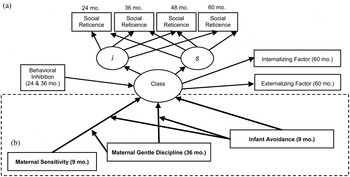
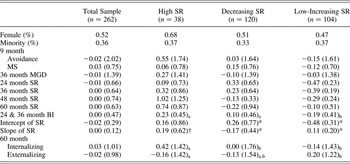
The structural equation model for multiple longitudinal risk trajectories of social reticence, previously reported in Degnan et al. (Reference Degnan, Almas, Henderson, Hane, Walker and Fox2014) was used in the current study. The model was analyzed using a latent class growth analysis (LCGA; Muthén, Reference Muthén and Kaplan2004) of repeated observational measures of social reticence at 24, 36, 48, and 60 months of age, as well as observed behavioral inhibition at 24 and 36 months and maternal report of internalizing and externalizing behavior problems at 60 months (see Degnan et al., Reference Degnan, Almas, Henderson, Hane, Walker and Fox2014, for details on these measures). The measures of social reticence consisted of children's level of onlooking, unoccupied, and passive social behavior with an unfamiliar peer during freeplay, cleanup, and special toy tasks at each time point. Specifically, latent factors of intercept and slope were estimated from the longitudinal repeated measures of social reticence. Another latent factor representing “class” or trajectory was estimated from the latent intercept and slope factors (see Figure 1a). Based on multiple fit indices, three trajectories were found to provide the best fitting model: high-stable social reticence, high-decreasing social reticence, and low-increasing social reticence. Behavioral inhibition in toddlerhood was estimated as a predictor of class membership and results revealed that the high-stable and high-decreasing trajectories were significantly higher on behavioral inhibition in toddlerhood than the low-increasing trajectory. Even more important, the trajectories were differentiated by internalizing and externalizing behavior problems at 60 months, such that the high-stable trajectory evidenced the highest internalizing problems (24% above the borderline-clinical cutoff), the low-increasing trajectory evidenced the highest externalizing problems (13% above the borderline-clinical cutoff), and the high-decreasing trajectory evidenced the lowest internalizing and externalizing problems. This model was estimated using all 262 participants who had behavioral inhibition and/or social reticence data at least for one time point. Descriptive statistics for each trajectory and the overall sample are reported in Table 1.
Two-step model of social reticence across early childhood: (a) latent class growth analysis of social reticence, behavioral inhibition, and behavior problems (Degnan et al., Reference Degnan, Almas, Henderson, Hane, Walker and Fox2014); and (b) main and interaction effects of avoidance, maternal sensitivity, and maternal gentle discipline on probability of class membership.

Descriptive statistics for all measures across total sample and within each latent class trajectory

Note: SR, Social reticence; BI, behavioral inhibition; MS, maternal sensitivity; MGD, maternal gentle discipline. Different subscript letters denote statistically significant trajectory differences on covariates and outcome measures.
†p < .07. *p < .001. Symbols denote mean intercept and slope estimate differences from zero.
Summary of measures
Of the 315 participants recruited at 4 months, 204 had complete data at 9 months, 226 had complete data at 24 months, 225 had complete data at 36 months, 221 had complete data at 48 months, and 199 had complete data at 60 months. Reasons for missing data included technical difficulties with the video collection, difficulty scheduling laboratory visits, families relocating, and permanent attrition (n = 13).
In the present study, early measures of infant avoidance, maternal sensitivity in infancy, maternal gentle discipline in toddlerhood, and their interactions were examined as predictors of the longitudinal risk trajectories of social reticence, above and beyond the predictive effects of behavioral inhibition (see Figure 1b). Specifically, an infant's avoidance behavior was investigated as it moderated the associations between maternal caregiving and children's longitudinal risk trajectories of social reticence across early childhood. While the initial trajectory analysis was conducted on 262 children who had toddler behavioral inhibition data (see Degnan et al., Reference Degnan, Almas, Henderson, Hane, Walker and Fox2014), due to missing infant and mother–child interaction data, the sample size for the current analysis was 153 cases. Participants missing data did not differ from those not missing data on any demographic measures (gender, maternal/paternal education, or child ethnicity), predictor measures (avoidance, maternal sensitivity, or maternal gentle discipline), or probability of membership in any of the social reticence trajectories (all ps > .10).
Data analysis plan
In a previous analysis, growth mixture modeling, a specific type of structural equation modeling, was performed using Mplus 6.11 (Muthén & Muthén, Reference Muthén and Muthén1998–2010) to examine the longitudinal risk trajectories of social reticence across early childhood (Figure 1a; see Degnan et al., Reference Degnan, Almas, Henderson, Hane, Walker and Fox2014, for more details). The current study expands this work to examine the influential role of infant avoidance on the contextual importance of maternal caregiving behavior for social behavior and psychopathological risk over time. To this end, infant avoidance, maternal sensitivity in infancy, and maternal gentle guidance in toddlerhood, and their interactive effects were added in a hierarchical fashion to the previous model as predictors of the probabilities of membership in the trajectories, above and beyond that of behavioral inhibition (see Figure 1b): (a) main effects, (b) two-way interactions, and (c) three-way interactions. The log-likelihoods of each step were compared with the prior step to compute the deviance, twice the difference between two log-likelihoods, as a measure of goodness of fit (McArdle, Reference McArdle, Cudeck and MacCallum2007). The deviance can be compared to a chi-square table (using the degrees of freedom difference) to determine whether the predictors significantly increased model fit. If they did not substantially influence the model, then the preceding influential step was chosen as the final model. It is important to note that quadratic effects of maternal behavior were tested, but did not yield significant effects and thus were not included here. Statistically significant interaction effects were probed as in logistic regression using the guidelines of Aiken and West (Reference Aiken and West1991).
Results
Preliminary analyses
Before the LCGAs with predictors were performed, demographic covariates and correlations between predictors were examined. None of the demographic measures (gender, ethnicity, maternal education, or 4-month temperament group) were significantly related to the trajectories (all ps > .05). In addition, avoidance and behavioral inhibition were not directly associated with either each other or the maternal behavior measures (all ps > .05). Maternal sensitivity and maternal gentle discipline were positively correlated, r (167) = .21, p = .01. Thus, both types of parenting were simultaneously entered in the model to examine the effects of one while controlling for the effects of the other.
Temperament and maternal behavior predicting odds of trajectory membership
A set of LCGA models was estimated to determine whether early measures of avoidance (9 months), maternal sensitivity (9 months), maternal gentle discipline (36 months), and their interactions were associated with the odds of membership in the three trajectories of social reticence, above and beyond the effects of behavioral inhibition. All predictors were mean-centered, and interaction terms (i.e., products) were computed from the mean-centered variables. An LCGA model without any predictors, except for behavioral inhibition, was estimated. Then, a model with just the main effects of avoidance, maternal sensitivity, and maternal gentle discipline, in addition to behavioral inhibition, was estimated and significantly increased model fit, χ2 (6) = 1012.16, p < .001. Next, all of the two-way interactions among avoidance, maternal sensitivity, and maternal gentle discipline were added and significantly increased model fit, χ2 (6) = 19.98, p < .01. Finally, a model adding the three-way interaction among avoidance, maternal sensitivity, and maternal gentle discipline was estimated. While the three-way interaction was significant (e.g., p = .01, high-stable vs. high-decreasing trajectories), its addition did not significantly increase model fit, χ2 (2) = 2.43, p > .05. Therefore, the more parsimonious model containing the two-way interactions among all three predictors was probed to examine how infant avoidance influenced the effects of maternal sensitivity and maternal gentle discipline on the longitudinal risk trajectories of social reticence.
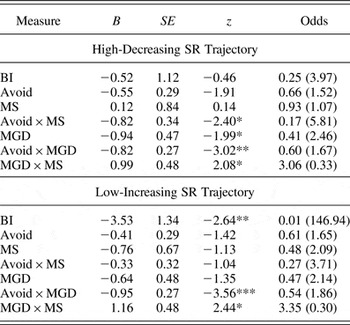
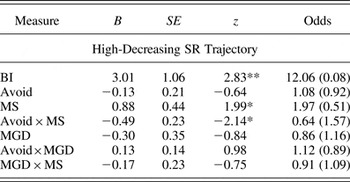
Results were examined to contrast the high-decreasing social reticence and low-increasing social reticence trajectories with the high-stable social reticence trajectory (Table 2). As well, the low-increasing social reticence trajectory was contrasted with the high-decreasing social reticence trajectory (Table 3). Overall, beyond behavioral inhibition, all main effects of the current predictors (avoidance, maternal sensitivity, and maternal gentle discipline) were superseded by interaction effects. Probing of significant interactions between avoidance and maternal behavior examined the effect of either maternal sensitivity or maternal gentle discipline on odds of membership in the respective trajectories when infant avoidance was high (+1 SD) or low (–1 SD). Additional interaction effects between maternal sensitivity and maternal gentle discipline were probed to examine the effect of maternal sensitivity on odds of membership in the respective trajectories when maternal gentle discipline was high (+1 SD) or low (–1 SD), at an average level of avoidance.
Predictive effects of avoidance, maternal sensitivity, maternal gentle discipline, and their interactions compared to high-stable social reticence trajectory

Note: SR, Social reticence; BI, behavioral inhibition; MS, maternal sensitivity; MGD, maternal gentle discipline. Odds in parentheses are reciprocals and refer to the odds of membership in the comparison profile.
*p < .05. **p < .01.
Predictive effects of avoidance, maternal sensitivity, maternal gentle discipline, and their interactions compared to low-increasing SR trajectory

Note: SR, Social reticence; BI, behavioral inhibition; MS, maternal sensitivity; MGD, maternal gentle discipline. Odds in parentheses are reciprocals and refer to the odds of membership in the comparison profile.
*p < .05. **p < .01.
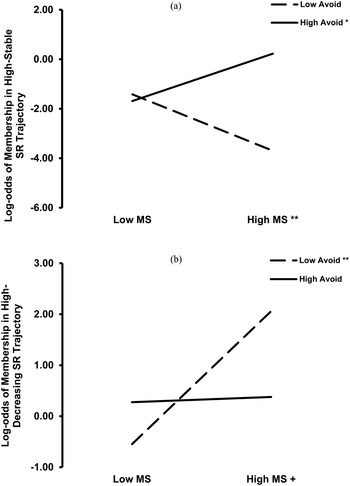
In comparison to the high-stable social reticence trajectory, the interaction of Avoidance × Maternal Sensitivity was significantly related to odds of membership in the high-decreasing social reticence trajectory (Figure 2a). Specifically, when avoidance was high, maternal sensitivity was positively associated with the odds of membership in the high-stable social reticence trajectory, compared to the high-decreasing social reticence trajectory (B = 1.24, z = 1.97, p = .05). When avoidance was low, maternal sensitivity was not associated with the odds of membership in the high-stable social reticence trajectory, compared to the high-decreasing trajectory (B = –1.47, z = –1.16, p = .25). In comparison to the low-increasing social reticence trajectory, when avoidance was low, maternal sensitivity was positively associated with the odds of membership in the high-decreasing social reticence trajectory (B = 1.69, z = 2.70, p = .01; Figure 2b). When avoidance was high, maternal sensitivity was not associated with the odds of membership in the high-decreasing social reticence trajectory, compared to the low-increasing trajectory (B = 0.06, z = 0.10, p = .92).
Interaction effect of early avoidance and maternal sensitivity on (a) the log-odds of membership in the high-stable social reticence trajectory compared to the high-decreasing trajectory and (b) the log-odds of membership in the high-decreasing trajectory compared to the low-increasing trajectory.

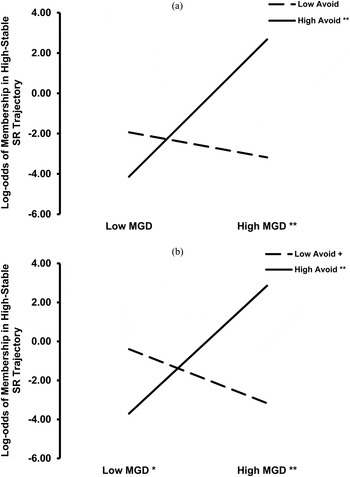
In addition, the interaction between avoidance and maternal gentle discipline significantly related to the odds of membership in the high-stable social reticence trajectory in comparison to the high-decreasing and the low-increasing social reticence trajectories (Figures 3a and b, respectively). Specifically, when avoidance was high, maternal gentle discipline was positively associated with the odds of membership in the high-stable social reticence trajectory, compared to the high-decreasing social reticence trajectory (B = 2.28, z = 3.11, p = .002) and compared to the low-increasing social reticence trajectory (B = 2.20, z = 2.91, p = .004). However, when avoidance was low, maternal gentle discipline did not significantly differentiate any of the trajectories (all ps > .07).
Interaction effect of early avoidance and maternal gentle discipline on the log-odds of membership in the high-stable social reticence trajectory compared to (a) the high-decreasing trajectory and (b) the low-increasing trajectory.

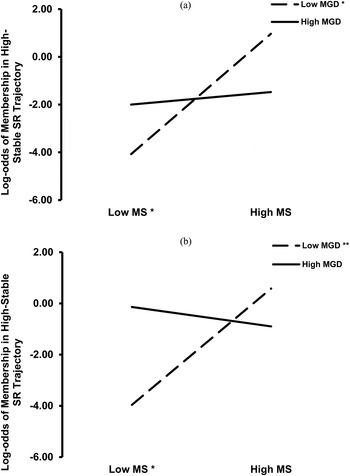
Finally, the interaction between maternal sensitivity and maternal gentle discipline was significantly related to the odds of membership in the high-stable social reticence trajectory in comparison to the high-decreasing social reticence and low-increasing social reticence trajectories (Figure 4a and b, respectively). Specifically, maternal sensitivity was positively associated with the odds of membership in the high-stable social reticence trajectory compared to the high-decreasing social reticence trajectory (B = 1.26, z = 2.18, p = .03) and compared to the low-increasing social reticence trajectory (B = 2.38, z = 3.30, p = .001), when maternal gentle discipline was low. However, when maternal gentle discipline was high, maternal sensitivity did not differentiate any of the trajectories (all ps > .20).
Interaction effect of maternal sensitivity and maternal gentle discipline on the log-odds of membership in the high-stable social reticence trajectory versus (a) the high-decreasing trajectory and (b) the low-increasing trajectory.

Discussion
The present study examined children, selected in infancy for a wide range of temperamental reactivity to novelty, for their behavioral responses to fear-eliciting tasks at 9 months of age. Children's level of avoidance influenced (i.e., moderated) associations between maternal caregiving behavior and longitudinal trajectories of social behavior across early childhood. Previous work revealed multiple longitudinal risk trajectories of social reticence across early childhood: high-stable, high-decreasing, and low-increasing (Degnan et al., Reference Degnan, Almas, Henderson, Hane, Walker and Fox2014). These developmental patterns of social behavior were predicted by levels of toddler behavioral inhibition, and differentiated by child behavior problems at 60 months of age. The two most extreme trajectories displayed greater risk for psychopathology, while the high-decreasing trajectory displayed evidence for resilience across time (Degnan & Fox, Reference Degnan and Fox2007). The high-stable trajectory evidenced high behavioral inhibition in toddlerhood and the highest levels of internalizing problems. The low-increasing trajectory evidenced low behavioral inhibition in toddlerhood and the highest levels of externalizing problems. The high-decreasing trajectory evidenced high behavioral inhibition in toddlerhood, but the lowest levels of internalizing and externalizing problems.
The current study expanded this work to focus on the influence that early infant behavior has on the associations between maternal caregiving behavior and membership in the longitudinal risk trajectories of social reticence. Using interactive effects in a structural equation modeling framework, the effects of maternal sensitivity during infancy and maternal gentle discipline during toddlerhood were examined when infants displayed high or low levels of avoidance to fear-eliciting stimuli in infancy. Consistent with a focus on the influential child, for infants who displayed greater avoidance at 9 months, mothers' displays of sensitivity across two structured, object exploration tasks at 9 months were positively associated with membership in the high-stable social reticence trajectory, compared to the high-decreasing social reticence trajectory. In contrast, when infants displayed less avoidance at 9 months, maternal sensitivity was positively associated with membership in the high-decreasing social reticence trajectory compared to the low-increasing social reticence trajectory. Given that the high-stable social reticence trajectory previously evidenced risk for internalizing symptoms and the high-decreasing social reticence trajectory evidenced resilience (Degnan & Fox, Reference Degnan and Fox2007), the present results suggest differential effects of maternal sensitivity on adaptive or maladaptive outcomes depend on the early level of infant avoidance behavior experienced or observed by the mother. That is, for infants lower on avoidance, higher maternal sensitivity during object exploration (i.e., heightened responsiveness to infant bids and following child's focus) protected against potential externalizing problems (low-increasing social reticence), while for infants higher on avoidance, maternal sensitivity in these contexts was a risk factor for potential internalizing problems (high-stable social reticence). Given other findings showing that insensitive maternal behavior during caregiving tasks (e.g., diaper changing or feeding) is predictive of internalizing and externalizing symptoms (e.g., Hane, Henderson, Reeb-Sutherland, & Fox, Reference Hane, Henderson, Reeb-Sutherland and Fox2010), the present results suggest that patterns of multifinality may indicate differential susceptibility (Pluess & Belsky, Reference Pluess and Belsky2010) to certain contexts (e.g., object exploration vs. caregiving tasks) for children with specific temperamental profiles (e.g., high avoidant vs. low avoidant). While reactive infants and children may evoke maternal sensitivity, or a heightened focus on infants' emotional signals and attentional focus, in certain contexts this may not help the child develop more adaptive coping skills to explore the world around them. In contrast, when mothers display more directive behavior, encouraging exploration and approach, somewhat fearful, avoidant infants may evidence greater resilience against their temperamental profile, declining in their social reticence and minimizing risk for psychopathology over time.
The present report also examined how maternal interactive behavior at 36 months served as a more proximate factor associated with the maintenance of socially reticent behavior with unfamiliar peers across early childhood. We found a modest positive correlation between maternal sensitivity (9 months) and maternal gentle discipline (36 months). Therefore, given the developmental changes that occur from infancy to late toddlerhood, as well as the moderate nature of this relation, it was important to examine whether these maternal characteristics operated in the same way at both time points. The interaction of infant avoidance at 9 months and maternal gentle discipline at 36 months of age was associated with the trajectories, above and beyond the effects of maternal sensitivity at 9 months, and differentiated the high-stable social reticence trajectory from both the high-decreasing and the low-increasing social reticence trajectories. Specifically, maternal gentle discipline was positively associated with the probability of membership in the high-stable social reticence trajectory, compared to the high-decreasing or low-increasing social reticence trajectories, when infants displayed greater avoidance at 9 months. Gentle discipline was not associated with membership in the trajectories when avoidance was low, however. Therefore, as hypothesized, infants displaying greater avoidance of fearful stimuli at 9 months whose mothers used gentle discipline to direct the child to engage in a cleanup activity in toddlerhood were more likely to follow a high, stable pattern of social reticence across early childhood. These findings suggest that gentle discipline (e.g., indirect suggestions) may maintain social reticence behavior from toddlerhood through the preschool years for high avoidant infants. However, for low avoidant infants, gentle discipline in toddlerhood did not seem to influence trajectories of social reticence. This suggests that differential susceptibility to maternal behavior for those with particular extreme temperaments may have a sensitive period in infancy. The current study focused on measures of parenting considered to be developmentally appropriate for the age of the child (infant vs. toddler); however, research is needed that assesses the same parenting constructs across time to truly determine whether sensitive periods or methods of parenting are influencing risk and resilience outcomes. One could assume that greater sensitivity develops into greater gentle discipline, but this is largely unknown in the developmental literature.
In general, the effects of maternal sensitivity and gentle discipline for high avoidant infants support the current understanding of parenting effects on behaviorally inhibited or socially anxious children (Degnan et al., Reference Degnan, Almas and Fox2010; Degnan, Henderson, et al., Reference Degnan, Henderson, Fox and Rubin2008; Hane, Cheah, et al., Reference Hane, Cheah, Rubin and Fox2008; Mount et al., Reference Mount, Crockenberg, Bárrig Jó and Wagar2010; Wood et al., Reference Wood, McLeod, Sigman, Hwang and Chu2003). The measures of maternal behavior in this study were collected during structured tasks with novel objects in which there was an external goal beyond regulating the child's own reactivity (e.g., 9 months: building a structure and touching the unpredictable toy; 36 months: cleaning up the toys). Therefore, mothers who exhibited lower levels of sensitivity or gentle discipline may have been more focused on the task at hand, rather than on their child's reactivity to the task. Reactive and avoidant infants may be more likely to evoke maternal focus on their affective cues, yet a parenting style that does not follow the cue, but challenges the infant to confront novelty, may help avoidant infants and toddlers develop ways of distracting themselves from distress (or being soothed for it). Instead, maternal support to confront the task in front of them may lead to greater approach and less reticence, as well as lower risk for internalizing disorders. In addition, because the current measures of maternal behavior were uncorrelated with infant avoidance, these effects are not explained by mothers of avoidant infants concurrently displaying greater sensitivity to their child's behavior or distress. Thus, not all mothers of avoidant infants react with heightened sensitivity and gentle discipline. It may be that this maternal behavior is evoked from specific types of parents or through repeated exposure to the infant's reactivity since birth. Studies examining maternal behaviors in response to children's distress to novelty have demonstrated that maternal behaviors that soothe or protect the child from the stressful event versus encouraging them to approach the novelty are associated with the maintenance of fear and inhibited behavior in toddlerhood (Kiel & Buss, Reference Kiel and Buss2011; Mount et al., Reference Mount, Crockenberg, Bárrig Jó and Wagar2010). This ability to regulate one's attention to achieve a goal by preschool age has been shown to help children high in behavioral inhibition decrease their risk for anxiety problems (White et al., Reference White, McDermott, Degnan, Henderson and Fox2011), and mother–child interactions may be a context in which children first learn these attention regulation skills. Future studies are needed to understand how the environmental context helps shape attention mechanisms such as vigilance to threat and attention shifting, as well as the physiological and neural patterns that support these mechanisms, by which parenting behavior may influence the development of psychopathology for avoidant or inhibited children.
In an effort to clarify the dual role of maternal sensitivity and maternal gentle discipline on trajectories of social reticence in early childhood, controlling for infant avoidance levels, the interaction between maternal sensitivity in infancy and maternal gentle discipline in toddlerhood was examined. Given the similar effects that each maternal behavior measure showed for highly avoidant infants, and the moderate association between maternal sensitivity and gentle discipline, it was hypothesized that a combination of high maternal sensitivity and high maternal gentle discipline would relate to the high-stable social reticence trajectory. However, results revealed that it was actually the combination of high maternal sensitivity with low maternal gentle discipline that was associated with a greater probability of membership in the high-stable social reticence trajectory, compared to the high-decreasing and low-increasing social reticence trajectories. In other words, infants and toddlers exposed to greater maternal sensitivity were more likely to be a member of the high-stable social reticence trajectory when exposed to lower maternal gentle discipline. However, when infants were exposed to lower maternal sensitivity, the effect of maternal gentle guidance was reversed, such that greater maternal gentle guidance was then associated with a greater likelihood of membership in the high-stable social reticence trajectory, compared to the high-decreasing or low-increasing social reticence trajectories. It is also important to note that these effects were evident at average levels of behavioral inhibition and infant avoidance. Thus, these effects of maternal caregiving behavior reflect associations for the temperamentally average child, rather than one more reactive to novelty or fear-eliciting stimuli. In terms of the low-increasing social reticence trajectory, which was rated higher on externalizing behavior problems in previous work (Degnan et al., Reference Degnan, Almas, Henderson, Hane, Walker and Fox2014), these results support main effects from the literature, where both low maternal sensitivity and low gentle discipline are associated with greater child externalizing behavior problems (Leerkes, Blankson, & O'Brien, Reference Leerkes, Blankson and O'Brien2009; Penela et al., Reference Penela, Henderson, Hane, Ghera and Fox2012; Smith, Calkins, Keane, Anastopolous, & Shelton, Reference Smith, Calkins, Keane, Anastopoulos and Shelton2004). Therefore, when considering parental strategies to include in parent training programs, one needs to consider the influence of the child on these effects, because different parent strategies may have varying implications for child risk or resilience for different types of children. Parents told to use specific strategies regardless of their child's temperament may be frustrated when the results are not what they expected.
Strengths and limitations
The current results extend the literature in multiple ways. Maternal caregiving behavior was examined during two developmental stages, infancy and toddlerhood, thus allowing for an examination of prospective and proximate effects of the environment on social reticence. Temperament × Environment interaction effects were explored in relation to longitudinal risk trajectories of social reticence, rather than measures of social functioning at one specific time point. Given the modest stability in maternal behavior across the two assessments in the current study and the joint effects found in relation to the low-increasing social reticence trajectory, future work should examine parenting profiles throughout development for other temperamental subtypes as well (e.g., frustration-prone or exuberant). Furthermore, longitudinal parenting profiles utilizing similar measures over time may better describe the parenting environment children are exposed to and greatly enhance our understanding of children's psychosocial development within context. While the current study examined multiple time points of parenting behavior, it is difficult to disentangle the measurement differences from the developmental differences.
In addition, while LCGA is a useful analysis for longitudinal data, the present trajectories do not necessarily represent qualitatively distinct groups in the general population. Instead, they represent patterns within the sample examined (Bauer & Curran, Reference Bauer and Curran2004). Because the present sample was overselected for negative and positive reactivity to novelty, the current results may not be generalizable to a random, community sample. Furthermore, observations of maternal behavior in response to children's actual social behavior may have been more closely related to our outcome measure of interest than maternal behaviors during structured home assessments and may have yielded different results. In addition, the present examination focused on the early years of development, earlier than many disorders fully emerge. Additional work should examine these factors in relation to outcomes at later ages to determine if risk for clinical disorder is predicted from early child and parenting measures. Finally, while the current sample evidenced temperamental risk, it was relatively low in stress exposure when considering the demographic nature in terms of socioeconomic status. Studies are needed that combine temperamental risk and risk for stress exposure in the same longitudinal samples.
Future directions for translating research on the influential child into preventive interventions
Overall, our findings highlight the importance of child temperament and the goodness of fit between parenting styles and child temperament, as sensitivity and gentle discipline operated differently for children with varying characteristics (i.e., higher vs lower infant avoidance). While higher sensitivity and gentle discipline may contribute to maladaptive outcomes for avoidant infants, different caregiving style combinations seem to contribute to maladaptive outcomes for low avoidant infants. These contrasting results support a continued focus on endogenous, individual differences such as temperament in the examination of exogenous, contextual effects such as parenting on child risk and resilience outcomes. In addition, they suggest that a parenting style that is structured, but flexible and responsive to changes in child behavior and affect over time, might be best for all children. However, studies of this type of parenting are lacking in the developmental literature. This work is sorely needed to inform prevention and community parenting programs. The current results add to the existing literature by providing support for a parenting style that is not overly focused on the infant's affective cues at the expense of object exploration in order to modify children's inhibited and avoidant cycles and urge them to approach the world around them (for reviews, see Degnan et al., Reference Degnan, Almas and Fox2010; Rubin et al., Reference Rubin, Coplan and Bowker2009).
The current results mostly point to parenting styles that contribute to the maintenance of social reticence behavior across early childhood, but knowledge is needed regarding the specific parenting behaviors that would help temperamentally avoidant and behaviorally inhibited children adapt across a myriad of domains. For instance, some work examining the intergenerational transmission of anxiety has pointed to such parenting skills as minimizing perceived threat (e.g., Muris et al., Reference Muris, van Zwol, Huijding and Mayer2010), and minimization of hypothetical threat in parent–child interactions is associated with better physiological regulation in school-aged children (Hane & Barrios, Reference Hane and Barrios2011). However, for this research to inform early intervention and prevention programs, concrete positive parenting practices (e.g., guiding children to approach; Mount et al., Reference Mount, Crockenberg, Bárrig Jó and Wagar2010) need to be clearly defined in relation to longitudinal patterns of child internalizing and externalizing outcomes and disorders. The current project suggests that fearful infants who experience less overall sensitivity and gentle discipline may evidence a pattern of resilience over time, but this does not explicate which behaviors should be used to impart these effects. Further, theory suggests that quadratic effects of parenting may be more closely related to outcomes. While the current study did not find any significant effects of quadratic parenting measures, other research should continue to explore this possibility. Finally, future work should examine other contextual effects that may have a joint impact on parenting and child outcomes, such as nonmaternal childcare or changes in family structure and parents' marital status. In general, however, these results suggest that any parent or child prevention or intervention program needs to include a focus on both the child's individual characteristics and the specific parenting context that might support different types of children as they grow and develop. All parents would benefit from learning about their child's temperament and being coached on how to best match their interactive styles to their child. However, this would be particularly true for parents of avoidant or behaviorally inhibited infants, whose influence on parenting behavior ensues such that they are more at risk for developing internalizing psychopathology.
Summary
Prior analyses conducted on repeated measures of social reticence across early childhood yielded three different longitudinal patterns: high-stable social reticence, high-decreasing social reticence, and low-increasing social reticence, further defined by individual behavioral inhibition in toddlerhood and shown to be at risk for later internalizing and externalizing psychopathology (Degnan et al., Reference Degnan, Almas, Henderson, Hane, Walker and Fox2014). The current study expanded on this model to further differentiate these trajectories by examining the interactive effects of infant avoidance and maternal caregiving behavior in infancy and toddlerhood on the longitudinal risk trajectories of social reticence. Highly avoidant infants with mothers exhibiting greater sensitivity (infancy) or gentle discipline (toddlerhood) were more likely to follow the high-stable social reticence trajectory compared to the high-decreasing or low-increasing trajectories. Furthermore, across levels of avoidance, when infants' mothers exhibited lower sensitivity in infancy and lower gentle discipline in toddlerhood, the infants were more likely to follow the high-decreasing and low-increasing social reticence trajectories compared to the high-stable trajectory, across early childhood. The results reported here suggest that the early behavior of avoidant infants influences maternal behavior in a fashion that exacerbates risk for maladaptive outcomes across development. Such findings underscore the need for future research to explore the nature of the influence of the child on the parent and the timing and nature of the context of parent–child interaction behaviors that may serve to buffer against a sustained trajectory of inhibition over time (Degnan et al., Reference Degnan, Almas and Fox2010; Degnan & Fox, Reference Degnan and Fox2007).