Second language acquisition studies of early and late learners have consistently demonstrated a more or less strong negative correlation between age of onset (AO) of acquisition and ultimate attainment of second language (L2) proficiency. Not only does this finding closely correspond to the layman's observation that children acquire languages more efficiently and with greater success than adults, but it also seems to support the idea of a biological critical period for human language acquisition (e.g., Abrahamsson & Hyltenstam, Reference Abrahamsson and Hyltenstamin press; DeKeyser, Reference DeKeyser2000; Hyltenstam & Abrahamsson, Reference Hyltenstam and Abrahamsson2000, Reference Hyltenstam and Abrahamsson2001, Reference Hyltenstam, Abrahamsson, Fraurud and Hyltenstam2003a, Reference Hyltenstam, Abrahamsson, Doughty and Long2003b; Johnson & Newport, Reference Johnson and Newport1989; Long, Reference Long1990, Reference Long, Hyltenstam and Viberg1993; Patkowski, Reference Patkowski1980). On the other hand, since the early 1990s a handful of studies have identified postpuberty, even adult, learners who appear to have attained a nativelike command of certain phonetic or morphosyntactic aspects of the L2 (e.g., Birdsong, Reference Birdsong1992, Reference Birdsong, Bohn and Munro2007; Birdsong & Molis, Reference Birdsong and Molis2001; Bongaerts, Reference Bongaerts and Birdsong1999; Colantoni & Steele, Reference Colantoni, Steele, Klee and Face2006; Montrul & Slabakova, Reference Montrul and Slabakova2003; Moyer, Reference Moyer1999; van Boxtel, Bongaerts, & Coppen, Reference Van Boxtel, Bongaerts and Coppen2005; White & Genesee, Reference White and Genesee1996) or of a variety of linguistic phenomena (e.g., Abrahamsson & Hyltenstam; Hyltenstam & Abrahamsson, Reference Hyltenstam, Abrahamsson, Fraurud and Hyltenstam2003a; Ioup, Boustagui, El Tigi, & Moselle, Reference Ioup, Boustagui, El Tigi and Moselle1994; Marinova-Todd, Reference Marinova-Todd2003). Despite the many problems that can be associated with several of these studies (for a recent review, see Long, Reference Long2005; see also Hyltenstam & Abrahamsson, Reference Hyltenstam and Abrahamsson2000, Reference Hyltenstam and Abrahamsson2001, Reference Hyltenstam, Abrahamsson, Doughty and Long2003b), their results may seem to argue against the existence of a critical period or maturational constraints on language acquisition generally. These studies have indeed been used to argue that the typical differences between child and adult learners' success should instead be attributed to social, psychological, and educational factors (e.g., Marinova-Todd, Marshall, & Snow, Reference Marinova-Todd, Marshall and Snow2000), to the development of formal operations (e.g., Felix, Reference Felix1985), to a general cognitive decline and sensory acuity (e.g., Bialystok & Hakuta, Reference Bialystok, Hakuta and Birdsong1999), or to effects of bilingualism per se (e.g., Birdsong, Reference Birdsong2006).
However, there are strong indications that apparently nativelike late high-level L2 learners may still not qualify as definitive, or even valid, counterexamples to the critical period. First, current research shows that when scrutinized linguistically for broad-based proficiency, such adult learners tend not to be entirely nativelike when compared to native speakers of the target language. Therefore, learners in this category may be better characterized as near-native rather than entirely nativelike (Abrahamsson & Hyltenstam, Reference Abrahamsson and Hyltenstamin press; Hyltenstam & Abrahamsson, Reference Hyltenstam, Abrahamsson, Doughty and Long2003b; Ioup et al., Reference Ioup, Boustagui, El Tigi and Moselle1994; Long & Robinson, Reference Long, Robinson, Doughty and Williams1998). Second, if a critical period applies only to implicit language acquisition (i.e., acquisition without conscious reflection on linguistic structure), then there may in fact be no exceptions to it. Results from a few recent studies suggest that the nativelike (or near-native) postpuberty learners identified by researchers may in fact possess an above-average degree of aptitude for language learning—a trait that may override and disguise the negative effects of maturation on language learning ability, thus making some adult learners appear nativelike (see DeKeyser, Reference DeKeyser2000; Harley & Hart, Reference Harley and Hart1997, Reference Harley, Hart and Robinson2002; Ioup et al.). Child learners, on the other hand, appear to attain a nativelike command of the L2 regardless of their degree of language aptitude, which has led researchers to conclude that this factor plays no role in early acquisition (e.g., DeKeyser; Harley & Hart, Reference Harley and Hart1997).
The present study aims at testing the hypotheses formulated by DeKeyser (Reference DeKeyser2000) in a Studies in Second Language Acquisition article entitled “The Robustness of Critical Period Effects in Second Language Acquisition,” albeit with a somewhat different methodology. This study aims specifically at exploring DeKeyser's hypothesis that a high degree of language learning aptitude is required if adult learners are to reach an ultimate attainment in the L2 that is comparable to that of native speakers. An additional aim is to explore more closely the role of aptitude in child SLA. Rather than using randomly selected L2 speakers representing a variety of proficiency levels, the present study focuses exclusively on near-native speakers (i.e., individuals who pass for native speakers of the target language in everyday oral communication).
BACKGROUND
Nativelikeness, Near-Nativeness, and Nonperceivable Nonnativeness
Given sufficient opportunity (time and exposure) to learn, the majority of individuals who begin to acquire a L2 during childhood eventually end up speaking that language as if it were their mother tongue; those who begin their acquisition in adulthood typically do not. The existence of a critical period for language acquisition has been the object of intense debate during the past 40 years. The critical period hypothesis (CPH), in its original formulation (Lenneberg, Reference Lenneberg1967), predicted eventual nativelike levels of L2 proficiency in prepuberty learners but—due to decreasing brain plasticity (or flexibility) with maturation—less than nativelike levels in postpuberty learners. Empirical results vary, however, concerning the exact scheduling of maturation; some researchers have suggested a critical age offset before, rather than at, puberty (e.g., Johnson & Newport, Reference Johnson and Newport1989), whereas others have proposed a general decline in language acquisition abilities over the entire life span (e.g., Hyltenstam & Abrahamsson, Reference Hyltenstam, Abrahamsson, Doughty and Long2003b; see also Uylings, Reference Uylings2006). The proposals of neurological correlates to decreasing brain flexibility or plasticity have also varied over the years, from an emphasis on hemispheric lateralization (Lenneberg) to more recent suggestions of timing and degree of neuronal myelination of different cortical areas (Long, Reference Long1990; Pulvermüller & Schumann, Reference Pulvermüller and Schumann1994; Seliger, Reference Seliger and Ritchie1978) or general cerebral organization and growth, such as development and maturation of dendrites, white matter, synapses, and transmitters (see, e.g., Neville & Bavelier, Reference Neville and Bavelier1998; Uylings).
Although very few adult learners ever reach degrees of L2 mastery similar to those of native speakers or childhood L2 learners, cases of nativelikeness resulting from postpuberty learning are sometimes reported—by laymen as well as in the academic literature. The actual existence of this phenomenon has, however, been debated. Ever since Selinker (Reference Selinker1972) estimated that 5% of the adult L2-learning population reach “absolute success” (p. 212), a variety of nativelikeness rates have been suggested. For example, Seliger, Krashen, and Ladefoged (Reference Seliger, Krashen and Ladefoged1975) concluded that 10% of their adult L2 learners had accent-free speech, and Birdsong (Reference Birdsong and Birdsong1999, Reference Birdsong, Kroll and De Groot2005a) suggested that 15% of all adult L2 learners can be considered nativelike. Most researchers reporting these figures do so to reject the CPH or maturational constraints on language acquisition in general. In fact, Bialystok (Reference Bialystok1997) claimed rather categorically that cases of nativelike adult L2 ultimate attainment “are not anomalous exceptions to a biological law [but] quite ordinary occurrences that emerge when conditions are favorable” (p. 134).
However, there are researchers who have doubted Selinker's (Reference Selinker1972) and others' quite optimistic estimations and have instead suggested that the actual incidence of nativelikeness should approach zero. Not surprisingly, proponents of this view offer an explanation for adults' relative failure to reach nativelikeness that is based on neurological changes that occur at a certain age (e.g., puberty) and that lead to a sudden or gradual deterioration or distortion of the implicit language learning mechanism. This should not, however, be taken to mean that adults are incapable of learning L2s; on the contrary, some may attain extremely advanced levels of L2 proficiency. For example, although he asserted that no (normal) adult learner reaches an entirely nativelike ultimate attainment of the L2, Bley-Vroman (Reference Bley-Vroman, Gass and Schachter1989) acknowledged that “some may have a performance difficult to distinguish from that of native speakers” (p. 44). Similar positions are held by Gregg (Reference Gregg, Ritchie and Bhatia1996) and Long and Robinson (Reference Long, Robinson, Doughty and Williams1998), who suggested that cases of ostensibly perfect or completely successful mastery of a L2 in adulthood should be labeled near-native rather than nativelike. Near-native L2 proficiency is taken to mean apparent nativelikeness (i.e., levels of proficiency that cannot be distinguished from native levels in everyday spoken communication and only become apparent through detailed linguistic analyses).
In Hyltenstam and Abrahamsson (Reference Hyltenstam, Abrahamsson, Doughty and Long2003b), we introduced the notion of nonperceivable nonnativeness to characterize the manner in which this proficiency level differs from nativelike proficiency. This notion motivates the hypothesis that cases of nativelike adult learners reported in the literature would still differ to some degree from native-speaker proficiency and target-language norms if they were to undergo a detailed linguistic examination. Such a hypothesis fits well with the observation made by Sorace and Robertson (Reference Sorace, Robertson, Elder, Brown, Grove, Hill, Iwashita, Lumley and al.2001) that “non-native grammars may exhibit certain subtle features that distinguish them from native grammars” (p. 266). Indeed, the well-known study by Ioup et al. (Reference Ioup, Boustagui, El Tigi and Moselle1994) of two extremely successful adult L2 learners of Egyptian Arabic, called Julie and Laura, is very much illustrative of nonperceivable nonnativeness. Despite the fact that the two L2 speakers passed for native speakers with actual mother-tongue speakers of Egyptian Arabic and despite the fact that they both performed within the native-speaker range on several of the language tests given to them, their L2 proficiency was found to be less than fully nativelike when aspects of their grammatical intuition were scrutinized in detail.
Even though the notion of nonperceivable nonnativeness may help us distinguish nativelike from near-native L2 ultimate attainment, investigation of an additional factor, language learning aptitude, may be even more helpful in explaining any apparent exceptions to the critical period. The investigation of the relationship between aptitude and near-nativeness may in fact turn out to potentially disqualify nativelikeness per se in adult L2 learning as automatic, unquestionable evidence against maturational constraints.
Language Learning Aptitude and Near-Nativeness
When native speakers occasionally encounter adult L2 learners of their language who seem to speak it without a noticeable foreign accent or other signs of linguistic nonnativeness, they most often look up to such rare individuals with some admiration, or even envy. Indeed, because these learners began to acquire the L2 as adults, few would hesitate to characterize them as linguistically talented or gifted. Such a propensity for picking up languages has frequently been framed and investigated within psychological research on aptitude.
Language learning aptitude is generally defined as a largely innate, relatively fixed talent for learning languages. This individual factor varies considerably within normal populations and has been found to be relatively independent of other factors, including general intelligence, personality, attitudes toward the language to be learned, and the motivation to learn it (Dörnyei & Skehan, Reference Dörnyei, Skehan, Doughty and Long2003; Novoa, Fein, & Obler, Reference Novoa, Fein, Obler, Obler and Fein1988; Ross, Yoshinaga, & Sasaki, Reference Ross, Yoshinaga, Sasaki and Robinson2002; Sasaki, Reference Sasaki1996; Skehan, Reference Skehan and Robinson2002). The popular belief that musical and linguistic talent are closely connected has generally not been borne out in empirical research (e.g., Novoa et al.). A recent study by Gilleece (Reference Gilleece2006) did, however, report significant (small to moderate) correlations between measures of foreign language aptitude and certain aspects of musical aptitude, although, again, these effects were independent of general intelligence (i.e., IQ).
The study of language learning aptitude was initiated half a century ago with the development of the Modern Language Aptitude Test (MLAT; Carroll & Sapon, Reference Carroll and Sapon1959). Other tests that have followed and, to a great extent, built on the foundations of the MLAT include the Pimsleur Language Aptitude Battery (PLAB; Pimsleur, Reference Pimsleur1966), the Defense Language Aptitude Battery (DLAB; Peterson & Al-Haik, Reference Peterson and Al-Haik1976), VORD (Parry & Child, Reference Parry, Child, Parry and Stansfield1990), and CANAL-F (Grigorenko, Sternberg, & Ehrman, Reference Grigorenko, Sternberg and Ehrman2000), as well as the set of tests used in the present study, the Swansea Language Aptitude Tests (LAT; Meara, Milton, & Lorenzo-Dus, Reference Meara, Milton and Lorenzo-Dus2003) and its more recent follower, the Llama Language Aptitude Tests (LLAMA; Meara, Reference Meara2005a, Reference Meara2005b). The four constituents of language aptitude identified as particularly important by Carroll (Reference Carroll and Diller1981) and thus included in most aptitude test batteries are (a) phonetic/phonemic coding ability, which refers to the ability to identify speech sounds and to form associations between sounds and symbols; (b) grammatical sensitivity, or the ability to identify the functions of constituents (e.g., subject, object) in a sentence; (c) rote learning ability, which is the ability to learn associations between lexical forms and meaning rapidly and efficiently (i.e., to easily learn and remember new words); and (d) inductive learning ability, or the ability to infer the rules of a set of previously unknown language materials (see Carroll; see also Dörnyei & Skehan, Reference Dörnyei, Skehan, Doughty and Long2003; Novoa et al., Reference Novoa, Fein, Obler, Obler and Fein1988; Ross et al., Reference Ross, Yoshinaga, Sasaki and Robinson2002; Schneiderman & Desmarais, Reference Schneiderman and Desmarais1988; Skehan, Reference Skehan and Robinson2002).
Due to the fact that aptitude tests, for the most part, have been developed and used as diagnostic tools for predicting success in instructed learning, research on language aptitude has to date focused heavily on foreign language learning in formal settings and very rarely on SLA in naturalistic contexts. This state of affairs was more or less sustained theoretically by Krashen (Reference Krashen, Burt, Dulay and Finocchiaro1977), who suggested that aptitude is an important predictor of success in explicit learning, whereas attitudinal factors better predict the outcome of implicit acquisition. In fact, Krashen (Reference Krashen and Diller1981) went so far as to claim that aptitude is irrelevant to language acquisition because unconscious and implicit rather than conscious and explicit processes are at work in natural language development. Some recent studies (e.g., DeKeyser, Reference DeKeyser2000; Harley & Hart, Reference Harley, Hart and Robinson2002; Robinson, Reference Robinson1997) have suggested, however, that language aptitude may play a decisive role in naturalistic SLA—and perhaps an even more decisive role than it plays in instructed SLA—because acquiring a language implicitly, by having to discover grammatical regularities and phonetic patterns merely from language exposure, can be seen as an even greater challenge than learning it through pronunciation tutoring and explicit grammar instruction (e.g., DeKeyser; Skehan, Reference Skehan1989).
How, then, does language learning aptitude relate to the phenomenon of nativelike or near-native L2 ultimate attainment by adult learners? When Selinker (Reference Selinker1972) made his 5% estimate of completely nativelike adult learners, he also argued that these learners are unique because they make use of psychological processes in their learning that are quite different from those used by the ordinary learner. He therefore suggested that these learners need not be considered at all in a theory of interlanguage. The idea that exceptionally successful adult learners are in some sense unique and different from average learners was made explicit by Bley-Vroman (Reference Bley-Vroman, Rutherford and Smith1988, Reference Bley-Vroman, Gass and Schachter1989), whose fundamental difference hypothesis stated that whereas children acquire language through implicit, domain-specific mechanisms, adult learners have lost most of their ability to acquire languages implicitly and are left instead with their general problem-solving strategies and processes when faced with the task of acquiring a L2. Given that these general cognitive functions are not designed specifically for language acquisition, virtually no adult learner should ever master a L2 entirely. Still, if such mastery does in fact happen, in rare cases, this could, according to Bley-Vroman (Reference Bley-Vroman, Gass and Schachter1989), be given the same “pathological status” (p. 44) as the exceptional phenomenon of children failing to fully master their first language (L1). Expressed in more moderate terms, if a general and—for the purpose of acquiring languages—less efficient system takes over at a certain age in all learners, the apparent exceptions to the critical period should be expected to possess an extraordinary verbal analytical ability (i.e., language learning aptitude). This trait, shared only by a small minority of learners, would thus allow for a greater amount of explicit and conscious reflection on grammatical structure during acquisition, which, in turn, potentially compensates for the biological disadvantage of having begun SLA beyond childhood. This view seems compatible with the one expressed by Ioup et al. (Reference Ioup, Boustagui, El Tigi and Moselle1994) when they reported that their participant Julie had an unusual talent for focusing on linguistic form. While acquiring Egyptian Arabic naturalistically, Julie had—in her own opinion—the ability to easily notice redundant morphology and to consciously manipulate grammatical structure. She was also very strong in her attitude that “grammar […] needed to be mastered correctly” (Ioup et al., p. 92).
A somewhat different view is held by those who propose that the innate acquisition system remains intact in certain rare individuals, thus allowing for a continued capacity for implicit language acquisition later in life. Selinker (Reference Selinker1972) made reference to Lenneberg's (Reference Lenneberg1967) concept of a latent language structure (i.e., the biological counterpart to Universal Grammar) and suggested that “those adults who ‘succeed’ in learning a second language so that they achieve native-speaker ‘competence’ have somehow reactivated the latent language structure which Lenneberg describes” (p. 212). In a similar but more explicit manner, Carroll (Reference Carroll1973) speculated that adults with high language aptitude “are those who have for some reason lost little of the language acquisition ability with which they are natively endowed,” whereas those with low aptitude for learning languages “are those who have lost most of this innate ability” (pp. 6–7). In fact, Ioup et al. (Reference Ioup, Boustagui, El Tigi and Moselle1994) actually seemed to lean toward this position when they suggested that if there are exceptions to the CPH, the neurocognitive change associated with a critical period has not taken place in the usual way. At the same time, they expressed a certain degree of ambivalence on this point when holding that “it remains to be answered whether this difference implies allowing an existing system to continue to function or whether an alternative system subsumes the role of language acquisition” (Ioup et al., p. 93), thereby leaving the door open for the view held by, for example, Bley-Vroman (Reference Bley-Vroman, Gass and Schachter1989). It is important to highlight, however, that despite their differences and regardless of which—if either—of these two theoretical positions might turn out to be correct, neither dispenses with the concepts of critical period and maturation.
DeKeyser's (Reference DeKeyser2000) study is of particular interest because, in addition to being a replication of the seminal critical period study by Johnson and Newport (Reference Johnson and Newport1989), it explicitly investigated the different roles of language learning aptitude for the attainment of near-native L2 proficiency by adult and child learners; in fact, the study set out specifically to test Bley-Vroman's (Reference Bley-Vroman, Rutherford and Smith1988) fundamental difference hypothesis. DeKeyser's central hypothesis was that those adult learners who have a L2 proficiency comparable to that of child learners all have high language aptitude because such a trait may have allowed them to learn the L2 grammar successfully through conscious reflection on linguistic structure, making them apparent counterexamples to the critical period. To test this hypothesis, he administered a modified version of Johnson and Newport's grammaticality judgment test (GJT) to 57 Hungarian L2 speakers of English. The participants had a minimum length of residence in the United States of 10 years and their AO of SLA ranged between 1 and 40 years. In addition to the GJT, a language learning aptitude test was given to the participants (a Hungarian adaptation of the MLAT subtest “Words in Sentences”; Ottó, Reference Ottó1996). Except for the predicted negative overall correlation between AO and GJT scores as well as the differing correlations between age and the mastery of different L2 elements, the most important finding was that, in principle, all those adult learners who scored within or just outside the range of child learners on the English GJT also had high scores on the aptitude test. For child learners, on the other hand, no effect of aptitude was found; they all scored well on the GJT regardless of their degree of aptitude. DeKeyser argued that if the implicit language acquisition mechanisms are lost, say after puberty, adults must instead draw heavily on explicit learning mechanisms when acquiring a new language. Therefore, adult L2 learners require an above-average degree of language aptitude in order to attain near-native proficiency, whereas this is not the case for child learners. Consequently, if the CPH applies to implicit acquisition only, then there may be no exceptions to it, and, therefore, DeKeyser argued, “the critical period really deserves its name” (p. 518). This view accords well with the interpretation of Ioup et al. (Reference Ioup, Boustagui, El Tigi and Moselle1994), namely that “any apparent exceptions to the CPH will manifest some aspect of the neuropsychological profile that characterizes language learning talent” (p. 93).
That a specific talent for language learning should be a crucial factor in adult near-native SLA is not, however, an idea that has been fully embraced by everyone; indeed, the literature contains a great deal of skepticism, even suspicion, toward any putative aptitude effects. For example, Bialystok (Reference Bialystok1997) dismissed the connection between aptitude and L2 near-nativeness as entirely irrelevant when stating that “the documented cases of perfect mastery of a second language achieved by late learners are not […] extraordinary feats by rare individuals with an unusual and prodigious talent” (p. 134) and claimed instead that this phenomenon simply occurs when circumstances (social, attitudinal, input related, educational, etc.) are advantageous. In a critique of DeKeyser (Reference DeKeyser2000), Bialystok (Reference Bialystok2002) maintained that “a specific type of cognitive processing model based on […] verbal ability is not necessary to explain the data” (p. 484). Similarly, Marinova-Todd (Reference Marinova-Todd2003) found talent to be an “unsatisfying” explanation for nativelikeness in late learners because “neither teachers nor learners could possibly do anything to improve their chance of success in the L2 learning endeavour if aptitude is the best predictor” (p. 31).
Indicative of the negative attitudes toward the role talent, or aptitude, can play is also the rather biased way various researchers have cited Ioup et al.'s (Reference Ioup, Boustagui, El Tigi and Moselle1994) article entitled “Reexamining the critical period hypothesis: A case study of successful adult SLA in a naturalistic environment.” Because of Julie's unusual success in acquiring Egyptian Arabic naturalistically, and probably also because of the somewhat ambiguous title of the article, this study has, time after time, been presented as strong evidence against the critical period, without any reference to the investigators' actual and very distinct interpretation—namely that Julie is an exceptionally talented language learner. The reluctance of many authors to even mention this theoretical interpretation—one of many examples being Marinova-Todd et al. (Reference Marinova-Todd, Marshall and Snow2000) in their review of misconceptions about age and L2 learning—becomes particularly odd when one considers the fact that Ioup et al. had actually framed their study within the paradigm of exceptional neuropsychological profiling, aptitude, and talent. The investigators made it very clear that they interpreted Julie's language learning mechanism as “in some way exceptional” (Ioup et al., p. 93), and her success was accounted for by comparing her inherited characteristics with those belonging to the so-called Geschwind-Galaburda cluster (e.g., left-handedness, twinning, and allergies; Geschwind & Galaburda, Reference Geschwind and Galaburda1985; see also Obler, Reference Obler, Gass, Madden, Preston and Selinker1989). Ioup et al. concluded that Julie “fits very well with the neuropsychological profile associated with unusual cognitive ability” (p. 92) and that “all signs point to Julie having the neuropsychological brain organization that typifies talented language learners” (p. 93). In other words, ignoring the exceptionality paradigm when making reference to Julie and leaving out the researchers' highly specific way of accounting for her success seriously misrepresents the Ioup et al. study as a refutation of the CPH when it should instead be described as an important refinement of it.
Aims of the Present Study
The primary aim of the present study was to test DeKeyser's (Reference DeKeyser2000) hypothesis that only late learners with a high level of verbal analytical ability will reach near-native levels of L2 proficiency. A second aim was to investigate whether late, as well as early, L2 speakers who pass for native speakers when engaged in natural, everyday conversation are necessarily entirely nativelike when scrutinized in linguistic detail. Finally, on the basis of Hyltenstam and Abrahamsson's (Reference Hyltenstam, Abrahamsson, Doughty and Long2003b) discussion of the possibility that aptitude (among other psychological and social factors) may also play a certain role in child SLA, a third aim was to test more carefully the part of DeKeyser's hypothesis that states that verbal analytical ability “will not be a significant predictor of success for childhood second language acquisition” (p. 499). With these aims in mind, we posited three hypotheses:
1. (a) Late L2 learners who are perceived as native speakers by actual mother-tongue speakers have above-average language aptitude, whereas (b) early L2 learners who are perceived as native speakers by mother-tongue speakers are normally distributed with regard to language aptitude.
2. (a) Most, if not all, late L2 learners who are perceived as native speakers by actual mother-tongue speakers are less than nativelike when scrutinized in linguistic detail, and (b) some, if not most, early L2 learners who are perceived as native speakers by mother-tongue speakers are also less than nativelike when scrutinized in linguistic detail.
3. Certain effects of language aptitude can be observed even for early L2 learners who are scrutinized in linguistic detail.
One crucial way in which the present study departs from that of DeKeyser (Reference DeKeyser2000) is in the selection of participants. Rather than investigating randomly selected L2 learners with varying degrees of ultimate attainment in the L2, the focus of the current study, as is the case for the Ioup et al. (Reference Ioup, Boustagui, El Tigi and Moselle1994) study, is on near-native speakers only—that is, individuals who have reached a proficiency level that allows them to pass for native speakers of the L2 in everyday language use, such that actual native speakers believe them to be true mother-tongue speakers. The rationale behind such a research design is twofold.
First, by keeping the near-nativeness variable constant, one is better able to investigate more closely its causal relationships with other variables, such as language aptitude, allowing for findings about how learners with different AOs of SLA have arrived at these near-native levels of ultimate attainment. Because proficiency is constant at the near-native level, we expect aptitude to have played an increasingly crucial role with higher AOs, hence our prediction of a positive correlation between AO and aptitude among our participants. In particular, because our basic assumption is that those late learners who attain near-native levels despite having lost most of their implicit learning ability do so with the help of a heightened verbal analytical ability, we expect all late-learner participants to have above-average aptitude.
Second, because one much debated issue is whether late, apparently nativelike learners are in fact nativelike, the most natural way to investigate this is, of course, to focus exclusively on L2 speakers who exhibit mastery that is potentially at this level, rather than to also include speakers who obviously do not (cf. Hyltenstam & Abrahamsson, Reference Hyltenstam, Abrahamsson, Doughty and Long2003b; Long, Reference Long, Hyltenstam and Viberg1993).
It is worth pointing out that this study does not intend to explore the nature of language learning aptitude itself; rather, it investigates the relation between verbal analytical ability and near-native L2 attainment on the basis of (a) existing knowledge and definitions of language aptitude and (b) the techniques available for its operationalization and measurement.
METHOD
Participants
Screening for Potential Nativelikeness
A total of 195 advanced L2 speakers of Swedish with Spanish as their L1Footnote 1 were identified; all of them considered themselves to be potentially nativelike in the L2. These candidates for nativelikeness were initially contacted through sizable advertisements in daily newspapersFootnote 2 and through posters at nearly all university campuses in the Stockholm area. Their AOs were <1–47 years; 107 had begun their acquisition of Swedish at or before the age of 11 years, and 88 had begun to learn Swedish at or beyond the age of 12 years.Footnote 3
The respondents first went through a 15-min interview and provided 1-min samples of spontaneous speech on a given topicFootnote 4; both the interview and spontaneous speech samples were recorded. Speech from 20 native speakers of Swedish was elicited and recorded in the same way. The first 20–30 s of each sample then served as stimuli in a computerized screening session in which 10 linguistically untrained native speakers of the Stockholm variety of Swedish acted as judges. The samples were presented in randomized orders that were different for each judge. For each of the 215 samples (i.e., 195 L2 speakers + 20 native speakers), the judges' task was to indicate whether they believed that the speaker was a native speaker of Swedish or a native speaker of some other language. The judges were financially compensated for their participation.
There was nearly absolute agreement among the judges concerning the native control speakers. No less than 18 of the 20 controls were judged by all 10 listeners as being mother-tongue speakers of Swedish. Two were judged as native speakers by 9 of the 10 listeners; that is, they were judged as nonnative speakers by 1 listener each. However, if these standards—9 of 10 native judges deeming a sample as native—are applied to L2 participants, only five with AOs beyond 11 years and none with an AO beyond 17 years passed for native speakers. Therefore, the criterion for potential participant selection was adjusted to include those who passed for native speakers of Swedish with a majority (i.e., at least 6) of the 10 native listeners. This criterion resulted in 104 potential participants out of the original 195 candidates. There was still a strong bias toward lower AOs, however: Whereas 87 (81%) of the candidates with AO <1–11 years passed for native speakers, only 17 (19%) individuals did so among the candidates with AO 12–47 years.
Selection of Participants
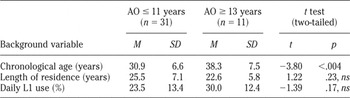
From the 104 potential candidates, 42 individuals (33 females and 9 males) were selected as participants who could be matched against each other according to all basic background criteria. Whereas 31 speakers with an AO between 1 and 11 years met the background and matching criteria, only 11 of the 17 late learners met these criteria, and their AOs ranged between 13 and 23 years. The mean age for the 42 selected participants at the time of testing was 33 years (range: 20–50), the mean length of residence in Sweden was 25 years (range: 12–42), and the mean percentage of self-reported daily L1 use was 25 (range: 5–50). As shown in Table 1, the late learners were on average about 7 years older than the early learners at the time of testing. However, the differences in length of residence and daily L1 use were not statistically significant, which means that the two groups are fairly comparable in terms of these basic background variables. All participants had an educational level of no less than senior high school (i.e., minimally 12 years of schooling); as it turned out, however, a majority had a university degree or were in the process of getting one.
Background information on the 42 selected participants: Comparisons between participants with age of onset (AO) before and after age 12 (df = 40)

Additionally, 15 native speakers of Swedish were included as controls. These were matched with the L2 speaker groups with regard to the distributions of age (M = 30 years, range = 23–46), sex (11 females and 4 males), and levels of education. They were all speakers of the Stockholm variety of Swedish and had no professional training in the phonetic or linguistic sciences.Footnote 5
Tests and Procedure
The project contained some 20 different instruments for language testing and speech elicitation and included various measures of pronunciation, speech perception, grammatical intuition, grammatical and semantic inferencing, and formulaic language. The results from 10 of these measures are presented in Abrahamsson and Hyltenstam (Reference Abrahamsson and Hyltenstamin press). The present article reports only on language aptitude and grammaticality judgment as well as the relation between these two measures.
Testing took place in a sound-treated room with each participant individually. The entire session lasted for approximately 4 h, divided into three subsessions with two 20-min breaks with food and refreshments. Participants first underwent a hearing test with an OSCILLA SM910 screening audiometer, and a loss of up to 10 dB for one frequency in one ear was considered acceptable. Participants received financial compensation of SEK 500. The testing was conducted by a male native speaker of Stockholm Swedish.
Language Aptitude Tests
A version of the Swansea LAT (v.2.0; Meara et al., Reference Meara, Milton and Lorenzo-Dus2003; for detailed descriptions, see Meara, Reference Meara2005b), adapted specifically to Swedish-speaking test takers,Footnote 6 was administered to the participants. Loosely based on the work of Carroll (see, e.g., Carroll, Reference Carroll1973; Carroll & Sapon, Reference Carroll and Sapon1959), the five subtests are designed to measure different aspects of language learning aptitude: phonetic memory (LAT A), lexical-morphological analytical skills (LAT B), grammatical inferencing skills (LAT C), aural memory for unfamiliar sound sequences (LAT D), and the ability to form sound-symbol associations (LAT E). All subtests are based on linguistic materials from either nonsense languages or rare languages with which the testee is unlikely to be familiar. The entire test was administered on a computer—LAT A, D, and E also through earphones—and responses were made by clicking on alternatives with a mouse. The test took 40–60 min to complete, and the maximum total test score is expressed as 100%.
Grammaticality Judgment Tests
To get a measure of participants' L2 grammatical intuition and processing ability, a demanding GJT was administered in two versions: one auditory and one written. The test included 80 sentences based on four morphosyntactic structures or features of Swedish grammar known to be particularly difficult for L2 learners: (a) subject-verb inversion, (b) reflexive possessive pronouns, (c) placement of sentence adverbs in restrictive relative clauses, and (d) adjective agreement in predicative position (gender and number). The present GJT differed greatly from those used in the grammaticality judgment studies of randomly selected L2 learners with varying levels of ultimate attainment. Because the focus in studies of near-native L2 speakers should not be on what they can do but rather on what they cannot do (Hyltenstam & Abrahamsson, Reference Hyltenstam, Abrahamsson, Doughty and Long2003b; Long, Reference Long, Hyltenstam and Viberg1993), the test items consisted of quite long and complex sentences (for samples, see the Appendix). Had we presented to our near-native L2 speakers the same kind of short and structurally simple sentences (e.g., *Mary will goes to Europe next year, *When Sam will fix his car?) as in, for example, Johnson and Newport (Reference Johnson and Newport1989) or DeKeyser (Reference DeKeyser2000), we predict that a majority of our 195 original candidates, and probably all of the 42 selected participants, would have scored at ceiling. The use of a test that causes a high degree of difficulty and cognitive load even for native speakers serves as a better means for distinguishing between native and near-native intuition and between different degrees of near-nativeness and can therefore be seen as a guarantee against conclusions based on underanalyzed data (for a similar approach, see McDonald, Reference McDonald2006).
Half of the GJT sentences were grammatically correct and half were grammatically incorrect; faulty sentences contained one error only. For the auditory version, the stimulus sentences had been recorded in an anechoic chamber by a female native speaker of Stockholm Swedish. The sentences were presented in different random orders for all participants, through earphones in the auditory version and on a computer screen in the written version. The participants were given 10 s to indicate whether they perceived a sentence as grammatically correct or incorrect. Responses were provided by pressing one of two buttons at any point during or after the sentence presentation (i.e., the presentation of a sentence could be interrupted as soon as an error was detected). If no decision had been reached within 10 s, the next sentence was presented; nonresponses were analyzed as incorrect responses. Both versions of the test were designed and run in E-Prime (v1.0; Schneider, Eschman, & Zuccolotto, Reference Schneider, Eschman and Zuccolotto2002a, Reference Schneider, Eschman and Zuccolotto2002b) and took 15–20 min each to finish.Footnote 7
A comparison between the auditory and written versions of the GJT revealed a strong correlation between the two sets of scores, r = .91, p < .001 (see Figure 1). For this reason, the results of the two versions will be presented in their collapsed form, allowing for a total score of 160 (i.e., 80 + 80).
Correlation between scores of the written and auditory versions of the GJT, r = .91, p < .001 (all participants, n = 57).

RESULTS
Language Aptitude
According to hypothesis 1, all near-native participants with a late AO of SLA should have above-average aptitude, whereas those with an early AO and the native controls should be normally distributed with respect to aptitude. This prediction was clearly borne out by the results of the aptitude test. As can be seen in Figure 2, both the native speakers and the early learners show wide ranges of aptitude scores, from fairly modest scores of around 40 to quite high results of around 77, with most scores somewhere in between.Footnote 8 The difference in mean scores between the native-speaker group and the early-learner group, 62.8 and 57.6, respectively, was not significant, t(44) = 1.74, p = .089 (two-tailed). In contrast, all scores in the late-learner group are located in the upper range of the native and early-learner results. A comparison between the early-learner and late-learner mean scores, 57.6 and 64.9, respectively, reveals that the difference in aptitude between these groups is significant, t(40) = −2.41, p < .05 (two-tailed). In fact, there is no single late learner with an aptitude score below the early-learner mean (indicated by the horizontal line in Figure 2); the late-learner range was 59.3–72.7. The overall correlation between AO and aptitude was modest but statistically significant (r = .31, p < .05).
Aptitude scores as a function of AO of SLA for the 42 near-native participants (♦); AO 0 years = 15 native speakers of Swedish (▪). Vertical line = division between early and late learners (AO 12 years); horizontal line = early-learner mean score (57.6 out of 100.0).

Grammaticality Judgment
According to hypothesis 2, a majority of the late L2 learners—who were all perceived as native speakers in ordinary oral communication—would exhibit less than nativelike L2 proficiency when faced with a linguistically demanding task. In fact, as shown in Figure 3, 7 of the 11 late learners (i.e., 64%) performed below the native-speaker range despite their apparently nativelike behavior in normal, everyday communication and, indeed, despite their above-average aptitude. Hypothesis 2 also predicted that some, if not most, of our early learners would exhibit less than nativelike proficiency when scrutinized in linguistic detail. As illustrated in Figure 3, as many as 13 of the 31 early learners (42%) performed below the lowest scoring native participant (as indicated by the horizontal line in the figure). In other words, when faced with a rather demanding linguistic task, nearly half of those who began to acquire the L2 between ages 1–11 exhibited less than nativelike grammatical intuition, despite their nativelike behavior in normal, everyday communication.
GJT scores as a function of AO for the 42 near-native participants (♦); AO 0 years = 15 native speakers of Swedish (▪). Vertical line = division between early and late learners (AO 12 years); horizontal line = lower limit of native-speaker range.

Relation Between Aptitude and Nativelikeness in Early SLA
Finally, hypothesis 3 predicted modest yet significant effects of language aptitude even for early L2 learners when they are scrutinized in linguistic detail. Figure 4 reproduces the information in Figure 3 but also adds a third dimension: In addition to GJT scores and AOs, individual participants have also been identified with respect to their degree of language aptitude. Those participants with above-average aptitude results are represented in the figure by filled (i.e., black) diamonds, whereas those with aptitude scores below average are represented by empty (i.e., white) diamonds.
Reproduction of the information in Figure 3 with the aptitude dimension added. ♦, ▪ = participants with above-average aptitude; ⋄, □ = participants with below-average aptitude.

What is most interesting about Figure 4 is the clear relationship that can be observed among the early learners between L2 grammatical proficiency and aptitude. A great majority (13 of 18, or 72%) of those who performed within the native-speaker range on the GJT also had above-average aptitude, whereas the majority (11 of 13, or 85%) of those who scored below the native range on the GJT also scored below average on the aptitude test. None with below-average aptitude scored above the native-speaker mean on the GJT. The correlation between aptitude scores and GJT scores was fairly strong and statistically significant within the early-learner group (r = .70, p < .001).
Such a relationship is not, however, present among the native controls: Represented by the empty (i.e., white) squares in Figure 4, the native speakers with low aptitude are found along the whole continuum of GJT scores. In fact, the two natives with the highest GJT scores both had below-average aptitude, and the correlation between aptitude and GJT within this group was nonsignificant (r = .47, p = .077). In other words, for the native speakers, aptitude and grammatical intuition seem to be unrelated.
Similarly, for the late learners, there was a sizable but nonsignificant relationship between aptitude scores and GJT scores (r = .53, p = .094). This, of course, is due to the small number of participants as well as the fact that all 11 late learners had above-average aptitude to begin with; their truncated distribution of aptitude scores thus made a significant correlation less likely. It is interesting to note, however, that the highest performing late learner was the one with the highest AO: 23 years. On the other hand, it is not at all surprising to note that this is also the late learner with the highest aptitude score: 72.7 out of 100.Footnote 9
DISCUSSION
Language Aptitude and L2 Near-Nativeness
With hypothesis 1, we predicted that our late L2 learners, who all qualified for the study by being perceived as native speakers by actual mother-tongue speakers of Swedish, would have above-average language aptitude, whereas our early L2 learners, who were also perceived as native speakers by mother-tongue speakers of Swedish, would be normally distributed with regard to language aptitude. Both predictions were borne out by the data. The late-learner group had a significantly higher aptitude mean score than the early-learner group; in fact, none of the late learners had an aptitude score below the early-learner mean score. This result implies that, in order to pass for a native speaker in everyday language use, a high degree of aptitude is required for the adult learner but not for the child learner, which is a conclusion that is fully consistent with the results presented by DeKeyser (Reference DeKeyser2000). Furthermore, because all participants in the present study had acquired Swedish in a natural L2 environment (i.e., not primarily in classroom contexts), and for 25 years on average, one additional conclusion will have to be that aptitude has clear effects on SLA in naturalistic settings (cf. DeKeyser; Harley & Hart, Reference Harley, Hart and Robinson2002; Robinson, Reference Robinson1997; Skehan, Reference Skehan1989), not only in explicit foreign or L2 learning situations, as previously suggested by, for example, Krashen (Reference Krashen, Burt, Dulay and Finocchiaro1977, Reference Krashen and Diller1981).
With hypothesis 2, we predicted that most (if not all) of the late learners as well as some (if not most) of the early learners would turn out to be less than entirely nativelike when challenged with linguistically demanding tasks. This hypothesis was also confirmed by the present data, which show that a majority of the late learners and almost half of the early learners scored below the native-speaker range on the GJT. This result implies that (a) for adult learners, a high degree of aptitude is not a sufficient condition for attaining a nativelike intuition of L2 grammar and that (b) for child learners, a low AO of SLA is not a guarantee for attaining fully nativelike grammatical intuition.
Of course, one single test of morphosyntactic intuition—even if it is a quite demanding one—cannot suffice to evaluate L2 speakers' degree of nativelikeness. As mentioned earlier, our selected participants were actually subjected to a much larger test battery than reported on here. In Abrahamsson and Hyltenstam (Reference Abrahamsson and Hyltenstamin press), we reported on 10 different measures of L2 Swedish proficiency, including various measures of pronunciation, speech perception, grammatical intuition, grammatical and semantic inferencing, and formulaic language. Those results revealed that the highest performing late learner, whose AO of acquisition was 19 years,Footnote 10 performed within the range of the 15 native controls on 7 of the 10 measures, and the second-highest performing late learner, with AO 17 years, performed within the native-speaker range on 6 of these 10 measures. These results are in line with the position taken by various researchers (e.g., Bley-Vroman, Reference Bley-Vroman, Rutherford and Smith1988, Reference Bley-Vroman, Gass and Schachter1989; Gregg, Reference Gregg, Ritchie and Bhatia1996; Hyltenstam & Abrahamsson, Reference Hyltenstam and Abrahamsson2000, Reference Hyltenstam and Abrahamsson2001, Reference Hyltenstam, Abrahamsson, Fraurud and Hyltenstam2003a, Reference Hyltenstam, Abrahamsson, Doughty and Long2003b; Long & Robinson, Reference Long, Robinson, Doughty and Williams1998), namely that nativelike ultimate attainment in adult learners is, in principle, nonexistent. Additionally, the results showed that most early learners also fell short of actual nativelikeness when their L2 proficiency was subjected to a high degree of linguistic scrutiny; in fact, only two participants in the early-learner group unambiguously performed within the native-speaker range on all 10 measures, and their AO of SLA were 3 and 7 years, respectively.Footnote 11 This result matches well with what we have hypothesized in previous publications (see Hyltenstam & Abrahamsson, Reference Hyltenstam and Abrahamsson2000, Reference Hyltenstam and Abrahamsson2001, Reference Hyltenstam, Abrahamsson, Doughty and Long2003b) as well as with several previous empirical studies (Butler, Reference Butler, Oshima-Takane, Shirai and Sirai2000; Ekberg, Reference Ekberg, Møller, Quist, Holmen and Jørgensen1998, Reference Ekberg, Hyltenstam and Lindberg2004; Hene, Reference Hene1993; Hyltenstam, Reference Hyltenstam and Harris1992; Hyltenstam & Abrahamsson, Reference Hyltenstam, Abrahamsson, Fraurud and Hyltenstam2003a; McDonald, Reference McDonald2000; see also Ioup, Reference Ioup, Gass, Madden, Preston and Selinker1989).
Finally, hypothesis 3 predicted that small but significant effects of language aptitude would be observed for early L2 learners when subjected to linguistic scrutiny. This prediction was borne out by the correlation between grammaticality judgment and aptitude scores. A majority of those early learners who scored within the native-speaker range on the GJT also had above-average aptitude, and most of those who scored below the native-speaker range exhibited below-average aptitude. This result seems to contradict that of DeKeyser (Reference DeKeyser2000), because no relation was observed between L2 proficiency and aptitude in early learners in DeKeyser's study. However, given that the present study employed a GJT that was significantly more complex and demanding than the one used by DeKeyser, we were better able to scrutinize different degrees of nonperceivable nonnative attainment among our early learners. Because DeKeyser's data exhibited little variance in GJT scores among the early learners (largely because of ceiling effects) but great variance in aptitude scores, a statistical correlation between these two measures was not possible. Only with a fine-grained discrimination of different degrees of nonnativeness or near-nativeness can any small effects of aptitude be observed, as demonstrated by the present study. Thus, we suggest that DeKeyser's claim that language aptitude “only plays [a] role for adult learners” (p. 515) should be modified to state that language aptitude “plays not only a crucial role for adult learners but also a certain role for child learners.”
To summarize, we have seen that every late learner who qualified for this study by passing for a native speaker in normal, everyday communication turned out to have an above-average degree of language aptitude. However, we saw also that a majority of these learners scored below the native-speaker range when subjected to a demanding GJT, which suggests that the effect of aptitude does not necessarily extend to actual, nativelike grammatical intuition. Furthermore, the early learners' passing for native speakers was shown not to be dependent on any certain degree of aptitude; their aptitude scores were distributed as normally as those of the native-speaker control group. On the other hand, about one third of the early learners actually fell short of nativelike grammatical intuition when faced with a demanding GJT, a fact that was shown to be closely related to these individuals' below-average degree of aptitude. In other words, language aptitude was shown to play not only a decisive role in adult near-native SLA but also a significant (albeit modest) role in child SLA.
Language Aptitude and Devotion to Language
Alongside a specific talent for learning languages, another recurrent characteristic of most near-native adult L2 learners reported in the ultimate attainment literature (although rarely mentioned in reviews of this literature) is a strong and often highly academic interest in issues related to language and language learning. It is not inconceivable that such an interest may follow naturally from linguistic talent. Interestingly enough, devotion to language is not uncommonly mirrored in near-native L2 speakers' choices of career. For example, in a review of pronunciation studies carried out with Dutch university students of French in the Netherlands, Bongaerts (Reference Bongaerts and Birdsong1999) reported that a majority of the participants—not least those few who were shown to have a pronunciation indistinguishable from that of native speakers—were either advanced senior university students or teachers or professors of the target language. Furthermore, a study of 43 very advanced late (AO ≥ 12) learners of Dutch by van Boxtel et al. (Reference Van Boxtel, Bongaerts and Coppen2005) revealed that all of the eight participants who performed within the native-speaker range on a test of Dutch dummy subject constructions were either professional translators, language teachers, linguists, language students, or the like. Similarly, in Moyer's (Reference Moyer1999) pronunciation study that involved American learners of German as a foreign language, all participants were doctoral students employed as university teachers of German, whose goal was an academic career in German studies. In a study of advanced adult learners' ultimate attainment of Spanish, Montrul and Slabakova (Reference Montrul and Slabakova2003) demonstrated that about 70% of their near-native participants had perfect command of the Spanish tense-aspect system, which is known to be a very difficult system to acquire. These learners were all university instructors of the target language, and the researchers speculated that “the success of their performance possibly stems from having explicitly learned and taught the distribution of these tenses” (Montrul & Slabakova, p. 387). They further suggest that “it is even likely that these individuals have chosen to pursue studies or a career in foreign languages because they have very high verbal ability” (Montrul & Slabakova, p. 387).
However, perhaps the clearest examples of this tendency of exceptional adult learners being language professionals are, again, the two cases described in the Ioup et al. (Reference Ioup, Boustagui, El Tigi and Moselle1994) study. The learner called Laura had learned Arabic predominantly through extensive formal exposure at the university level (in the United States, France, and Egypt) and had a master's degree in modern standard Arabic. Furthermore, she had taught English as a second language (ESL) in Morocco and was employed as a teacher of standard Arabic at the university level in Cairo at the time of the study. In contrast, Julie, who was actually the more successful of the two learners, had received no formal instruction whatsoever, and she could neither read nor write in Arabic. Still, one may speculate that her talent, metalinguistic awareness, and interest in language studies had been nourished by her 25-year-long career as an ESL teacher in Cairo. At the time of the study, she had a position as an ESL teacher/trainer at the university level.
We can present similar facts about our two highest achieving postpuberty learners, who actually were the two participants with the highest AOs of acquisition. We refer to these by using their identification numbers within the project: 067 and 070.
Participant 067 was 23 years old when she arrived in Sweden and had lived in the country for 26 years at the time of the study. In addition to being the participant with the highest AO, she had the highest score among the late learners on the GJT. Not surprisingly, she was also the late learner with the highest aptitude score—only a few points from the highest performing participant in the project. Having grown up in the Basque-speaking part of Spain, her native language is Basque; although Spanish was spoken outside the home, she reported that her first serious encounter with, and use of, Spanish was when she entered the school system at age 5. She did not, however, go to an ordinary Spanish school, but to the German school in the Basque Country, where the medium of instruction was exclusively German during 2 years of kindergarten, German and Spanish in grades 1–9, and Spanish only in senior high school. In school, she also learned English and Latin as foreign languages. At age 18, she went to Dublin to work as an au pair for 6 months. Back in the Basque Country, she studied French for 3 years while attending a manager's assistant program and then went to France to work as an au pair for 8 months.
After her arrival in Sweden at age 23, she received formal instruction in Swedish as a L2 a few hours a day over a period of 4 months. She then attended a 2-year advanced interpreting program (Spanish/Swedish) at a Swedish university and thereafter worked professionally for 10 years with consecutive interpreting in Spanish/Swedish within the Swedish health care and law sectors. Furthermore, she has a B.A. degree in Romance languages (Spanish and French) from a Swedish university. She also worked as a consecutive interpreter in Swedish/French for the French police when she lived in Paris. Additionally, she took evening courses in Italian when living in France and Flemish courses when living in Belgium. During all this time, she has maintained her first language, and she reports that she has mostly spoken Swedish and some Basque with her children. This learner has lived an unusually international life and has also had positions within the political administration of the European Union. In her professional life, she has been required to use a variety of different languages; in fact, she reported using no fewer than six languages on a daily basis: English, French, Spanish, German, and Swedish at work, Basque with relatives and friends in the Basque Country, and Swedish with her children and husband.
This participant reports that she is “very communicative” and “linguistically observant,” that she “owns tons of grammars and dictionaries,” and that she prefers to listen to the linguistic structure rather than to the content “when someone speaks beautifully.” Furthermore, her parents and relatives have reported that she was “very talkative” as a child, that she always wanted to “interfere and participate in all kinds of conversations,” and that she typically gave “long explanations,” even for simple things. As a child, she had no problems whatsoever in handling her two L2s (Spanish and German) in school; on the contrary, unlike her three siblings (and other children) who early on were transferred from the German school to ordinary Spanish schools because of difficulties with the German language, this individual was actually promoted to the first grade after only 1 year in kindergarten because she was doing extremely well.
Participant 070 was 19 years old when she left a South American country for Sweden, which makes her the participant with the second-highest AO. At the time of the study, she had been living in Sweden for 29 years. Spanish had almost exclusively been the language she used with her husband and children. Her score on the Swedish GJT was the second-highest among the late learners, and she performed within the native-speaker range on 7 of the 10 measures reported in Abrahamsson and Hyltenstam (Reference Abrahamsson and Hyltenstamin press). In contrast to participant 067, participant 070's aptitude score was not outstanding, although, as with all the other late learners in the study, it was well above the early-learner mean score. Furthermore, this participant's linguistic history is not as varied as that of participant 067 but is restricted to studies of English and French as foreign languages in grades 4–9 in South America. However, what is extraordinary about this learner is that she has devoted her whole adult professional life to the Swedish language. Immediately after her arrival in Sweden, she received 240 h of intensive instruction in Swedish, after which she began to study Swedish at the university level. After a few years, she became a university-trained teacher of Swedish as a L2. At the time of the study, she had been working as a teacher of Swedish for 25 years and continues to hold this position.
In conclusion, then, alongside the effects of an innate aptitude for language learning, a certain amount of these two exceptional learners' L2 near-nativeness can probably be accounted for by their unusual interest in and devotion to language structure and language learning. Their professional lives have provided them with extraordinary opportunities to reflect consciously and explicitly on the linguistic structure of Swedish, which has made it possible for them, as expressed by Bongaerts, van Summeren, Planken, and Schils (Reference Bongaerts, van Summeren, Planken and Schils1997), to “beat the predictions of the critical period hypothesis” (pp. 450–451). Needless to say, neither linguistic talent, interest, nor the metalinguistic skills that come with academic training or long careers in the language professions are required for near-native attainment to result from child SLA. Early learners' degree of nonnativeness (if any) will typically be nonperceivable even in the absence of such favorable conditions.
CONCLUSIONS
This study set out to investigate the relationship between near-nativeness in a L2 and language learning aptitude, specifically aiming to test the hypotheses in DeKeyser's (Reference DeKeyser2000) study. The present data suggest that for the late (i.e., adolescent or adult) learner, language aptitude is a necessary condition for eventually passing for a native speaker in normal everyday communication, but it is not a sufficient condition for attaining actual nativelikeness, as measured by demanding tests or a multiple-test design. For the child learner, however, language aptitude is not a necessary condition for eventually sounding like a native speaker, but it is a significantly advantageous condition for attaining a level of L2 proficiency identical to that of native speakers. In conclusion, the basic prediction of DeKeyser's hypothesis was borne out by the present results—namely if the scope of the CPH is limited to implicit acquisition, then there may be no exceptions to it. On the other hand, DeKeyser's conclusion that verbal analytical ability plays no role in child SLA was shown to be not entirely correct, as language aptitude seems to have small but significant effects in early language learning, too.
We would like to suggest that the results of the present study, together with those presented by DeKeyser (Reference DeKeyser2000) and Ioup et al. (Reference Ioup, Boustagui, El Tigi and Moselle1994), should qualify as solid evidence of the robustness of aptitude effects in SLA, especially, but not only, in the case of near-native ultimate attainment in adult learners. With relevant neurological data still pending concerning the exact nature and workings of aptitude, we find it reasonable at this point to concur with these researchers' conclusion that any (apparent) exceptions to age effects and the CPH will possess an above-average degree of language learning talent, even though, at present, the question of “how the talented brain acquires language in comparison with the normal brain remains a mystery” (Ioup et al., p. 93).
One important implication that the present findings offer for future research is that the mere existence of a few nativelike adult learners does not justify a rejection of the CPH. An equally—or even more—informative finding may emerge from the investigation of the way in which such learners attain their nativelikeness—for example, through the use of unique psychological processes and an unusual sensitivity to language structure or even through continued access to the innate, implicit language acquisition mechanism that, for some reason, has remained unaffected by maturation. In the context of such a reformed research agenda, the CPH would predict that no adult learners should be found who are entirely nativelike in the L2 without having a high level of language aptitude and—we may add—without having worked professionally and successfully with the target language for a significant period of their lives. Although some would argue that the domain of falsification of the CPH should not be constrained any further (see, e.g., Birdsong, Reference Birdsong2005b), we maintain that a narrowing of the scope of investigation in the ways just described will prevent us from making unwarranted overinterpretations of exceptional, apparently nativelike adult L2 learners. This, in turn, will potentially serve as an adequate guarantee against hasty rejections of the role of maturational constraints in SLA.
APPENDIX
Eight examples out of 80 grammaticality judgment items, grouped by structure type: (a) = grammatical sentences, (b) = *ungrammatical sentences. Target structures are underlined, and for the ungrammatical items, the correct structure is given in brackets.
1. Subject-verb inversion (V2)
(a) Med tanke på att den förmögenhet familjen förfogade över var ganska betydande förstår man deras negativa inställning till dagens skattesystem.
“Given that the fortune the family controlled was rather significant, one understands their negative stance on today's tax system.”
(b) *Med tanke på att den högkonjunktur landet gick mot var mycket tydlig man förstår [förstår man] kapitalägarnas uppfattning gällande ekonomiska skyddstullar.
“Given that the economic upturn the country was approaching was very obvious, one understands the capitalists' position regarding protectionist tolls.”
2. Reflexive possessive pronouns
(a) De återkommande stamgästerna insåg genast att deras restaurangbesök inte skulle vara sig lika efter ägarbytet.
“The returning regular customers realized immediately that their visits to the restaurant would not be the same after the change of owners.”
(b) *De mest rutinerade kroppsbyggarna såg till att sina [deras] benmuskler utvecklades i samma takt som övriga muskler.
“The most experienced body builders made certain that their leg muscles developed at the same rate as their other muscles.”
3. Placement of sentence adverbs in relative clauses
(a) Flygplanet träffade en kraftledning som flygledningen inte fick in på sin skärm vilket var nära att orsaka en katastrof.
“The plane hit a power line that the air-traffic controllers could not pick up on their monitor, which nearly resulted in a catastrophe.”
(b) *Fartyget rammade en eka som styrmannen observerade inte [inte observerade] på sin radar vilket fick katastrofala följder.
“The ship rammed a rowboat that the helmsman hadn't noticed on his radar, which had catastrophic consequences.”
4. Adjective agreement in predicative position (e.g., agr-Num, plural)
(a) Värdena som legat under det normala i flera veckor och därför inte rapporterats till myndigheterna var nu plötsligt starkt förhöjda.
“The levels that had been below normal for several weeks and therefore not reported to the government authorities were now greatly increased.”
(b) *Skjulen som varit skymda av den höga stenmuren och därför inte existerat i folks medvetande blev nu helt blottlagd [blottlagda].
“The sheds that had been hidden by the high stone wall, and therefore non-existent in people's consciousness, were now suddenly entirely exposed.”